
Need a full custom project? See the options below.
Need a full custom project? See the options below.
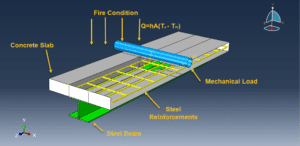
Composite beams, which typically consist of a reinforced concrete slab acting in conjunction with a steel beam, are widely used in modern building construction due to their structural efficiency, ease of construction, and economic advantages. The combination allows each material to be used where it is most effective—concrete in compression and steel in tension, resulting in enhanced load-bearing capacity and stiffness.
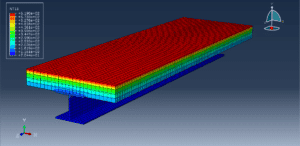
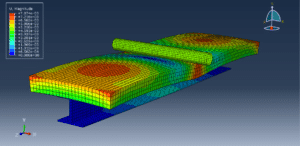
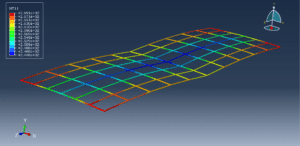
However, in the event of a fire, the structural behavior of composite beams can be significantly affected. Elevated temperatures can degrade the mechanical properties of both concrete and steel, compromise the bond between them, and ultimately reduce the structural integrity of the beam. Understanding this behavior is critical for safe structural design and fire protection strategies.
Material Degradation:
Steel loses strength rapidly when temperatures exceed 400–600°C.
Concrete can experience spalling, cracking, and loss of strength at high temperatures (above ~300°C).
The interface (shear connectors) between the slab and beam may weaken, affecting composite action.
Thermal Expansion:
Differential thermal expansion between steel and concrete can cause internal stresses.
Unrestrained expansion may lead to distortion or buckling of steel components.
Fire Resistance Ratings:
Composite beams must meet specific fire resistance requirements (e.g., 1-hour, 2-hour ratings), often achieved through passive fire protection like sprayed fire-resistant materials (SFRM), intumescent coatings, or concrete encasement.
Design Approaches:
Prescriptive methods rely on codes (e.g., Eurocode, ASCE, or local building codes).
Performance-based design uses advanced analysis methods (e.g., finite element modeling) to predict behavior under realistic fire scenarios.
Failure Modes in Fire:
Loss of composite action due to failure of shear connectors.
Sagging failure occurs when tensile steel weakens.
Shear failure or web buckling in the steel beam.
Overall collapse due to progressive failure if the beam is critical to structural stability.
Designing composite beams for fire resistance is a multidisciplinary challenge, combining structural engineering, materials science, and fire dynamics. By accounting for thermal effects and degradation mechanisms, engineers can ensure that composite structures maintain their integrity and provide adequate time for evacuation and firefighting during a fire event.
Need more than the files?
There are two ways we can help. Book a one hour online consultation if you want to talk a problem through with a CAE engineer, using the checkbox in the order box. Order a project if you need a full simulation built for you, delivered to an agreed scope, price and deadline under a written contract.
We work on FEA and CFD for engineers, researchers and companies. Order your project, or message us on WhatsApp for a quick reply.
Other packages engineers working on this topic also download.
 Simulation an analysis of the Steel-Timber composite beam under fire conditions in Abaqus
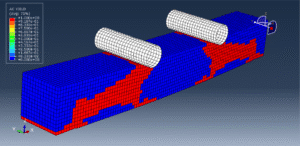 Fire analysis of a timber beam-sequential method
 Fire Analysis of a CFRP-Strengthened Reinforced Concrete Beam Using Abaqus
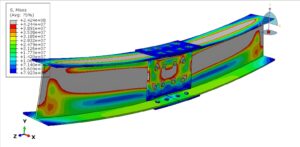 Analysis of the bolted steel splice connections under fire-Sequential Method
 Fire Simulation Package in Abaqus (12 Structural Fire Analysis Models)
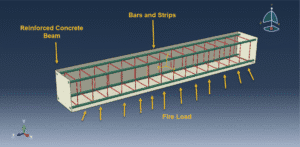 Simulation of RC Beams During Fire Events Using a Fully Coupled Thermal Stress Analysis in Abaqus
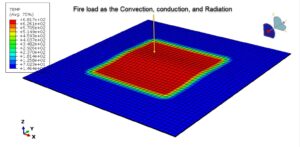 Fire analysis of the CFRP composite material in Abaqus
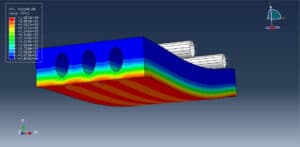 Fire and bending analysis of hollow-core concrete slab-DCT method

Need a full custom project? See the options below.

€129,00

€179,00

€149,00

€119,00

€129,00

€149,00
See more
Want to receive push notifications for all major on-site activities?




