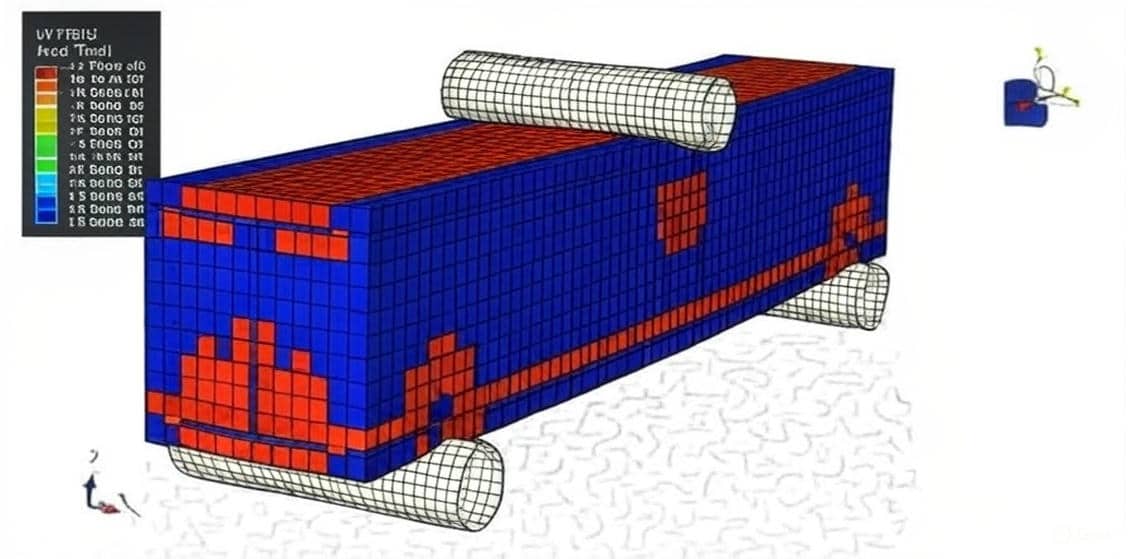
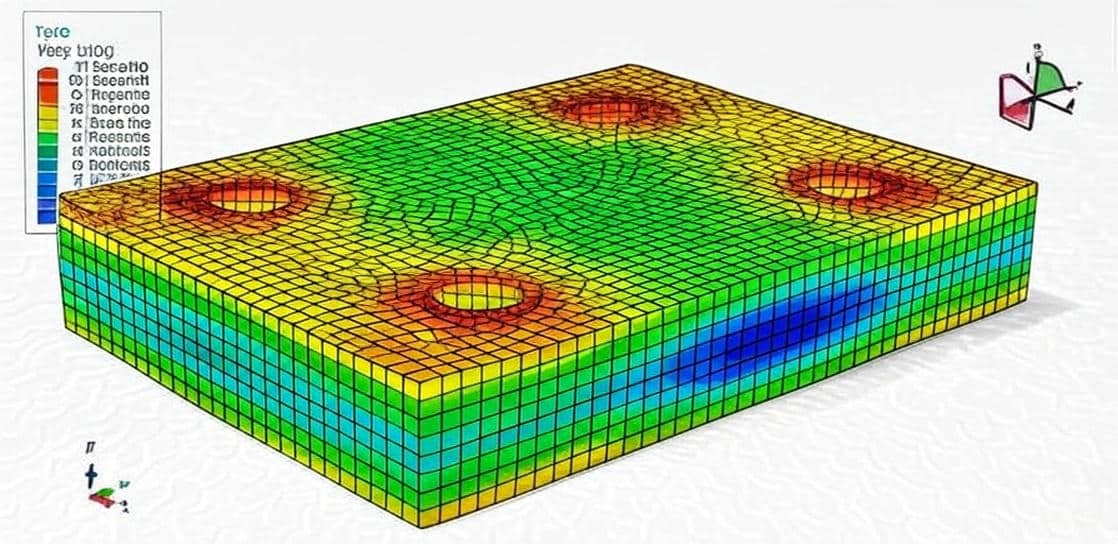
Fire Simulation Package in Abaqus (12 Structural Fire Analysis Models)

€179,00 €360,00
Optional extras

Need a full custom project? See the options below.

€179,00 €360,00
Optional extras

Need a full custom project? See the options below.

23 people watching this product now!

Material Includes

  • 1- Abaqus Files
  • 2- Document
  • 3- Tutorial Videos

Audience

  • 1- Mechanical Engineering
  • 2- Civil Engineering
  • 3- Structural Engineering

What You Will Learn?

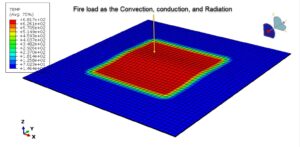
  • During this practical and comprehensive course, you'll learn all about fire modeling and analysis in Abaqus software. This package includes 12 tutorials that cover sequential and direct techniques for fire modeling for various objects, such as steel and concrete beams, RC concrete beam and column, bolt connections, frames, wood, and composite beams. You'll also learn how you can model fire through convection, conduction, and radiation for some materials like concrete, wood, steel,...

About Course

This is a complete fire simulation package in Abaqus: 12 ready-to-run models of steel, concrete, timber and composite members under fire, with about 6 hours of video tutorials, the Abaqus files and supporting documents.

It covers both ways of running a fire analysis: the sequential method, where a heat transfer analysis feeds a separate stress analysis, and the fully coupled thermal–stress method, where temperature and deformation are solved together. Seeing both lets you choose the right approach for your own case.

The problem this package solves

Fire is one of the hardest load cases in structural engineering. The temperature rises fast, and material properties change as it does: steel loses strength and stiffness, concrete cracks and spalls, timber chars from the outside in. The structure then has to carry its mechanical load with these reduced properties.

In Abaqus, this means combining a thermal analysis with a structural one, with temperature-dependent material data at every step. Deciding between sequential and coupled analysis, applying the fire curve, and transferring the temperature field correctly are exactly where most models go wrong. This package shows working examples of each.

What is inside: 12 Abaqus fire analysis models

Reinforced concrete members

  • RC beams in fire using a fully coupled thermal–stress analysis
  • 3D reinforced concrete beam using the sequential method
  • Fire and temperature analysis of an RC beam
  • Fire and stress analysis of a concrete beam
  • Concrete beam with a steel core under fire, with thermal and stress analysis

Steel members and connections

  • Steel beam under combined fire and mechanical load
  • Thermal and fire analysis of a steel joint with bolted connectors
  • Thermal and structural analysis of a steel frame

Composite and timber members

  • Composite beam (RC slab with steel beam) under fire and bending load
  • Hollow-core slab under fire and four-point bending
  • Steel–timber composite beam under fire
  • Timber beam under fire and bending load

Abaqus techniques you will practise

  • Heat transfer analysis with fire exposure, convection and radiation
  • Temperature-dependent material properties for steel, concrete and timber
  • The sequential method: mapping a temperature field into a stress analysis
  • Fully coupled temperature–displacement analysis
  • Concrete Damaged Plasticity and steel plasticity at elevated temperature
  • Bolted connection behaviour under thermal load

What you will learn

  • How to set up a fire analysis in Abaqus from heat transfer to structural response
  • When to use the sequential method and when a fully coupled analysis is better
  • How steel, concrete and timber lose capacity as temperature rises
  • How composite members and connections behave in fire
  • How to extract temperature histories, deflection and failure time

What is included

  • Abaqus model files for all 12 examples
  • Video tutorials, about 6 hours in total
  • Written documents
  • Lifetime access and downloadable files
  • Certificate of completion

The package was prepared by instructor Peyman Karampour.

Who this is for

  • Civil and structural engineering students working on fire resistance
  • Researchers studying structural behaviour at elevated temperature
  • Fire safety and structural engineers who need numerical evidence for a design
  • Abaqus users who want to learn coupled thermal–stress analysis

Software used

Abaqus/CAE with Abaqus/Standard for heat transfer and coupled thermal–stress analysis.

Related packages

Frequently asked questions

What is the difference between sequential and coupled fire analysis?

In the sequential method you run a heat transfer analysis first and then apply the temperature field to a separate stress analysis. In a fully coupled analysis, temperature and displacement are solved together in one step. The package includes both, so you can compare them.

Which materials are covered?

Steel, reinforced concrete, timber and composite steel–concrete and steel–timber members.

Are connections included?

Yes. One example covers a steel joint with bolted connectors under thermal and fire loading, and another covers a full steel frame.

Can I apply my own fire curve?

Yes. You get the full Abaqus files, so you can change the temperature–time exposure, materials, section sizes and mechanical load.

What if I get stuck running a model?

Contact us and we will help you get it running. If you need a fire analysis for your own structure, you can also talk to one of our engineers.

Related model: Bolted steel beam–column connection under fire in Abaqus — a single-connection example with convection, radiation and thermal conductance between parts.

Need more than the files?

There are two ways we can help. Book a one hour online consultation if you want to talk a problem through with a CAE engineer, using the checkbox in the order box. Order a project if you need a full simulation built for you, delivered to an agreed scope, price and deadline under a written contract.

We work on FEA and CFD for engineers, researchers and companies. Order your project, or message us on WhatsApp for a quick reply.

Course Content

Example-1: Fire analysis of a Steel-Timber composite beam
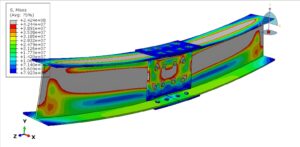
In this lesson, the fire analysis of a Steel-Timber composite beam is studied. Both steel and timber wood beams are modeled as three-dimensional solid parts. The combination of timber and steel in a single-beam cross-section can result in multiple benefits. There are a lot of ways to do so, but we have shown that one type of configuration is of particular interest: it consists of fitting timber beams between the flanges of an H-shaped steel section. Studies suggest that these STC (Steel–steel-timber composite) beams allow mutual mechanical reinforcement of both steel and timber components. They show improved strength compared to steel-only or timber-only beams of the same size, as well as better ductility. It has also been found that the buckling of steel profiles is significantly reduced when combined with timber beams. propose various recommendations, such as ensuring that the steel structure is fully enclosed in the timber. The timber is firmly secured in place, and the timber is seasoned to limit or prevent shrinkage and cracking, which could reduce the ability of the timber to control heat transfer to the structure. From a mechanical point of view, at ambient temperature, the timber can improve the resistance to the instability of steel beams. In this tutorial, first fire analysis as a heat transfer step with conduction, convection, and radiation as the heat transfer method is done, then the results of it are imported to the structural model as a static bending test by using a predefined field. In the static approach, both temperature and mechanical load are considered.

  • Aabqus Files
  • Document
  • Tutorial Video
    32:18

Example-2: Fire modeling of the hollow-core slab under four-point bending
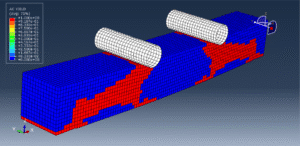
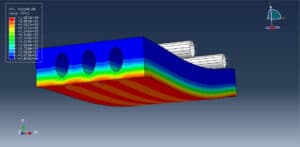
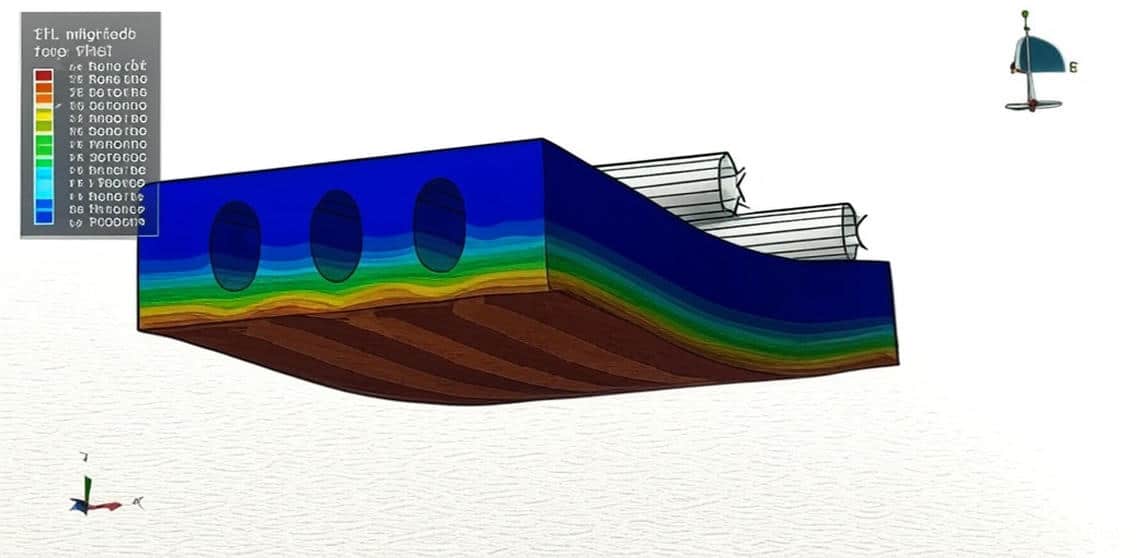
In this section, the fire modeling of the hollow-core slab under four-point bending is investigated. Precast/prestressed concrete hollow core (PCHC) slabs with a reduction in self-weight due to longitudinal voids, and without shear reinforcement due to the extrusion method, are most susceptible to shear failure. When subjected to shears, hollow-core slabs commonly failed in a critically brittle manner with the formation of web-shear cracks. In the event of a fire, the shear behavior of PCHC slabs is governed by the temperature-reduced material properties of concrete and strands, and thermal stresses due to a temperature gradient over the depth of the hollow-core sections. All heat transfer methods, such as Conduction, Convection, and Radiation, are used. Conduction heat transfer is the transfer of heat through matter (i.e., solids, liquids, or gases) without bulk motion of the matter. In another ward, conduction is the transfer of energy from the more energetic to less energetic particles of a substance due to interaction between the particles. Convection. Convective heat transfer is heat transfer between two bodies by moving gas or fluid currents. In free convection, air or water moves away from the heated body as the warm air or water rises and is replaced by a cooler parcel of air or water. Radiation heat transfer is the energy that is emitted by matter in the form of photons or electromagnetic waves. Radiation can be important even in situations in which there is an intervening medium. An example is the heat transfer that takes place between a living entity with its surroundings. Both sequential and direct methods can be used to model fire analysis and bending test; in this model, the direct method is selected. All proper boundaries and contacts are assigned to all parts.

Example-3: Fire simulation of the timber beam under bending load
In this case, the fire simulation of the timber beam under bending load is done through a comprehensive tutorial. The timber beam is modeled as a three-dimensional solid part. Along with the innovation of new building systems, how we design them must also advance for the systems to be implemented by practitioners. This is especially true for the fire engineering design of novel construction methods, as their performance under fire is investigated. To complete a performance-based design of such systems, a computer model is often required to demonstrate system behavior. Predictive models are often valuable in the design and optimization of such complex structures, provided they can be validated against meaningful data. In the thermal simulation, we have three ways to transfer the heat and energy 1- Conduction occurs when atoms or molecules interact with each other. It happens most frequently in solids but also occurs in liquids and gases. 2- Convective heat transfer is the transfer of heat between two bodies by currents of moving gas or fluid. In free convection, air or water moves away from the heated body as the warm air or water rises and is replaced by a cooler parcel of air or water. 3- Radiation heat transfer is a process where heat waves are emitted that may be absorbed, reflected, or transmitted through a colder body. The Sun heats. All heat transfer ways, conduction, convection, and radiation, are considered. First, fire analysis is done, and the nodal temperature for each node is written, and they are used as the initial condition for the static bending test. The elastic-plastic material depends on the temperature selected for the timber.

Example-4: Thermal and fire analysis of a steel joint with bolt connectors
In this section, the thermal and fire analysis of a steel joint with bolt connectors is investigated. The two steel plates are modeled as three-dimensional solid parts. The bolts are modeled as three-dimensional parts. Steel has been at the forefront of efficient construction in the last few years, where it has been widely used in the construction of high-rise buildings, industrial structures, and residential structures. What makes steel one of the most appealing materials in the construction industry is its engineering properties. The most appealing properties of steel are its strength-to-weight ratio, ductility, and flexibility. Such properties allow designers to build structures such as skyscrapers, which certainly would not have been possible with any other material. Steel can also be prefabricated and shipped to construction sites easily, which is quite beneficial when it comes to meeting the ever-increasing demands of new buildings. Nevertheless, there is a huge downside to using steel as a construction material because of its low resistance to fire when compared to other construction materials such as concrete. Steel loses almost half of its strength when subjected to temperatures that are equal to or greater than 590 °C, which will eventually lead the structure to fail. The losses that follow structural failures caused by fire are colossal and can take different forms, such as loss of human lives, environmental loss, and economic loss. Hence, the insurance of structural stability of a building under fire loading has been one of the most important and challenging aspects when it comes to designing a new structure. It is important that in the event of a fire, structures can withstand the minimum level of life safety not only for the occupants but also for firefighters and the public who are in proximity to the building. The minimum level of fire safety design must ensure a reduction of the risk of deaths and injuries, protect the contents of a building, and ensure that the building continues to function after a fire with the least amount. The elastic-plastic material data depend on the temperature selected for both heat transfer and static analysis. First, the heat transfer model uses conduction and convection as the fire load is applied and the nodal temperatures are extracted. In the second model, the static analysis with bolt load as the pre-load is applied to the bolts, and the fire results from the previous model are considered as the initial state of the model.

Example-5: Fire modeling of a composite beam(RC concrete slab-steel beam)under bending load
In this lesson, the fire modeling of a composite beam(RC concrete slab-steel beam)under bending load is studied. The concrete slab is modeled as a three-dimensional solid part. The steel reinforcements are modeled as wire parts. The steel beam is modeled as a three-dimensional solid part, and a rigid body to apply load is also used. Steel–concrete composite beams are often employed in office and industrial buildings or bridges and viaducts for fast and economic erection. Most usually, they comprise a steel girder and a reinforced concrete slab interconnected by shear connectors (fasteners). The number of shear connectors largely determines whether the composite cross-section behaves as compact or partially connected. In any case, the deformation of the beam causes some relative tangential displacement (slip) between the steel girder and the concrete slab. While usually being very small, slip can have a substantial effect on the overall ductility of the beam, which indicates that it should be taken into account in the analysis. The issue that plays an important role in the concrete and composite steel–concrete beams' response due to fire is the effect of moisture transport on the temperature and stress distribution histories in the concrete part of the cross-section. In the composite beam context discussed here, we are particularly interested in assessing these effects quantitatively. To model the fire analysis, first fire simulation through a heat transfer model is considered, and the nodal temperatures are extracted from the model as an input for the structural model. In the second stage, the static model is performed bending is applied to the top surface of the concrete slab, and the fire results are implied as the initial situation.

Example-6: Thermal and Structural analysis of a steel frame
In this case, the thermal and structural analysis of a steel frame is done. The steel beam is modeled as an I-shape three-dimensional part. The two boxes are modeled as a three-dimensional part. Steel has been at the forefront of efficient construction in the last few years, where it has been widely used in the construction of high-rise buildings, industrial structures, and residential structures. What makes steel one of the most appealing materials in the construction industry is its engineering properties. The most appealing properties of steel are its strength-to-weight ratio, ductility, and flexibility. Such properties allow designers to build structures such as skyscrapers, which certainly would not have been possible with any other material. Steel can also be prefabricated and shipped to construction sites easily, which is quite beneficial when it comes to meeting the ever-increasing demands of new buildings. Nevertheless, there is a huge downside to using steel as a construction material because of its low resistance to fire when compared to other construction materials such as concrete. Steel loses almost half of its strength when subjected to temperatures that are equal to or greater than 590 °C, which will eventually lead the structure to fail. The losses that follow structural failures caused by fire are colossal and can take different forms, such as loss of human lives, environmental loss, and economic loss. Hence, the insurance of structural stability of a building under fire loading has been one of the most important and challenging aspects when it comes to designing a new structure. It is important that in the event of a fire, structures can withstand the minimum level of life safety not only for the occupants but also for firefighters and the public who are in proximity to the building. The minimum level of fire safety design must ensure a reduction of the risk of deaths and injuries, protect the contents of a building, and ensure that the building continues to function after the fire with the least amount of repair possible. There are three ways for heat transfer in the fire analysis: Conduction, Convection, and Radiation. All the methods are implied in this tutorial. The proper material data depends on the temperature in both the thermal and structural models used. Proper boundary conditions and mesh are assigned to all parts. In the first model, the fire effect is simulated by a heat transfer model; in the second stage, the static model with fire and mechanical load is considered.

Example-7: RC Beams during Fire Events Using a Fully Coupled Thermal-Stress Analysis
In this model, the RC Beams during Fire Events Using a Fully Coupled Thermal-Stress Analysis is considered. The concrete beam is modeled as a three-dimensional solid part. The steel reinforcements are modeled as wire parts. The main concern relating to fire events is their classification (moderate or severe) and the evaluation of their impact on the structures. The classification of the fire assists in determining whether the structure is reusable or not after the extinguishment of the fire. The reason for the complexity of estimated residual structural capacity is its dependency on an enormous number of factors, such as mechanical pre-load during the fire, peak fire temperature, fire duration, degradation of thermal and mechanical properties of concrete and reinforcement, and boundary conditions of the structure, besides knowing the fact that not all material properties are reversible or valid during the heating, cooling, and post-fire loading stages. Research efforts to achieve structural safety and evaluate structural performance have been in demand recently due to the high capital investment in the building and infrastructure sectors. The residual capacity for any structural element can be determined through destructive tests and non-destructive approachesThis tutorial mainly emphasizes the direct coupling technique (DCT), coupled elements, and how to apply it to fire events to fill the existing gap in the literature regarding DCT. As previously mentioned, most numerical simulations for structural elements under different fire scenarios implement either the sequential coupling technique (SCT) or simplified 2D models. This paper aims to study RC beams under fire conditions using DCT, and the same concept can be replicated with other research software packages, such as ANSYS The proposed methodology was based on a detailed numerical finite element model developed with the ABAQUS program, and DCT was chosen to join the thermal and structural analysis. Generally, two types of coupling techniques are available to connect thermal and structural analyses: SCT or DCT. SCT is based on running a thermal analysis and implementing these results into a structural analysis. On the other hand, for DCT, one model can perform thermal and structural analysis, as coupled elements can express both the thermal and the structural degrees of freedom. Convection loads are used to apply fire loads on different areas of the beam with film coefficients to simulate the desired fire scenario and determine the surfaces in direct contact with the fire. The convection loads vary with time according to the applied fire curve. The proper mesh and boundary conditions are assigned to all parts

Example-8: Fire analysis of a 3D reinforced concrete beam using the sequential method
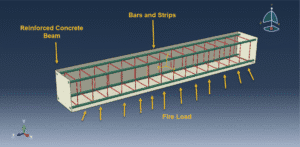
In this lesson, the fire analysis of a 3D reinforced concrete beam using the sequential method is studied. The concrete beam is modeled as a three-dimensional solid part. The longitudinal bar and strips are modeled as a three-dimensional solid part. In the thermal simulation, we have three ways to transfer the heat and energy 1- Conduction occurs when atoms or molecules interact with each other. It happens most frequently in solids, but also occurs in liquids and gases 2- Convective heat transfer is the transfer of heat between two bodies by currents of moving gas or fluid. In free convection, air or water moves away from the heated body as the warm air or water rises and is replaced by a cooler parcel of air or water 3- Radiation heat transfer is a process where heat waves are emitted that may be absorbed, reflected, or transmitted through a colder body. The Sun heats the Earth by electromagnetic waves. Hot bodies emit heat waves In this tutorial, we used the first two methods to define the fire effect. In the first model, the thermal properties of concrete and steel reinforcement are used to consider the thermal effect, and the heat transfer step is selected to report the nodal temperature. The fire is applied as a convection method by using a file coefficient and an amplitude. The second model is considered a mechanical analysis by using a general static step that considers the nodal temperature from model one to change it to the stress in the structure model. The proper boundary conditions are assigned to all parts of both models. The proper mesh can help us get better results

Example-9: Analysis of the steel beam under fire and mechanical load conditions
In this section, the analysis of the steel beam under fire and mechanical load conditions is investigated. he steel beam is modeled as a three-dimensional solid part, and it can also be modeled as a shell part. Methods for assessing the fire resistance of steel structures are among the best reported in the literature, and they are generally focused on analytical methods. To model thermal behavior of the steel beam under fire conditions in the first analysis, the thermal properties such as specific heat depends on temperature, conductivity depends on temperature, and density are used. In the mechanical analysis, the density, elasticity, and plasticity data that depend on temperature are used. In the fire analysis, the heat transfer step with a long time step to apply the fire condition is selected. The fire condition is considered as a film surface condition, and to apply the fire curvature as a function of the time-temperature, a tabular amplitude is used. The radiation is also applied to the bottom surface of the steel beam. The nodal temperature after the first analysis is imported to the mechanical analysis as an initial condition, and that temperature causes the stress and strain in the steel beam. In the mechanical simulation, the static general step is selected, and mechanical pressure is applied to the top surface of the beam. In the mechanical model, the temperature causes plastic work in the beam.

Example-10: Fire and temperature analysis of an RC beam
In this case, the fire and temperature analysis of an RC beam is done through a comprehensive tutorial. The concrete beam is modeled as a three-dimensional solid part. The steel bars are modeled as three-dimensional solid parts. To consider heat transfer in the steel bars, using the solid part and element is necessary because the wire part and truss element can’t be considered in the heat transfer during the analysis. To model concrete behavior under fire conditions, the material should be appropriate, and for that purpose, the specific heat and conductivity depend on the temperature. For the steel bars, specific heat and conductivity are also used. The heat transfer step with a two-hour time duration of the fire is selected. The three types of heat transfer methods are applied. The film condition or fire condition, as a convection method, with an amplitude to apply fire temperature is selected. The radiation is applied to the surfaces of the concrete beam. The conduction is also considered among the steel bars and the concrete beam. The fixed boundary condition is assigned to the two ends of the beam, and the initial temperature to the whole of the model.

Example-11: Simulation of the concrete beams with steel core under fire condition-Thermal and Stress analysis
In this lesson, the simulation of the concrete beam with steel core under fire condition-Thermal and Stress analysis- is studied. The concrete and steel beams are modeled as three-dimensional solid parts. Reinforced concrete (RC) structural members, when exposed to elevated temperatures, as in the case of fire, experience loss of structural capacity as a result of temperature-induced degradation in the mechanical properties of reinforcing steel and concrete. The Composite beam exhibits excellent merit over bare steel or reinforced concrete (RC) beams because of the composite action between the core concrete and the steel beam. To model concrete and steel behavior in the heat transfer analysis, the conductivity, specific heat, and density are used. The heat transfer step is used to model fire conditions. There are three types of heat transfer during the fire. Conduction between concrete and steel, convection on the outer surface, which they are interacts with fire, and radiation. All these types of heat transfer are considered. The mesh should be fine to obtain good results. After the heat transfer simulation, all results, such as nodal temperature and heat flux, are available. In the second simulation, the elastic-plastic behavior with an expansion coefficient is used for the concrete and steel beam. The general static step with some changes in the convergence model. The surface-to-surface interaction with contact property is used. The fire conditions as a nodal temperature are applied from the first simulation to the second one.

Example-12: Fire and stress analysis of the concrete beam
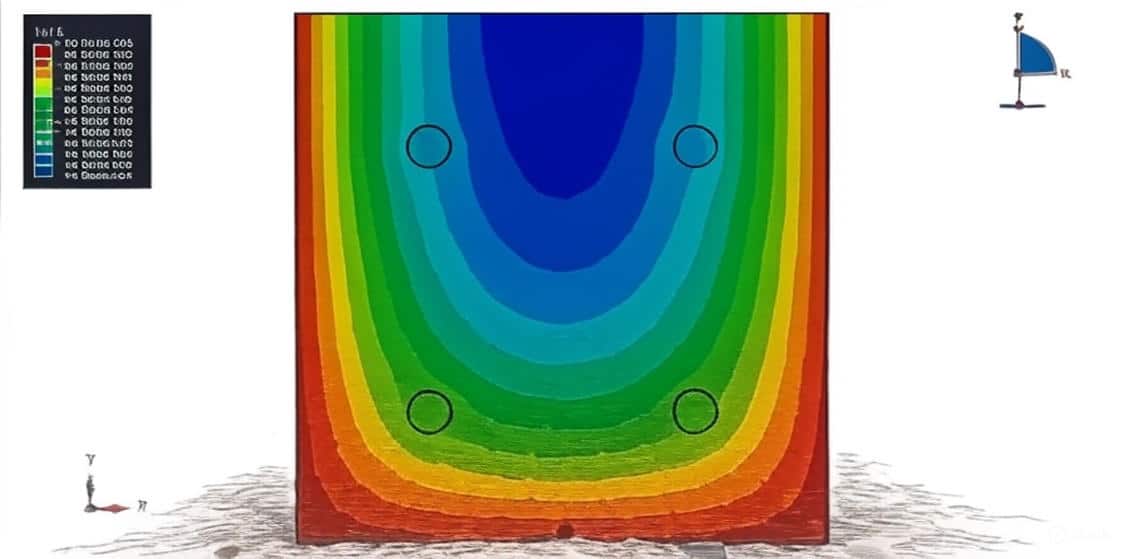
In this case, the fire and stress analysis of the concrete beam is done. Owing to the low thermal conductivity of concrete, the concrete cover acts as fire insulation to reinforcing bars in reinforced concrete (RC) elements. In real fire incidents, concrete buildings generally perform well, and local or global collapse is rare. FE modelling of a realistic behaviour of reinforced concrete under the fire effects has been an attractive topic to researchers for more than 30years. The general modelling approach has two distinct steps: (i) heat transfer step where the realistic fire exposure boundary conditions along with the heat transfer properties of concrete are defined to estimate the heat propagation at various positions of the element at different time intervals; (ii) structural and mechanical analysis of the element taking into account the simultaneous effects of heat and mechanical loads. The three-dimensional solid part is used to model the concrete beam. In the first simulation, the heat transfer step is used to model fire conditions and temperature analysis. The thermal properties are used in the thermal analysis. The fire condition is assigned to the bottom surfaces of the beam with the temperature diagram for two hours. After the thermal simulation, all results such as nodal temperature and heat flux are obtainable. In the second simulation or the structural analysis, the Concrete Damaged Plasticity data depends on temperature, is considered. The elasticity and expansion depend on the temperature is used to consider the heat effect on them. The elasticity, expansion, and CDP model depend on temperature, which can convert the temperature from the fire situation in the thermal simulation to the stress and strain. The general static step is used to model the structural analysis with some changes in the convergence model. The fixed boundary conditions are assigned to the two end sides of the beam. The results from the thermal analysis are transferred to the structure model.

Reviews

No Review Yet
No Review Yet
€179,00 €360,00
Optional extras

Need a full custom project? See the options below.

23 people watching this product now!

Material Includes

  • 1- Abaqus Files
  • 2- Document
  • 3- Tutorial Videos

Audience

  • 1- Mechanical Engineering
  • 2- Civil Engineering
  • 3- Structural Engineering

Related  Products

See more

Want to receive push notifications for all major on-site activities?

✕