Need a full custom project? See the options below.
Need a full custom project? See the options below.
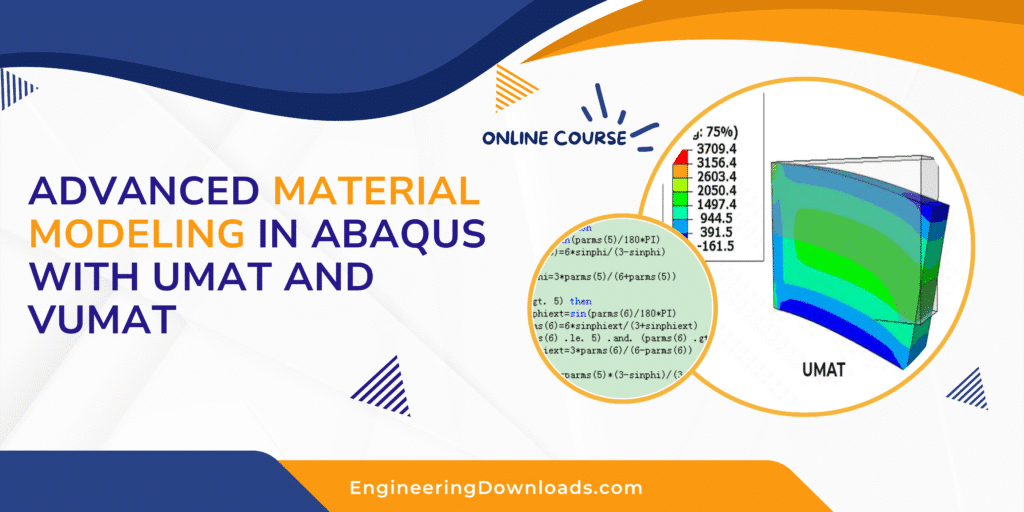
This course teaches you how to write your own UMAT and VUMAT subroutines in Abaqus, so you can model materials that the built-in Abaqus library cannot handle. You start with how Abaqus calls a user material, move through the stress update and the Jacobian, and finish with real case studies in plasticity, hyperelasticity and damage, including composite laminate failure.
Every chapter comes with its files and subroutine codes, so you can run the examples, change them and use them as templates for your own material models.
Abaqus has a large material library, but research and advanced industry work often need something it does not offer: a new damage law, a special hardening rule, a hyperelastic model fitted to your own test data, or a failure criterion for a composite. At that point, the only way forward is a user material subroutine.
The problem is that most people get stuck at the same places. They do not know which variables Abaqus expects back, their UMAT runs but will not converge because the Jacobian is wrong, their state variables do not update, or their VUMAT behaves differently from the UMAT and they cannot see why. This course is built around exactly those points.
Abaqus/Standard and Abaqus/Explicit with user subroutines. To run subroutines you need Abaqus linked to a compatible Fortran compiler and Visual Studio (on Windows).
Not sure if this course is right for you? Watch the free introduction to advanced material modelling in Abaqus with UMAT and VUMAT webinar first.
UMAT is used with Abaqus/Standard (implicit) and must return the stress and the Jacobian matrix. VUMAT is used with Abaqus/Explicit, works on blocks of material points and does not need a Jacobian. The course covers both and shows when to use each.
Basic programming knowledge helps. The course explains the subroutine structure and code line by line, so you do not need to be an expert Fortran programmer to follow it.
Abaqus linked with a compatible Intel Fortran compiler and Visual Studio on Windows, or the equivalent compiler setup on Linux.
Yes. The subroutines are written to be used as templates. You can change the constitutive equations, add state variables and adapt them to your own material.
Contact us with the error and we will help you find the cause. For a custom material model built for your project, you can also talk to one of our engineers.
Need more than the files?
There are two ways we can help. Book a one hour online consultation if you want to talk a problem through with a CAE engineer, using the checkbox in the order box. Order a project if you need a full simulation built for you, delivered to an agreed scope, price and deadline under a written contract.
We work on FEA and CFD for engineers, researchers and companies. Order your project, or message us on WhatsApp for a quick reply.
Other packages engineers working on this topic also download.
 Subroutine Programming in Abaqus: UMAT, UHARD, USDFLD and DLOAD (20-Hour Course)
 Thermal and Creep subroutines in Abaqus
 Fracture Mechanics with Abaqus: J-Integral, CZM and XFEM (20-Hour Course)
 Welding & Additive Manufacturing: AM Plug-in + Python/DFLUX
 Free Webinar: Introduction to Advanced Material Modeling in ABAQUS with UMAT and VUMAT
 Introductory Abaqus Course for Beginners (24 Hours, Example-Based)
 Advanced Abaqus Course: Nonlinear, Dynamic and Multiphysics Simulation (40 Hours)
 Introduction to FEM & Custom User Elements in Abaqus

Need a full custom project? See the options below.

€129,00

€179,00

€149,00

€119,00

€129,00
See more
Want to receive push notifications for all major on-site activities?