Need a full custom project? See the options below.
Need a full custom project? See the options below.
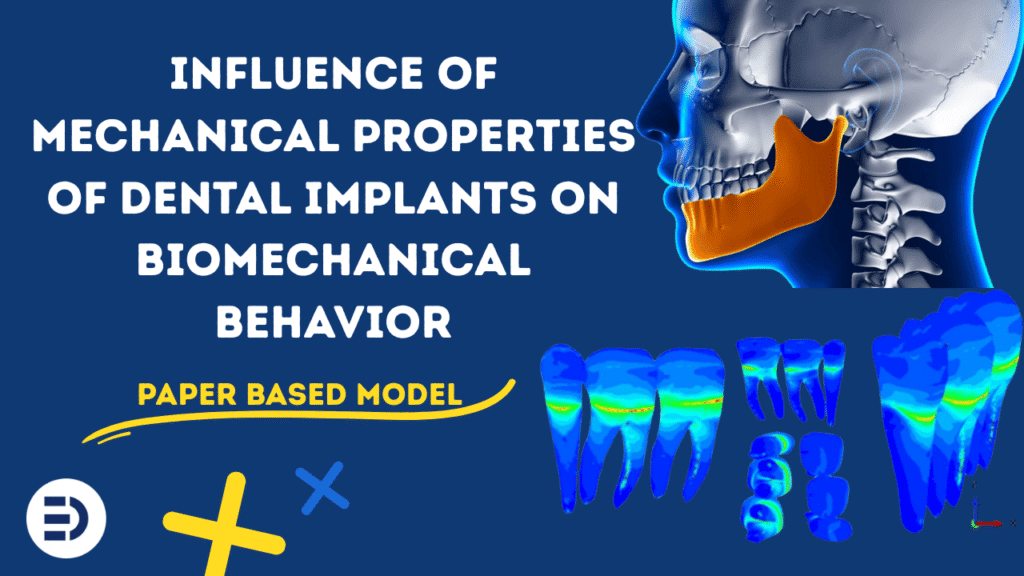
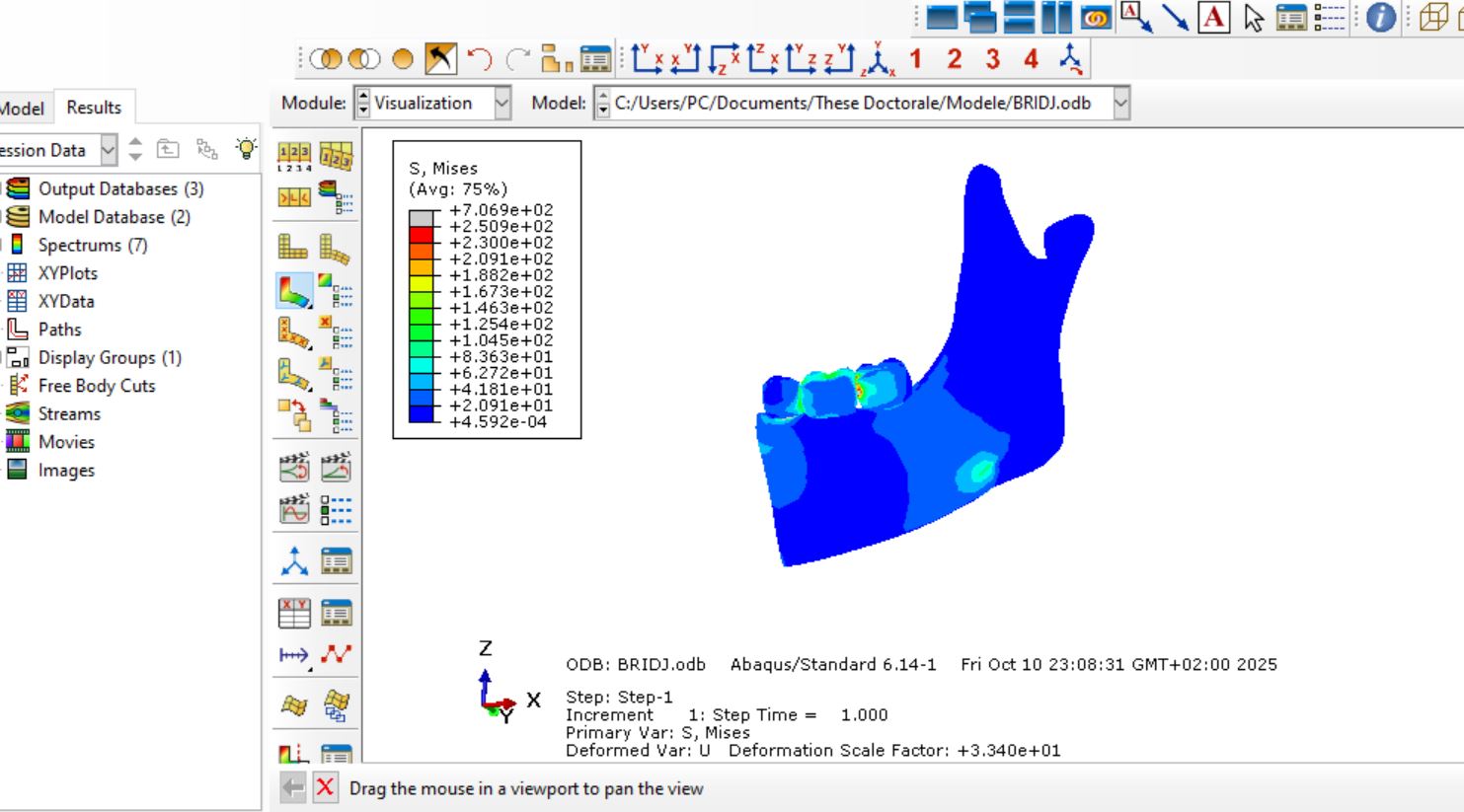
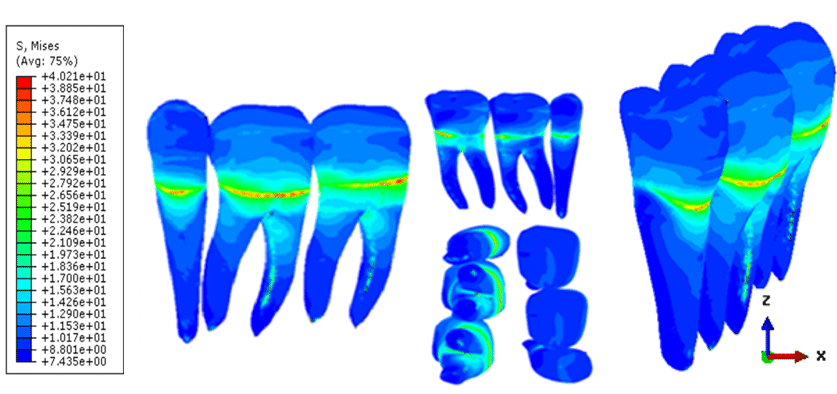
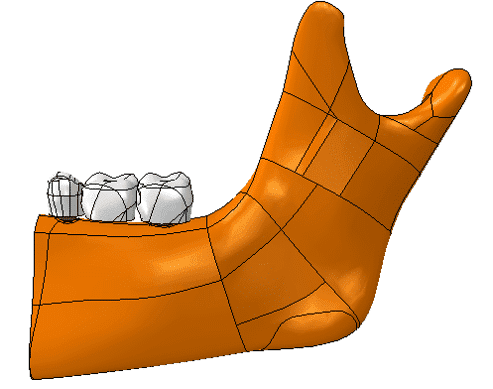
This is a ready-to-use 3D finite element model of an implant-supported dental bridge in Abaqus. It studies how the mechanical properties of the implant system and the chewing (masticatory) forces affect the stress in the mandible, in both the cortical and cancellous (spongy) bone, and in the bridge components: the abutments, the implants and the bridge itself.
The model is based on a published study, so you can compare your results with the paper and use it as a starting point for your own dental biomechanics research.
The long-term success of a dental implant depends on how load is transferred from the bridge, through the implants, into the jaw bone. If stress is too concentrated, the bone around the implant can be damaged or resorb. Material choice for the implants, abutments and bridge changes this load path, but it is hard and costly to measure inside the jaw.
Finite element analysis lets you see the stress distribution directly and compare design options. Building a 3D mandible model with an implant bridge from scratch takes a lot of time. This model gives you a working setup to study and adapt.
Please note: this product is the model file. It does not include a video tutorial.
Reference: DOI 10.4028/p-g22CO2. Model prepared by Youcef Goradia.
Abaqus/CAE and Abaqus/Standard.
No. The mandible is split into cortical bone and cancellous (spongy) bone, each with its own properties, because they carry load very differently.
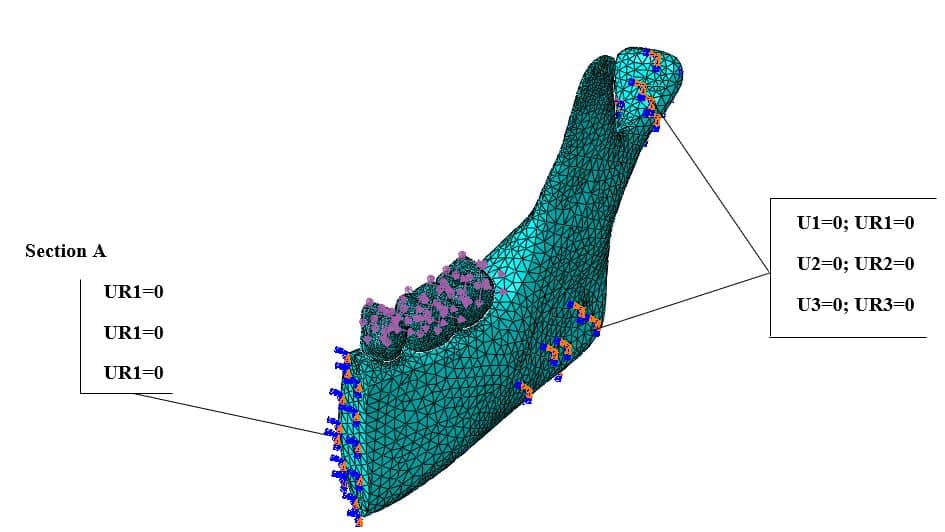
Masticatory forces are applied in the three directions of space: corono-apical, mesio-distal and bucco-lingual, to represent realistic chewing.
Yes. The study is parametric on the mechanical properties, so you can change the properties of the implants, abutments and bridge and compare the stress results.
No. This product is the Abaqus CAE model based on the published study. If you need help understanding or adapting it, contact us.
Contact us with your question. For a dental or biomechanics model built for your own geometry, you can also talk to one of our engineers.
Need more than the files?
There are two ways we can help. Book a one hour online consultation if you want to talk a problem through with a CAE engineer, using the checkbox in the order box. Order a project if you need a full simulation built for you, delivered to an agreed scope, price and deadline under a written contract.
We work on FEA and CFD for engineers, researchers and companies. Order your project, or message us on WhatsApp for a quick reply.
Other packages engineers working on this topic also download.
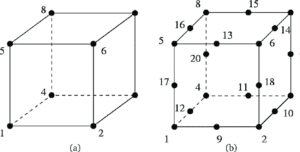 How to partition and use the Abaqus meshing module
 Abaqus Mesh Algorithm
 Decreasing processing time in explicit models
 ALE Method in Abaqus: Adaptive Meshing Tutorial (Lagrangian vs Eulerian vs ALE)
 Underwater CEL Explosion Near Aluminum Hull from Three Sea Mines in Abaqus
 Numerical Study on the Ballistic Impact of Hard Bulletproof Vests: Influence of Multilayer Armor Design
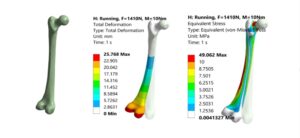 Stress Analysis of Human Femur Bone Under Physiological Loading Conditions using ANSYS
 piezoelectric sensor

Need a full custom project? See the options below.

€129,00

€179,00

€149,00

€119,00

€129,00

€149,00
See more
Want to receive push notifications for all major on-site activities?



