Modified Tesla Micromixer with Tip Clearance in COMSOL

€50,00 €55,00
Optional extras

Need a full custom project? See the options below.

€50,00 €55,00
Optional extras

Need a full custom project? See the options below.

7 people watching this product now!

Material Includes

  • Laminar Flow
  • Transport of Diluted Species (TDS)

Audience

  • The simulation of the micromixer was conducted using COMSOL Multiphysics, employing the physics modules for Laminar Flow and Transport of Diluted Species (TDS). Additionally, an analysis of concentration, velocity, and pressure was performed.

About Course

This package gives you a complete, ready-to-use COMSOL Multiphysics model of a modified Tesla micromixer with tip clearance. Open the file, run it, and study how a small gap above the wedge divider changes mixing quality and pressure loss in a passive microfluidic mixer.

The engineering problem

Microfluidic devices work at very low Reynolds numbers. There is almost no turbulence, so two fluids mix only by molecular diffusion. That is slow, and slow mixing limits lab-on-a-chip devices used in chemical synthesis, biomedical diagnostics and drug delivery.

Passive micromixers solve this with geometry instead of moving parts. The Tesla mixing unit is one of the best known designs: it splits the stream into two sub-streams and recombines them downstream using the Coanda effect. The open question is how to push its performance further without paying a large pressure penalty.

What this model does

The model adds a tip clearance above the wedge-shaped divider of each Tesla mixing unit. This small gap changes the flow in three different ways depending on the flow regime, and the model lets you see all three.

  • Diffusion-dominated regime (Re below 1): flow through the gap drags the interface of one sub-stream and connects it to the other, creating a wider mixing interface.
  • Transition regime (Re 1 to 50): the gap flow interacts with the secondary flow in the vortex zone and agitates it, which raises the degree of mixing.
  • Convection-dominated regime (Re above 50): a pair of counter-rotating vortices governs the mixing, and the gap mainly reduces the required pressure load.

You can change the clearance height, the number of mixing units and the inlet velocity, then compare the degree of mixing and the pressure drop between inlet and outlet.
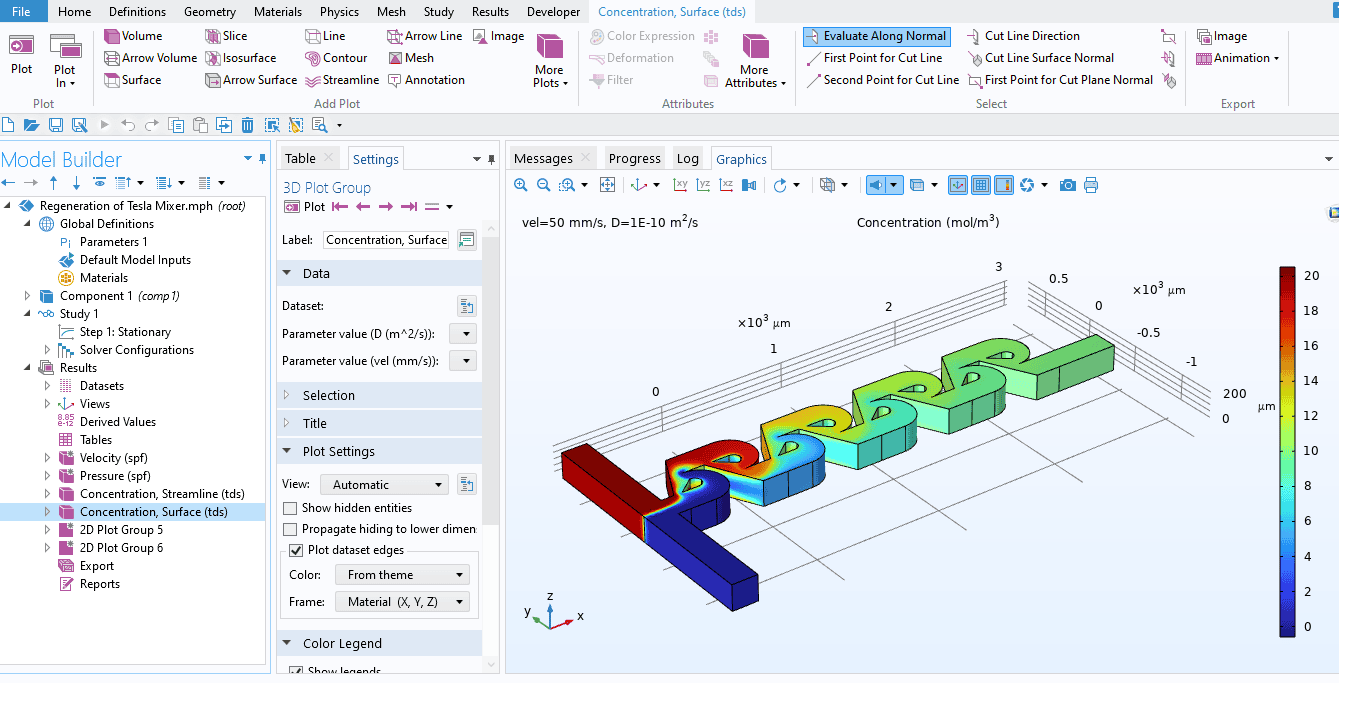
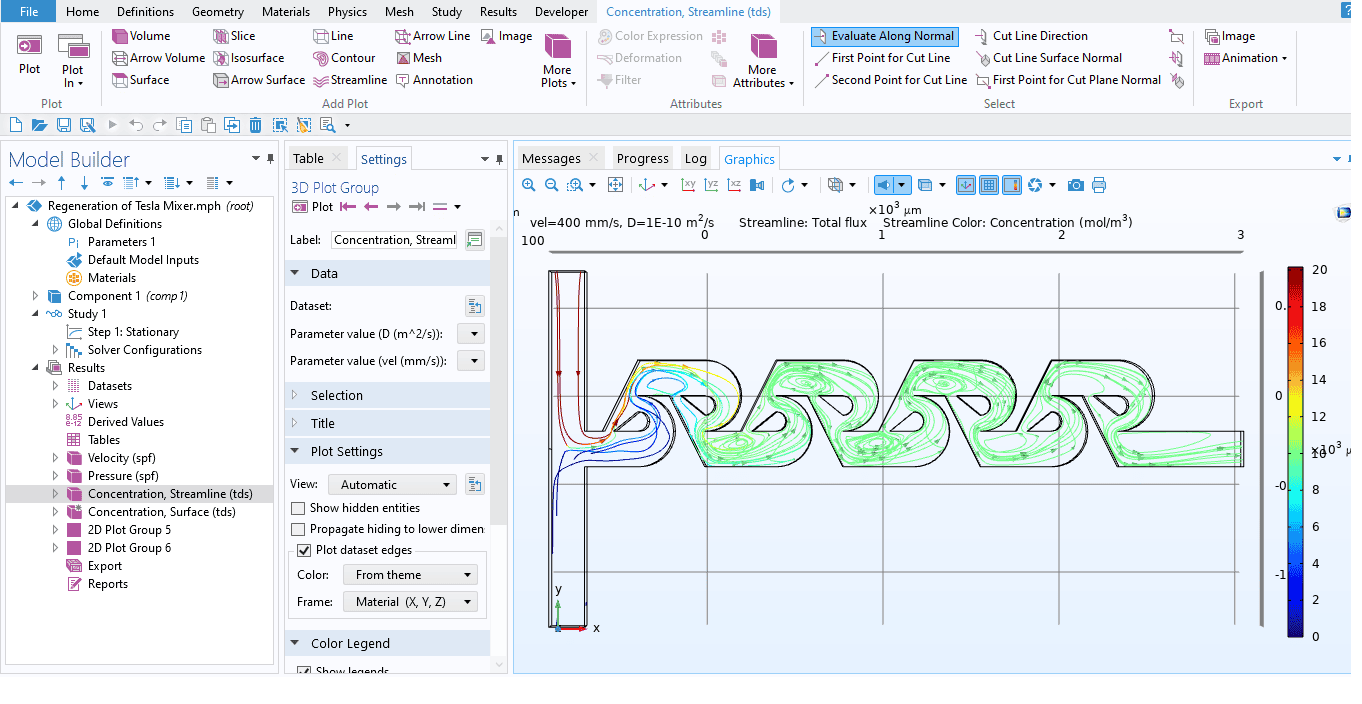
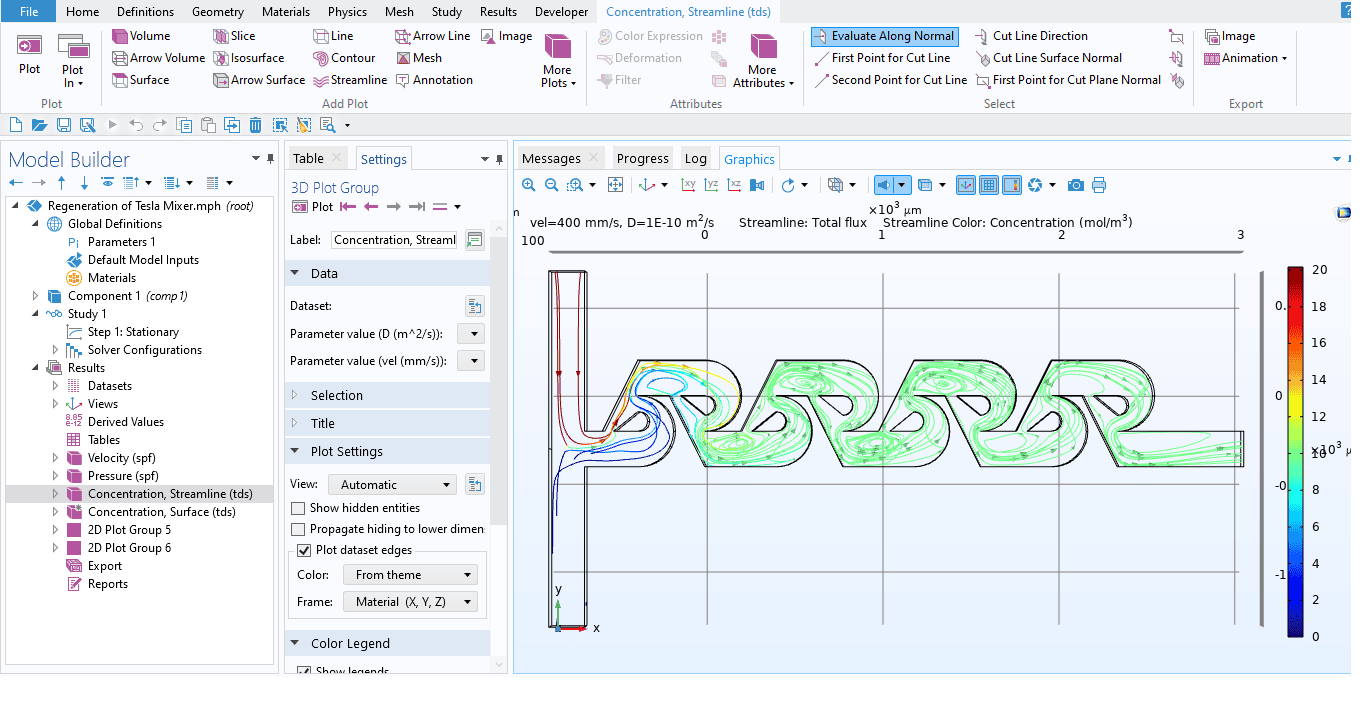
Concentration field in a modified Tesla micromixer with tip clearance simulated in COMSOL Multiphysics

Results you can extract

  • Degree of mixing (DOM) at the outlet and after each mixing unit
  • Pressure load between the inlets and the outlet
  • Mixing energy cost, so you can compare designs on a fair basis
  • Concentration contours on horizontal and cross-flow planes
  • Velocity vectors and counter-rotating vortex structures in the vortex zone
  • Effect of clearance height and number of Tesla units on performance

Mixing and concentration results along the Tesla micromixer channel in COMSOL

What you get

  • The complete COMSOL model file (.mph) with geometry, mesh, physics and study already set up
  • The reference research paper the model is based on, so you can check every assumption
  • Post-processing already prepared, so you can see the results right after you open the file
  • A model you can edit and reuse for your own micromixer geometry

Software used

COMSOL Multiphysics. The model couples laminar single-phase flow with transport of diluted species, so you get both the velocity field and the concentration field in one study.

Who this is for

  • Master’s and PhD students working on microfluidics, micromixers or lab-on-a-chip devices
  • Researchers who need a validated starting point instead of building a model from zero
  • CFD engineers who want a clean example of laminar mixing and species transport in COMSOL
  • Anyone learning COMSOL who wants a real, published case rather than a textbook exercise

What you will learn

  • How to build and mesh a planar micromixer geometry with a tip clearance
  • How to couple laminar flow with species transport at high Schmidt number
  • How to calculate the degree of mixing from the concentration field
  • How to compare designs using mixing performance against pressure load
  • How to read vortex structures and secondary flow in a passive mixer

Reference paper

This model is built on a published, peer-reviewed study. The full PDF is included in the download, so you can check every assumption and compare your results with the published data.

  • Title: Mixing Performance of the Modified Tesla Micromixer with Tip Clearance
  • Authors: Makhsuda Juraeva and Dong-Jin Kang, School of Mechanical Engineering, Yeungnam University, Korea
  • Journal: Micromachines, 2022, volume 13, issue 9, article 1375
  • Published: 23 August 2022
  • DOI: 10.3390/mi13091375
  • Open access: published under a Creative Commons Attribution (CC BY 4.0) licence

What the paper covers

The authors take a passive micromixer built from modified Tesla mixing units and add a tip clearance above the wedge-shaped divider. They then simulate the mixing behaviour across Reynolds numbers from 0.1 to 80, with three, four and five mixing units, and clearance heights from 40 to 80 micrometres (roughly 25 to 33 percent of the channel depth). Performance is judged on two things: the degree of mixing at the outlet, and the pressure load between the inlets and the outlet.

The main findings are:

  • The clearance improves mixing clearly for Reynolds numbers below 50, and the benefit grows with the number of mixing units.
  • The best clearance height is around 60 micrometres, about a third of the channel depth. That same value also minimises the mixing energy cost, so one geometry choice improves mixing and reduces pumping effort at the same time.
  • At Re = 5 with four mixing units, the clearance raises the degree of mixing by roughly 94 percent while cutting the required pressure load by about 12 percent.
  • Below Re = 1, mixing improves because flow through the gap drags the interface of one sub-stream across to the other, widening the contact area between the two fluids.
  • Between Re = 1 and 50, the gap flow agitates the secondary flow in the vortex zone of each unit, and that agitated vortex drives the improvement.
  • Above Re = 50, a pair of counter-rotating vortices governs the mixing instead. The clearance then adds little to the degree of mixing, but it still lowers the pressure needed to reach the same result, as long as the gap stays below about 70 micrometres.

One practical point from the paper: because the change is a simple planar modification, it can be produced with low-cost techniques such as xurography, where a cutting plotter trims an adhesive film to create the clearance zone.

Related model

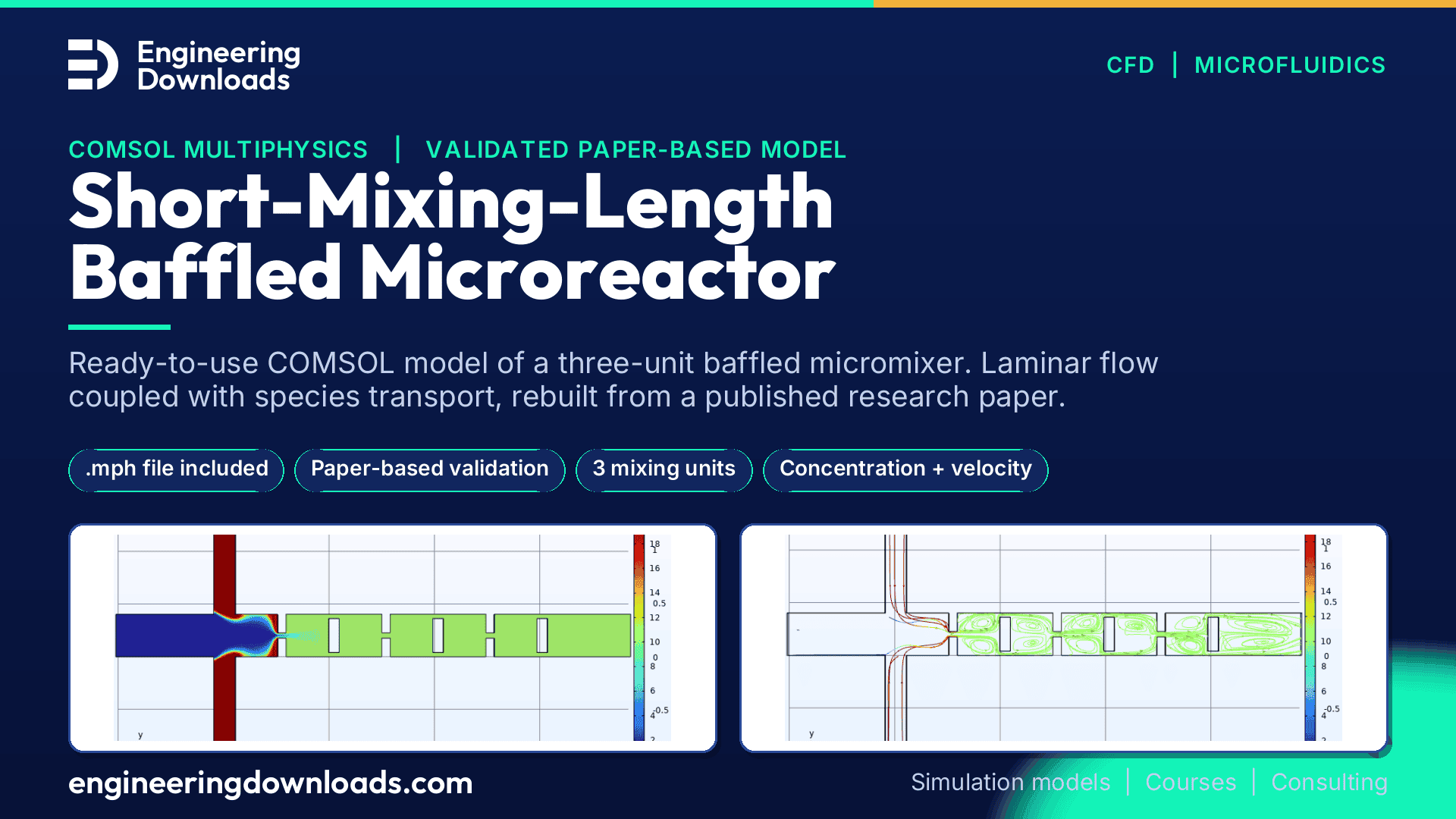
For a different approach to passive mixing over a very short channel, see the short-mixing-length baffled microreactor in COMSOL. It uses the same laminar flow and species transport setup, so the two models are easy to compare.

Need more than the file?

If you need a different geometry, a different fluid or a full parametric study, we can build it for you through our CFD and FEA project services. If your case is heavy and your laptop is not enough, you can run it on our HPC servers, starting from EUR 5 per week. And if your goal is a journal article, our team can support you through the paper publication service.

You can also browse more ready-to-use simulation models, courses and tutorials, or join one of our webinars and workshops.

Quality guarantee: if the package does not work for you, contact us and we will refund you.

Need more than the files?

There are two ways we can help. Book a one hour online consultation if you want to talk a problem through with a CAE engineer, using the checkbox in the order box. Order a project if you need a full simulation built for you, delivered to an agreed scope, price and deadline under a written contract.

We work on FEA and CFD for engineers, researchers and companies. Order your project, or message us on WhatsApp for a quick reply.

Course Content

Mixing Performance of the Modified Tesla Micromixer with Tip Clearance
Regeneration of the article "Mixing Performance of the Modified Tesla Micromixer with Tip Clearance" by COMSOL Multiphysics.

  • Downloadable Files

Reviews

No Review Yet
No Review Yet
€50,00 €55,00
Optional extras

Need a full custom project? See the options below.

7 people watching this product now!

Material Includes

  • Laminar Flow
  • Transport of Diluted Species (TDS)

Audience

  • The simulation of the micromixer was conducted using COMSOL Multiphysics, employing the physics modules for Laminar Flow and Transport of Diluted Species (TDS). Additionally, an analysis of concentration, velocity, and pressure was performed.

Related  Products

See more

Want to receive push notifications for all major on-site activities?

✕