

Need a full custom project? See the options below.
Need a full custom project? See the options below.
A semi-elliptical surface crack on the outside of a pressure vessel, the classic flaw of a fitness-for-service assessment. This is a validated, ready-to-run Abaqus model that computes the stress intensity factor KI and J along the whole crack front for 12 crack depths, with a focused spider-web crack-front mesh (collapsed quarter-point elements) and no user subroutines. Every result is compared with a peer-reviewed paper: 12 of 12 cracks within 5 %, mean difference 1.5 %. You get CAE + INP files for every case, a parametric Python generator for your own crack, and an 11-page PDF tutorial covering model set-up, meshing, loads, post-processing and the full validation.
Reference: G. de C. Coêlho, A. A. Silva, M. A. Santos, A. G. B. Lima, N. C. Santos, Stress Intensity Factor of Semielliptical Surface Crack in Internally Pressurized Hollow Cylinder – A Comparison between BS 7910 and API 579/ASME FFS-1 Solutions, Materials 2019, 12(7), 1042, doi:10.3390/ma12071042 (open access, CC BY 4.0). Steel cylinder Ri = 1139.75 mm, t = 19 mm, internal pressure 3.5 MPa, axial outer-surface crack with a/c = 0.5 and a/t from 0.26 to 0.91. The model was rebuilt independently from the published data.
| Item | This package |
|---|---|
| Geometry | Exact half model of one crack: half circumference × 400 mm, crack mid-plane symmetry |
| Crack | Axial outer-surface semi-elliptical crack, a/c = 0.5, 12 depths a = 5.0 to 17.3 mm |
| Mesh | C3D20R, about 38,000 elements; spider web with a collapsed quarter-point ring + 5 hex rings, 24 sectors, 81 front nodes |
| Loads and BCs | Internal pressure 3.5 MPa; symmetry on the ligament, on θ = 180° and the crack mid-plane; fine zone tied to the far field |
| Fracture output | *CONTOUR INTEGRAL, K factors and J, 5 contours at every front node |
| Software | Abaqus/CAE and Abaqus/Standard 2024; Python 3 |
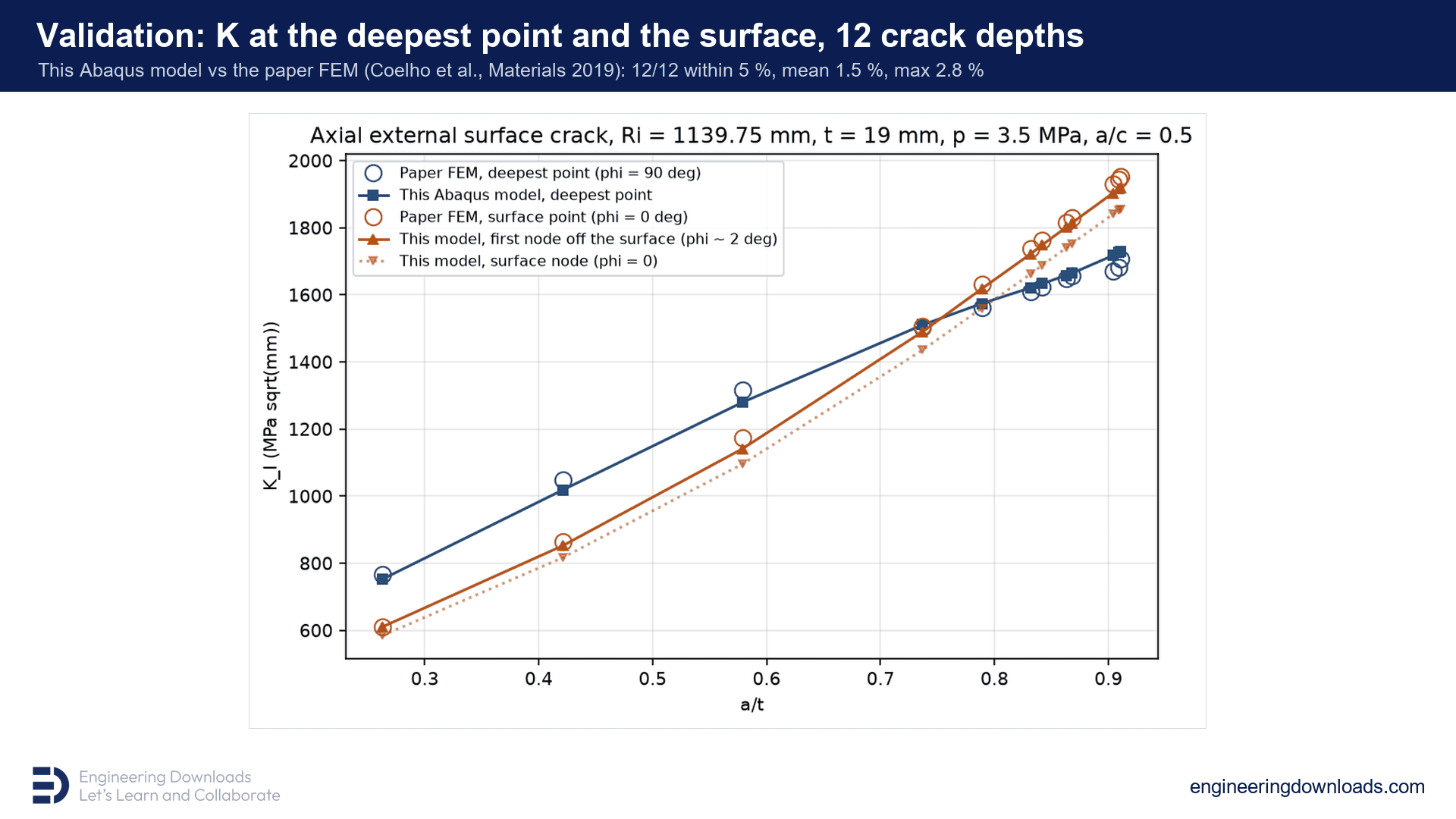
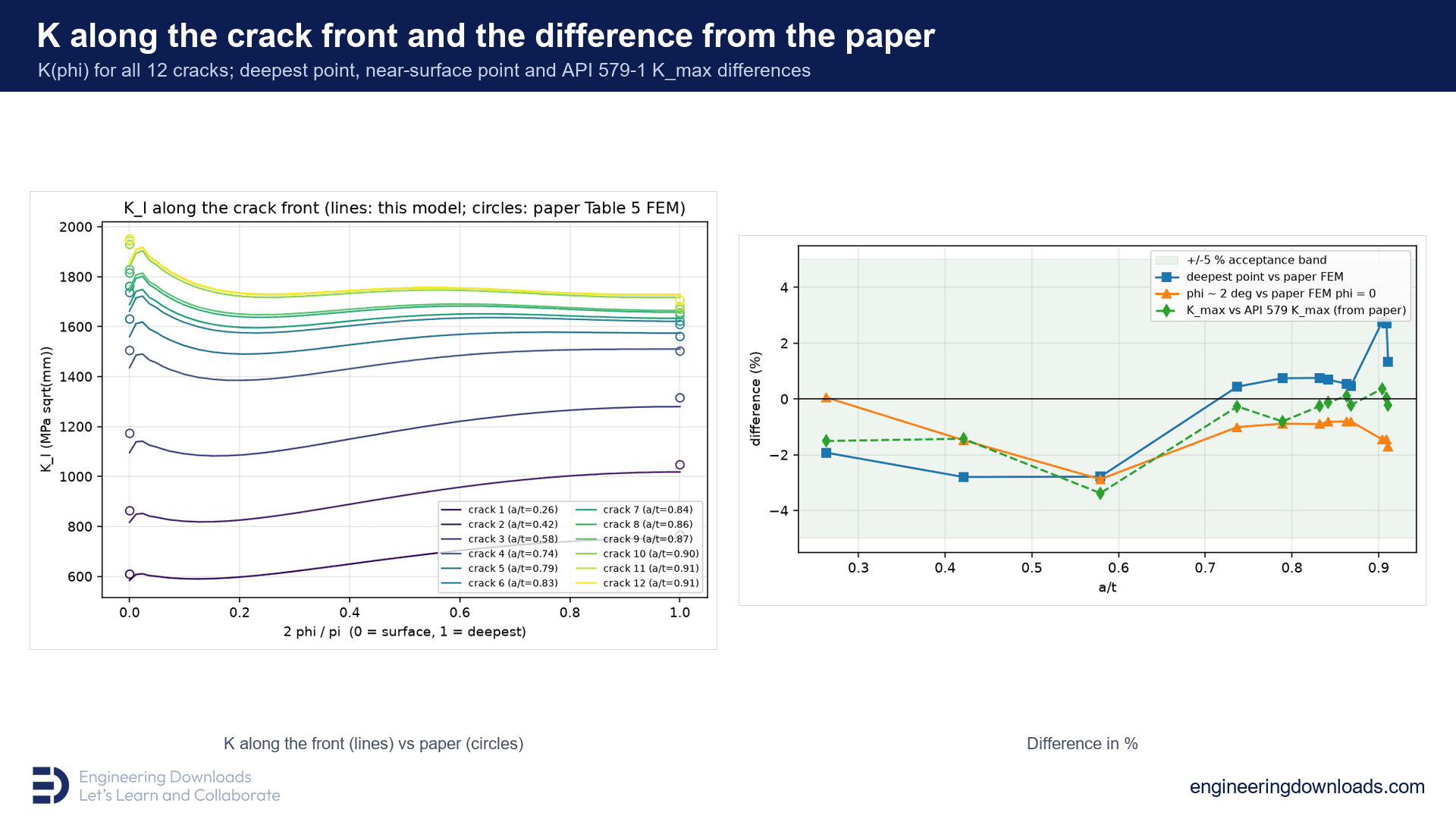
Deepest-point KI (MPa√mm) against the paper’s FEM values. Acceptance criterion fixed before the runs: within 5 %.
| Crack | a (mm) | a/t | Paper | This model | Difference |
|---|---|---|---|---|---|
| 1 | 5.00 | 0.26 | 767.1 | 752.3 | -1.93 % |
| 2 | 8.00 | 0.42 | 1047.1 | 1017.8 | -2.80 % |
| 3 | 11.00 | 0.58 | 1316.2 | 1279.5 | -2.79 % |
| 4 | 14.00 | 0.74 | 1503.3 | 1510.0 | +0.44 % |
| 5 | 15.00 | 0.79 | 1562.1 | 1573.8 | +0.74 % |
| 6 | 15.80 | 0.83 | 1608.9 | 1621.0 | +0.75 % |
| 7 | 16.00 | 0.84 | 1621.5 | 1632.8 | +0.69 % |
| 8 | 16.40 | 0.86 | 1648.8 | 1657.8 | +0.54 % |
| 9 | 16.50 | 0.87 | 1655.9 | 1663.8 | +0.47 % |
| 10 | 17.18 | 0.90 | 1670.6 | 1716.8 | +2.76 % |
| 11 | 17.28 | 0.91 | 1680.7 | 1726.0 | +2.70 % |
| 12 | 17.30 | 0.91 | 1705.7 | 1728.5 | +1.34 % |
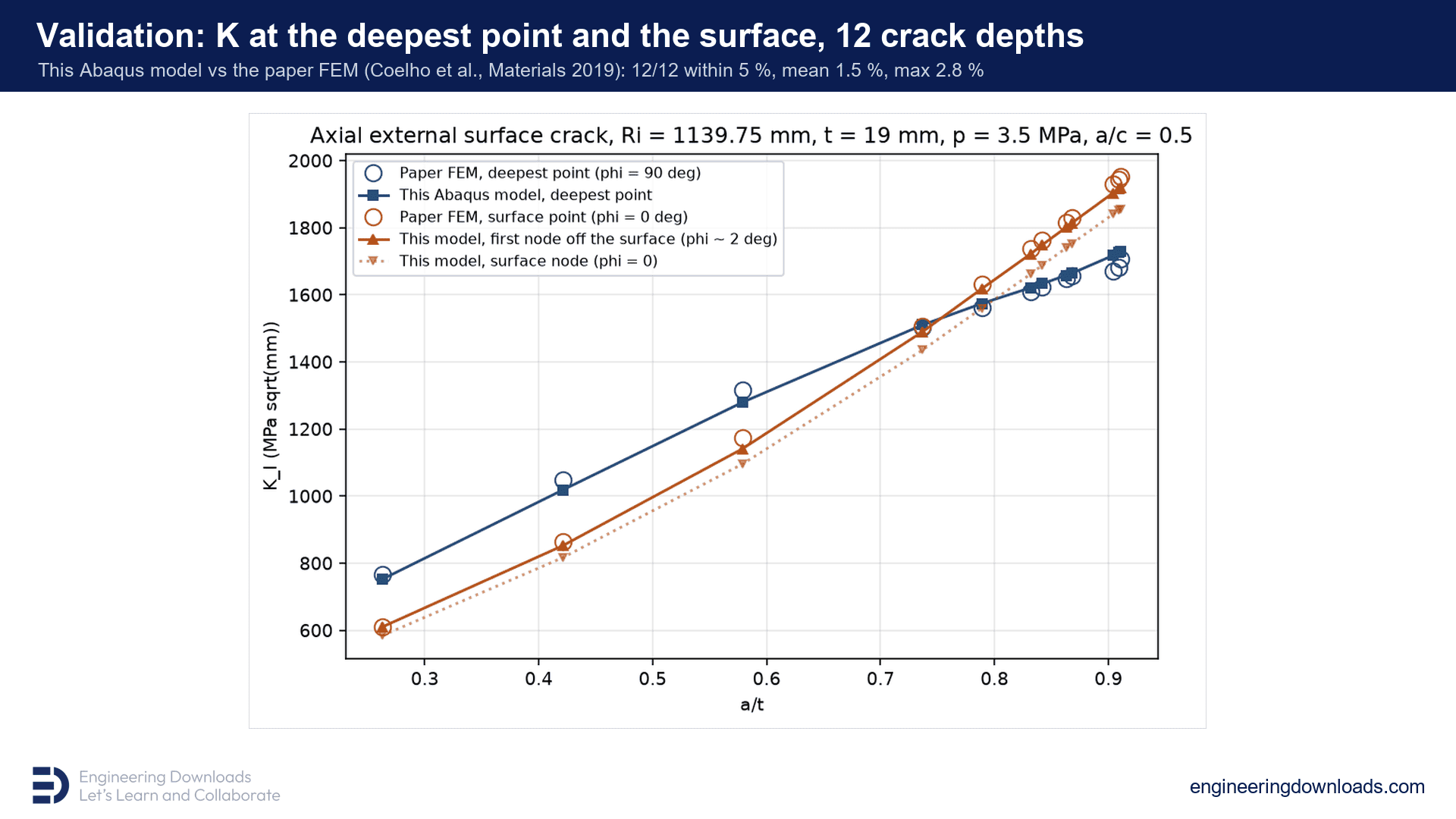
All 12 cracks pass: the deepest-point K differs from the paper by 1.5 % on average (maximum 2.8 %), the near-surface point by about 1 %, and the maximum K along the front agrees with the paper’s API 579-1 values within 1.6 % for 11 of 12 cracks. Two different crack-front mesh topologies and a refined mesh agree within 0.05 %, so the model is mesh-independent; the remaining differences come from the paper’s own discretisation. The change of the maximum K from the deepest point to the surface at a/t ≈ 0.74 is reproduced.
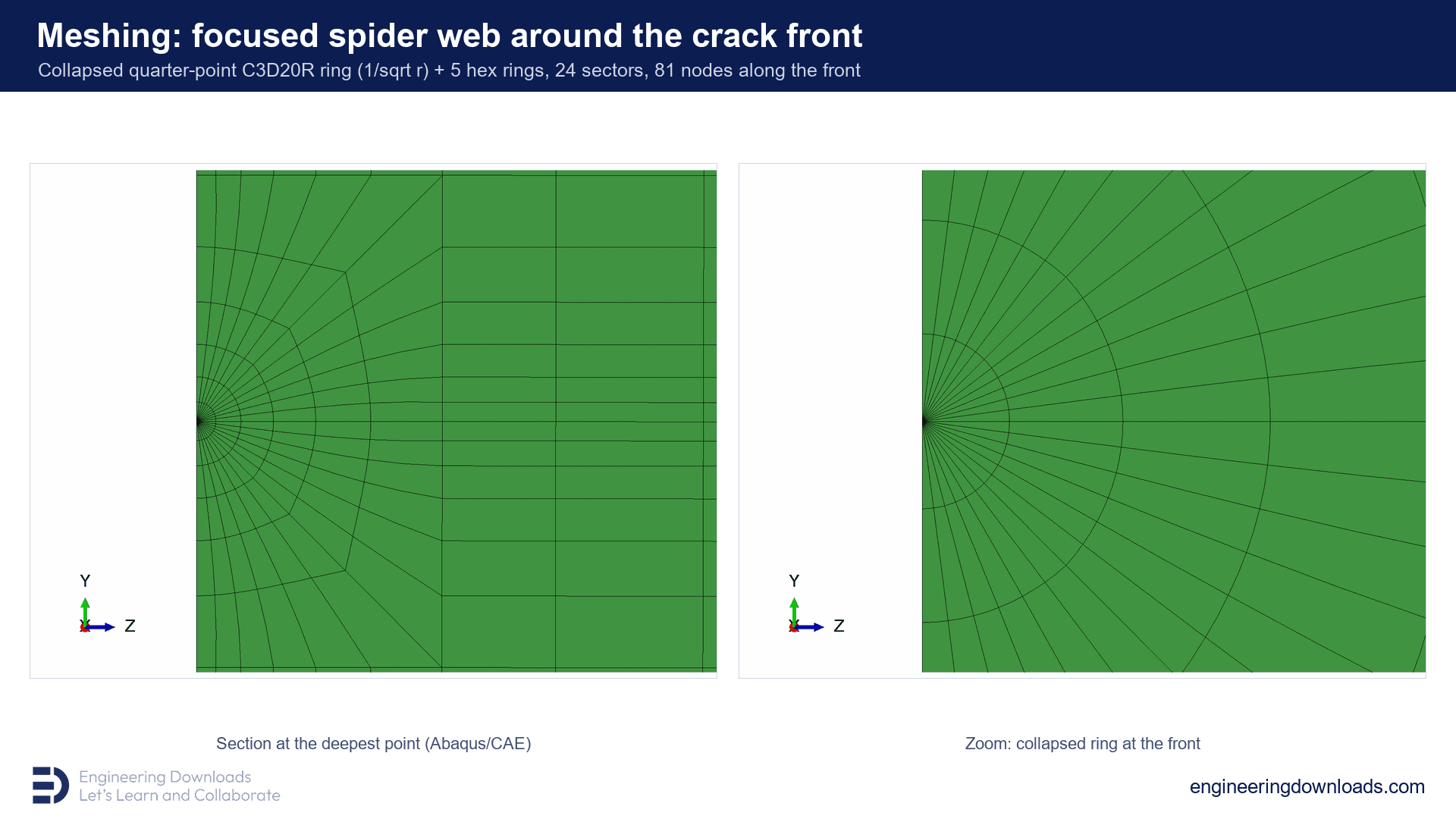
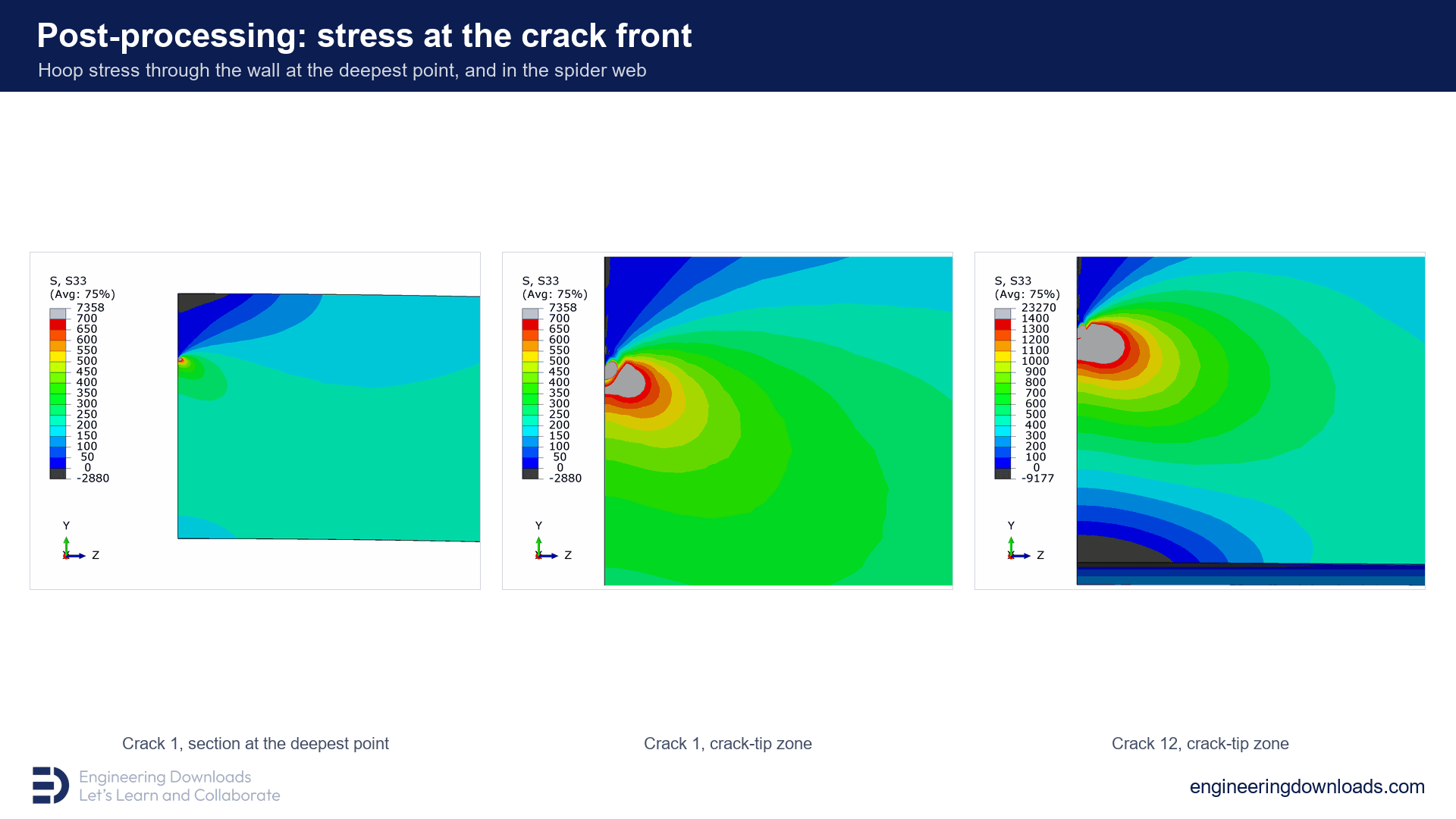
The first ring is collapsed C3D20R bricks with the mid-side nodes at the quarter points (the 1/√r singularity); five graded hex rings follow, with 24 uniform sectors that blend into the structured mesh.
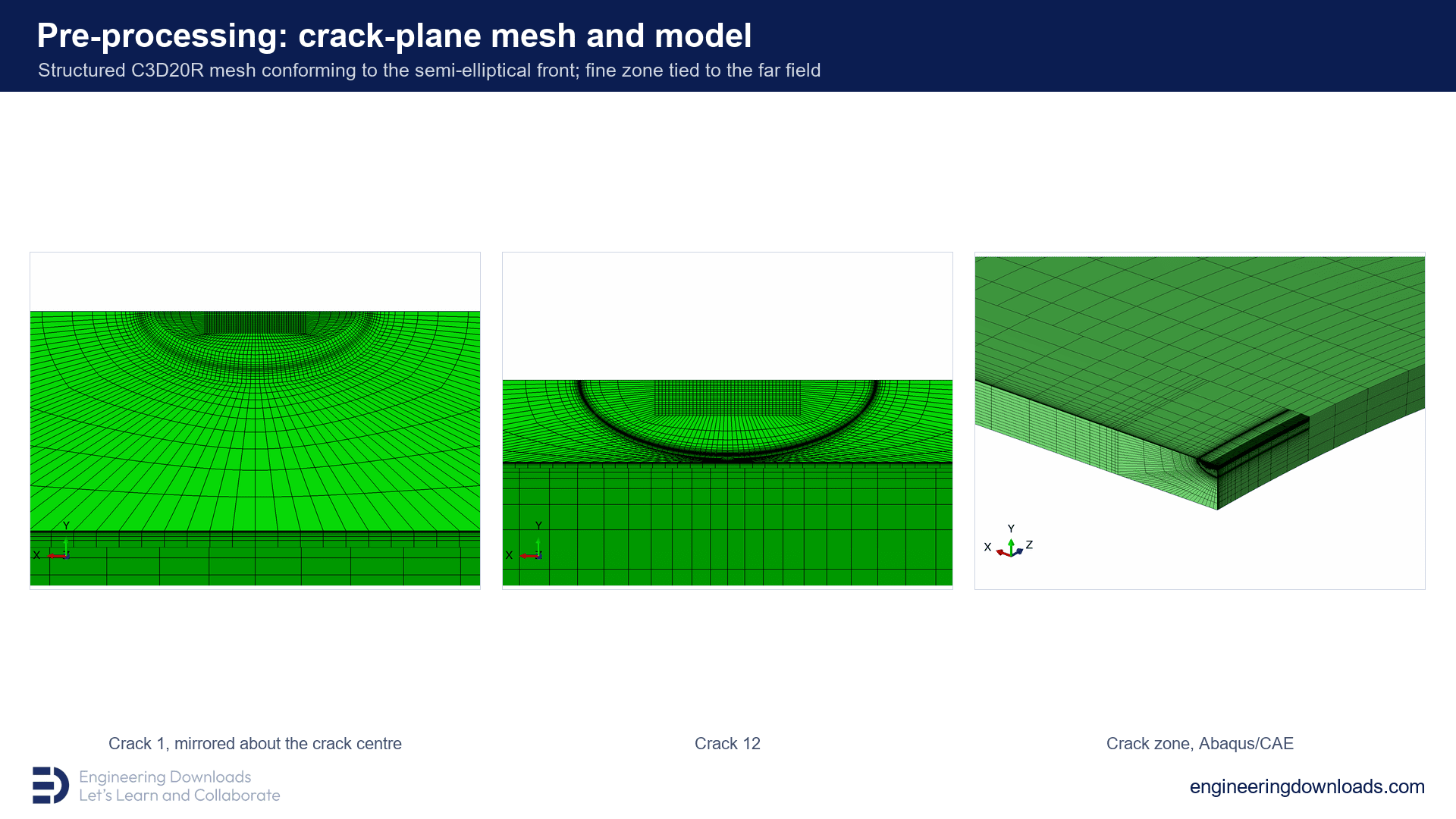
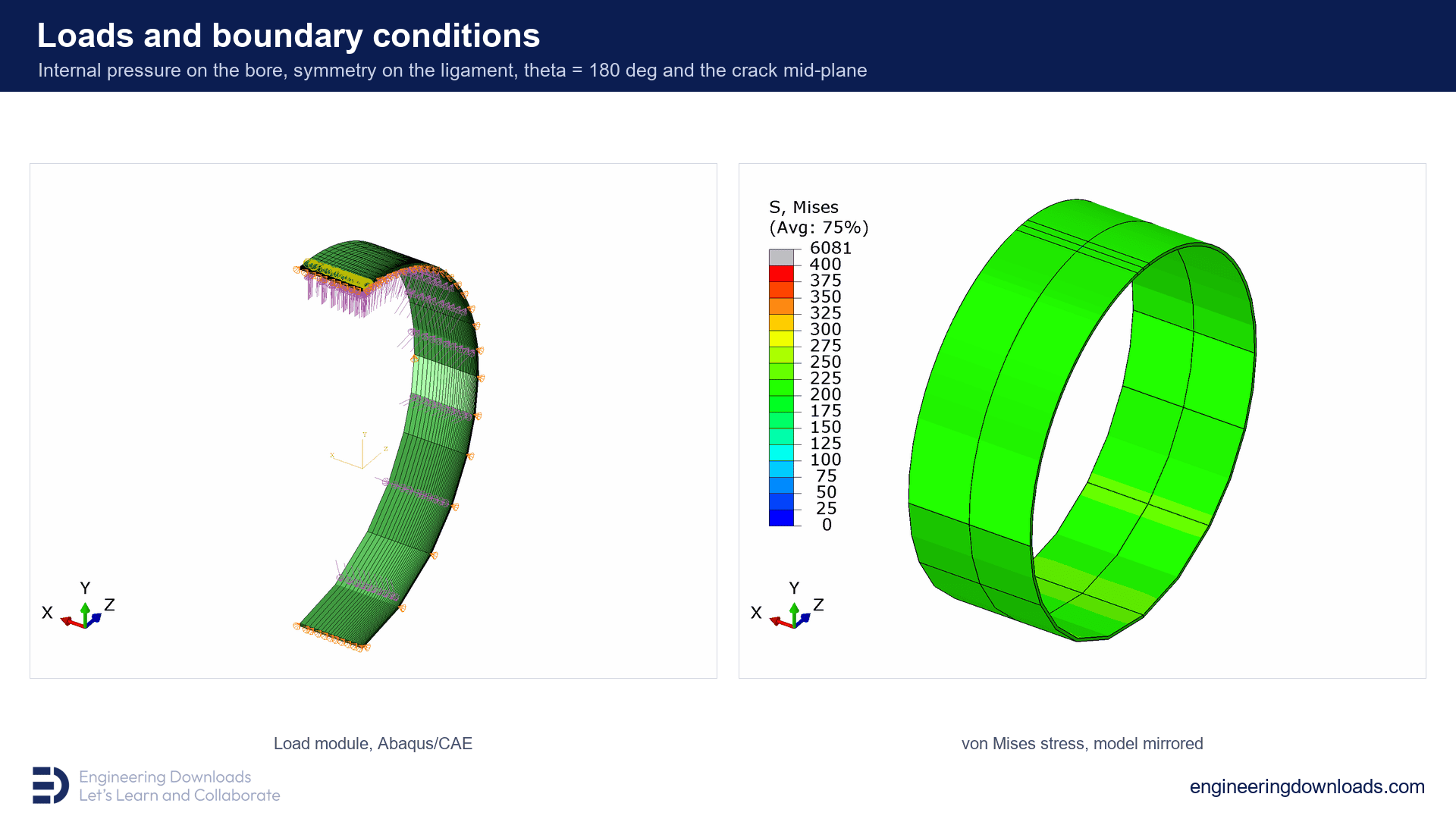
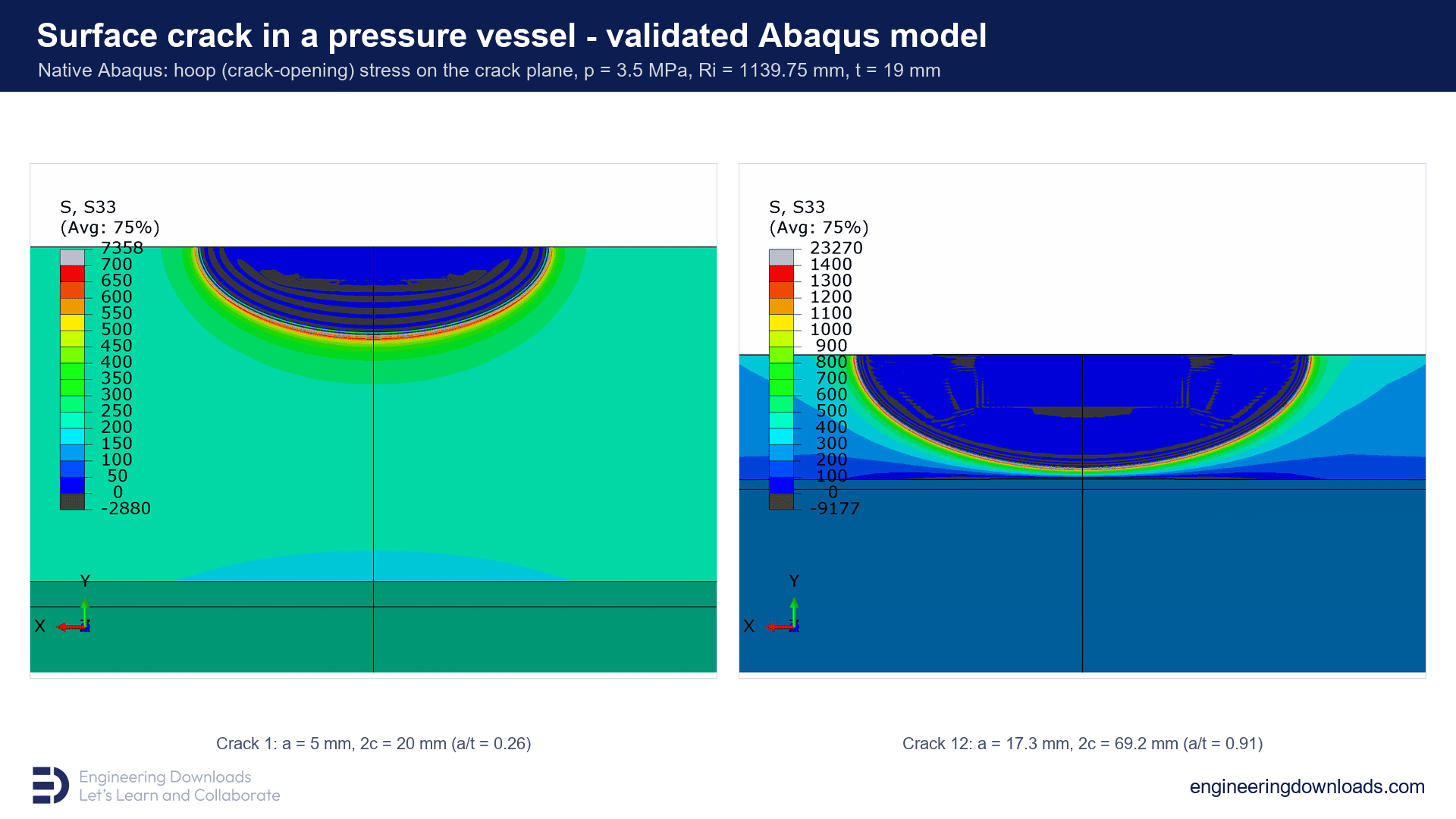
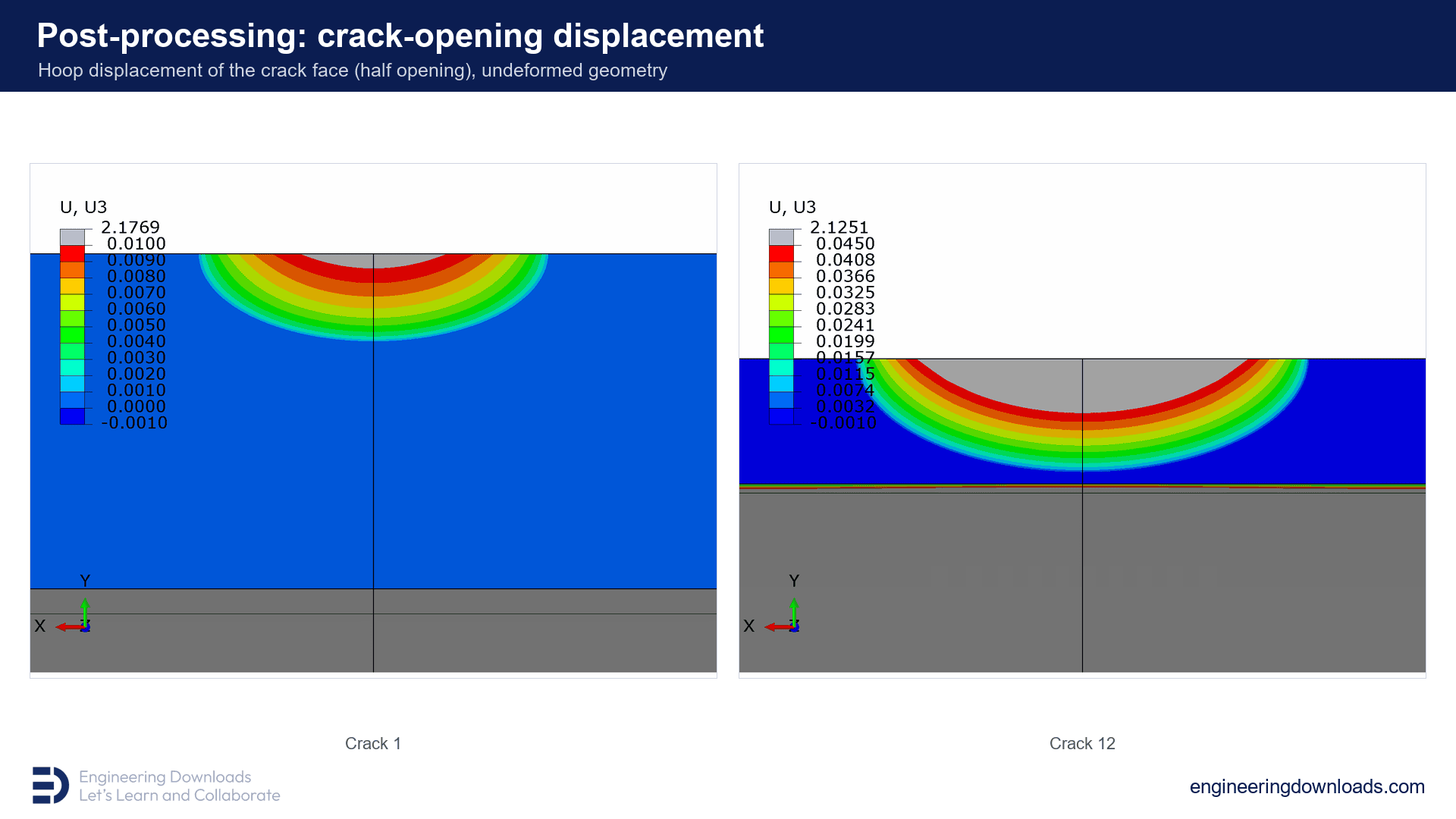
Contours of the crack-opening stress at the front, the crack-opening displacement, and K along the front written to CSV by the included post-processor.
Structural-integrity and fitness-for-service engineers (API 579-1/ASME FFS-1 Part 9, BS 7910) who need a checked 3D crack model, FEA engineers learning crack-front meshing and contour integrals in Abaqus, and students of fracture mechanics. Change the crack, cylinder or pressure and the generator writes a new Abaqus deck for your case.
What does this model calculate? The mode-I stress intensity factor K and the J-integral at 81 points along the front of an axial semi-elliptical surface crack in an internally pressurised cylinder, for 12 crack depths, with the Abaqus contour integral.
How well does it match the paper? All 12 cracks are within the 5 % criterion: the deepest-point K differs from the paper’s FEM by 1.5 % on average (maximum 2.8 %). The maximum K agrees with the paper’s API 579-1 values within 1.6 % for 11 of 12 cracks.
What mesh is used at the crack front? A focused spider web: a ring of collapsed C3D20R elements with quarter-point mid-side nodes (1/sqrt(r) singularity) and five hex rings with 24 sectors. A different mesh topology and a refined mesh change K by less than 0.05 %.
Can I model my own crack? Yes. The Python generator writes a new Abaqus deck for any crack depth and length, cylinder radius, thickness, pressure and material. The validated envelope is a/c = 0.5, Ri/t = 60, a/t = 0.26 to 0.91.
Are the images real Abaqus results? Yes. Every mesh, load and contour image is an unedited PNG written by Abaqus/CAE 2024 (printToFile) from the included models and their results; only a title bar, the logo and the web address are added around them. Charts are drawn from the results tables in the package.
Which Abaqus version do I need? Abaqus/CAE and Abaqus/Standard 2024 or newer for the .cae files and the scripts; the .inp files also run in older releases. ODB files are not included: every job is linear and runs in minutes.
Are user subroutines needed? No. The models use only standard Abaqus keywords: *CONTOUR INTEGRAL for K and J, collapsed quarter-point elements at the crack front, *TIE or *COUPLING and *DSLOAD or *CLOAD.
Is the reference paper included? No. The paper is open access (CC BY 4.0) and cited with its DOI; no figures or text from it are reproduced. The comparison uses the numbers published in its tables.
What if the package is not what I expected? Write to us. Engineering Downloads refunds clients who are not satisfied with a delivered product.
Need more than the files?
There are two ways we can help. Book a one hour online consultation if you want to talk a problem through with a CAE engineer, using the checkbox in the order box. Order a project if you need a full simulation built for you, delivered to an agreed scope, price and deadline under a written contract.
We work on FEA and CFD for engineers, researchers and companies. Order your project, or message us on WhatsApp for a quick reply.
Other packages engineers working on this topic also download.
 Compact Tension (CT) Specimen: Validated Abaqus Stress Intensity Factor Model vs ASTM E647 (2D + 3D)€99,00
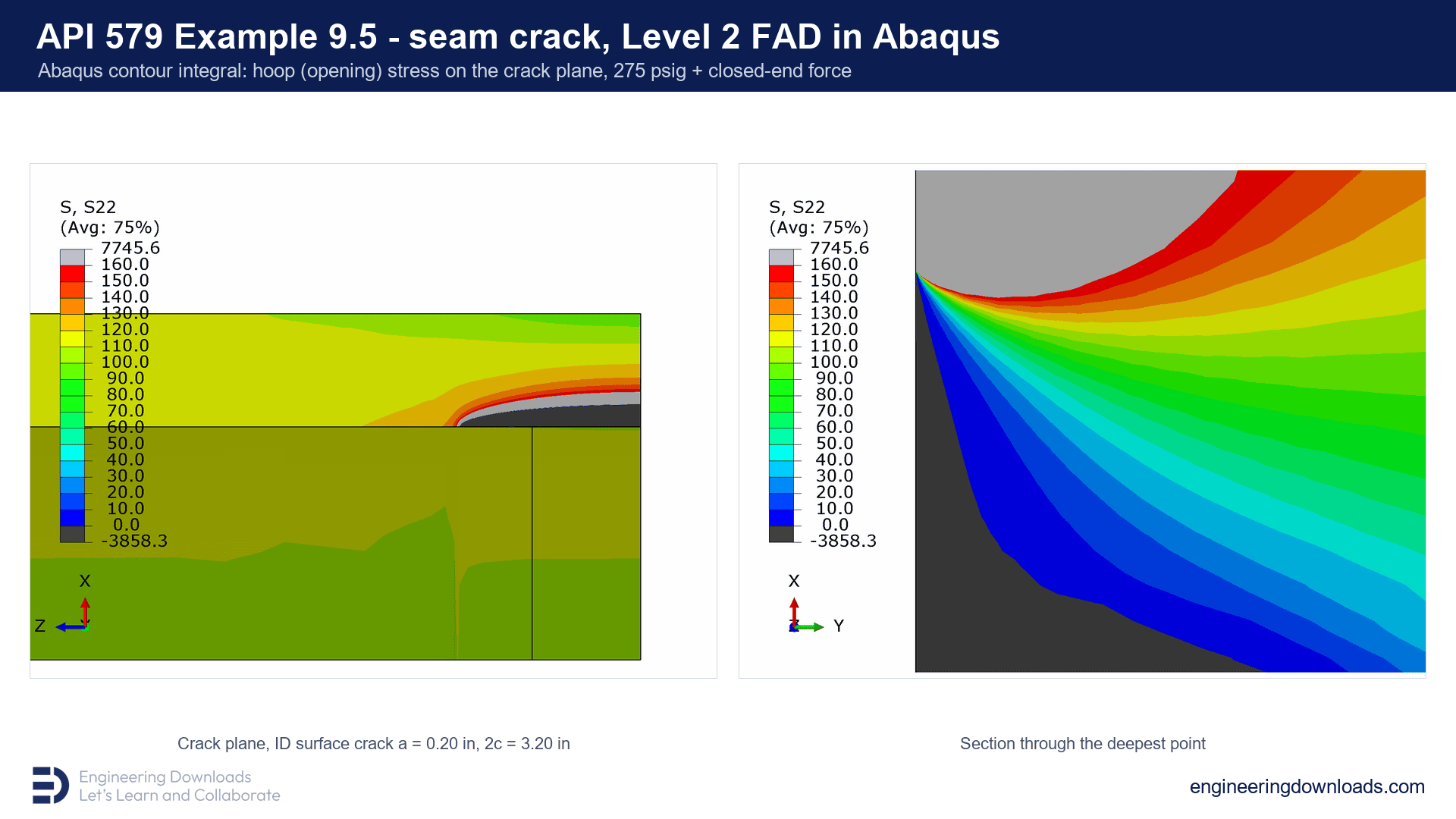 API 579 Example 9.5 in Abaqus: Seam Crack Level 2 FAD with 3D Contour Integral€99,00
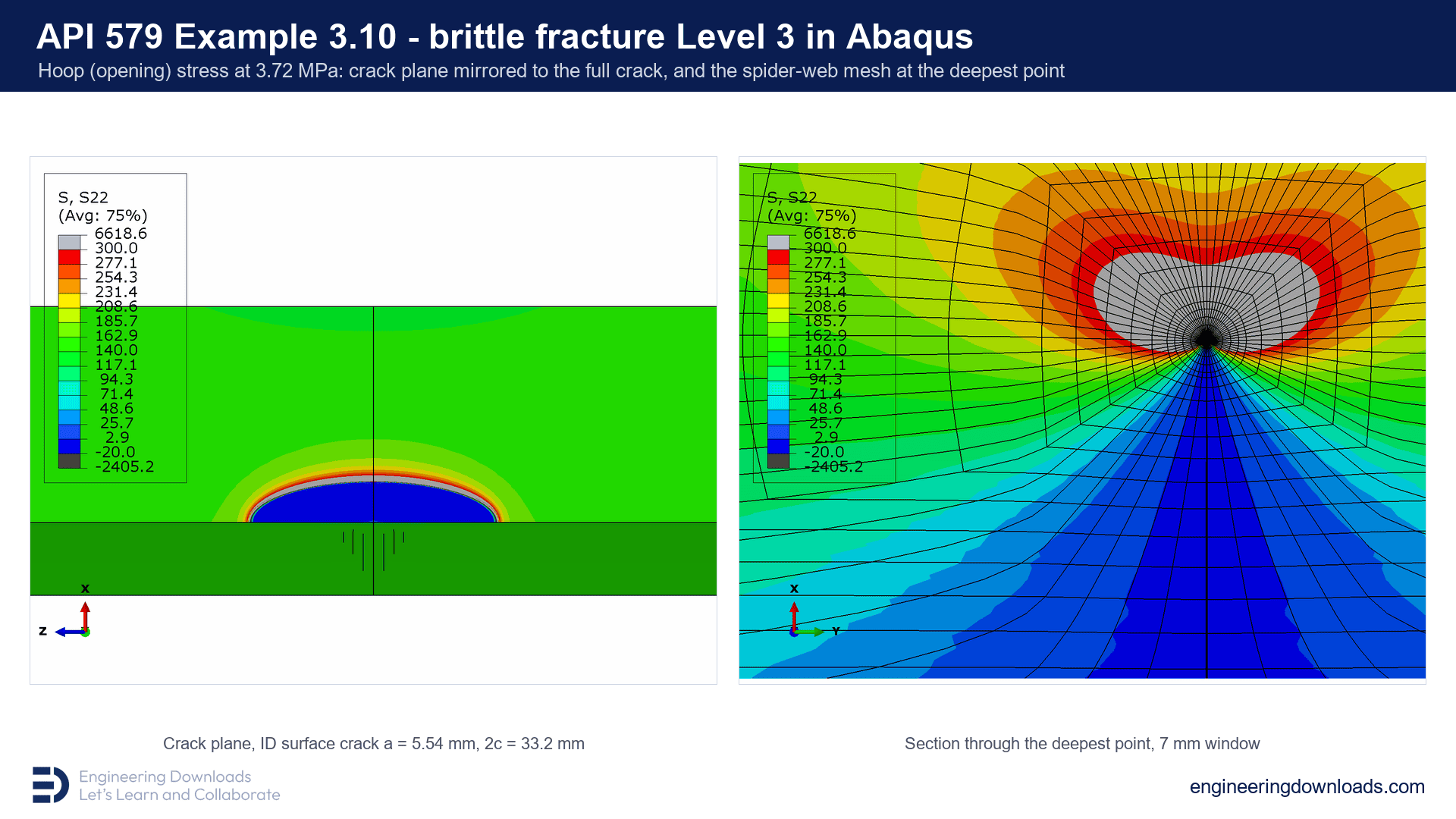 API 579 Example 3.10 in Abaqus: Brittle Fracture Level 3, Demethanizer Thermal Shock€139,00
 API 579 Example 9.7 in Abaqus: Girth Weld Crack with Weld Residual Stress, Level 2 FAD€129,00
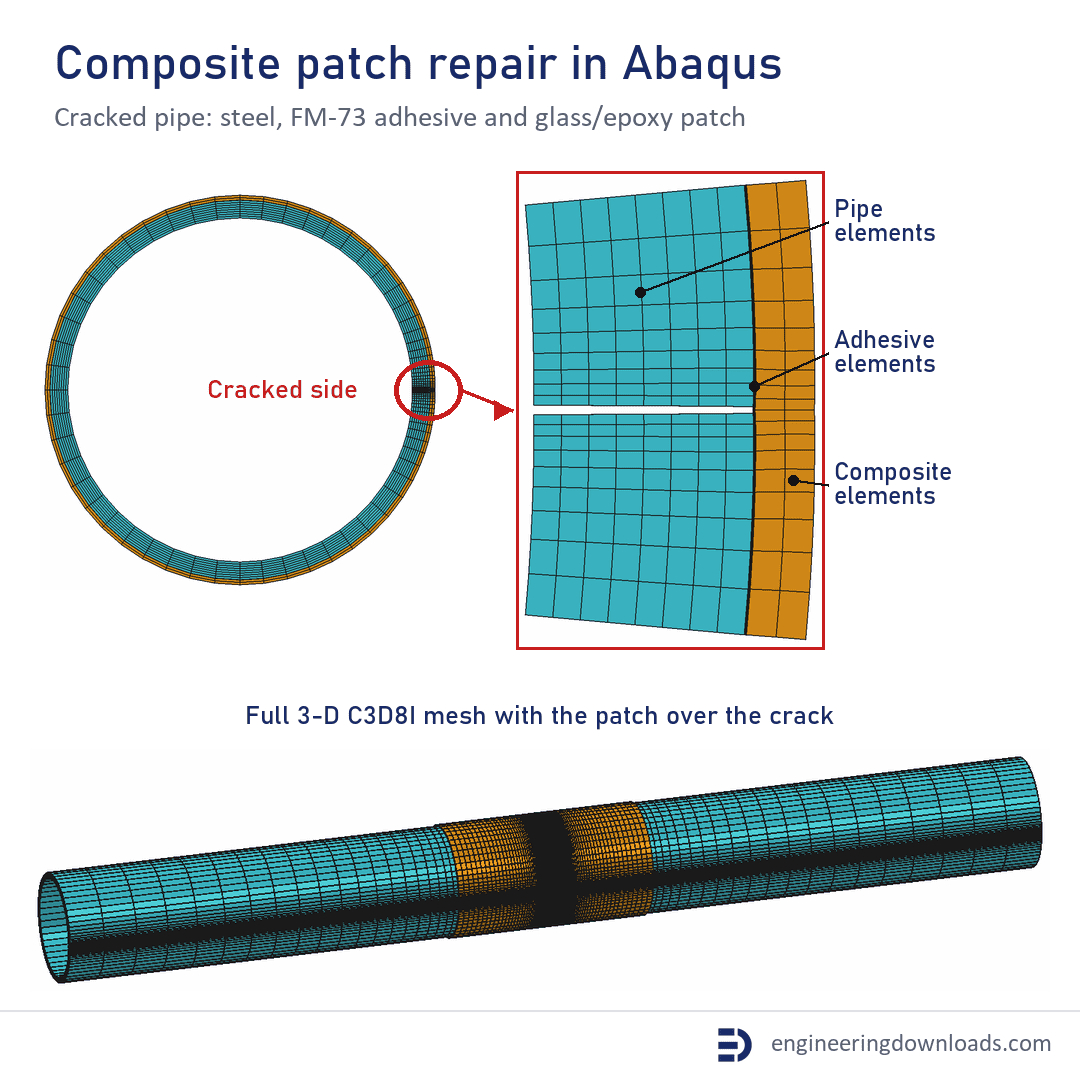 Composite Patch Repair of a Cracked Pipe in Abaqus: Fatigue Crack Growth under Cyclic Pressure
 ANSYS Workbench Simulation for SIF, PLP and Fatigue Life Assessment of High-Aspect-Ratio Axial Surface Cracks in Pressurized Pipes€129,00
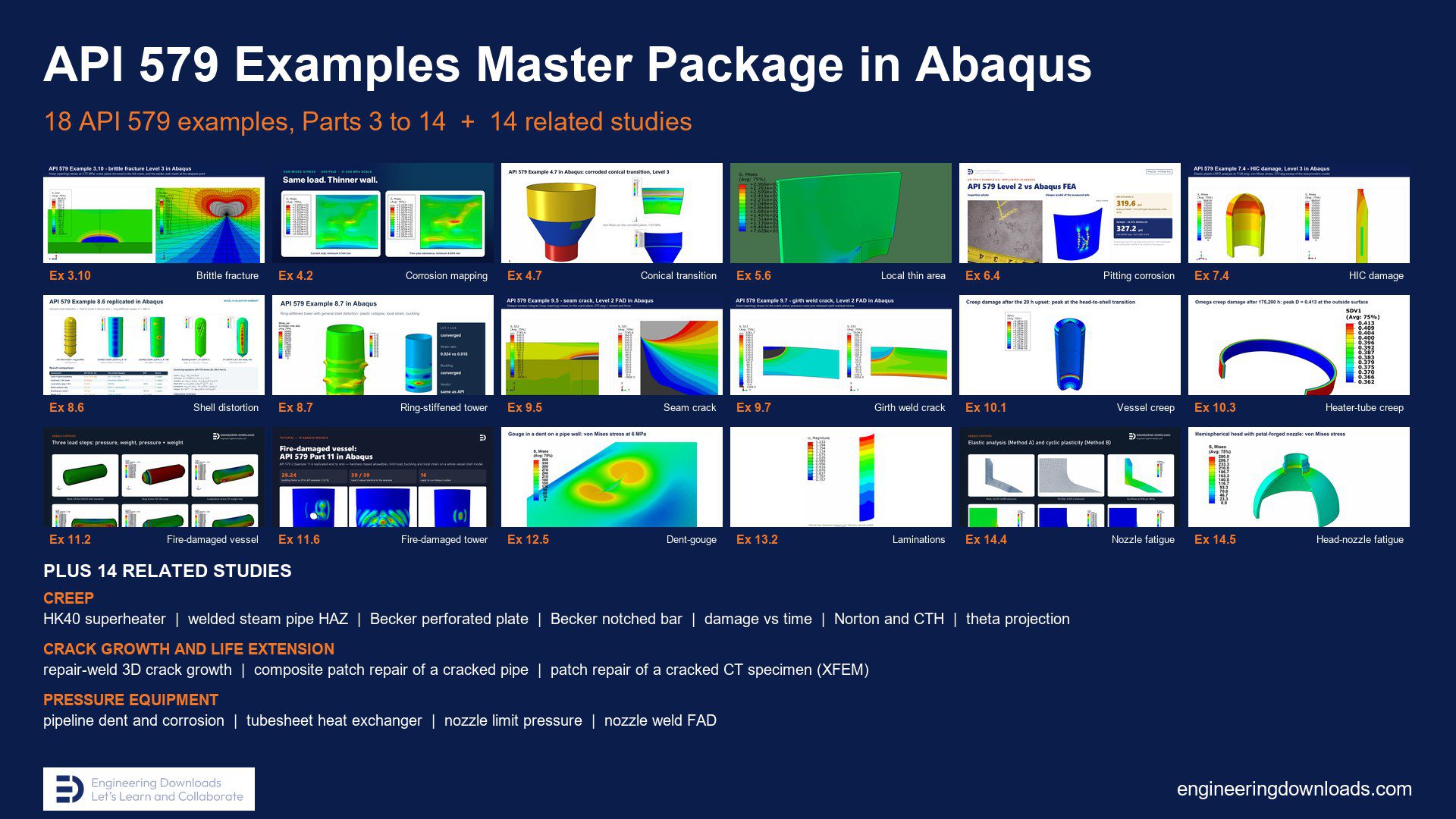 API 579 Examples Master Package in Abaqus: 18 Examples from Parts 3 to 14 plus 14 Creep, Crack Growth, Life Extension and Pressure-Equipment Studies
 Repair Welding Residual Stress and 3D Fatigue Crack Growth in Abaqus: Ductile Cast Iron Wind-Turbine Hub (FFS Level 3)€299,00

Need a full custom project? See the options below.

€129,00

€179,00

€149,00

€119,00

€129,00
See more
Want to receive push notifications for all major on-site activities?