Need a full custom project? See the options below.
Need a full custom project? See the options below.
Hydrogen-induced cracking (HIC) found mid-wall on the long seam of a heavy-wall separator, only 10 in from the head junction. That is too close to a structural discontinuity for Level 1 or 2, so the published API 579-2 Example 7.4 goes straight to a Level 3 assessment: an elastic-plastic finite-element check against plastic collapse, then a Part 9 failure assessment diagram (FAD) for the HIC zone treated as embedded cracks. This package rebuilds the whole procedure in Ansys Mechanical APDL: a native APDL input for all four load cases, a ready-to-solve database, a one-click Python workflow that solves the cases and writes the comparison charts, and a PDF tutorial. Every key number is compared with the example.
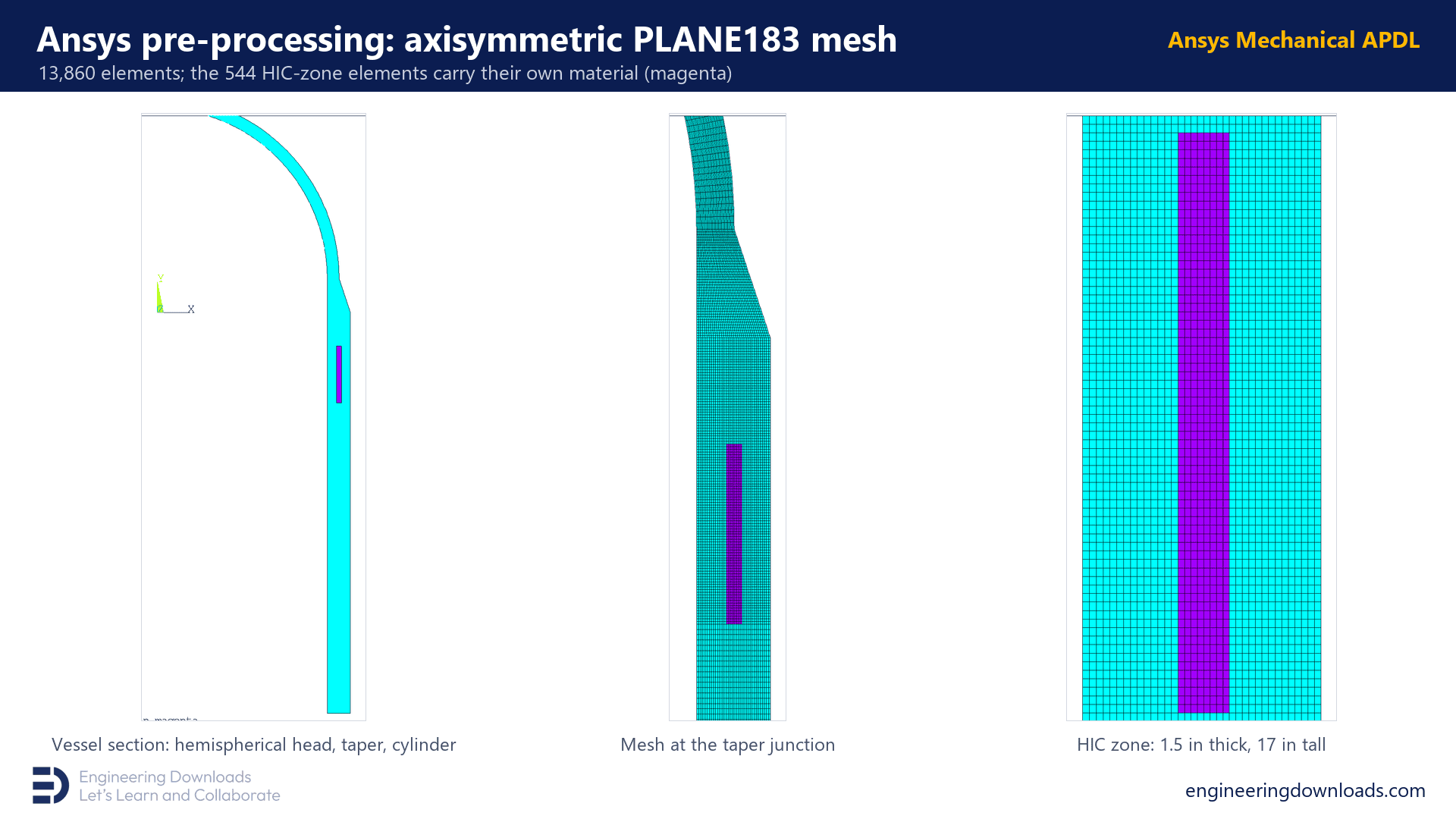
Source: API 579-2/ASME PTB-14 Fitness-For-Service Example Problem Manual, Part 7 Hydrogen Blisters and HIC/SOHIC Damage, Example 7.4. The vessel is a high-pressure separator in SA-516 Grade 70: 102 in inside diameter, 6.984 in cylinder wall and a 3.557 in hemispherical head joined by a 3:1 taper, designed for 2640 psig at 450 °F. Ultrasonic inspection found an HIC zone 17 in long and 8 in around, 1.5 in thick, 2.8 in from the inside surface, on the post-weld heat treated long seam and 10 in below the taper.
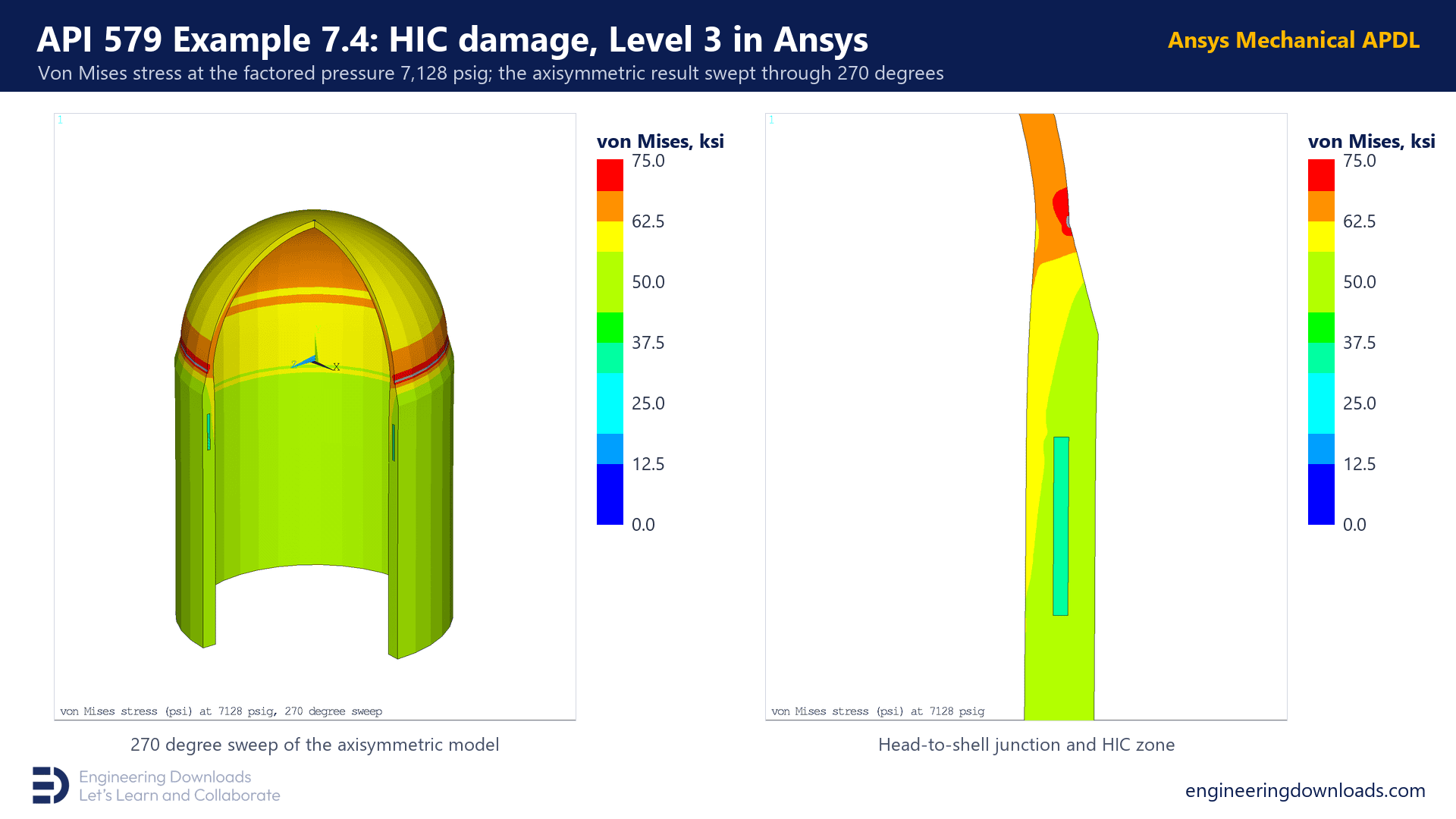
The Level 1 and 2 screening needs the damage at least 1.8√(D·tc) = 1.8√(102 × 6.984) = 48 in from a structural discontinuity. With 10 in available, the example moves to Level 3, which checks protection against plastic collapse (Annex 2C, factored load 3.0 × 0.9 × 2640 = 7128 psig) and protection against brittle fracture (Part 9, FAD with Lr,max = 1.25 for carbon-manganese steel).
| Item | This package |
|---|---|
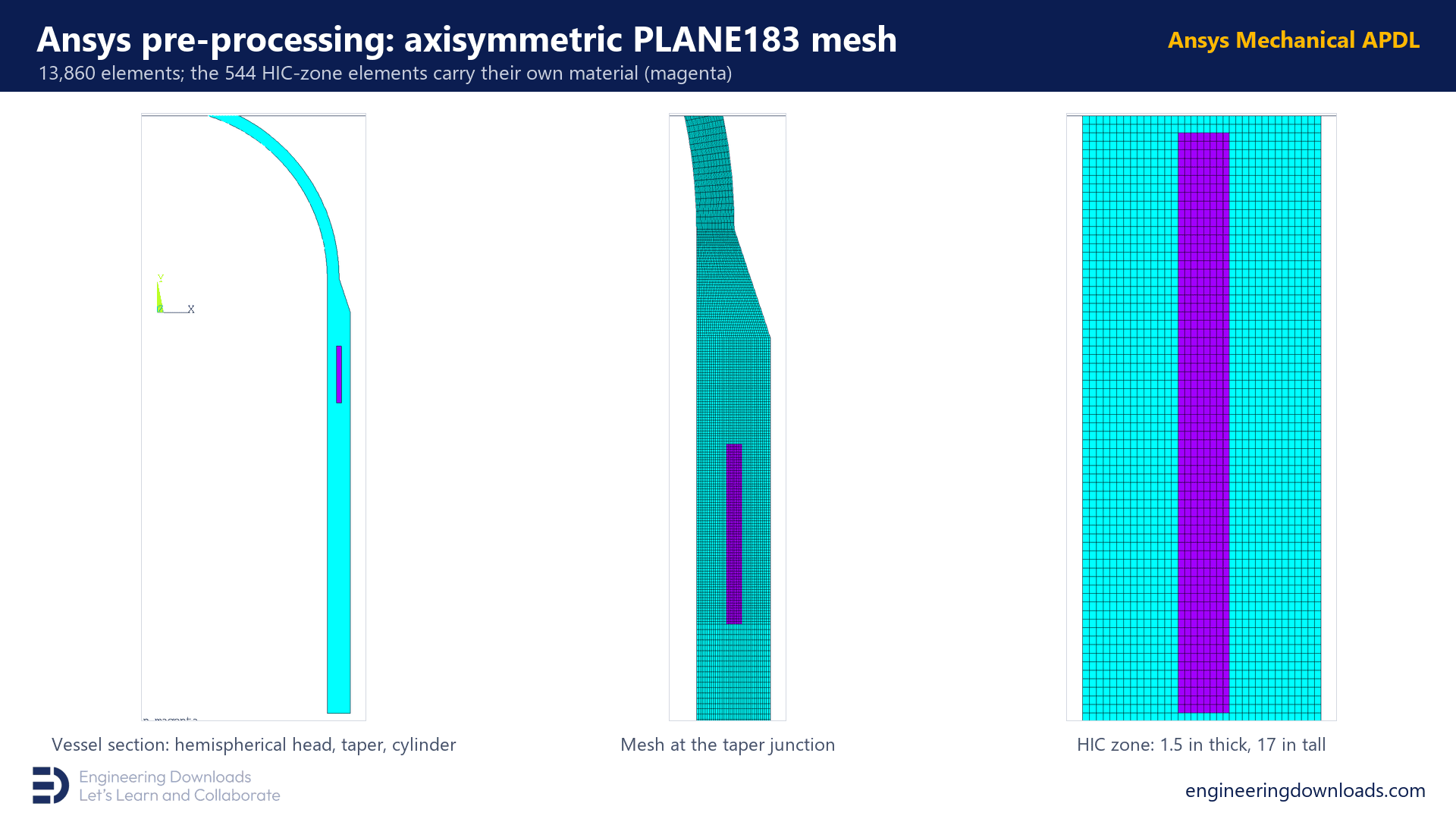
| Geometry and mesh | Axisymmetric section: hemispherical head, 3:1 taper and cylinder; 42,423 nodes and 13,860 quadratic PLANE183 elements, 544 of them in the HIC zone, modelled as a full ring |
| Material | SA-516 Grade 70 hardening table at 450 °F for the base metal; HIC zone elastic-perfectly plastic at 31.75 ksi, as Part 7 requires |
| Loads and supports | Internal pressure on the cylinder and head bore; UY = 0 on the cylinder cut plane; UX = 0 on the axis of symmetry |
| Analyses | Case 1 linear elastic at 2,640 psig; case 2 large-deformation elastic-plastic at 7,128 psig; cases 3 and 4 arc-length limit-pressure runs with and without HIC |
| Fracture | Stress linearization of the elastic result, Annex 9D residual stress, embedded elliptical flaws (KPECE1, RPECE1, Table 9.3 plasticity factor), arrest Master Curve toughness, FAD at 150 °F and a search for the Minimum Allowable Temperature |
| Software | Ansys Mechanical APDL; Python 3 with NumPy and Matplotlib for the one-click workflow |
| Quantity | Example | Ansys |
|---|---|---|
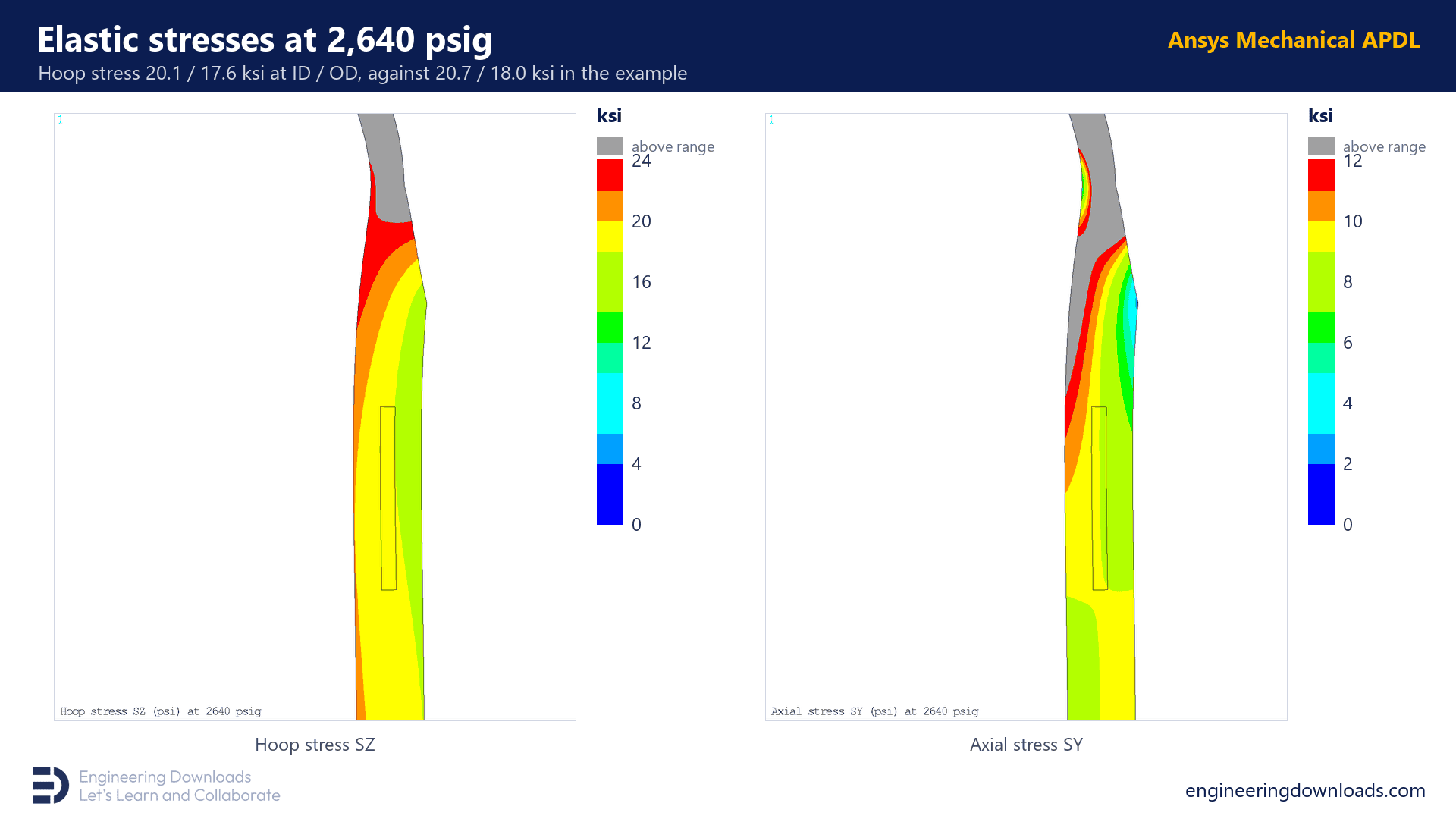
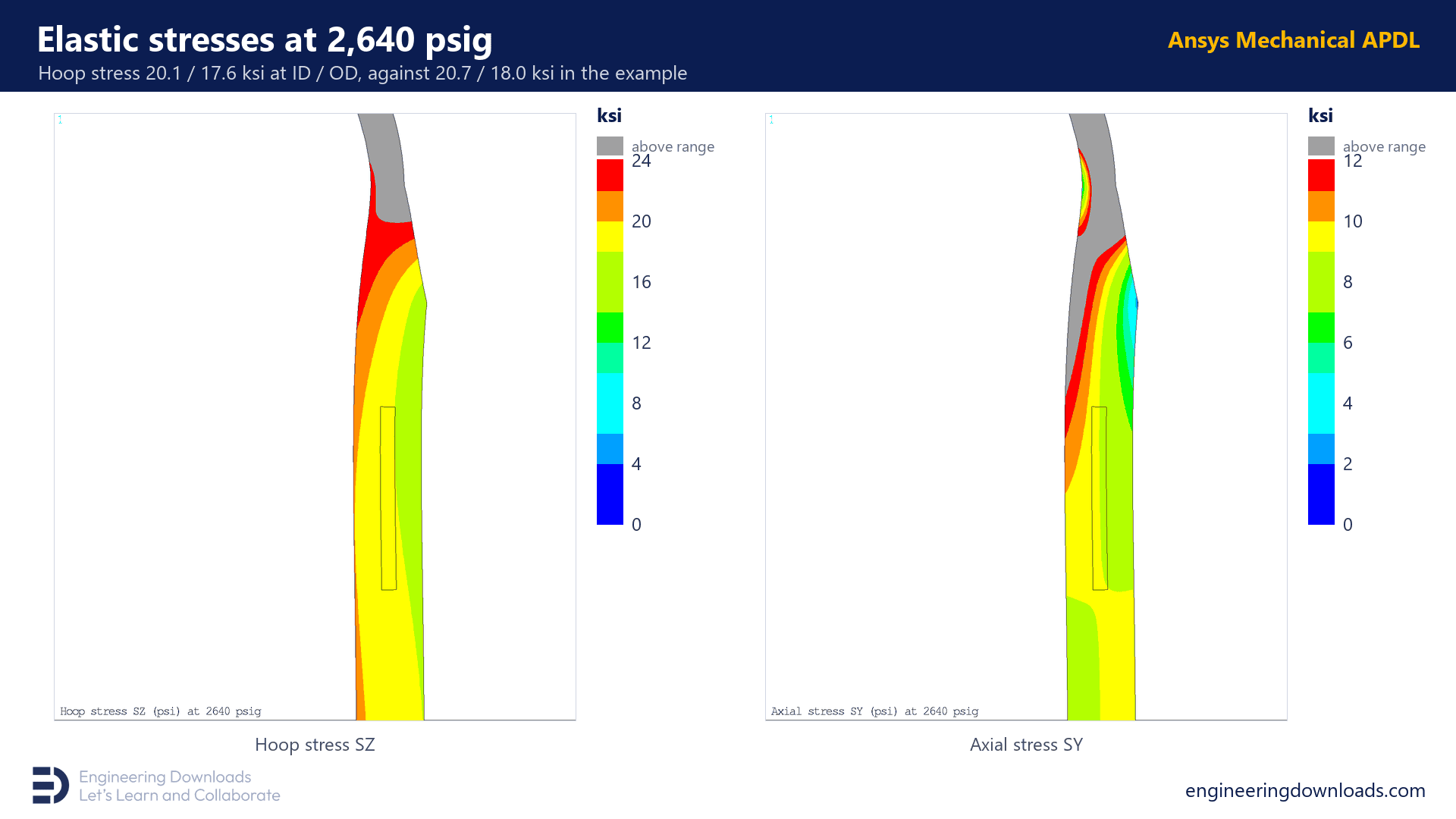
| Hoop stress at ID / OD, 2,640 psig | 20.7 / 18.0 ksi | 20.12 / 17.56 ksi |
| Axial membrane stress | 9.0 ksi | 9.08 ksi |
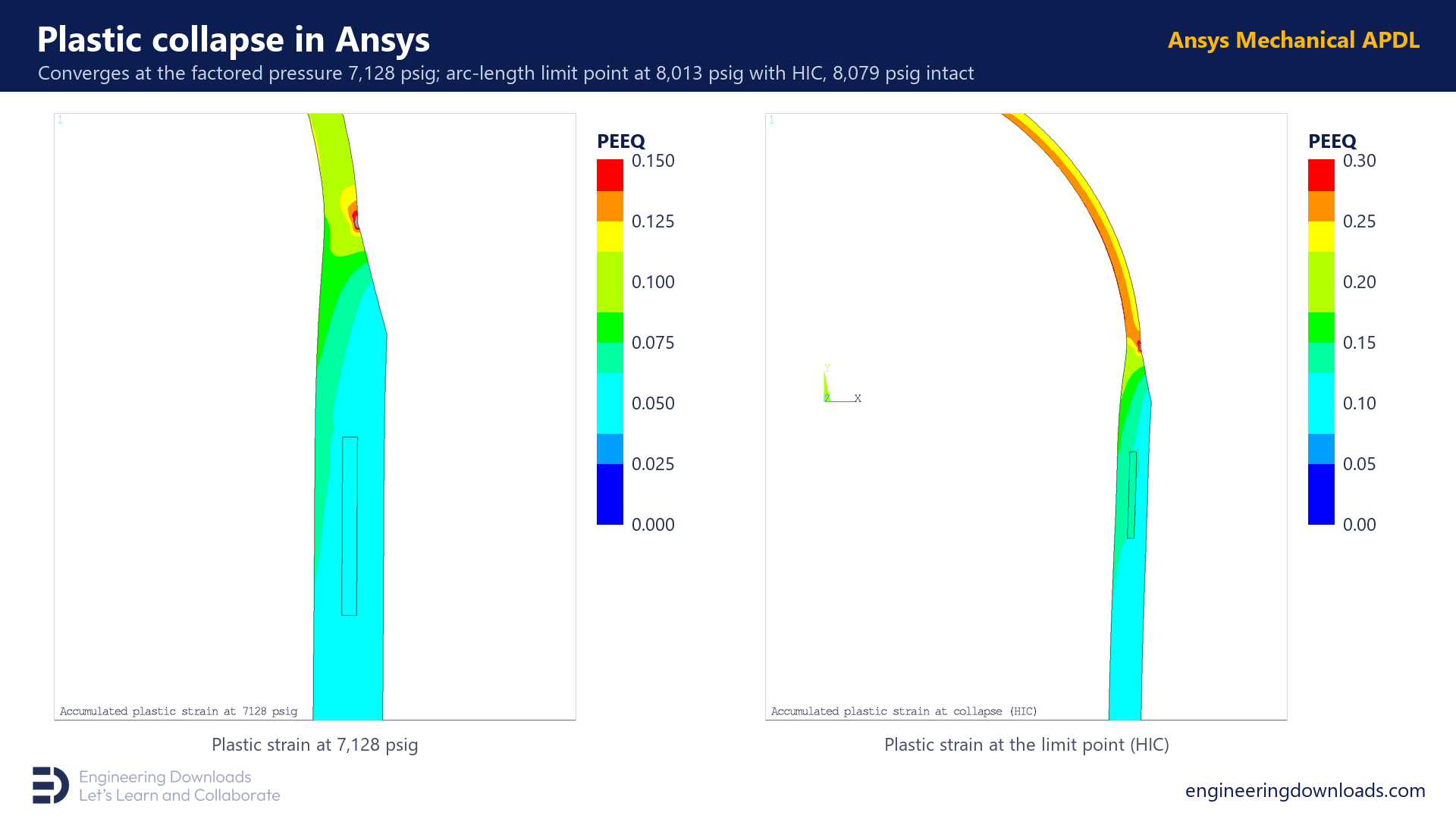
| Annex 2C analysis at 7,128 psig | Converges | Converges |
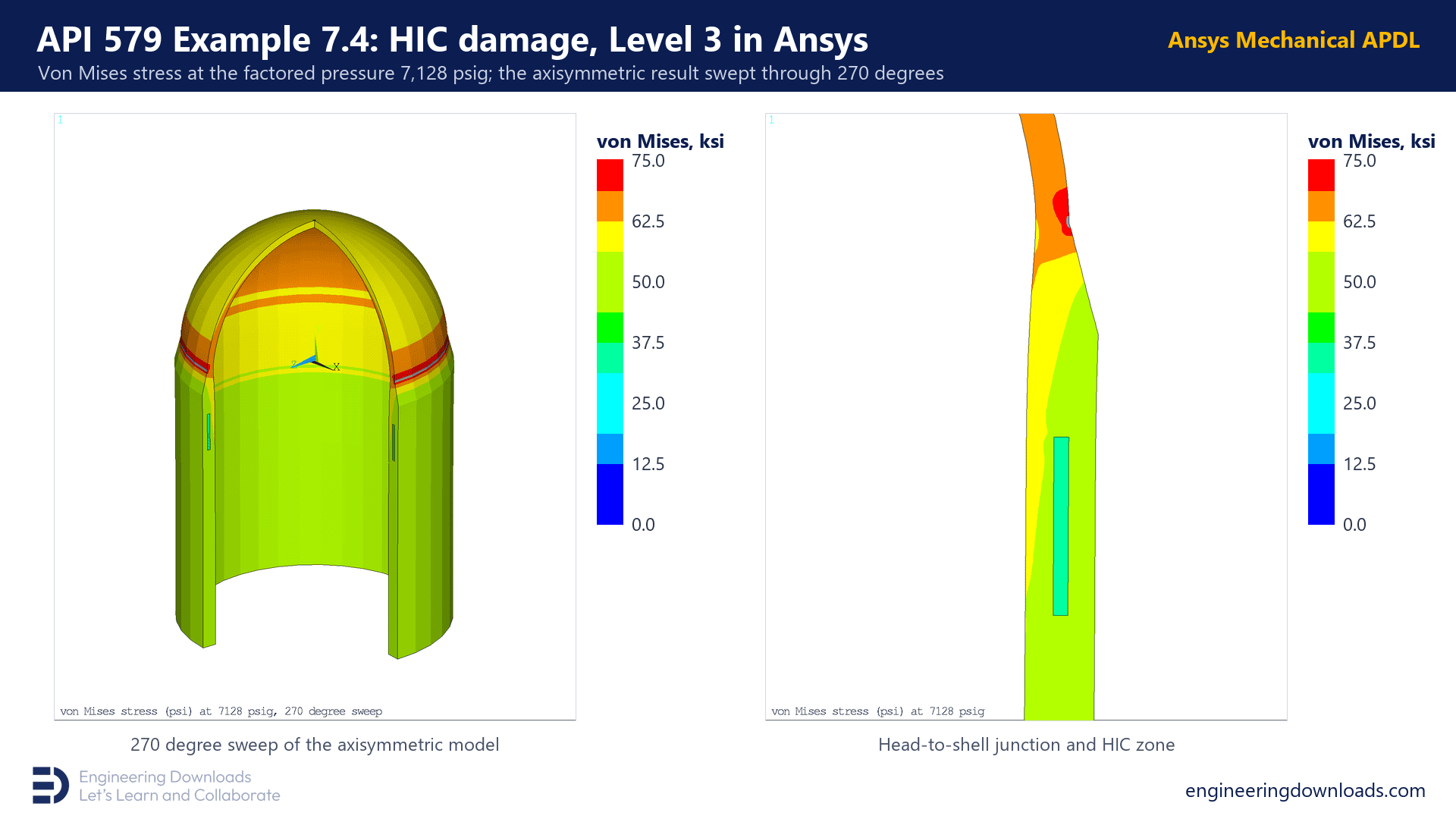
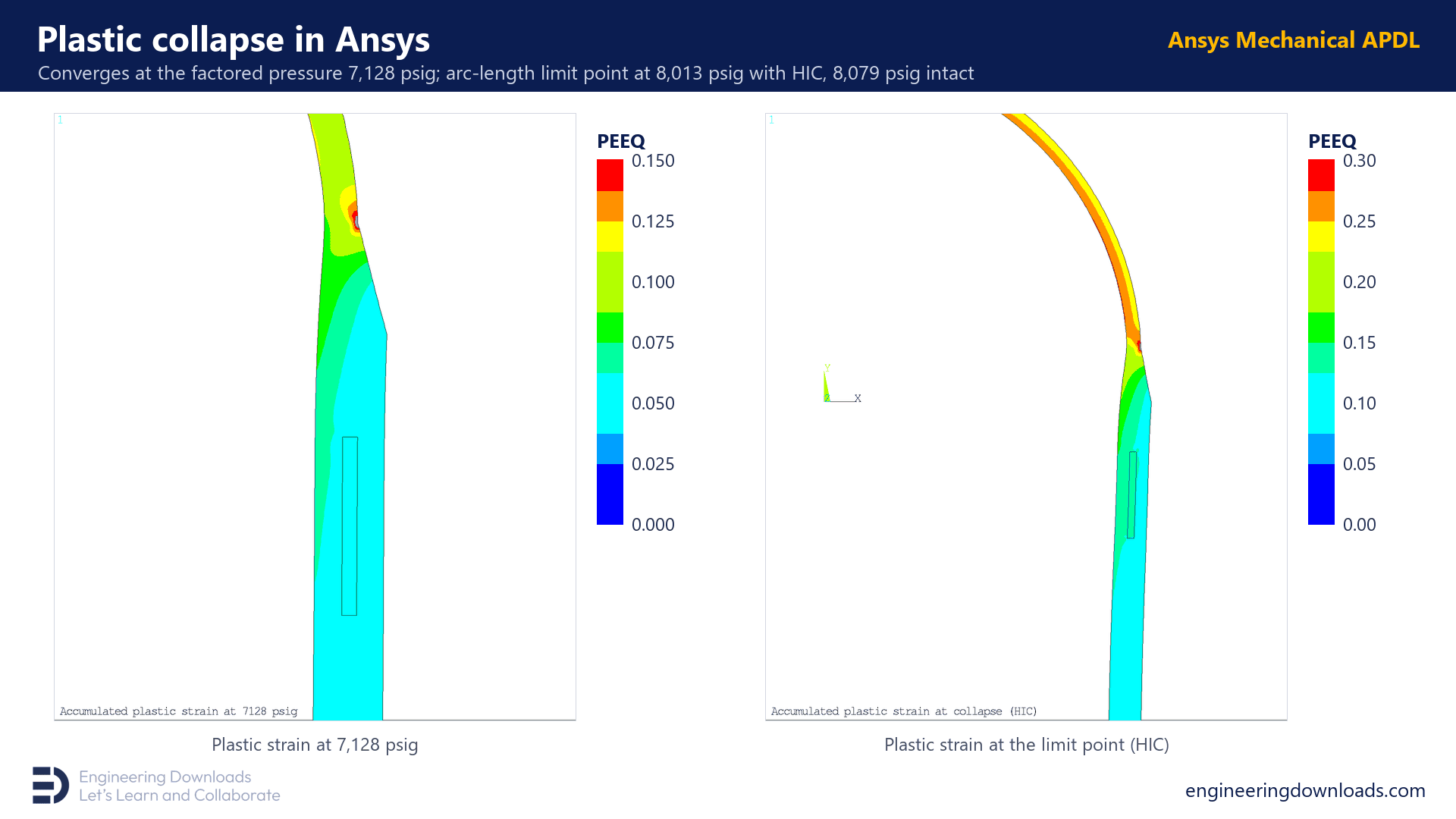
| Max von Mises / PEEQ outside the taper corner | contour scale 73.25 ksi / 0.15 | 72.45 ksi / 0.134 |
| Limit pressure with HIC / intact (extra check) | not given | 8,013 / 8,079 psig |
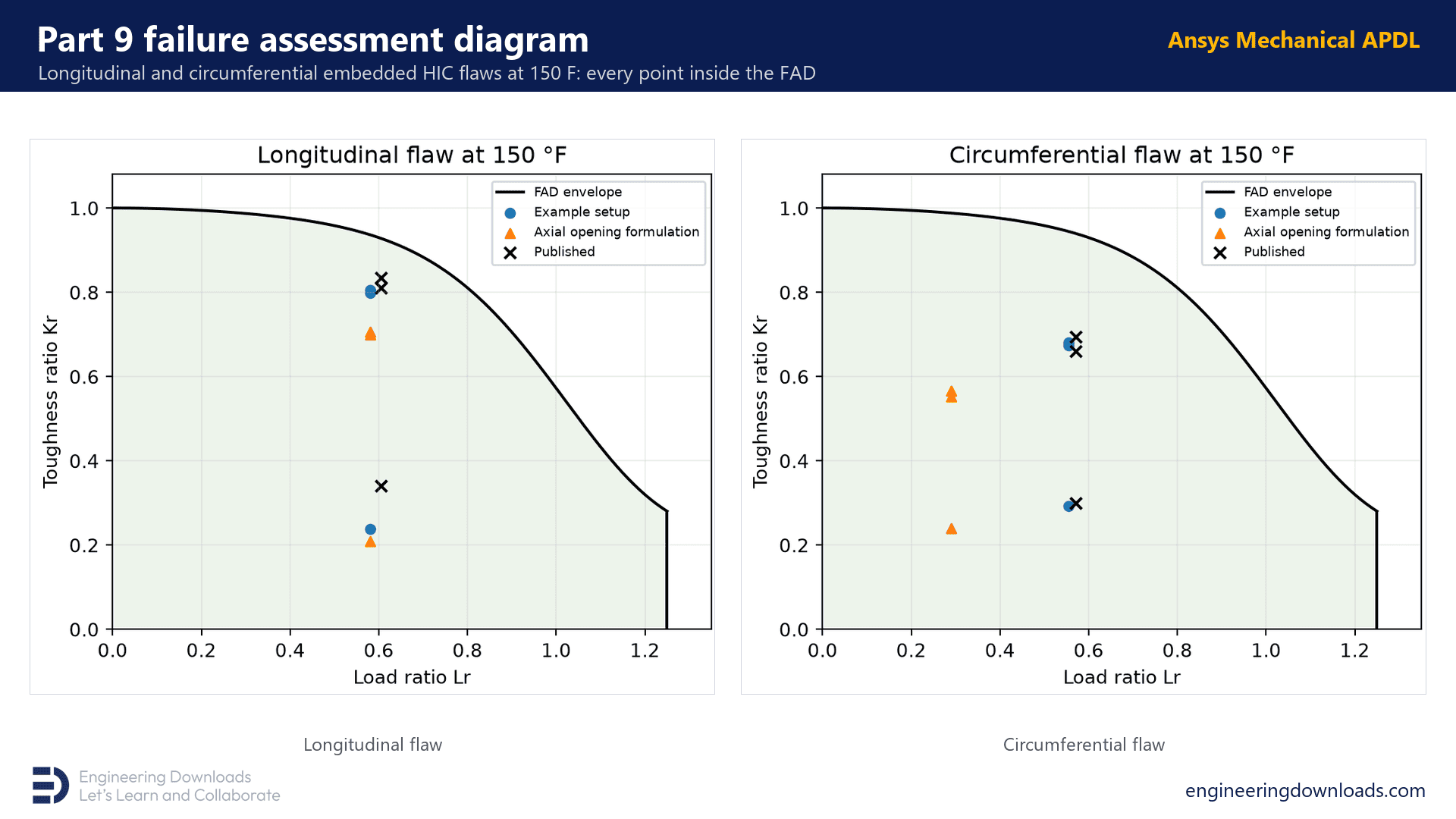
| Lr, longitudinal / circumferential flaw | 0.605 / 0.57 | 0.581 / 0.555 |
| Kr at the +90° / −90° tips, longitudinal flaw | 0.81 / 0.835 | 0.798 / 0.806 |
| Kr at the +90° / −90° tips, circumferential flaw | 0.66 / 0.695 | 0.673 / 0.680 |
| Minimum Allowable Temperature | 99 °F | 99.3 °F (low-sulfur toughness), 106.7 °F (high sulfur) |
| Level 3 verdict | Acceptable | Acceptable |
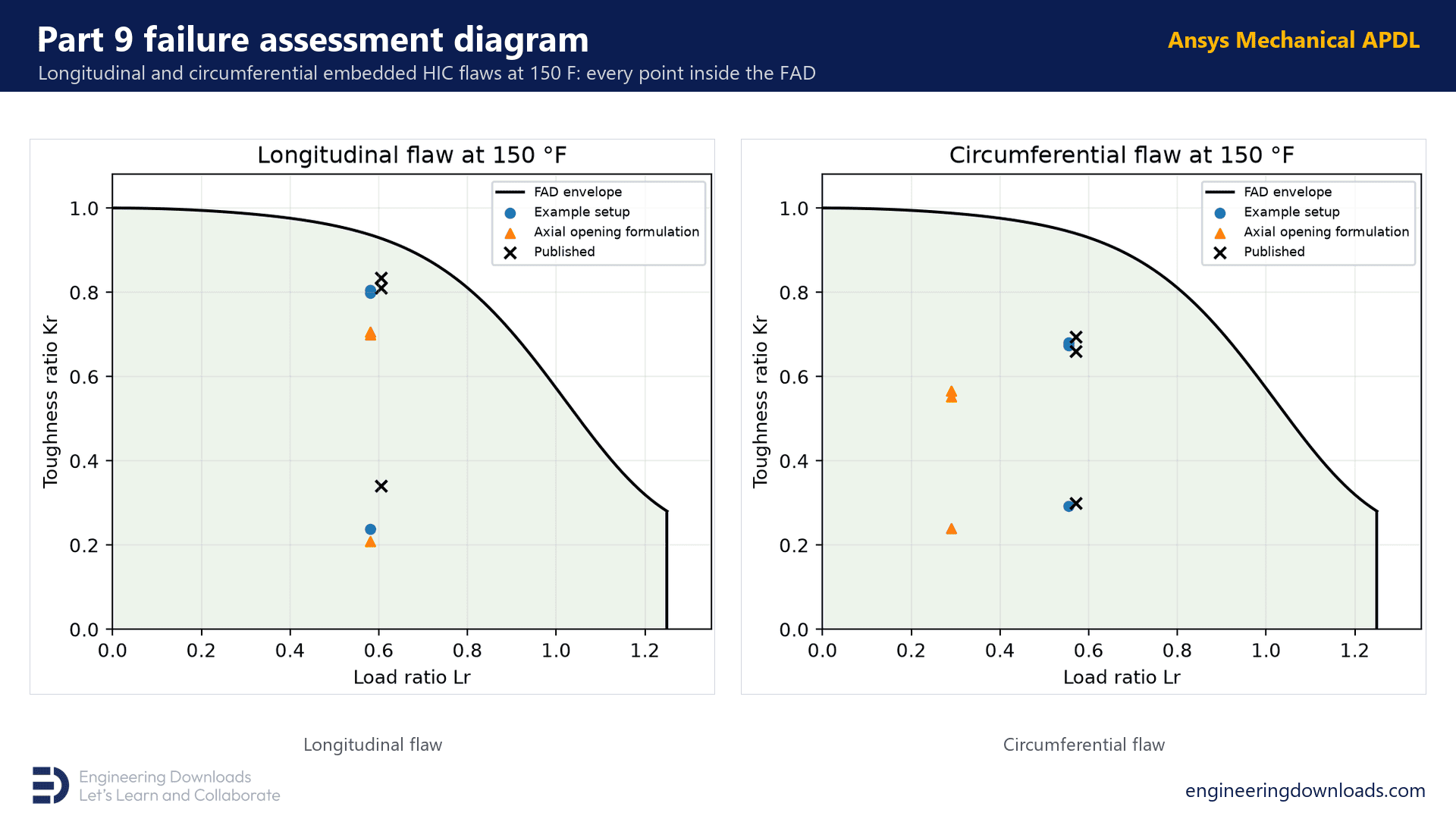
The elastic hoop stresses land within 3 % of the example’s values and the axial membrane stress within 1 %. The bore reaction equals the closed-end pressure thrust (21,572,186 lbf), which checks load application and supports. Lr and the toughness ratios at the flaw tips are within 4 % of the example for both flaw orientations, and all points sit inside the FAD. The arc-length limit pressures, 8,013 psig with the HIC zone and 8,079 psig for the intact vessel, agree with the same model solved in Abaqus to better than 0.02 %. The HIC zone lowers the limit pressure by only 0.8 %, because collapse is governed by the thinner head.
The fracture step is evaluated two ways so you can see the effect of each modelling choice: the example’s setup (hoop opening stress on the circumferential flaw, toughness length equal to c), and a second formulation with axial opening stress and the toughness length capped at 4 in. The Minimum Allowable Temperature is 99.3 °F with the low-sulfur arrest correlation, matching the published 99 °F; the example does not state the sulfur class, and high-sulfur gives 106.7 °F.
Integrity and inspection engineers who assess HIC, SOHIC or blistering in sour-service vessels; FEA engineers who need a checked Annex 2C elastic-plastic and arc-length workflow in Ansys APDL; and anyone learning how Part 9 fracture mechanics fits into a Part 7 Level 3 assessment.
Ansys Mechanical APDL with a structural licence, running in your own installation: the model is delivered as a plain APDL input and a database, so Workbench is not needed. The optional one-click workflow also needs Python 3 with NumPy and Matplotlib.
What does this package calculate? The complete Level 3 assessment of API 579-2 Example 7.4: an Annex 2C large-deformation elastic-plastic analysis of the head-to-shell junction at the load case 3.0 x 0.9 x 2640 = 7128 psig, arc-length limit pressures with and without the HIC zone, the Part 9 failure assessment diagram for the HIC zone as longitudinal and circumferential embedded flaws, and the Minimum Allowable Temperature.
Does it reproduce the API 579 example? Yes for the verdict and the key numbers. The elastic hoop stresses are within 3 % of the example and the axial membrane stress within 1 %, the analysis converges at 7128 psig as in the example, and Lr and the toughness ratios at the flaw tips are within 4 %. All FAD points are inside the envelope, and the Minimum Allowable Temperature is 99.3 F with low-sulfur toughness against the published 99 F.
Do I need Ansys Workbench? No. The model is a plain APDL input file plus an Ansys database, so it runs in your own Ansys Mechanical APDL installation. Python 3 with NumPy and Matplotlib is only needed for the optional one-click workflow.
How is the collapse pressure found? Cases 3 and 4 apply a reference pressure with the arc-length method and large deformation, so the solver follows the pressure-displacement curve through its first limit point. The actual pressure is the reference pressure times the load factor. The limit pressures are 8,013 psig with the HIC zone and 8,079 psig for the intact vessel.
What does the one-click script do? run_model.py launches Mechanical APDL for the four cases, checks each solve, extracts the through-wall stresses, runs the Part 9 FAD assessment and the temperature search, and writes a comparison figure and a results summary. You can also run any single case by reading E74.inp into an empty APDL session.
Is there an Abaqus version? Yes. The same example is available as an Abaqus package with CAE and INP files, so you can compare the two solvers on the same vessel.
What if the package is not what I expected? Write to us. Engineering Downloads refunds clients who are not satisfied with a delivered product.
Is this an API publication or a certified assessment? No. It is an independent worked benchmark and training package. It does not reproduce API figures and does not replace a fitness-for-service assessment by a qualified engineer.
The same example is also available as an Abaqus version of API 579 Example 7.4. For another Level 3 fitness-for-service workflow in APDL, see API 579 Example 4.7 in Ansys: corroded conical transition.
This is an independent worked benchmark for training. It is not an API publication, reproduces no API figures and does not replace an assessment by a qualified engineer. You need your own copy of API 579-1/ASME FFS-1 and API 579-2.
Need more than the files?
There are two ways we can help. Book a one hour online consultation if you want to talk a problem through with a CAE engineer, using the checkbox in the order box. Order a project if you need a full simulation built for you, delivered to an agreed scope, price and deadline under a written contract.
We work on FEA and CFD for engineers, researchers and companies. Order your project, or message us on WhatsApp for a quick reply.
Other packages engineers working on this topic also download.
 API 579 Example 7.4 in Abaqus: HIC Damage Level 3 Assessment with FAD and Plastic Collapse€139,00
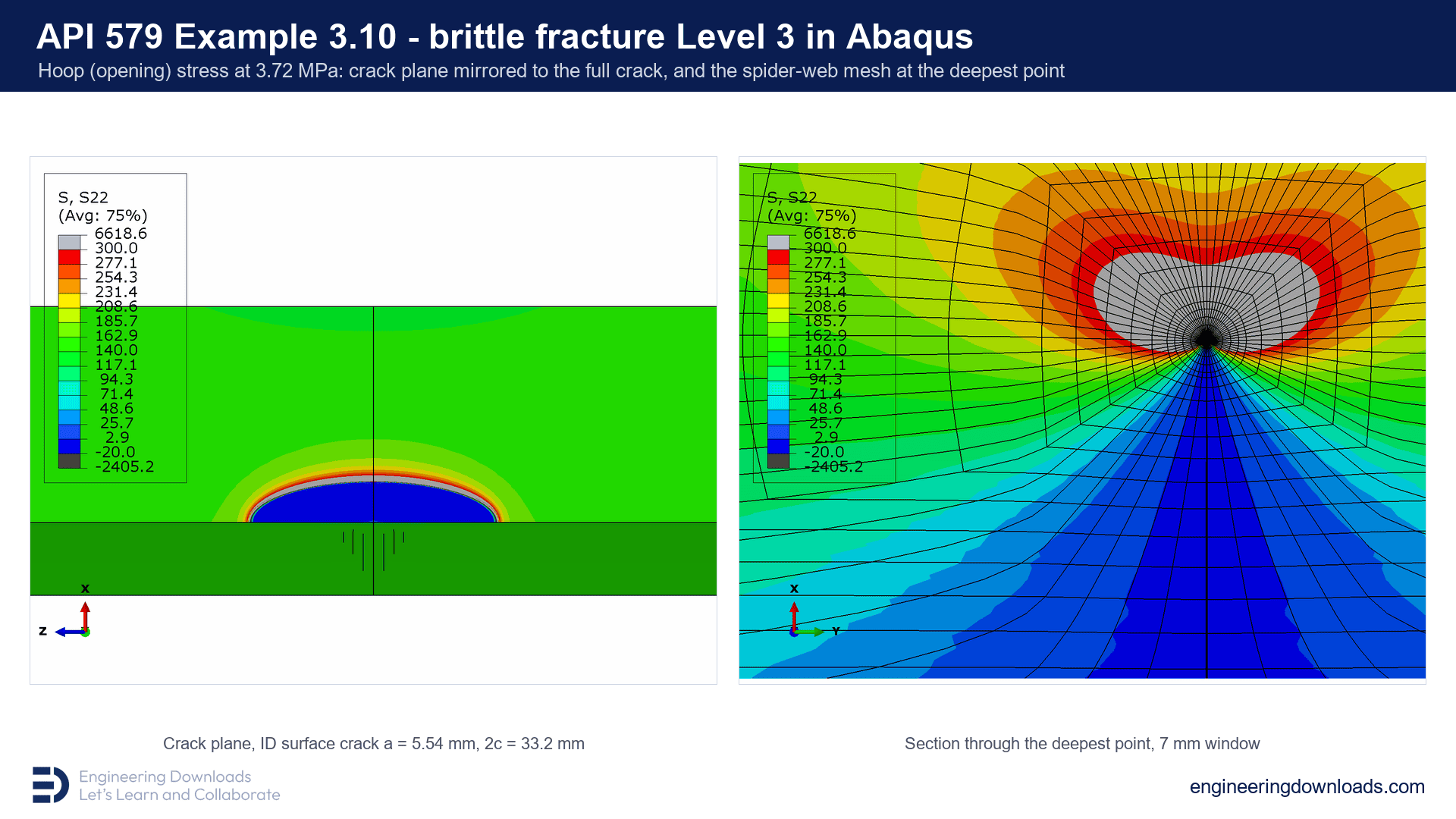 API 579 Example 3.10 in Abaqus: Brittle Fracture Level 3, Demethanizer Thermal Shock€139,00
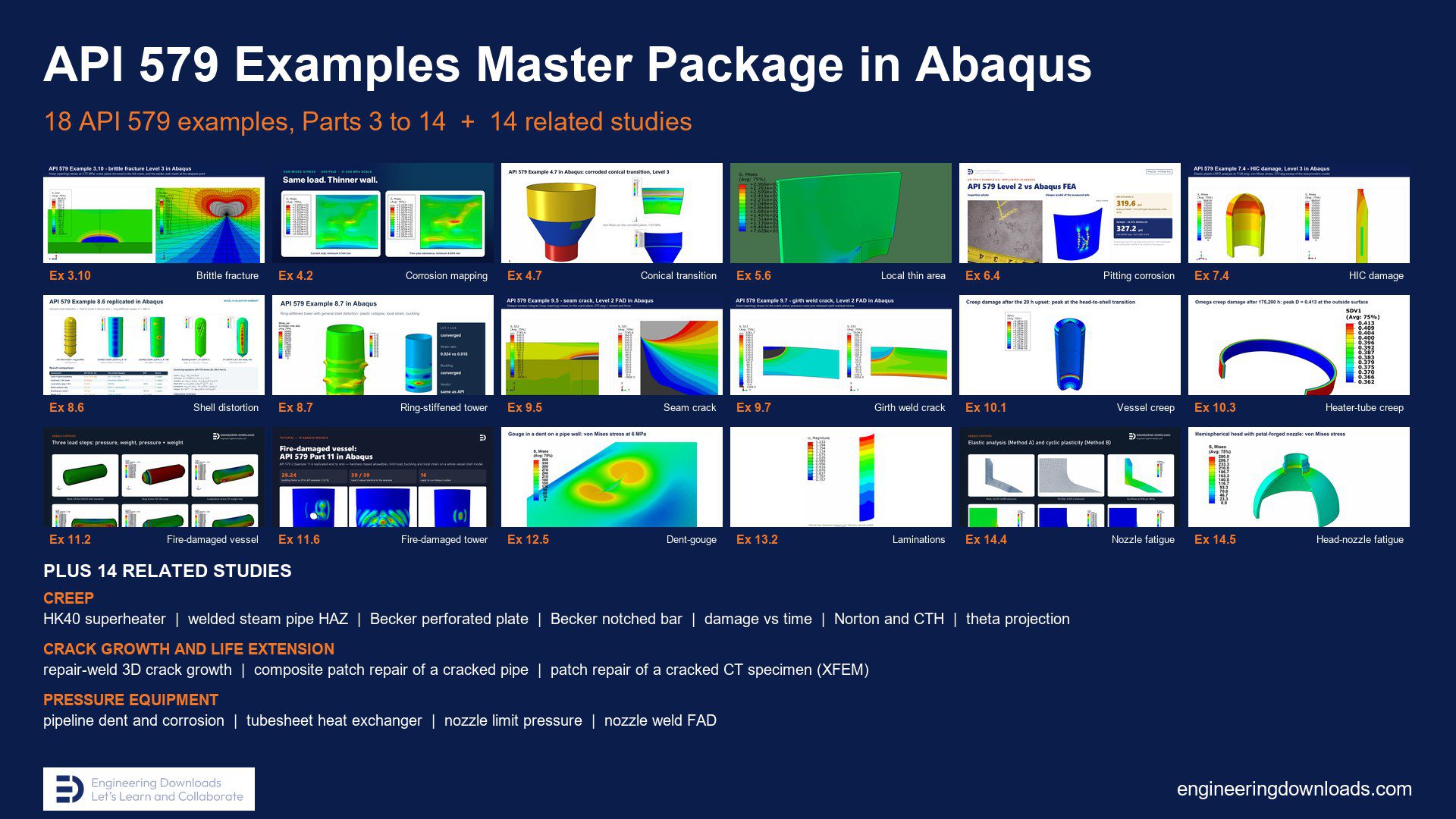 API 579 Examples Master Package in Abaqus: 18 Examples from Parts 3 to 14 plus 14 Creep, Crack Growth, Life Extension and Pressure-Equipment Studies
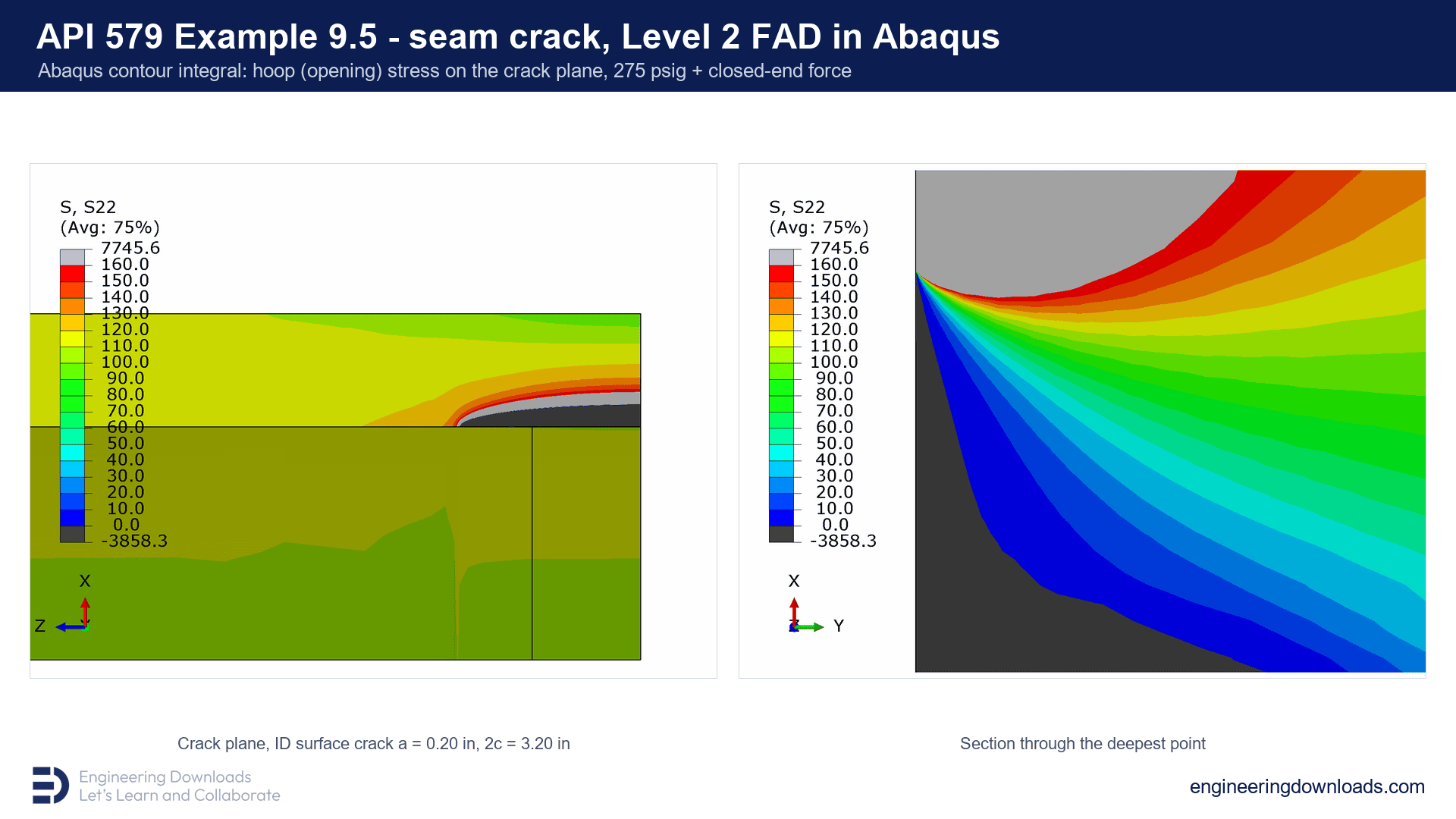 API 579 Example 9.5 in Abaqus: Seam Crack Level 2 FAD with 3D Contour Integral€99,00
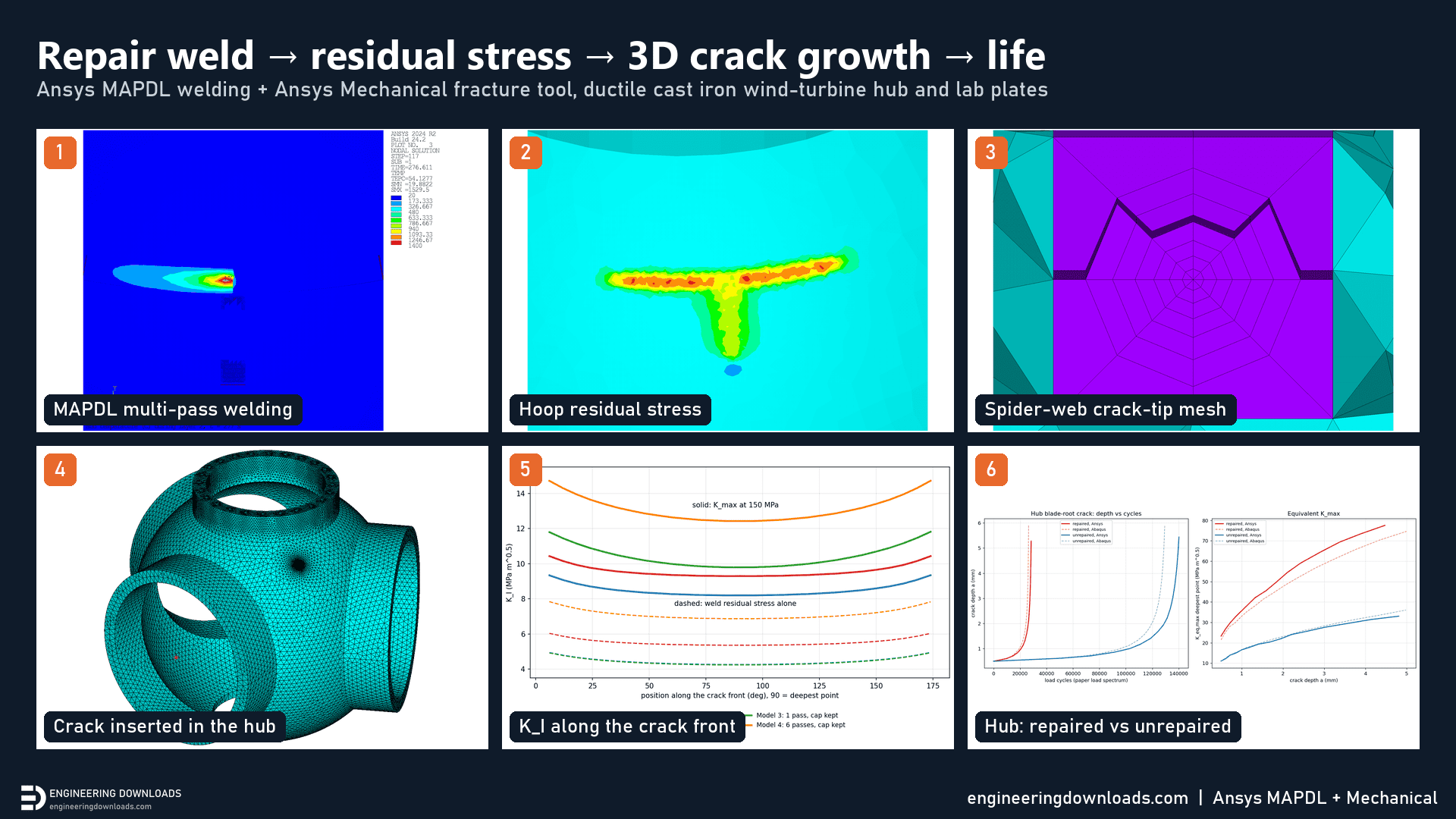 Repair Welding Residual Stress and 3D Fatigue Crack Growth in Ansys: Ductile Cast Iron Wind-Turbine Hub (FFS Level 3)€299,00
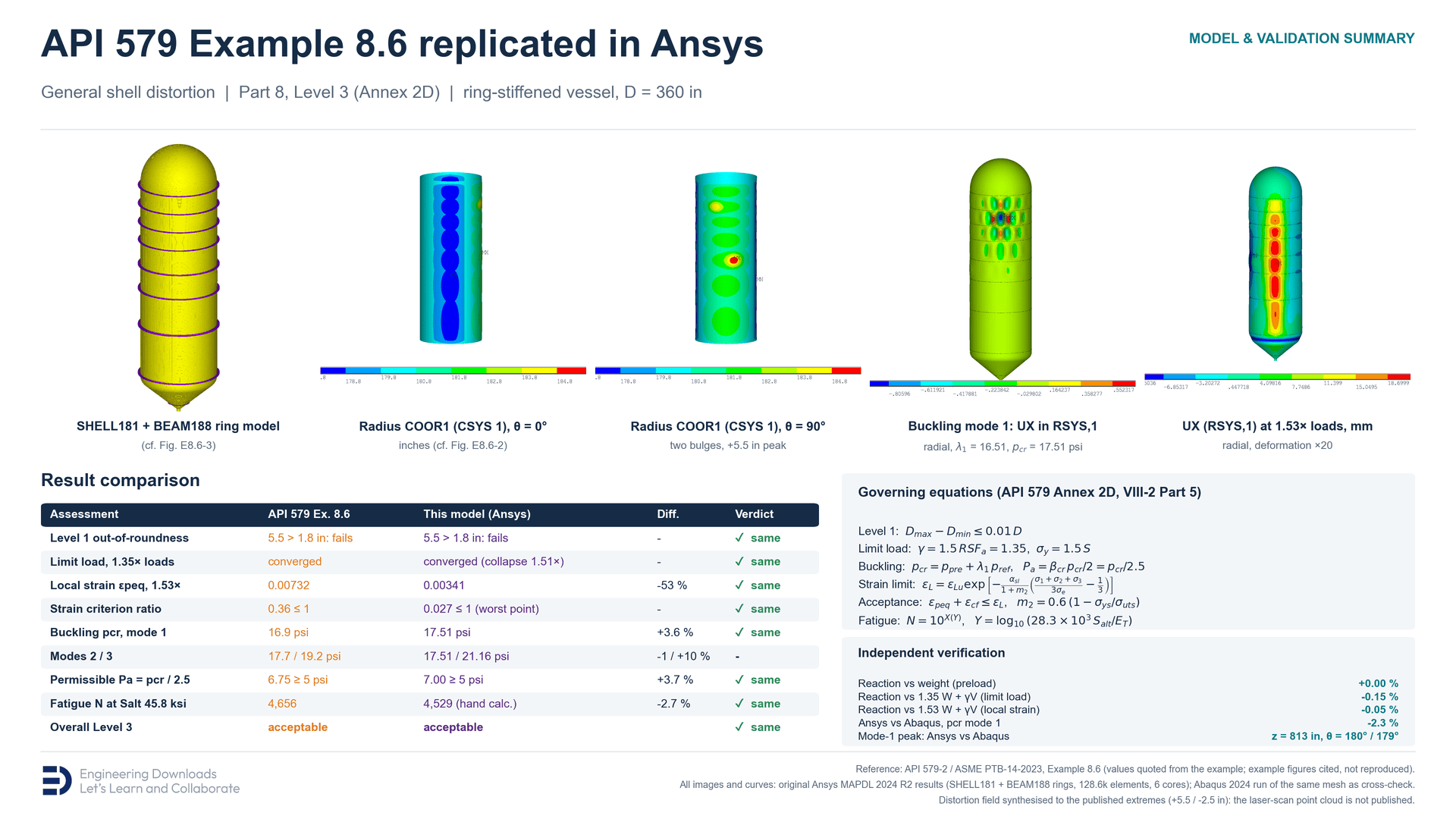 API 579 Example 8.6 in Ansys: General Shell Distortion and Buckling, Level 3 FFS€129,00
 API 579 Example 9.7 in Abaqus: Girth Weld Crack with Weld Residual Stress, Level 2 FAD€129,00
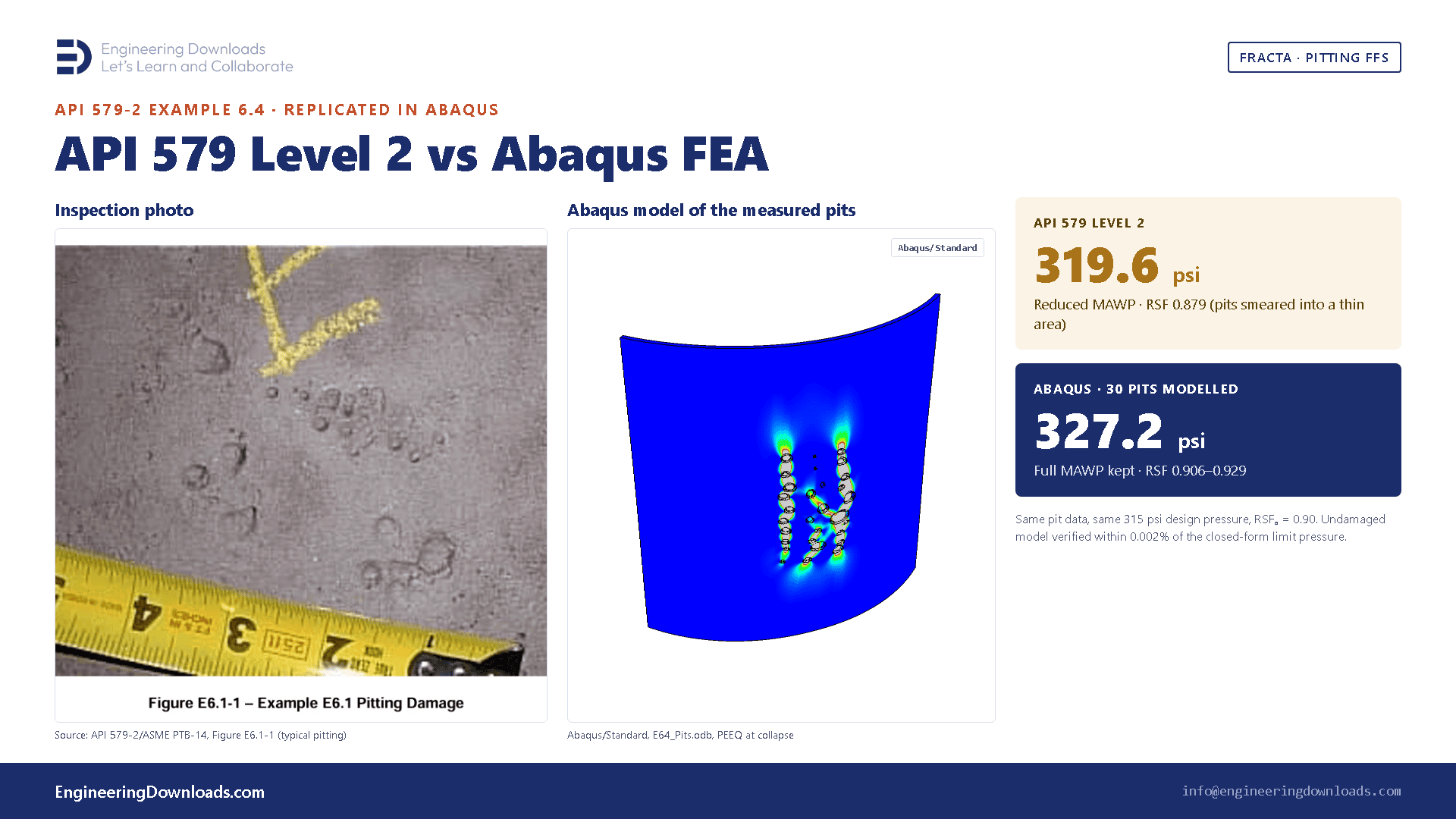 API 579 Example 6.4 in Abaqus: Localized Pitting Corrosion, Level 2 vs Level 3 FFS€129,00

Need a full custom project? See the options below.

€129,00

€179,00

€149,00

€119,00

€129,00

€149,00
See more
Want to receive push notifications for all major on-site activities?



