Need a full custom project? See the options below.
Need a full custom project? See the options below.
Internal ring stiffeners are used in circular hollow section (CHS) joints in offshore jackets and other tubular steel structures. This Ansys example shows how to set up furnace heating and compare the resulting steel temperatures with two full-scale tests. It compares an unstiffened joint, SP-T1, with a joint reinforced by three internal rings, SP-T2.
In the Ansys reproduction of the paper’s Fig. 22 case, the chord wall indents under the brace and the two outer rings fold out of plane. The central saddle ring stays nearly straight. The cutaway shows the solved mesh at true deformation scale.
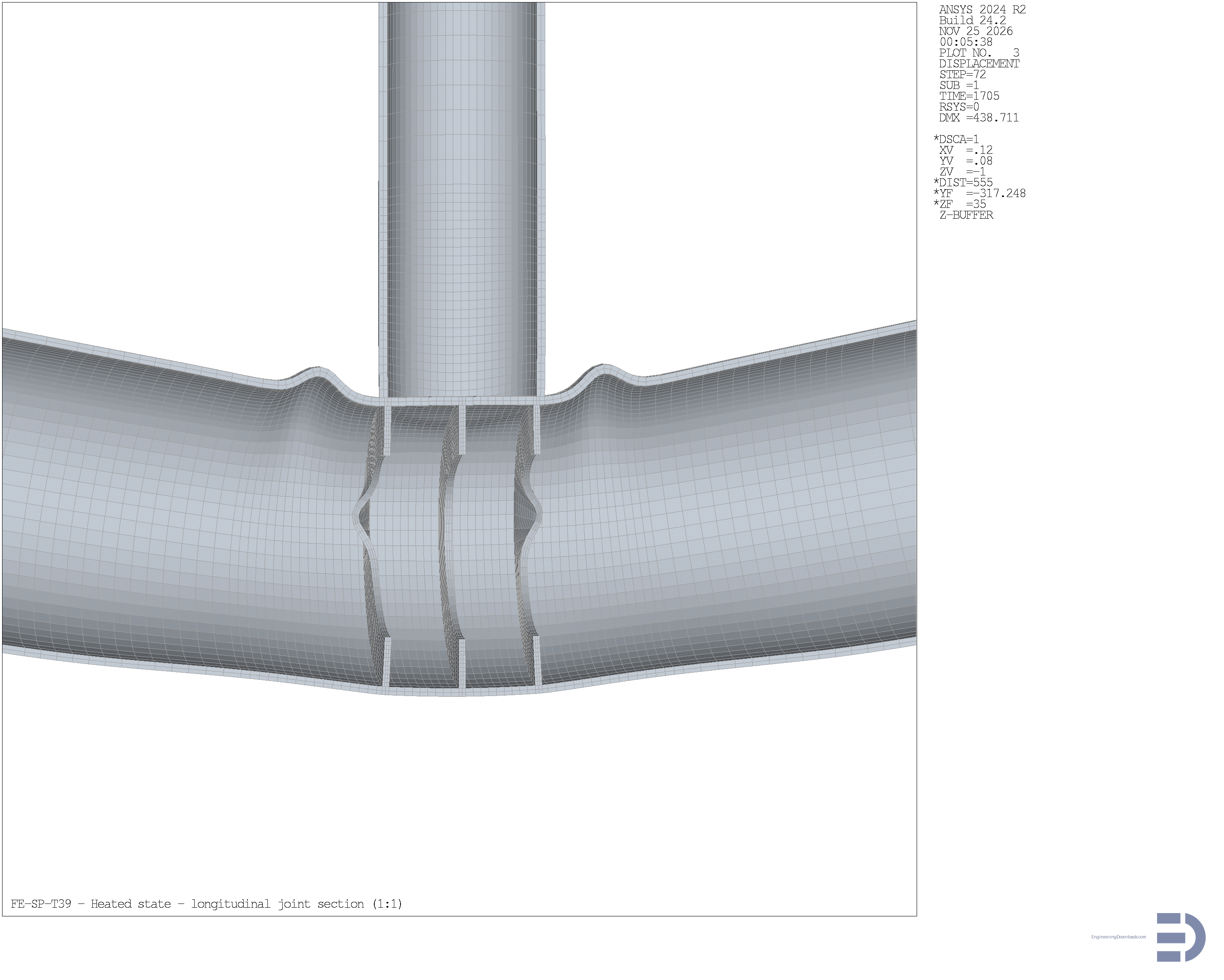
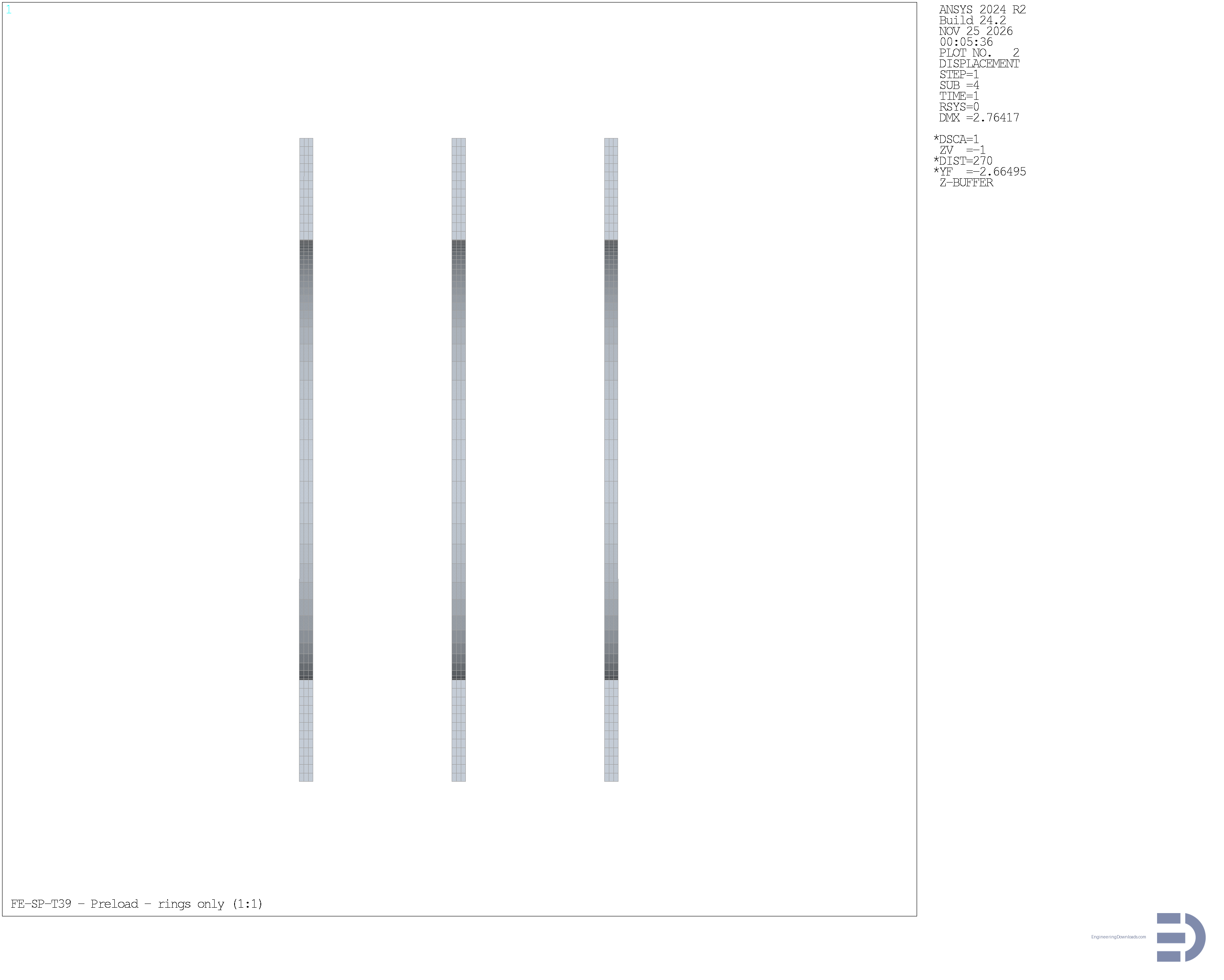
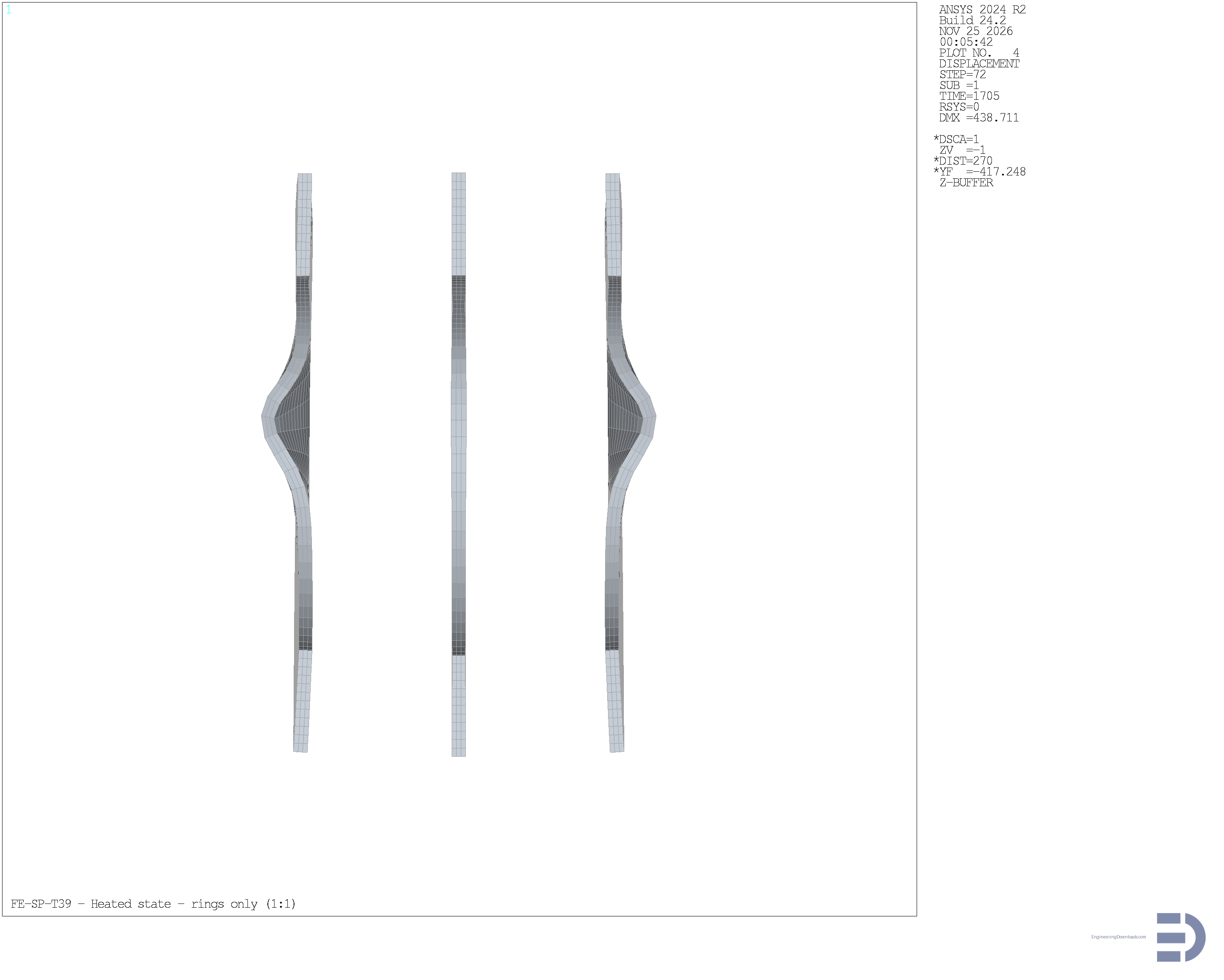
FE-SP-T39 is the paper’s Section 4 parametric configuration with a 400 mm chord, fixed chord ends and 169.1 kN of brace compression during ISO 834 heating. Both Ansys meshes reach 12 mm of relative chord indentation at a crown temperature of about 699 °C. The corresponding benchmark in Fig. 24 is about 714 °C. In both meshes, the outer-ring warp is about 15.2 mm at 1,680 s.
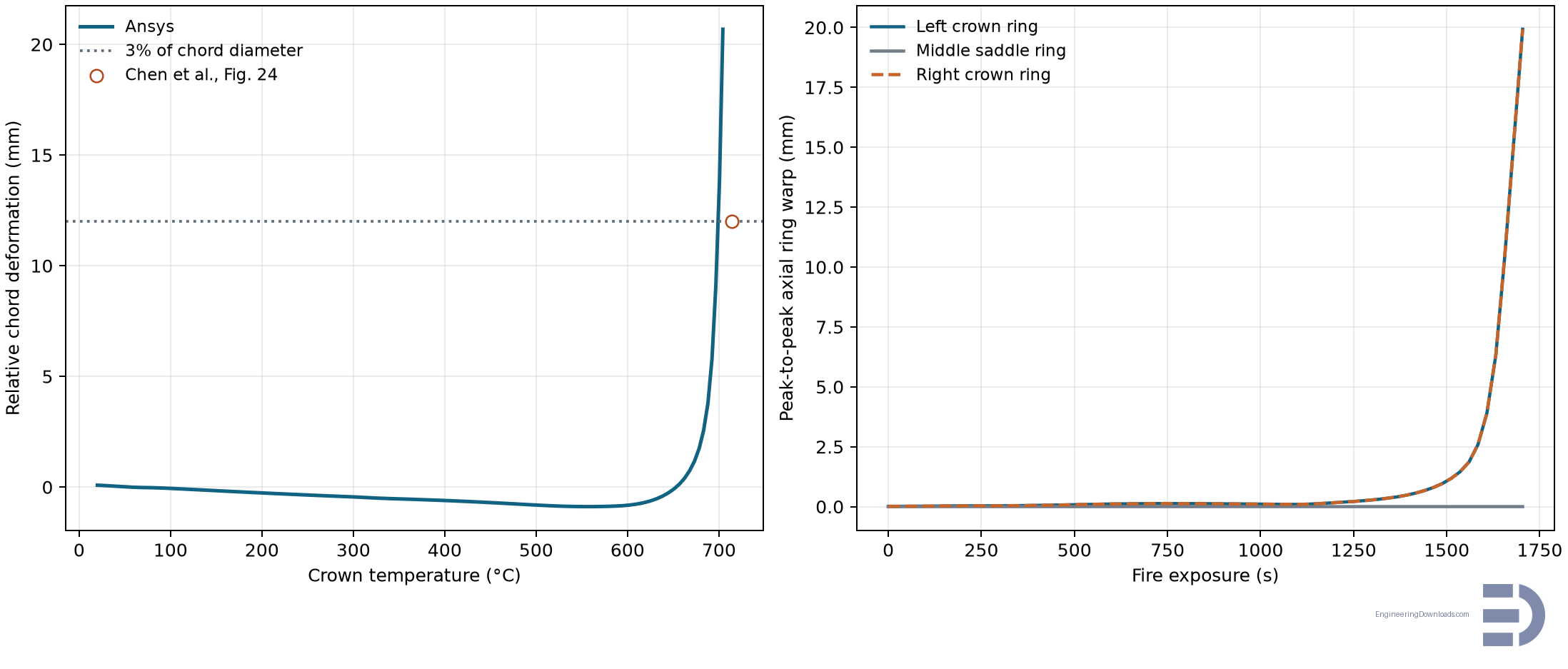
For the reference failure shape, see Fig. 22 in Chen, Shao and Yang (2015). The SP-T1 and SP-T2 furnace-test models below are a separate comparison.
Study on fire resistance of circular hollow section (CHS) T-joint stiffened with internal rings
Chen, Shao and Yang tested two full-scale CHS T-joints, one unstiffened and one reinforced with internal rings. They applied a constant compressive load to each brace and heated the joints in an electric furnace until failure. The authors reported that the rings limited chord heating and increased the time to failure. They compared sequentially coupled thermal and structural models with measured temperatures and displacements at the crown, saddle and brace end, then used those models to study how ring dimensions and tubular diameter ratios affect fire resistance and failure mode.
C. Chen, Y.B. Shao and J. Yang, Thin-Walled Structures, 92, 104–114 (2015). Read the paper and its failure-mode figures.
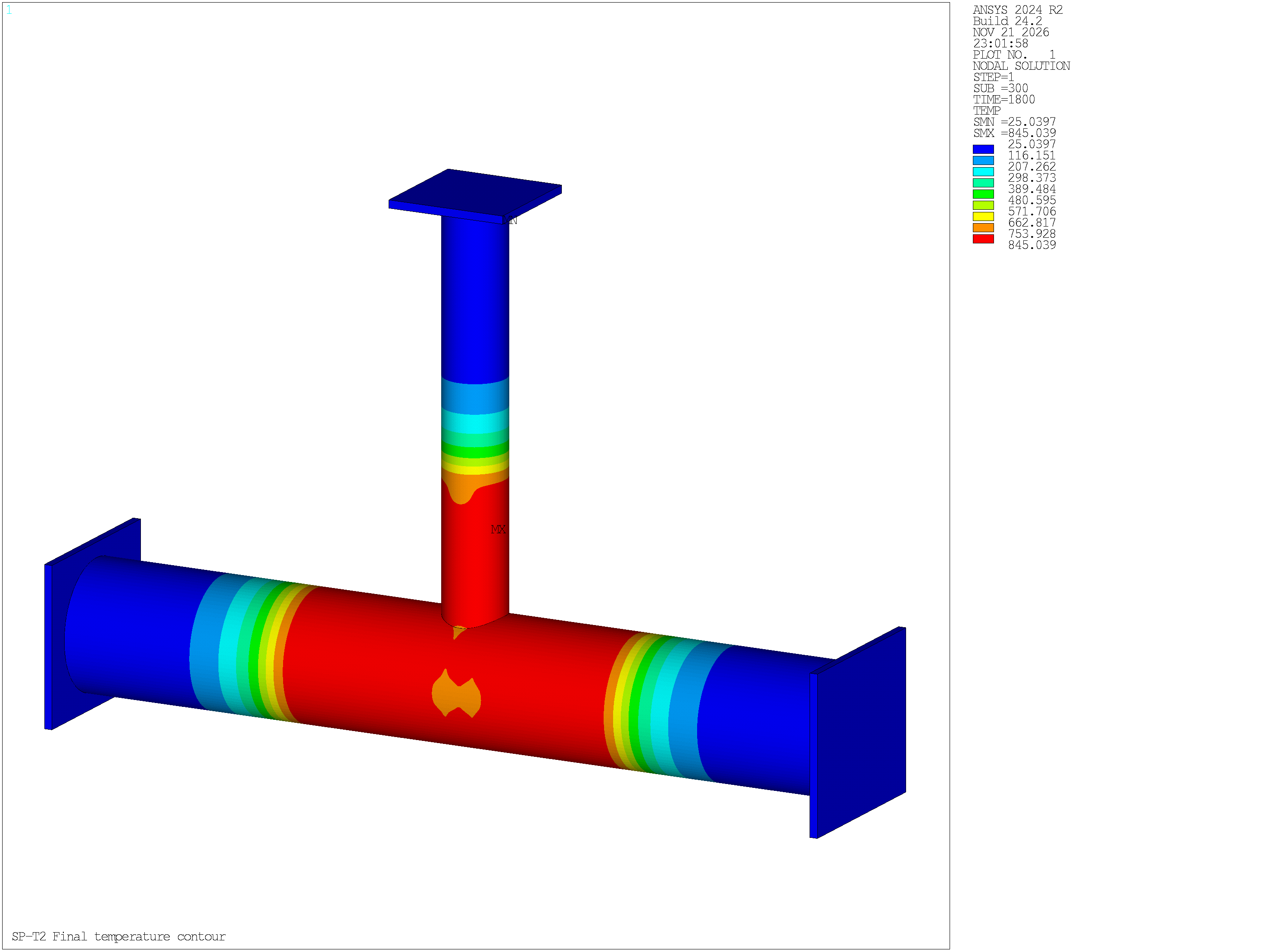
The furnace-test model uses solid elements for the steel chord, brace, end plates and rings. The chord is 325 mm in outside diameter with a 6 mm wall. The brace is 159 mm in outside diameter with a 6 mm wall. SP-T2 has two crown rings and one saddle ring. The test fixture supports the chord ends, and the furnace test applies a sustained 98.4 kN compressive load at the brace end.
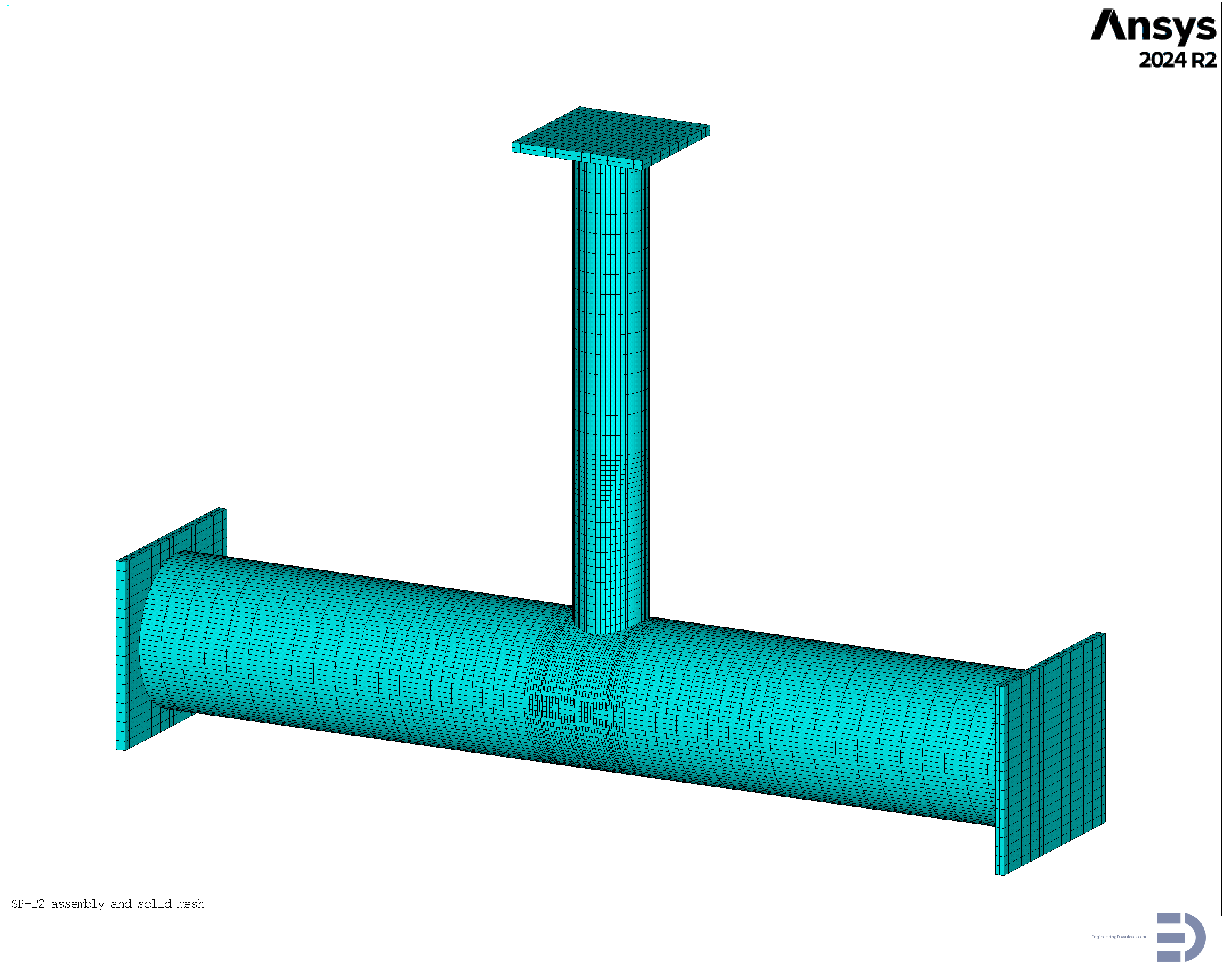
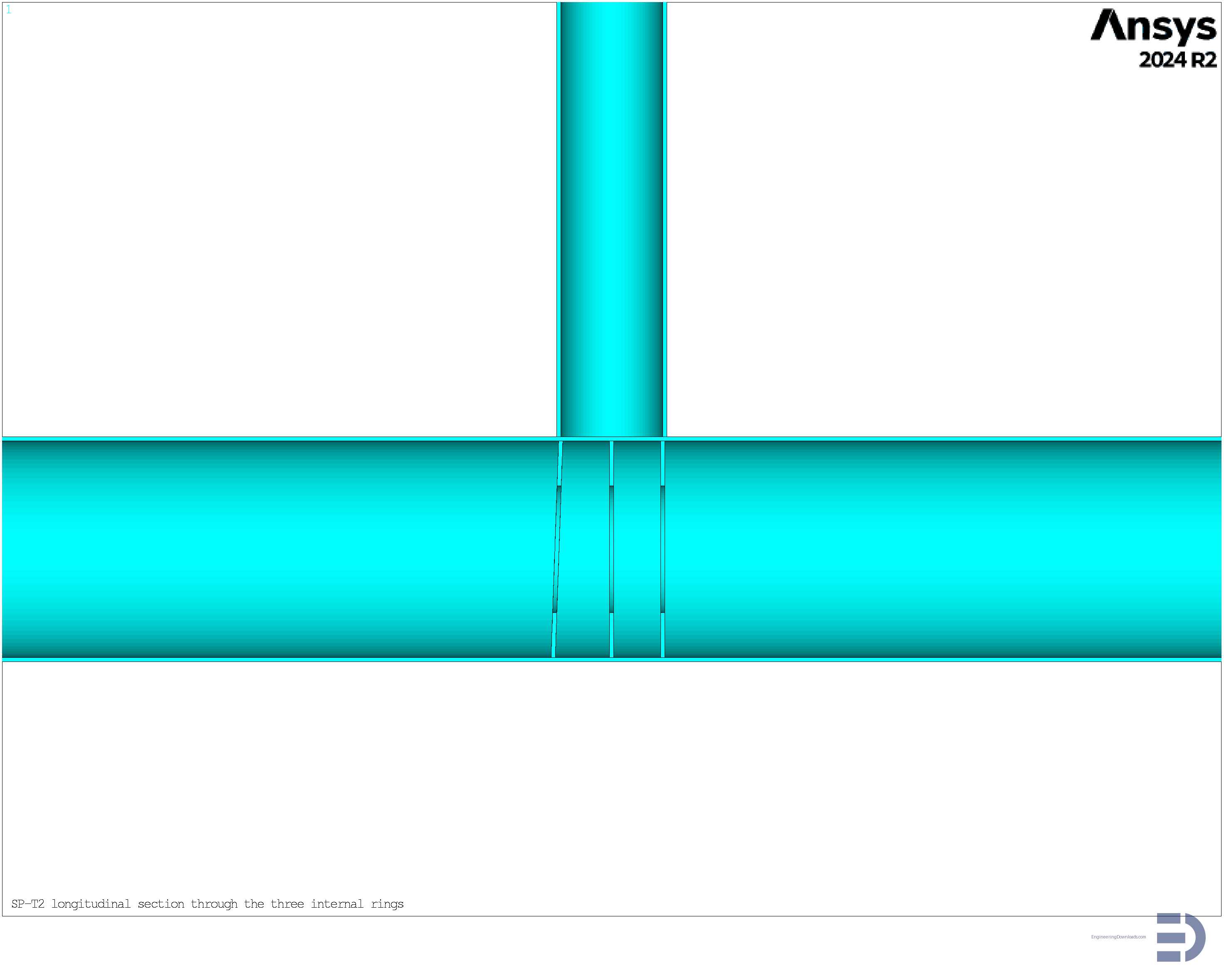
The transient conduction equation is ρcp∂T/∂t = ∇·(k∇T), where ρ is density in kg/m3, cp is specific heat in J/(kg·K), k is thermal conductivity in W/(m·K), and t is time in seconds. The exposed surface receives q = h(Tair − T) + εσ(Tcoil4 − T4), in W/m2. The radiation term uses absolute temperatures in K. The model uses h = 25 W/(m2·K) and effective emissivity ε = 0.7.
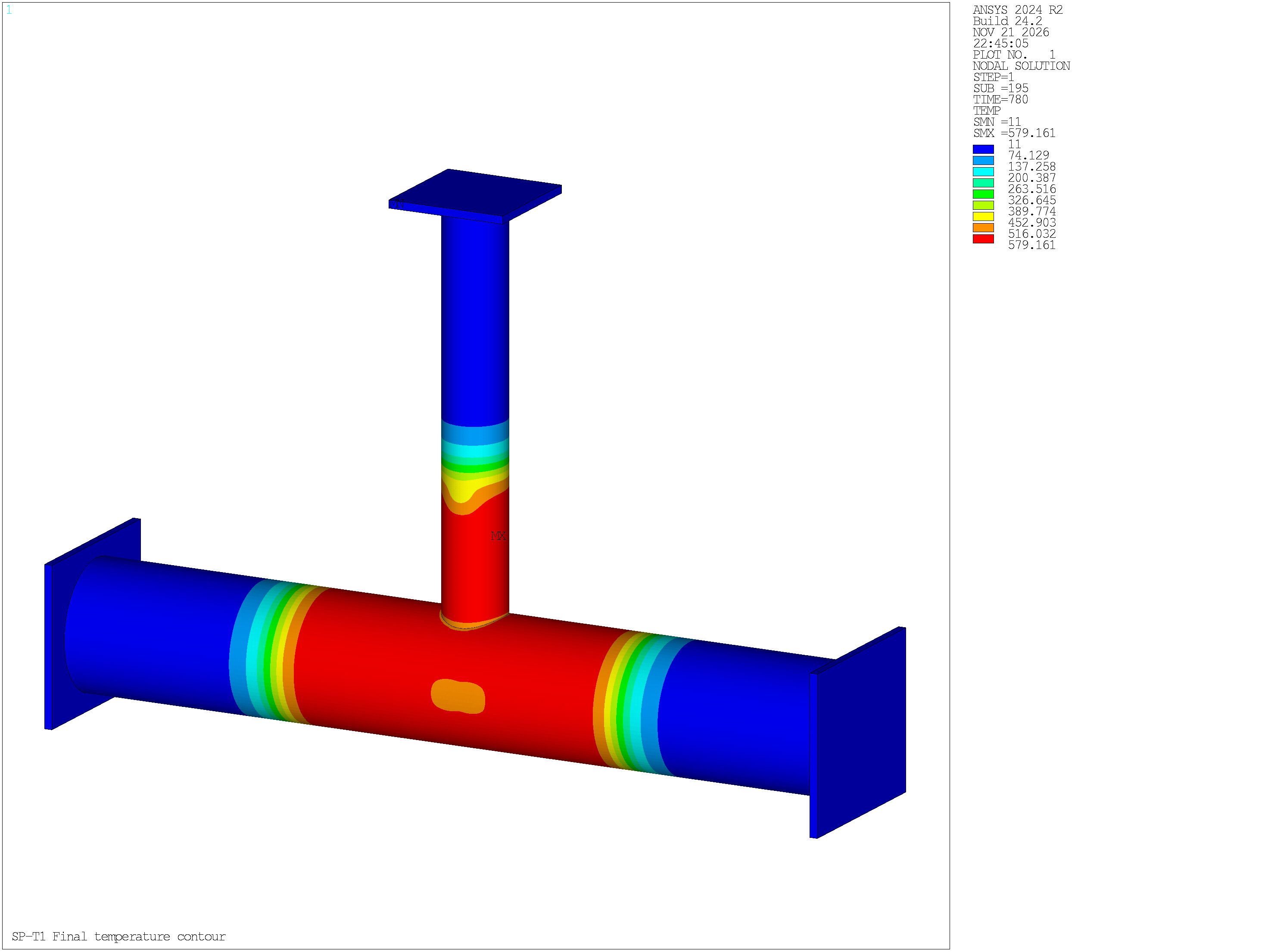
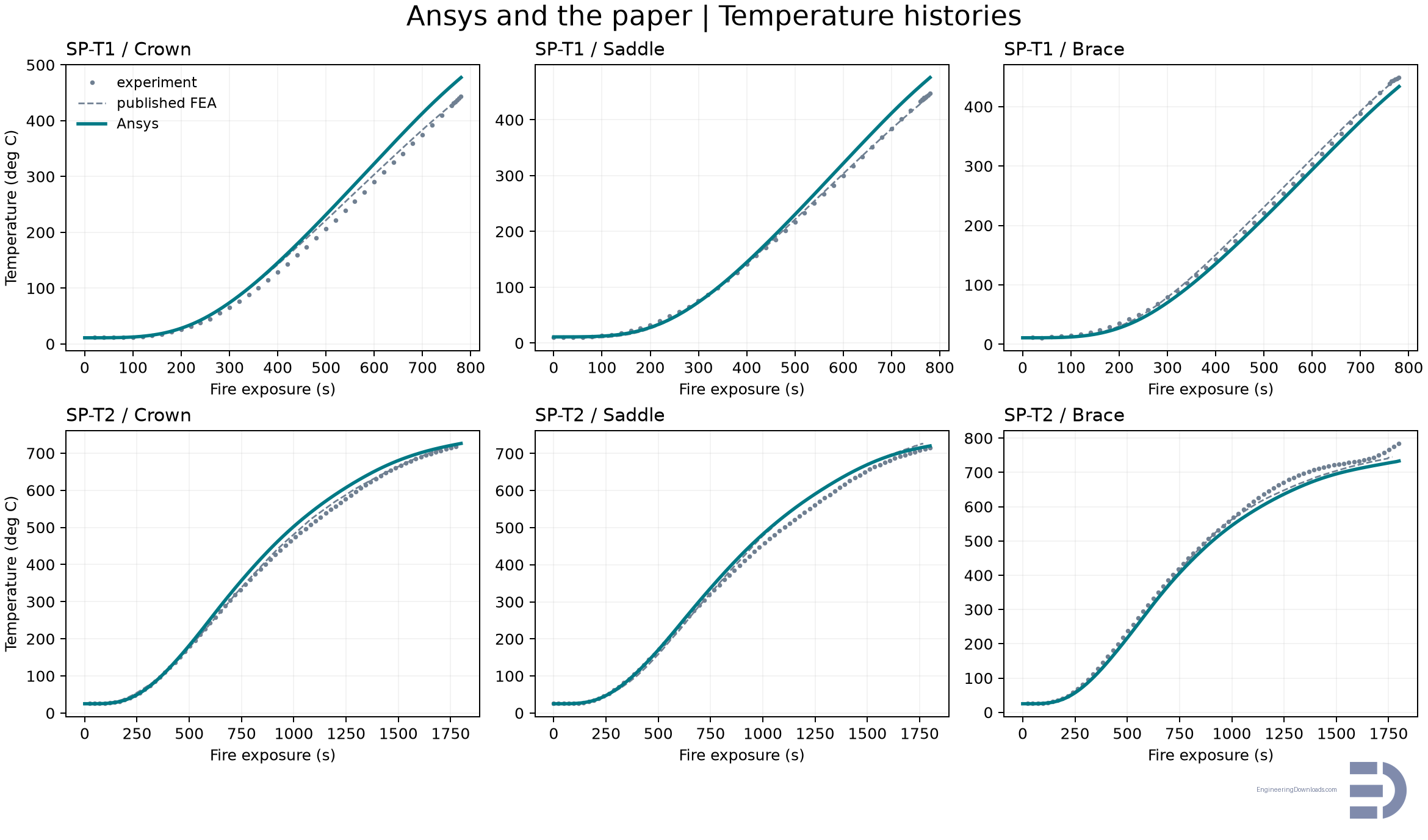
The comparison uses temperatures at the crown, saddle and brace over the shared furnace-test time range. The root-mean-square errors against the plotted test histories were 10.8–23.9 °C for SP-T1 and 17.0–23.4 °C for SP-T2.
For a related tubular-joint example, see the Ansys offshore tubular T-joint stress concentration study.
Need more than the files?
There are two ways we can help. Book a one hour online consultation if you want to talk a problem through with a CAE engineer, using the checkbox in the order box. Order a project if you need a full simulation built for you, delivered to an agreed scope, price and deadline under a written contract.
We work on FEA and CFD for engineers, researchers and companies. Order your project, or message us on WhatsApp for a quick reply.
Other packages engineers working on this topic also download.
 Analysis of aluminum-wood composite panels under high-velocity impact
 Simulation of Underwater Explosion Near a Floating Structure Using the CEL Method in Abaqus
 API 579 Example 8.6 in Abaqus: General Shell Distortion and Buckling, Level 3 FFS€129,00
 DP600 Dual-Phase Steel Microstructure RVE (Ferrite + Martensite) in Ansys Mechanical: Tensile Response and Plastic Strain Localisation€129,00
 Compression test of middle long CFST column with inner I-shaped CFRP Profile
 Crack Modeling and Mechanical Fracture Parameters in the Four-Point Bending Test Using Abaqus
 Pipe Girth Weld Residual Stress and Post-Weld Heat Treatment in Abaqus: 12Cr1MoV Multi-Pass Weld, DHT and Tempering€129,00
 Modeling the response of ultra-high-performance fiber reinforced concrete beams

Need a full custom project? See the options below.
€129,00

€179,00

€149,00

€119,00

€129,00
See more
Want to receive push notifications for all major on-site activities?