

Abaqus USDFLD Subroutine: Practical Guide with Working Examples
How the Abaqus USDFLD subroutine works, the three keywords you must define, reading stress with GETVRM, two working Fortran examples, and the common mistakes.
Abaqus UMATHT Subroutine: Define Custom Thermal Material Behavior

A practical guide to the Abaqus UMATHT subroutine: what it controls, the variables you must define, a working Fortran example, and how to verify it.
Abaqus DFLUX Subroutine: Practical Guide to Moving Heat Sources

How to use the Abaqus DFLUX subroutine to drive a moving Goldak heat source: interface, working Fortran code, mesh and increment rules, verification and common mistakes.
UMAT vs VUMAT in Abaqus: Which One Should You Use?

UMAT runs in Abaqus/Standard, VUMAT in Abaqus/Explicit. Here is what really differs between them, how to choose, and how to debug each one.
Introduction to UMAT Subroutine in Abaqus
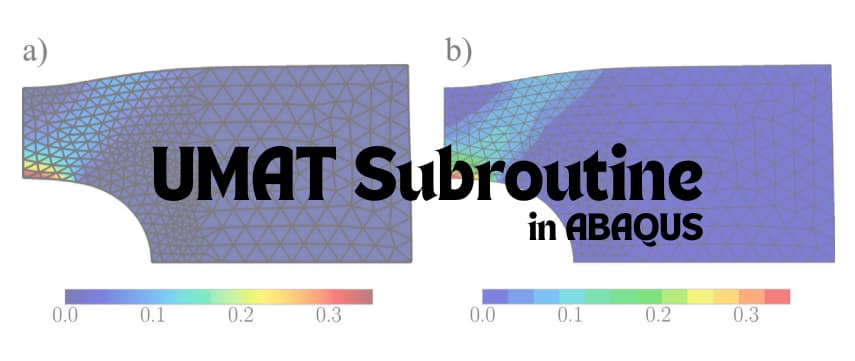
In many engineering projects, the built-in material models in Abaqus are not enough for capturing complex material behavior. This is where user-defined material subroutines come into play. Abaqus allows advanced users to write their own material model through a User MATerial subroutine, commonly known as UMAT. In simple terms, a UMAT is a piece of […]
Large Deformation in ABAQUS via UMAT
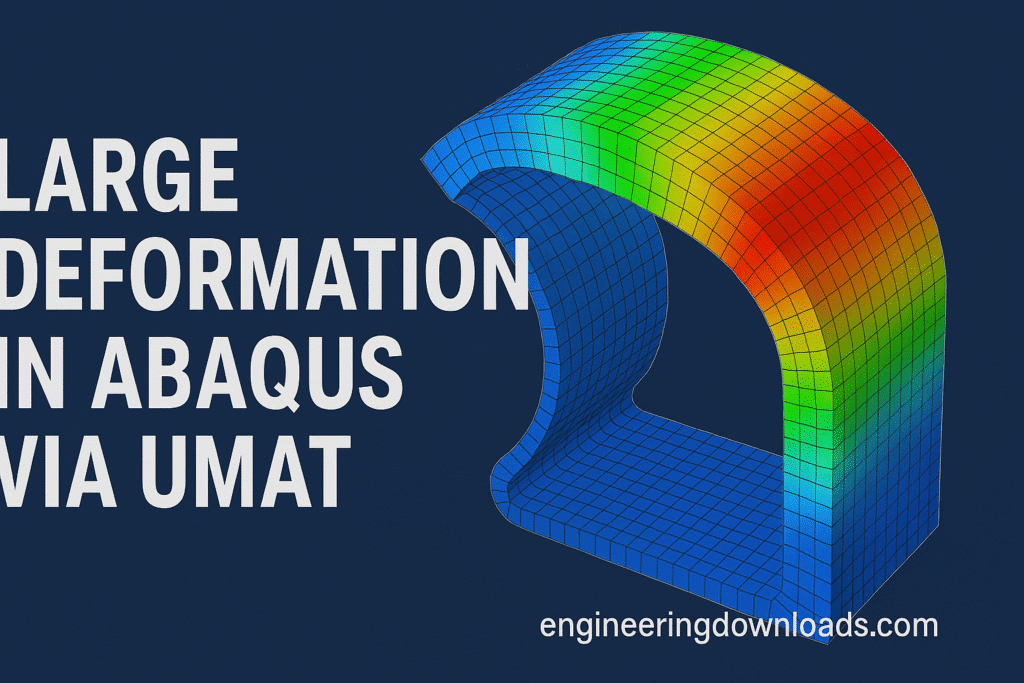
1. An Introduction to Non-Linear Continuum Mechanics Finite deformation (also called large deformation or finite strain theory) is a framework in continuum mechanics that describes the behavior of materials undergoing significant volume changes, where strains and rotations are not small. Contrary to small deformation theories, which assume infinitesimal changes, finite deformation accounts for geometric non-linearities […]
Tips for FEM Analysis of Solid Phase Transformation During Welding
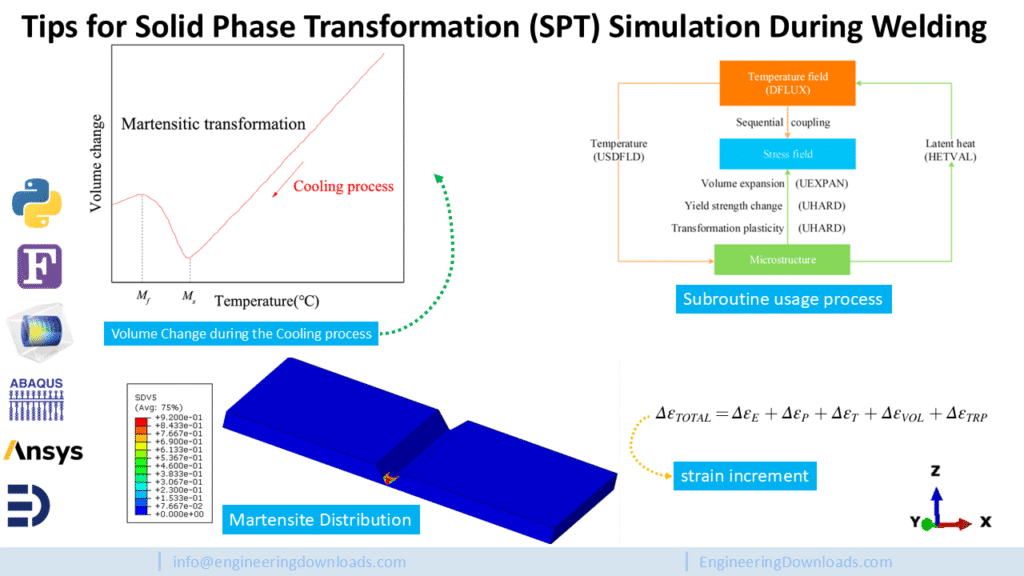
Welding is one of the most critical processes in mechanical and structural engineering. Beyond simply joining metals, it introduces complex thermal cycles, stress fields, and microstructural transformations that can significantly affect the performance of the welded joint. For high-temperature steels like P91, understanding these transformations is essential for predicting residual stresses, hardness distribution, and service […]