

Need a full custom project? See the options below.
Need a full custom project? See the options below.
This package gives you a working 3D Hashin progressive damage model as an editable Fortran user subroutine (VUMAT) for Abaqus/Explicit, together with the open-hole laminate models built around it. It follows the approach of Zhang, Van Paepegem and De Corte (Materials 2024, 17, 5176): each ply is a layer of solid elements with four 3D Hashin failure modes (fiber tension and compression, matrix tension and compression), energy-based softening, element deletion for fractured fibers, and cohesive contact between plies for delamination. Damage inside the plies and separation between plies are stored as separate output variables, so you can see whether a laminate fails by fiber breakage, matrix cracking or delamination.
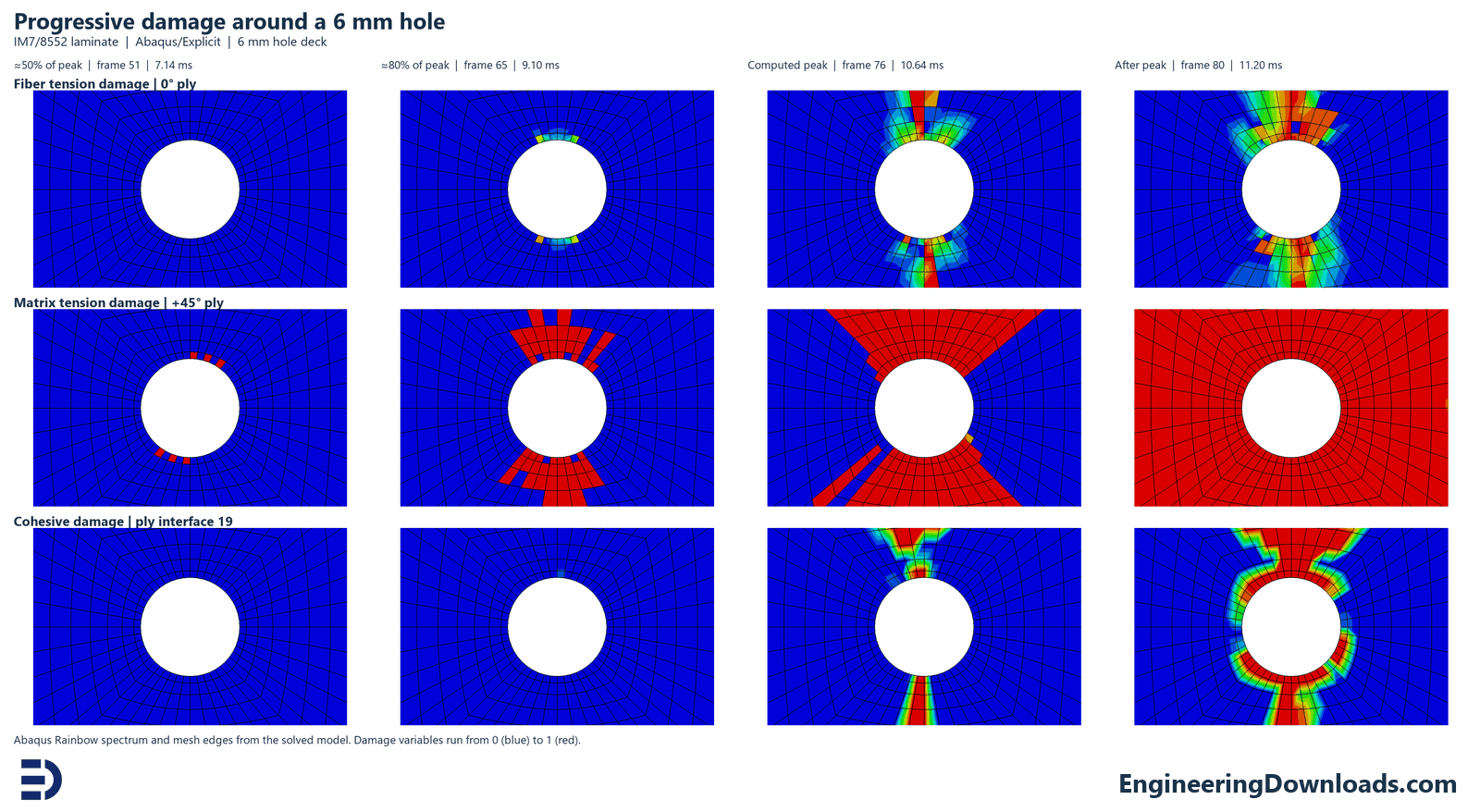
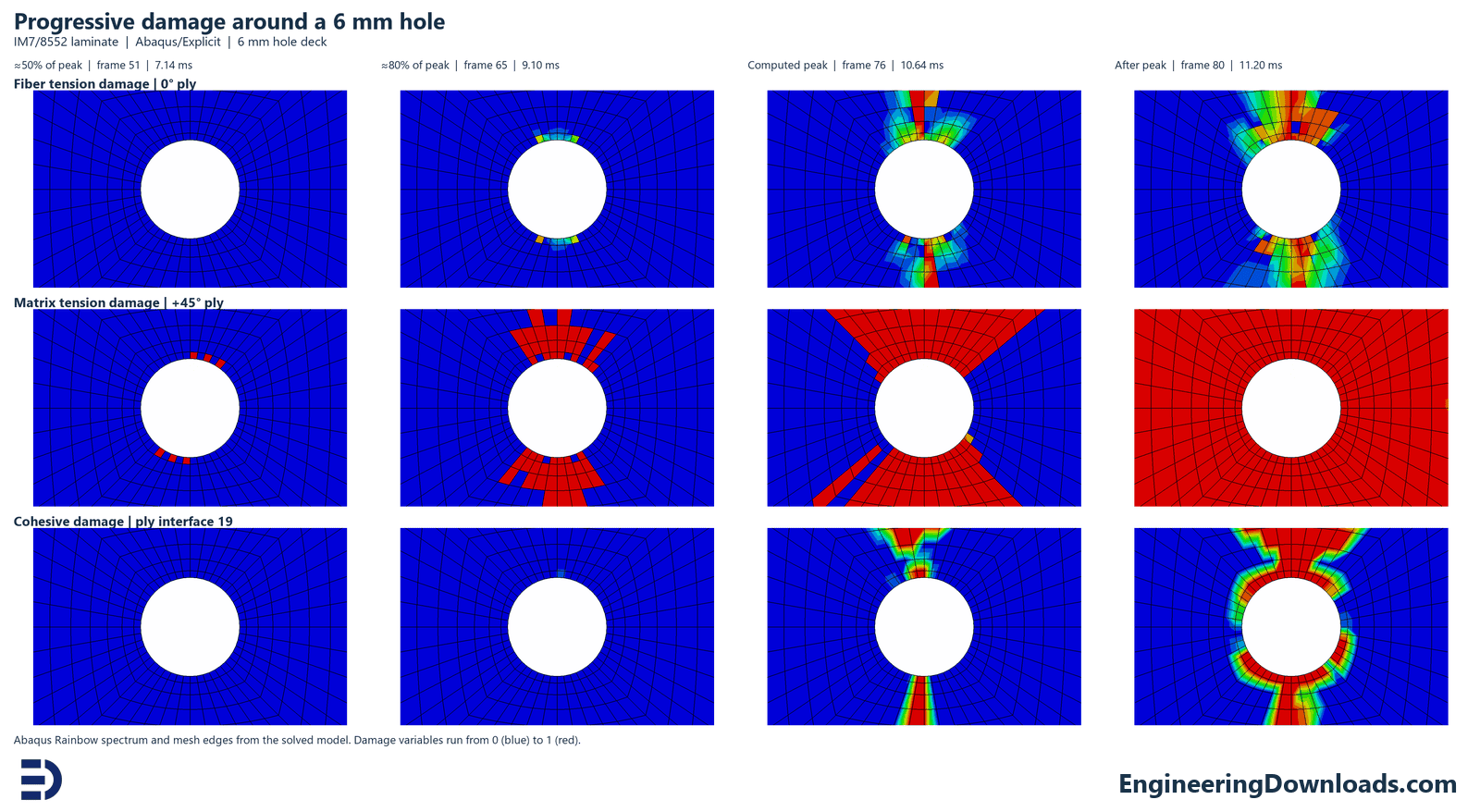
The specimen is 120 mm long and 3 mm thick with a width-to-diameter ratio of 6. It has 24 plies of 0.125 mm, each modeled with one layer of C3D8R elements, and a structured radial mesh around the hole with coarser grip regions. One grip is fixed and the other receives a smooth-step displacement of 1.45 mm over 18 ms. Fixed mass scaling keeps the explicit run short, and the kinetic-to-internal energy ratio can be checked in the output. The IM7/8552 ply data and the cohesive interface data are listed in the tutorial. Units are mm, N, MPa, s and tonne.
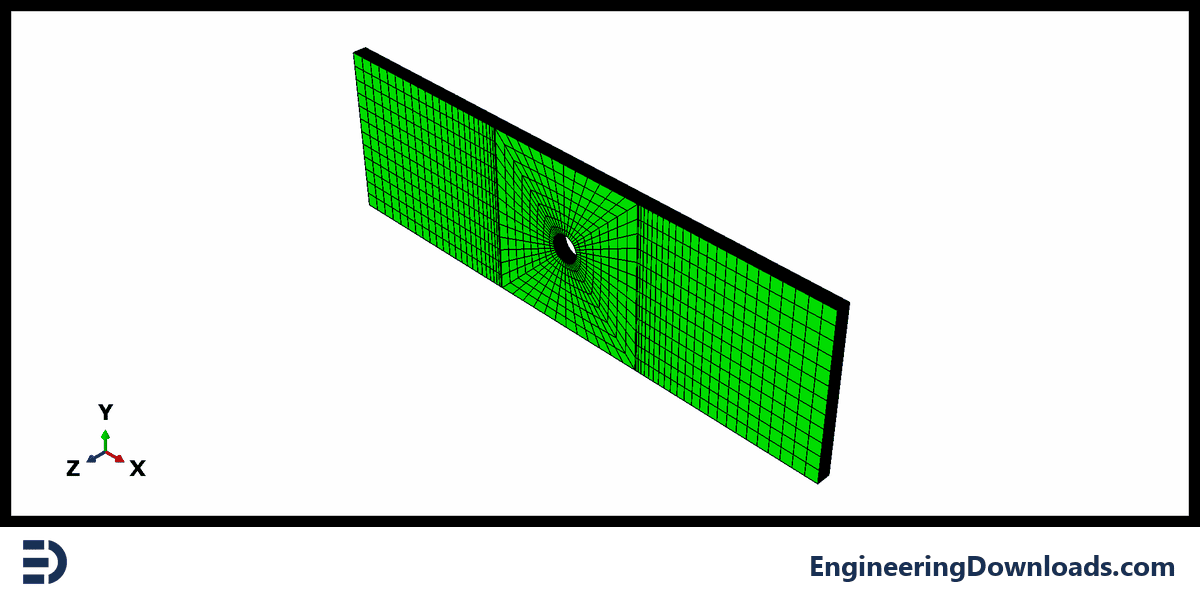
The open-hole decks are application models of the laminate described in the paper. Use them as a ready starting point for your own layups, hole sizes and material data.
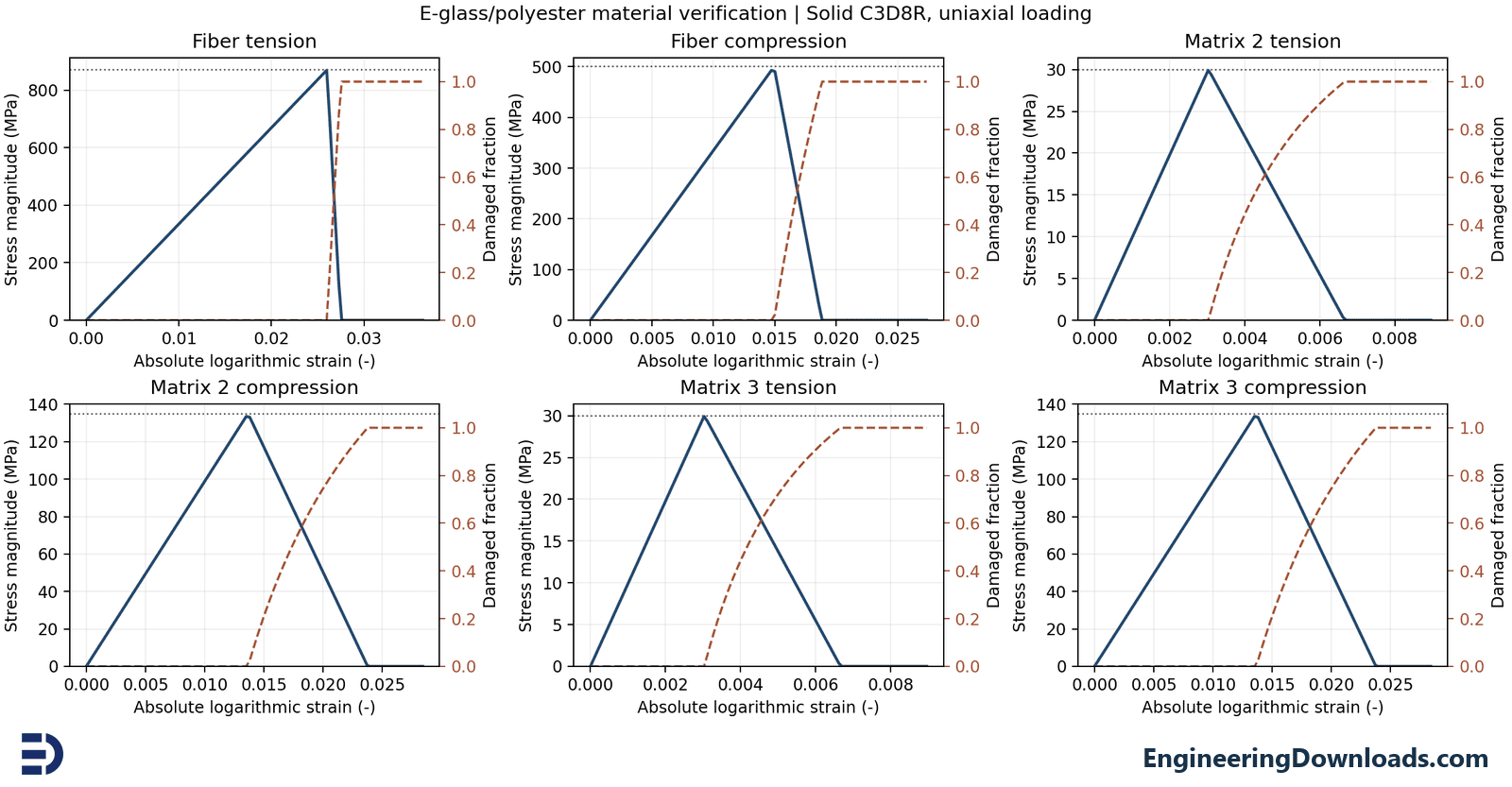
The implementation is checked with single-element and interface decks that you can run yourself with python run_model.py verify:
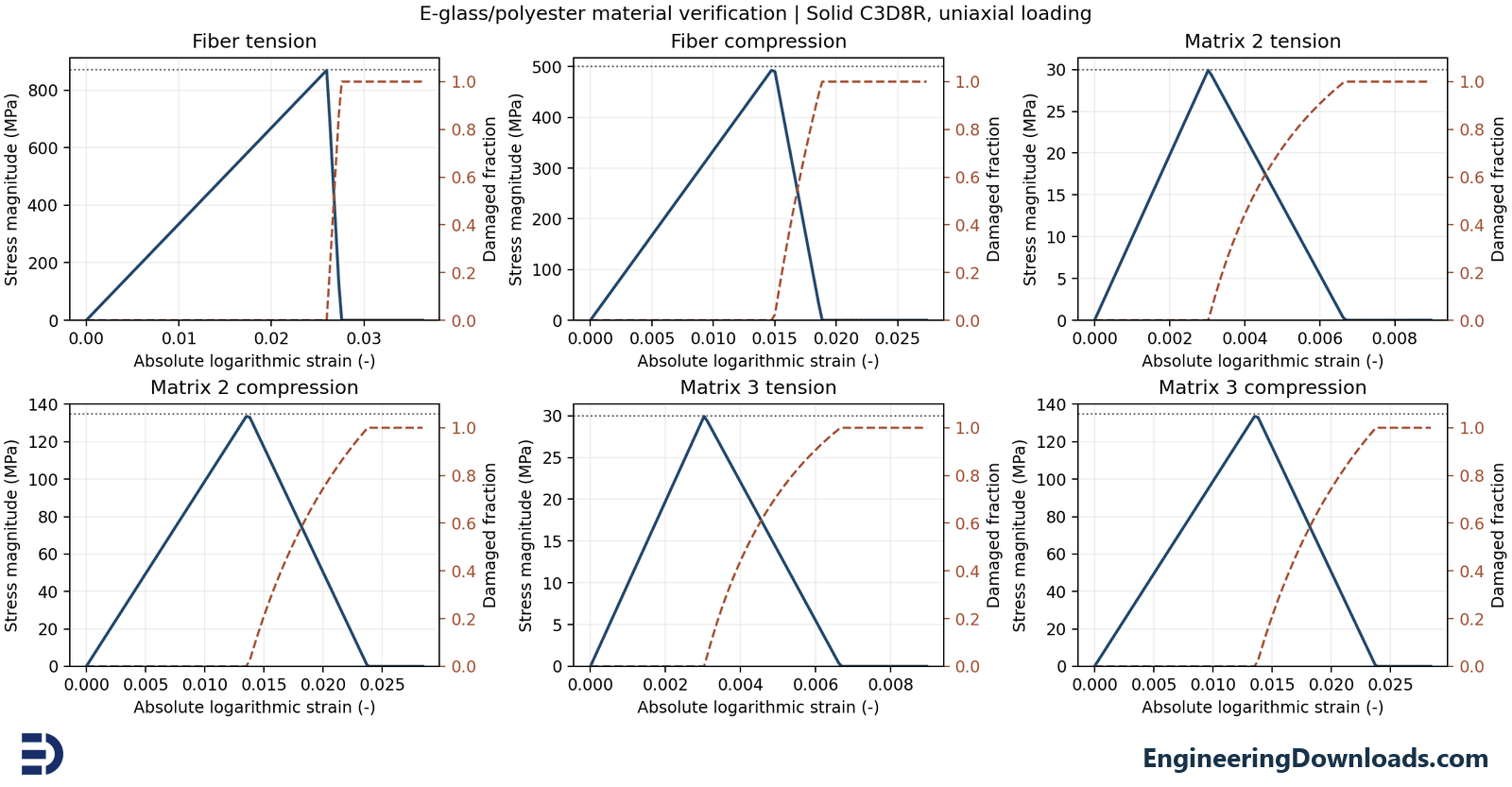
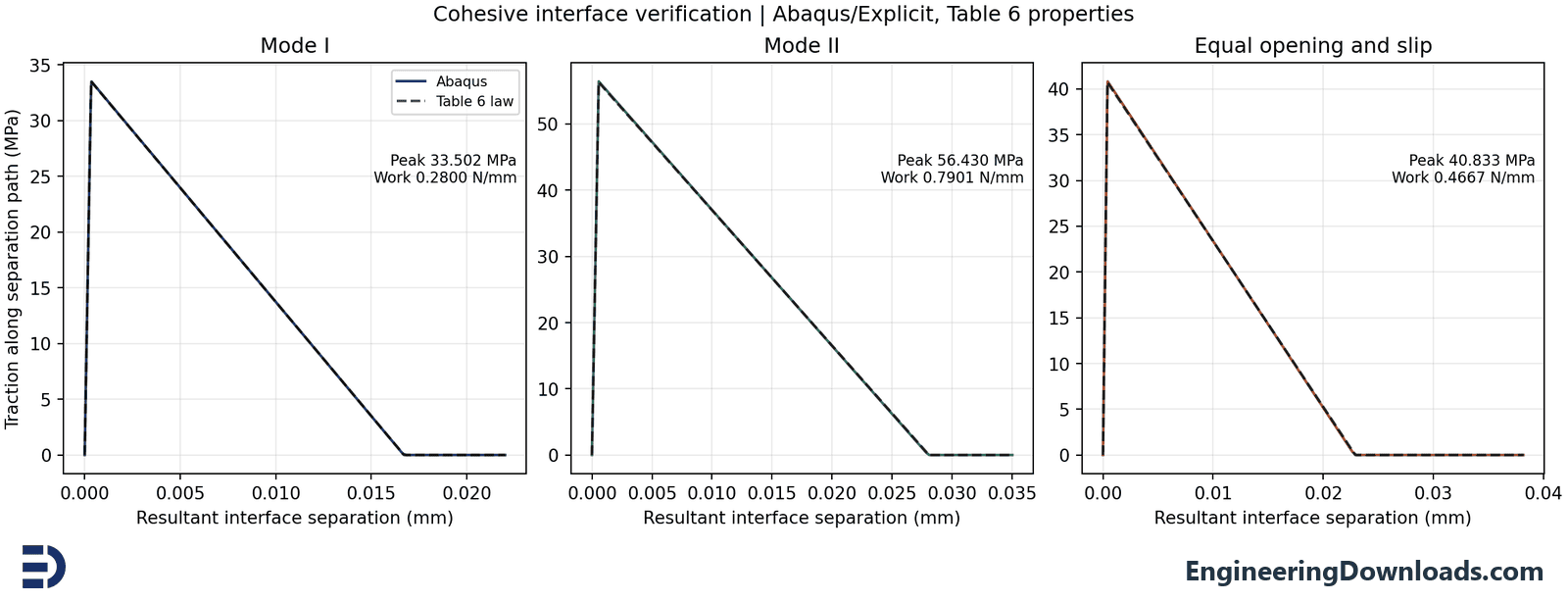
At each integration point the VUMAT evaluates four 3D Hashin failure indices from the stress state. When an index reaches 1 the equivalent strain and stress at onset are stored and linear softening follows, with the final equivalent strain from the fracture energy divided by the characteristic length of the element. Each mode softens only while its loading sign is active, so a damaged ply keeps its tension and compression stiffness separate when the load reverses. A fiber damage of 0.9999 switches the element off so that fractured plies stop carrying load. The plies are joined by surface-based cohesive contact with quadratic stress initiation and mixed-mode energy evolution, which gives the delamination between plies. In Abaqus/CAE you read the results from SDV1 to SDV4 for the four damage modes and from CSDMG and COPEN for the interfaces.

The input files and the full VUMAT source are included, so everything runs in your own Abaqus installation.
The authors present a progressive damage model for laminated fiber-reinforced composites that uses the 3D Hashin failure criterion and is implemented in Abaqus/Explicit through a VUMAT. The model is verified at several levels, from single elements to laminates, the influence of the characteristic length is assessed, and open-hole tests on laminas and laminates are used to compare it with the built-in 2D Hashin model.
Paraphrase by EngineeringDownloads.com; refer to the original article for the authors full text. Source: Zhang, Van Paepegem and De Corte, Materials 2024, 17, 5176, https://doi.org/10.3390/ma17215176. This product is an independent implementation and is not affiliated with the authors or the journal.
What is included in the package? The editable VUMAT source hashin_3d.f90, five open-hole laminate decks (hole_02mm.inp to hole_10mm.inp), single-element and interface verification decks, the one-click Python script run_model.py, a 7-page PDF tutorial and a short README.
How do I run the model? Run python run_model.py in the package folder. By default it solves the 6 mm hole; the options 2, 4, 8, 10, all and verify select other decks. It compiles the VUMAT and solves in double precision in your own Abaqus, with no manual steps. You can also run the input files from the command line.
What do I need to run it? Abaqus/Explicit with a compatible Fortran compiler configured for user subroutines, and Python 3 for the run script. The input files and the full VUMAT source are included, so everything runs in your own Abaqus installation.
Which failure modes are modeled? Fiber tension, fiber compression, matrix tension and matrix compression, with 3D Hashin indices, linear fracture-energy softening and sign-dependent damage evolution. Delamination is modeled with cohesive contact between the plies.
How was the implementation checked? With single-element decks in all material directions (peak stress within 1.4 % of the strength input), shear checks, cohesive mode I, mode II and mixed-mode decks (peak traction within 0.27 %, work within 0.012 %) and a load-reversal check of the transverse unloading stiffness.
Can I use my own material and layup? Yes. The 21 material constants are listed in the deck and explained in the tutorial, and the ply orientations and thickness are set by the orientation definitions in each deck.
Which paper does the model follow? Zhang, Van Paepegem and De Corte, Materials 2024, 17, 5176, https://doi.org/10.3390/ma17215176. This product is an independent implementation and is not affiliated with the authors or the journal.
Need more than the files?
There are two ways we can help. Book a one hour online consultation if you want to talk a problem through with a CAE engineer, using the checkbox in the order box. Order a project if you need a full simulation built for you, delivered to an agreed scope, price and deadline under a written contract.
We work on FEA and CFD for engineers, researchers and companies. Order your project, or message us on WhatsApp for a quick reply.
Other packages engineers working on this topic also download.
 Composite Fatigue UMAT for Abaqus: Hashin, Tsai-Hill and Maximum-Stress Criteria€159,00
 Buckling of a composite plate with a central hole, Abaqus eigenvalue models€129,00
 LPBF 316L Residual Stress and Cantilever Distortion in Abaqus: Sequentially Coupled Thermal-Stress Model with DFLUX and USDFLD Subroutines€159,00
 Timber–Steel Composite Beam Under Air Blast in Abaqus: CONWEP, Hashin & Johnson–Cook Damage
 Peridynamics in Abaqus: Brittle Fracture with a VUMAT, after Han et al. (PeriFEM, CMES 2023)€149,00
 A damage model for tensile test in Abaqus
 Creep Master Package in Abaqus: API 579 Part 10 Examples 10.1 and 10.3, Creep Damage UMAT and Paper Benchmarks€299,00
 Fatigue and Cyclic Loading Package

Need a full custom project? See the options below.

€129,00

€179,00

€149,00

€119,00

€129,00
See more
Want to receive push notifications for all major on-site activities?