Need a full custom project? See the options below.
Hi, Welcome back!
€149,00€169,00
Need a full custom project? See the options below.
Lifetime access
Download capability
29 people watching this product now!
Material Includes
Course notes for all three chapters (PDF, 27 pages)
A1 poster: ASME requirement vs Ansys result (PDF)
11 Ansys Mechanical APDL input files (.dat) with macros (.mac)
APDL macros for PRSECT linearization and the local failure checks
Audience
Stress and integrity engineers
Pressure vessel engineers
FEA analysts using Ansys
Students and researchers
About Course
Part 5 of ASME BPVC Section VIII Division 2 lets you design a pressure vessel by analysis instead of by formula. It is also where most engineers get stuck. The rules are clear on paper. Turning them into an Ansys model, a set of load cases and a pass or fail check is where the hours go.
This course follows Part 5 the way you work on a real project: one vessel, one model, every check. Plastic collapse, local failure, buckling and fatigue, each with a worked example in Ansys Mechanical APDL and a hand calculation that confirms the FE result.
Stress linearization with PRSECT on nine stress classification lines
Arc-length runs that find the real collapse load, and APDL macros that evaluate the local failure checks as contour plots, with no user subroutine or compiler
Every result cross-checked against the same models solved in Abaqus
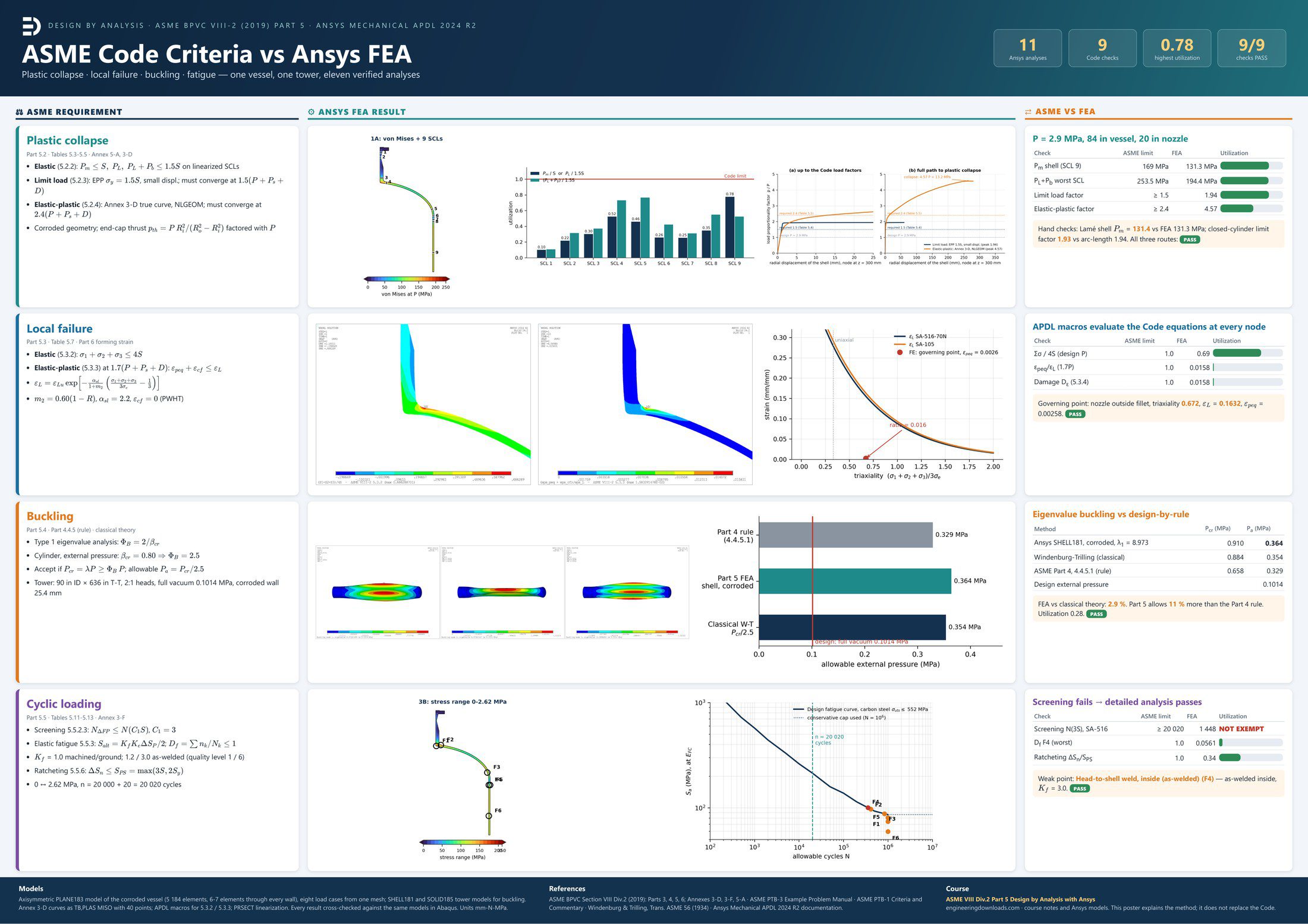
ASME requirement vs Ansys result at a glance
The A1 poster supplied with the course: for each failure mode, the ASME requirement, the Ansys result and the comparison.
Check
Part 5
ASME requirement
Ansys result
Status
Elastic, shell membrane Pm
5.2.2
≤ S = 169 MPa
131.3 MPa (hand check 131.4)
Pass, 0.78
Limit load
5.2.3
converge at 1.5P
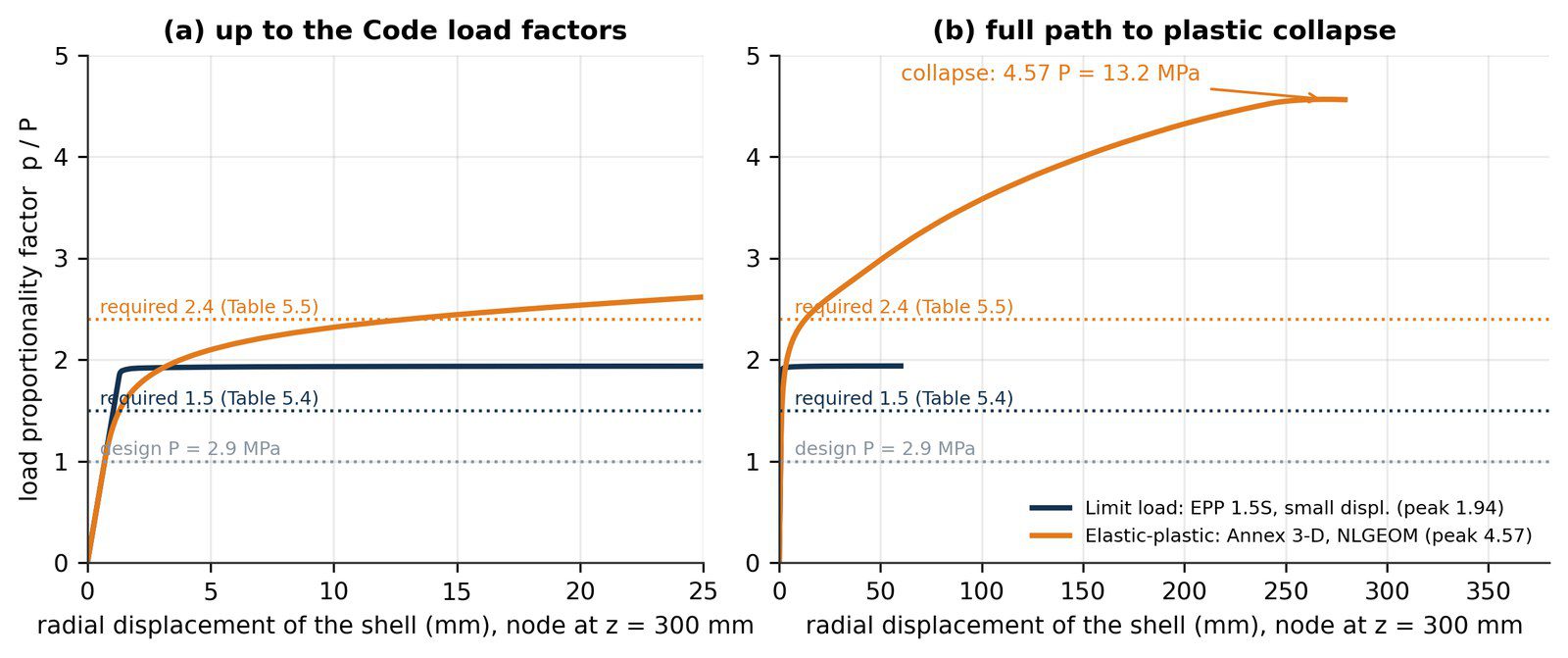
collapse at 1.94P (theory 1.93P)
Pass
Elastic-plastic
5.2.4
converge at 2.4P
collapse at 4.57P
Pass
Local failure
5.3
Σσ ≤ 4S; εpeq ≤ εL at 1.7P
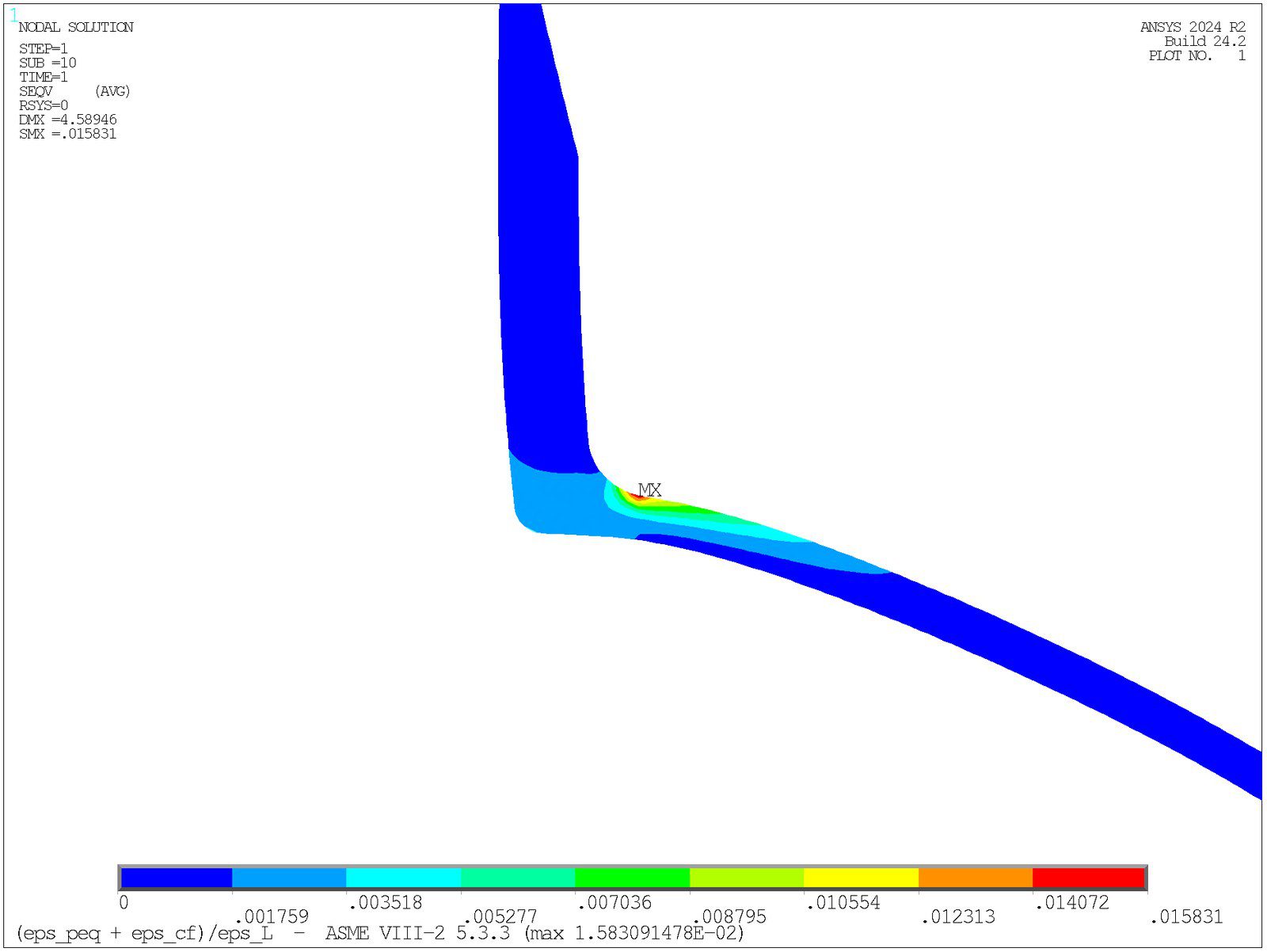
0.69 and 0.016
Pass
Buckling, full vacuum
5.4
Pcr ≥ 2.5 × 0.1014 MPa
Pcr 0.910 MPa, allowable 0.364 MPa
Pass
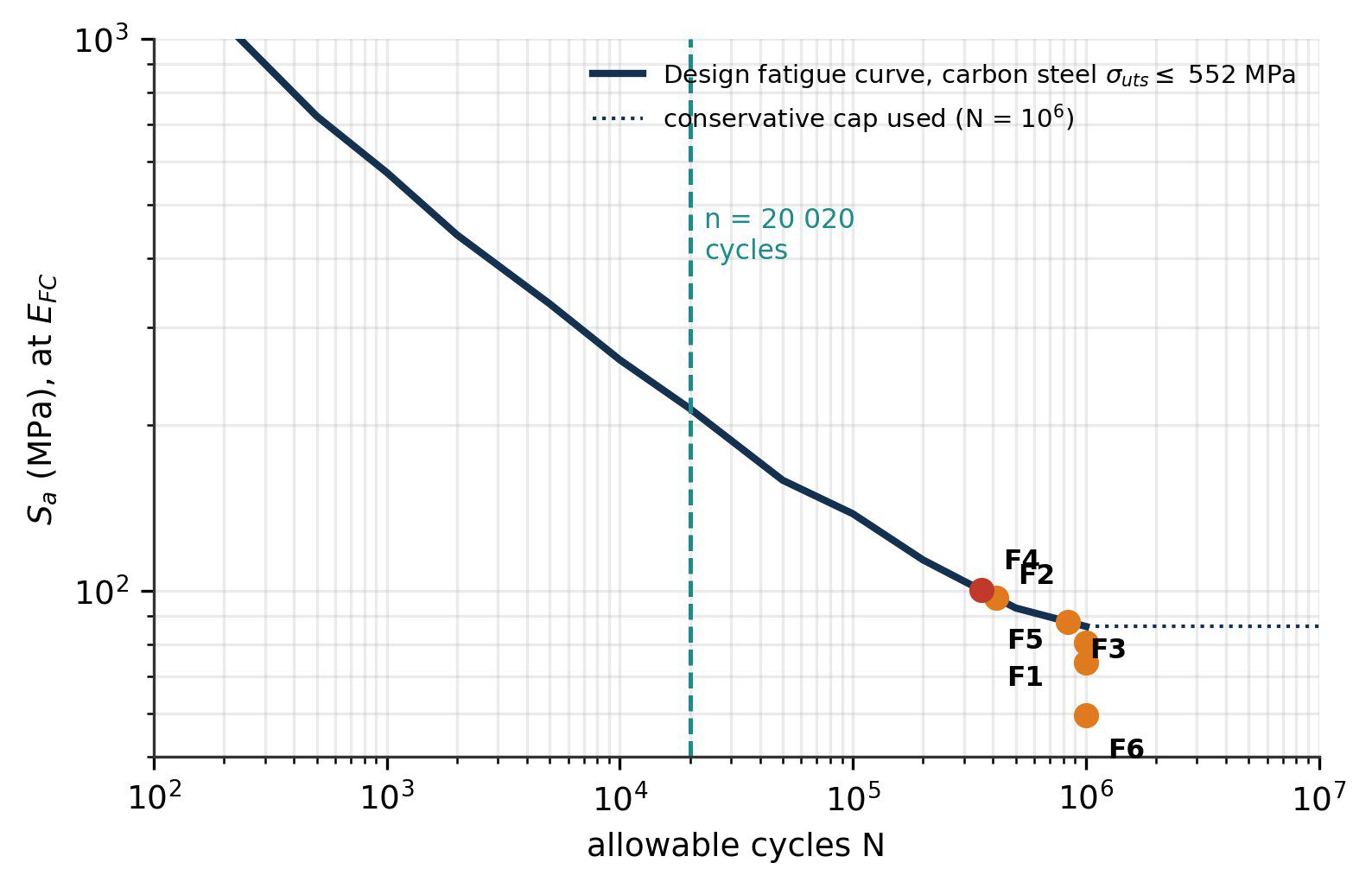
Fatigue, 20,020 cycles
5.5
Df ≤ 1.0
Df = 0.056
Pass
The problem this course solves
Part 5 gives you options. Three routes for plastic collapse. Three types of buckling analysis. Several routes for fatigue. Each one has its own load factors, material model and acceptance limit. Pick the wrong combination and the analysis is not valid, even if the contour plots look fine.
The course shows you how to choose the route, then builds it in Ansys so you can see what to model, what to run and what to check.
What the course covers
Chapter 1: Protection against plastic collapse and local failure (Part 5.2 and 5.3)
Elastic stress analysis with nine stress classification lines, PRSECT and strict Annex 5-A linearization
Limit load analysis with TB,BISO at 1.5S and a 1.5 load factor, plus an arc-length run that finds the real limit load
Elastic-plastic analysis with the Annex 3-D true stress-strain curve (TB,PLAS MISO) and a 2.4 load factor, plus an arc-length run to plastic collapse
Local failure: the 4S limit on the sum of principal stresses, and the triaxial strain limit at 1.7P, both evaluated by APDL macros
Four worked examples (1A to 1D) on one pressure vessel
The Chapter 1 vessel in Ansys
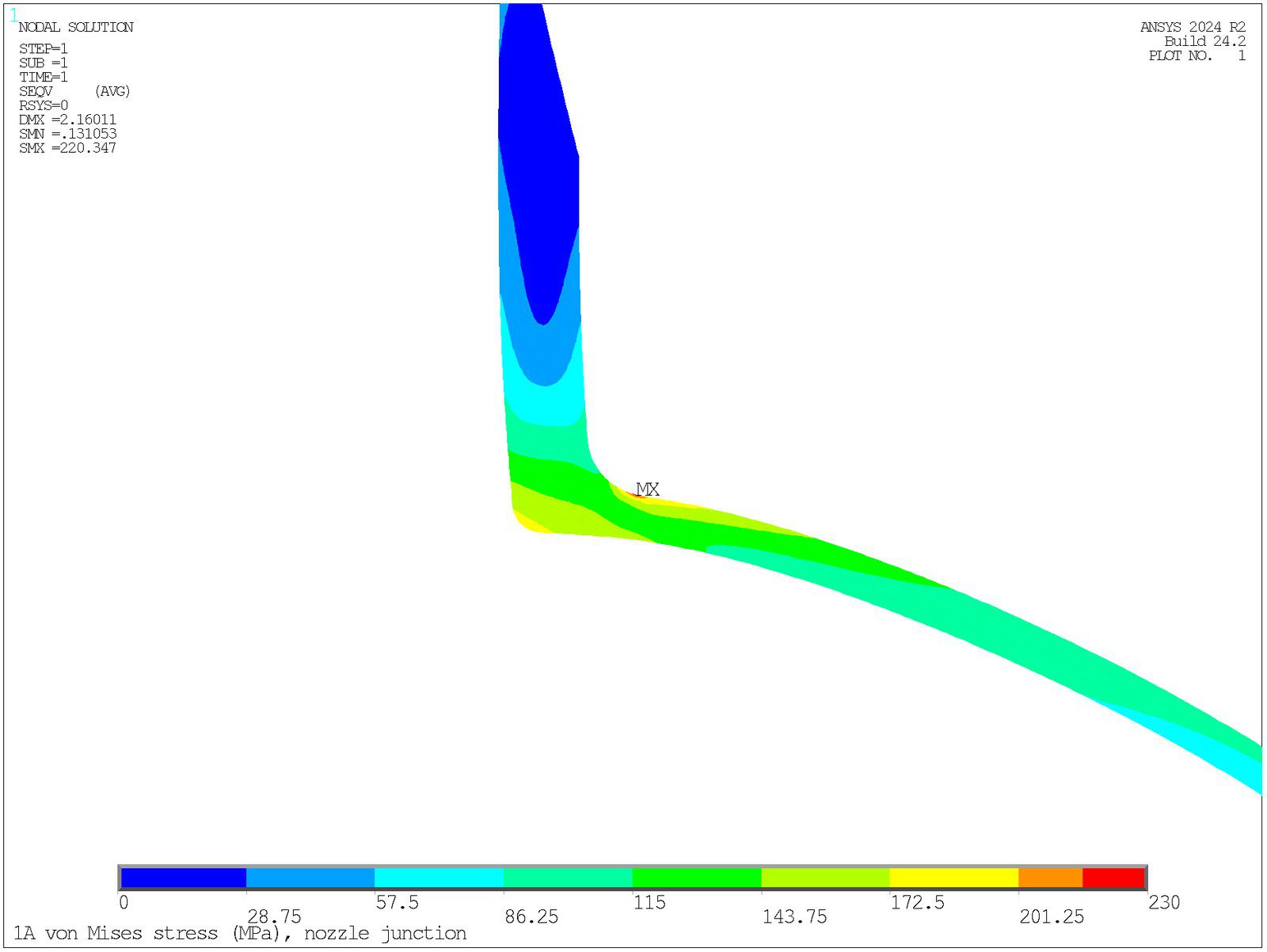
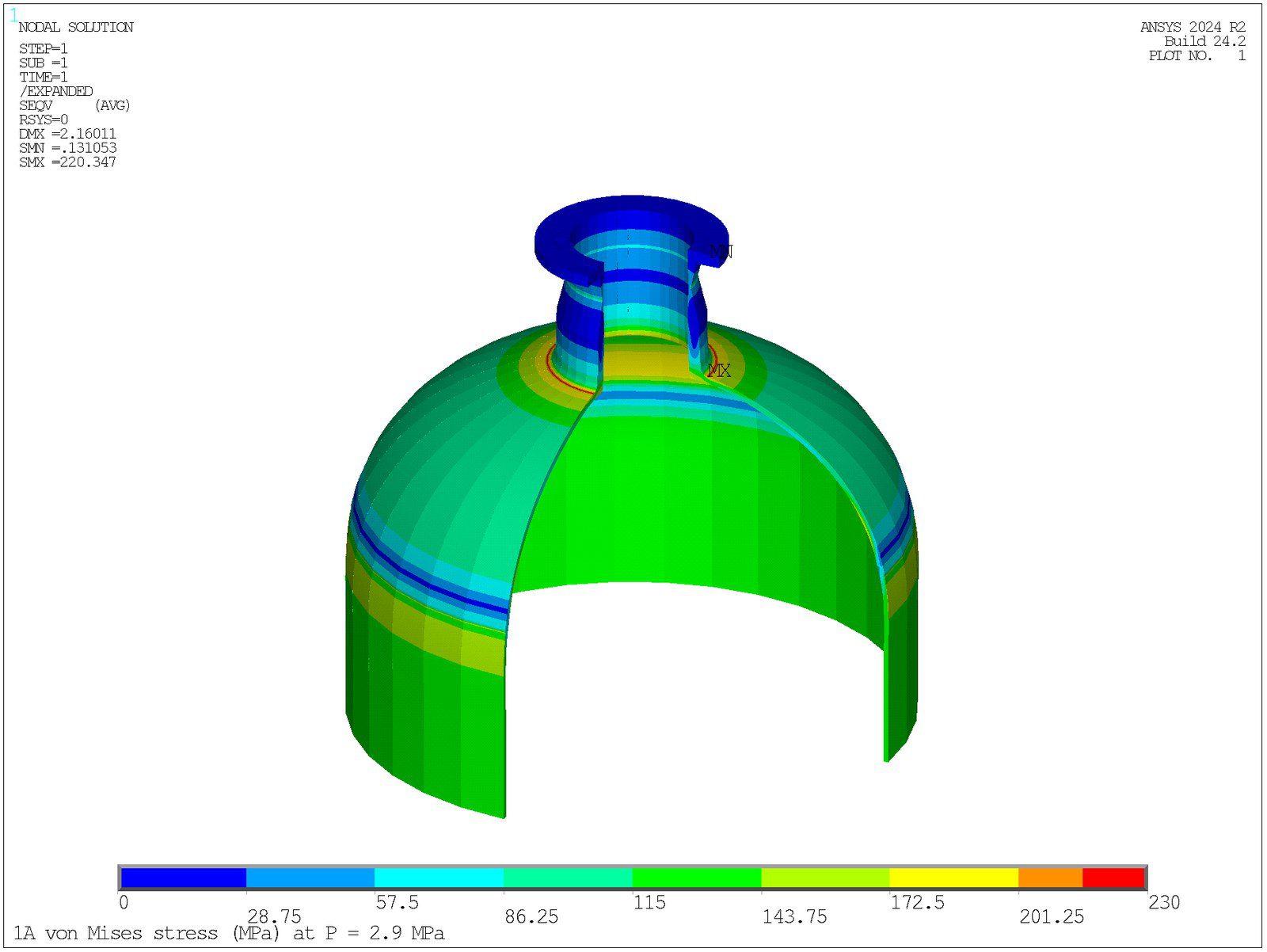
Von Mises stress at design pressure, 270° expansion of the axisymmetric PLANE183 model.Close-up of the nozzle-to-head junction.
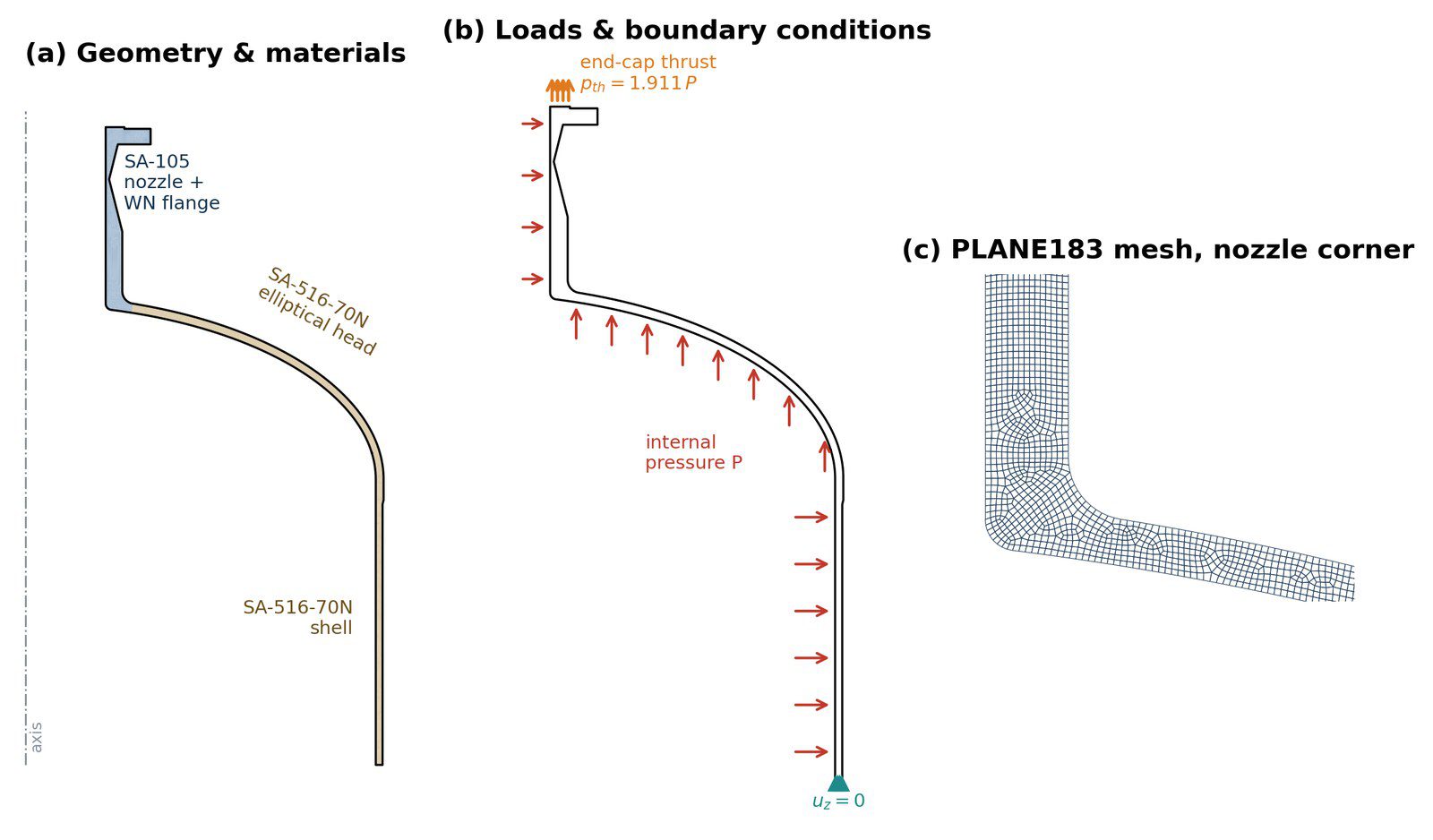
Corroded geometry and materials, pressure and end-cap thrust, and the PLANE183 mesh at the nozzle corner.
Stress classification lines and linearization
This is the step most people ask about. You pick a section through the wall, linearize the stress along it and split it into membrane, bending and peak. The course places nine SCLs and checks every one, with PRSECT and with a strict Annex 5-A integration.
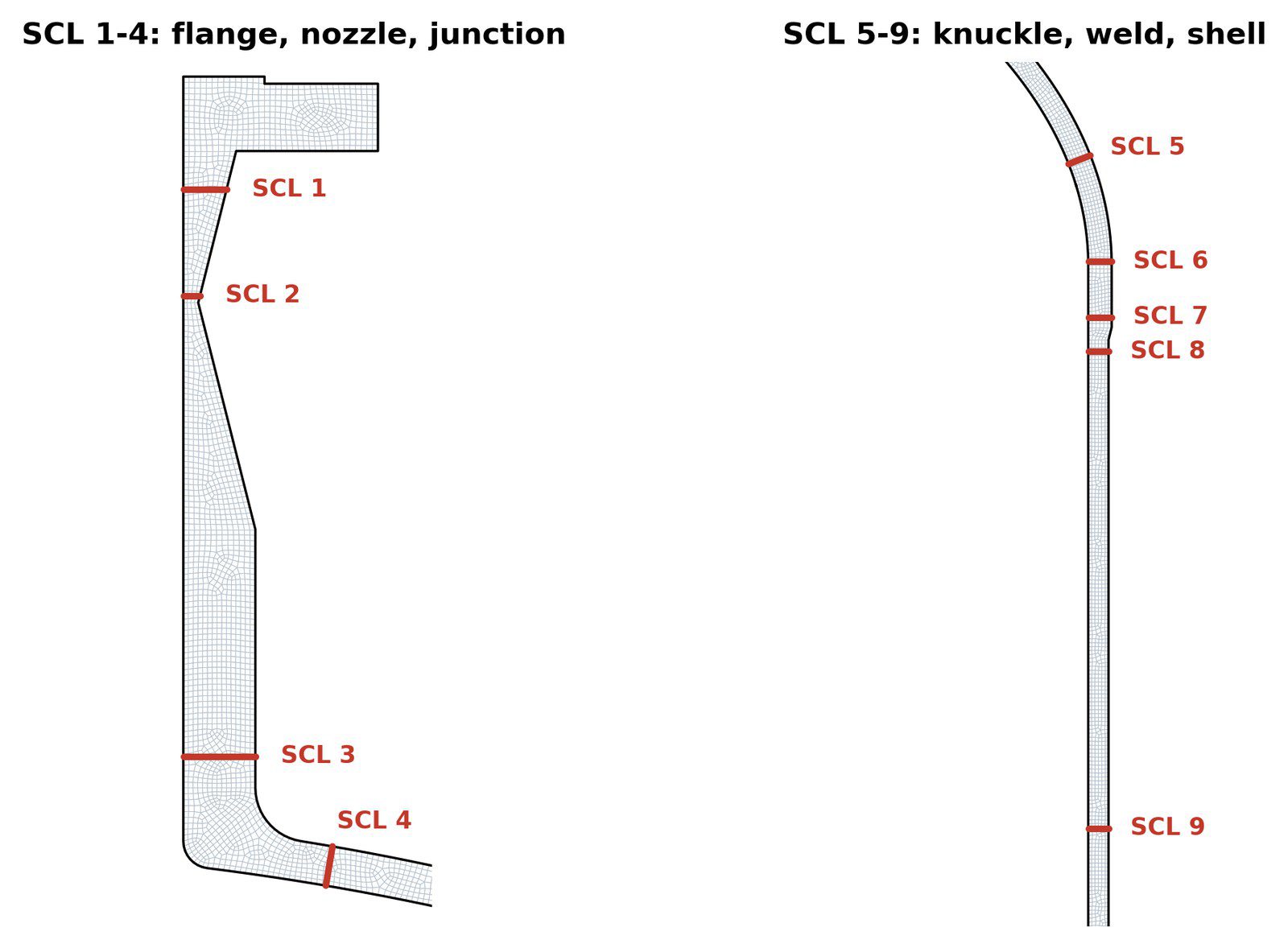
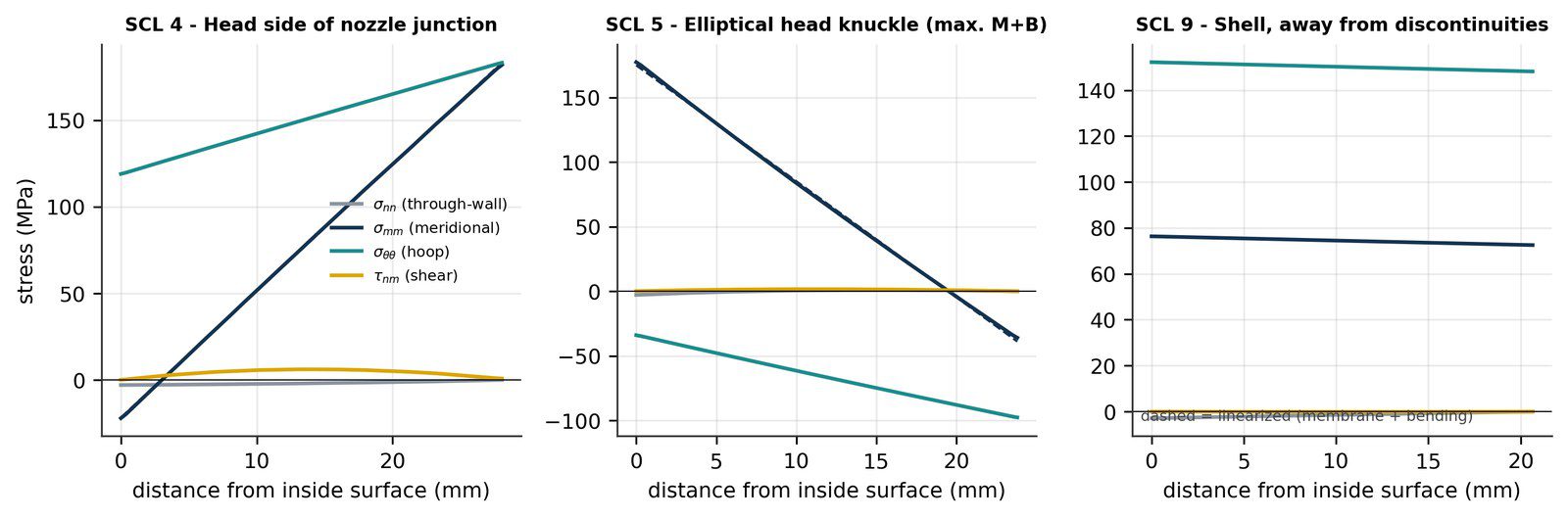
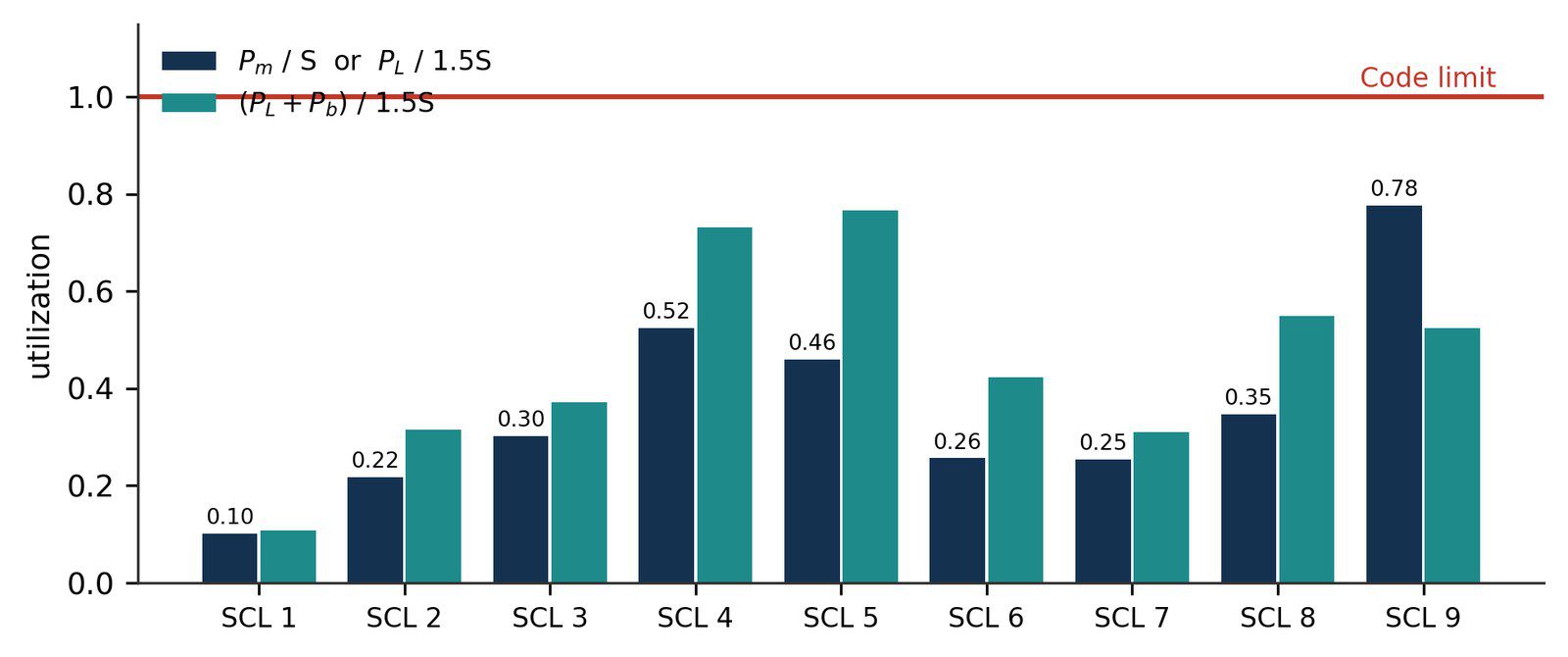
The nine stress classification lines: flange hub, nozzle neck, both sides of the nozzle junction, the head knuckle, the tangent line, both sides of the head-to-shell weld and the undisturbed shell.
Through-wall stress components and their linearized membrane plus bending parts at three SCLs.Utilization of every SCL against Pm ≤ S and PL+Pb ≤ 1.5S. The undisturbed shell governs at 0.78.
Limit load, elastic-plastic collapse and local failure
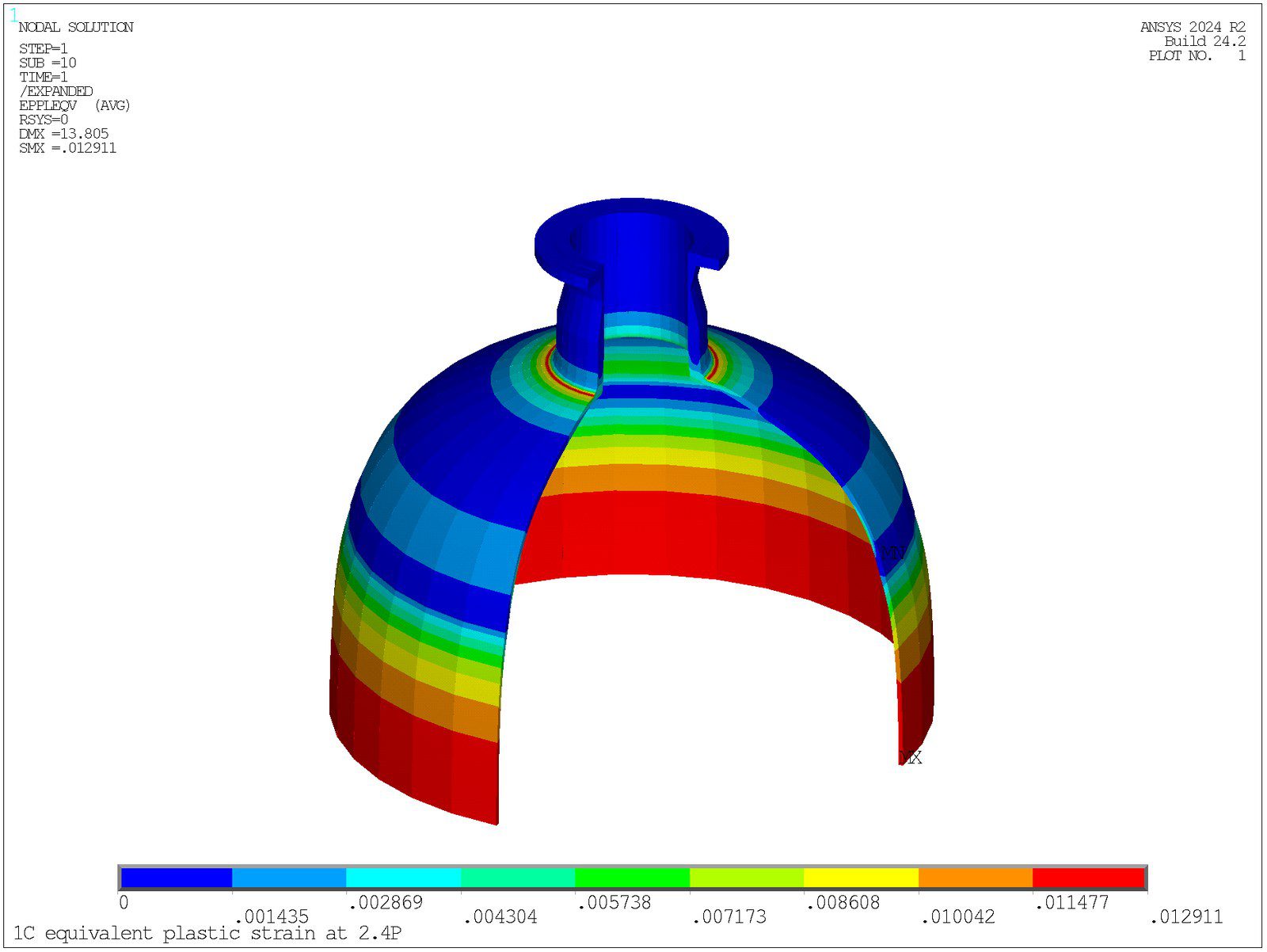
Arc-length load-displacement curves: the limit-load model collapses at 1.94P and the elastic-plastic model at 4.57P, against required factors of 1.5 and 2.4.Equivalent plastic strain at 2.4P.
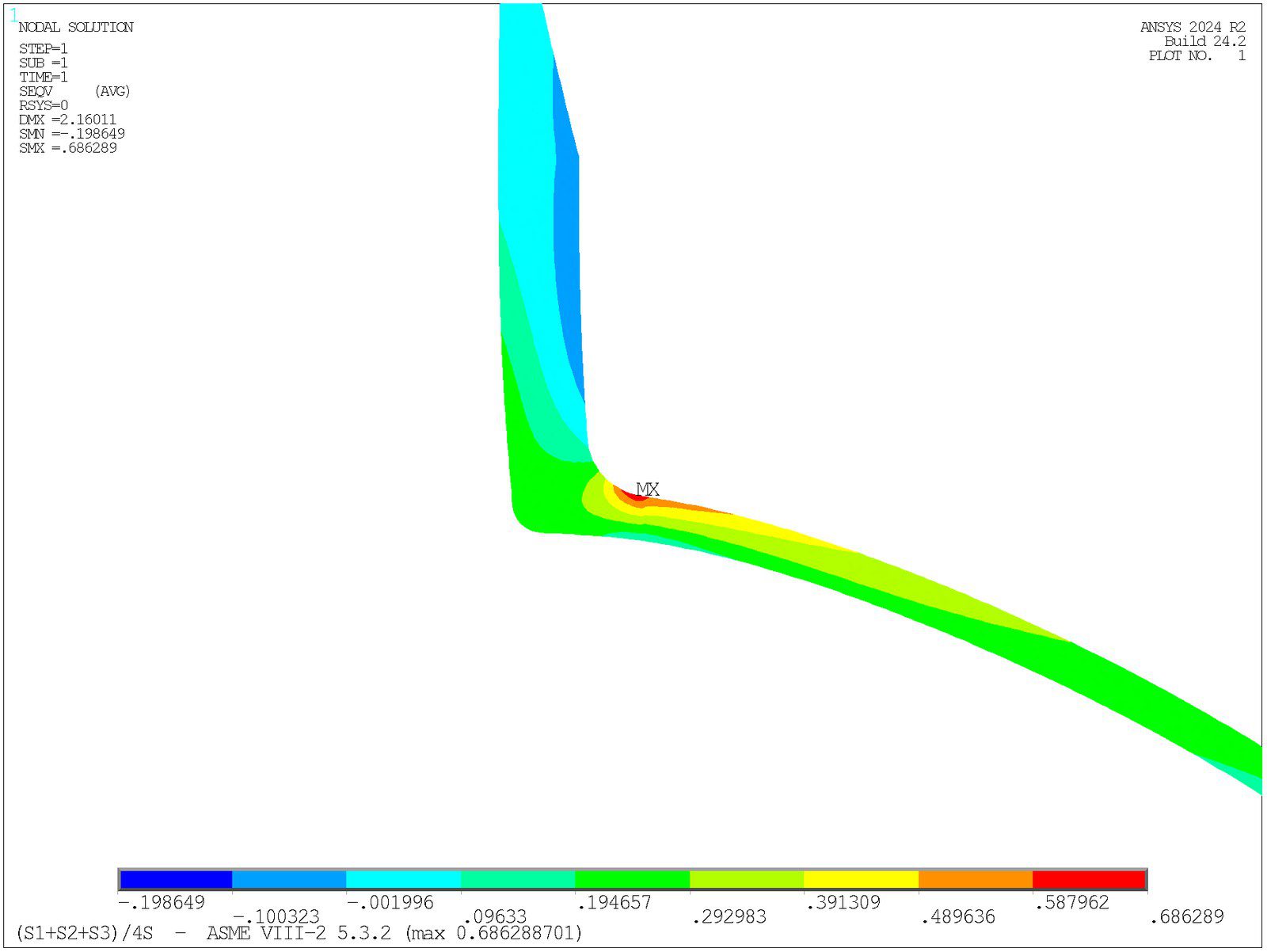
Strain-limit ratio at 1.7P from the APDL macro: maximum 0.016.Elastic check: sum of principal stresses / 4S, maximum 0.69.
Chapter 2: Protection against buckling (Part 5.4)
Type 1 linear eigenvalue analysis, Type 2 and Type 3 with imperfections
Capacity reduction factors (βcr) for cylinders under external pressure, formed heads and other shapes
Pre-stressed eigenvalue buckling in Ansys (PSTRES, ANTYPE,BUCKLE), shell and solid models
Example 2A: a vertical tower under full vacuum, checked against classical theory and the Part 4 design-by-rule result
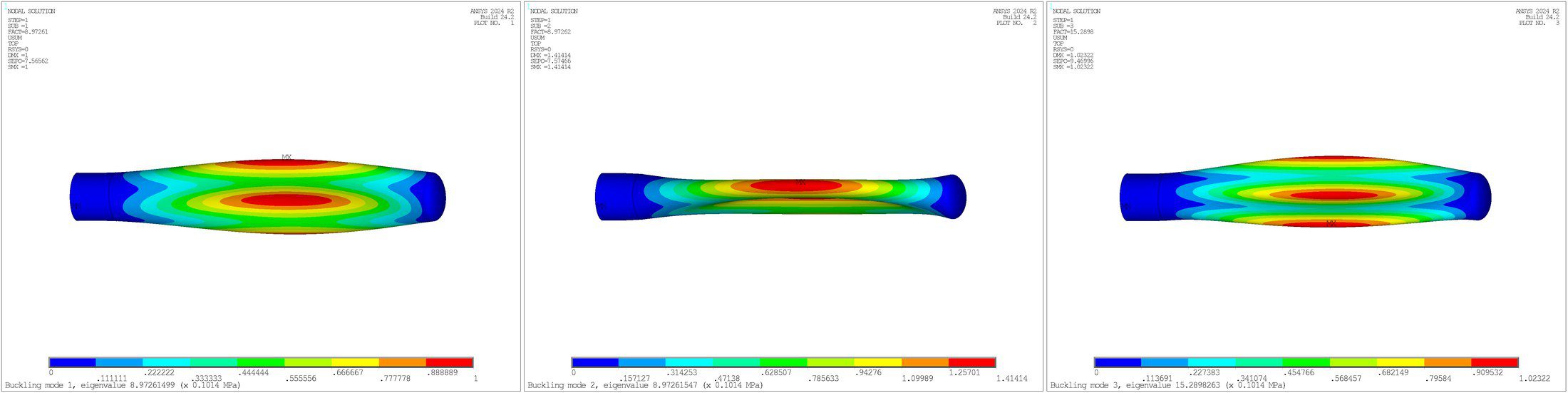
First three buckling modes of the corroded SHELL181 tower model: λ1 = 8.973, critical pressure 0.910 MPa.
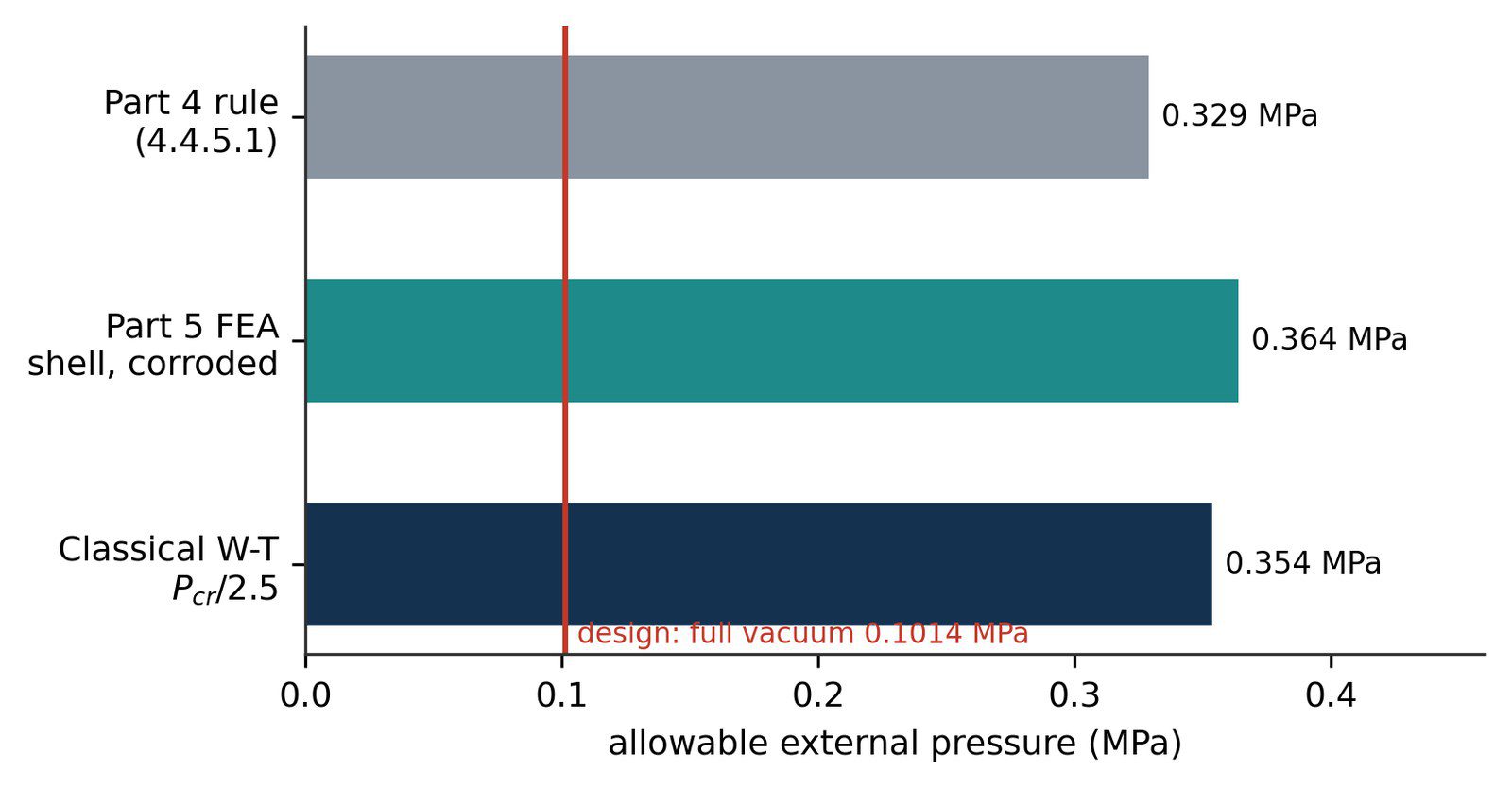
Allowable external pressure: Part 5 FEA 0.364 MPa against the Part 4 rule 0.329 MPa, both above the 0.1014 MPa design vacuum.
Chapter 3: Protection against cyclic loading (Part 5.5)
Fatigue screening, load history and cycle counting
Elastic fatigue analysis: fatigue strength reduction factors, penalty factors, the Annex 3-F fatigue curve and Miner’s rule
Elastic ratcheting check
Example 3A (screening), Example 3B (detailed analysis at six locations) and Example 3C (ratcheting)
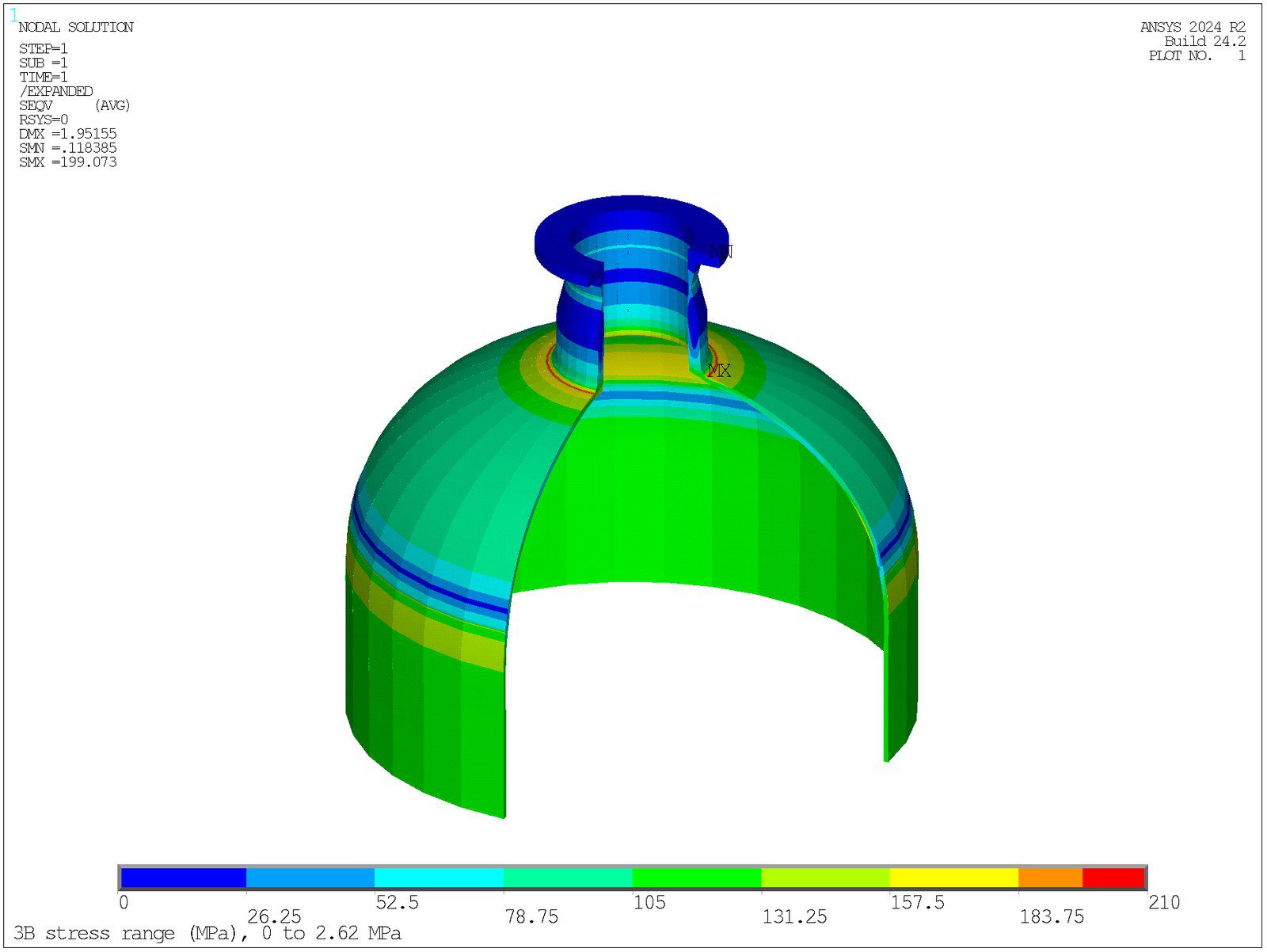
Stress range for the 0 to 2.62 MPa operating cycle.The six fatigue locations on the design fatigue curve against 20,020 required cycles.
Ansys and Abaqus give the same answer
The same meshes, materials and loads were also solved in Abaqus. Membrane stresses, collapse loads and buckling pressures agree within about one percent; the comparison table and curves are in Chapter 4 of the course notes.
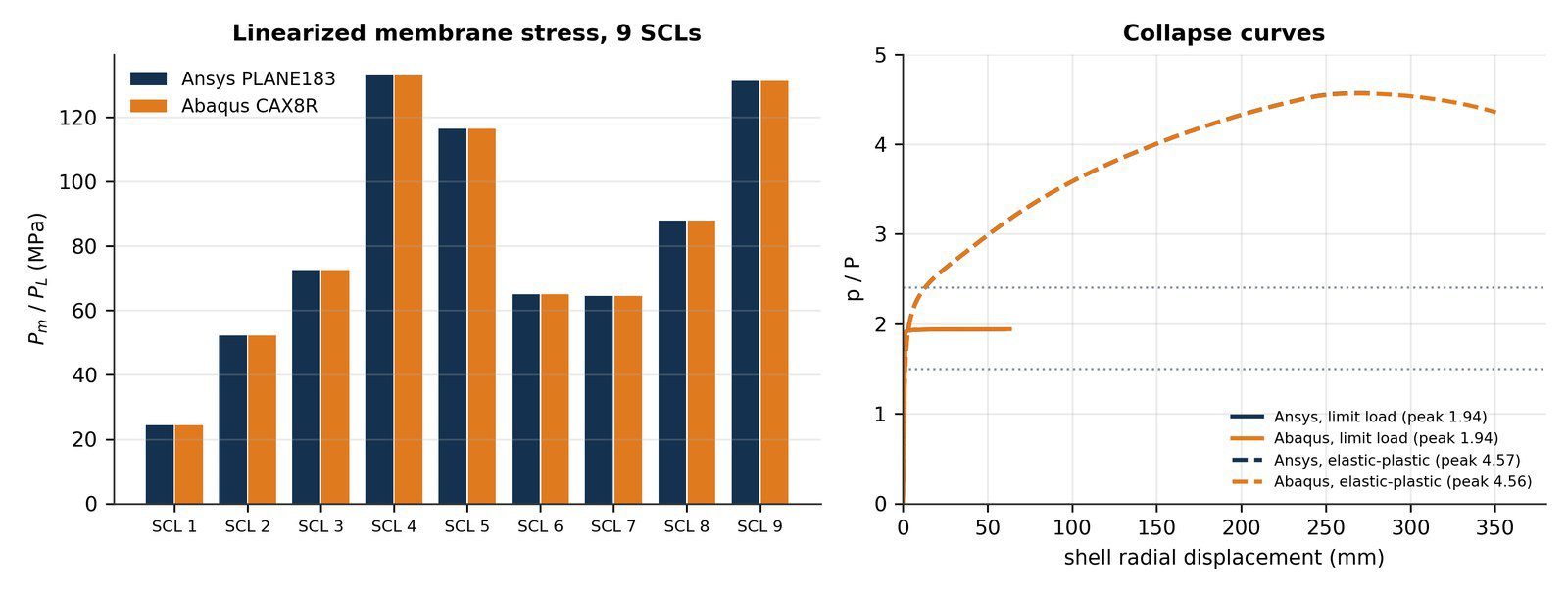
Ansys versus Abaqus: membrane stress on the nine SCLs and the collapse curves.
The worked examples
Pressure vessel with nozzle. 84 in ID shell, 2:1 elliptical head in SA-516-70N, and an SA-105 20 in Class 300 weld neck nozzle. Design pressure 2.9 MPa at 52 °C, corrosion allowance removed. Axisymmetric PLANE183 model. Checked for plastic collapse by all three routes and for local failure by both methods.
Tower under full vacuum. With the corroded wall, the Ansys buckling pressure is 0.910 MPa and the allowable external pressure is 0.364 MPa against 0.1014 MPa applied.
Same vessel, cyclic pressure. At 2.62 MPa the screening check fails: 20,020 cycles against an allowable of 1,448. A detailed fatigue analysis then passes with a worst fatigue damage of 0.056.
What you will be able to do
Choose the right Part 5 route for plastic collapse and explain why
Build an axisymmetric Ansys model of a vessel and nozzle, including the correct end-cap thrust, and apply the design load cases
Place stress classification lines and linearize stresses with PRSECT
Run limit load and elastic-plastic analyses with the correct load factors and material curves, and find the real collapse load with the arc-length method
Evaluate the local failure strain limit at every node with an APDL macro
Run a buckling analysis and apply the right capacity reduction and design factors
Screen a vessel for fatigue, count cycles and calculate fatigue damage
Check every FE result against a hand calculation
What is included
Course notes for all three chapters (PDF)
A1 poster: ASME requirement vs Ansys result for every failure mode (PDF)
11 Ansys Mechanical APDL input files (.dat) with the mesh, load and post-processing macros (.mac)
APDL macros for PRSECT linearization and both local failure checks
Who this is for
Stress and integrity engineers who use Ansys and need to document ASME VIII-2 Part 5 checks
Pressure vessel engineers moving from Part 4 design by rule to Part 5 design by analysis
FEA analysts who want a clear method for load cases, linearization and acceptance limits
Students and researchers working on pressure equipment
Software and code basis
The models are Ansys Mechanical APDL input files, solved with Ansys 2024 R2. They run in any recent Mechanical APDL release and can be used from Workbench through a Mechanical APDL system. The course notes follow ASME BPVC Section VIII Division 2, Part 5, 2019 edition. If you work to a different edition, check the clause numbers and factors against your own copy. The course explains the method. It does not replace the code.
Which parts of ASME VIII-2 does this course cover?
Part 5 design by analysis: protection against plastic collapse and local failure, protection against buckling, and protection against cyclic loading (fatigue and ratcheting). Each chapter has worked examples in Ansys.
Do I need Ansys Workbench or Mechanical APDL?
The model files are Mechanical APDL input files. Run them in Mechanical APDL directly, or from Workbench through a Mechanical APDL system. The method itself applies to any FE code.
Do I need my own copy of the ASME code?
Yes. The course walks through the method and the factors, but you should always work from the edition of the code that applies to your project.
Is there an Abaqus version?
Yes. The same course with Abaqus models is available as a separate product; the Ansys notes include a result-by-result comparison of the two codes.
What do I get after purchase?
Access to the three chapters. Each chapter has a Files and codes lesson with the Ansys input files for its examples, the course notes and the poster.
Need more than the files?
There are two ways we can help. Book a one hour online consultation if you want to talk a problem through with a CAE engineer, using the checkbox in the order box. Order a project if you need a full simulation built for you, delivered to an agreed scope, price and deadline under a written contract.
We work on FEA and CFD for engineers, researchers and companies. Order your project, or message us on WhatsApp for a quick reply.
Related Simulation Models and Courses
Other packages engineers working on this topic also download.
Chapter 1: Protection Against Plastic Collapse and Local Failure
Part 5.2 and 5.3. Elastic stress analysis with PRSECT, limit load, elastic-plastic analysis and local failure, with four worked examples in Ansys Mechanical APDL.
Files and codes
Chapter 2: Protection Against Buckling
Part 5.4. Eigenvalue buckling of a vertical tower under full vacuum with SHELL181 and SOLID185 models, checked against classical theory and Part 4.
Files and codes
Chapter 3: Protection Against Cyclic Loading
Part 5.5. Fatigue screening, elastic fatigue analysis at six locations and the elastic ratcheting check in Ansys.
Files and codes
Reviews
No Review Yet
€149,00€169,00
Need a full custom project? See the options below.

Lifetime access
Download capability
Money-back guarantee
29 people watching this product now!
Material Includes
Course notes for all three chapters (PDF, 27 pages)
A1 poster: ASME requirement vs Ansys result (PDF)
11 Ansys Mechanical APDL input files (.dat) with macros (.mac)
APDL macros for PRSECT linearization and the local failure checks
Audience
Stress and integrity engineers
Pressure vessel engineers
FEA analysts using Ansys
Students and researchers
Related Products
Composite Curing in Abaqus for AS4/3501-6 Laminates