Need a full custom project? See the options below.
Need a full custom project? See the options below.
The dynamic analysis of three-point bending tests on bolted steel splice connections provides vital insight into the structural performance of steel members subjected to impact or rapidly applied loads. Unlike quasi-static loading, dynamic bending introduces strain-rate effects, inertia forces, and potential changes in failure mechanisms that can significantly influence the connection’s stiffness, ductility, and energy dissipation capacity. In steel structures, bolted splice connections are widely used to join beam segments, transfer forces, and maintain structural continuity, making their behavior under dynamic bending actions critical for assessing overall structural reliability, particularly in applications such as bridges, industrial buildings, cranes, and structures exposed to seismic or accidental loading scenarios.
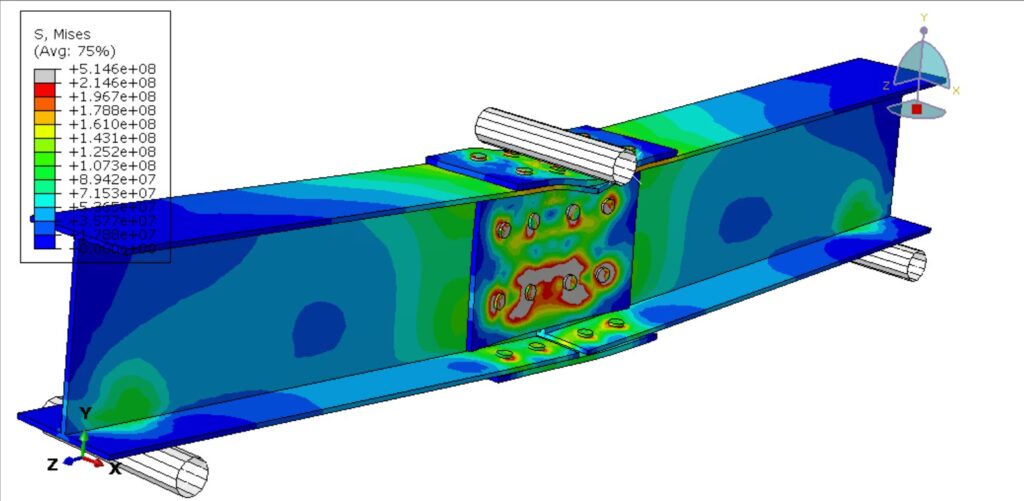
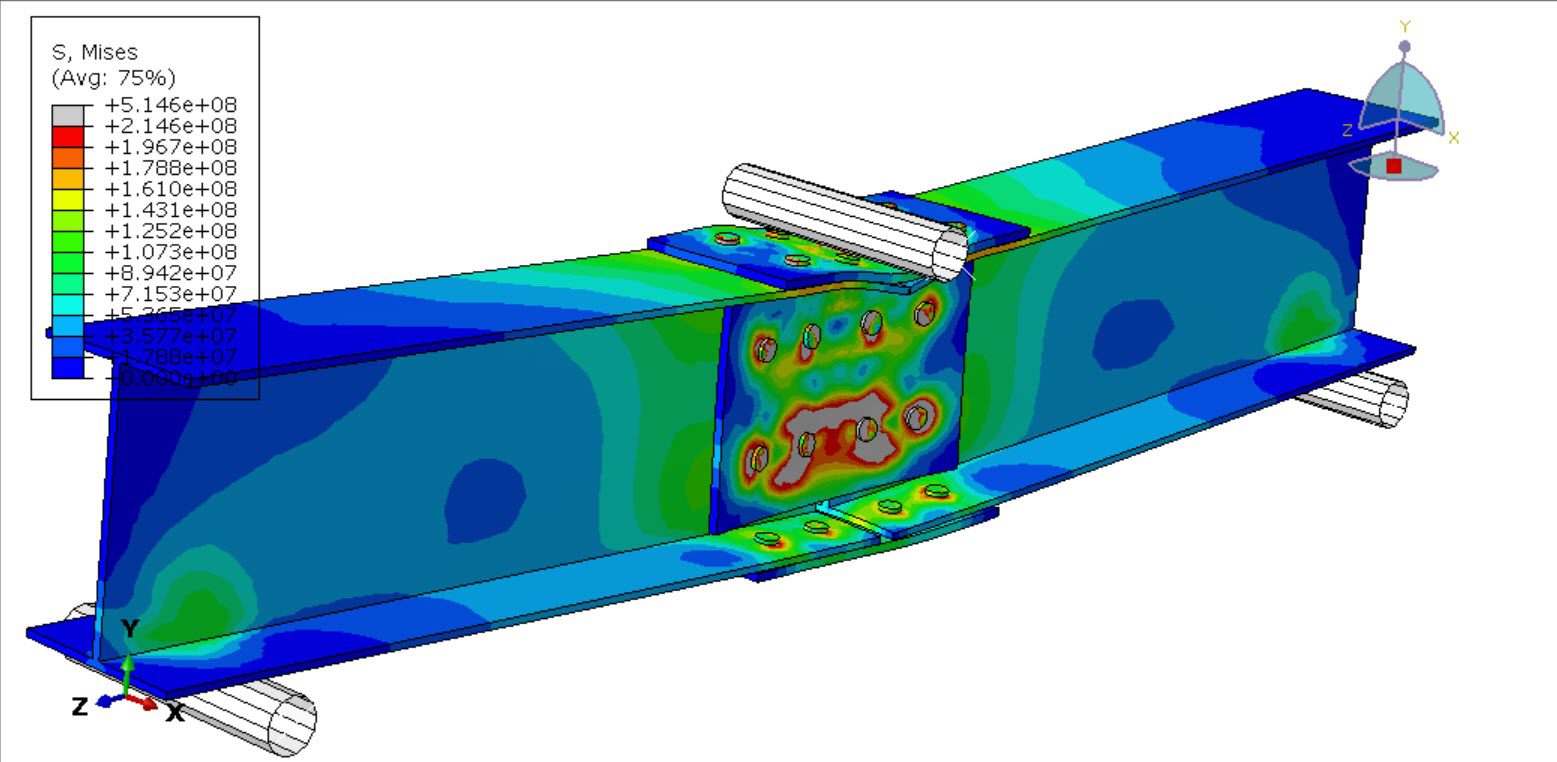
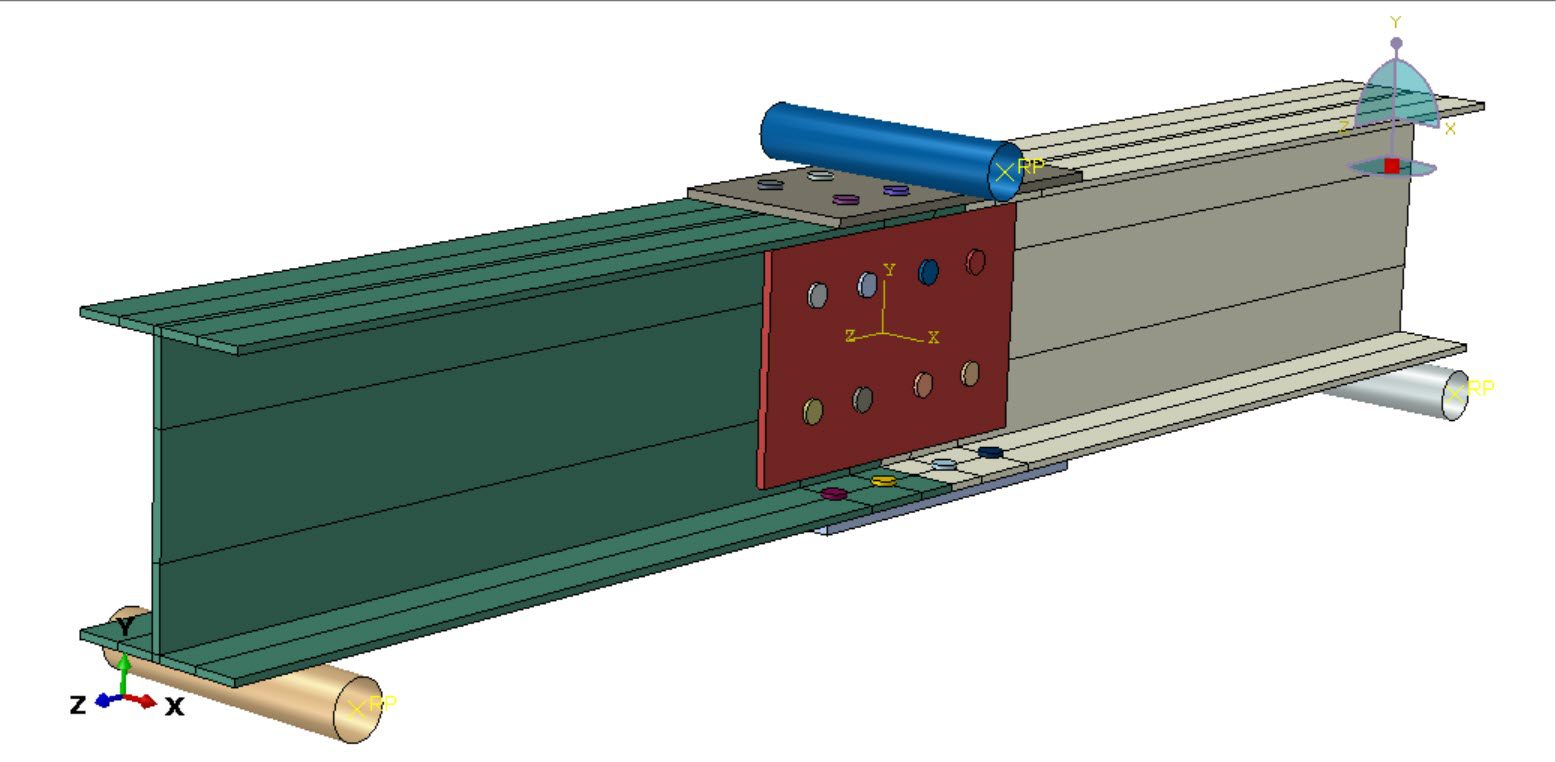
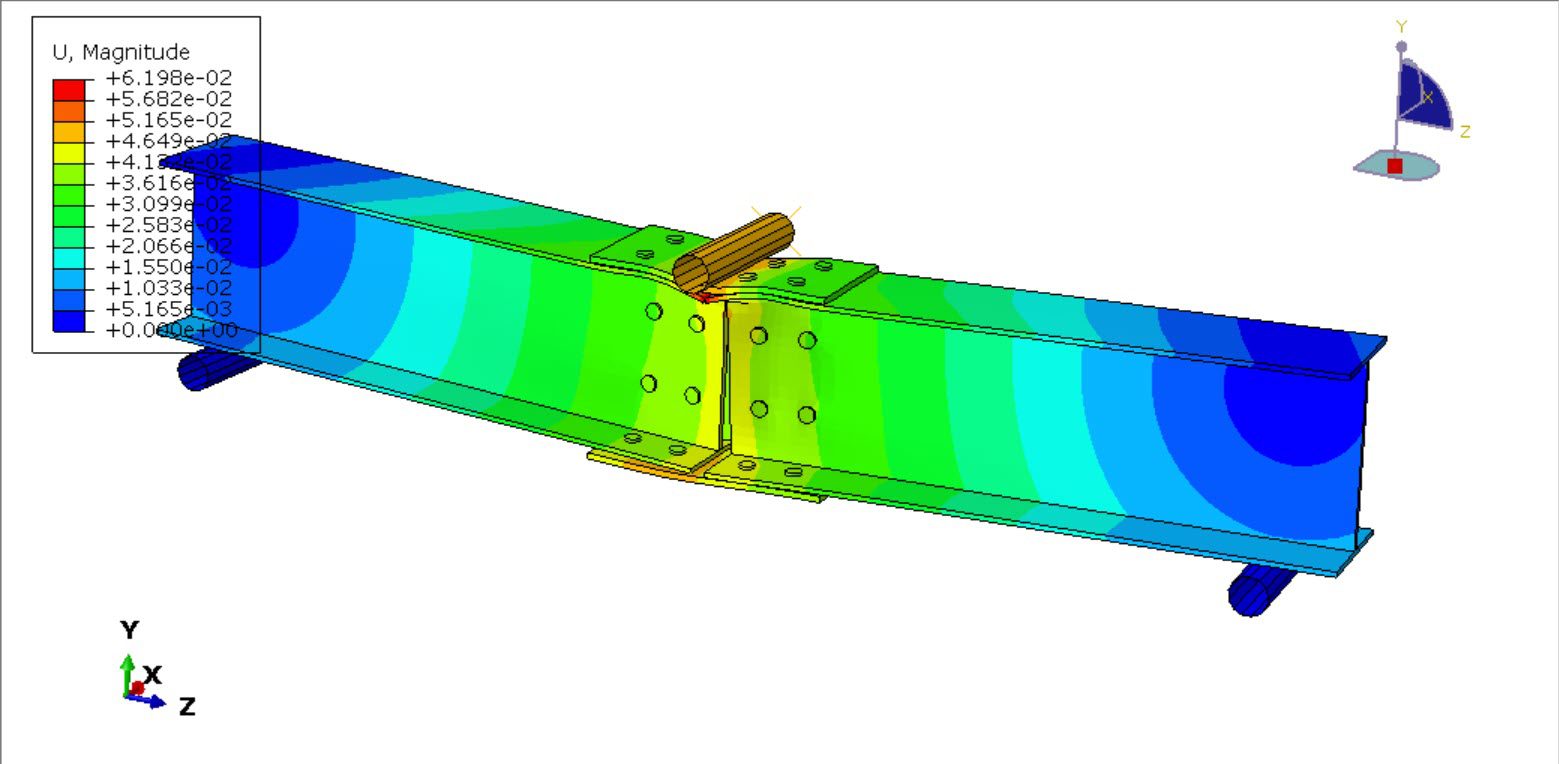
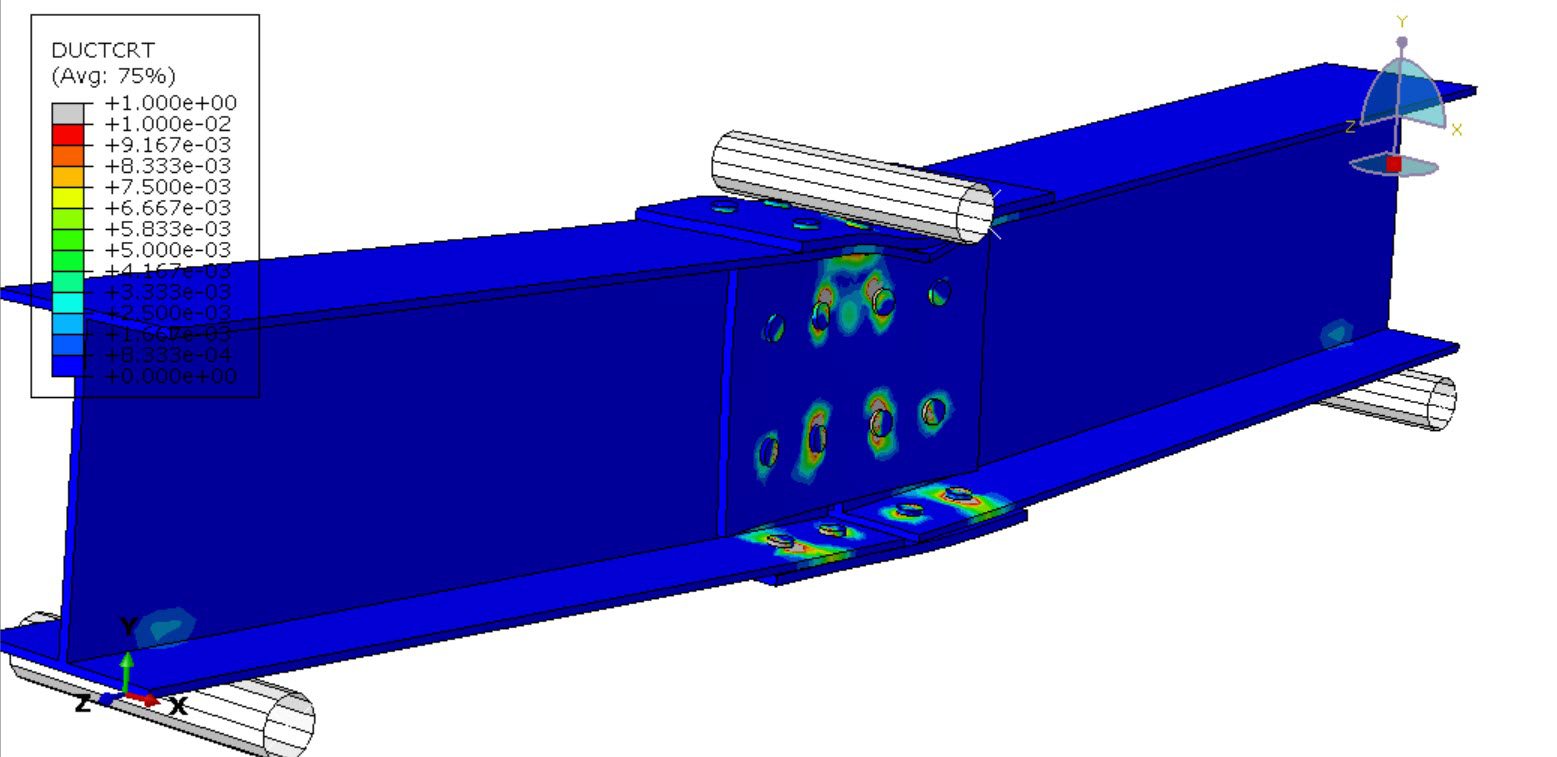
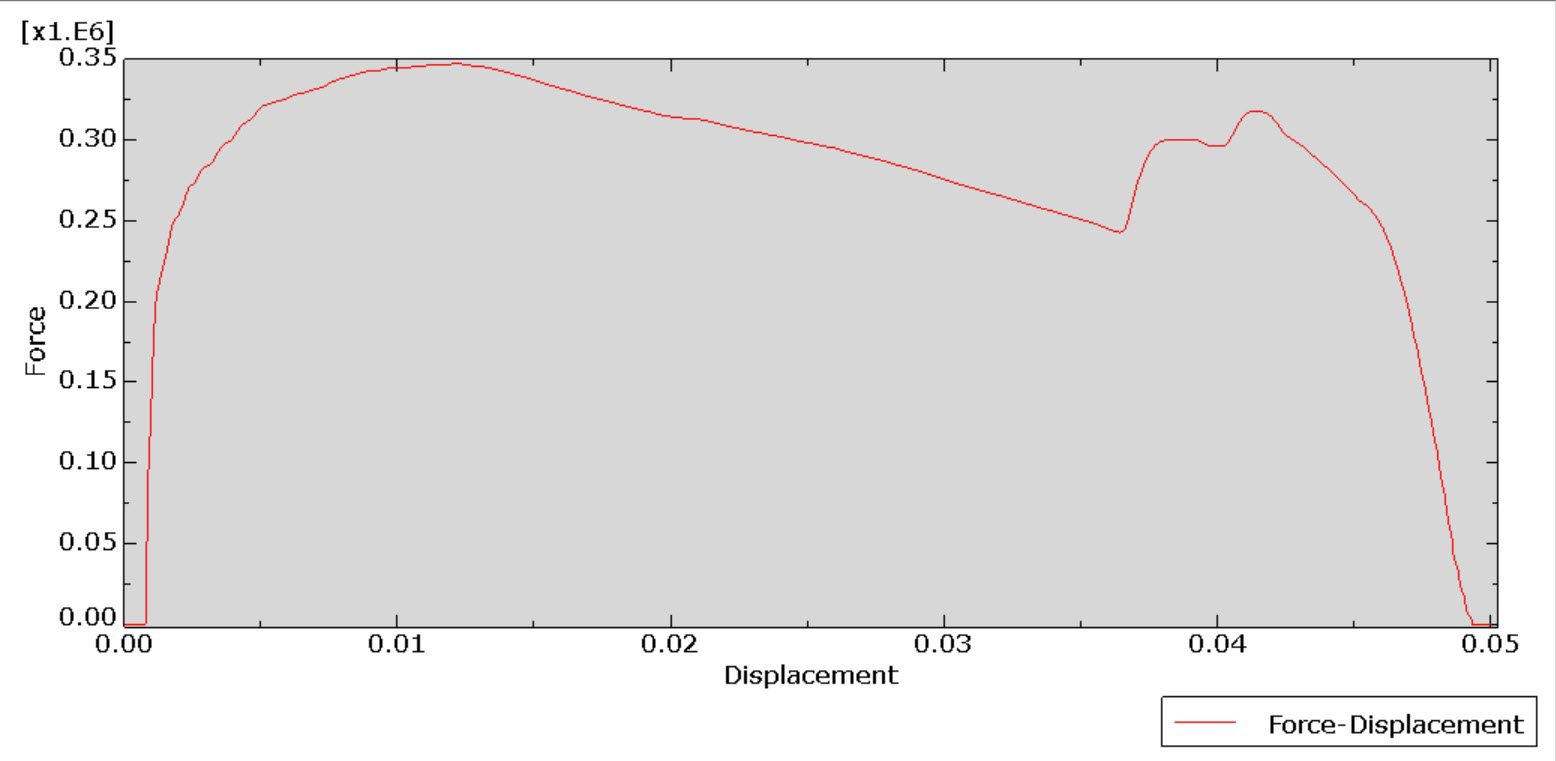
In this case, all the parts, such as beams, bolts, and rigid bodies, are modeled as three-dimensional. The elastic-plastic material model and damage behavior are considered to allow the material to reach the maximum force capacity till full failure.
Three-point bending tests allow a controlled means of evaluating the bending strength and deformation response of a splice connection while isolating parameters such as bolt preload, bolt arrangement, friction, plate thickness, and material grade. Under dynamic loading, factors such as bolt slippage, local plate deformation, frictional energy dissipation, and potential bearing failure at the bolt holes become more prominent. Experimental testing, complemented by numerical modeling, can be used to characterize these behaviors, allowing researchers to quantify dynamic amplification, identify changes in failure mode, and improve analytical or design models for real-world applications.
Overall, understanding the dynamic response of bolted steel splice connections under three-point bending is essential for designing safer, more reliable steel structures capable of withstanding rapid or unforeseen loading conditions.
Need more than the files?
There are two ways we can help. Book a one hour online consultation if you want to talk a problem through with a CAE engineer, using the checkbox in the order box. Order a project if you need a full simulation built for you, delivered to an agreed scope, price and deadline under a written contract.
We work on FEA and CFD for engineers, researchers and companies. Order your project, or message us on WhatsApp for a quick reply.
Other packages engineers working on this topic also download.
 Analysis of the bolted steel splice connections under fire-Sequential Method
 Bending test analysis of the steel-concrete composite beam in the SRC structure
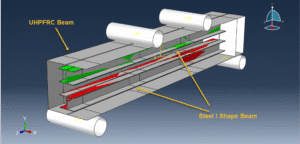 Simulation dynamic bending test of steel-UHPFRC composite beam(column) with multiple encased steel profiles in Abaqus
 Bolt Analysis Package in Abaqus
 Steel Structure Analysis Package
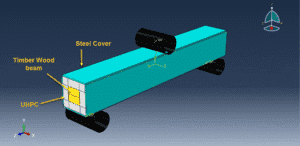 Simulation of Bending Test on a Wood–UHPC–Steel Composite Beam in Abaqus
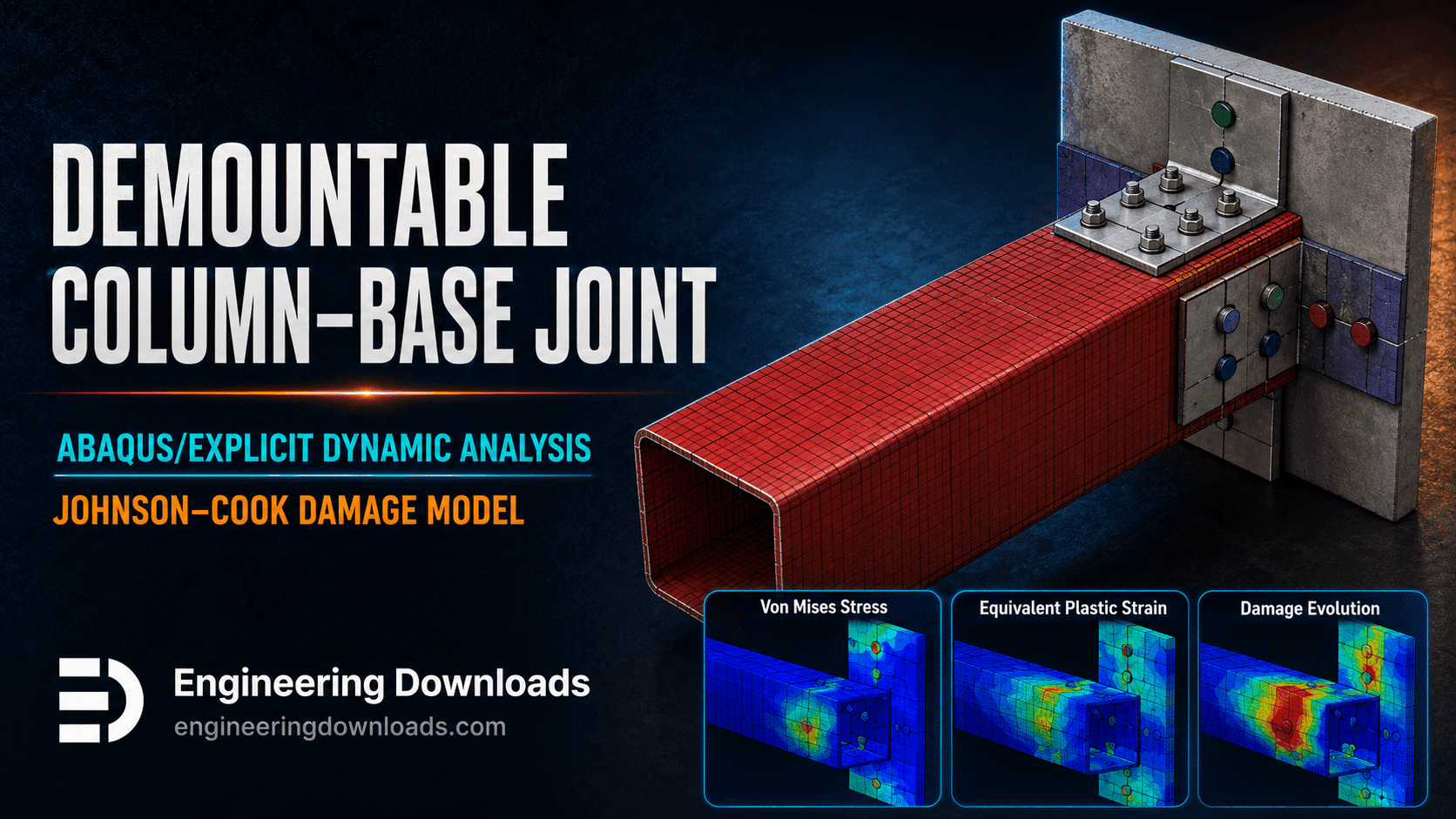 Behaviour analysis of demountable tubular column-to-base plate joints with studs
 Bolted Steel Beam–Column Connection Under Fire in Abaqus: Sequential Heat Transfer and Structural Analysis

Need a full custom project? See the options below.

€129,00

€179,00

€149,00

€119,00

€129,00

€149,00
See more
Want to receive push notifications for all major on-site activities?




