Cold Spray Simulation Package in Abaqus (9 Models: CEL, ALE and SPH)

€178,00 €270,00
Optional extras

Need a full custom project? See the options below.

€178,00 €270,00
Optional extras

Need a full custom project? See the options below.

30 people watching this product now!

Material Includes

  • 1- Abaqus files+Codes
  • 2- Paper and Document
  • 3- Tutorial Videos

Audience

  • 1- Mechanical Engineering
  • 2- Materials Science and Engineering
  • 3- Manufacturing Engineering
  • 4- Aerospace Engineering

What You Will Learn?

  • The Cold Spray Package includes 9 tutorials, and during this course, you'll learn all the methods, such as ALE, CEL, and SPH methods for many of the materials, like aluminum, ceramic, steel, and titanium. In this package, all details are explained through the comprehensive tutorial videos.

About Course

This is a complete cold spray simulation package in Abaqus: 9 ready-to-run models of particle impact and deposition, with about 3 hours 33 minutes of video tutorials, the Abaqus files and codes, plus the reference papers and documents.

The package covers all four modelling methods used for cold spray, so you can compare them directly: Lagrangian, CEL (Coupled Eulerian–Lagrangian), ALE (adaptive meshing) and SPH (Smoothed Particle Hydrodynamics). It also covers metal, ceramic and polymer materials, and single- and multi-particle impact.

The problem this package solves

In cold spray, a solid particle hits a substrate at several hundred metres per second and bonds without melting. The whole event happens in microseconds and involves extreme plastic deformation, adiabatic heating and a very localised interface.

That level of deformation destroys a normal Lagrangian mesh. To model it you need a method that can handle material flow, and the choice between CEL, ALE and SPH changes both the result and the run time. This package shows the same process modelled each way, which is the fastest way to understand which method suits your case.

What is inside: 9 Abaqus cold spray models

Modelling methods compared

  • Cold spray particle deposition with the CEL method
  • Cold spray with the ALE method
  • Cold spray with the SPH method
  • Multi-particle impact deposition behaviour

Material combinations

  • Steel particle on an Inconel surface
  • Ceramic particle on steel
  • Cold spray of ceramic particles
  • Cold spray of ABS polymer material
  • Aluminium-based metallic coatings deposited onto polymer substrates

Abaqus techniques you will practise

  • CEL, ALE and SPH methods for extreme localised deformation
  • Johnson–Cook plasticity and damage at high strain rate
  • Adiabatic heating during particle impact
  • Contact and bonding at the particle–substrate interface
  • Multi-particle build-up rather than a single impact
  • Modelling dissimilar material pairs, including metal on polymer

What you will learn

  • How to set up a cold spray impact model in Abaqus
  • How CEL, ALE and SPH differ in accuracy, stability and run time for this process
  • How particle velocity and material pairing affect deformation and bonding
  • How coating build-up develops when several particles impact
  • How to read flattening ratio, plastic strain and temperature at the interface

What is included

  • Abaqus model files and codes for all 9 examples
  • Video tutorials, about 3 hours 33 minutes in total
  • Reference papers and documents
  • Lifetime access and downloadable files
  • Certificate of completion

The package was prepared by instructor Peyman Karampour.

Who this is for

  • Materials and mechanical engineering students working on coatings or surface engineering
  • Researchers studying cold spray, thermal spray or additive repair
  • Engineers developing coating processes for metal, ceramic or polymer substrates
  • Abaqus users who want to learn CEL, ALE and SPH through one clear application

Software used

Abaqus/CAE and Abaqus/Explicit.

Related packages

Frequently asked questions

Which method is best for cold spray simulation?

It depends on what you need. Lagrangian is simplest but distorts at high deformation, ALE keeps the mesh usable, CEL handles extreme flow, and SPH is meshless and suits splashing and jetting. The package includes all four so you can compare them on the same process.

Are multiple particles included?

Yes. One example models multi-particle impact, so you can see how deposition builds up rather than only a single particle.

Which material combinations are covered?

Steel on Inconel, ceramic on steel, ceramic particles, ABS polymer, and aluminium-based coatings on polymer substrates.

Can I change the particle speed and size?

Yes. You get the full Abaqus files, so you can change particle velocity, diameter, material and substrate for your own study.

What if I get stuck running a model?

Contact us and we will help you get it running. If you need a coating or impact model built for your own process, you can also talk to one of our engineers.

Need more than the files?

There are two ways we can help. Book a one hour online consultation if you want to talk a problem through with a CAE engineer, using the checkbox in the order box. Order a project if you need a full simulation built for you, delivered to an agreed scope, price and deadline under a written contract.

We work on FEA and CFD for engineers, researchers and companies. Order your project, or message us on WhatsApp for a quick reply.

Course Content

Example-1: Analysis of the Cold Spray process of an ABS material
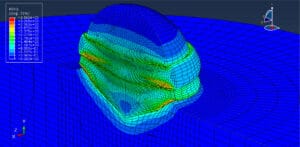
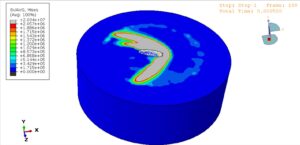
In this study, the Analysis of the Cold Spray process of an ABS material in Abaqus is investigated. The ABS is an amorphous polymer comprised of three monomers, acrylonitrile, butadiene, and styrene. ABS is most commonly polymerized through the emulsification process or the expert art of combining multiple products that don’t typically combine into a single product. The ABS target is modeled as a three-dimensional solid part, the particle is also modeled as a solid part, and the domain is an Eulerian part. To model particle and target material, the Johnson-Cook hardening is selected. The couple-temperature-displacement as a dynamic step is appropriate for this type of analysis. The proper interaction and contact behavior are considered. The mechanical boundary conditions are assigned to the target, and Eulerian boundary conditions to the Eulerian part.

  • Abaqus Files
  • Document
  • Tutorial Video
    21:56

Example-2: Simulation of the Cold Spray Particle Deposition Process-CEL method
In this lesson, the Simulation of the Cold Spray Particle Deposition Process-CEL method in Abaqus is studied. In recent years, a significant number of studies have been dedicated to the modeling of impact dynamics. For very low-speed impact, such as in the shot peening metal working process, the semi-analytical method can be used for the modeling of both thick (half-space assumption) and thin (finite-depth) structures. In the case of higher-speed impact, such as in the cold spray particle deposition process, three explicit finite element analysis codes, ABAQUS, LS-DYNA, have been used to investigate the whole deformation history of materials. In this simulation, three-dimensional CEL analysis has been used. The aluminium material for the target and spray is considered with the Johnson-Cook model. Dynamic Temp explicit is appropriate for this type of analysis.

Example-3: Modeling of theCold Spray process in Abaqus- ALE method
In this case, the Modeling of the Cold Spray process in Abaqus- ALE method in Abaqus is done through a comprehensive tutorial. In this study particle is modeled as three-dimensional with micrometer size and an AL material, which is selected for the particle and target. Dynamic Temp Explicit is appropriate for this type of analysis. During the analysis particle and the target experienced a huge plastic deformation. The temperature result has proper adoption with experimental data.

Example-4: Analysis of the cold spray process-SPH method
In this study, the Analysis of the cold spray process-SPH method in Abaqus software is investigated. To model particle deformation under a huge impact load, the Smooth Particle Hydrodynamic(SPH) formulation is considered. To model heat transfer between the particles, some changes are made in the step definition. The dynamic explicit and general contact is applicable for this case.

Example-5: Simulation of the cold spray process of ceramic particles
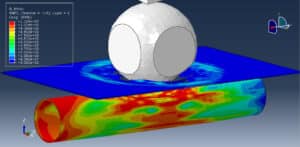
In this lesson, the Simulation of the cold spray process of ceramic particles is done through a comprehensive tutorial. The ceramic impactor is modeled as a three-dimensional sphere part with a forty-micrometer radius; this is the minimum size of the sphere radius in Abaqus. The titanium target is modeled as a three-dimensional part. The titanium material is modeled as an elastic-plastic material with Johnson-Cook behavior and Johnson-Cook damage to predict the damaged zone. The Johnson-Cook material model can predict the deformation under the rapid load perfectly. The ceramic material can be modeled as some material models that Abaqus recommends. In this simulation, the Johnson-Holmquist ceramic material model is used to consider the silicon carbide behavior in the high-velocity impact. The dynamic explicit step is used with the surface-to-surface contact algorithm, with the contact property

Example-6: Modeling of the cold spray process of steel particle on the Inconel surface
In this case, the Modeling and simulation of the cold spray process of steel particles on the Inconel surface is studied through the ALE method. The steel particle is modeled as a three-dimensional solid part. The Nickel Chromium(Inconel) part is modeled as a three-dimensional solid part. A numerical model for the impact of the steel ball on the surface of Inconel targets was developed by the finite element method using the ALE method. The plastic deformation of the target specimen was simulated using the J–C plasticity model. In addition, the steel ball was modeled as elastic and Johnson-Cook plasticity. The thermal properties for both parts are used because of the temperature change during the simulation. A dynamic, Temp-Disp, Explicit solving procedure is used to model the relation between stress and temperature during the simulation. The surface-to-surface contact with contact properties like friction is used. The movement of the target was constrained in three directions. The initial velocity is assigned to the steel projectile. The arbitrary Lagrangian-Eulerian (ALE) is considered to refine the mesh during the simulation. The mesh should be fine at the contact zone because of the deformation and high-temperature rate there

Example-7: Analysis of the deposition behavior of multi-particle impact in the cold spraying process
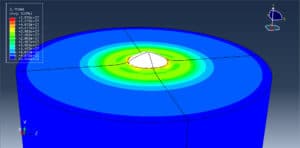
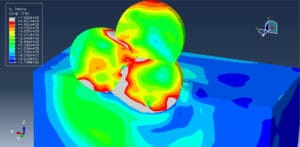
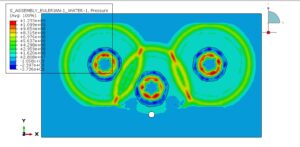
In this lesson, the Analysis of the deposition behavior of multi-particle impact in the cold spraying process is studied. The aluminum particles are modeled as three-dimensional solid parts. The aluminum target is also modeled as a three-dimensional solid part. In the practical cold-spraying process, several particles impact onto a substrate and then form a coating. To study the deformation behavior and multi-particle interactions, single-particle, two-particle, and three-particle impacts were simulated using Abaqus software. A contact model that accounts for interfacial cohesion and thermal conduction is developed to investigate the influence of bonding on the final residual stresses build-up in cold spray. The impact of particles on a flat substrate is simulated in a Lagrangian reference frame by using the commercially available FE analysis software ABAQUS/Explicit. The Lagrangian method is used as it provides a unique way to model the interface contact interactions for particle bonding. The aluminum material with elastic-plastic behavior is selected. The dynamic explicit step and proper interaction with the interaction property are considered.

Example-8: Simulation of the cold spray process of a ceramic particle on the steel material
In this model, the Simulation of the cold spray process of a ceramic particle on the steel material in Abaqus Software is investigated. The ceramic particle is modeled as a three-dimensional solid part. The steel target is modeled as a solid part. The dimensions of all parts are in micrometers. To model steel behavior under high strain rate, the Johnson-Cook hardening and damage model is selected. To model the brittle behavior of the ceramic particle, the Johnson-Holmquist material model is used. The dynamic explicit step and surface-to-surface contact are appropriate for this example. The proper boundary, initial velocity, and mesh are selected for all parts.

Example-9: Modeling the Depositing Al-Based Metallic Coatings onto Polymer Substrates by Cold Spray
In this section, the Modeling and Analysis the Depositing Al-Based Metallic Coatings onto Polymer Substrates by Cold Spray in Abaqus through a comprehensive tutorial is studied. The aluminum particles are modeled as a three-dimensional solid part on a microscale. The polyetheretherketone(PEEK) polymer is modeled as a three-dimensional solid part. Polymers are widely used in land and air vehicles because of their low density, ease of forming, and weldability. In the last two decades, the use of polymers to reduce component weight has increased in various industries. However, applications for polymers are limited by intrinsically inferior structural properties relative to metals, including low strength and modulus, poor erosion resistance, poor electrical conductivity, susceptibility to UV damage, and low service temperatures. Metalization of polymers can be an effective approach to mitigate these shortcomings and broaden their applications. The objective of the present study is to investigate the feasibility of metallizing polymer substrates using a relatively mild process that does not damage or distort the polymer substrate. Presently, few conventional methods are suitable for the surface metallization of polymers. Cold spray (CS) produces uniform metallic deposits by accelerating solid powder particles in a supersonic gas flow to impinge on and deposit onto substrates. Until recently, CS was used primarily to deposit metal onto metallic substrates, primarily for the repair of worn or surface-damaged components. Thus, metal-on-metal deposition via CS has been widely studied. However, few studies have been devoted to CS onto polymeric substrates. Substrate erosion reportedly is a key problem with CS onto polymeric substrates, especially with thermoset polymers, which degrade at high temperatures.

Reviews

No Review Yet
No Review Yet
€178,00 €270,00
Optional extras

Need a full custom project? See the options below.

30 people watching this product now!

Material Includes

  • 1- Abaqus files+Codes
  • 2- Paper and Document
  • 3- Tutorial Videos

Audience

  • 1- Mechanical Engineering
  • 2- Materials Science and Engineering
  • 3- Manufacturing Engineering
  • 4- Aerospace Engineering

Related  Products

See more

Want to receive push notifications for all major on-site activities?

✕