
Need a full custom project? See the options below.
Need a full custom project? See the options below.
Product Overview:
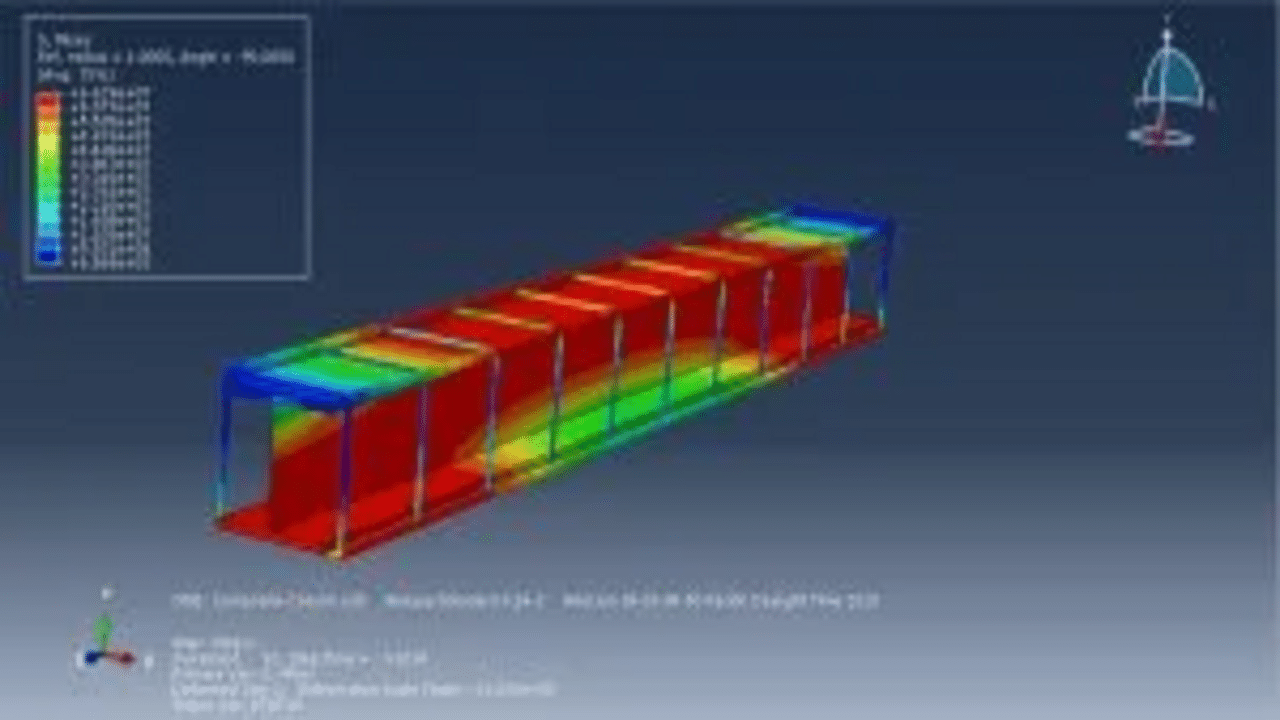
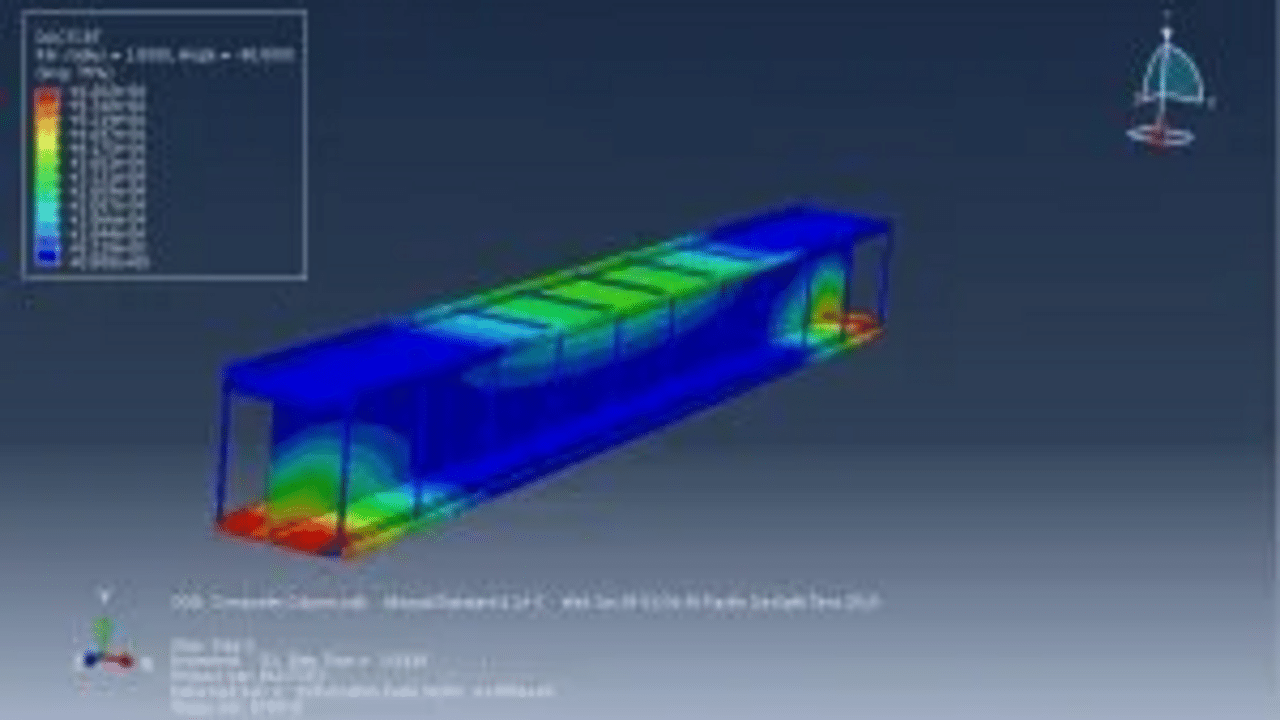
In this tutorial, we investigate the simulation of steel-concrete composite columns subject to both vertical and horizontal loads using Abaqus. Steel-concrete composite columns are innovative structural members that have gained popularity due to their high load-bearing capacity and efficient material use, as well as their outstanding stiffness, ductility, and energy absorption capabilities. By combining reinforced concrete (RC) with structural steel sections, these columns offer significant advantages over traditional reinforced concrete and steel solutions. The concrete element provides fire resistance to the steel components, preventing buckling and contributing to overall structural stability. Utilizing steel-concrete composite columns positively affects the concrete strains when compared to those observed in standard reinforced concrete columns. However, to ensure performance under axial loads, fire exposure, or seismic activity, Steel-Reinforced Concrete (SRC) columns require appropriate longitudinal and transverse reinforcements to mitigate the risk of concrete spalling.
In this simulation, the concrete column and the steel beam core are modeled as three-dimensional solid parts, with the reinforcement bars represented as wire elements and the pusher plate as a rigid component.
The steel members are modeled using an elastic-plastic material with a ductile damage criterion, while the Concrete Damage Plasticity (CDP) model is applied to the concrete column. This tutorial distinguishes between general static and dynamic explicit procedures, comparing the results at the conclusion of the simulations. Perfect contact is assumed between the concrete and steel beam, with the bars embedded within the concrete matrix. A vertical concentrated load is applied to the top surface of the column, and a pressure load is enacted on the side surface of the concrete.
Upon completing both the static and dynamic simulations, a variety of results—including stress, strain, damage, displacement, and force diagrams—are available for analysis.
Related model: concrete cover effect on steel-concrete bond-slip in SRC members.
Need more than the files?
There are two ways we can help. Book a one hour online consultation if you want to talk a problem through with a CAE engineer, using the checkbox in the order box. Order a project if you need a full simulation built for you, delivered to an agreed scope, price and deadline under a written contract.
We work on FEA and CFD for engineers, researchers and companies. Order your project, or message us on WhatsApp for a quick reply.
Other packages engineers working on this topic also download.
 Eccentric Loading of CFDST Columns
 Finite element analysis of new composite floors having cold-formed steel and concrete slab
 Flexural response of concrete-filled seamless steel tubes
 Study on steel reinforced concrete-filled GFRP tubular column under compression
 Behavior of inclined, tapered and STS square CFST stub columns subjected to axial load – Part 2
 Behavior of thin-walled dodecagonal section double skin concrete-filled steel tubes under bending
 Modeling the response of ultra-high-performance fiber reinforced concrete beams
 Flexural behavior of reinforced concrete beams strengthened with ultra-high performance fiber reinforced concrete

Need a full custom project? See the options below.

€129,00

€179,00

€149,00

€119,00

€129,00

€149,00
See more
Want to receive push notifications for all major on-site activities?