


Need a full custom project? See the options below.
Need a full custom project? See the options below.
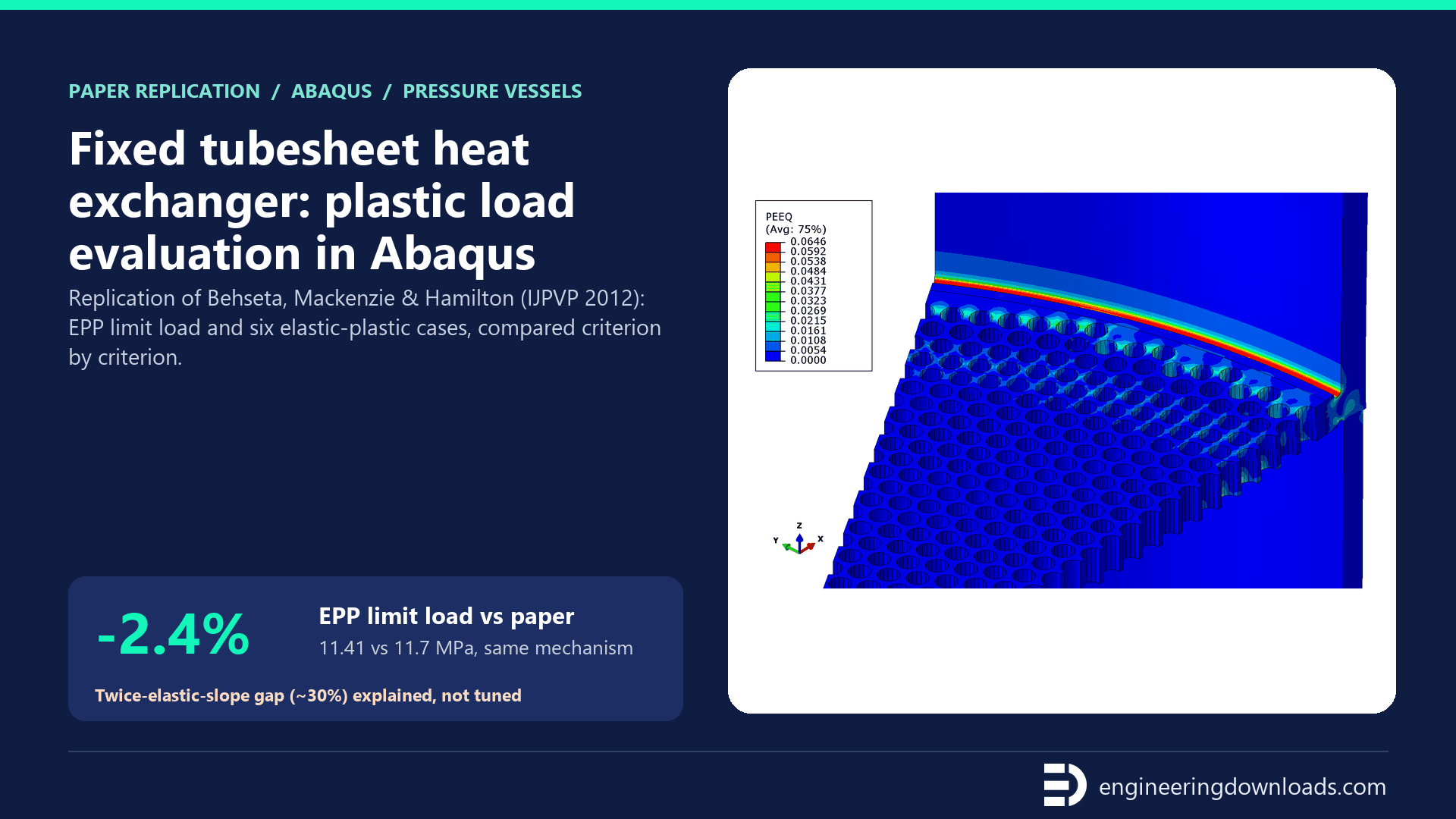
Fixed tubesheet heat exchangers are designed against plastic collapse, and the design-by-analysis route of ASME Section VIII Division 2 asks for a plastic load from an elastic-plastic finite element analysis. Which criterion you use to read that load from the analysis (limit load, twice elastic slope, tangent intersection, plastic work curvature or a strain limit) can change the answer by tens of percent. This Abaqus package rebuilds the fixed tubesheet heat exchanger of a published paper, runs the elastic-perfectly plastic limit analysis and six elastic-plastic cases, and evaluates every criterion the paper reports, so you can see where they agree and where they do not.
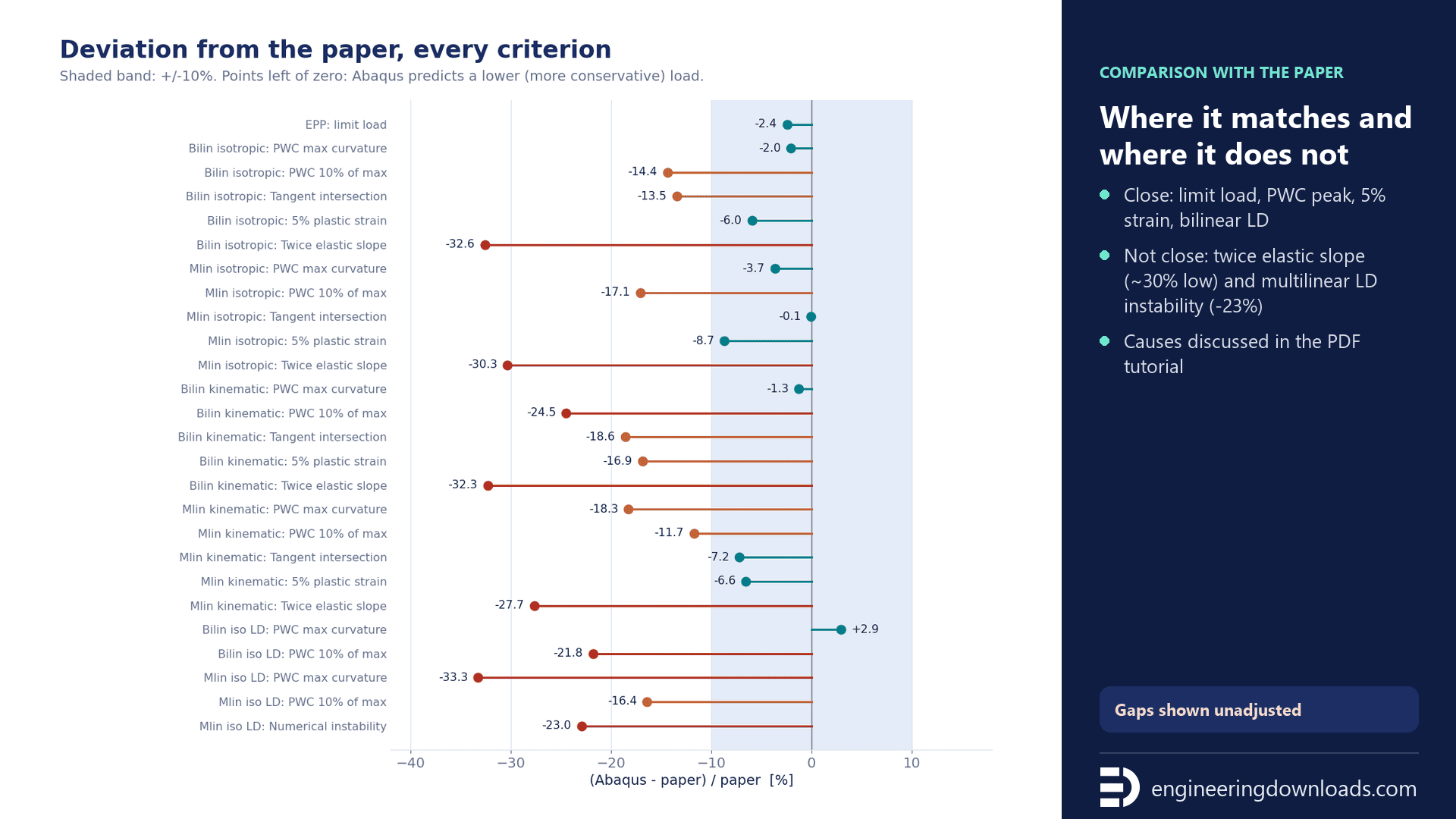
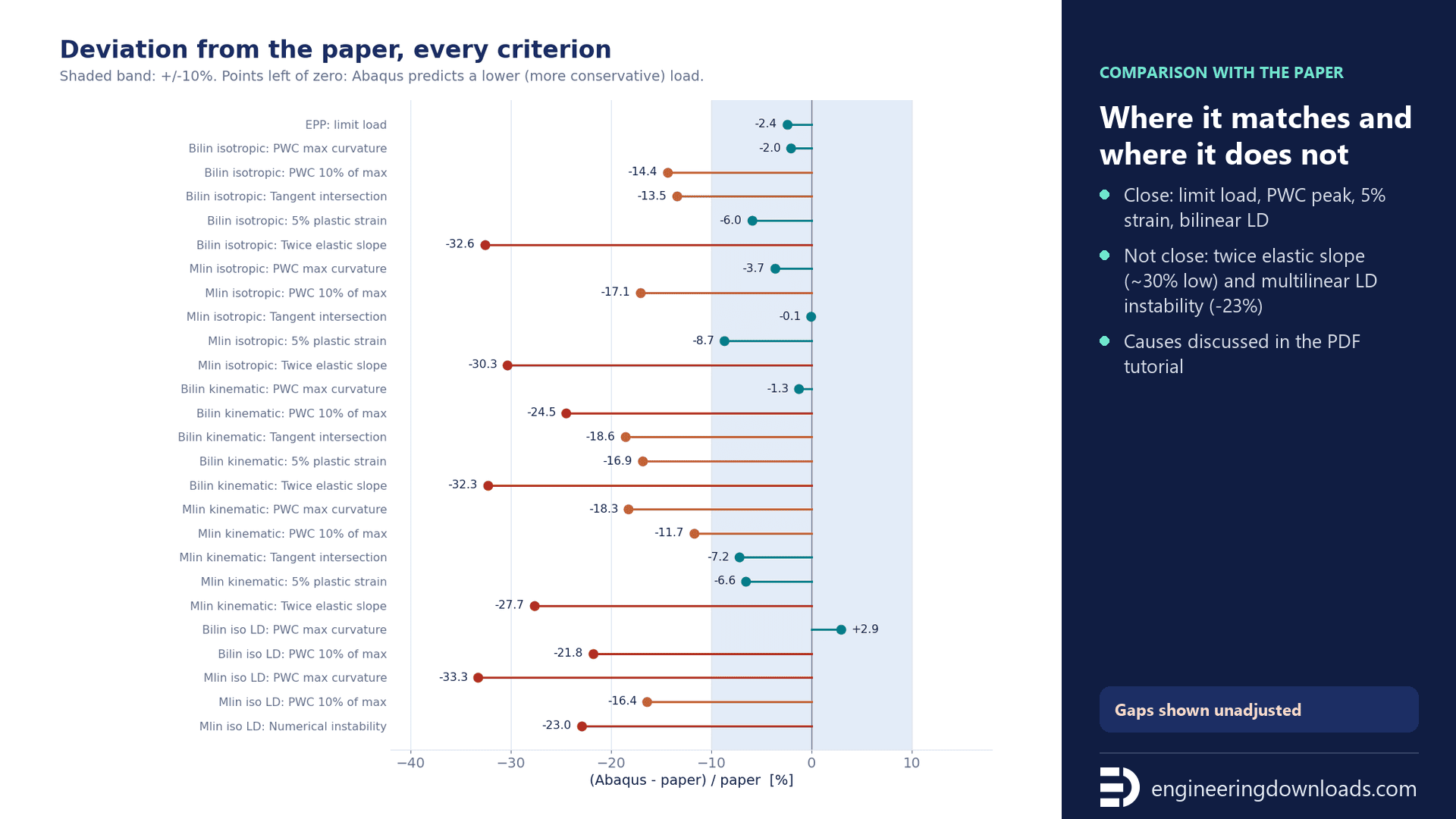
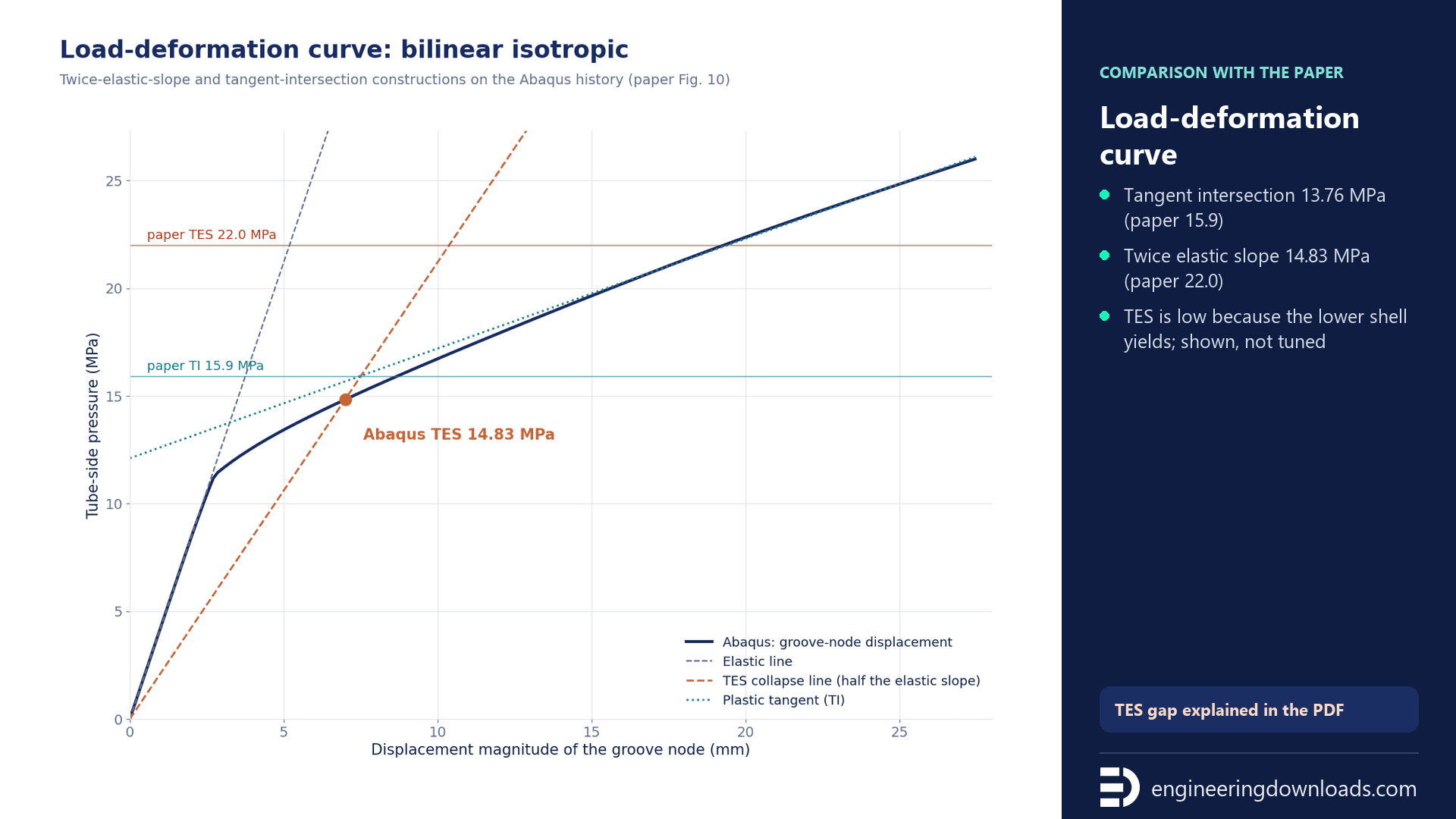
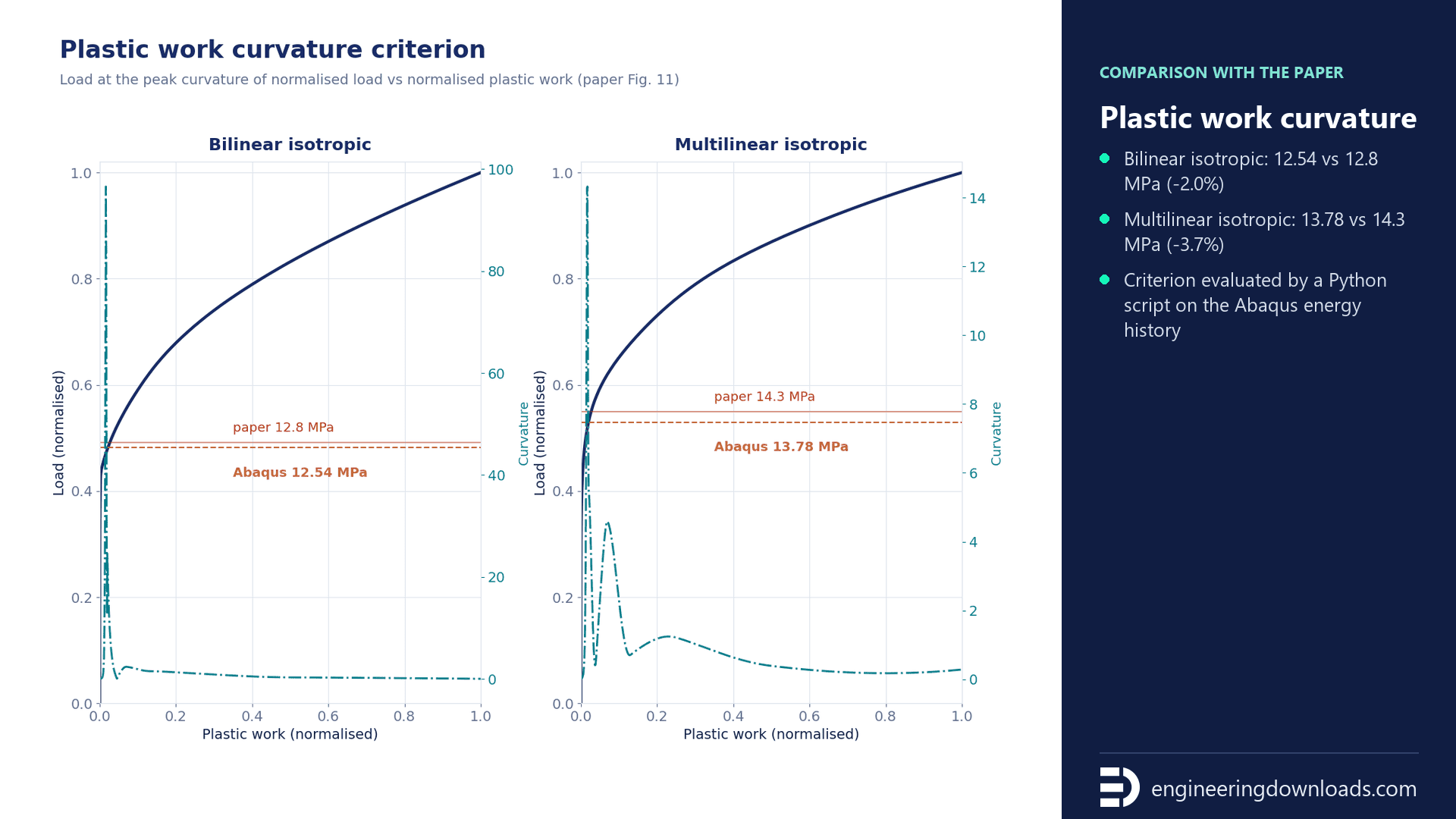
Honest status: partial validation. The limit load is 11.41 MPa against the paper’s 11.7 MPa (-2.4%) with the same collapse mechanism. The plastic work curvature load agrees within -1.3% to -3.7% and the load at 5% plastic strain within -6.0% to -8.7% in three of the four small-deformation cases. The twice-elastic-slope load is about 30% lower than the paper in every case, and the multilinear large-deformation instability load is 16.2 MPa against 21 MPa. Both gaps are shown in every table and figure, nothing was tuned to close them, and the tutorial explains them with a diagnostic run.
K. Behseta, D. Mackenzie, R. Hamilton, "Plastic load evaluation for a fixed tube sheet heat exchanger subject to proportional loading", International Journal of Pressure Vessels and Piping 92 (2012) 11-18.
What the paper does. It analyses a fixed tubesheet heat exchanger under tube-side pressure with a 3-D finite element model and compares plastic-load criteria for elastic-perfectly plastic, bilinear and multilinear (ASME VIII-2 Annex 3-D) material, with isotropic and kinematic hardening, in small and large deformation.
What this package reproduces. The geometry of the paper’s Fig. 4, the limit analysis, the four small-deformation hardening cases of Tables 2 and 3 and the two large-deformation cases of Table 4, with the same criteria. The paper does not give the tube pitch and count, the shell length or the channel head, so these are assumptions listed below. The paper is cited but not included, and none of its figures are used on this page; only its published values are compared.
| Tubesheet | 100 mm thick, SA266, 12.5 mm grooves on both faces at the shell junction |
|---|---|
| Tubes | Ø57 × 2.9 mm, SA334, triangular pitch 71.25 mm, 2917 tubes (pitch and count assumed) |
| Shells | Channel ID 4230, t = 90 mm, SA537. Lower shell ID 4250, 70 mm hub, 1:3 taper, 34 mm shell, SA516. 3000 mm to the mid-plane (assumed) |
| Model | 30 degree sector with cyclic symmetry; 143 924 nodes, 111 612 C3D8I solids; outer 4 tube rows as B31 PIPE beams, other tubes as truss links |
| Load | Tube-side pressure on the tubesheet, holes, grooves and channel, channel end-cap thrust, increased proportionally to 26 MPa (30 MPa large deformation) |
| Materials | EPP; bilinear Et = 0.1E; multilinear ASME VIII-2 Annex 3-D; isotropic, linear kinematic and combined (3 backstresses) hardening |
| Criteria | EPP limit load, twice elastic slope, tangent intersection, plastic work curvature (peak and 10%), 5% plastic strain, numerical instability |
| Solver | Abaqus/Standard 2024, 4 cores, about 25 minutes per small-deformation hardening case, up to about 55 minutes in large deformation |
All pictures in this section are screenshots of the delivered heat_exchanger_tubesheet.cae, which holds one model per analysis case.
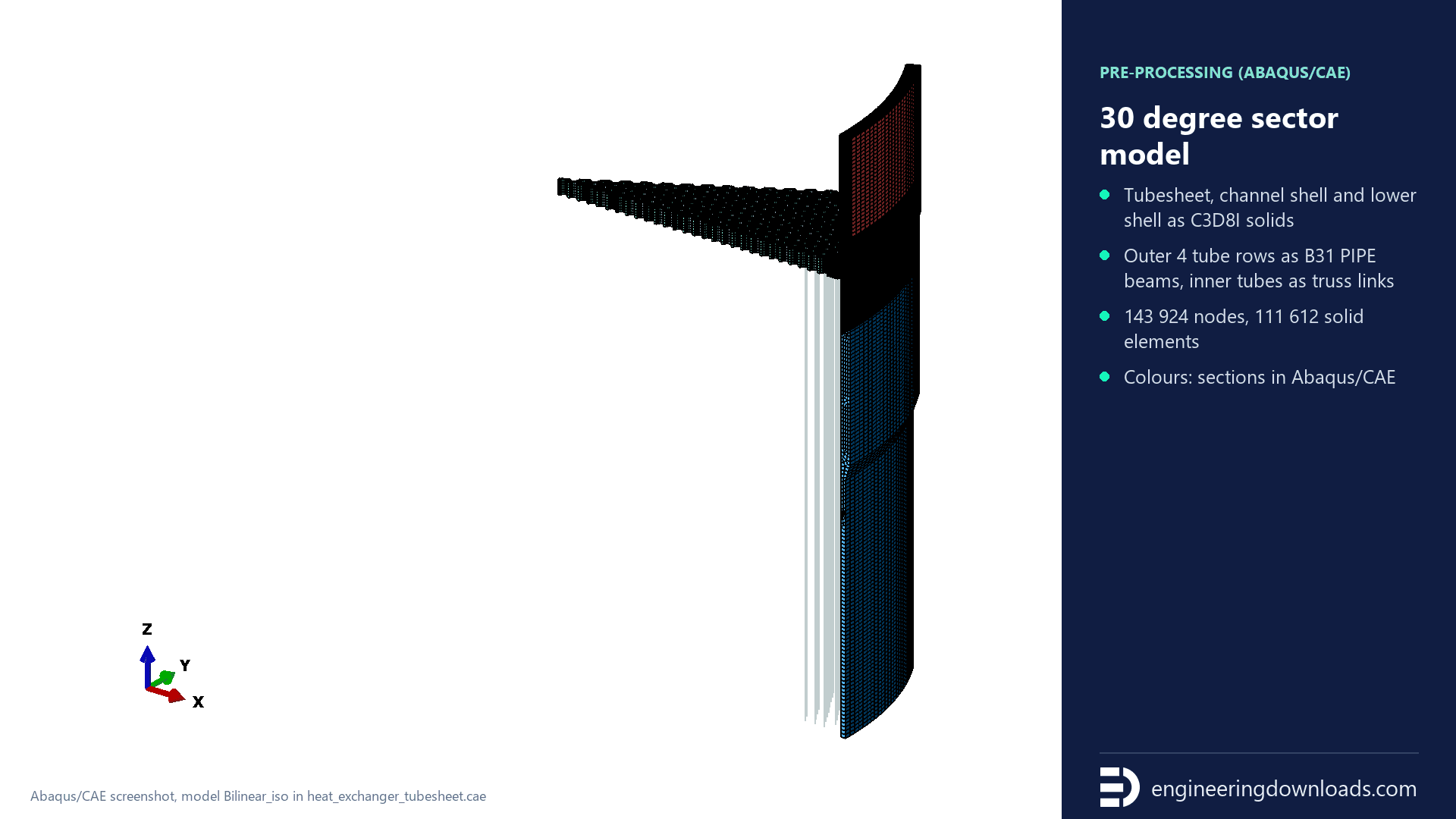
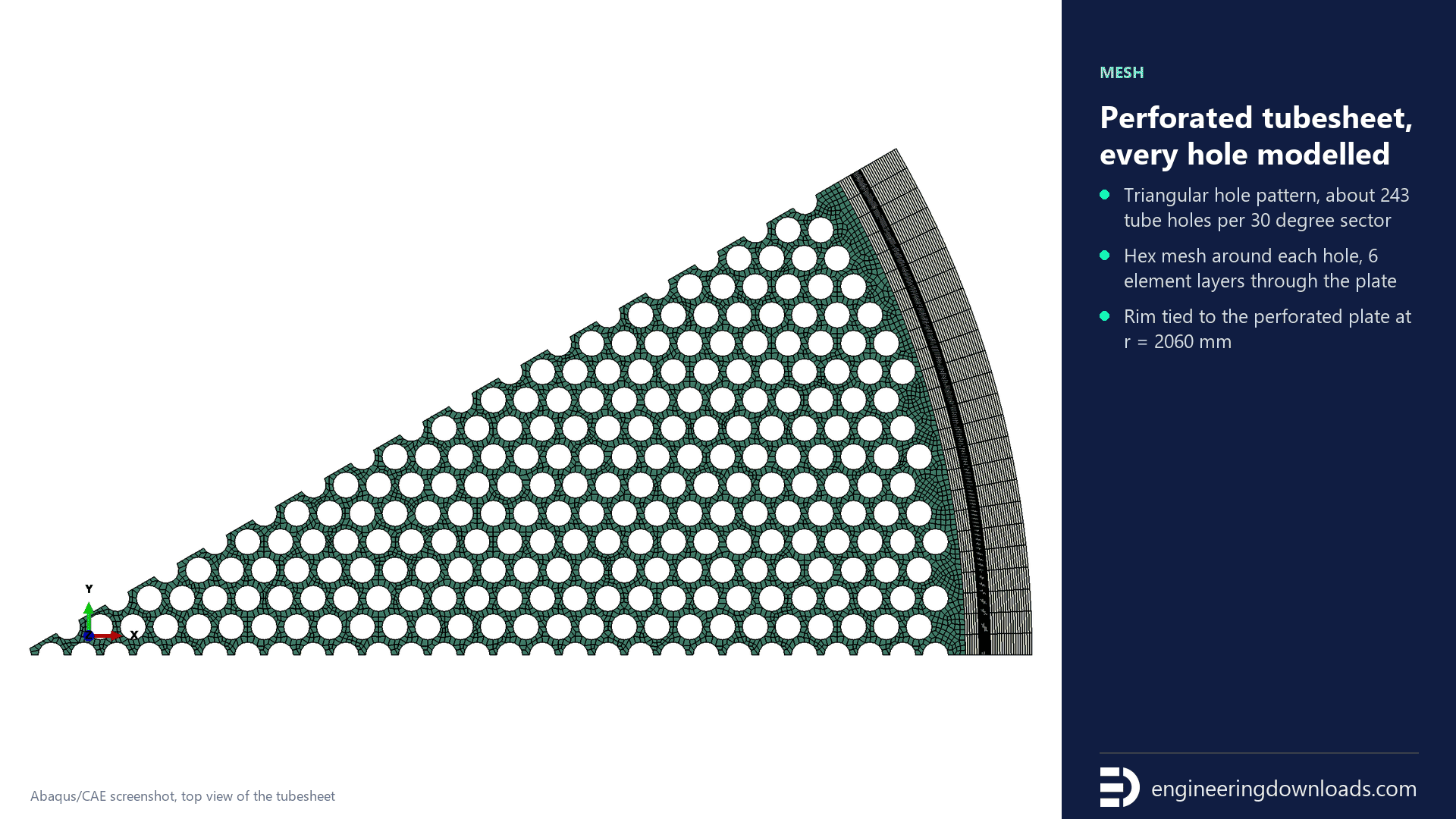
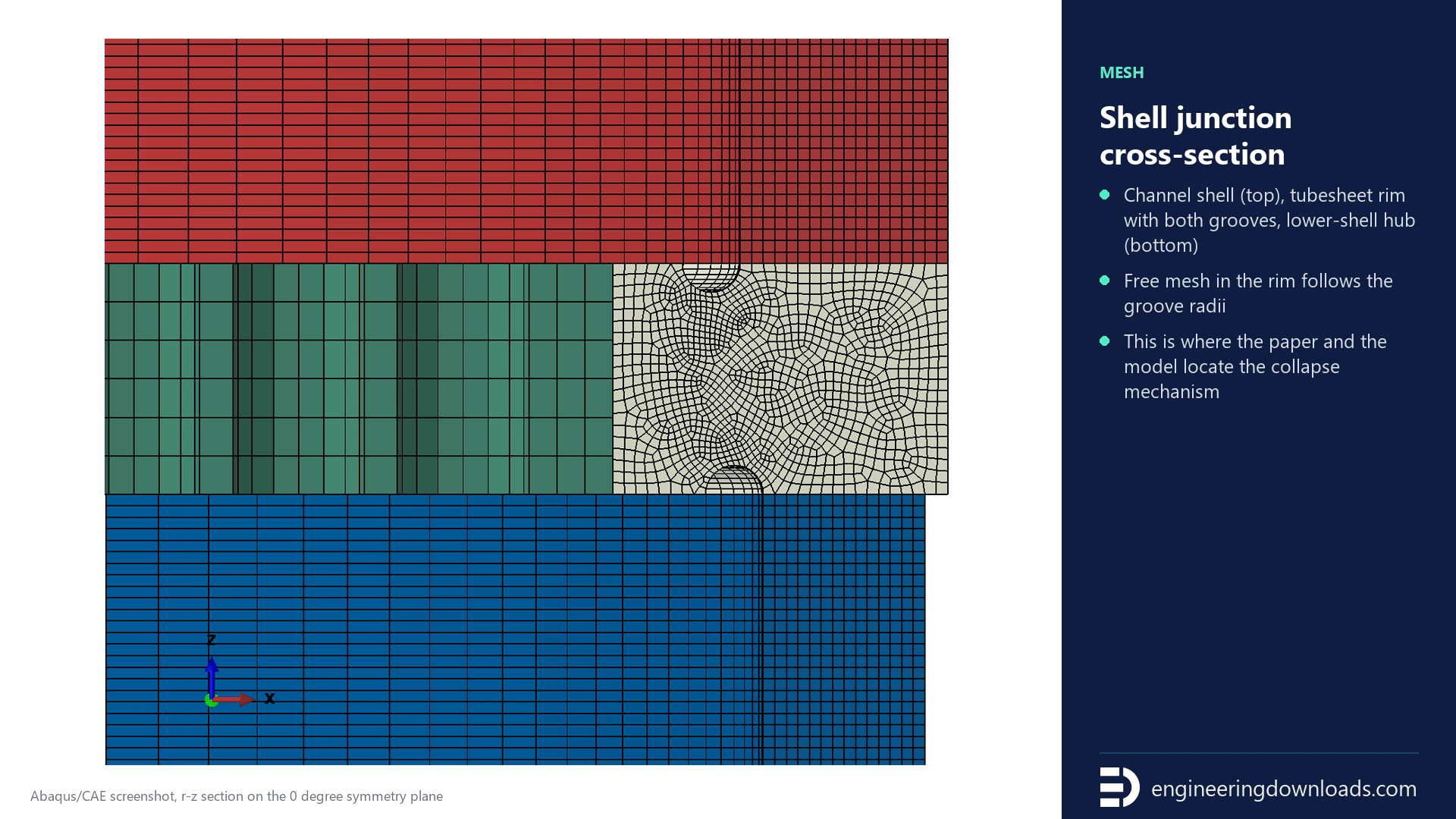
Every tube hole of the sector is modelled in the perforated plate, with six element layers through the thickness. The rim is tied to the perforated plate, and the mesh is refined to 5 mm around the grooves, where the plastic mechanism forms.

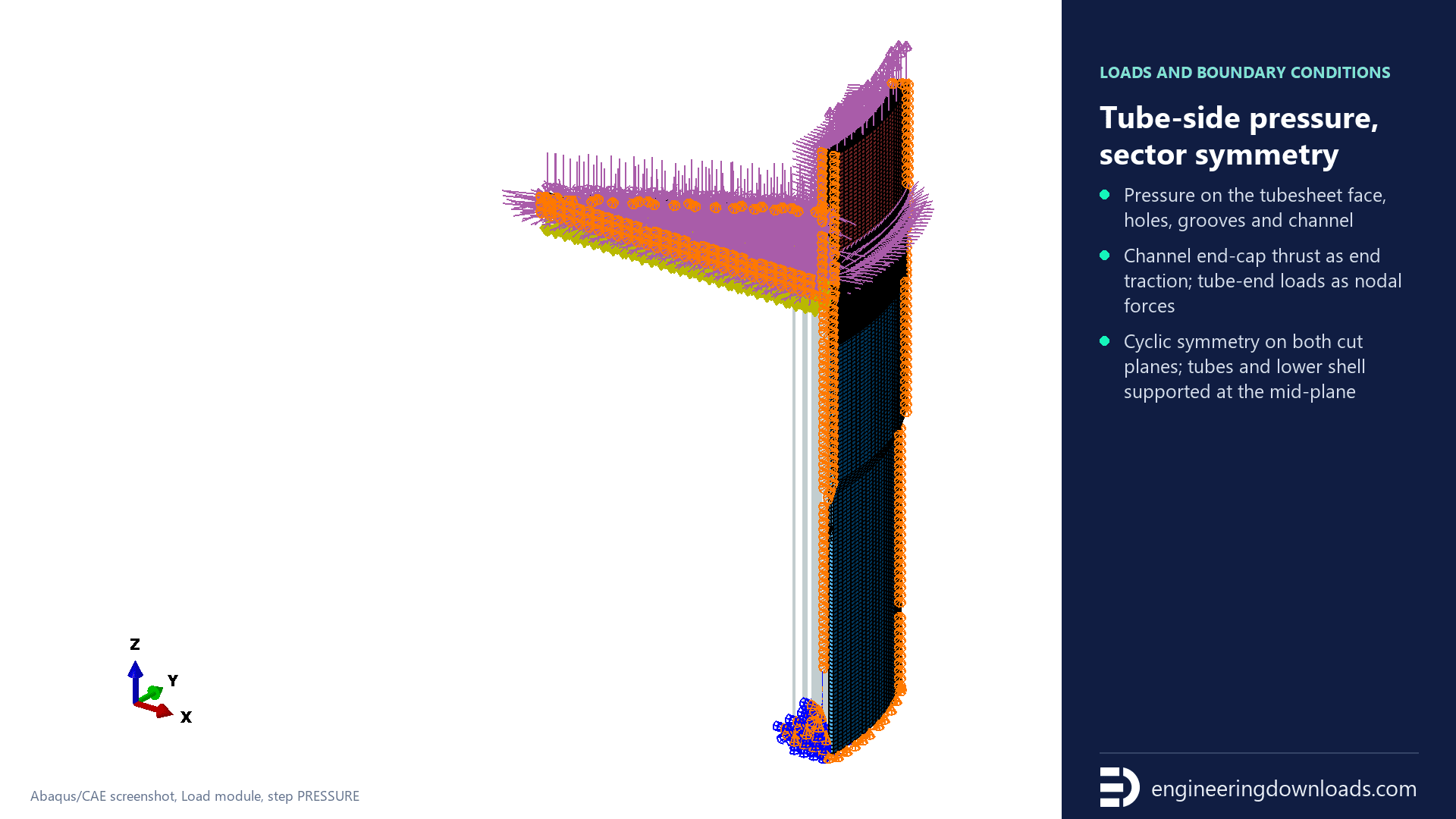
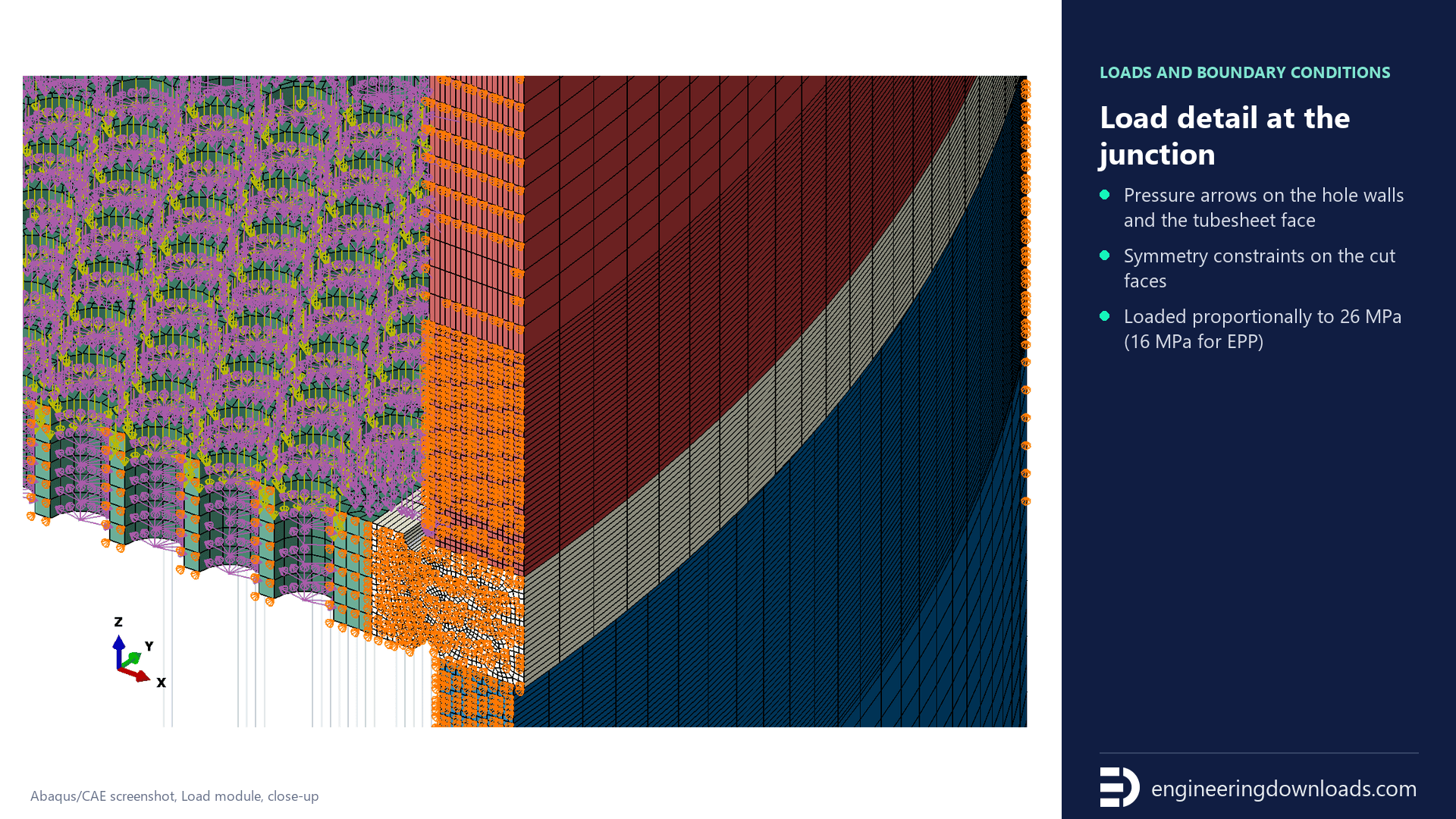
Tube-side pressure acts on the tubesheet face, the hole walls, the grooves and the channel. The channel head is replaced by its pressure thrust, and the tube-end loads by nodal forces. Both cut planes carry cyclic symmetry; tubes and lower shell are supported at the exchanger mid-plane. In large deformation the tube links are replaced by axial simple supports, as the paper does.
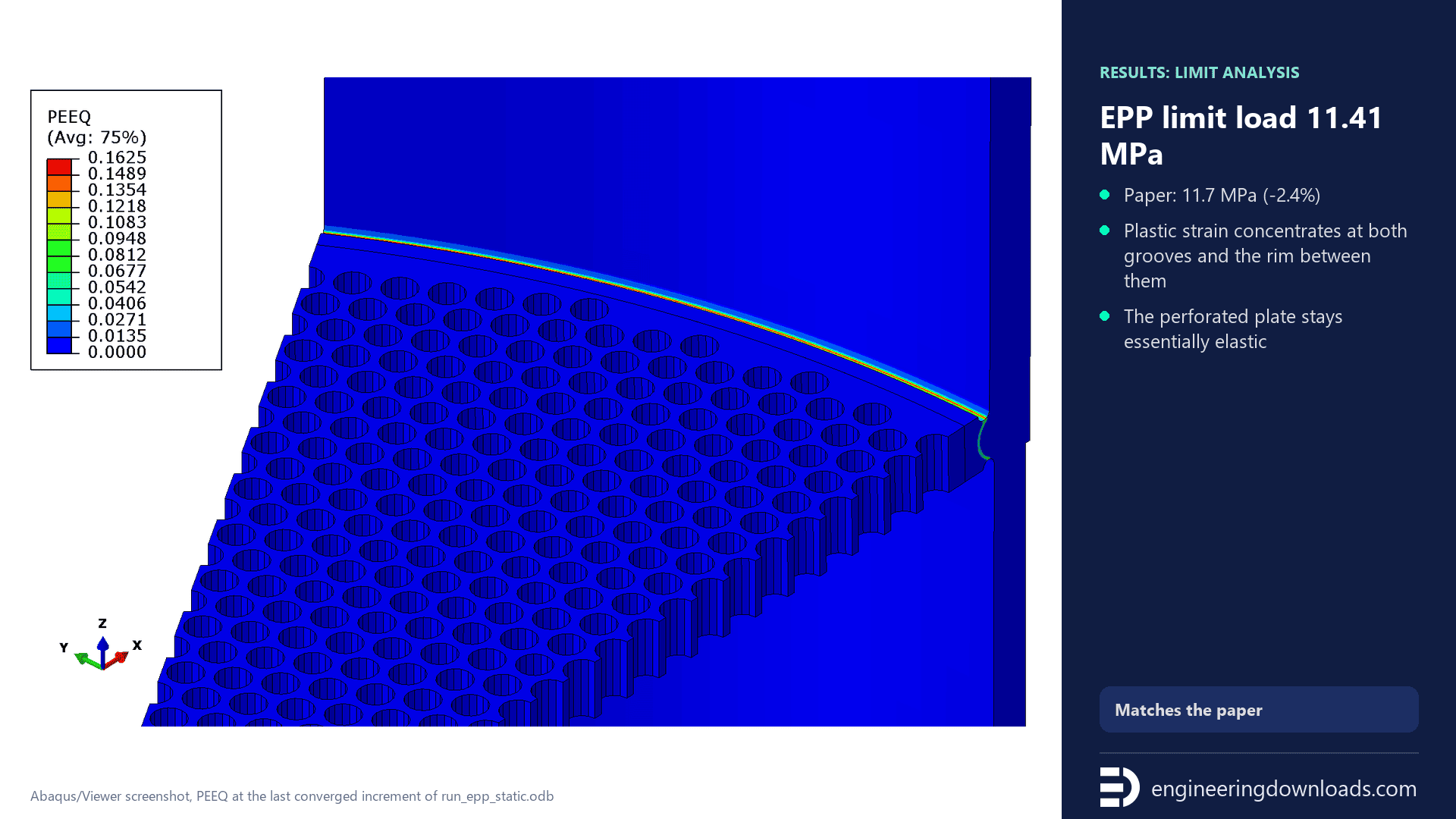
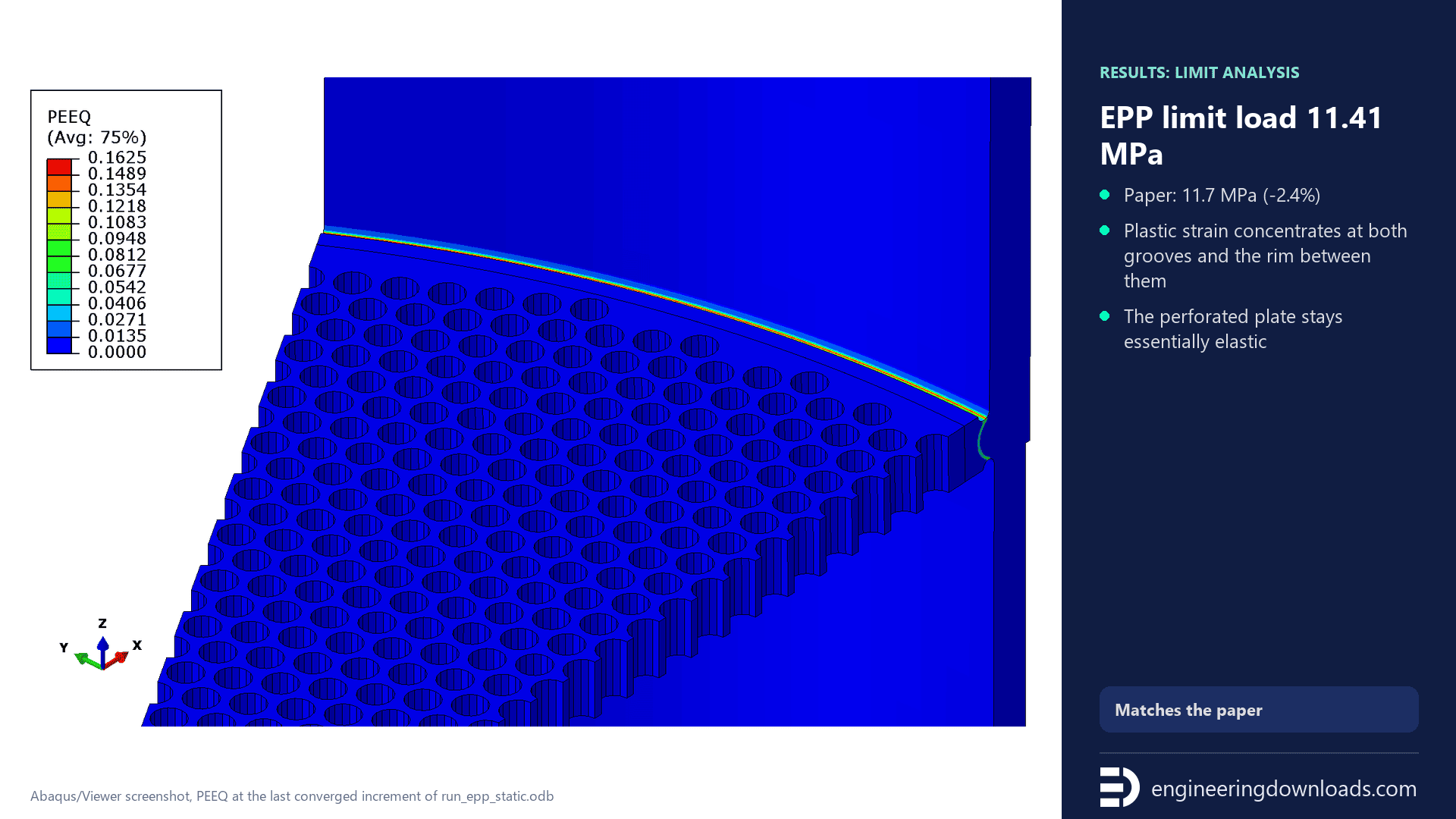
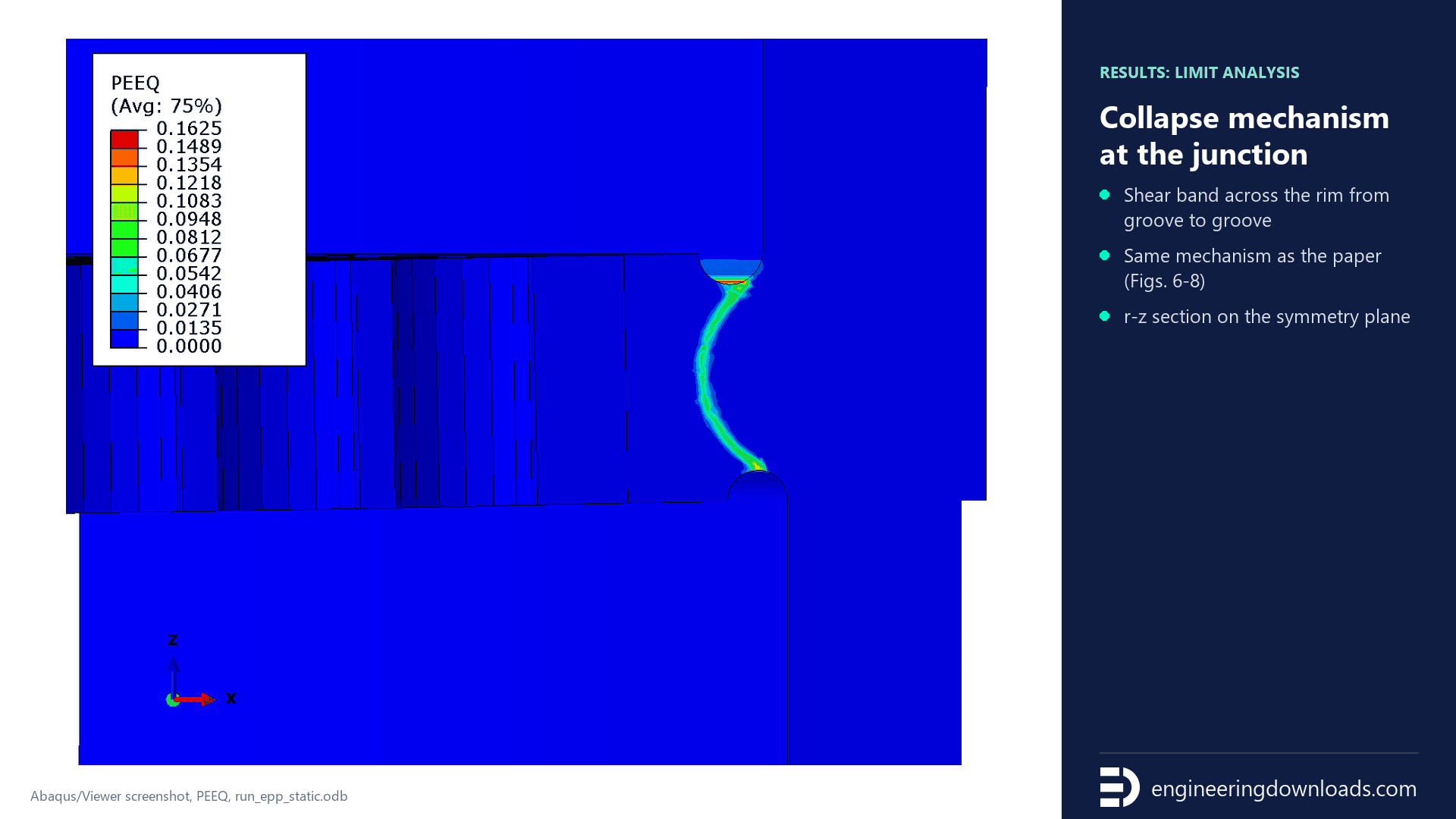
The elastic-perfectly plastic analysis stops converging at 11.41 MPa. Plastic strain concentrates at both grooves and forms a shear band across the rim between them, the same mechanism the paper shows. The perforated plate stays essentially elastic.
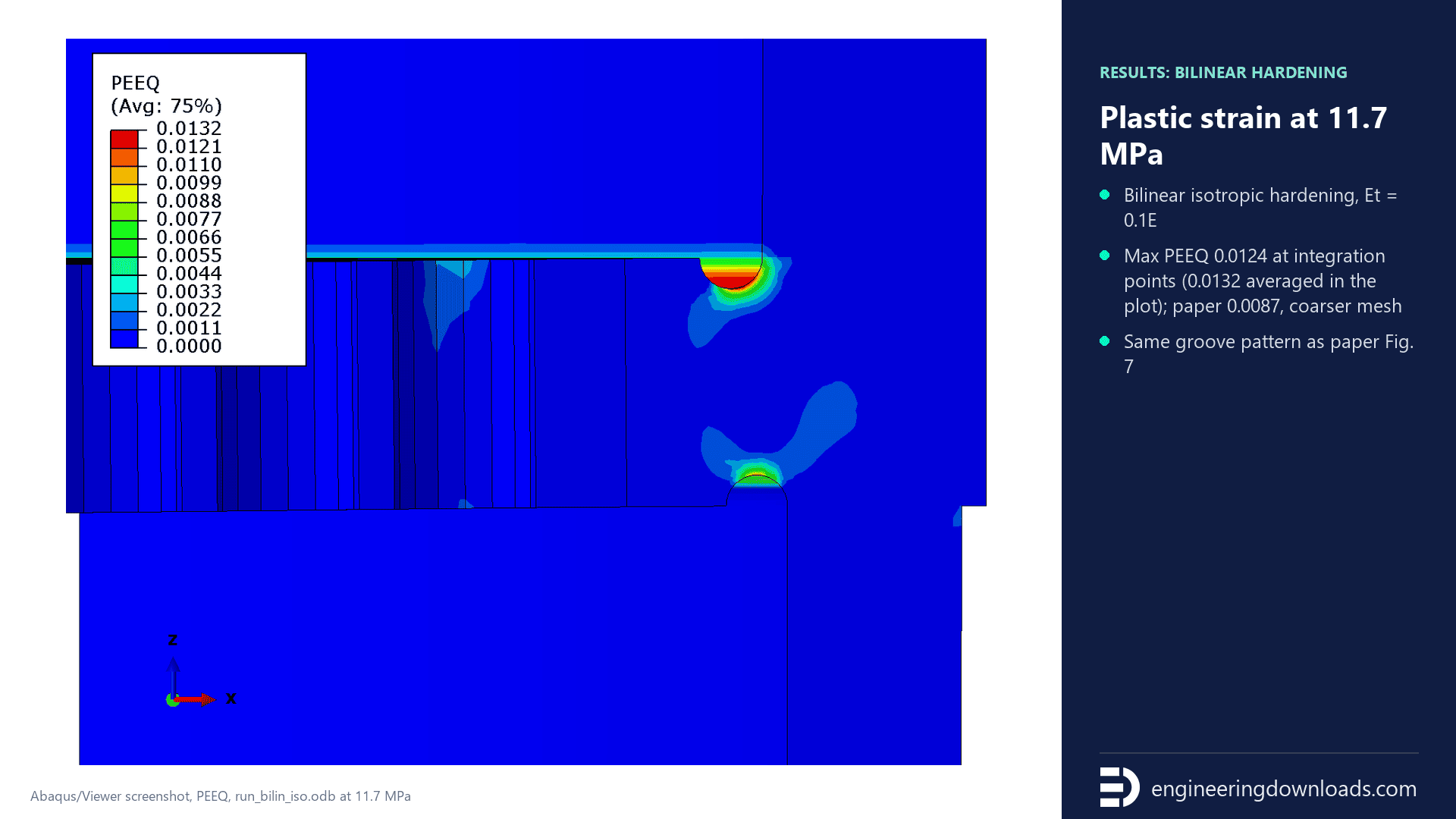
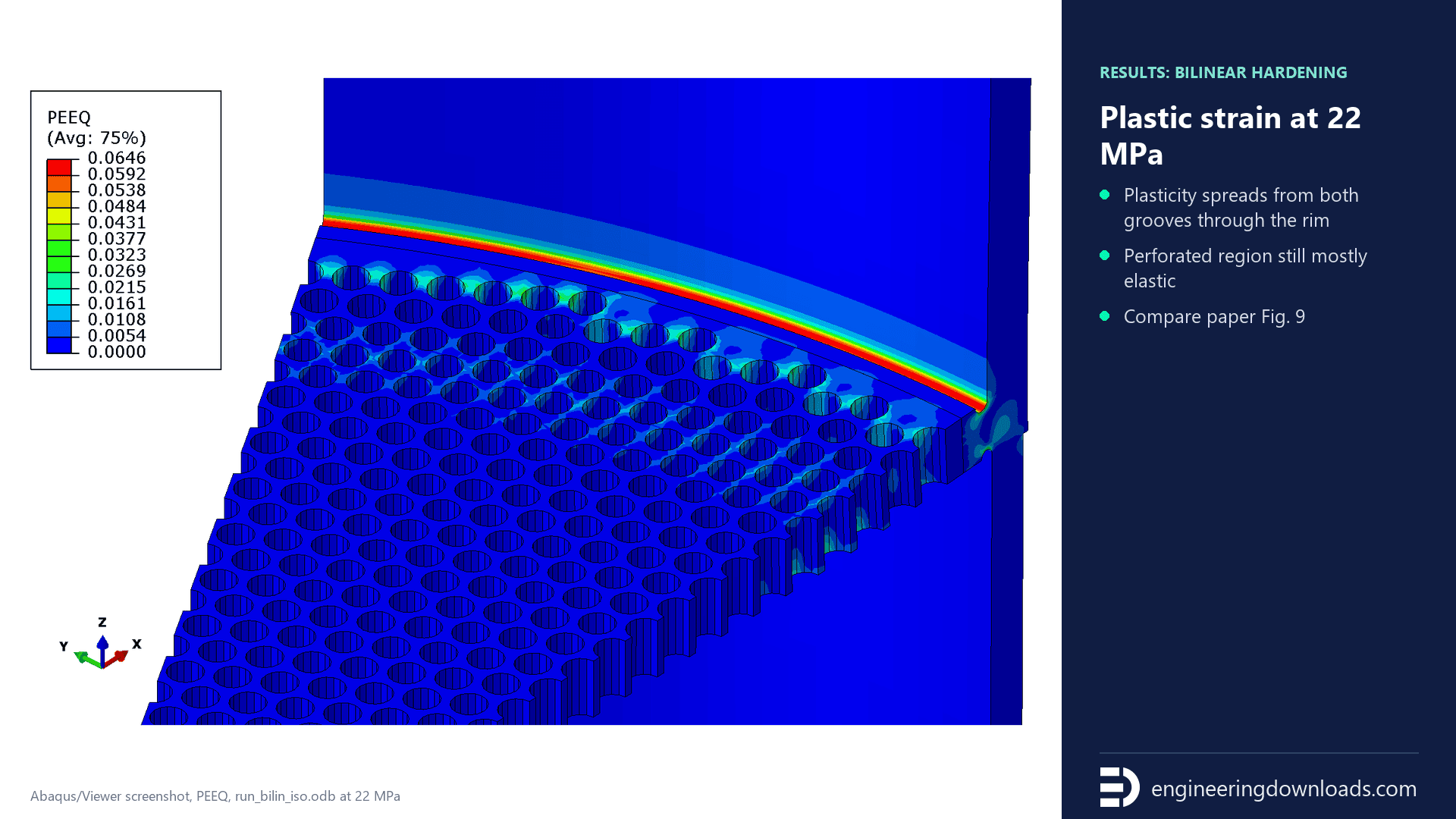
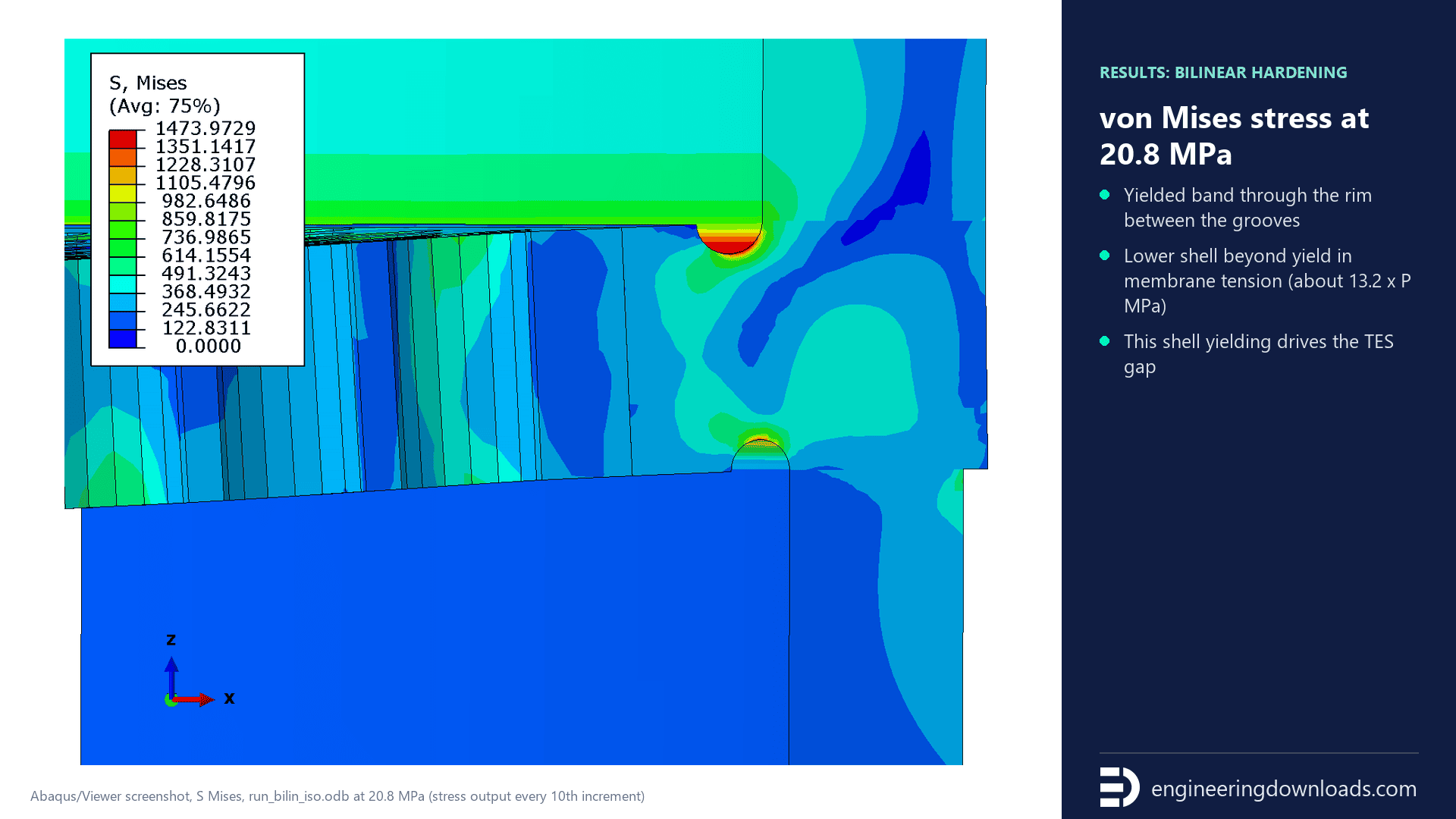
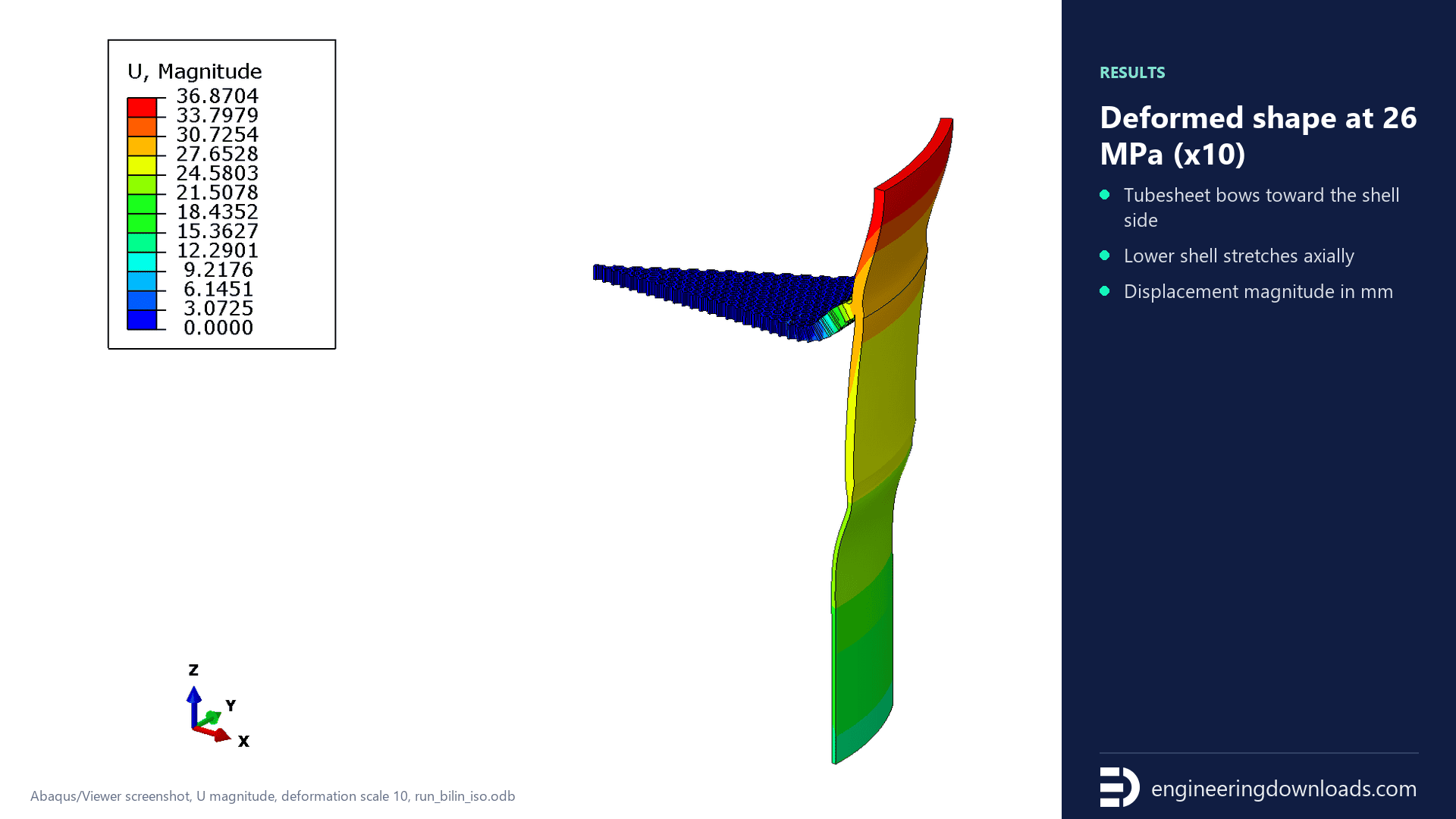
With bilinear hardening the structure keeps carrying load past the limit load. At 11.7 MPa plasticity is confined to the groove roots; at 22 MPa it spreads through the rim, and the 34 mm lower shell yields in membrane tension.
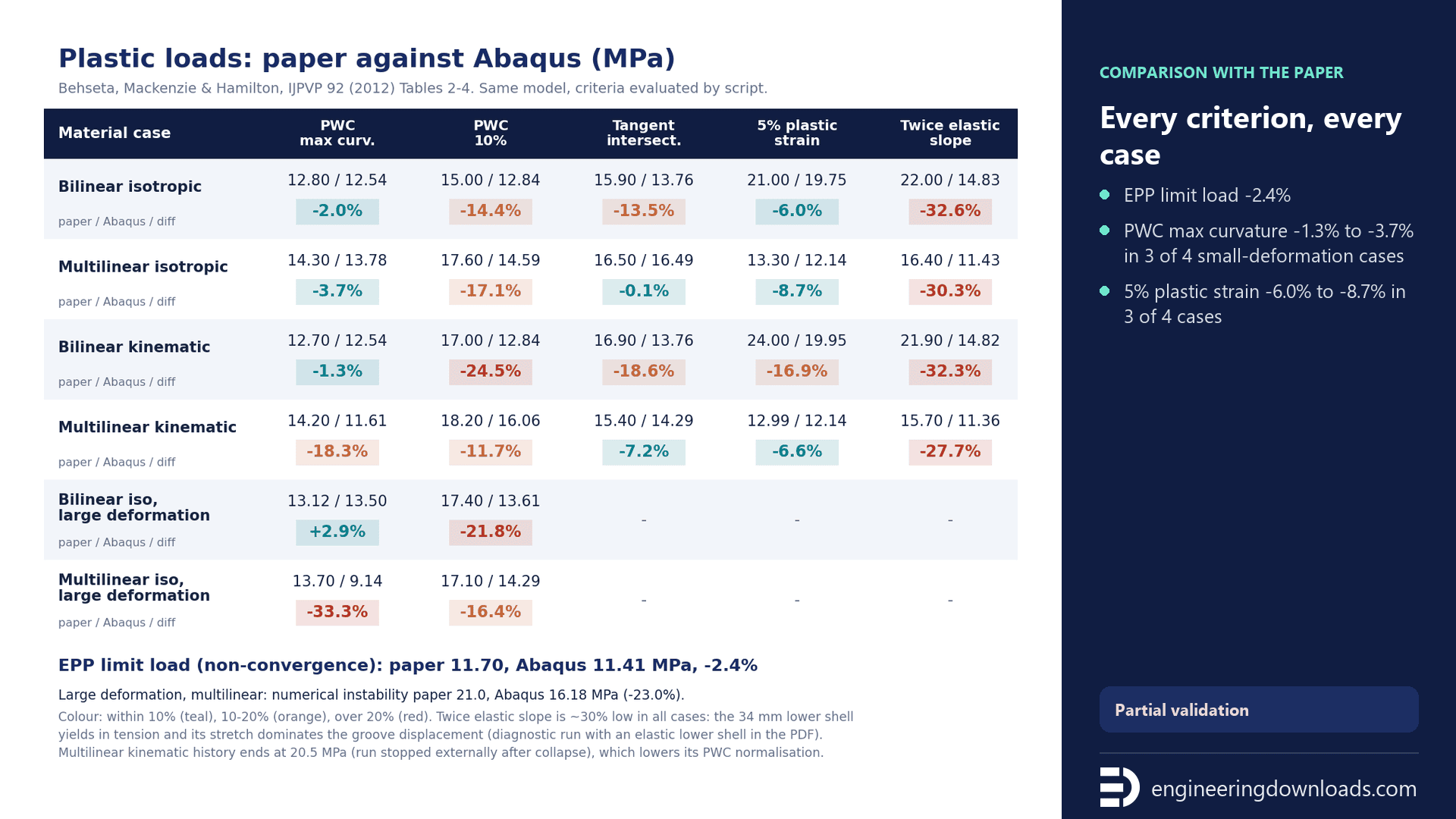
Paper value / Abaqus value (difference), in MPa. Small deformation, Tables 2 and 3 of the paper.
| Case | PWC max curvature | PWC 10% | Tangent intersection | 5% plastic strain | Twice elastic slope |
|---|---|---|---|---|---|
| Bilinear isotropic | 12.80 / 12.54 (-2.0%) | 15.00 / 12.84 (-14.4%) | 15.90 / 13.76 (-13.5%) | 21.00 / 19.75 (-6.0%) | 22.00 / 14.83 (-32.6%) |
| Multilinear isotropic | 14.30 / 13.78 (-3.7%) | 17.60 / 14.59 (-17.1%) | 16.50 / 16.49 (-0.1%) | 13.30 / 12.14 (-8.7%) | 16.40 / 11.43 (-30.3%) |
| Bilinear kinematic | 12.70 / 12.54 (-1.3%) | 17.00 / 12.84 (-24.5%) | 16.90 / 13.76 (-18.6%) | 24.00 / 19.95 (-16.9%) | 21.90 / 14.82 (-32.3%) |
| Multilinear kinematic | 14.20 / 11.61 (-18.3%) | 18.20 / 16.06 (-11.7%) | 15.40 / 14.29 (-7.2%) | 12.99 / 12.14 (-6.6%) | 15.70 / 11.36 (-27.7%) |
| Other checks | Paper | Abaqus | Difference |
|---|---|---|---|
| EPP limit load | 11.70 | 11.41 | -2.4% |
| Bilinear, large deformation: PWC max curvature | 13.12 | 13.50 | +2.9% |
| Bilinear, large deformation: numerical instability | 24 | increment cut-back at 24.4, completes to 30 | – |
| Multilinear, large deformation: PWC max curvature | 13.70 | 9.14 | -33.3% |
| Multilinear, large deformation: numerical instability | 21.0 | 16.18 | -23.0% |
heat_exchanger_tubesheet.cae with 7 models: EPP limit, bilinear and multilinear with isotropic and kinematic hardening, bilinear and multilinear in large deformation.run_*.inp) of the 7 validation cases, the elastic check and the elastic-lower-shell diagnostic, plus the shared mesh.inp.No ODB files are included (about 1.7 GB each); every result can be regenerated from the decks.
Requirements: Abaqus/Standard and Abaqus/CAE 2024 or newer; a 4-core licence is enough.
The same tubesheet, rebuilt and solved in Ansys Mechanical APDL 2024 R2 with all hardening cases and cross-checked against this Abaqus model (23 of 31 criterion values within 5 %): Fixed tubesheet heat exchanger plastic load in Ansys MAPDL.
Need more than the files?
There are two ways we can help. Book a one hour online consultation if you want to talk a problem through with a CAE engineer, using the checkbox in the order box. Order a project if you need a full simulation built for you, delivered to an agreed scope, price and deadline under a written contract.
We work on FEA and CFD for engineers, researchers and companies. Order your project, or message us on WhatsApp for a quick reply.
Other packages engineers working on this topic also download.
 Fixed Tubesheet Heat Exchanger in Ansys MAPDL: Plastic Load and Limit Load Replication of a Journal Paper€99,00
 Plastic limit pressure of a nozzle on a cylindrical pressure vessel, Abaqus Riks models€129,00
 Bolted Header Box Flange: Stress Linearisation in Abaqus€129,00
 3D Finite Element Analysis of Steel Plate Spinning Process in Abaqus
 Seismic Response of a Steel Building in Abaqus: Nonlinear Dynamic Analysis with Beam Elements
 Abaqus Simulation of a Steel Stud Push-Out Test in a Voided Reinforced Concrete Slab
 Fire Analysis of a CFRP-Strengthened Reinforced Concrete Beam Using Abaqus
 Stiffening Rings at Saddle Supports of a Horizontal Pressure Vessel in Abaqus: 20 Models vs Paper

Need a full custom project? See the options below.

€129,00

€179,00

€149,00

€119,00

€129,00

€149,00
See more
Want to receive push notifications for all major on-site activities?



