Need a full custom project? See the options below.
Need a full custom project? See the options below.
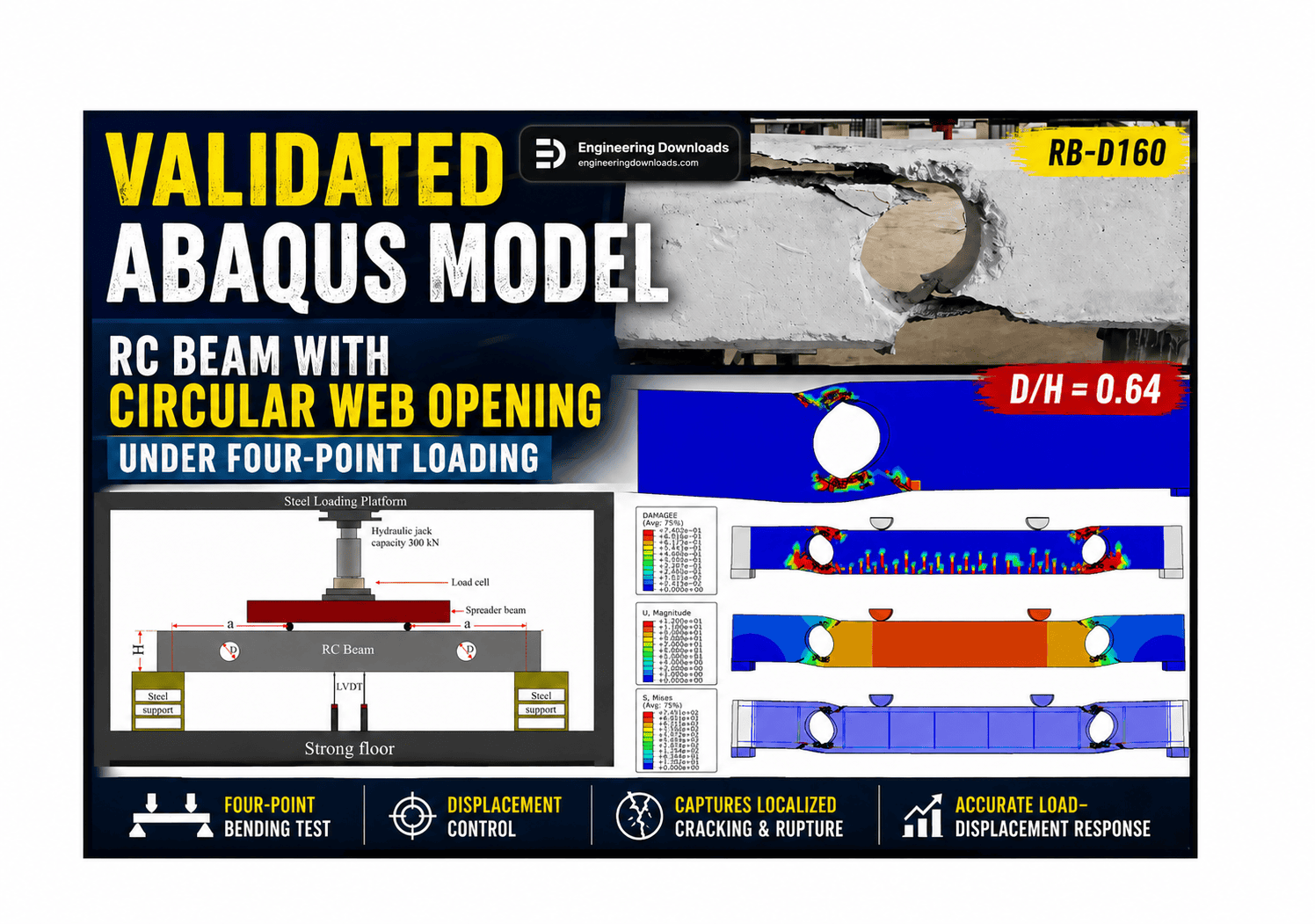
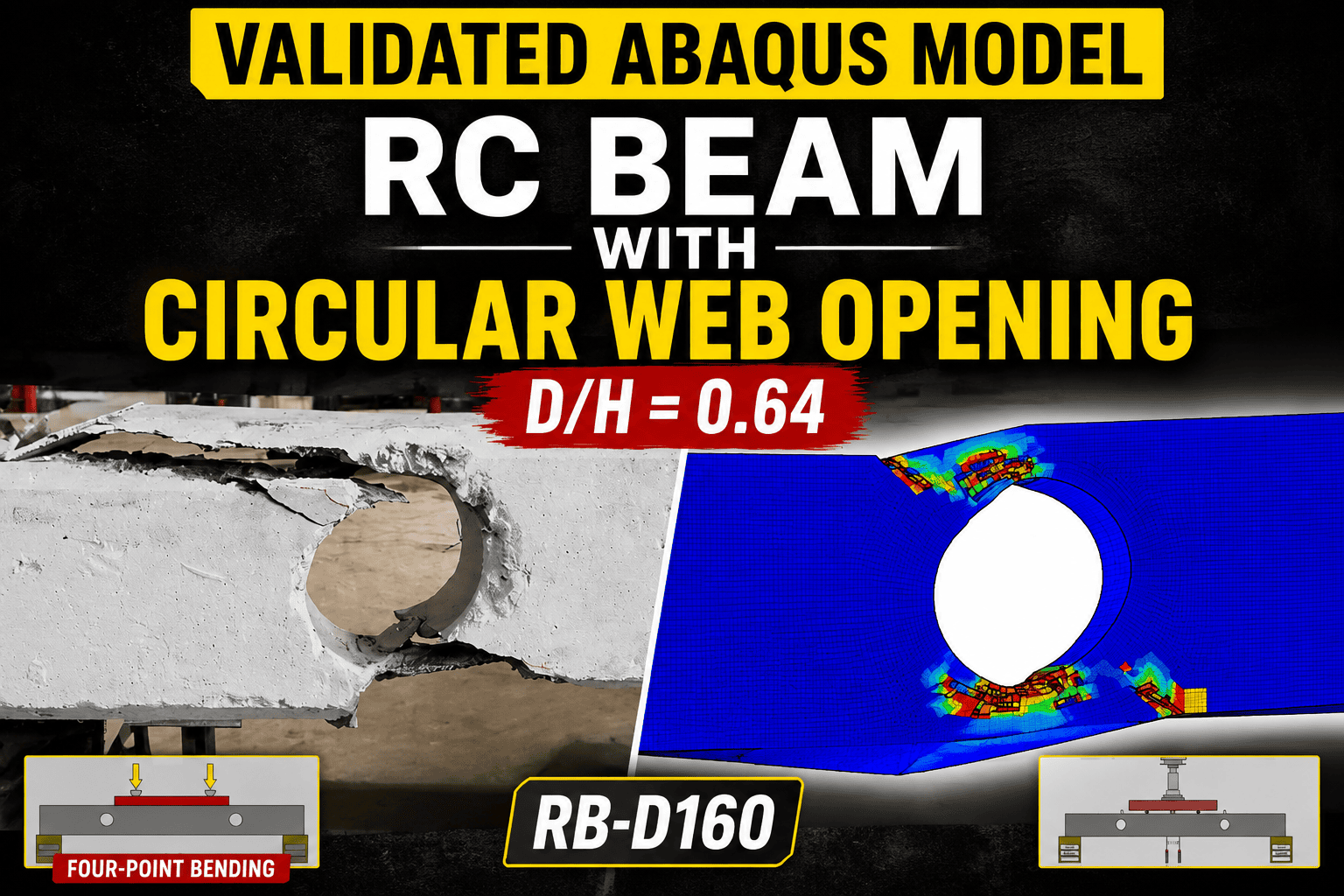
This validated Abaqus/Explicit model represents a shear-deficient reinforced concrete beam with a circular web opening, based on the experimental study “Experimental analysis of reinforced concrete shear deficient beams with circular web openings strengthened by CFRP composite.”
The model corresponds to specimen RB-D160, with a circular opening having a hole diameter-to-beam height ratio (D/H) of 0.64. The large opening significantly affects the shear behavior and load-carrying capacity of the beam, making this configuration particularly useful for studying localized damage and failure around web openings.
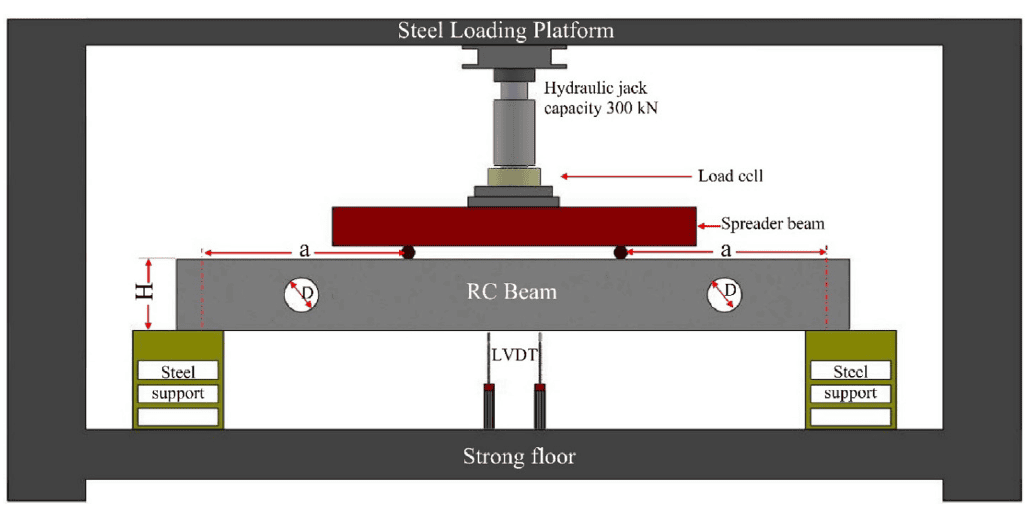
A detailed nonlinear finite element model is developed in Abaqus/Explicit to reproduce the experimental four-point bending test. The experimental supports and loading actuators are explicitly represented in the numerical model, allowing the loading and boundary conditions to be reproduced more realistically.
The analysis is performed using a displacement-controlled loading method, enabling the model to capture the nonlinear response and progressive damage of the reinforced concrete beam.
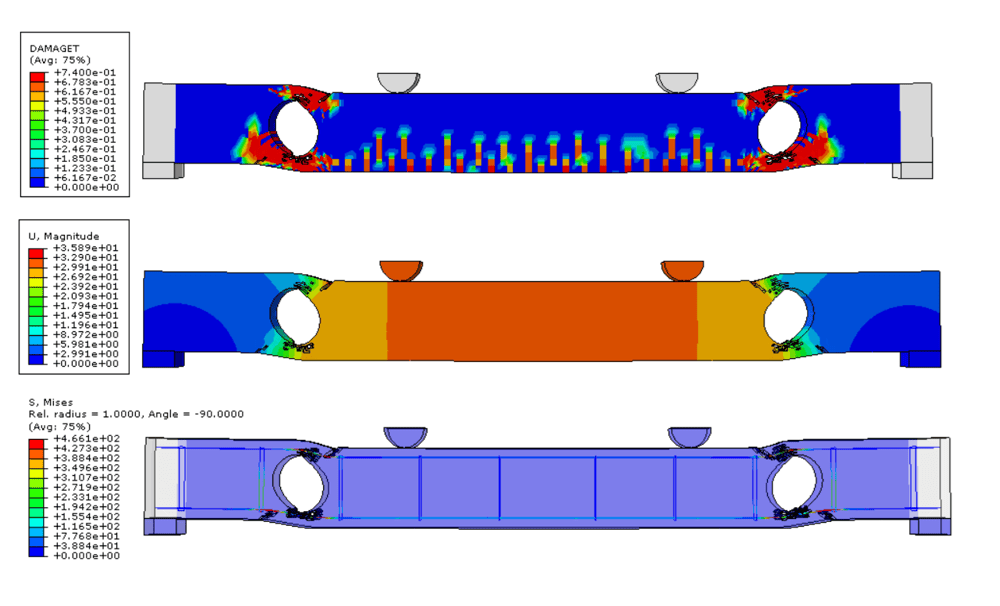
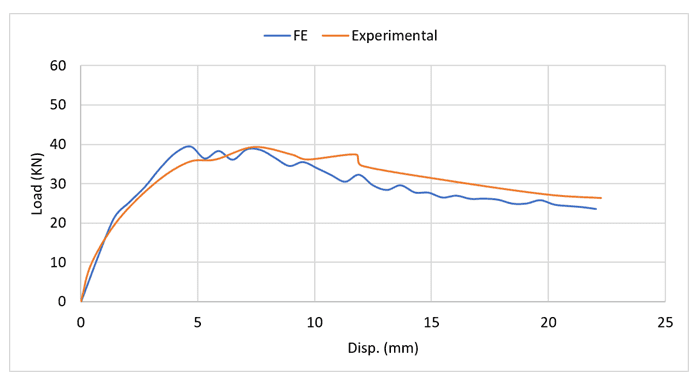
The model is validated against the experimental response and is capable of accurately reproducing both the global load–displacement behavior and the localized failure mechanisms around the circular opening. In particular, the simulation captures the development and concentration of cracking and the rupture/failure behavior around the opening.
This makes the model useful for researchers and engineers studying reinforced concrete beams with web openings, shear behavior, nonlinear concrete analysis, structural failure, and finite element validation using Abaqus/Explicit.
PAPER Abstract
In this study, two methods of CFRP applications were utilized to strengthen the shear deficient beams with circular holes and a comprehensive experimental program consisting of 11 ½ scaled specimens was undertaken. The beams with hole diameter (D)/beam height ratio (H) of 0.30, 0.44, 0.64 ratios, symmetrically drilled in shear span were tested under vertical loading. D/H ratio of 0.30 did cause not only a decrease in load carrying capacity but also increased the ductility of the beam. However, significant decreases in load carrying capacities were observed as the hole diameters increase. The load carrying capacity and ductility were significantly improved owing to different CFRP configurations. The fact that the hole diameter and CFRP strengthening method are very important parameters for strengthening is observed. No CFRP strengthening alternative was successful in the beams with a D/H ratio of 0.64. A detailed macro and micro damage analyses are presented.
Need more than the files?
There are two ways we can help. Book a one hour online consultation if you want to talk a problem through with a CAE engineer, using the checkbox in the order box. Order a project if you need a full simulation built for you, delivered to an agreed scope, price and deadline under a written contract.
We work on FEA and CFD for engineers, researchers and companies. Order your project, or message us on WhatsApp for a quick reply.
Other packages engineers working on this topic also download.
 Steel Structure Analysis Package
 Concrete Structure Simulation Package in Abaqus (35 Models)
 Concrete Slab Simulation Package in Abaqus (20 Models: Bending, Fire, Blast, Impact)
 Beam-Column Joint Simulation Package in Abaqus (23 Steel, RC and Composite Models)
 analysis of a composite column under air blast load
 Analysis of a RC beam column joint reinforced with steel plates and rods under vertical load in abaqus
 Analysis of Axial Compression Performance of Concrete-Filled Steel-Tubular Shear Wall with a Multi-Cavity T-Shaped Cross-Section
 Bolted Steel Beam–Column Connection Under Fire in Abaqus: Sequential Heat Transfer and Structural Analysis

Need a full custom project? See the options below.

€129,00

€179,00

€149,00

€119,00

€129,00
See more
Want to receive push notifications for all major on-site activities?