



Need a full custom project? See the options below.
Need a full custom project? See the options below.
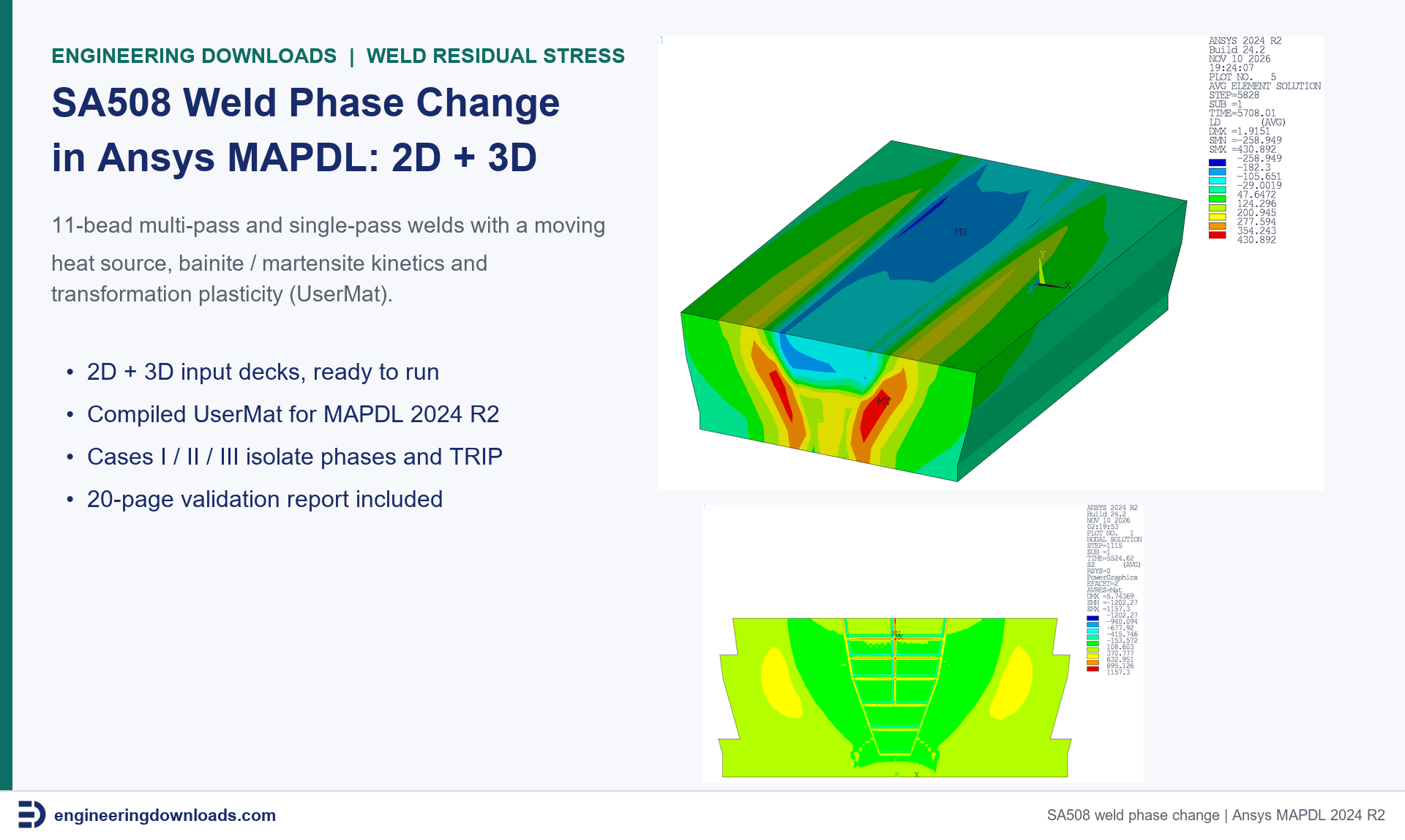
Welding changes the steel twice: the heat makes residual stress, and the cooling can turn the metal into bainite or martensite, which changes volume and shifts that stress again. This Ansys Mechanical APDL package models both effects for a multi-pass SA508 weld, in 2D cross-sections and in 3D with a moving heat source, with ferrite, austenite, bainite and martensite tracked in every element, transformation strain and transformation plasticity (TRIP), and weld deposition by element birth.
The same weld also exists as an Abaqus package. This Ansys product is the MAPDL version, extended with the 3D moving-arc models, and every model was checked against the paper and against the calibrated Abaqus reference.
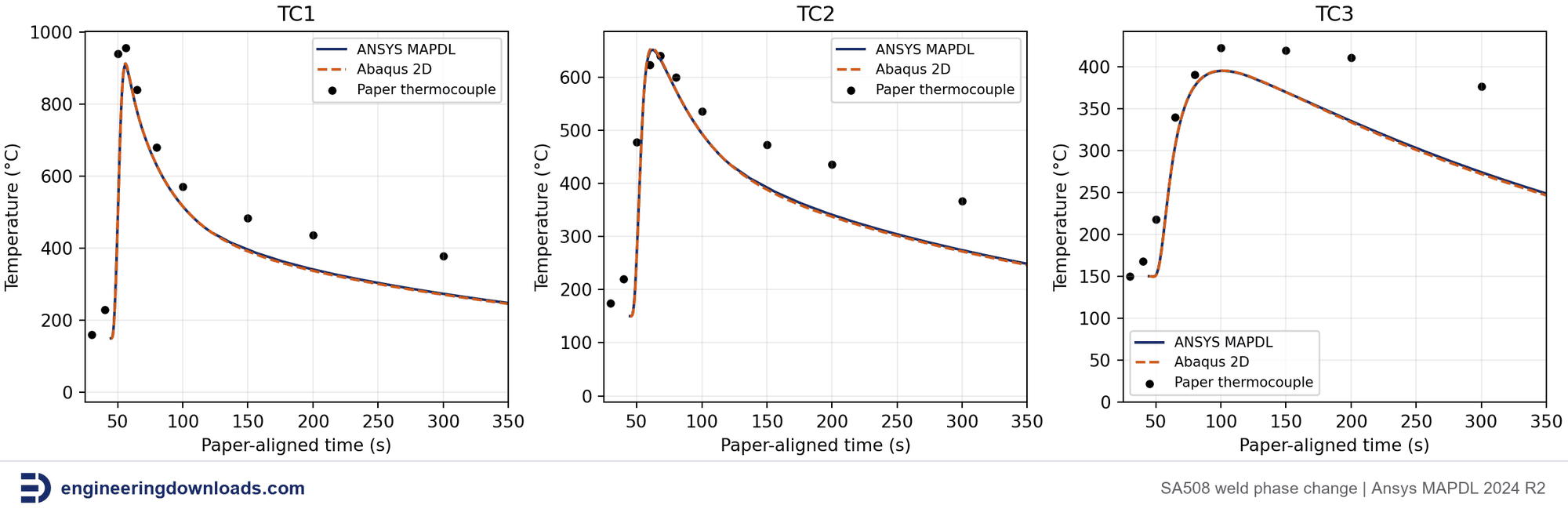
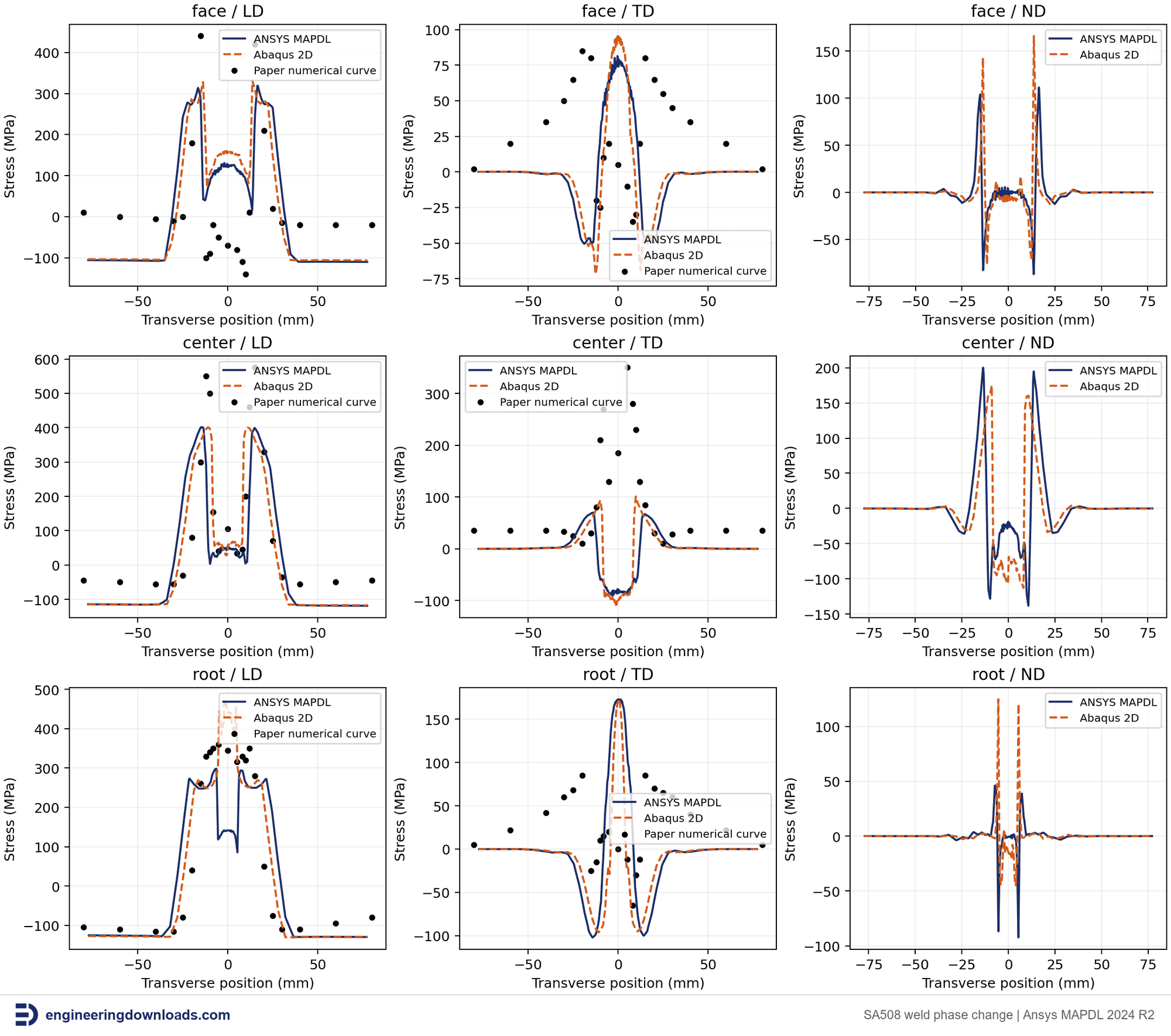
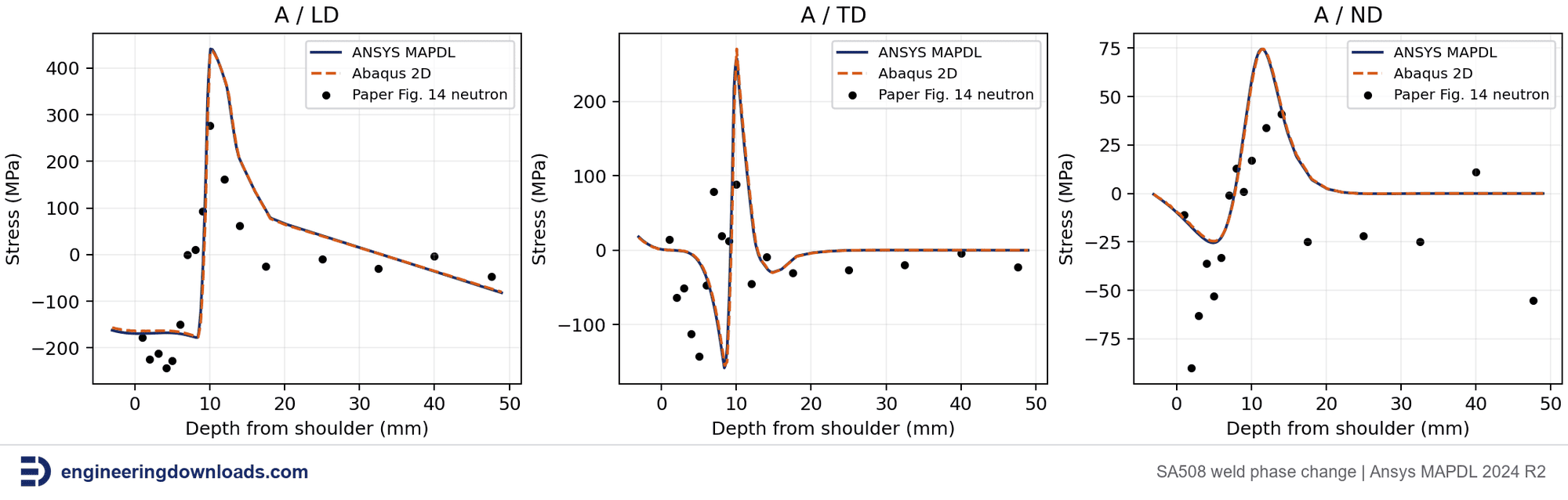
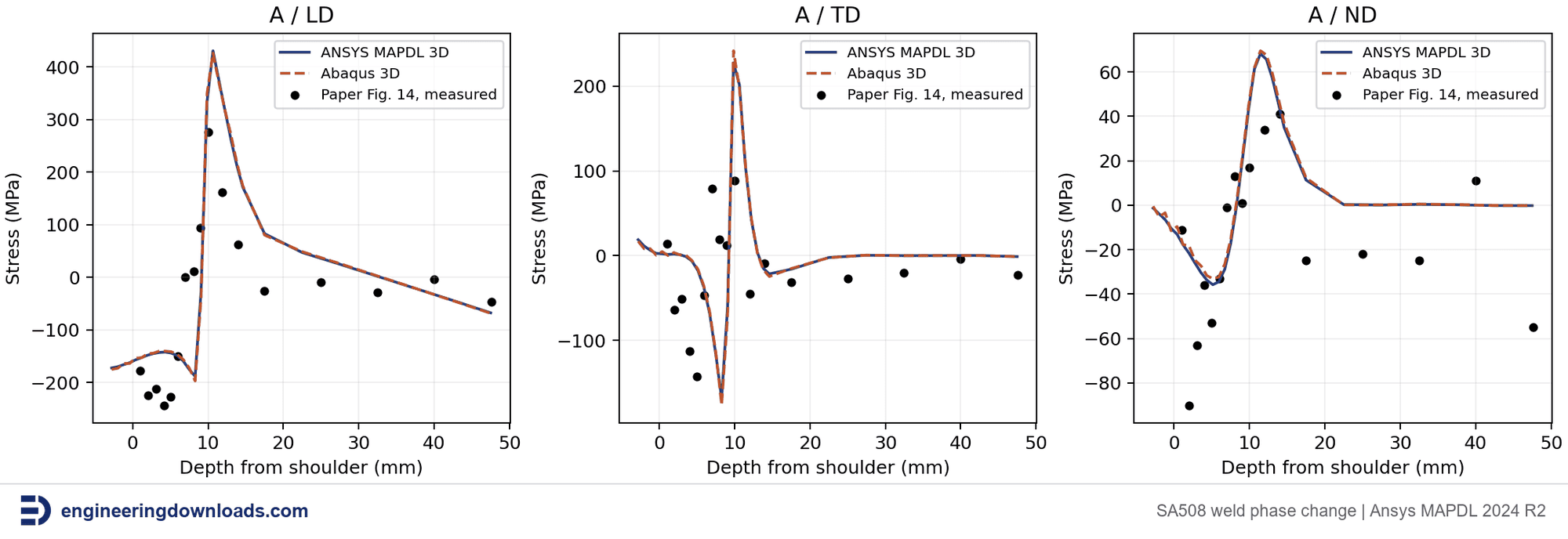
Honest status: reproduction of a calibrated model, not a full validation. All four models (2D and 3D, single pass and 11 passes) ran to their final time with zero native solver errors. The Ansys thermal and stress results follow the calibrated Abaqus model closely in 2D (single-pass stress RMSE 11.0, 8.4 and 0.9 MPa in the longitudinal, transverse and normal directions), but they differ from the paper where the paper itself differs from the calibration: single-pass stress against the neutron measurements has RMSE of 111.4, 86.5 and 32.3 MPa, the 2D multi-pass peak temperature is 339 °C above the published numerical contour, and the 3D multi-pass peak is about 150 °C above both Abaqus and the paper. Every one of these gaps is shown below and in the PDF.
Y. Chen et al., Journal of Constructional Steel Research 166 (2020) 105948, doi:10.1016/j.jcsr.2020.105948.
What the paper does. It simulates the welding of SA508 steel with solid-state phase transformation, for a single-pass bead with thermocouple and neutron-diffraction measurements and for an 11-bead groove weld, and studies how transformation strain and TRIP change the residual stress.
What this package reproduces. The single-pass and 11-pass 2D sections of the paper, with the same kinetics and mechanical model as the Abaqus package, and a 3D moving-source extension of both welds. The paper gives 2D contours only, so the 3D models are compared with the matching Abaqus 3D solution and with the paper sections. The paper is cited but not included, and none of its figures are used on this page; only its published values are compared.
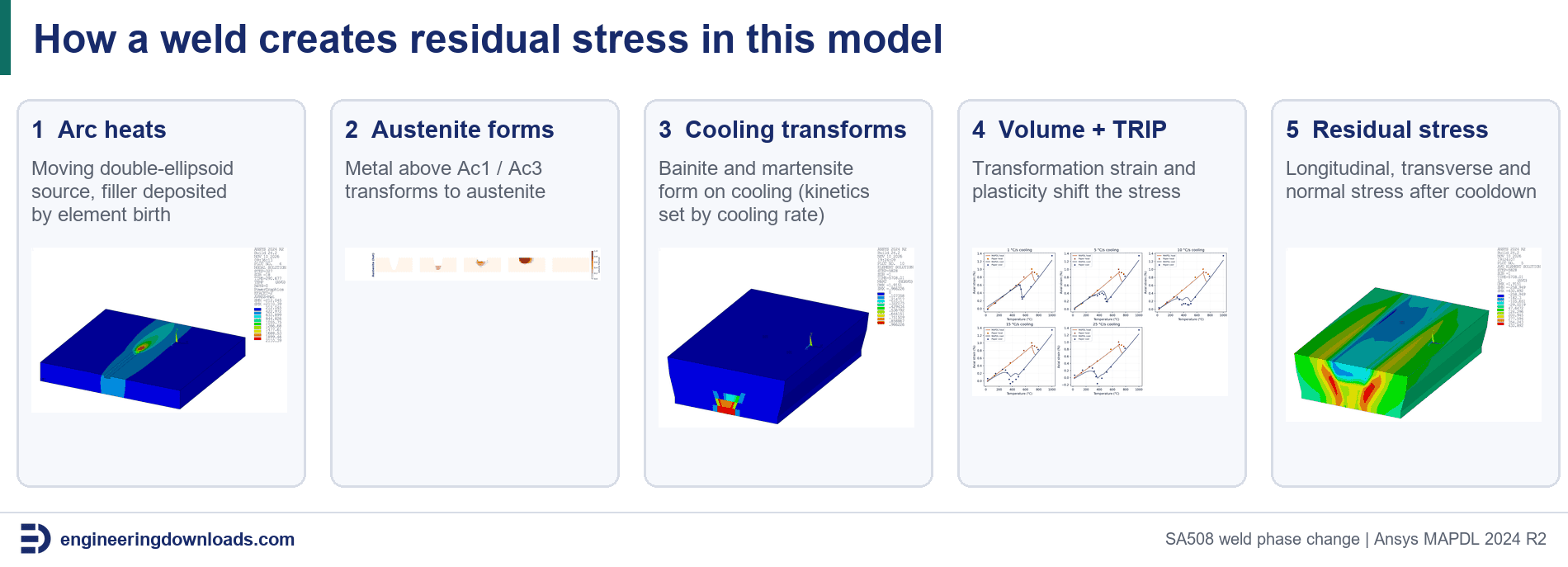
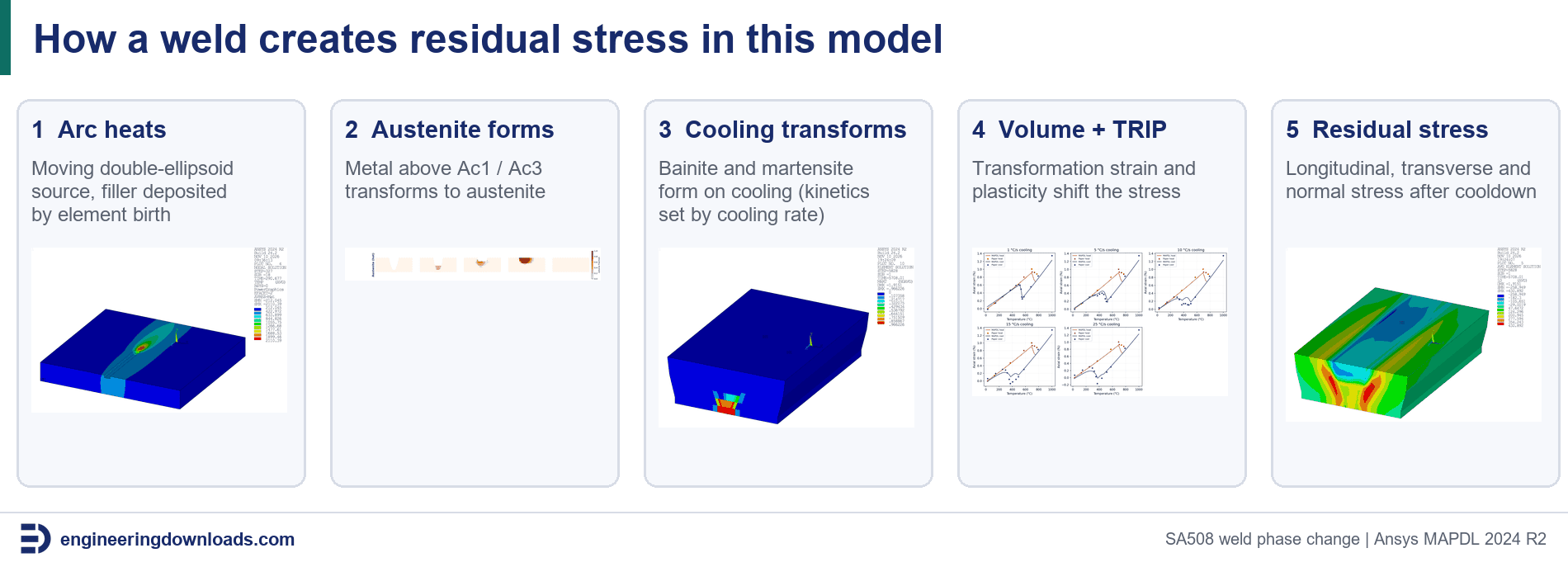
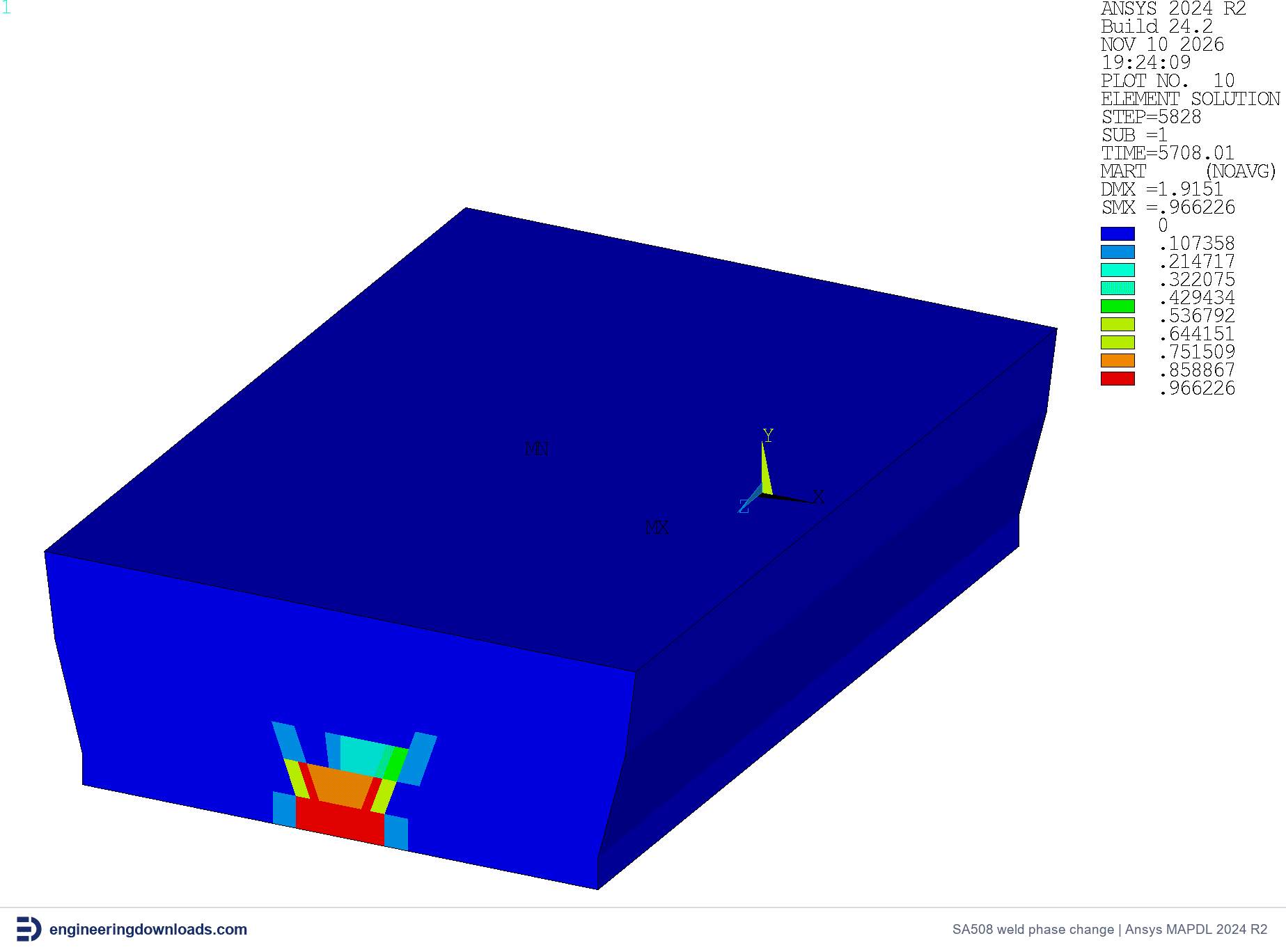
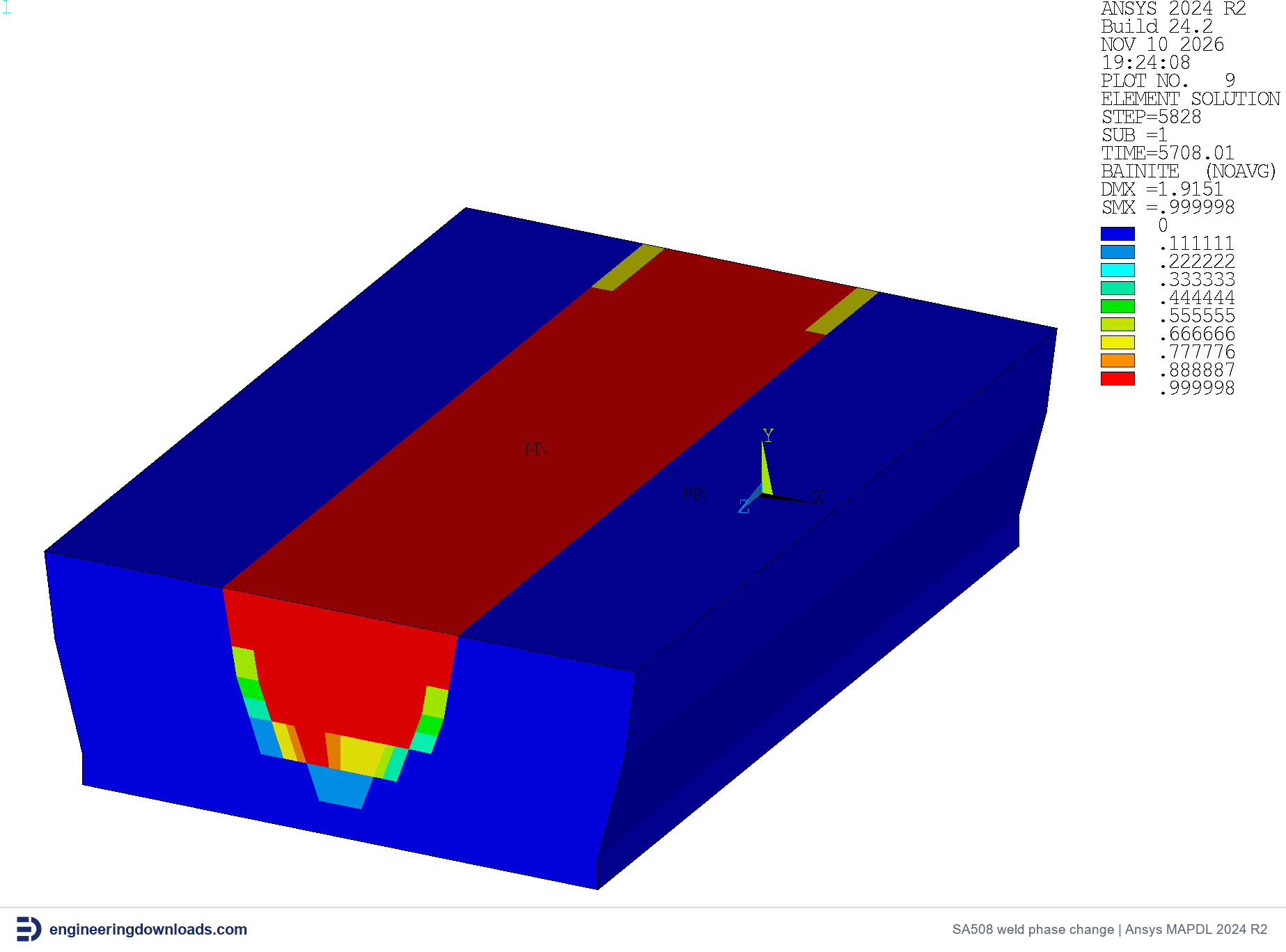
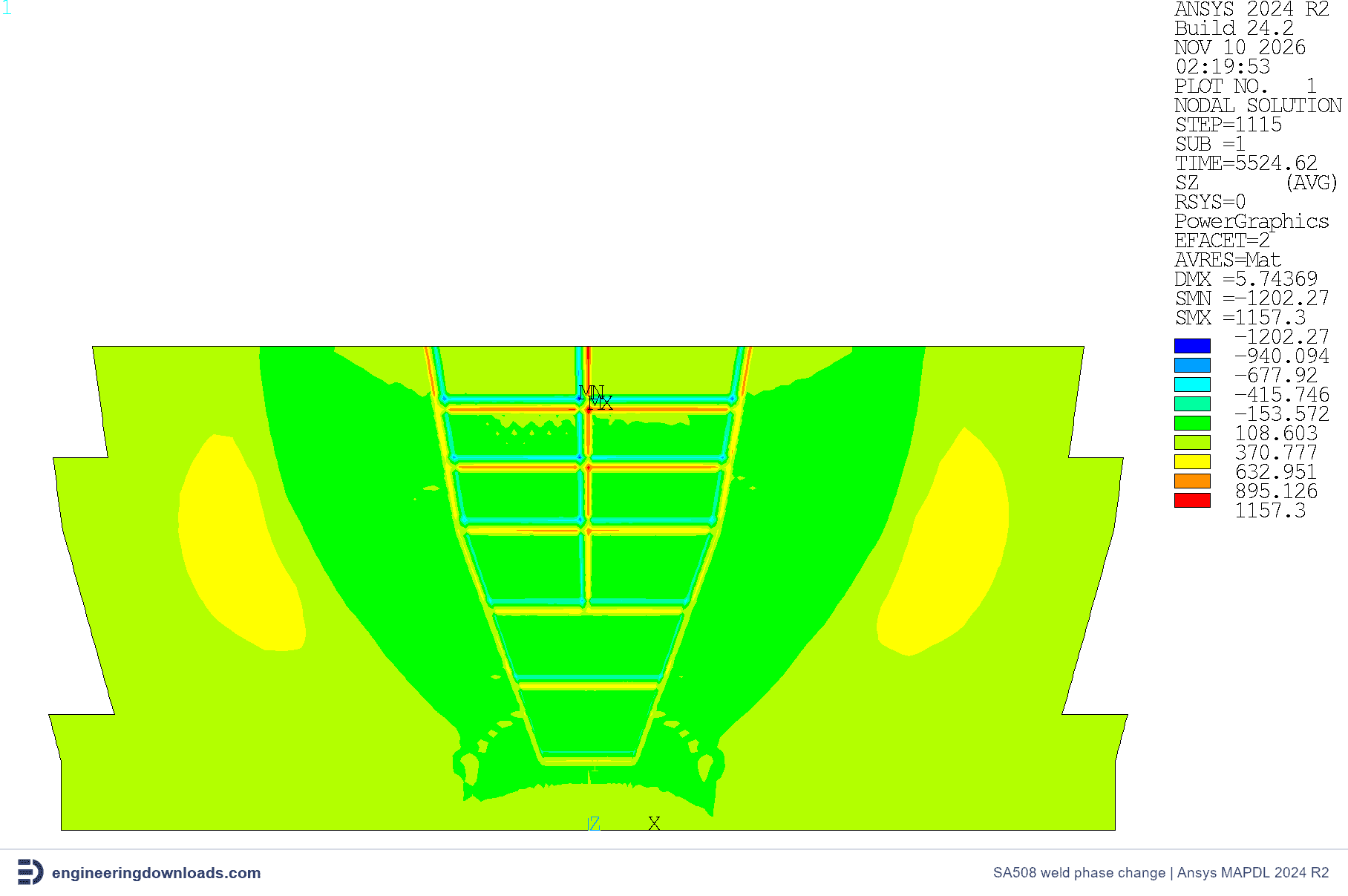
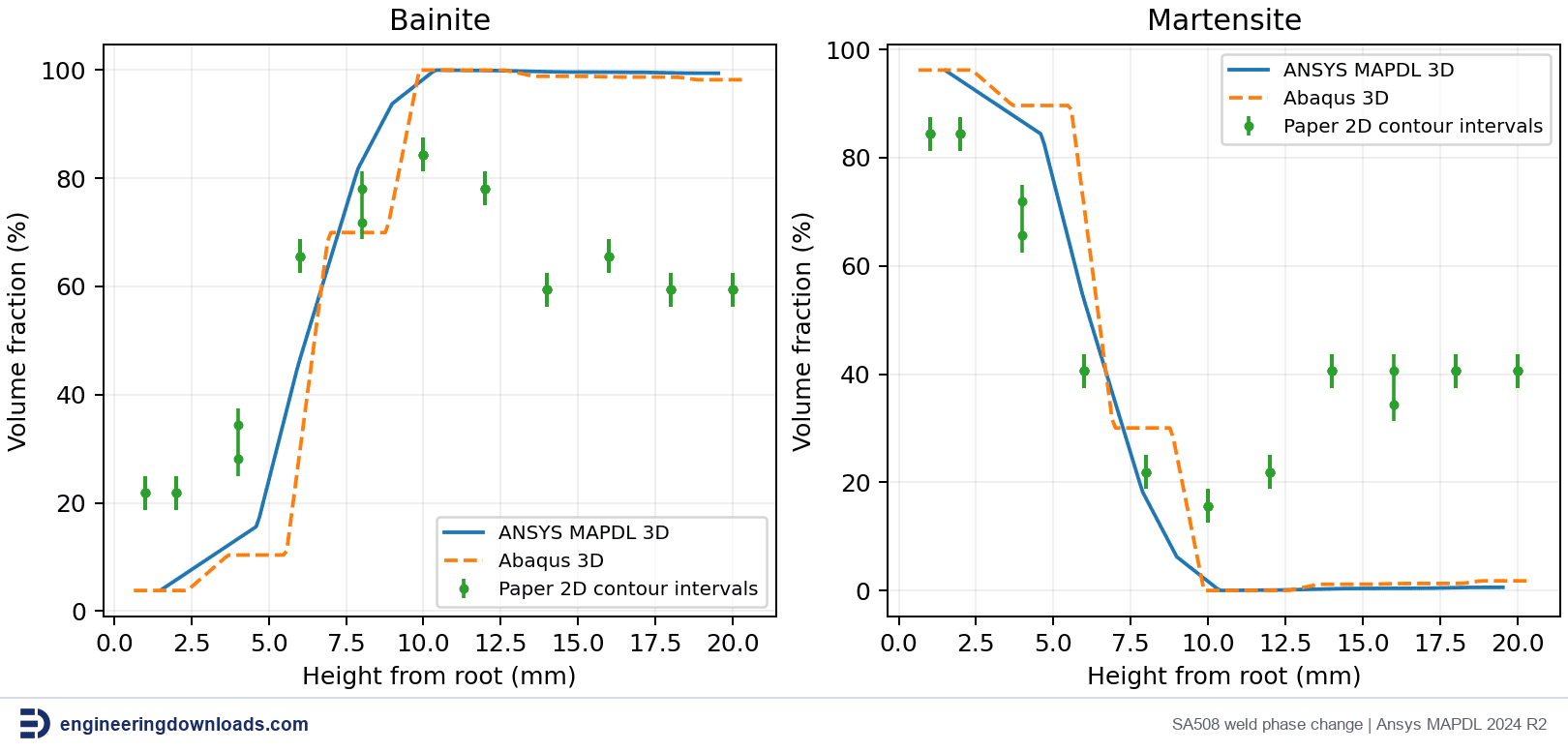
Each pass heats the weld region above Ac1 and Ac3 so it turns into austenite, then cools it. During cooling the austenite transforms to bainite or martensite depending on the cooling rate. The next pass re-heats part of that metal, so the phase pattern is rebuilt pass after pass. These pictures show it from the exported MAPDL element results.
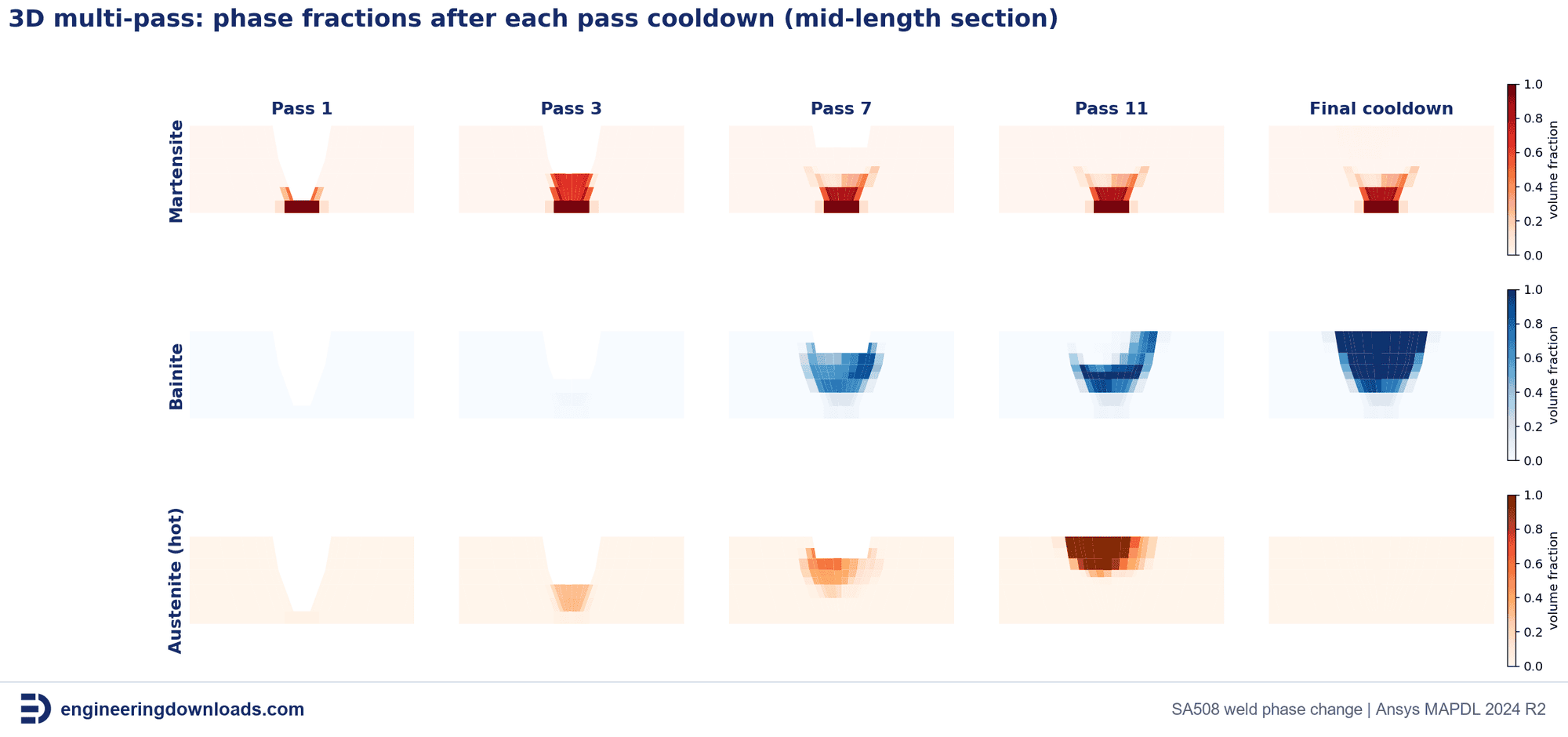
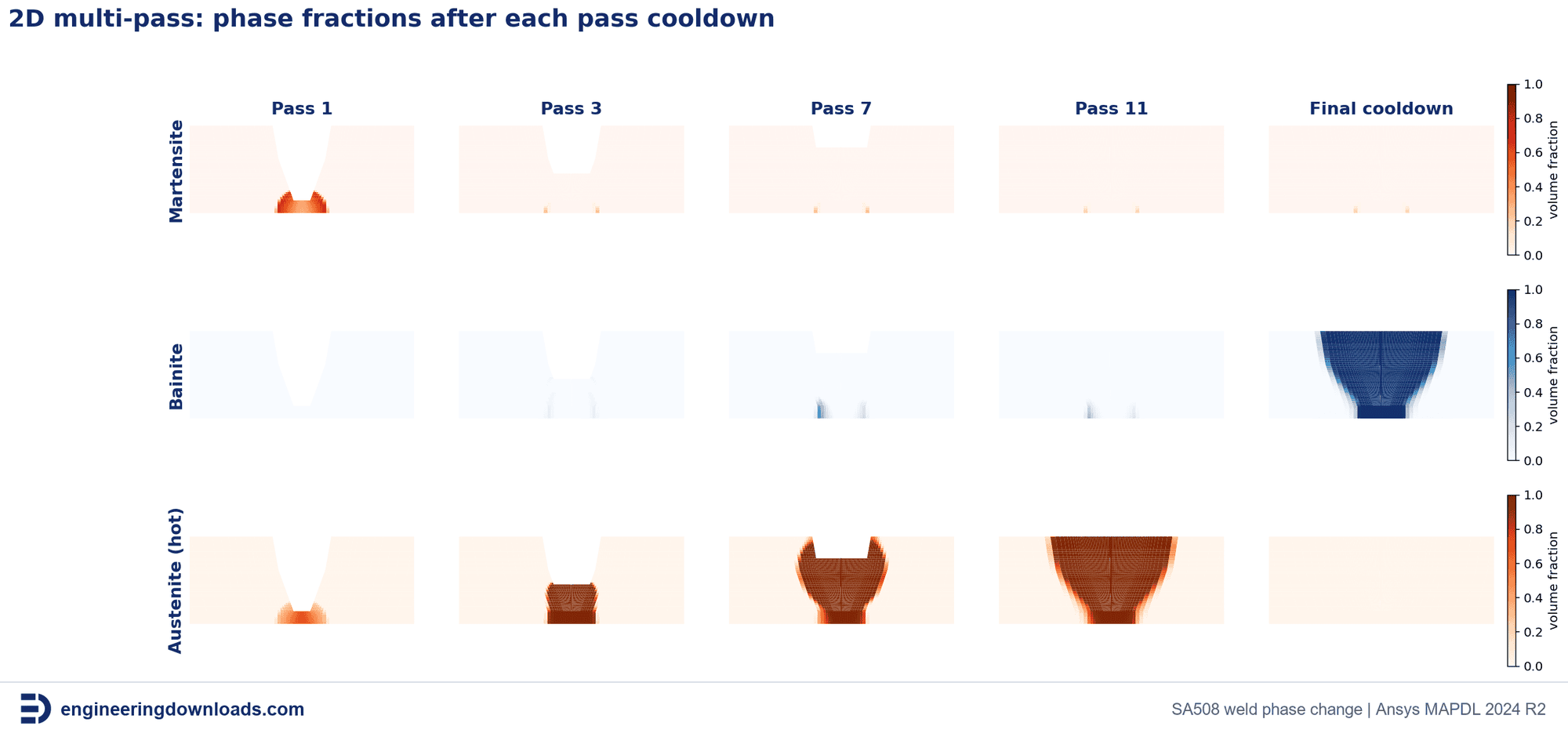
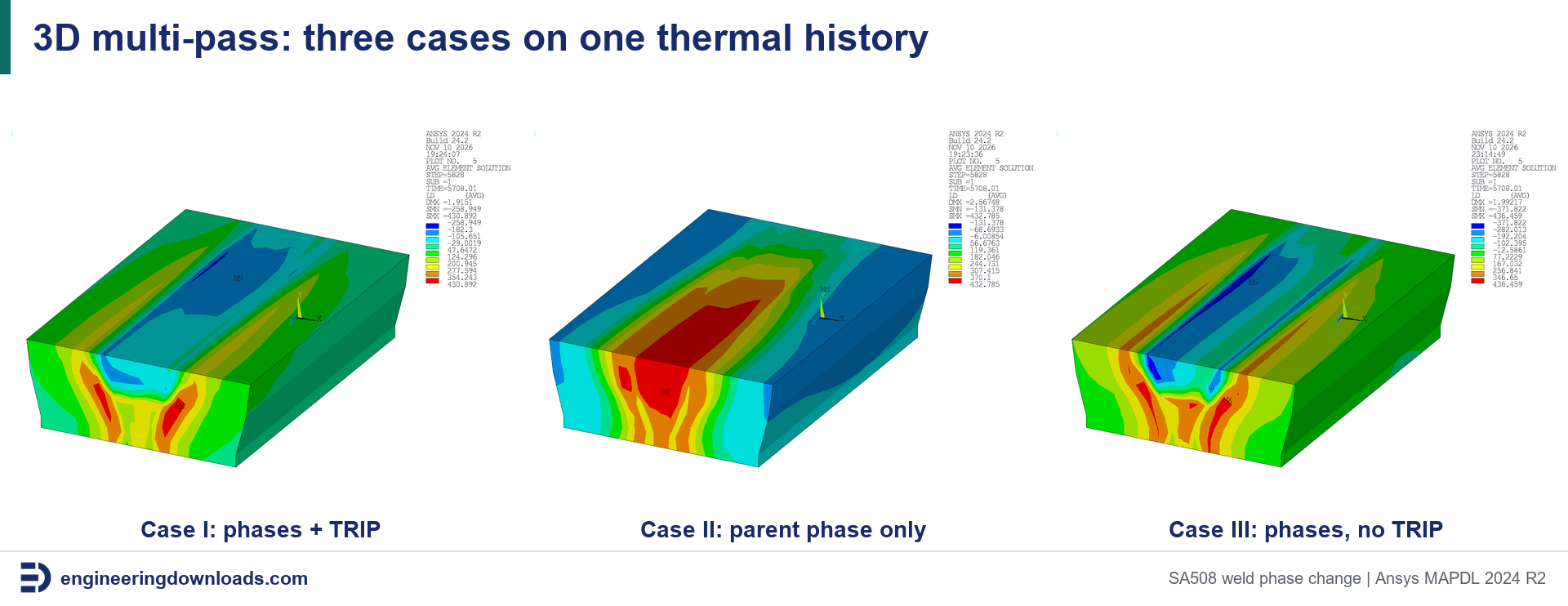
The sections show hot interpass states for passes 3 to 11, which is why austenite is still present there; after the final cooldown the weld metal is mostly bainite in both models, with martensite concentrated in the root region in 3D. The deposited martensite fraction at the end is 18.3% in the 3D multi-pass model.
| Software | Ansys Mechanical APDL 2024 R2, input decks (.dat), SMP, 4 cores used for the delivered runs |
|---|---|
| Material | SA508 low-alloy steel: temperature-dependent density, conductivity, specific heat, elastic-plastic data; latent heat omitted, as in the calibrated reference |
| Metallurgy | Ferrite, austenite, bainite, martensite. Austenitization between Ac1 and Ac3, bainite by non-isothermal additivity, martensite by Koistinen-Marburger form, transformation strain and TRIP, mixed hardening, weak melt surrogate |
| UserMat | Compiled user material UserMatLib.dll for MAPDL 2024 R2 Windows x64, shared by the 2D and 3D stress decks |
| Thermal losses | Convection and radiation to 20 °C on exposed surfaces, updated as weld metal is deposited |
| Deposition | Element birth and death (EKILL/EALIVE) with progressive update of the exposed surfaces |
| Cases | Case I: phases and TRIP. Case II: parent phase held. Case III: phases, TRIP disabled |
| Model | Elements and method | Decks |
|---|---|---|
| 2D single pass | PLANE55 and SURF151, integrated Goldak section pulse; PLANE182 generalized plane strain. 2,368 quads | Thermal + Case I |
| 2D multi-pass | Eleven deposition passes and cooling periods, 4,312 quads | Thermal + Cases I, II, III |
| 3D single pass | SOLID70 and SURF152, travelling double-ellipsoid source; SOLID185 stress mesh with 10,080 bricks (thermal mesh 30,240) | Thermal + Case I |
| 3D multi-pass | Eleven passes with progressive axial deposition; SOLID185 stress mesh with 2,880 bricks (thermal mesh 5,760) | Thermal + Cases I, II, III |
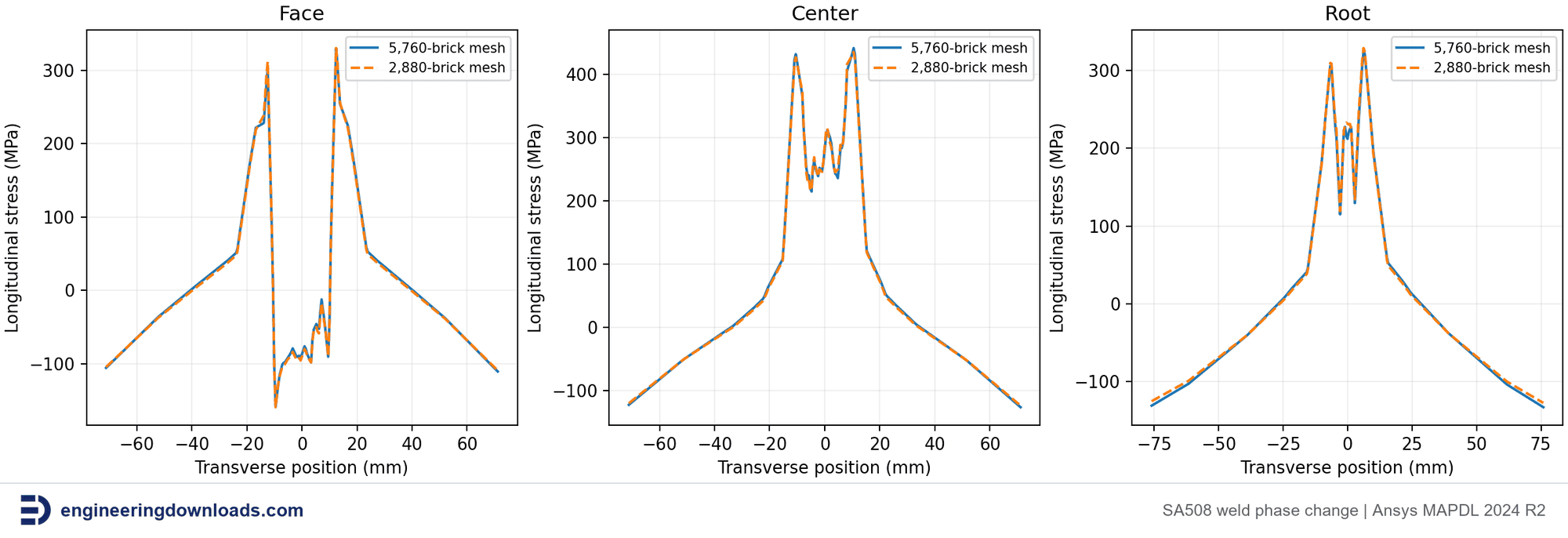
The 3D stress cases use a medium mesh and reuse the temperatures of the original thermal solve at the retained node labels. Comparing the medium and the fine mesh for multi-pass Case I gives RMSE of 2.82, 2.92 and 3.67 MPa along the face, centre and root paths, and 18.31% against 18.13% final martensite, while the run time falls from 7 h 53 min to 2 h 7 min on 4 cores.
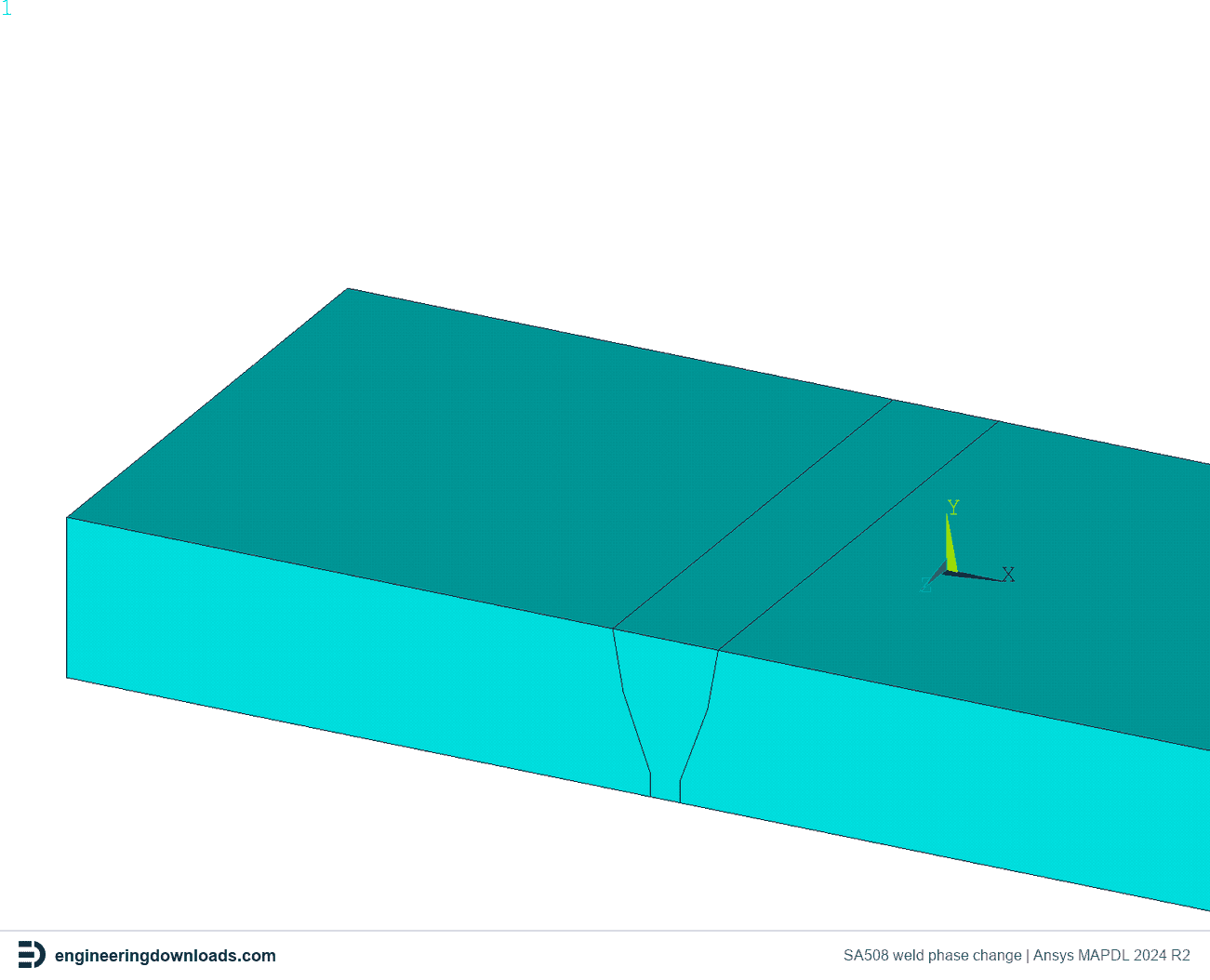
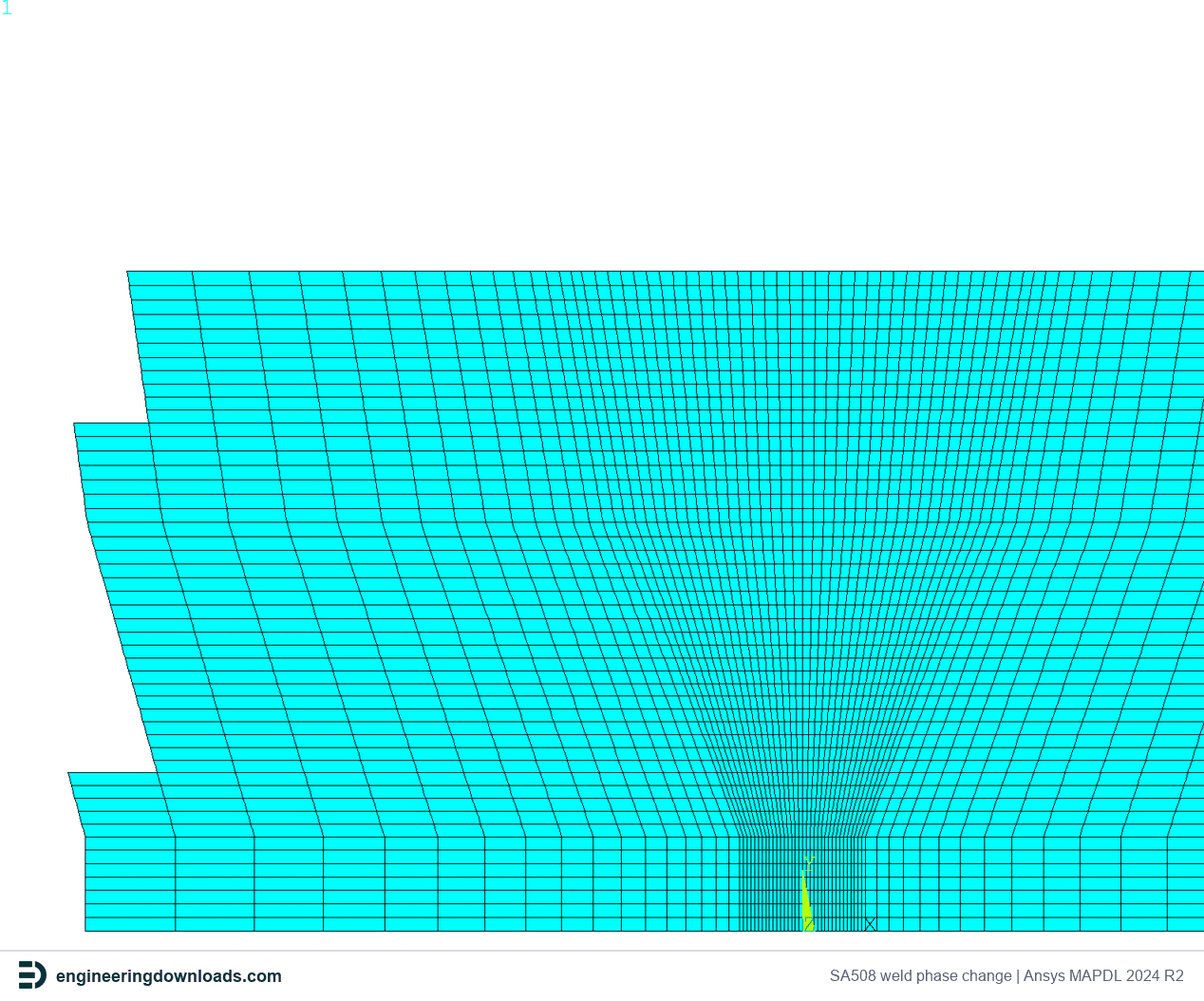
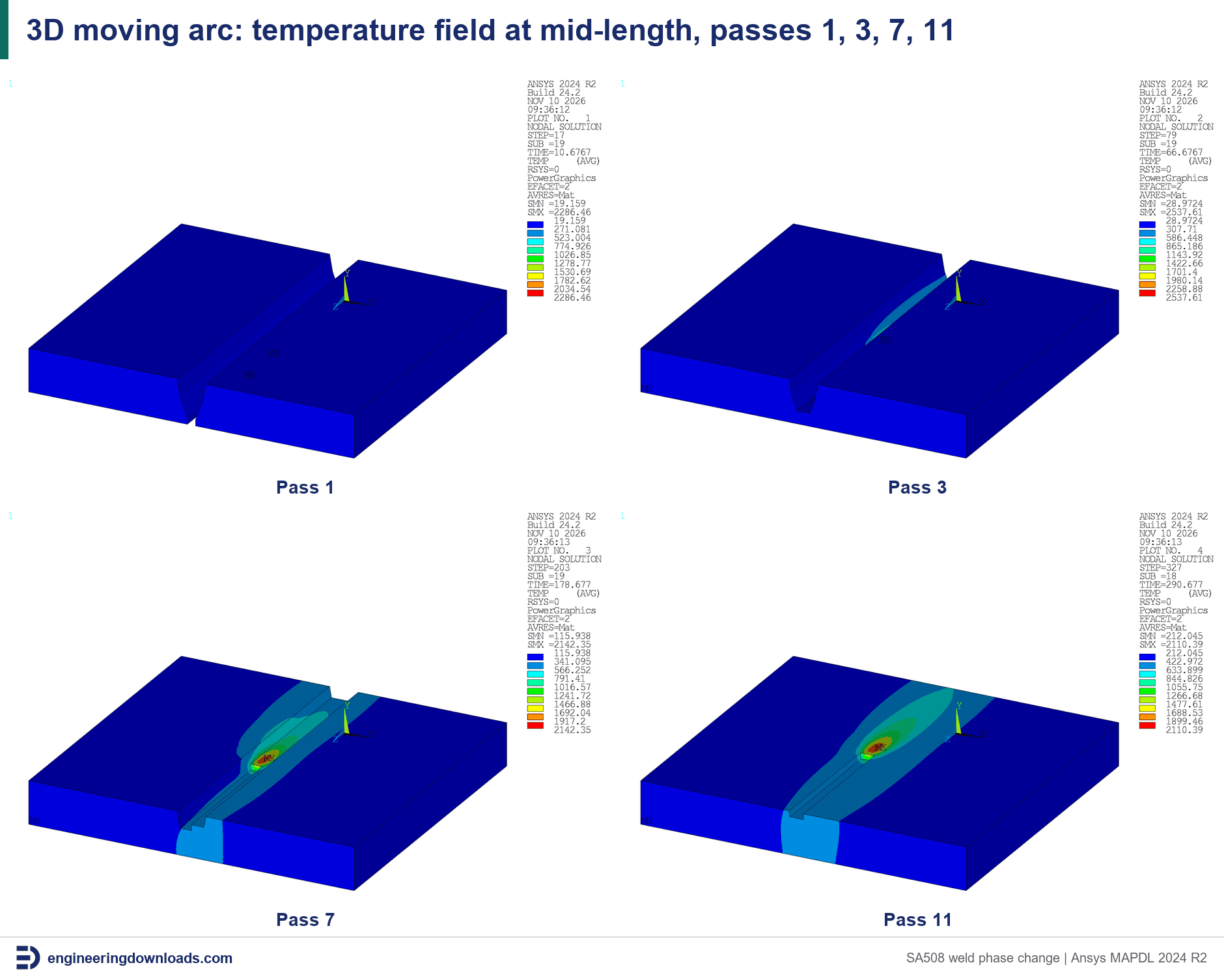
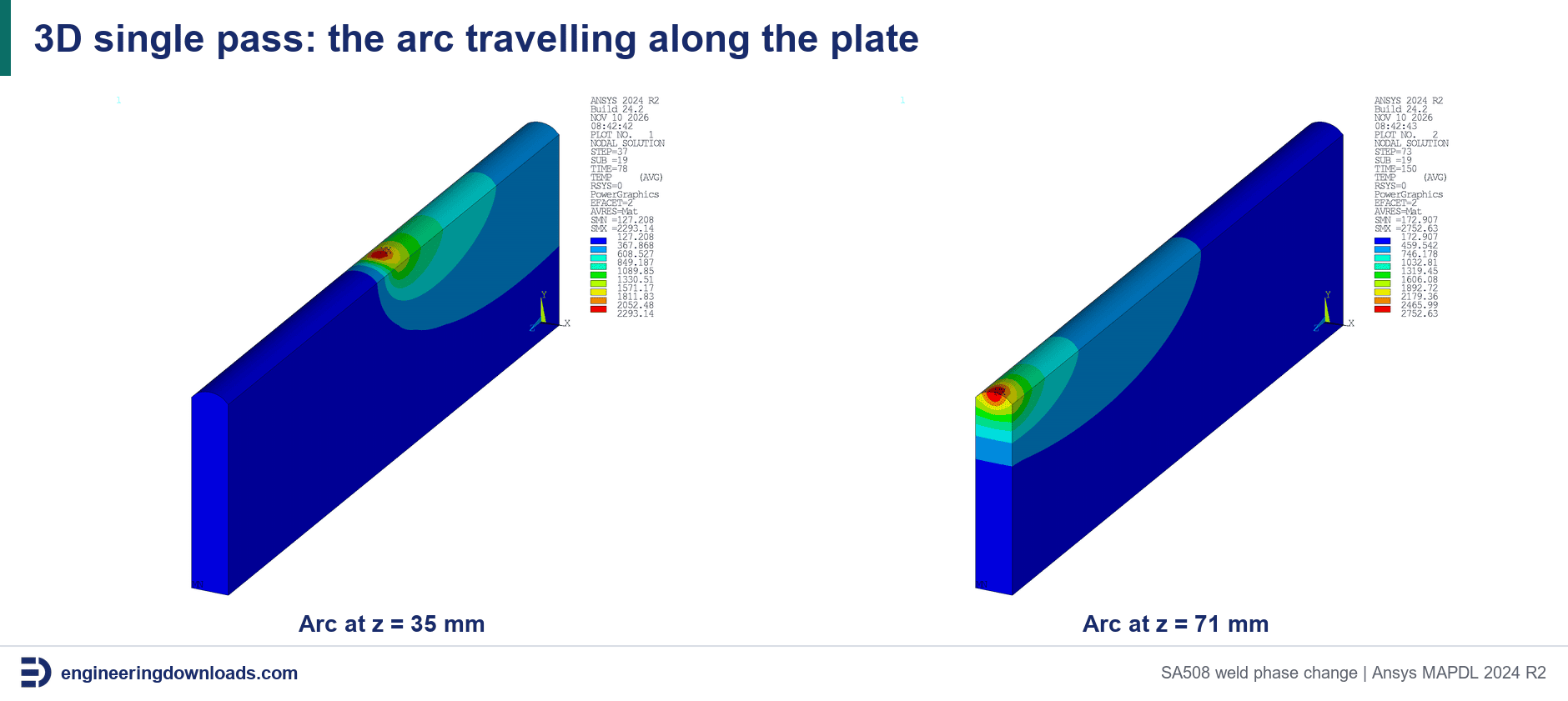
The 3D thermal decks convert the double-ellipsoid source density to nodal heat using the active element Jacobians, so the arc really travels along the plate and the heat-affected zone forms behind it.
| 2D single pass | Thermocouple peaks within 5.3 °C of Abaqus; -53, +11 and -30 °C against the paper measurements; domain peak 2605 °C vs 2626 °C in the paper contour |
|---|---|
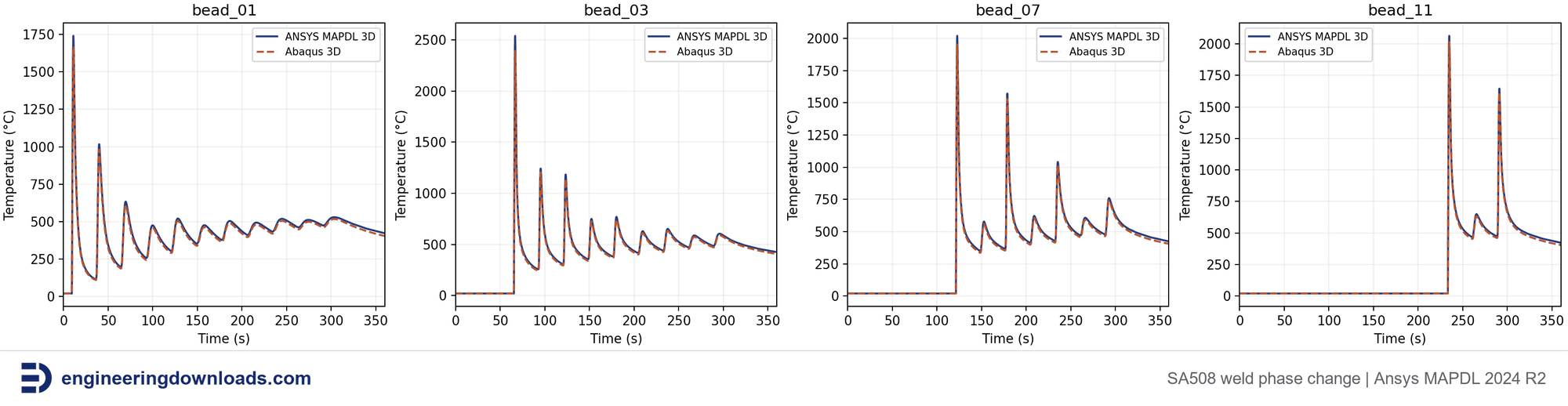
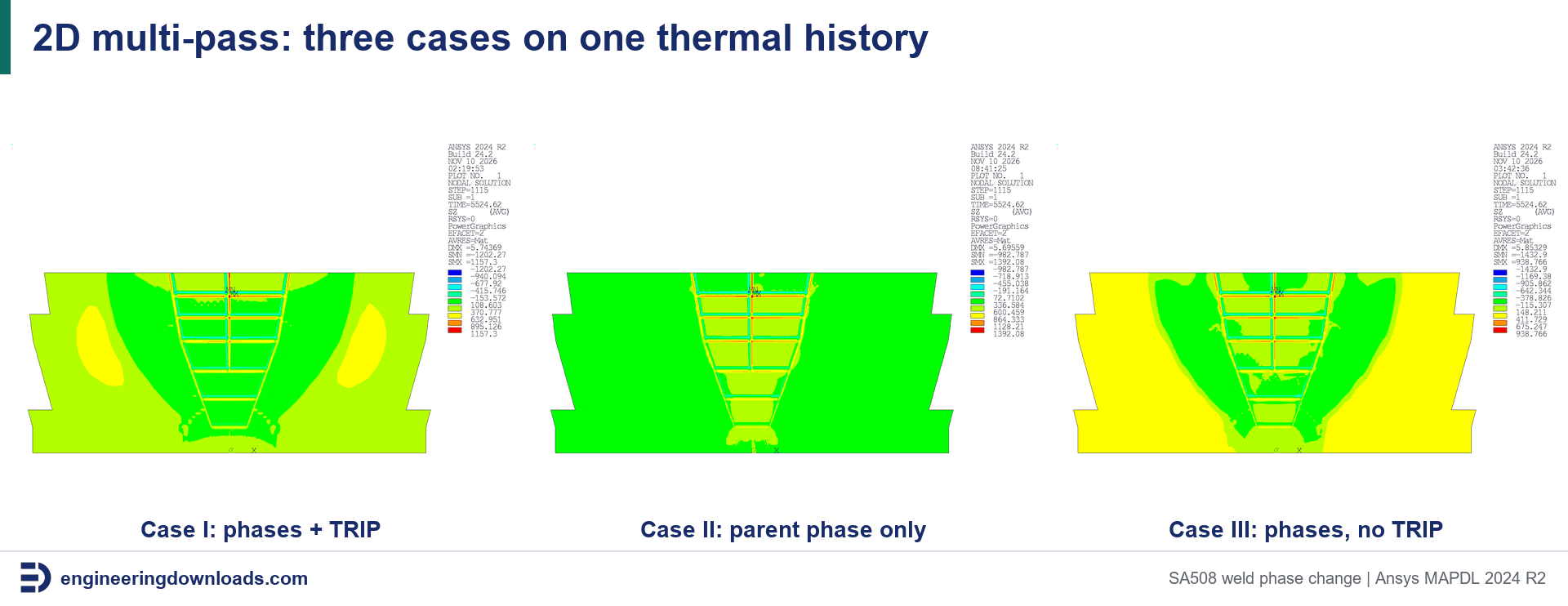
| 2D multi-pass | Domain peak 2735 °C, 339 °C above the published numerical maximum; final-bead cooling near 600 °C is 4.21 °C/s, below the paper range of 5 to 7 °C/s |
| 3D single pass | Domain peak 2752.6 °C vs 2746.7 °C in Abaqus 3D (+6.0); mid-length 2320.6 °C vs 2311.3 °C in Abaqus and 2626 °C in the paper 2D contour |
| 3D multi-pass | Peak 2539.3 °C, +149.7 °C above Abaqus 3D and +142.9 °C above the paper contour; final-bead cooling near 600 °C is 18.7 °C/s vs 14.7 °C/s in Abaqus and 5 to 7 °C/s in the paper |
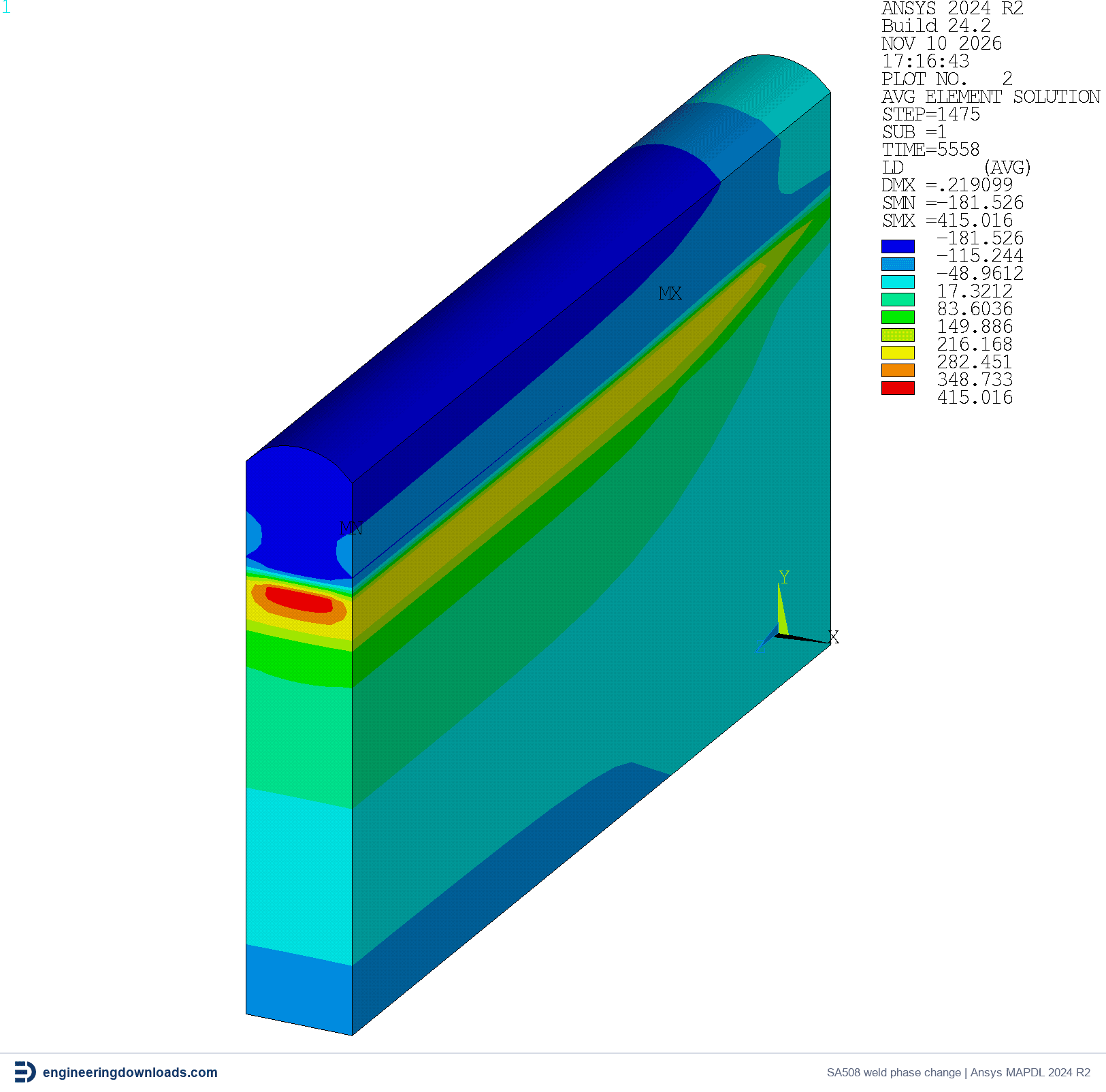
These contours are native MAPDL plots of the delivered models after final cooling. Longitudinal stress (LD) is along the weld, transverse (TD) across it and normal (ND) through the thickness.
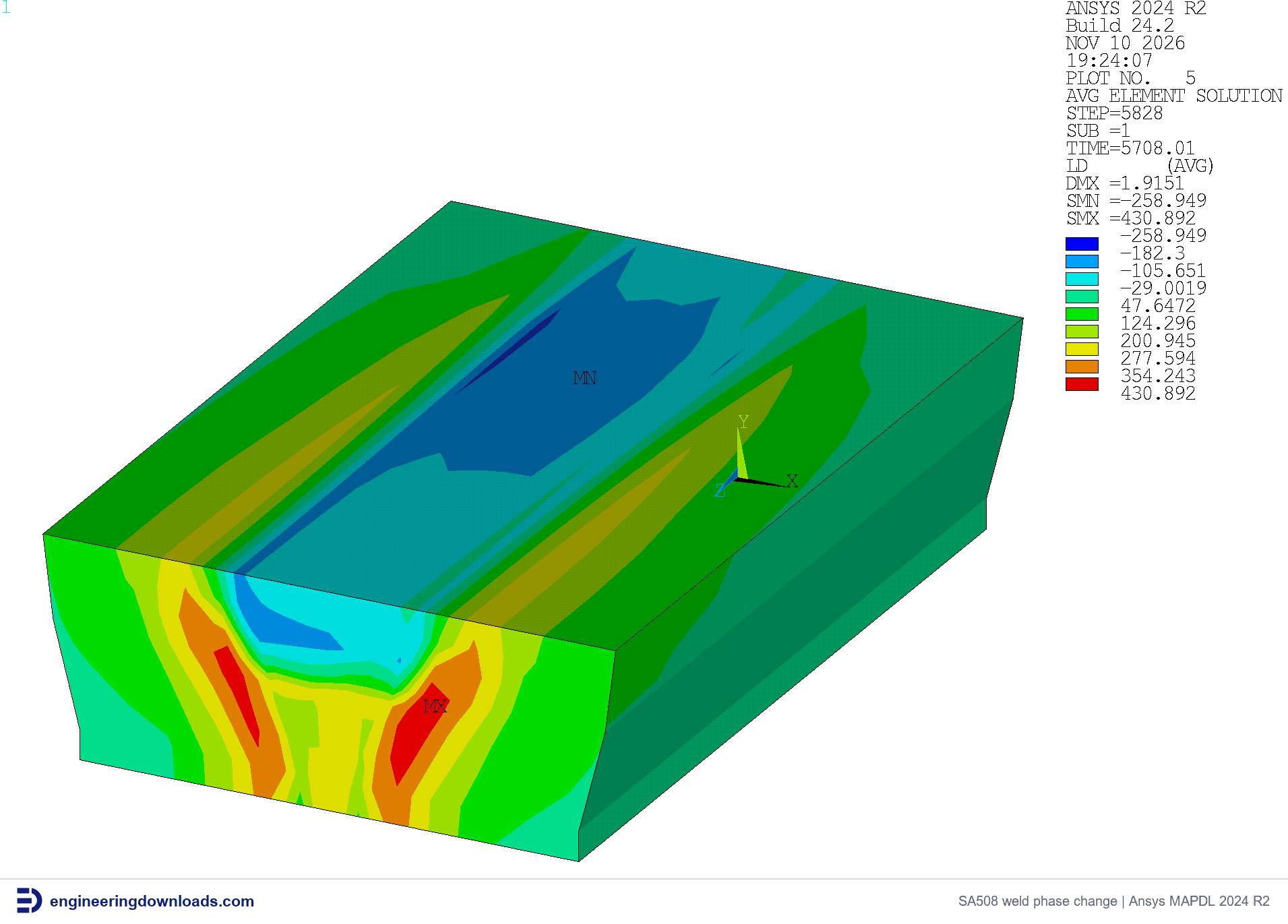
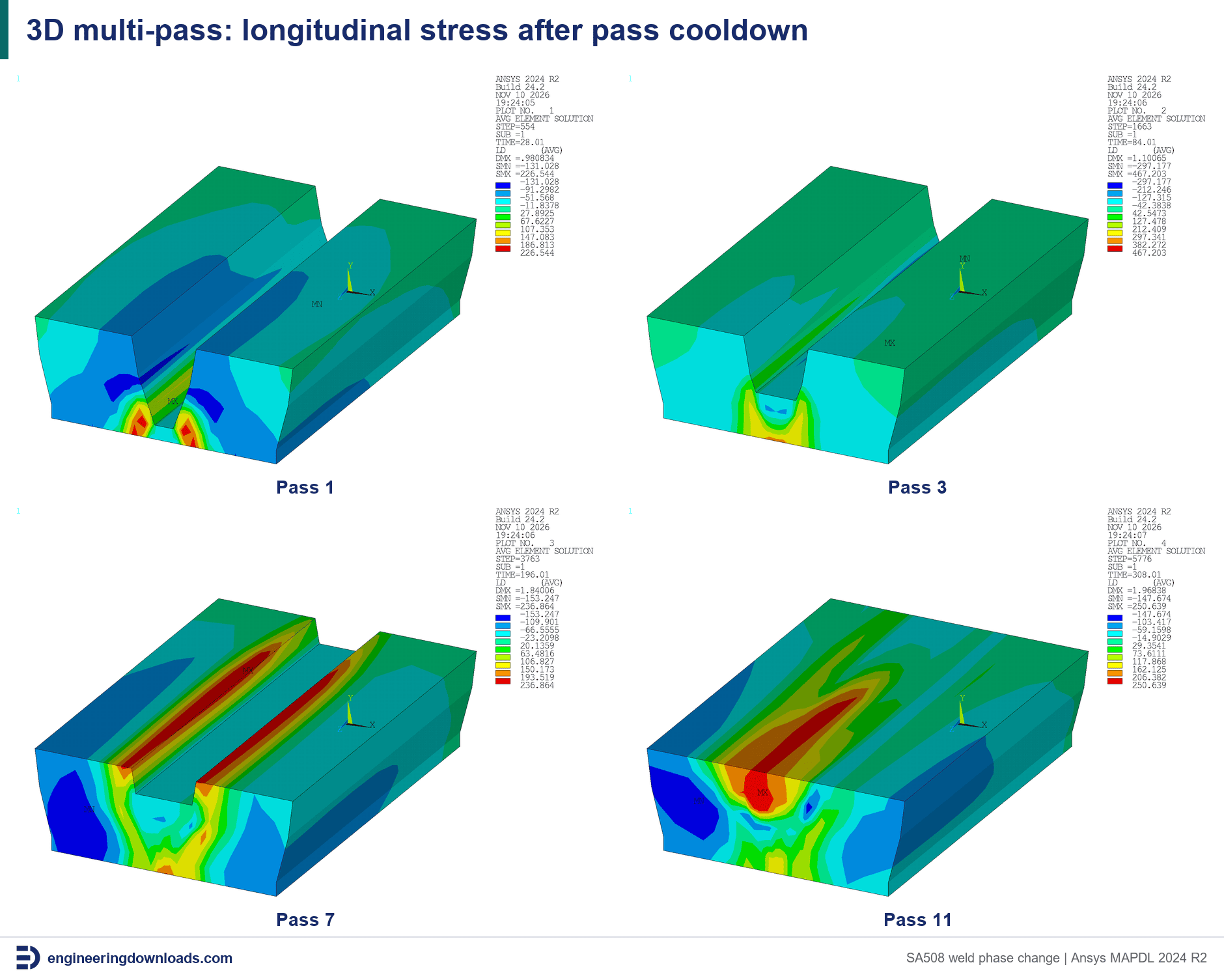
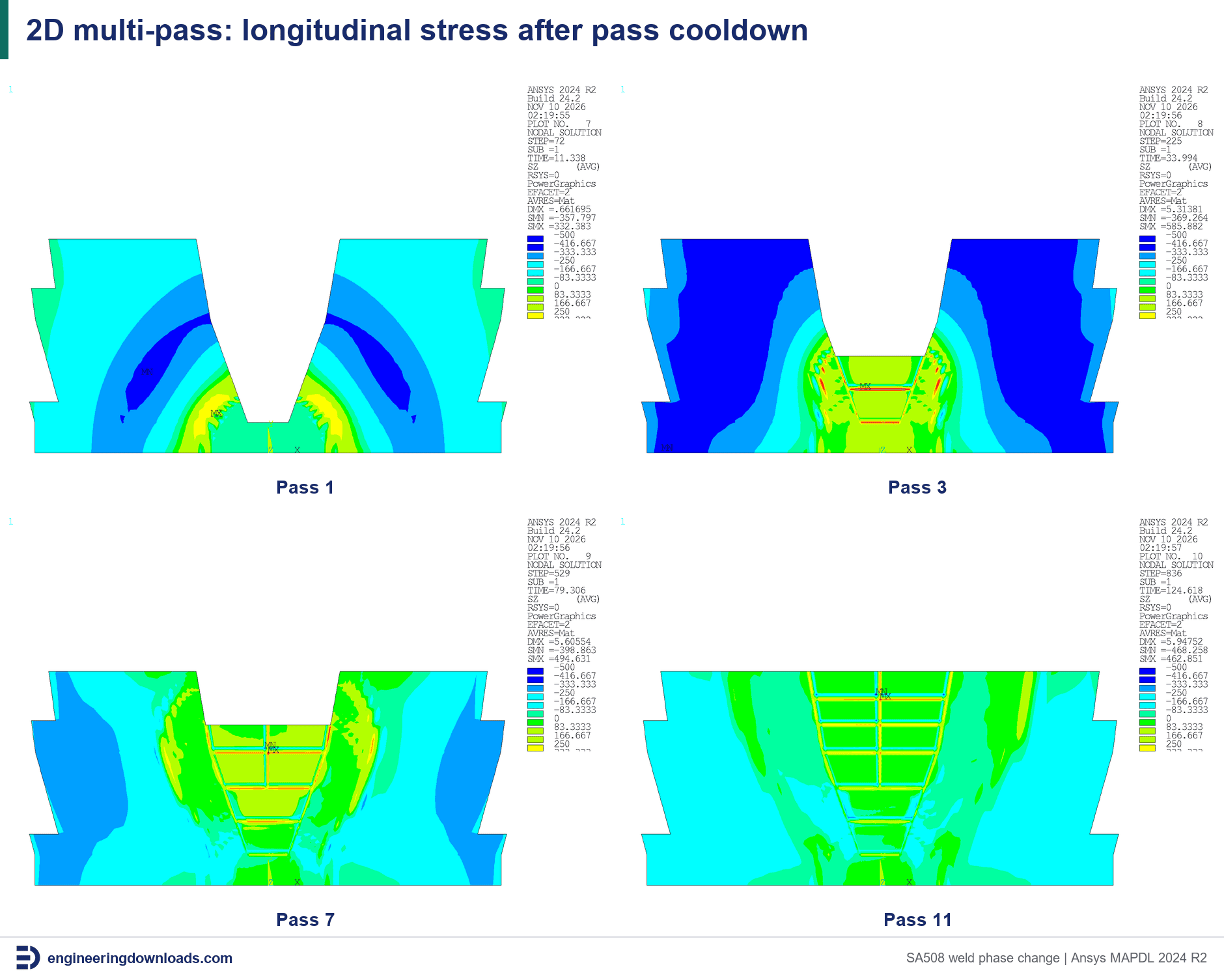
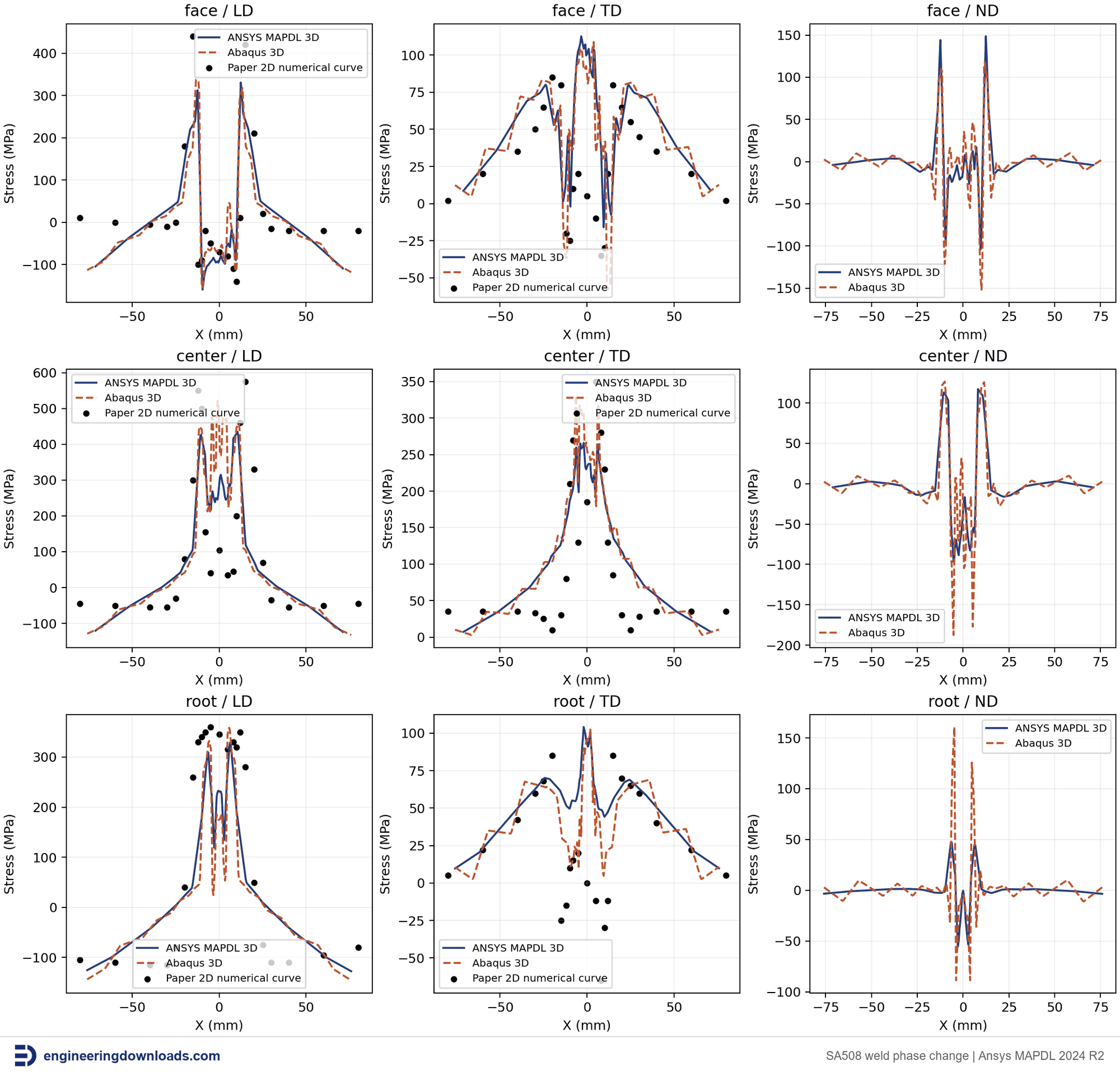
The three cases run on one thermal history, so differences come only from the metallurgy: Case I has phase transformation and TRIP, Case II keeps the parent phase, and Case III keeps phase changes without TRIP.
The single-pass models follow the NeT-style bead of the paper. In 2D the stress along path A differs from Abaqus by RMSE 11.0, 8.4 and 0.9 MPa (LD, TD, ND) and from the neutron measurements by 111.4, 86.5 and 32.3 MPa.
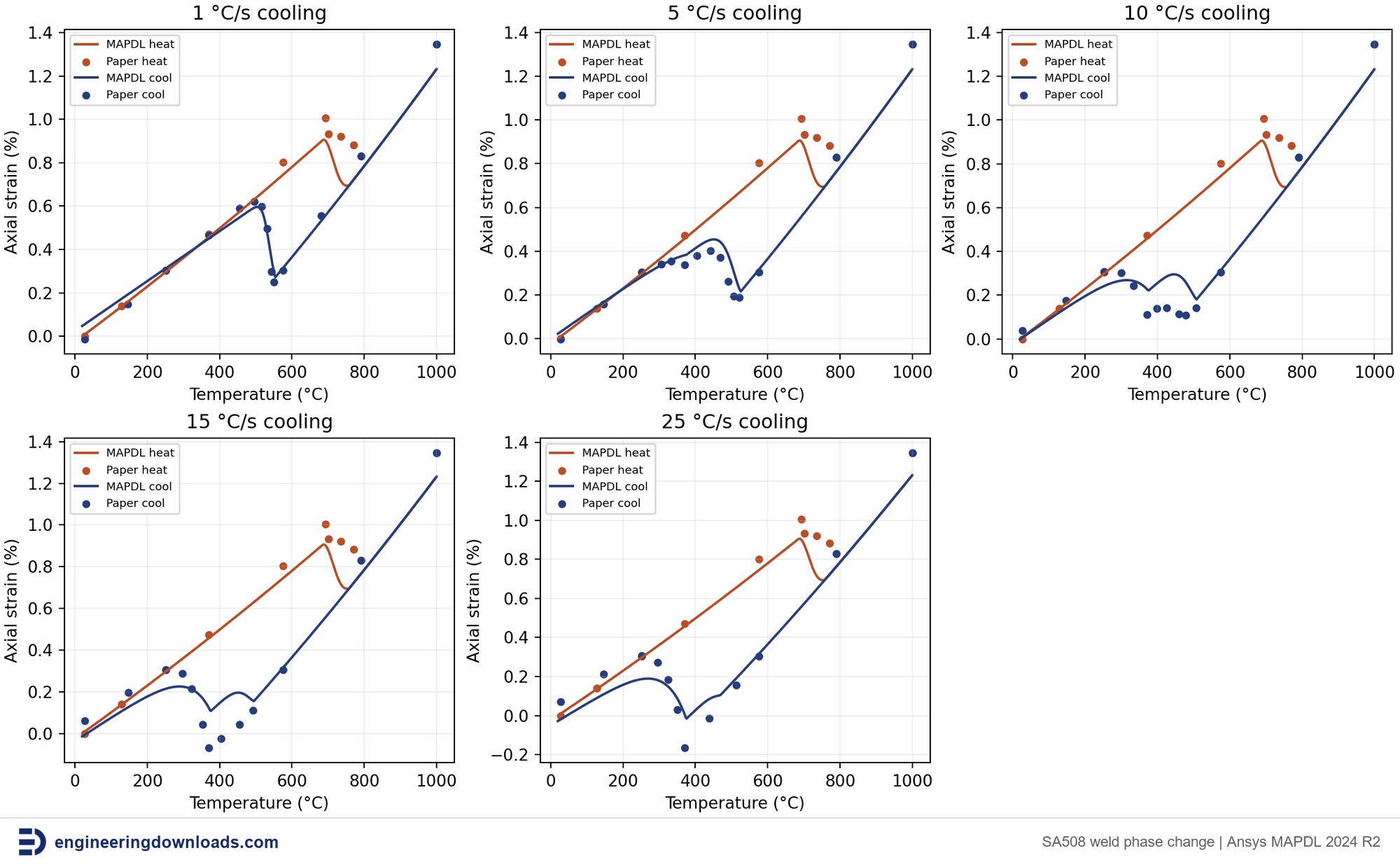
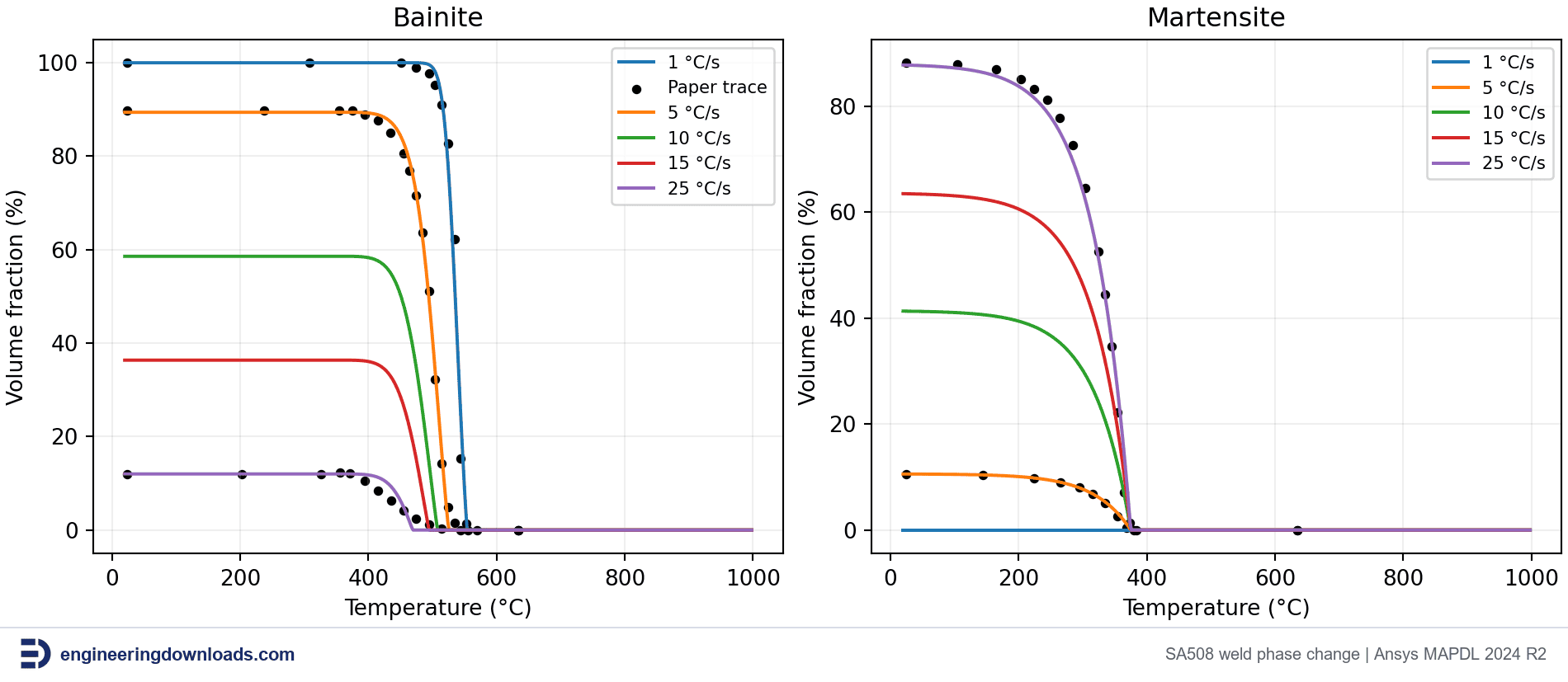
Five free-expansion coupons are cooled at 1, 5, 10, 15 and 25 °C/s from 1000 °C. At 5 °C/s MAPDL gives 89.40% bainite and 10.58% martensite. A SOLID185 patch test checks the 3D shear mapping and free thermal expansion of the user material.
| Matches | Ansys 2D thermal and stress results against the calibrated Abaqus model; 3D single-pass peaks against Abaqus 3D (+6 °C); medium against fine 3D mesh; phase kinetics in the coupons |
|---|---|
| Fitted | Phase kinetics, dilation and thermal parameters were calibrated in the earlier Abaqus work and are inherited here. Agreement with them is reproduction, not independent validation |
| Differs | 2D single-pass stress against neutron data (RMSE 111.4/86.5/32.3 MPa); 2D multi-pass peak temperature +339 °C; 3D multi-pass peak +150 °C against Abaqus and the paper; final-bead cooling rate above Abaqus in 3D and below the paper range in 2D |
| Not modelled | Latent heat, distortion of the groove, creep or stress relief, and real arc efficiency scatter. The 3D models use a medium stress mesh |
Thermal.dat) and the structural decks (Stress_Case_I.dat, plus II and III for the multi-pass models).Longitudinal_Stress.png result image in each model folder and one README with the run commands.No solver result files are included; every result can be regenerated from the decks. The package is about 520 MB unpacked, mostly the thermal decks.
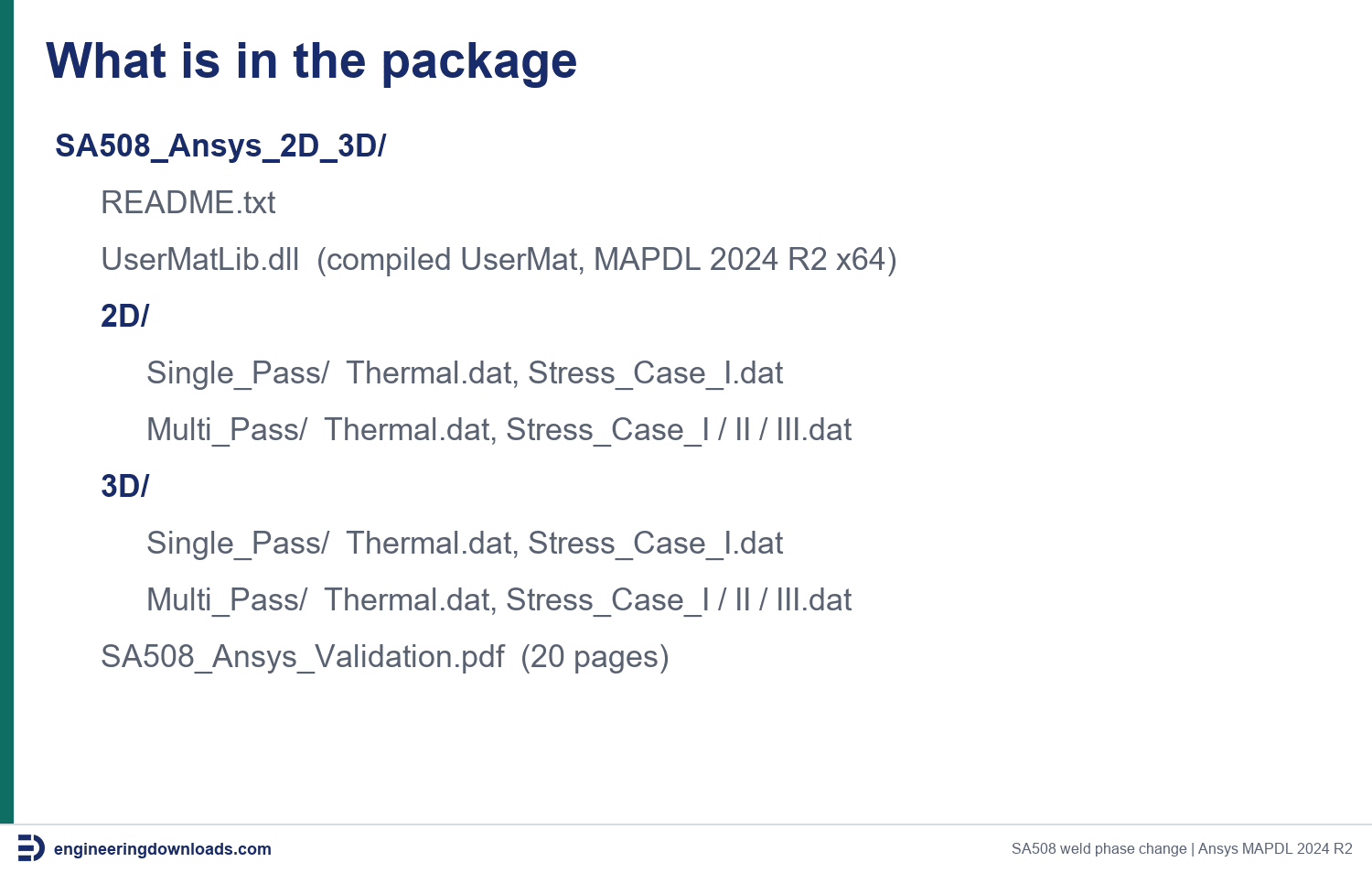
Ansys Mechanical APDL 2024 R2 (the user material is compiled for this release on Windows x64), batch or Launcher use, 4 cores recommended, and an Ansys licence that allows user materials. The decks do not need a Fortran compiler. Other Ansys releases or Linux need the user material to be rebuilt, which this package does not provide.
Welding of SA508 ferritic steel in Ansys MAPDL 2024 R2: a single-pass bead and an 11-pass groove weld, in 2D cross-sections and in 3D with a moving double-ellipsoid heat source, with ferrite, austenite, bainite and martensite, transformation strain, TRIP and residual stress.
It is a reproduction of a calibrated model. The Ansys 2D results follow the calibrated Abaqus model closely, but they differ from the paper in places, for example single-pass stress against neutron data (RMSE 111.4, 86.5, 32.3 MPa) and multi-pass peak temperature (+339 C in 2D, about +150 C in 3D). The tutorial shows every gap.
The 2D models use generalized plane strain sections, as in the paper. The 3D models add a travelling heat source along the plate with progressive axial deposition, so they show the arc moving, heat flow along the weld and end effects.
Case I includes phase transformation and TRIP. Case II holds the parent phase throughout. Case III keeps phase transformation and disables TRIP. They run on the same thermal history, so differences come only from the metallurgy.
Yes, as a compiled UserMatLib.dll for Ansys MAPDL 2024 R2 on Windows x64. The Fortran source is not included, and other releases or platforms need a rebuild.
The 3D multi-pass Case I stress run took about 2 hours 7 minutes on 4 cores on the medium mesh; the fine mesh took 7 hours 53 minutes. Times for the other decks depend on your machine and licence.
Ansys Mechanical APDL 2024 R2 on Windows, with a licence that allows user materials. The decks are APDL input files, so no Workbench or Fortran compiler is needed.
No. The package has the input decks, one result image per model folder, a README and a PDF report. Results are regenerated by running the decks in order: thermal first, then the stress cases.
Yes, the Abaqus package covers the 2D models with a UMAT that you supply. This Ansys package adds the 3D moving-source models and ships the compiled user material.
No. The paper is cited (Chen et al., Journal of Constructional Steel Research 166, 2020, 105948) and only its published values are compared, with no figures reproduced.
Need more than the files?
There are two ways we can help. Book a one hour online consultation if you want to talk a problem through with a CAE engineer, using the checkbox in the order box. Order a project if you need a full simulation built for you, delivered to an agreed scope, price and deadline under a written contract.
We work on FEA and CFD for engineers, researchers and companies. Order your project, or message us on WhatsApp for a quick reply.
Other packages engineers working on this topic also download.
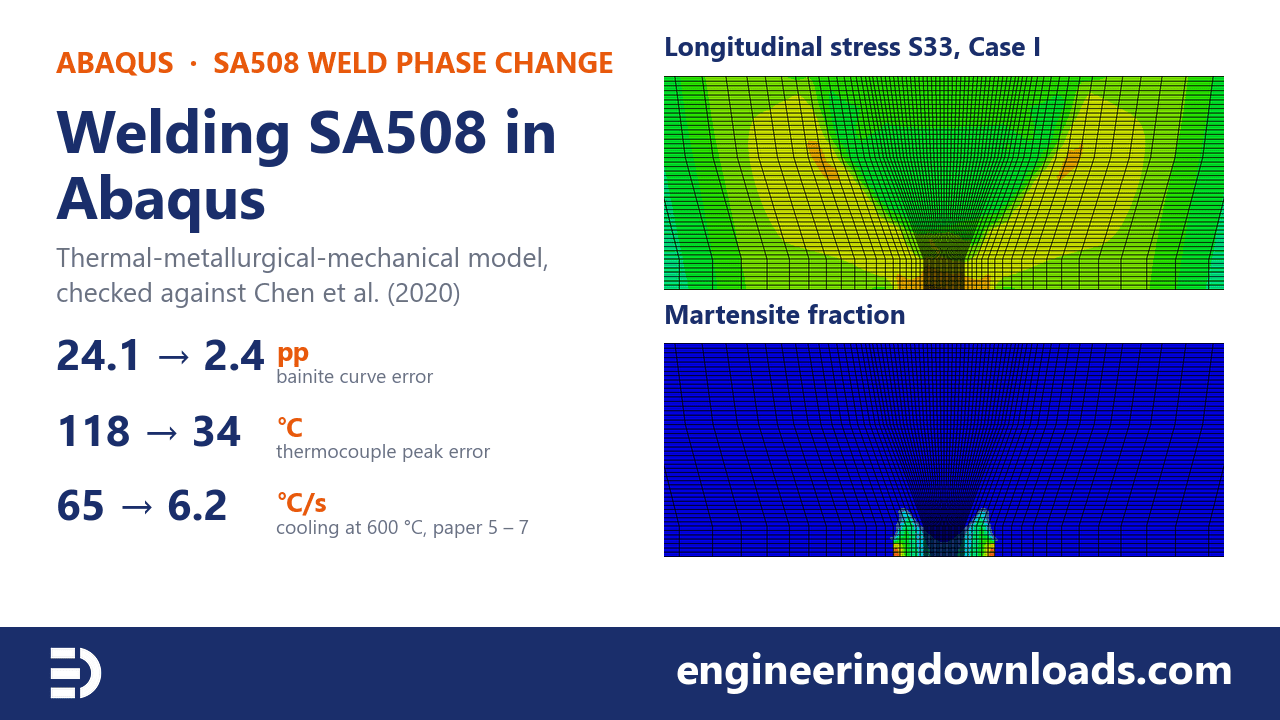 SA508 Weld Phase Transformation in Abaqus: Bainite, Martensite and Residual Stress Model Checked Against a Published Paper€299,00
 SA508 3D Weld Phase Transformation in Abaqus: Moving Heat Source, UMAT and Residual Stress Checked Against a Published Paper€299,00
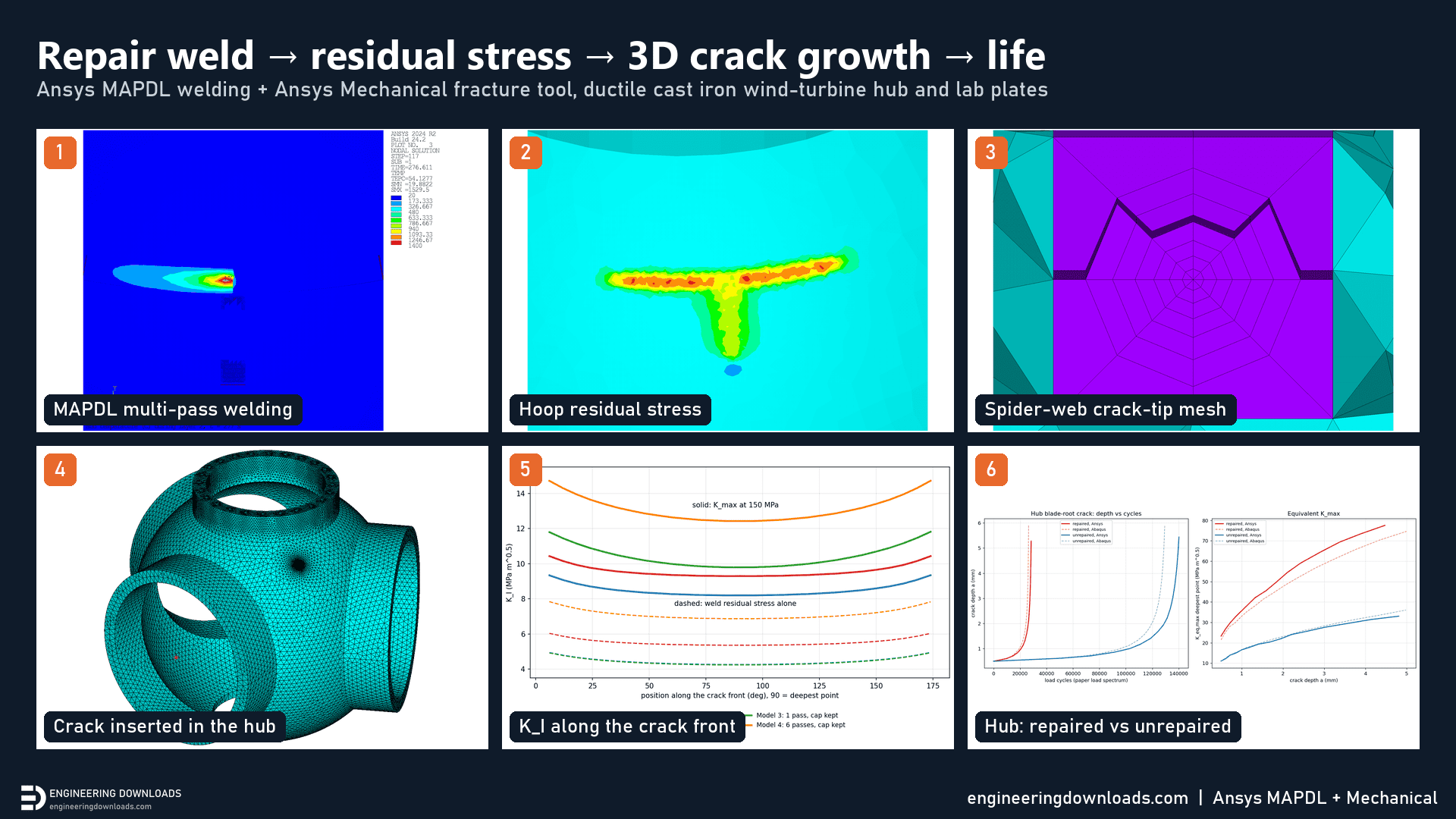 Repair Welding Residual Stress and 3D Fatigue Crack Growth in Ansys: Ductile Cast Iron Wind-Turbine Hub (FFS Level 3)€299,00
 Nozzle-to-Vessel Weld in Abaqus: Martensitic Phase Change, Residual Stress and User Subroutines€209,00
 Repair Welding Residual Stress and 3D Fatigue Crack Growth in Abaqus: Ductile Cast Iron Wind-Turbine Hub (FFS Level 3)€299,00
 DP600 Dual-Phase Steel Microstructure RVE (Ferrite + Martensite) in Ansys Mechanical: Tensile Response and Plastic Strain Localisation€129,00
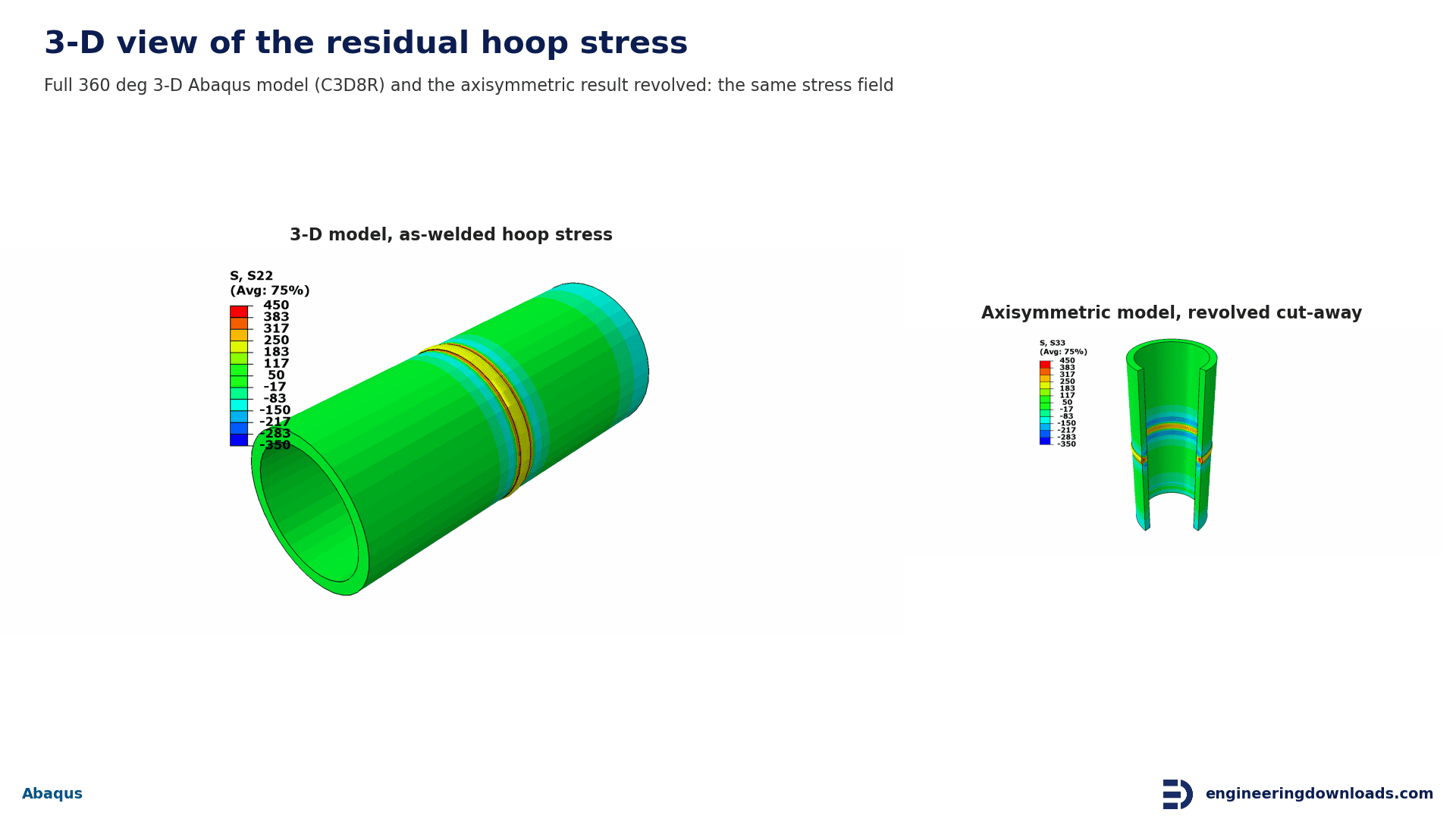 Pipe Girth Weld Residual Stress and Post-Weld Heat Treatment in Abaqus: 12Cr1MoV Multi-Pass Weld, DHT and Tempering€129,00
 DP600 Dual-Phase Steel Microstructure RVE (Ferrite + Martensite) in Abaqus: Tensile Response and Plastic Strain Localisation€129,00

Need a full custom project? See the options below.
€129,00

€179,00

€149,00

€119,00

€129,00

€149,00
See more
Want to receive push notifications for all major on-site activities?



