Need a full custom project? See the options below.
Need a full custom project? See the options below.
The Pull-Out Test is a widely used experimental method to assess the bond behavior between reinforcement materials and a substrate, such as glass fiber-reinforced polymer (GFRP) bars embedded in timber using epoxy adhesives. This method provides valuable insights into the load transfer mechanisms, bond strength, and failure modes at the interface between the bar, adhesive, and wood substrate. With the increasing use of FRP reinforcements in structural timber retrofitting, understanding these interactions through numerical modeling has become crucial.
In simulation, this test is replicated using finite element modeling (FEM) or other computational methods to predict how the materials behave under tensile loading conditions. The simulation aims to reproduce the pull-out behavior of the GFRP bar, accounting for the material properties of timber, GFRP, and epoxy, along with the interfacial bond-slip relationship.
Material Modeling:
Timber: Treated as an orthotropic, anisotropic material due to its grain structure. Modeling must account for directional stiffness and strength.
GFRP Bars: Typically modeled as linear elastic or orthotropic, depending on complexity.
Epoxy Adhesive: May be modeled as a linear elastic or elasto-plastic material with cohesive properties, often using cohesive zone models (CZM) to simulate interface failure.
Interface Behavior:
Cohesive elements or contact models are used to simulate the interaction between epoxy and both the timber and the GFRP bar. In this example, the Concrete Damaged Plasticity is selected to demonstrate the behavior of epoxy interface as the cohesive interaction between wood and GFRP in this paper: Glued-in CFRP and GFRP rods in block laminated timber subjected to monotonic and cyclic loading
Geometry and Boundary Conditions:
The GFRP bar is partially embedded into a timber block with epoxy.
The model replicates the setup of the experimental pull-out test, with fixed boundary conditions at one end and a displacement or load applied at the free end of the bar.
Failure Mechanisms:
Interfacial debonding
Timber splitting or crushing
Epoxy cracking or yielding
Simulation of the pull-out test for GFRP bars in timber with epoxy bonding is a powerful tool that complements experimental research. It enables a deeper understanding of the complex bond interactions at the interface of composite reinforcements and natural materials like wood. Accurate modeling supports better engineering design and enhances the durability and performance of FRP-reinforced timber structures
Need more than the files?
There are two ways we can help. Book a one hour online consultation if you want to talk a problem through with a CAE engineer, using the checkbox in the order box. Order a project if you need a full simulation built for you, delivered to an agreed scope, price and deadline under a written contract.
We work on FEA and CFD for engineers, researchers and companies. Order your project, or message us on WhatsApp for a quick reply.
Other packages engineers working on this topic also download.
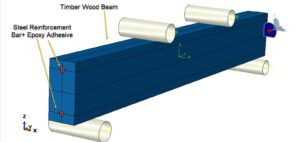 Analysis of reinforcement of timber beam with steel bars and epoxy glue
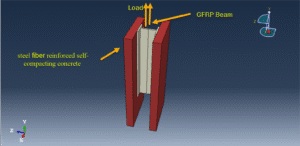 Push-Out analysis of GFRP-concrete adhesively bonded to steel fibre reinforced self-compacting concrete (SFRSCC)
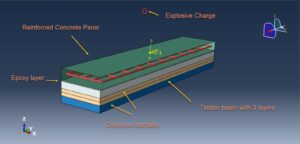 Analysis of adhesively bonded cross-laminated timber-concrete composite under close blast explosion test
 Analysis of a reinforced concrete (RC) beam with an embedded spiral GFRP bar subjected to air blast loading
 Composite Simulation Package in Abaqus (27 FRP and Natural Fibre Models)
 High-velocity impact analysis of the composite sandwich panels with GFRP faces and an aluminum foam core
 2D and Axisymmetric pull-out test analysis of a steel fiber
 Pull-Out Test Package- Analysis and Simulation in Abaqus

Need a full custom project? See the options below.

€129,00

€179,00

€149,00

€119,00

€129,00
See more
Want to receive push notifications for all major on-site activities?