Need a full custom project? See the options below.
Need a full custom project? See the options below.
Terrorism has become a major challenge for the world. Terrorist organizations have raised their activities and their attacks in recent years using explosives. These attacks have left numerous numbers of victims, wreaked massive havoc on basic infrastructure, and increased global concern about the nature of these attacks. Blast wall protection systems can provide a required safety level to reduce injuries/casualties in different attack scenarios. Furthermore, installation and procurement costs could be greatly reduced using readily available materials.
Explosions can result from several instances, including but not limited to industrial accidents or terrorist operations. The former can be controlled by considering industrial safety requirements while the latter is far more challenging to maintain. Blind terror does not distinguish between a child, a woman, or an old man. All these are targets for terrorists. Attacks of this nature inside cities targeting civilians and infrastructure have been on the rise in recent years, leaving a massive number of victims in addition to billions of dollars worth of losses. Lately, terrorists have been using innovative and dynamic attack plans to overcome security precautions and surprise security forces. Hence, these attacks have become more complicated to prevent or delay in most scenarios.
While protecting structures from blast loading is important, it is clear that terrorist organizations have been focusing on targeting civilians in open urban settings to produce mass casualties. This trend can be attributed to accessibility to the crowds in open spaces and, in some cases, the inability of the structure to resist abnormal loads. This tutorial investigates the possibility of using readily available (low-tech) materials to develop simple blast wall systems to help mitigate damage from explosives.
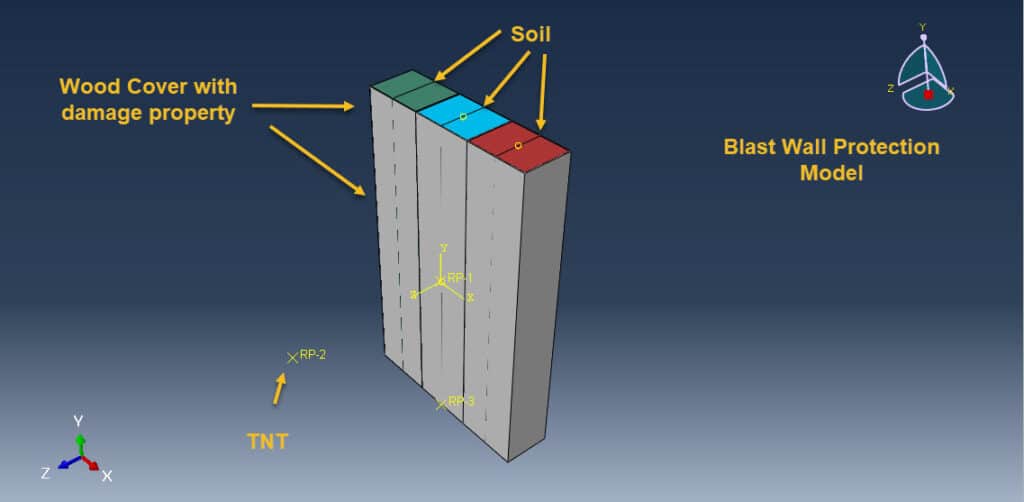
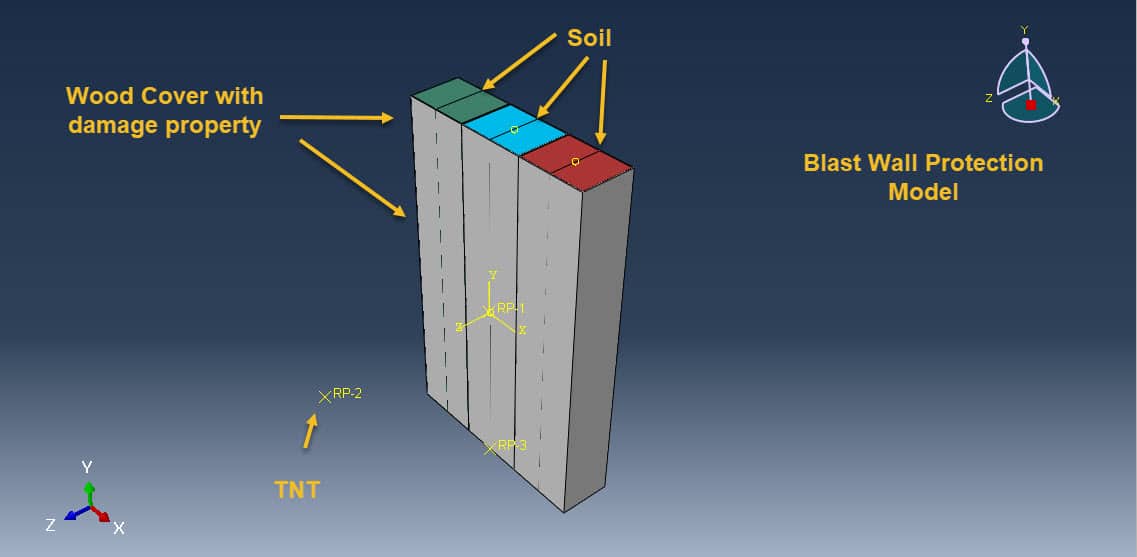
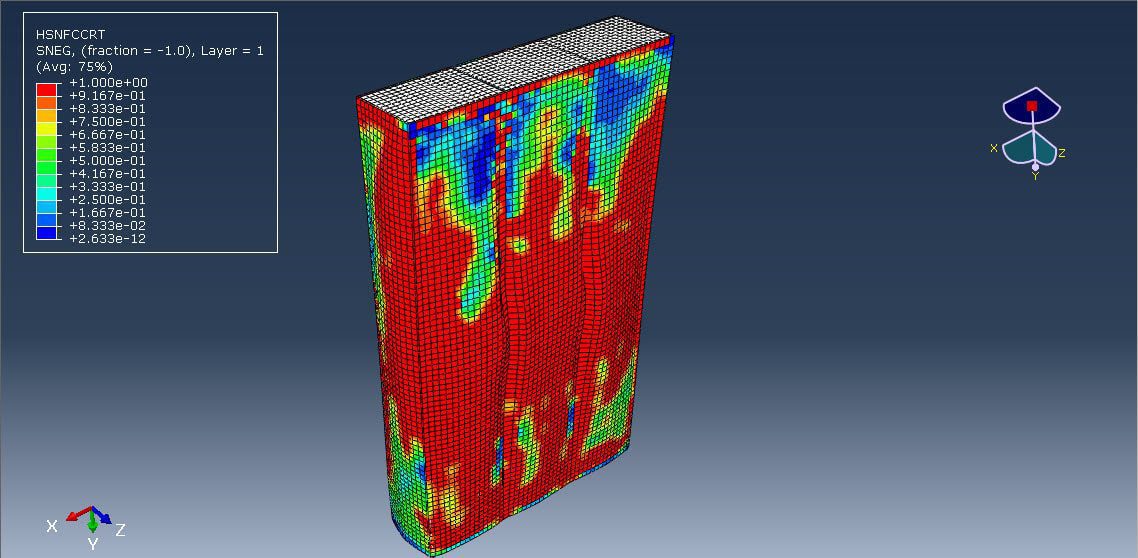
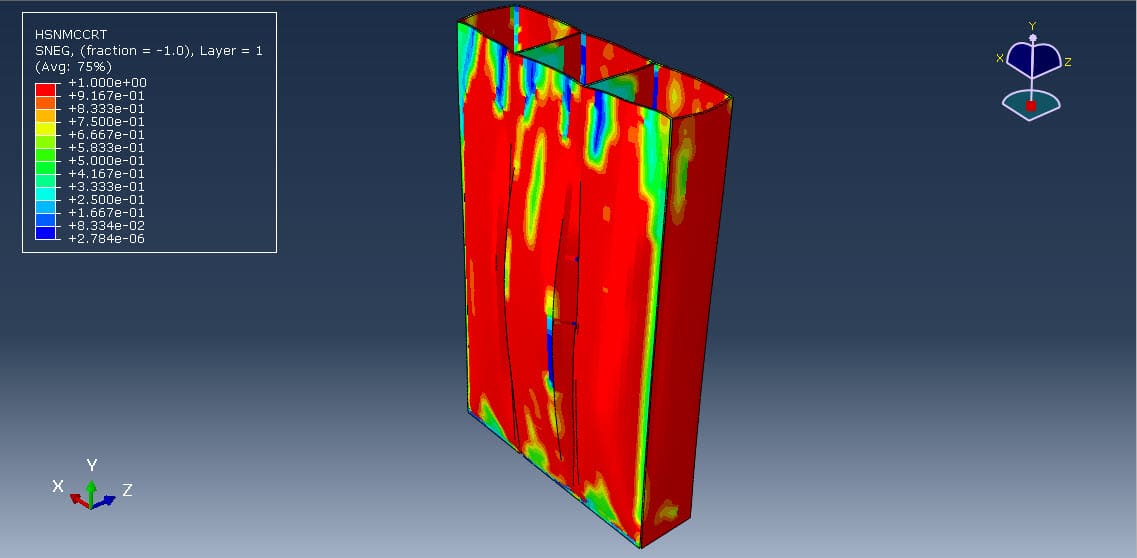
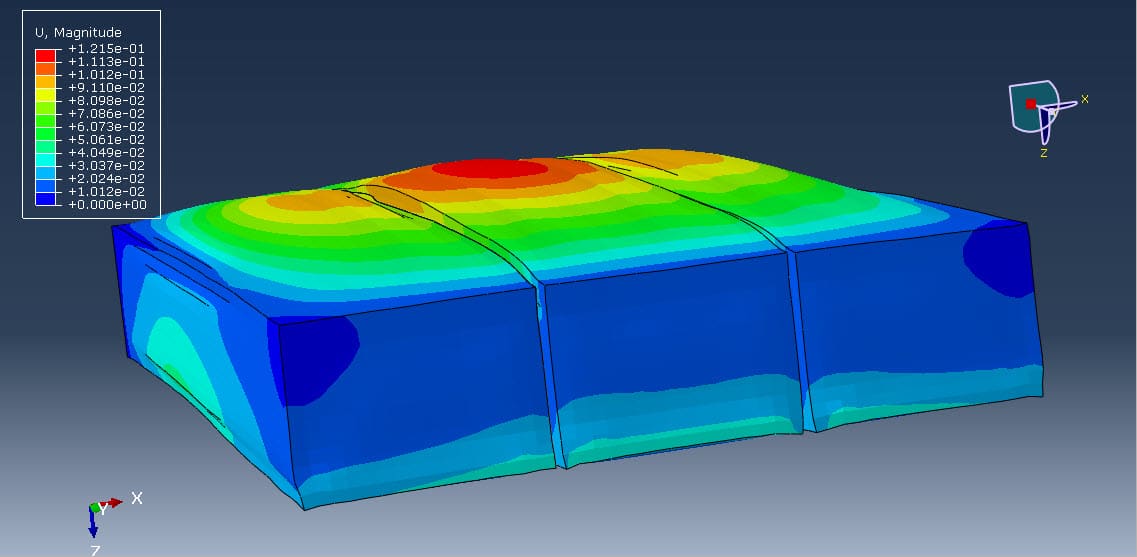
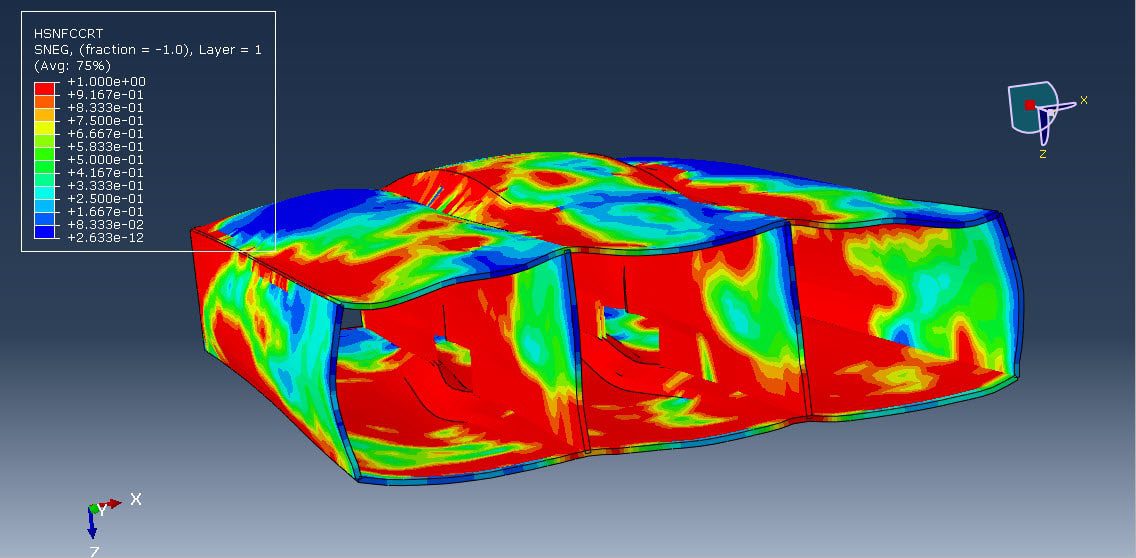
The wood cover is modeled as a 3D shell part with fully damaged behavior. During the blast analysis, the wood cover experienced damage and failure because of the severe pressure.
This example is close to the paper here: Probabilistic analysis of a simple composite blast protection wall system
Need more than the files?
There are two ways we can help. Book a one hour online consultation if you want to talk a problem through with a CAE engineer, using the checkbox in the order box. Order a project if you need a full simulation built for you, delivered to an agreed scope, price and deadline under a written contract.
We work on FEA and CFD for engineers, researchers and companies. Order your project, or message us on WhatsApp for a quick reply.
Other packages engineers working on this topic also download.
 Analysis of the laced reinforced concrete with wood cover under air blast load
 Wood Analysis Package in Abaqus
 Analysis of adhesively bonded cross-laminated timber-concrete composite under close blast explosion test
 Analysis of a composite panel(CFRP-Ceramic-GFPP) under air blast load
 Air blast analysis of a composite panel made of CFRP facing and PET foam core
 Numerical analysis of the CFRP blanket effect on reducing the deformation of pipelines in soil exposed to the Coupled Eulerian-Lagrangian subsurface explosion
 Analysis of aluminum-wood composite panels under high-velocity impact
 Bending test analysis of an aluminium-timber composite beam

Need a full custom project? See the options below.

€129,00

€179,00

€149,00

€119,00

€129,00

€149,00
See more
Want to receive push notifications for all major on-site activities?




