Need a full custom project? See the options below.
Need a full custom project? See the options below.
Steel braces do not usually fail by yielding. They buckle. And when a compression member goes unstable, the whole braced frame can lose capacity in seconds. This ready-to-use Abaqus project shows you how to predict that failure properly — using both linear (eigenvalue) buckling analysis and nonlinear buckling analysis with initial imperfections on a full 3D steel braced structure.
You get the complete Abaqus/CAE model, the input file, and a step-by-step video tutorial. Open it, run it, change it, and reuse the workflow on your own structure.
A lot of engineers run a linear buckling analysis in Abaqus, read the critical load, and stop there. That number is almost always too high.
Real steel structures are never perfect. They have fabrication tolerances, residual stresses, slightly out-of-straight members, and steel that yields before the theoretical buckling load is ever reached. If you design from the eigenvalue result alone, you overestimate the strength of the structure.
This project walks you through the correct two-stage workflow used in research papers and real design checks:
The model is a three-dimensional finite element model of a steel braced structure built in Abaqus. It includes:
Every part of the setup is shown in the video: geometry, assembly, material definition, mesh, interactions, boundary conditions, steps, and results.
Linear buckling analysis, also called eigenvalue buckling analysis, is the fast way to estimate the theoretical critical buckling load of a structure.
It assumes that:
Why it is still useful:
Its weakness is simple: it overestimates real buckling strength, because real structures have imperfections and material nonlinearity.
Real steel frames are not perfectly straight elastic systems. Manufacturing tolerances, residual stresses, connection imperfections, and yielding all change the buckling behaviour. That is why the second stage matters.
Large deformation effects are included, because the structure moves significantly while it buckles. In Abaqus this is activated with NLGEOM = ON.
The elastic-plastic material model lets the steel behave elastically at first, reach yield, develop plastic deformation, and keep carrying load past the elastic limit.
The first buckling mode from the eigenvalue analysis is imported into the nonlinear model as an initial imperfection. This represents real construction tolerances and stops the model from behaving like a mathematically perfect structure.
| Analysis type | What it gives you | Limitation |
|---|---|---|
| Linear (eigenvalue) buckling | Theoretical critical load and buckling mode shapes | Overestimates real strength |
| Nonlinear buckling | Realistic failure load and post-buckling behaviour | Higher computational cost |
You need both. Linear analysis tells you how the structure will fail. Nonlinear analysis tells you when.
The nonlinear result gives a lower and far more reliable buckling capacity than the linear one. Seeing that gap on your own screen is the fastest way to understand why imperfections matter.
Built in Abaqus/CAE. Suitable for all levels — the video explains each step, so you do not need prior buckling experience. Video length is about 38 minutes.
Yes. The nonlinear model needs an imperfection shape, and the cleanest source of that shape is the first mode from the eigenvalue buckling analysis. The tutorial shows exactly how to export and apply it.
The model opens in standard recent Abaqus versions. The .inp file also lets you run the analysis without depending on a specific CAE release.
Yes — that is the point. The two-stage buckling procedure is the same for columns, frames, shells, and braced systems. Swap the geometry and material, keep the workflow.
Because of initial imperfections, large deformation effects, and steel yielding. All three reduce capacity below the theoretical eigenvalue prediction. This model lets you see the difference in numbers.
Need this analysis run on your own geometry? We also offer custom FEA and CFD project support and HPC rental from EUR 5/week if your nonlinear model needs more cores.
Not satisfied with the file? We refund it. No arguments.
Need more than the files?
There are two ways we can help. Book a one hour online consultation if you want to talk a problem through with a CAE engineer, using the checkbox in the order box. Order a project if you need a full simulation built for you, delivered to an agreed scope, price and deadline under a written contract.
We work on FEA and CFD for engineers, researchers and companies. Order your project, or message us on WhatsApp for a quick reply.
Other packages engineers working on this topic also download.
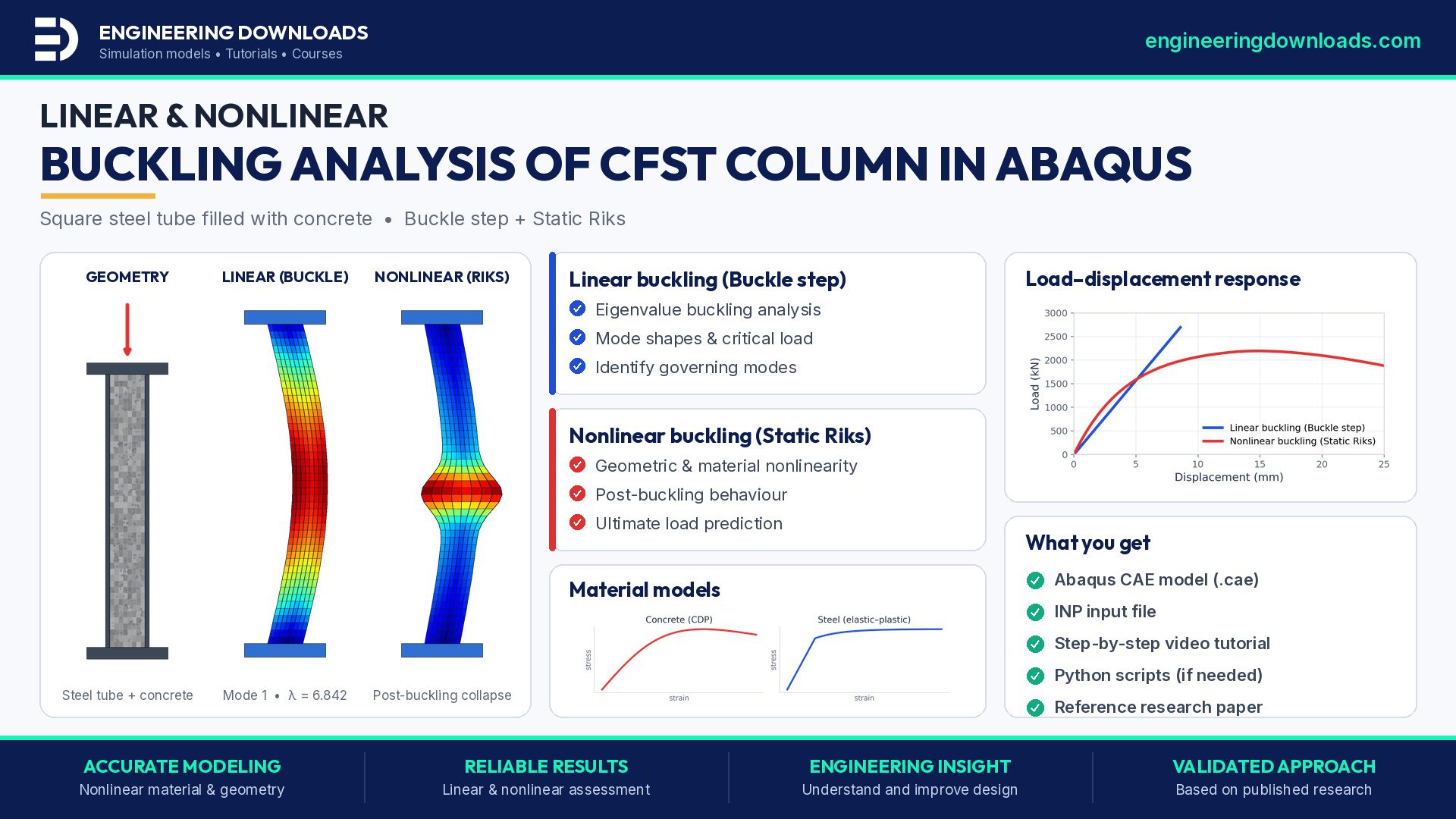 Buckling Analysis of a Concrete-Filled Steel Tube (CFST) Column Using Abaqus
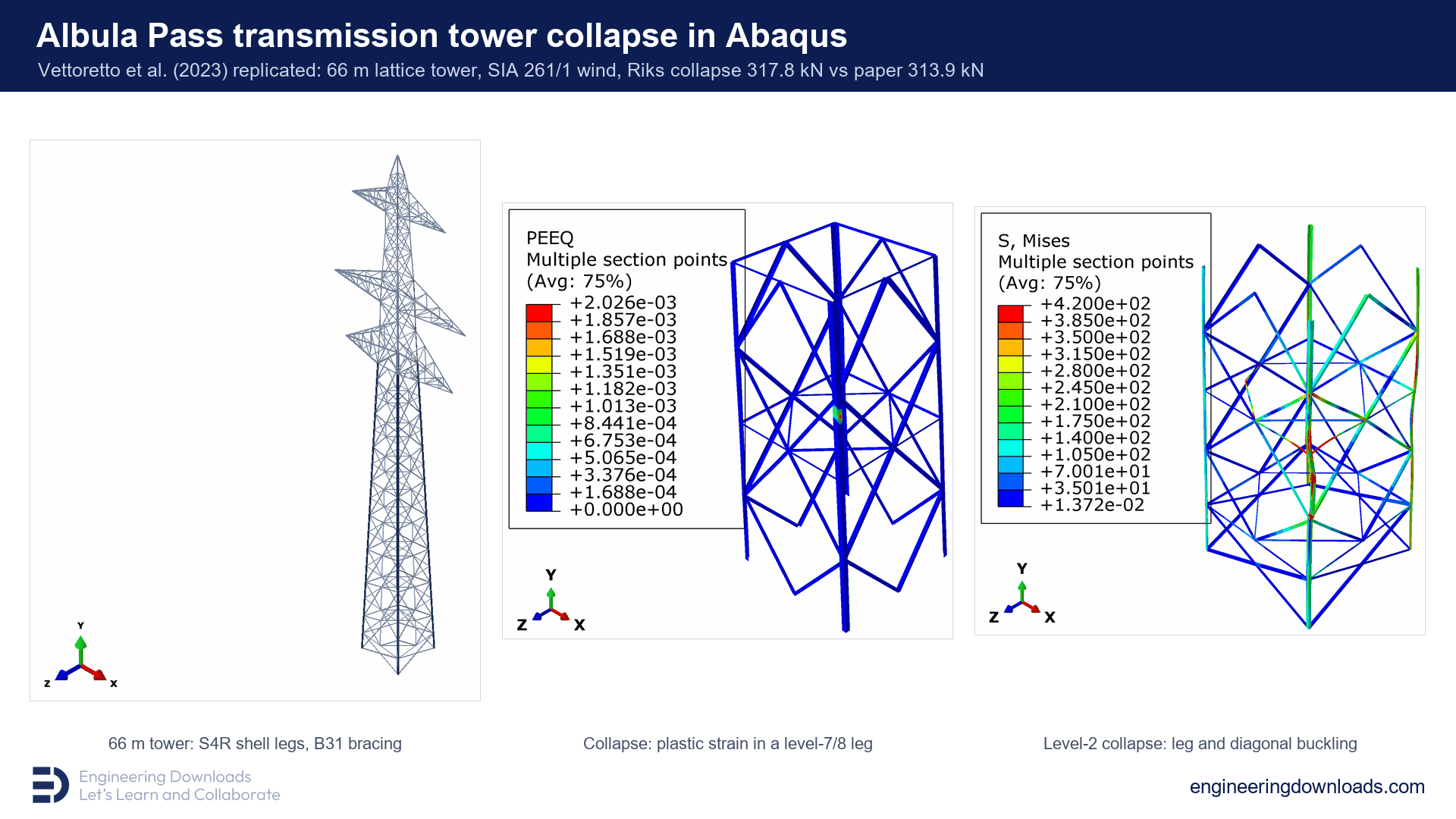 Transmission Tower Collapse under Extreme Wind in Abaqus: Buckling, Riks and Post-Buckling, after Vettoretto et al. (2023)€169,00
 Ring-Stiffened Cylinder Buckling in Abaqus: T and L Stiffening Rings vs Zhu, Dong & Gao (2015)€59,00
 Tank Wind Buckling in ANSYS: EN 1993-1-6 MNA-LBA Model of a Cylindrical Oil Tank€129,00
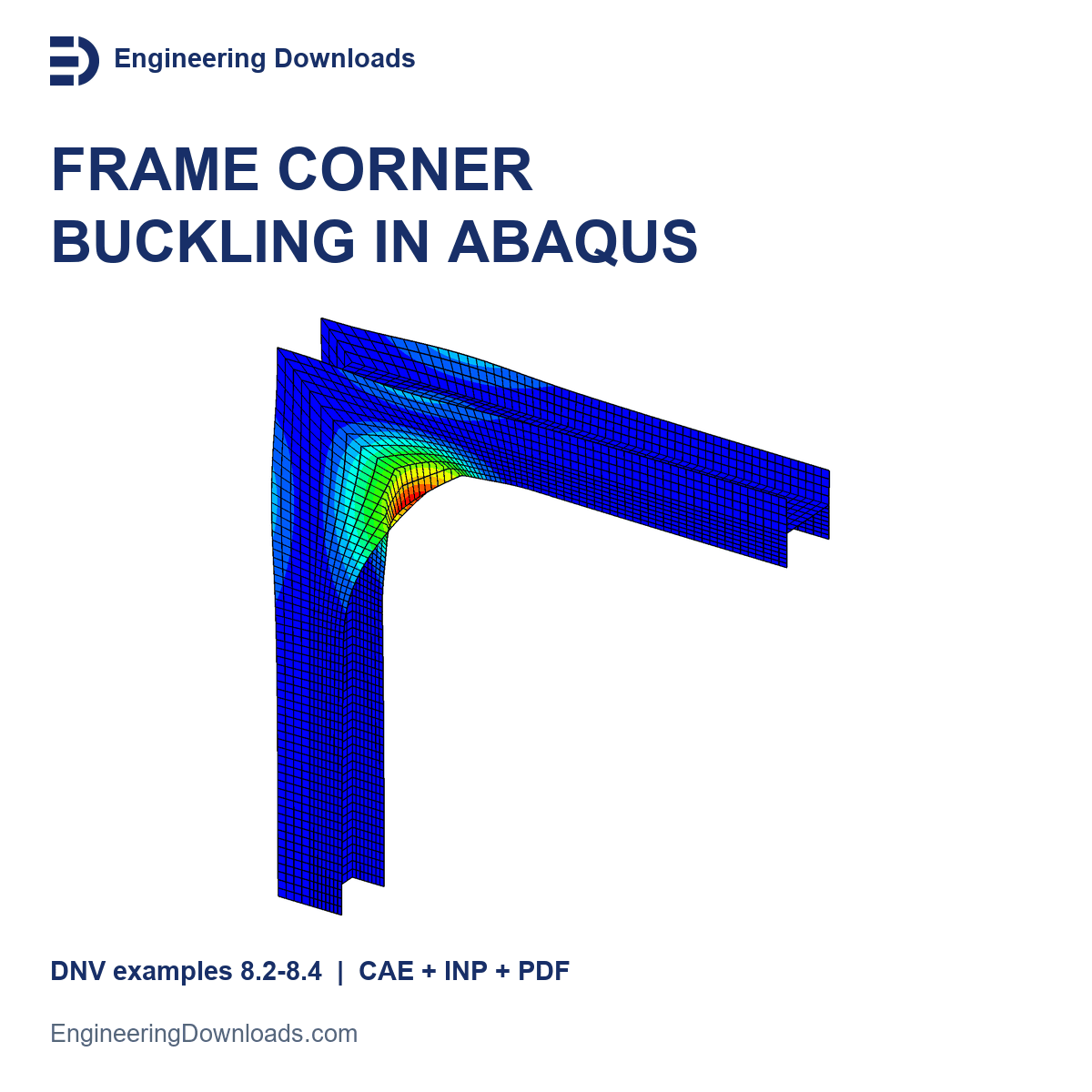 DNV-RP-C208 Examples 8.2-8.4 in Abaqus: Frame Corner Buckling, Resistance Check and Nonlinear Collapse€79,00
 Seismic Response of a Steel Building in Abaqus: Nonlinear Dynamic Analysis with Beam Elements
 Bolted Steel Beam–Column Connection Under Fire in Abaqus: Sequential Heat Transfer and Structural Analysis
 Concrete Cover Effect on Steel–Concrete Bond-Slip in SRC Members: Abaqus CDP & Cohesive Model

Need a full custom project? See the options below.

€129,00

€179,00

€149,00

€119,00

€129,00
See more
Want to receive push notifications for all major on-site activities?