


Need a full custom project? See the options below.
Need a full custom project? See the options below.
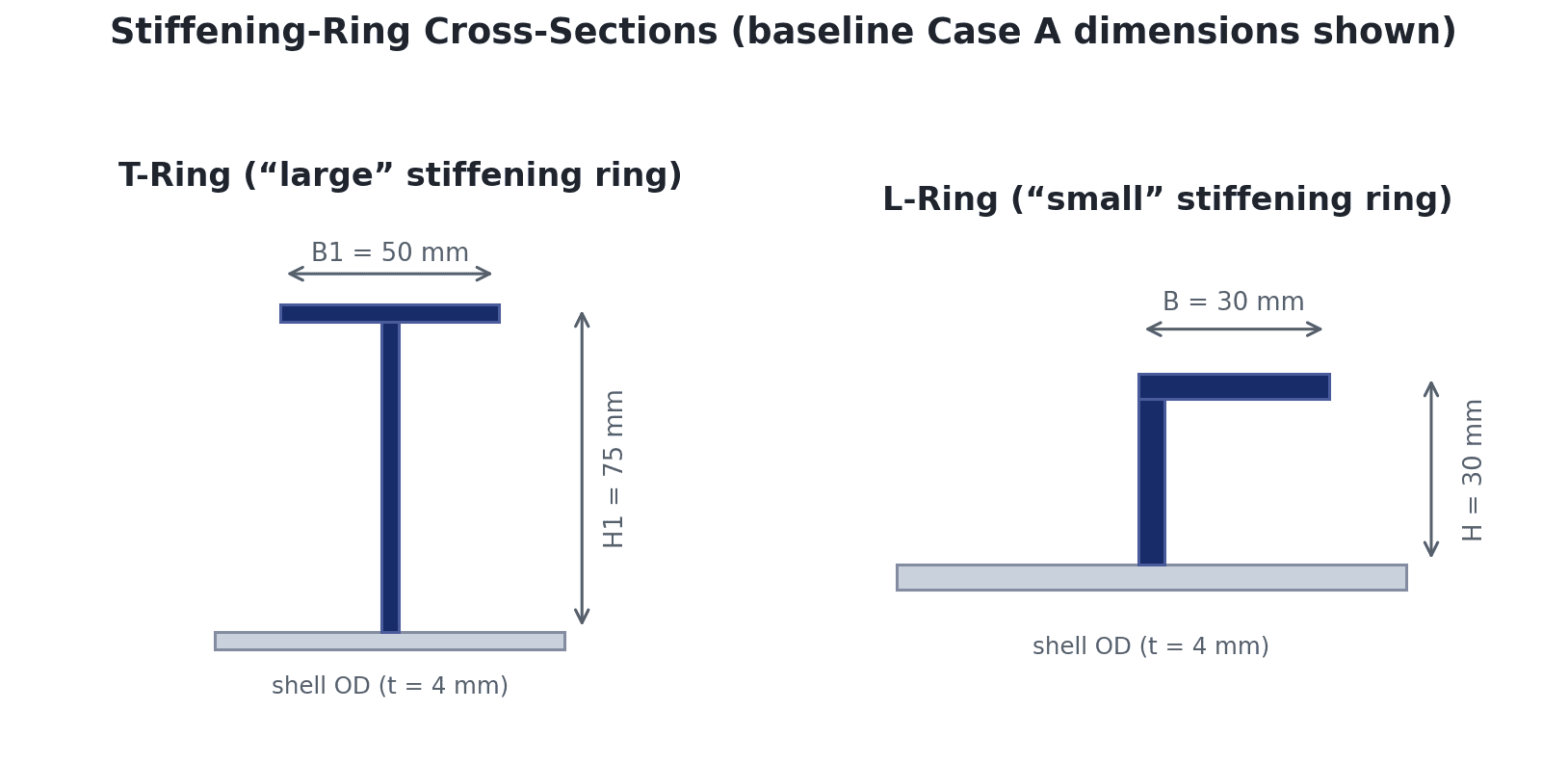
How does the size and spacing of “large” (T-shaped) and “small” (L-shaped) stiffening rings change the buckling pattern and critical pressure of a thin-walled cylinder under external pressure? Zhu, Dong & Gao (2015) answer this with ANSYS eigenvalue buckling analysis of a Q345R steel cylinder, mapping three distinct buckling-pattern regions and using them to optimise the stiffening-ring design. This ring-stiffened cylinder buckling Abaqus model rebuilds their study as a parametric shell-of-revolution mesh, reproduces all three published buckling-pattern families plus the paper’s own optimised design, and compares every critical pressure with the published ANSYS results. You get 4 Abaqus CAE models, ready-to-run INP files, a parametric Python mesh/.inp generator, an eigenvalue extraction and pattern-classification script, and a 10-page PDF validation tutorial.
*BUCKLE, Lanczos), with the mode eigenvalue × 0.1 MPa giving the critical pressure PcrPaper title: Buckling Analysis of Thin Walled Cylinder with Combination of Large and Small Stiffening Rings under External Pressure
Authors: Y. Zhu, J.H. Dong, B.J. Gao
Published in: Procedia Engineering, Volume 130 (2015), pp. 364–373 (14th International Conference on Pressure Vessel Technology, ICPVT-14)
DOI: 10.1016/j.proeng.2015.12.229 – open access under CC BY-NC-ND
Abstract (our summary): the authors use ANSYS SHELL181 eigenvalue buckling analysis to map how the size of T-shaped “large” and L-shaped “small” stiffening rings changes the buckling pattern of a Q345R cylinder under external pressure. They identify three buckling-pattern regions – cylinder buckling together with both ring types (BP-I), with only the small rings (BP-II), and only between rings with both ring types staying round (BP-III) – and use these results, plus an ANSYS optimisation routine, to find a minimum-weight ring layout that satisfies a stability design factor. The full original abstract is available from the publisher through the DOI link above; the paper itself is not included in this package.
| Item | Reference paper (ANSYS) | This Abaqus package |
|---|---|---|
| Cylinder | Outer diameter 2490 mm, wall 4 mm, length 11795 mm, Q345R, E=194 GPa, ν=0.3 | |
| Stiffening rings | SHELL181, 2 T-rings + 18 L-rings, 568 mm pitch | S4R, same layout, true 3D web + flange geometry sharing shell nodes |
| Load | 0.1 MPa external pressure, eigenvalue × 0.1 MPa = Pcr | |
| Boundary conditions | Restrained “at 1/3 depth of the curved head” (head geometry not published) | Documented simplification: radial + circumferential restraint at the cut cylindrical edge, axial restraint at one end (see Limitations) |
| Mesh | Convergence-checked, density not published | ~120 circumferential divisions, ~25,500 nodes, convergence-checked (−2.5% on a 1.5× refinement) |
| Case | H1 / H / Na | Paper Pcr | Abaqus Pcr | % diff | Pattern |
|---|---|---|---|---|---|
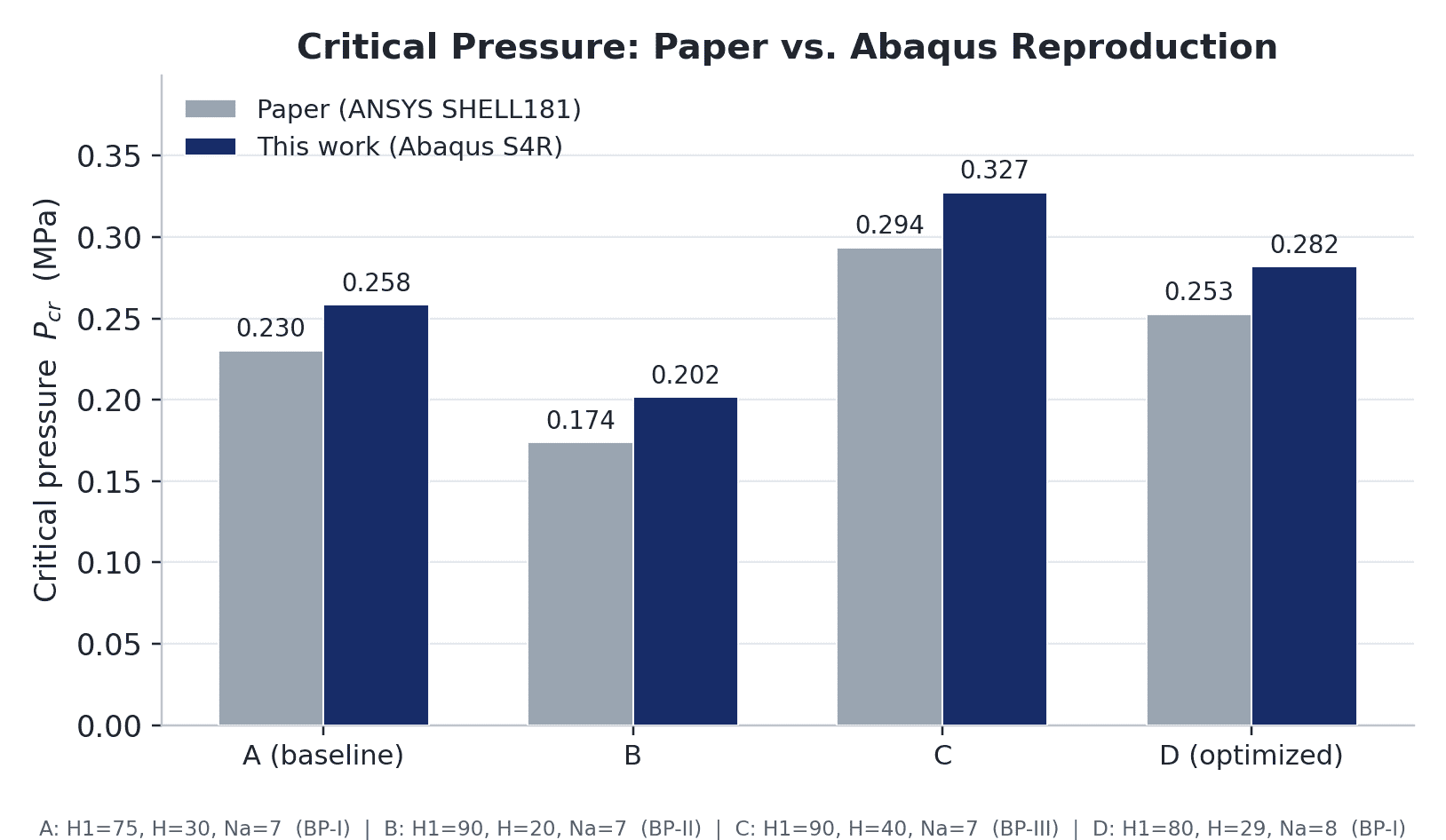
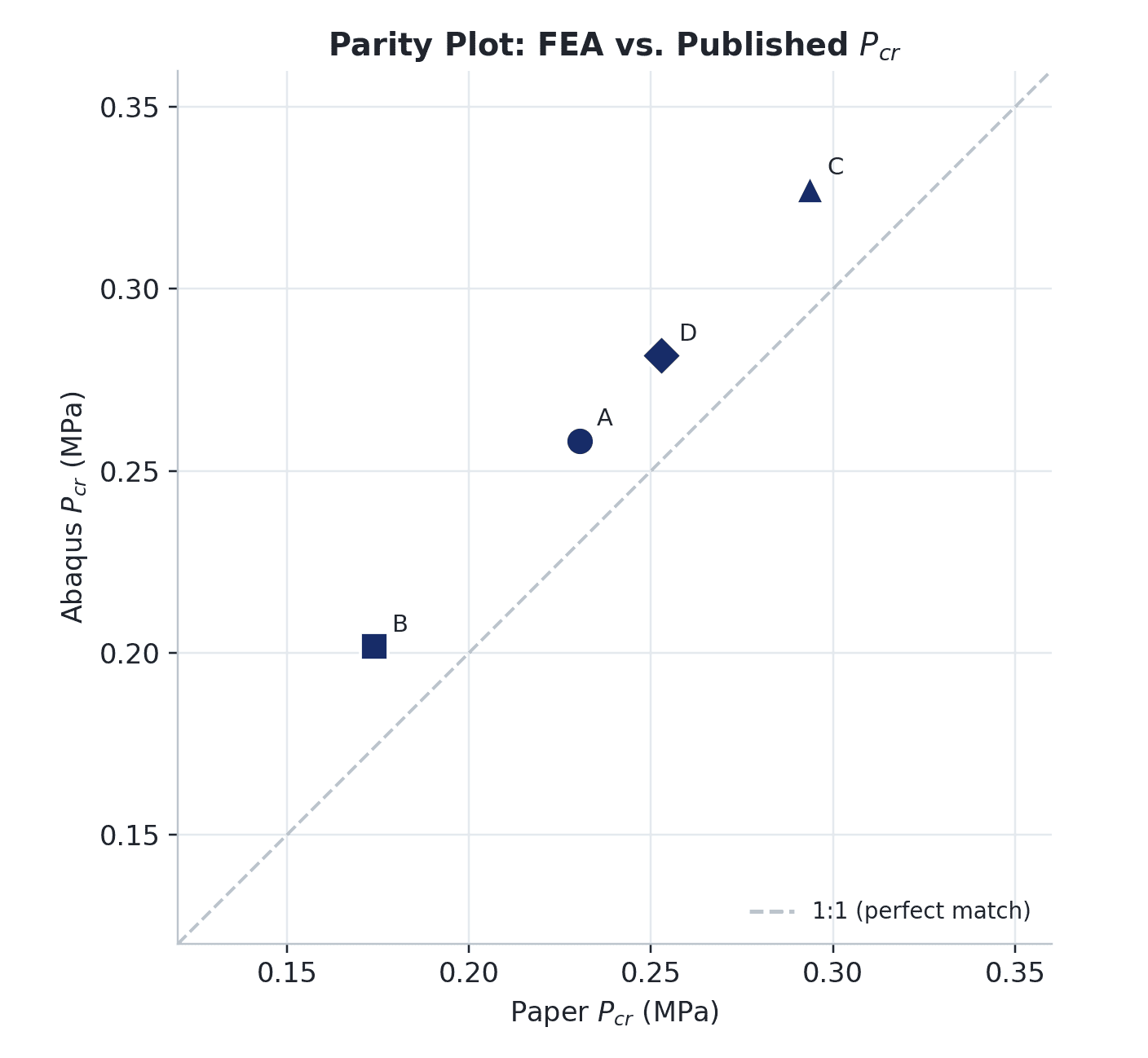
| A (baseline) | 75 / 30 / 7 | 0.2303 MPa | 0.2583 MPa | +12.1% | BP-I / BP-I |
| B | 90 / 20 / 7 | 0.1739 MPa | 0.2017 MPa | +16.0% | BP-II / BP-II |
| C | 90 / 40 / 7 | 0.2936 MPa | 0.3274 MPa | +11.5% | BP-III / BP-III |
| D (optimized) | 80 / 29 / 8 | 0.2527 MPa | 0.2817 MPa | +11.5% | BP-I / BP-I |
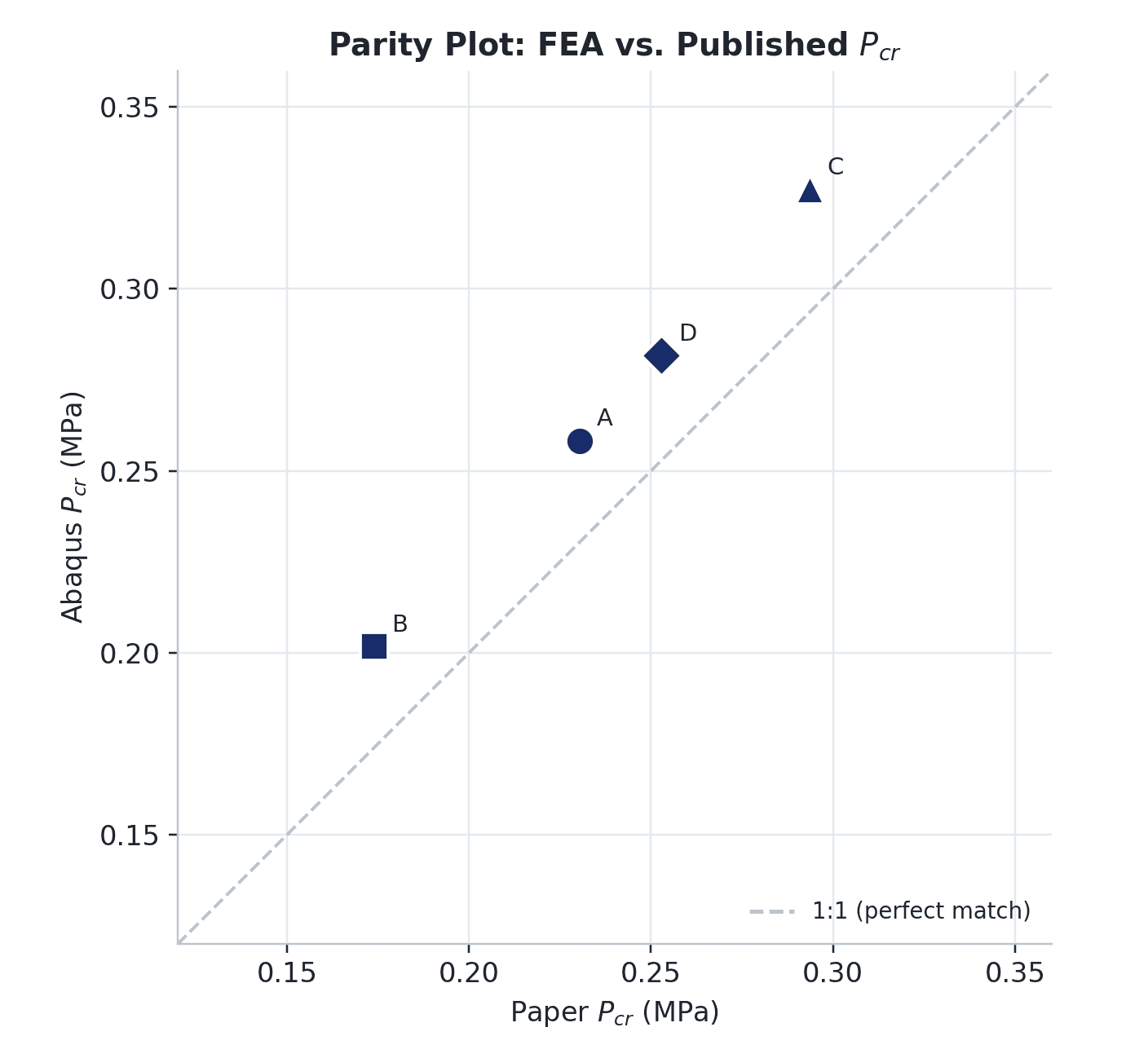
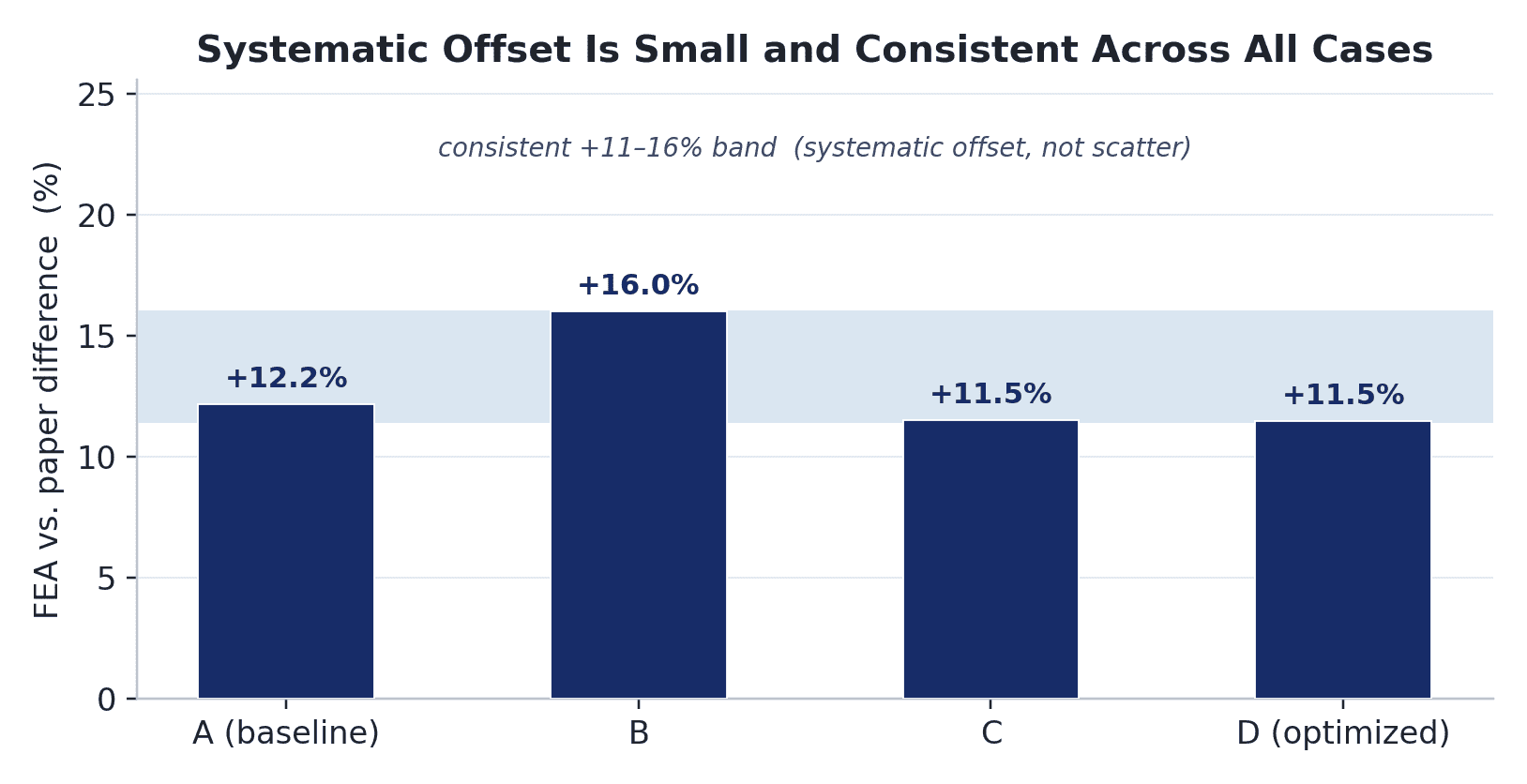
All 4 cases correctly reproduce the published buckling-pattern family, with mode-1 critical pressures a consistent +11–16% above the paper – a small, mesh-converged, systematic offset (not scattered error), explained in detail below.
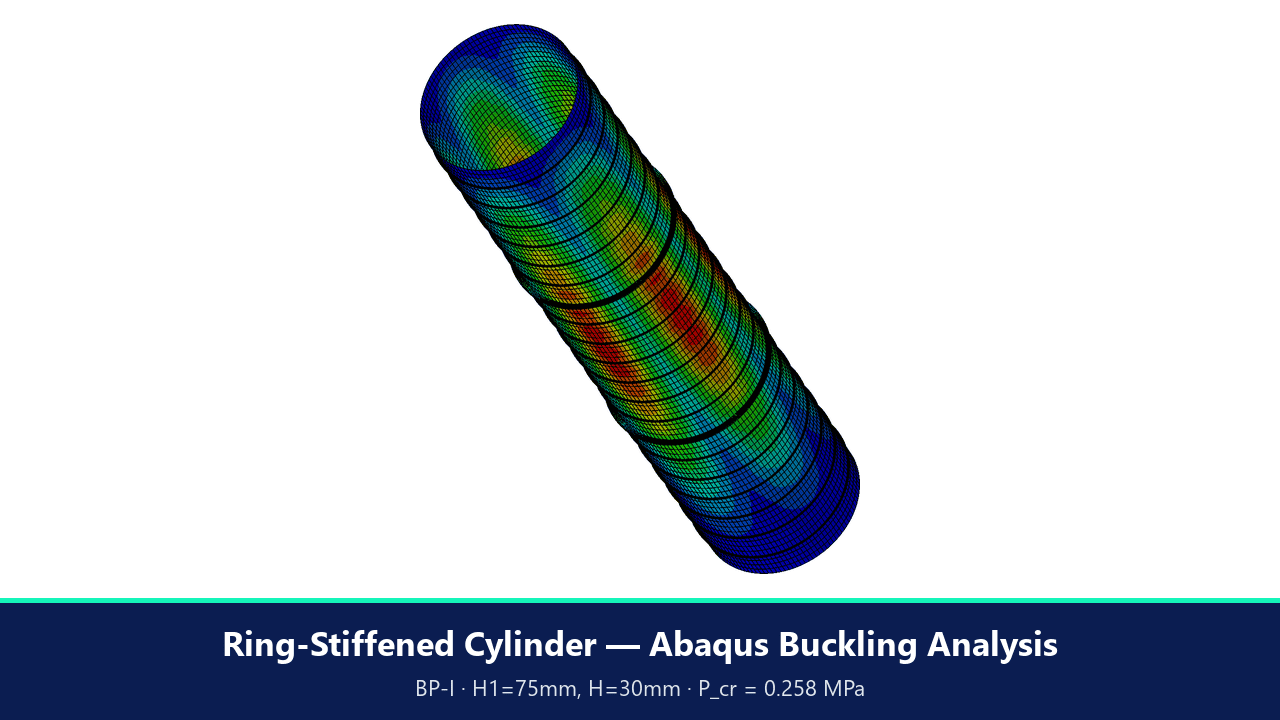
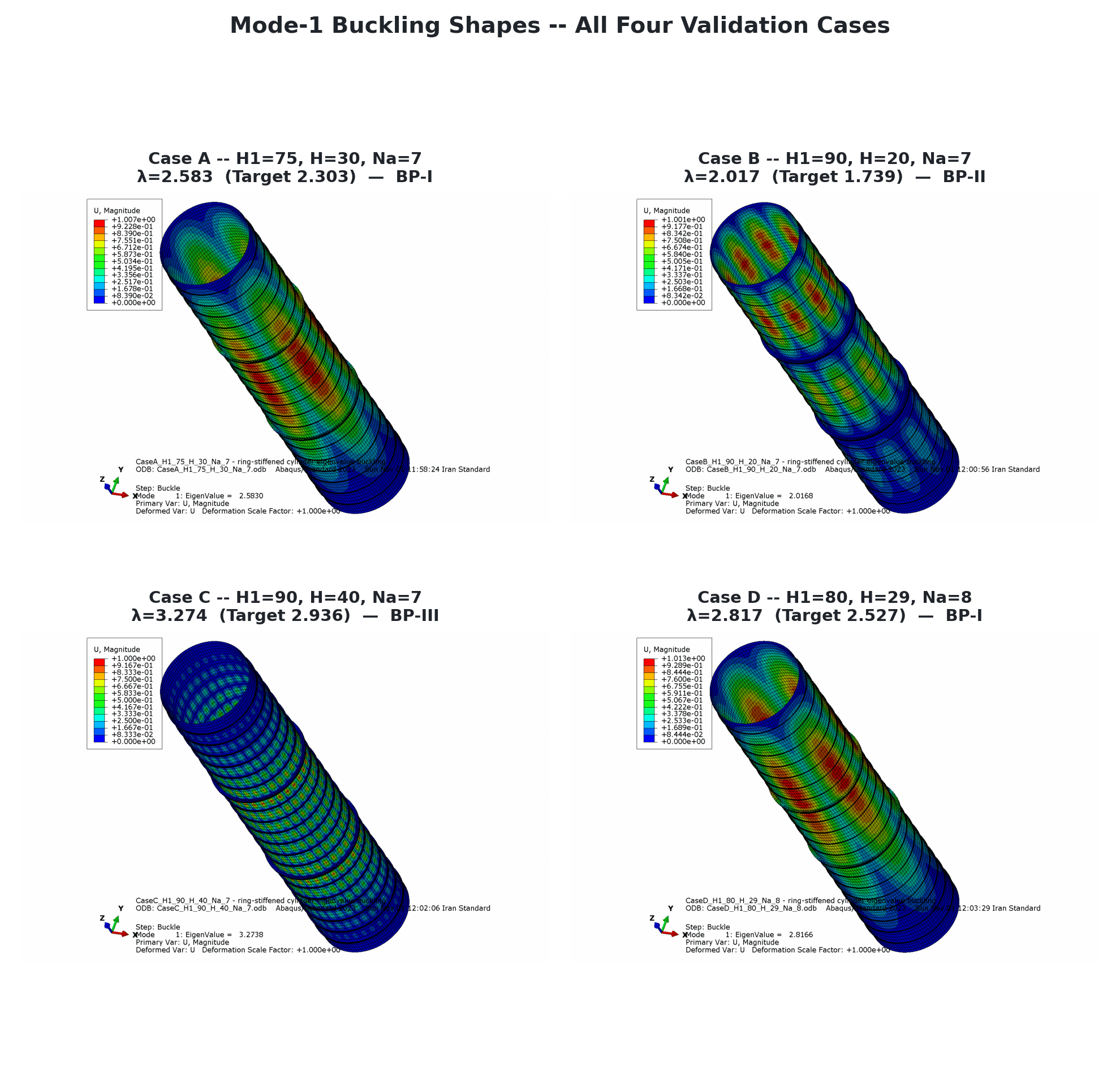
The parity plot shows every case sitting consistently above the 1:1 line – the same proportional offset, not scattered error. The mode-1 shapes confirm the pattern classification: in BP-I, both ring types bow with the shell; in BP-II only the small L-rings follow the shell; in BP-III the shell buckles only locally between rings that stay essentially round.
One zip file, RingStiffenedCylinder_Buckling_Abaqus_Complete_Package.zip (6.2 MB). The CAE models and the INP files are also available as separate downloads.
build_model.py – the parametric mesh/.inp generator for any H1/H/Na; extract_eigenvalues.py – eigenvalue + buckling-pattern classification from the ODB; render_mode_shape.py, make_charts.py, build_report_pdf.py – regenerate the figures and this tutorialResult files (ODB) are not included: each case solves in well under a minute on a modern machine.
python build_model.py (edit the cases list, or call build_case(name, H1, H, Na, out_dir) directly) – builds the full mesh and .inp in seconds, no CAD or Abaqus/CAE geometry scripting neededabaqus job=<name> input=<name>.inp cpus=4 ask_delete=OFF interactiveabaqus python extract_eigenvalues.py <name>.odb 6 – eigenvalues, critical pressures and BP-I/II/III classificationPressure vessel and structural engineers designing ring-stiffened cylindrical shells under external pressure to ASME VIII-2 or EN 13445, FEA engineers who need a validated template for eigenvalue buckling of stiffened shells, and researchers and MSc/PhD students studying buckling-pattern classification and stiffening-ring optimisation.
Abaqus/CAE and Abaqus/Standard 2023 or newer for the CAE files (the INP files also run in older releases). Python 3 with numpy/matplotlib/reportlab only needed if you want to regenerate the mesh generator, charts or tutorial. Units are mm, N, tonne, s and MPa.
This ring-stiffened cylinder buckling Abaqus model gives you a validated, reusable parametric model instead of building the shell-of-revolution mesh and eigenvalue setup from scratch: generate any new T/L ring design in seconds, with every number checked against a published paper and the residual offset explained rather than hidden. See also the saddle-support stiffening ring study, the DNV-RP-C208 bolted flange joint and the NAFEMS LE7 pressure vessel benchmark.
What does this package calculate? This ring-stiffened cylinder buckling Abaqus model calculates the eigenvalue (linear) buckling critical pressure and buckling-pattern family (BP-I, BP-II or BP-III) of a Q345R thin-walled cylinder stiffened with a combination of T-shaped “large” and L-shaped “small” rings under external pressure, for any ring height (H1, H) and spacing (Na) within the paper’s studied range.
Does it reproduce the paper’s results? Yes, for all three buckling-pattern families and the paper’s own optimised design. All 4 validated cases correctly reproduce the published buckling-pattern family, with mode-1 critical pressures a consistent 11–16% higher than the paper’s ANSYS results – a small, mesh-converged, systematic offset, not scattered error.
Why is there an 11–16% offset from the paper? Mainly because the paper restrains its model “at 1/3 depth” of a curved head whose dimensions are not published; this package restrains the cut cylindrical edge instead, which is mildly stiffer. A smaller contribution comes from using Abaqus S4R shells instead of ANSYS SHELL181. The tutorial explains both in detail.
Which inputs did you have to assume? The head geometry needed for the paper’s exact boundary condition is not given in the published text, so this package uses a standard, documented simplification (restraint at the cylinder edge) instead. The ring cross-section is modeled as a simple rectangular web and flange, which is why the Case D ring-weight estimate runs about 30% higher than the paper’s own code-based calculation – this does not affect the buckling results.
Can I use it for my own ring-stiffened cylinder design? Yes. build_model.py builds the full shell-of-revolution mesh and Abaqus input deck from three parameters – T-ring height H1, L-ring height H and ring-position parameter Na – in a few seconds, with no CAD or Abaqus/CAE geometry scripting needed. Valid range: 75≤H1≤94 mm, 21≤H≤40 mm, 1≤Na≤10 (the paper’s studied design space).
Which Abaqus version do I need? Abaqus/CAE and Abaqus/Standard 2023 or newer for the CAE files; the INP files also run in older releases. Each case solves in well under a minute on a modern machine.
Is the paper included, or is this an official publication? No. The paper (Zhu, Dong & Gao, Procedia Engineering 130 (2015) 364–373, open access, DOI 10.1016/j.proeng.2015.12.229) is not included – it is freely available from the publisher via the DOI link. This package is an independent reproduction and validation, not an official ASME, Elsevier or Procedia Engineering publication.
What if the package is not what I expected? Write to us. Engineering Downloads refunds clients who are not satisfied with a delivered product.
Need more than the files?
There are two ways we can help. Book a one hour online consultation if you want to talk a problem through with a CAE engineer, using the checkbox in the order box. Order a project if you need a full simulation built for you, delivered to an agreed scope, price and deadline under a written contract.
We work on FEA and CFD for engineers, researchers and companies. Order your project, or message us on WhatsApp for a quick reply.
Other packages engineers working on this topic also download.
 Abaqus Buckling Analysis of a Steel Braced Frame (Linear + Nonlinear)
 Stiffening Rings at Saddle Supports of a Horizontal Pressure Vessel in Abaqus: 20 Models vs Paper
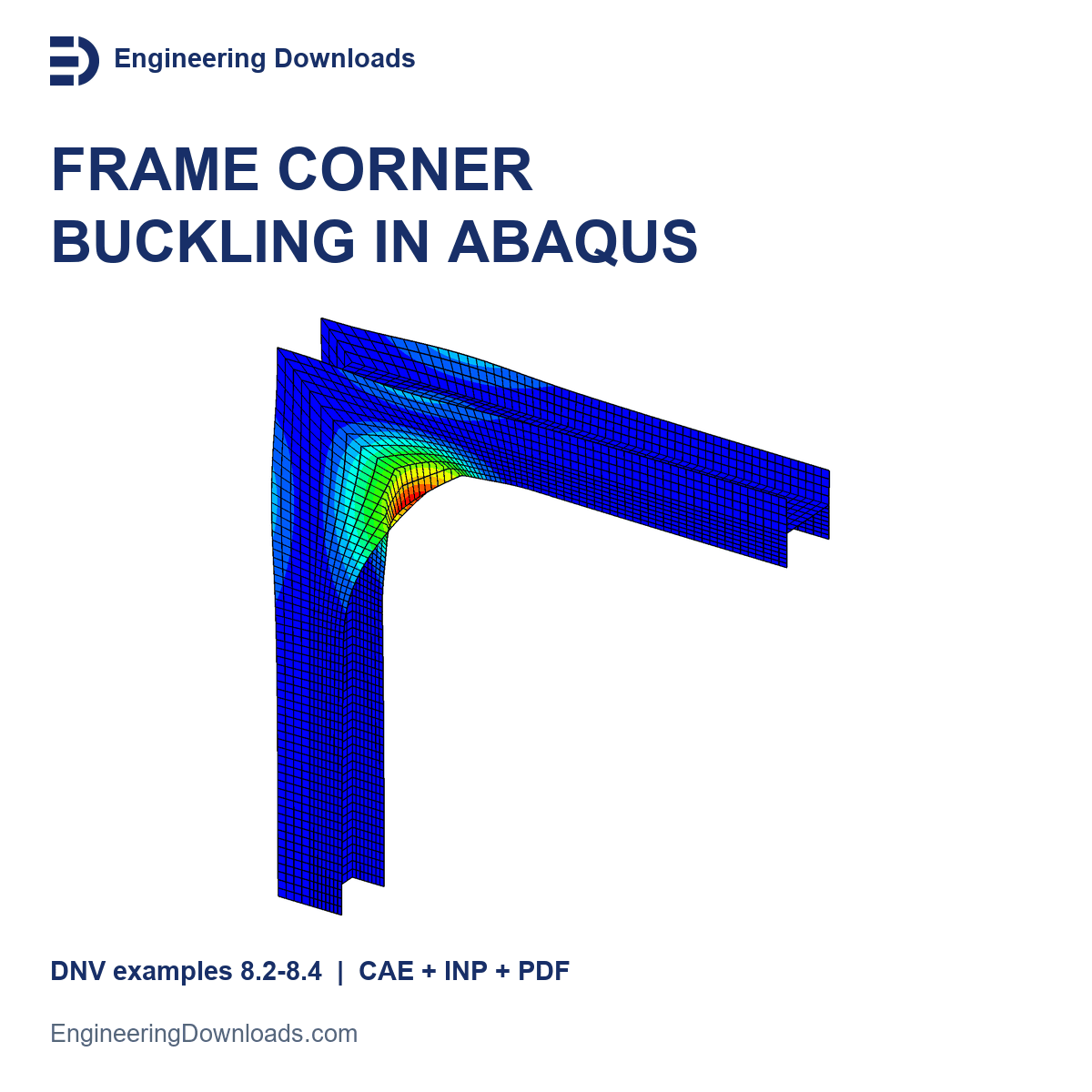 DNV-RP-C208 Examples 8.2-8.4 in Abaqus: Frame Corner Buckling, Resistance Check and Nonlinear Collapse€79,00
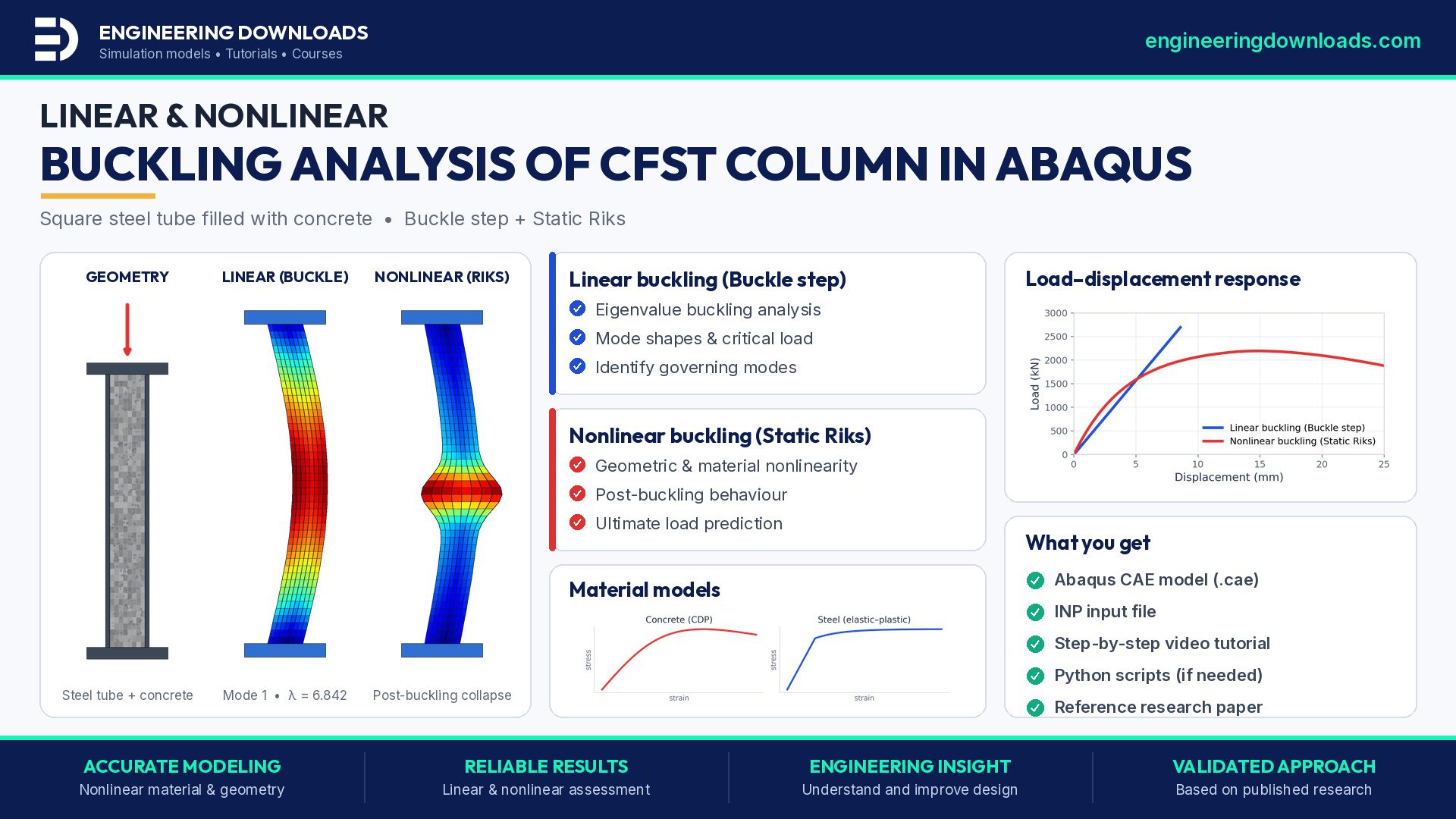 Buckling Analysis of a Concrete-Filled Steel Tube (CFST) Column Using Abaqus
 Tank Wind Buckling in ANSYS: EN 1993-1-6 MNA-LBA Model of a Cylindrical Oil Tank€129,00
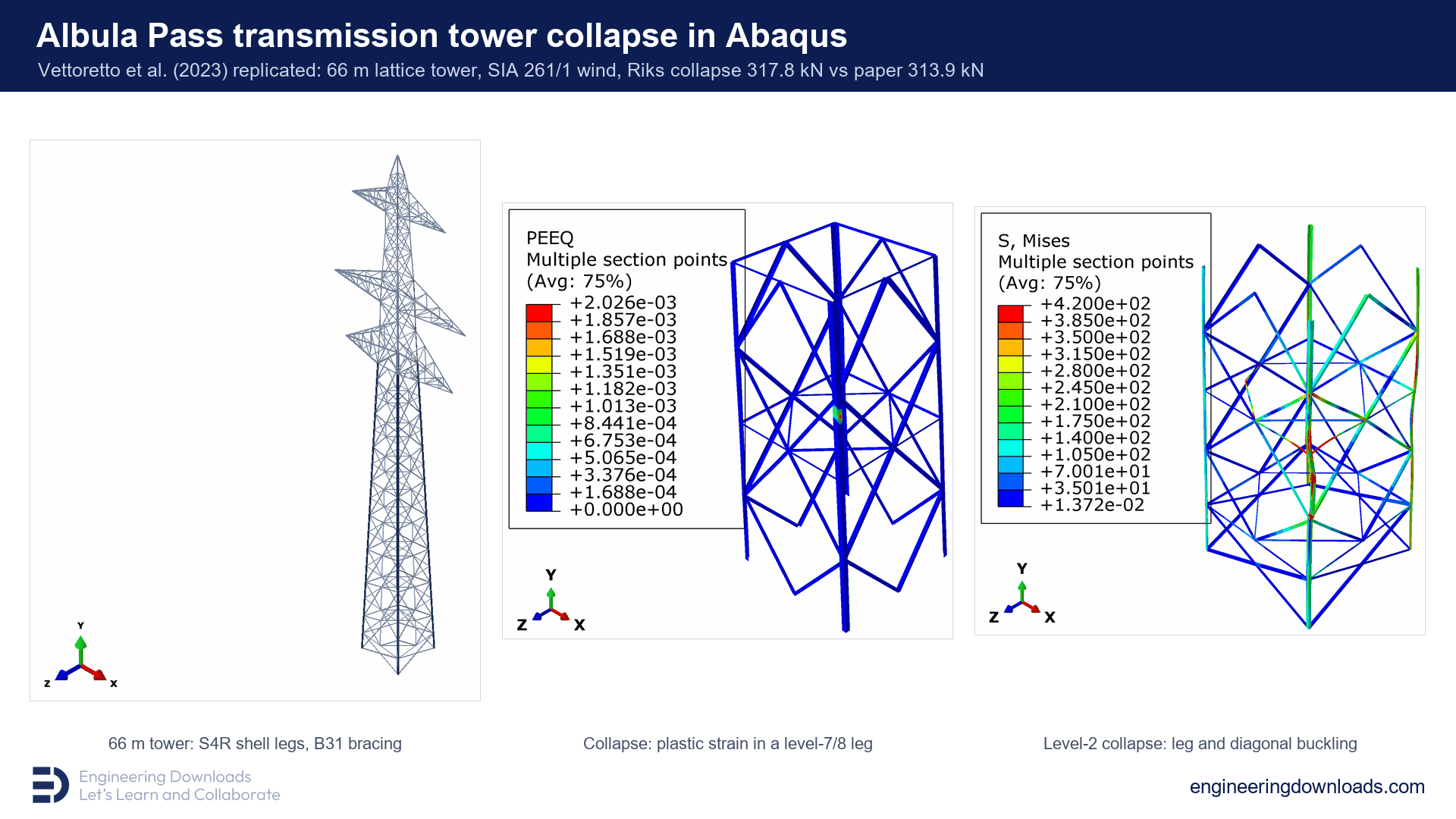 Transmission Tower Collapse under Extreme Wind in Abaqus: Buckling, Riks and Post-Buckling, after Vettoretto et al. (2023)€169,00
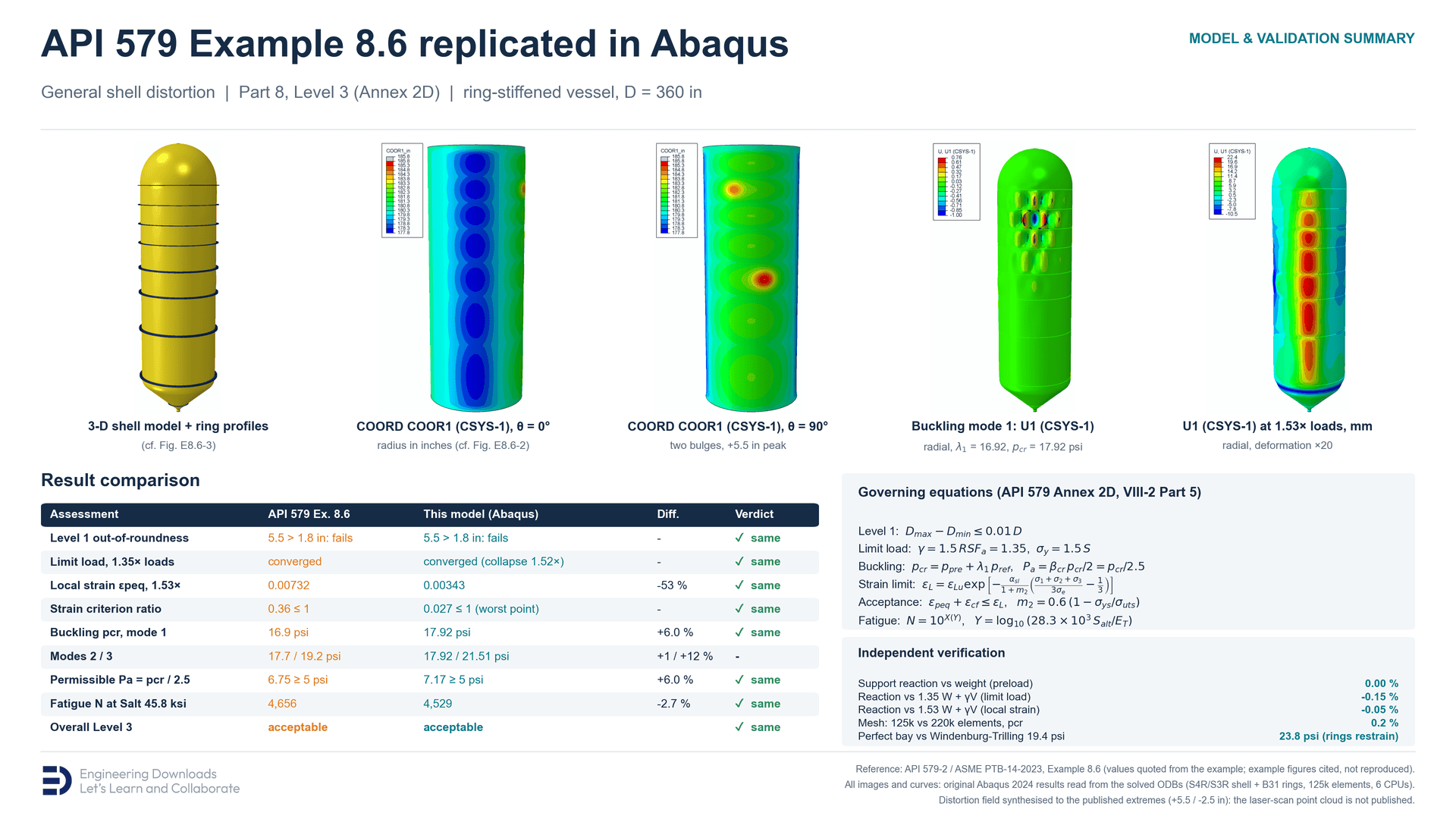 API 579 Example 8.6 in Abaqus: General Shell Distortion and Buckling, Level 3 FFS€129,00
 API 579 Example 8.7 in Abaqus: Ring-Stiffened Tower with General Shell Distortion, Level 3 FFS€129,00

Need a full custom project? See the options below.

€129,00

€179,00

€149,00

€119,00

€129,00

€149,00
See more
Want to receive push notifications for all major on-site activities?



