Fire Analysis of a CFRP-Strengthened Reinforced Concrete Beam Using Abaqus

€62,00 €107,00
Optional extras

Need a full custom project? See the options below.

€62,00 €107,00
Optional extras

Need a full custom project? See the options below.

10 people watching this product now!

Material Includes

  • 💻 CAE File (.cae): Editable Abaqus/CAE model.
  • 📄 Input File (.inp): Model definitions and analysis settings in text format.
  • 🎥 Video Tutorial: Step-by-step guidance through the modeling and simulation workflow.
  • 🧱 Material Models: Temperature-dependent properties for concrete, reinforcing steel, and CFRP.
  • 🔥 Thermal Analysis: Fire exposure and transient heat-transfer simulation.
  • 🔄 Structural Analysis: Sequential temperature transfer and thermo-mechanical response evaluation.
  • 📊 Simulation Results: Visualizations of temperature, stress, strain, concrete damage, and displacement, as available in the provided files.

Audience

  • 🎓 University Students: Undergraduate, MSc, and PhD students studying civil, structural, and materials engineering.
  • 🔬 Researchers: Professionals investigating structural fire behavior, reinforced concrete, CFRP strengthening, and thermo-mechanical analysis.
  • 🏗️ Structural Engineers: Engineers interested in evaluating the response of reinforced concrete structures under elevated temperatures.
  • 💻 Abaqus Users: Beginners and experienced users who want to improve their skills in thermal and sequential thermal–structural simulations.
  • 📚 Academic Instructors: Educators seeking a practical example for teaching finite element analysis and structural fire engineering.
  • 🧪 Simulation Specialists: Analysts developing temperature-dependent material models and investigating the thermal shielding effects of CFRP.

What You Will Learn?

  • 🏗️ Build a 3D model of a reinforced concrete member strengthened with a CFRP cover.
  • 🔥 Perform transient heat-transfer analysis under fire exposure, considering conduction, convection, radiation, and relevant thermal interfaces.
  • 🌡️ Define temperature-dependent material properties for concrete, reinforcing steel, and orthotropic CFRP.
  • 🧱 Model concrete damage using the Concrete Damaged Plasticity (CDP) model.
  • 🔄 Perform sequential thermal–structural analysis by transferring the temperature field from the thermal model to the structural model.
  • 🛡️ Investigate the thermal shielding effect of CFRP and its influence on heat penetration.
  • 📊 Evaluate structural response under elevated temperatures, including stress, strain, concrete damage, and displacement.
  • 📈 Visualize and interpret Abaqus results to better understand the behavior of CFRP-strengthened reinforced concrete under fire.

About Course

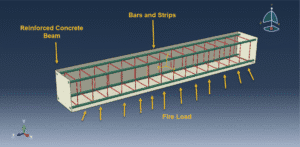
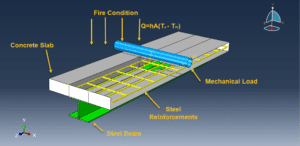
This is a ready-to-use Abaqus fire analysis of a CFRP-strengthened reinforced concrete member. The model is a 3D reinforced concrete (RC) member with a CFRP cover, exposed to fire. The analysis runs in two steps: a transient heat transfer analysis first, then a structural analysis that uses the temperatures from the first step.

You get an editable Abaqus/CAE model, the .inp file and a document, so you can open the model, study the setup and reuse it in your own work.

The problem this model solves

Fire changes how reinforced concrete behaves. As the temperature rises, concrete loses stiffness and strength and starts to crack and crush, and the reinforcing steel loses strength and elastic modulus. When the member is strengthened with CFRP, the strengthening layer also changes how fast the heat moves into the concrete.

Modelling this in Abaqus takes more than one analysis. You need the temperature field first, then a structural model that reads those temperatures and uses temperature-dependent materials. Many users get stuck on the thermal boundary conditions, the orthotropic CFRP data, and the handover of temperatures between the two analyses. This package gives you a working model so you can learn the workflow or build on it for your own research.

What the model covers

Stage 1: Heat transfer analysis

  • Conduction inside the concrete, steel and CFRP.
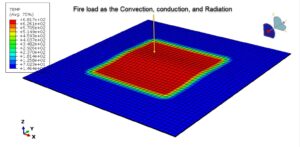
  • Convection and radiation on the exposed surfaces to represent the fire.
  • Thermal conductance at the contact interfaces where it applies.
  • Transient temperature history in the concrete, reinforcement and CFRP.

Stage 2: Structural analysis

  • Temperature transfer: the nodal temperature history from stage 1 is applied as a predefined temperature field.
  • Concrete: Concrete Damaged Plasticity (CDP) with temperature-dependent properties, so cracking and crushing are included.
  • Steel: temperature-dependent properties for the reinforcement.
  • CFRP: orthotropic elasticity, because CFRP behaves differently along the fibres, across them and through the thickness.

This is a sequential thermal-mechanical approach. It is a practical way to study fire effects on RC members in Abaqus without running a fully coupled analysis.

Results you can study

  • Temperature distribution in the concrete, steel and CFRP
  • How the CFRP cover changes heat penetration into the concrete
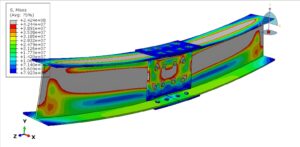
  • Stress and strain development under the elevated temperature field
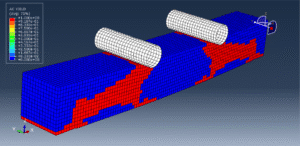
  • Concrete damage
  • Displacement of the member

The result images shown on this page come from the model files.

What is included

  • Abaqus/CAE file (.cae): the editable finite element model.
  • Abaqus input file (.inp): model definitions and analysis settings in text format.
  • Document: a supporting document that comes with the package.

Files are available as downloads in the course lessons after purchase.

Software

Abaqus/CAE with Abaqus/Standard (heat transfer step and structural step).

What you will learn

  • How a sequential thermal-structural analysis is set up in Abaqus
  • How to apply convection, radiation and thermal conductance in a fire model
  • How to define temperature-dependent properties for concrete and reinforcing steel
  • How to model CFRP with orthotropic elasticity
  • How to use the CDP model for concrete damage at high temperature
  • How to transfer the temperature field into the structural model
  • How to read temperature, stress, strain, damage and displacement results

Who this model is for

  • Civil and structural engineering students at undergraduate, MSc and PhD level
  • Researchers working on structural fire engineering, RC members and CFRP strengthening
  • Structural engineers who want to see how a strengthened RC member responds to fire
  • Abaqus users who want practical skills in thermal and sequential thermal-structural analysis
  • Instructors who need a worked example for teaching finite element analysis

Why buy this model

A fire study on a CFRP-strengthened member needs thermal boundary conditions, temperature-dependent materials, orthotropic CFRP and a clean handover between two analyses. Here that work is already done. Use it to learn the method, save time on a research project, or as a starting point for your own parametric study.

A note on accuracy: this is a numerical study. Results depend on the material data, fire exposure and modelling assumptions. For design decisions or published work, validate the model with test data and follow the fire design standards that apply to you.

Engineering Downloads offers a quality guarantee: if you are not satisfied with the delivered product, you can get a refund.

Frequently asked questions

Which Abaqus version do I need?

You need Abaqus/CAE with Abaqus/Standard. The .inp file is included, which makes it easier to run the model in another Abaqus version.

Is this a fully coupled thermal-stress analysis?

No. It is sequential. The heat transfer analysis runs first, and its temperatures are then used in the structural analysis. For a fully coupled approach, see the RC beams during fire model.

How is the CFRP modelled?

The CFRP cover uses orthotropic elasticity, so the properties differ along the fibres, across the fibres and through the thickness.

Can I change the fire exposure or the materials?

Yes. The boundary conditions and material definitions are in the model, so you can edit them in Abaqus/CAE or in the .inp file and run it again.

Can I use the results for fire design?

Use it to learn and to study behaviour. For design, validate the model against test data and follow the rules that apply to your project.

Related Abaqus models

Browse more ready-to-use models in the Engineering Downloads shop.

Need more than the files?

There are two ways we can help. Book a one hour online consultation if you want to talk a problem through with a CAE engineer, using the checkbox in the order box. Order a project if you need a full simulation built for you, delivered to an agreed scope, price and deadline under a written contract.

We work on FEA and CFD for engineers, researchers and companies. Order your project, or message us on WhatsApp for a quick reply.

Course Content

A practical 3D example for thermal and thermo-mechanical analysis of CFRP-strengthened reinforced concrete under fire
This study presents a three-dimensional numerical methodology for investigating the behavior of a reinforced concrete structural member strengthened with a CFRP cover under fire exposure. A sequential thermal–mechanical strategy is employed. The first stage calculates the transient temperature distribution using conduction within the materials together with convection and radiation at the exposed surfaces and thermal conductance at relevant interfaces. The resulting temperature history is then transferred to the structural model. Temperature-dependent constitutive behavior is considered for concrete and reinforcing steel, while the CFRP is represented using orthotropic material properties with temperature-dependent thermal and mechanical characteristics. The results demonstrate how a CFRP cover can modify heat penetration into the RC member and how the resulting temperature field affects the structural response through thermal expansion, material degradation, stress development, strain accumulation and displacement. The methodology provides a useful numerical framework for researchers, structural engineers and Abaqus users interested in structural fire engineering, reinforced concrete, CFRP strengthening and sequential thermo-mechanical finite element analysis.

  • Abaqus Files
  • Document
  • Video Tutorial

Reviews

No Review Yet
No Review Yet
€62,00 €107,00
Optional extras

Need a full custom project? See the options below.

10 people watching this product now!

Material Includes

  • 💻 CAE File (.cae): Editable Abaqus/CAE model.
  • 📄 Input File (.inp): Model definitions and analysis settings in text format.
  • 🎥 Video Tutorial: Step-by-step guidance through the modeling and simulation workflow.
  • 🧱 Material Models: Temperature-dependent properties for concrete, reinforcing steel, and CFRP.
  • 🔥 Thermal Analysis: Fire exposure and transient heat-transfer simulation.
  • 🔄 Structural Analysis: Sequential temperature transfer and thermo-mechanical response evaluation.
  • 📊 Simulation Results: Visualizations of temperature, stress, strain, concrete damage, and displacement, as available in the provided files.

Audience

  • 🎓 University Students: Undergraduate, MSc, and PhD students studying civil, structural, and materials engineering.
  • 🔬 Researchers: Professionals investigating structural fire behavior, reinforced concrete, CFRP strengthening, and thermo-mechanical analysis.
  • 🏗️ Structural Engineers: Engineers interested in evaluating the response of reinforced concrete structures under elevated temperatures.
  • 💻 Abaqus Users: Beginners and experienced users who want to improve their skills in thermal and sequential thermal–structural simulations.
  • 📚 Academic Instructors: Educators seeking a practical example for teaching finite element analysis and structural fire engineering.
  • 🧪 Simulation Specialists: Analysts developing temperature-dependent material models and investigating the thermal shielding effects of CFRP.

Related  Products

See more

Want to receive push notifications for all major on-site activities?

✕