

Need a full custom project? See the options below.
Need a full custom project? See the options below.
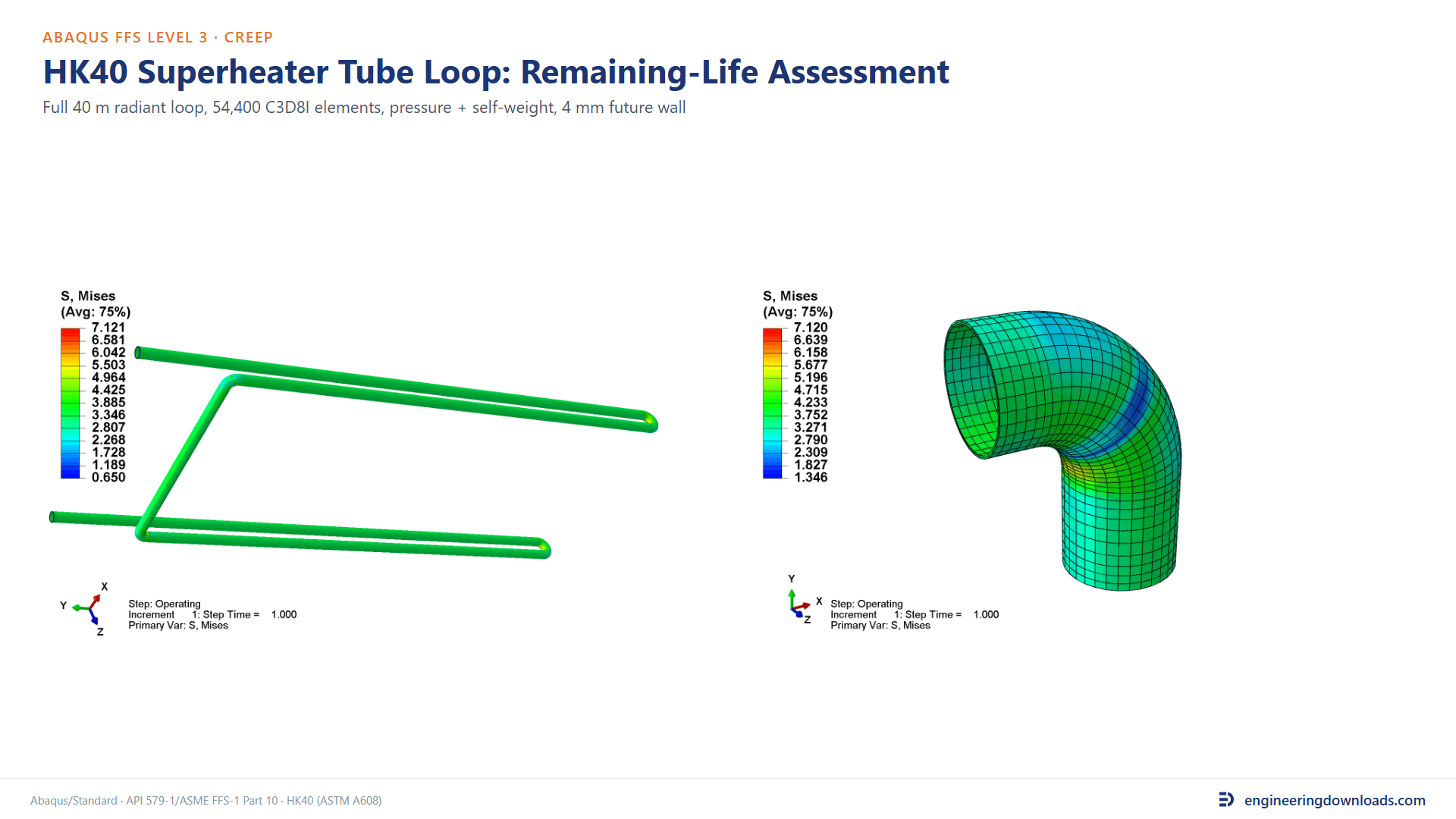
Fired-heater superheater tubes spend their whole life in the creep range, and every unplanned temperature excursion eats remaining life faster than the design calculation assumed. This Abaqus package rebuilds a published API 579 FFS Level 3 creep assessment of HK40 (25Cr-20Ni) superheater tubes end to end: the loop geometry, a light hex mesh, the elastic stress analysis that feeds the API 579-1 Part 10 Omega damage sum, and, going beyond the paper, a real Abaqus creep analysis with creep strain and a creep-damage field you can contour.
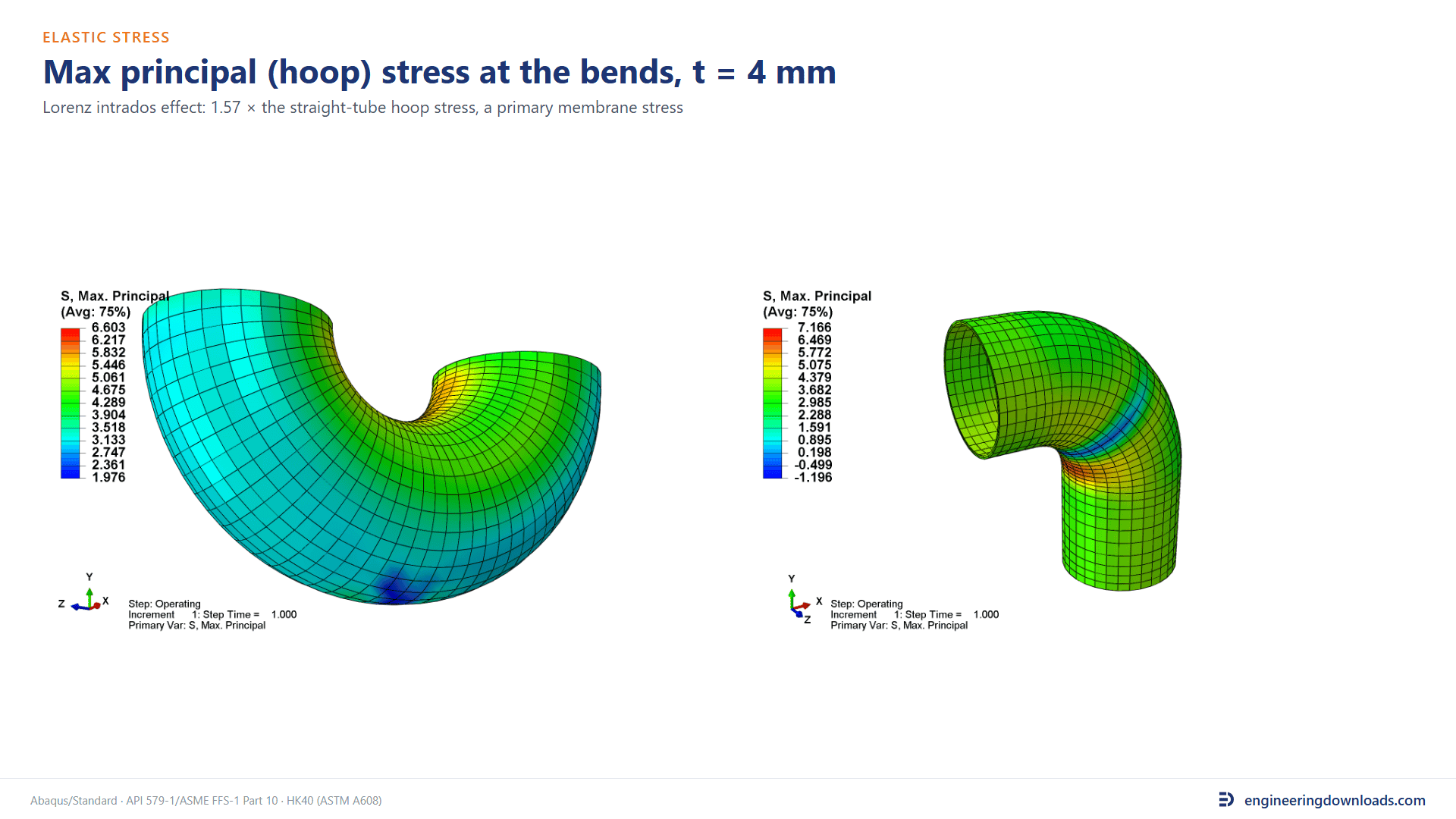
Honest status: a validated replication of the paper’s finite-element and damage results, with every gap stated. Level 2 damage matches exactly (0.355 vs 0.355). The Level 3 damage is 5 to 6 % below the paper because this model’s 4 mm ring hoop stress is 2.4 % lower. The creep law is calibrated from data printed in the paper, not from a qualified HK40 creep database.
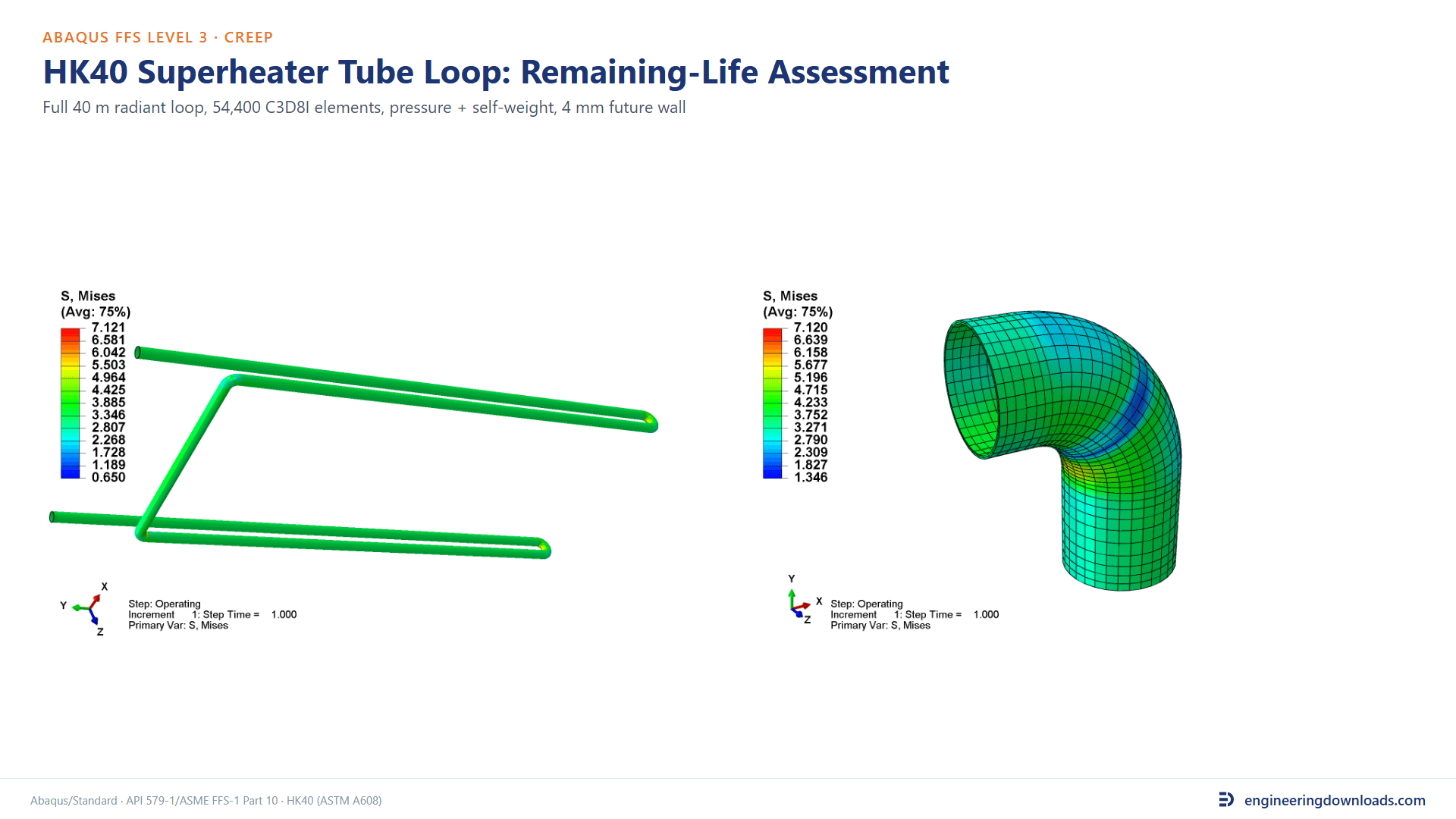
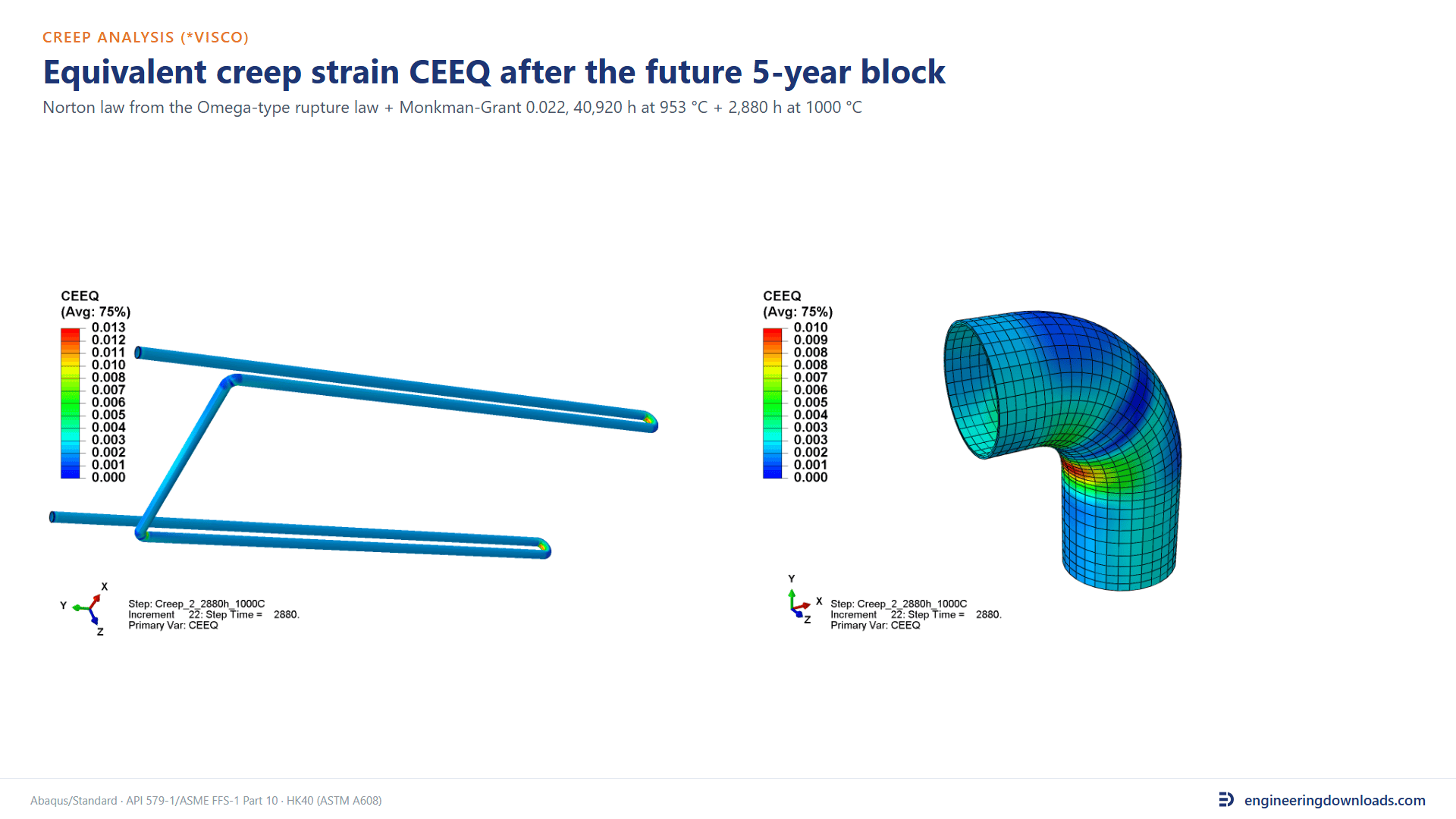
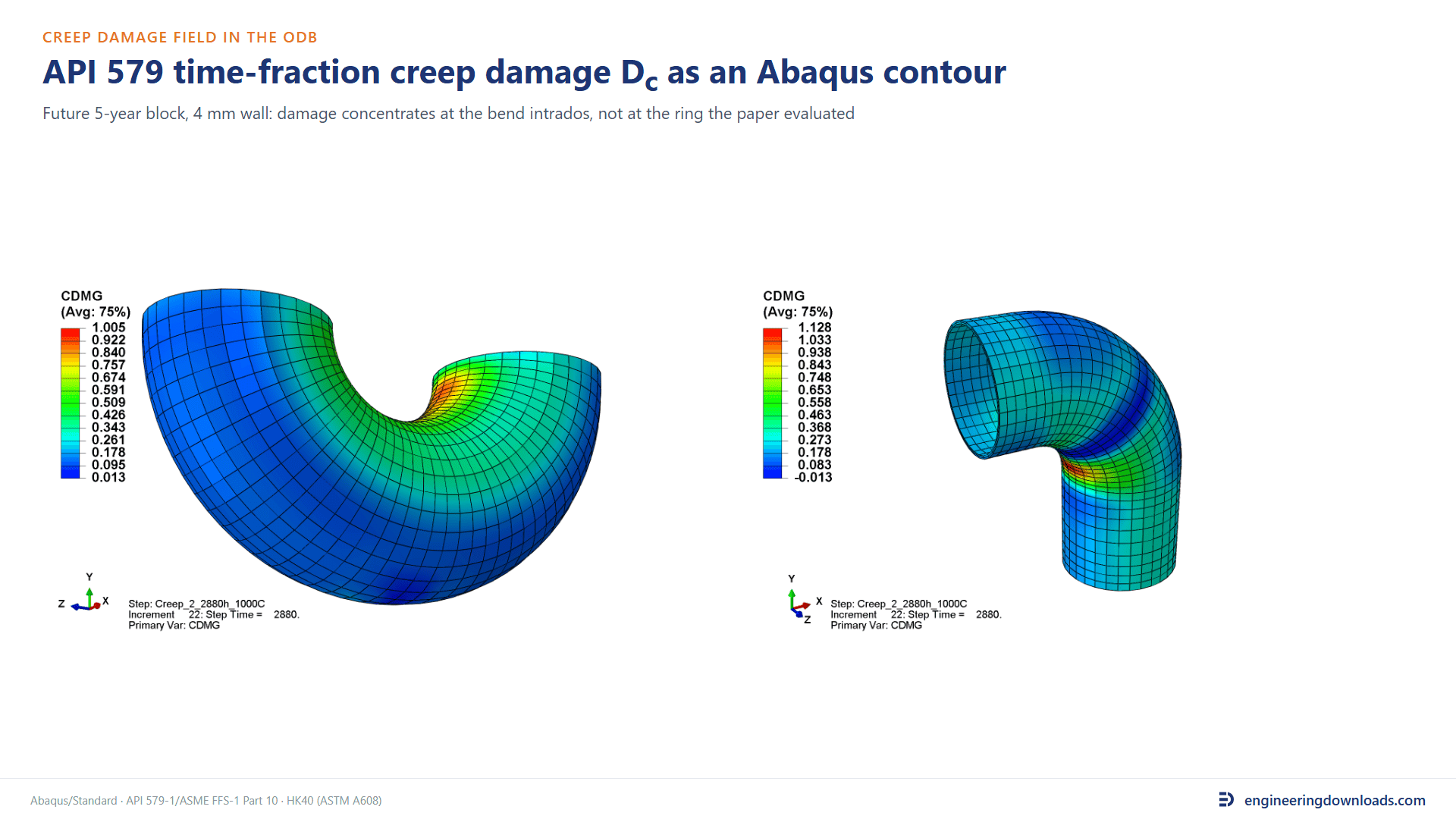
The Abaqus creep run with the API 579 damage field in every frame: the straight tubes stay well below 1, the 4 mm bend intrados does not.
Watch the full video on YouTube · Watch the short
S. Kooshamanesh, A. Mostafavi, R. Miresmaeili, S. Karimi, Fitness-for-service (FFS) and remaining life assessment of HK40/25Cr-20Ni steam superheater tubes subjected to high temperature excursions, Journal of Materials Research and Technology, 2026 (doi:10.1016/j.jmrt.2026.11.055). The tubes had run 113,064 h at a 953 °C design metal temperature with about 2 days per month above it. The paper runs API 579-1 Levels 1 to 3 and an API 530 Larson-Miller check for the next 5 years. The paper is cited only; every image on this page comes from this package’s own Abaqus results.
| Item | Value |
|---|---|
| Geometry | T-1 9682, T-2 8050, T-3 3020, T-4 9698 mm; 180° return bends and 90° elbows, OD 168.3 mm (40.3 m of tube) |
| Walls | 6 mm (past), 5 mm (present), 4 mm (future) |
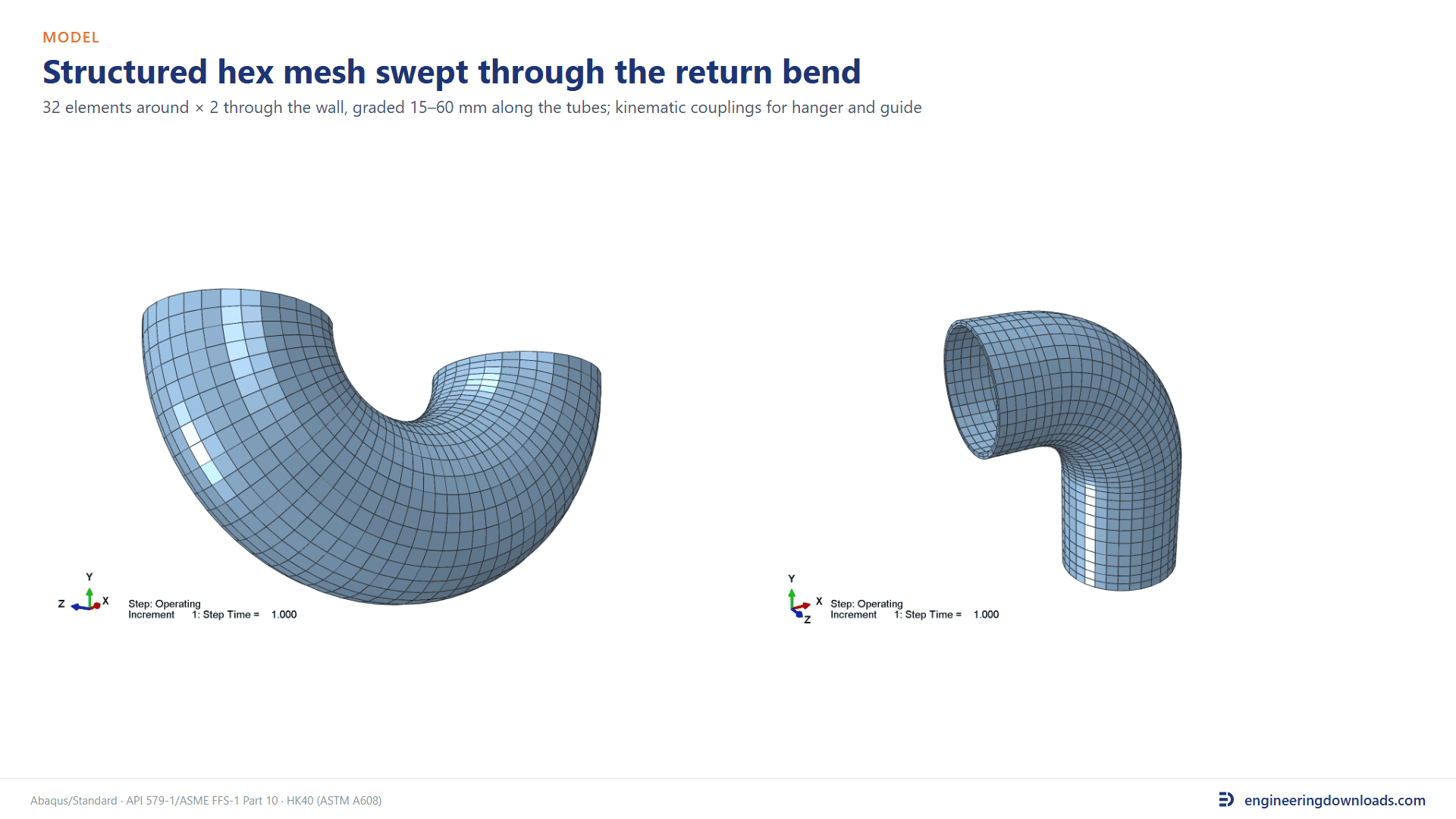
| Mesh | 54,400 C3D8I hex, 32 around x 2 through the wall, swept through the bends |
| Material | HK40 at 953 °C: E 130 GPa, yield 167 MPa, density 7380 kg/m³ |
| Loads | internal pressure 0.195 MPa + self-weight |
| Supports | roof ends fixed, elbow hangers (coupled RP), sliding oval guide under each return bend |
| Analyses | 3 elastic + 3 creep (*Visco, Norton law, 953/980/1000 °C blocks) |
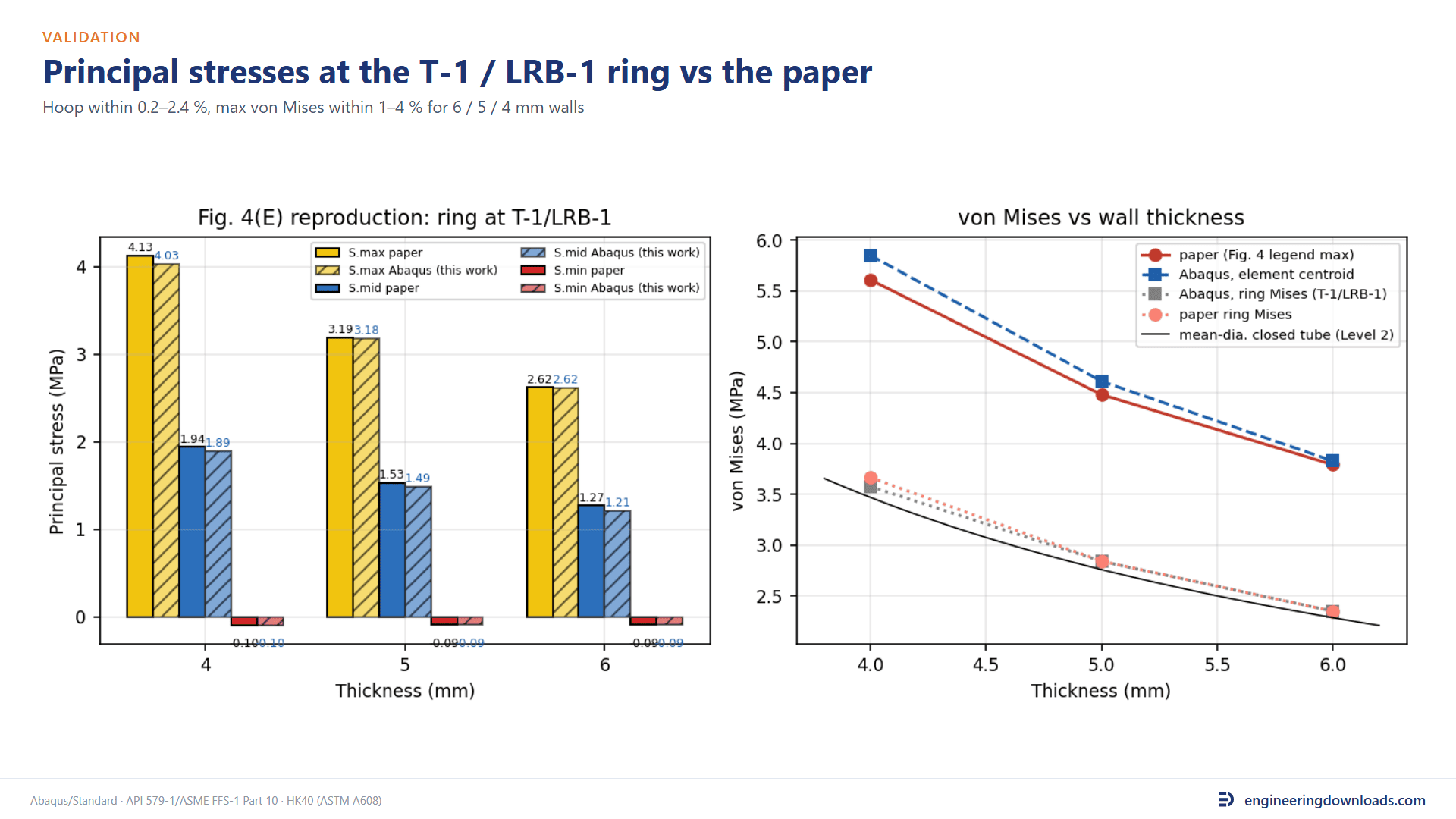
| Wall (mm) | Hoop S.max paper / Abaqus | Axial S.mid paper / Abaqus | Radial S.min paper / Abaqus | Max von Mises paper / Abaqus |
|---|---|---|---|---|
| 6 | 2.62 / 2.62 | 1.27 / 1.21 | -0.09 / -0.09 | 3.79 / 3.83 |
| 5 | 3.19 / 3.18 | 1.53 / 1.49 | -0.09 / -0.09 | 4.48 / 4.61 |
| 4 | 4.13 / 4.03 | 1.94 / 1.89 | -0.10 / -0.10 | 5.61 / 5.85 |
Stresses in MPa, averaged over the T-1 / return-bend ring exactly as in the paper. Mesh study at 6 mm (13,600 / 54,400 / 122,400 elements): the ring stresses do not change in the third digit, and the local bend peak moves by about 2 %.

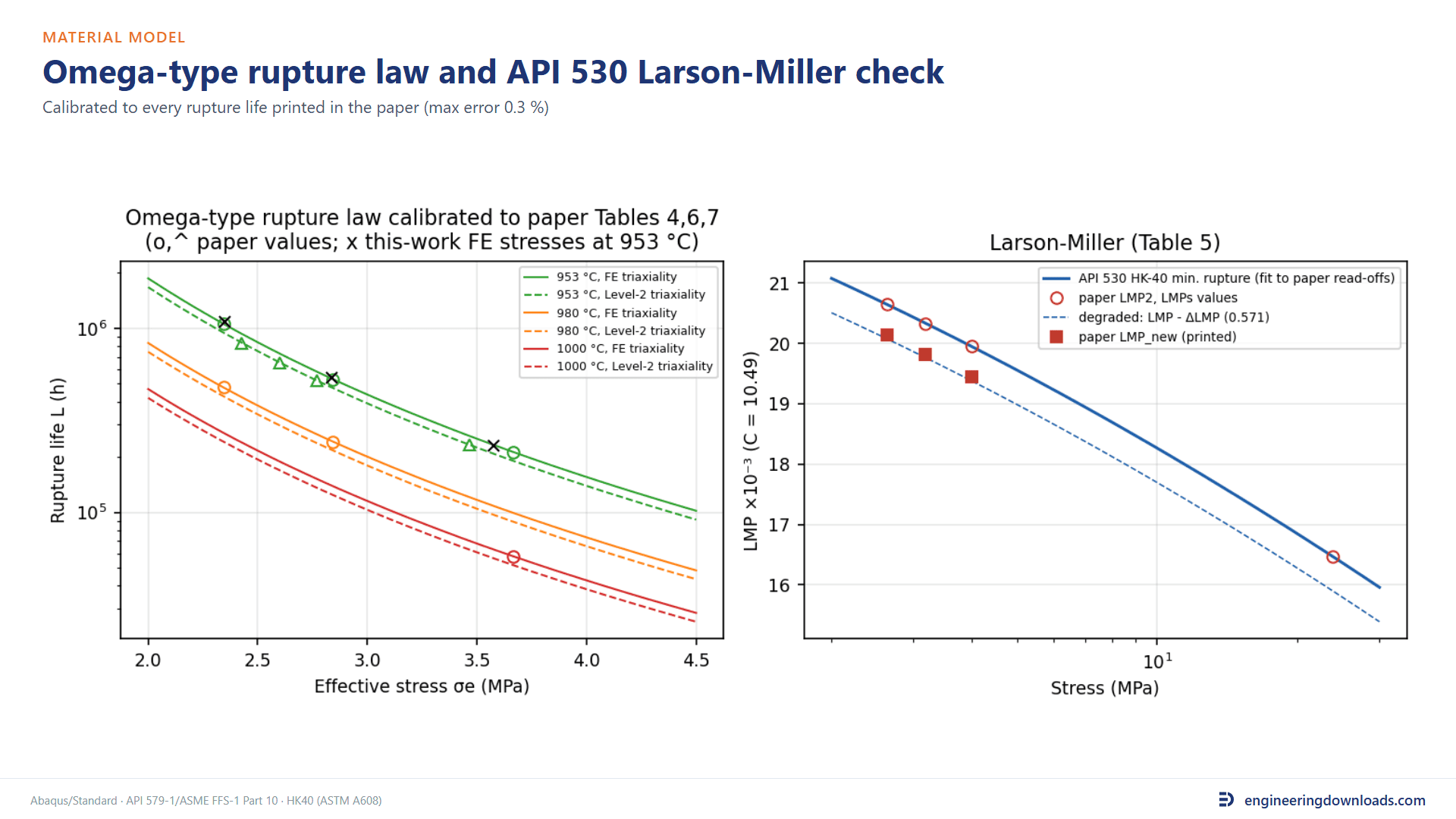
The paper’s HK40 MPC Omega coefficients are not printed, so the package calibrates an Omega-form rupture law, including the multiaxiality term, to all ten rupture lives printed in the paper (maximum error 0.3 %). The independent check is this model’s own FE stresses fed through that law.
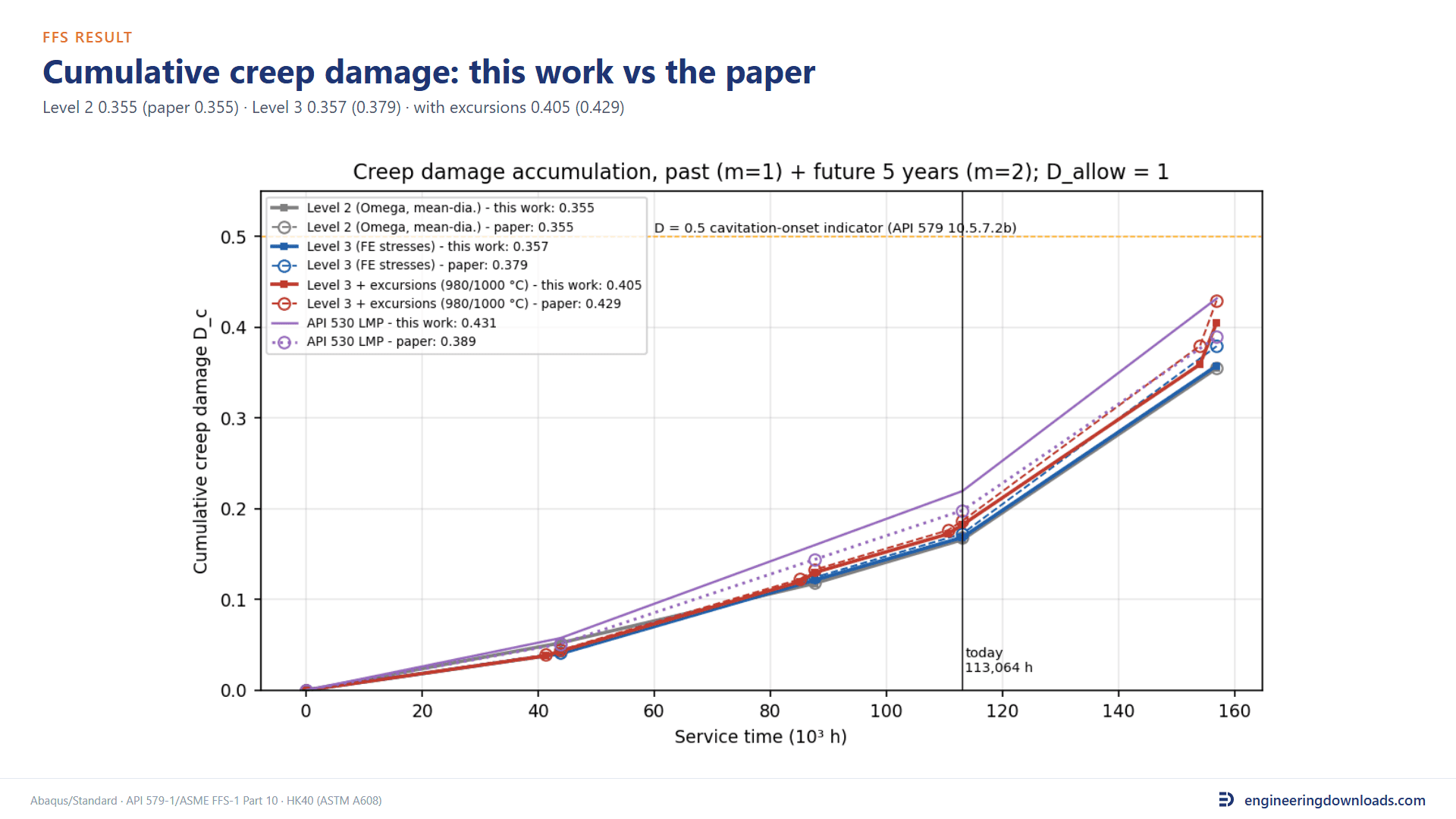
| Assessment | Paper | This package |
|---|---|---|
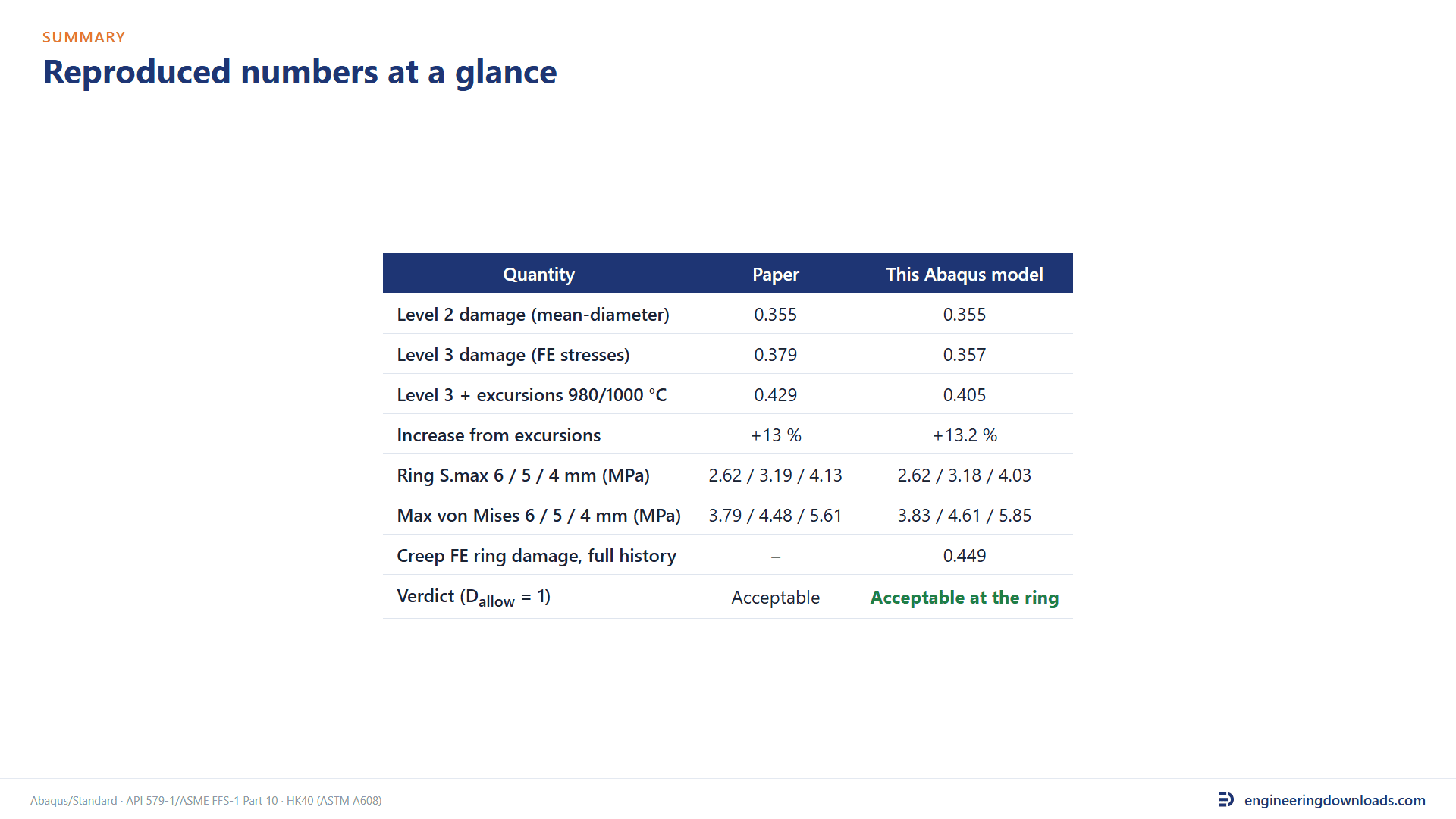
| Level 2 (mean-diameter stresses) | 0.355 | 0.355 |
| Level 3 (FE stresses, 953 °C) | 0.379 | 0.357 |
| Level 3 + excursions (980 / 1000 °C) | 0.429 | 0.405 |
| Damage increase from excursions | +13 % | +13.2 % |
| API 530 Larson-Miller | 0.389 | 0.431 (0.385 using the paper’s printed LMP_new) |
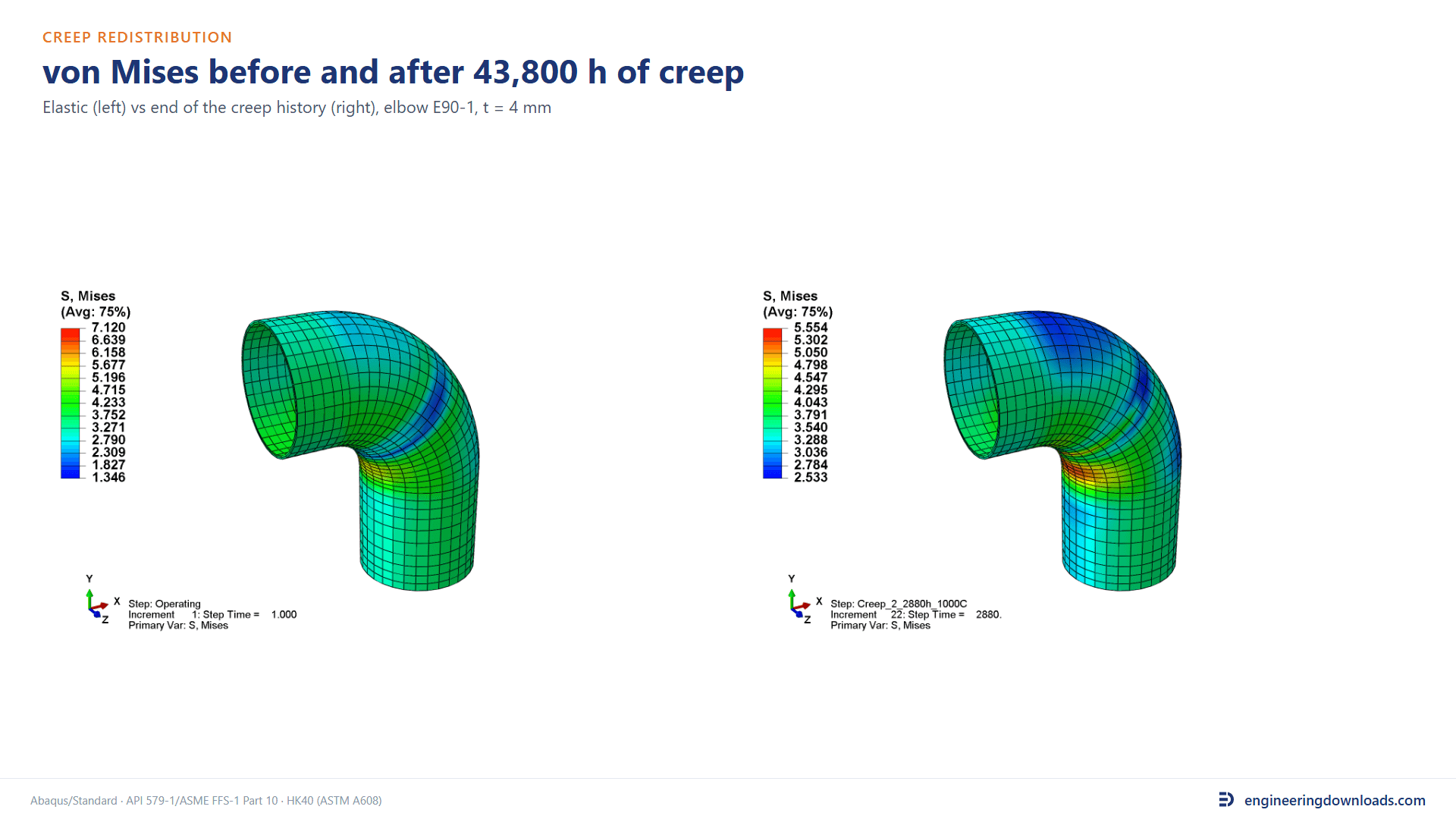
The paper stops at elastic stresses. This package also runs the full service history as an Abaqus creep analysis: a static operating step, then *Visco steps with the paper’s Table 7 hours at 953, 980 and 1000 °C. The Norton constants come from the paper’s own data: the stress exponent (n = 3.45 to 3.58) from the calibrated rupture law, and the rate from the 1000 °C / 23.8 MPa creep-test curve through a Monkman-Grant constant of 0.022. The ODB holds CEEQ and CE; the PDF gives the script that writes the API 579 creep damage CDMG into every frame. Over the full history, the creep FE damage at the paper’s ring is 0.449.
ODB result files are not included; run the jobs to regenerate them.
One radiant-section loop of a fired-heater steam superheater (HK40 cast tubes, OD 168.3 mm) under internal pressure and self-weight, for 6, 5 and 4 mm walls. Elastic models feed an API 579-1 Part 10 creep assessment; creep models (*Visco) run the full 156,864 h history with temperature excursions to 980 and 1000 C.
Kooshamanesh, Mostafavi, Miresmaeili and Karimi, Journal of Materials Research and Technology (2026), doi:10.1016/j.jmrt.2026.11.055. The paper is cited, not bundled, and none of its figures are reused.
Ring hoop stress within 0.2 to 2.4 %, maximum von Mises within 1 to 4 %, Level 2 damage 0.355 vs 0.355, Level 3 0.357 vs 0.379, Level 3 with excursions 0.405 vs 0.429, and the excursion effect +13.2 % vs +13 %.
Yes. The creep models use *Visco steps with a Norton law, so the ODB contains CEEQ and CE. The PDF lists a short Abaqus Python script that writes the API 579 time-fraction creep damage CDMG into every creep frame so you can contour it.
The stress exponent and temperature dependence come from an Omega-form rupture law calibrated to all rupture lives printed in the paper (within 0.3 %). The rate level comes from the paper’s 1000 C / 23.8 MPa creep-test curve through a Monkman-Grant constant of 0.022. The PDF states this as a demonstration-grade law, not a qualified creep-strain prediction.
No. There are no user subroutines; everything runs with standard Abaqus/Standard.
The CAE database was saved with Abaqus 2023 and opens in 2023 or newer. The INP decks run in any recent Abaqus/Standard.
54,400 C3D8I elements. An elastic run takes about 10 s and peaks at about 1 GB; a creep run takes a few minutes on 8 cores. A 16 GB workstation is enough.
No. The download has the CAE database, the six INP decks and the PDF tutorial. Run the jobs to regenerate the ODBs.
It reproduces the paper’s conclusion for the straight tubes at the paper’s extraction ring. It also shows that the bend intrados would exceed D = 1 if the fittings had thinned to 4 mm, so a real assessment needs measured fitting thickness. Use it as a worked method, not as a certificate for your plant.
Need more than the files?
There are two ways we can help. Book a one hour online consultation if you want to talk a problem through with a CAE engineer, using the checkbox in the order box. Order a project if you need a full simulation built for you, delivered to an agreed scope, price and deadline under a written contract.
We work on FEA and CFD for engineers, researchers and companies. Order your project, or message us on WhatsApp for a quick reply.
Other packages engineers working on this topic also download.
 API 579 Example 10.1 in Abaqus: Vessel Creep After a Temperature Excursion, Omega Damage Model and One-Click Python Check€129,00
 API 579 Example 10.3 in Abaqus: P22 Heater-Tube Creep Life, Omega Damage Model and One-Click Python Check€139,00
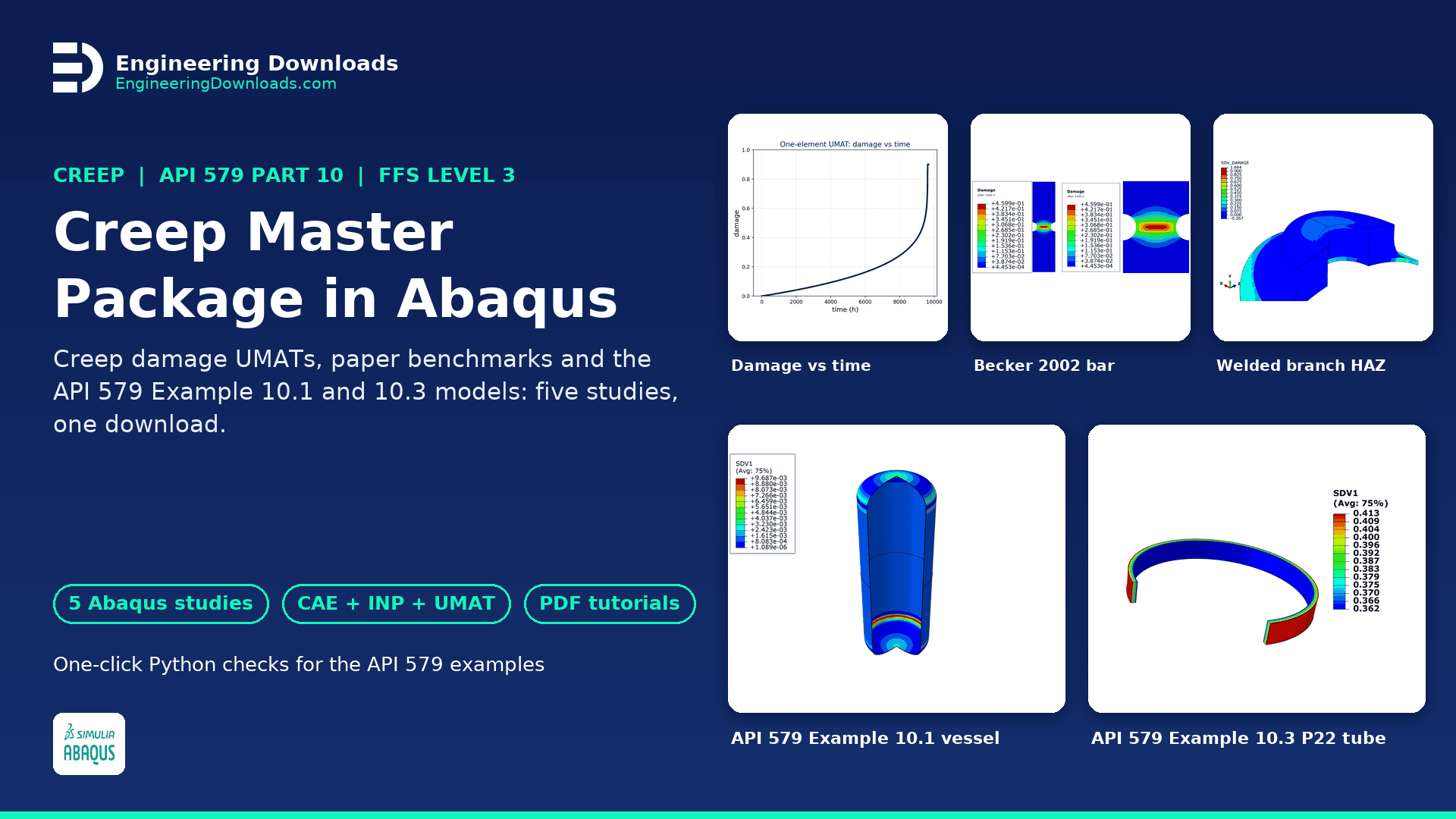 Creep Master Package in Abaqus: API 579 Part 10 Examples 10.1 and 10.3, Creep Damage UMAT and Paper Benchmarks€299,00
 Pipe and Pipeline Simulation Package in Abaqus (21 Models)
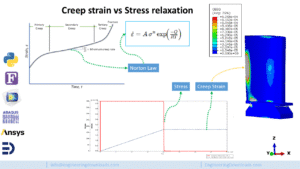 Blade creep study with side-by-side built-in vs custom creep models
 Creep in Abaqus: Norton and Combined Time Hardening Subroutine with Cyclic Hardening and Heated Plate Models (Inal 2023)€149,00
 Theta Projection Creep in Abaqus: MAR-M247 and GH-4169 Subroutines, Rotating Sectors and Two Gas Turbine Blade Models (Varadhayamunan 2023)€149,00
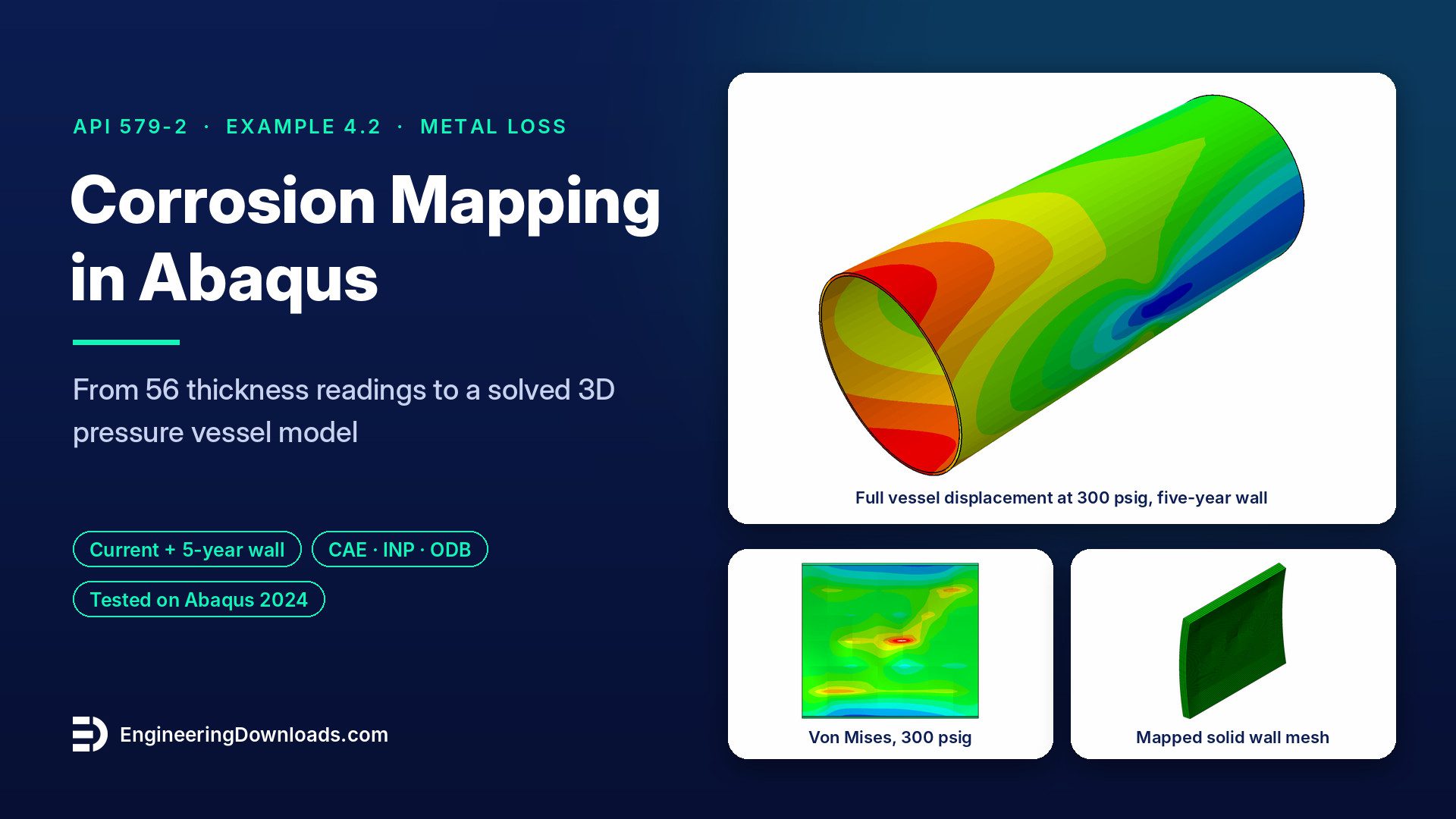 API 579 Example 4.2 in Abaqus: Corrosion Mapping of a Metal Loss Pressure Vessel

Need a full custom project? See the options below.

€129,00

€179,00

€149,00

€119,00

€129,00

€149,00
See more
Want to receive push notifications for all major on-site activities?



