


Need a full custom project? See the options below.
Need a full custom project? See the options below.
How much creep life has a heater tube used after 20 years at 1,130 F, a corroding bore and two weeks at 1,200 F? API 579-1/ASME FFS-1 Part 10 answers it with the Omega method, and API 579-2 Example 10.3 works it through for an SA-335 Grade P22 tube. This package rebuilds that example in two ways: a one-click Python check that recomputes the six rupture lives and the total creep damage, and an Abaqus model with a CREEP user subroutine, verified on coupons and then run as an axisymmetric tube that carries damage, strain and stress through each wall-loss step. You get INP and CAE files for 19 models, the subroutine source, the script, key images and an 8-page PDF tutorial.
Source: API 579-2/ASME PTB-14 Fitness-For-Service Example Problem Manual, Part 10, Example 10.3. The example evaluates the creep damage of a heater tube with the Omega method (Annex 10B): for each period it takes the corroded wall thickness, the temperature and the hoop stress, reads the virgin rupture life from the Omega law and adds hours divided by life to the damage. It is a Level 2 assessment. The pressure-loaded tube model in this package is an independently developed Level 3 style extension of the same case; it is not the manual’s published Example 10.4.
| Item | API 579-2 Example 10.3 | This package |
|---|---|---|
| Material and loading | SA-335 Grade P22, OD 8.625 in, 210 psig, uniform temperature | Same, with closed-end thrust on the axisymmetric section |
| Periods | Six periods, 175,200 h in total, wall 0.297 in to 0.222 in | Six periods; each model starts from the stress, damage and strain left by the previous one |
| Creep law | Annex 10B Omega method | CREEP subroutine omega_creep.for, verified on six coupons |
| Models | – | 19 Abaqus models: six coupons, three tube histories (8 x 8 mesh, 16 x 16 mesh, half time step) |
| One-click check | – | run_omega_check.py recomputes the lives and the total damage in about a second |
| Software | – | Abaqus/Standard with a linked Fortran compiler, and Python 3 |
| Quantity | Example 10.3 | This package | Difference |
|---|---|---|---|
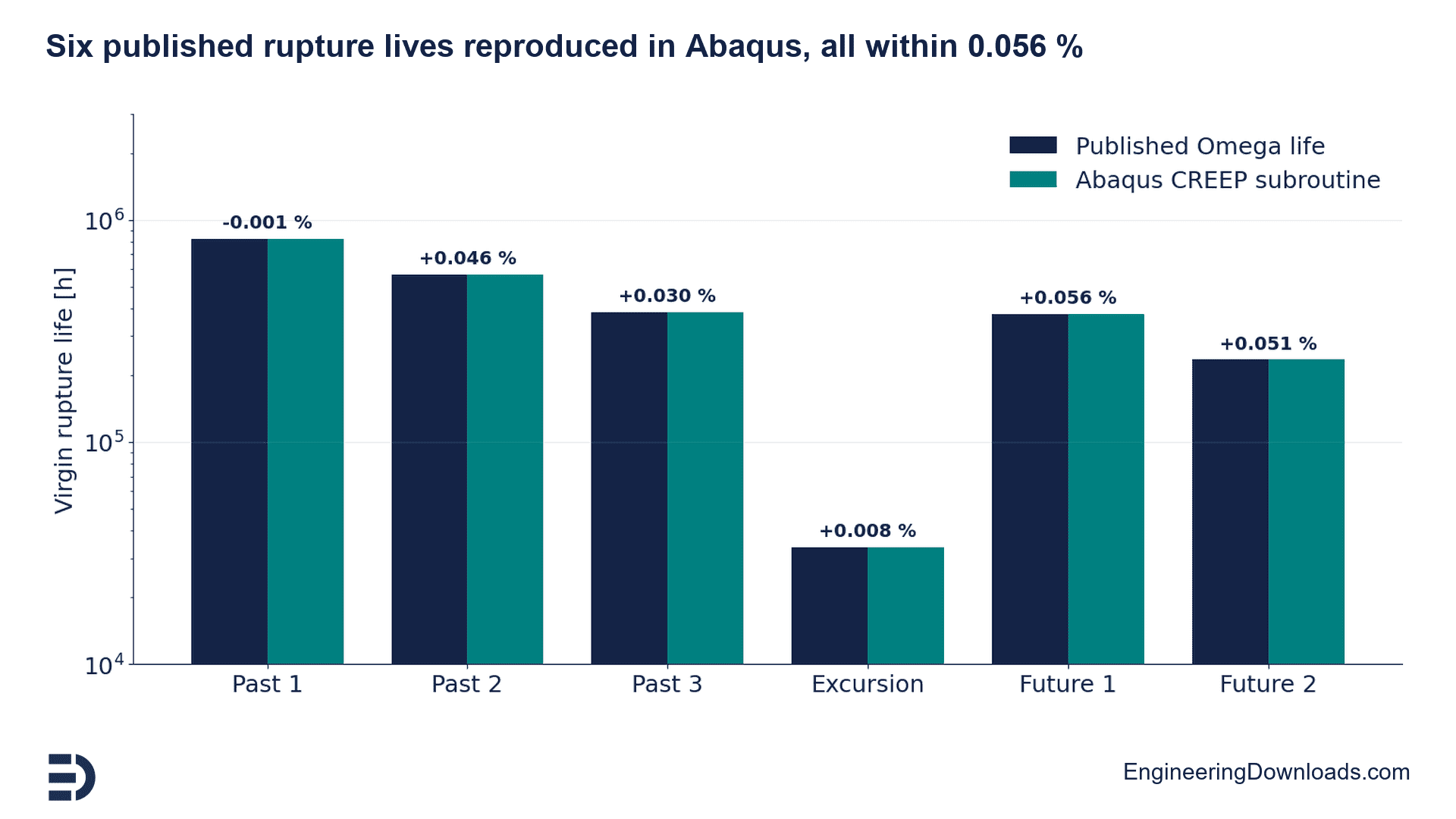
| Past 1 rupture life | 820,432 h | 820,424 h | −0.001% |
| Past 2 rupture life | 568,185 h | 568,448 h | +0.046% |
| Past 3 rupture life | 384,091 h | 384,207 h | +0.030% |
| Excursion rupture life (1,200 F) | 33,687 h | 33,690 h | +0.008% |
| Future 1 rupture life | 375,881 h | 376,090 h | +0.056% |
| Future 2 rupture life | 234,885 h | 235,005 h | +0.051% |
| Total creep damage after 175,200 h | 0.440 | 0.44002 | +0.005% |
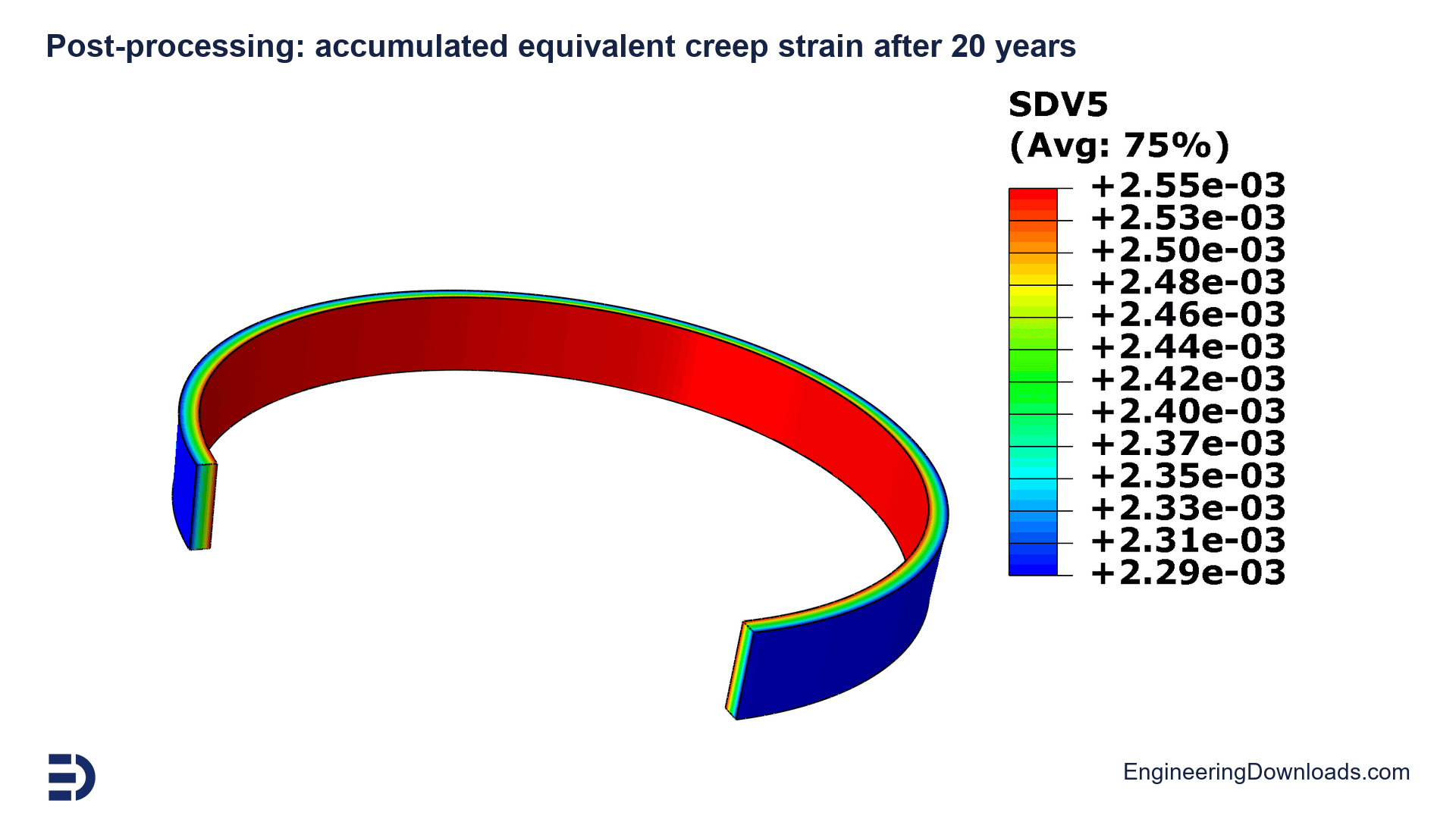
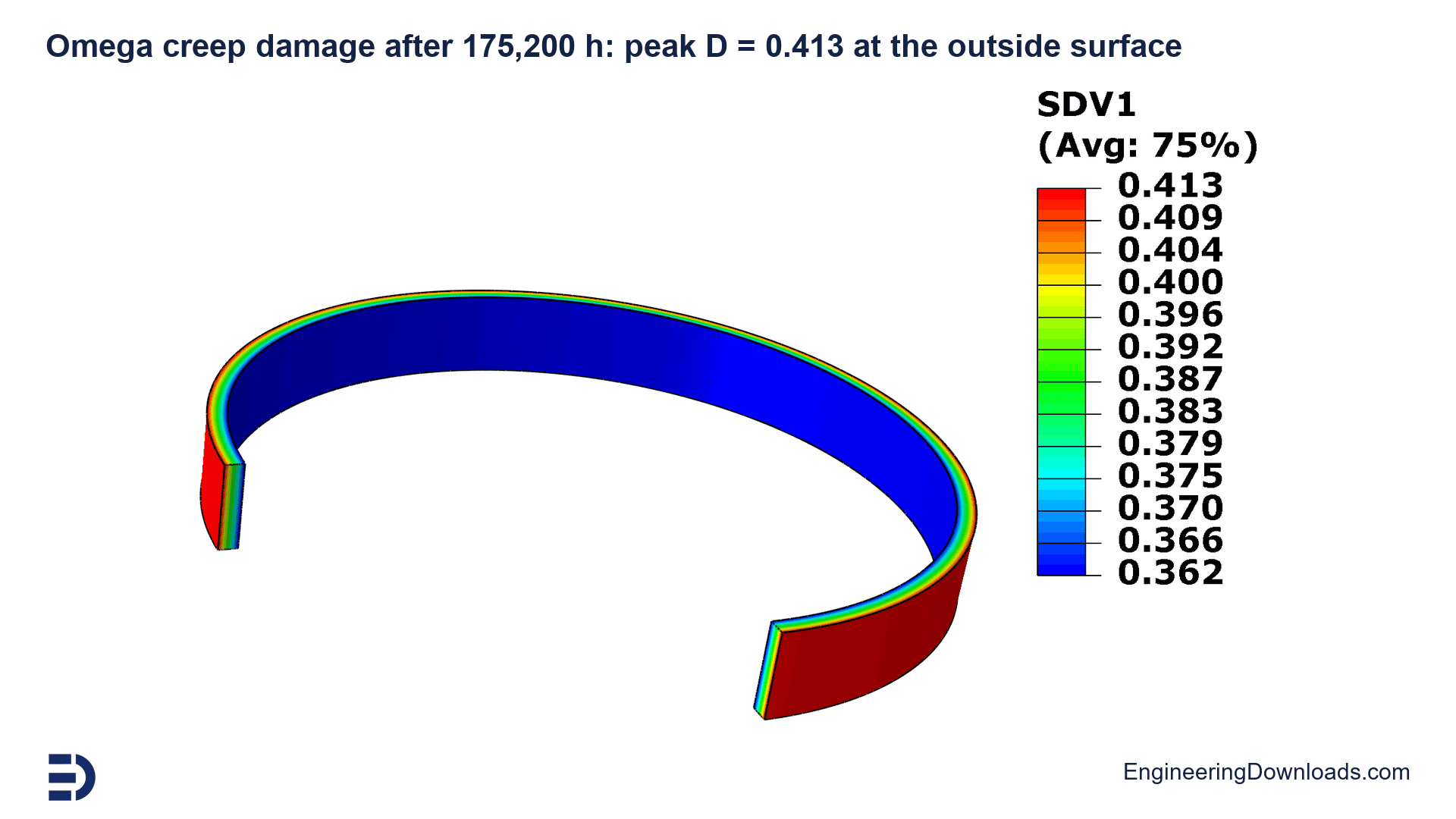
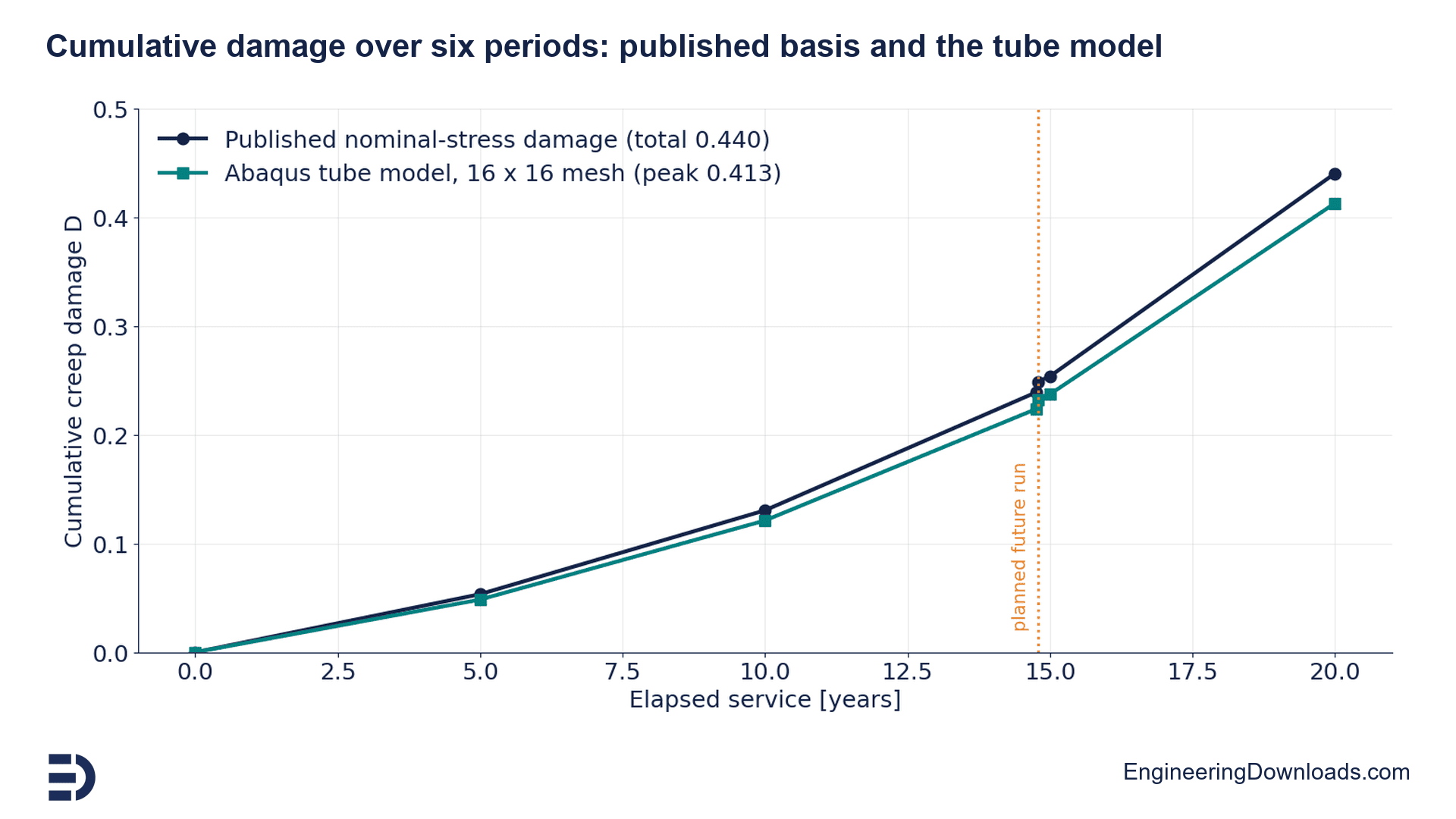
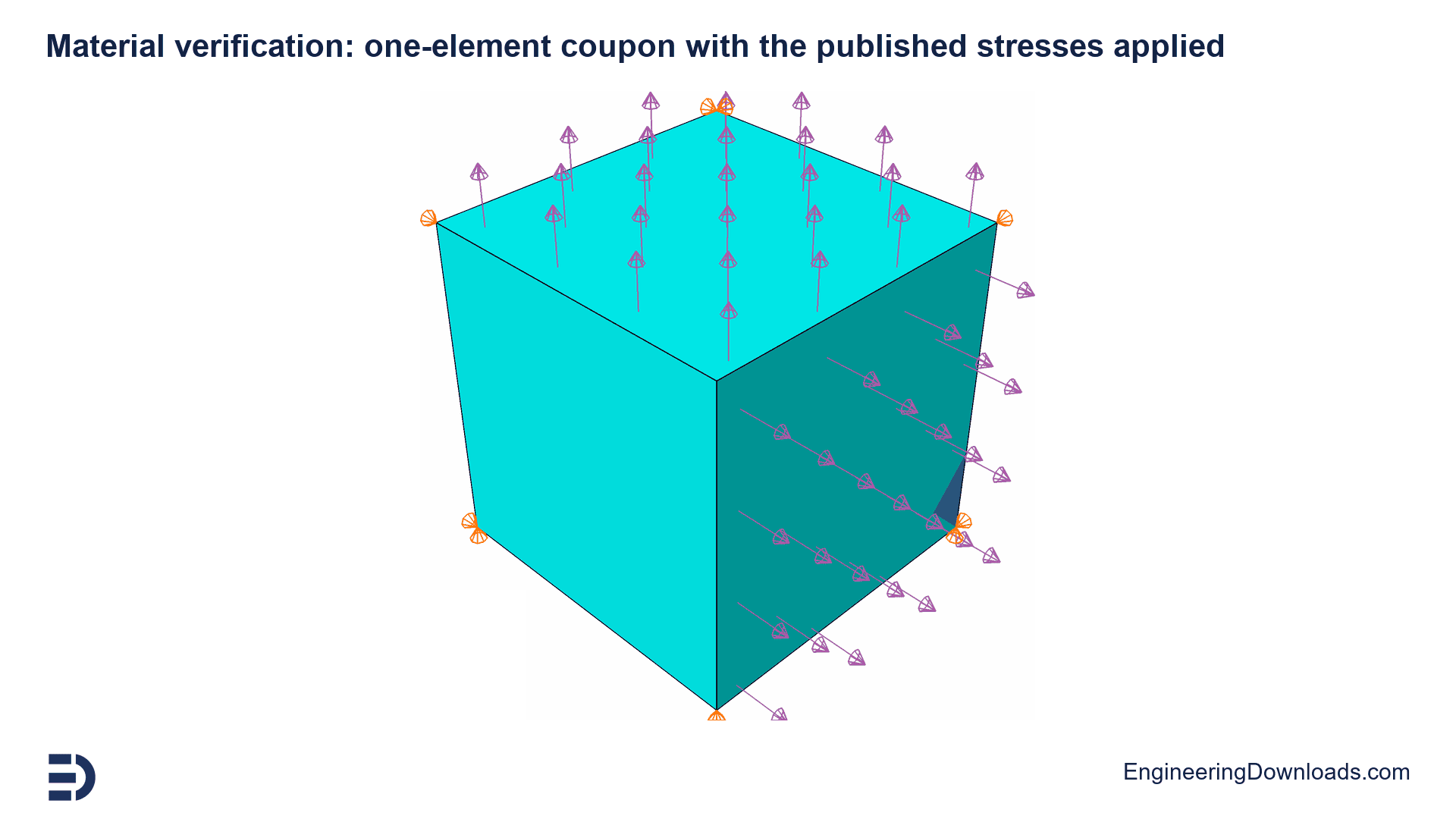
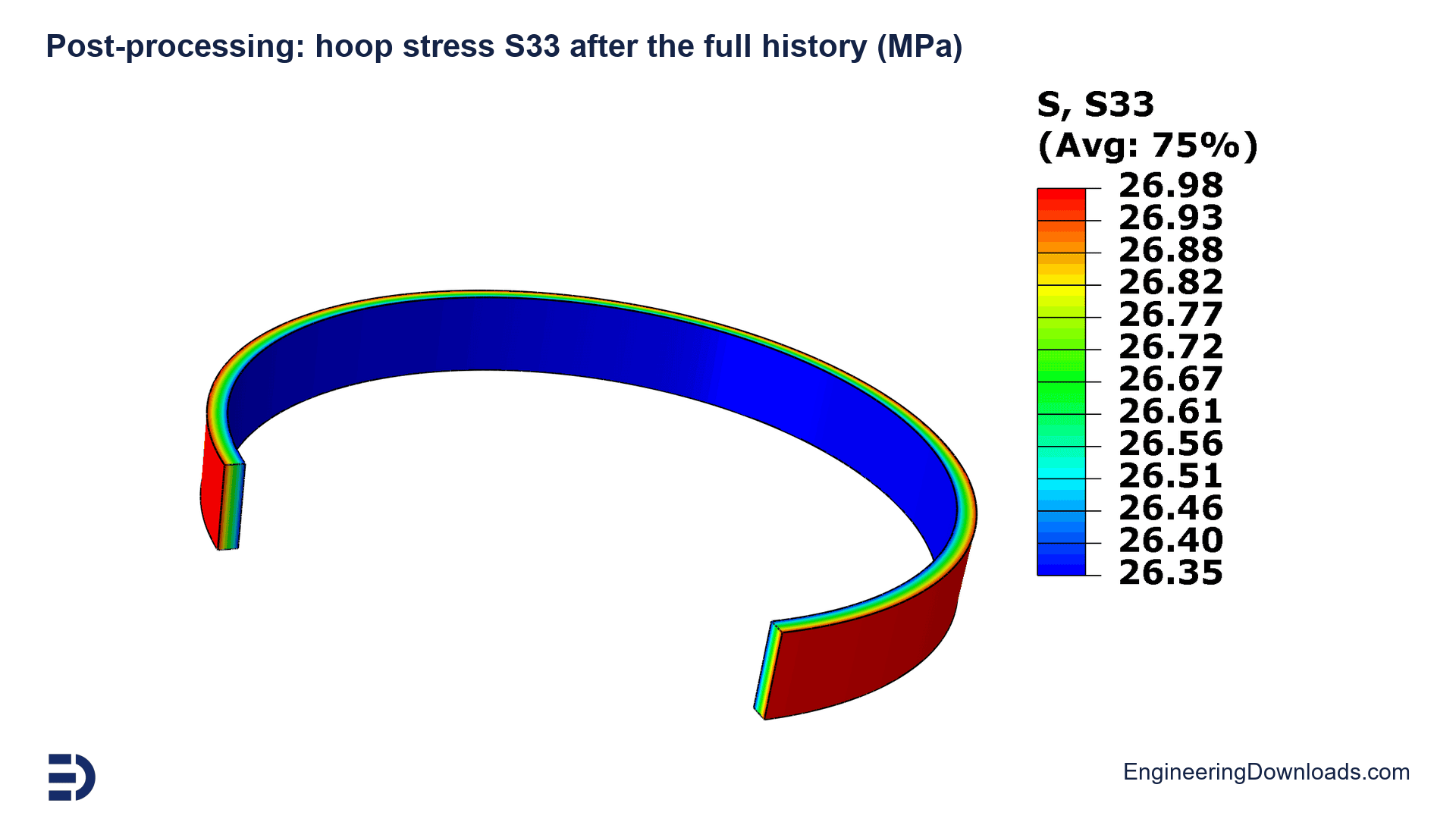
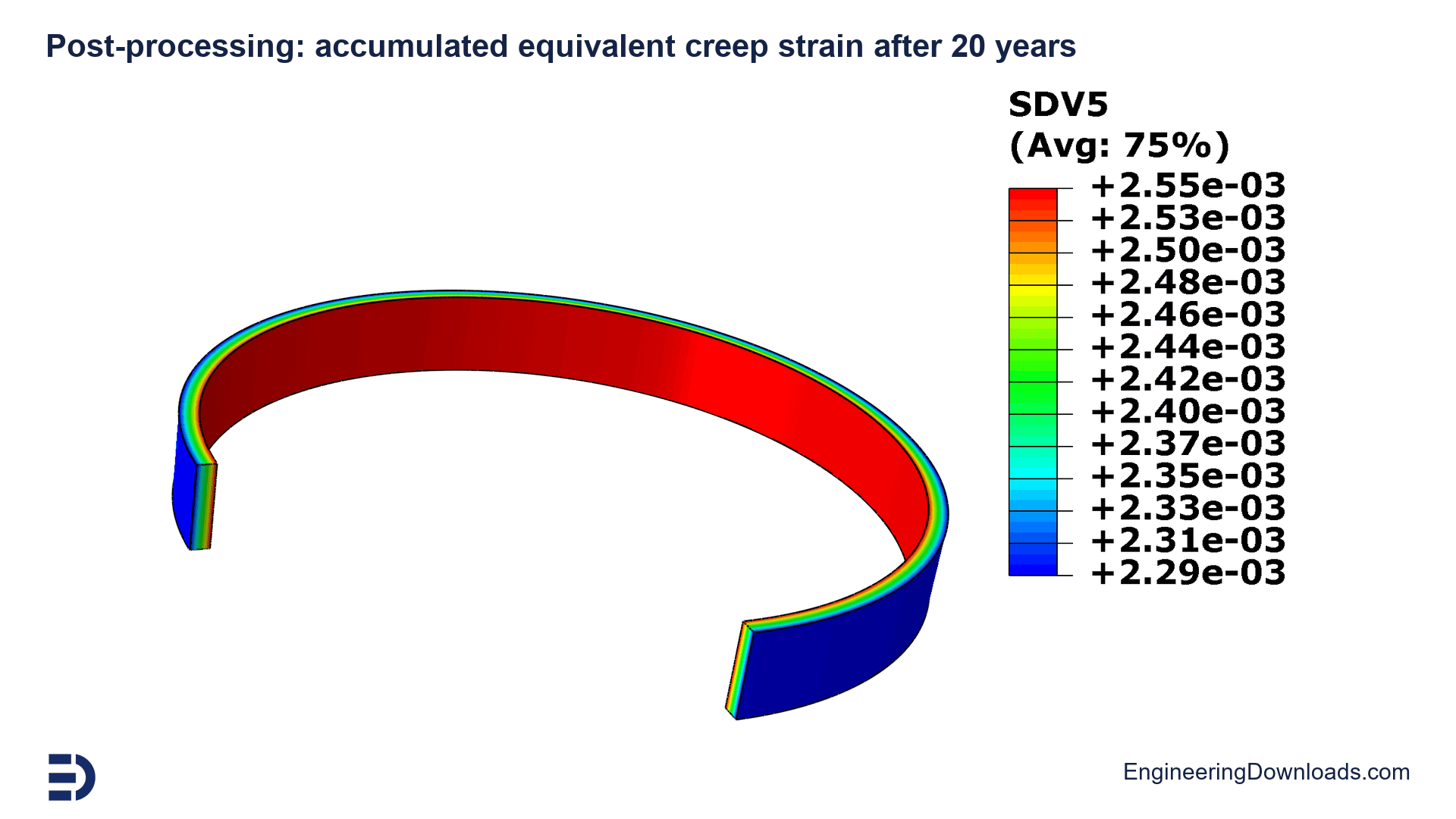
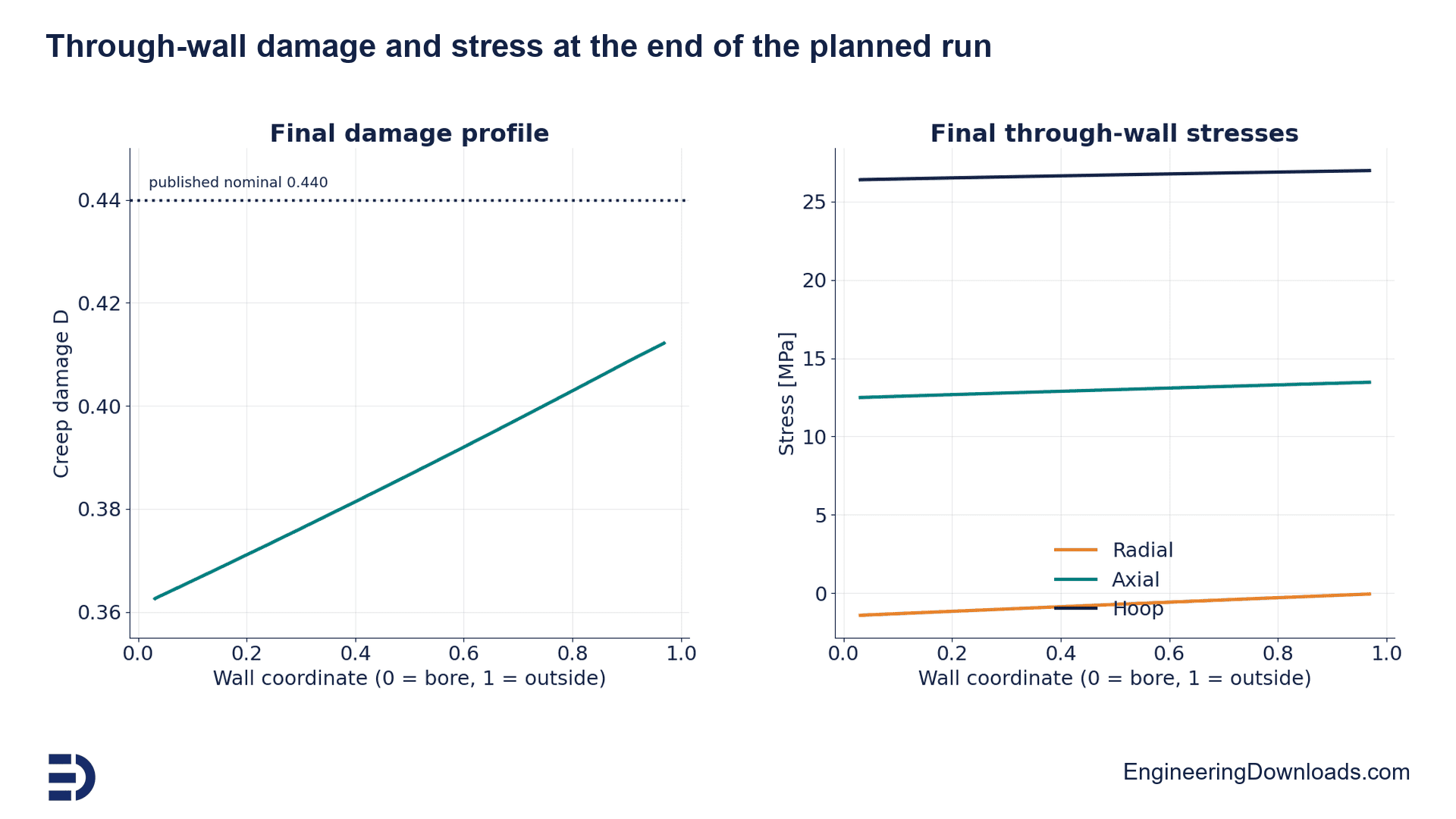
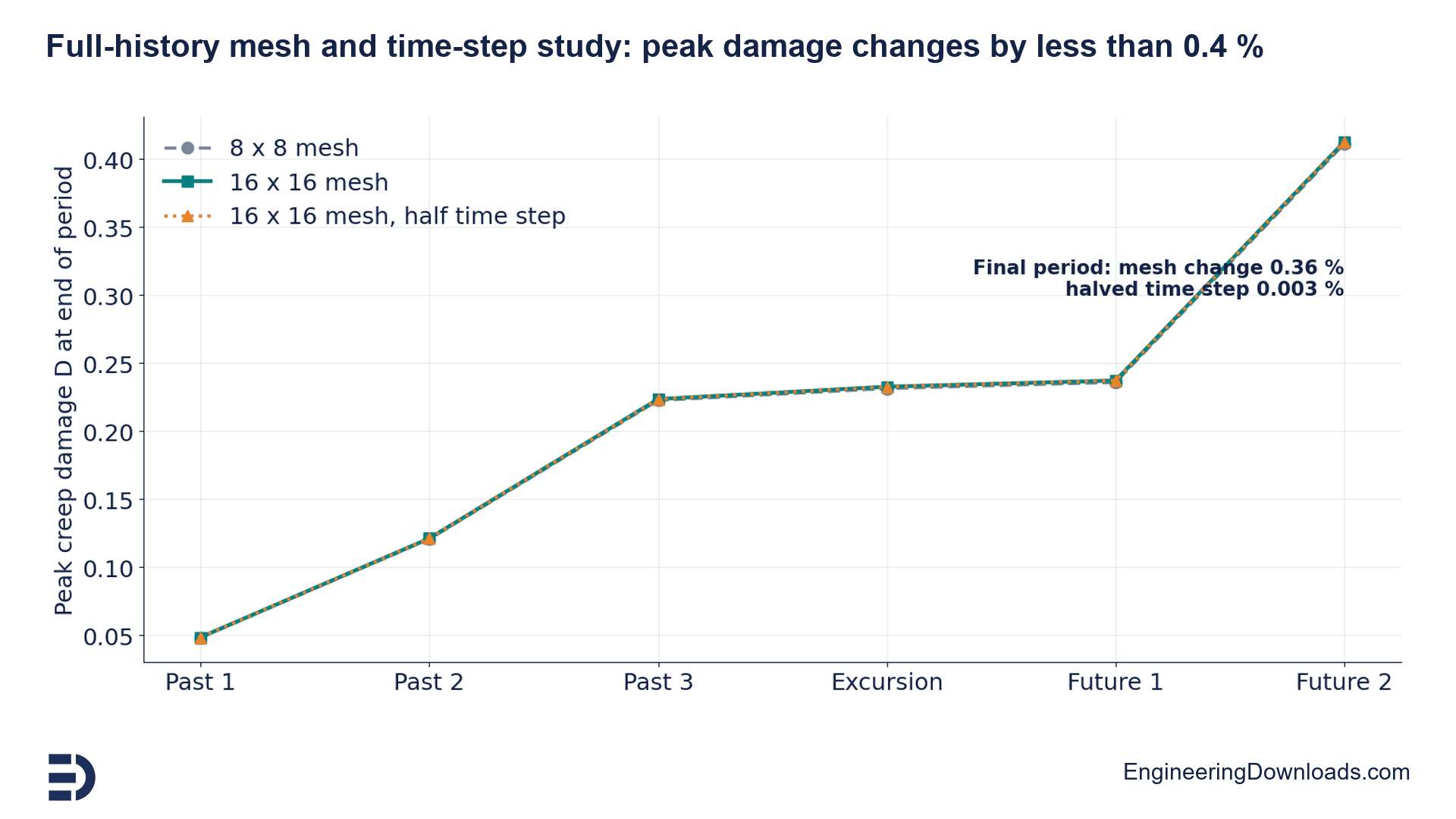
The Abaqus lives come from six single-element coupons loaded with the published stresses and temperatures, so the subroutine is tested before it is used in the tube. One hour of the 1,200 F excursion consumes about 11 times the damage of an hour at 1,130 F. In the axisymmetric tube model the peak damage at the end of the planned run is 0.4126, 6.2% below the nominal-stress total, because the model resolves the stress through the wall. The peak accumulated equivalent creep strain is 0.25%, below the 1% membrane limit, and damage stays below 1. Refining the mesh from 8 x 8 to 16 x 16 changes the peak damage of the full history by 0.36% and halving the time increment by 0.003%.
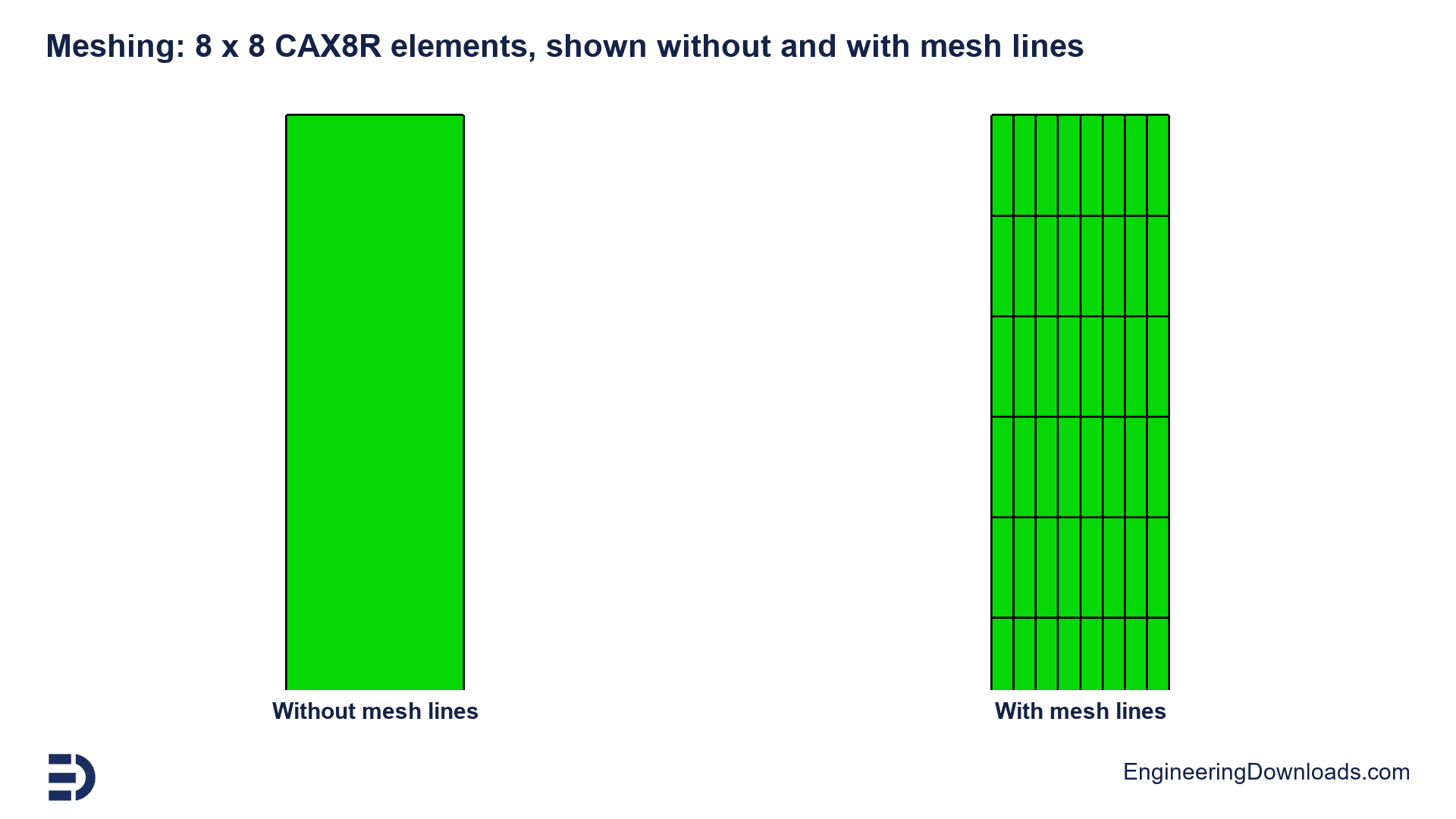
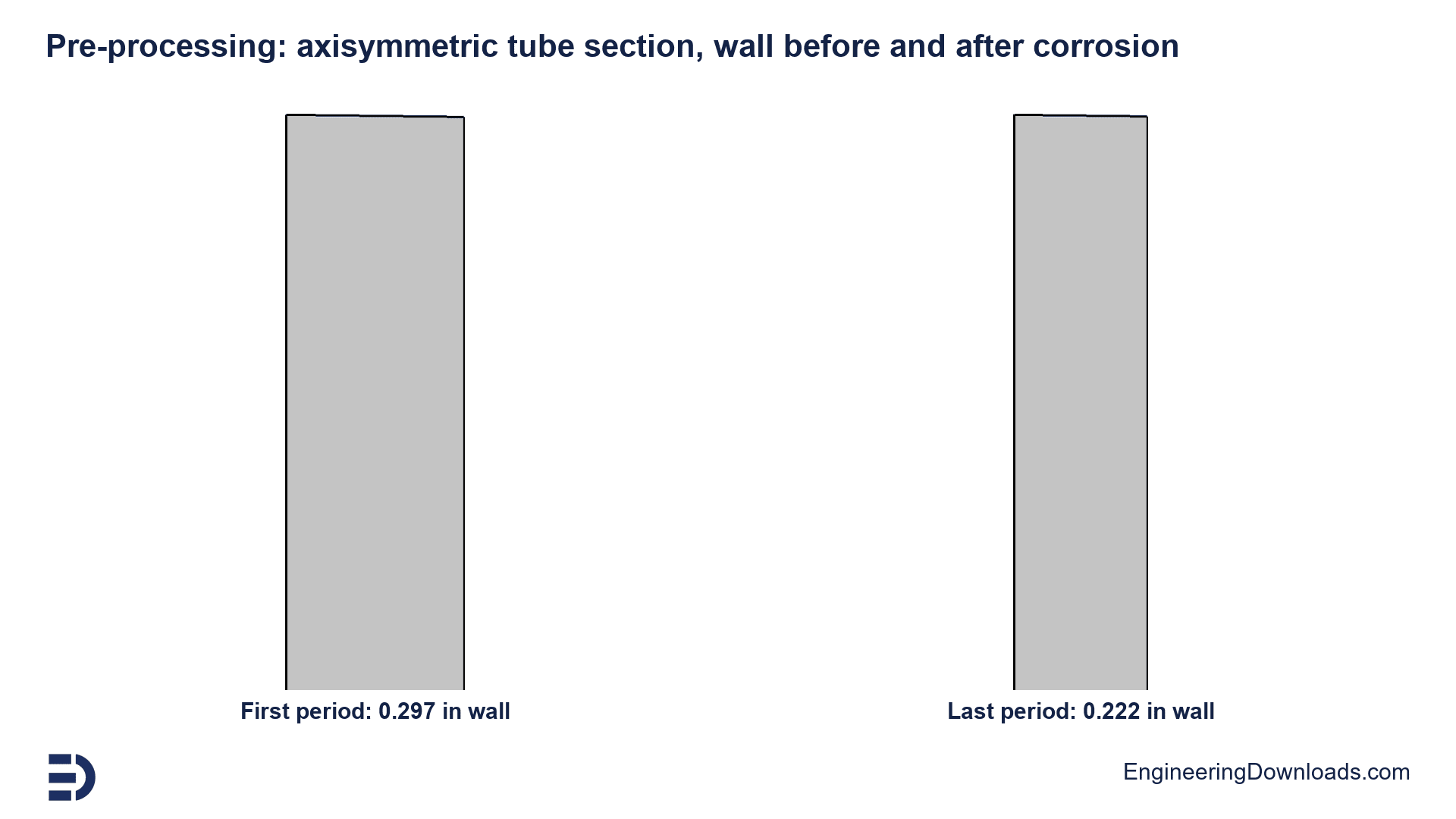
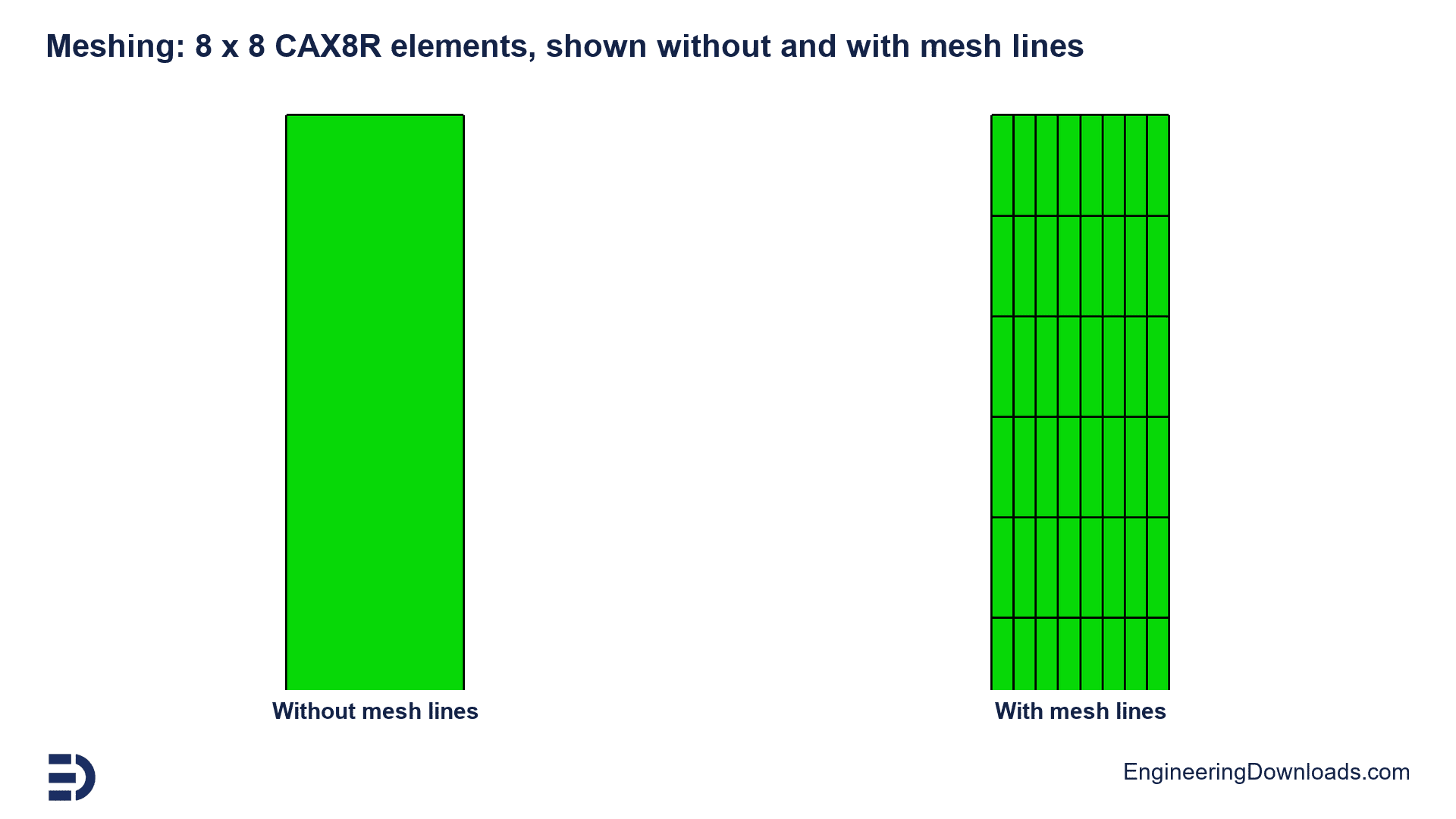
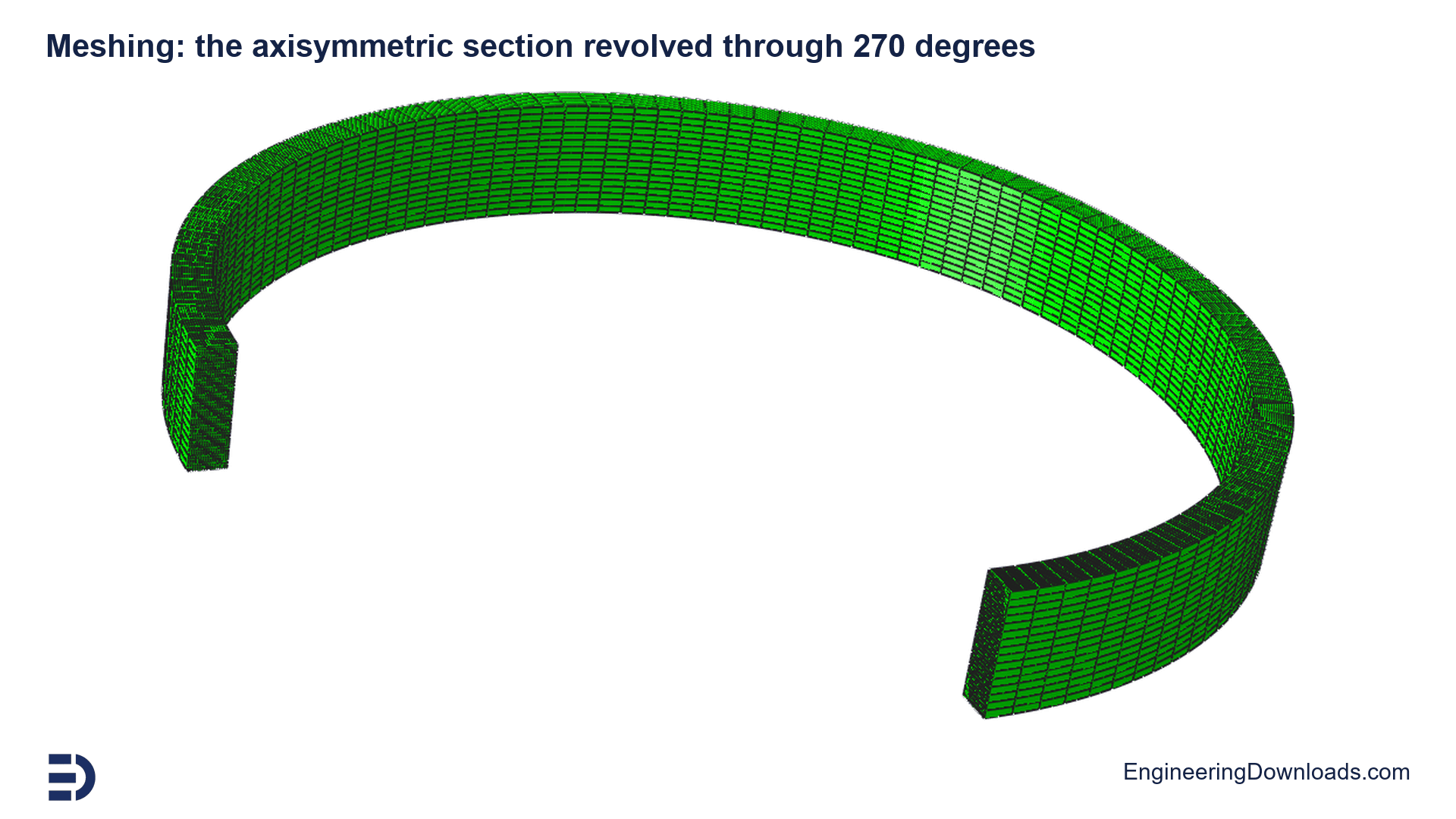
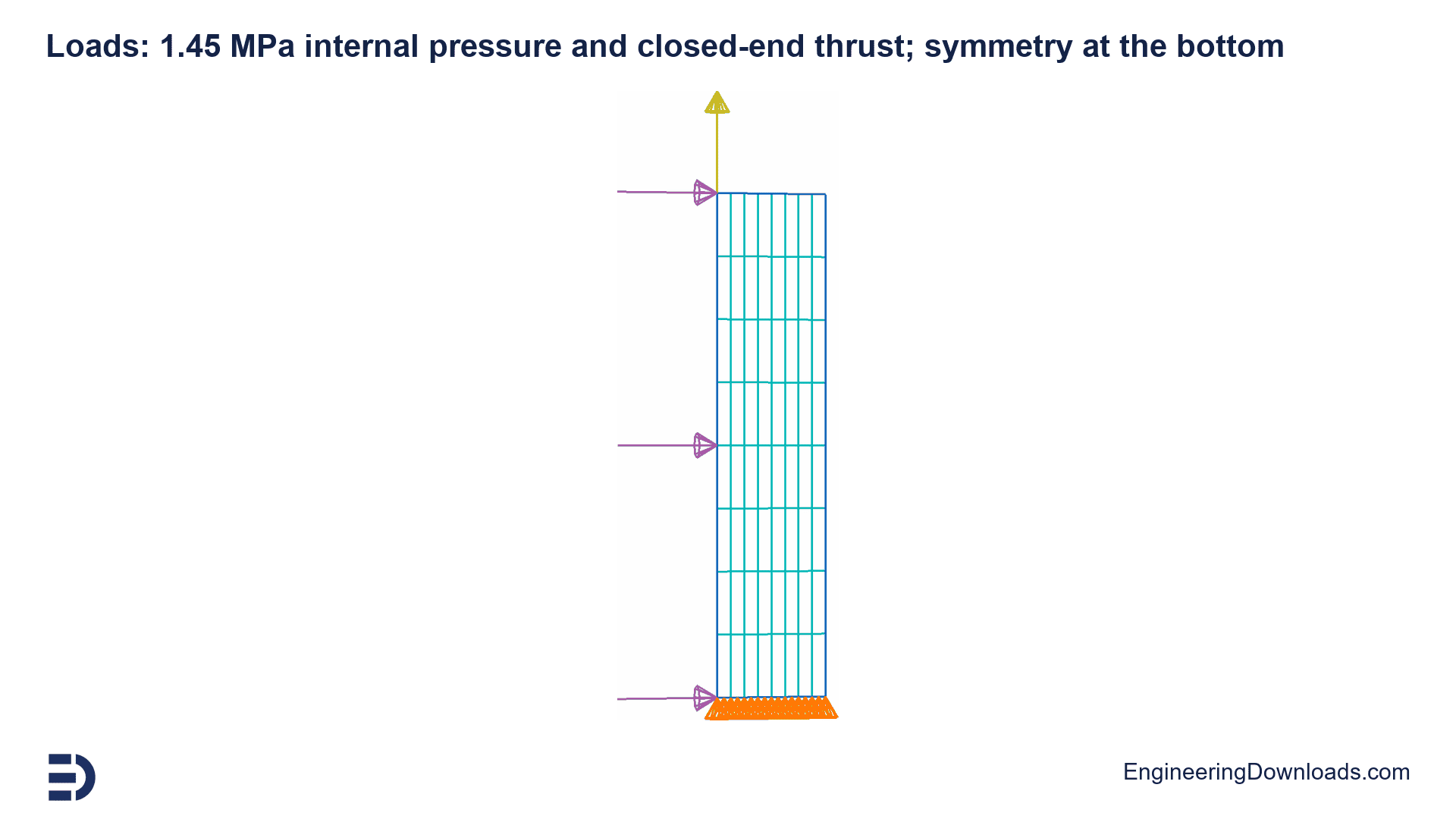
The tube is a body of revolution, so one axisymmetric section 25.4 mm long is modelled with second-order CAX8R elements. Corrosion removes the inner layer between periods, so the section is 0.297 in thick in the first period and 0.222 in in the last. The bore carries 210 psig (1.448 MPa), a concentrated force on a master node carries the closed-end thrust, and the bottom edge is held axially. Each period is a static load step followed by a viscoelastic creep step that calls the CREEP subroutine. Between periods the surviving wall keeps its damage, creep strain and stress, mapped by absolute radius and written into the next model as initial conditions. Young modulus 160 GPa and Poisson ratio 0.3 are assumed because the example does not give a modulus.
Example 10.3 is a published Level 2 assessment, and the tube model is an independent extension with a uniform temperature that omits weight, bending, external loads and thermal gradients. It is a technical benchmark for learning and review, not a plant-specific fitness-for-service approval. The models run in your own Abaqus installation (with a Fortran compiler linked for the user subroutine), and you need your own copy of the standard.
What does this package assess? The creep damage of the SA-335 P22 heater tube in API 579-2 Example 10.3 (Part 10): 20 years at 1,130 F, bore corrosion and a 1,200 F excursion, summed with the Omega method. It reproduces the published rupture lives and adds an Abaqus tube model that carries damage through the wall loss.
What is the one-click script? run_omega_check.py is plain Python 3 with no extra packages. Run it and it prints the six rupture lives next to the published and Abaqus values, the total damage and three pass/fail checks, and writes a CSV. No edits are needed.
How close is the result to the example? The six rupture lives are within 0.056% of the published values and the summed damage is 0.44002 against 0.440. The Abaqus CREEP subroutine returns the same lives on single-element coupons.
Which Abaqus files do I get? INP and CAE files of 19 models: six verification coupons and the six-period tube history on an 8 x 8 mesh, a 16 x 16 mesh and with a halved time step, plus the CREEP subroutine source. You solve them in your own Abaqus installation with a Fortran compiler linked.
Why is the tube model damage lower than 0.440? The published value uses the nominal thin-wall hoop stress. The tube model resolves the stress through the wall, so the peak damage at the end of the planned run is 0.4126, 6.2% lower. These are different stress models, so the agreement of the material check does not require the same structural damage.
Which inputs are assumed? The example gives no elastic modulus, so 160 GPa and a Poisson ratio of 0.3 are assumed. The temperature is uniform and weight, bending, external loads and thermal gradients are not modelled. The tutorial lists the assumptions.
Is this the Level 3 Example 10.4? No. Example 10.3 is a Level 2 assessment. The pressure-loaded tube model is an independently developed Level 3 style extension of the same case and is not the manual's published Example 10.4. It does not replace an assessment by a qualified engineer.
Do I need the standard? Yes. API 579-1/ASME FFS-1 and API 579-2/ASME PTB-14 are not included. Keep your own copy to follow the equations and the example.
What if the package is not what I expected? Write to us. Engineering Downloads refunds clients who are not satisfied with a delivered product.
Need more than the files?
There are two ways we can help. Book a one hour online consultation if you want to talk a problem through with a CAE engineer, using the checkbox in the order box. Order a project if you need a full simulation built for you, delivered to an agreed scope, price and deadline under a written contract.
We work on FEA and CFD for engineers, researchers and companies. Order your project, or message us on WhatsApp for a quick reply.
Other packages engineers working on this topic also download.
 API 579 Example 10.1 in Abaqus: Vessel Creep After a Temperature Excursion, Omega Damage Model and One-Click Python Check€129,00
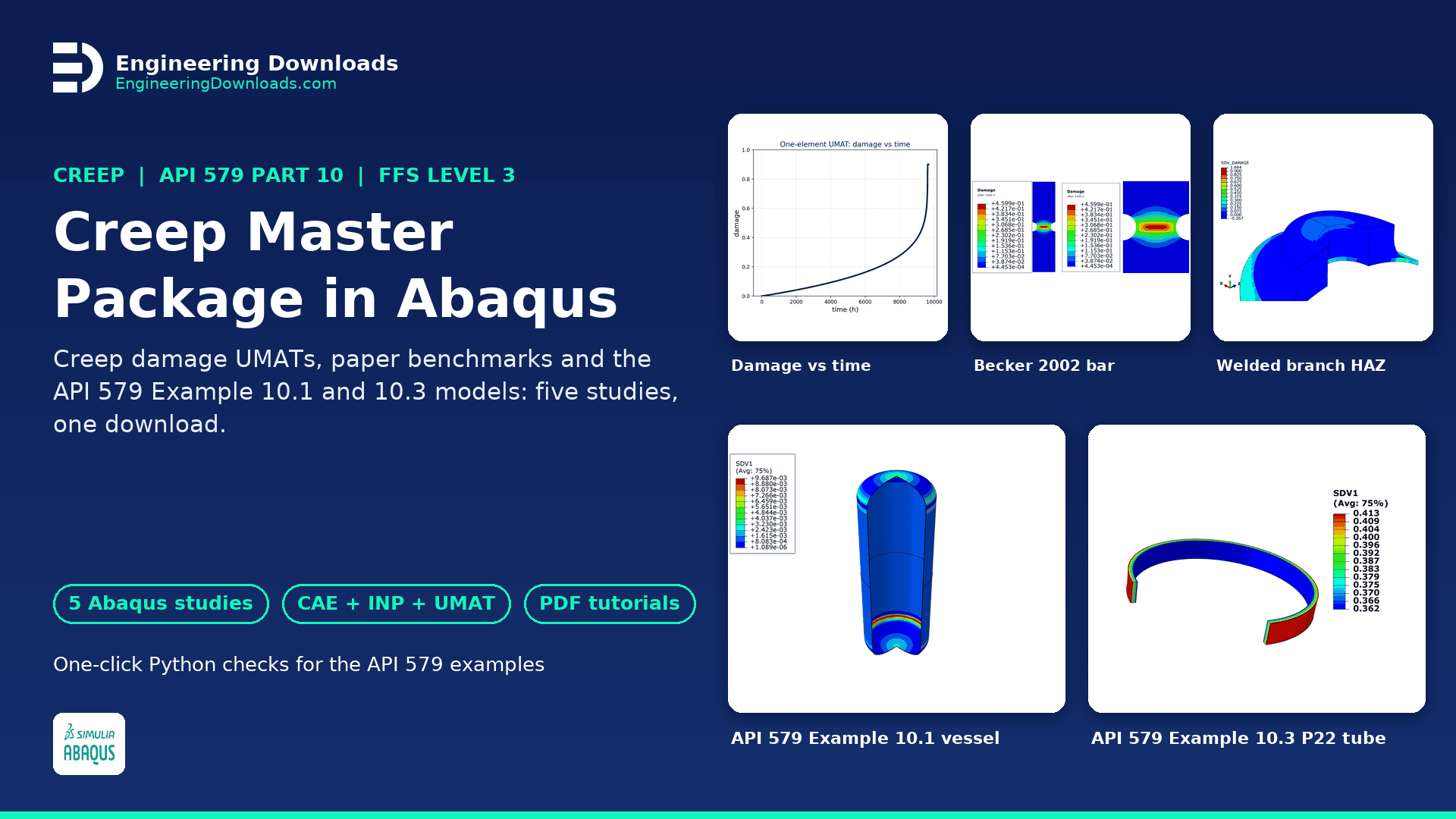 Creep Master Package in Abaqus: API 579 Part 10 Examples 10.1 and 10.3, Creep Damage UMAT and Paper Benchmarks€299,00
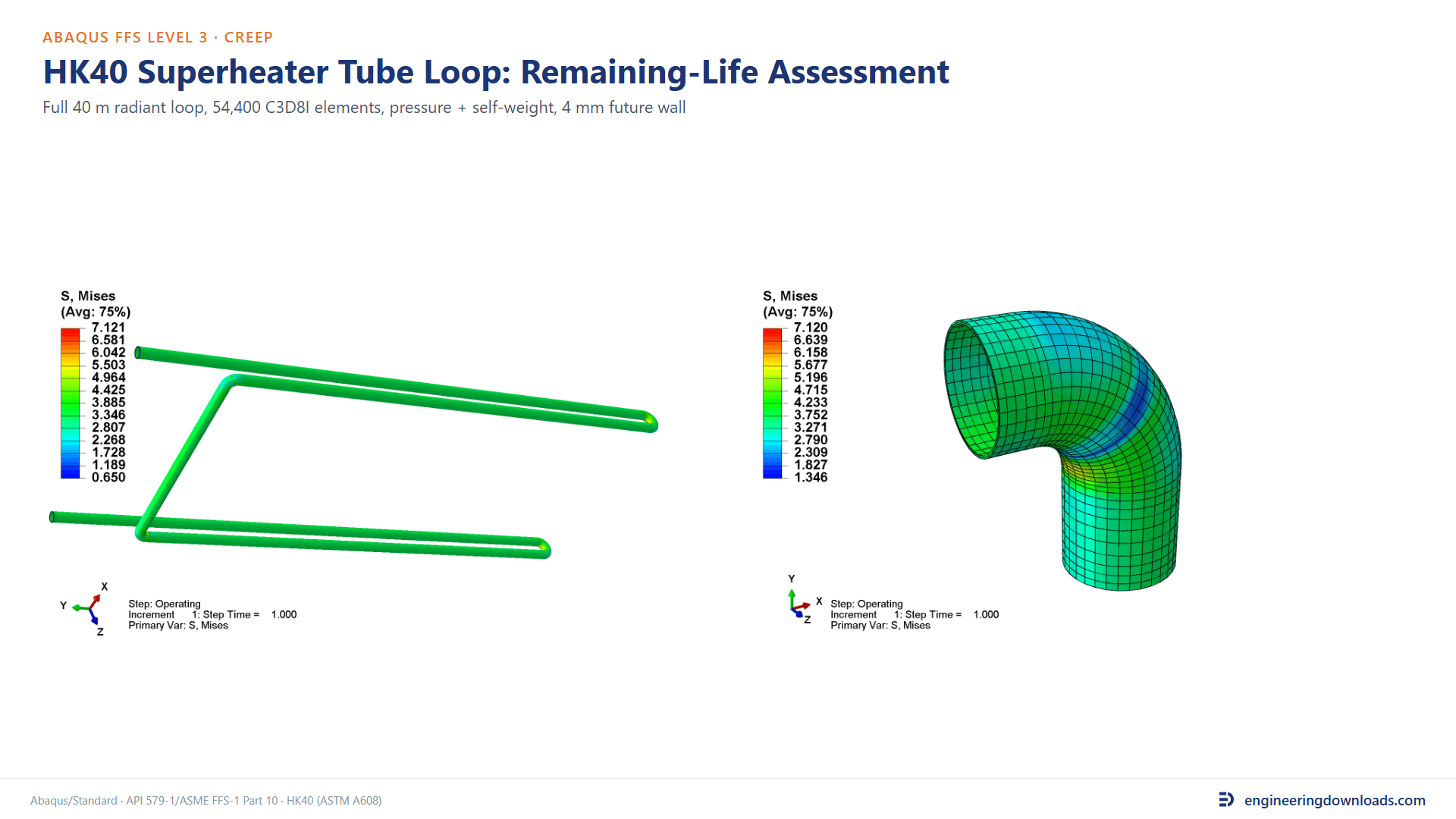 HK40 Superheater Tubes: API 579 FFS Level 3 and Creep Remaining Life in Abaqus€139,00
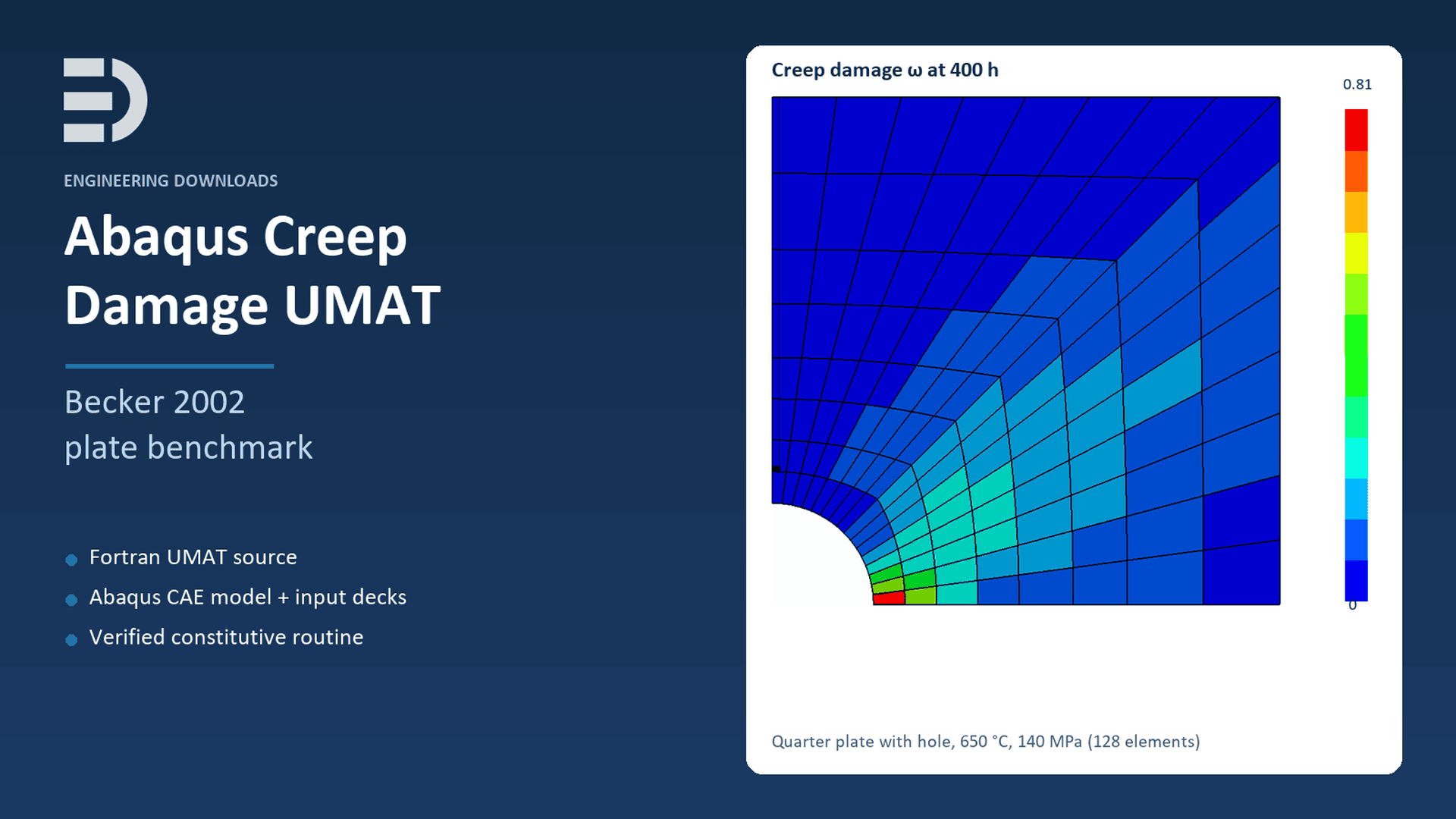 Creep Continuum Damage UMAT in Abaqus: Becker 2002 Perforated Plate Benchmark€49,00
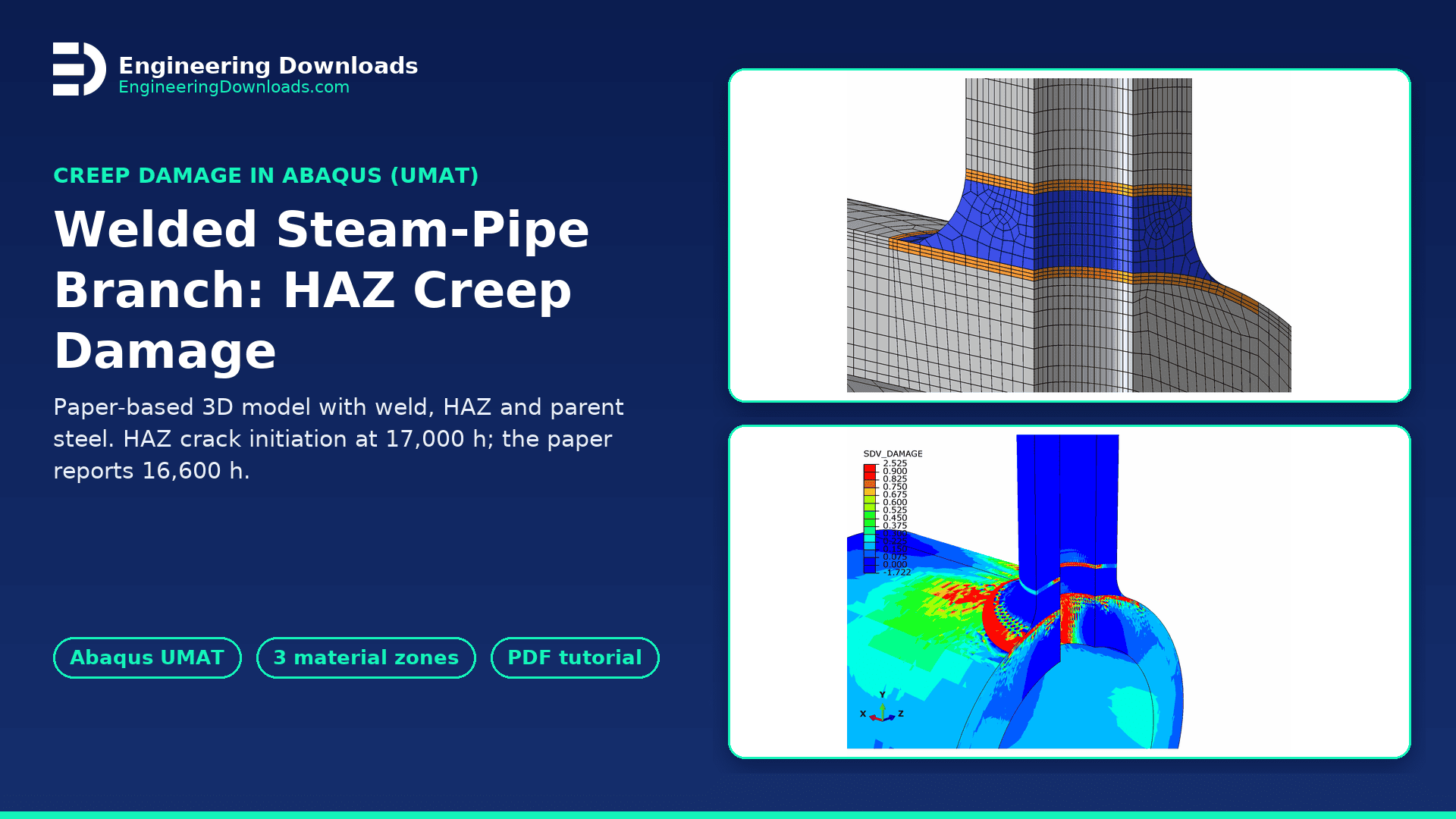 Creep Damage Analysis of a Welded Steam Pipe Branch in Abaqus: UMAT, HAZ Hex Mesh and Paper Comparison€149,00
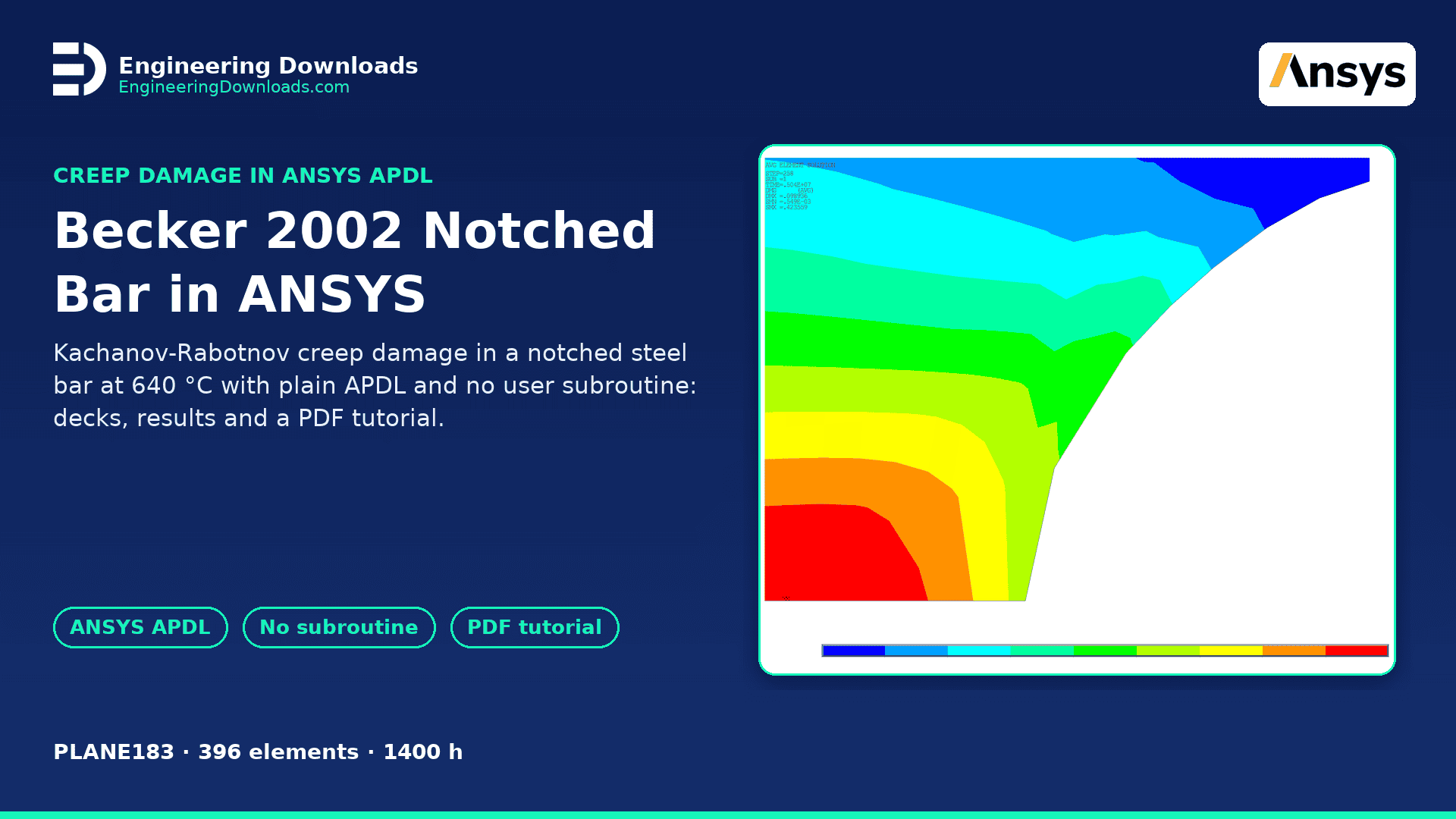 Creep Damage Notched Bar in ANSYS APDL: Becker 2002 Benchmark with No User Subroutine, Decks and Paper Comparison€49,00
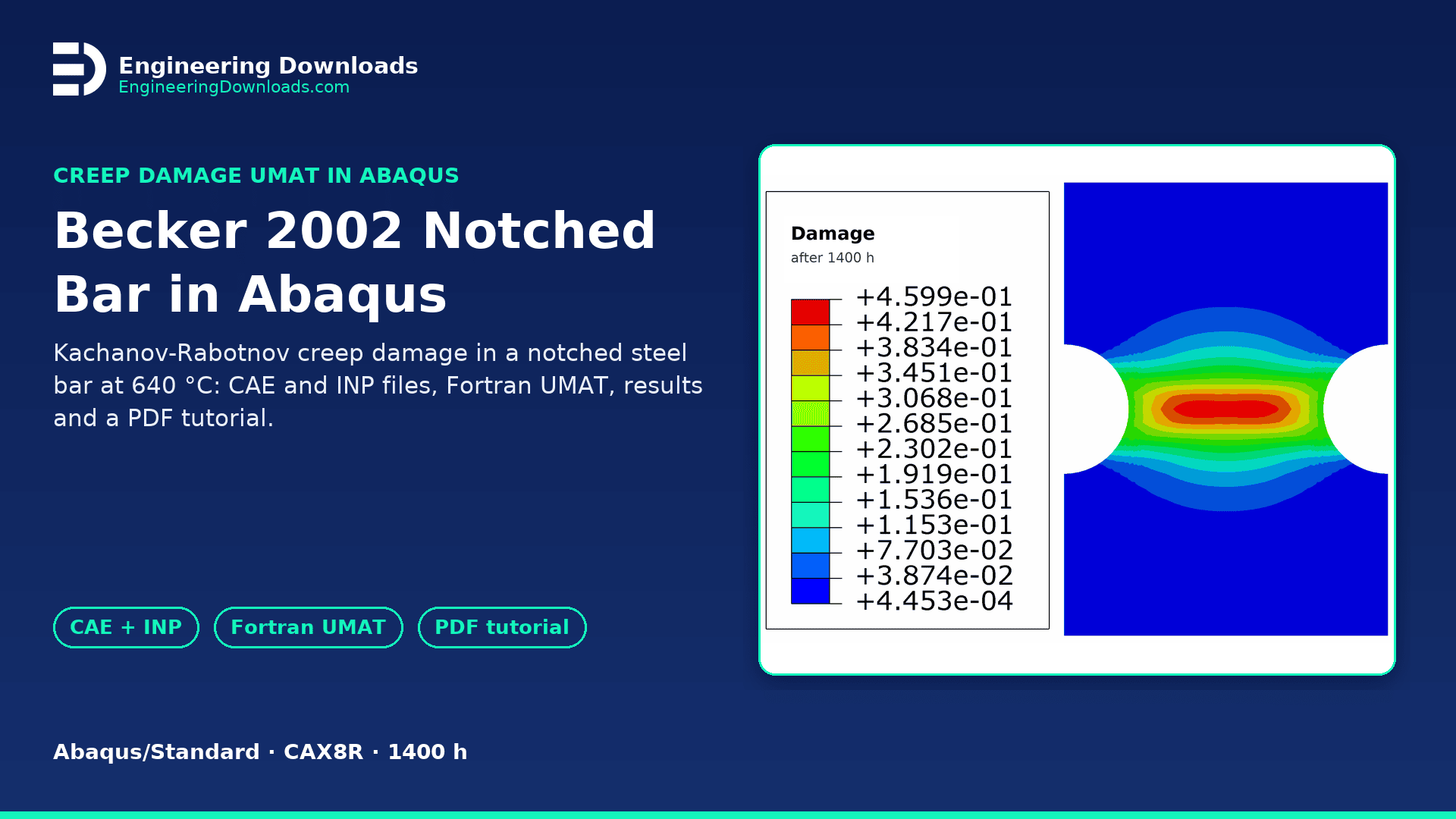 Creep Damage Notched Bar in Abaqus: Becker 2002 Benchmark with UMAT, CAE and INP Files and Paper Comparison€49,00
 Creep Damage Versus Time in Abaqus: Failure Horizon of a Single Element with a Kachanov-Rabotnov UMAT€49,00

Need a full custom project? See the options below.

€129,00

€179,00

€149,00

€119,00

€129,00

€149,00
See more
Want to receive push notifications for all major on-site activities?



