

Need a full custom project? See the options below.
Need a full custom project? See the options below.
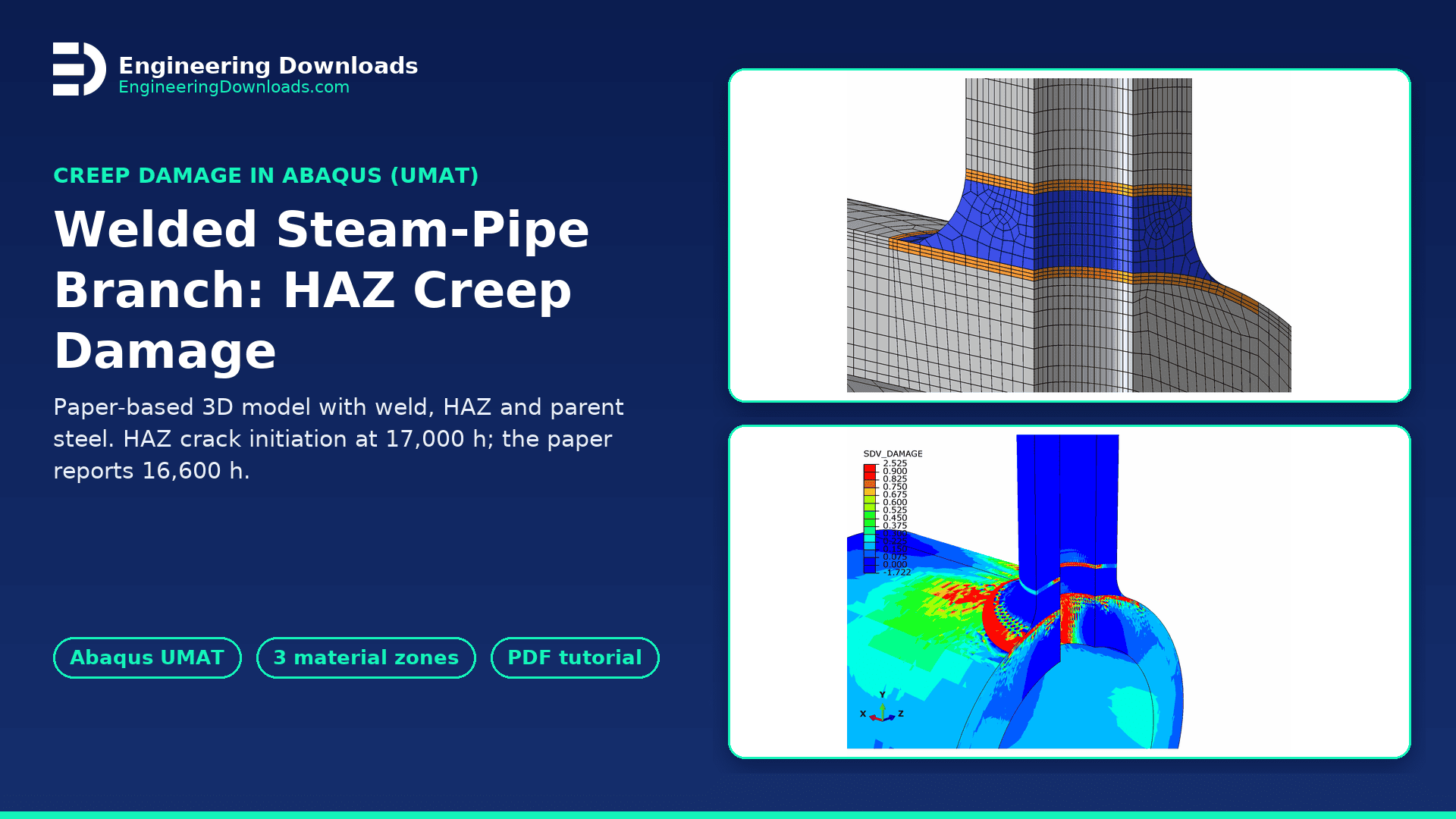
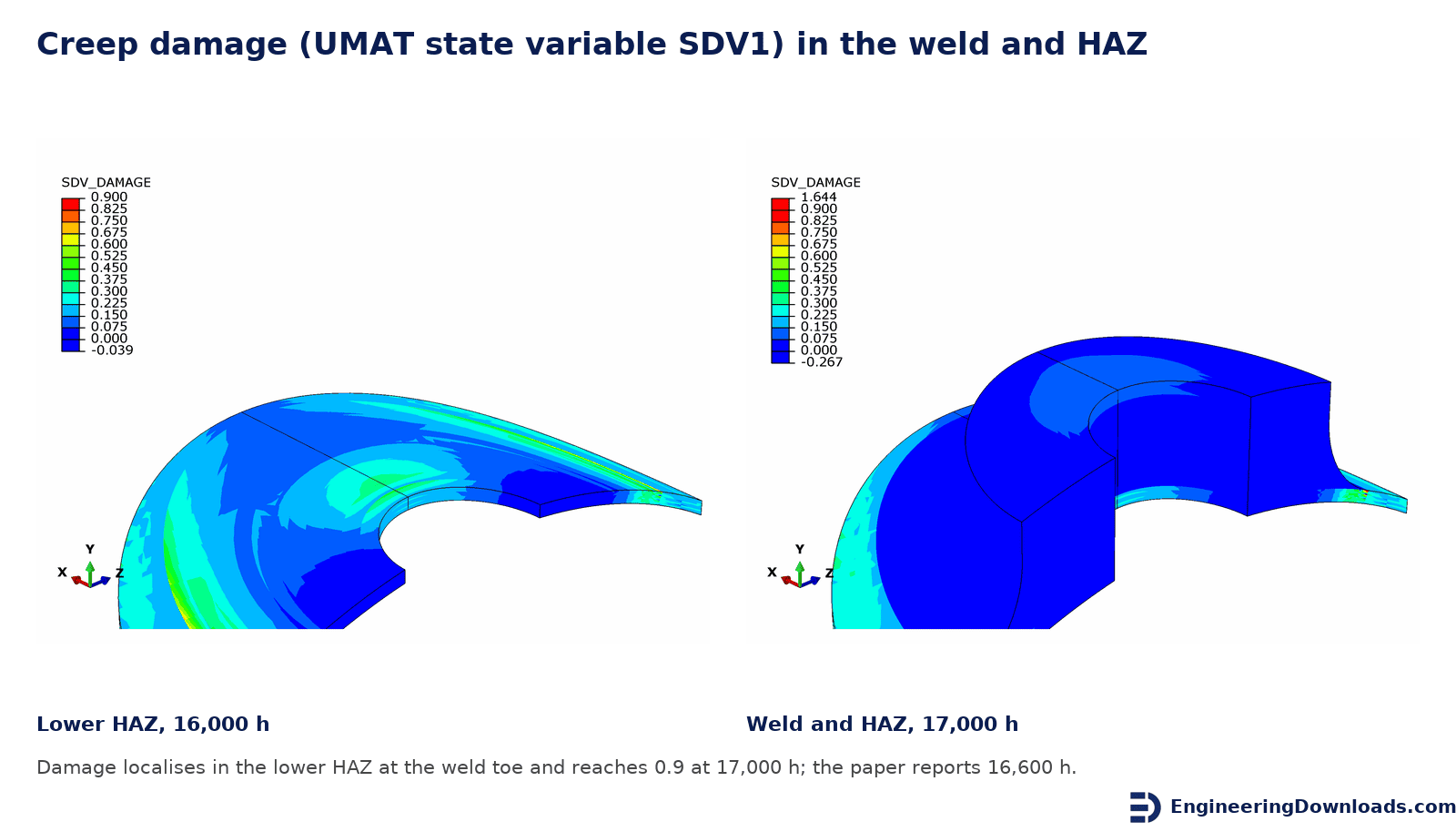
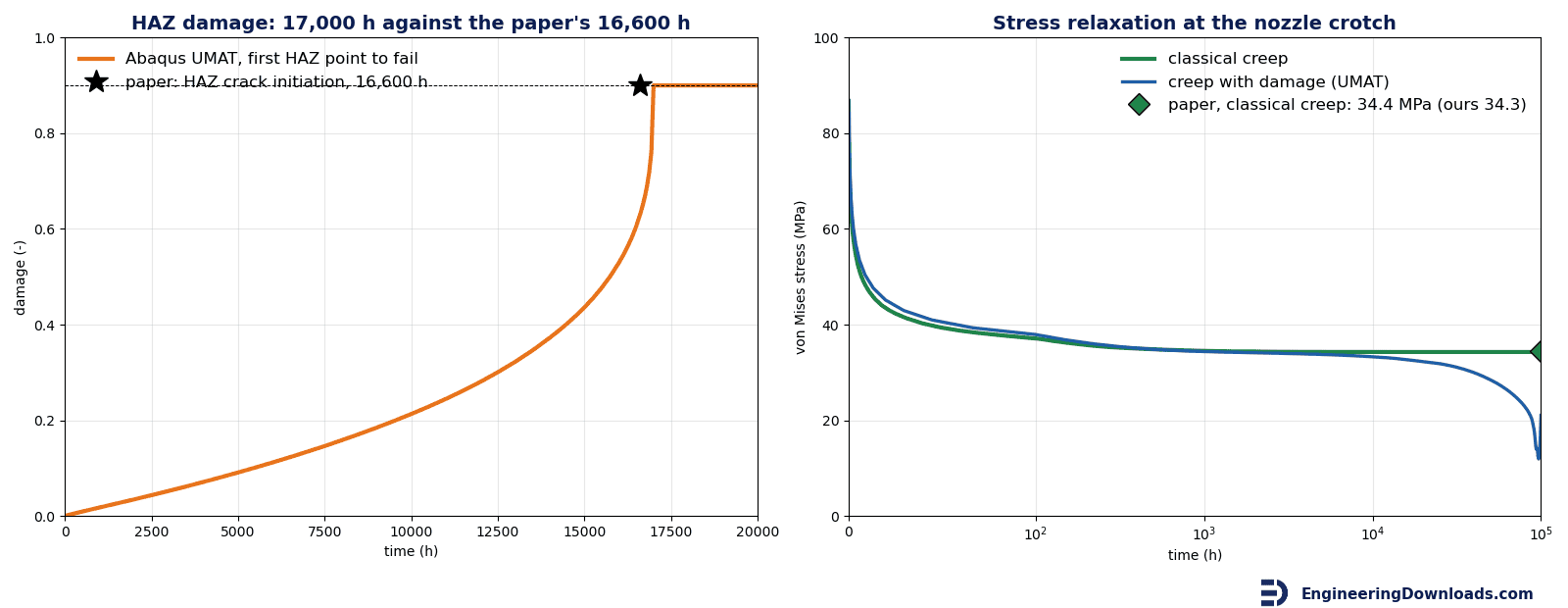
Where does a welded steam-pipe branch crack first after years at 640 °C? In the heat-affected zone of the weld. This package rebuilds the paper-based model of Hosseini-Toudeshky and Jannesari (2022) in Abaqus, with a Fortran creep-damage UMAT on a clean all-hex HAZ mesh, run for the full 100,000 hours. Our model puts HAZ crack initiation at 17,000 h against the paper’s 16,600 h, and the classical-creep stress at the branch crotch at 34.3 MPa against 34.4 MPa after 100,000 hours.
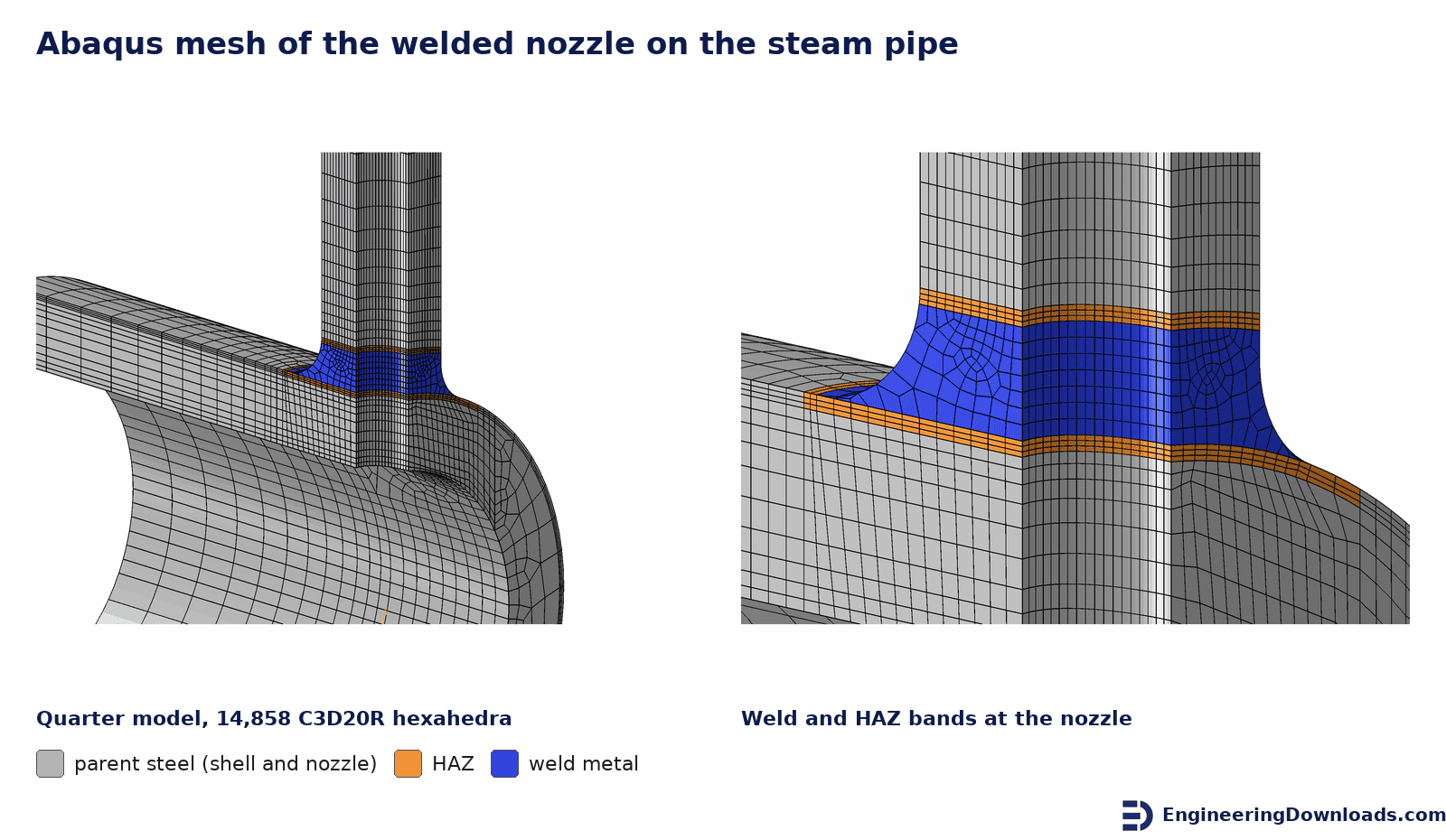
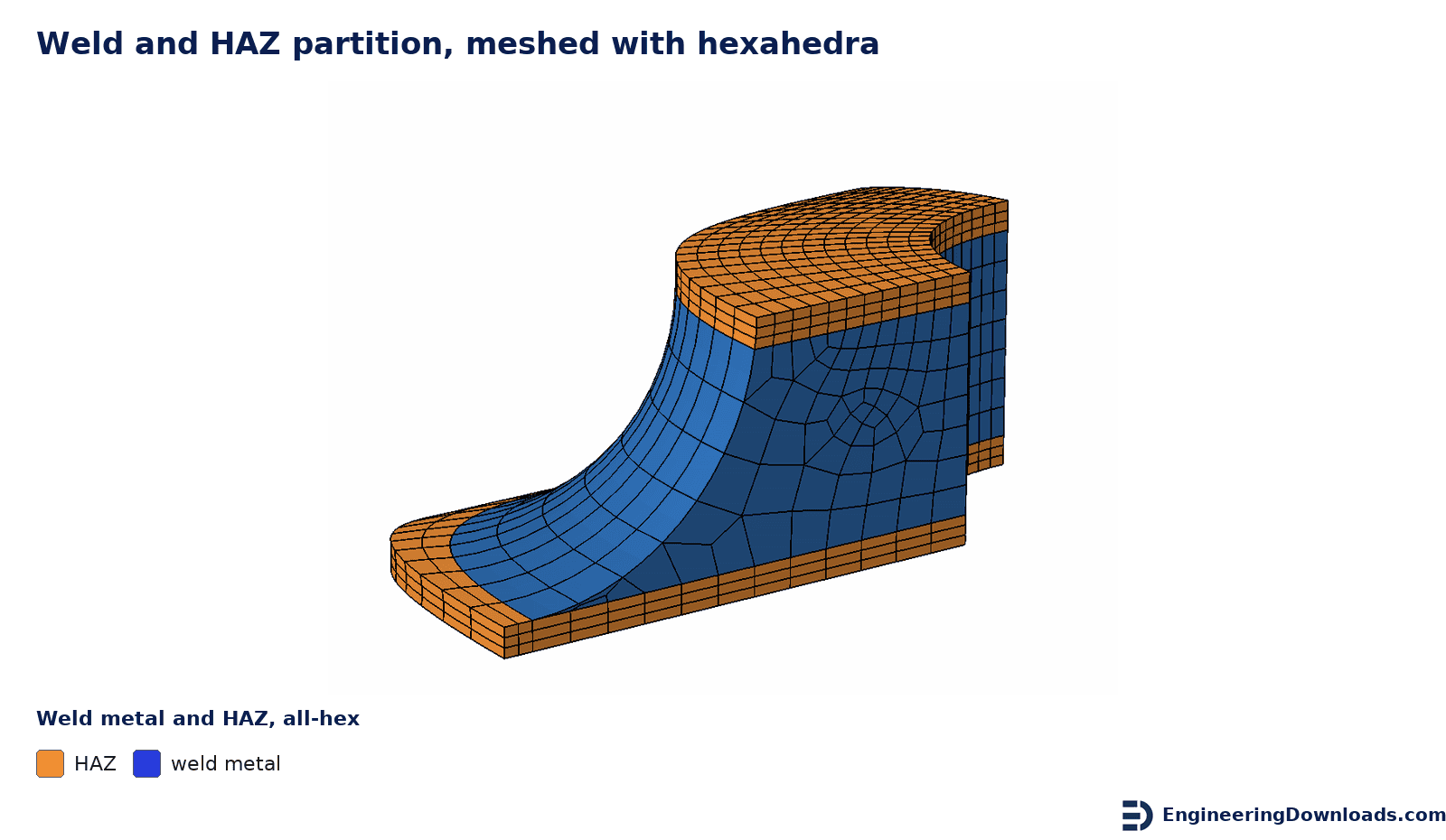
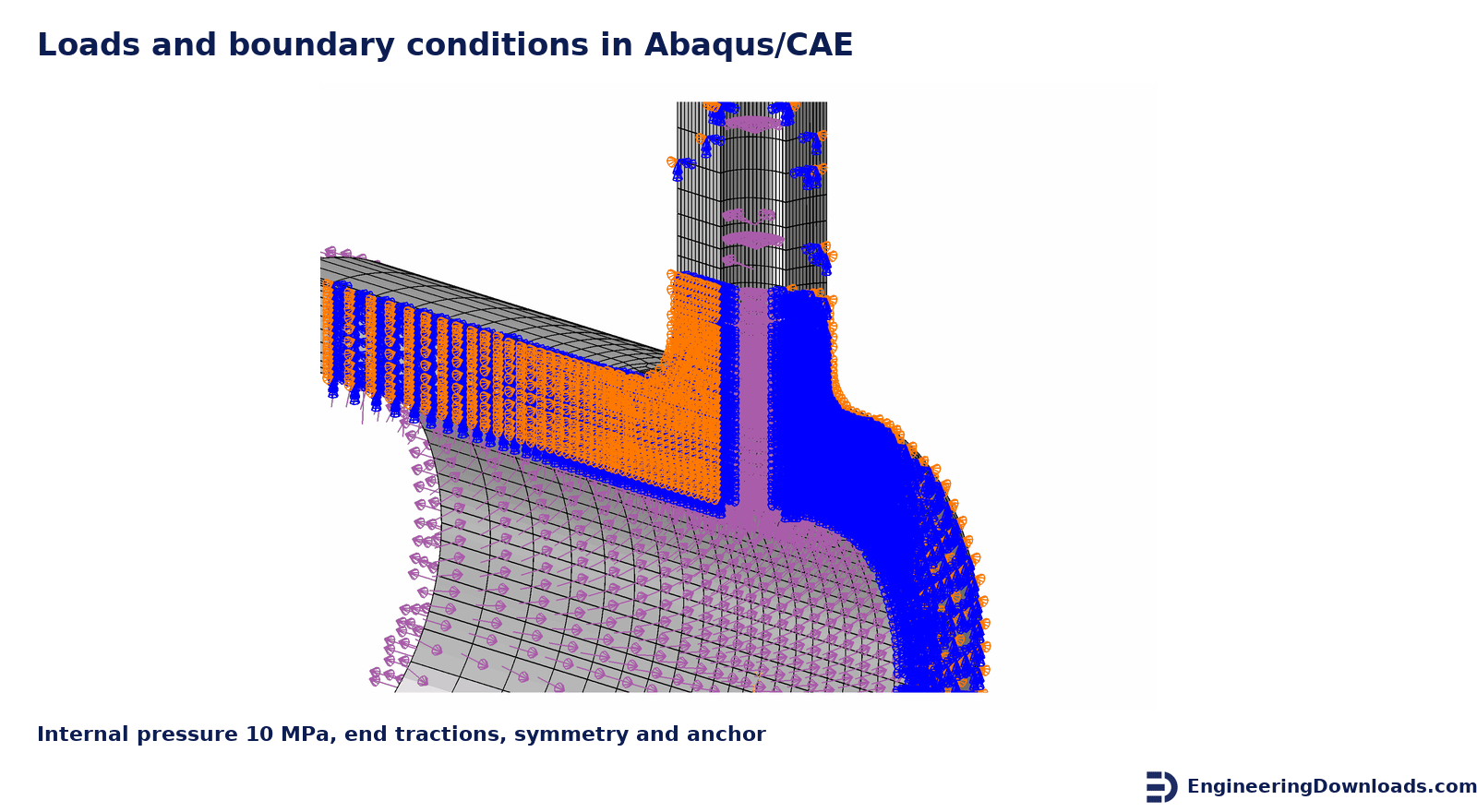
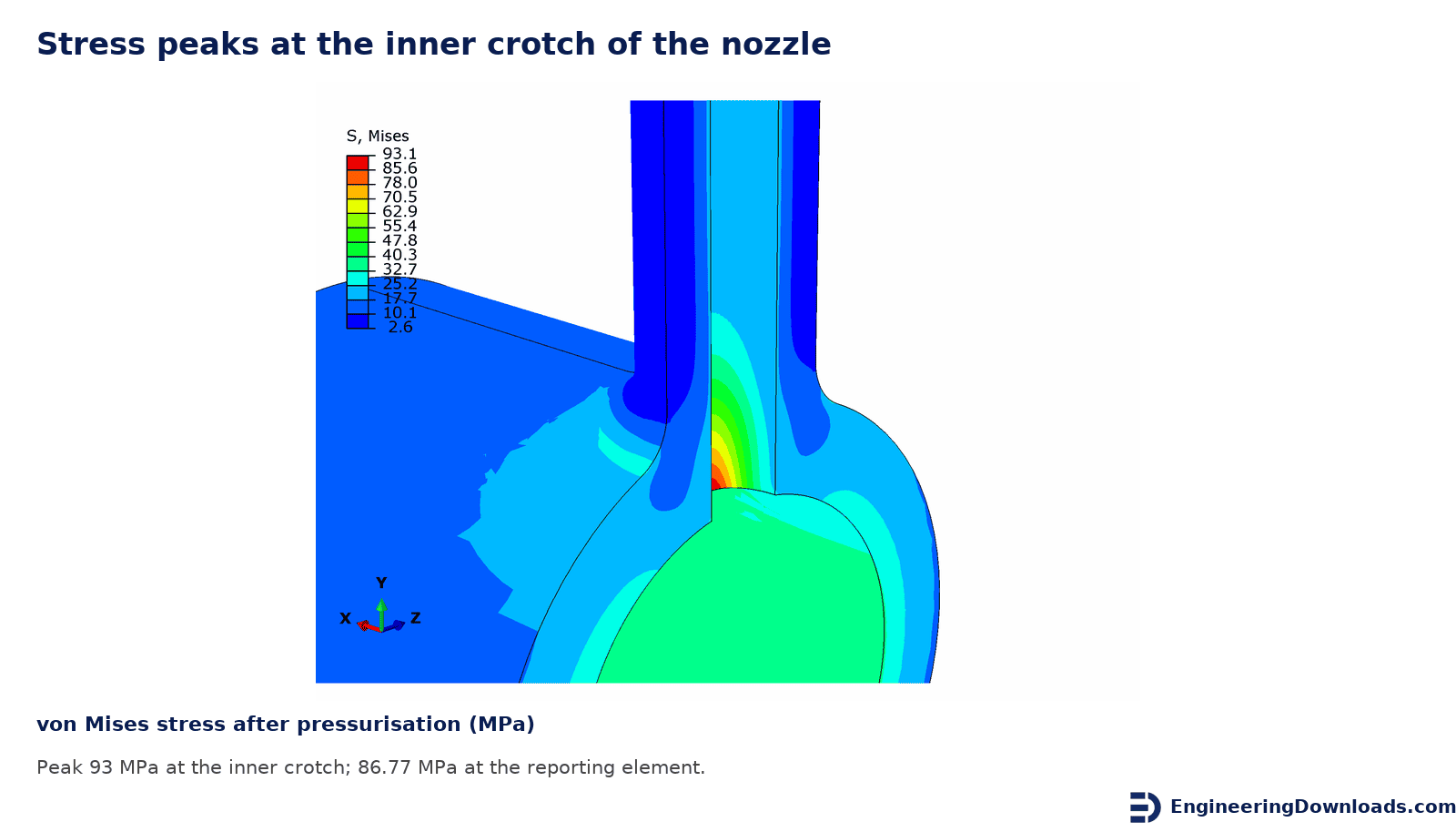
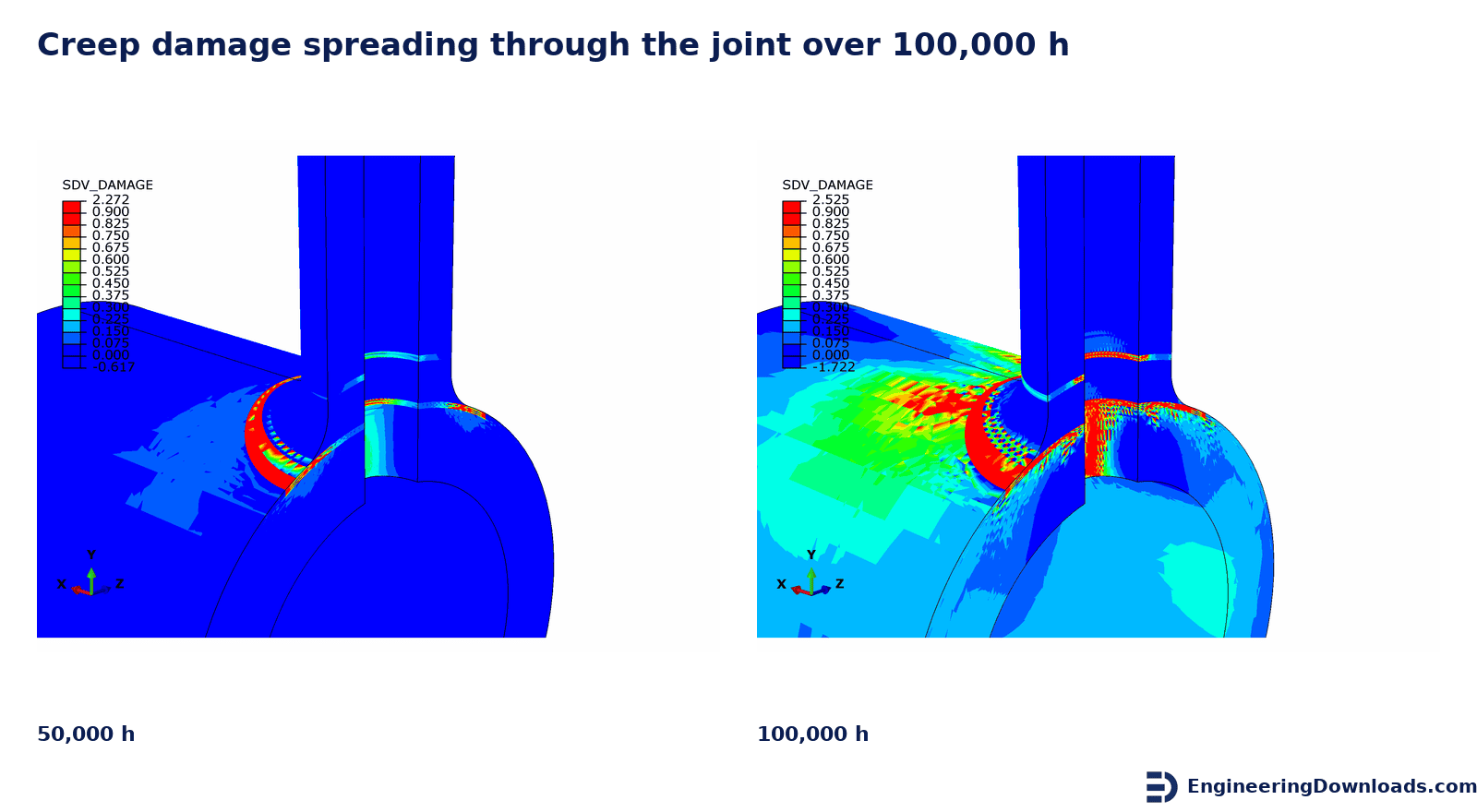
A quarter of the welded branch is modelled in 3D: the run pipe (shell), the nozzle, the weld metal and two heat-affected zone (HAZ) bands, each zone with its own creep-damage constants.
| Quantity | Paper | This model | Agreement |
|---|---|---|---|
| HAZ crack initiation, multi-zone (damage 0.9) | 16,600 h | Abaqus 17,000 h | +2.4 % |
| Classical creep, von Mises at the crotch after 100,000 h | 34.4 MPa | Abaqus 34.3 MPa | −0.3 % |
| Life by linear damage accumulation (classical creep, CEGB rupture fit) | 14,600 h | Abaqus 15,280 h | +4.7 % |
Paper: H. Hosseini-Toudeshky and M. Jannesari (2022), An investigation on creep life assessment of welded steam pipeline intersection using classical and progressive damage analyses, Welding in the World 66, 1653–1664. DOI: 10.1007/s40194-022-01324-2
In this paper, classical creep analysis and creep continuum damage modeling (CDM) are performed for a welded steam pipeline intersection with parent material of 0.5Cr0.5Mo0.25V, weld metal of 2.25CrMo, and consideration of heat-affected zone (HAZ). Creep life assessment using classical creep deformation analysis incorporating with linear damage accumulation (LDA) often deviates largely from practice. Therefore, in this investigation, three different analyses assuming classical creep analysis (without material degradation due to damage), creep continuum damage of single-zone welded intersection, and creep continuum damage of multi-zone welded intersection will be performed. The required formulations for creep continuum-damage analyses are implemented in a user material subroutine (UMAT) and linked with ANSYS finite element software. The predicted distribution of equivalent stresses, damage evolution, and crack initiation life from the mentioned these modeling are presented and discussed. It is shown that the predicted life from classical creep analysis and considering multi-zone modeling are quite larger than the obtained lives from creep-damage modeling (CDM). However, the predicted results from creep-damage analyses from single zone and multi-zone models are comparable with about 7.5% difference.
Abstract quoted from the paper for reference (© International Institute of Welding 2022). The paper itself, and its figures, are not included in this package.
Researchers, graduate students and engineers working on creep of welds, power-plant piping, structural integrity and fitness-for-service, who want a working 3D creep-damage model in Abaqus that starts from a published paper.
Abaqus with a Fortran compiler linked to Abaqus. Abaqus is not included.
You get a 3D welded-joint creep-damage model that already runs, on a clean all-hex HAZ mesh, with the matched results. See also the Becker 2002 notched bar with an Abaqus UMAT, the Becker 2002 perforated plate UMAT, our guide Introduction to UMAT Subroutine in Abaqus and the article Life Assessment and Creep Damage Analysis of Welded Components.
Which results match the paper? HAZ crack initiation (17,000 h against 16,600 h), the classical-creep crotch stress after 100,000 h (34.3 against 34.4 MPa) and the classical life by linear damage accumulation (15,280 against 14,600 h).
Does the steel crotch match? No. Our crotch damage is much slower than the paper’s; the tutorial explains why the printed constants cannot give the paper’s curve there.
Do I need a Fortran compiler? Yes, Abaqus compiles the UMAT at job start.
Did the run reach 100,000 h? Yes, the full hold.
Can I use my own material or weld? Yes. The constants are in the material section of the input files and at the top of the APDL decks.
Quality guarantee: if you are not satisfied with the delivered product, we will refund you.
Need more than the files?
There are two ways we can help. Book a one hour online consultation if you want to talk a problem through with a CAE engineer, using the checkbox in the order box. Order a project if you need a full simulation built for you, delivered to an agreed scope, price and deadline under a written contract.
We work on FEA and CFD for engineers, researchers and companies. Order your project, or message us on WhatsApp for a quick reply.
Other packages engineers working on this topic also download.
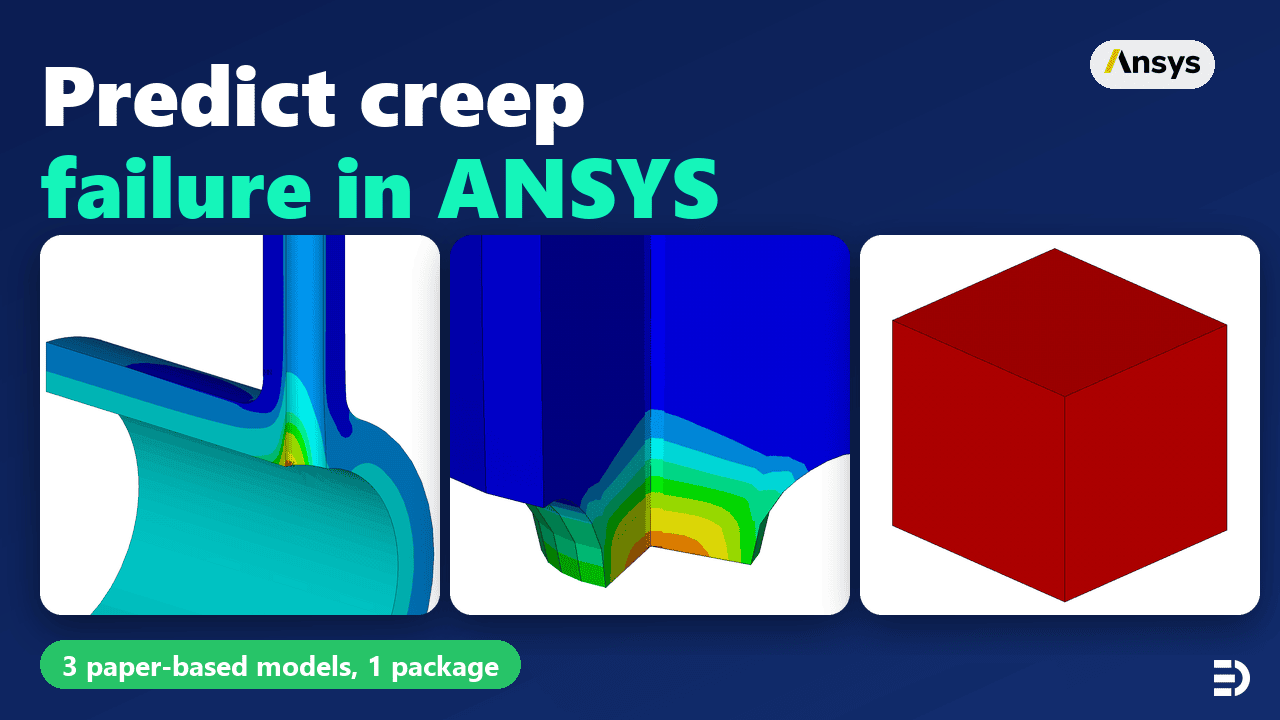 ANSYS Creep Damage Package: 3 Paper-Based APDL Models (Welded Pipe Branch, Notched Bar, Failure Horizon)€299,00
 Creep Damage of a Welded Steam Pipe Branch in ANSYS APDL: HAZ Failure, All-Hex Mesh and Paper Comparison€149,00
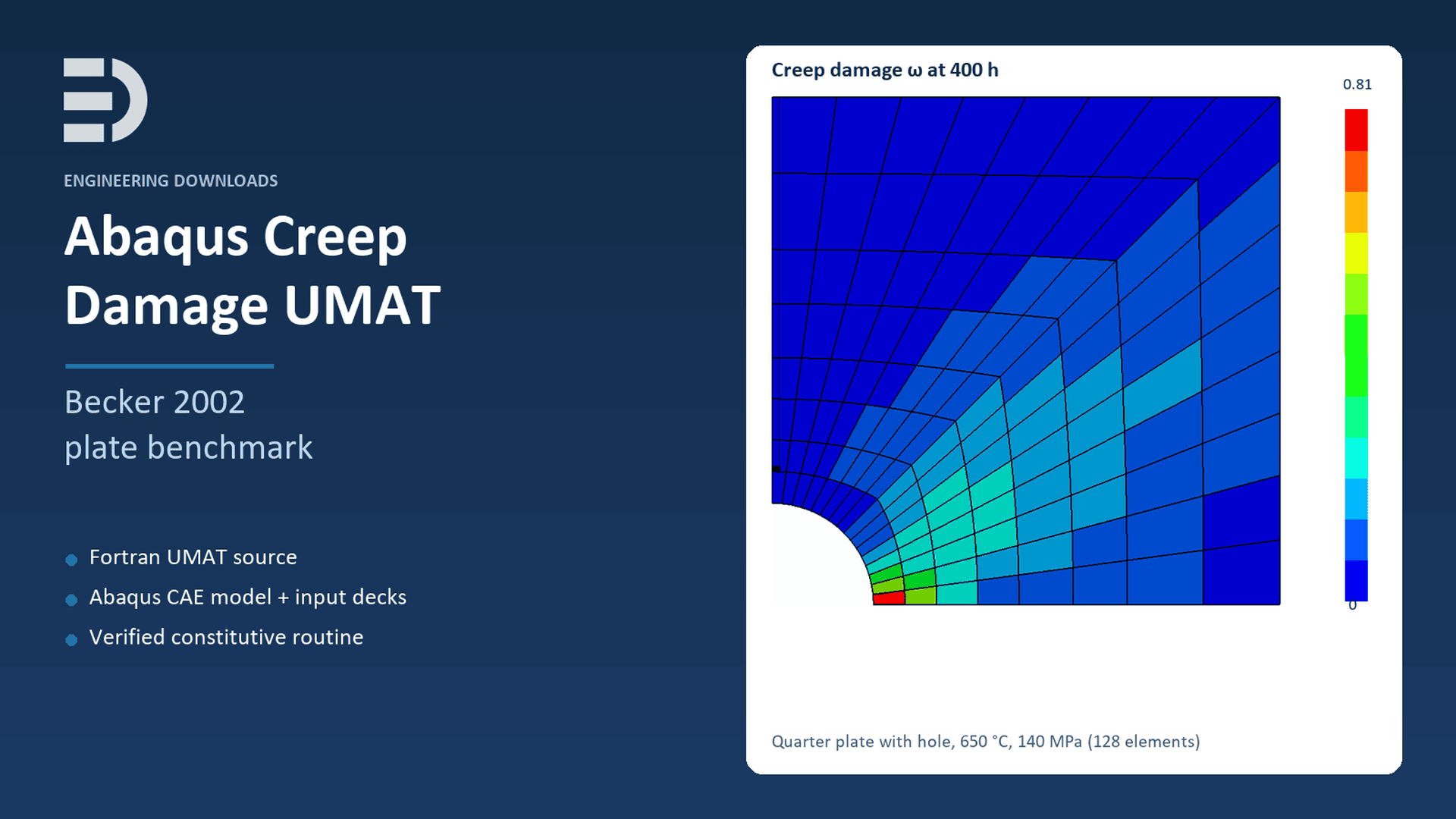 Creep Continuum Damage UMAT in Abaqus: Becker 2002 Perforated Plate Benchmark€49,00
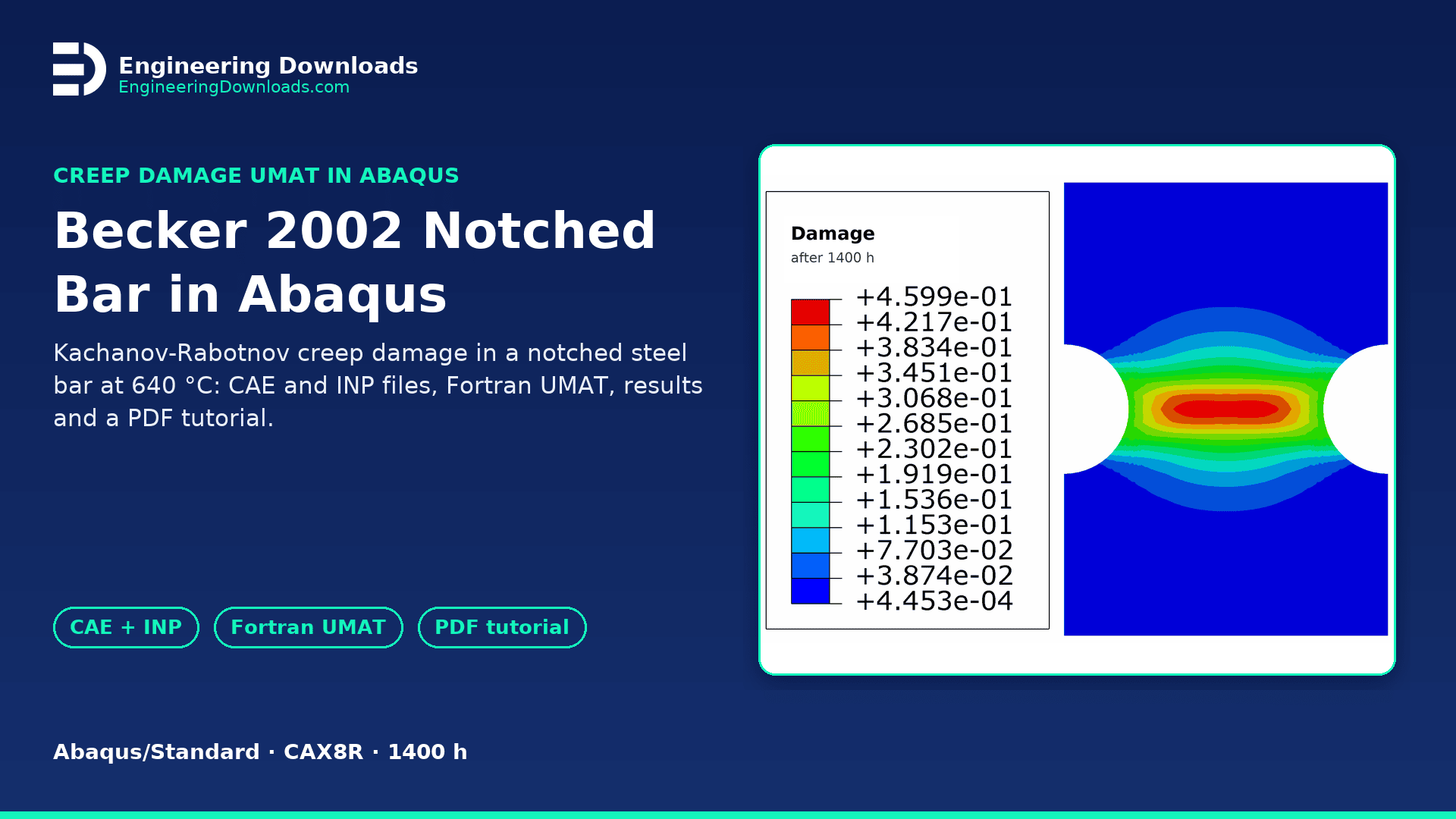 Creep Damage Notched Bar in Abaqus: Becker 2002 Benchmark with UMAT, CAE and INP Files and Paper Comparison€49,00
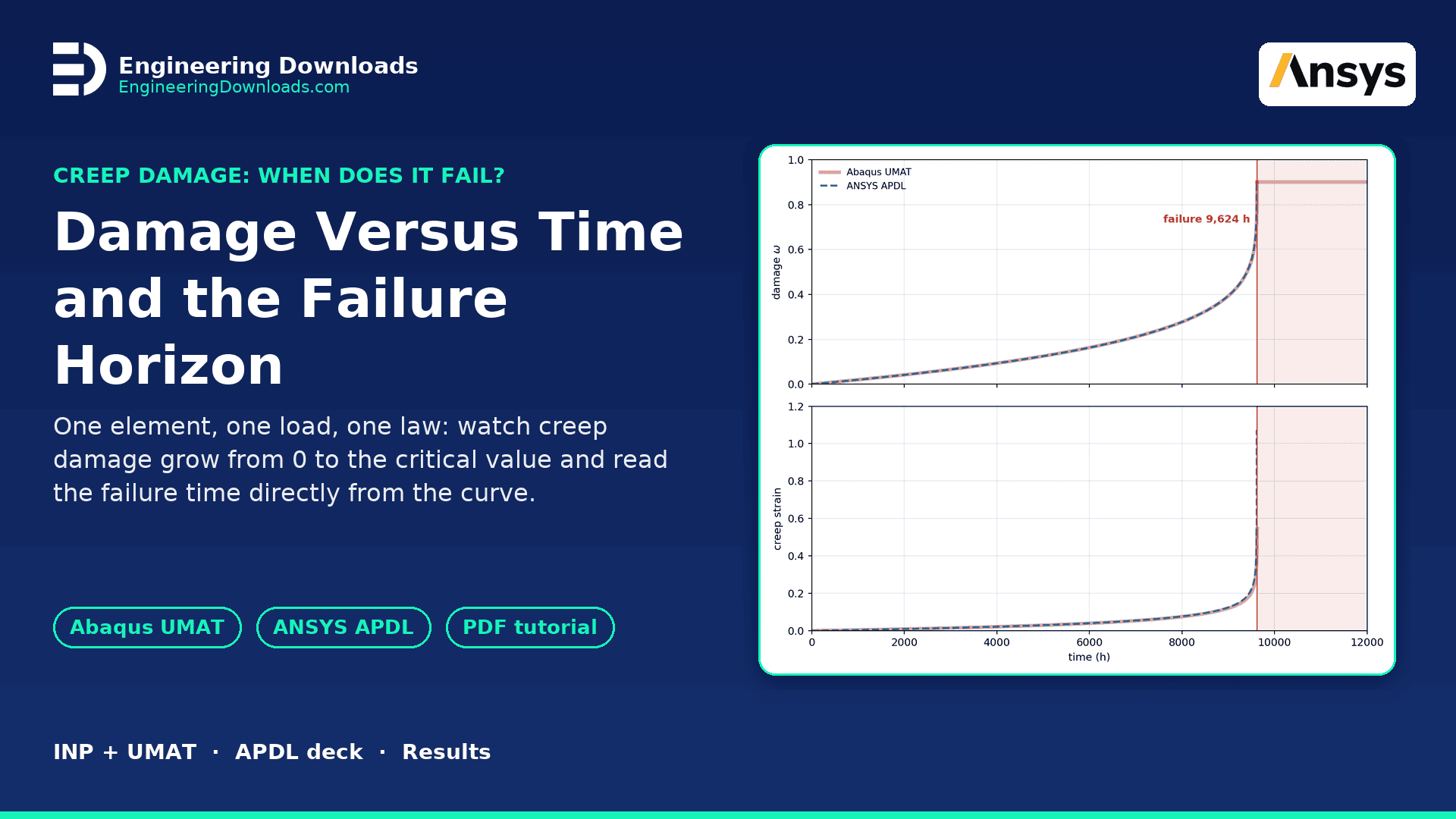 Creep Damage Versus Time in Abaqus: Failure Horizon of a Single Element with a Kachanov-Rabotnov UMAT€49,00
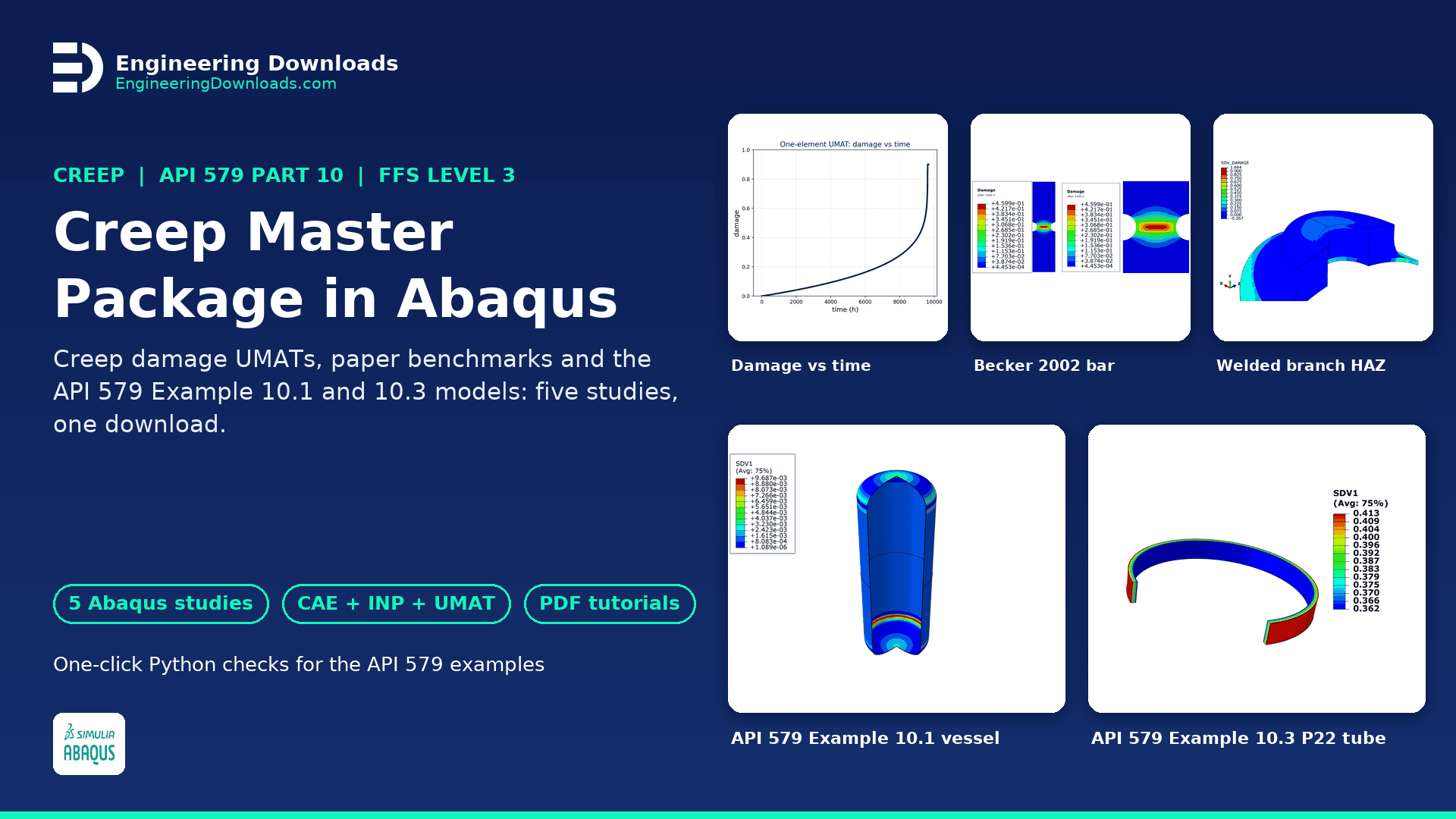 Creep Master Package in Abaqus: API 579 Part 10 Examples 10.1 and 10.3, Creep Damage UMAT and Paper Benchmarks€299,00
 Composite Fatigue UMAT for Abaqus: Hashin, Tsai-Hill and Maximum-Stress Criteria€159,00
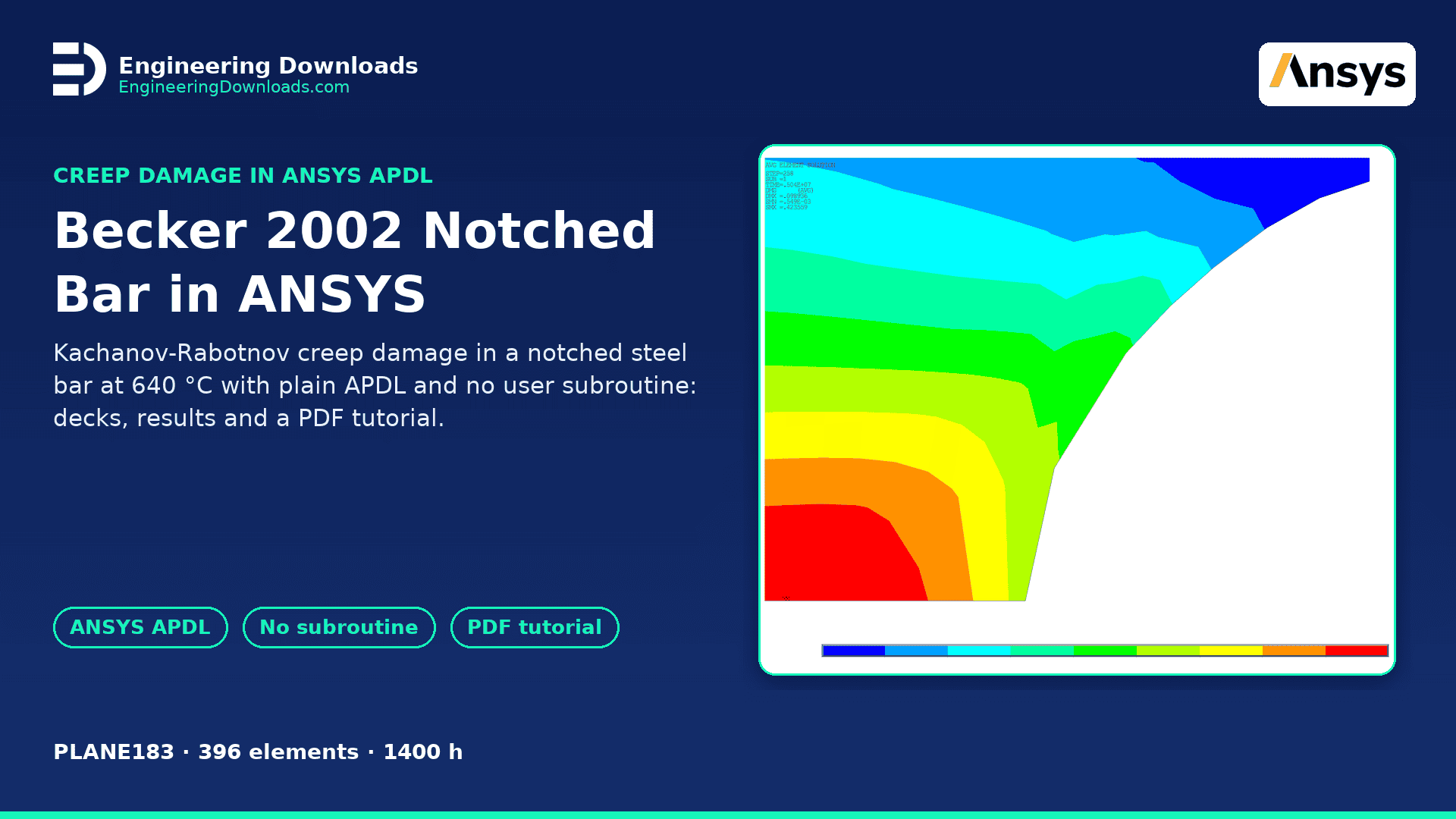 Creep Damage Notched Bar in ANSYS APDL: Becker 2002 Benchmark with No User Subroutine, Decks and Paper Comparison€49,00

Need a full custom project? See the options below.

€129,00

€179,00

€149,00

€119,00

€129,00

€149,00
See more
Want to receive push notifications for all major on-site activities?



