

Need a full custom project? See the options below.
Need a full custom project? See the options below.
Creep damage is where a high-temperature component quietly loses its life: strain accumulates, damage grows inside the steel, and the growing damage speeds the creep up until failure comes quickly. This package puts three complete, paper-based ANSYS Mechanical APDL creep damage models in one download, from a one-element failure curve, through a notched bar benchmark, to a 3D welded steam pipe branch with a heat-affected zone (HAZ). Each model comes as an ANSYS Workbench project (.wbpz) together with its APDL creep-damage deck and mesh, a one-click run file and a PDF tutorial. All input files and scripts are included, so everything runs in your own ANSYS installation.
Paper: H. Hosseini-Toudeshky and M. Jannesari (2022), An investigation on creep life assessment of welded steam pipeline intersection using classical and progressive damage analyses, Welding in the World 66, 1653–1664. DOI: 10.1007/s40194-022-01324-2
The authors study a welded steam pipeline intersection made of a 0.5Cr0.5Mo0.25V parent steel, a 2.25CrMo weld metal and a heat-affected zone. They compare three treatments: classical creep without damage, continuum creep damage with a single material zone, and continuum creep damage with separate zones. Classical creep combined with linear damage accumulation tends to deviate from service experience, so the damage-based analyses are used to follow the equivalent stress, the damage evolution and the crack initiation life. The damage models predict shorter lives than the classical approach, and the single-zone and multi-zone damage results differ by about 7.5 %. (Source: the paper above.)
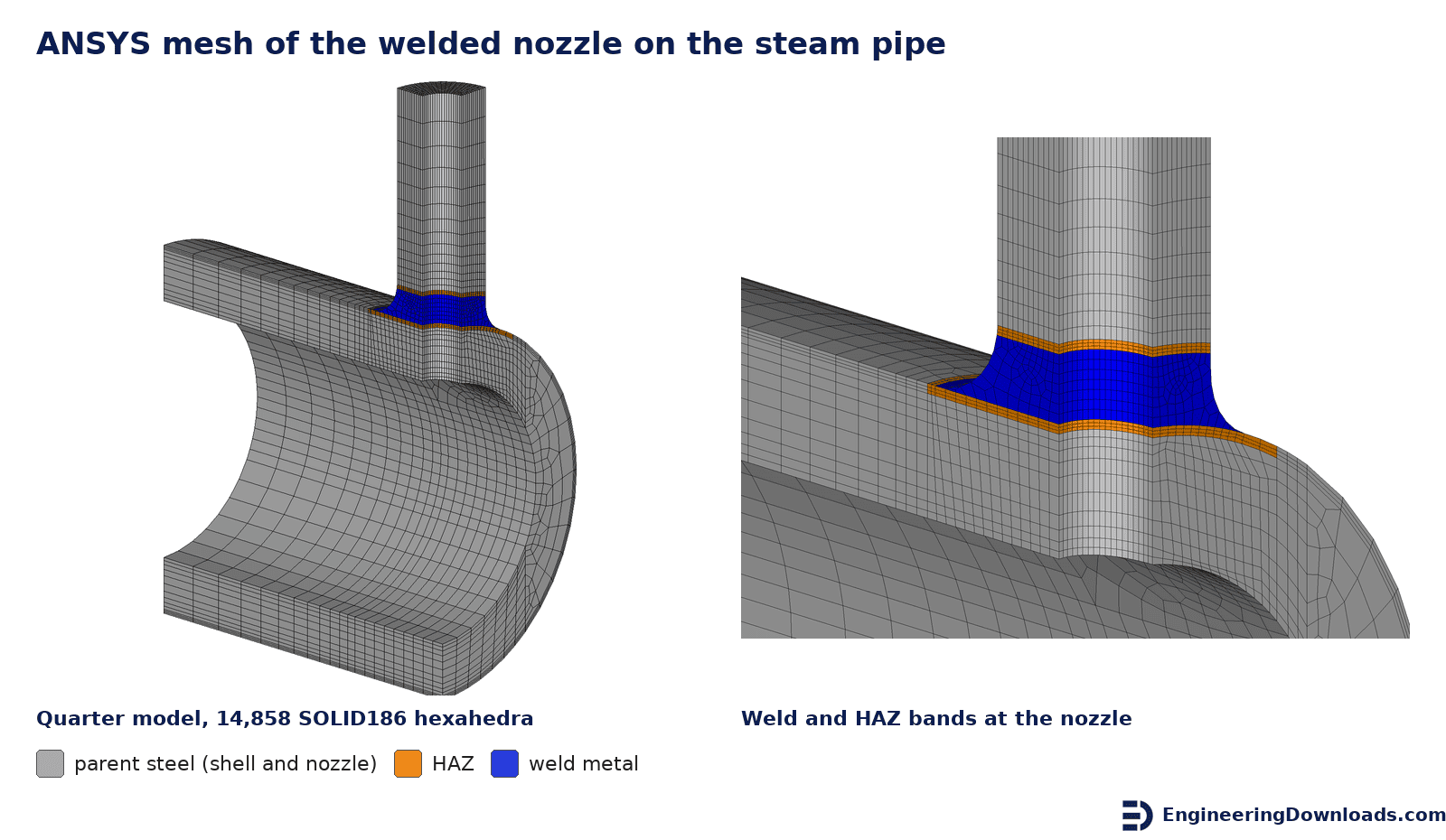
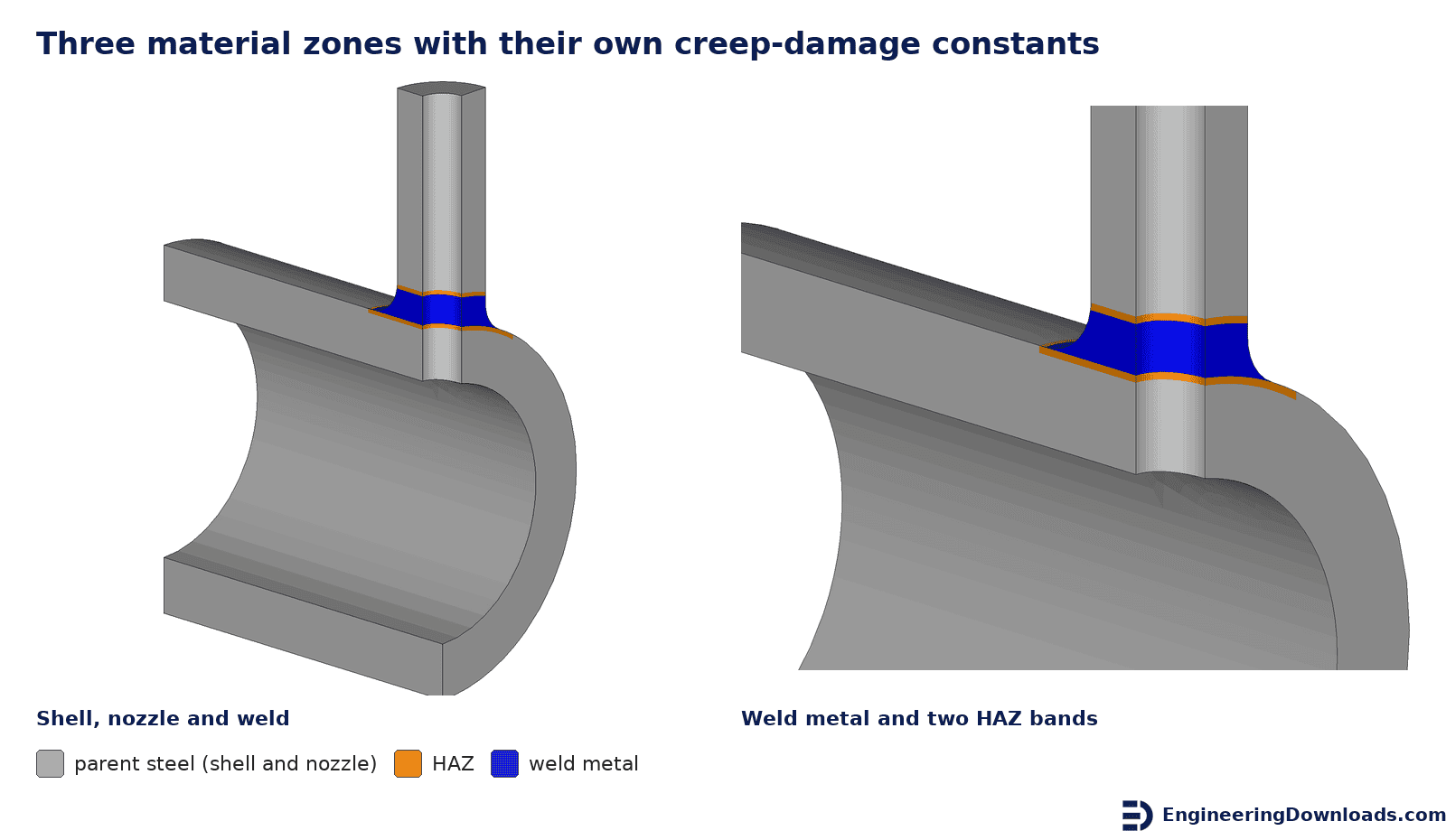
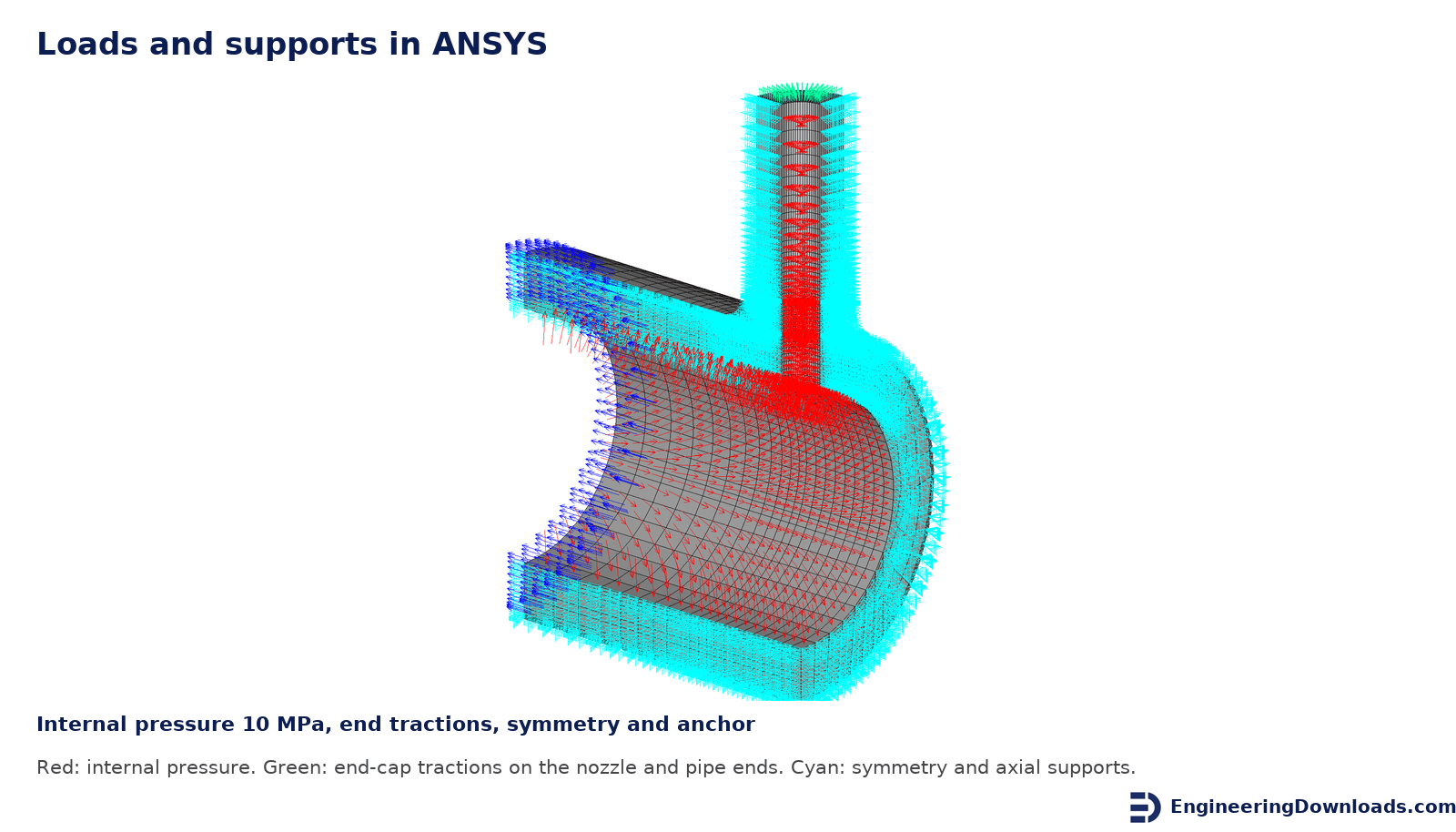
A quarter of the welded branch is modelled in 3D with the run pipe, the nozzle, the weld metal and two HAZ bands. Each zone carries its own creep-damage constants, and the load is 10 MPa internal pressure with end tractions and symmetry supports.
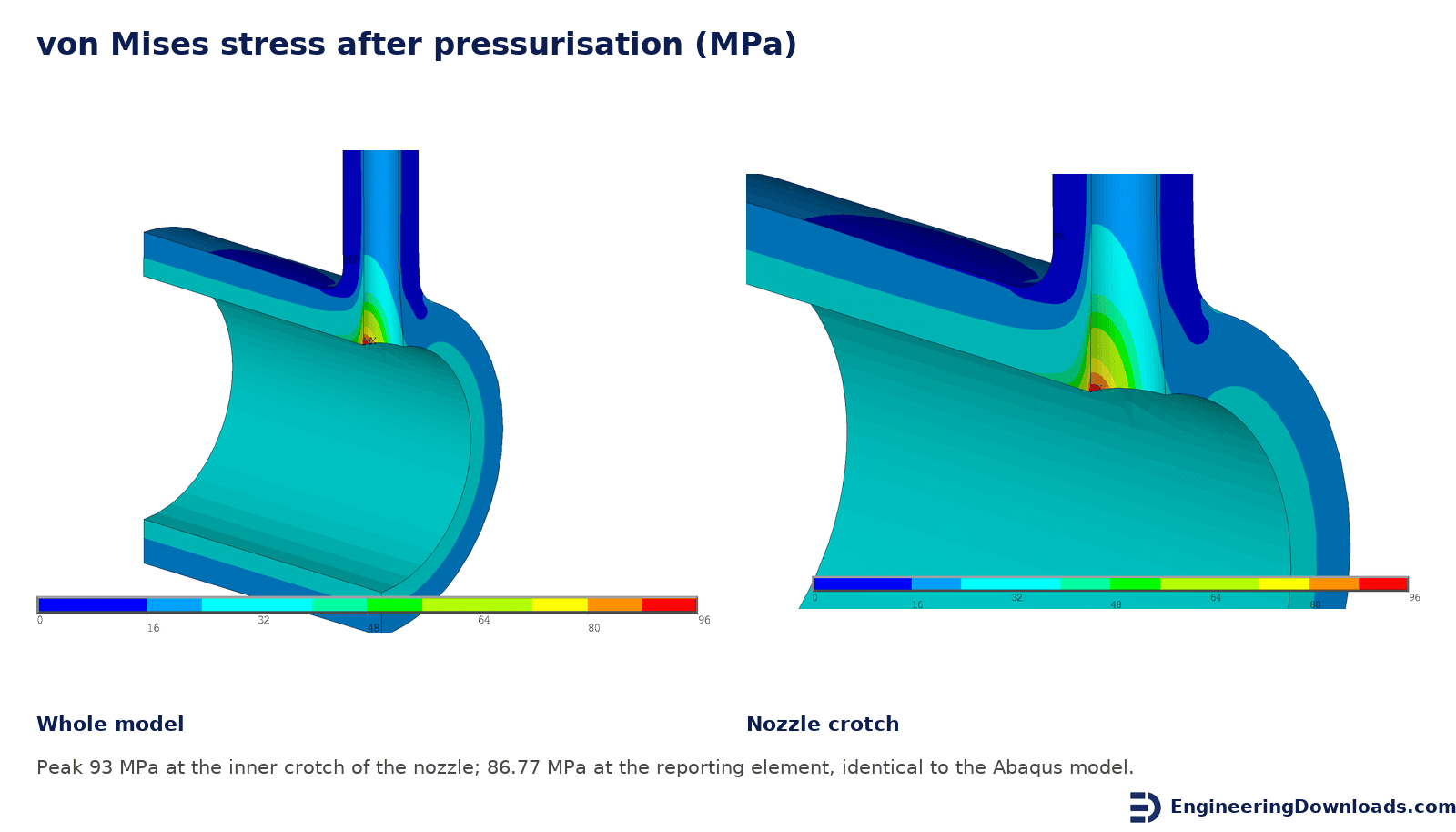
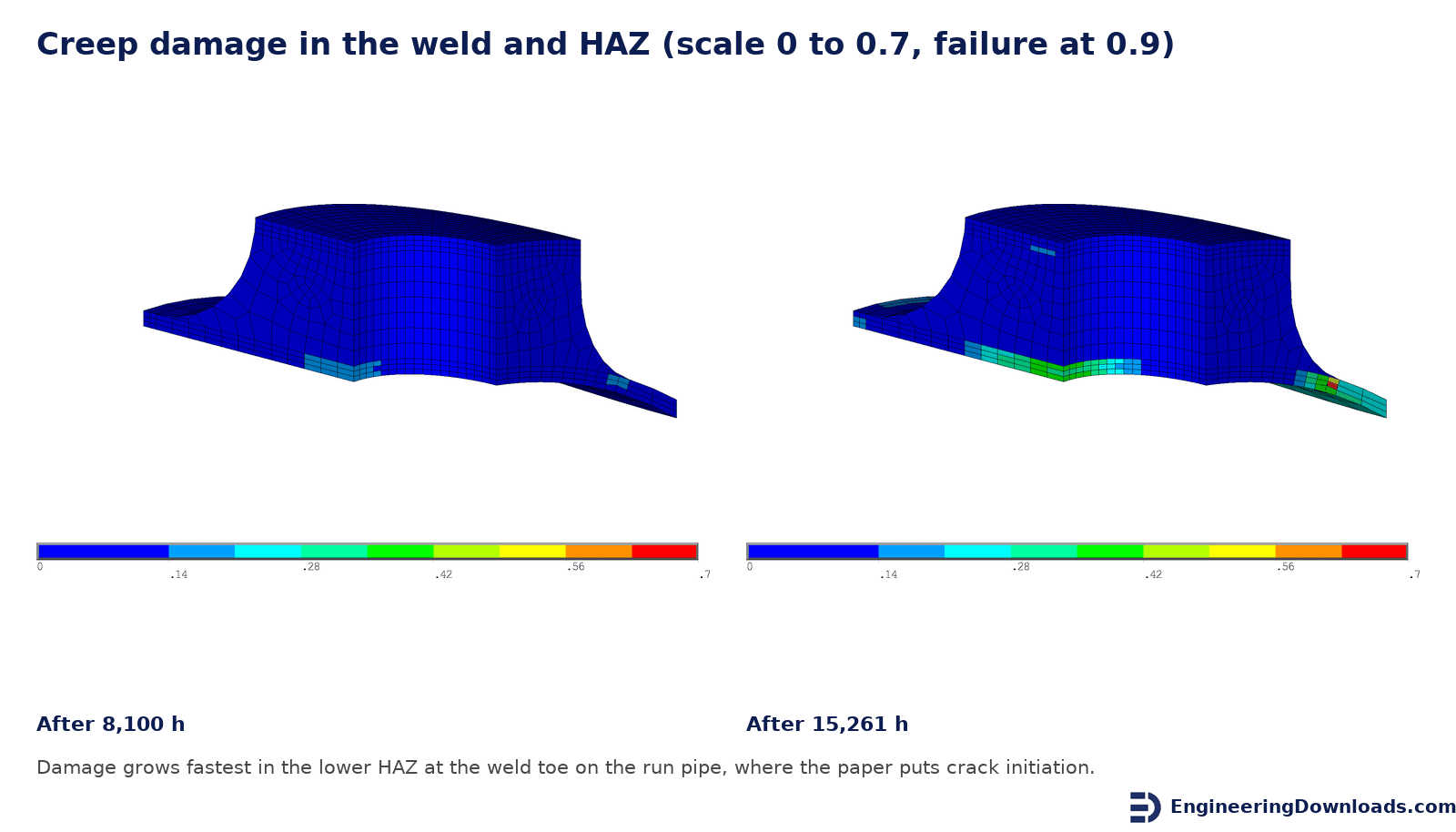
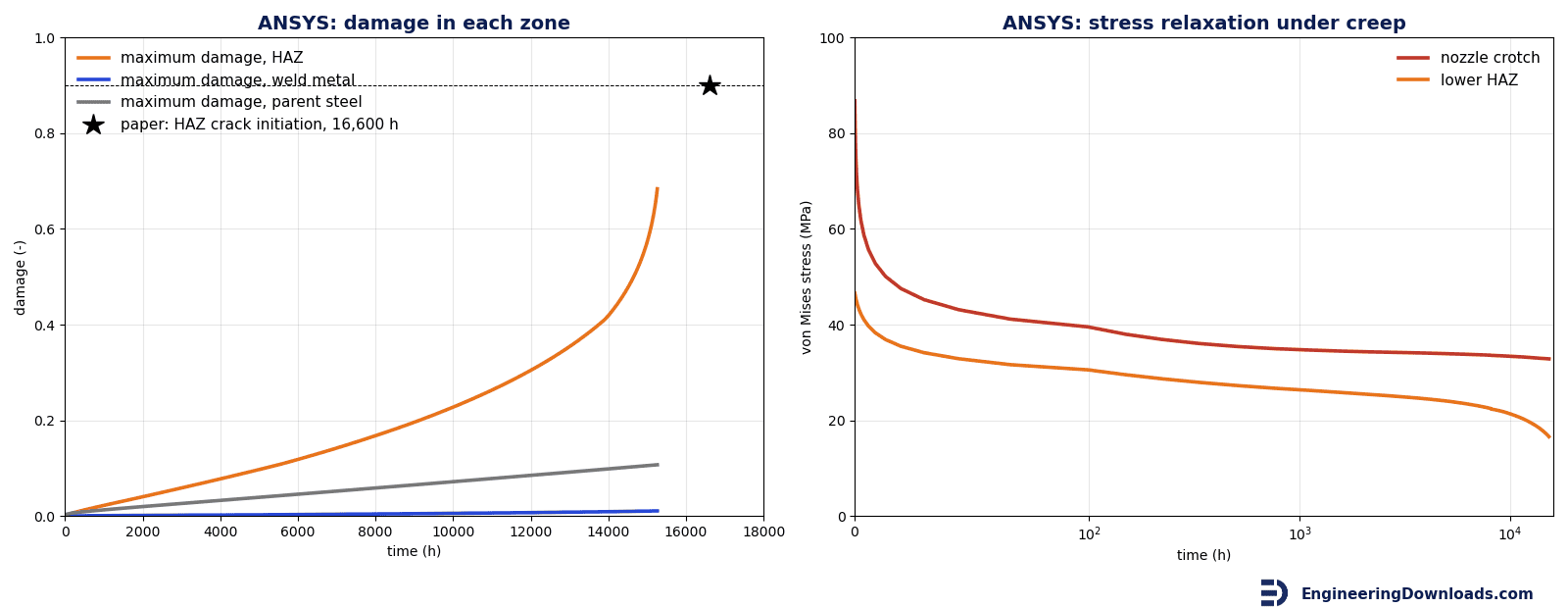
The von Mises stress at the branch crotch after 100,000 h of creep is 34.6 MPa in ANSYS against 34.4 MPa in the paper (+0.6 %). The creep damage concentrates in the lower HAZ at the weld toe, which is the crack initiation site reported in the paper.
Paper: A.A. Becker, T.H. Hyde, W. Sun and P. Andersson (2002), Benchmarks for finite element analysis of creep continuum damage mechanics, Computational Materials Science 25, 34–41. DOI: 10.1016/S0927-0256(02)00247-1
The paper explains that creep rupture life can be predicted by adding a damage variable to the finite element formulation: it runs from 0 (intact) to 1 (fully damaged) in each element until the section fails. The numerical difficulty is the very small time steps needed as damage approaches 1, so the authors publish benchmark problems that other codes can use to verify their own solutions. Two independent codes are used, an in-house program and a commercial solver with a user material routine, and the tests cover uniaxial, biaxial, triaxial and multi-material creep and damage. (Source: the paper above.)
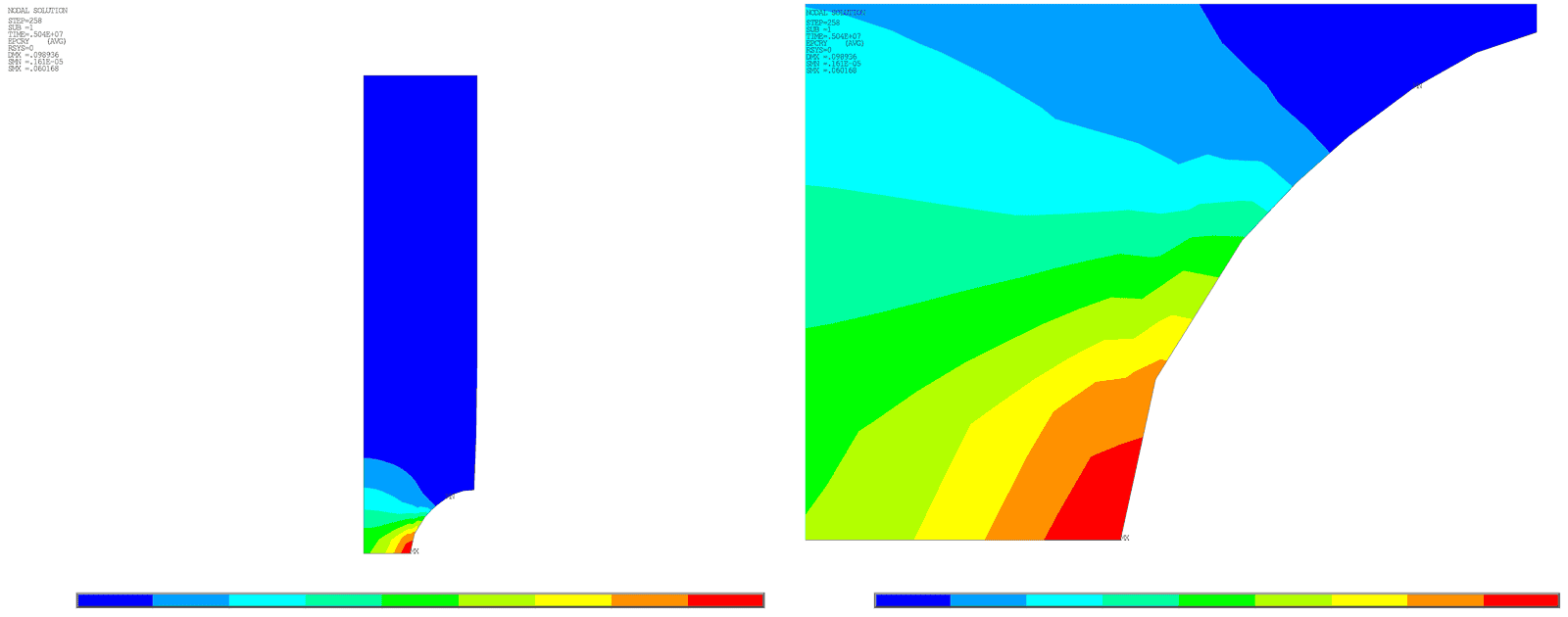
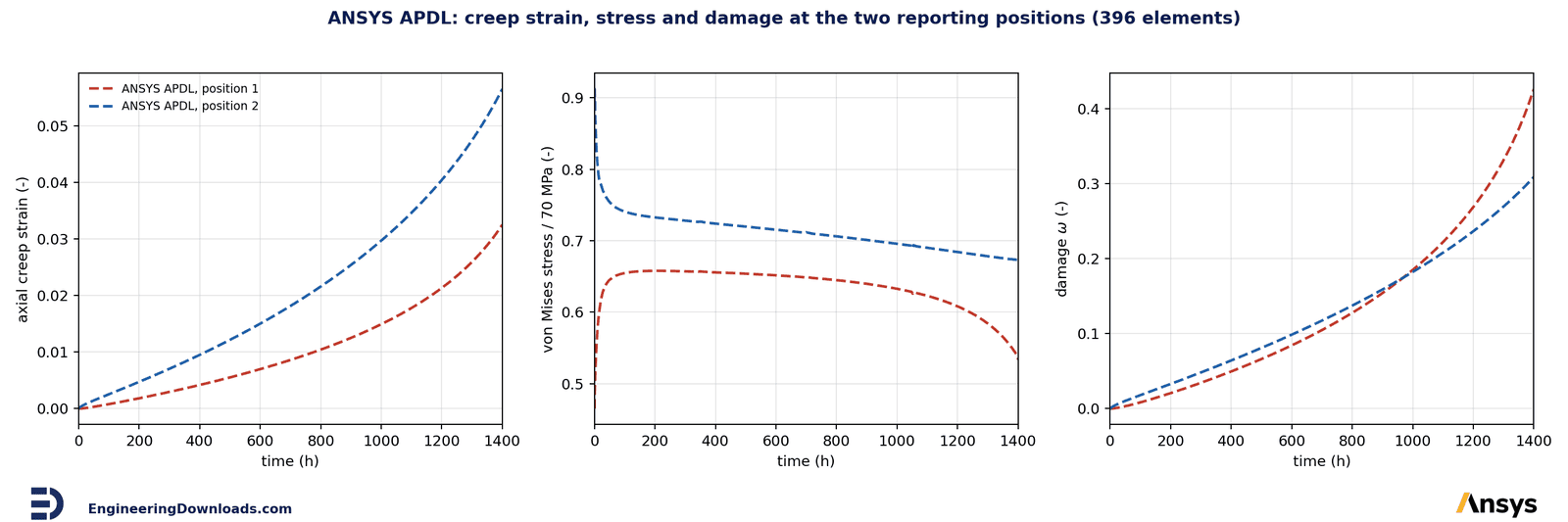
The notched round bar is modelled as an axisymmetric quarter with symmetry supports and an axial traction on the end face, at 640 °C for a 1400 h creep hold, with damage carried at every Gauss point.
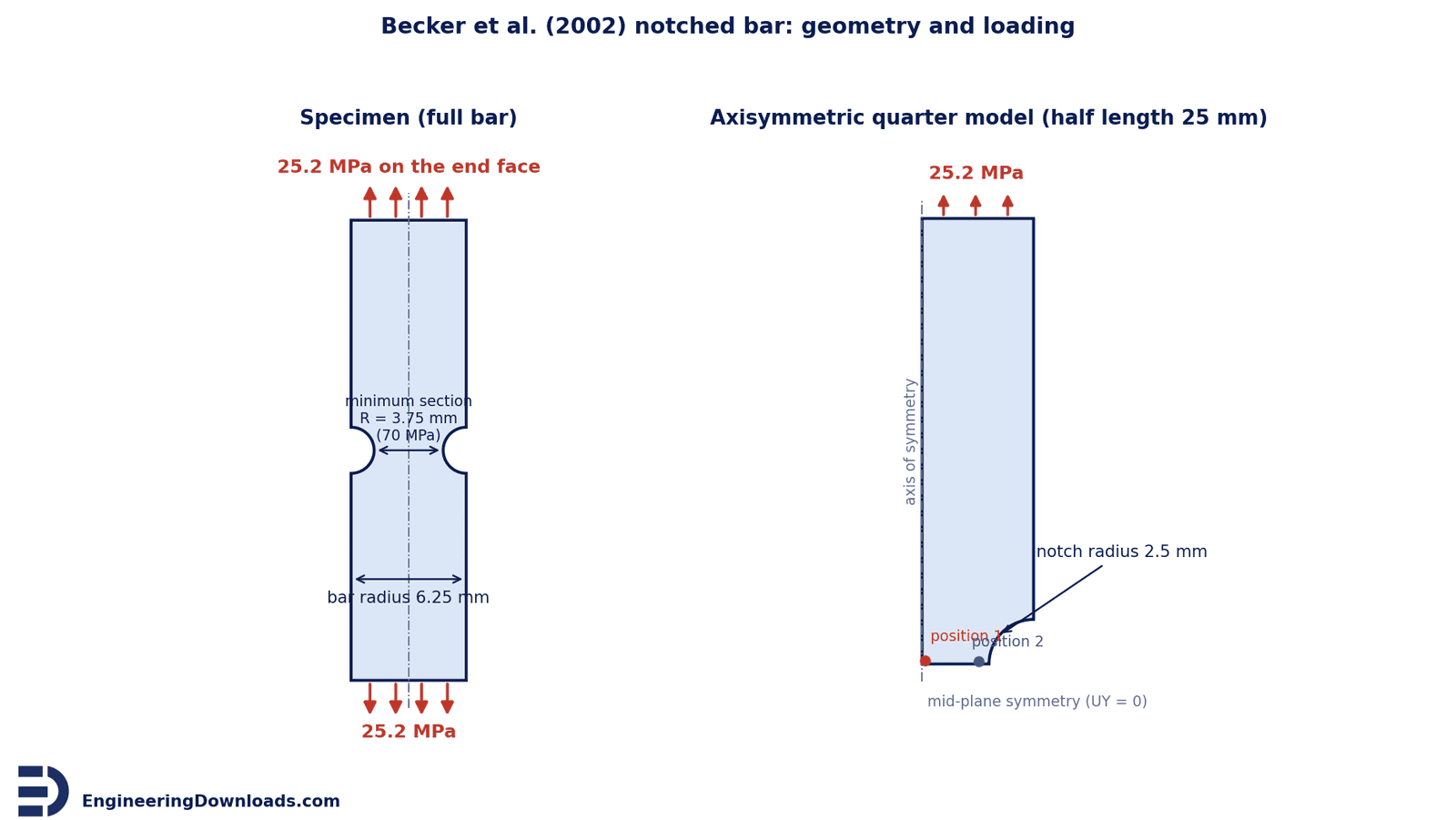
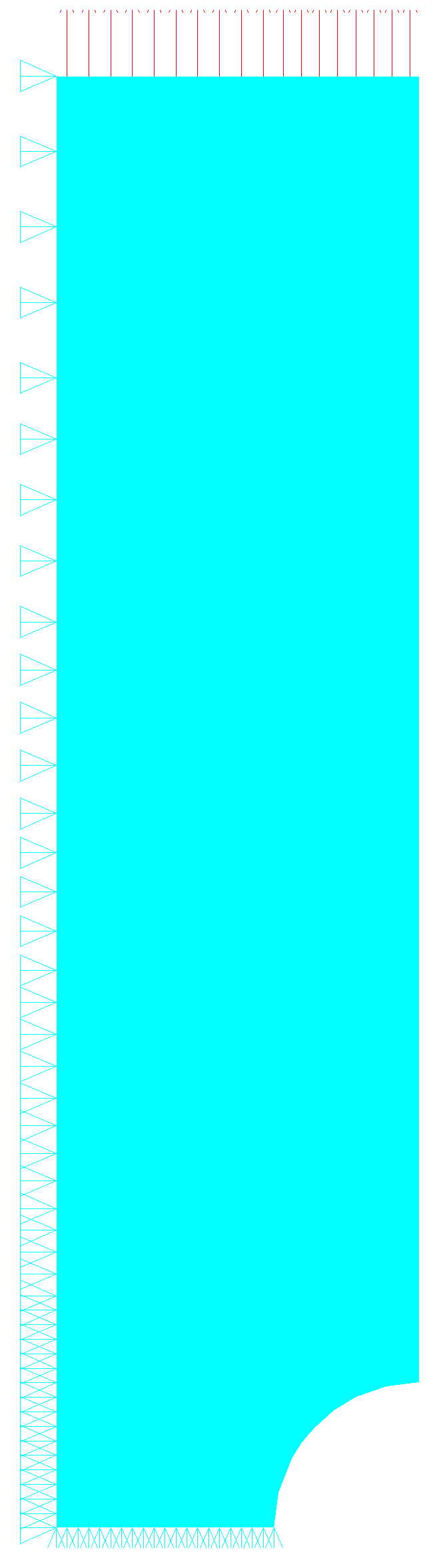
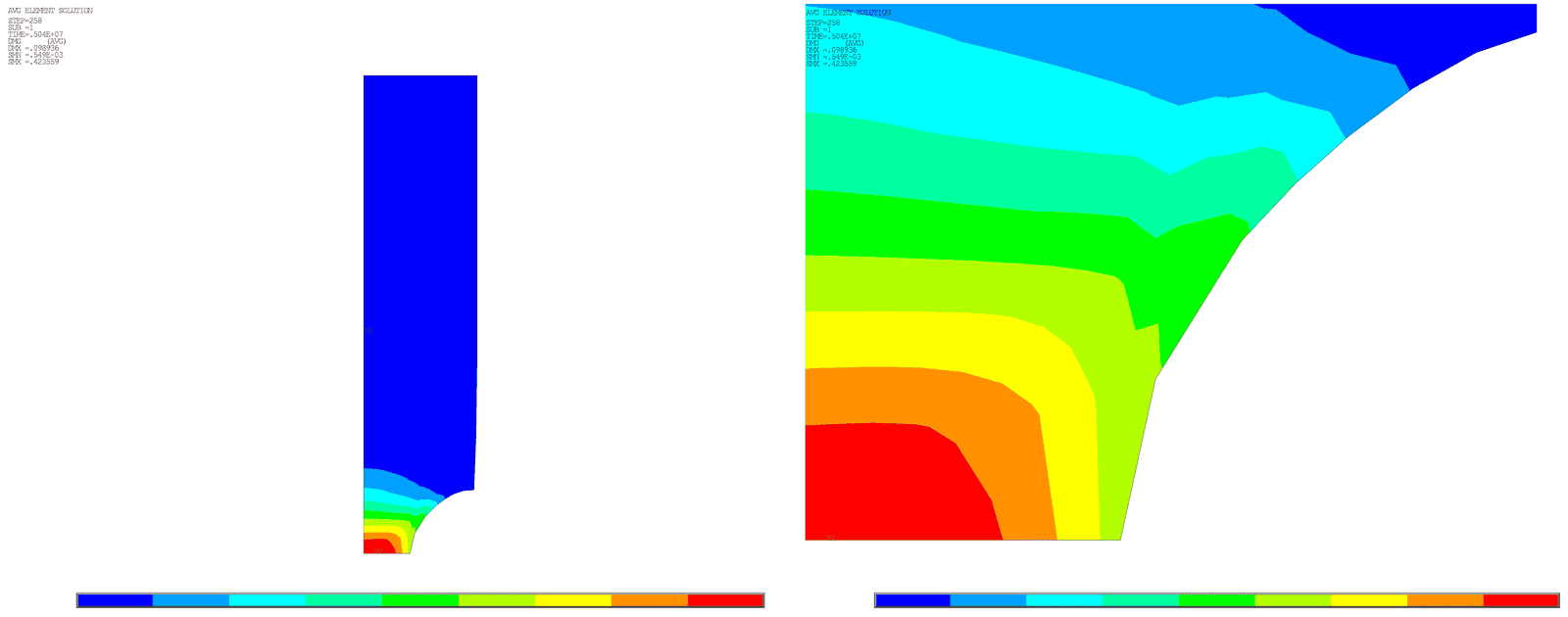
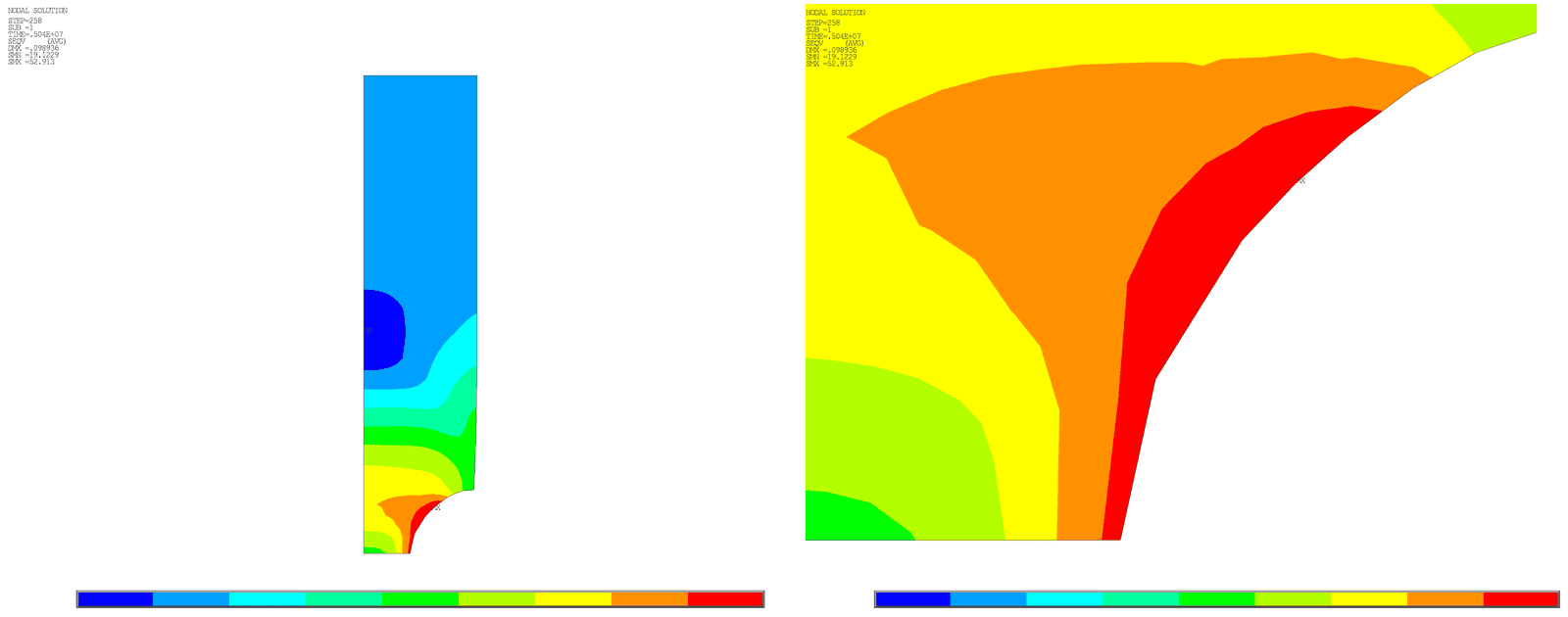
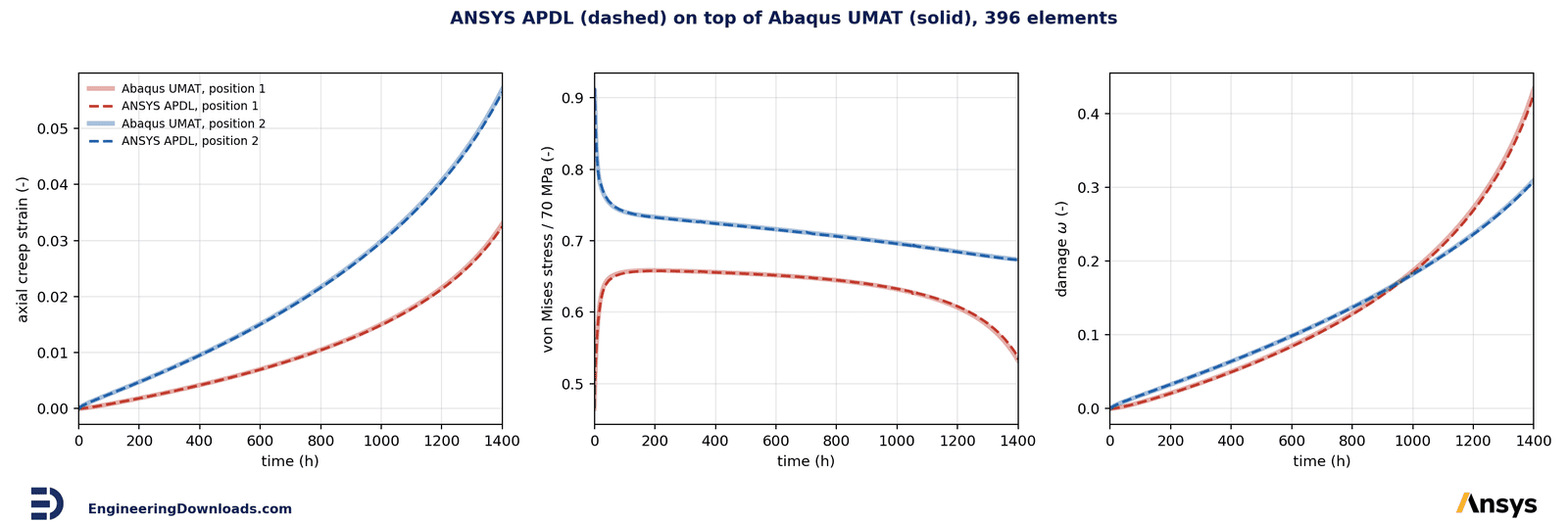
The ANSYS creep strain, equivalent stress and damage curves follow the markers of Fig. 6 of Becker et al. (2002) at the two reporting positions over the 1400 h hold. The ANSYS results are within 2 % of an independent Abaqus solution of the same problem.
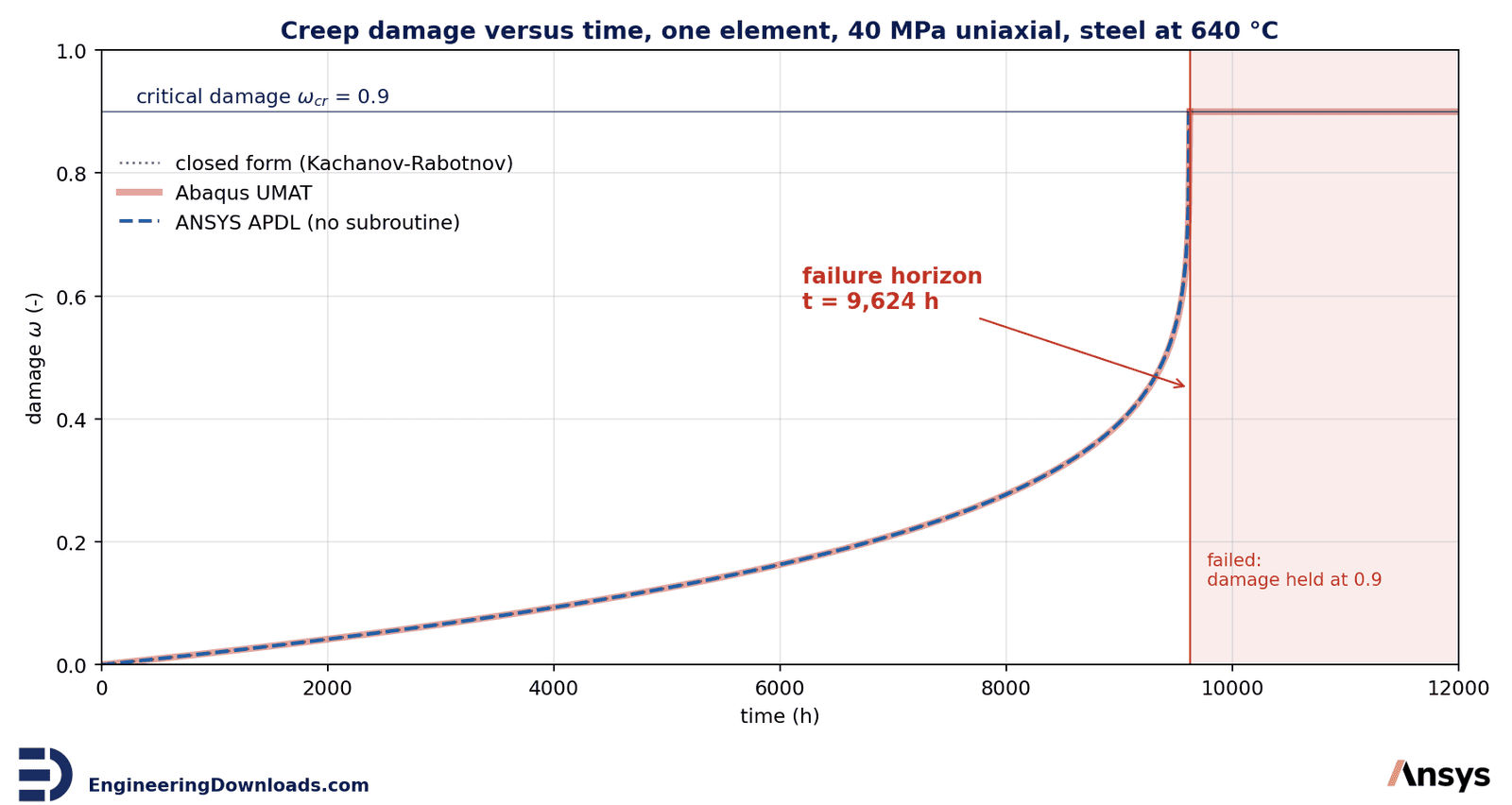
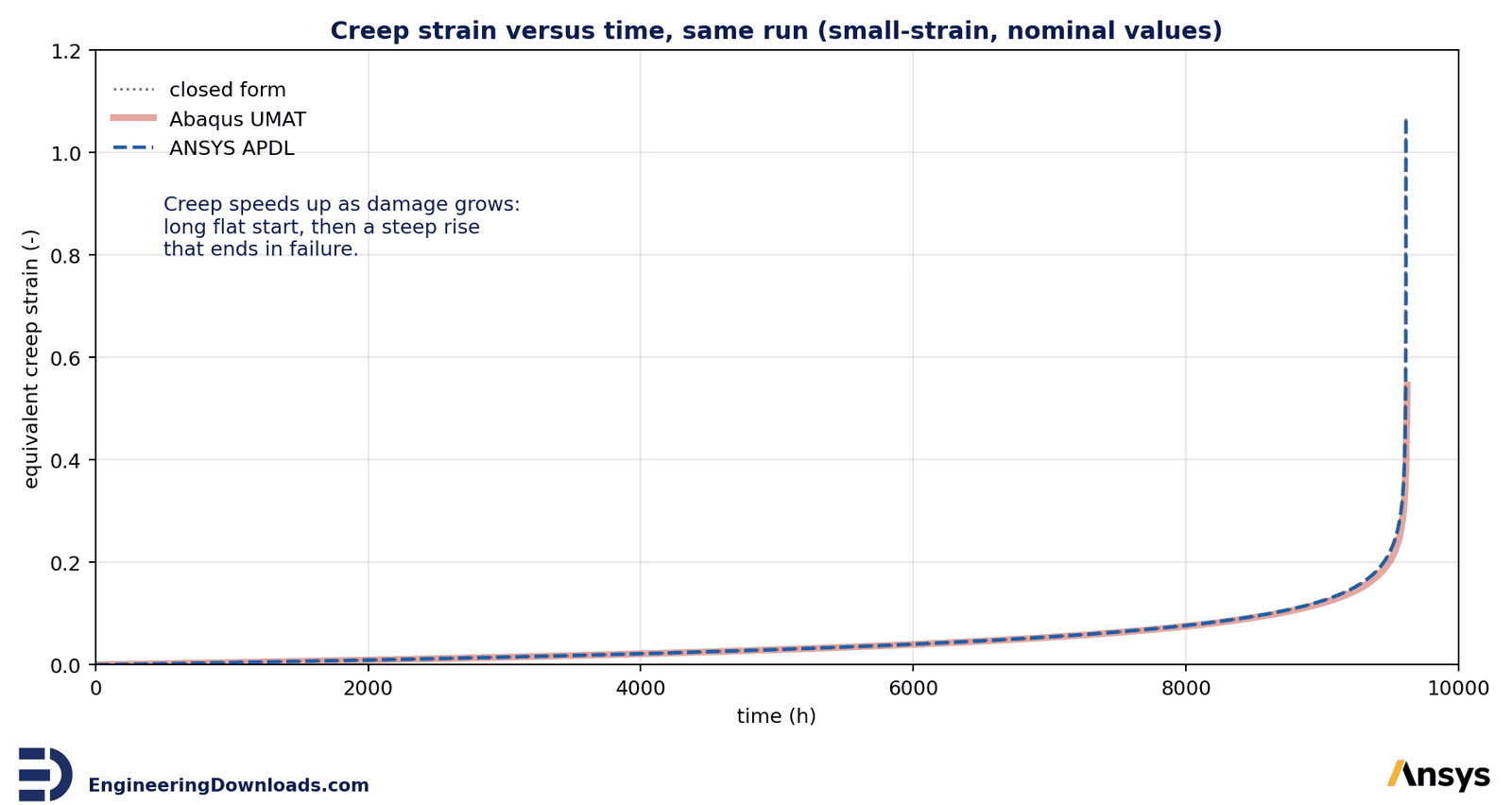
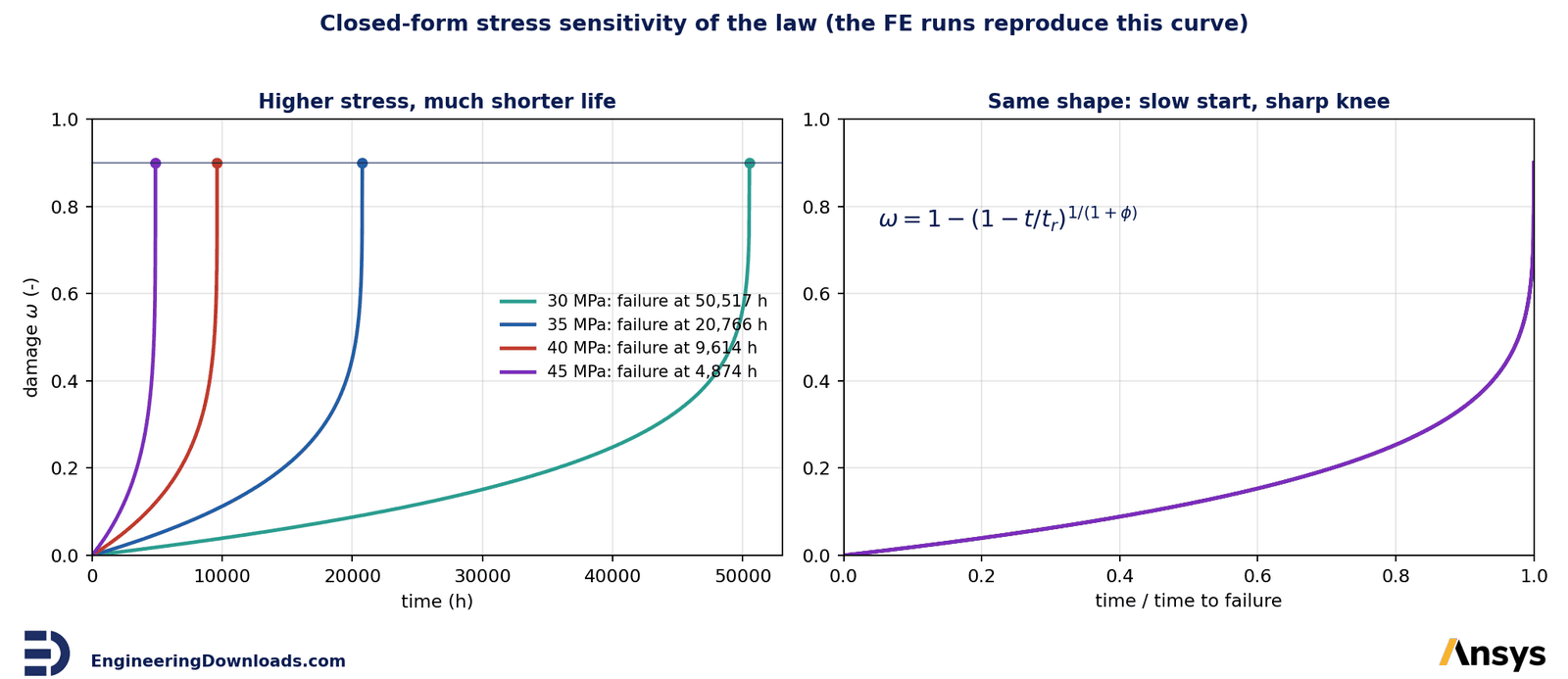
One element under constant uniaxial stress shows the whole creep damage story in the simplest setting: a long, almost flat start and a sharp upturn as damage approaches failure. The form of the law follows Becker et al. (2002), cited above, and the steel constants are those printed in Table 3 of Hosseini-Toudeshky and Jannesari (2022), cited under Model 1. The deck changes the stress with one number.
At 40 MPa the element reaches the failure damage of 0.9 at 9,614.6 h in ANSYS against 9,614.2 h from the closed-form solution. This is a closed-form check of the implementation of the law, not a test validation.
The decks, meshes and scripts are delivered as plain input files, so the models run in your own ANSYS installation and you can change the material constants, loads and mesh.
Engineers, researchers and graduate students working on creep, continuum damage mechanics, welded joints, power-plant piping and fitness-for-service, who want working ANSYS APDL creep damage models built from published papers.
Each model is also offered on its own: welded steam pipe branch with HAZ in ANSYS APDL, Becker 2002 notched bar in ANSYS APDL and creep damage vs time and failure horizon in ANSYS APDL. See also the article Life Assessment and Creep Damage Analysis of Welded Components.
What do I receive? Three ANSYS Workbench projects (.wbpz), the APDL decks and meshes, one-click run files and PDF tutorials.
Does it run in my ANSYS? Yes. All input files and scripts are included and run in your own ANSYS installation; ANSYS itself is not included.
Can I use my own material or load? Yes. The constants and loads are set at the top of the decks.
Quality guarantee: if you are not satisfied with the delivered product, we will refund you.
Need more than the files?
There are two ways we can help. Book a one hour online consultation if you want to talk a problem through with a CAE engineer, using the checkbox in the order box. Order a project if you need a full simulation built for you, delivered to an agreed scope, price and deadline under a written contract.
We work on FEA and CFD for engineers, researchers and companies. Order your project, or message us on WhatsApp for a quick reply.
Other packages engineers working on this topic also download.
 Creep Damage of a Welded Steam Pipe Branch in ANSYS APDL: HAZ Failure, All-Hex Mesh and Paper Comparison€149,00
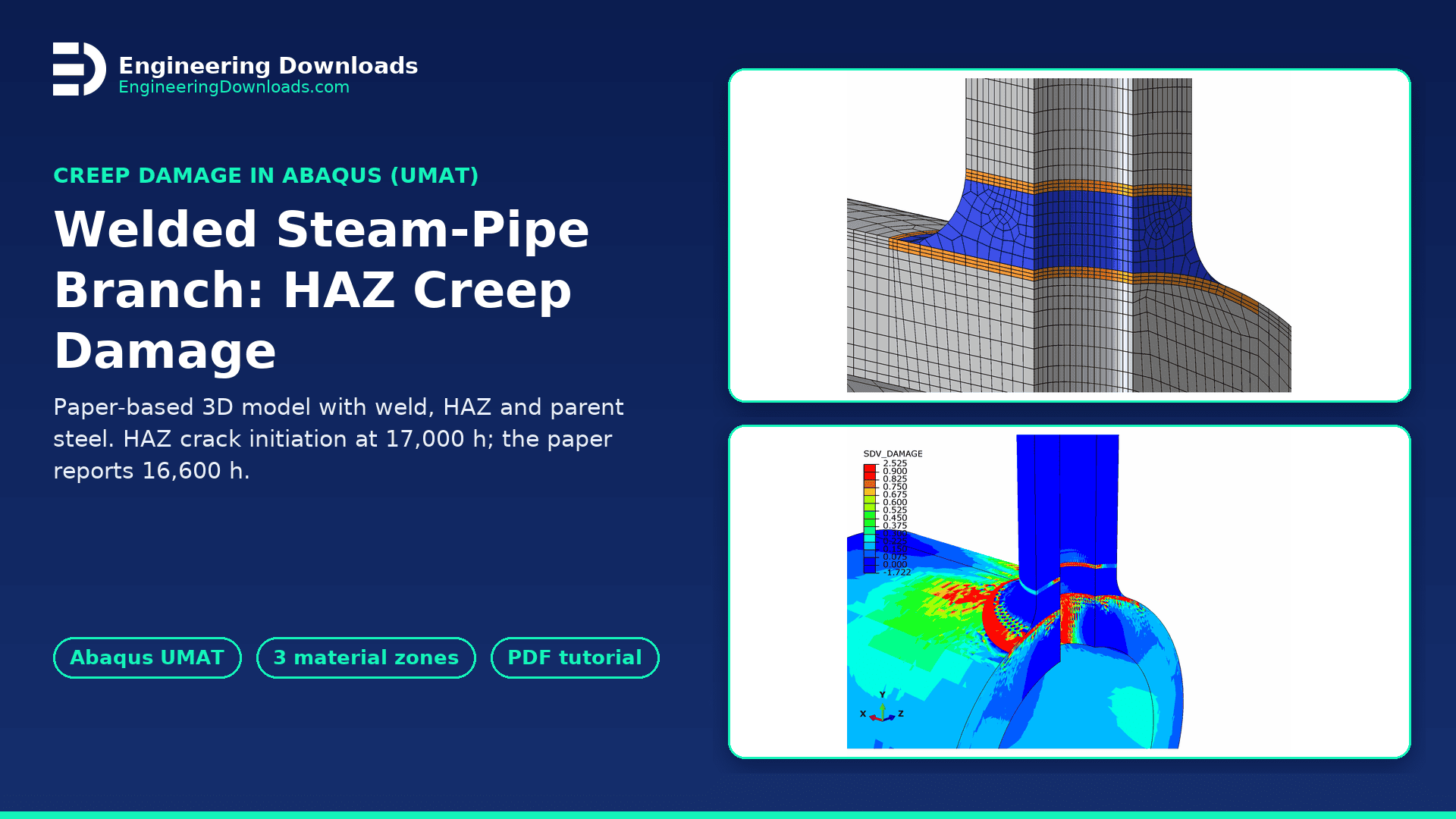 Creep Damage Analysis of a Welded Steam Pipe Branch in Abaqus: UMAT, HAZ Hex Mesh and Paper Comparison€149,00
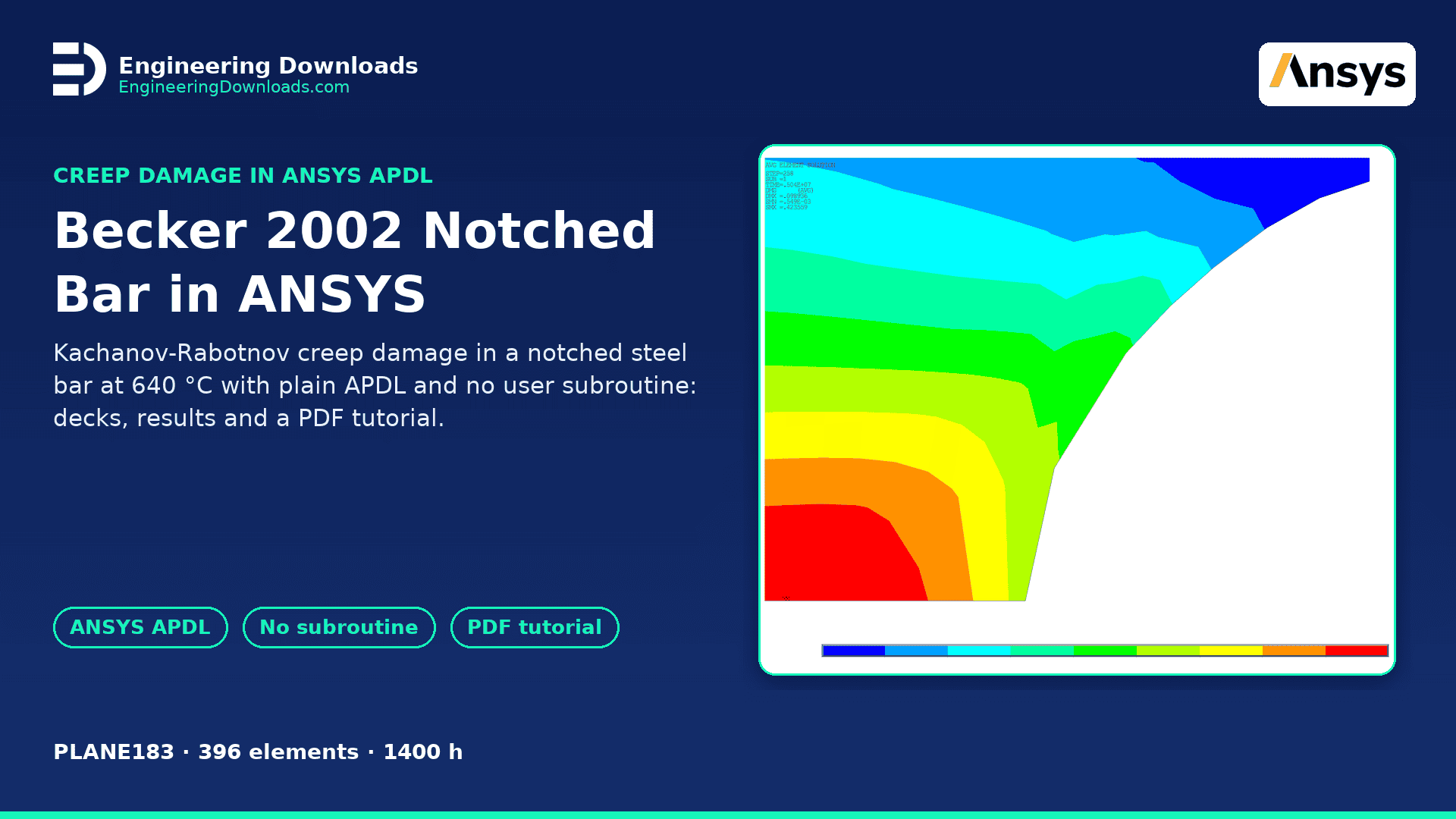 Creep Damage Notched Bar in ANSYS APDL: Becker 2002 Benchmark with No User Subroutine, Decks and Paper Comparison€49,00
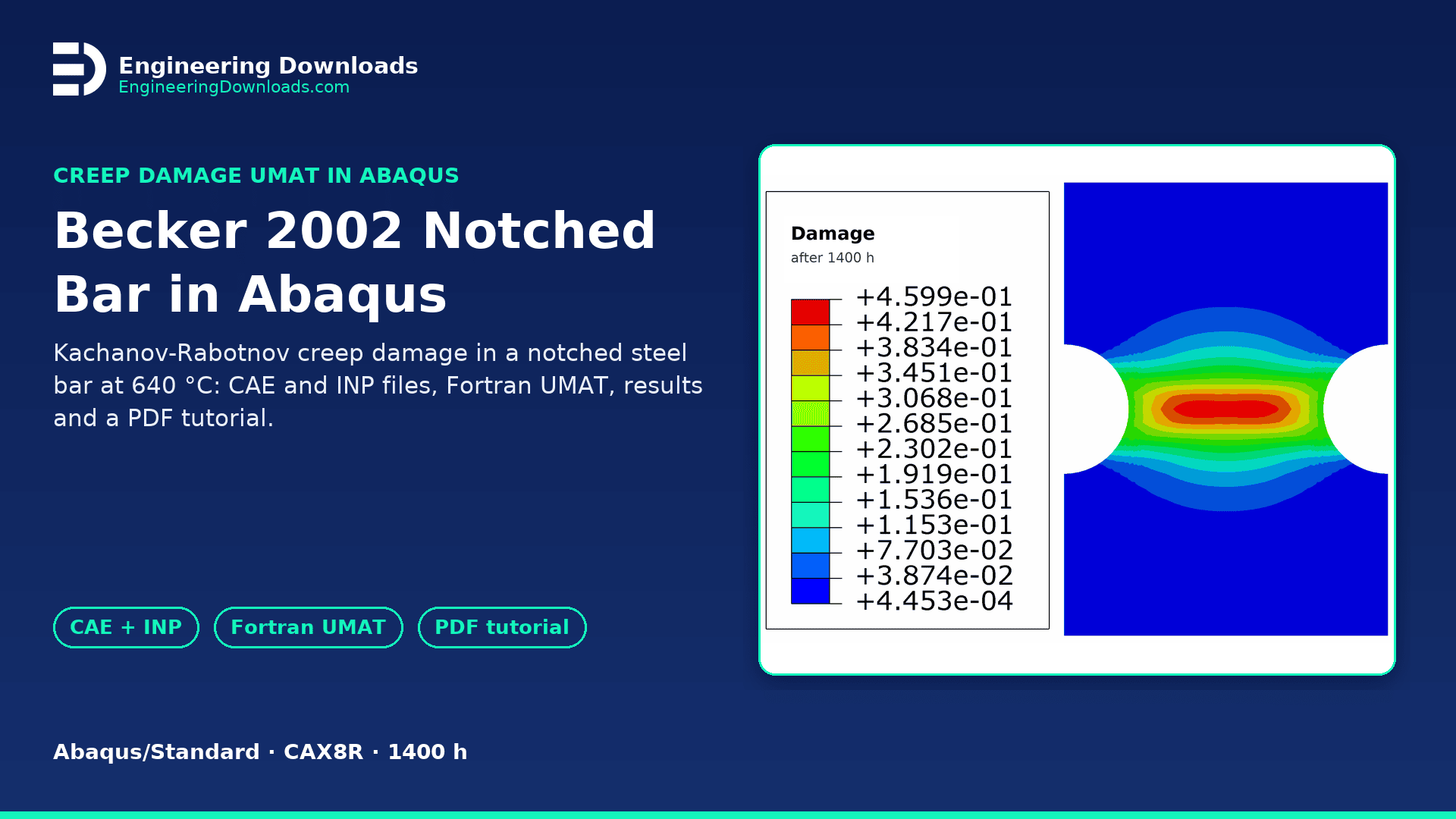 Creep Damage Notched Bar in Abaqus: Becker 2002 Benchmark with UMAT, CAE and INP Files and Paper Comparison€49,00
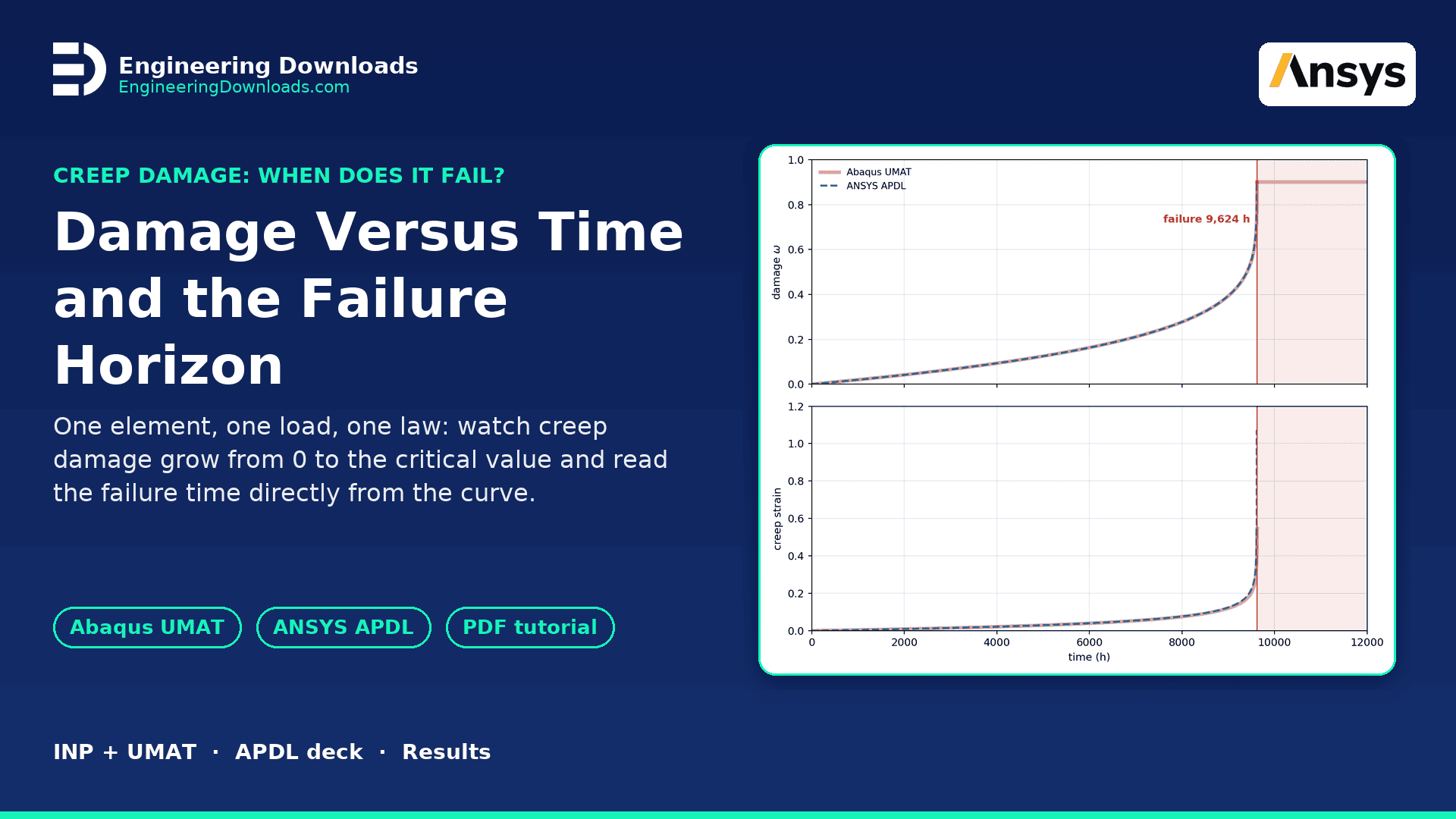 Creep Damage Versus Time in ANSYS APDL: Failure Horizon of a Single Element, No User Subroutine€49,00
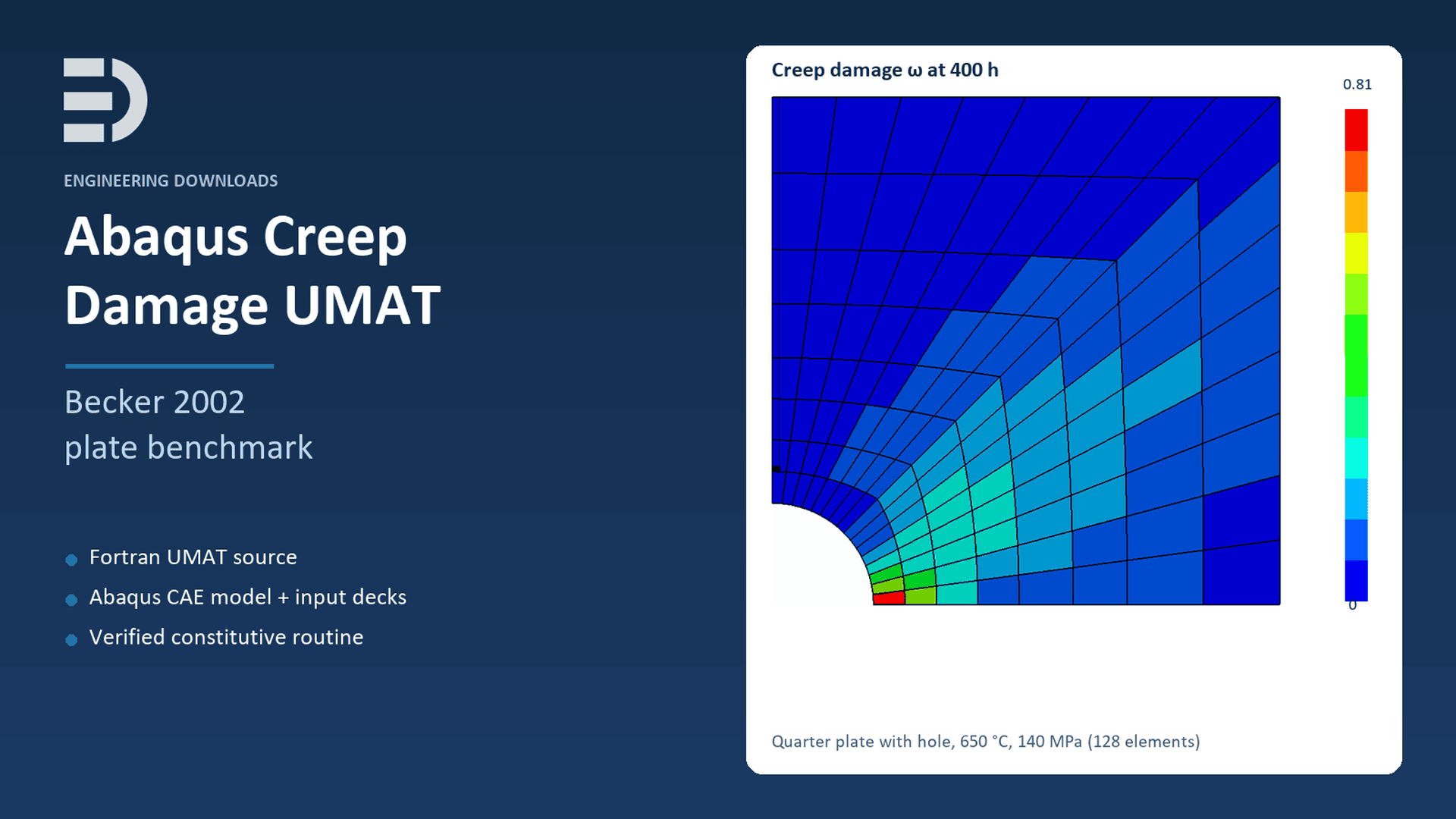 Creep Continuum Damage UMAT in Abaqus: Becker 2002 Perforated Plate Benchmark€49,00Creep Damage Versus Time in Abaqus: Failure Horizon of a Single Element with a Kachanov-Rabotnov UMAT€49,00
 API 579 Example 10.1 in Abaqus: Vessel Creep After a Temperature Excursion, Omega Damage Model and One-Click Python Check€129,00

Need a full custom project? See the options below.

€129,00

€179,00

€149,00

€119,00

€129,00
See more
Want to receive push notifications for all major on-site activities?