Need a full custom project? See the options below.
Need a full custom project? See the options below.
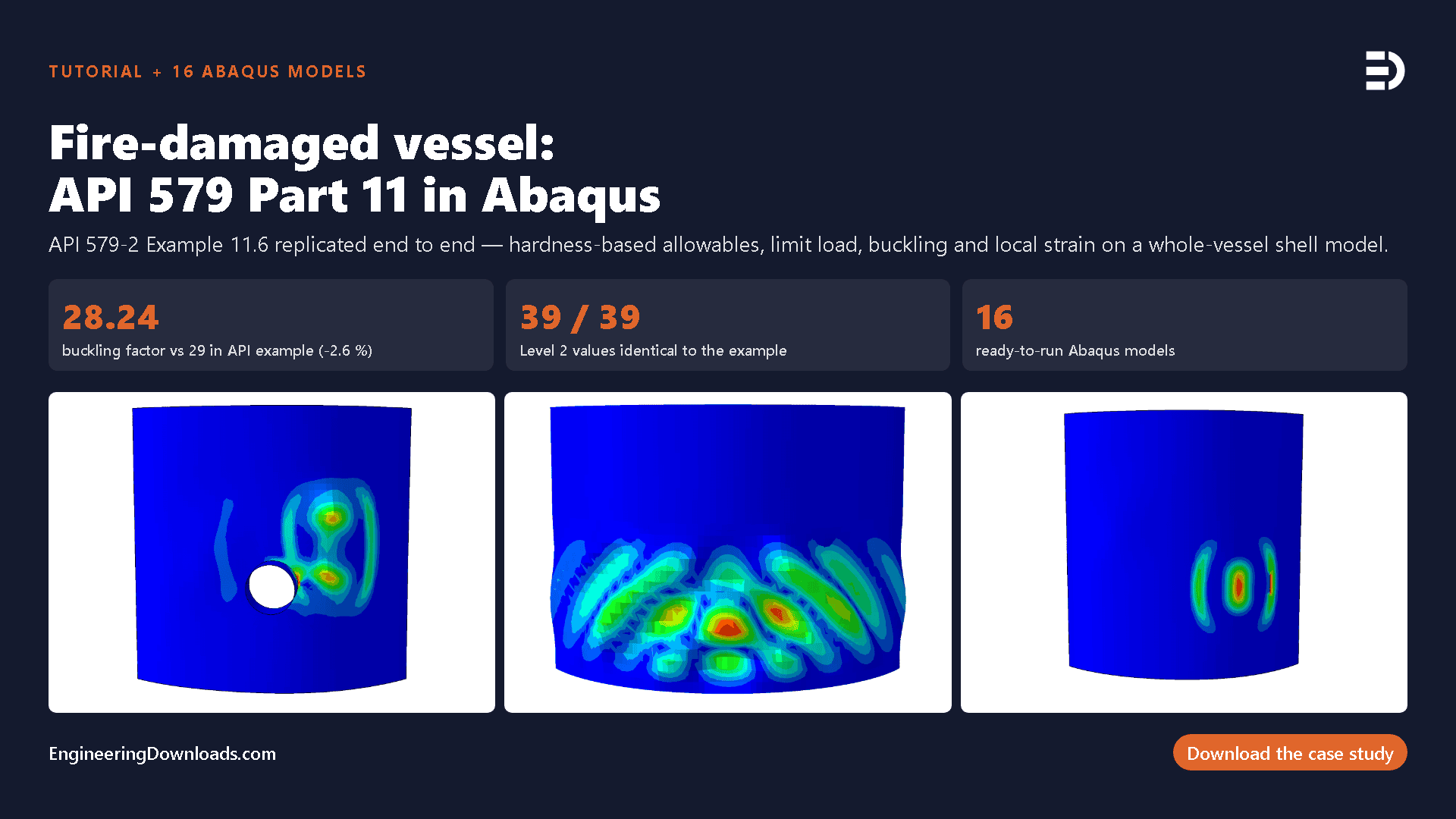
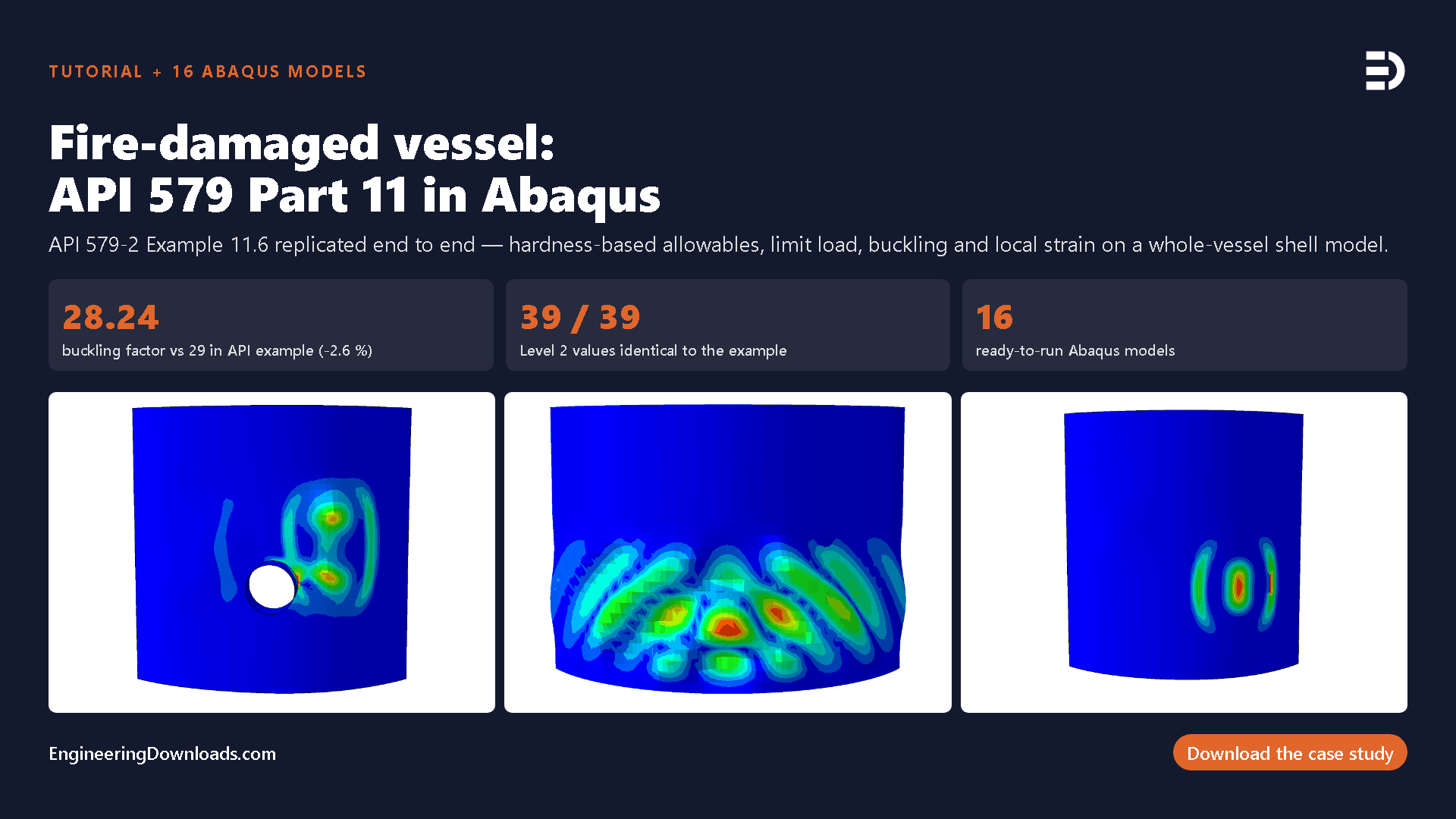
A packing fire hotter than 1900 °F left four bulges in the shell of an FCC main fractionator. Can the tower go back into service? API 579-1/ASME FFS-1 Part 11 answers that in three levels, and the published API 579-2 Example 11.6 needs all of them. This Abaqus package rebuilds the whole assessment: the Level 2 hardness-based allowable stresses and MAWP, then the Level 3 finite-element checks on a whole-vessel shell model with the fire distortions built into the mesh – limit load, linear buckling and the local strain criterion. You get 16 ready-to-run Abaqus models (INP + CAE), parametric Python scripts, reference results and a PDF tutorial, with every number compared against the example.
Source: API 579-2/ASME PTB-14 Fitness-For-Service Example Problem Manual, Part 11 Fire Damage, Example 11.6. The vessel is the main fractionator of an FCC unit: ASTM A70 firebox steel (1947), inside diameter 228 in, upper shell 5/8 in, lower shell 7/8 in with 7/64 in Type 410 cladding, 1 in and 1-3/8 in heads, design 25 psig. During a packing fire a thermowell read about 1900 °F; four areas bulged (Dist. 1 around Manway M2, Dist. 2 below Nozzle T, Dist. 3 above a circumferential weld and Dist. 4, a laser-scanned zone at 57.5–70.5 ft). Level 1 is not satisfied, Level 2 cannot accept a bulge, so the example finishes with a Level 3 FE assessment.
| Item | This package |
|---|---|
| Geometry | Whole vessel: skirt, 2:1 elliptical heads, shell, Manway M2 and Nozzle T with necks and blind-flange thrust |
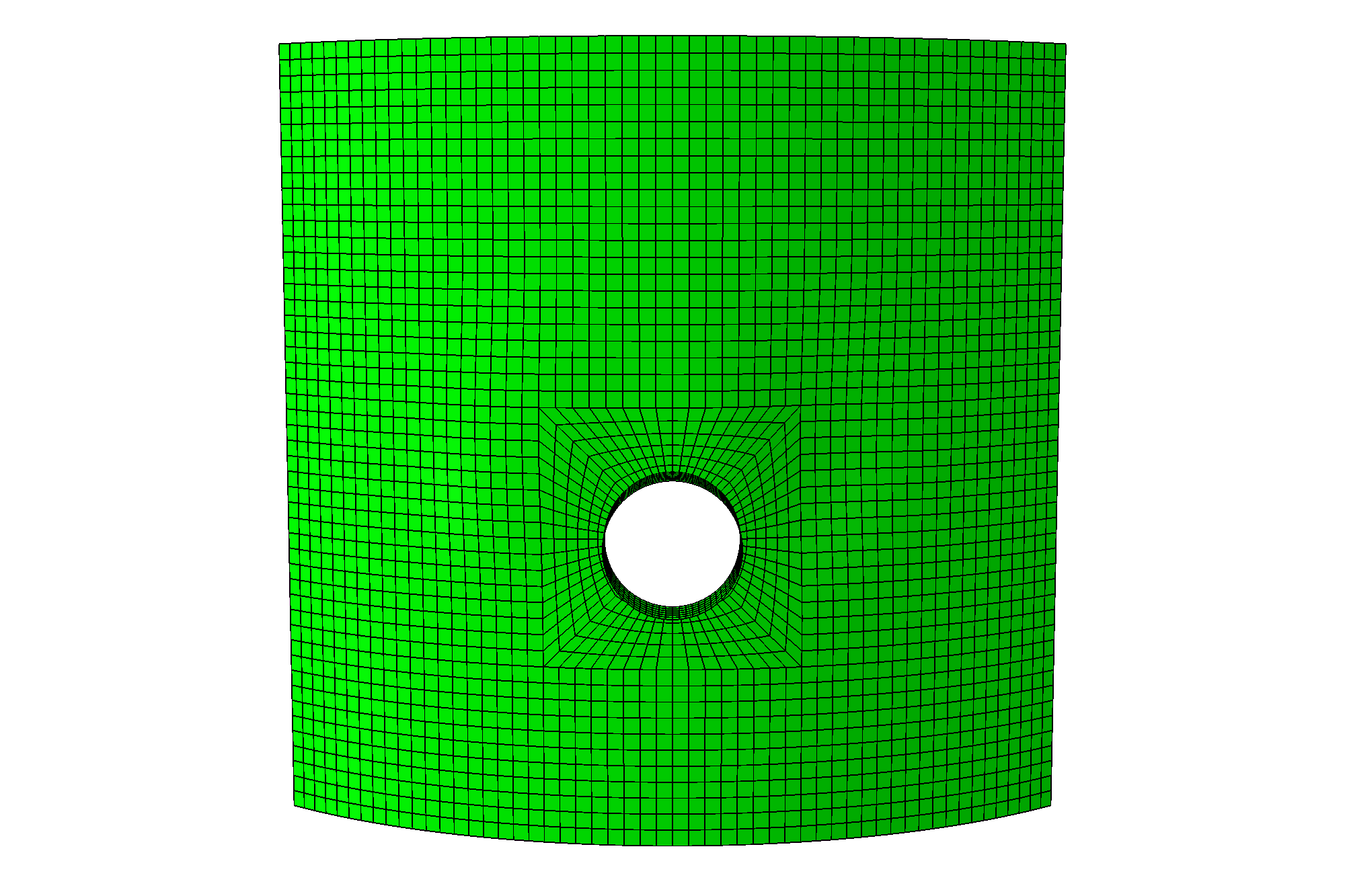
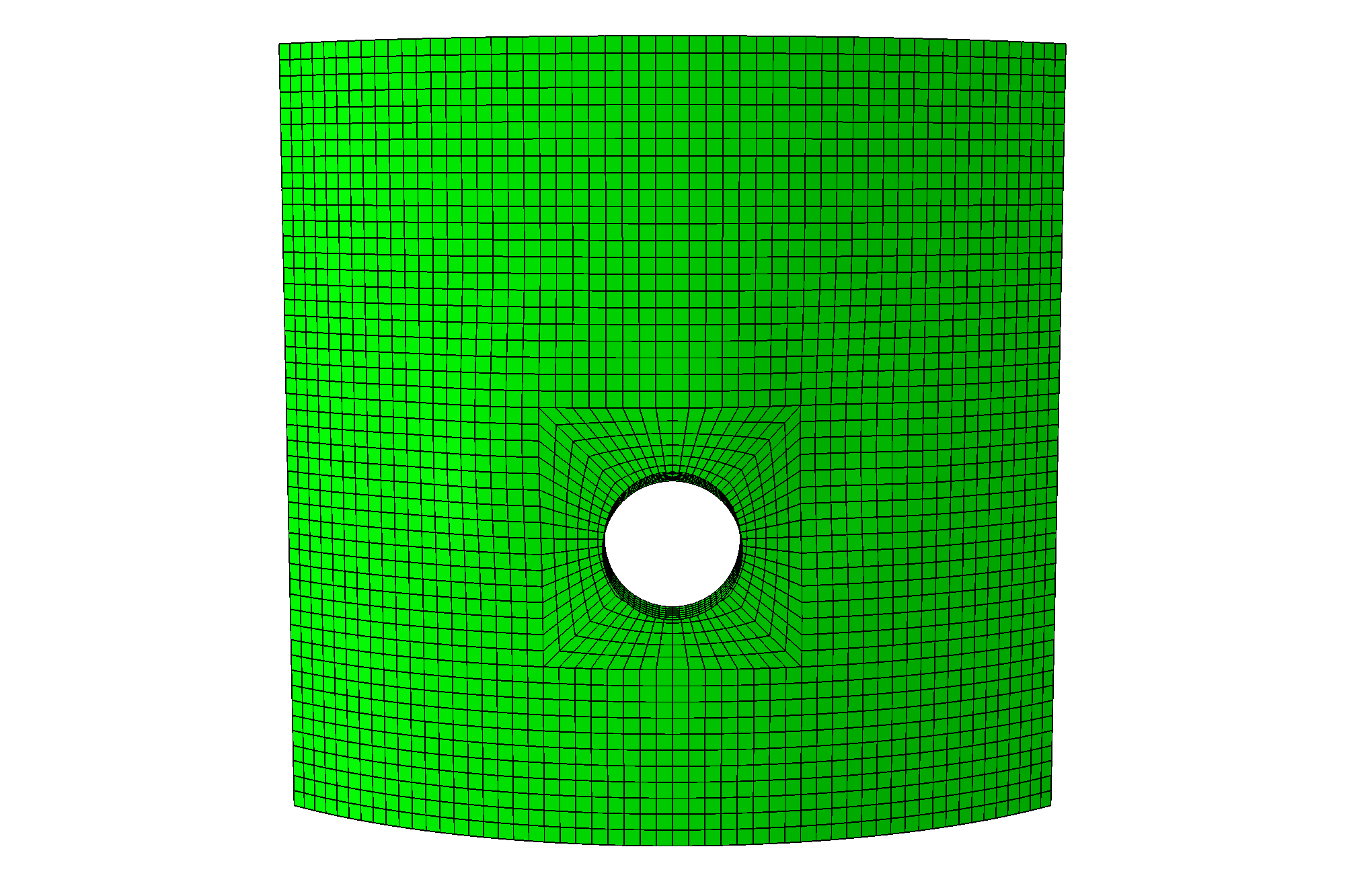
| Mesh | S4R/S3R shells, about 78,000 elements, 3 in pitch in the distortion zones, O-grid around the openings |
| Fire distortions | Built into the mesh as inward/outward lobes of the published size (text values and, in model M1F, the larger values printed on the example’s FE figure) |
| Loads | Dead weight, 25 psig internal pressure, wind 38 psf at grade to 66 psf at the top head (two ways: windward pressure and global lateral load) |
| Analyses | Riks limit load (EPP, σy = 1.5S), linear eigenvalue buckling, elastic-plastic NLGEOM local strain (ASME VIII-2 Annex 3-D curve) |
| Models | 16 INP + 16 CAE: M1, M1F, M2 × LL1, LL2, BUCK, BUCKG, LS, plus a 5/8 in skirt sensitivity case |
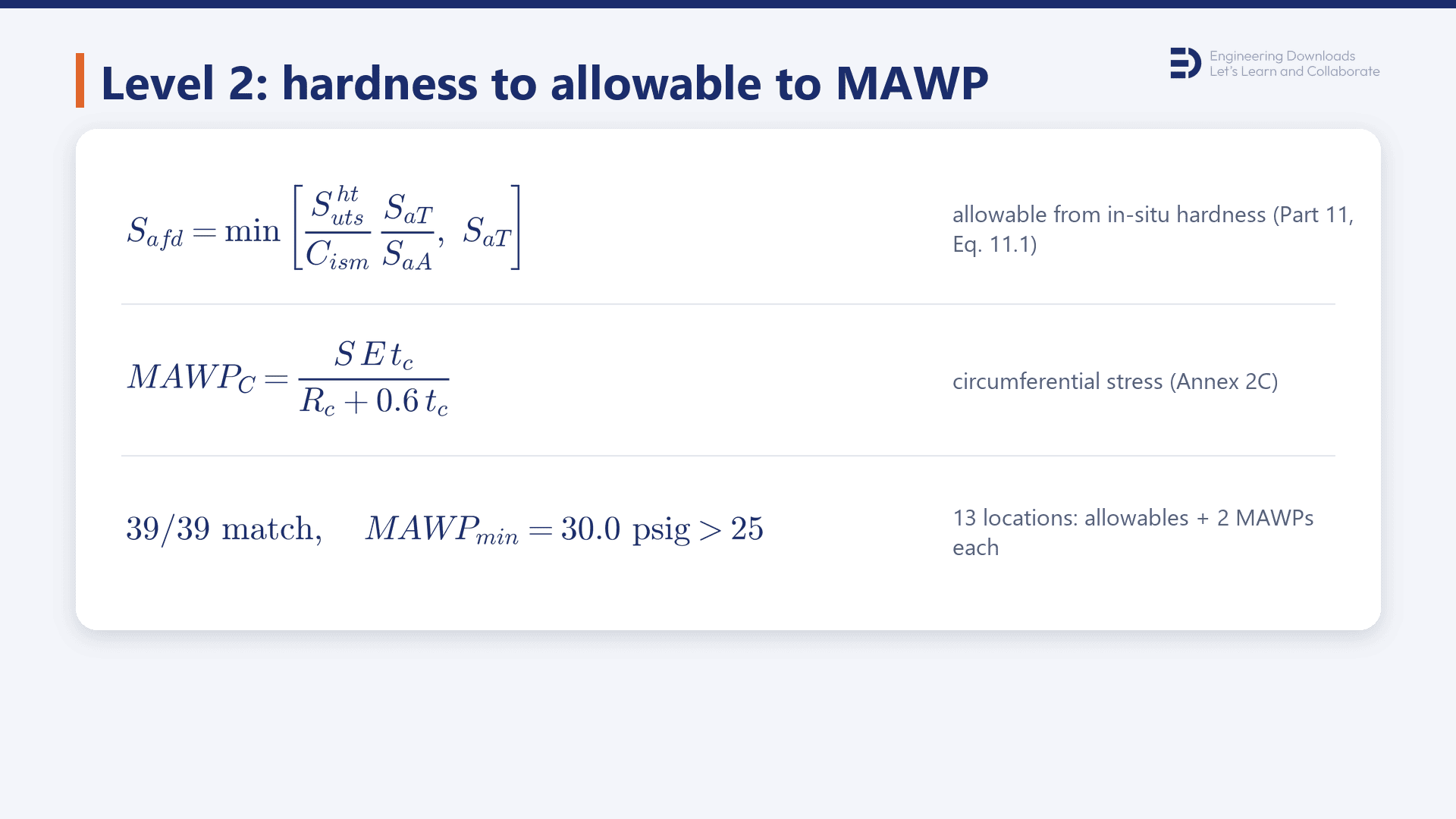
Brinell hardness at 13 locations gives a tensile strength; Part 11 Eq. 11.1 turns it into a fire-damaged allowable stress Safd, and Annex 2C gives the circumferential and longitudinal MAWP. The included Python script reproduces all 13 allowables and all 26 MAWP values exactly. Minimum MAWP: 30.0 psig (example: 30 psig), above the 25 psig design pressure. One printed value in the example (location 11, 13.5 ksi) is a typo: Eq. 11.1 gives 13.75 ksi, which the example’s own MAWP for that location uses.
| Check (Annex 2D) | API 579-2 example | Abaqus (this package) | Verdict |
|---|---|---|---|
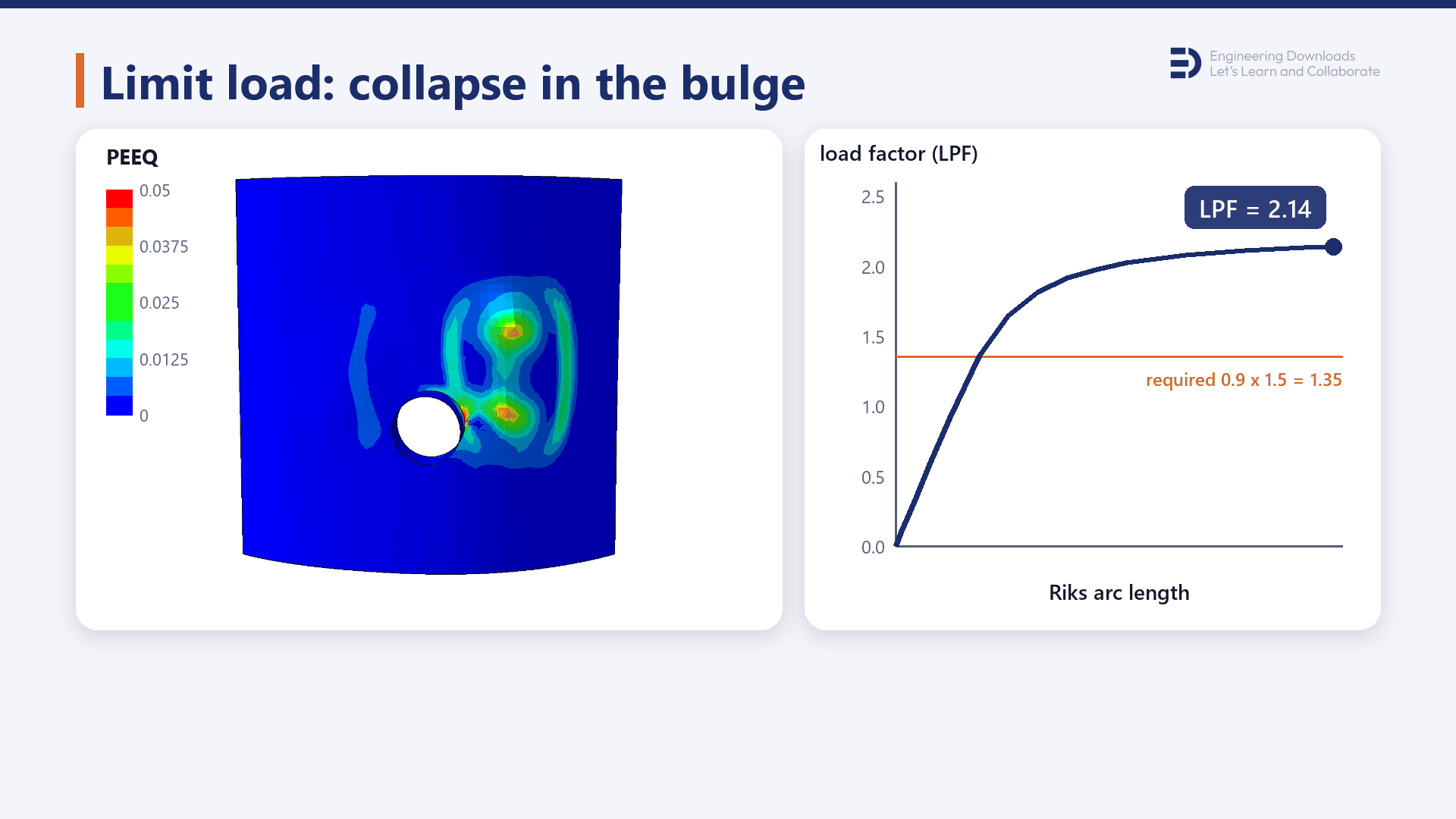
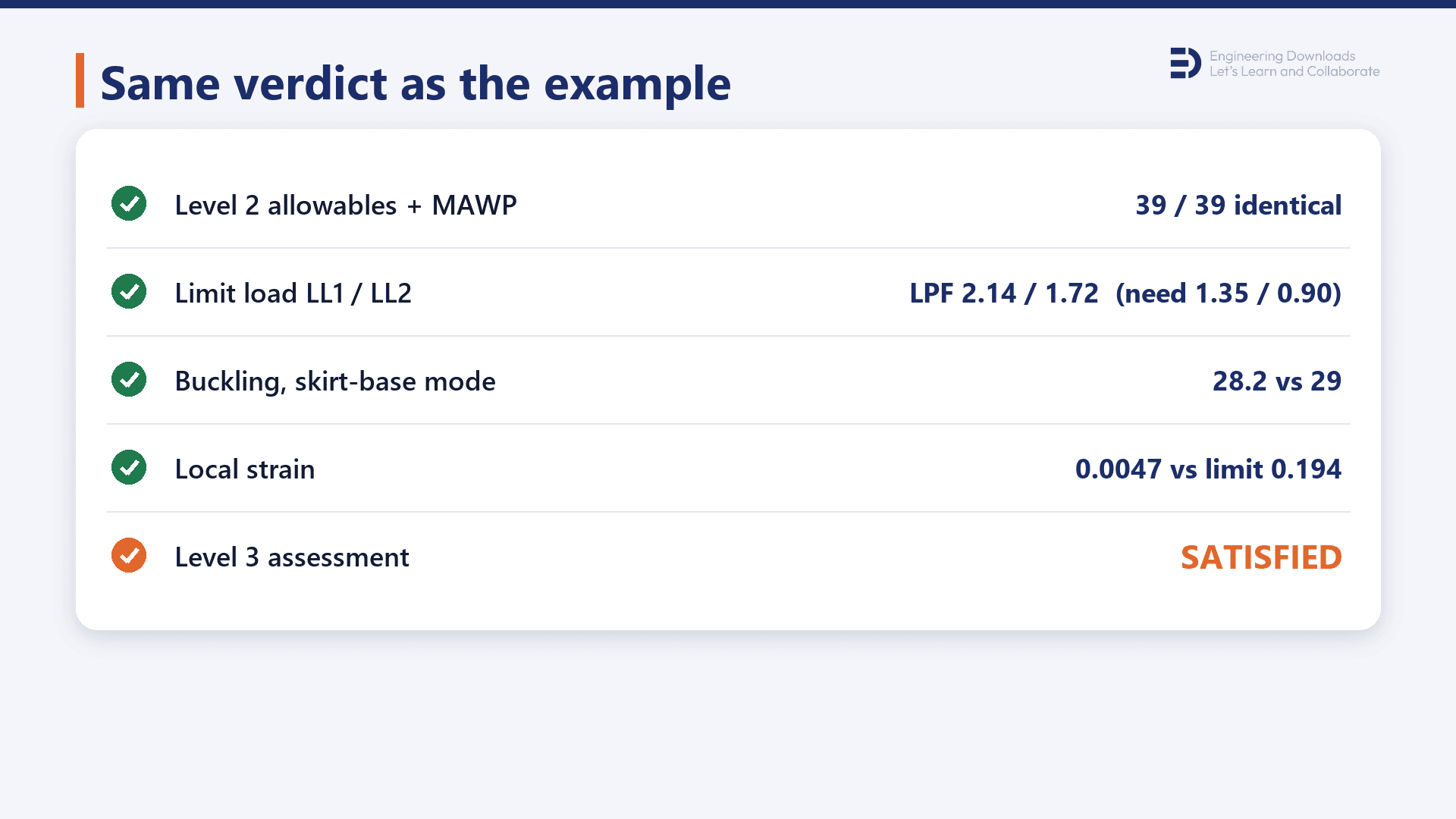
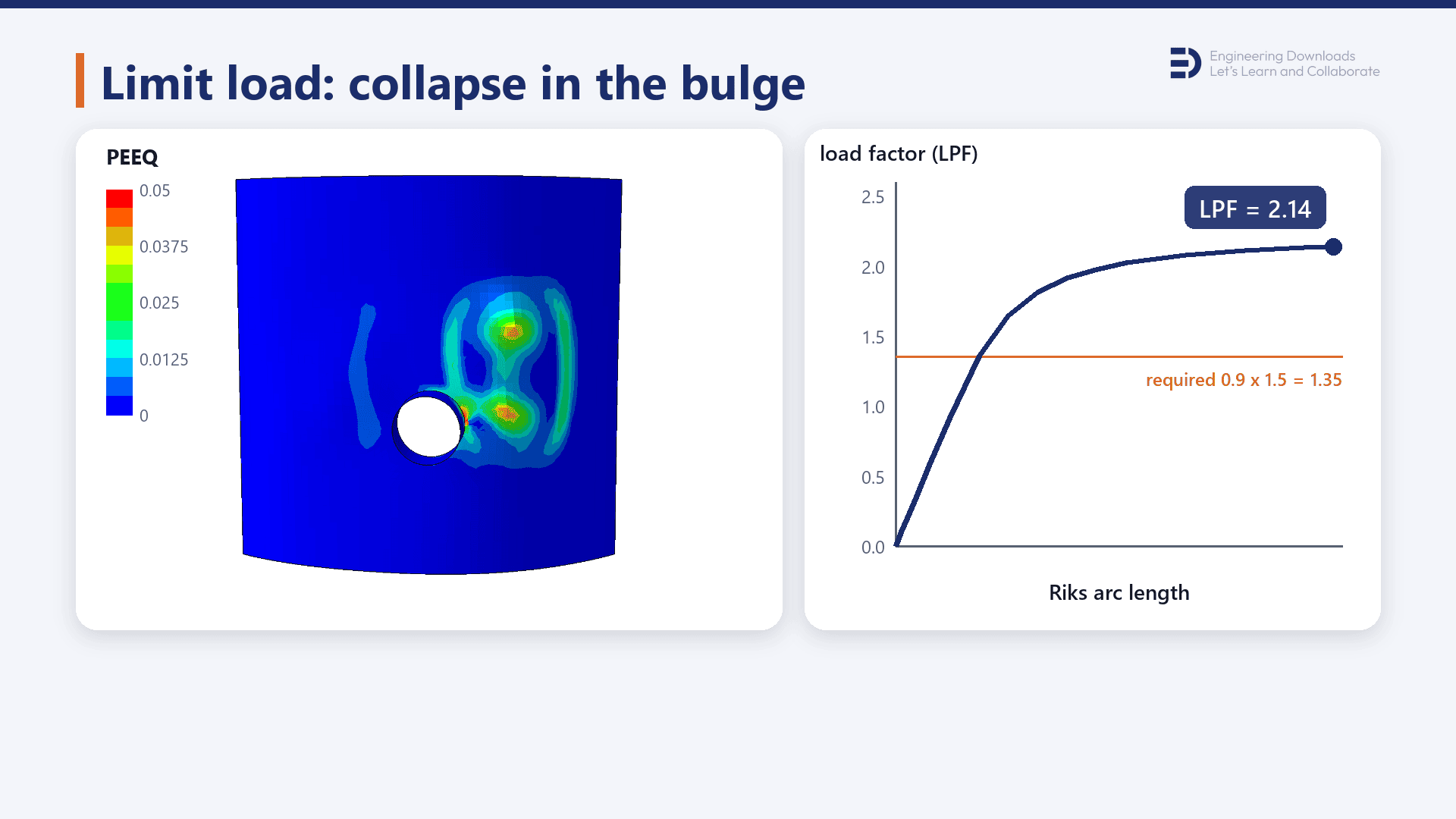
| Limit load LL1, 0.9×1.5(D+P), needs ≥ 1.35 | converged at the factored load | collapse LPF 2.14–2.55, mechanism in the bulges | pass |
| Limit load LL2, 0.9[1.3(D+P)+1.7W], needs ≥ 0.90 | converged at the factored load | collapse LPF 1.72–1.93 | pass |
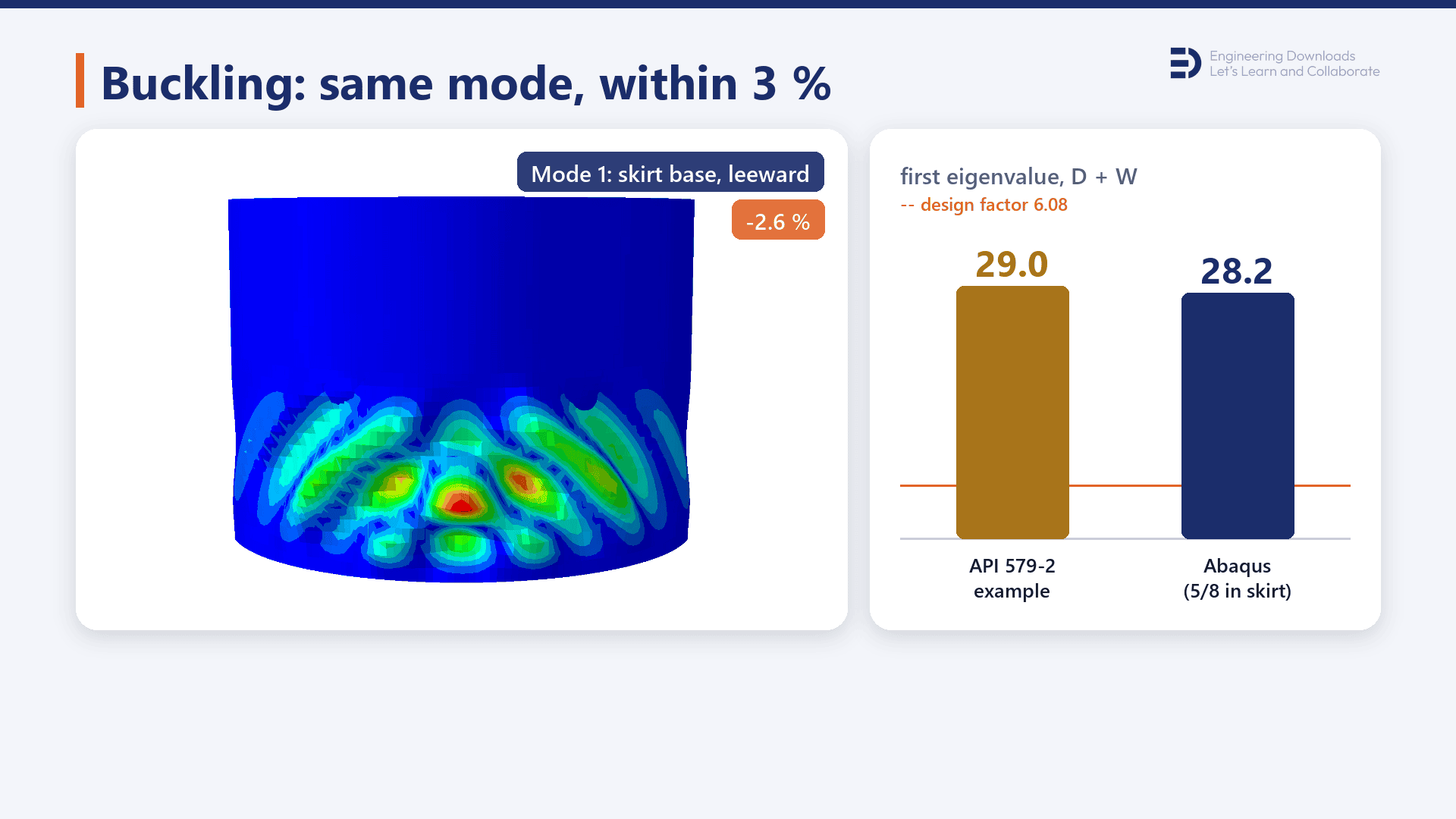
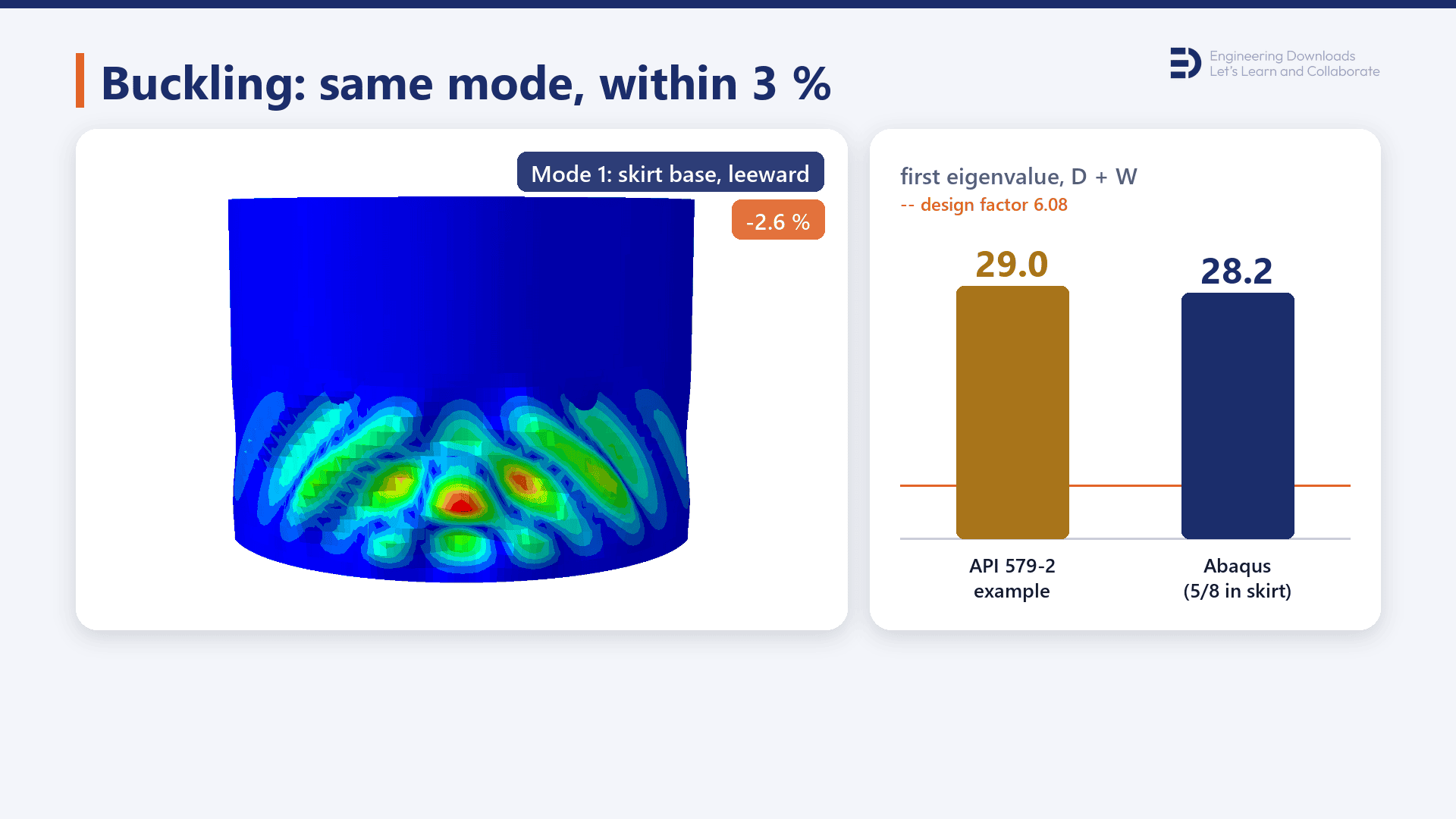
| Buckling D+W, model M#2 (skirt-base mode) | λ1 = 29 | λ1 = 28.24 with a 5/8 in skirt (−2.6 %), same mode location | pass (≥ 6.08) |
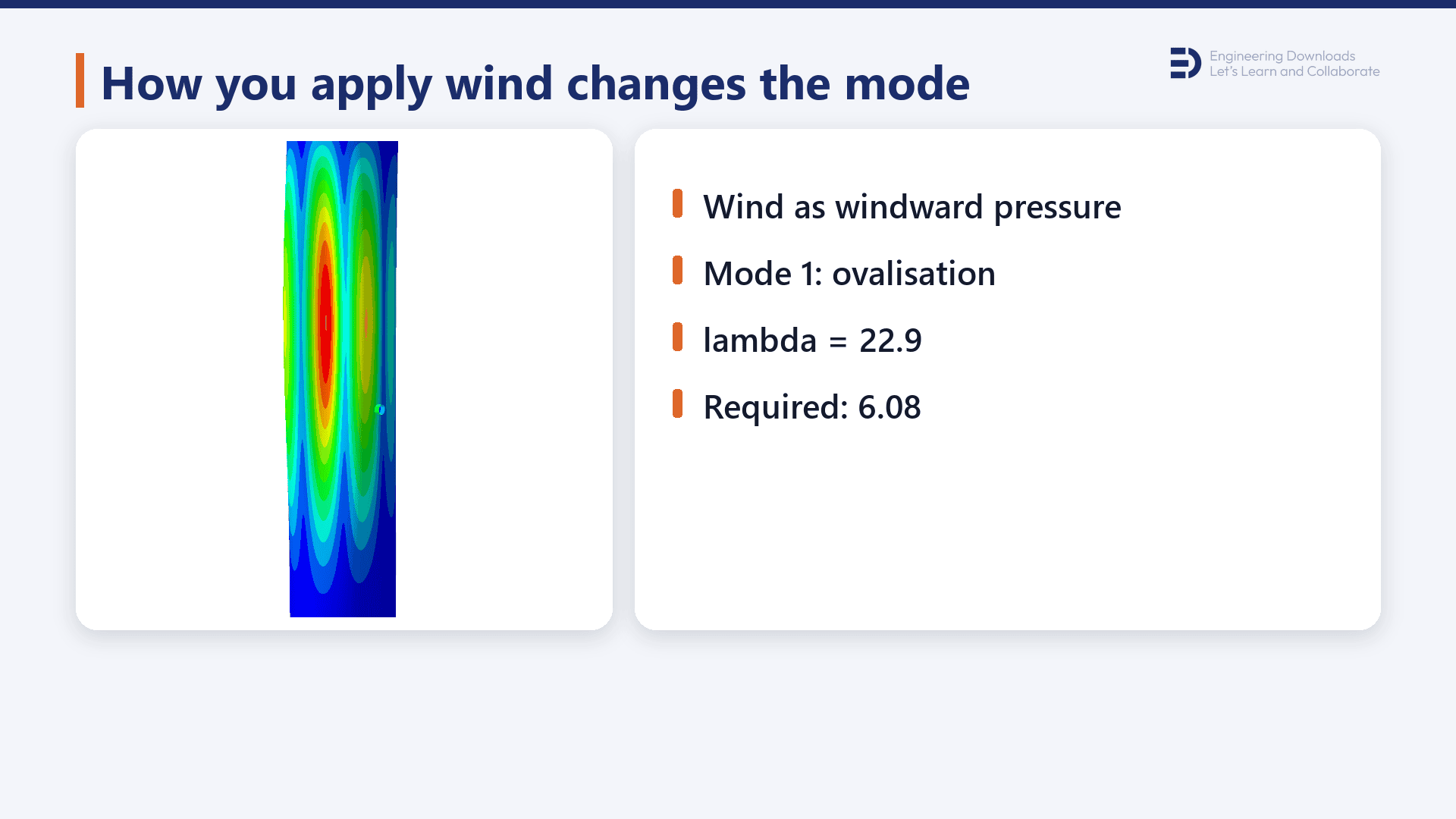
| Buckling D+W, model M#1 | λ1 = 9.81 (Dist.1 mode) | 22.9 (wind as pressure, windward ovalisation) to 41.6; Dist.1 mode at 33.8 | pass (≥ 6.08) |
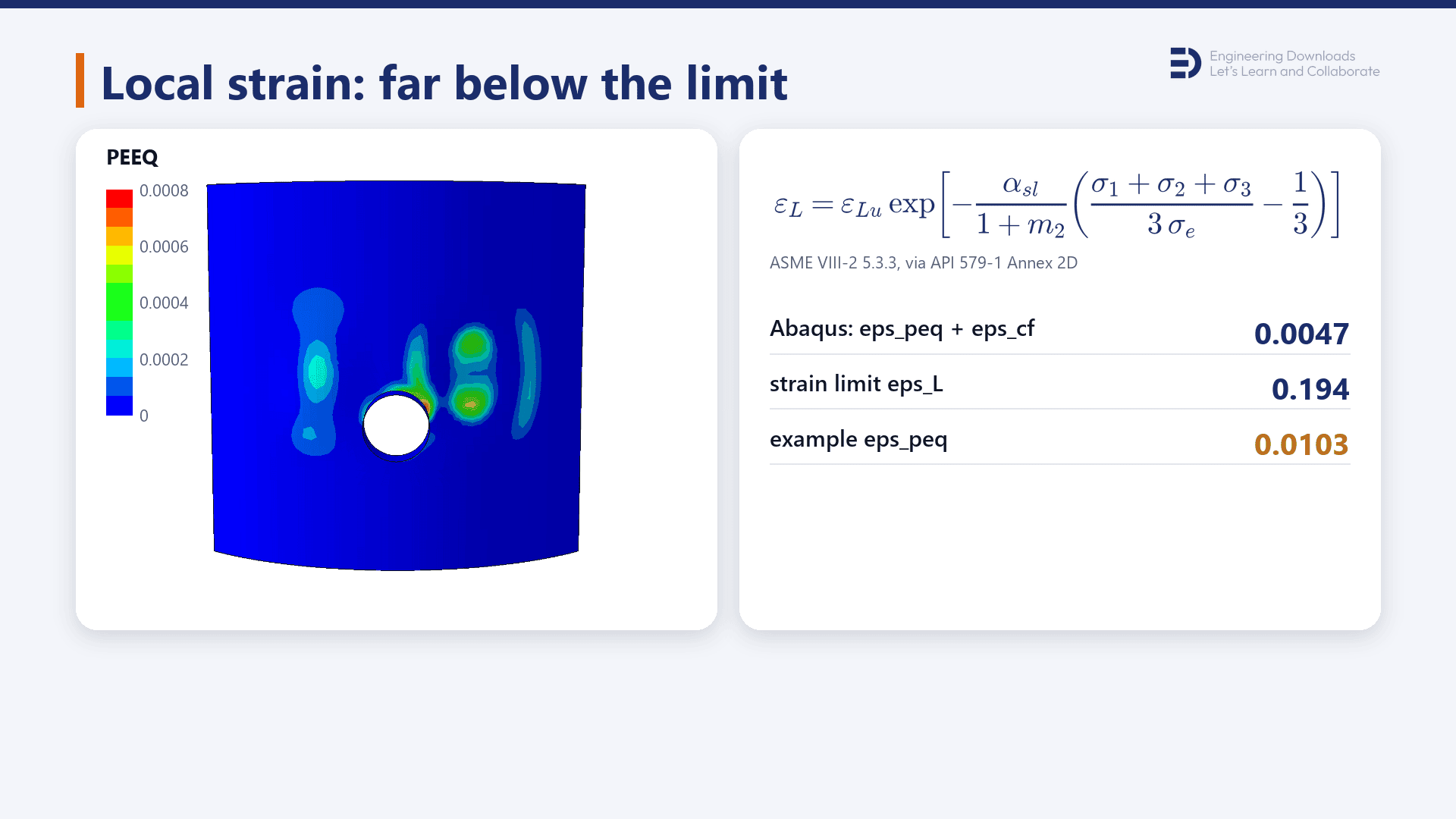
| Local strain 1.53(D+P) | εpeq = 0.0103, εL = 0.102 | εpeq = 0.0005–0.0008 (0.0047 with forming strain) vs εL ≈ 0.18–0.19 | pass |
| Level 3 assessment | satisfied | satisfied | same verdict |
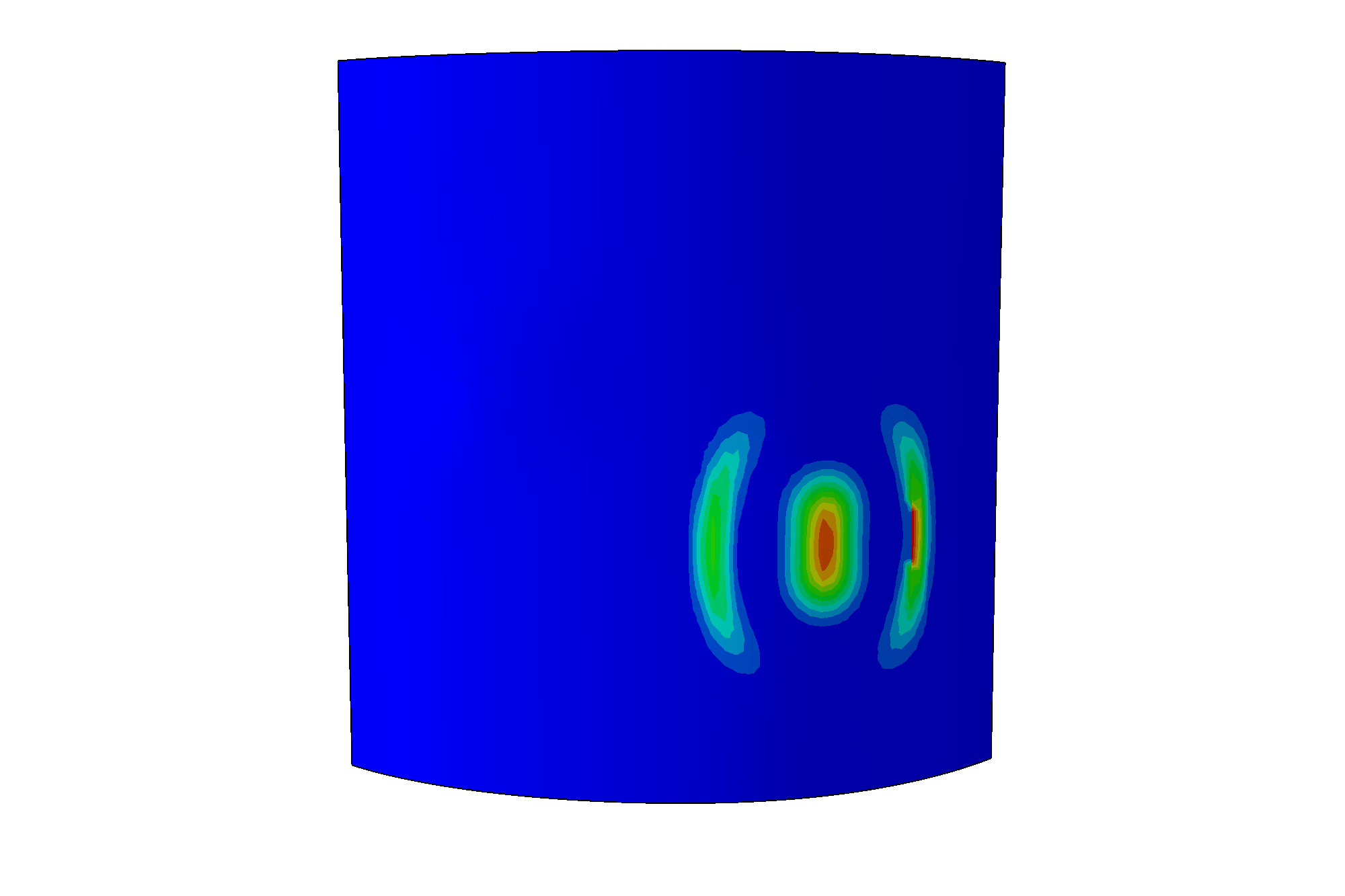
Elastic-perfectly-plastic material with σy = 1.5 S (S from the hardness-based allowables), small displacements, Riks. Plastic strain gathers in the Dist. 1 lobes beside Manway M2 and the load factor levels off at 2.14 (M1F) against the 1.35 the code requires. In model M2 the mechanism forms in the Dist. 4 inward lobe.
Preload D+W, then a linear perturbation buckle step with D+W. With the wind as a global lateral load the first mode is leeward axial buckling at the skirt base – where the example’s M#2 mode sits – at λ1 = 28.24 against 29 with a 5/8 in skirt. With the wind applied as a windward pressure the unstiffened 19 ft shell ovalises first at 22.9. Every case stays far above the design factor ΦB = 6.08.
Elastic-plastic analysis with large displacements at 1.53(D+P), using the ASME VIII-2 Annex 3-D stress-strain curve (24/45 ksi, back-calculated from the example’s m2 = 0.28) and the 5.3.3 strain limit with αsl = 2.2. The script reproduces the example’s own arithmetic exactly (εL = 0.1025).
fire_mesh.py to close the gap.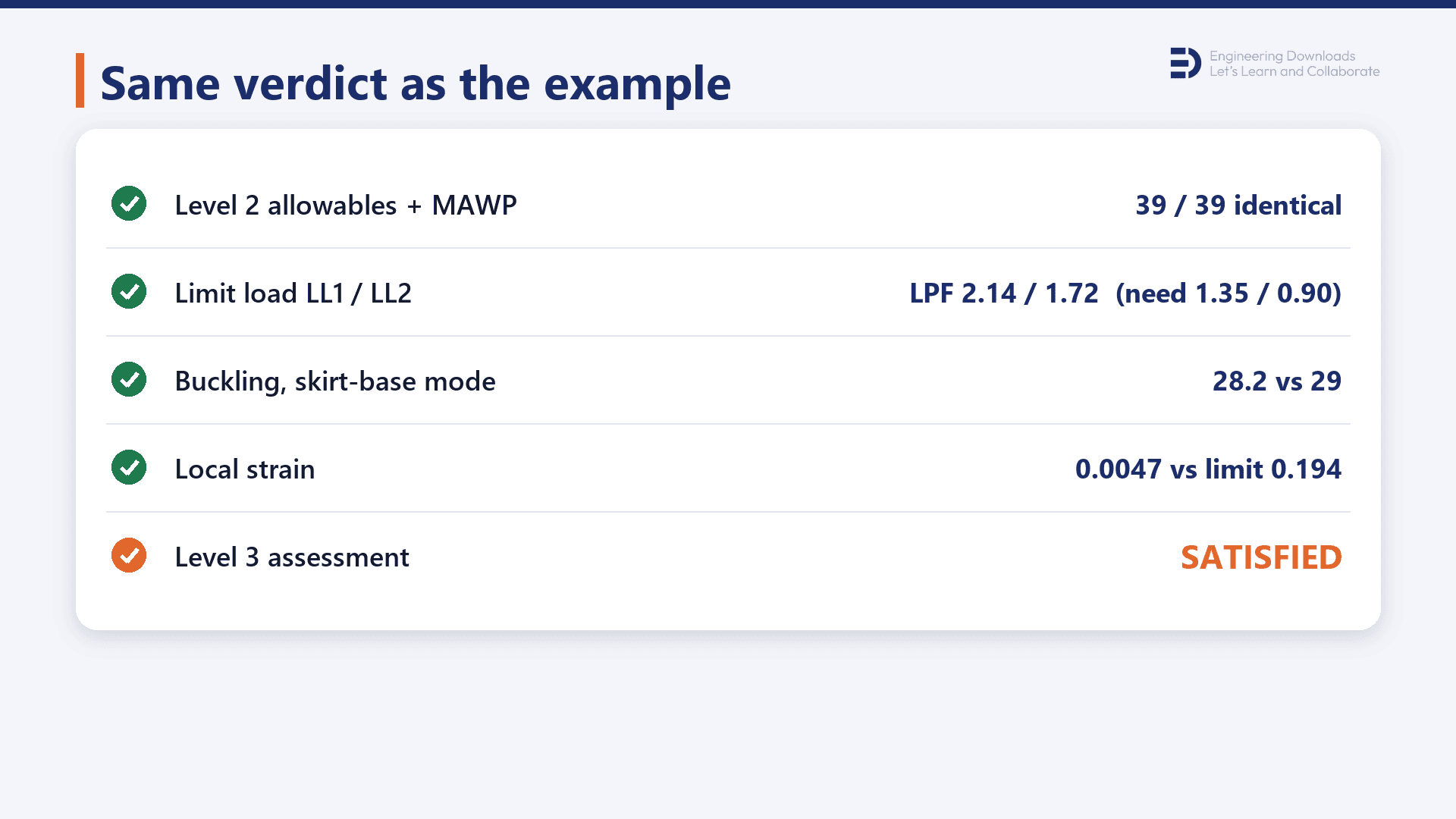
fire_mesh.py (geometry, distortions, nozzles, wind – all inputs in tables at the top) and fire_model.py (materials, steps, loads); build_model.py rebuilds any caseapi579_E11_6.py: Level 2 tables and local-strain arithmeticpost_odb.py, compare_results.py, odb_images.py: results, comparison and contour images from your own runsAbaqus/CAE and Abaqus/Standard 2024 or newer (the CAE files are 2024; the INP decks also run in older releases). The Level 2 script runs in any Python 3. You need your own copy of API 579-1/ASME FFS-1 and API 579-2 for the standard itself; the package cites them and does not reproduce their text or figures.
Single mesh, no convergence study. Distortions are idealised lobes, not the measured profiles. The LL1 run on model M1 was still rising slightly at its last increment, so 2.55 is a lower bound. This package is a worked benchmark and training material; it does not replace an assessment of a real component by a qualified engineer.
Need more than the files?
There are two ways we can help. Book a one hour online consultation if you want to talk a problem through with a CAE engineer, using the checkbox in the order box. Order a project if you need a full simulation built for you, delivered to an agreed scope, price and deadline under a written contract.
We work on FEA and CFD for engineers, researchers and companies. Order your project, or message us on WhatsApp for a quick reply.
Other packages engineers working on this topic also download.
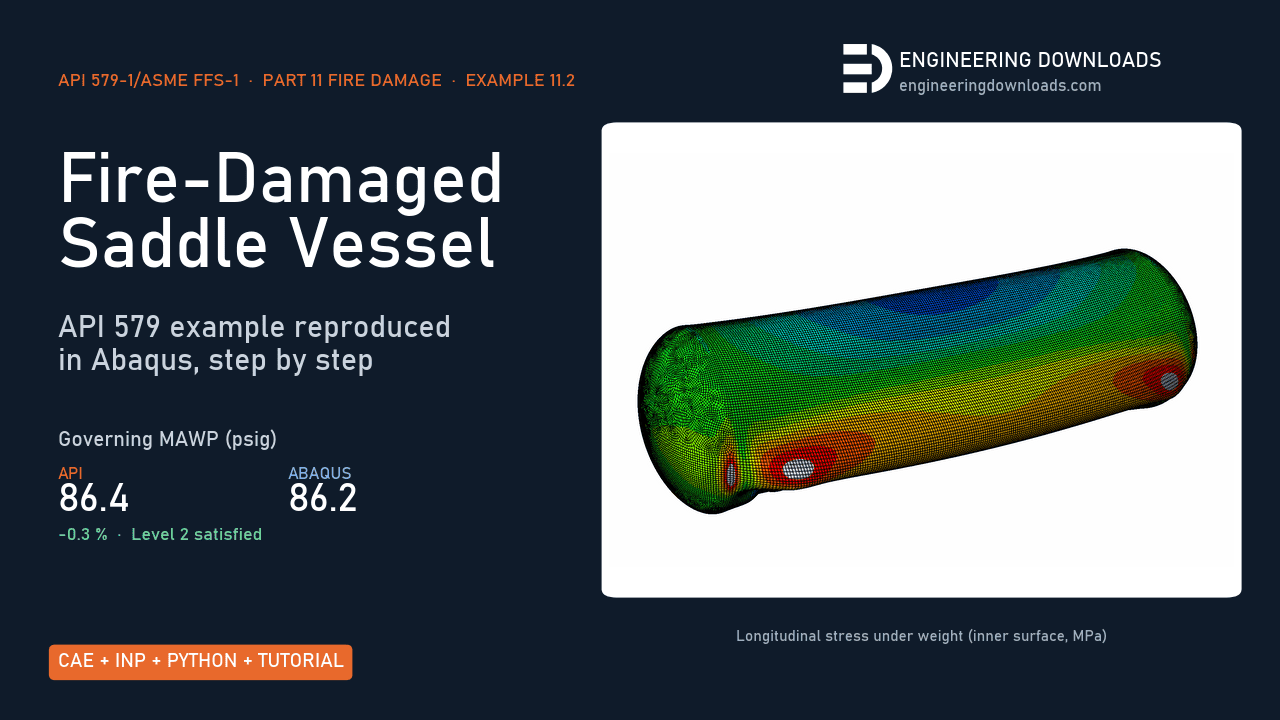 API 579 Example 11.2 in Abaqus: Fire-Damaged Horizontal Vessel on Saddles, Level 2 FFS
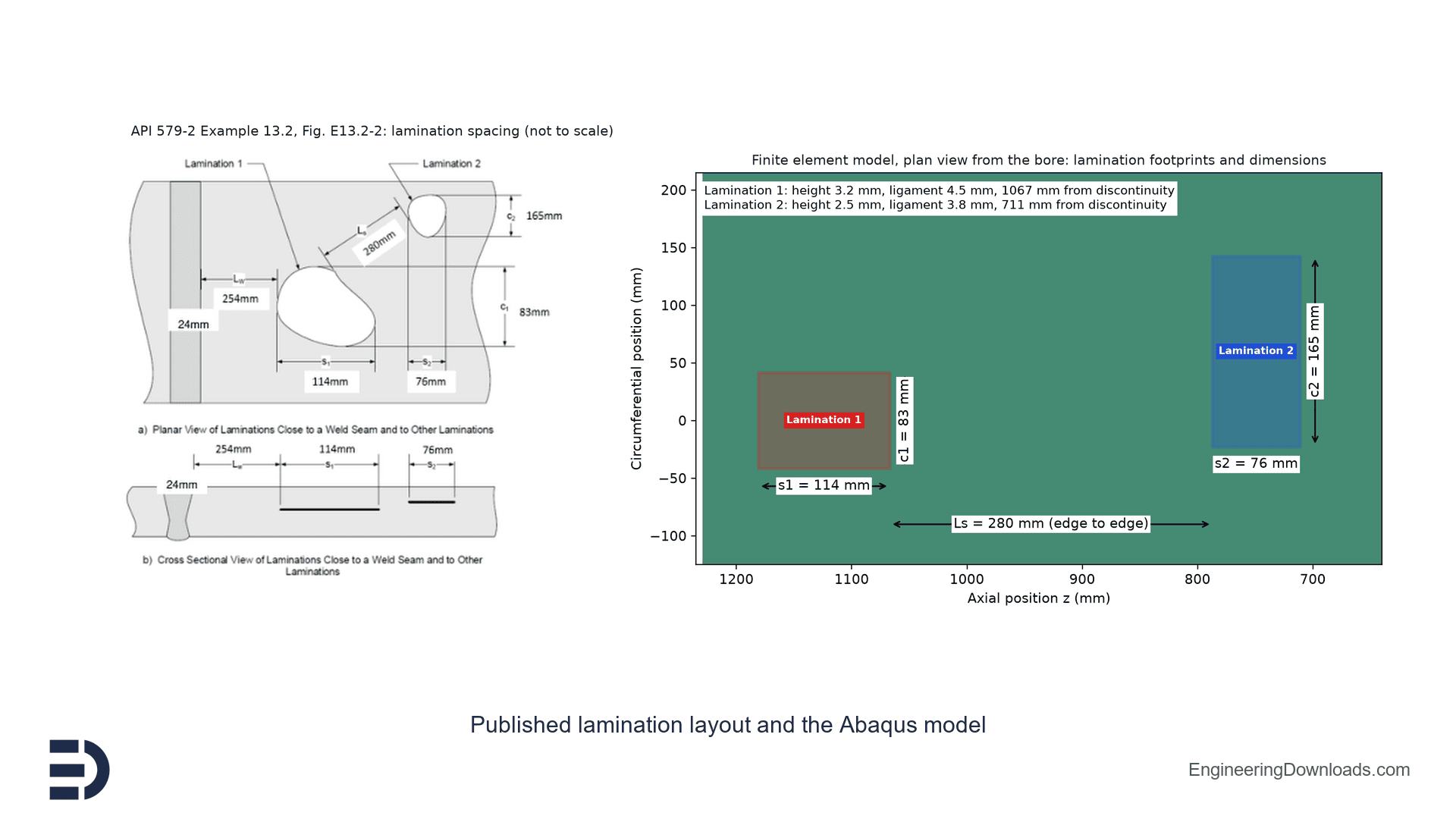 API 579-2 / ASME PTB-14 Example 13.2 Laminations in a Pressure Vessel: Abaqus FEA Model with Contact, Level 1 Screening and MAWP€139,00
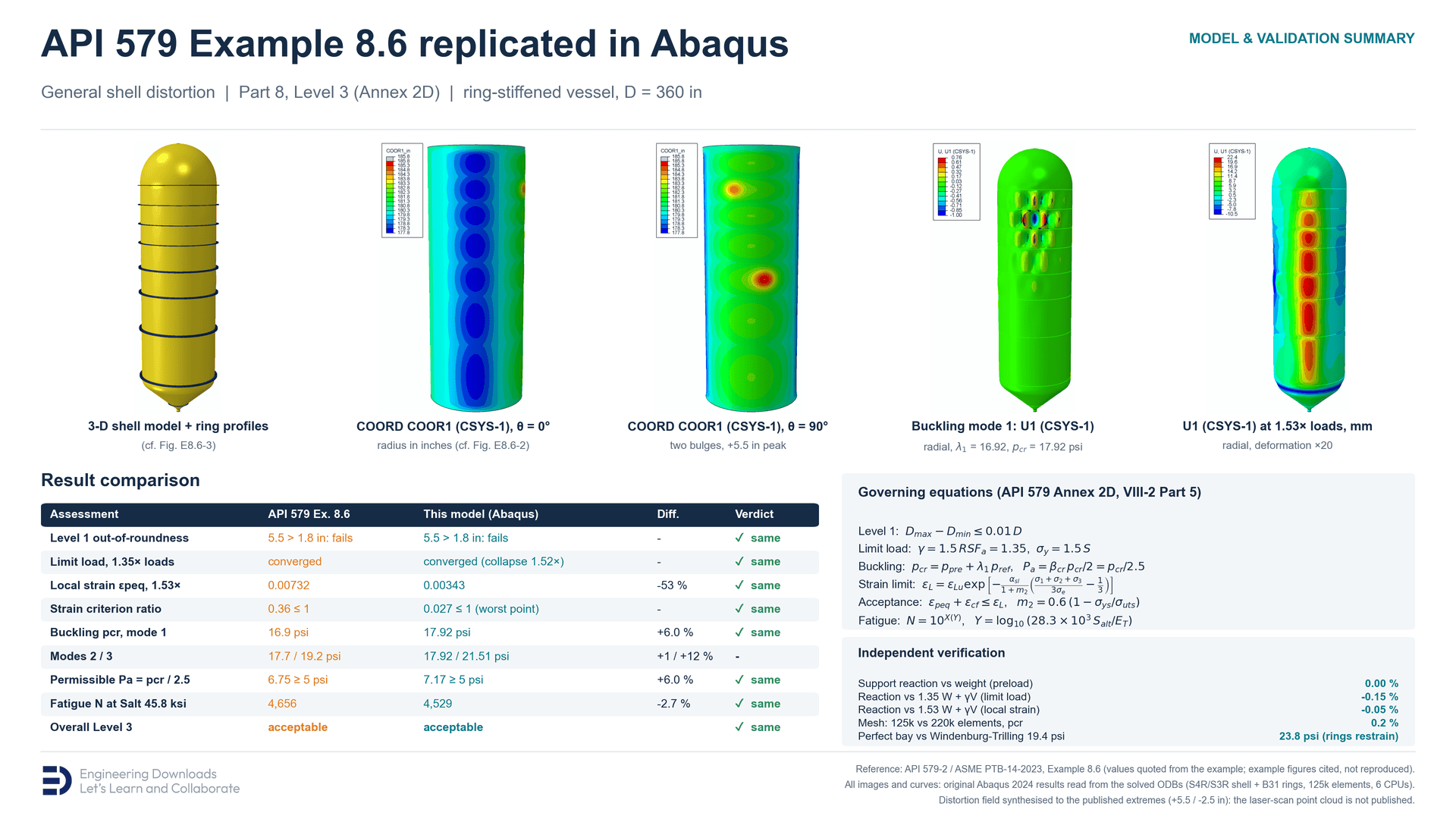 API 579 Example 8.6 in Abaqus: General Shell Distortion and Buckling, Level 3 FFS€129,00
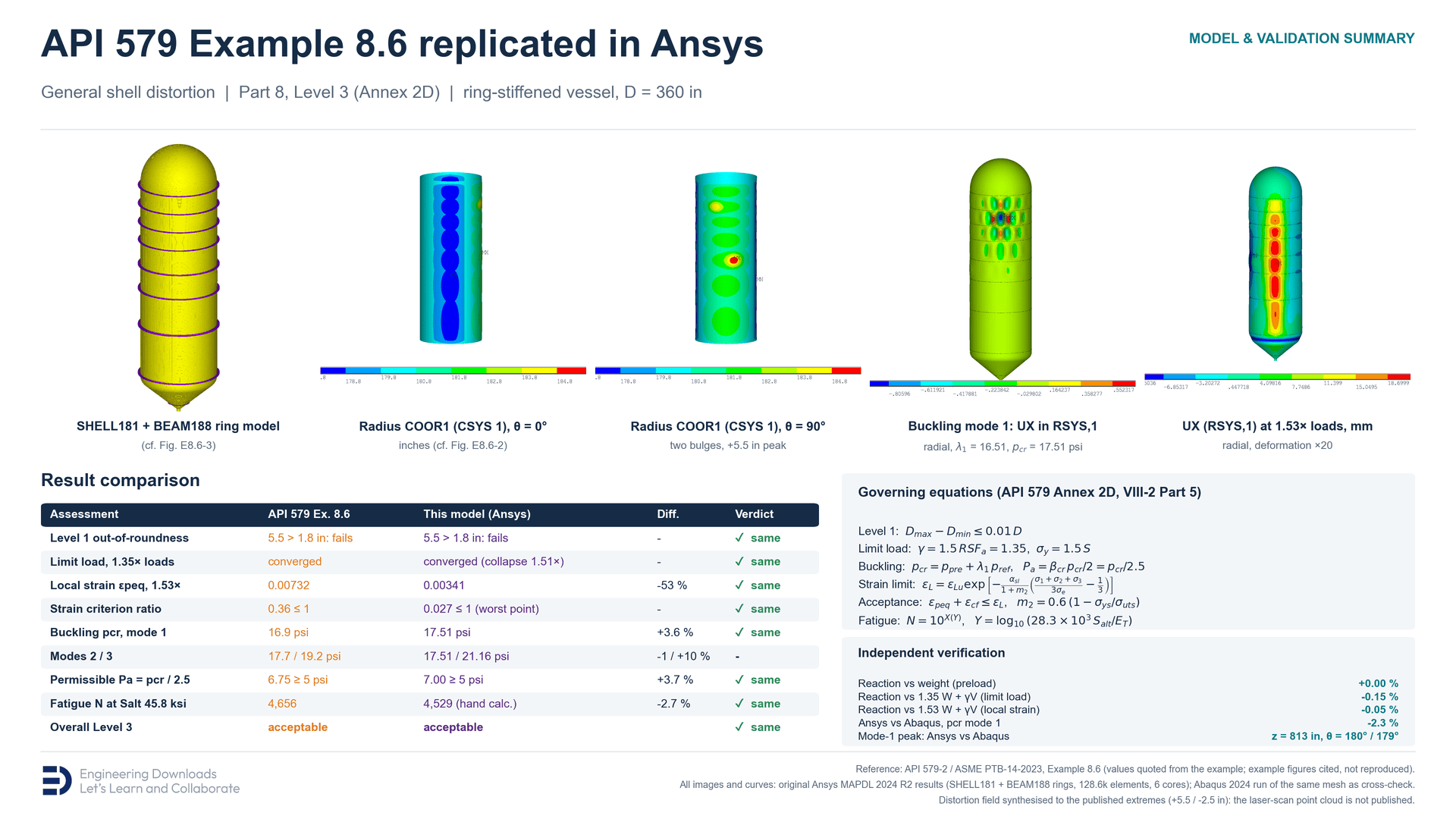 API 579 Example 8.6 in Ansys: General Shell Distortion and Buckling, Level 3 FFS€129,00
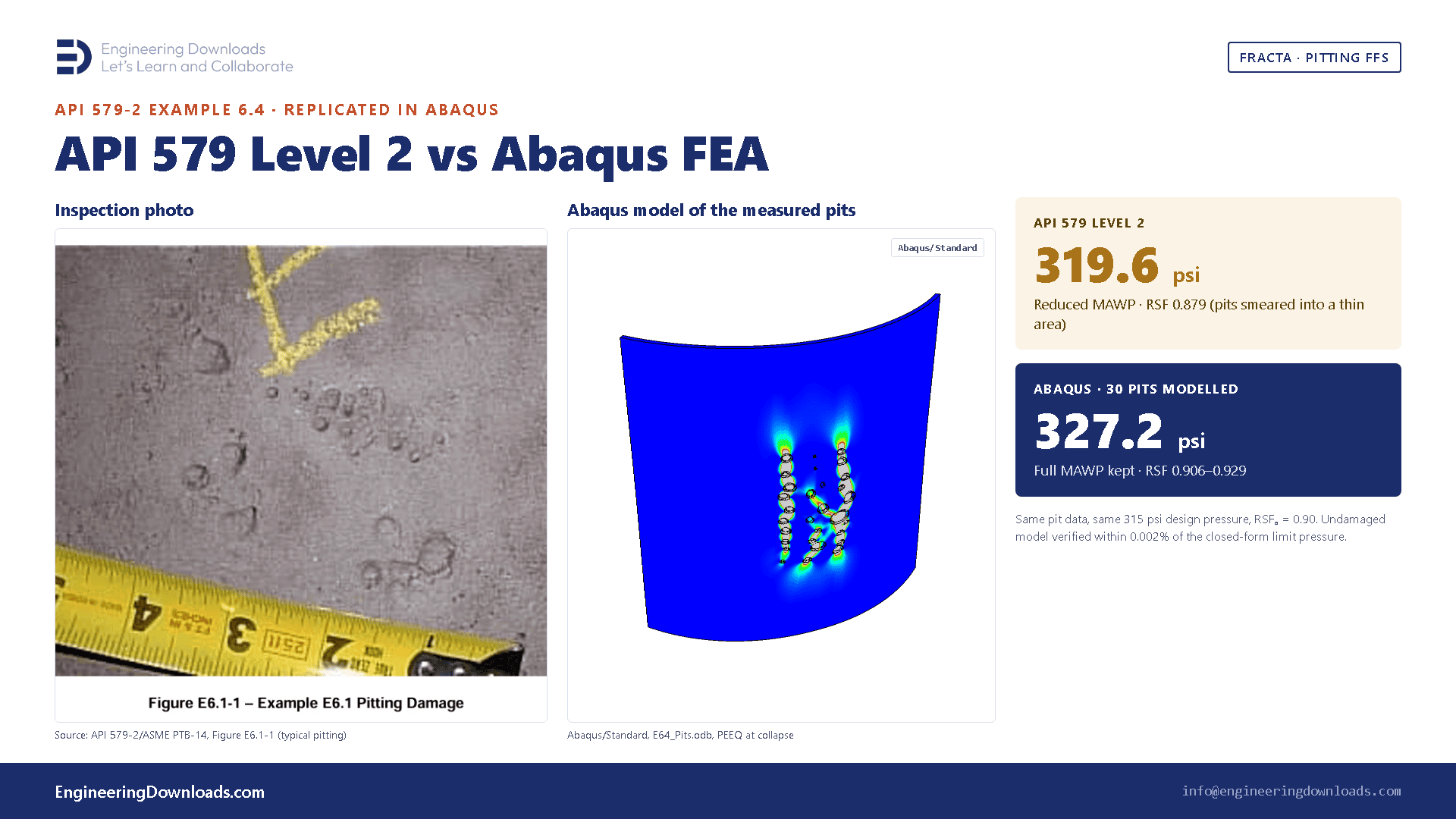 API 579 Example 6.4 in Abaqus: Localized Pitting Corrosion, Level 2 vs Level 3 FFS€129,00
 API 579 Example 5.6 in Abaqus: Local Thin Area Limit Load, Level 3 FFS€89,00
 API 579 Example 7.4 in Abaqus: HIC Damage Level 3 Assessment with FAD and Plastic Collapse€139,00
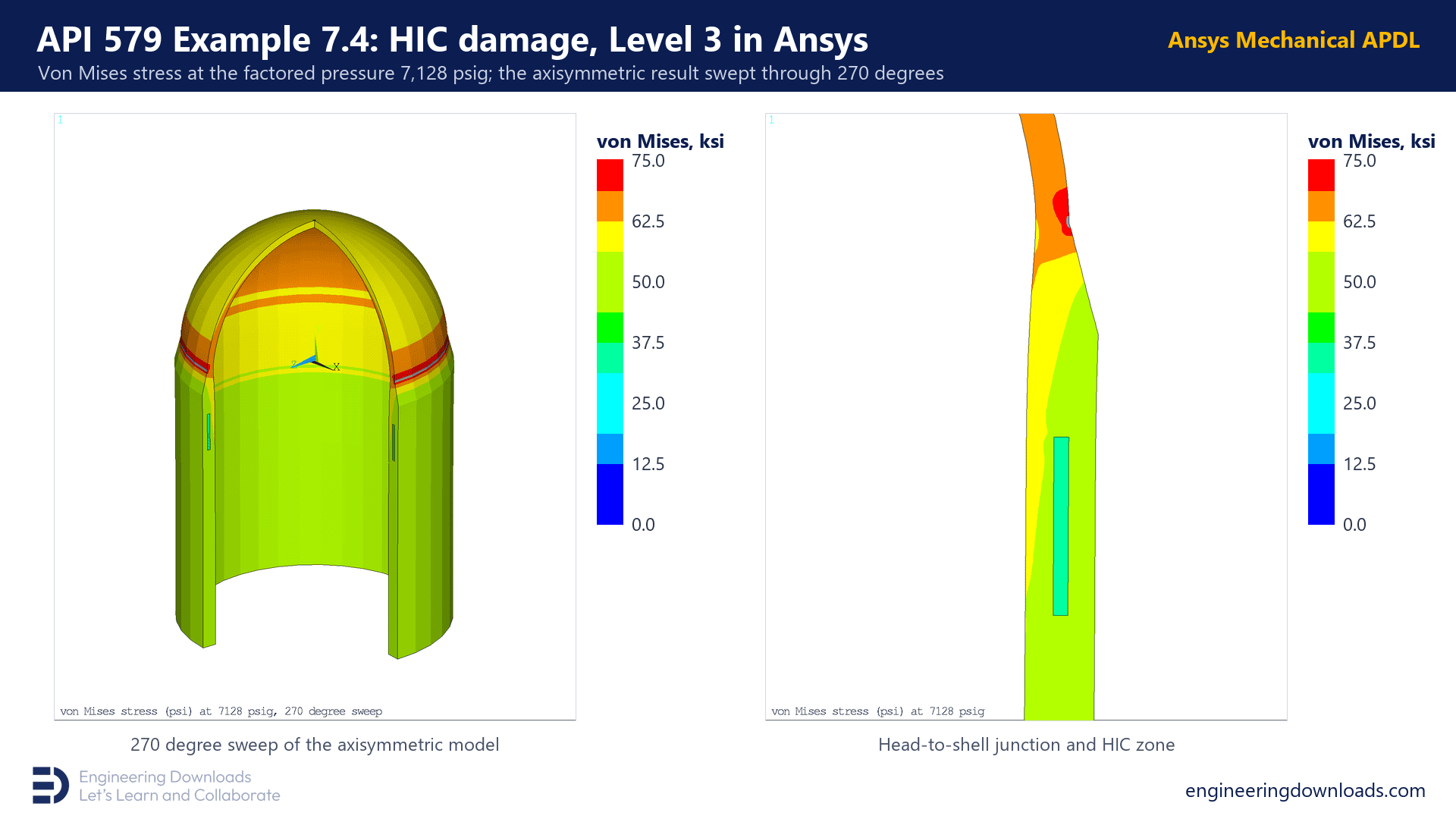 API 579 Example 7.4 in Ansys: HIC Damage Level 3 Assessment with FAD and Plastic Collapse€139,00

Need a full custom project? See the options below.

€129,00

€179,00

€149,00

€119,00

€129,00

€149,00
See more
Want to receive push notifications for all major on-site activities?



