
Need a full custom project? See the options below.
Need a full custom project? See the options below.
A local thin area (LTA) is one of the most common findings in a fitness-for-service (FFS) inspection: corrosion or erosion has thinned a patch of a pressure vessel shell, and the owner needs to know whether the vessel can stay in service and at what pressure. API 579-1/ASME FFS-1 Part 5 answers this with the remaining strength factor (RSF). This Abaqus package rebuilds the published API 579-2 Example 5.6 as a 3-D Level 3 limit-load model, calculates the RSF from FEA, and compares every result with the example’s Level 1 answer. You get an Abaqus CAE database, ready-to-run INP files, Python scripts for meshing and post-processing, a 9-page PDF tutorial, a 13-slide presentation and a clear README.
Source: API 579-2/ASME PTB-14 Fitness-For-Service Example Problem Manual, Part 5, Example 5.6, assessed to API 579-1/ASME FFS-1 Part 5 with the Annex 2D limit-load method. The component is an SA-516 Grade 60 drum, 2438 mm inside diameter and 32 mm thick, designed for 2.068 MPa at 340 °C. Inspection found a local thin area on the inside surface, 191 mm long and 250 mm wide, with a minimum measured thickness of 16 mm. The example’s Level 1 assessment gives RSF = 0.857, below the allowable 0.90, so the MAWP has to be reduced from 2.3095 MPa to 2.1994 MPa.
| Item | API 579-2 Example 5.6 | This package |
|---|---|---|
| Component | Cylindrical drum, SA-516 Gr 60, corroded wall tc = 26.3 mm | Quarter-symmetry 3-D solid model, Ri = 1224.7 mm, Ro = 1251.0 mm |
| Damage | Inside LTA, s = 191 mm, c = 250 mm, remaining ligament 12.8 mm | Same pocket, flat floor and sharp walls, built into the hex mesh |
| Loads | Internal pressure, closed ends | Pressure on the bore and pocket faces, end thrust applied as a traction |
| Method | Level 1: RSF from Folias factor Mt | Level 3: Riks limit load, elastic–perfectly plastic, yield 1.5S = 163.4 MPa (Annex 2D.2.3); RSF = LDC/LUC |
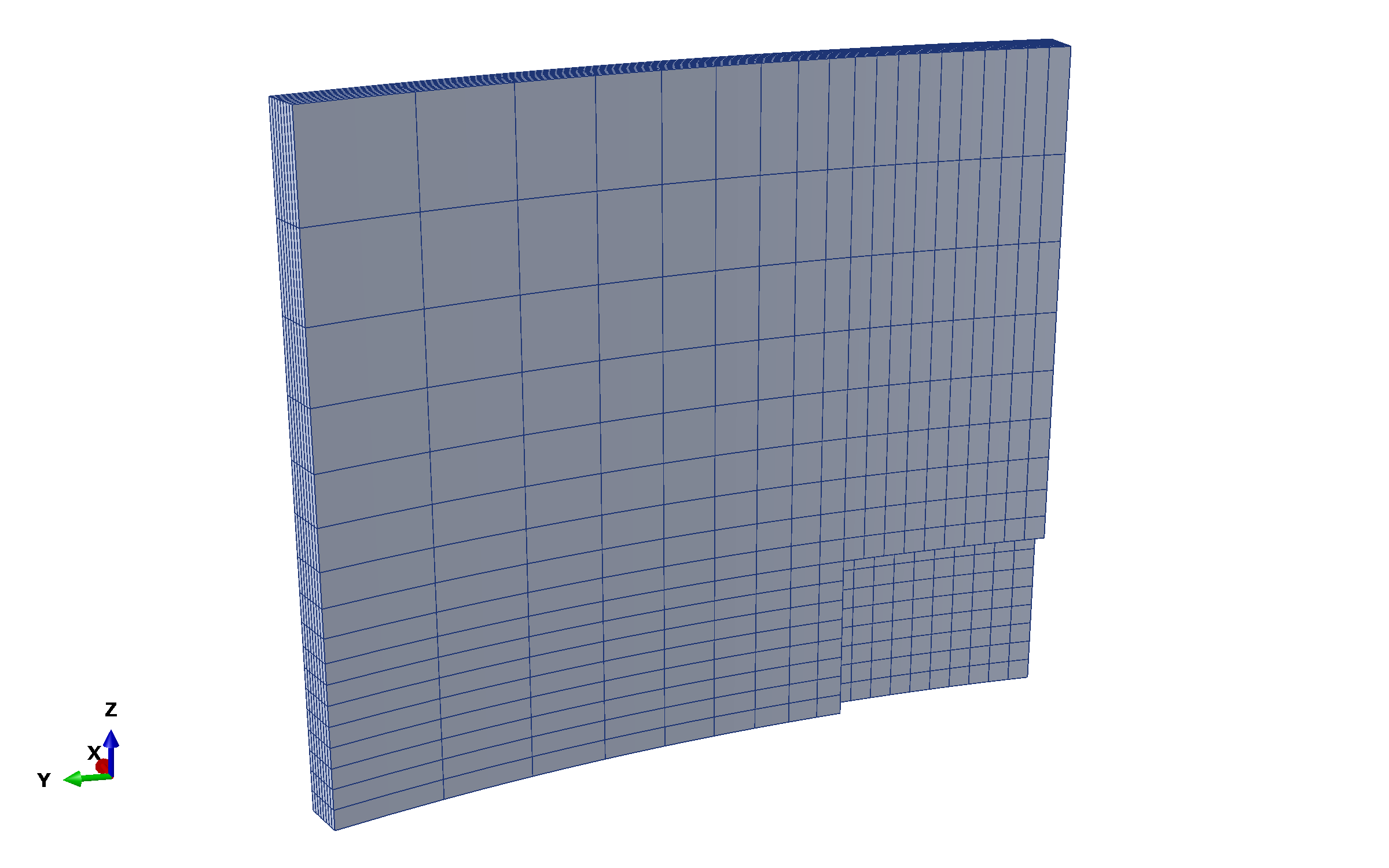
| Mesh | – | About 12,200 C3D20R bricks, 8 through the wall; fine mesh of 30,650 bricks changes the collapse load by 0.14% |
| Software | – | Abaqus/CAE and Abaqus/Standard 2024, Python 3 |
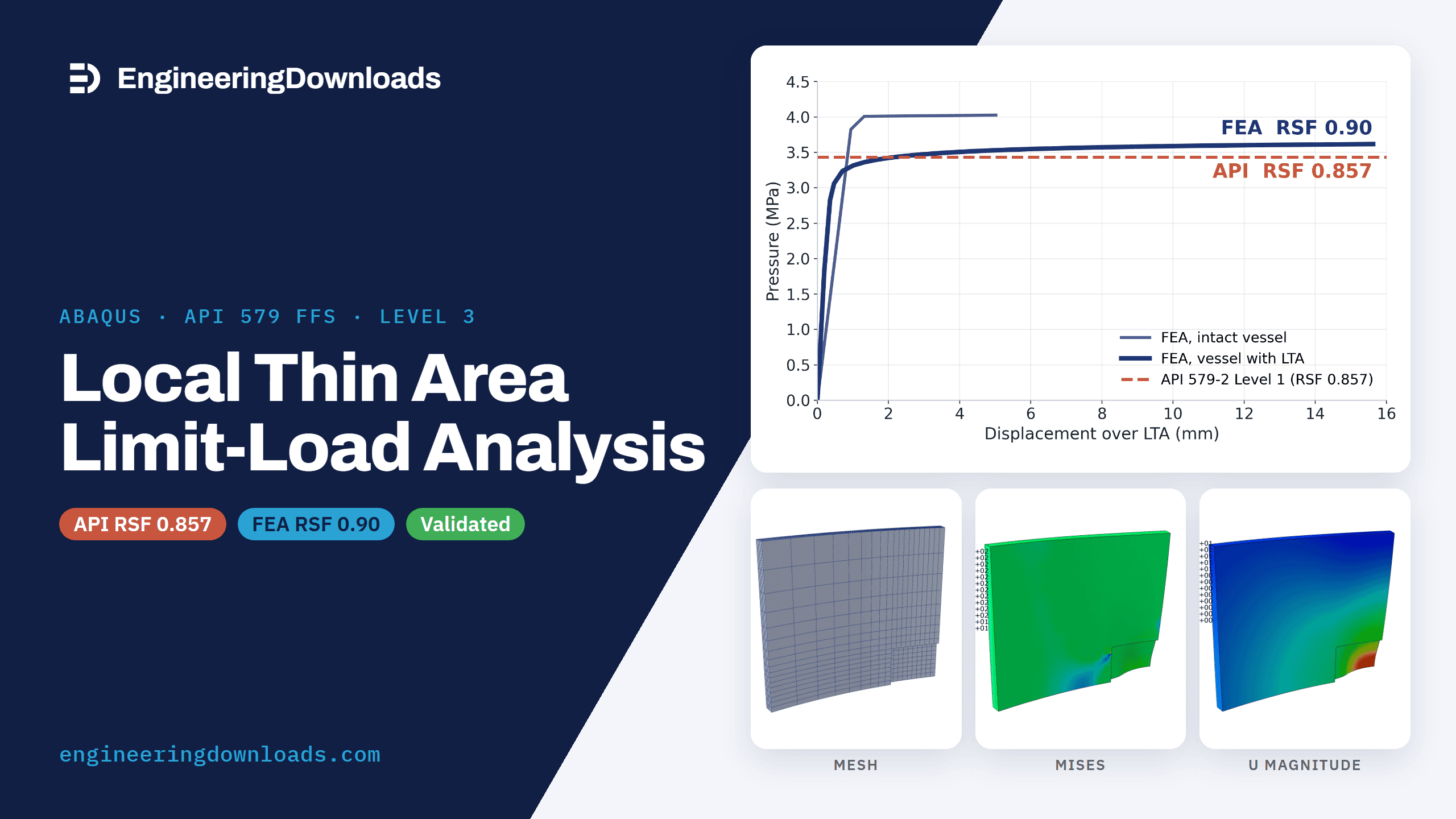
The mesh is generated by a Python script, not drawn by hand, so you can change the LTA size or the mesh density and rebuild the deck in seconds. It is a structured C3D20R hexahedral mesh, refined in the pocket and the ligament below it, with graded elements away from the LTA. The model runs from the LTA centre to 1500 mm along the axis (about 8.4√(Rt)), with symmetry on both cut planes.
| Quantity | Example 5.6 (Level 1) | This model (Level 3) | Comment |
|---|---|---|---|
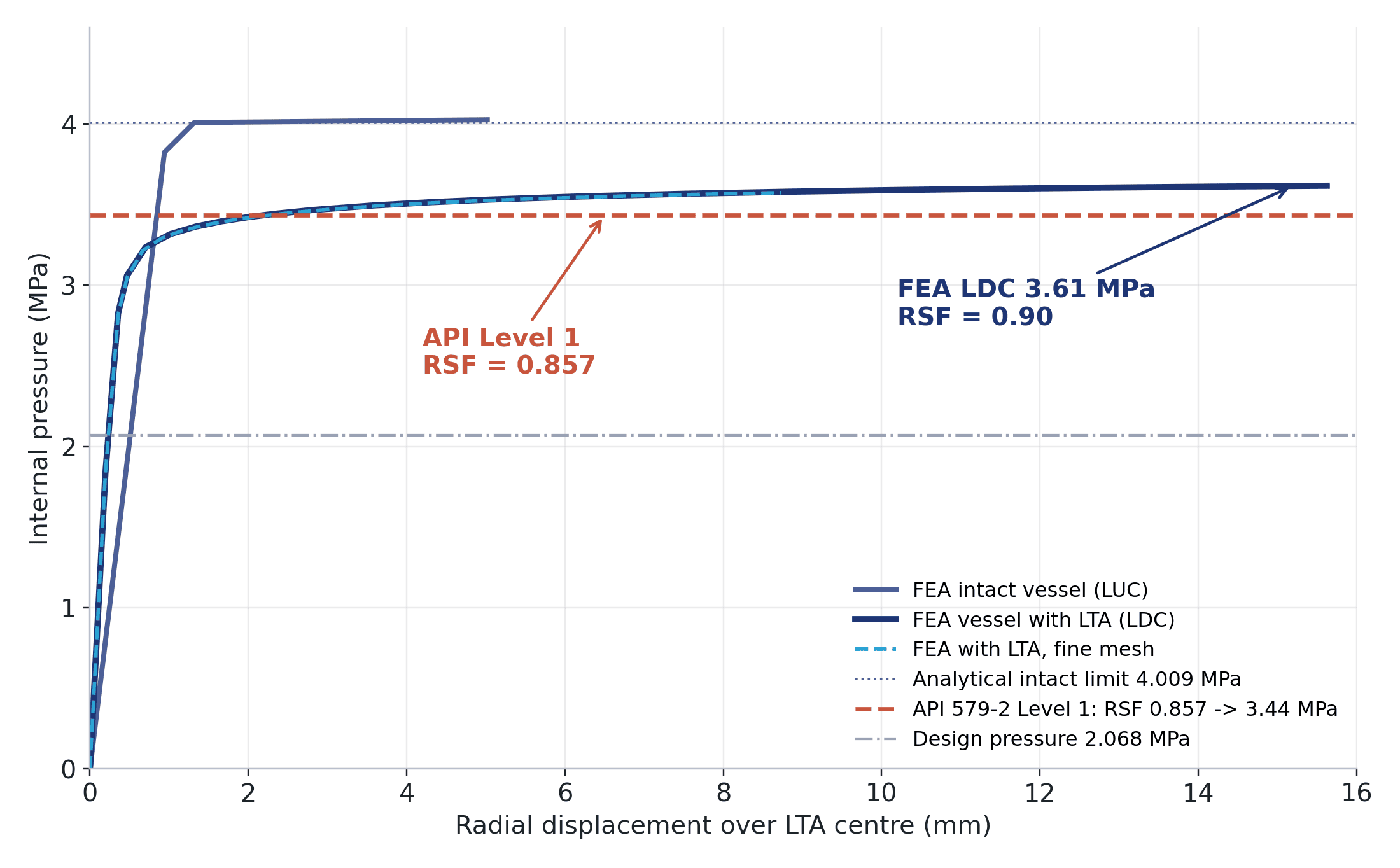
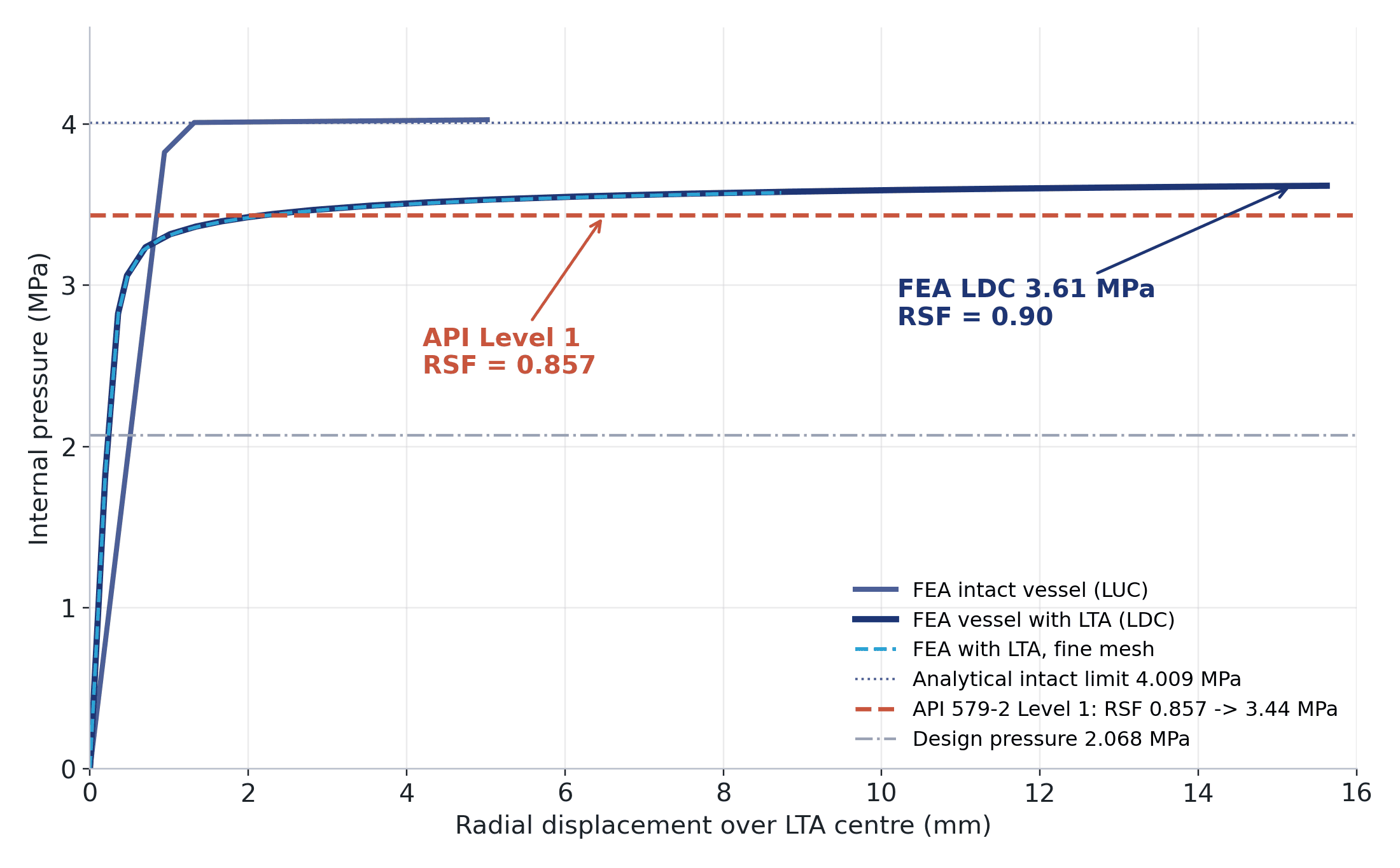
| Intact limit pressure LUC | 4.0088 MPa (closed-form) | 4.0090 MPa | Error 0.005% |
| Collapse pressure with LTA, LDC | 3.44 MPa (implied by RSF) | 3.61 MPa | Lower bound |
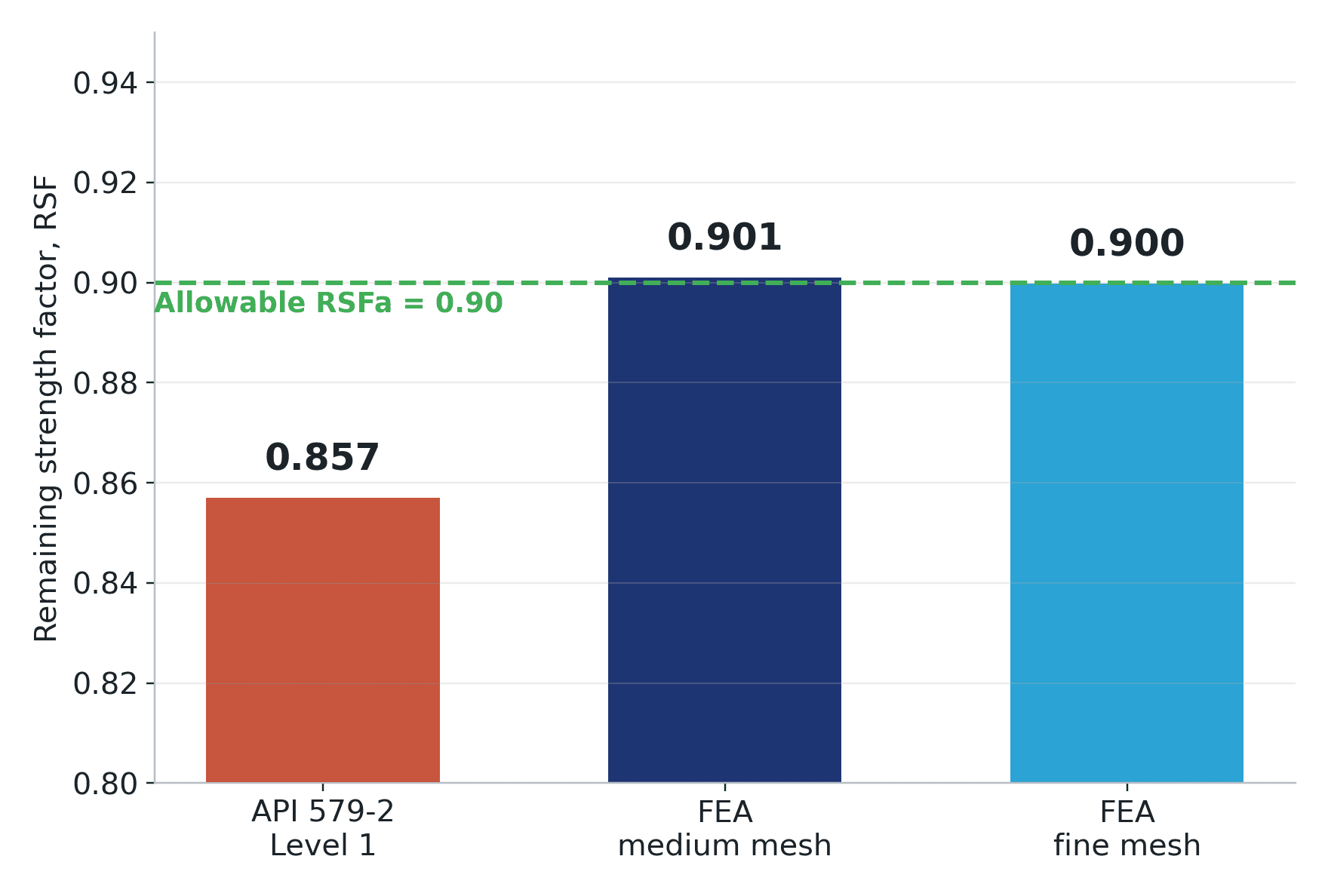
| Remaining strength factor RSF | 0.857 | 0.901 (medium), 0.900 (fine) | Level 1 about 5% conservative |
| MAWPr (Eq. 2.2/2.3) | 2.1994 MPa | 2.3095 MPa (no reduction) | RSF ≥ RSFa |
| Annex 2D load case 1, 1.5·RSFa·P = 2.79 MPa | – | Converges | Pass |
| Verdict at 2.068 MPa design | Acceptable | Acceptable | Same |
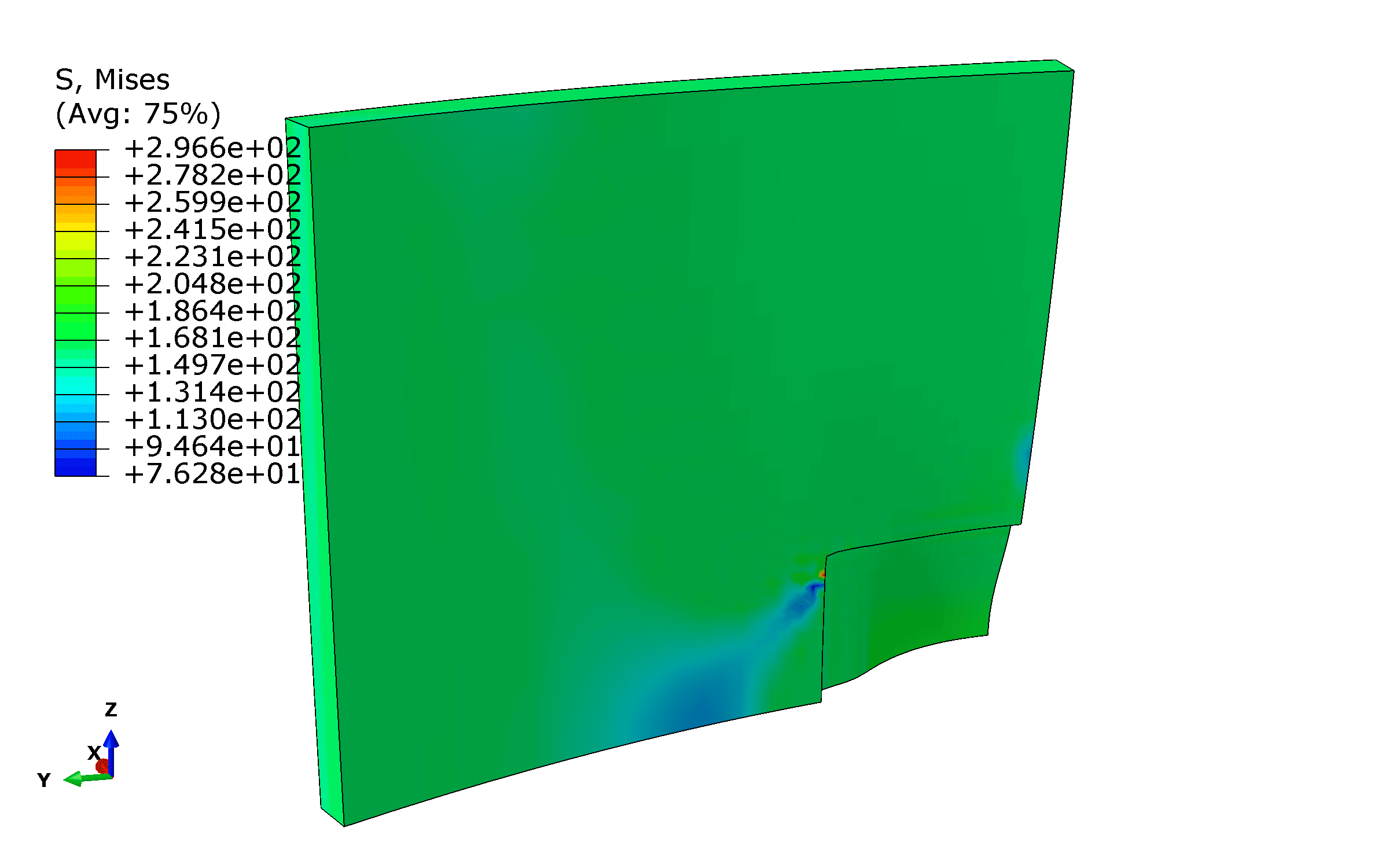
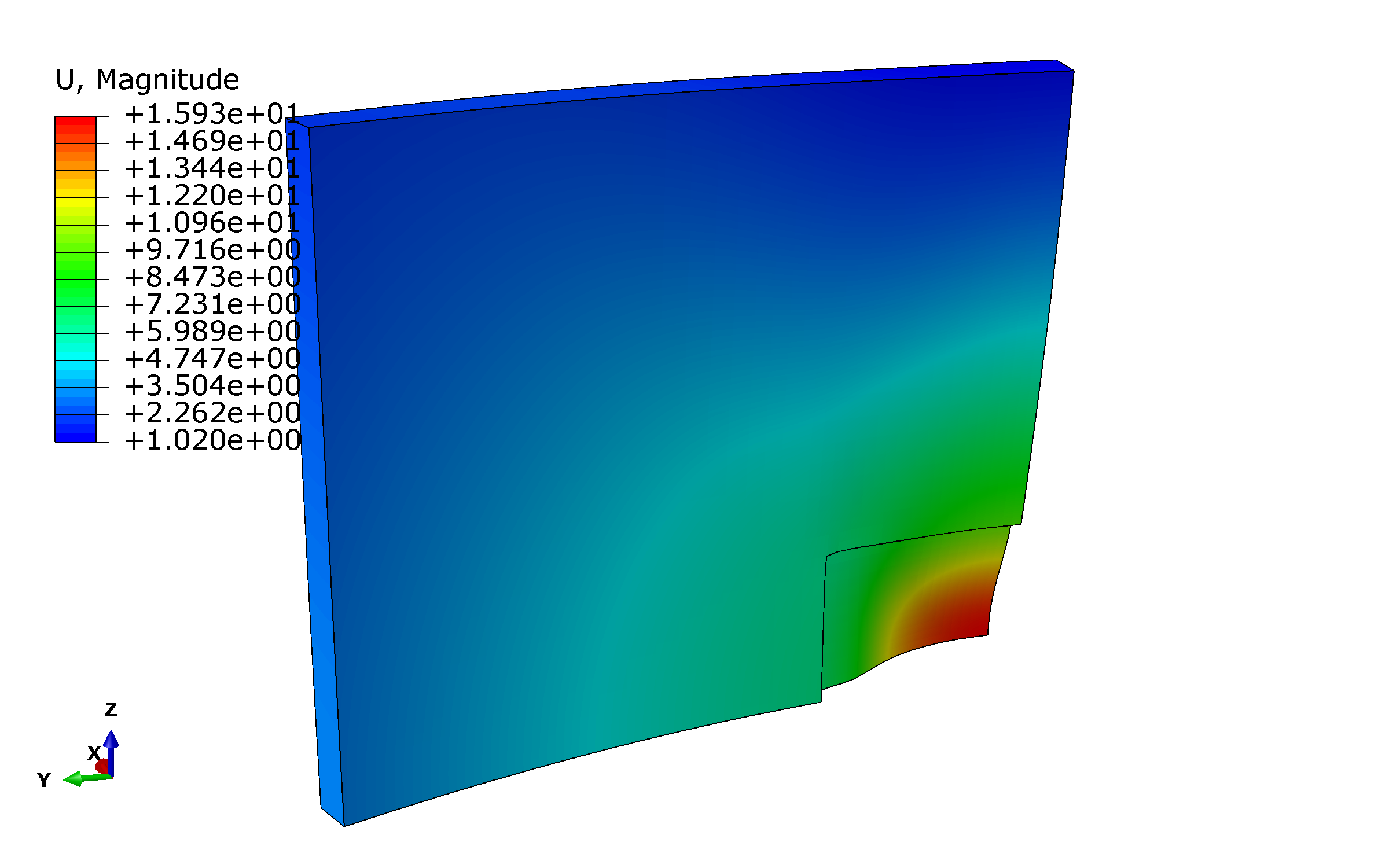
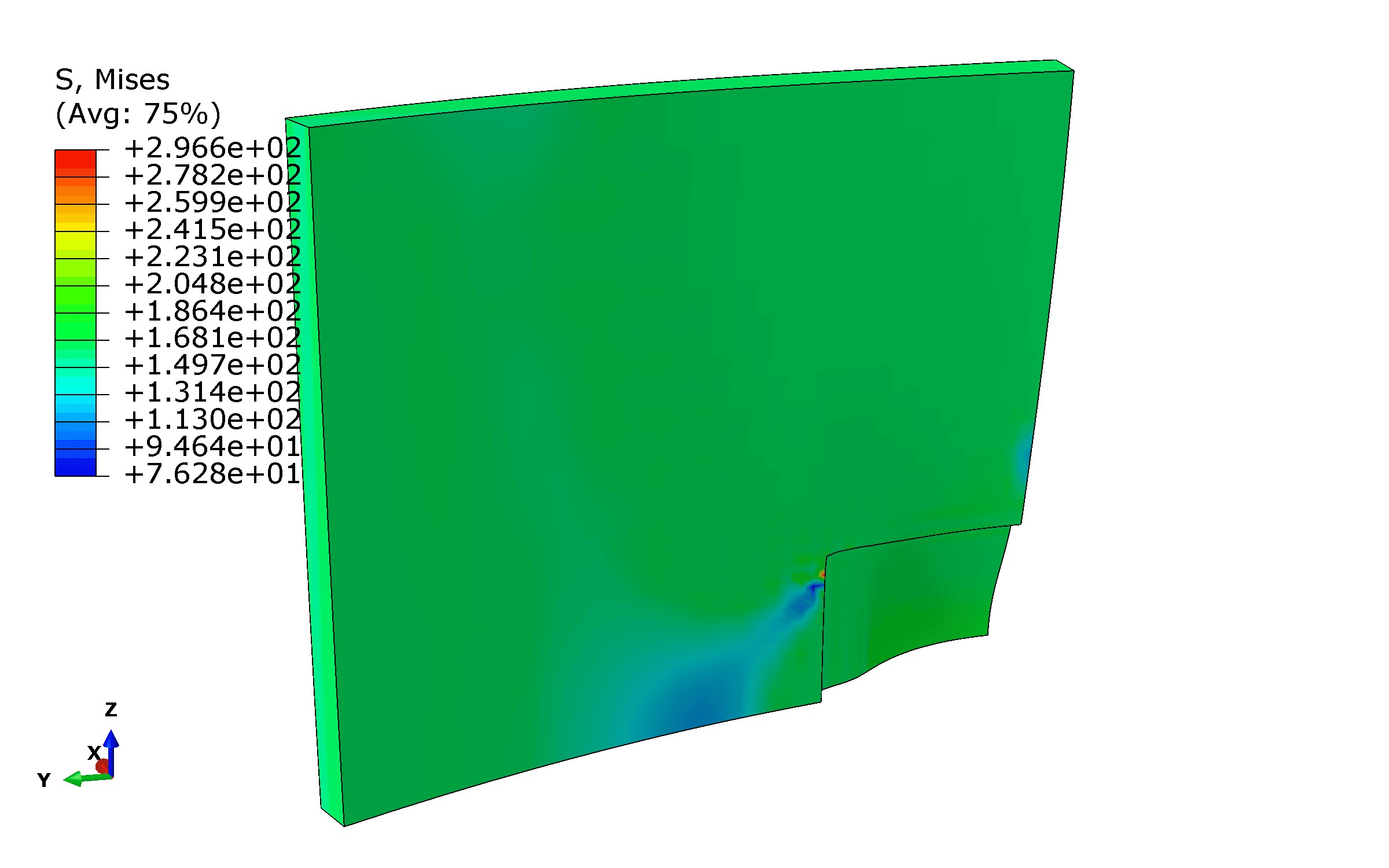
At collapse the thin ligament bends inward and plastic hinges form along the edges of the pocket. The contours show where the load path goes: von Mises stress reaches yield across the ligament, the displacement concentrates over the LTA, and the equivalent plastic strain (PEEQ) marks the hinge lines along the LTA edge.
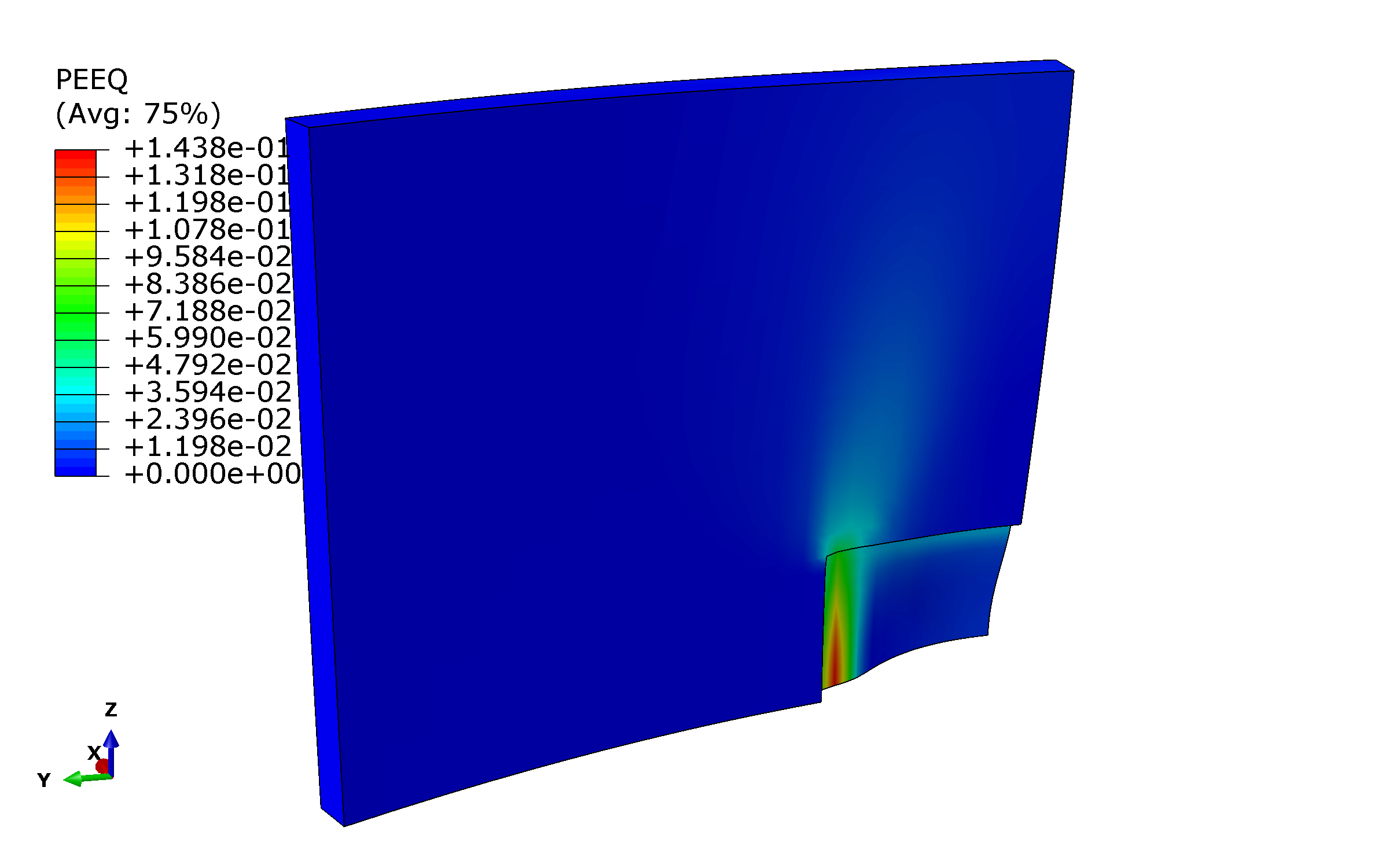
Result files (ODB) are not included: you run the jobs yourself. Each Riks job takes about 10–25 minutes on 6 cores.
Integrity and FFS engineers, inspection and corrosion engineers, pressure vessel designers and Abaqus users who want a worked API 579 Part 5 example: how to go from a Level 1 RSF to a Level 3 limit-load RSF, and how to set up and read a Riks collapse analysis.
Abaqus/CAE and Abaqus/Standard 2024 or newer for the CAE file (the INP files also run in older releases), Python 3 for the mesh generator and the comparison script, and the Abaqus Python for ODB post-processing. You need your own copy of API 579-1/ASME FFS-1 and API 579-2 for the standard itself.
You get a validated, ready-to-run Level 3 local thin area model with every number compared with the published example, a mesh study, an exact check against the closed-form limit pressure of the intact cylinder, and a script that rebuilds the model for your own LTA. See also API 579 Example 4.2 in Abaqus: corrosion mapping, API 579 Example 6.4 in Abaqus: pitting corrosion and API 579 Example 4.7 in Abaqus: corroded conical transition.
Does it reproduce the API 579 example? It uses all of the example’s data and reaches the same verdict. The FEA RSF is 0.90 against 0.857 in the example, so the Level 1 method is about 5% conservative for this LTA, as expected for a screening method.
How do you know the FEA is right? The intact model matches the closed-form limit pressure (2/√3)·σy·ln(Ro/Ri) within 0.005%, a finer mesh changes the collapse load by 0.14%, and the pressure resultants were checked against hand values.
Why Riks instead of a load-controlled static step? At collapse a load-controlled step stops converging, so you never see the peak. Riks follows the curve to the limit. The tutorial explains the small hardening used to keep Riks stable and how the result is corrected back to elastic–perfectly plastic.
Can I use it for my own LTA? Yes. Change the dimensions in e56_inputs.json and rebuild the decks with make_decks.py.
Is this a design or acceptance result? No. It is a worked benchmark and training package and does not replace an assessment by a qualified engineer.
Quality guarantee: if you are not satisfied with the delivered product, we will refund you.
Need more than the files?
There are two ways we can help. Book a one hour online consultation if you want to talk a problem through with a CAE engineer, using the checkbox in the order box. Order a project if you need a full simulation built for you, delivered to an agreed scope, price and deadline under a written contract.
We work on FEA and CFD for engineers, researchers and companies. Order your project, or message us on WhatsApp for a quick reply.
Other packages engineers working on this topic also download.
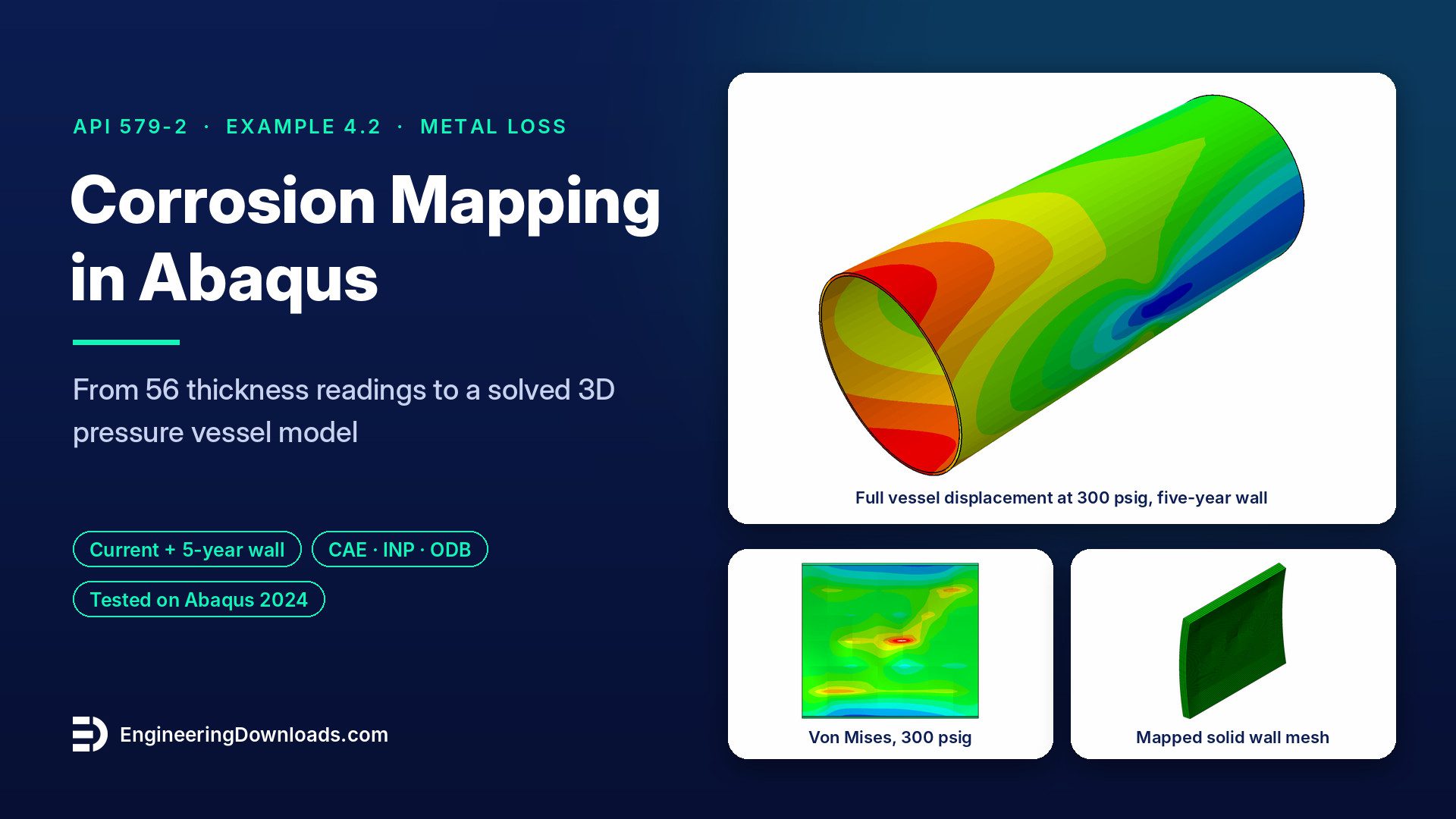 API 579 Example 4.2 in Abaqus: Corrosion Mapping of a Metal Loss Pressure Vessel
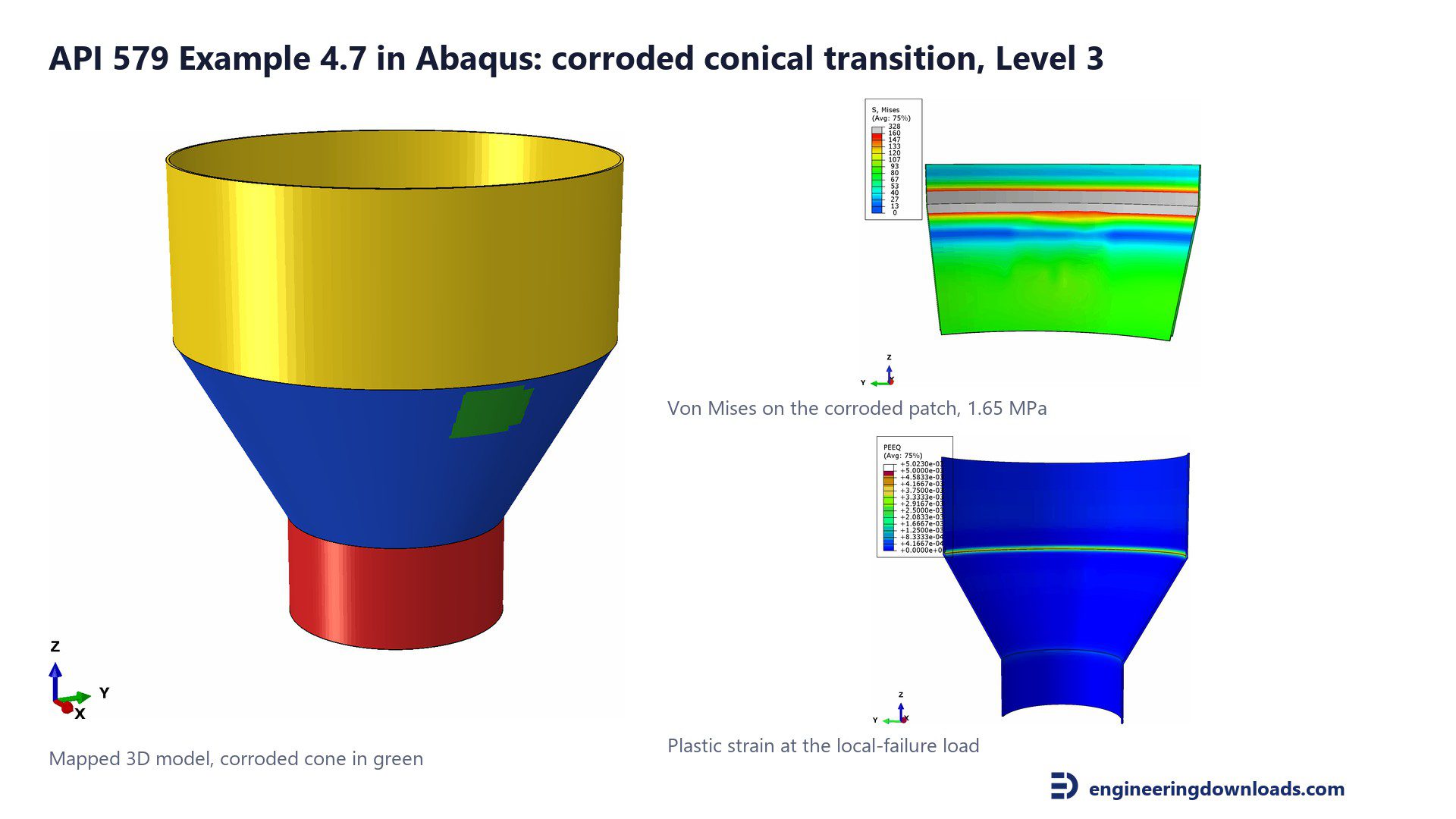 API 579 Example 4.7 in Abaqus: Corroded Conical Transition, Level 3 FFS
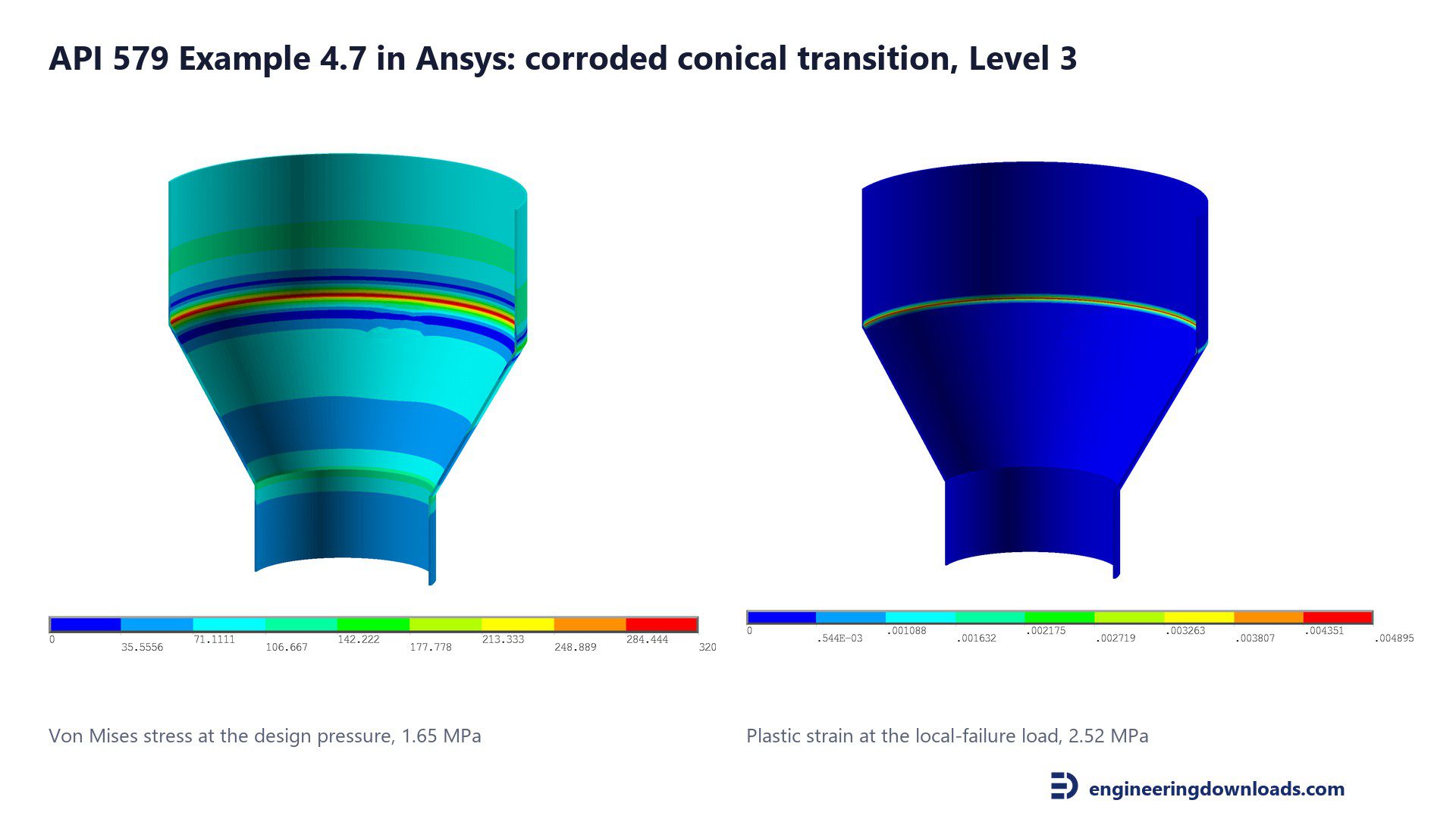 API 579 Example 4.7 in Ansys: Corroded Conical Transition, Level 3 FFS
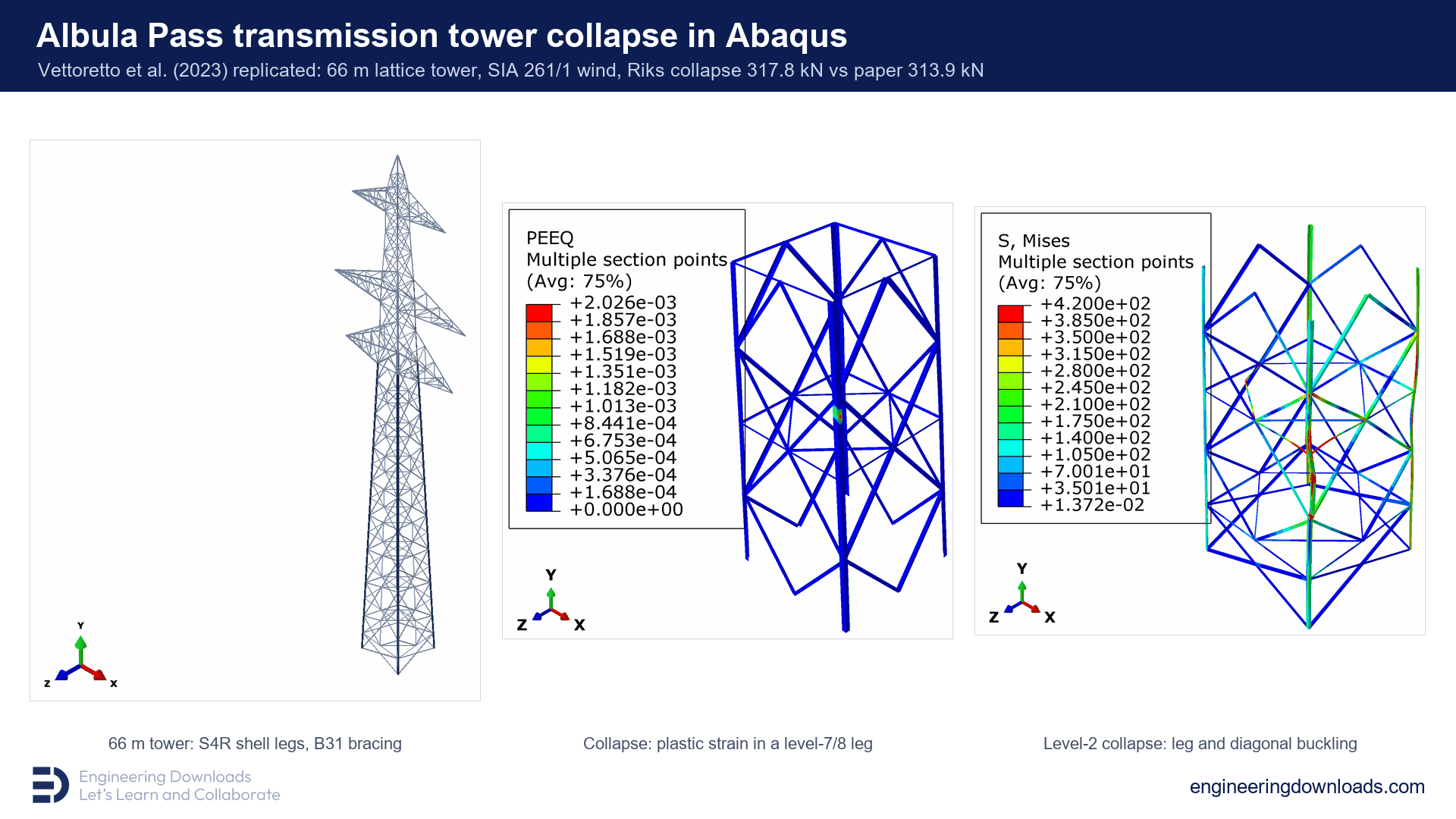 Transmission Tower Collapse under Extreme Wind in Abaqus: Buckling, Riks and Post-Buckling, after Vettoretto et al. (2023)€169,00
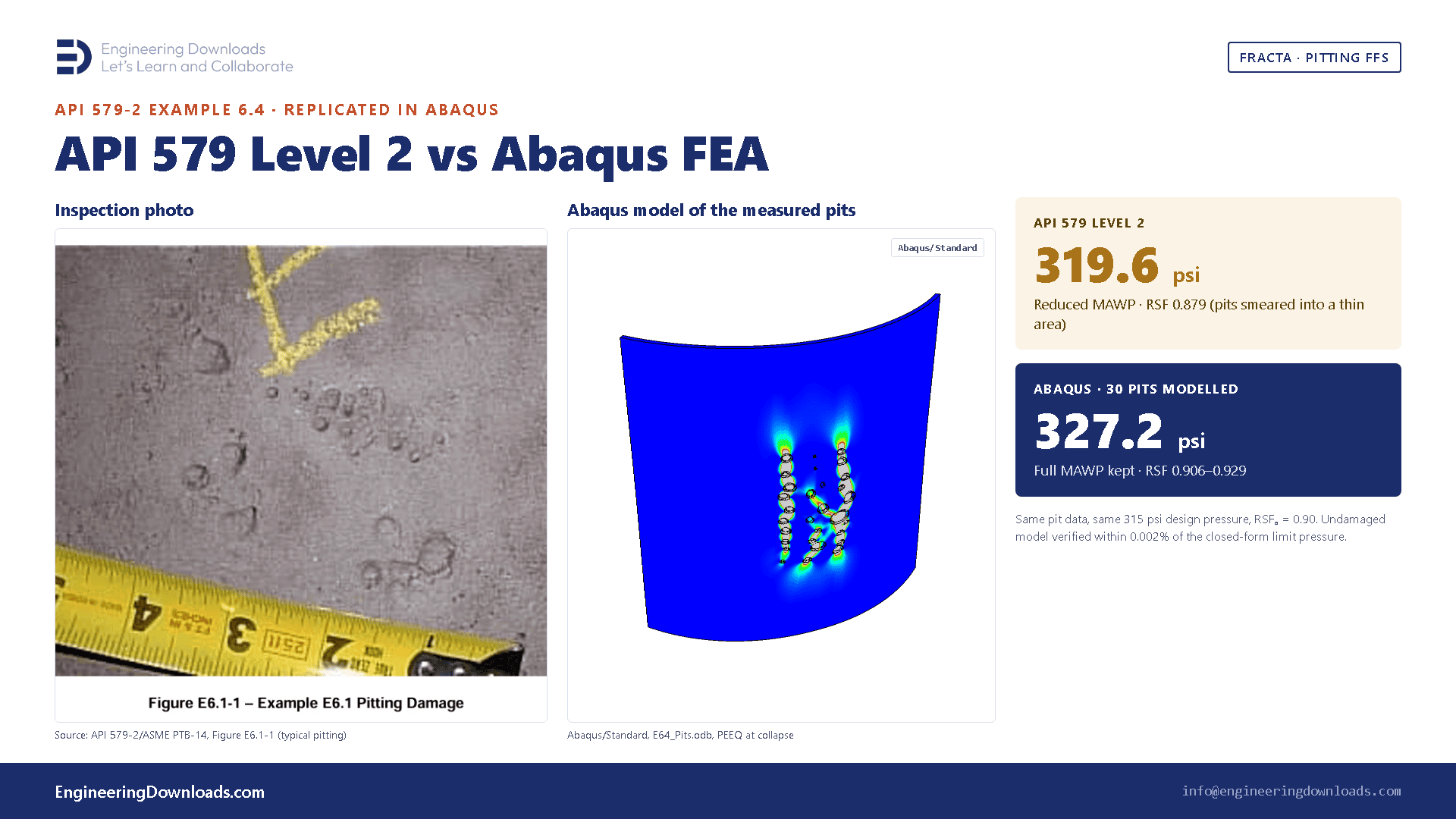 API 579 Example 6.4 in Abaqus: Localized Pitting Corrosion, Level 2 vs Level 3 FFS€129,00
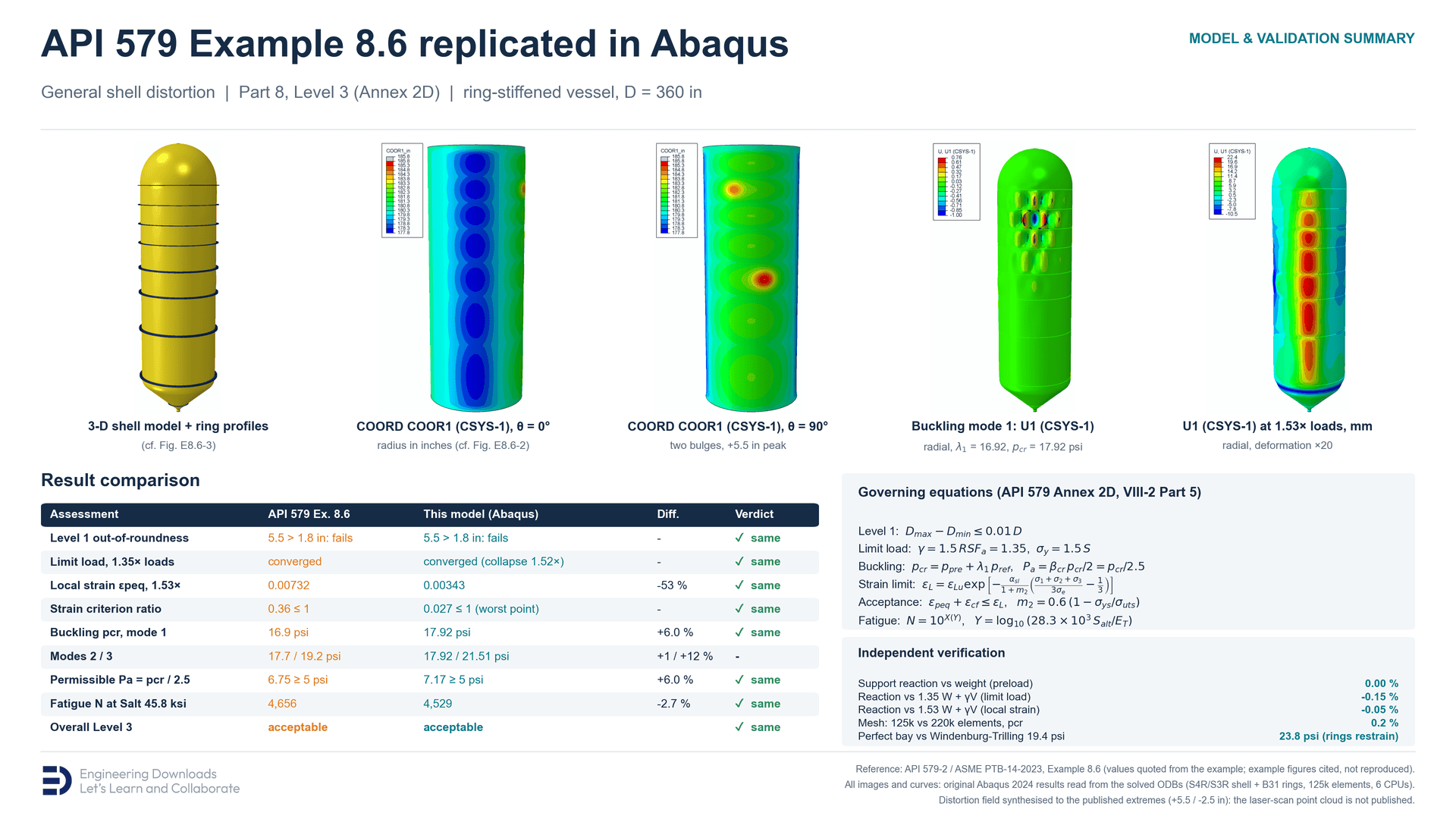 API 579 Example 8.6 in Abaqus: General Shell Distortion and Buckling, Level 3 FFS€129,00
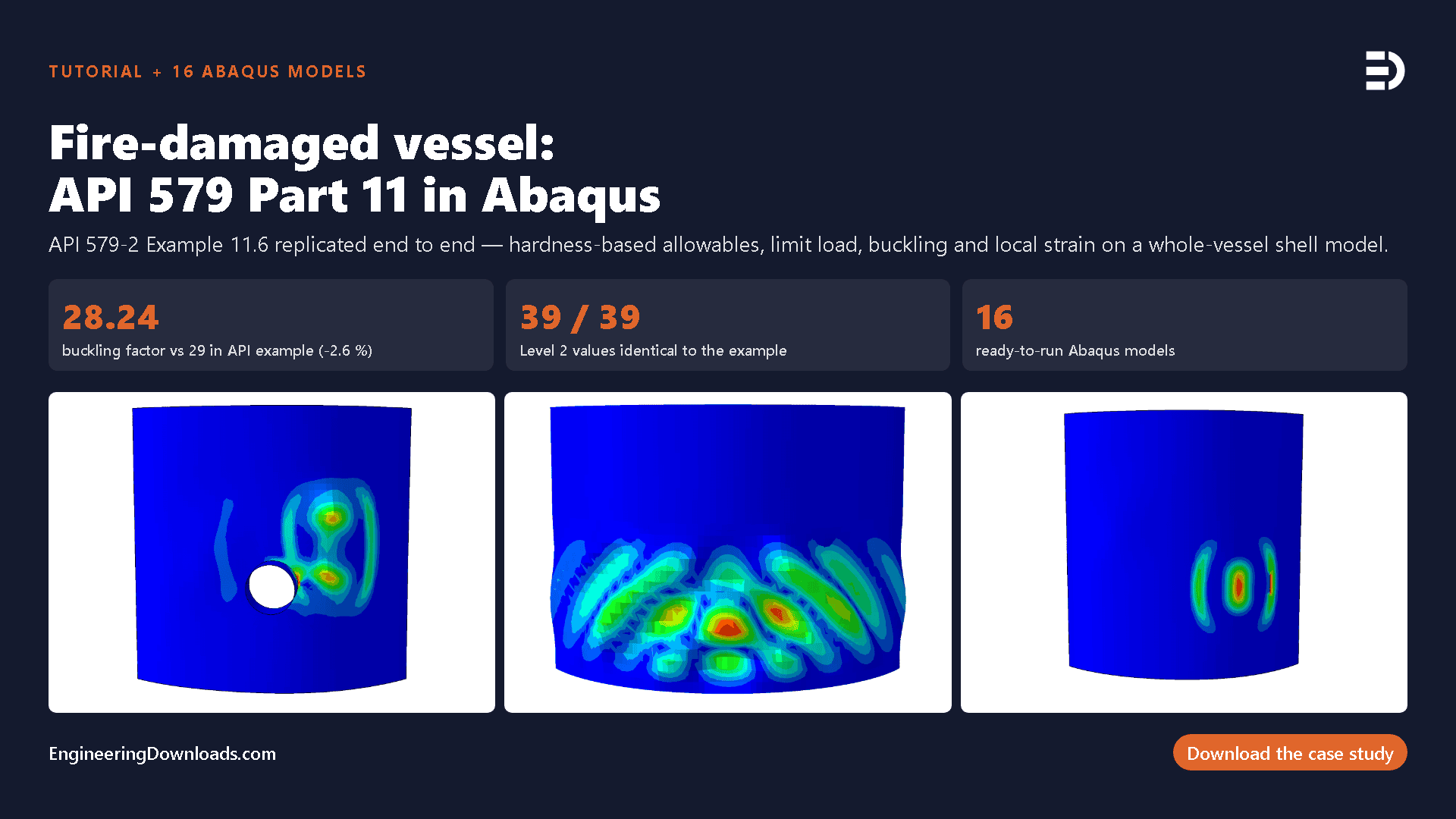 API 579 Example 11.6 in Abaqus: Fire-Damaged Fractionator, Level 3 FFS (Limit Load, Buckling, Local Strain)€139,00
 API 579 Example 7.4 in Abaqus: HIC Damage Level 3 Assessment with FAD and Plastic Collapse€139,00

Need a full custom project? See the options below.

€129,00

€179,00

€149,00

€119,00

€129,00

€149,00
See more
Want to receive push notifications for all major on-site activities?



