API 579 Example 4.7 in Ansys: Corroded Conical Transition, Level 3 FFS

€129,00 €149,00
Optional extras

Need a full custom project? See the options below.

€129,00 €149,00
Optional extras

Need a full custom project? See the options below.

22 people watching this product now!

Material Includes

  • PDF tutorial document
  • Five ready-to-run Ansys MAPDL input files
  • One-click Python run script
  • README and reference result images

Audience

  • Integrity and inspection engineers working with API 579 metal loss
  • FEA engineers who need a checked Level 3 workflow
  • Consultants who want a traceable, validated example
  • MSc and PhD students working on corroded vessels and shell junctions

What You Will Learn?

  • Run a complete API 579 Level 3 assessment of a corroded conical transition in Ansys Mechanical APDL.
  • Use a 3D SOLID185 model whose inner wall follows 120 inspection readings, with the thinnest reading kept exact.
  • Compare the Ansys junction stresses with the API 579 Level 2 values.
  • Run the API 579 limit-load analysis for protection against plastic collapse.
  • Check local failure with the ASME VIII-2 strain limit and the Annex 3-D stress-strain curve, evaluated in APDL.
  • Find the collapse pressure with an arc-length analysis and compare it with closed-form limits.
  • See the same results reproduced independently in Abaqus and with quadratic SOLID186 elements.

About Course

A corroded patch next to a cone-to-cylinder junction is a hard case for a hand calculation. API 579 Level 2 averages the thin spot into one thickness and checks the junction with shell formulas. It does not show you where the vessel actually yields, or how much margin is left.

This package completes API 579 Example 4.7 as a Level 3 assessment in Ansys Mechanical APDL. The 120 inspection readings are mapped onto a full 3D solid model of the cylinder-cone-cylinder transition. The model is solved at the design pressure, then the API 579 plastic-collapse and local-failure checks are run. Every result is validated against the manual’s own numbers, against closed-form theory, against a second element formulation, and against an independent Abaqus model of the same problem.
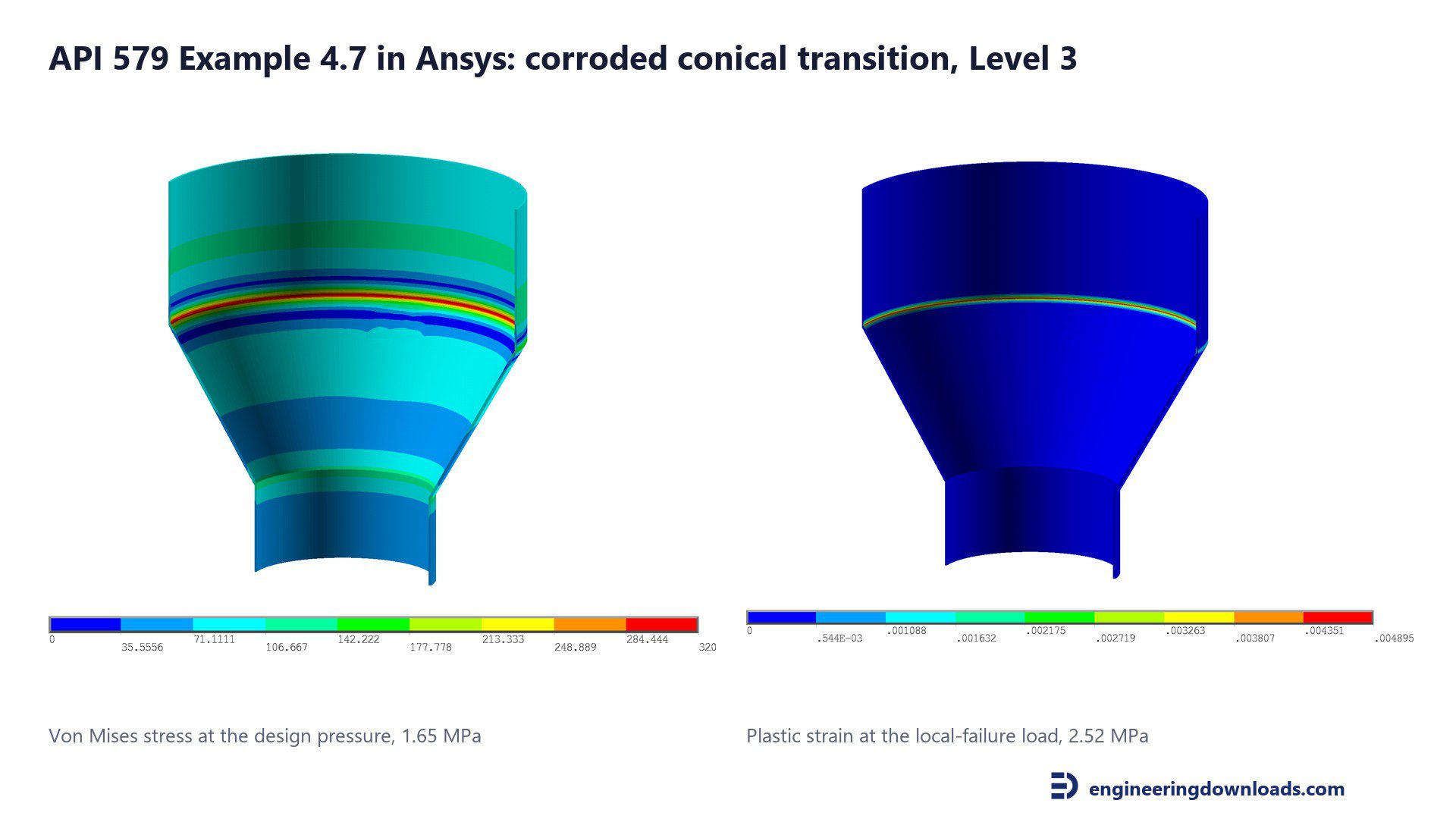
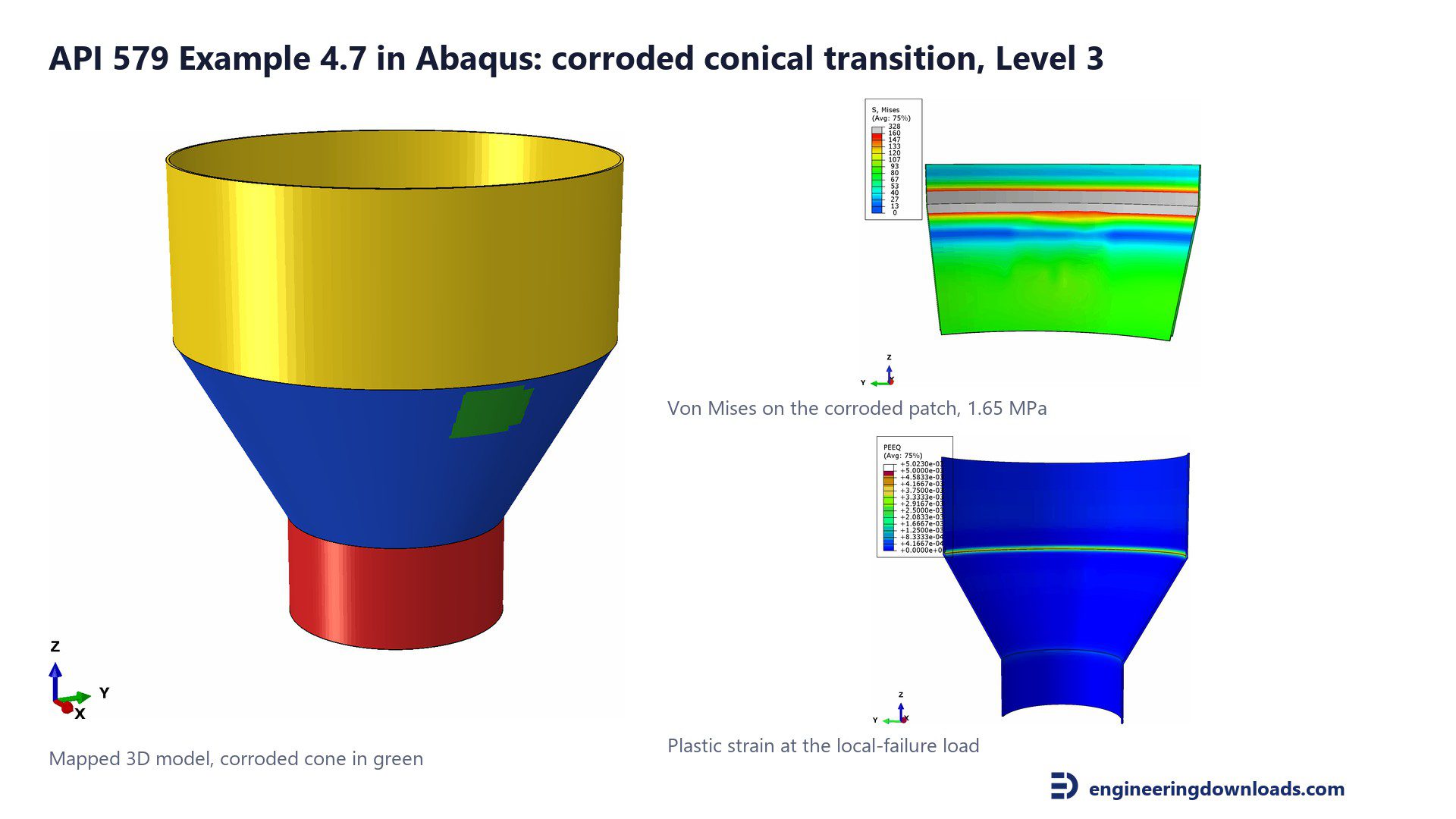
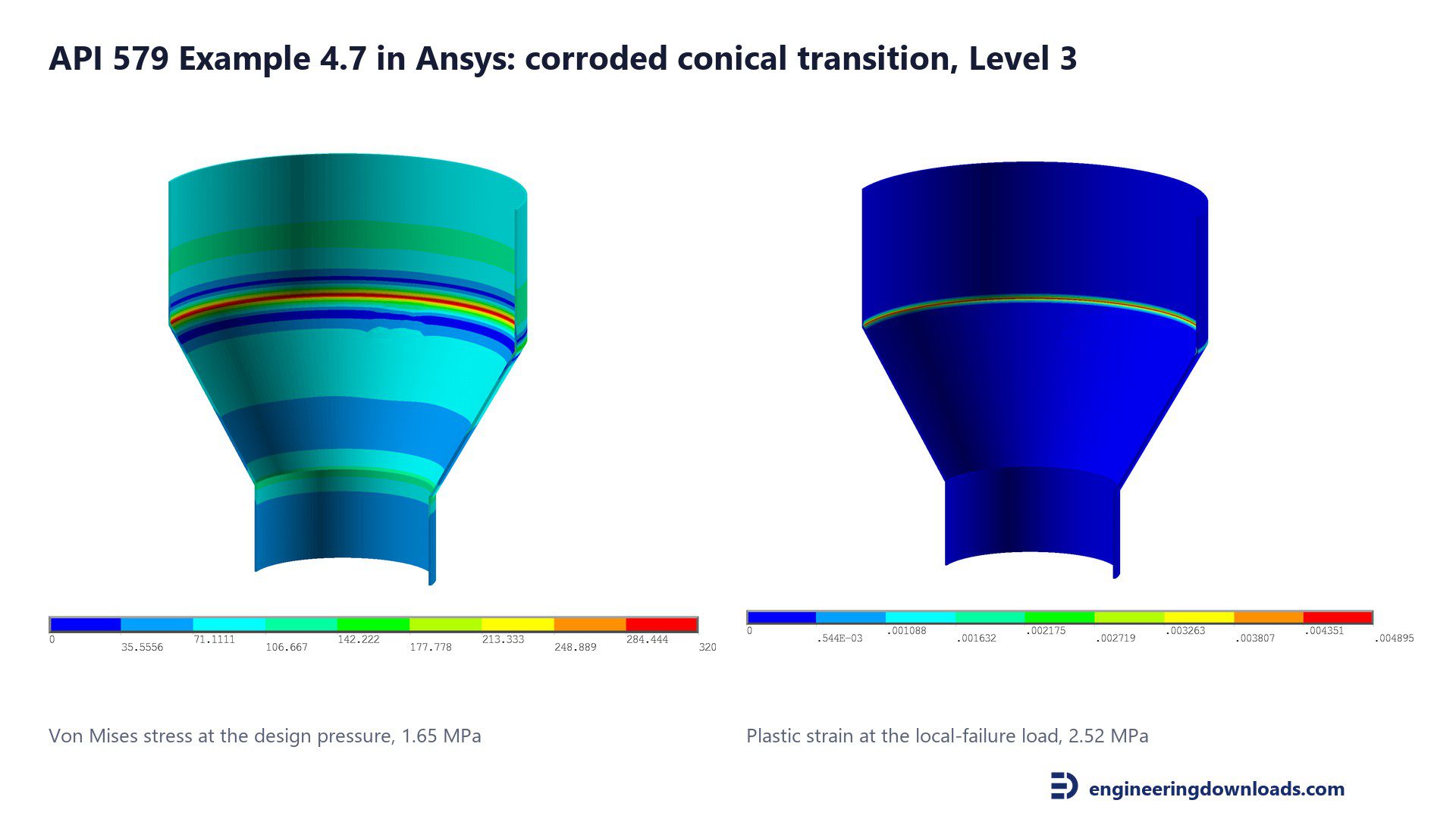
Ansys MAPDL model of API 579 Example 4.7: corroded conical transition, von Mises stress at design pressure and plastic strain at the local-failure load
The mapped 3D Ansys model: stress at the design pressure and plastic strain at the local-failure load.

Watch the 50-second overview

What this package is about

This package covers the whole chain, from the inspection table to a code-based verdict, in five ready-to-run Ansys input files:

  • Map: the 10 x 12 thickness grid on the 30° cone becomes a solid wall. The outer surface is fixed. The inner surface follows the readings minus the 1 mm future corrosion allowance, and the thinnest reading is kept exactly.
  • Check the hand calculation: a benchmark model with the API Level 2 idealised walls is compared with the API junction stresses.
  • Assess: elastic stresses at the design pressure. Then a limit-load analysis for plastic collapse, an arc-length collapse search, and an elastic-plastic local-failure check with the ASME VIII-2 strain limit.
  • Validate: against API 579, closed-form theory, quadratic SOLID186 elements and an independent Abaqus model.

Each input file builds the mesh, materials, loads and supports, solves, and prints its key results with plots. A PDF tutorial explains every step.

The API 579 Example 4.7 problem

We describe the example in our own words. The standard is not included, so keep your copy of API 579-2 / ASME PTB-14 next to you.

The vessel is a large cylinder, a 30° cone and a small cylinder. Internal corrosion was found on the cone, close to the large-end junction. The thickness was measured on a 10 x 12 grid at 30 mm spacing.
Inputs of the example

  • Inside radii 1000 mm (large end) and 500 mm (small end); walls 15, 18 and 14 mm; half-apex angle 30°
  • SA-516 Grade 70, design pressure 1.65 MPa at 125 °C, allowable stress 138 MPa
  • Future corrosion allowance 1.0 mm; RSFa = 0.9
  • 120 readings; thinnest reading 14.1 mm, which is 13.1 mm after the corrosion allowance

What we built in Ansys

  • Mesh: 143 880 nodes and 114 232 SOLID185 bricks with enhanced strain (KEYOPT(2)=2). There are four elements through the wall, and the mesh is refined at the corroded patch and both junctions.
  • Corrosion mapping: the inner surface follows the readings by bilinear interpolation. The mean mapping error over the 120 readings is 0.018 mm.
  • Loads: internal pressure on the corroded inner faces, and closed-end thrust on the large cut end. The small end is held axially, with three in-plane anchor points.
  • Materials: elastic for the design check. Elastic-perfectly plastic at 1.5 S = 207 MPa for the limit load. The ASME VIII-2 Annex 3-D true stress-strain curve (61 points) for the local-failure check.
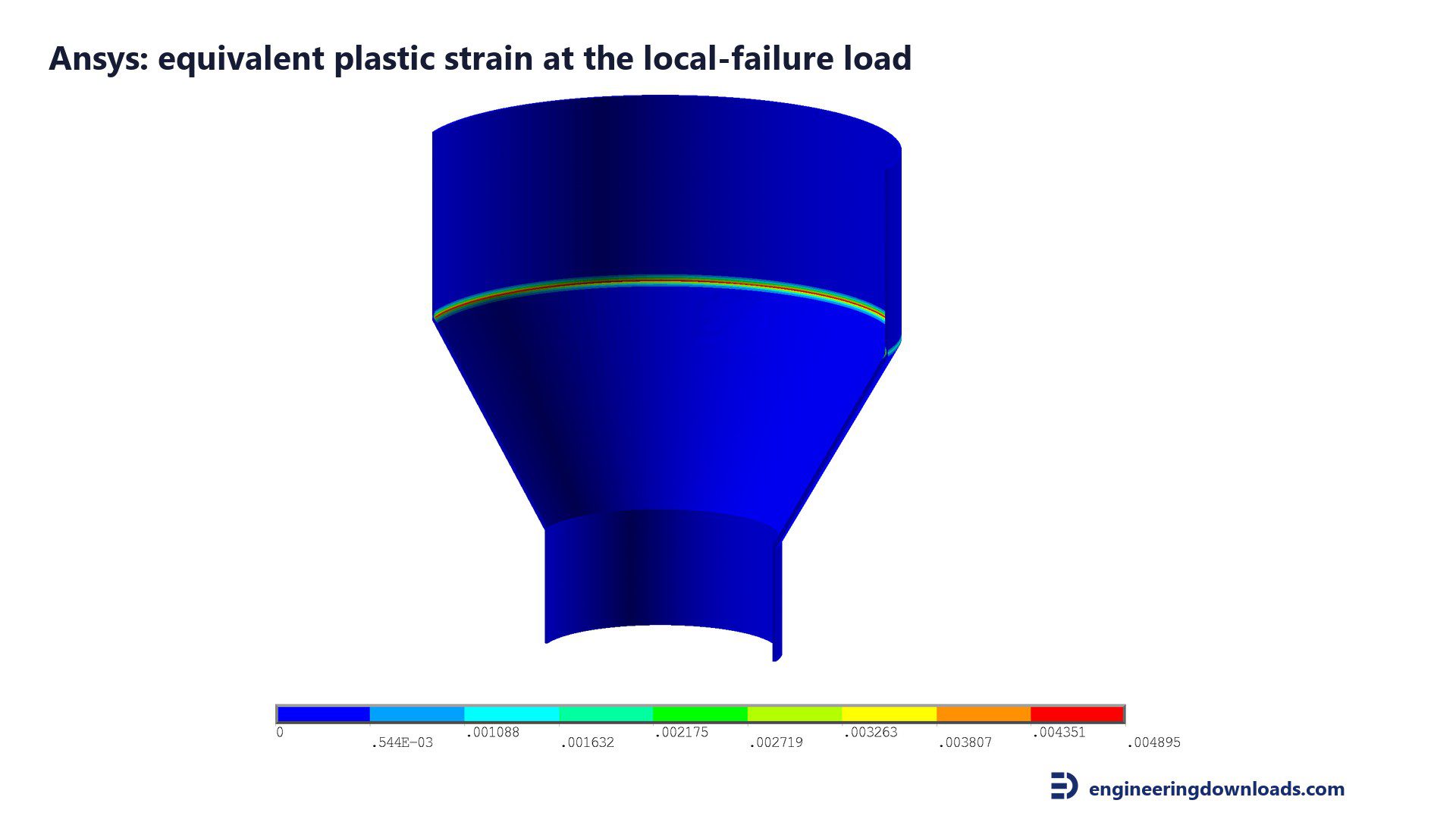
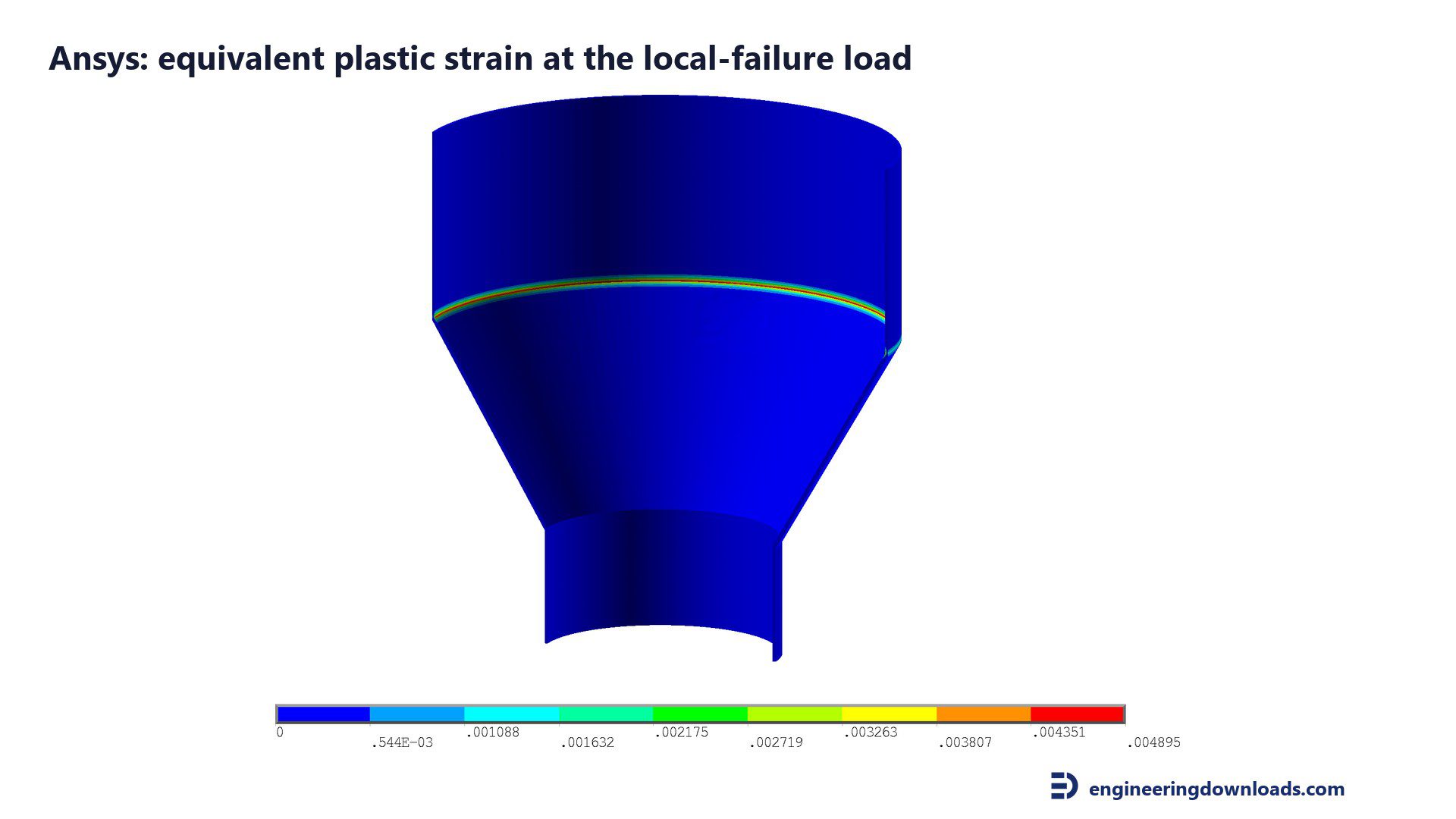
Equivalent plastic strain in the Ansys model of the corroded conical transition at the local-failure load
Equivalent plastic strain at 1.7 RSFa P = 2.52 MPa. Plasticity stays in a narrow band at the large-end junction.

Level 3 results

CheckLoadResultVerdict
Global plastic collapse (API 579-1 Annex 2D, VIII-2 5.2.3)1.5 RSFa P = 2.2275 MPaConverges at the full factored load; max PEEQ 0.0056PASS
Local failure, strain limit (VIII-2 5.3.3)1.7 RSFa P = 2.5245 MPaStrain-limit ratio 0.029 (limit 1.0)PASS
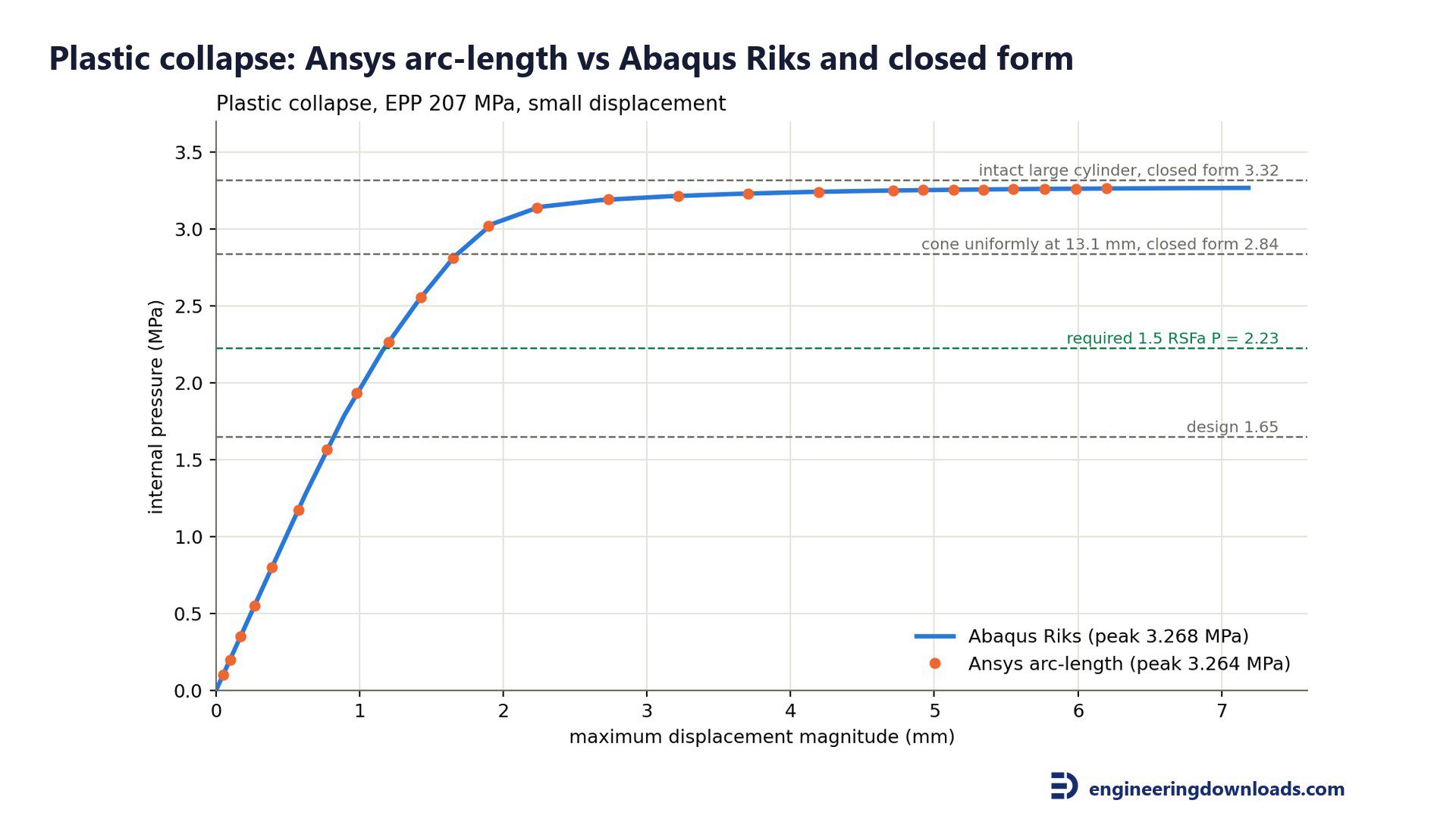
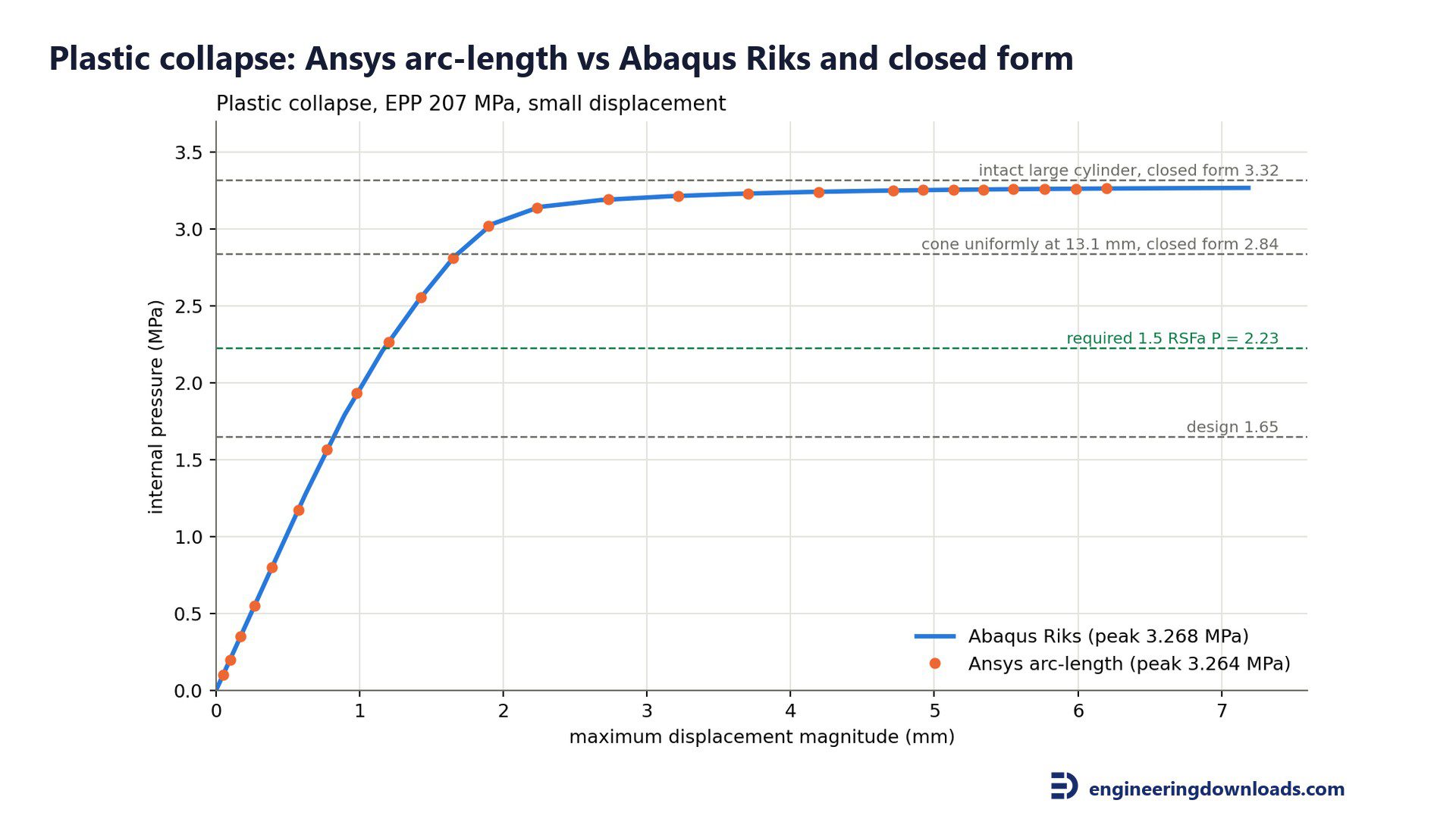
Plastic collapse pressure (arc-length)—3.26 MPa = 1.98 x design pressure—
Plastic collapse curve of the corroded conical transition: Ansys arc-length against Abaqus Riks and closed-form limit pressures
Collapse curve: the Ansys arc-length result lies on the Abaqus Riks curve and between the two closed-form limits.

How the model was validated

ReferenceQuantityResult
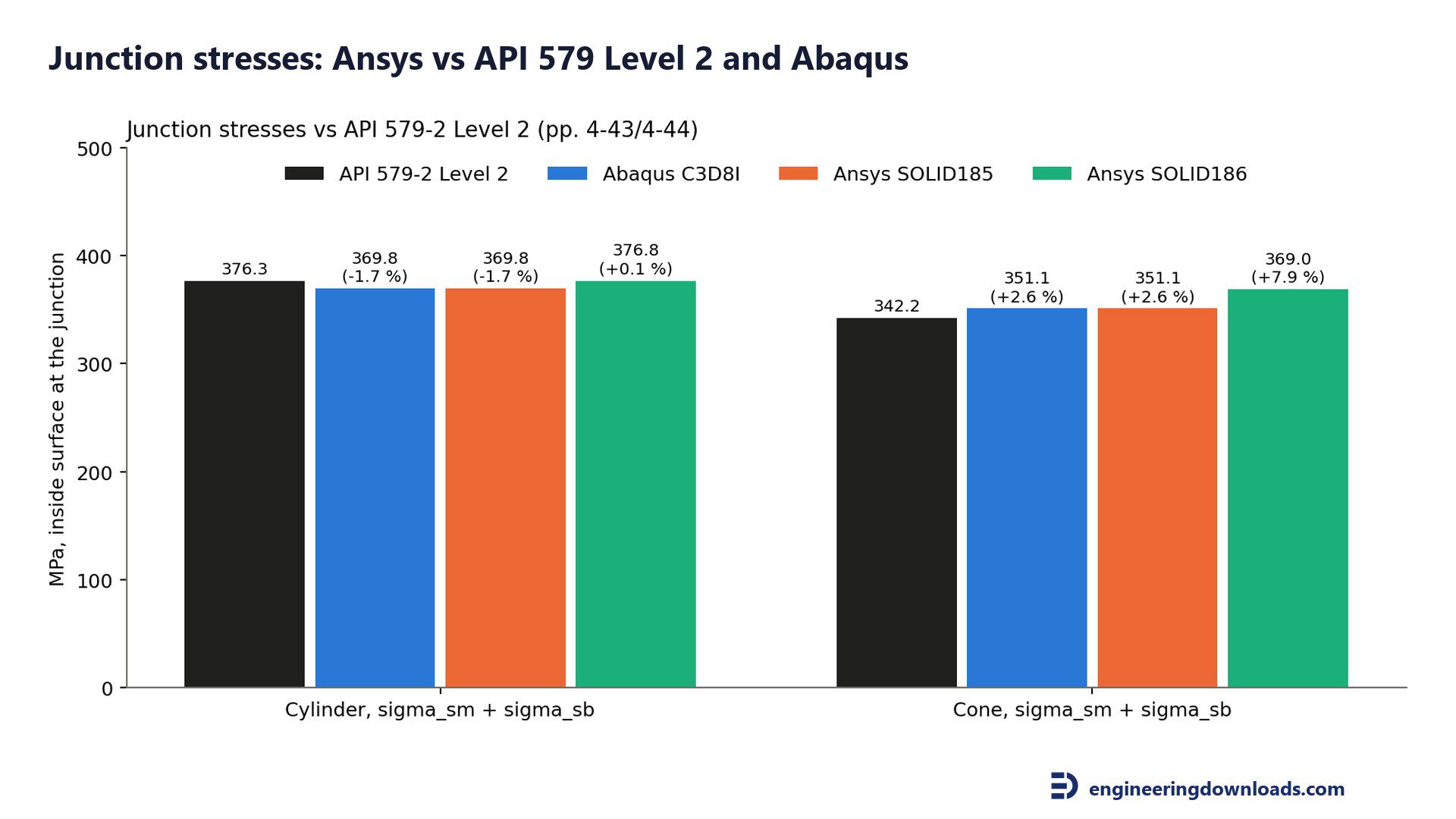
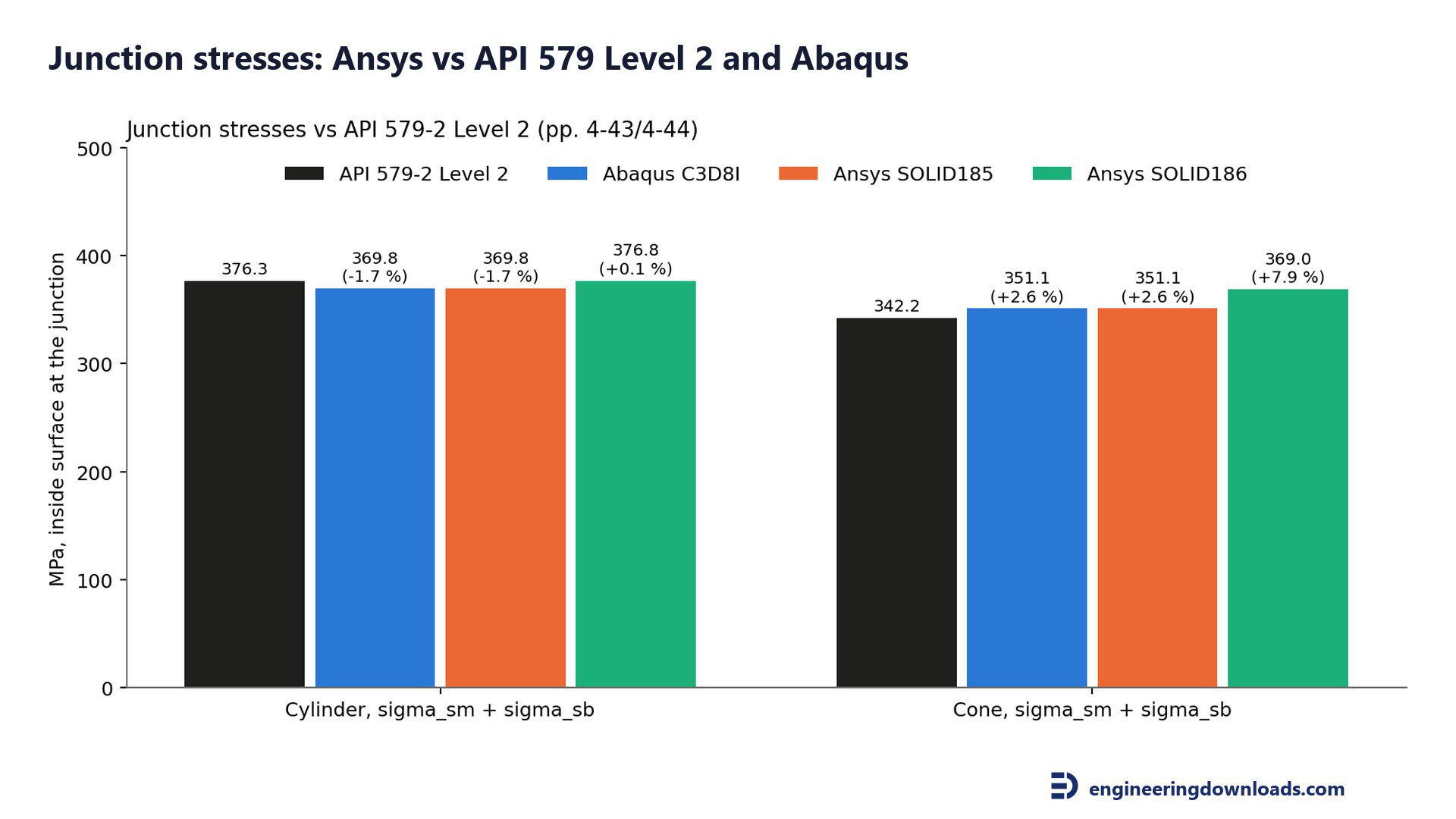
API 579-2 Level 2 (benchmark walls)Junction stress, cylinder / cone369.8 vs 376.3 MPa (−1.7 %) / 351.1 vs 342.2 MPa (+2.6 %)
Quadratic SOLID186 elementsMembrane stress at every classification linewithin 1 %
Closed form p R²(1−ν/2)/(E t)Radial displacement of the large cylinder0.516 vs 0.518 mm
Closed-form limit pressuresCollapse pressure3.26 MPa, between 2.84 and 3.32 MPa
Independent Abaqus model (C3D8I)All five casesElastic: same to 7 digits. Limit load and strain limit: within 0.05 %. Collapse: within 0.12 %
Junction stresses of API 579 Example 4.7: Ansys SOLID185 and SOLID186 against the API Level 2 values and Abaqus
Junction stresses against API 579 Level 2, Abaqus and quadratic elements.
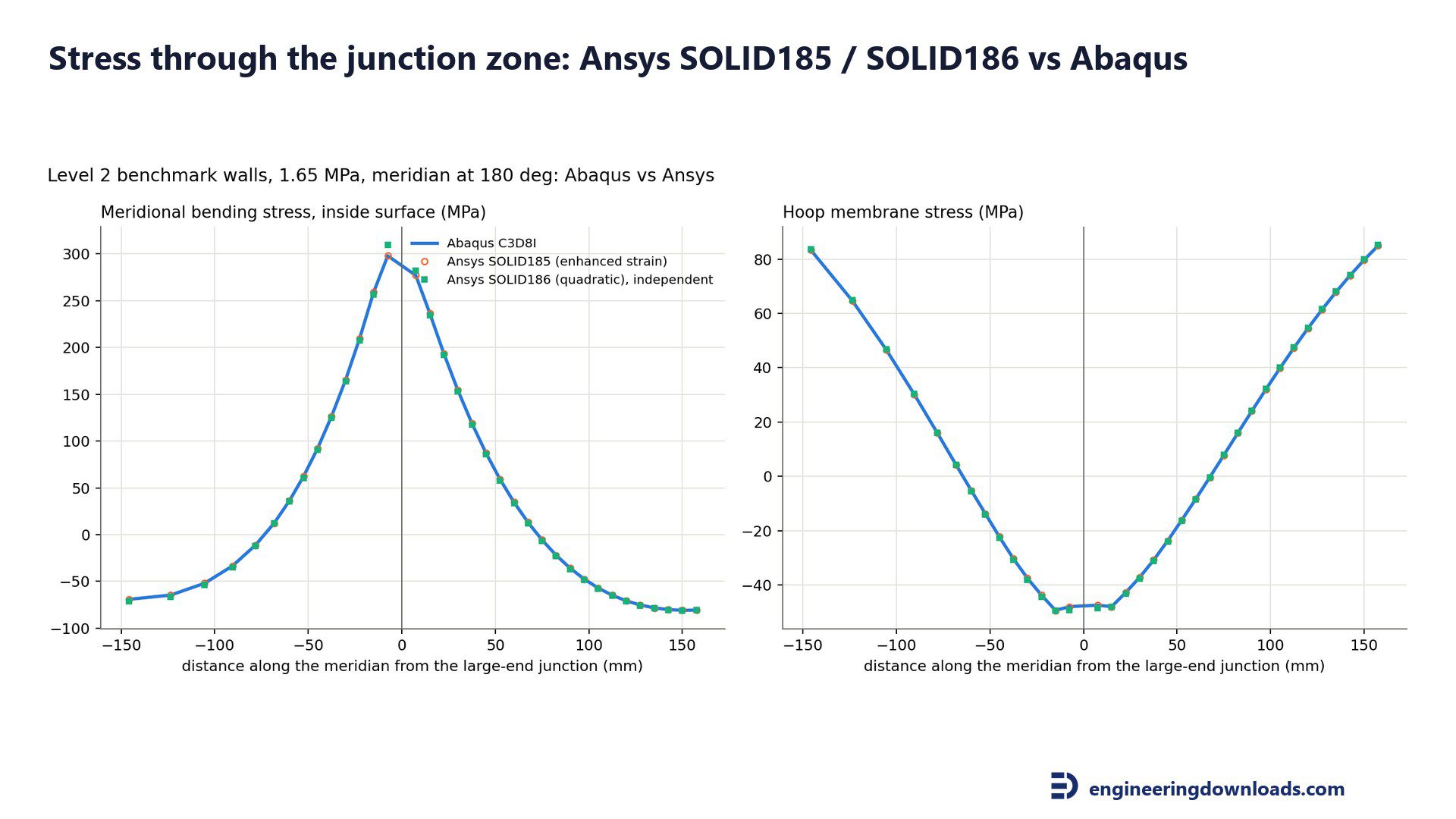
Meridional bending and hoop membrane stress along the meridian of the conical transition: Ansys against Abaqus
Stress distribution through the junction zone, Ansys and Abaqus.

What is included

  • Five ready-to-run Ansys Mechanical APDL input files (.dat):
    • Level 2 benchmark
    • Corroded wall at the design pressure
    • Global limit load
    • Local failure with the strain limit
    • Arc-length plastic collapse
  • Each file builds the full model, solves it, prints the key results and writes plots.
  • A step-by-step PDF tutorial with the method, the expected results and the validation.
  • A short README and reference result images.

What this package does not do

  • It is not a signed fitness-for-service decision for your equipment. It is a worked, validated example of the method.
  • It does not include the API 579 standard.
  • It does not generate a new mesh from your own inspection grid. The mesh of this example is delivered ready to use.

Who this package is for

  • Integrity and inspection engineers working with API 579 metal loss
  • Ansys users who need a checked Level 3 workflow with limit-load, strain-limit and collapse analyses
  • Consultants who want a traceable, validated example
  • MSc and PhD students working on corroded vessels and shell junctions

Software required

Ansys Mechanical APDL. The files were tested with Ansys 2024 R2 and use standard commands that run in recent releases. The model has 114 232 elements, so student licences with node limits cannot run it.

Frequently asked questions

Is this the actual text of API 579 Example 4.7?

No. It is an independent reproduction. We describe the example in our own words and use its inputs and published results. The standard is not included.

Do I need Ansys Workbench?

No. The files run directly in Mechanical APDL, from the Product Launcher, the command line, or with /INPUT in an open session.

How do you check the strain limit in Ansys?

The local-failure file evaluates the ASME VIII-2 5.3.3 strain-limit equations element by element after the solve, and prints the largest ratio and where it occurs.

Is there an Abaqus version?

Yes. The same example is available as an Abaqus package with CAE and INP files. Both packages give the same results.

What if the package is not what I expected?

Write to us. Engineering Downloads refunds clients who are not satisfied with a delivered product.

Related packages and reading

Need more than the files?

There are two ways we can help. Book a one hour online consultation if you want to talk a problem through with a CAE engineer, using the checkbox in the order box. Order a project if you need a full simulation built for you, delivered to an agreed scope, price and deadline under a written contract.

We work on FEA and CFD for engineers, researchers and companies. Order your project, or message us on WhatsApp for a quick reply.

Course Content

Product files

  • Ansys MAPDL models
  • Tutorial document

Reviews

No Review Yet
No Review Yet
€129,00 €149,00
Optional extras

Need a full custom project? See the options below.

22 people watching this product now!

Material Includes

  • PDF tutorial document
  • Five ready-to-run Ansys MAPDL input files
  • One-click Python run script
  • README and reference result images

Audience

  • Integrity and inspection engineers working with API 579 metal loss
  • FEA engineers who need a checked Level 3 workflow
  • Consultants who want a traceable, validated example
  • MSc and PhD students working on corroded vessels and shell junctions

Related  Products

See more

Want to receive push notifications for all major on-site activities?

✕