

Need a full custom project? See the options below.
Need a full custom project? See the options below.
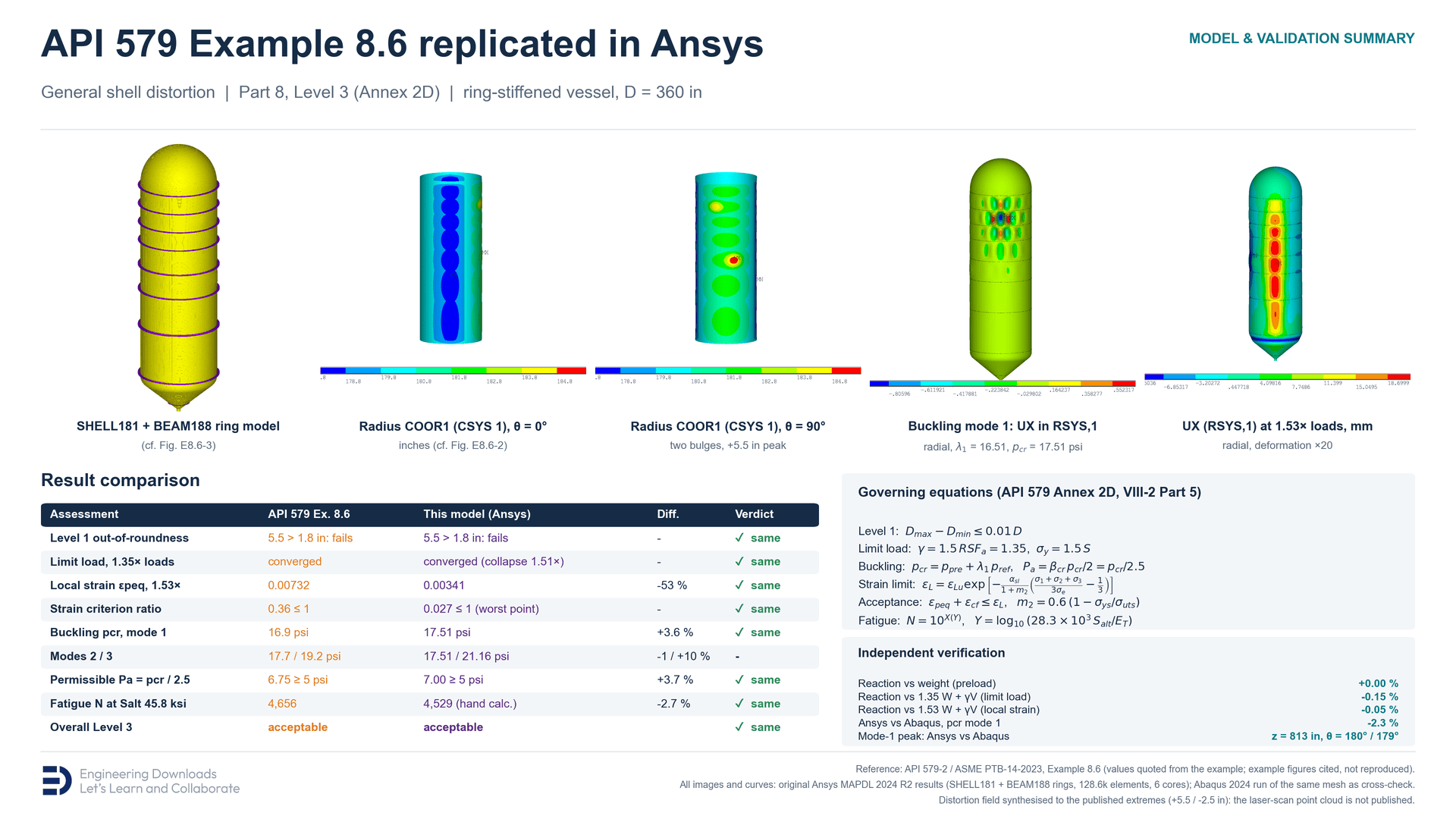
General shell distortion is a common fitness-for-service (FFS) question on large storage and process vessels: a laser scan shows the shell is out of round, and the owner needs to know whether it can still carry its loads, including vacuum. API 579-1/ASME FFS-1 Part 8 sends this case to a Level 3 assessment. This Ansys package rebuilds the published API 579-2 Example 8.6, a ring-stiffened vessel 360 in in diameter with up to +5.5 in of shell distortion, and runs all three Level 3 analyses in Ansys Mechanical APDL: elastic buckling with preload, limit load and local strain. Every result is compared with the example. You get an Ansys Workbench project, ready-to-run APDL decks, a Python post-processing script, an APDL plotting macro for the cylindrical coordinate system and a 16-page PDF tutorial.
Source: API 579-2/ASME PTB-14 Fitness-For-Service Example Problem Manual, Example 8.6, assessed to API 579-1/ASME FFS-1 Part 8 Level 3 with the Annex 2D numerical methods. The vessel is a ring-stiffened cylinder with a hemispherical top head and a conical bottom. It carries its own weight, liquid head, 25 psi at the top and a 5 psi vacuum design condition. A laser scan found general distortion between +5.5 in and −2.5 in. That fails the Level 1 out-of-roundness check, so a Level 3 FEA is required.
| Item | API 579-2 Example 8.6 | This package (Ansys) |
|---|---|---|
| Component | Ring-stiffened vessel, 960 in tangent to tangent, courses 0.5–0.78 in | Full 3-D model: head, four shell courses, knuckle, cone, nozzle, 8 rings (C12x20.7, W12x26, W12x40) |
| Damage | Laser-scanned general distortion, +5.5 / −2.5 in | Distortion field built into the node coordinates with the same extremes |
| Loads | Weight 383,000 lbf, liquid head, 25 psi top pressure, 5 psi vacuum | Same, with support reactions checked against hand values (within 0.15%) |
| Method | Annex 2D Level 3: limit load, local strain, buckling | Three Mechanical APDL systems in one Workbench project, one per check |
| Elements | 3-D shell model | About 125,000 SHELL181 shell elements plus BEAM188 ring profiles with offset I and flat-bar sections |
| Software | General FEA | Ansys Mechanical APDL 2024 R2, Ansys Workbench, Python 3 |
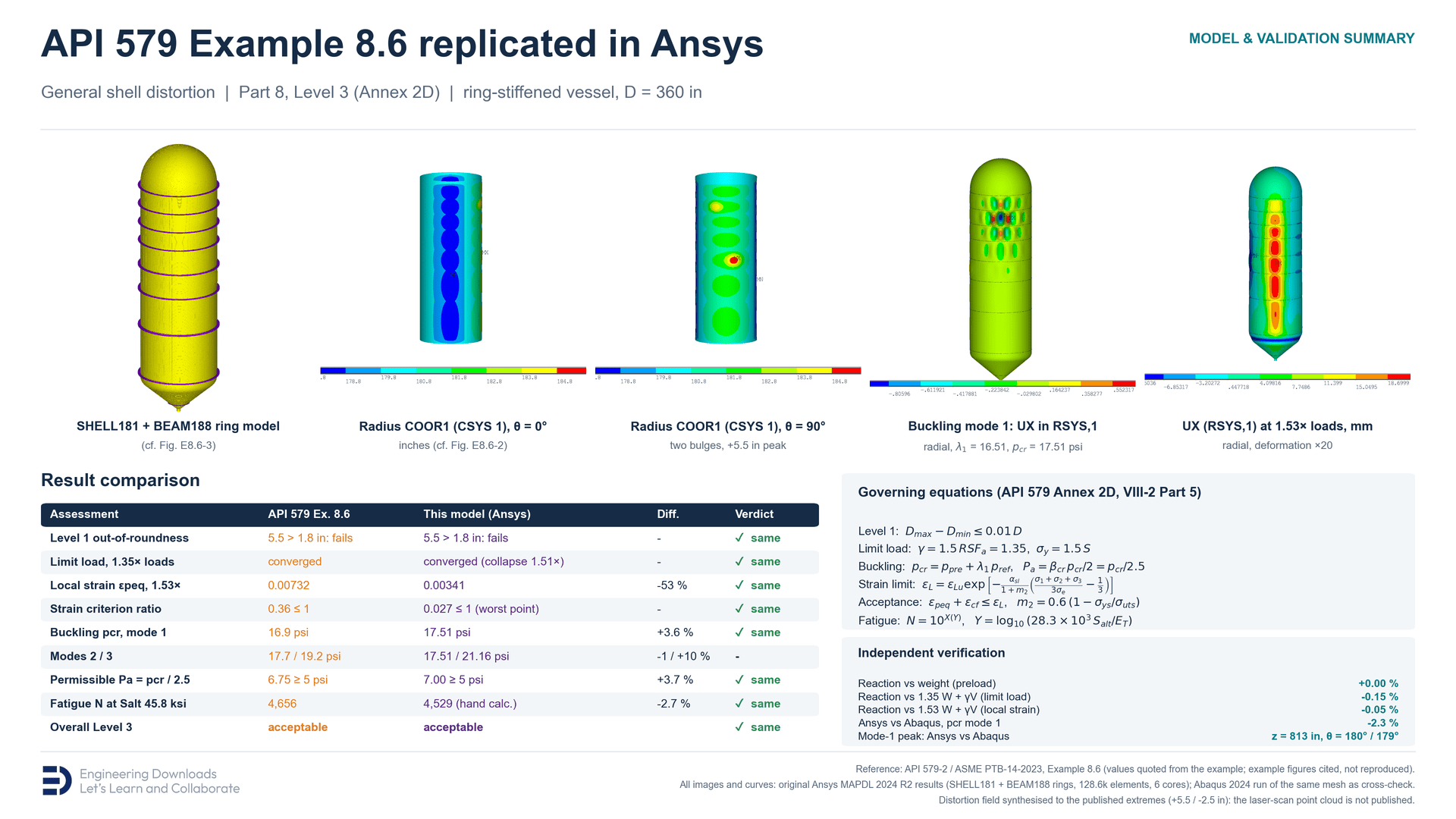
The example presents the scan as COOR1 in a cylindrical coordinate system, which is simply the radius at each point. The package does the same in Ansys. In the global cylindrical system (CSYS,1 and RSYS,1), the COOR1 plot shows the distorted shape directly (177.8–185.8 in), and UX becomes the true radial deflection rather than displacement magnitude. That is how you see where the shell is pushed out and where it is flattened. The included macro makes all these plots with one command.
| Check | Example 8.6 | This model (Ansys) | Verdict |
|---|---|---|---|
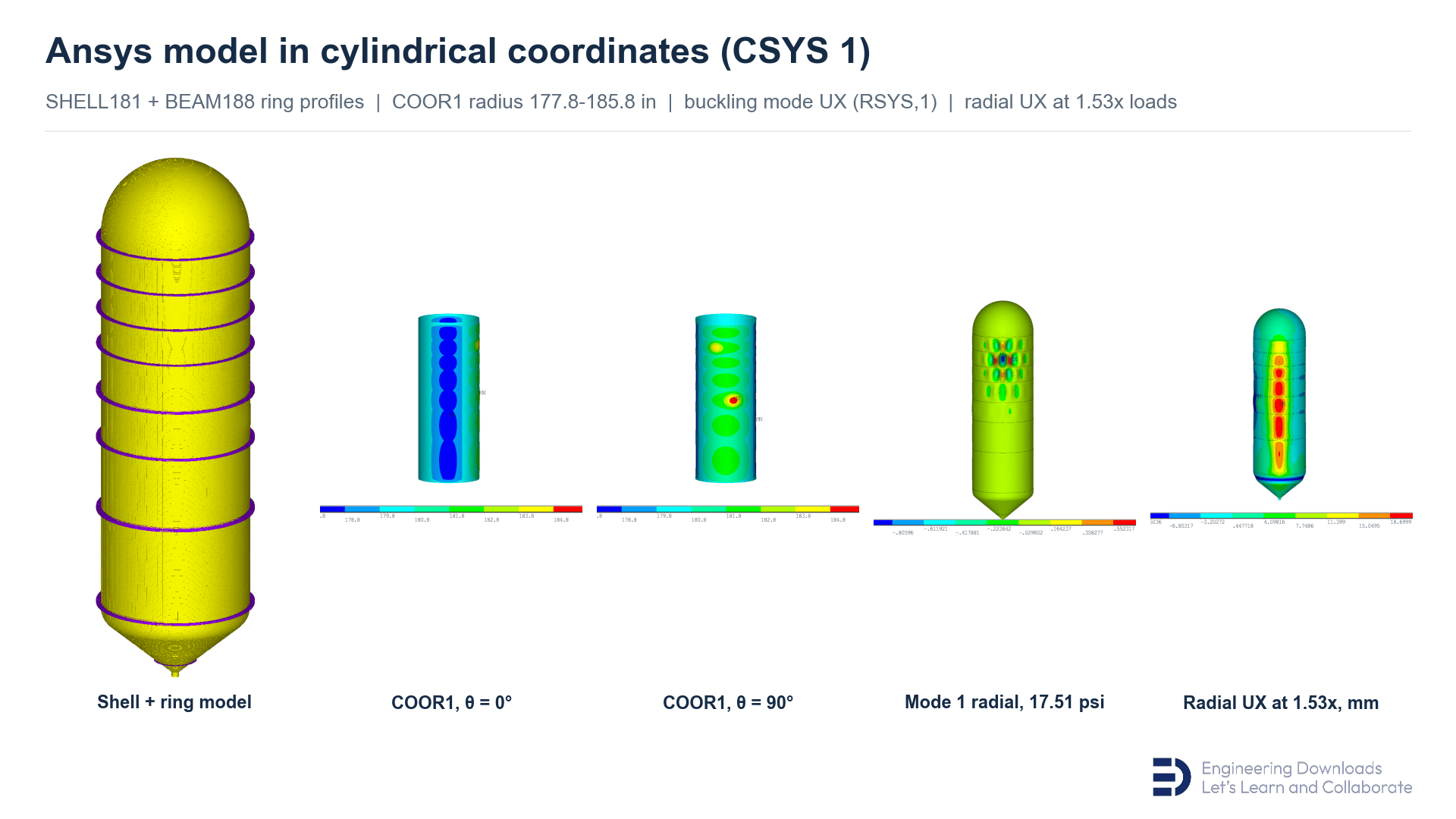
| Level 1 out-of-roundness | 5.5 in > 1.8 in, fails | 5.5 in > 1.8 in, fails | Same |
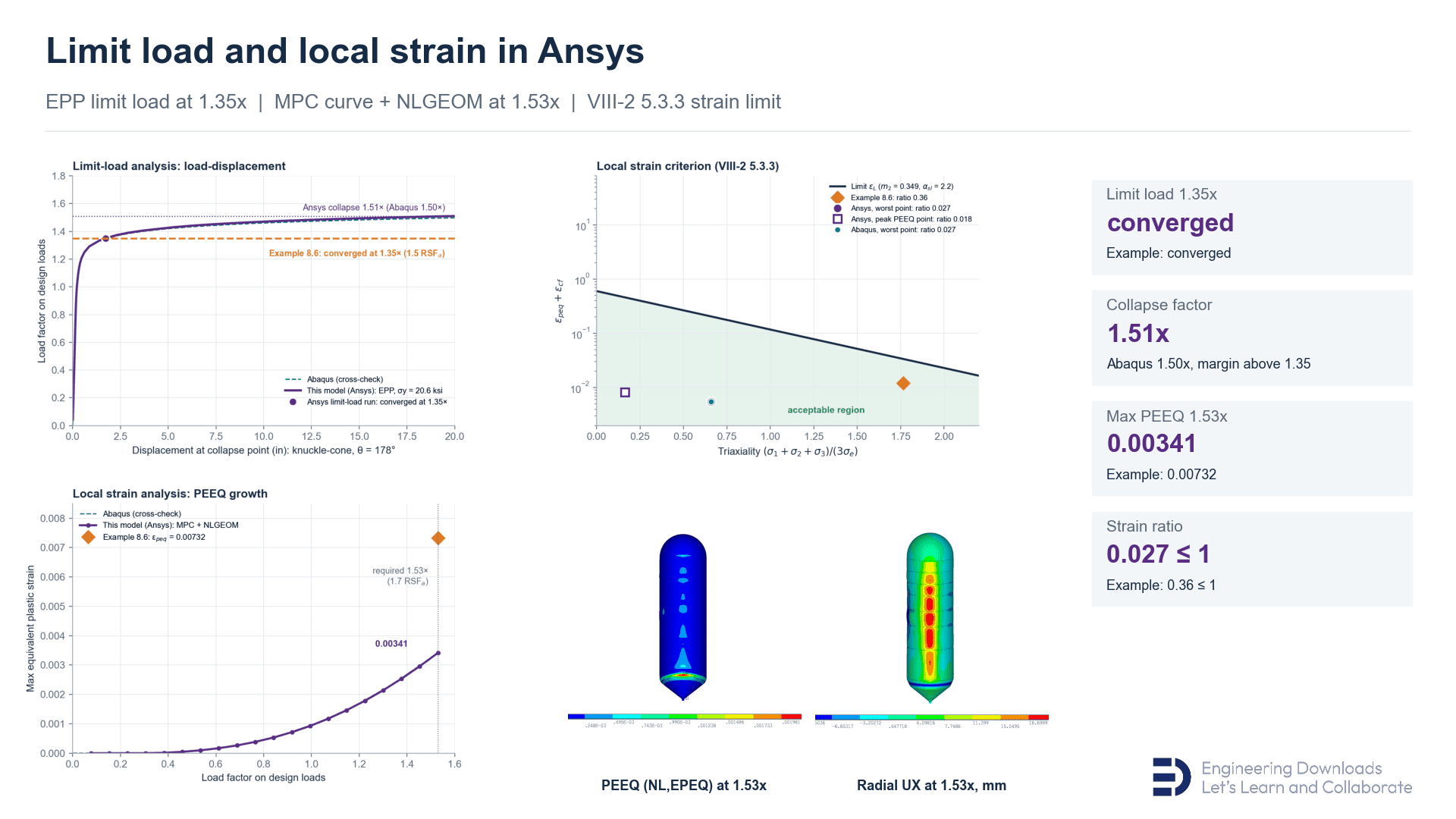
| Limit load, loads × 1.35 | Converged | Converged; plastic collapse at 1.51× | Same |
| Local strain, loads × 1.53 | εpeq = 0.00732, satisfied | εpeq = 0.00341, worst ratio 0.027, satisfied | Same |
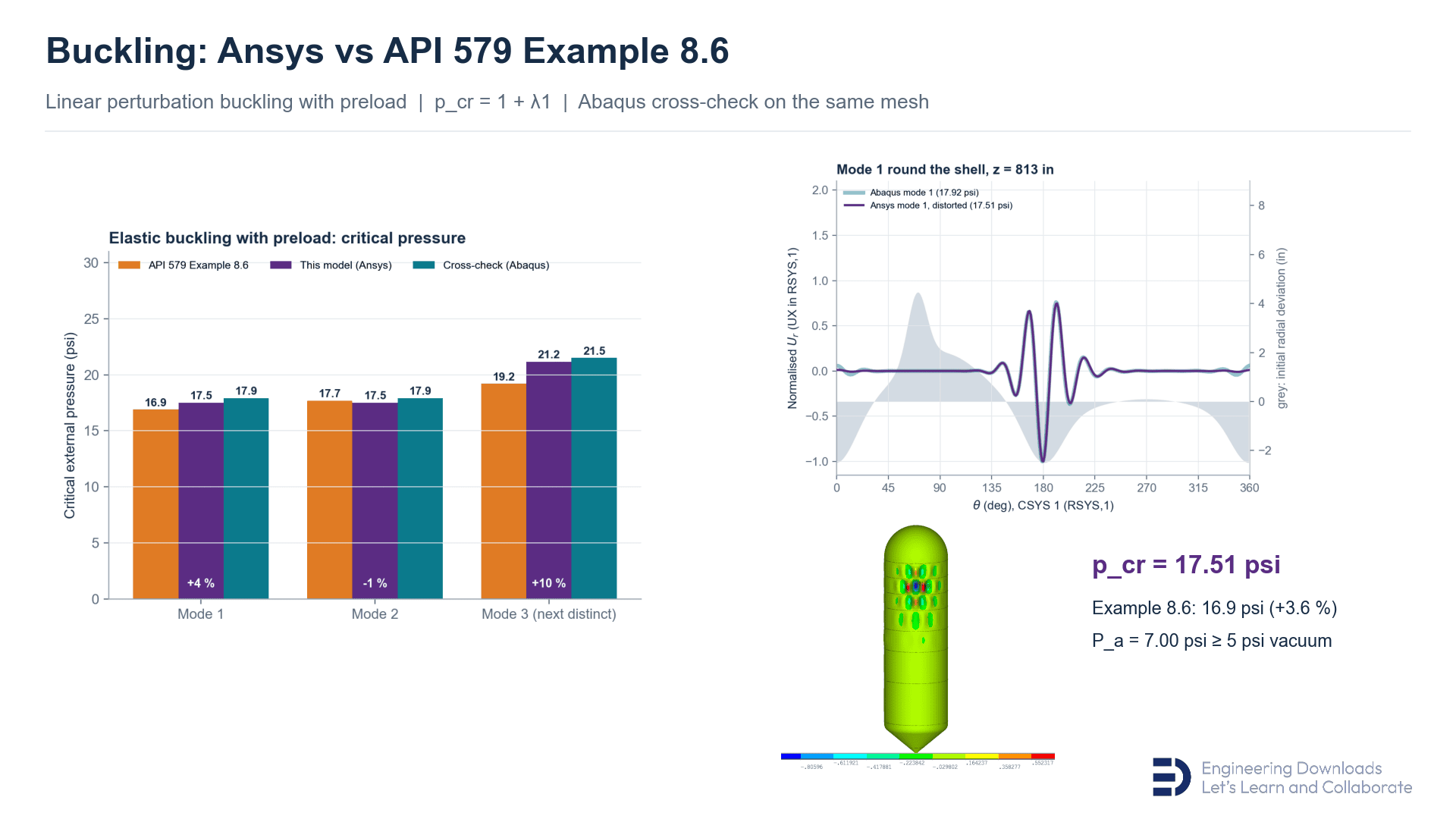
| Buckling pressure pcr | 16.9 psi | 17.51 psi (+3.6%) | Same |
| Permissible pressure pcr/2.5 | 6.75 psi ≥ 5 psi | 7.00 psi ≥ 5 psi | Same |
| Fatigue screening | N = 4,656 cycles | N = 4,529 cycles (−2.7%) | Same |
The same mesh was also solved in Abaqus as an independent cross-check. The two solvers agree within 2.3% on buckling pressure and 1% on collapse load, and give practically the same peak plastic strain (0.00341 against 0.00343).
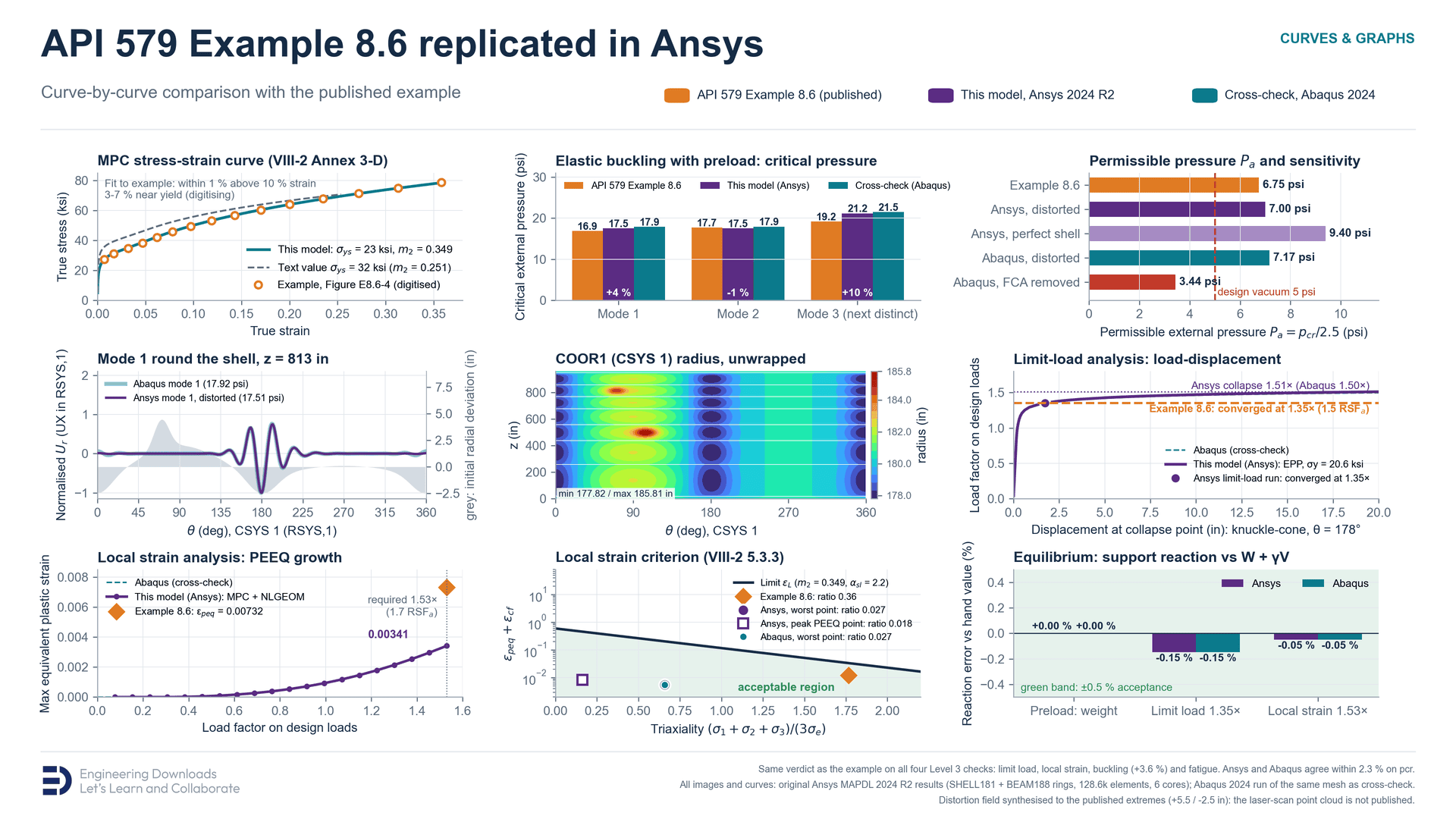
A nonlinear static base step applies the weight and 1 psi external pressure. A linear perturbation buckling analysis (PERTURB,BUCKLE with Block Lanczos) then applies a 1 psi perturbation, so pcr = 1 + λ1. With βcr = 0.8 the design factor is 2/βcr = 2.5. The first mode sits in the upper ring bays, on the flattened band of the shell, as in the example. On the same mesh, the perfect shell buckles at 23.5 psi, so the distortion lowers the buckling pressure by about 25%.
The limit-load system uses an elastic–perfectly plastic material (TB,BISO) with yield 1.5S = 20.6 ksi and loads factored by 1.35 (1.5 RSFa). It converges, and a ramp beyond the required factor collapses at 1.51×. The local strain system uses the ASME VIII-2 Annex 3-D stress–strain curve (TB,MISO) with large deflection at loads × 1.53. The Annex 3-D curve reproduces the example’s Figure E8.6-4. The strain limit εL is then checked on the top and bottom surface of every shell element.
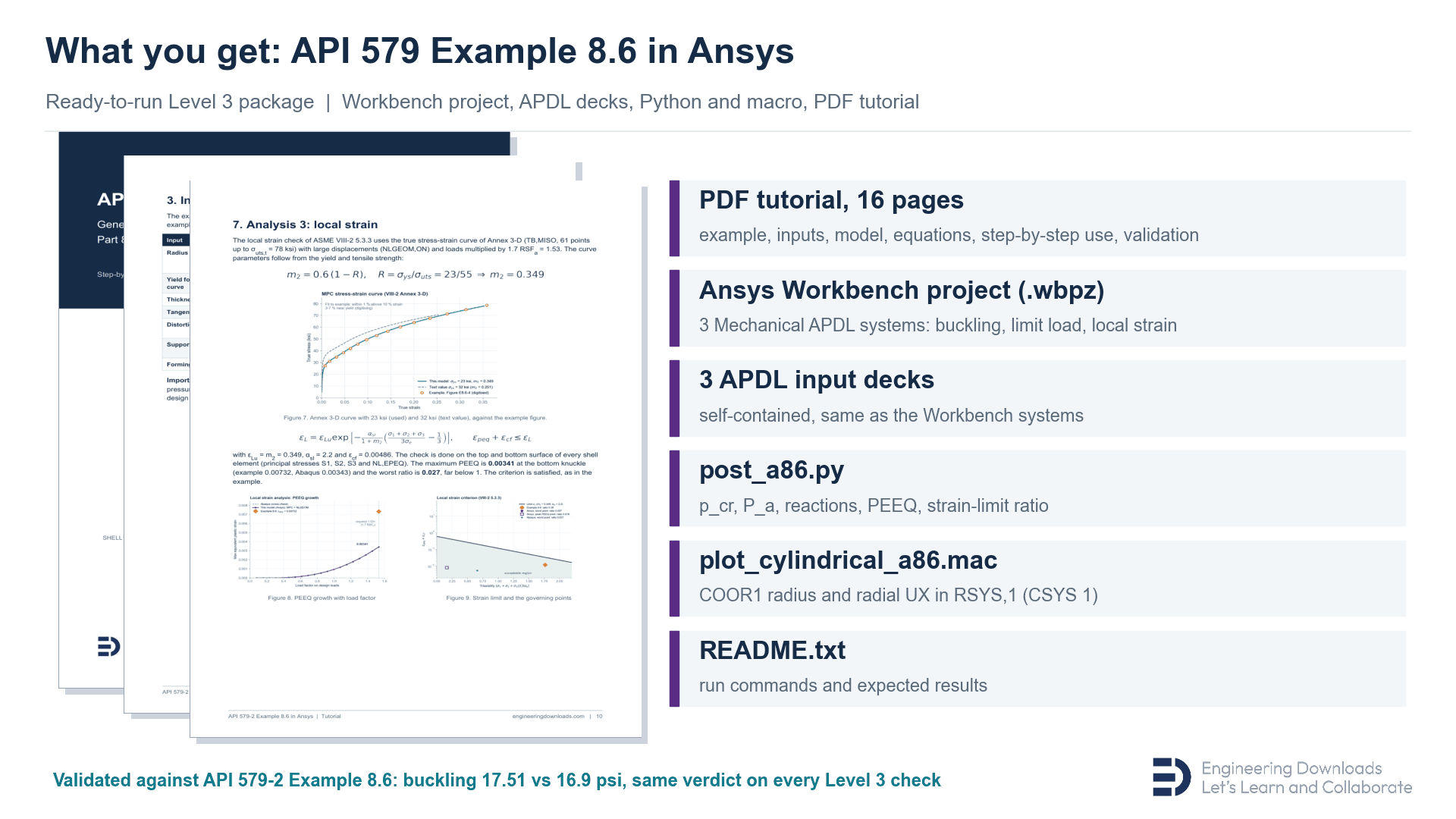
Each APDL deck is self-contained, with no include files. Result files (RST) are not included: you run the analyses yourself.
Integrity and FFS engineers, pressure vessel and tank designers, and Ansys users who want a worked API 579 Part 8 Level 3 example: buckling with preload, limit load, local strain and how to read shell distortion in cylindrical coordinates.
Ansys Mechanical APDL and Workbench 2024 R2 or newer, and Python 3 with numpy for post-processing. The buckling run takes about 2 minutes on 6 cores; the plastic runs take about 10 minutes each. You need your own copy of API 579-1/ASME FFS-1 and API 579-2 for the standard itself.
You get a verified, ready-to-run Level 3 shell distortion model in Ansys, with every check compared with the published example and with a second solver. You also see clearly where the result is sensitive. The same example is available as API 579 Example 8.6 in Abaqus. See also API 579 Example 6.4: pitting corrosion and API 579 Example 4.7: corroded conical transition.
Does it reproduce the API 579 example? Yes, with the same verdict on every check. Buckling pressure is 17.51 psi against 16.9 psi (+3.6%), and the permissible pressure is 7.00 psi against 6.75 psi.
Is the laser-scan data included? No. The example does not publish the point cloud, so the distortion is a smooth field built to the published extremes (+5.5 / −2.5 in). You can replace the node coordinates with your own scan.
Which inputs did you have to interpret? The model uses a 180 in radius, 23 ksi yield for the stress–strain curve and nominal thickness, because those are what the example’s results imply. With the 0.125 in corrosion allowance removed, the permissible pressure falls to about 3.4 psi, below the 5 psi design vacuum. The tutorial explains each choice.
Do I need Workbench? No. The three APDL decks run directly in Mechanical APDL from the command line; the Workbench project is there for convenience.
Is this a design or acceptance result? No. It is a worked benchmark and training package and does not replace an assessment by a qualified engineer.
Quality guarantee: if you are not satisfied with the delivered product, we will refund you.
Need more than the files?
There are two ways we can help. Book a one hour online consultation if you want to talk a problem through with a CAE engineer, using the checkbox in the order box. Order a project if you need a full simulation built for you, delivered to an agreed scope, price and deadline under a written contract.
We work on FEA and CFD for engineers, researchers and companies. Order your project, or message us on WhatsApp for a quick reply.
Other packages engineers working on this topic also download.
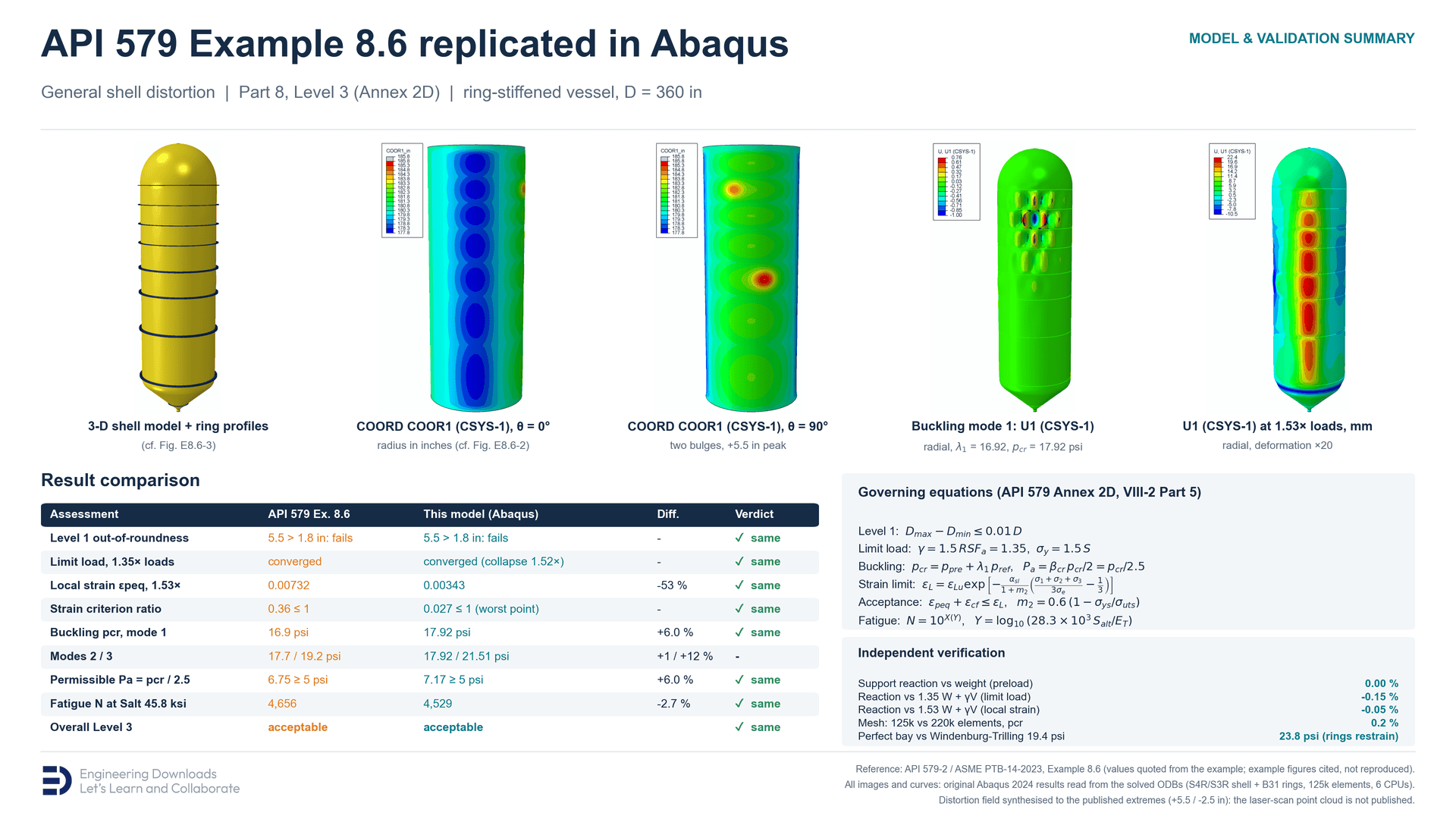 API 579 Example 8.6 in Abaqus: General Shell Distortion and Buckling, Level 3 FFS€129,00
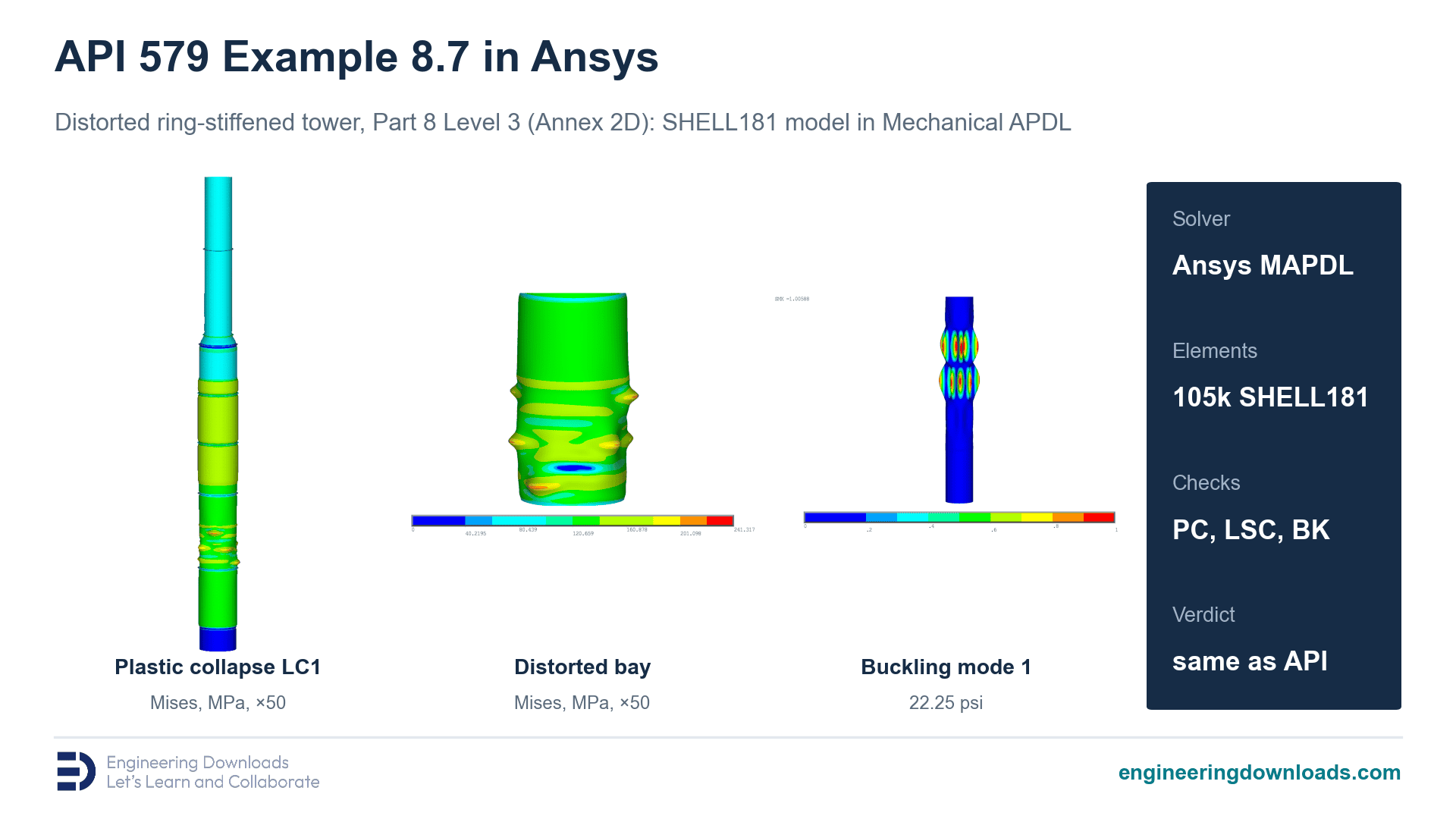 API 579 Example 8.7 in Ansys: Ring-Stiffened Tower with General Shell Distortion, Level 3 FFS€129,00
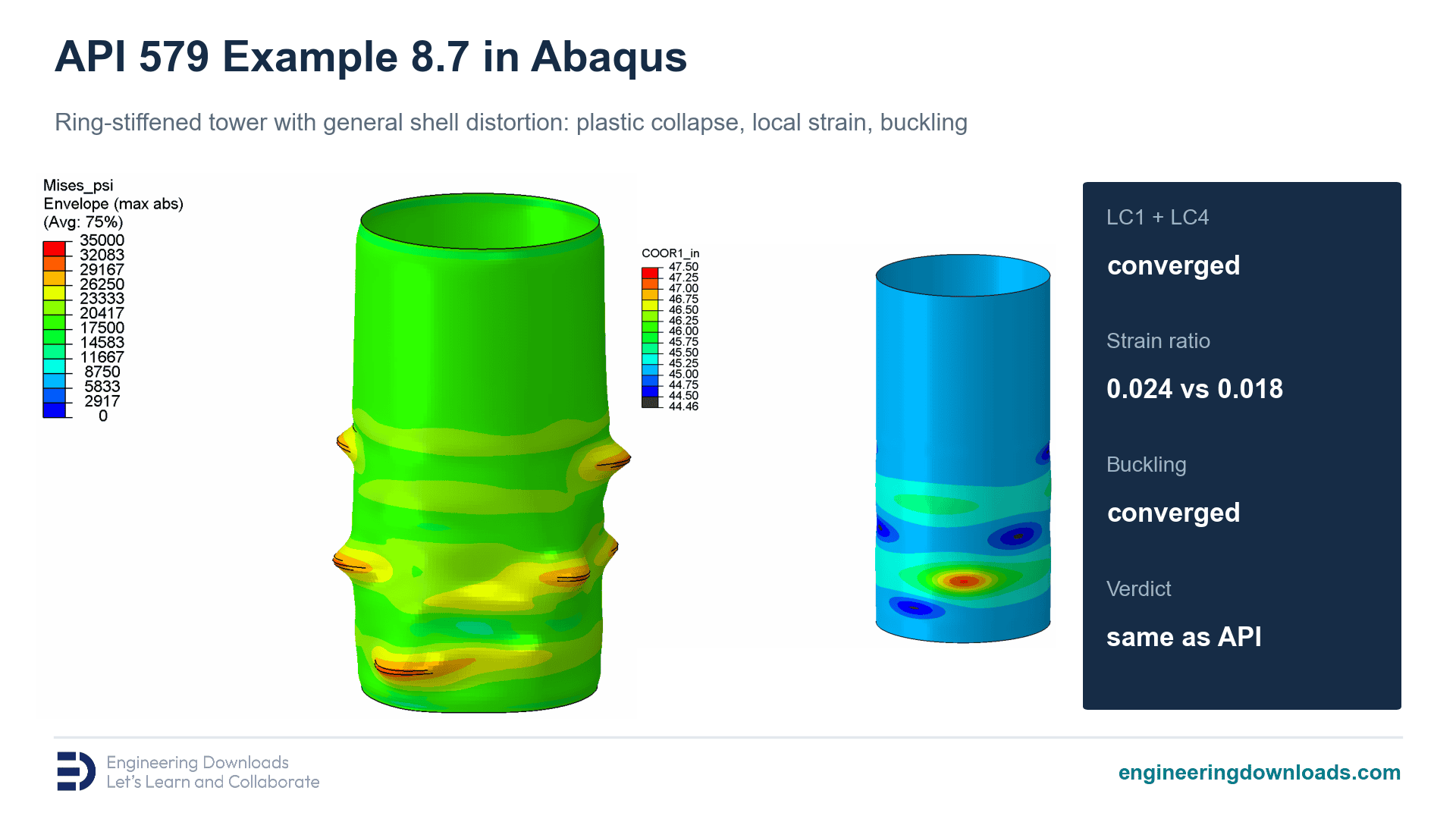 API 579 Example 8.7 in Abaqus: Ring-Stiffened Tower with General Shell Distortion, Level 3 FFS€129,00
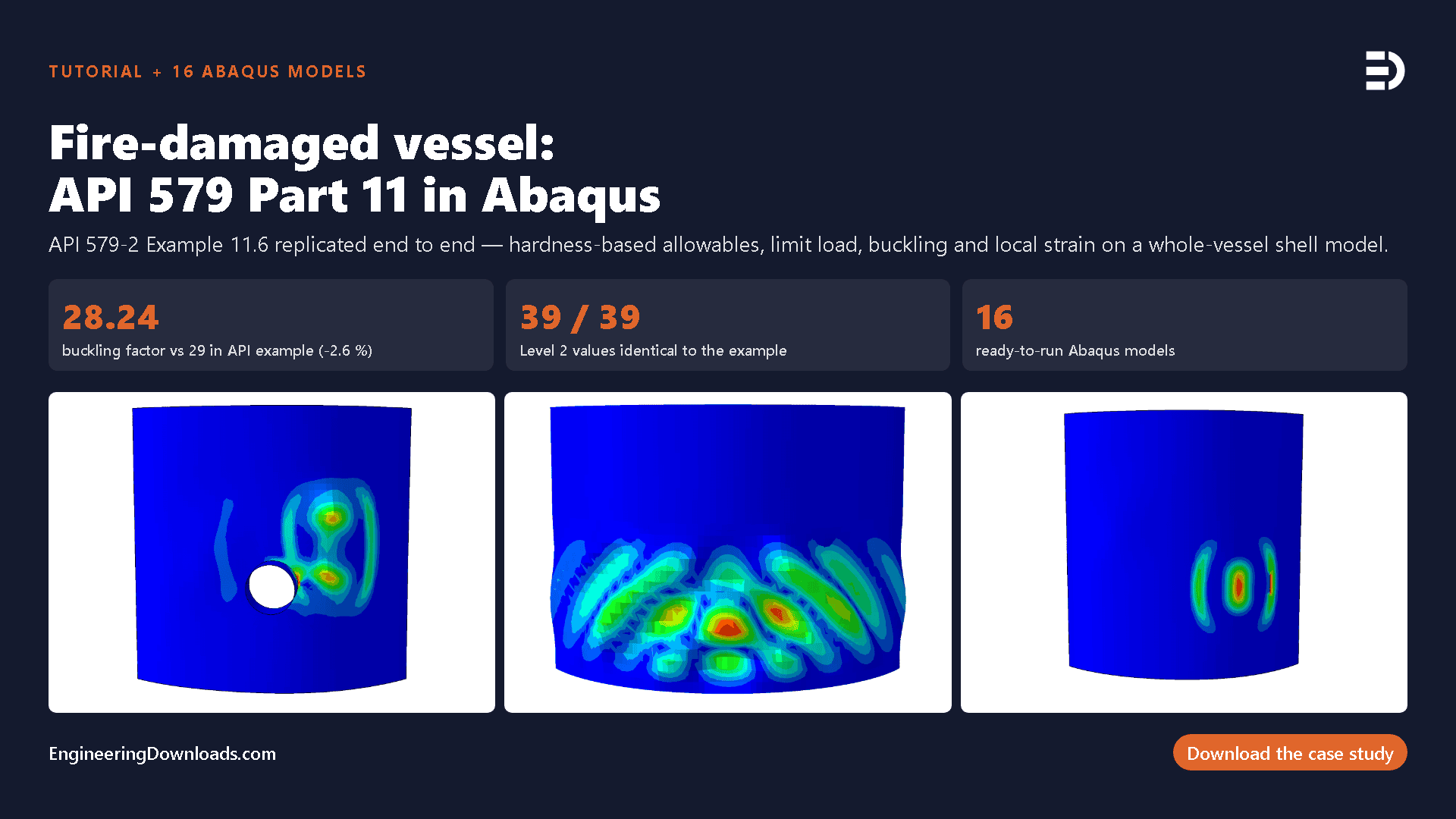 API 579 Example 11.6 in Abaqus: Fire-Damaged Fractionator, Level 3 FFS (Limit Load, Buckling, Local Strain)€139,00
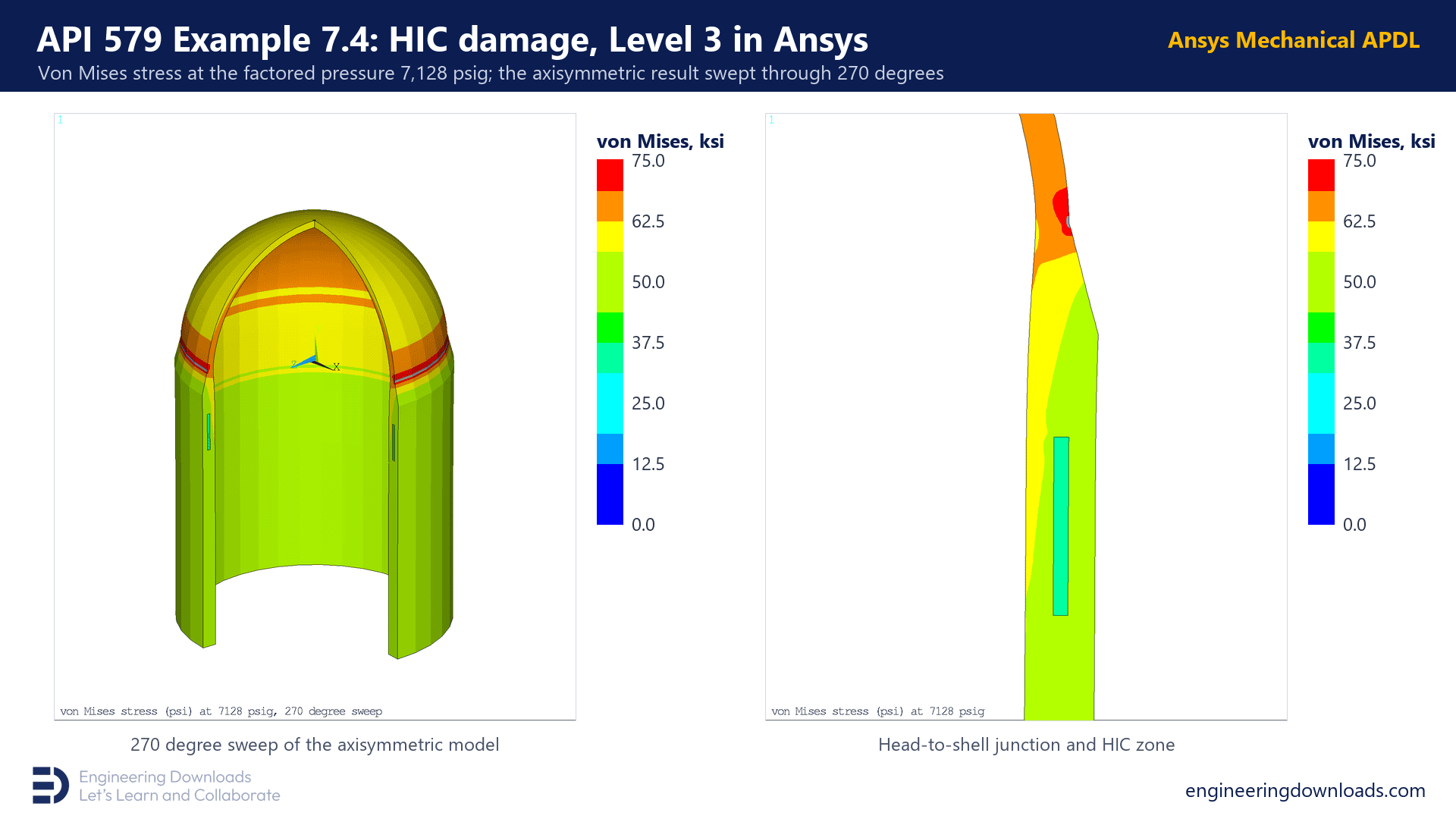 API 579 Example 7.4 in Ansys: HIC Damage Level 3 Assessment with FAD and Plastic Collapse€139,00
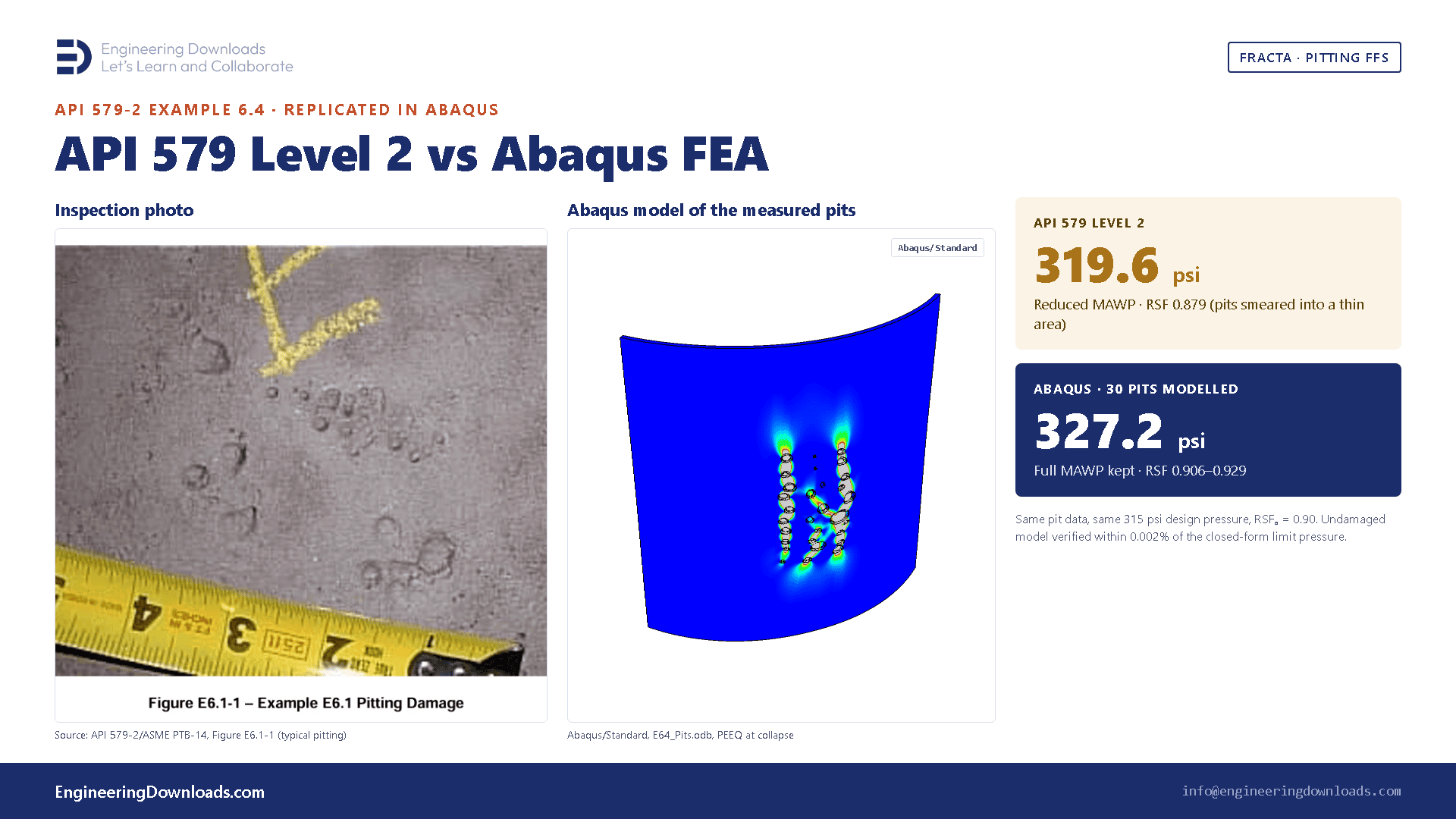 API 579 Example 6.4 in Abaqus: Localized Pitting Corrosion, Level 2 vs Level 3 FFS€129,00
 API 579 Example 5.6 in Abaqus: Local Thin Area Limit Load, Level 3 FFS€89,00
 API 579 Example 7.4 in Abaqus: HIC Damage Level 3 Assessment with FAD and Plastic Collapse€139,00

Need a full custom project? See the options below.

€129,00

€179,00

€149,00

€119,00

€129,00

€149,00
See more
Want to receive push notifications for all major on-site activities?



