


Need a full custom project? See the options below.
Need a full custom project? See the options below.
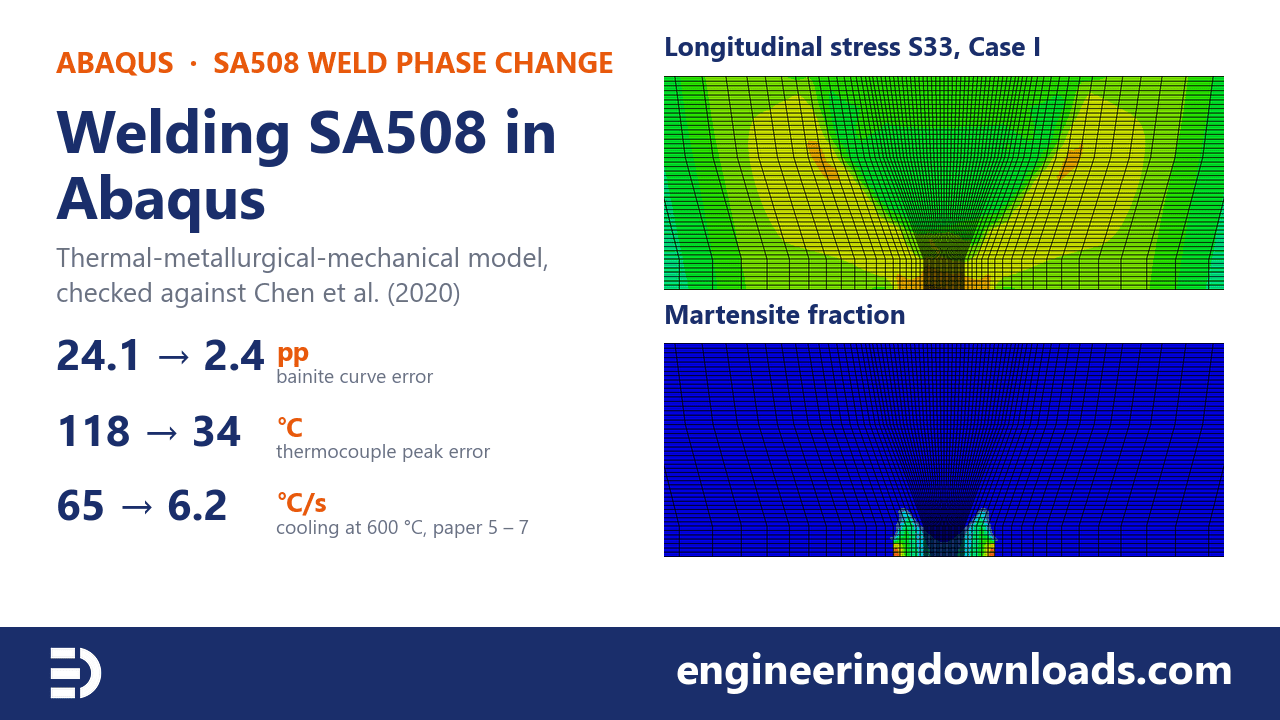
When you weld steel, the weld does not just cool down. It changes phase. Austenite turns into bainite or martensite as it cools, the steel expands while it does, and that phase change decides a good part of the residual stress left in the part (background on residual stress). This Abaqus package is a 3D weld phase change simulation of SA508 steel: a moving heat source along each bead, an eleven-bead groove filled layer by layer, and a user material that tracks ferrite, austenite, bainite and martensite in every element, with transformation strain and transformation plasticity (TRIP). It extends the two-dimensional weld study of Chen et al. (2020) to three dimensions.
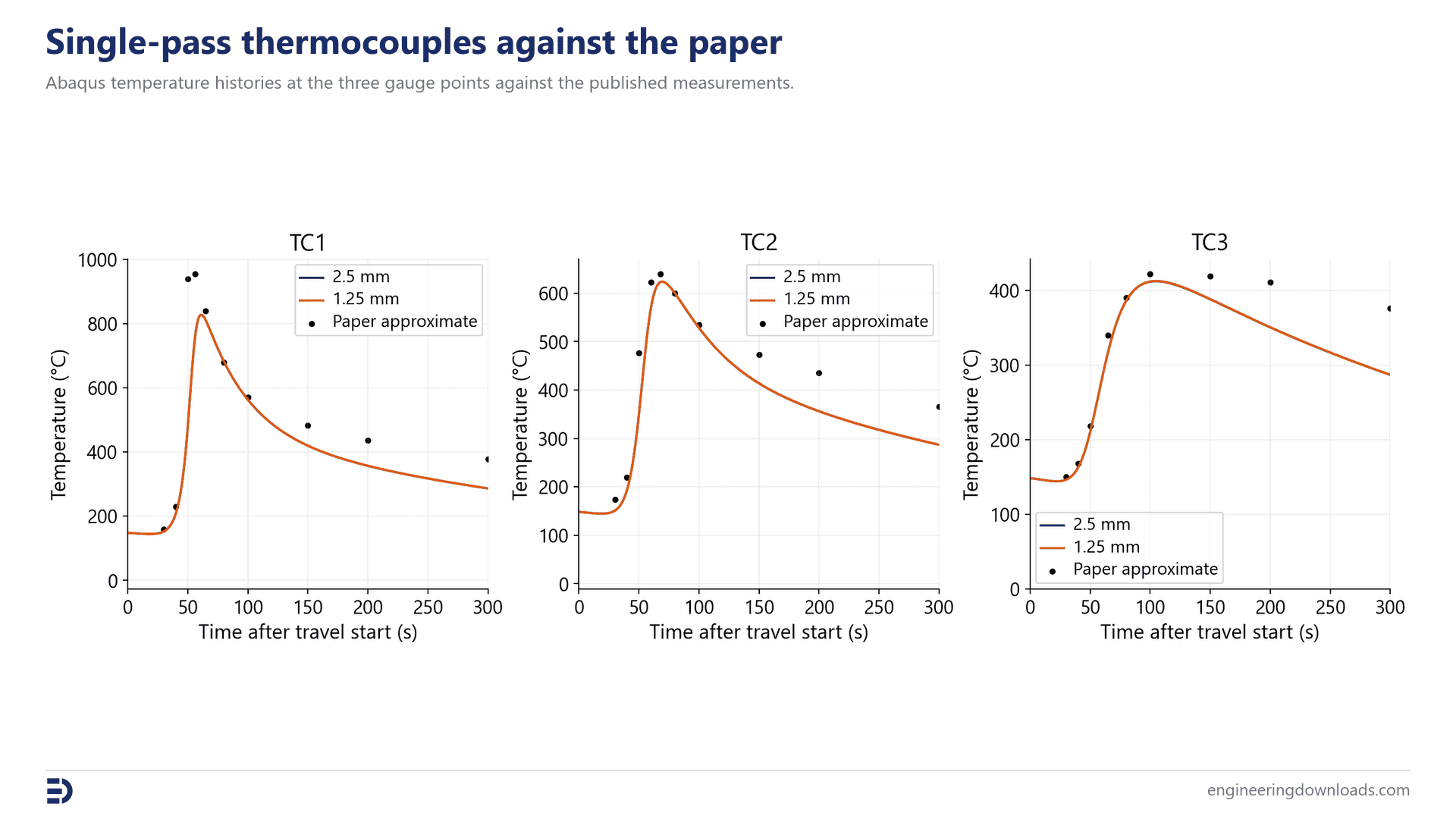
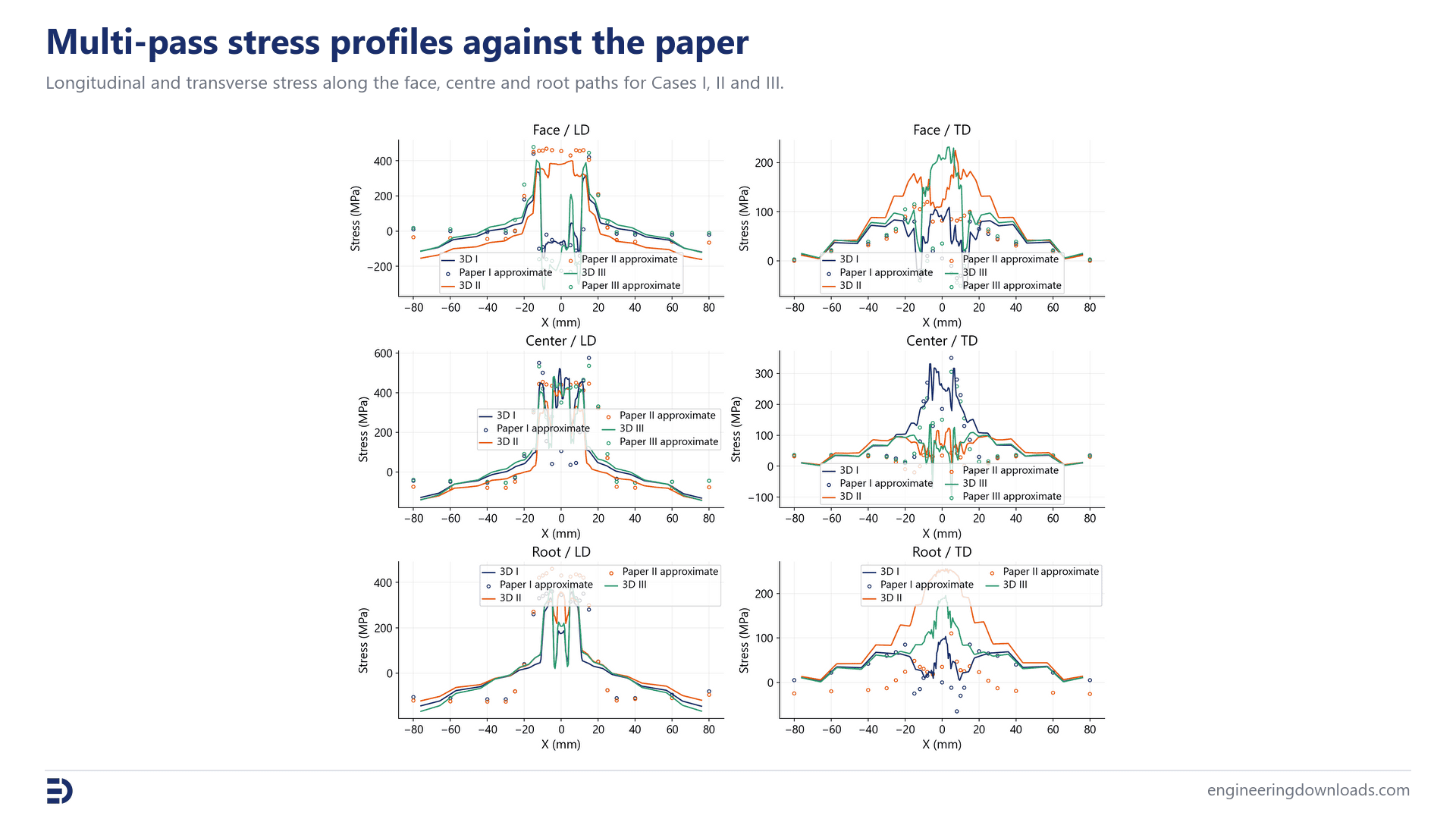
Honest status: calibrated to selected curves, not fully validated. The phase curves of the free coupon follow the paper within about 4 percentage points, and two of the three single-pass thermocouple peaks land within about 3%. The multi-pass phase fractions are the weakest match (about 28 percentage points RMS against the paper contour bins), the longitudinal stress along the paths differs from the paper readings by 130 to 220 MPa RMS, and the first thermocouple peak is about 14% low. Every figure and table below shows these gaps, and the tutorial explains how each number was computed.
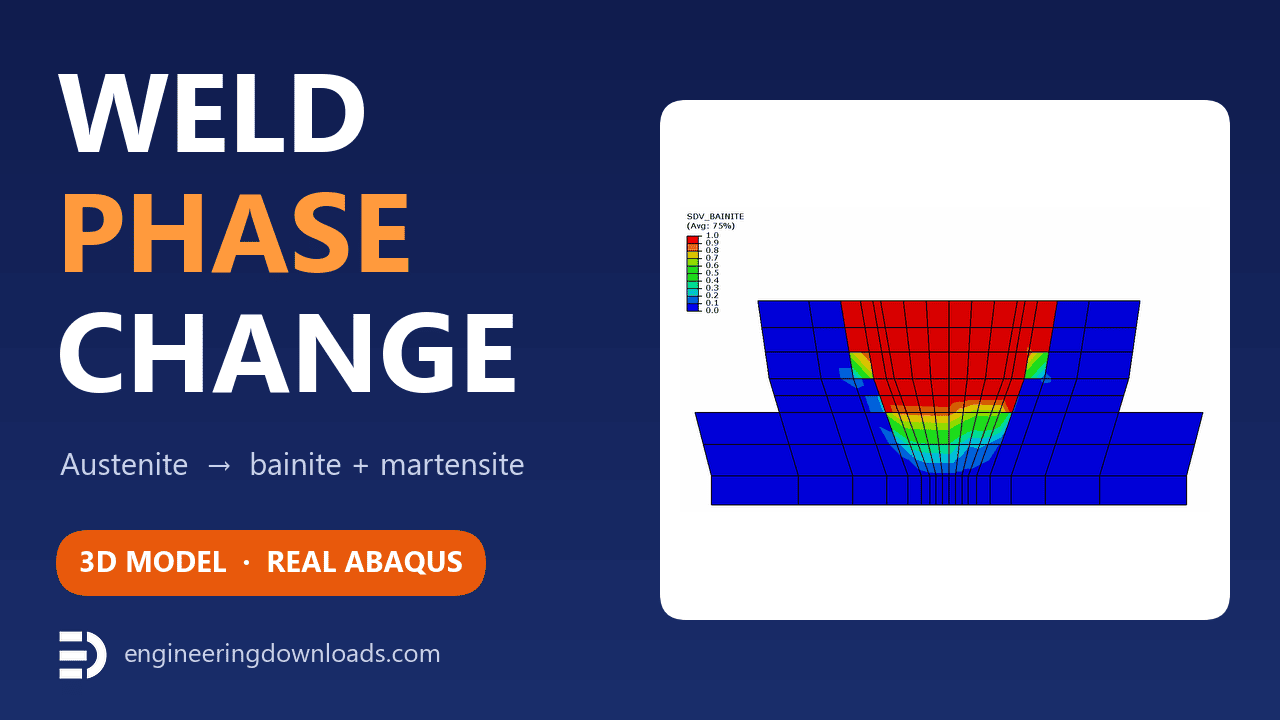
The same set-up applies to multi-pass welds of low-alloy and ferritic steels in pressure vessels, nozzles and piping, and to any weld where the phase change matters. All field pictures on this page are real Abaqus/CAE viewport prints with the element mesh visible, taken from the solver results of the packaged model.
This short shows the phase change in the weld, from austenite to bainite and martensite, in real Abaqus output.
Chen et al., "Thermo-mechanical-metallurgical modeling and validation for ferritic steel weldments", Journal of Constructional Steel Research 166 (2020) 105948 (DOI 10.1016/j.jcsr.2020.105948).
What this package reproduces and what it adds. The paper solves two-dimensional sections. This package builds the same welds in 3D: the NeT TG5 single-pass beam (180 mm long) and an eleven-bead, seven-layer groove weld, with the travel of the heat source, longitudinal conduction and end effects that a 2D slice cannot show. The curves and contours are compared with the paper wherever it publishes them: the coupon phase and dilation curves, the thermocouple histories, the neutron stress readings, the fusion width, and the multi-pass stress and phase maps. The 2D version of this study is a separate product (SA508 weld phase transformation in Abaqus, 2D). The paper is cited but not included, and none of its figures appear on this page. Its values were read from the published figures, so they are approximate.
| Analysis | Sequential: heat transfer first, then a mechanical analysis driven by the recorded nodal temperatures (*Temperature, FILE=) |
|---|---|
| Elements | DC3D8 for heat transfer, C3D8 hexahedral bricks for the mechanical analysis |
| Single pass | NeT TG5 beam, 180 mm long, 30,240 bricks, 2.5 mm axial spacing, moving source travelling along +Z |
| Multi-pass | Groove plate, 5,760 bricks, 5 mm axial spacing (assumed 150 mm length), eleven beads in seven layers deposited with progressive element activation |
| Heat source | Goldak double-ellipsoid moving source in a DFLUX subroutine, one for the single pass and one for the multi-pass groove |
| Metallurgy | UMAT with ferrite, austenite, bainite and martensite, thermal strain, transformation strain, TRIP and kinematic hardening; 18 state variables |
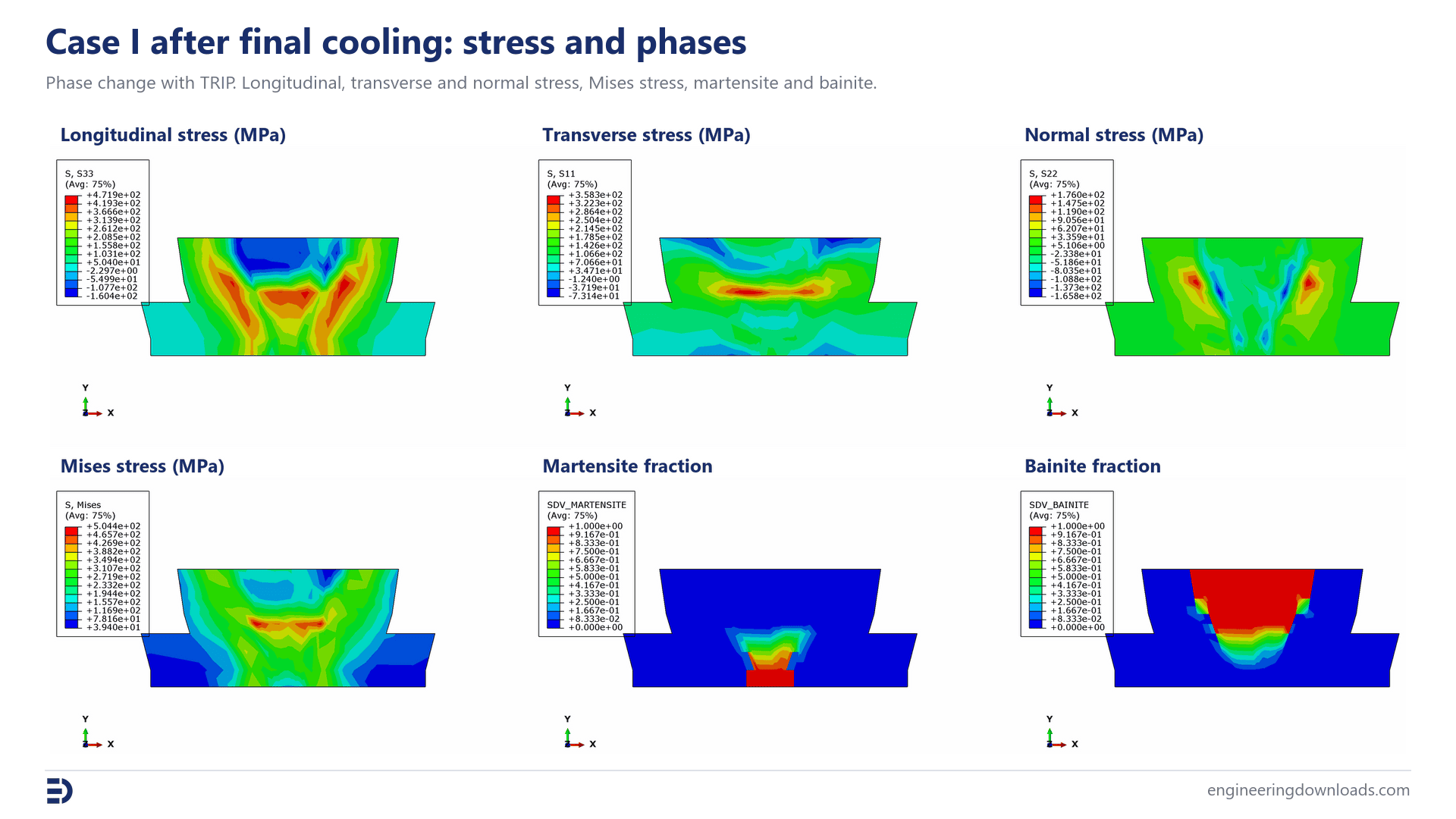
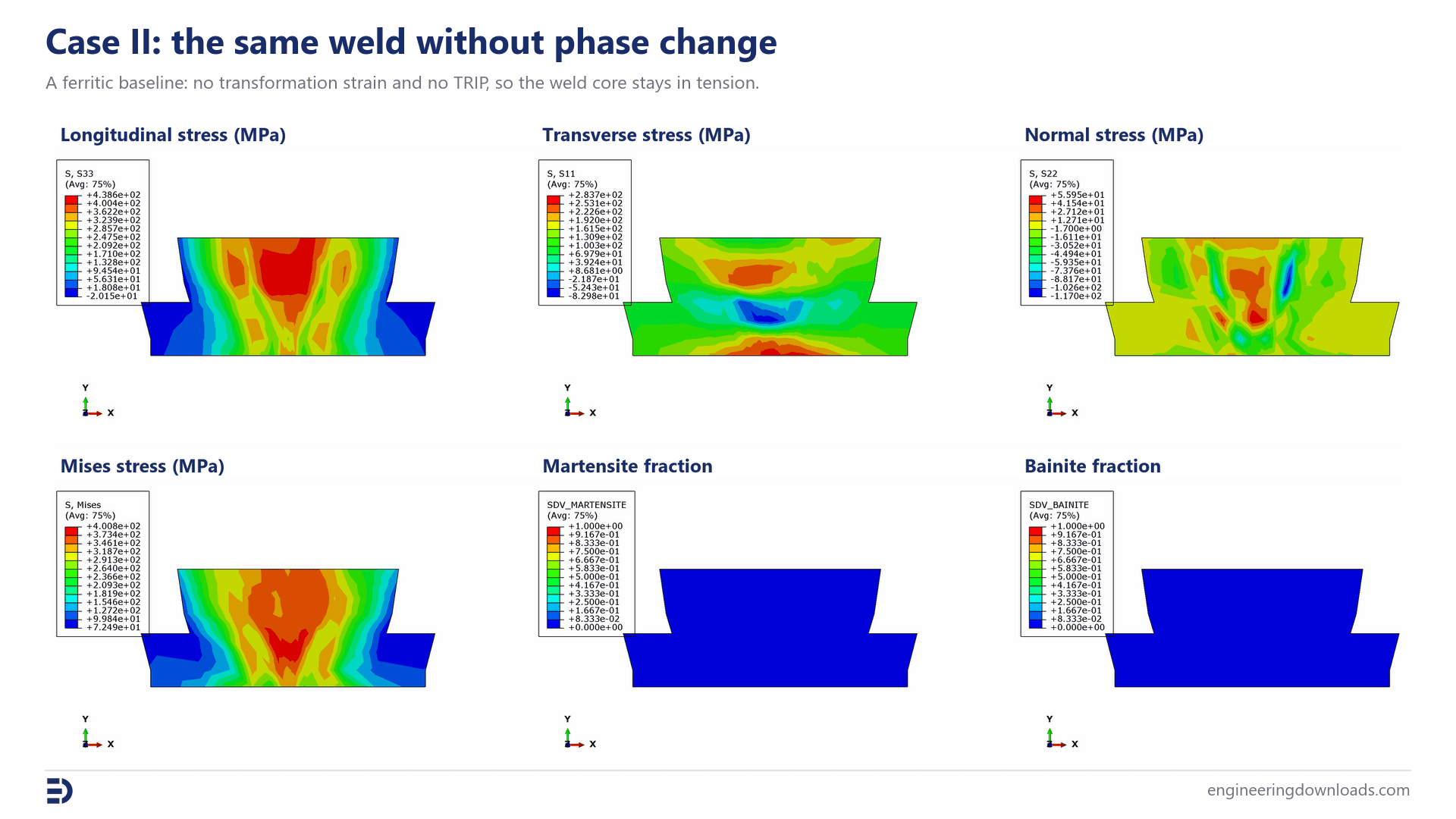
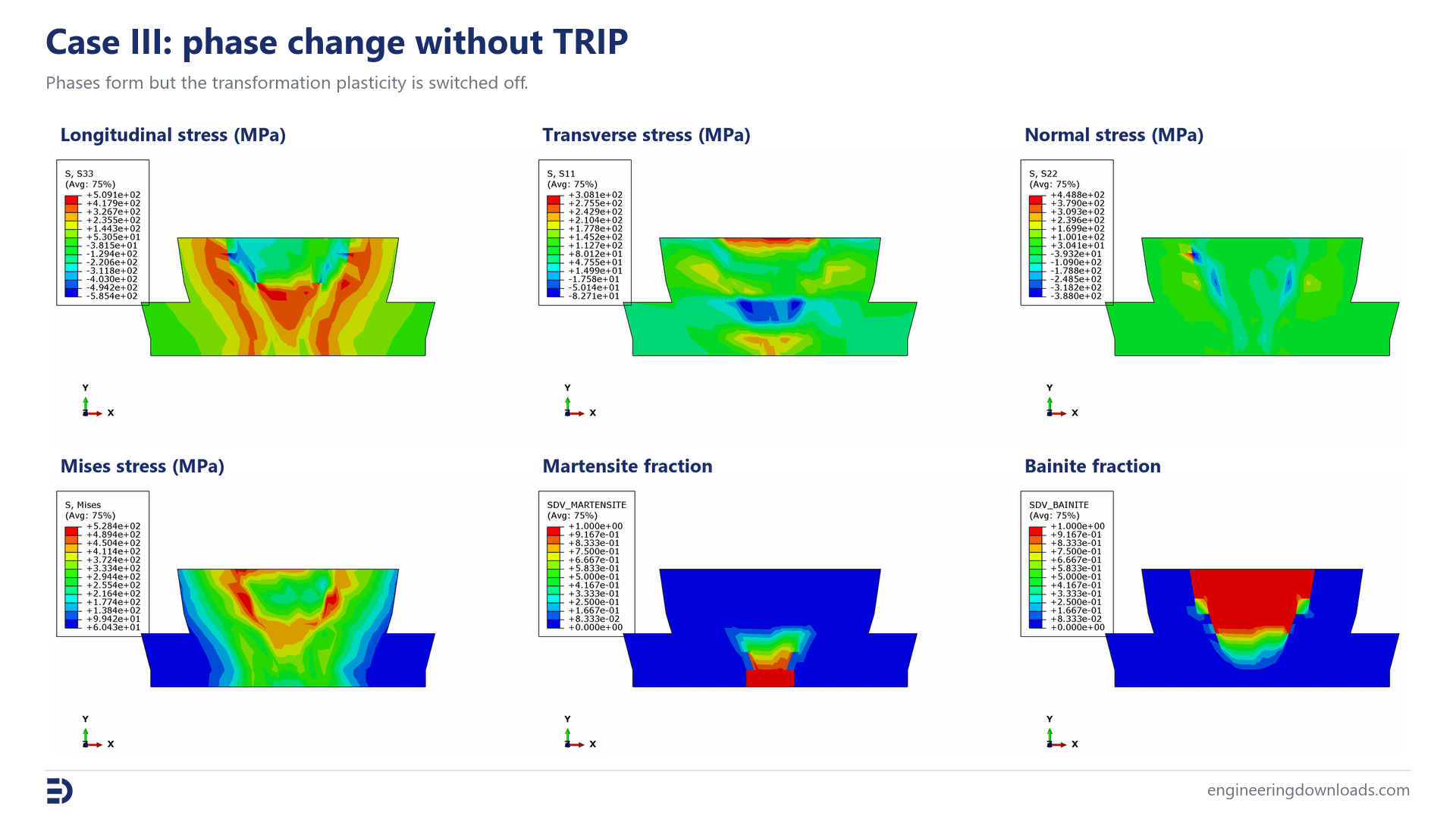
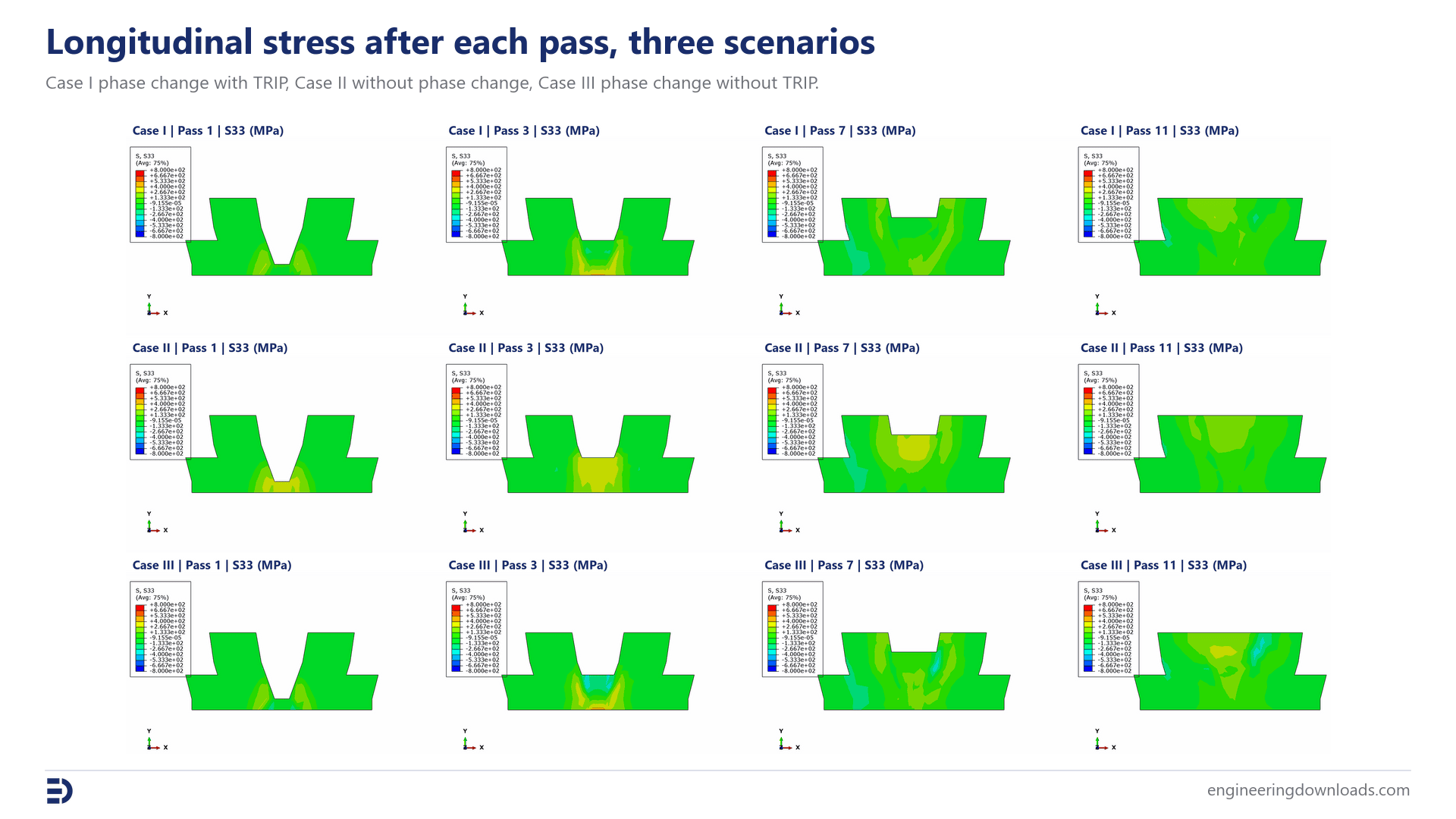
| Stress cases | Case I phase change with TRIP; Case II without phase change; Case III phase change without TRIP. One thermal solution drives all three |
| Units and solver | mm, N, MPa, s, tonne; Abaqus/Standard 2024; X transverse, Y normal, Z longitudinal |
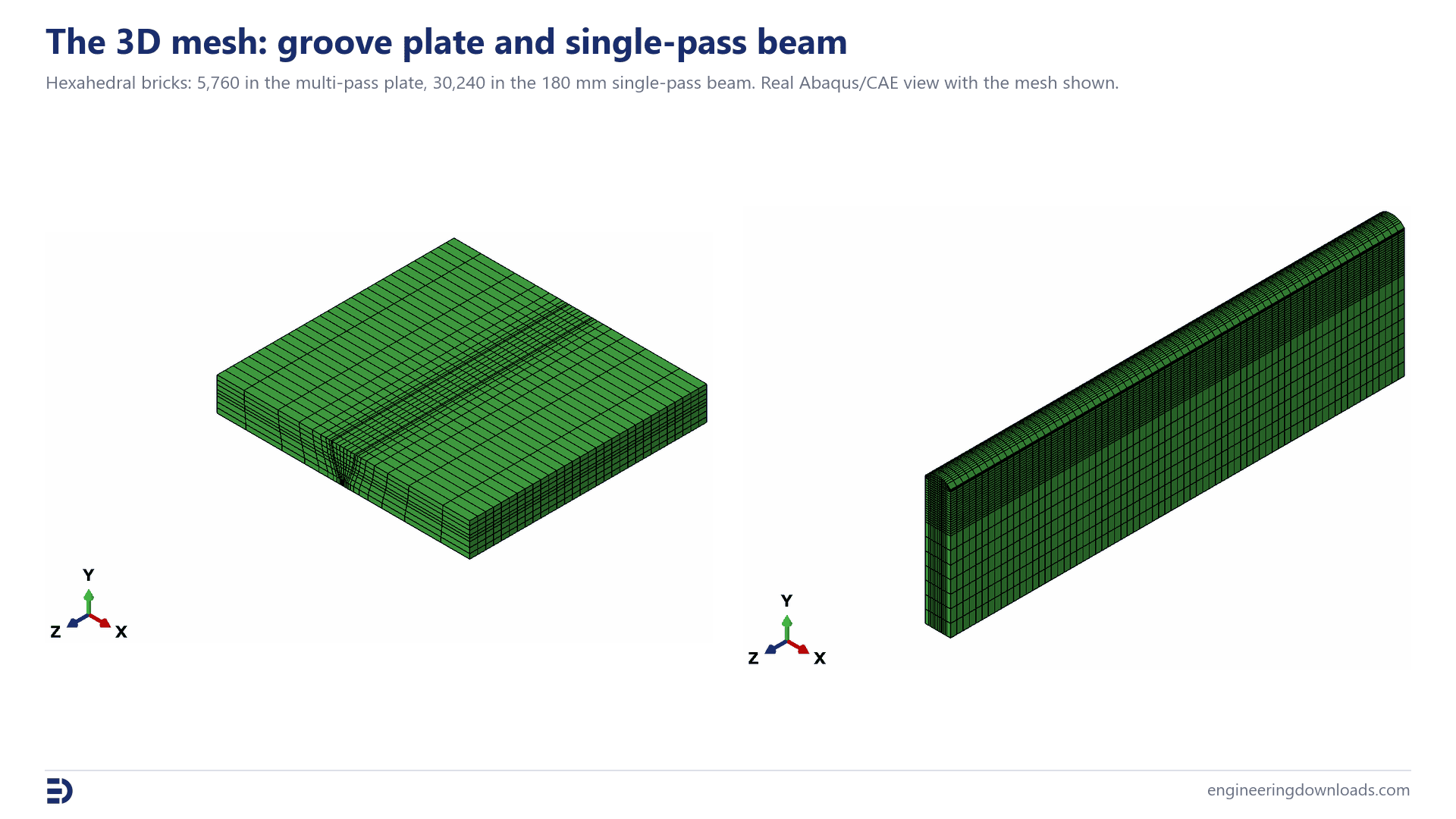
The multi-pass plate and the single-pass beam are meshed with hexahedral bricks, finer around the weld and coarser towards the edges. The weld metal of each bead is born when its pass starts: the elements are inactive until the torch arrives, then heated by the moving source. The picture shows the meshes as Abaqus draws them.
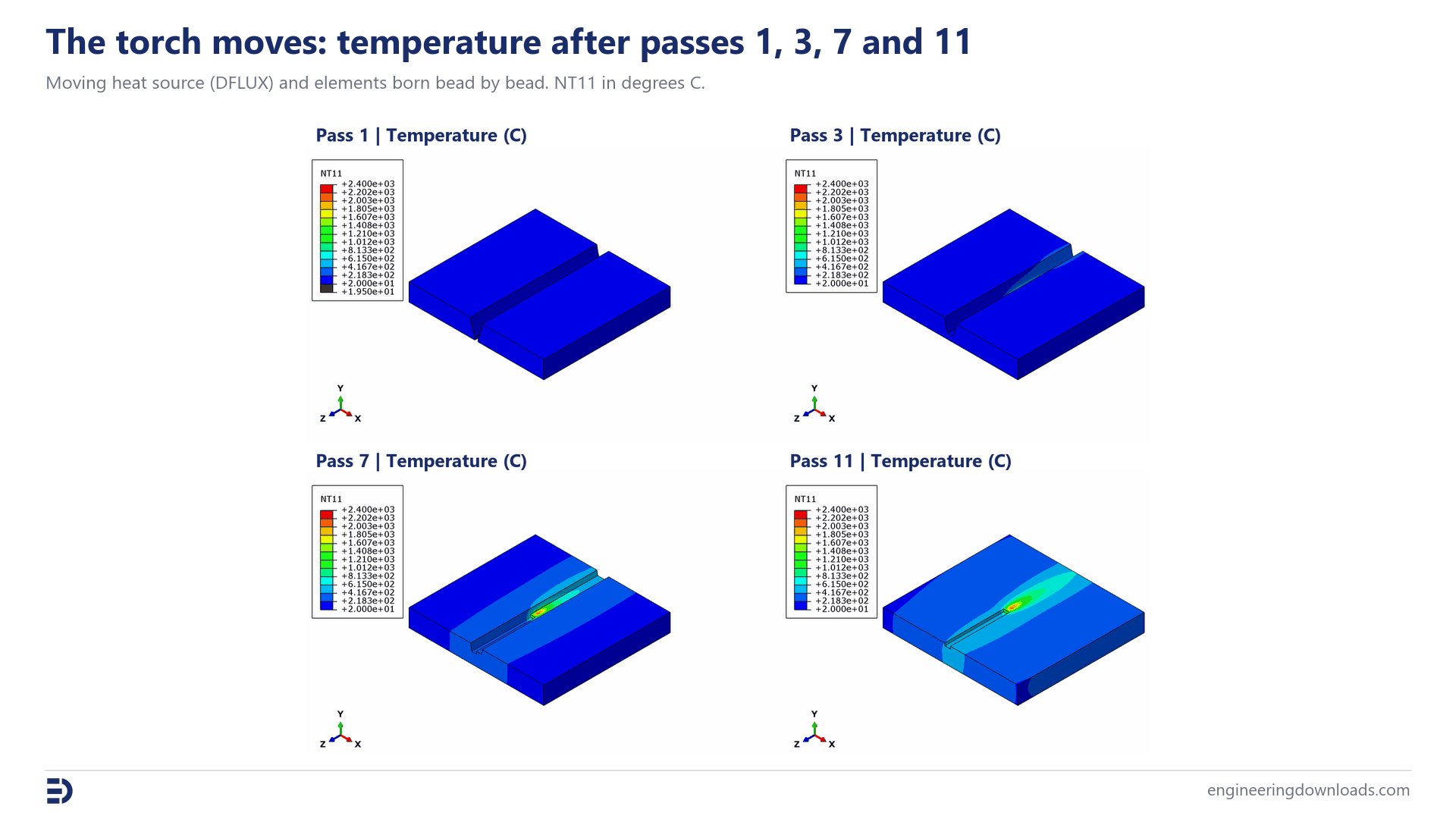
The DFLUX subroutine moves a Goldak double-ellipsoid source along each bead. Pass after pass the groove fills, and every new bead reheats the layers below it. The pictures show the temperature after passes 1, 3, 7 and 11.
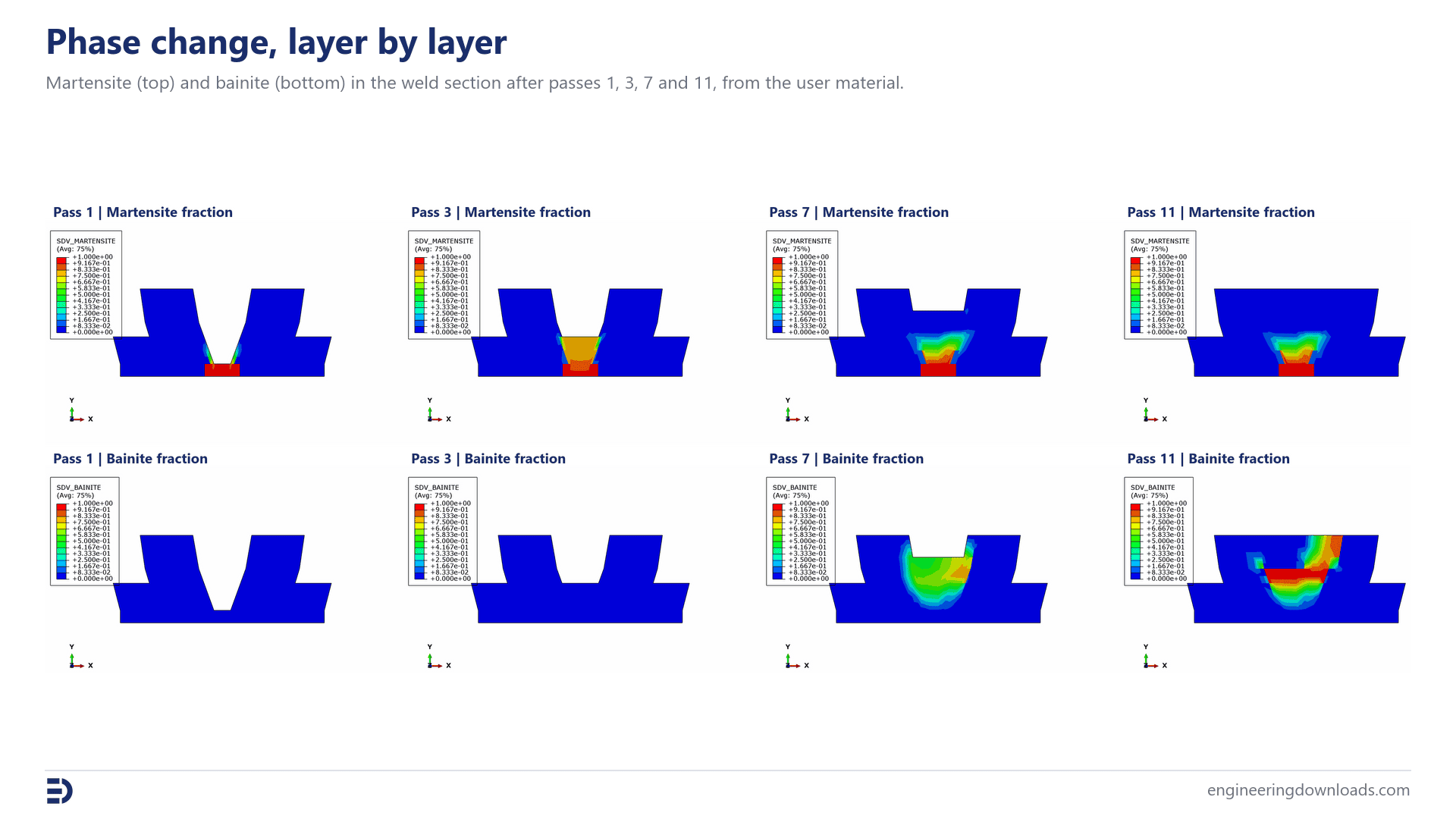
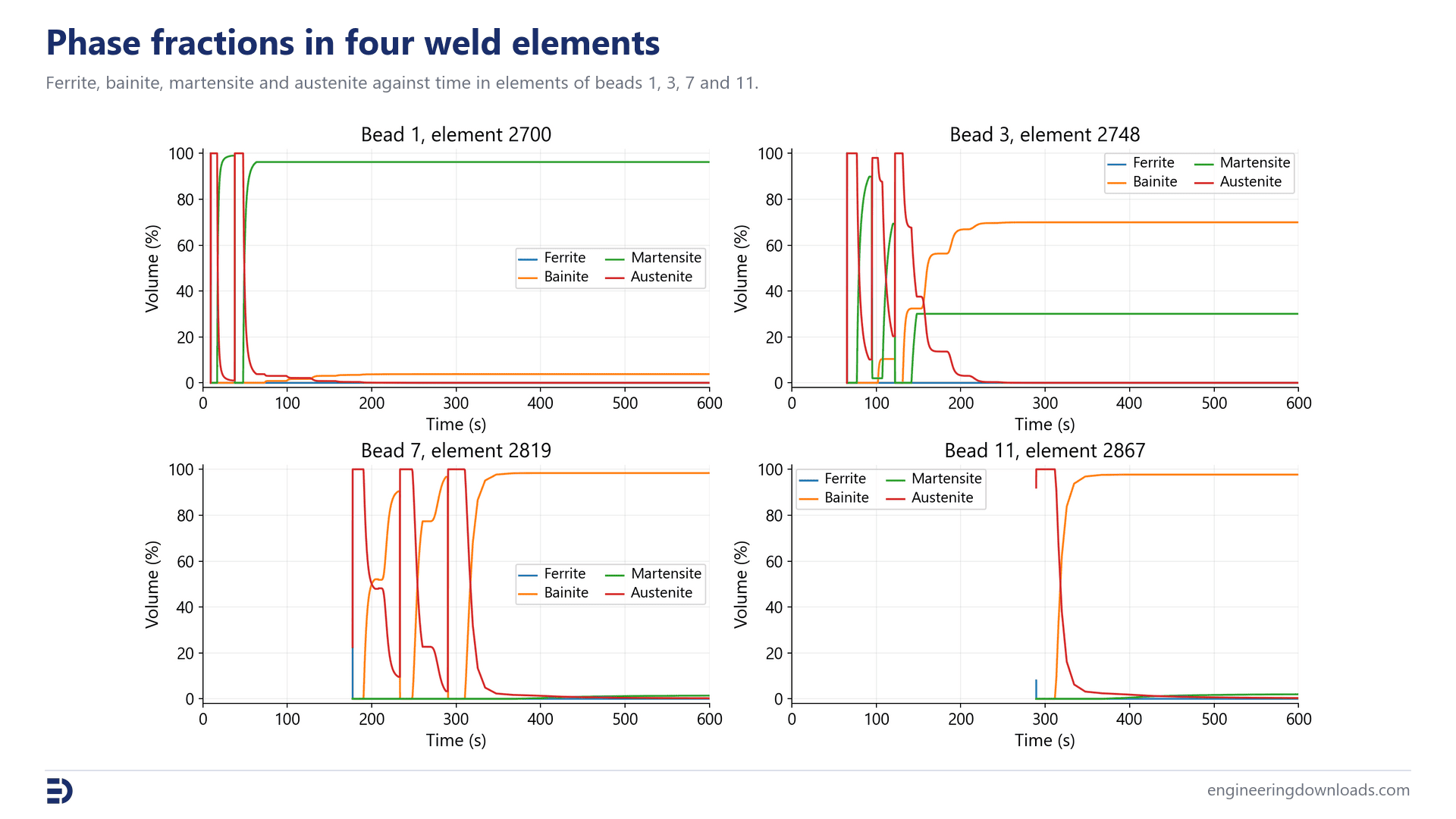
This is the core of the model. Above the austenite start temperature (Ac1) the steel turns to austenite. On cooling the rate decides the product: slower cooling gives bainite, faster cooling gives martensite. In a multi-pass weld every new pass re-heats and re-transforms what lies beneath it, so each layer goes through the cycle again. The contours show martensite and bainite in the weld section after passes 1, 3, 7 and 11.
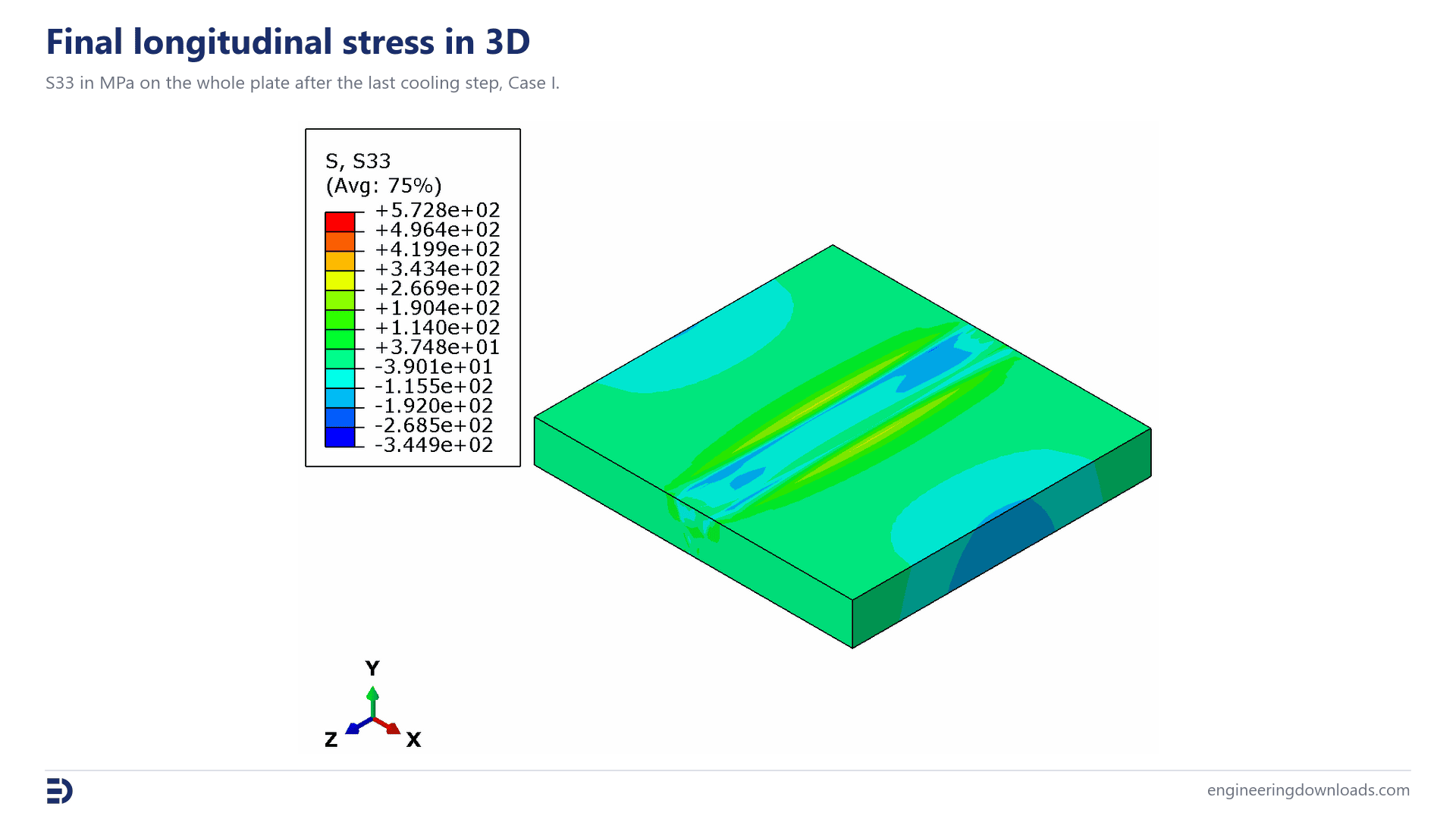
The three cases share one thermal history, so the differences come only from the metallurgy. Case I includes phase change and TRIP. Case II is a ferritic baseline without phase change, and its weld core stays in tension. Case III keeps the phase change but removes TRIP.
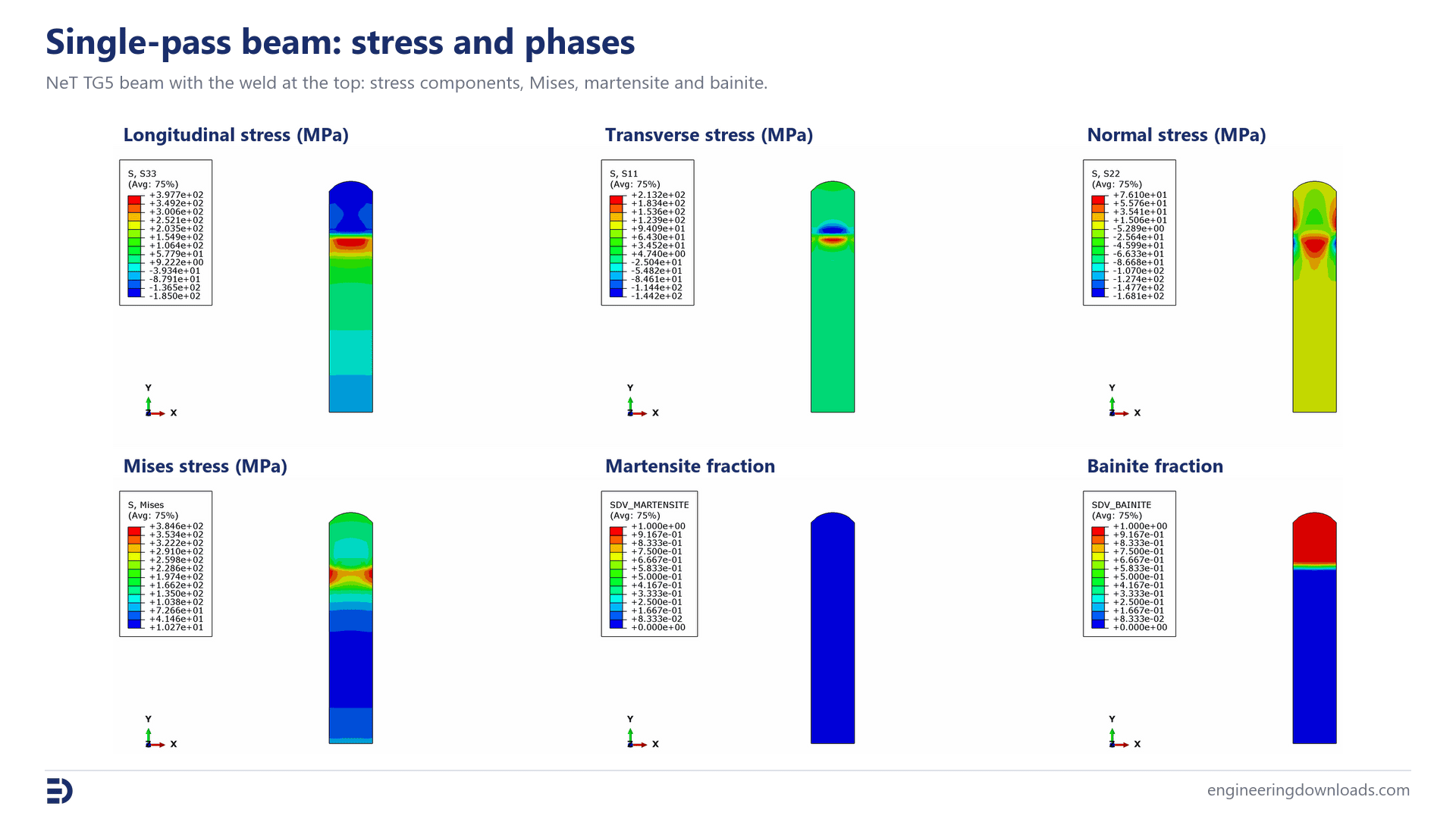
The NeT TG5 beam is the experimental benchmark of the paper, with thermocouples at three depths and neutron stress readings along a path. The single-pass model shows the weld at the top of the beam, bainite in the fusion zone and the stress along the section.
Errors are computed from the exported results against the digitized paper values, which are approximate. The coupon curves are calibration data (the phase laws were fitted to them); the thermocouples and neutron readings are experimental comparisons; the multi-pass curves and contour bins are comparisons with another numerical model in the paper.
| Quantity | Result | Reference | Kind |
|---|---|---|---|
| Coupon bainite and martensite curves, Fig. 10b | RMSE 0.3 to 3.8 percentage points | paper curves | calibration |
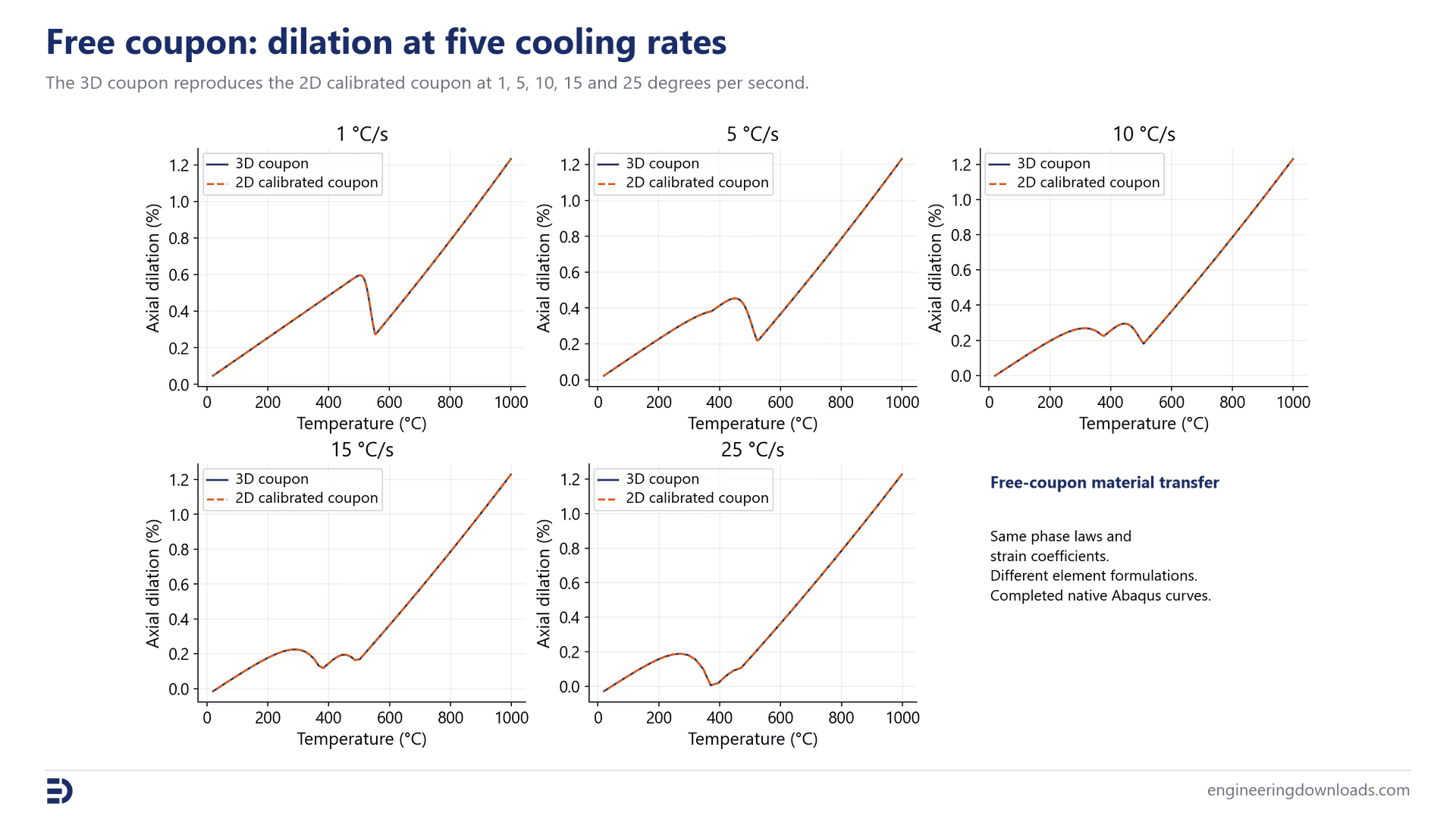
| Coupon dilation, Fig. 10a | RMSE 0.04 to 0.11 % | paper curves | calibration |
| Single-pass TC1 peak, Fig. 12 | 133 °C low (about 14%) | measured peak | experiment |
| Single-pass TC2 and TC3 peaks, Fig. 12 | 16 and 13 °C low (within about 3%) | measured peaks | experiment |
| Single-pass longitudinal stress along Path A, Fig. 14 | RMSE 110 MPa (TD 92, ND 28) | neutron readings, approx. | experiment |
| Multi-pass peak temperature, Fig. 15 | within 7 °C of the paper maximum | paper contour maximum | numerical |
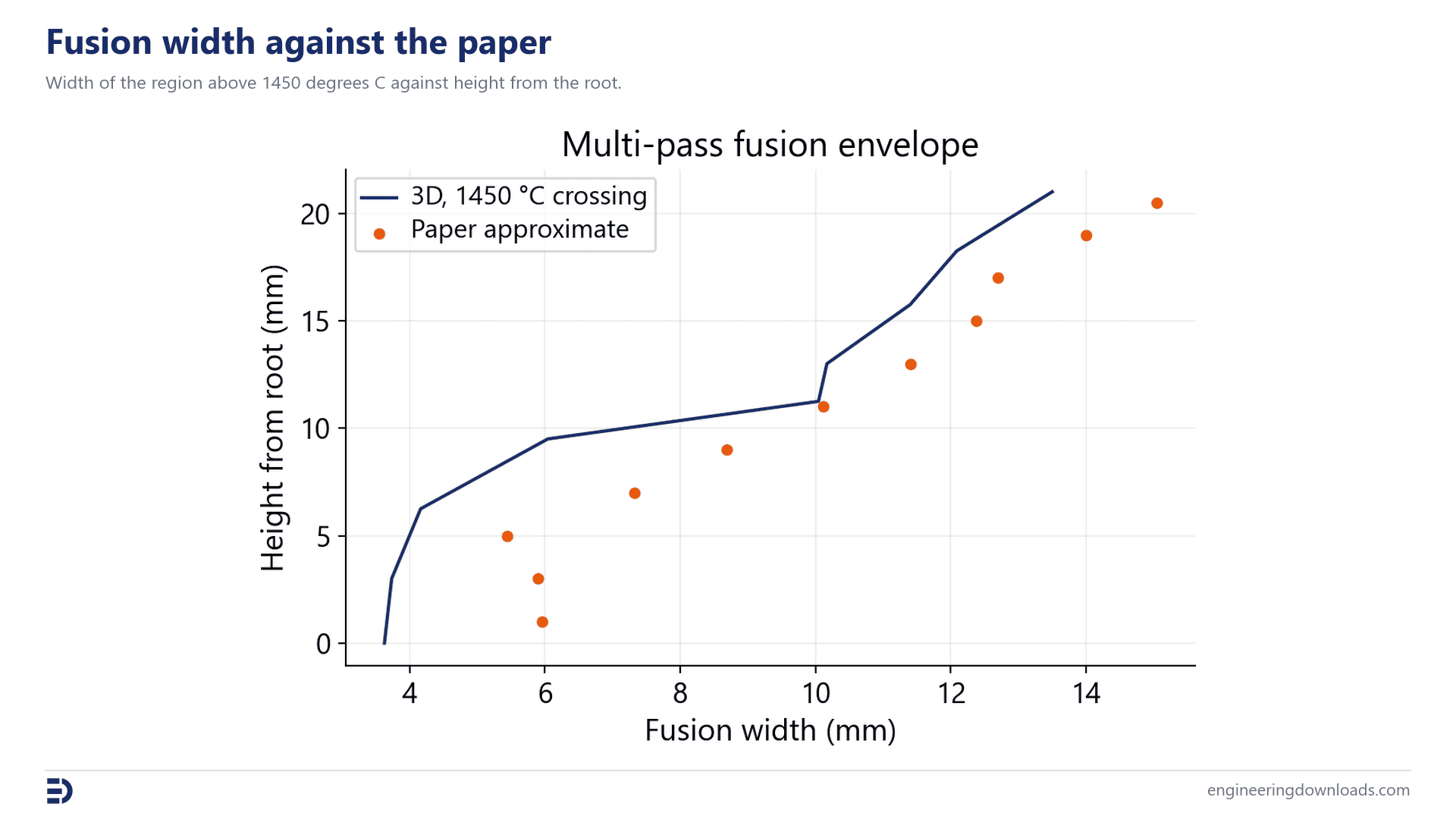
| Multi-pass fusion envelope, Fig. 15 | RMSE 1.9 mm | paper contour readings | numerical |
| Last-bead cooling rate at 600 °C | 14.7 °C/s, above the paper range of 5 to 7 °C/s | paper stated range | numerical |
| Multi-pass longitudinal stress, face / centre / root, Figs. 20-22 | RMSE about 130 to 220 MPa | approximate paper readings | numerical |
| Multi-pass centreline martensite and bainite, Fig. 16 | RMSE about 28 percentage points | paper contour bins | numerical |
Chen2020_SA508_3D.cae with the models for inspection: mesh, sets, steps and materials.decks folder: dilatometry3d (free coupon), single3d_thermal, single3d_I, multi3d_thermal, multi3d_I, multi3d_II and multi3d_III.src folder: the UMAT sa508_3d_umat.for and the two moving-source DFLUX files single_dflux.for and multi_dflux.for.Not included: the ODB result files (the decks create them) and the paper. The jobs need an Intel Fortran compiler linked to Abaqus for the subroutines. We ran a datacheck of the coupon deck and both thermal decks from the packaged folder with the launcher before release.
Related models: SA508 weld phase transformation in Abaqus (2D), SA508 weld phase transformation in Ansys MAPDL, 2D and 3D, nozzle-to-vessel weld with martensitic phase change in Abaqus and welding simulation package in Abaqus.
The welding of SA508 ferritic steel in 3D with Abaqus/Standard: a moving heat source, an eleven-bead groove filled layer by layer, phase change (ferrite, austenite, bainite, martensite), transformation strain, TRIP and the resulting residual stress, plus a single-pass beam with thermocouples.
It is calibrated to selected curves of Chen et al. (2020) and compared with the rest. The coupon curves agree within about 4 percentage points and two of three thermocouple peaks within about 3%. The multi-pass phase fractions (about 28 percentage points RMS) and the longitudinal stress along the paths (130 to 220 MPa RMS) still differ, and the tutorial lists every error.
Yes. The download contains the UMAT (sa508_3d_umat.for) and the two DFLUX sources (single_dflux.for and multi_dflux.for), with the seven input decks and the CAE database. You need an Intel Fortran compiler linked to Abaqus to run them.
The 2D product solves a cross-section. This one is fully 3D: the heat source travels along the weld, heat flows along the weld, and the ends of the plate matter. The two share the same phase laws.
The two thermal decks, then the mechanical decks that read their ODB: dilatometry3d and single3d_thermal first, then single3d_I, then multi3d_thermal, then the three multi-pass cases. The launcher run_case.bat enforces that order.
Case I includes phase change and TRIP. Case II has no phase change, a ferritic baseline. Case III has phase change but no TRIP. All three use the same temperature history.
Abaqus/Standard 2024 or newer. The results on this page were produced with Abaqus 2024 using six cores.
No. ODB files are not part of the package; the decks create them. The tutorial shows how to read temperature, stress and the 18 state variables.
Not demonstrated. The multi-pass plate uses a 5,760-brick mesh with an assumed length, and full mesh, time-step and length convergence has not been shown. The tutorial states this and includes a two-level axial study of the single-pass thermal model.
No. It is a benchmark and learning package for welding simulation and does not replace a weld residual stress assessment by a qualified engineer.
Write to us. Engineering Downloads refunds clients who are not satisfied with a delivered product.
All figures on this page are our own Abaqus results and plots. The paper is cited but not included in the package.
Need more than the files?
There are two ways we can help. Book a one hour online consultation if you want to talk a problem through with a CAE engineer, using the checkbox in the order box. Order a project if you need a full simulation built for you, delivered to an agreed scope, price and deadline under a written contract.
We work on FEA and CFD for engineers, researchers and companies. Order your project, or message us on WhatsApp for a quick reply.
Other packages engineers working on this topic also download.
 SA508 Weld Phase Transformation in Abaqus: Bainite, Martensite and Residual Stress Model Checked Against a Published Paper€299,00
 SA508 Weld Phase Transformation in Ansys MAPDL: 2D and 3D Multi-Pass Residual Stress with Bainite, Martensite and TRIP€299,00
 Nozzle-to-Vessel Weld in Abaqus: Martensitic Phase Change, Residual Stress and User Subroutines€209,00
 Welding Simulation Package in Abaqus (14 Models with DFLUX)
 Repair Welding Residual Stress and 3D Fatigue Crack Growth in Abaqus: Ductile Cast Iron Wind-Turbine Hub (FFS Level 3)€299,00
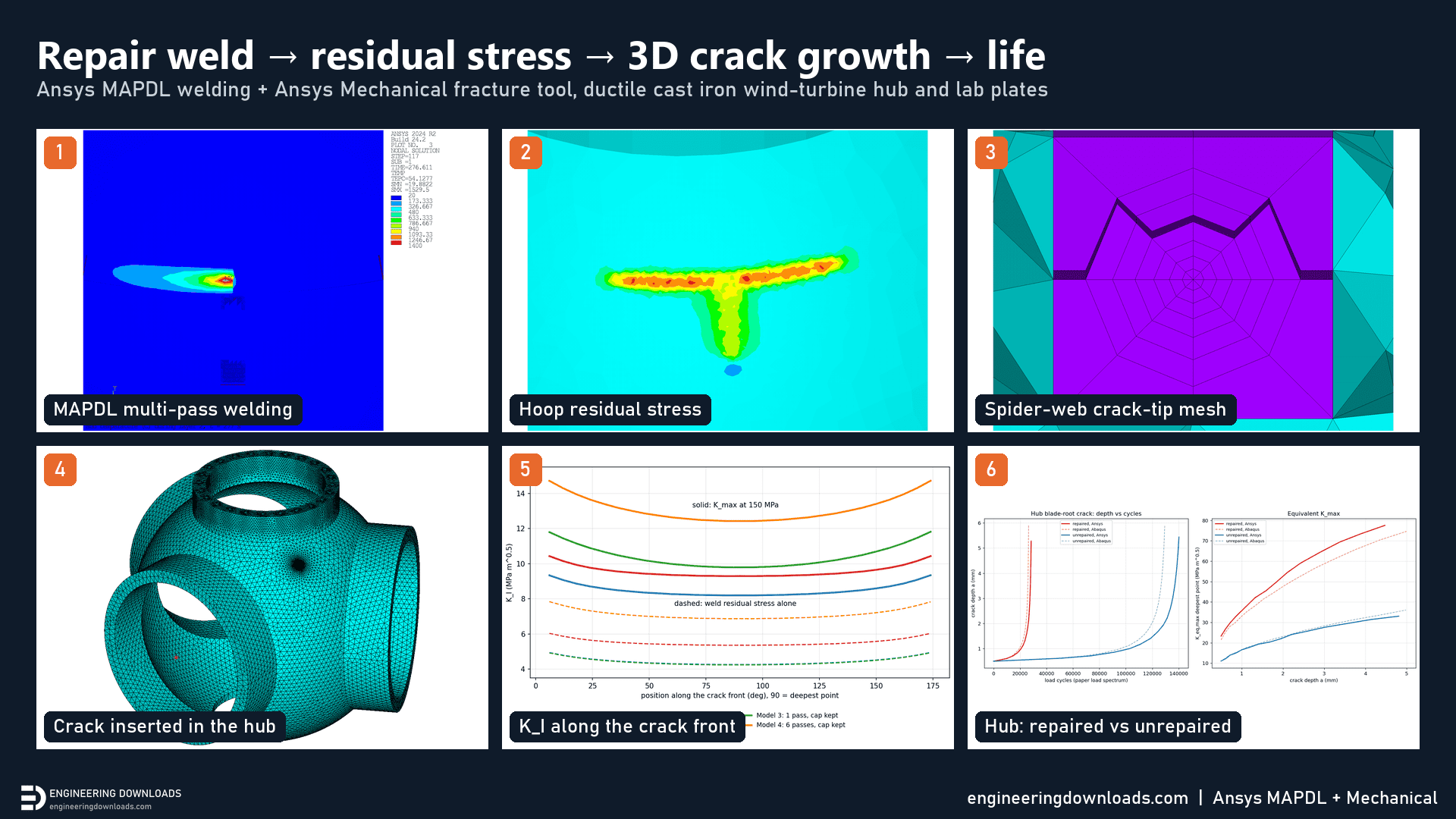 Repair Welding Residual Stress and 3D Fatigue Crack Growth in Ansys: Ductile Cast Iron Wind-Turbine Hub (FFS Level 3)€299,00
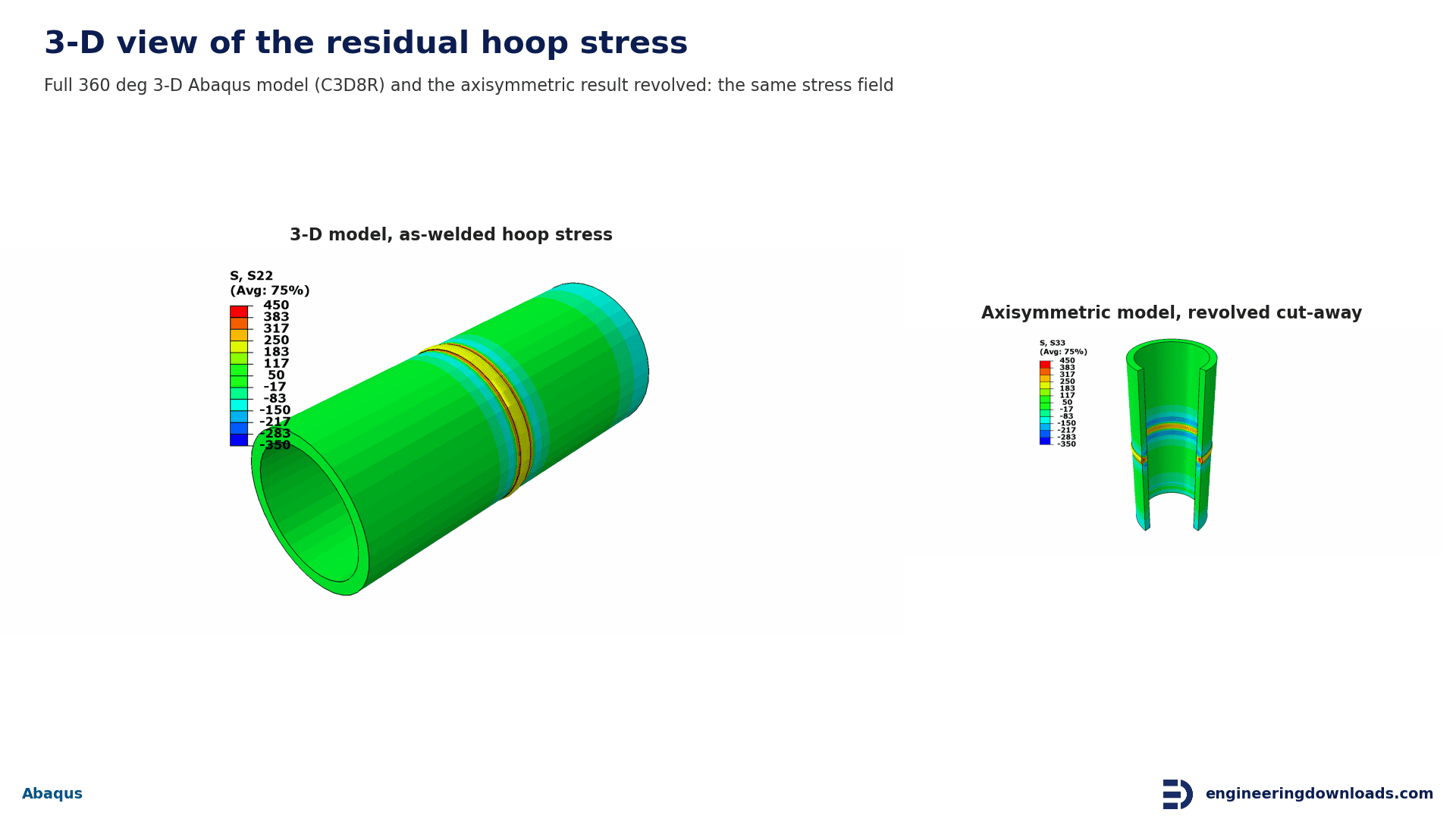 Pipe Girth Weld Residual Stress and Post-Weld Heat Treatment in Abaqus: 12Cr1MoV Multi-Pass Weld, DHT and Tempering€129,00
 Modeling the Fatigue Response of Reinforced Concrete Columns Using the Direct Cyclic Procedure

Need a full custom project? See the options below.

€129,00

€179,00

€149,00

€119,00

€129,00

€149,00
See more
Want to receive push notifications for all major on-site activities?



