


Need a full custom project? See the options below.
Need a full custom project? See the options below.
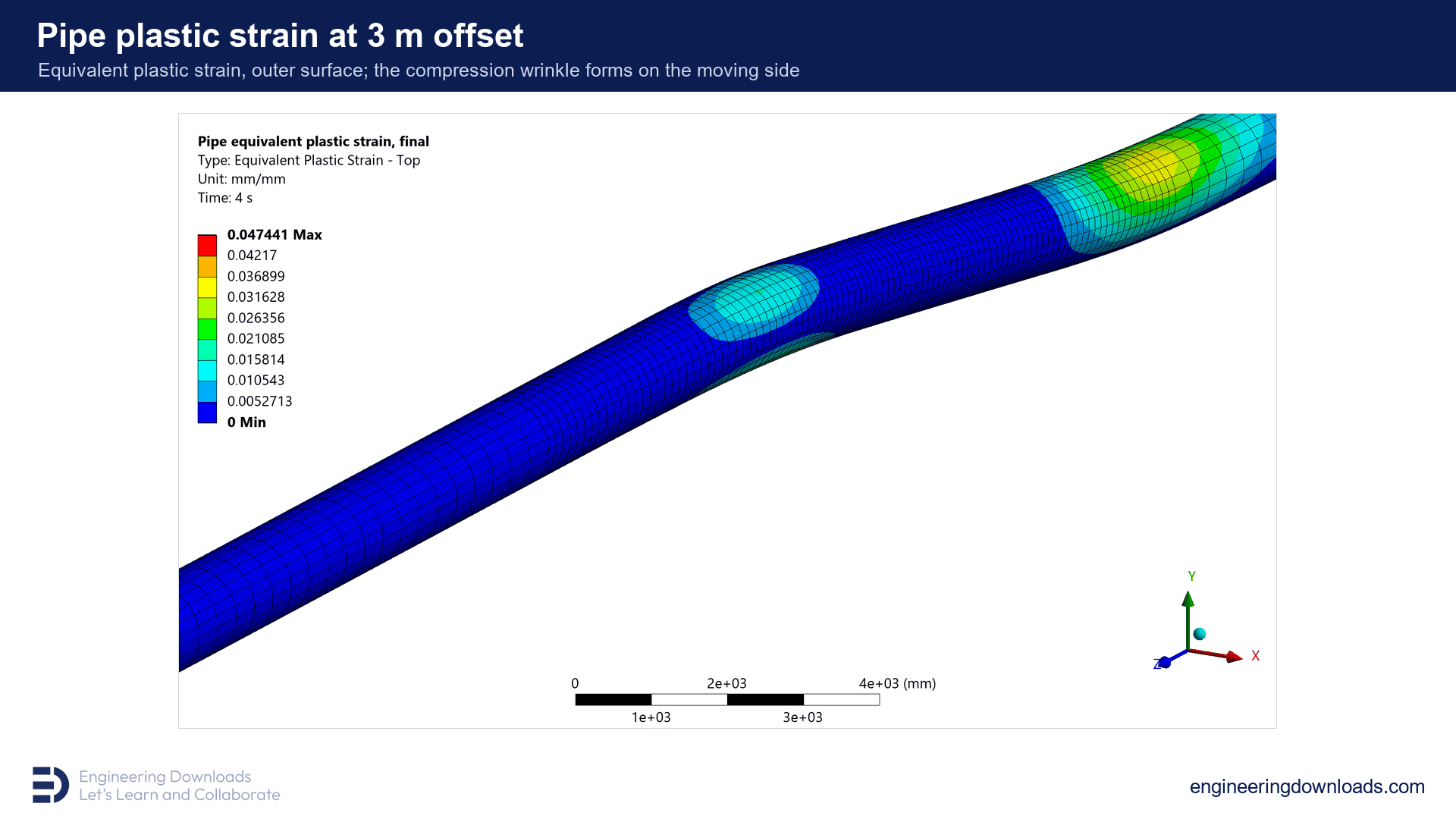
What happens to a buried high-pressure gas pipeline when the ground moves along an active fault? How much is the pipe dragged up, where does it bend, and how large are the axial strains in the pipe wall? This Ansys Workbench package replicates the journal paper Zhang, Wang, Li, Zhang and Liu, “Numerical Simulation Study on the Performance of Buried Pipelines under the Action of Faults”, Applied Sciences 2023, 13, 11266: an X80HD2 pipe, D 1219 × 22 mm at 12 MPa, buried in elasto-plastic soil and crossing a 60° strike-slip reverse fault that moves 3 m. You get the complete Workbench project with the full Mechanical tree, ready to solve in your own Ansys installation, and a step-by-step PDF tutorial that compares every result with the paper.
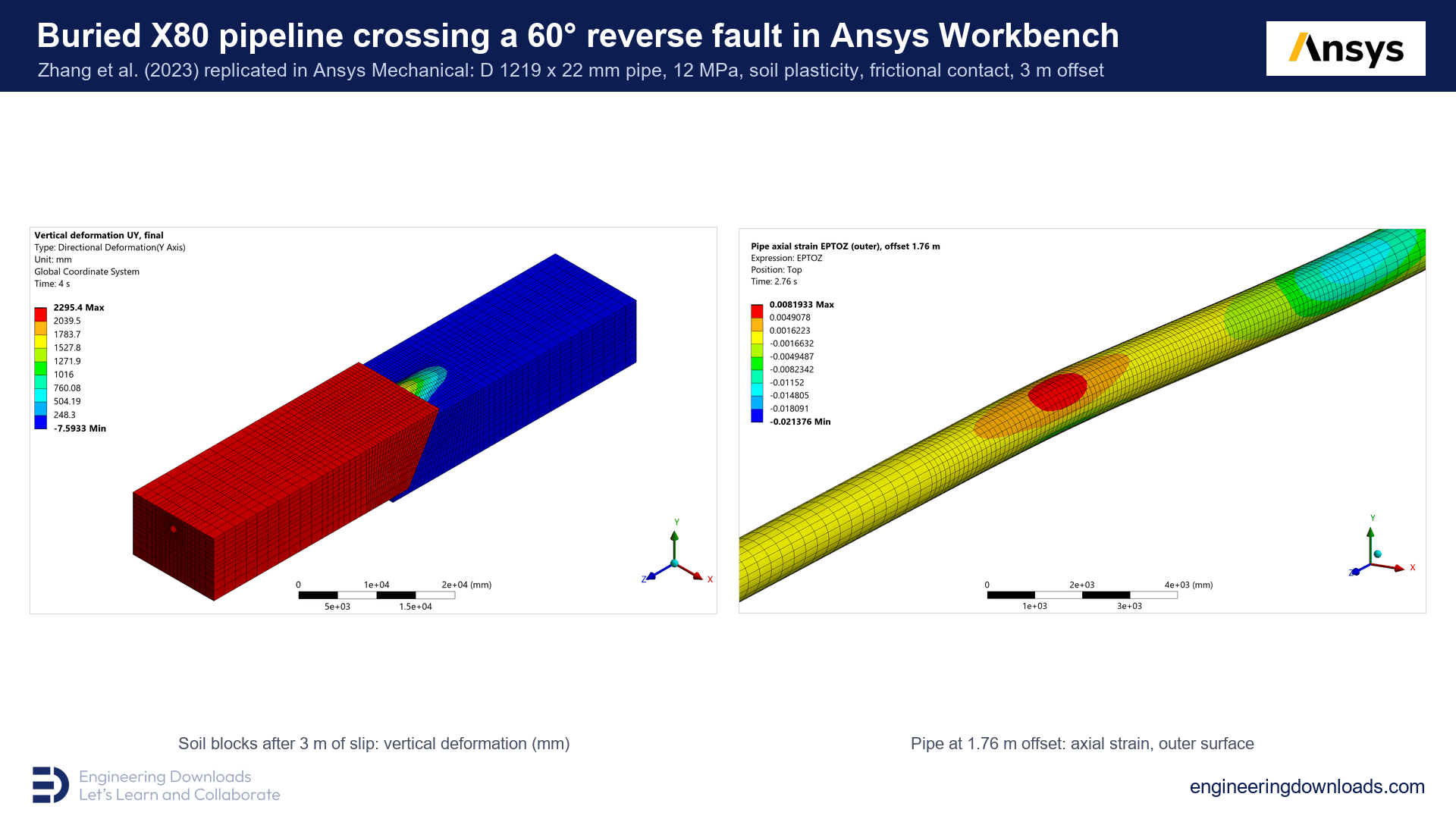
Long-distance oil and gas pipelines cross active faults onshore, in seismic regions such as western China, Iran, Turkey or California, and offshore where pipelines cross seabed faults. Fault crossing is a strain-based design problem: the pipe must follow ground displacements of metres while its wall strains stay within the limits of codes such as CSA Z662 and the ALA guidelines. A validated 3D pipe-soil model in Ansys gives the displacement, strain and stress of the pipe at every fault offset.
The paper models a buried X80HD2 gas pipeline in elasto-plastic soil crossing a strike-slip reverse fault with a 3D shell-and-solid model. It tracks the vertical displacement of the pipe along its length, the axial compressive and tensile strain against fault displacement and the stress state of the pressurised pipe, then studies how the fault angle, internal pressure, wall thickness and burial depth change the response. This package reproduces the paper's baseline: fault angle 60°, internal pressure 12 MPa, wall 22 mm, cover 1.5 m.
| Item | This package |
|---|---|
| Workbench project | External Model (structured mesh) linked to a Static Structural system with the complete Mechanical tree |
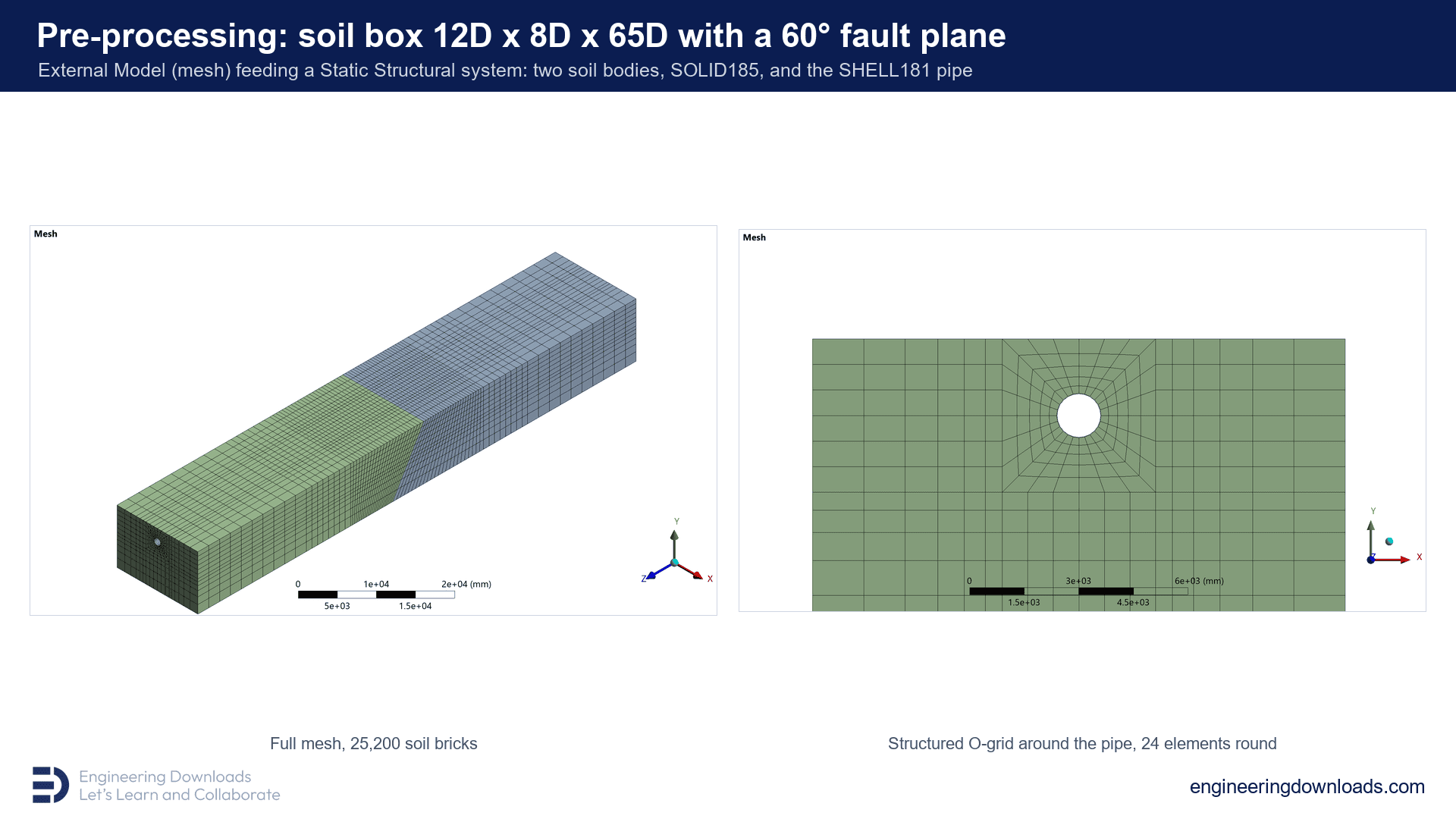
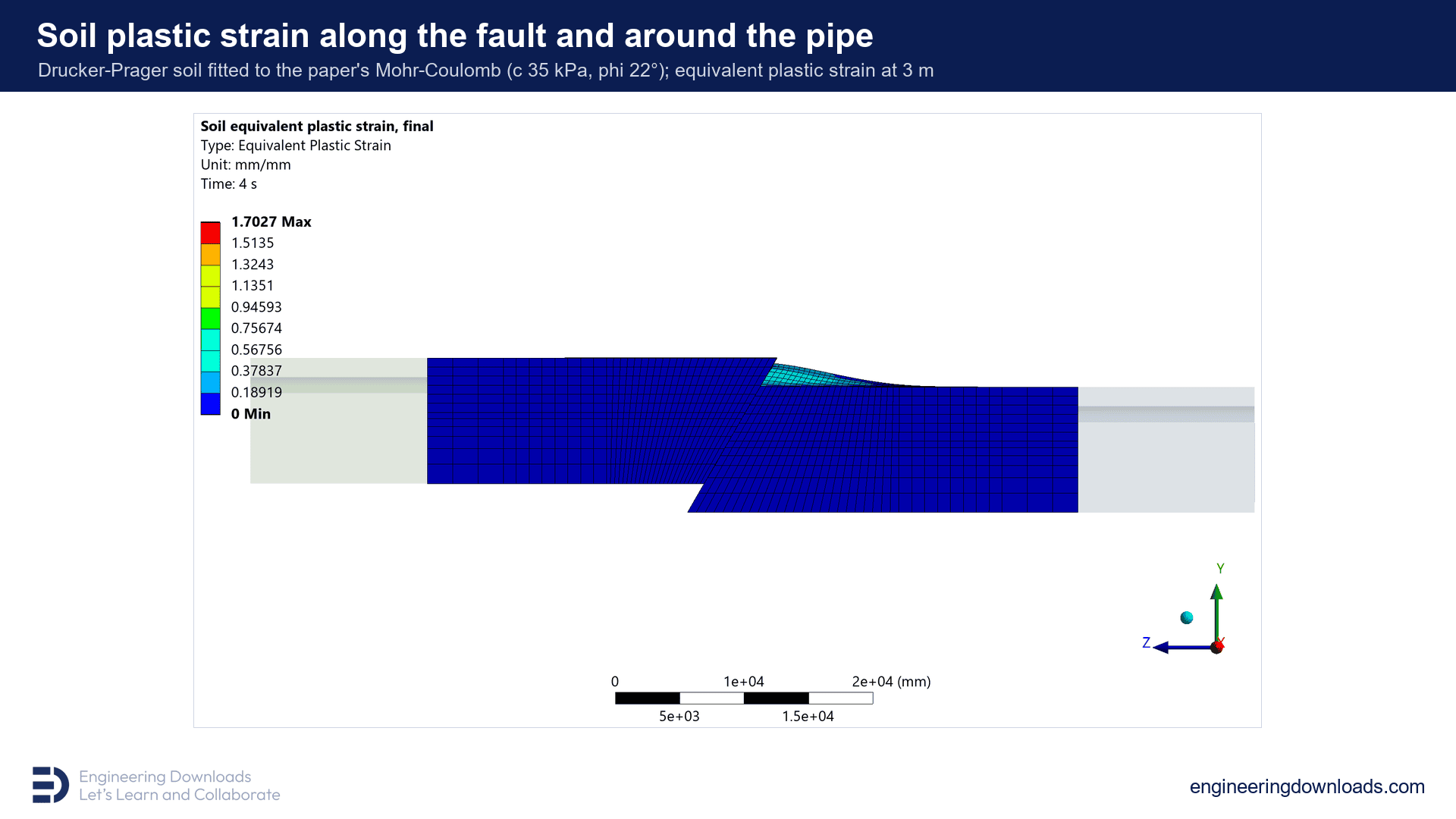
| Soil | Box 12D × 8D × 65D = 14.6 × 9.75 × 79.2 m; two soil bodies (SOLID185) meeting on the 60° fault plane; Drucker-Prager fitted to the paper's Mohr-Coulomb soil (c = 35 kPa, φ = 22°); geostatic initial stress |
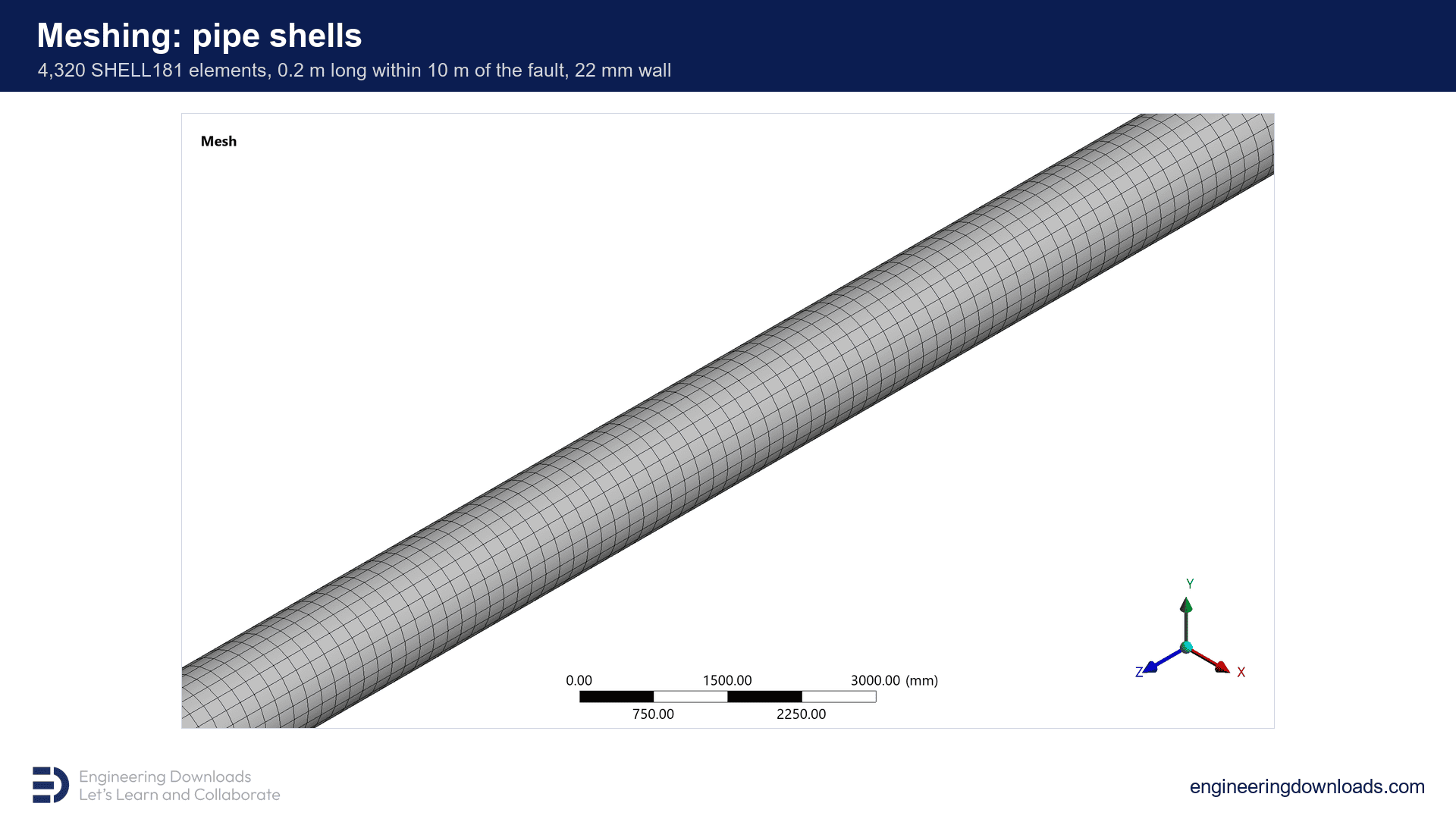
| Pipe | X80HD2, D 1219 mm, t 22 mm, SHELL181, multilinear hardening from the paper, 12 MPa internal pressure |
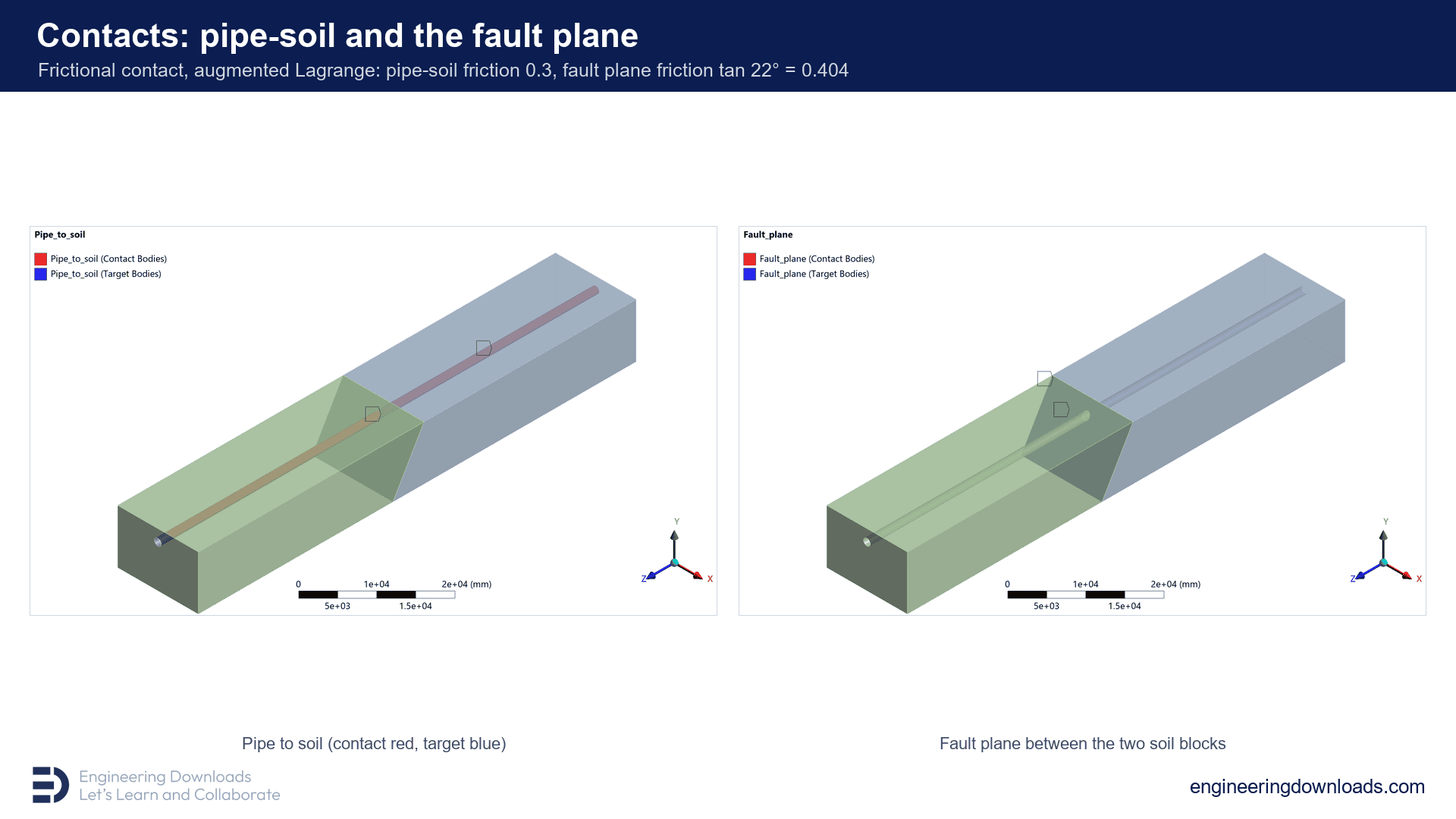
| Contacts | Frictional pipe-soil contact (0.3) and frictional fault plane (0.404), augmented Lagrange |
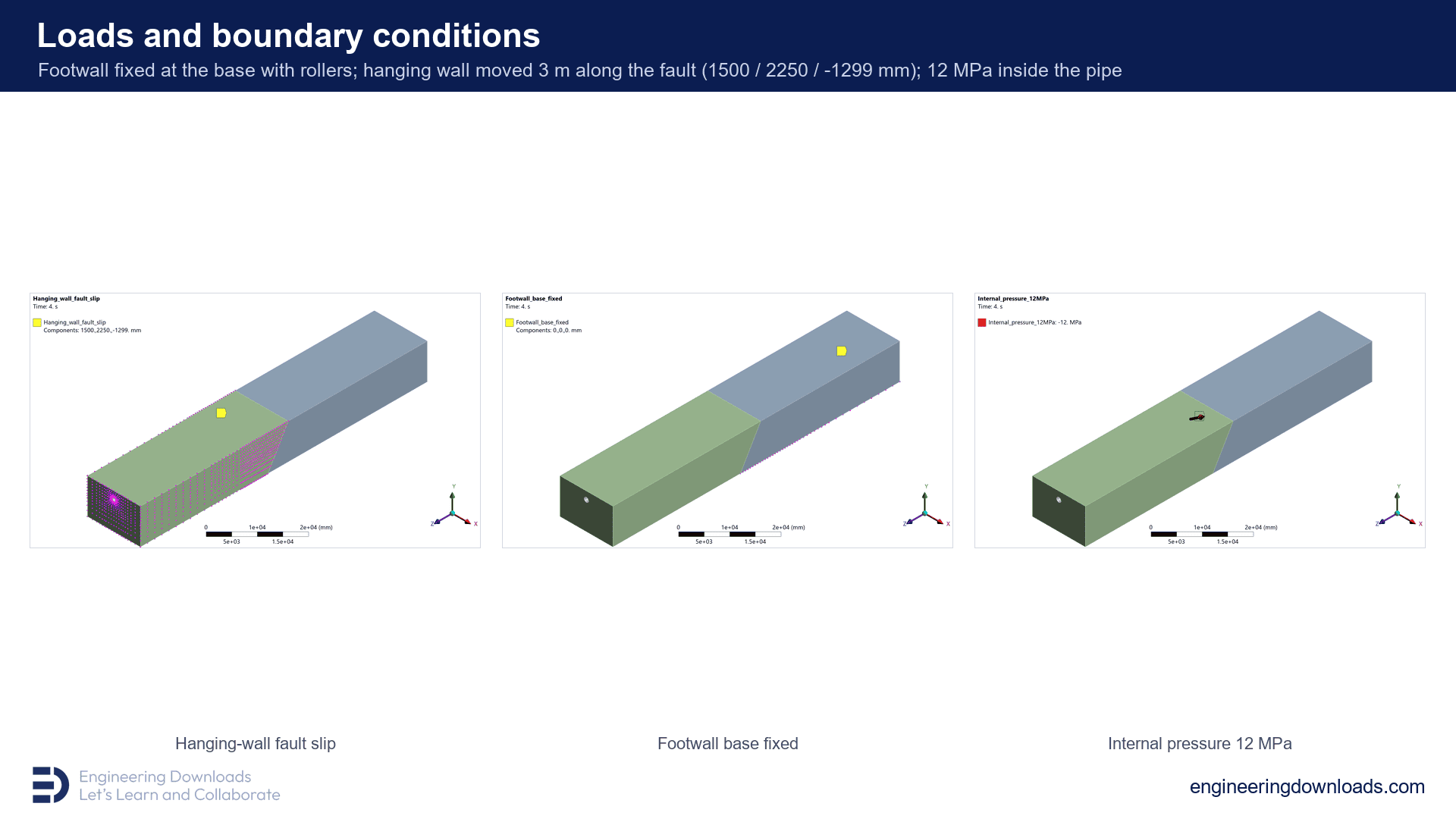
| Loading | Step 1: gravity and pressure. Step 2: hanging wall moved 3 m along the fault (1.50 m strike-slip, 2.25 m up) |
| Analysis | Static Structural, large deflection, Newton-Raphson, energy stabilization |
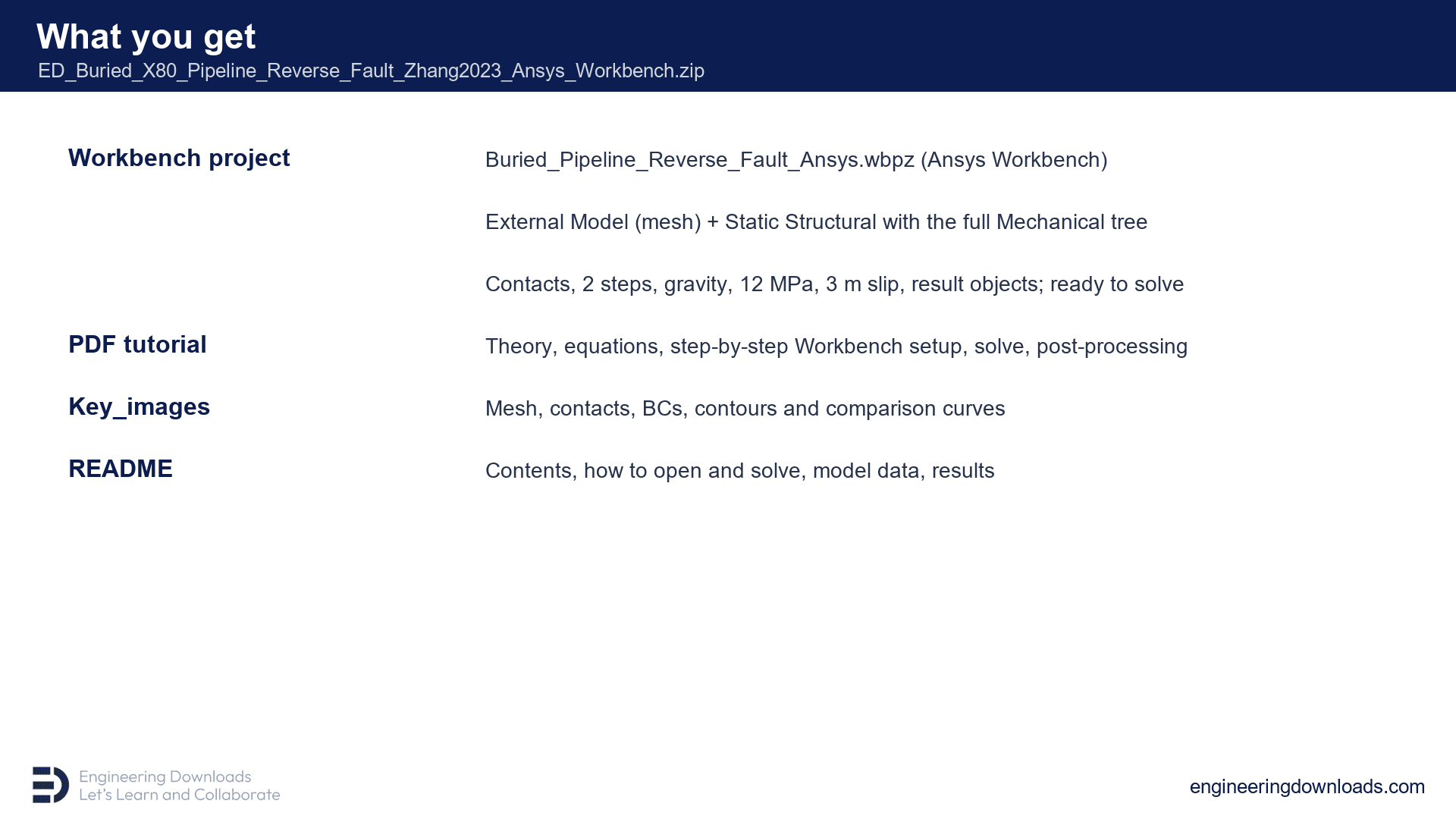
| Files | Workbench archive (.wbpz) with the mesh, Engineering Data, Mechanical model and APDL command snippets |
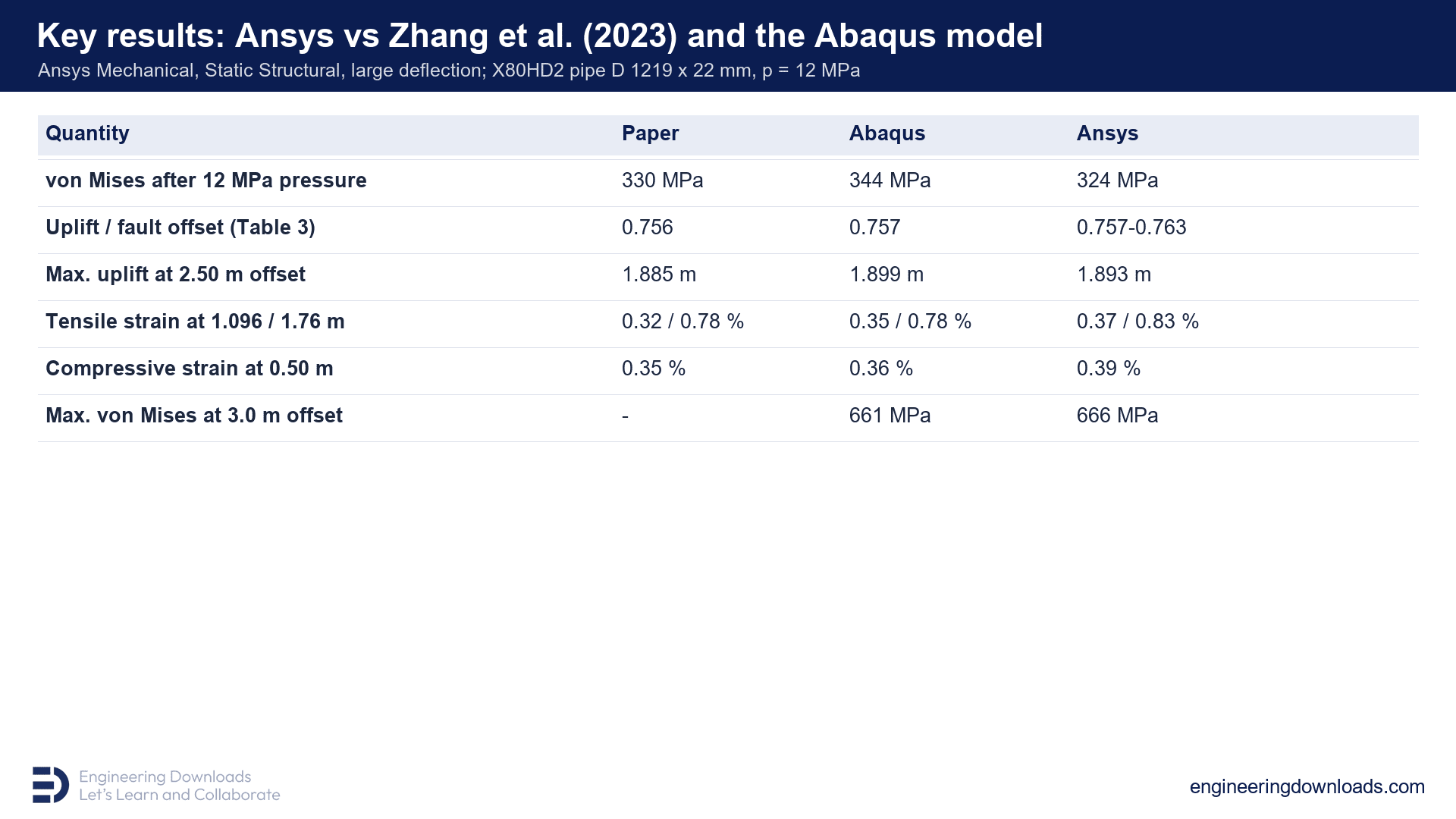
| Quantity | Paper | Abaqus model | This Ansys model |
|---|---|---|---|
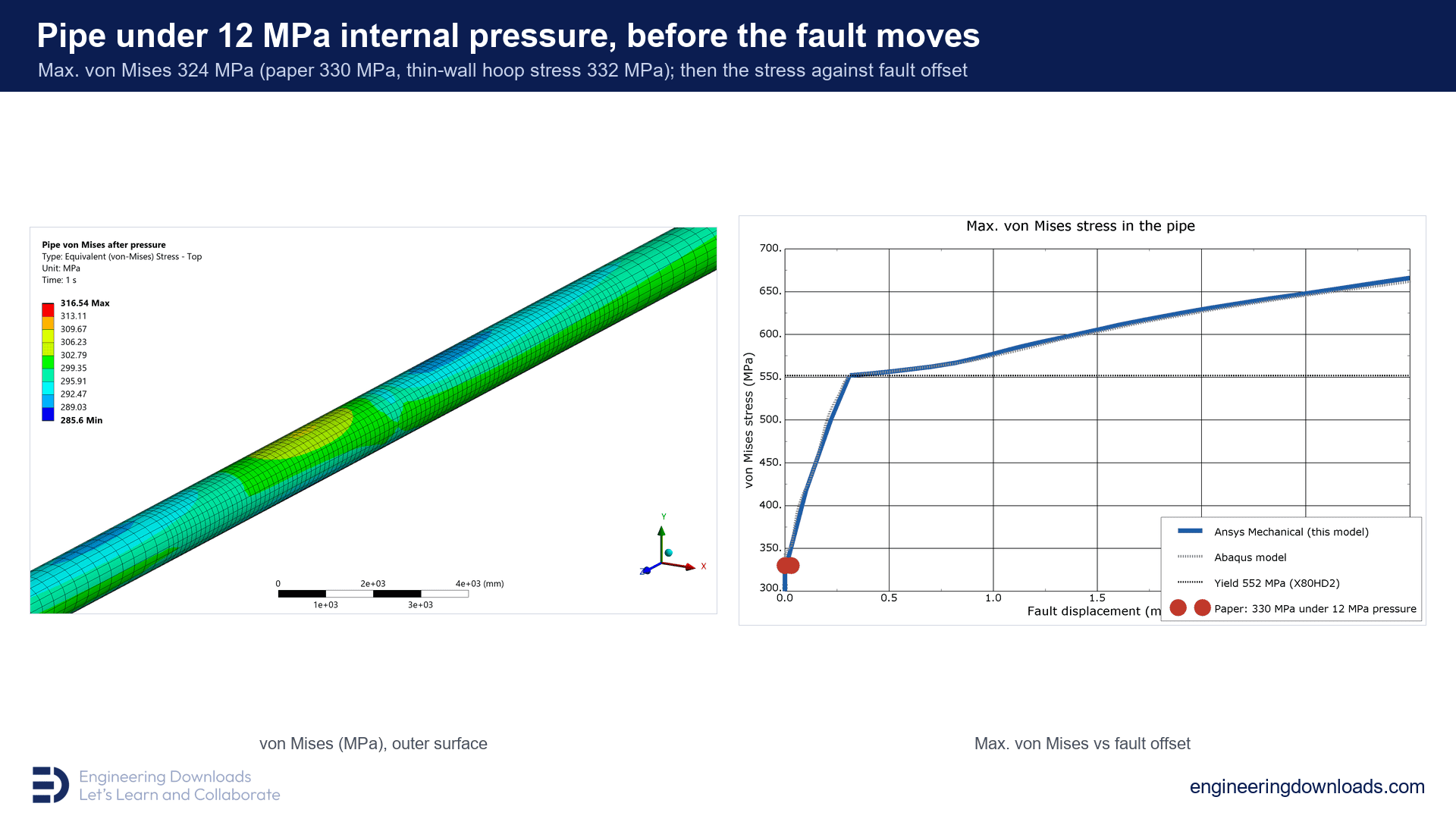
| von Mises stress after 12 MPa pressure | 330 MPa | 344 MPa | 324 MPa |
| Pipe uplift / fault offset (Table 3) | 0.756 | 0.757 | 0.757-0.763 |
| Max. uplift at 2.50 m offset | 1.885 m | 1.899 m | 1.893 m |
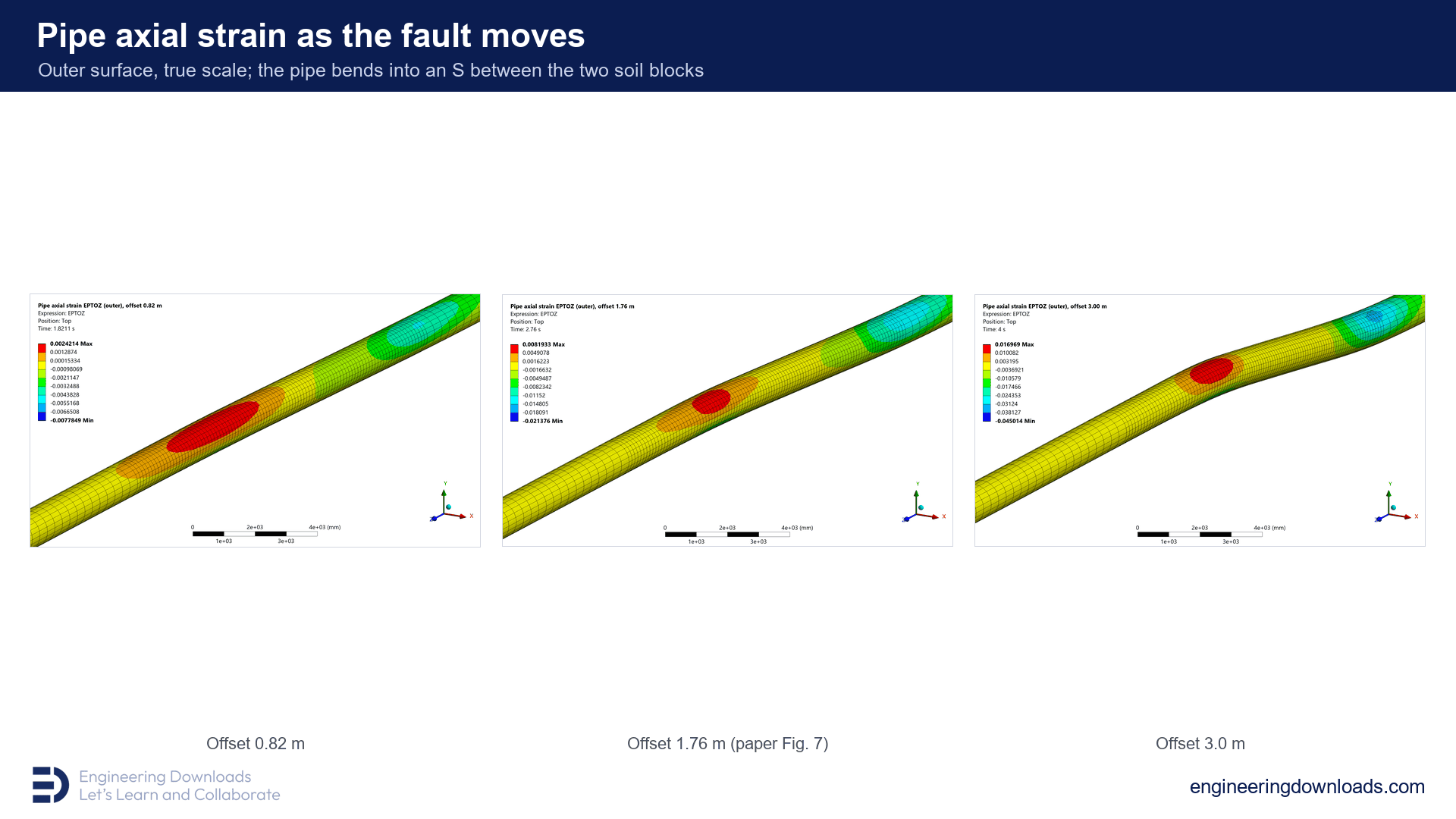
| Compressive strain at 0.50 m offset | 0.35 % | 0.36 % | 0.39 % |
| Tensile strain at 1.096 / 1.76 m offset | 0.32 / 0.78 % | 0.35 / 0.78 % | 0.37 / 0.83 % |
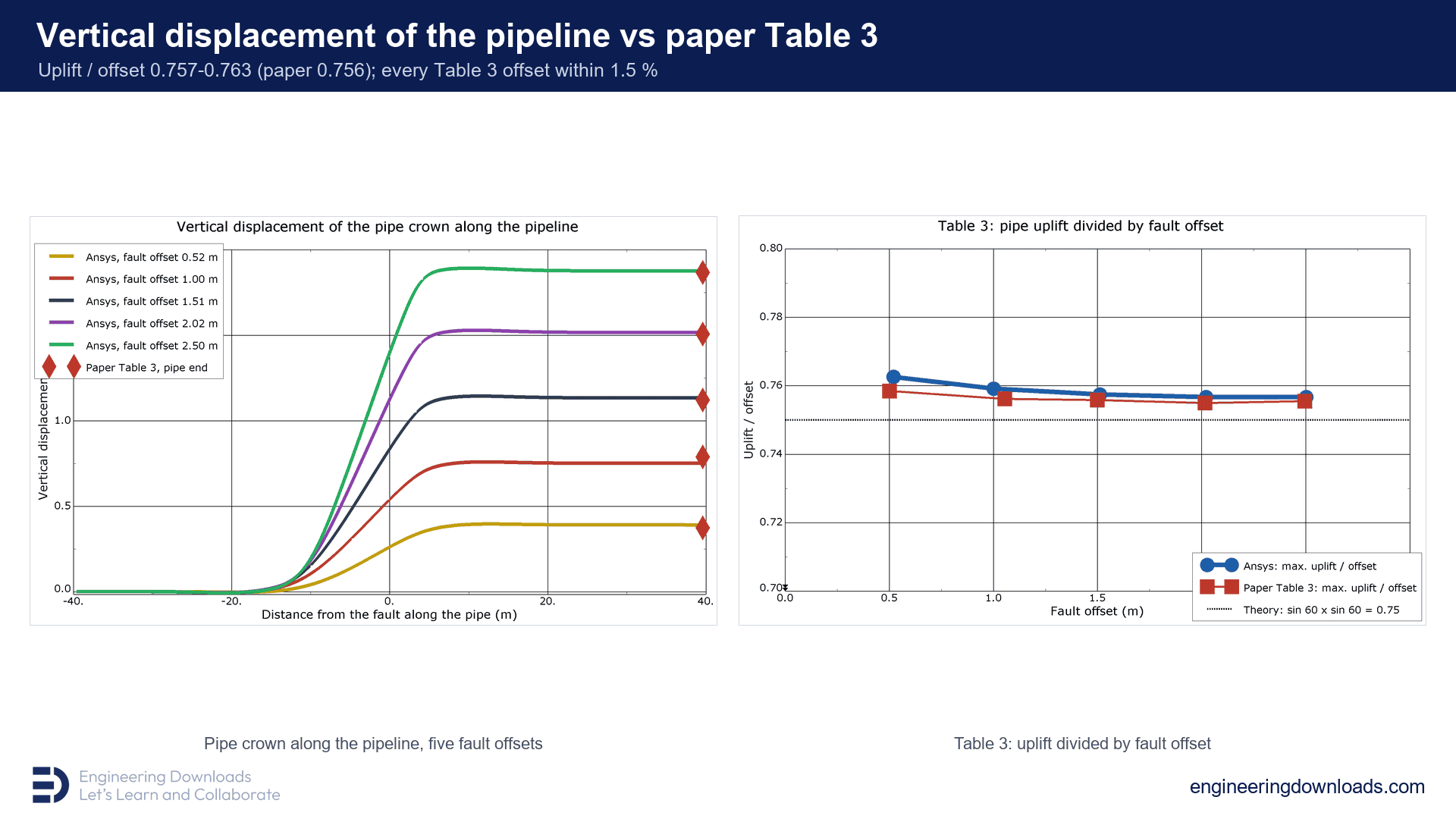
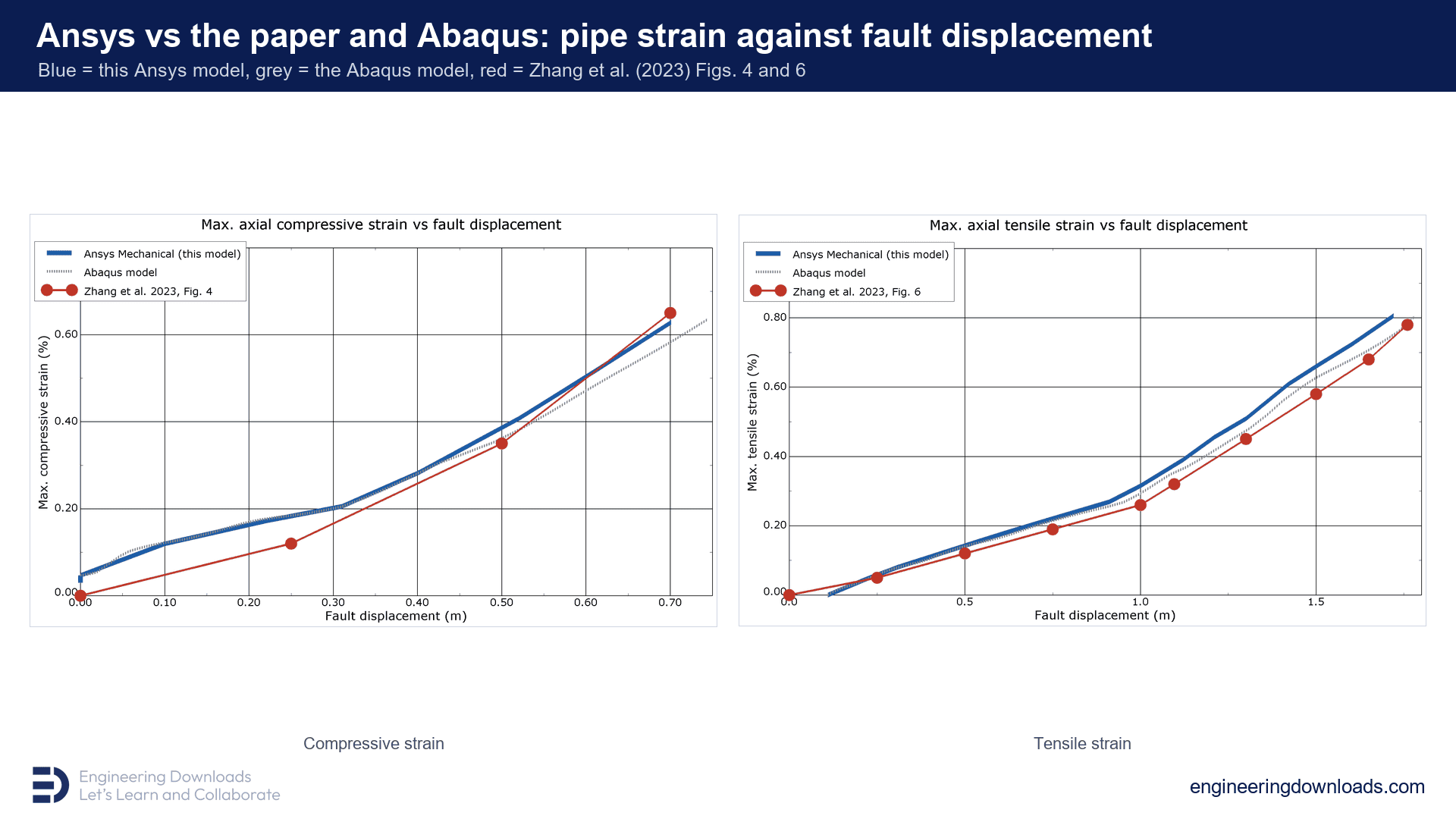
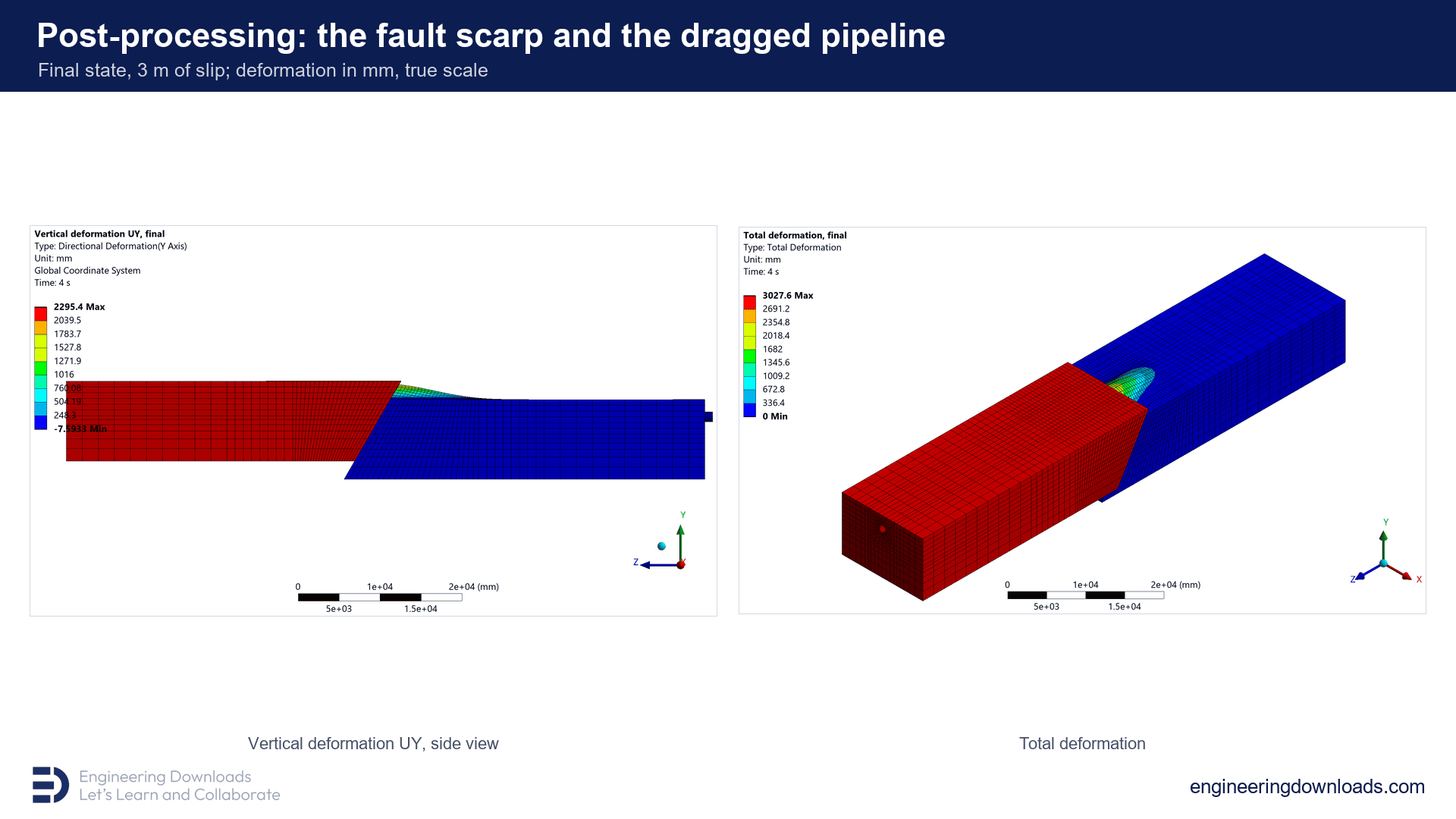
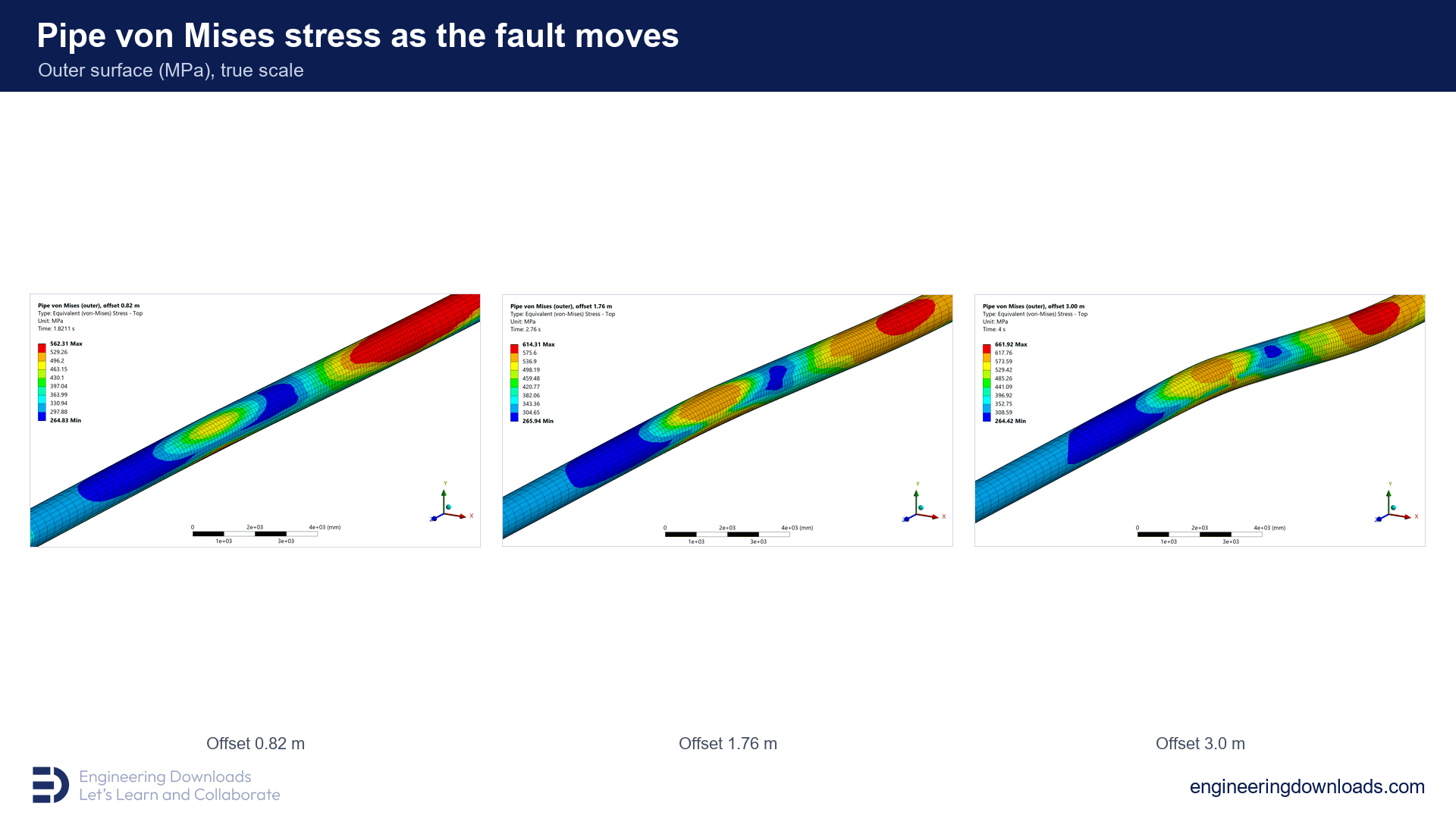
The pressurised pipe carries a von Mises stress of 324 MPa before the fault moves, against 330 MPa in the paper and 332 MPa from the thin-wall formula. As the hanging wall rises, the pipe is bent into an S over about 15 m and follows the moving block: its uplift is 0.757-0.763 times the fault offset, against 0.756 in the paper's Table 3. The axial strains follow the paper's curves, and the Ansys static model and our Abaqus explicit model of the same case practically coincide, although they use different solvers, meshes and soil yield surfaces.
Fault slip vector for an offset δ, rake 60° and dip β = 60°:
ux = δ cos 60° uy = δ sin 60° sin β uz = −δ sin 60° cos β (δ = 3 m: 1.500, 2.250, −1.299 m)
Drucker-Prager fitted to Mohr-Coulomb in plane strain, written in the Extended Drucker-Prager form of Ansys:
√J2 + b I1 = k, b = tanφ / √(9 + 12 tan2φ), k = 3c / √(9 + 12 tan2φ) ⇒ q + ασm = σY, α = 0.634, σY = 54.9 kPa
Critical compressive strain of CSA Z662 (paper Eqs. 2-3) and initial soil stress:
εccrit = 0.5 t/D − 0.0025 + 3000 (σh/E)2 = 0.99 % σh,soil = K0 ρgy, K0 = ν/(1 − ν) = 0.429
Pipeline engineers who check fault crossings with strain-based design, geotechnical and earthquake engineers who model pipe-soil interaction in Ansys, FEA engineers who want a working Workbench model with soil plasticity, frictional contact, initial geostatic stress and a moving fault block, and MSc and PhD students who want to see a published pipeline study rebuilt in Ansys and checked number by number. The same case is also available as an Abaqus model.
Which paper does this package replicate? Zhang, Wang, Li, Zhang and Liu, Numerical Simulation Study on the Performance of Buried Pipelines under the Action of Faults, Applied Sciences 2023, 13, 11266 (open access). The baseline case is reproduced: X80HD2 pipe D 1219 x 22 mm, 12 MPa, fault angle 60 degrees. The paper is cited, not bundled.
How close are the results to the paper? The stress after pressurising is 324 MPa against 330 MPa, the pipe uplift divided by fault offset is 0.757-0.763 against 0.756 with all five Table 3 offsets within 1.5 %, and the tensile strain is 0.83 % at 1.76 m against 0.78 % in the paper.
Is it a real Workbench project? Yes. The .wbpz restores to a Workbench project with an External Model system holding the mesh and a Static Structural system with Engineering Data and the complete Mechanical tree: materials, contacts, analysis settings, loads, boundary conditions, command snippets and result objects. Press Solve to run it.
How is the soil modelled? As two soil bodies meeting on the 60 degree fault plane, with a geostatic initial stress and a Drucker-Prager yield surface fitted to the paper's Mohr-Coulomb soil (c = 35 kPa, phi = 22 degrees) so that both give the same strength in plane strain. The fitting equations are in the tutorial.
How is the fault movement applied? The footwall is fixed at its base; the base, sides and end of the hanging wall are moved 3 m along the fault (1.50 m strike-slip, 2.25 m up, 1.30 m toward the footwall) in the second load step, and the hanging wall slides on the footwall through frictional contact.
Is there an Abaqus version? Yes. The same case is available as an Abaqus/Explicit model on Engineering Downloads, and this tutorial compares the two: their strain curves practically coincide.
Are the images real Ansys results? Yes. Meshes, contacts, boundary conditions and contours are exported from Ansys Mechanical with the included model; only a title bar, the logo and the web address are added around them.
What if the package is not what I expected? Write to us. Engineering Downloads refunds clients who are not satisfied with a delivered product.
Need more than the files?
There are two ways we can help. Book a one hour online consultation if you want to talk a problem through with a CAE engineer, using the checkbox in the order box. Order a project if you need a full simulation built for you, delivered to an agreed scope, price and deadline under a written contract.
We work on FEA and CFD for engineers, researchers and companies. Order your project, or message us on WhatsApp for a quick reply.
Other packages engineers working on this topic also download.
 Buried Pipeline Crossing a Reverse Fault in Abaqus, after Zhang et al. (2023)€129,00
 Oil Storage Tank under Non-Uniform Foundation Settlement in Abaqus, after Jiao et al. (2024)€169,00
 Wind Turbine Tower Man Door and Ventilation Opening Buckling in Ansys: GMNIA after Gantes et al. (2024)€129,00
 Pipe and Pipeline Simulation Package in Abaqus (21 Models)
 Composite Transverse Fracture in Ansys: AS4/8552 R-Curve and Homogenized Cohesive Softening Laws (Herráez et al. 2018)€179,00
 DP600 Dual-Phase Steel Microstructure RVE (Ferrite + Martensite) in Ansys Mechanical: Tensile Response and Plastic Strain Localisation€129,00
 Underwater and Underground Explosion Simulation Package in Abaqus (20 Models)
 FEA of Connecting Rod using ANSYS

Need a full custom project? See the options below.
€129,00
€179,00

€149,00

€119,00
€129,00

€149,00
See more
Want to receive push notifications for all major on-site activities?



