Need a full custom project? See the options below.
Need a full custom project? See the options below.
What happens to a 100,000 m³ crude oil tank when its foundation settles unevenly? How far does the top of the wall go out of round, when does the bottom plate lift off the foundation, and when can you leave the foundation out of the model? This Abaqus package replicates the journal paper Jiao, Wang, Li and Liu, “Finite Element Analysis and Improved Evaluation of Mechanical Response in Large Oil Storage Tanks Subjected to Non-Uniform Foundation Settlement”, Processes 2024, 12, 2838: a tank wall of nine courses, the bottom plate, the large fillet weld and the foundation with frictional contact, Ramberg-Osgood steels, hydrostatic load and harmonic or measured settlement. Five ready-to-run models (CAE + INP) and a results report that compares every curve with the paper.
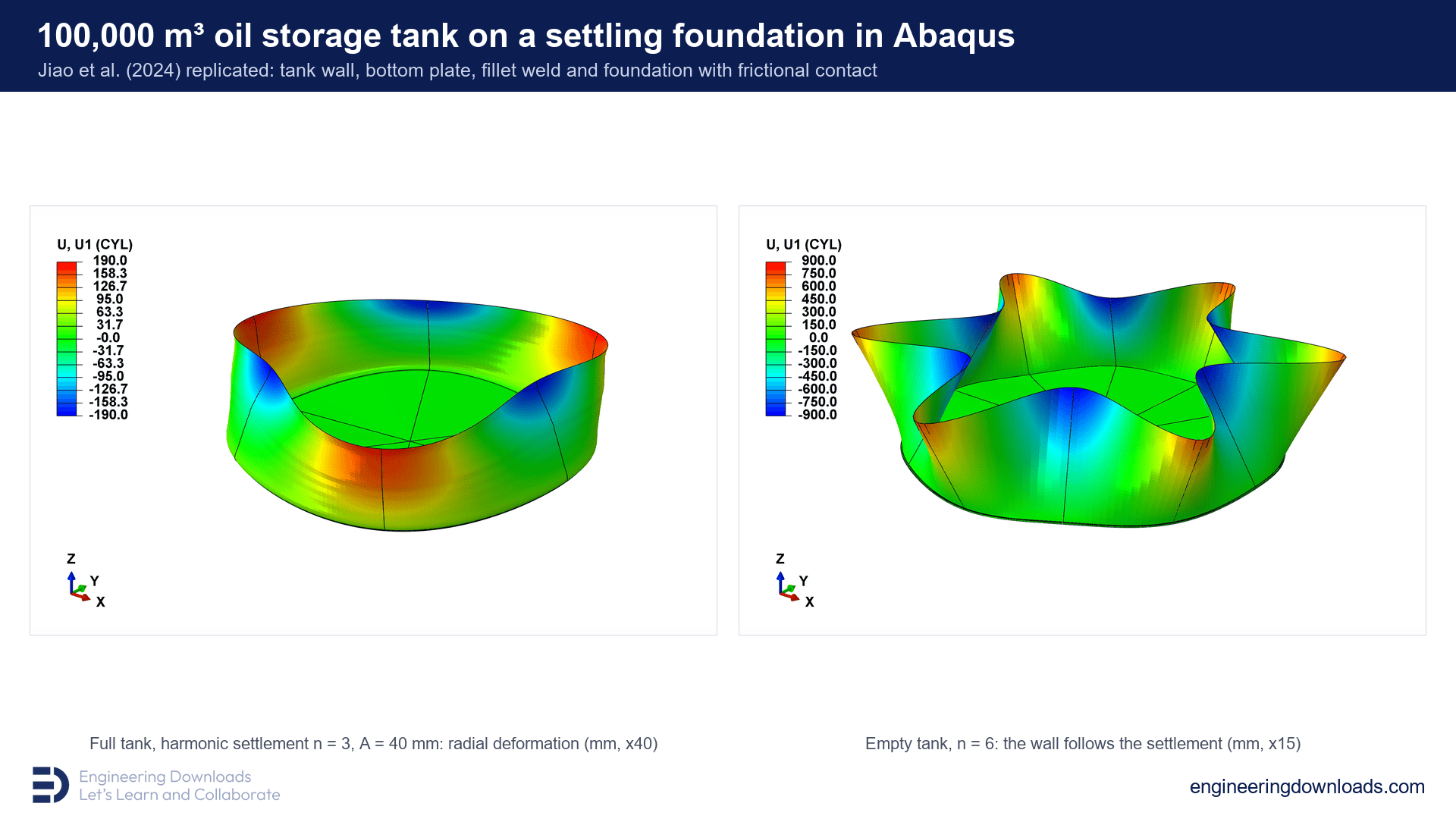
Large crude oil tanks rest freely on a ring-wall foundation and rely on friction, so a non-uniform settlement of the foundation is shared between the soil and the tank. The paper builds an Abaqus model with the foundation and the tank bottom in contact, checks it against strain-gauge data from a water test, and studies how the diameter-to-thickness ratio, height-to-diameter ratio, harmonic number and amplitude change the radial deformation at the top of the wall. It then compares the model with and without the foundation and proposes critical harmonic amplitudes below which the simpler model is accurate enough.
| Item | This package |
|---|---|
| Tank | D 80 m, wall 21.8 m in 9 courses (31.2 → 11.7 mm), annular plate 20 mm, centre plate 12 mm, 13 mm fillet weld |
| Materials | Ramberg-Osgood 08MnNiVR (courses 1-7, annular plate), 16MnR (course 8), Q235-B (course 9, centre plate); foundation E = 20 MPa |
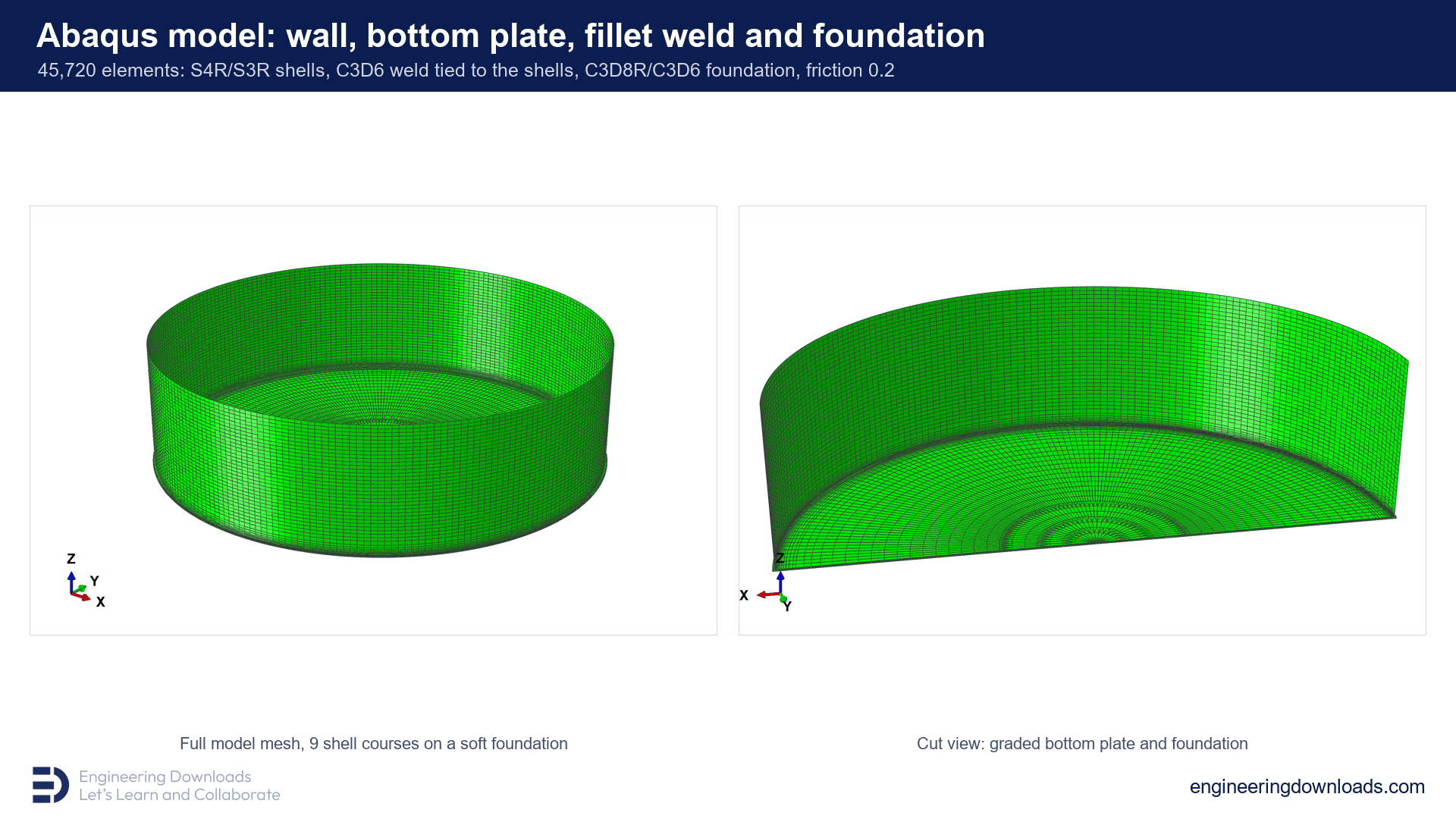
| Elements | S4R/S3R shells for wall and bottom plate, C3D6 weld tied to both, C3D8R/C3D6 foundation; 45,720 elements in the full model |
| Interaction | Bottom plate on foundation: surface-to-surface contact, friction 0.2, free to lift off |
| Loads | Gravity + hydrostatic pressure p = ρg(H − h), water at 19.76 m |
| Settlement | Applied at the foundation base: u = A cos(nθ) at the edge, mean at the centre, linear in r; or a measured field profile |
| Analysis | Abaqus/Standard, nonlinear geometry; single harmonics on a 180/n° sector with symmetry planes |
| Software | Abaqus/CAE and Abaqus/Standard 2024 or newer (INP files also run in older releases) |
| Quantity | Paper | This model |
|---|---|---|
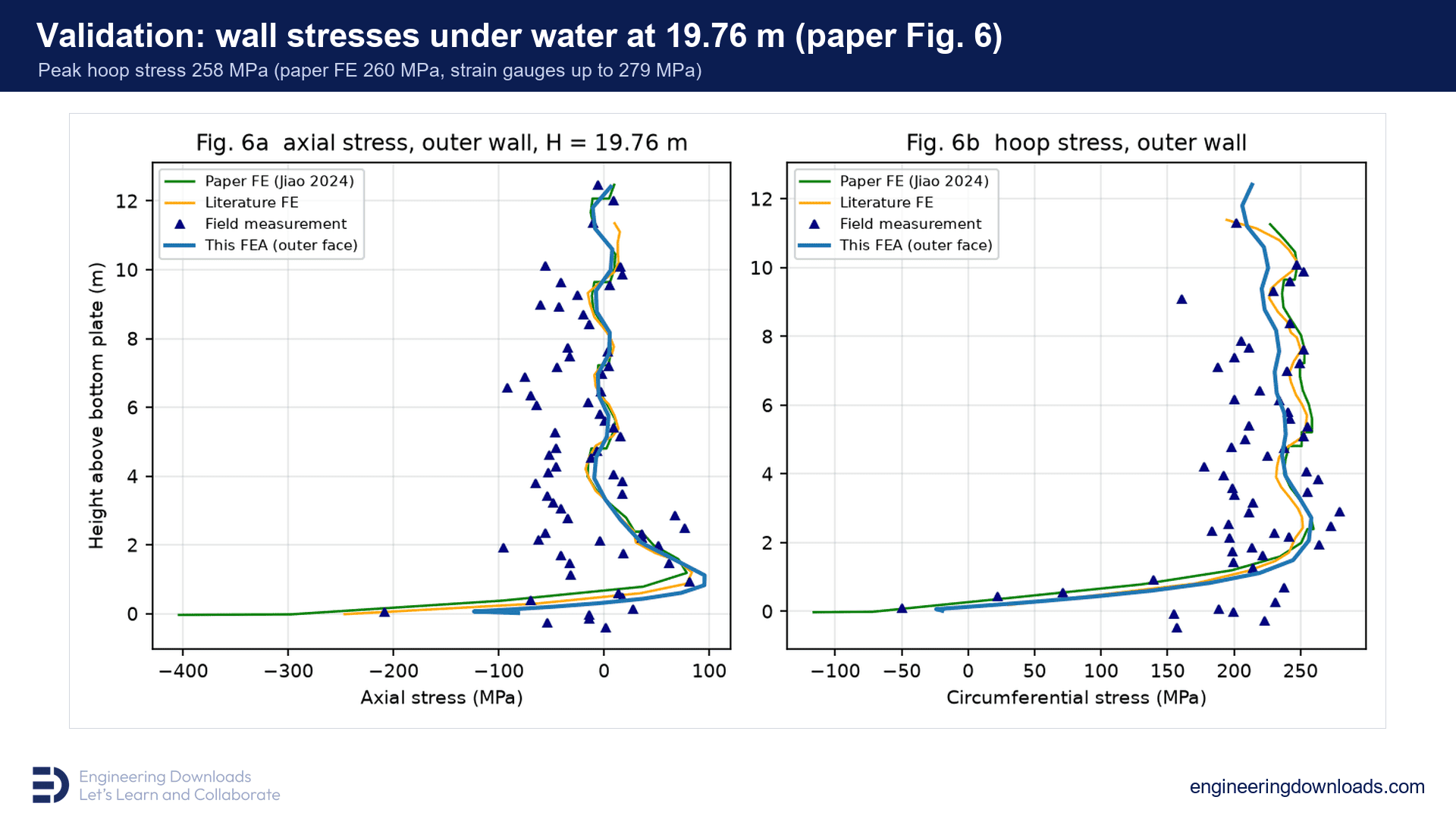
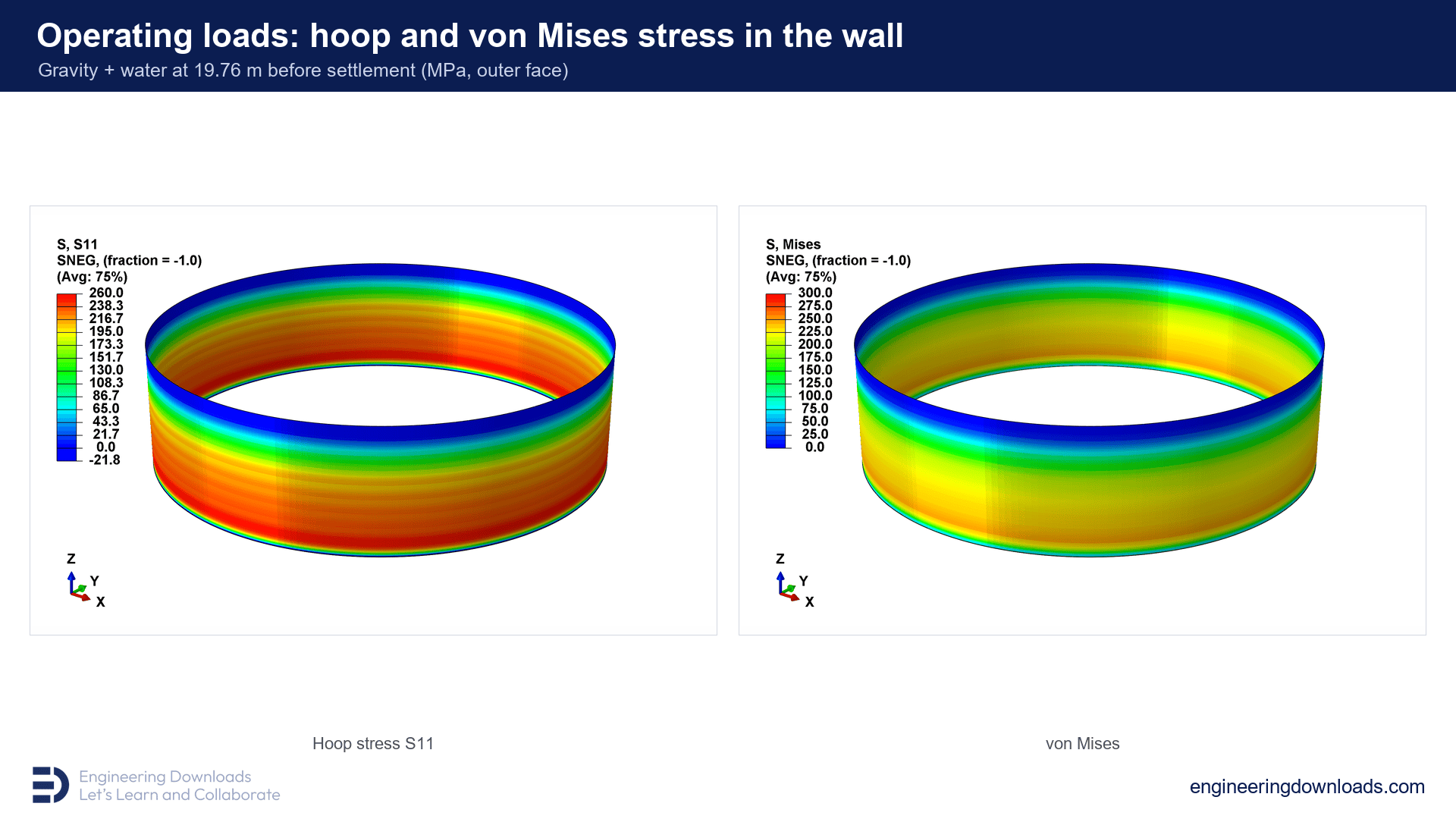
| Peak hoop stress, water 19.76 m | 260 MPa | 258 MPa |
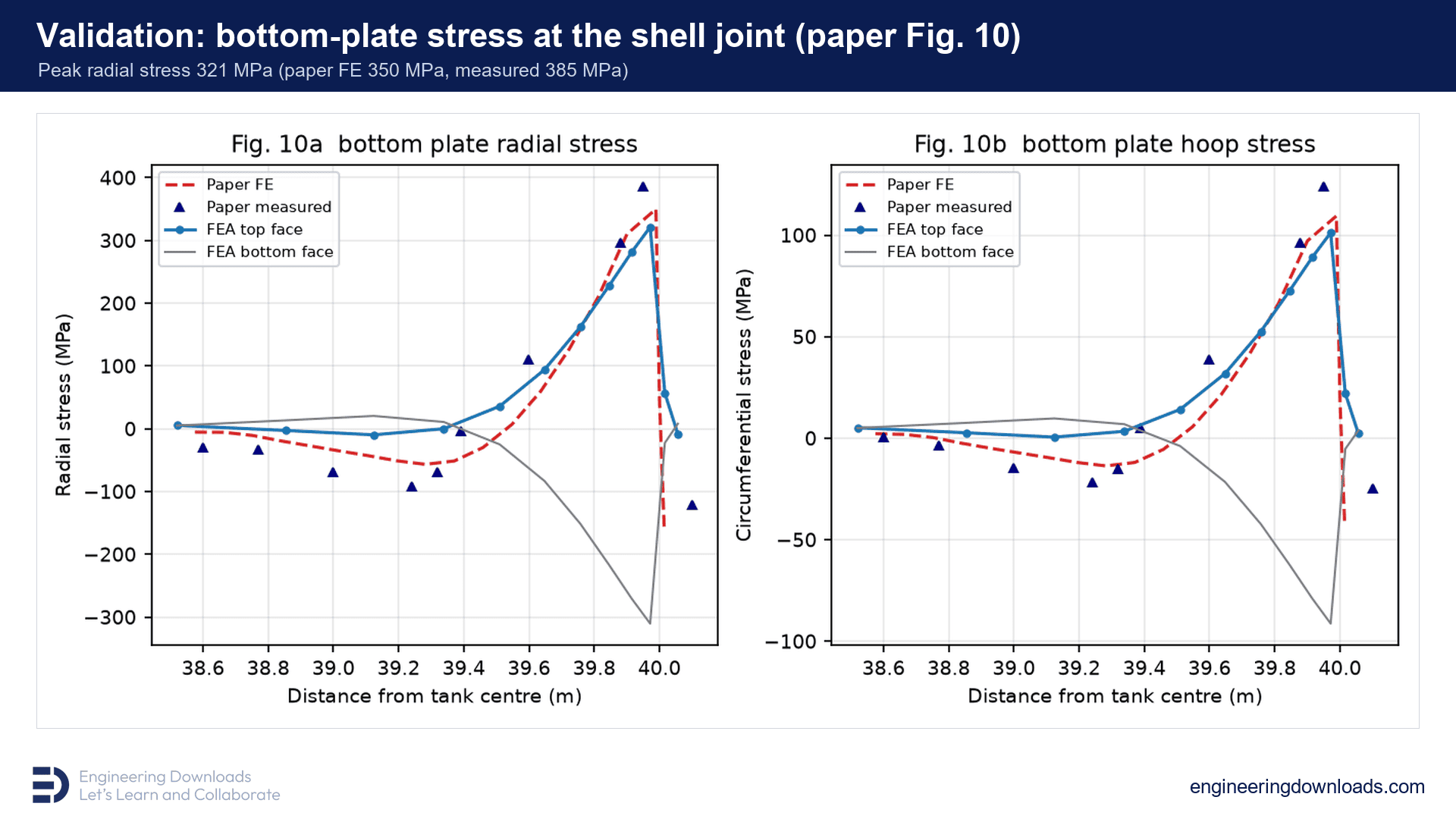
| Peak bottom-plate radial stress at the joint | 350 MPa | 321 MPa |
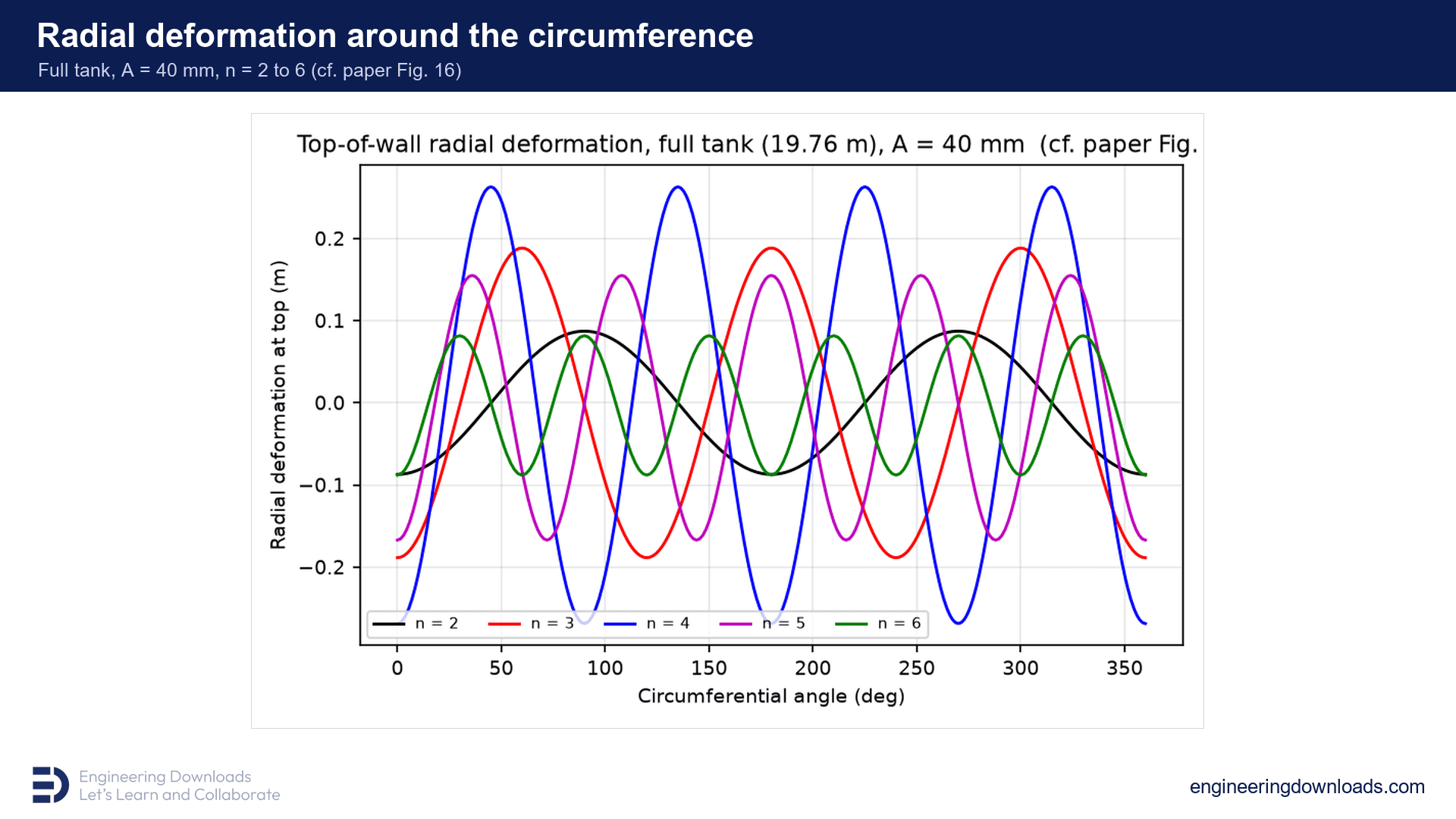
| Top deformation, n = 3, A = 40 mm, full / empty | 0.192 / 0.197 m | 0.189 / 0.196 m |
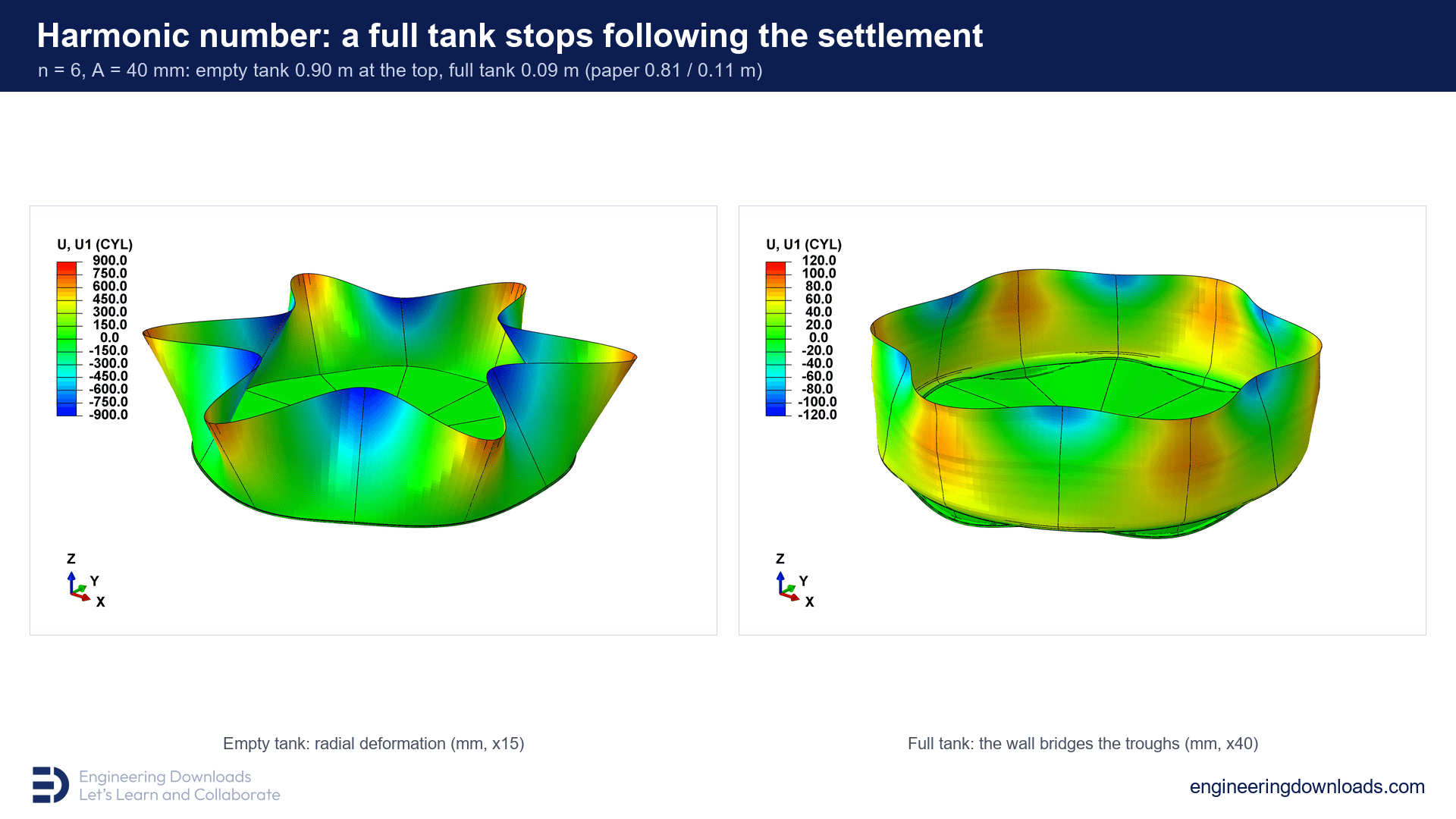
| Top deformation, n = 6, A = 40 mm, empty / full | 0.81 / 0.106 m | 0.90 / 0.088 m |
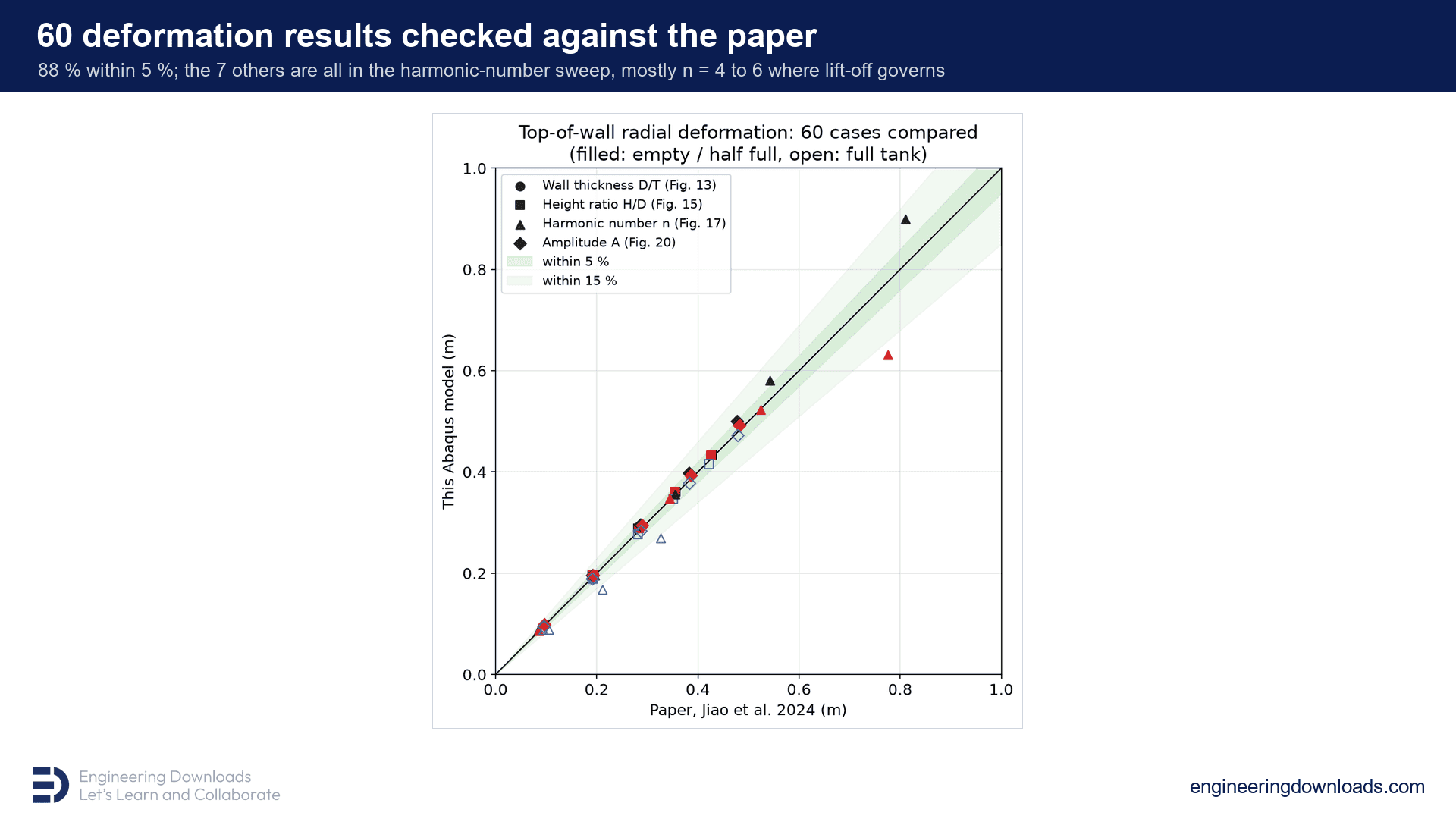
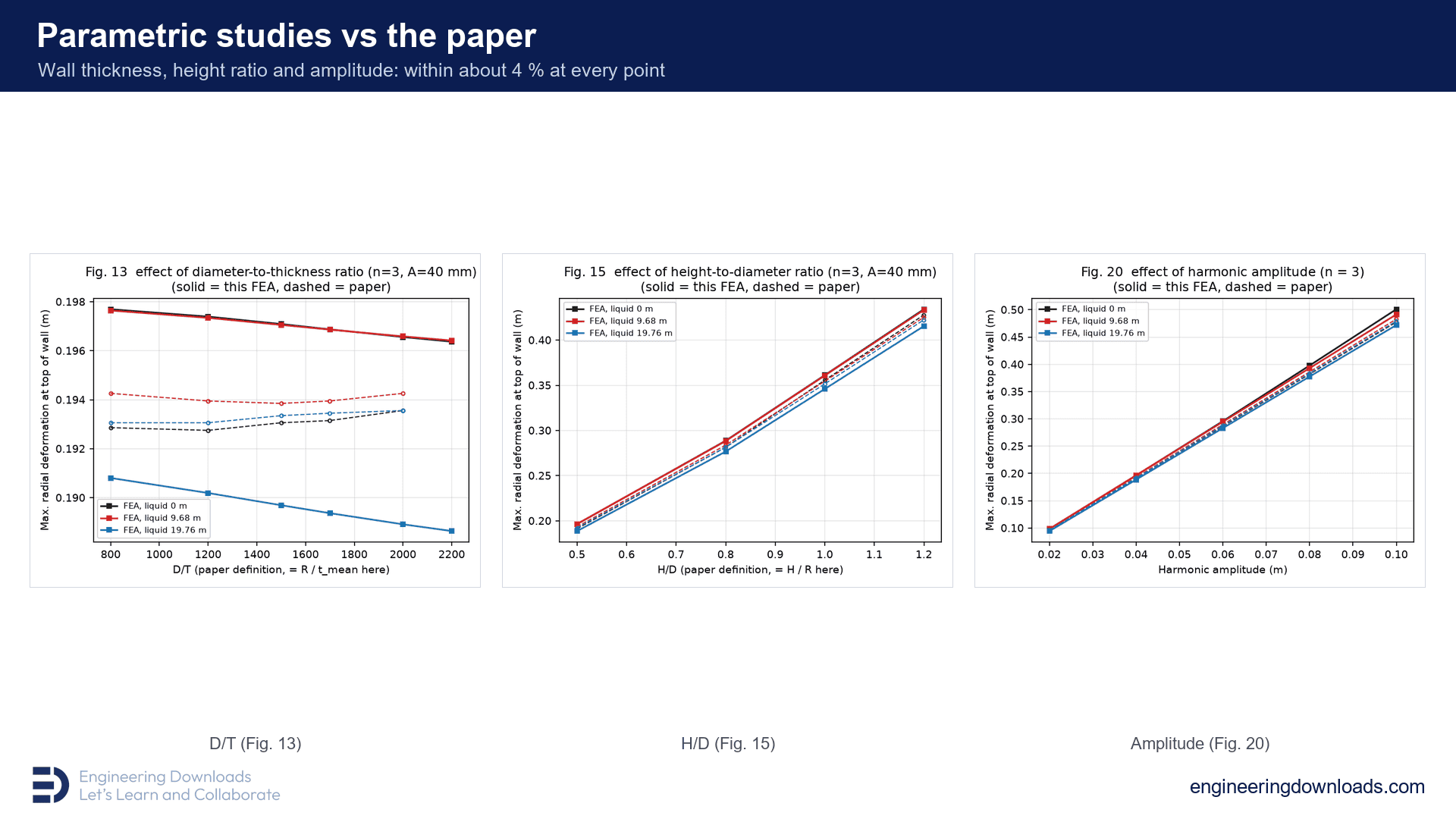
| D/T, H/D and amplitude sweeps (45 points) | – | within about 4 % |
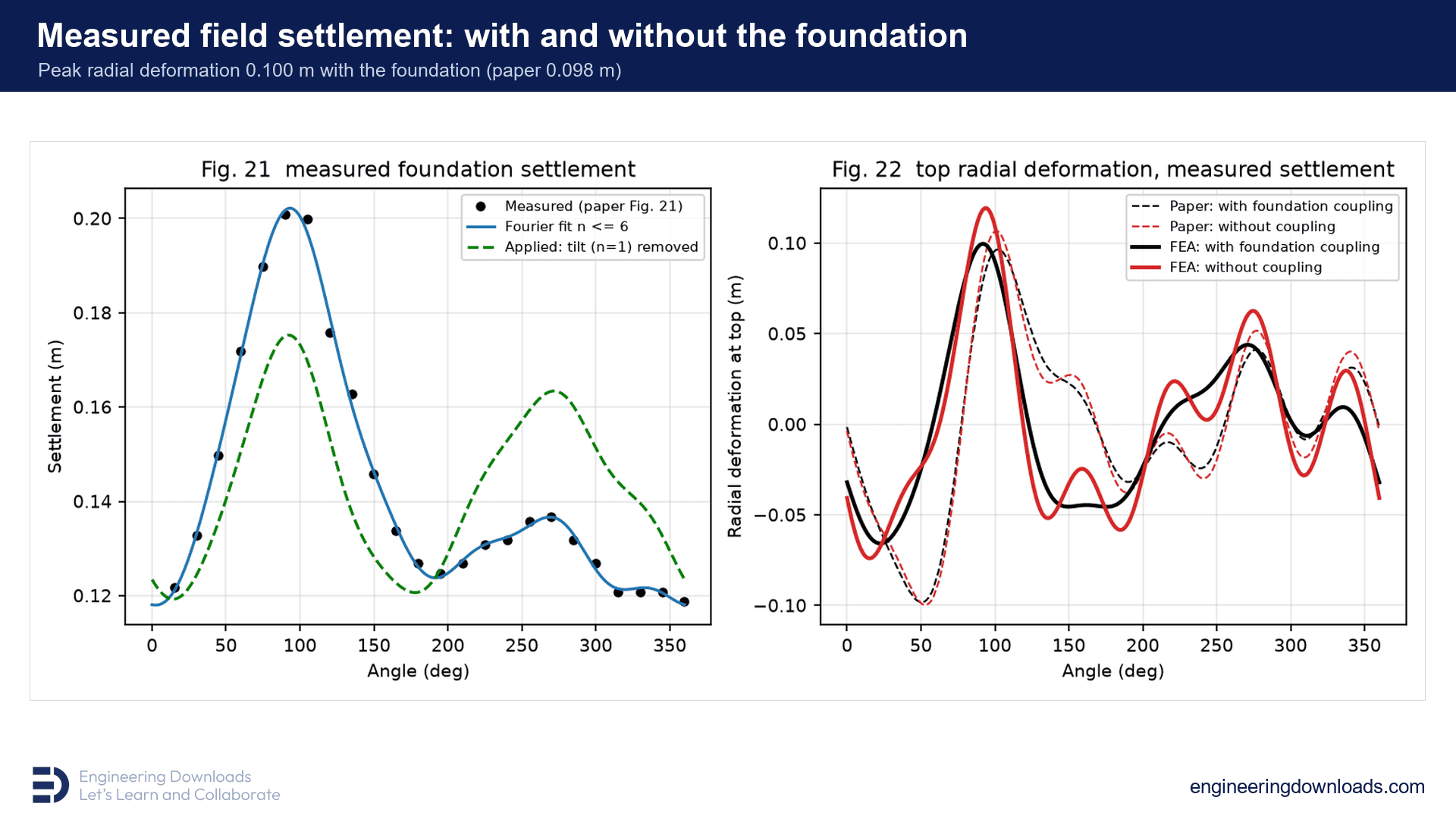
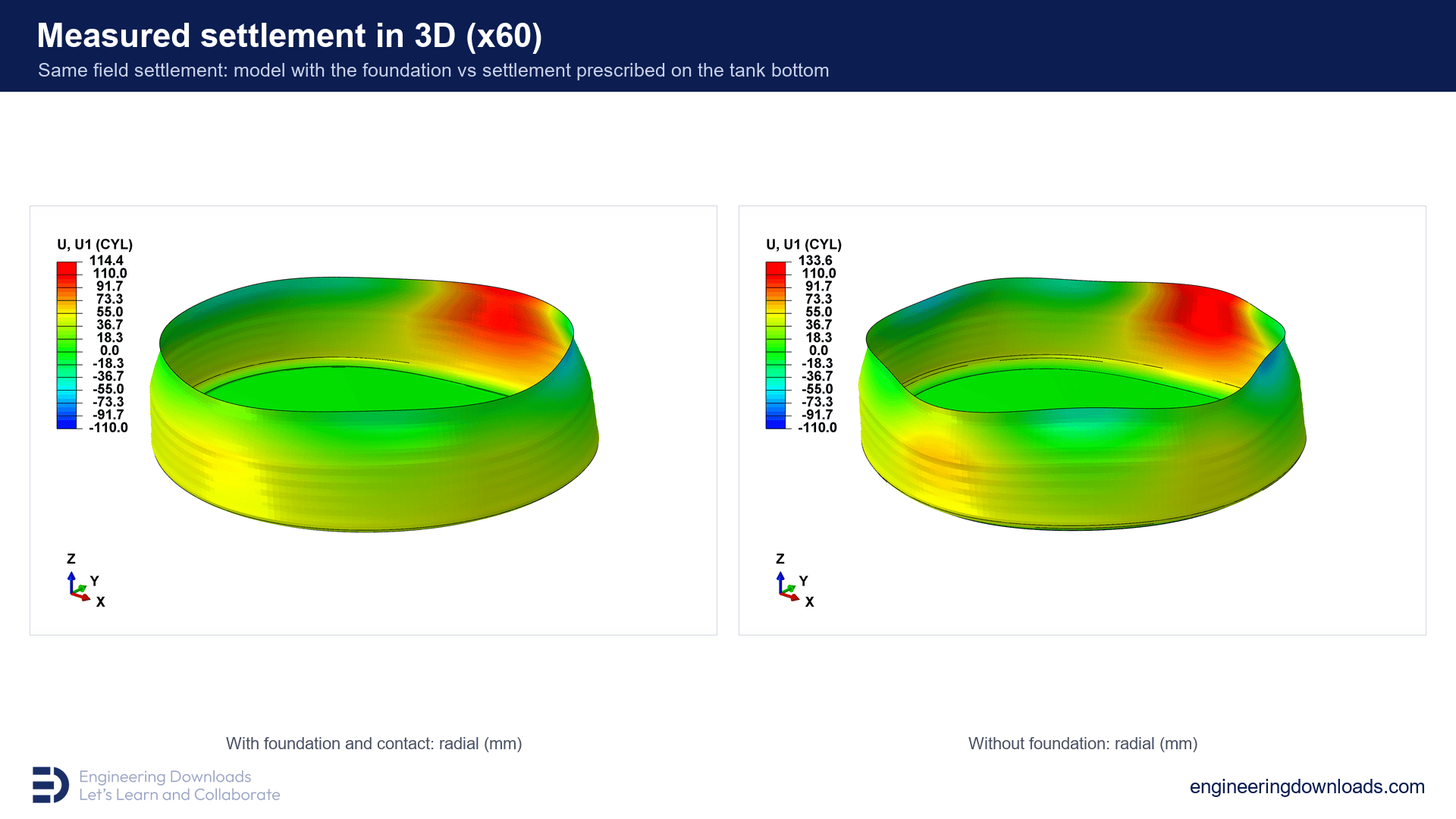
| Measured settlement, with / without foundation | 0.098 / 0.107 m | 0.100 / 0.119 m |
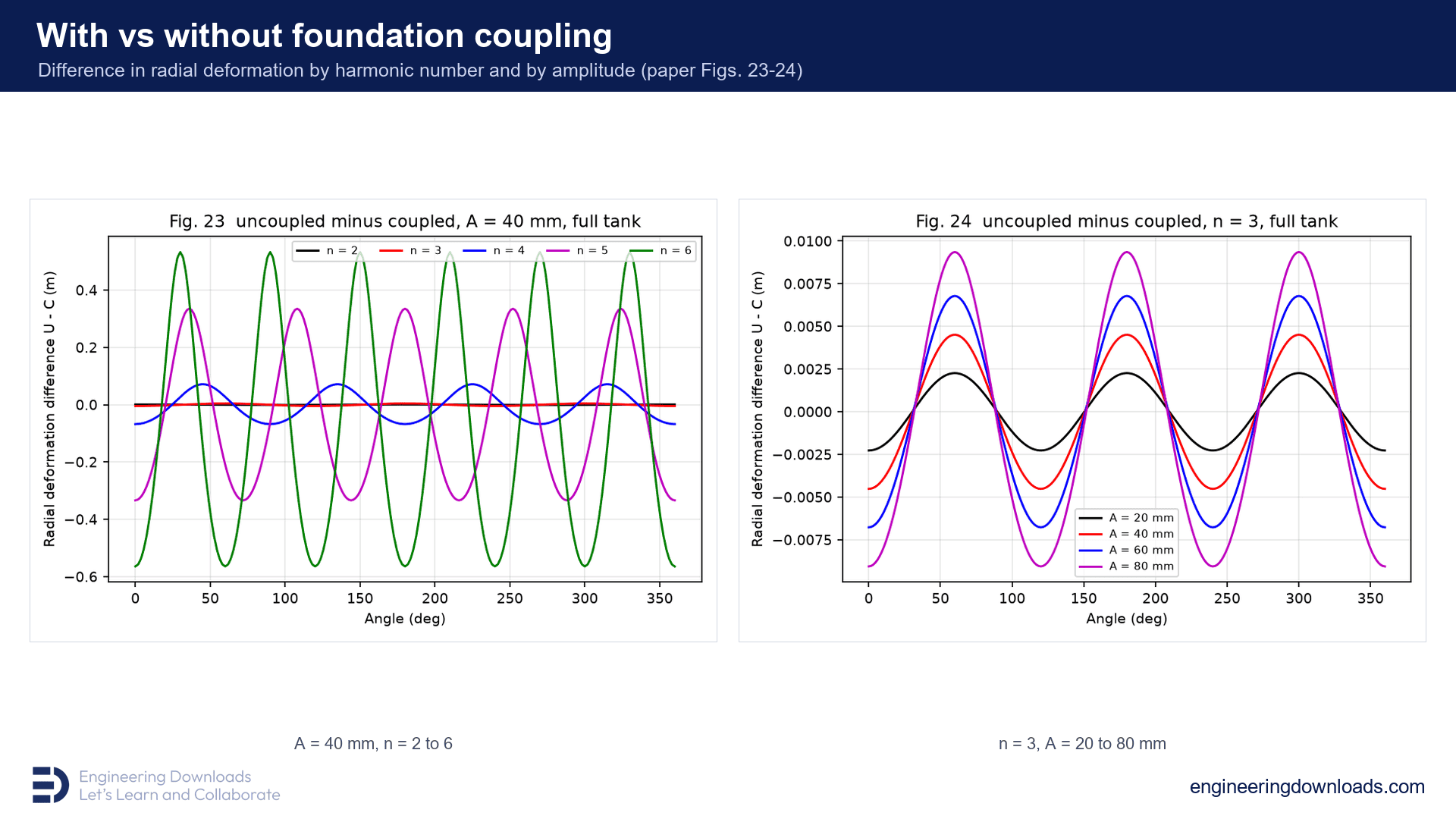
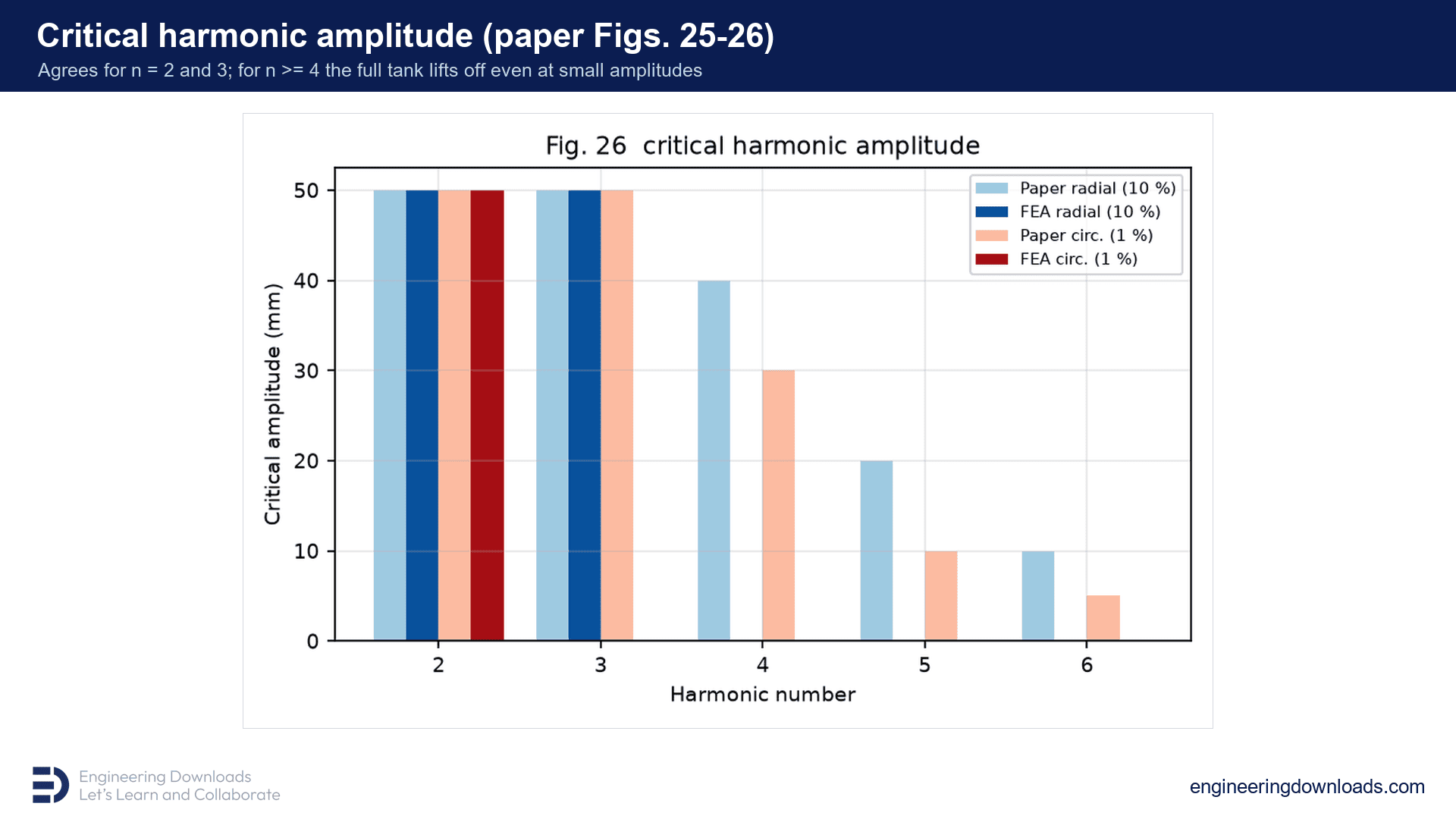
| Critical amplitude, n = 2 / 3 (radial, 10 %) | 50 / 50 mm | ≥ 50 / ≥ 50 mm |
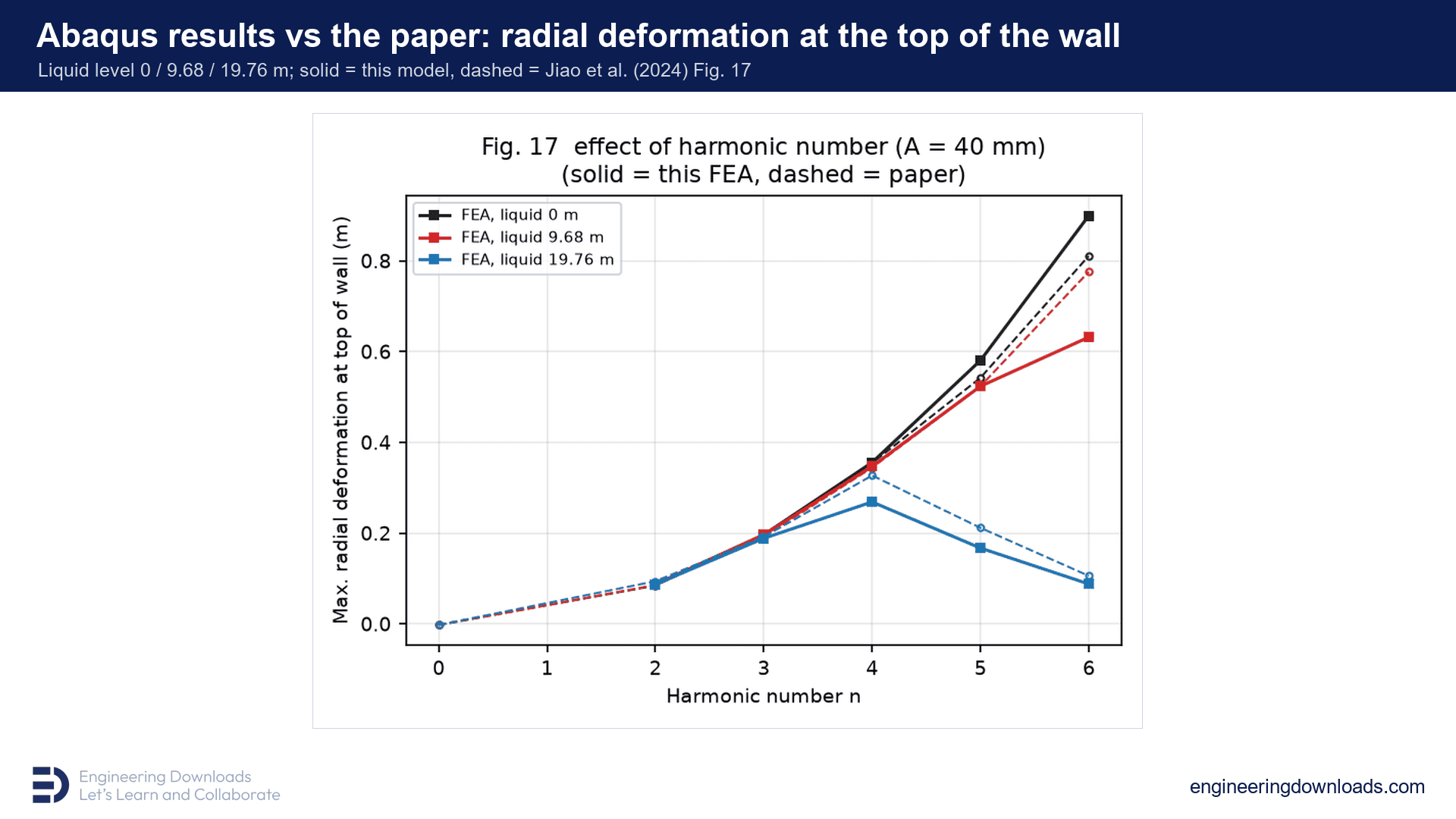
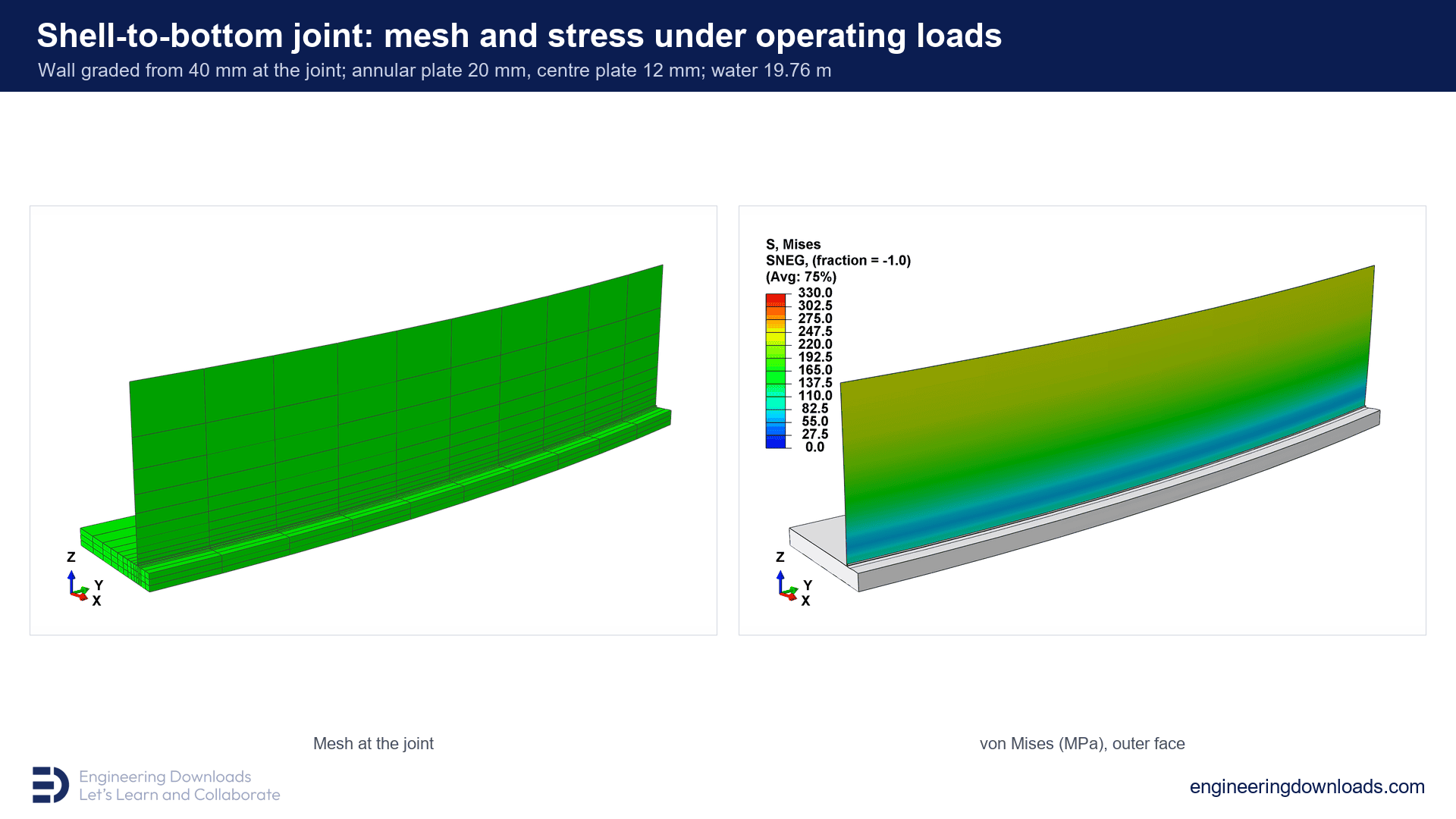
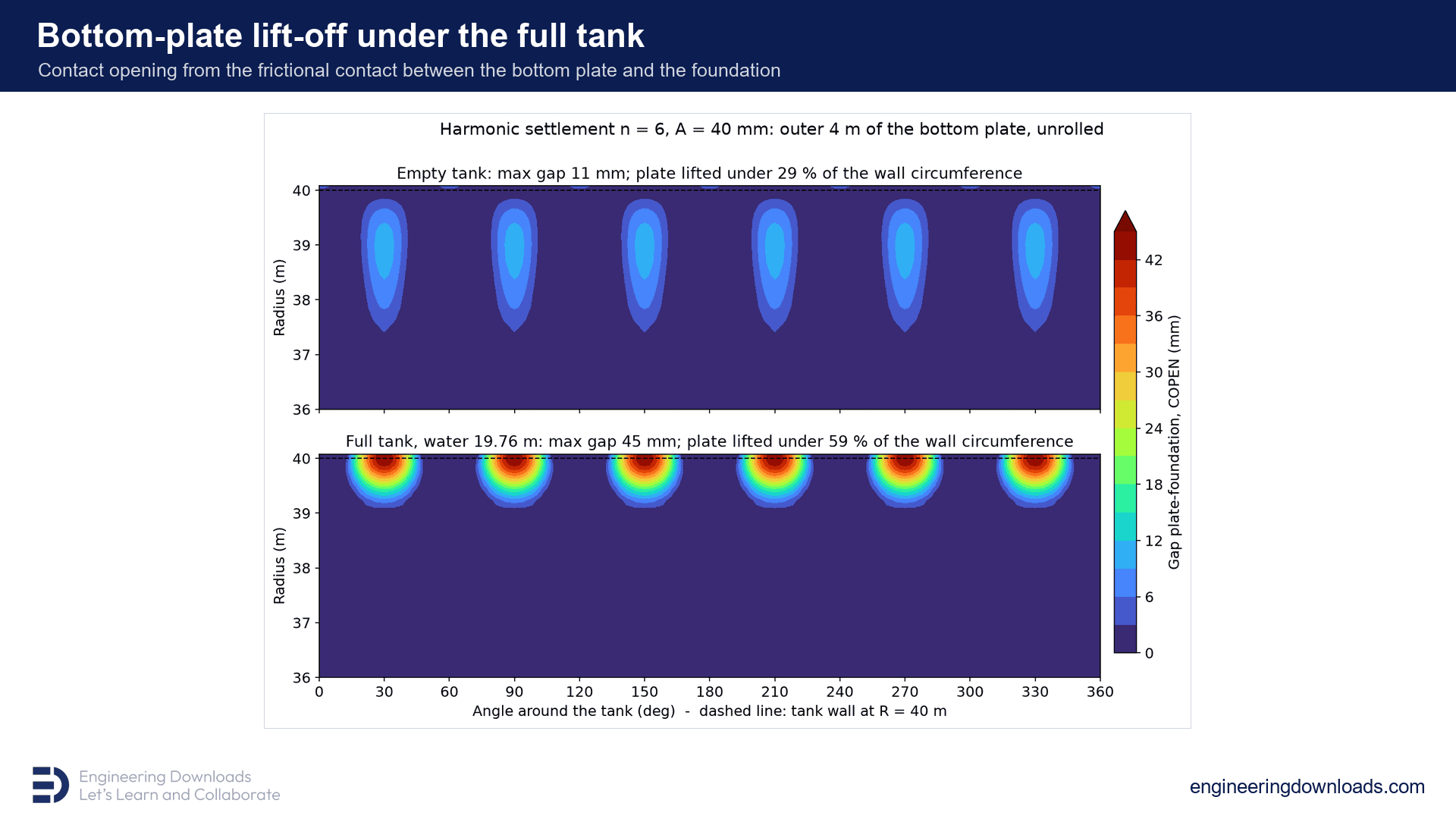
Under operating loads the wall stresses follow the paper's model and its strain-gauge data along the full height, and the bottom-plate stress at the shell joint peaks at 321 MPa against 350 MPa in the paper. For harmonic settlement the top of the wall follows inextensional shell theory, w = (H/R)·n²·A, as long as the tank stays on its foundation: wall thickness barely matters, while height and amplitude scale the deformation linearly, as the paper concludes. With a full tank the hoop tension stiffens the wall, which then bridges the troughs and lifts the bottom plate off the foundation, so the deformation drops for high harmonic numbers. The model reproduces this mechanism; it lifts off one harmonic earlier than the paper (n = 4), consistent with a slightly softer foundation. The paper does not give the foundation depth or wall thicknesses; the assumptions are listed in the README and the report.
Storage tank and pipeline engineers who assess foundation settlement (API 653 style out-of-plane settlement), FEA engineers who want a working shell-on-foundation contact model with hydrostatic load in Abaqus, and students who want to see a published tank study rebuilt and checked number by number.
Which paper does this package replicate? Jiao, Wang, Li and Liu, Finite Element Analysis and Improved Evaluation of Mechanical Response in Large Oil Storage Tanks Subjected to Non-Uniform Foundation Settlement, Processes 2024, 12, 2838 (open access). The paper is cited, not bundled.
How close are the results to the paper? The peak hoop stress is 258 MPa against 260 MPa, the top-of-wall deformation for the n = 3 baseline 0.189 m against 0.192 m, and 88 % of the 60 deformation results of the parametric studies are within 5 %. The differences sit in the harmonic-number sweep, where the full tank lifts off the foundation one harmonic earlier than in the paper.
Is the foundation modelled with contact? Yes. The bottom plate rests on a solid foundation with surface-to-surface contact and friction 0.2, so it can slide and lift off. The settlement is applied at the base of the foundation as in the paper. Uncoupled versions without the foundation are included for comparison.
How is the settlement applied? As a Fourier harmonic u = A cos(n theta) at the edge of the foundation, the mean value at the centre and a linear variation in radius, exactly as described in the paper. One model uses the paper's measured field settlement, fitted with harmonics 2 to 6.
What did you have to assume? The paper does not give the course thicknesses, the bottom-plate thicknesses or the foundation depth. The package uses typical values for a 100,000 m3 tank (31.2 to 11.7 mm courses, 20 mm annular and 12 mm centre plate) and a 0.25 m foundation set once on the n = 3 baseline. All assumptions are listed in the README and the report.
Are the images real Abaqus results? Yes. Every mesh and contour image is exported by Abaqus/CAE 2024 from the included models and their results; only a title bar, the logo and the web address are added around them. Charts are drawn from the same solver output, with the paper's curves as reference.
Which Abaqus version do I need? Abaqus/CAE and Abaqus/Standard 2024 or newer for the CAE files; the INP files also run in older releases. ODB files are not included: the sector models solve in 1 to 3 minutes and the full models in about 30 minutes on 4 cores.
What if the package is not what I expected? Write to us. Engineering Downloads refunds clients who are not satisfied with a delivered product.
Need more than the files?
There are two ways we can help. Book a one hour online consultation if you want to talk a problem through with a CAE engineer, using the checkbox in the order box. Order a project if you need a full simulation built for you, delivered to an agreed scope, price and deadline under a written contract.
We work on FEA and CFD for engineers, researchers and companies. Order your project, or message us on WhatsApp for a quick reply.
Other packages engineers working on this topic also download.
 Buried Pipeline Crossing a Reverse Fault in Abaqus, after Zhang et al. (2023)€129,00
 Buried Pipeline Crossing a Reverse Fault in Ansys Workbench, after Zhang et al. (2023)€129,00
 Tank Wind Buckling in ANSYS: EN 1993-1-6 MNA-LBA Model of a Cylindrical Oil Tank€129,00
 Extended End-Plate Moment Connection in Abaqus: Bolted Beam-to-Column Joint, after Rahchamandi et al. (2026)€129,00
 Bolt Preload Abaqus: SC3 End-Plate Connection with All-Hex Bolts (Native Bolt Load and Initial Stress, .inp and .cae)€89,00
 Contact Fatigue Limit of a Hardness-Graded Gear Flank: Abaqus Brown-Miller-Morrow Workflow€129,00
 Seismic Analysis of a Spherical Liquid Storage Tank in Abaqus: Response Spectrum, Legs and X-Braces
 Analysis of water sloshing in a cylindrical tank under seismic loading-Acoustic method

Need a full custom project? See the options below.

€129,00

€179,00

€149,00

€119,00

€129,00
See more
Want to receive push notifications for all major on-site activities?