



Need a full custom project? See the options below.
Need a full custom project? See the options below.
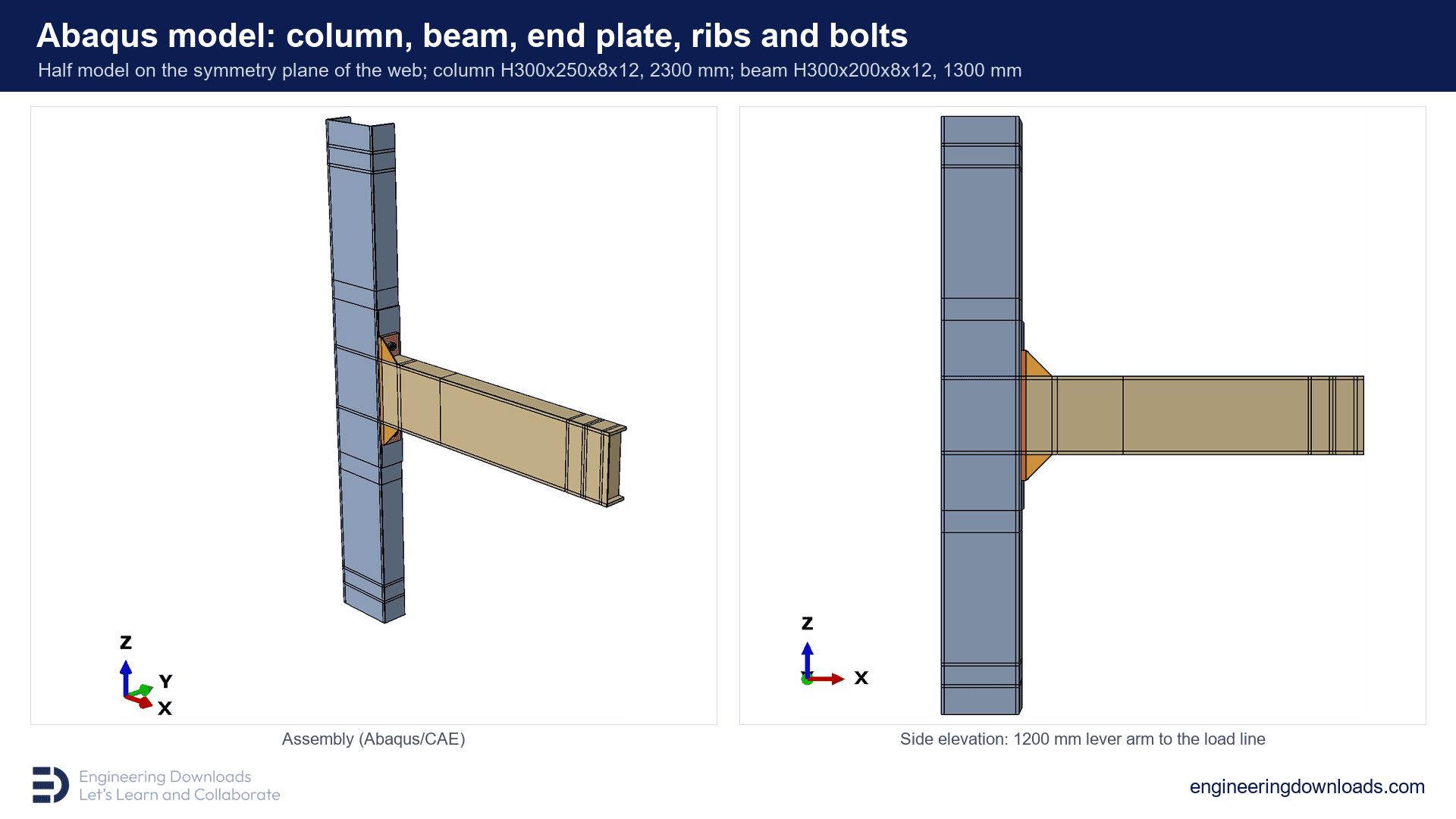
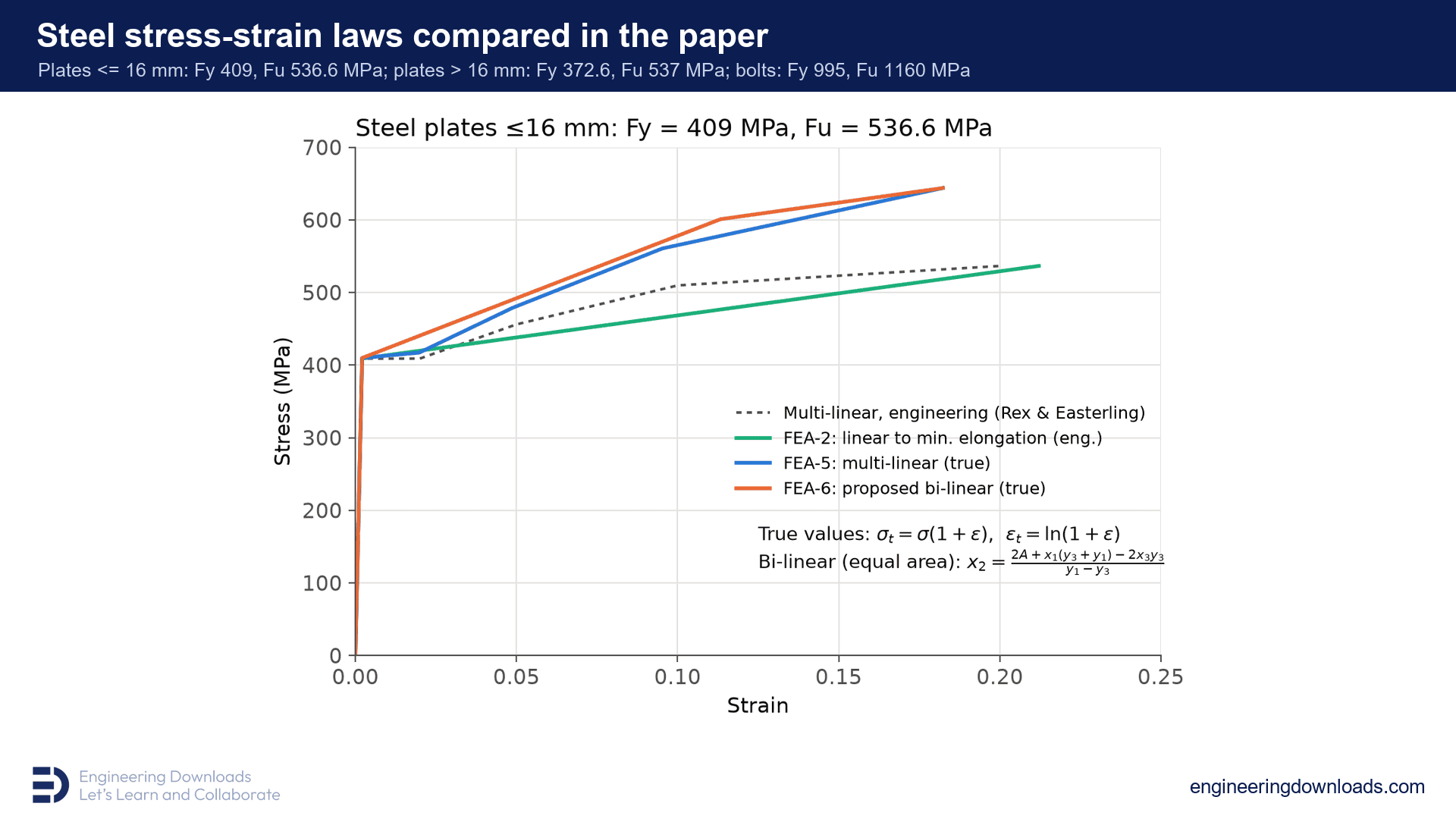
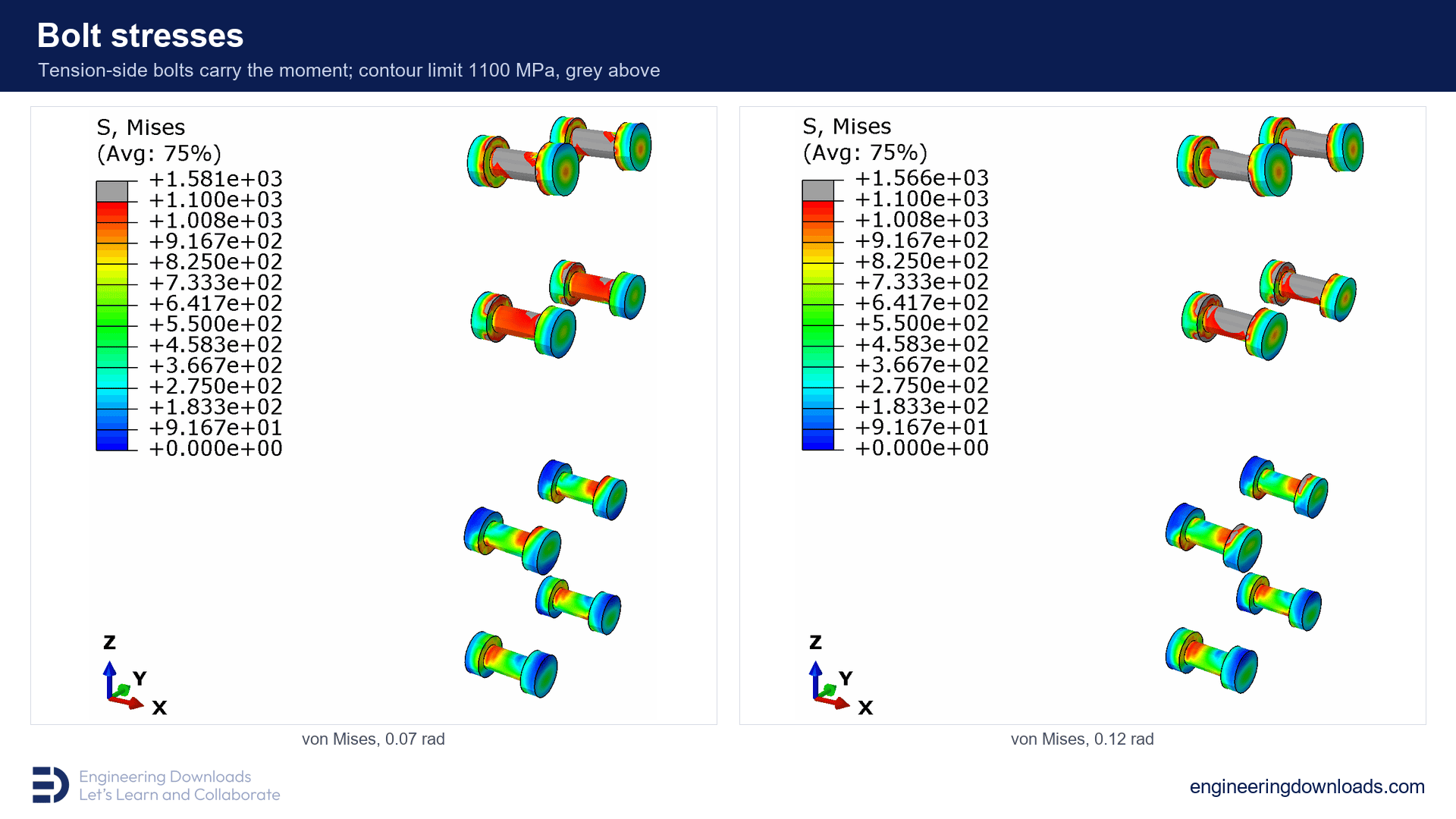
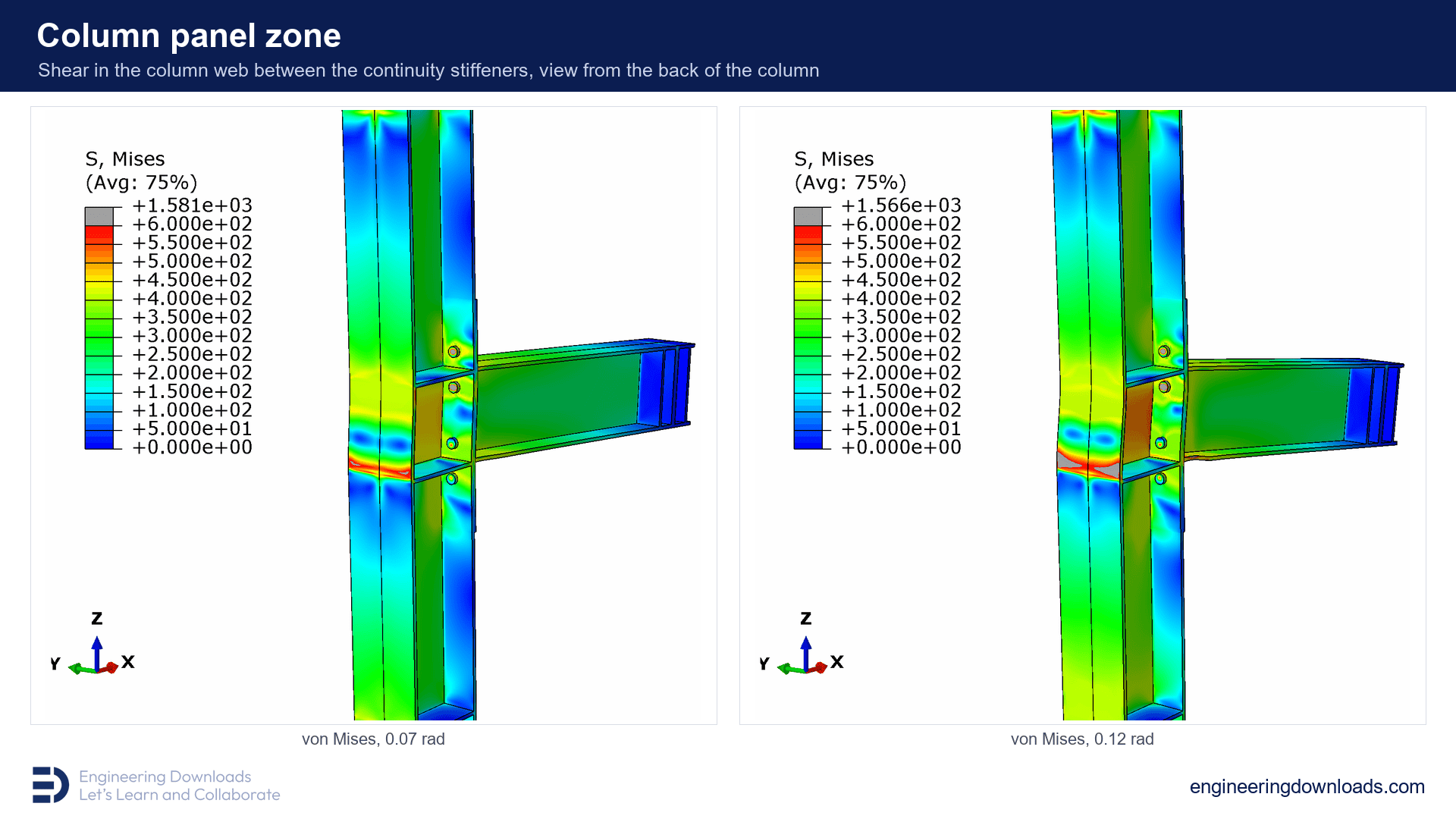
How stiff is a bolted extended end-plate connection once it yields, and how much does the answer depend on the steel stress-strain law you type into Abaqus? This package rebuilds specimen JD2 (Shi et al. 2007) from the journal paper Rahchamandi et al., Buildings 2026, 16, 236: a beam-to-column joint with a 20 mm end plate, rib stiffeners, 8 x M20 grade 10.9 pretensioned bolts, contact with friction and a column axial load, solved with three of the paper's steel laws. Three ready-to-run models (CAE + INP) and a step-by-step PDF tutorial with every result checked against the paper.
FE models of steel connections usually start from two numbers on a mill certificate, the yield and tensile strength. The paper compares ways of turning them into a plastic law (linear, multi-linear, bi-linear, engineering or true values) on published connection tests, and measures the effect on the moment-rotation curve and on the plastic rotational stiffness. JD2 is an extended end-plate connection tested by Shi, Shi and Wang (2007).
| Item | This package |
|---|---|
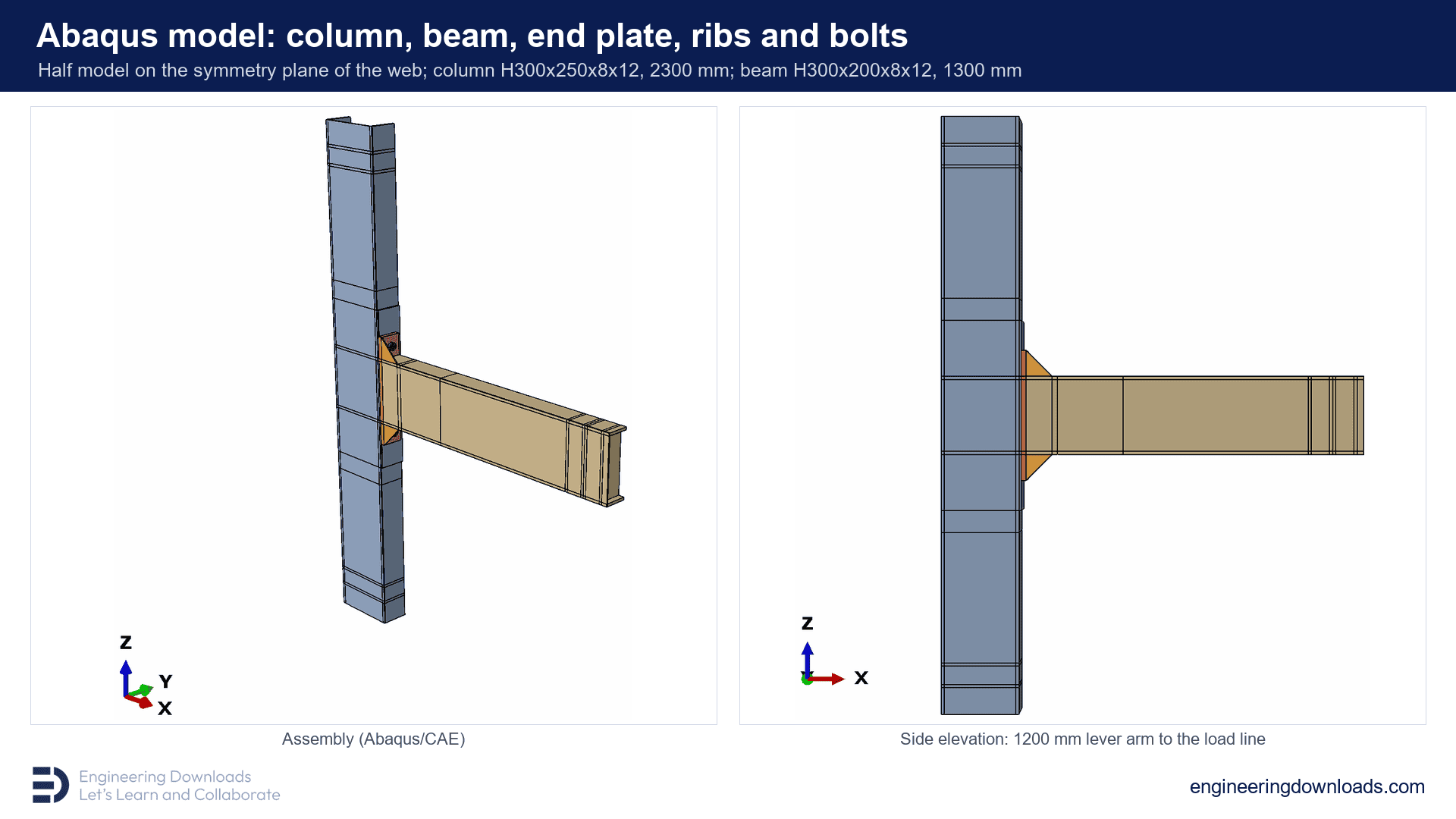
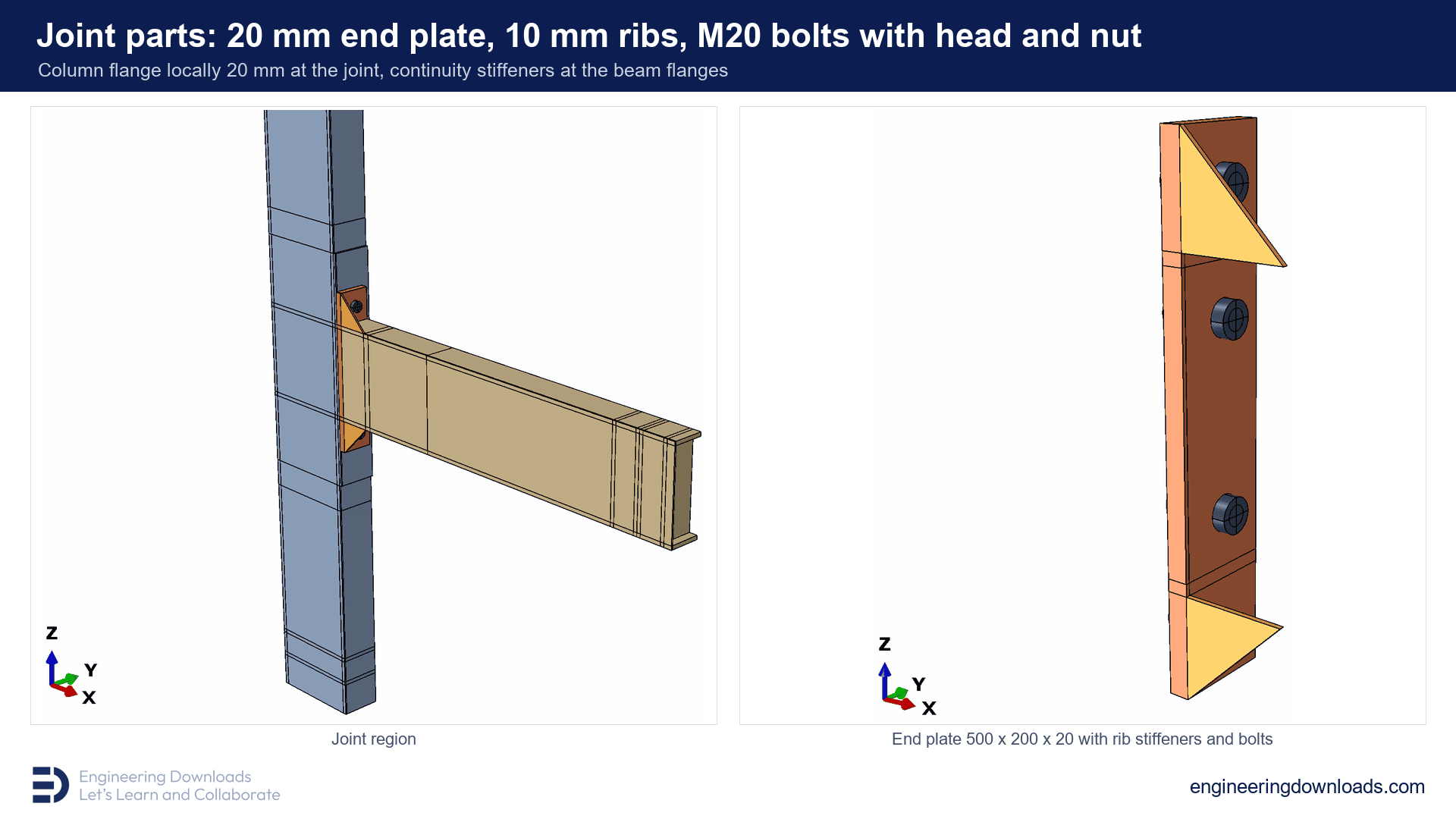
| Specimen | Column H300x250x8x12 (2300 mm, flange 20 mm at the joint), beam H300x200x8x12 (1300 mm), end plate 500x200x20, 10 mm ribs |
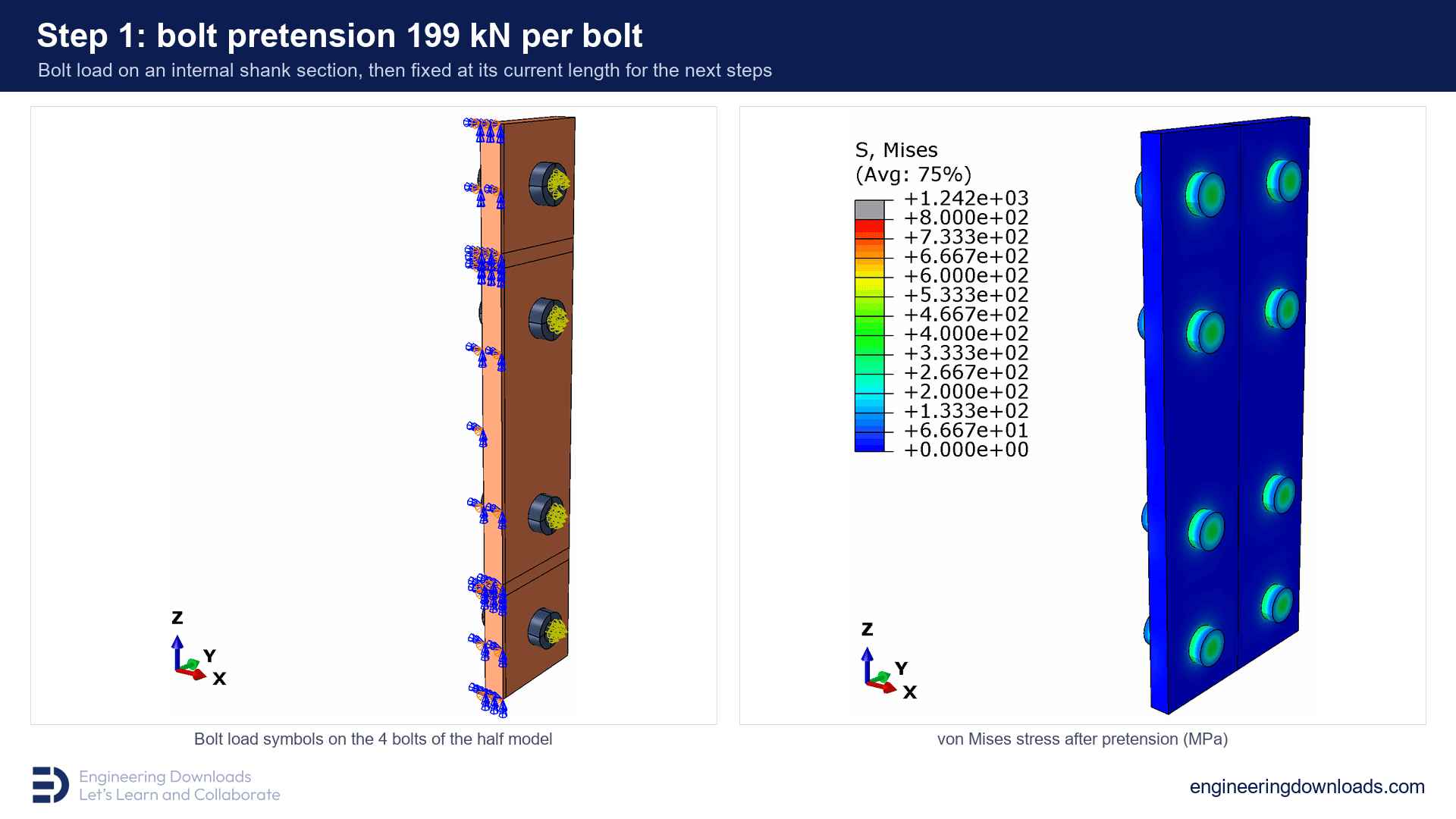
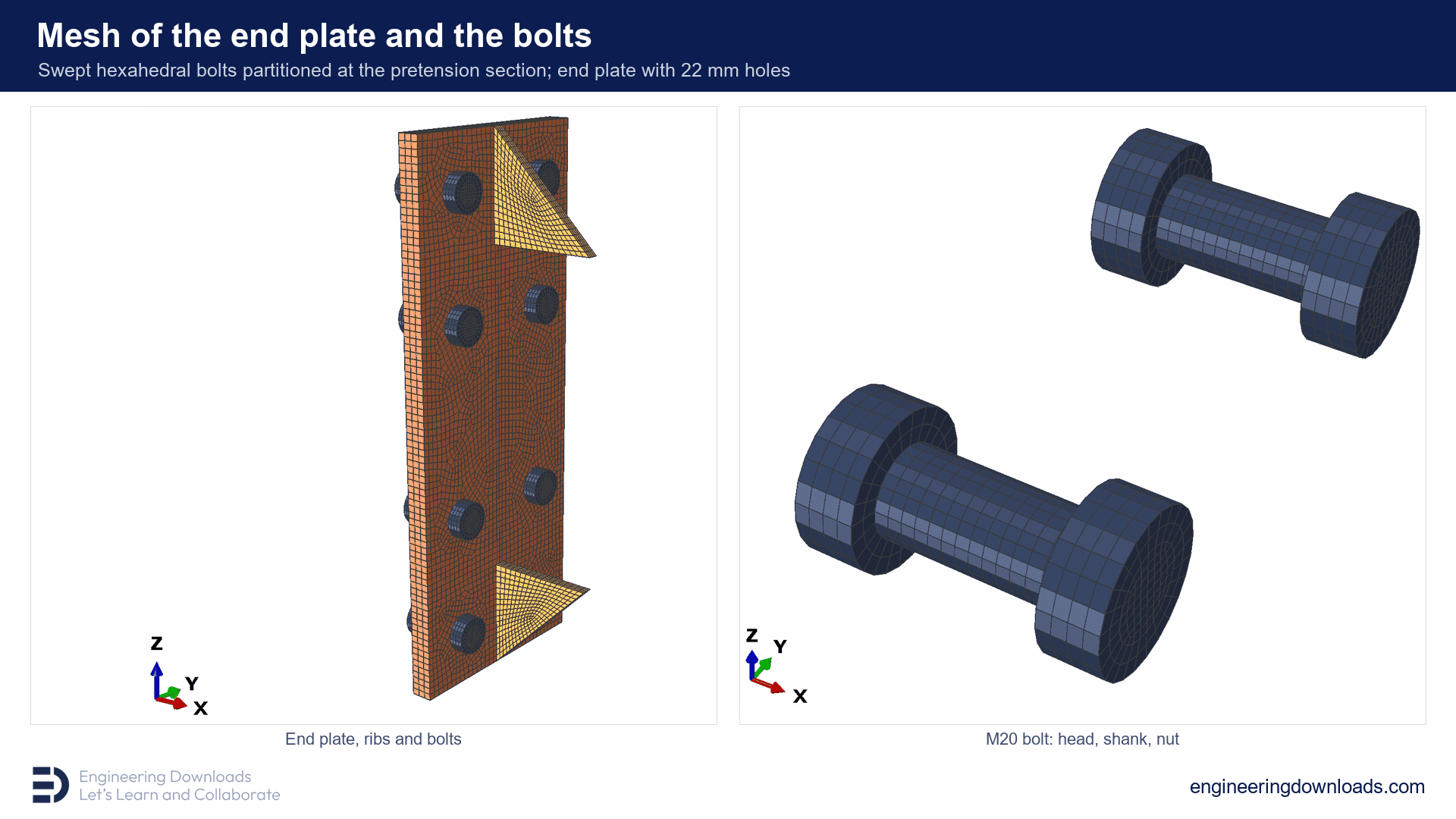
| Bolts | 8 x M20 grade 10.9 with head and nut, pretension 199 kN each |
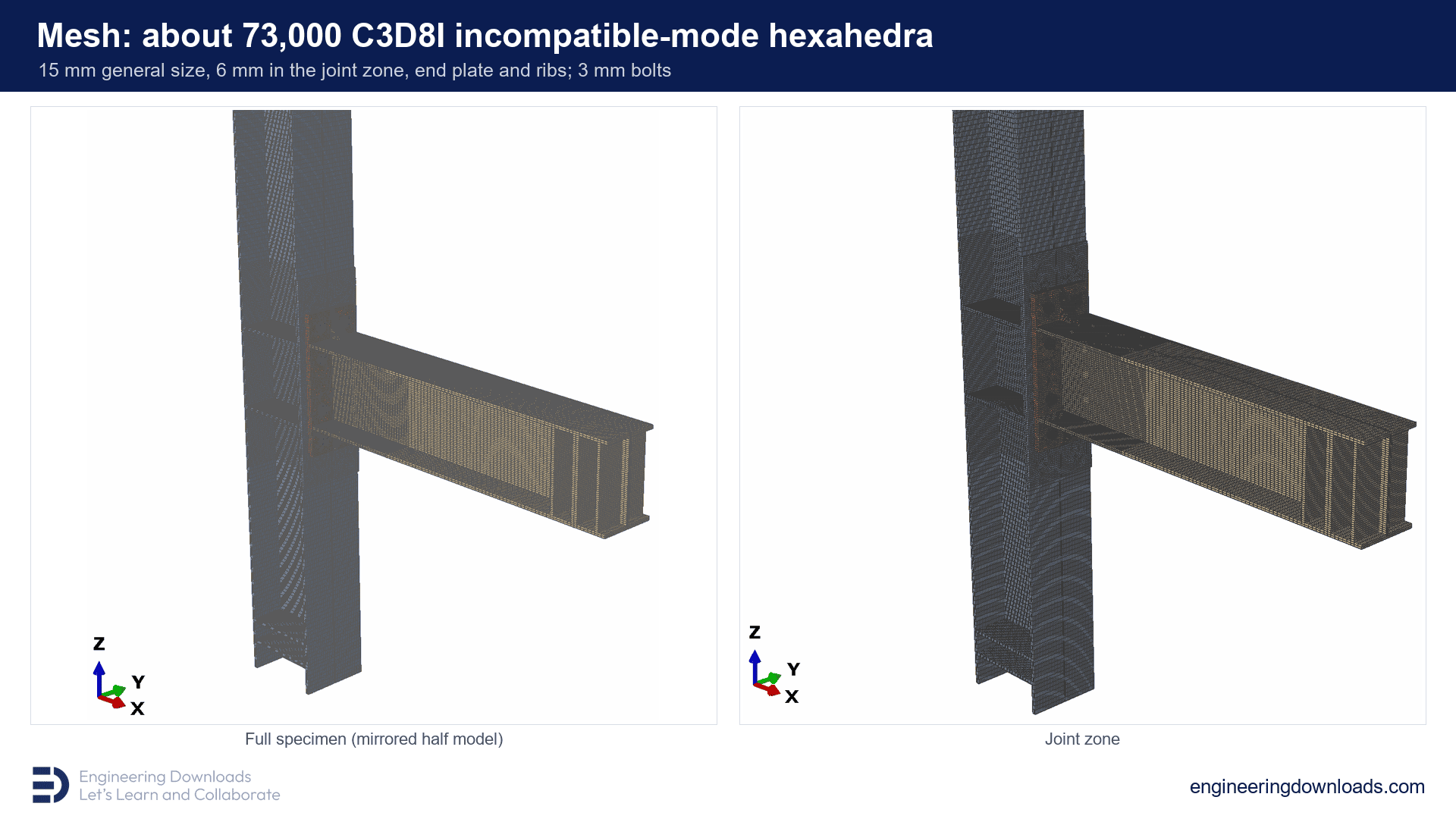
| Elements | C3D8I incompatible-mode hexahedra, about 73,000 elements, half model about the beam web |
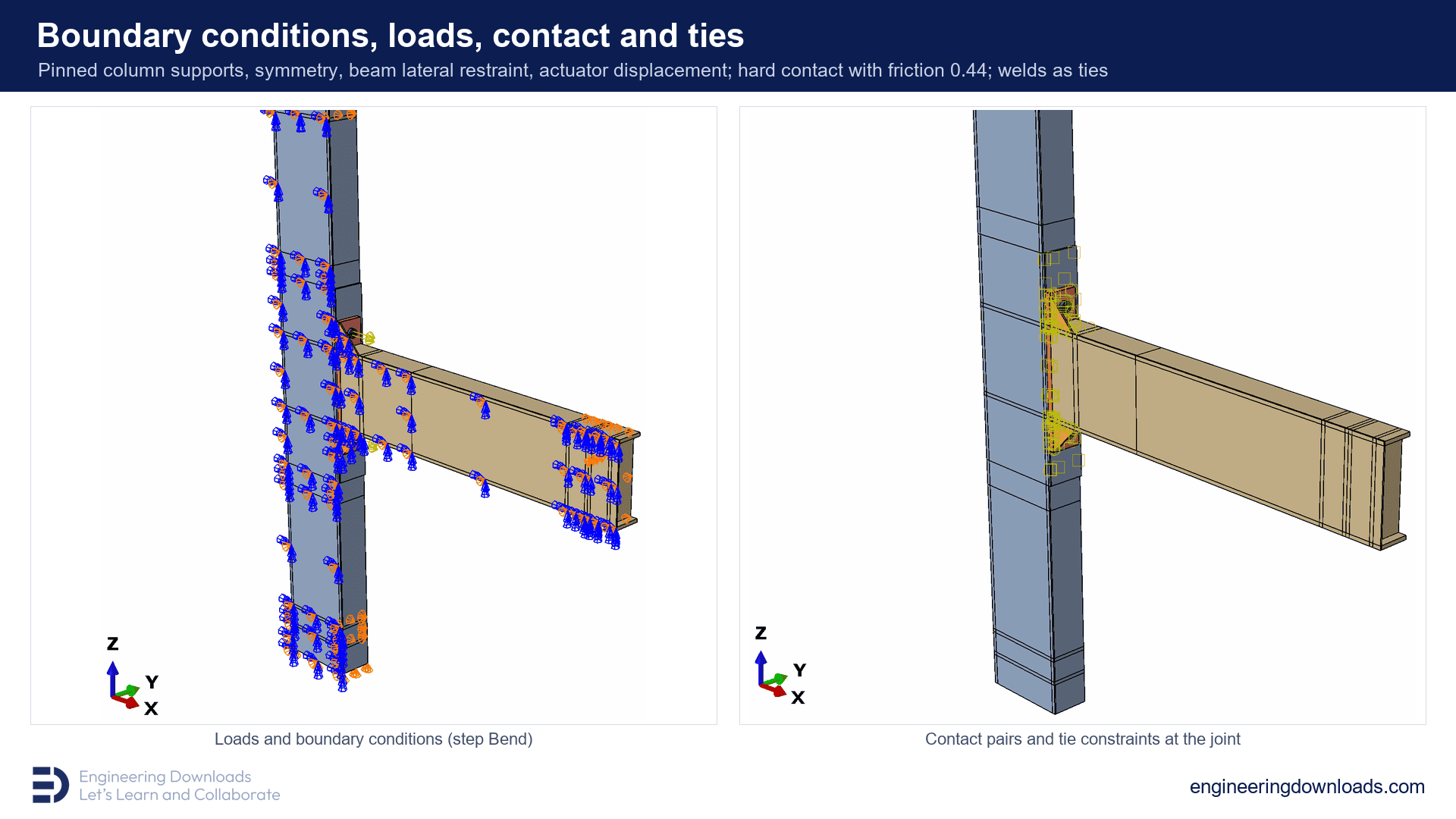
| Interaction | End plate on column flange, bolt heads and nuts: hard contact, friction 0.44; welds as ties |
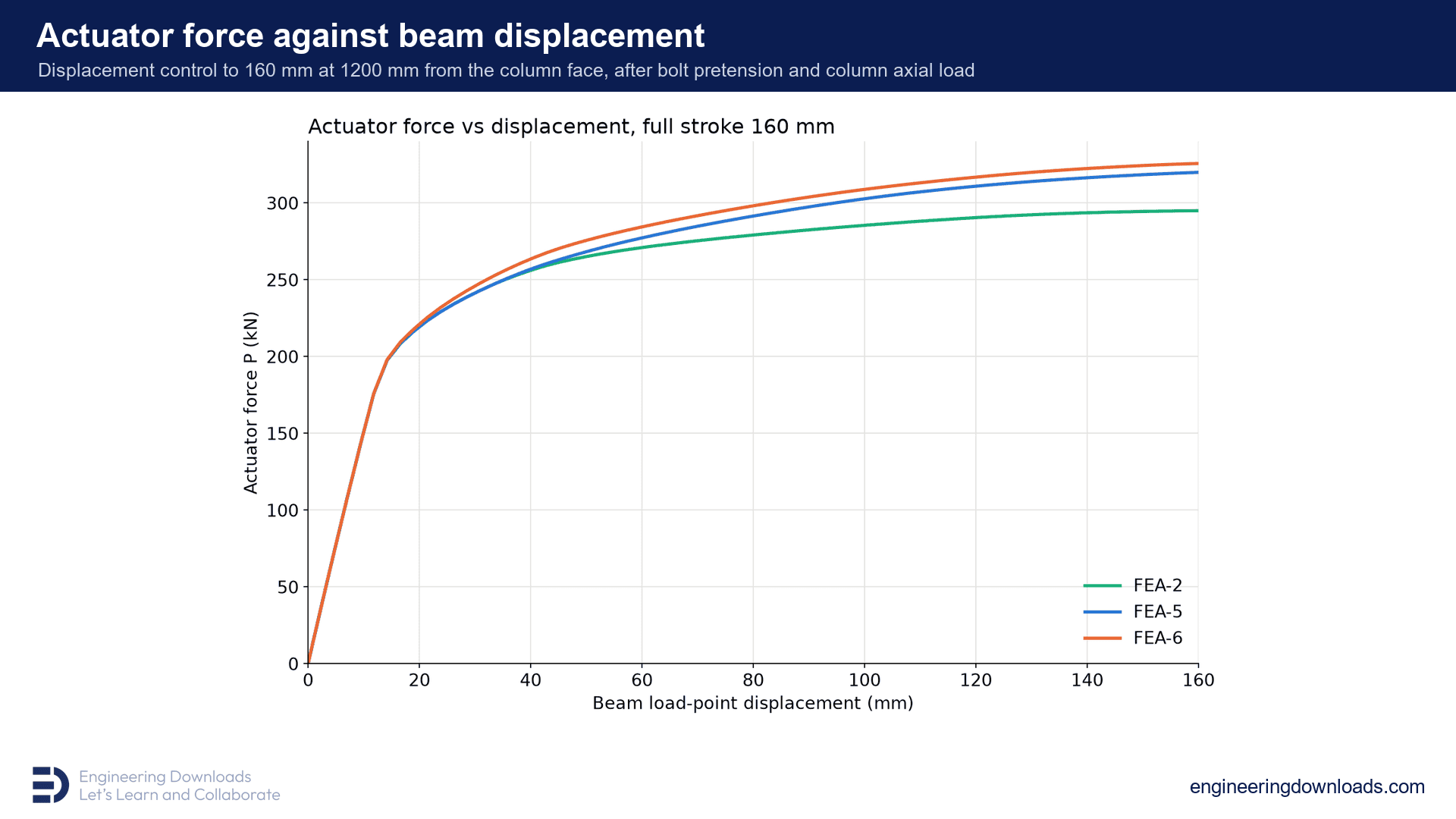
| Loads | 1) bolt pretension, 2) column axial load 485 kN, 3) beam displaced 160 mm at 1200 mm from the column face |
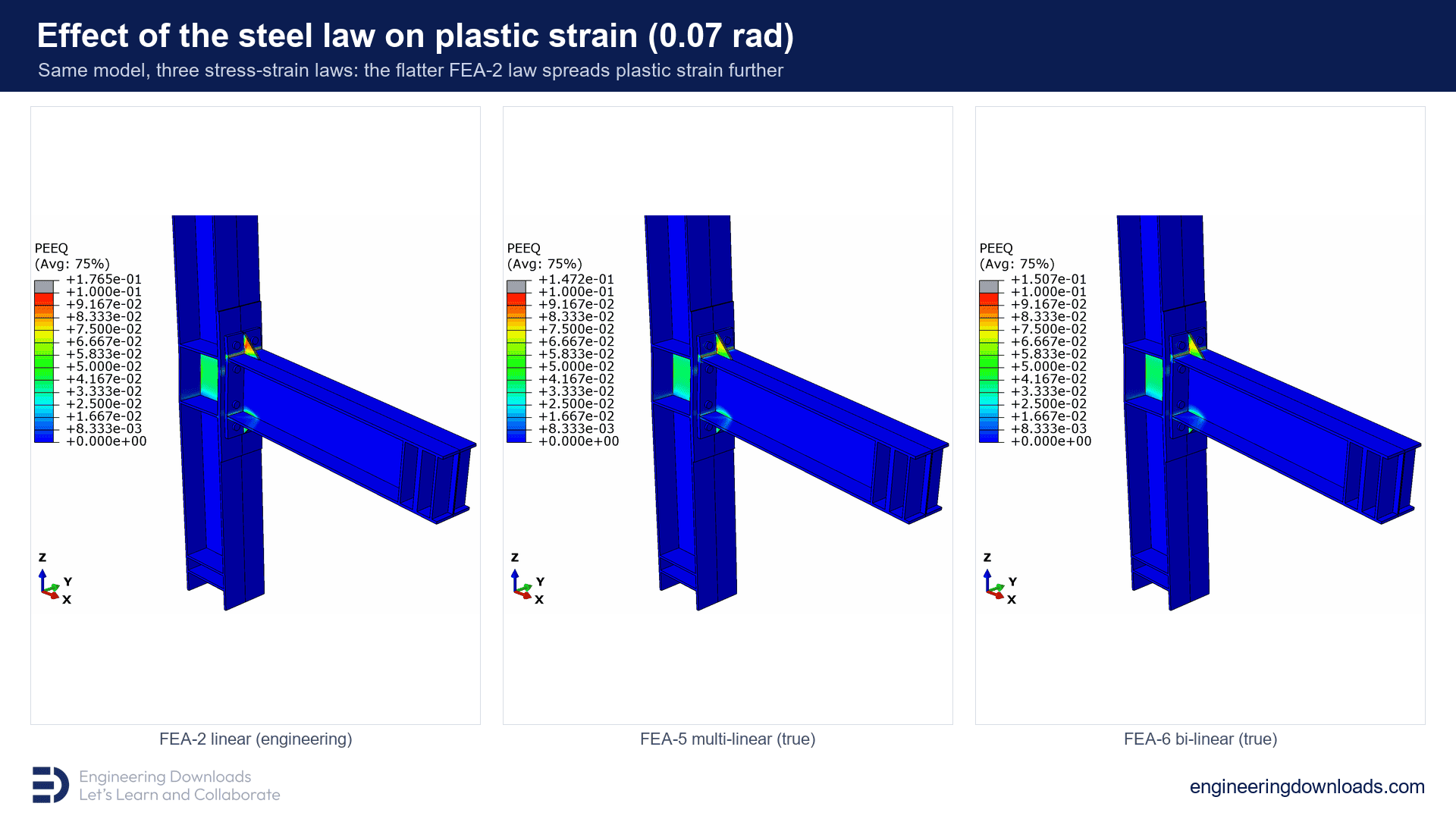
| Steel laws | FEA-2 linear (engineering), FEA-5 multi-linear (true), FEA-6 bi-linear (true); bolts Fy 995, Fu 1160 MPa |
| Analysis | Abaqus/Standard, nonlinear geometry, 3 static steps |
| Software | Abaqus/CAE and Abaqus/Standard 2024 or newer (INP files also run in older releases) |
| Plastic rotational stiffness (kN.m/rad) | Test | Paper FEA | This model |
|---|---|---|---|
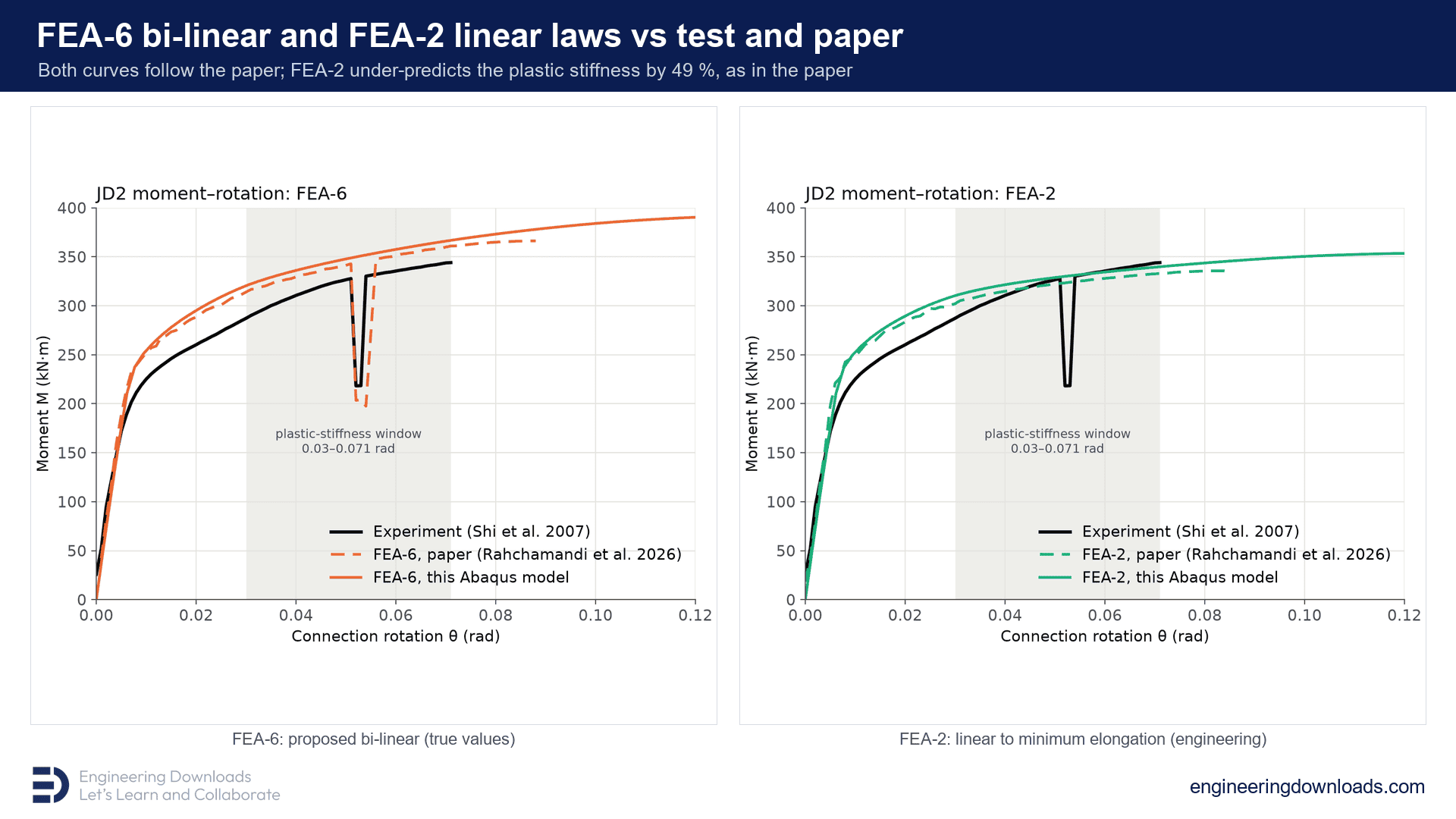
| FEA-2 linear, engineering values | 1412 | 718 | 720 |
| FEA-5 multi-linear, true values | 1412 | 1198 | 1154 |
| FEA-6 bi-linear, true values | 1412 | 1142 | 1130 |
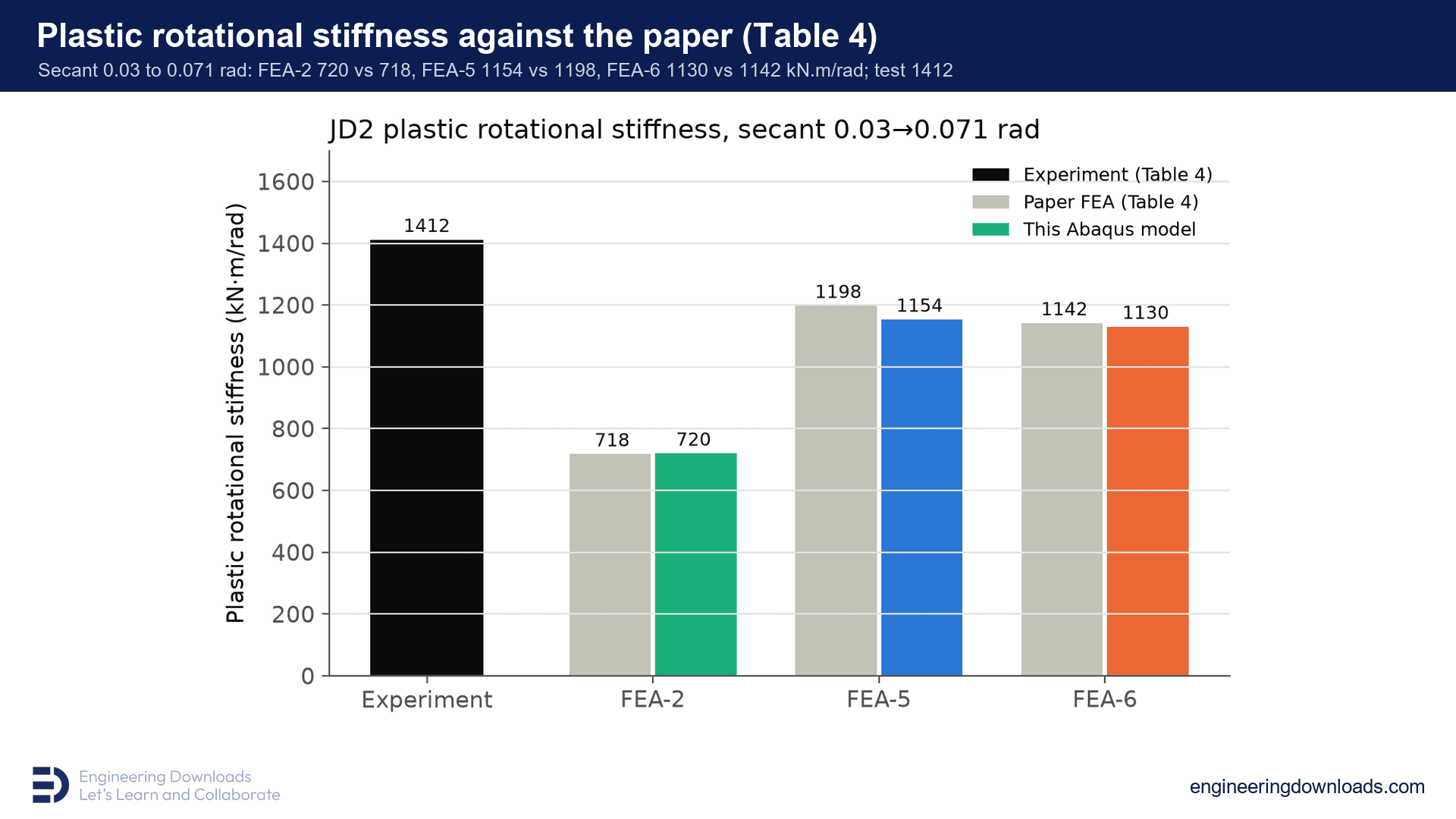
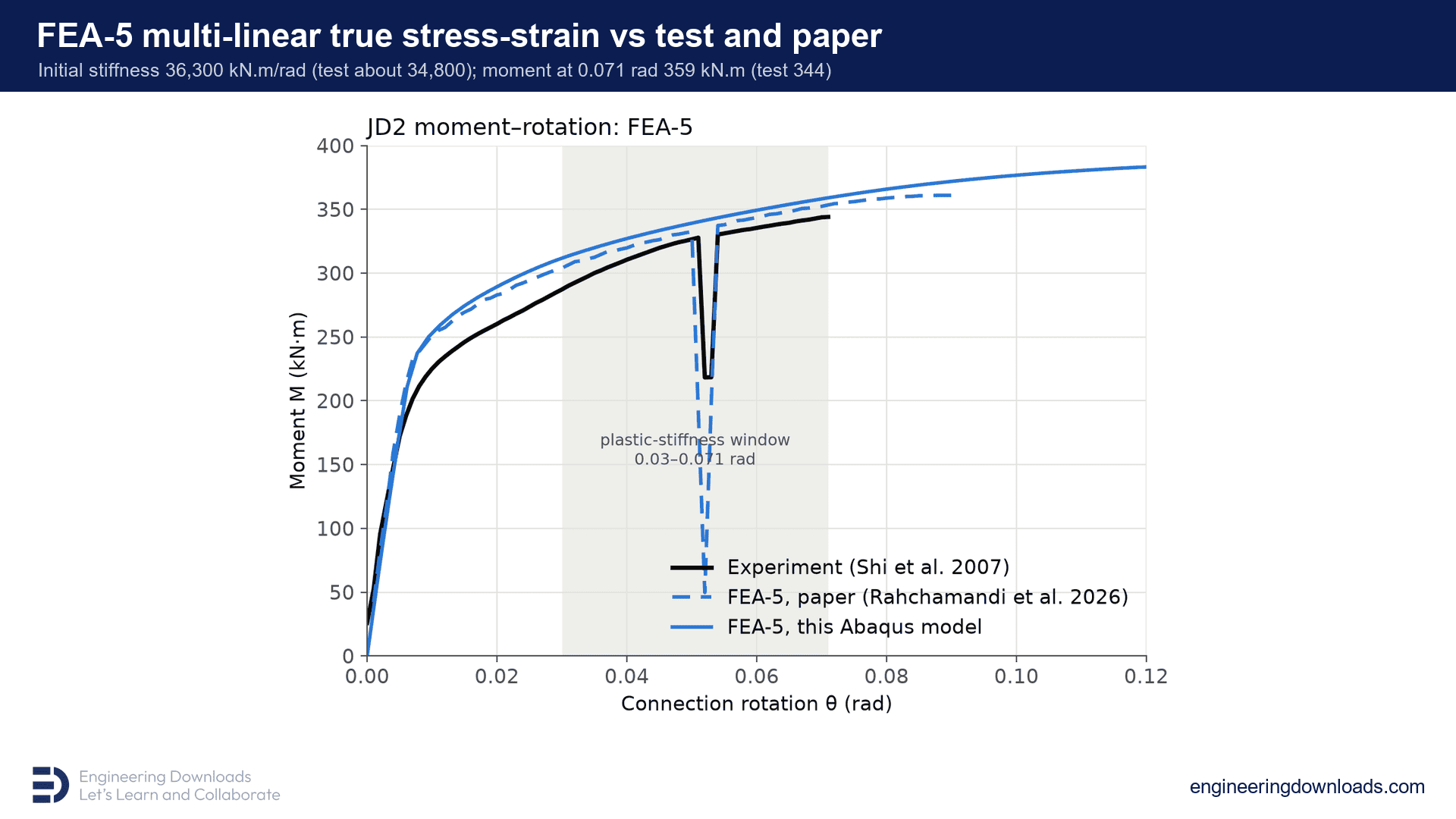
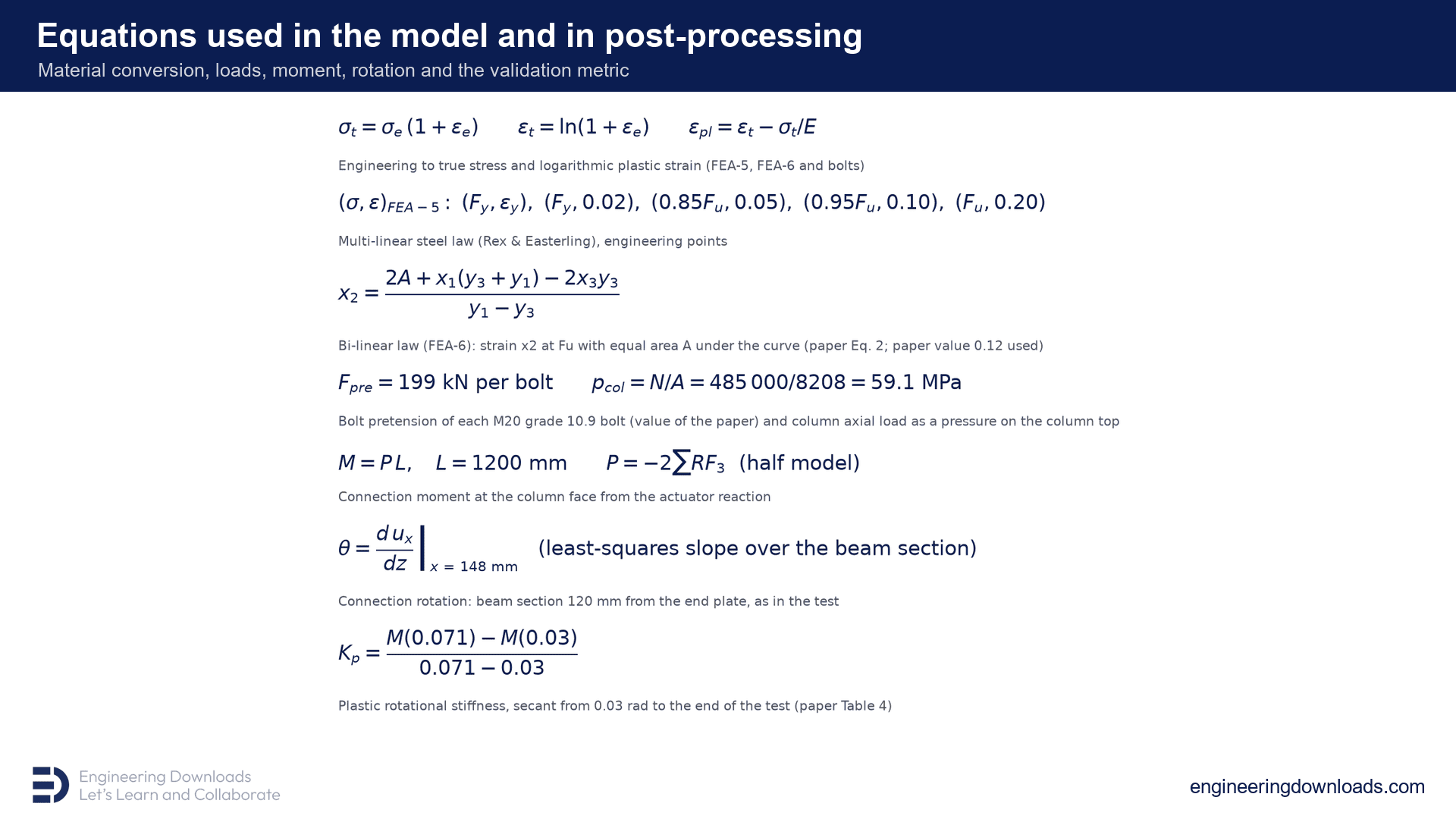
Plastic rotational stiffness is the secant of the moment-rotation curve from 0.03 rad to the end of the test (0.071 rad), the definition that reproduces Table 4 of the paper. The moment at 0.071 rad is 359 kN.m with FEA-5 against 344 kN.m in the test, and the initial stiffness is 36,300 kN.m/rad against about 34,800 kN.m/rad.
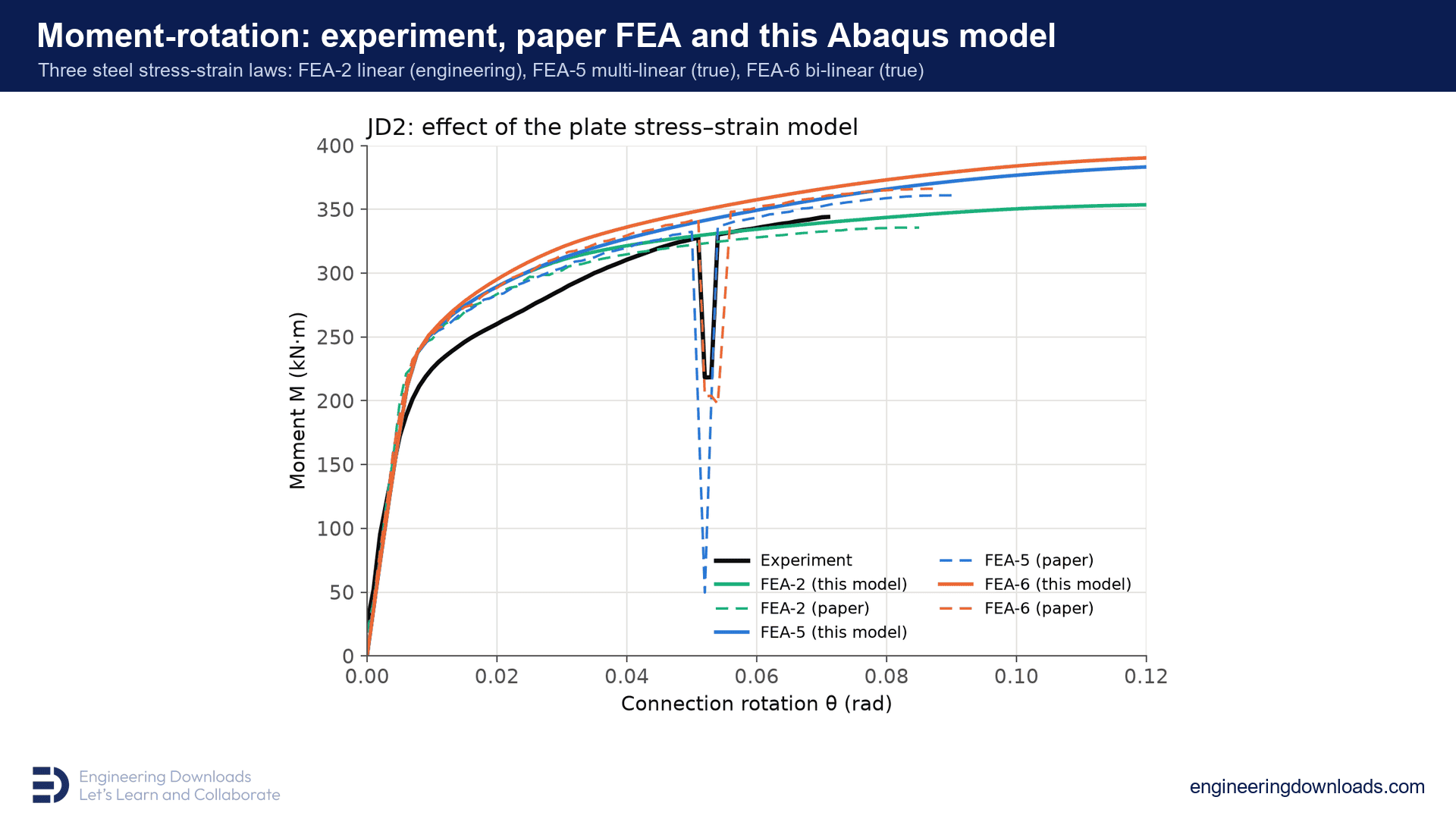
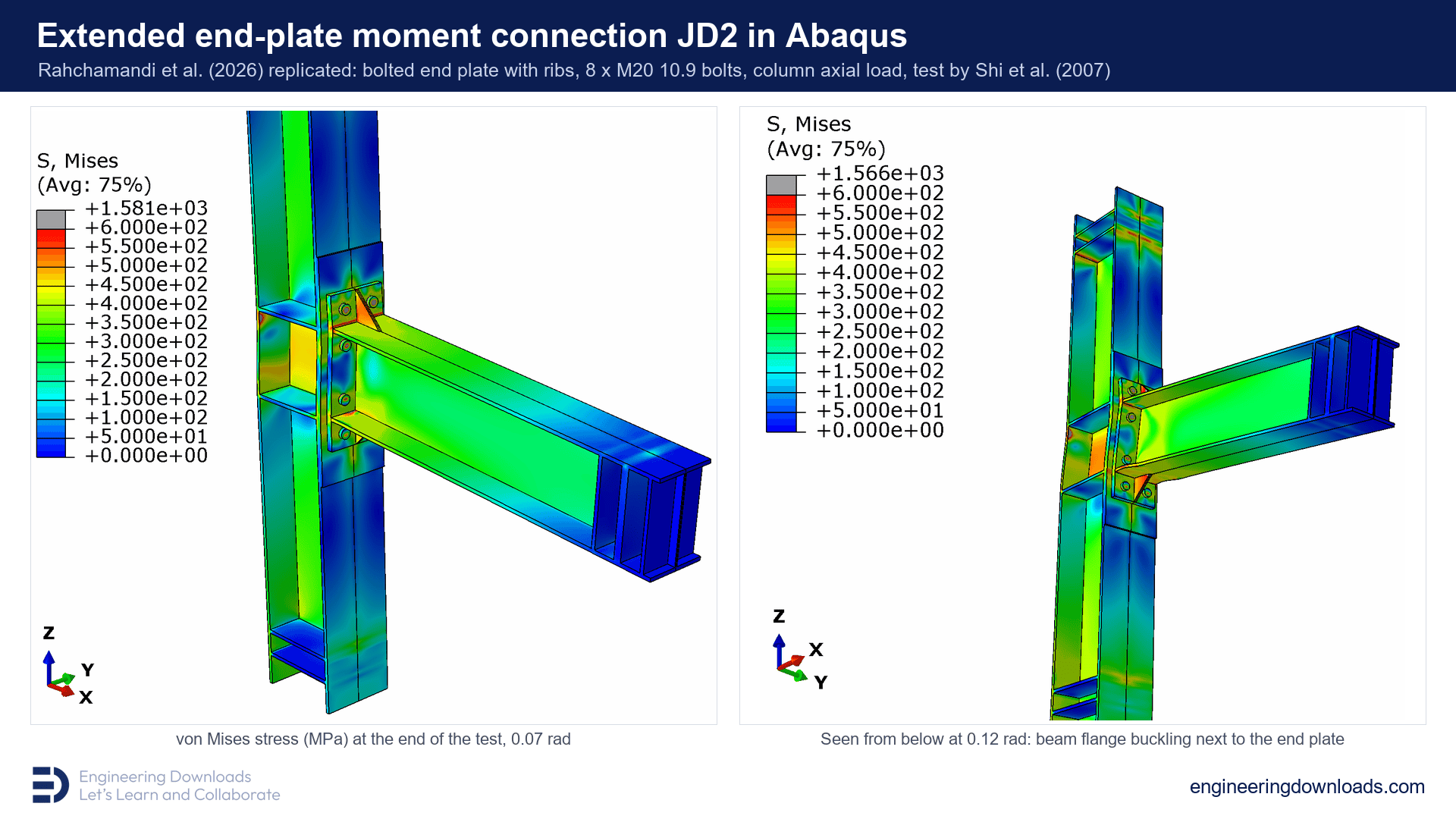
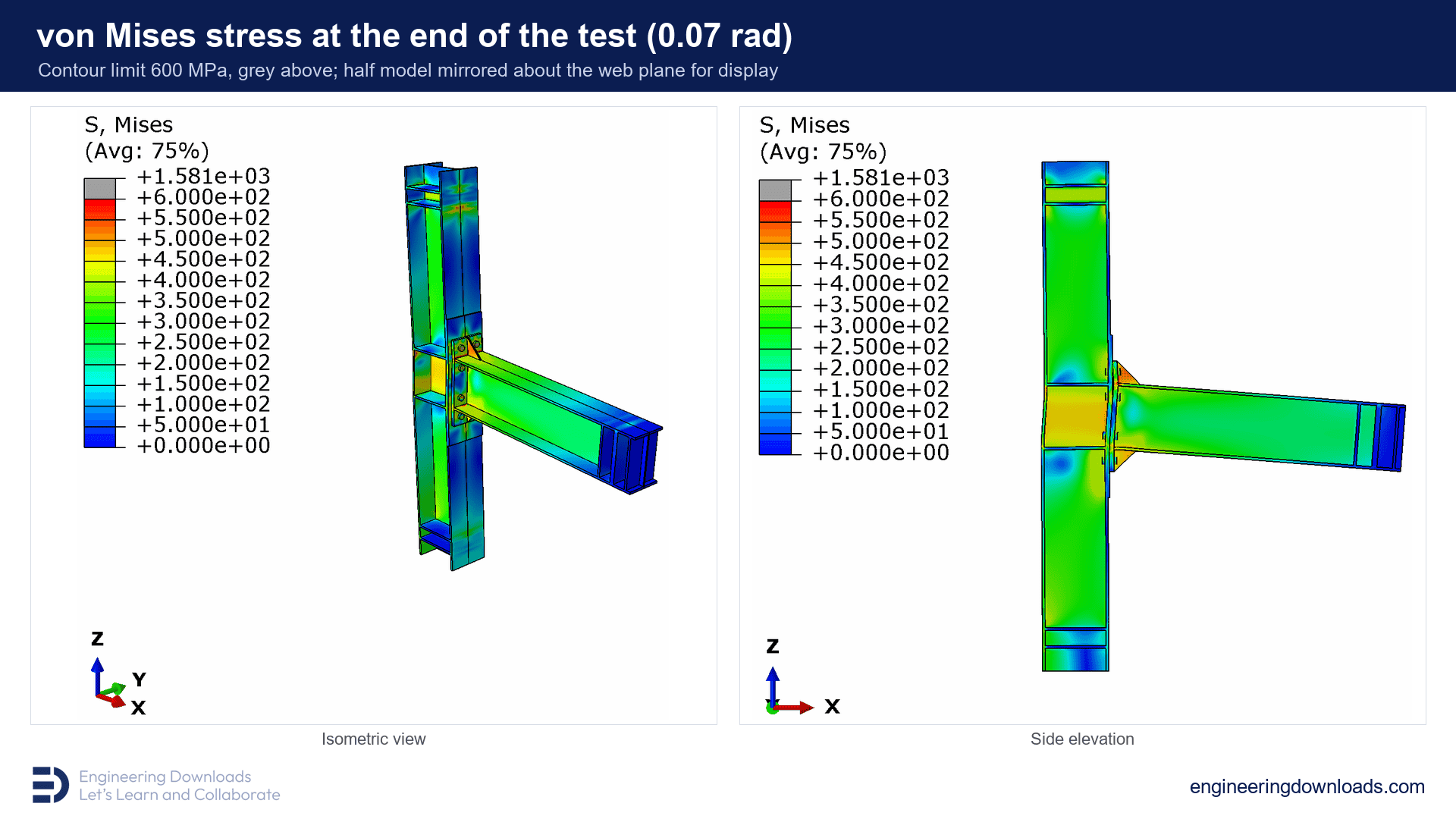
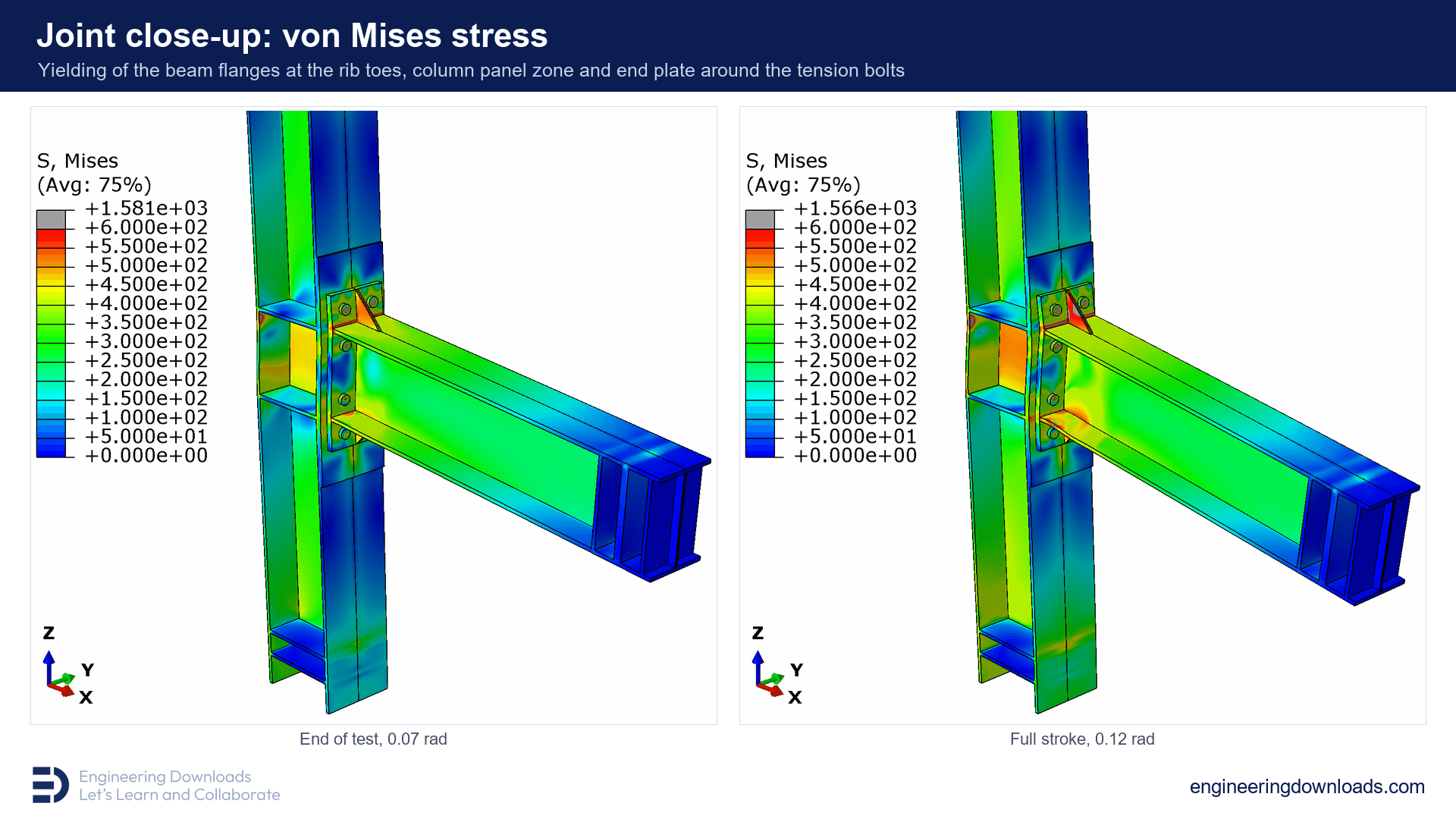
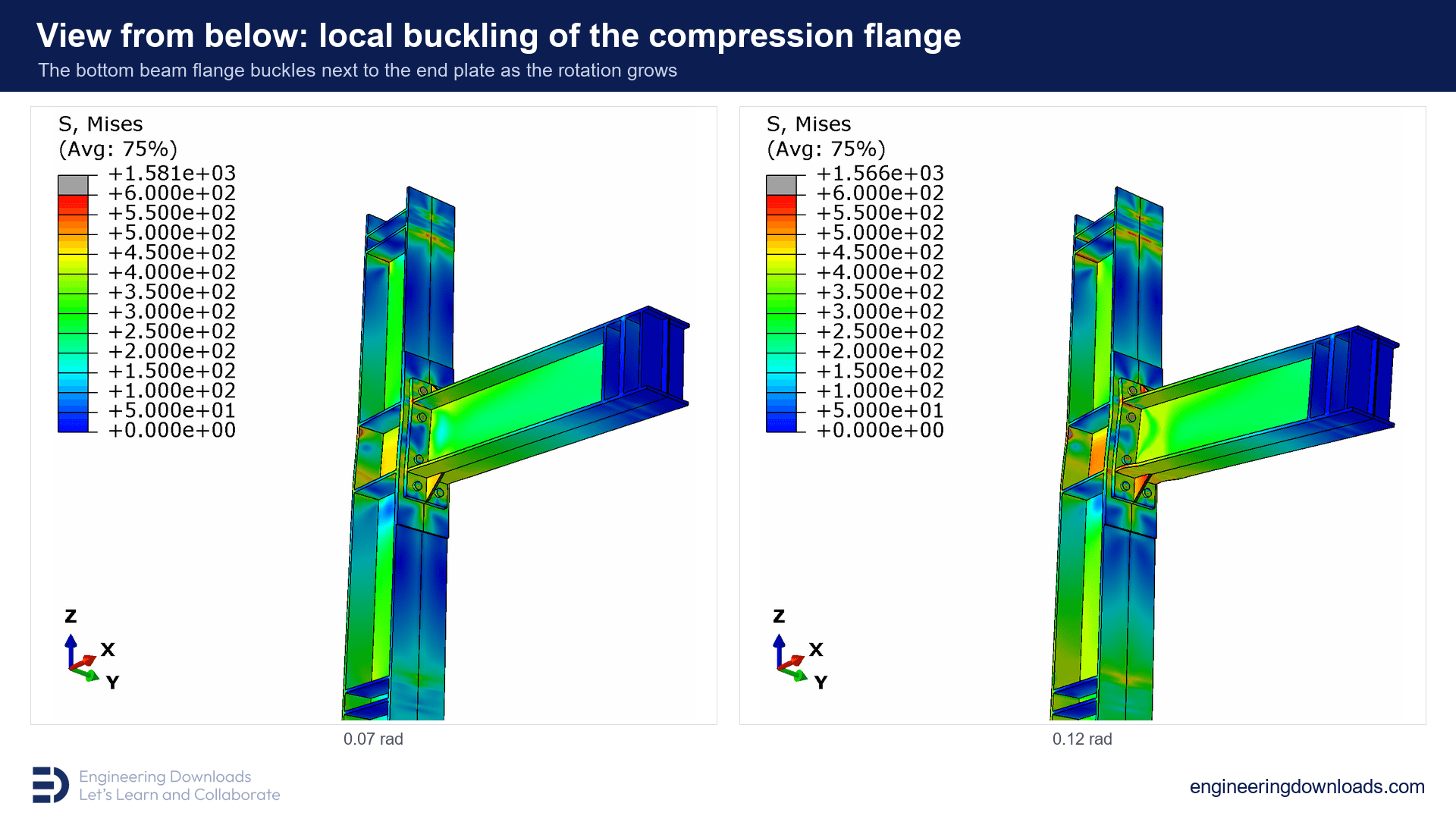
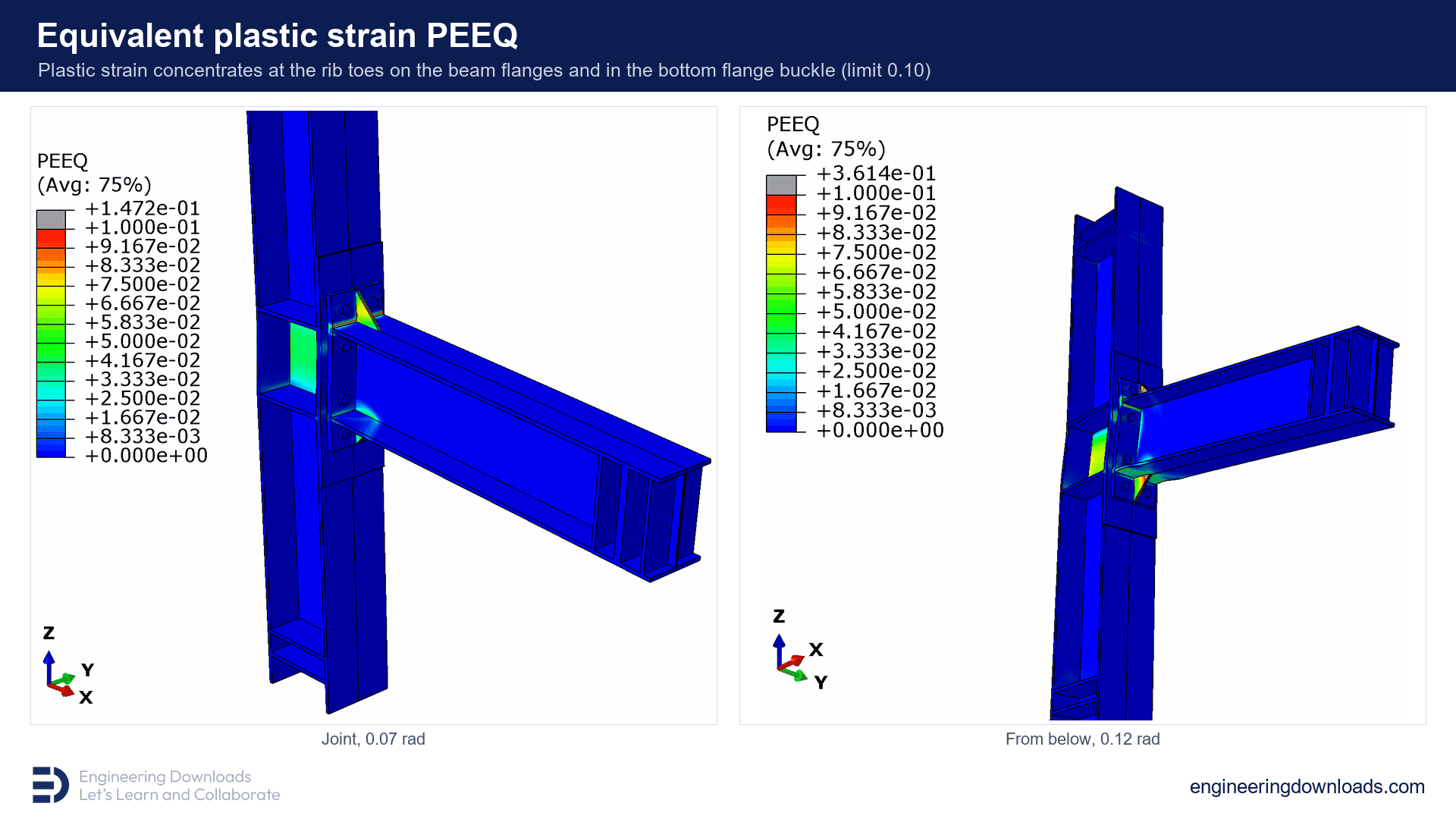
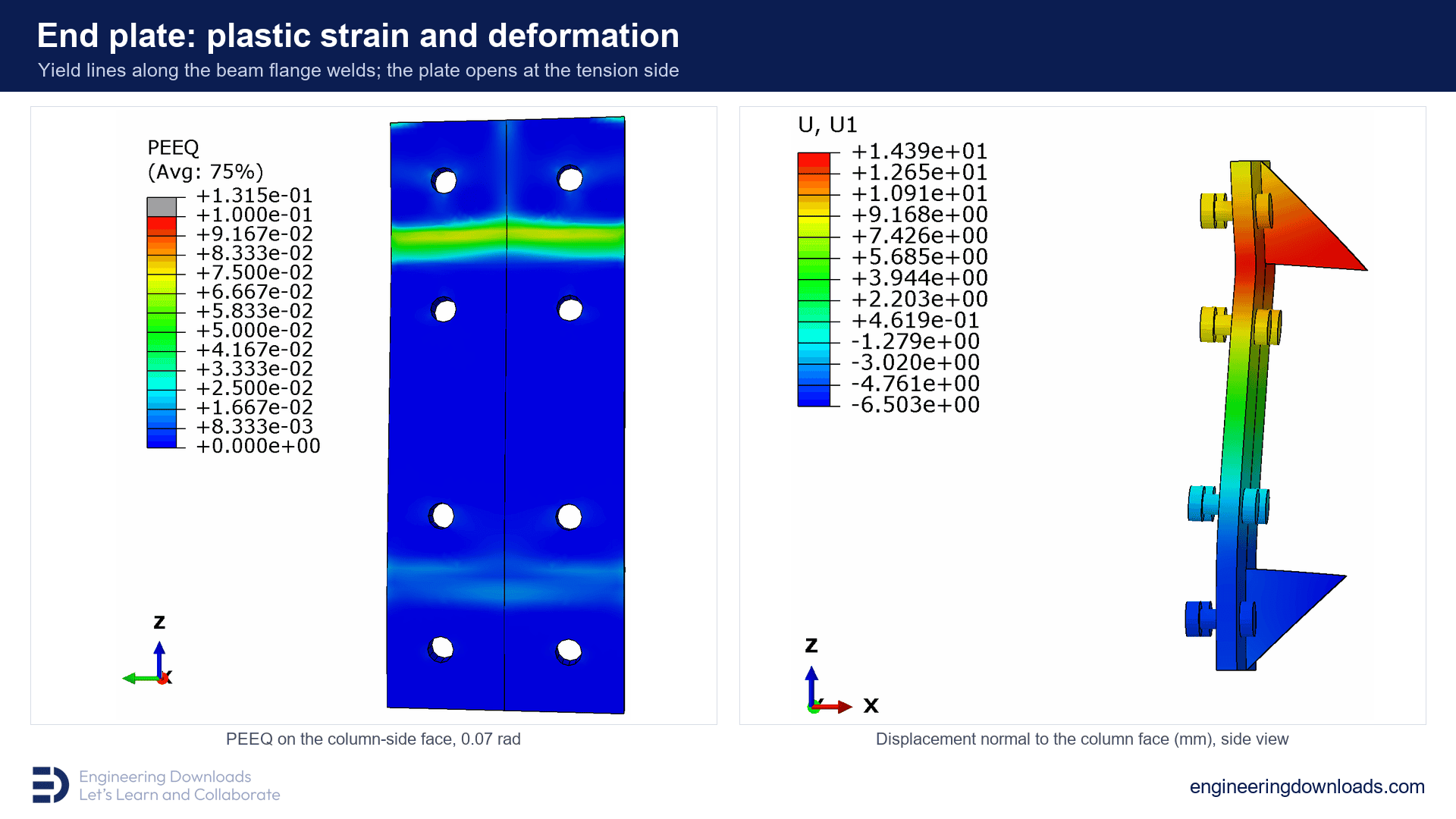
All three Abaqus curves follow the paper's FE curves through the elastic and plastic range. The linear law in engineering values (FEA-2) flattens too early and gives about half the measured plastic stiffness, while the multi-linear and bi-linear laws in true values come within 18 to 20 % of the test, close to the 15 to 19 % gap the paper reports. Like the paper's models, this model is slightly stiffer than the test in the yielding knee and softer in the plastic range. The failure picture is the expected one for this joint: plastic strain at the rib toes, end-plate yield lines along the beam flanges and local buckling of the compression flange next to the end plate.
Structural and steel engineers who design or check bolted moment connections, FEA engineers who need a working Abaqus model with bolt pretension and contact, and MSc and PhD students in steel structures who want a published connection test and paper rebuilt and checked number by number.
Which paper does this package replicate? Rahchamandi et al., Buildings 2026, 16, 236 (open access), specimen JD2, which was tested by Shi, Shi and Wang, Engineering Structures 29 (2007) 703-716. The papers are cited, not bundled.
How close are the results to the paper? The plastic rotational stiffness is 720, 1154 and 1130 kN.m/rad for the FEA-2, FEA-5 and FEA-6 steel laws, against 718, 1198 and 1142 kN.m/rad in the paper (within 0.3 to 3.7 %). The test value is 1412 kN.m/rad; like the paper, every FE model is below it.
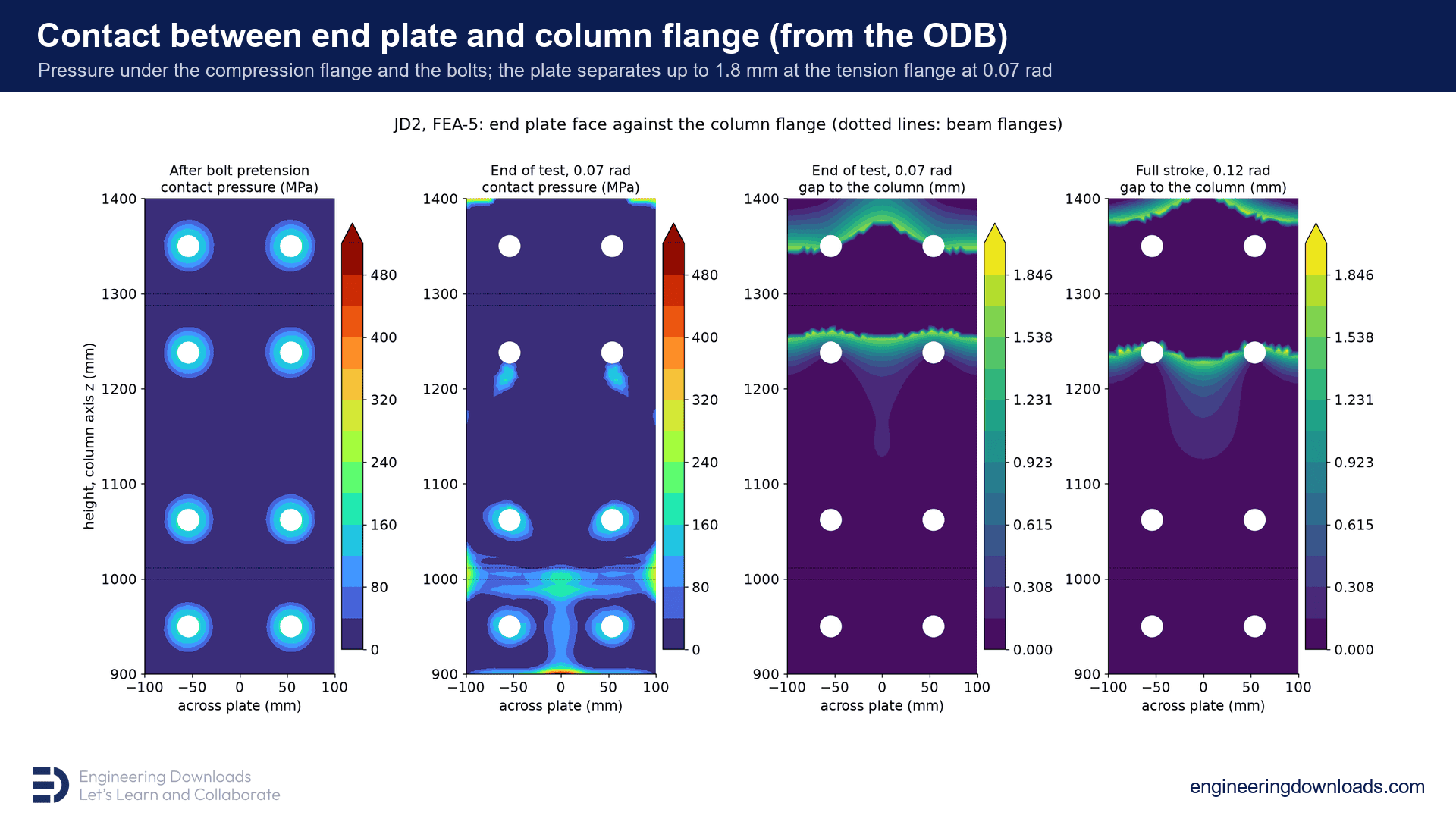
Are the bolts pretensioned and in contact? Yes. Each M20 grade 10.9 bolt is a solid with head and nut, pretensioned to 199 kN with an Abaqus bolt load, and the end plate, bolt heads and nuts are in hard contact with friction 0.44.
Why three models? The paper studies how the steel stress-strain law changes the connection response. The package includes the multi-linear true law (FEA-5), the paper's proposed bi-linear law (FEA-6) and the simple linear engineering law (FEA-2), so you can compare them directly.
Is the test cyclic? The test was cyclic. Like the paper, the FE model is loaded monotonically and compared with the test curve up to its end at 0.071 rad.
Are the images real Abaqus results? Yes. Every model, mesh and contour image is exported by Abaqus/CAE 2024 from the included models and their results; only a title bar, the logo and the web address are added. Charts are drawn from the same solver output, with the paper's and the test curves as reference.
Which Abaqus version do I need? Abaqus/CAE and Abaqus/Standard 2024 or newer for the CAE files; the INP files also run in older releases. ODB files are not included: each model solves in about 1.5 to 2 hours on 6 cores.
What if the package is not what I expected? Write to us. Engineering Downloads refunds clients who are not satisfied with a delivered product.
Need more than the files?
There are two ways we can help. Book a one hour online consultation if you want to talk a problem through with a CAE engineer, using the checkbox in the order box. Order a project if you need a full simulation built for you, delivered to an agreed scope, price and deadline under a written contract.
We work on FEA and CFD for engineers, researchers and companies. Order your project, or message us on WhatsApp for a quick reply.
Other packages engineers working on this topic also download.
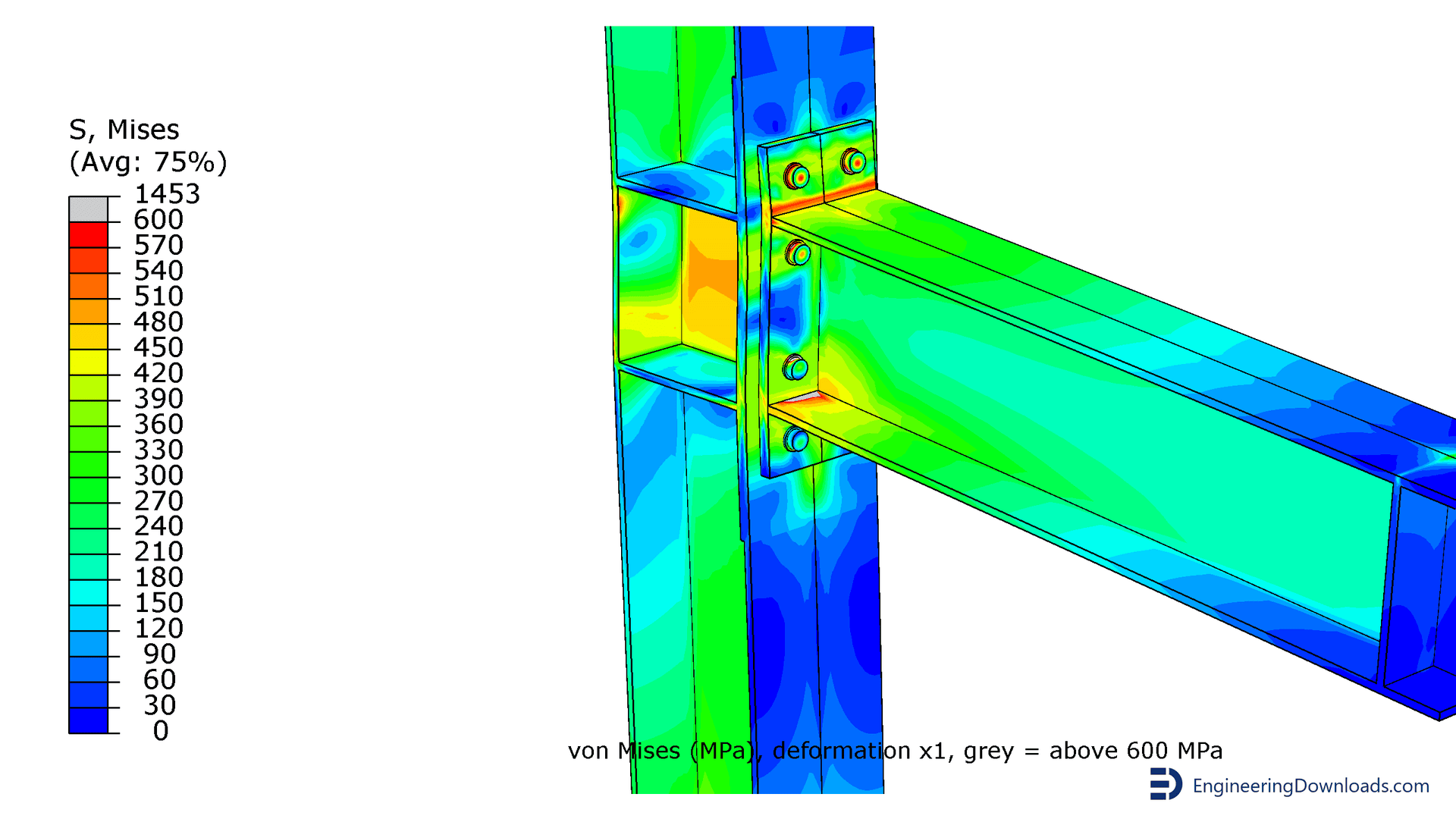 Bolt Preload Abaqus: SC3 End-Plate Connection with All-Hex Bolts (Native Bolt Load and Initial Stress, .inp and .cae)€89,00
 Bolt Pretension in Ansys Workbench: SC3 End-Plate Connection with All-Hex Bolts (Pretension Section with Lock, Initial Shank Stress, .wbpz)€89,00
 Oil Storage Tank under Non-Uniform Foundation Settlement in Abaqus, after Jiao et al. (2024)€169,00
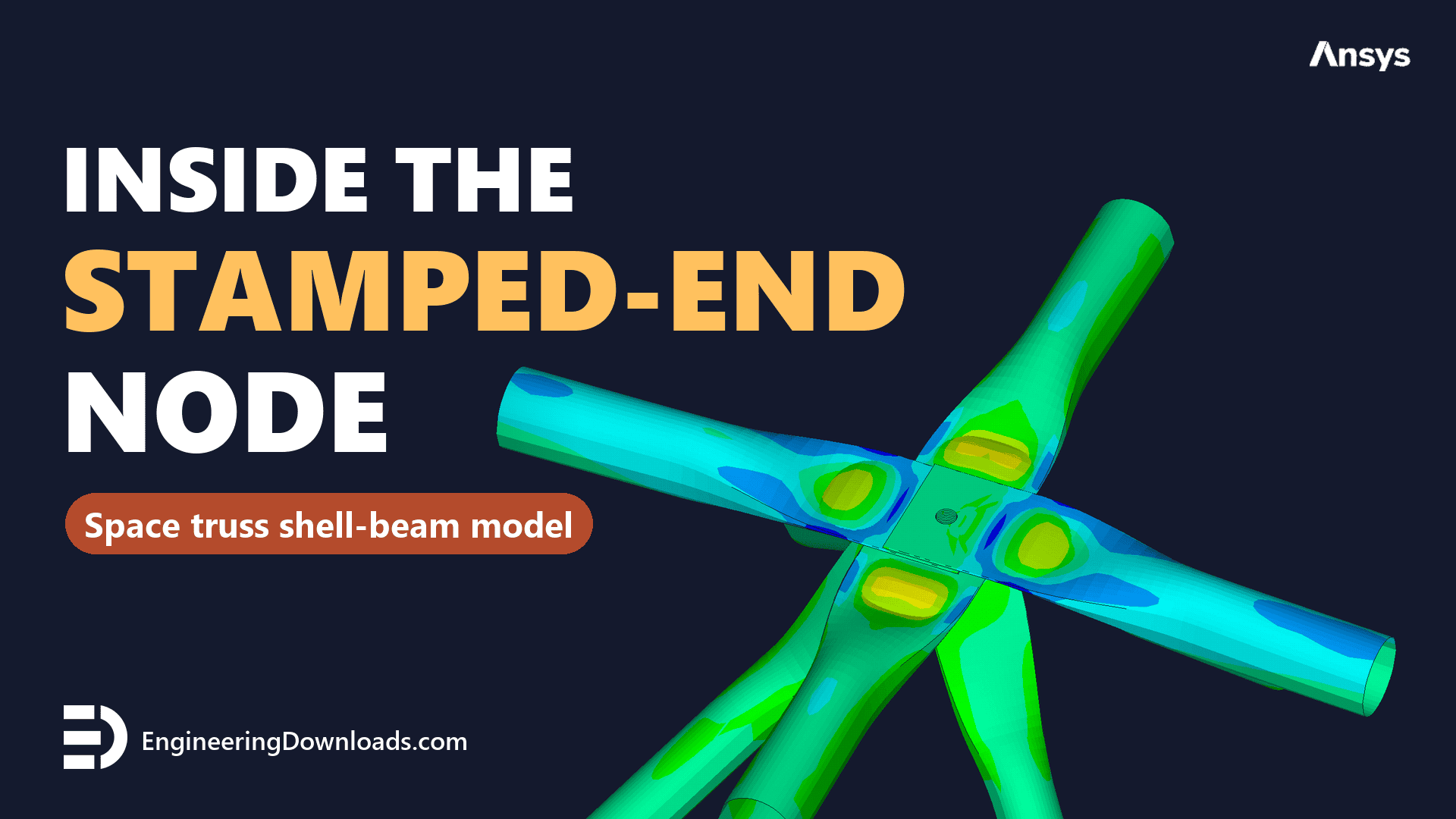 Stamped-End Tube Space Truss Node in Ansys: Shell-Beam Model of the Central Joint (Double-Layer Grid)€129,00
 Contact Fatigue Limit of a Hardness-Graded Gear Flank: Abaqus Brown-Miller-Morrow Workflow€129,00
 Timber–Steel Composite Beam Under Air Blast in Abaqus: CONWEP, Hashin & Johnson–Cook Damage
 Fire Analysis of Timber–Steel Bolted Connections in Abaqus | Sequential Thermal–Structural Simulation
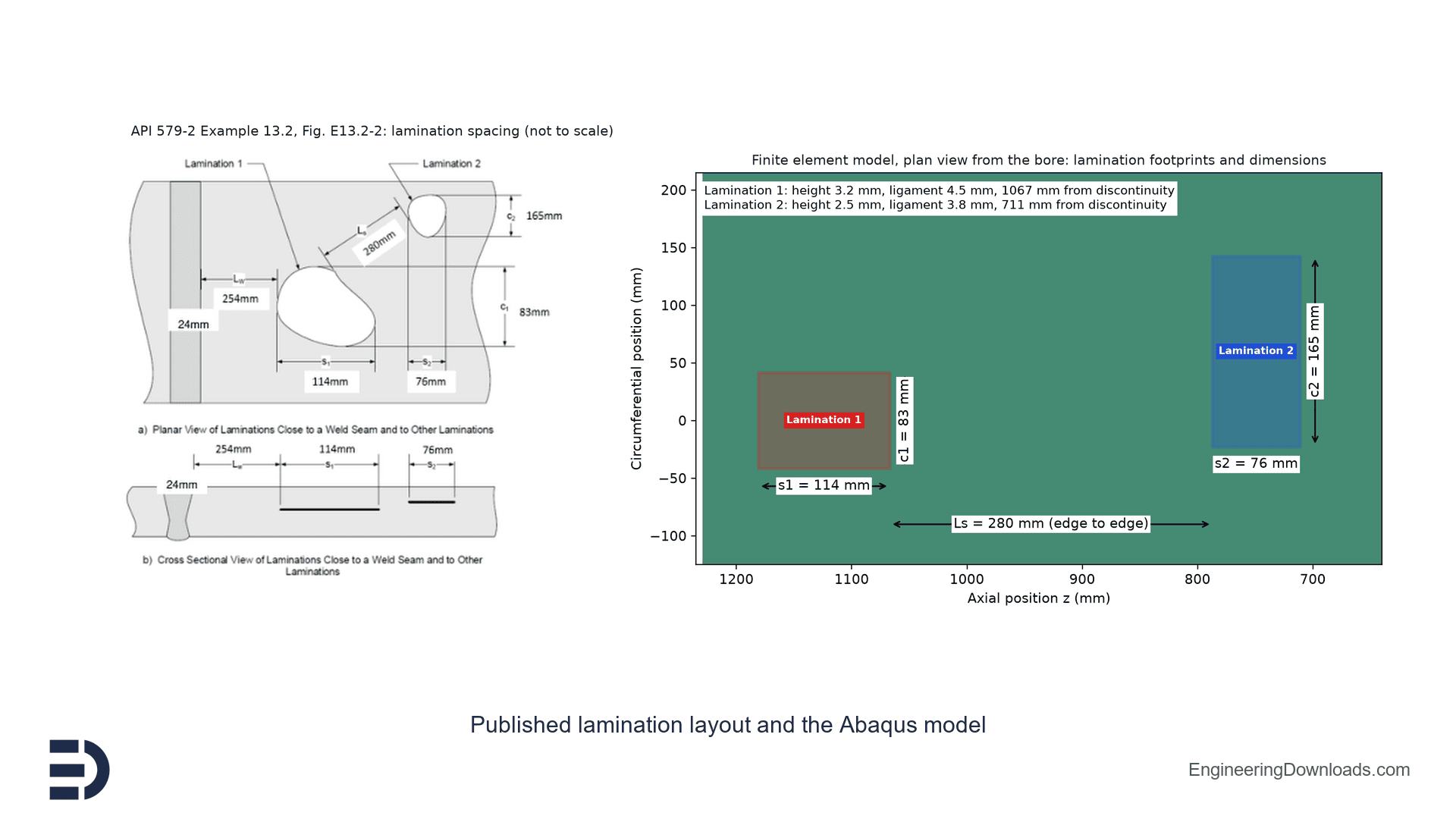 API 579-2 / ASME PTB-14 Example 13.2 Laminations in a Pressure Vessel: Abaqus FEA Model with Contact, Level 1 Screening and MAWP€139,00

Need a full custom project? See the options below.

€129,00

€179,00

€149,00

€119,00

€129,00

€149,00
See more
Want to receive push notifications for all major on-site activities?



