


Need a full custom project? See the options below.
Need a full custom project? See the options below.
An Abaqus CREEP user subroutine for the Norton law and Combined Time Hardening, with coupon, cyclic hardening and heated-plate models, following the method of the Gebze Technical University turbine blade creep thesis by T. İnal (2023). You get nine ready-to-run input files, a CAE file with all models, the Fortran subroutine, a one-click Python workflow that solves every job and checks it against closed-form equations and hand calculations, result pictures and a 6-page PDF tutorial.
Scope. Primary and secondary creep strain for rate-dependent analyses in Abaqus/Standard, combined with isotropic or kinematic plasticity. Tertiary creep, damage and rupture are not modelled.
| Feature | Abaqus implementation |
|---|---|
| Coupons | Plane-stress CPS4, 2 x 8 elements, five independent specimens per deck, base fixed, edge nodal loads, 4 h dwell at 1,073 K or 2 h at 1,123 K |
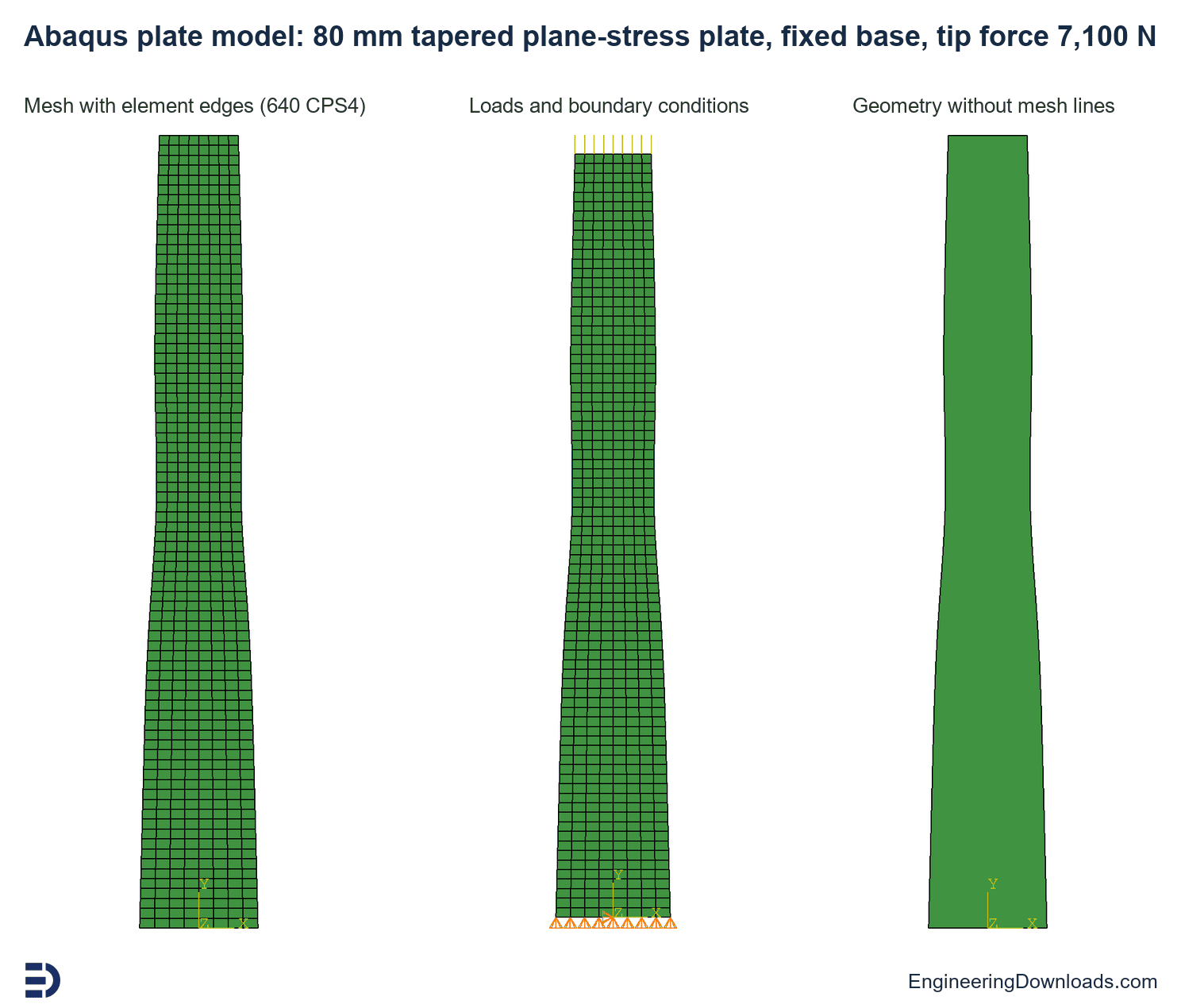
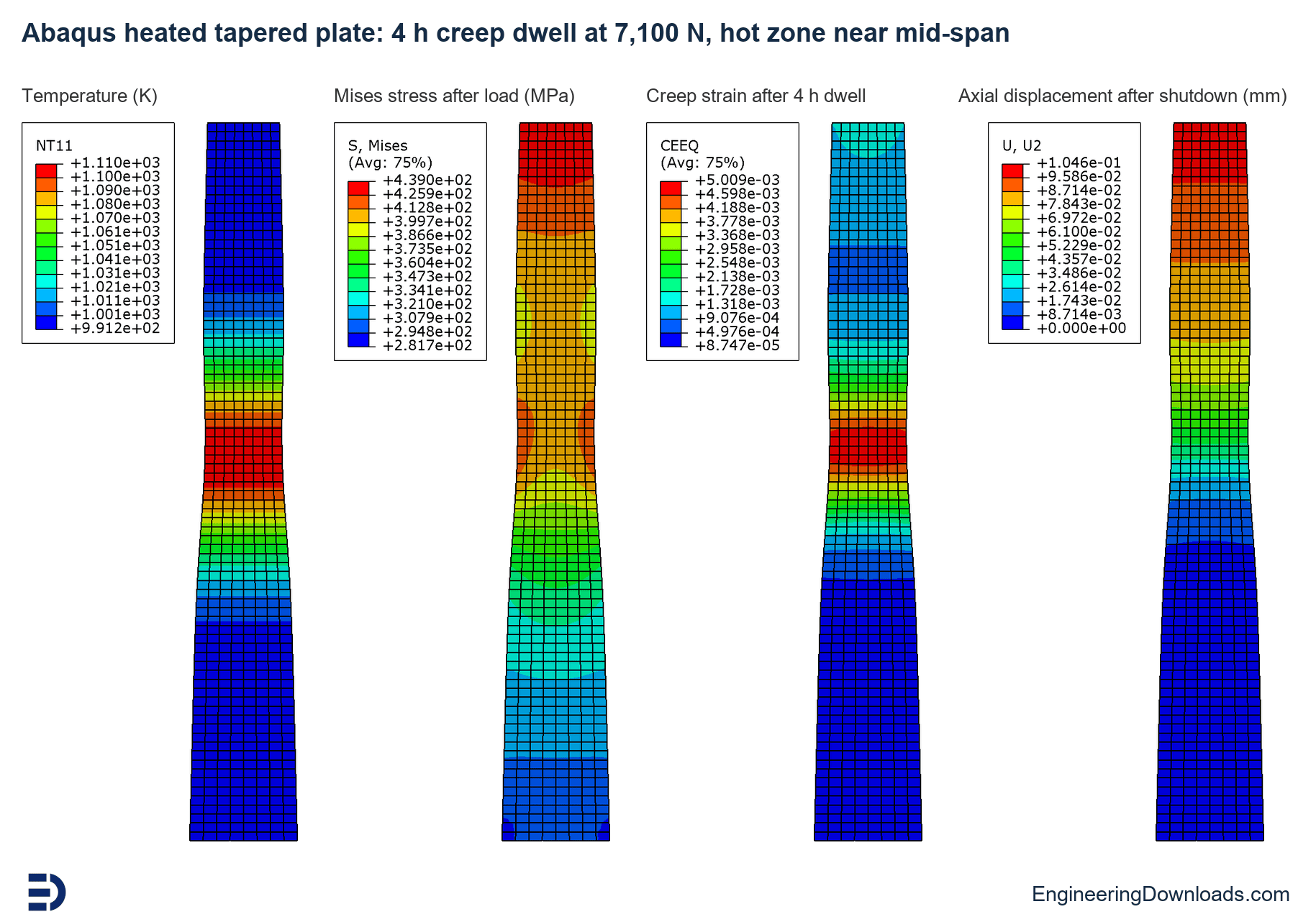
| Plate | 80 mm long, 2 mm thick, width 12 mm tapering to 8 mm with a notch near mid-span; 640 CPS4 elements (2,560 in the fine variant) |
| Material | E = 160,000 MPa, ν = 0.30; bilinear plasticity 320 MPa rising to 410 MPa at 2.5 % plastic strain; creep through the CREEP subroutine |
| Temperature | Prescribed field: uniform coupons; plate hot zone around mid-span, 991 K to 1,110 K |
| Loading | Static load step, visco creep dwell, shutdown step (plate); strain-controlled cycles with holds (cyclic elements) |
| Solution | Abaqus/Standard, automatic time incrementation with creep tolerance, user subroutine CREEP |
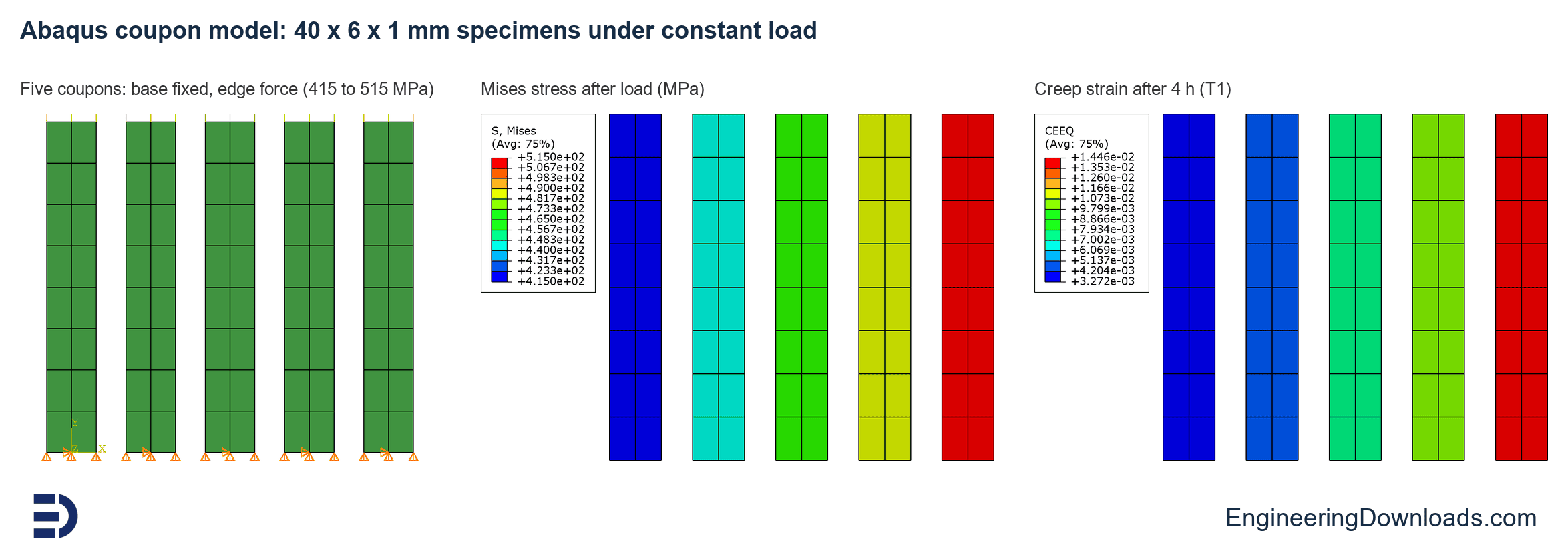
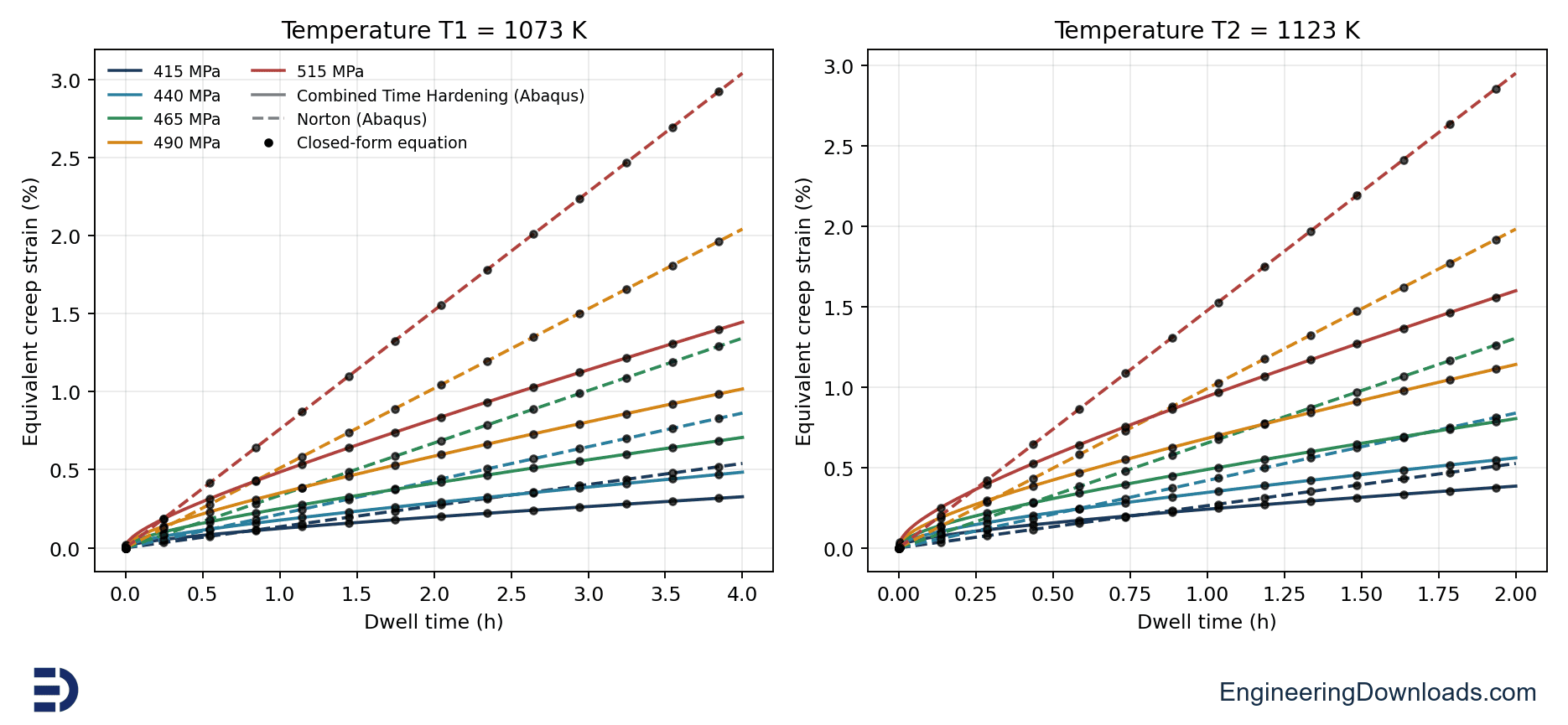
Norton gives a constant creep rate at constant stress. Combined Time Hardening adds a primary term proportional to t0.45, so the rate starts high and settles into the same linear secondary stage. All twenty coupon histories (two laws, two temperatures, five stresses) agree with the closed-form equations to better than 0.0003 % at every time step.
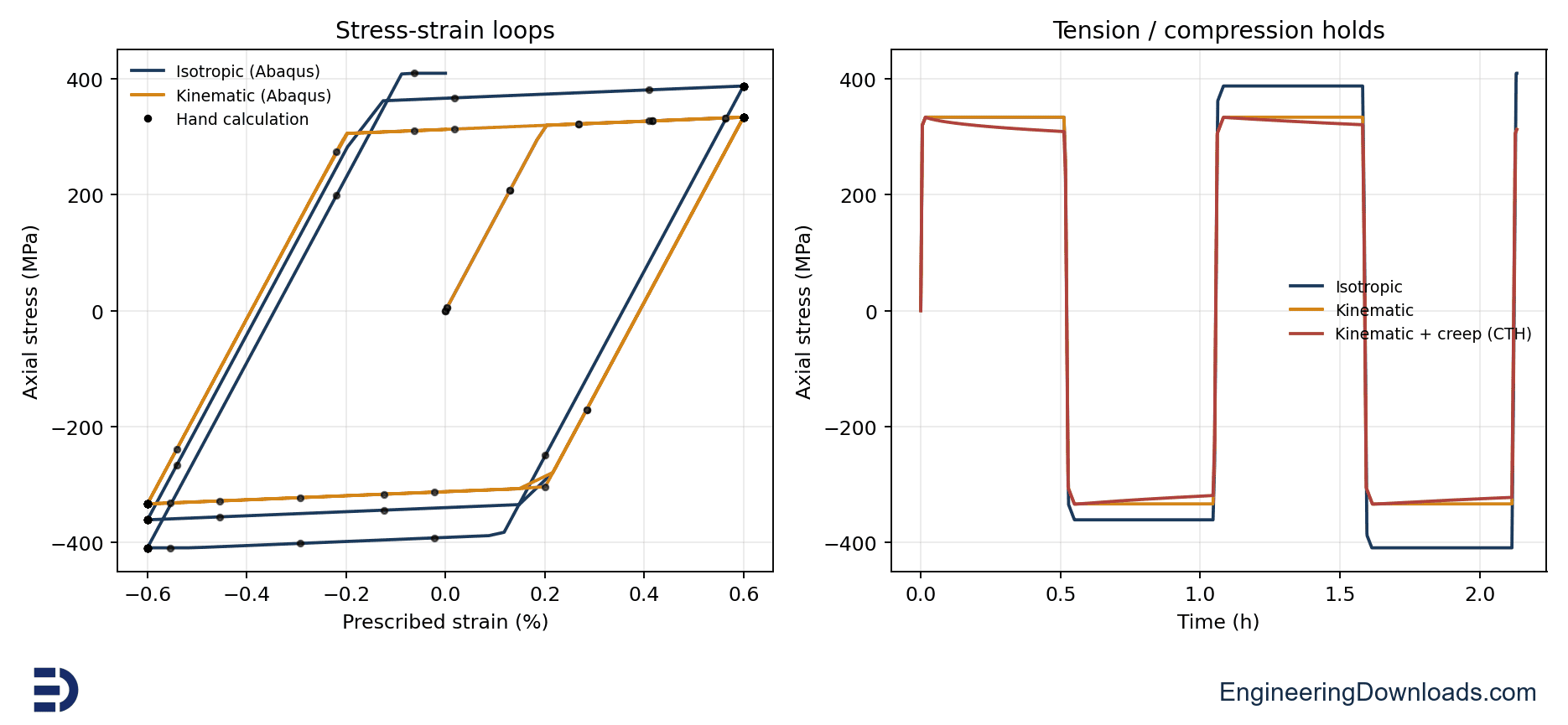
Isotropic hardening grows the elastic range cycle by cycle (peak 410 MPa); kinematic hardening keeps a stable loop at ±334 MPa. Both match a hand calculation of the same hardening table. With Combined Time Hardening added, stress relaxes by 24.7 MPa during the first 30-minute tension hold.
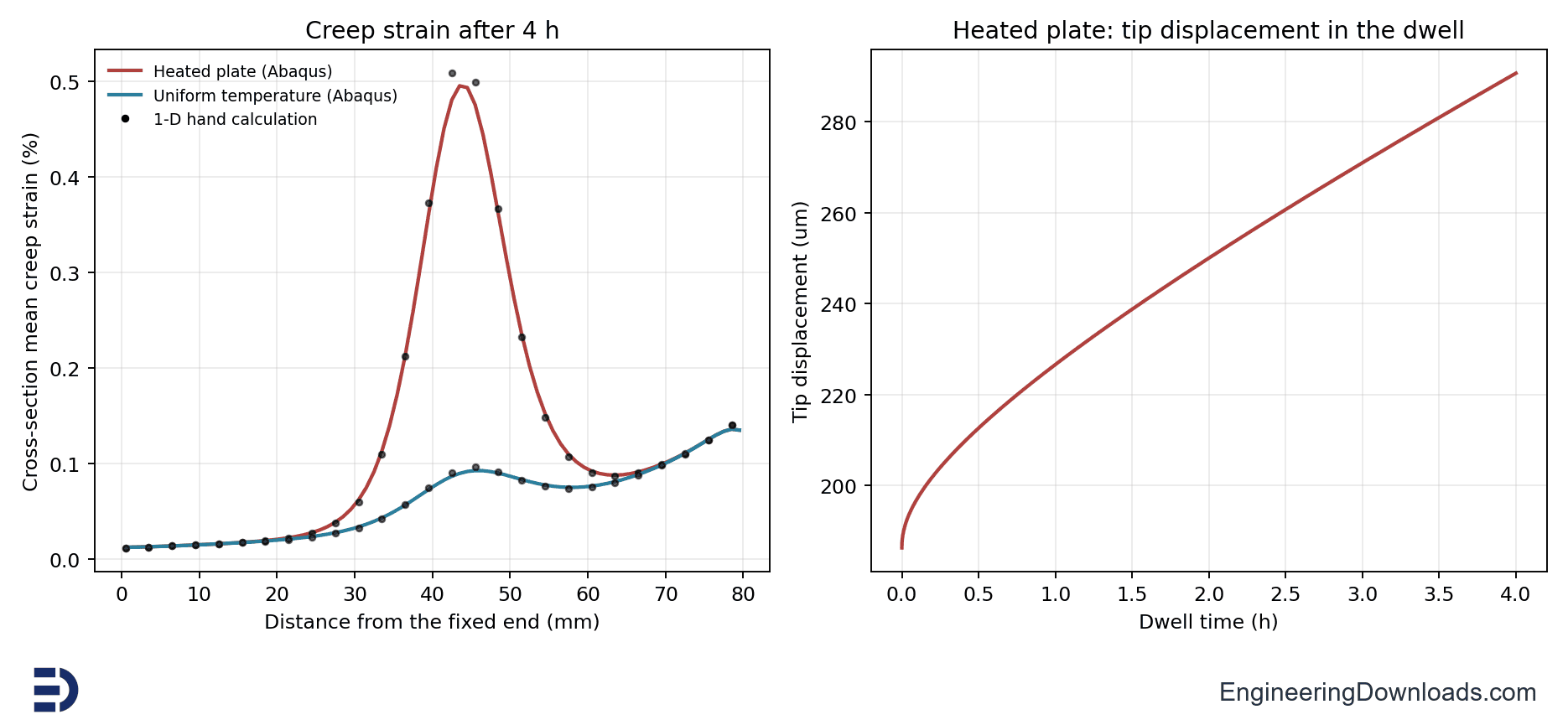
The creep strain peaks in the hot zone (0.50 % after 4 h) while the stress is highest at the narrow tip section. Permanent elongation after shutdown is 104 µm for the 4 h dwell and 246 µm for the 12 h dwell.
| Check | Reference | Abaqus | Difference |
|---|---|---|---|
| Creep strain history, 20 coupon cases | Closed-form equation | all time steps | below 0.0003 % |
| Kinematic hardening peak stress | 334.08 MPa (hand calculation) | 334.08 MPa | 0.00 % |
| Isotropic hardening peak stress | 410.00 MPa (hand calculation) | 410.02 MPa | 0.004 % |
| Plate base reaction | 7,100 N (applied load) | 7,100.0 N | 0.0000 % |
| Plate peak axial stress at load | 442.4 MPa (force / local section) | 442.4 MPa | 0.00 % |
| Plate peak creep strain after 4 h | 0.524 % (1-D hand calculation) | 0.495 % | -5.6 % (creep shifts load to cooler sections) |
| Mesh refinement, 640 to 2,560 elements | Peak creep strain / residual displacement | +0.88 % / +0.17 % | mesh converged |
T. İnal, Creep Damage Analysis and Life Prediction of a Superalloy Turbine Blade, Gebze Technical University, 2023 (Norton and Combined Time Hardening creep laws, isotropic and kinematic hardening comparison, heated-blade analysis method). The thesis is cited, not bundled; the models and the subroutine in this package are independent implementations.
Which work does this package follow? The method of T. İnal, Gebze Technical University, 2023: Norton law (Eq. 3.38), Combined Time Hardening (Eq. 3.40), hardening comparison and heated-component creep analysis.
Are the material constants those of the thesis? The package uses representative constants, written and explained at the top of Creep_Laws.for. Replace them with constants fitted to your own creep tests; the decks and checks work unchanged.
Does it predict rupture or life? No. It models primary and secondary creep strain; tertiary creep, damage and rupture are not included.
Do I need a Fortran compiler? Yes. The creep law is a user subroutine, so Abaqus must be linked to a Fortran compiler.
Is it a design tool? No. It is a research and learning model and does not replace an assessment by a qualified engineer.
Need more than the files?
There are two ways we can help. Book a one hour online consultation if you want to talk a problem through with a CAE engineer, using the checkbox in the order box. Order a project if you need a full simulation built for you, delivered to an agreed scope, price and deadline under a written contract.
We work on FEA and CFD for engineers, researchers and companies. Order your project, or message us on WhatsApp for a quick reply.
Other packages engineers working on this topic also download.
 Theta Projection Creep in Abaqus: MAR-M247 and GH-4169 Subroutines, Rotating Sectors and Two Gas Turbine Blade Models (Varadhayamunan 2023)€149,00
 Blade creep study with side-by-side built-in vs custom creep models
 Pipe and Pipeline Simulation Package in Abaqus (21 Models)
 HK40 Superheater Tubes: API 579 FFS Level 3 and Creep Remaining Life in Abaqus€139,00
 API 579 Example 10.1 in Abaqus: Vessel Creep After a Temperature Excursion, Omega Damage Model and One-Click Python Check€129,00
 API 579 Example 10.3 in Abaqus: P22 Heater-Tube Creep Life, Omega Damage Model and One-Click Python Check€139,00
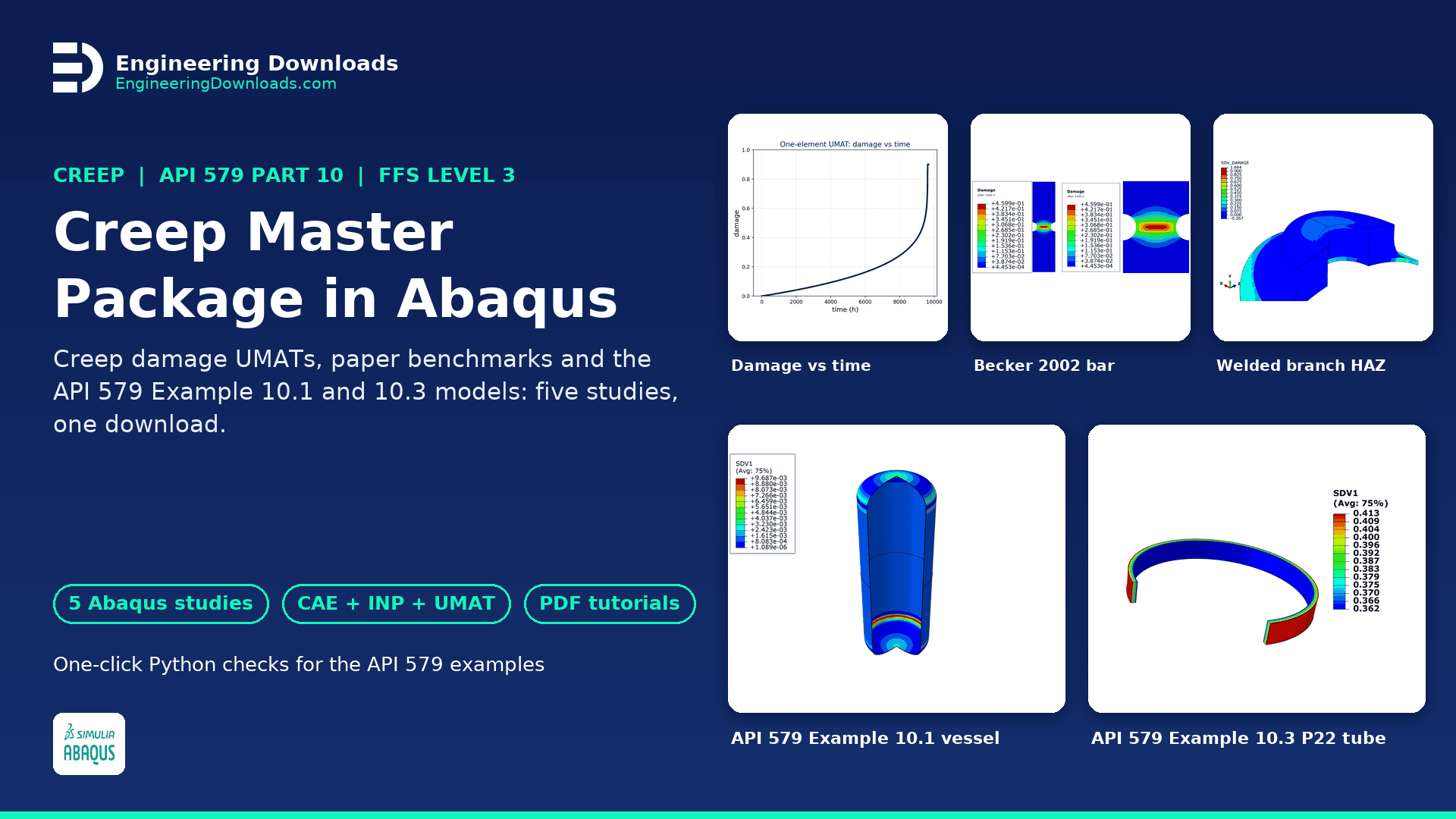 Creep Master Package in Abaqus: API 579 Part 10 Examples 10.1 and 10.3, Creep Damage UMAT and Paper Benchmarks€299,00
 Reinforcement load and deformation mode of geosynthetic-reinforced soil walls subject to seismic loading during service life

Need a full custom project? See the options below.

€129,00

€179,00

€149,00

€119,00

€129,00

€149,00
See more
Want to receive push notifications for all major on-site activities?



