Buckling of a strip on a stepped Winkler foundation, Abaqus S4R models

€129,00
Optional extras

Need a full custom project? See the options below.
€129,00
Optional extras

Need a full custom project? See the options below.

12 people watching this product now!

Material Includes

  • 12 Abaqus/CAE models (.cae) with their input files (.inp): s38_ex1_f10, s38_ex2_f10, s38_ex3_f10, s38_r01_f10, s38_r03_f10, s38_r05_f10, s38_r1_f10, s38_r2_f10, s38_r5_f10, s38_r10_f10, s38_ex5_f10, s38_ex6_f10.
  • The base build script, the variant generator and read_fcr.py (eigenvalues to Fcr and comparison with the reference).
  • The 32-page PDF tutorial in 14 chapters: buckling on an elastic foundation, the problem and its inputs, the hand check, the shell model and mesh, the elastic foundation on shells, boundary conditions and in-plane bending, the axial load and the sign pitfall, the buckle and static steps, running the jobs, results against the paper, buckling localisation, three checks (Example 3, mesh, Poisson ratio), limitations, and adapting the model.
  • A readme with the file list, the units and how to get Fcr from the eigenvalue.

Audience

  • Geotechnical and structural engineers who check piles
  • Sheet piles and embedded struts in layered soil. Rail
  • Pipe and strip engineers dealing with non-uniform elastic support. Analysts who need an inspectable Abaqus recipe for shell buckling with an elastic foundation per unit area. Researchers and students who want a worked reproduction of a published stepped-foundation study

What You Will Learn?

  • A complete, inspectable chain from the foundation stiffness to Fcr: shell, two-zone foundation, boundary conditions, edge load, buckle step, equilibrium check.
  • A hand check on a calculator, including the lower bound that predicts a stepped bar to a few percent.
  • Three traps that give plausible but wrong results, each with the check that catches it: foundation per unit area, in-plane bending, and the sign of the edge load.
  • An honest treatment of a paper inconsistency (Example 3) with both numbers shown.
  • Buckling localisation made visible, with practical rules for layered soil and poor stretches.

About Course

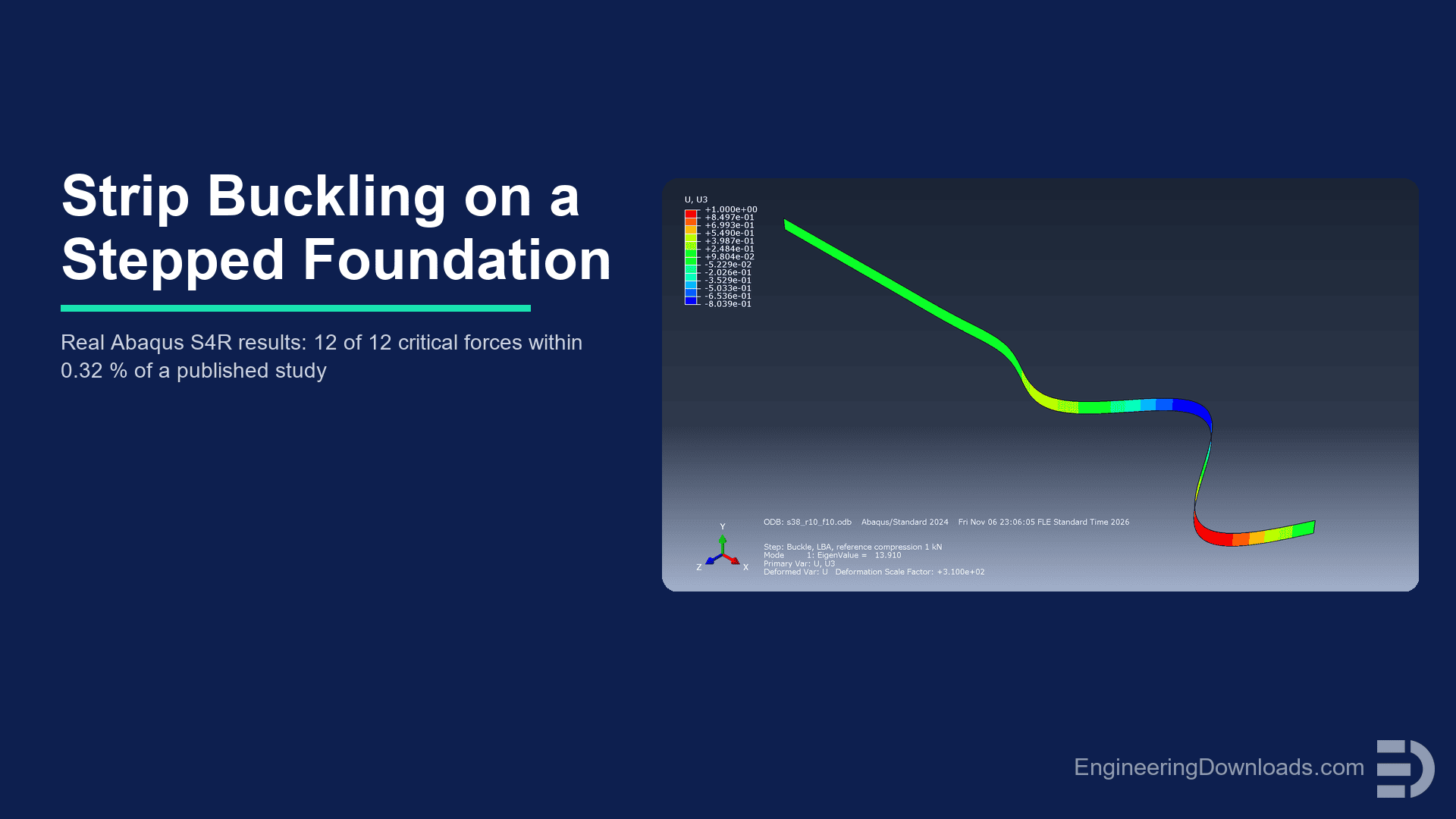
First buckling mode of a strip on a stepped foundation, from an Abaqus S4R shell model

Twelve ready-to-run Abaqus/Standard 2024 models and a 32-page tutorial that compute the critical force of a compressed flat strip resting on an elastic foundation whose stiffness changes in a step, and compare it with a published study. All 12 critical forces agree with the reference within +0.03 % to +0.32 %.

Application

Piles and sheet piles pass through layers of soil with different stiffness. Rails and pipes lie on support that is firm in one stretch and poor in the next. Strips and plates bonded to a substrate can lose the bond over part of their length. In all of them a slender member is compressed and supported sideways by an elastic medium of non-uniform stiffness, and the designer needs to know how much the weak stretch costs in critical force. This package answers it for one fully documented case, with a model you can open, rerun and change.

The key finding is physical and easy to use. The buckling wave moves into the softer zone, and the critical force follows the softer zone. A stiff stretch elsewhere hardly helps. In the Example 1 bar, replacing the soft zone by one ten times stiffer takes Fcr from 13.91 to 42.34 kN, and making the stiff zone ten times stiffer again adds only 1.5 %.

The paper behind the models

Reference: M. Sadowski, J. Marcinowski and V. Sakharov, “Stability of a Compressed Bar Resting on an Elastic Substrate with Stepwise Changes in Parameters”, Materials 2026, 19(2), 258, doi:10.3390/ma19020258. Open access, CC BY 4.0. We use its input data for Examples 1 to 6, its finite element model description (Section 3), and its tabulated critical forces (Tables 1 and 2) as numbers.

In our own words: the paper treats a compressed flat bar on a foundation with a stepwise change of stiffness, derives a critical force from an energy method and checks it against finite element linear buckling analyses and closed-form limits. This package rebuilds the finite element side in Abaqus with S4R shells and a two-zone elastic foundation, and uses only the numbers of the paper for comparison. No figure, table or passage of the paper is reproduced.

Model at a glance

  • Software: Abaqus/Standard 2024, native .cae files with their .inp input files.
  • Analysis: linear eigenvalue buckling (Buckle step, 6 eigenvalues), 1 kN reference compression, followed by a linear static step as an equilibrium check.
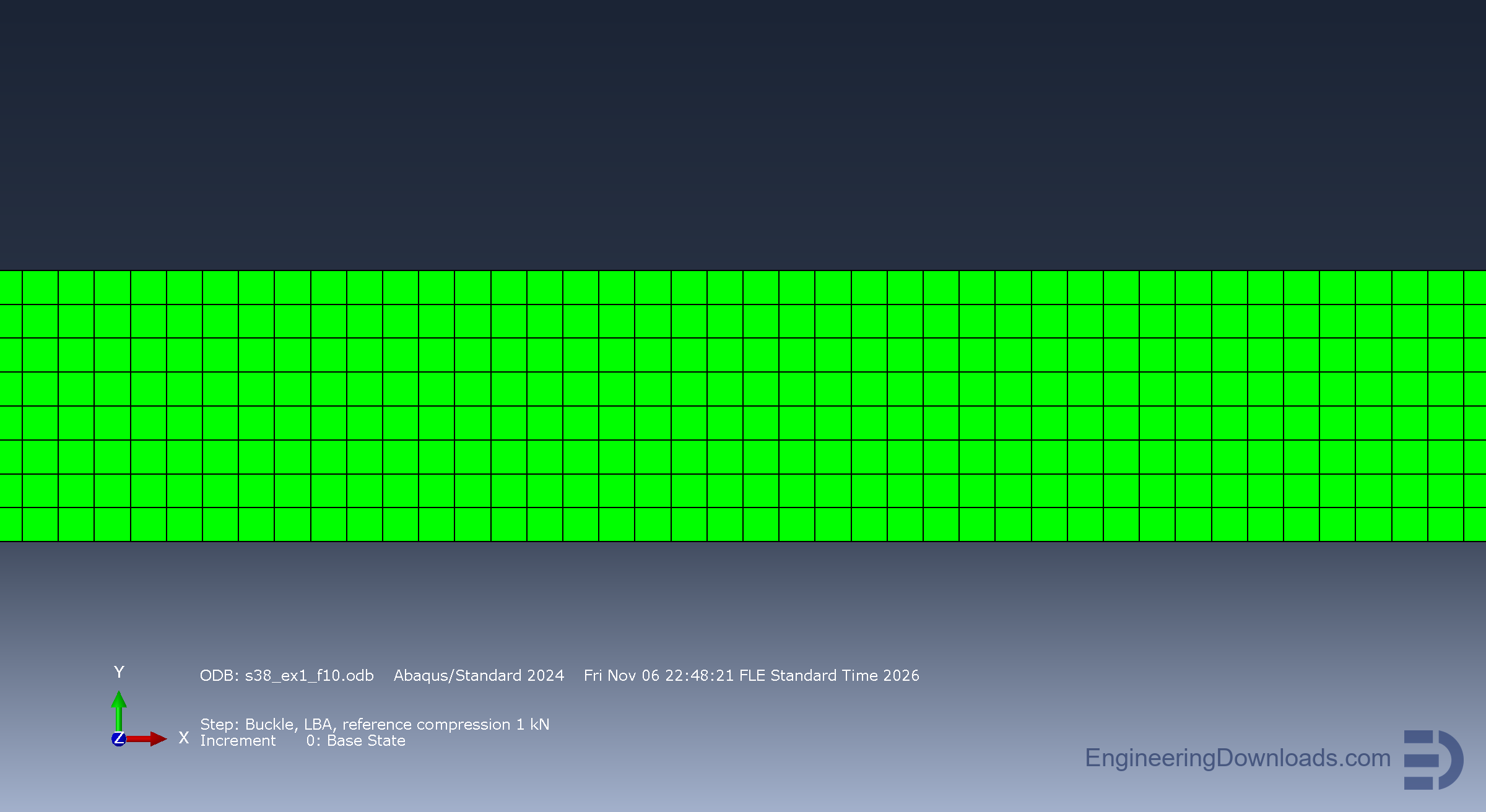
  • Element and mesh: S4R shell on the mid-surface, about 8 mm along the length and 8 elements across the width. The Example 1 bar has 3104 elements.
  • Foundation: two *Foundation zones, stiffness k / b per unit area, k1 from the loaded end up to xi0 L and k2 beyond.
  • Supports: pinned end (all three translations fixed), loaded end held out of plane, centre line held against in-plane motion.
  • Load: 1 kN uniform shell edge load, so the smallest positive eigenvalue is Fcr in kN.
  • Run time: about a minute per model on our workstation (64 s for the Example 1 bar).
  • Units: mm, N, MPa.
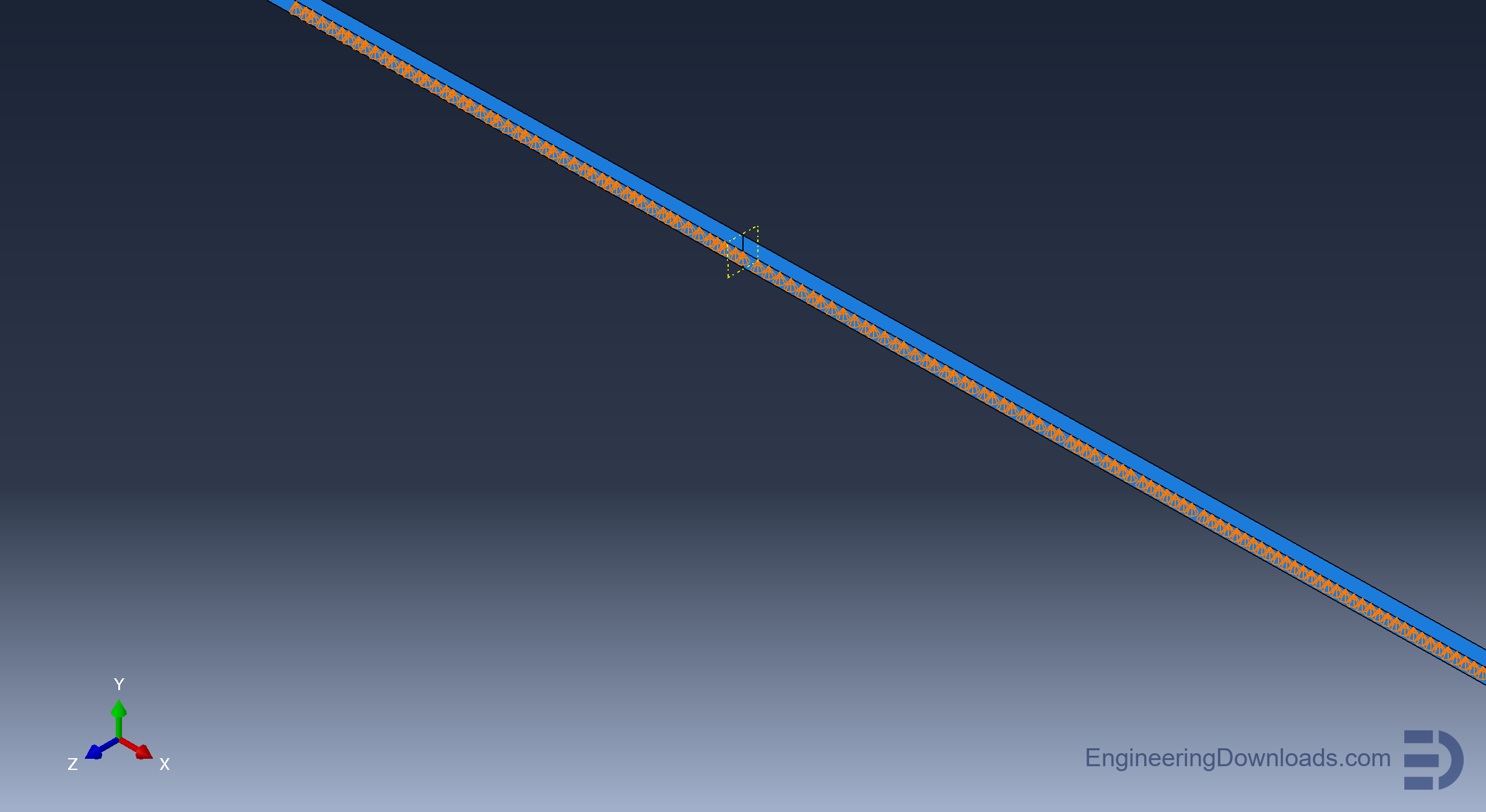
Abaqus/CAE: the Example 1 strip in the Buckle step, with the zone boundary at L0 (datum plane) and the centre-line constraints
Abaqus mesh close-up: S4R elements across the 60 mm width

Pre-processing

Four modelling details are worth the price of the package:
  • Elastic foundation on a shell, per unit area. The paper’s k is per unit length of the strip. The shell foundation needs k / b. The tutorial shows the conversion and what happens if it is forgotten (a factor of about 7.7 in Fcr for the Example 1 strip).
  • In-plane bending must be suppressed. A wide strip has an in-plane Euler load that the foundation does not touch. For the Example 1 and Example 5 strips it is 18.3 and 12.5 kN, below the foundation modes, so the first mode would be an in-plane one. The model fixes the centre line against in-plane motion and leaves the edges free. The tutorial shows the numbers for four bars.
  • Positive EDNOR is compression. The first Example 1 job had the edge load with the wrong sign. It solved without a warning and every eigenvalue was negative. The static reaction check (+1000 N instead of -1000 N) caught it before any eigenvalue was used. The tutorial shows both checks.
  • The step on a mesh line. The zone boundary is a partition of the face, so no element carries two foundation values and the step is exact.

Equations used

  • No foundation: Fcr = pi^2 E I / L^2, with I = b h^3 / 12. Example 6: 0.534 kN.
  • Uniform foundation, long bar: Fcr = 2 sqrt(E I k), at a half-wave length pi (E I / k)^(1/4).
  • Finite length: F(n) = E I (n pi / L)^2 + k (L / (n pi))^2, smallest over whole numbers of half-waves n. For the Example 1 bar with k = 2.5 this gives 42.26 kN at n = 11, the value the paper lists, against 42.21 kN for the long-bar formula.
  • Stepped bar, hand bound: the finite-length formula with the softer k under the whole bar. It is a lower bound: the finite element value sits 0.2 % to 4.2 % above it for the seven ratios of the Example 1 bar.
  • Foundation per area: k_area = k / b.

Results

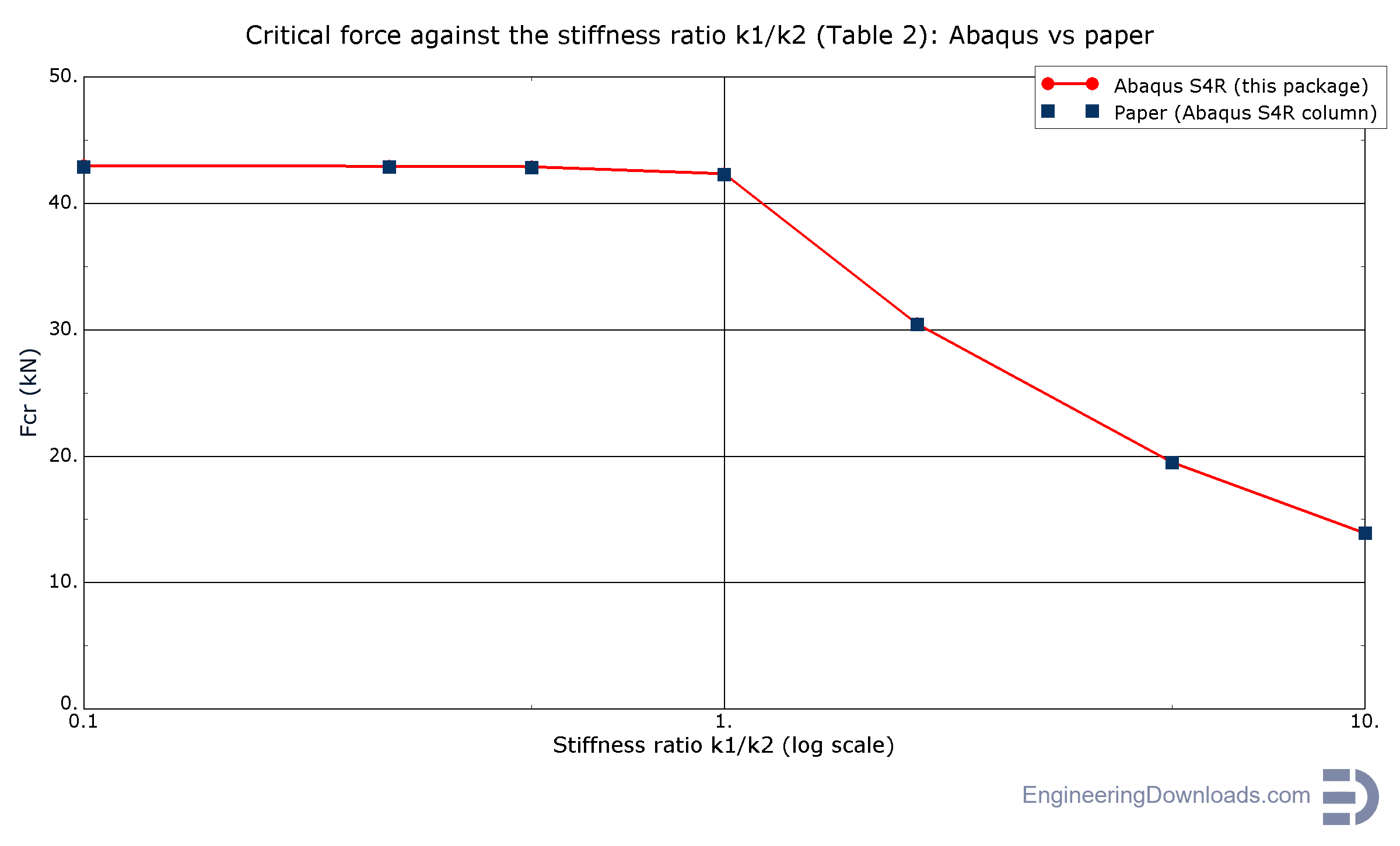
Abaqus X-Y plot: critical force against k1/k2 for the seven Table 2 strips, Abaqus (line) against the paper (symbols)
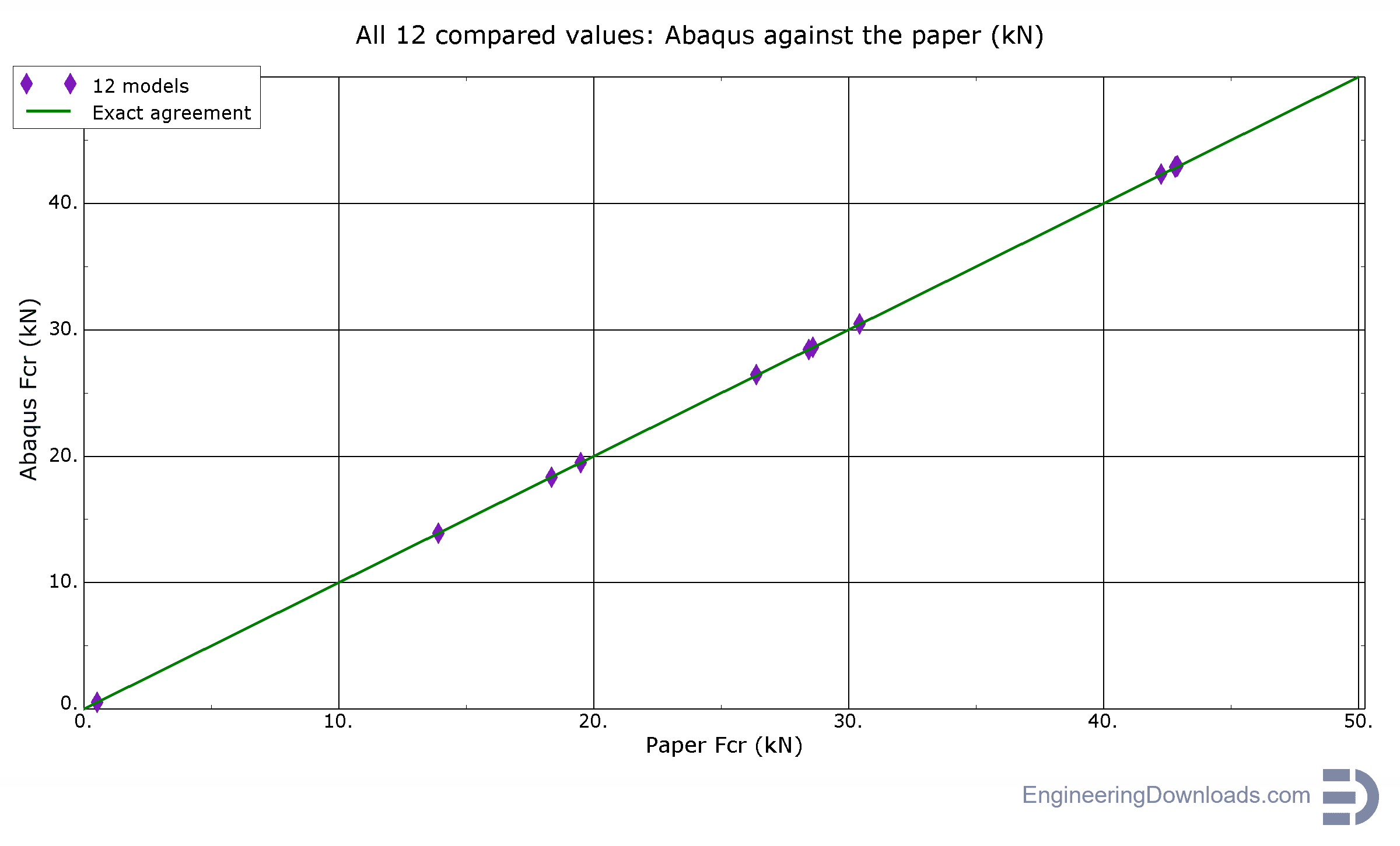
Abaqus X-Y plot: all 12 compared values, Abaqus against the paper, on the line of exact agreement
CasePaper (kN)Abaqus (kN)Error
Ex. 1, k1/k2 = 2.5/1.1, step at L/228.6028.633+0.12 %
Ex. 2, 0.65/2.2, step at L/218.3418.352+0.07 %
Ex. 3, 1.5/2.15, step at L/3 (h = 5 mm)26.3826.464+0.32 %
k1/k2 = 0.142.8942.975+0.20 %
k1/k2 = 0.342.8642.938+0.18 %
k1/k2 = 0.542.8142.895+0.20 %
k1/k2 = 142.2642.342+0.19 %
k1/k2 = 230.4230.459+0.13 %
k1/k2 = 519.4919.514+0.12 %
k1/k2 = 1013.9013.910+0.07 %
Ex. 5, uniform k, closed form28.4328.457+0.10 %
Ex. 6, no foundation, Euler0.53390.5341+0.03 %

Validation statement. All 12 critical forces agree with the reference within +0.03 % to +0.32 %, against a 5 % tolerance set before the runs. Ten references are the paper’s own Abaqus S4R values and two are closed forms. A 2x finer mesh changes the two cases tested by -0.02 % and -0.01 %, and Poisson’s ratio 0 instead of the assumed 0.3 changes Example 1 by -0.13 %. Example 3 uses the thickness implied by the paper’s stated second moment of area (see the limitations).
Mode shapes and localisation

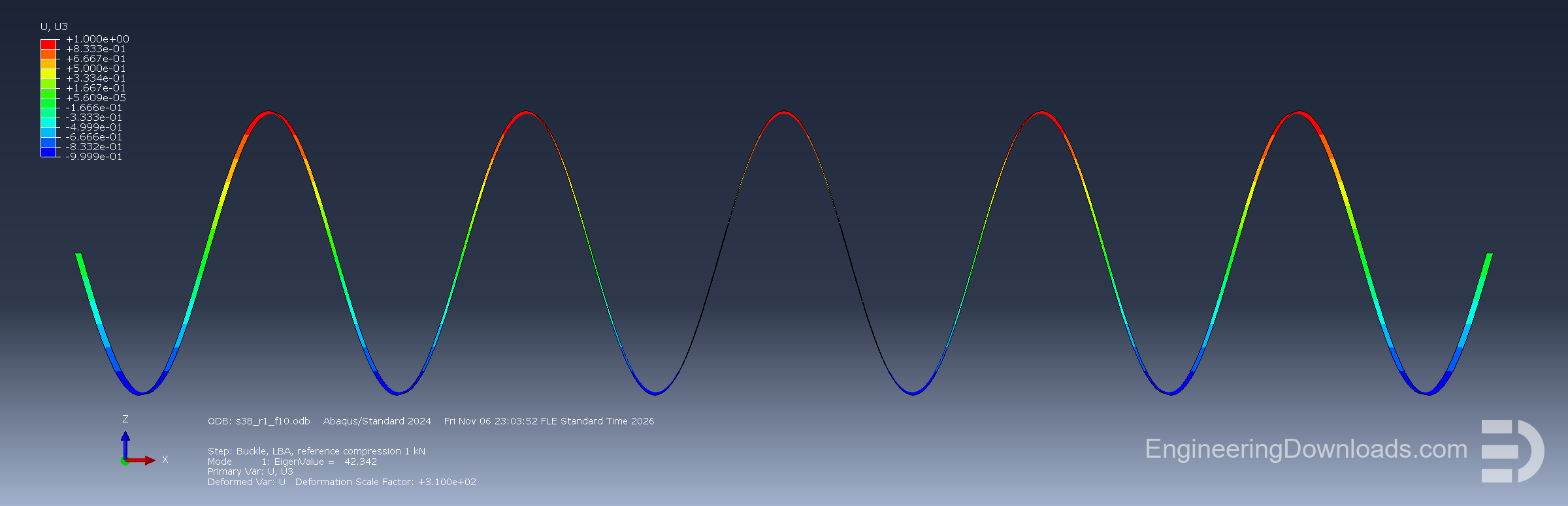
Abaqus/Viewer: uniform foundation (k1/k2 = 1), side view of the first mode, eigenvalue 42.342
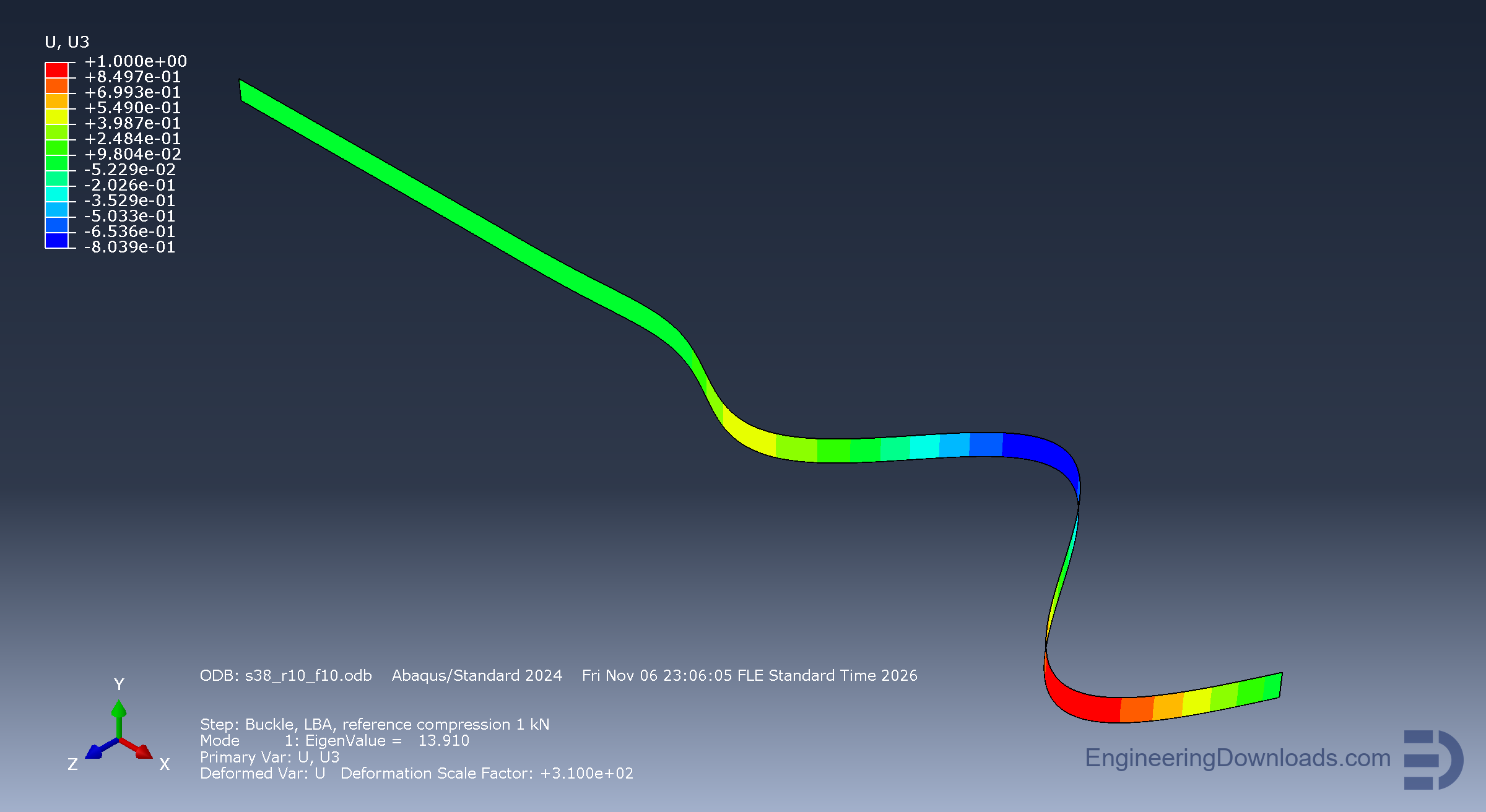
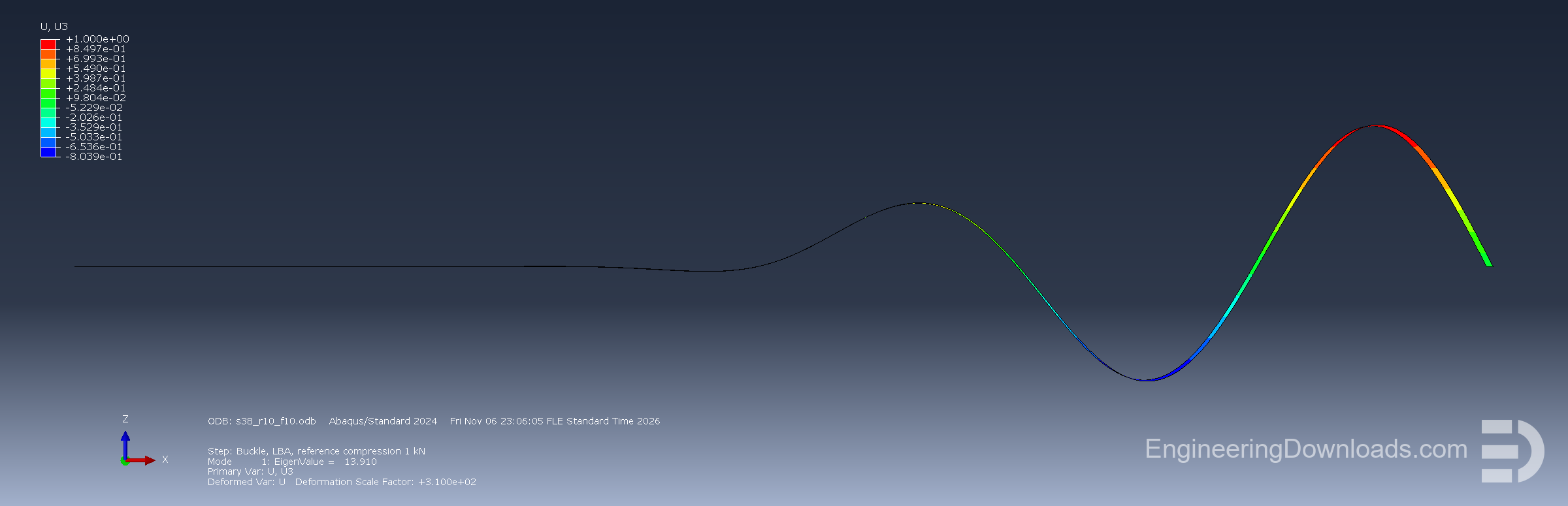
Abaqus/Viewer: k1/k2 = 10, side view of the first mode, eigenvalue 13.910: the stiff zone stays straight
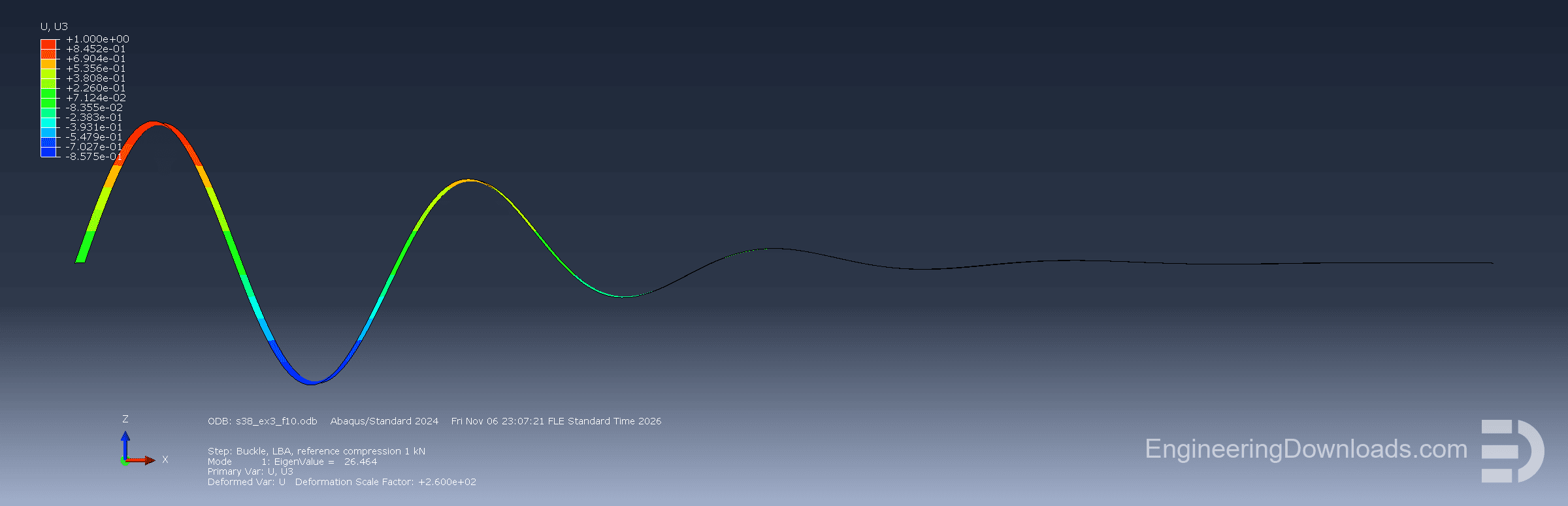
Abaqus/Viewer: Example 3, side view of the first mode, eigenvalue 26.464: the buckle sits in the softer zone at the loaded end
Abaqus/Viewer: k1/k2 = 10, the same mode in 3D

These are Abaqus/Viewer screenshots of the delivered output databases, with the out-of-plane displacement U3 as the contour (Abaqus normalises modes to 1) and the eigenvalue in the state block; Fcr is the eigenvalue x the 1 kN reference load. With a uniform foundation the wave is an even train of 11 half-waves. At k1/k2 = 10 the strip is straight in the stiff zone and all the buckling is in the soft zone. In Example 3 the short softer zone at the loaded end carries 97 % of the squared deflection.
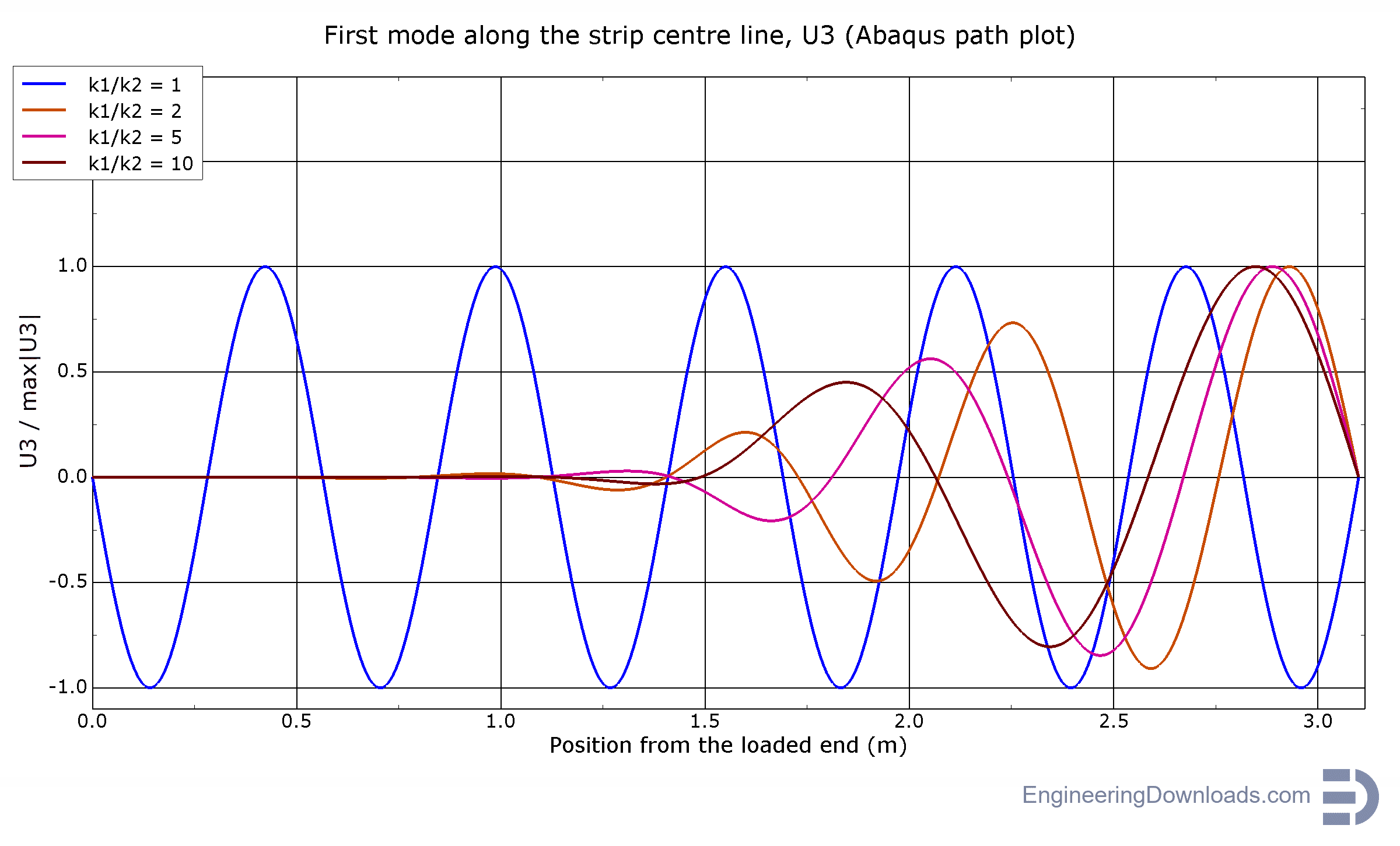
Abaqus X-Y path plot: first-mode deflection along the centre line for four stiffness ratios: the wave moves into the softer zone

Two regimes appear. When the second zone is stiffer or equal (k1/k2 of 1 or less), Fcr stays between 42.3 and 43.0 kN because the k1 zone governs. When it is softer, Fcr drops to 30.46, 19.51 and 13.91 kN for ratios 2, 5 and 10.

Hand check

The tutorial starts with a hand check you can do on a calculator: the Euler load for no foundation, 2 sqrt(E I k) and the whole-half-wave formula for a uniform foundation, and the lower bound for a stepped bar. The finite element values are within 0.01 % to 0.5 % of the hand values for the uniform and no-foundation cases. Note that the paper’s Example 5 value (28.43 kN) is the whole-half-wave value; the long-bar formula gives 28.32 kN, and the model is +0.50 % above that one.

Caveats you should read before buying

  1. The reference is a calculation, not a test. The paper’s finite element values and our model solve the same idealised problem. Agreement shows that Abaqus reproduces it. It does not give the stiffness of a real soil or support. You supply k.
  2. Example 3 follows the stated second moment, not the listed thickness. The paper lists h = 6 mm but states I = 781.25 mm4, which is h = 5 mm (h = 6 gives 1350 mm4). With h = 6 the model gives 35.00 kN (+32.7 %). With h = 5 it gives 26.464 kN (+0.32 %), and the paper’s own analytical value of 26.45 kN also needs I = 781.25. We chose h = 5 mm and the tutorial shows both numbers.
  3. Poisson’s ratio is assumed. The paper does not give it. We used 0.3 and measured the sensitivity for Example 1 only (-0.13 % for nu = 0).
  4. Ideal elastic buckling. No imperfections, no initial stress, no post-buckling, no yielding, no soil nonlinearity, no gapping. Fcr feeds a design check; it is not a resistance.
  5. Scope. Pinned ends, axial end compression, one step at L/2 or L/3, a stiffness ratio of 0.1 to 10 for one bar. Several steps, gradual change, a very short soft zone and other end conditions are not in the package.
  6. In-plane bending is suppressed on every run. That is right for a strip held in its plane and wrong for one that is free to buckle in plane.
  7. All differences to the reference are positive, a few tenths of a percent. We did not find a cause beyond the Poisson ratio and mesh checks and do not claim one.

What you download

  • 12 Abaqus/CAE models (.cae) with their input files (.inp): s38_ex1_f10, s38_ex2_f10, s38_ex3_f10, s38_r01_f10, s38_r03_f10, s38_r05_f10, s38_r1_f10, s38_r2_f10, s38_r5_f10, s38_r10_f10, s38_ex5_f10, s38_ex6_f10.
  • The base build script, the variant generator and read_fcr.py (eigenvalues to Fcr and comparison with the reference).
  • The 32-page PDF tutorial in 14 chapters: buckling on an elastic foundation, the problem and its inputs, the hand check, the shell model and mesh, the elastic foundation on shells, boundary conditions and in-plane bending, the axial load and the sign pitfall, the buckle and static steps, running the jobs, results against the paper, buckling localisation, three checks (Example 3, mesh, Poisson ratio), limitations, and adapting the model.
  • A readme with the file list, the units and how to get Fcr from the eigenvalue.

The solver output databases are not included. Every model can be rerun in about a minute.

Who it is for

Geotechnical and structural engineers who check piles, sheet piles and embedded struts in layered soil. Rail, pipe and strip engineers dealing with non-uniform elastic support. Analysts who need an inspectable Abaqus recipe for shell buckling with an elastic foundation per unit area. Researchers and students who want a worked reproduction of a published stepped-foundation study.

Requirements

  • Abaqus/CAE and Abaqus/Standard 2024.
  • Any ordinary workstation.
  • No user subroutines and no extra licences.

Why buy

  • A complete, inspectable chain from the foundation stiffness to Fcr: shell, two-zone foundation, boundary conditions, edge load, buckle step, equilibrium check.
  • A hand check on a calculator, including the lower bound that predicts a stepped bar to a few percent.
  • Three traps that give plausible but wrong results, each with the check that catches it: foundation per unit area, in-plane bending, and the sign of the edge load.
  • An honest treatment of a paper inconsistency (Example 3) with both numbers shown.
  • Buckling localisation made visible, with practical rules for layered soil and poor stretches.

Need more than the files?

There are two ways we can help. Book a one hour online consultation if you want to talk a problem through with a CAE engineer, using the checkbox in the order box. Order a project if you need a full simulation built for you, delivered to an agreed scope, price and deadline under a written contract.

We work on FEA and CFD for engineers, researchers and companies. Order your project, or message us on WhatsApp for a quick reply.

Course Content

Product files

  • Abaqus CAE + INP + Python scripts + PDF (12 models, complete package)
  • Tutorial document (PDF)

Reviews

No Review Yet
No Review Yet
€129,00
Optional extras

Need a full custom project? See the options below.

12 people watching this product now!

Material Includes

  • 12 Abaqus/CAE models (.cae) with their input files (.inp): s38_ex1_f10, s38_ex2_f10, s38_ex3_f10, s38_r01_f10, s38_r03_f10, s38_r05_f10, s38_r1_f10, s38_r2_f10, s38_r5_f10, s38_r10_f10, s38_ex5_f10, s38_ex6_f10.
  • The base build script, the variant generator and read_fcr.py (eigenvalues to Fcr and comparison with the reference).
  • The 32-page PDF tutorial in 14 chapters: buckling on an elastic foundation, the problem and its inputs, the hand check, the shell model and mesh, the elastic foundation on shells, boundary conditions and in-plane bending, the axial load and the sign pitfall, the buckle and static steps, running the jobs, results against the paper, buckling localisation, three checks (Example 3, mesh, Poisson ratio), limitations, and adapting the model.
  • A readme with the file list, the units and how to get Fcr from the eigenvalue.

Audience

  • Geotechnical and structural engineers who check piles
  • Sheet piles and embedded struts in layered soil. Rail
  • Pipe and strip engineers dealing with non-uniform elastic support. Analysts who need an inspectable Abaqus recipe for shell buckling with an elastic foundation per unit area. Researchers and students who want a worked reproduction of a published stepped-foundation study

Related  Products

See more

Want to receive push notifications for all major on-site activities?

✕