

Need a full custom project? See the options below.
Need a full custom project? See the options below.
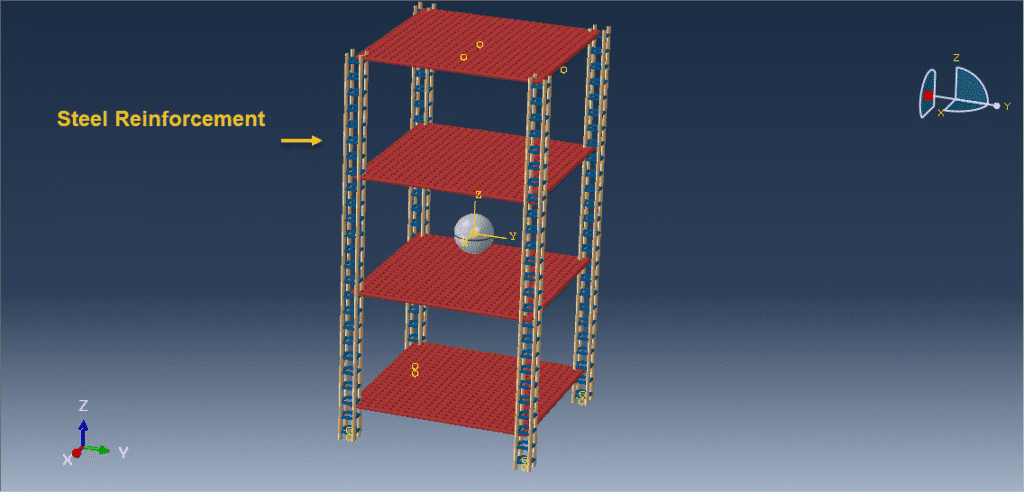
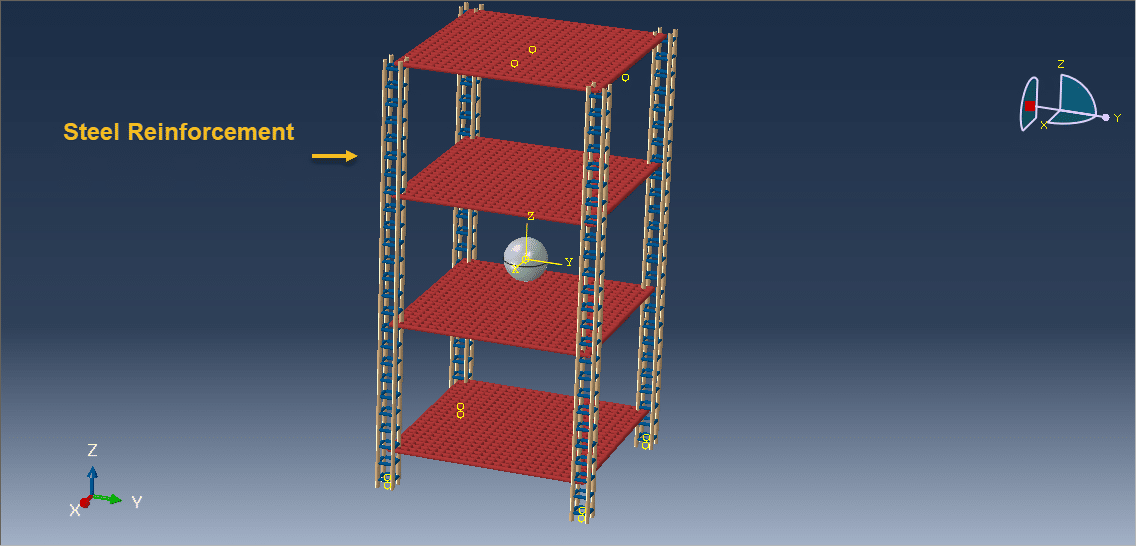
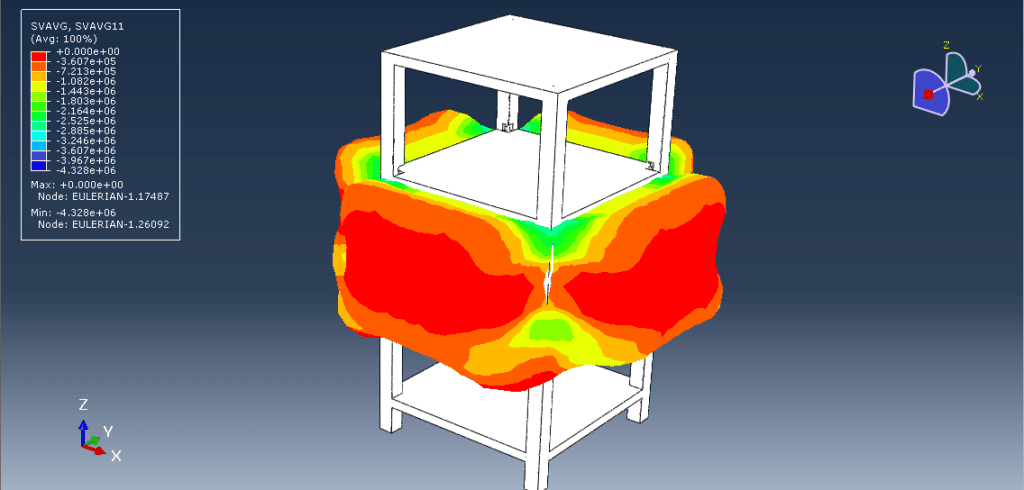
In this tutorial, the simulation of a CEL explosion inside a reinforced concrete (RC) UHPC building has been carried out in Abaqus to investigate structural damage. The ultra-high-performance concrete (UHPC) building is modeled as a three-dimensional solid part, the reinforcements are modeled as wire parts, and the TNT charge is represented as a spherical solid part inside the Eulerian domain. Explosions are short-duration dynamic events that generate high-pressure waves propagating radially from the source and inducing strong dynamic responses in nearby structures. These impulsive loads impart significant energy to affected surfaces, often leading to severe vibrations and structural damage. Explosives are generally categorized as physical, nuclear, or chemical, and further classified according to their physical state as solids, liquids, or gases. High explosives (HE), such as TNT, RDX, PETN, and C4, detonate rapidly, releasing large amounts of energy in the form of heat and pressure. To represent explosive behavior in this study, the TNT charge is modeled using the Jones-Wilkins-Lee (JWL) equation of state, which describes the pressure-volume-energy relationship of detonation products. This model is implemented in a programmed burn form, where initiation is defined by detonation speed and geometry rather than shock. The UHPC material is modeled using the Johnson-Holmquist-II (JH-2) formulation, which accounts for the increase in strength under hydrostatic pressure, degradation due to damage, and progressive failure with plastic deformation. Data for JH-2 parameters are taken from published reference studies. The reinforcements are defined as elastic-plastic steel materials with damage properties. A dynamic explicit step is used, which is appropriate for capturing fast transient events such as explosions. Reinforcements are embedded in the UHPC matrix, proper boundary conditions and initial states are applied, and a fine mesh is generated to improve accuracy of the results. After the simulation, the analysis provides results including stress, strain, structural damage, reinforcement response, and blast wave propagation through the building.
Need more than the files?
There are two ways we can help. Book a one hour online consultation if you want to talk a problem through with a CAE engineer, using the checkbox in the order box. Order a project if you need a full simulation built for you, delivered to an agreed scope, price and deadline under a written contract.
We work on FEA and CFD for engineers, researchers and companies. Order your project, or message us on WhatsApp for a quick reply.
Other packages engineers working on this topic also download.
 Analysis of the CEL explosion near the steel-UHPC composite RC column with multiple encased steel profiles
 Underwater and Underground Explosion Simulation Package in Abaqus (20 Models)
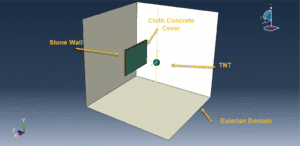 Simulation of CEL Explosion Near a Stone Wall Covered with Cloth and Concrete in Abaqus
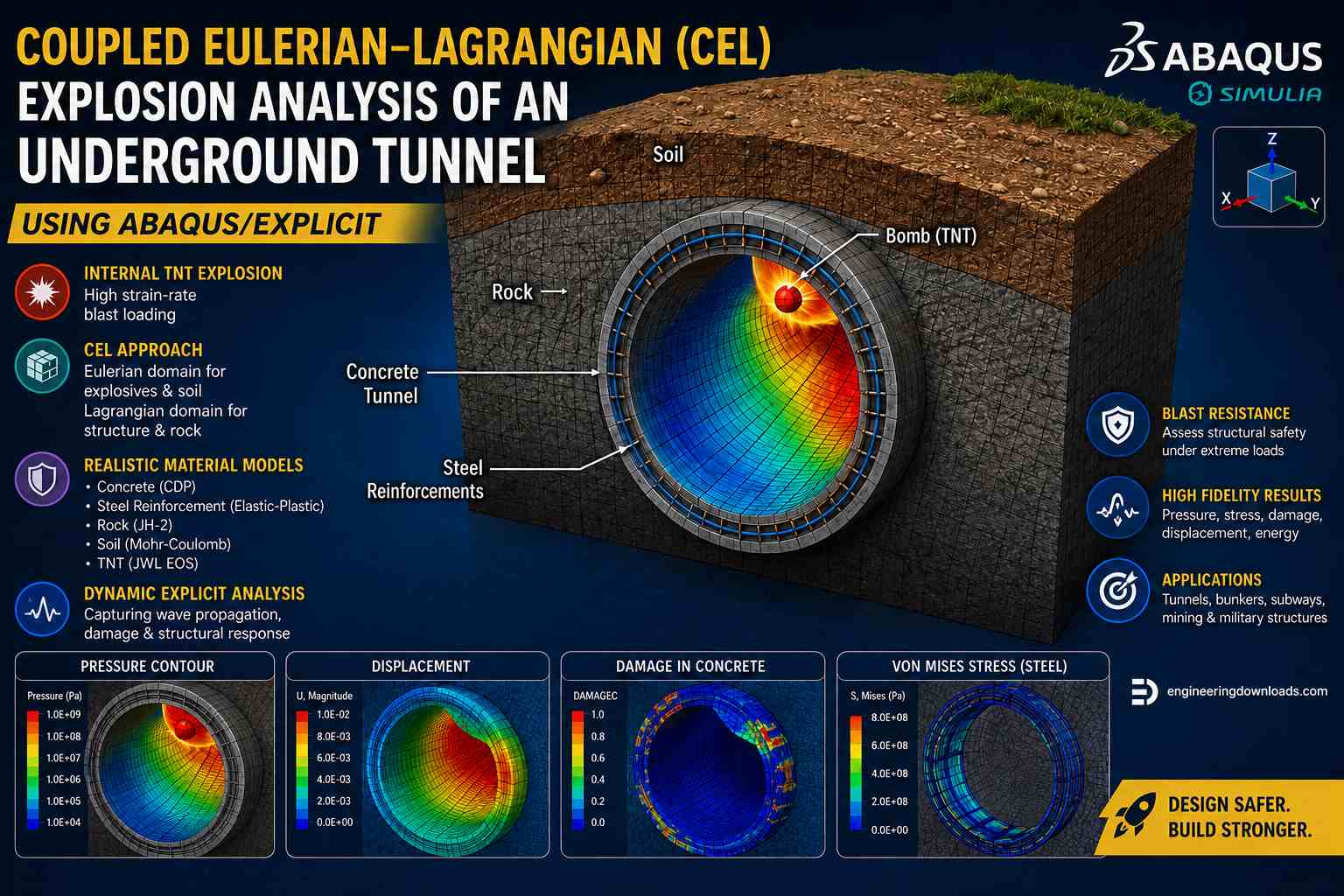 Analysis of a CEL explosion in an underground tunnel
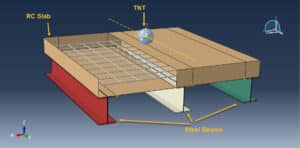 Analysis of close-range blast loading based on the CEL method over a concrete composite concrete slab
 Ceramic and Silicon Carbide Simulation Package in Abaqus (17 Armour and Impact Models)
 Blast and Explosion Simulation Package in Abaqus (26 Models)
 Analysis of an ice sheet in interaction with water subjected to underwater explosion load

Need a full custom project? See the options below.

€129,00

€179,00

€149,00

€119,00

€129,00

€149,00
See more
Want to receive push notifications for all major on-site activities?