Need a full custom project? See the options below.
Need a full custom project? See the options below.
Paper Title: Stability Analysis and Novel Damage Identifcation of Multispan Fluid-Conveying Pipes Immersed in a Fluid Using Orthogonal Matching Pursuit
This framework follows the methodology published in the following open access article:
Understanding the stability and damage behavior of fuid-conveying pipes is crucial in many engineering applications, including ofshore and energy systems. This paperproposes anovel and unifedframeworkfor stability analysis and damage identifcation of a multispan fuid-conveying pipe submerged in an external fuid, addressing a problem that has not previously been systematically investigated. Moreover, the paper presents a detailed stability analysis, examining how various key system parameters infuence the critical fow velocities associated with diferent vibration modes. The study introduces a systematically constructed and normalized sparse dictionary within the orthogonal matching pursuit (OMP) framework, explicitly defned from the structure’s mode shapes to enable consistent and reproducible sparse reconstruction. The OMP implementation employs clearly defned sparsity and stopping criteria to ensure reproducibility of the damage identifcation procedure. The proposed methoddemonstrates signifcantly improved accuracy in damage detection compared to conventional dictionaries. Validation is carried out in two
benchmark cases: (i) a single-span pipe conveying internal moving fuid and submerged in an external fuid and (ii) a multispan beam in the absence of surrounding fuids; in both cases, good agreement with existing studies is observed. In addition, to evaluate the practical applicability of the proposed damage identifcation method, an experimental test was conducted to detect damage in a fuid-conveying pipe submerged in an external fuid.
Citation: Jafari-Talookolaei, R.-A. and Abedi, M. (2026). Stability Analysis and Novel Damage Identification of Multispan Fluid-Conveying Pipes Immersed in a Fluid Using Orthogonal Matching Pursuit. Structural Control and Health Monitoring, 2026:6806524. https://doi.org/10.1155/stc/6806524
If you are researching fluid-conveying pipes, you already know where the time goes. Deriving the equations of motion is manageable. Coding a working finite element solver, getting the complex eigenvalue problem to behave, identifying where divergence turns into flutter, and then building a damage detection routine on top of it — that is months of debugging.
Most published papers show the results. Almost none give you the code.
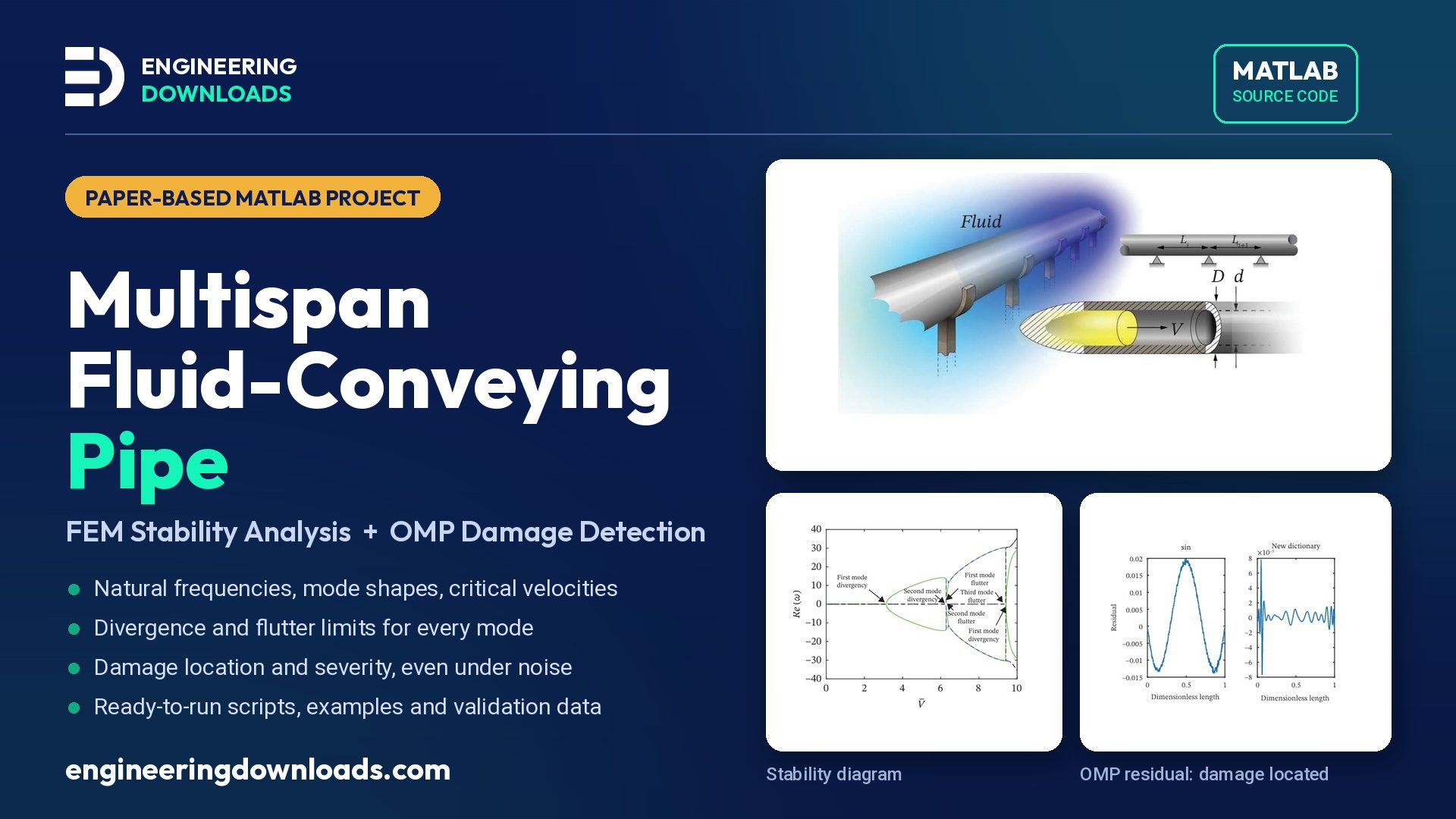
This is a complete, working MATLAB framework. It covers the full chain: finite element formulation, vibration analysis, stability assessment, and vibration-based damage identification, all in one package.
The pipe model includes internal flowing fluid and the surrounding external stationary fluid. Both are treated properly, not simplified away. You can set the number of spans, boundary conditions, flow velocity, axial force, mass ratios, and damage scenarios, then run the analysis.
Finite element solver
Three-node beam element with six degrees of freedom. Mass, damping, and stiffness matrices are assembled for the full multispan structure. Boundary conditions are applied with the penalty method, so you can model free, simply supported, clamped, or elastic supports by changing spring stiffness values.
Fluid-structure interaction
Internal fluid contributes added mass, Coriolis, and centrifugal terms. External fluid contributes virtual added mass and viscous drag. Hydrostatic pressure effects are included.
Vibration and stability analysis
Solves the complex eigenvalue problem and returns real and imaginary parts of the frequency against dimensionless flow velocity. Divergence and flutter points are identified for each mode. Stability diagrams are generated directly.
Damage identification with OMP
This is the part that is hard to find elsewhere. The code implements Orthogonal Matching Pursuit with a sparse dictionary built from Legendre polynomials, normalised and constructed from the structure’s own mode shapes. The residual between the measured and reconstructed mode shape shows a sharp spike at the damage location.
Conventional sine, cosine, and DCT dictionaries often miss damage near supports or at low severity. The dictionary implemented here does not have that weakness, and it can be combined with the conventional dictionaries as well.
Noise robustness
Gaussian noise can be added to the mode-shape data to test whether the method still finds the damage under realistic measurement conditions.
Parametric studies
Ready-to-run cases for the effect of number of spans, dimensionless axial force, mass ratio, boundary spring stiffness, damage location, and damage intensity.
After working through this package you will be able to:
MATLAB. No additional toolboxes beyond standard numerical functions. The code is modular, commented, and written so you can change the pipe geometry, fluid properties, span configuration, and damage cases without rewriting the solver.
If your project needs a different pipe configuration, other boundary conditions, a different flow regime, or a customised damage detection setup, we can build it for you. See our simulation and consulting services, or if the analysis is heavy, use our HPC rental starting from EUR 5 per week.
Working towards a publication? Our paper support service covers validation, manuscript writing, and journal selection, with first authorship staying with you.
Quality guarantee: if you are not satisfied with the delivered files, we refund you.
Questions before buying? Message us on WhatsApp for a free consultation.
Need more than the files?
There are two ways we can help. Book a one hour online consultation if you want to talk a problem through with a CAE engineer, using the checkbox in the order box. Order a project if you need a full simulation built for you, delivered to an agreed scope, price and deadline under a written contract.
We work on FEA and CFD for engineers, researchers and companies. Order your project, or message us on WhatsApp for a quick reply.
Other packages engineers working on this topic also download.
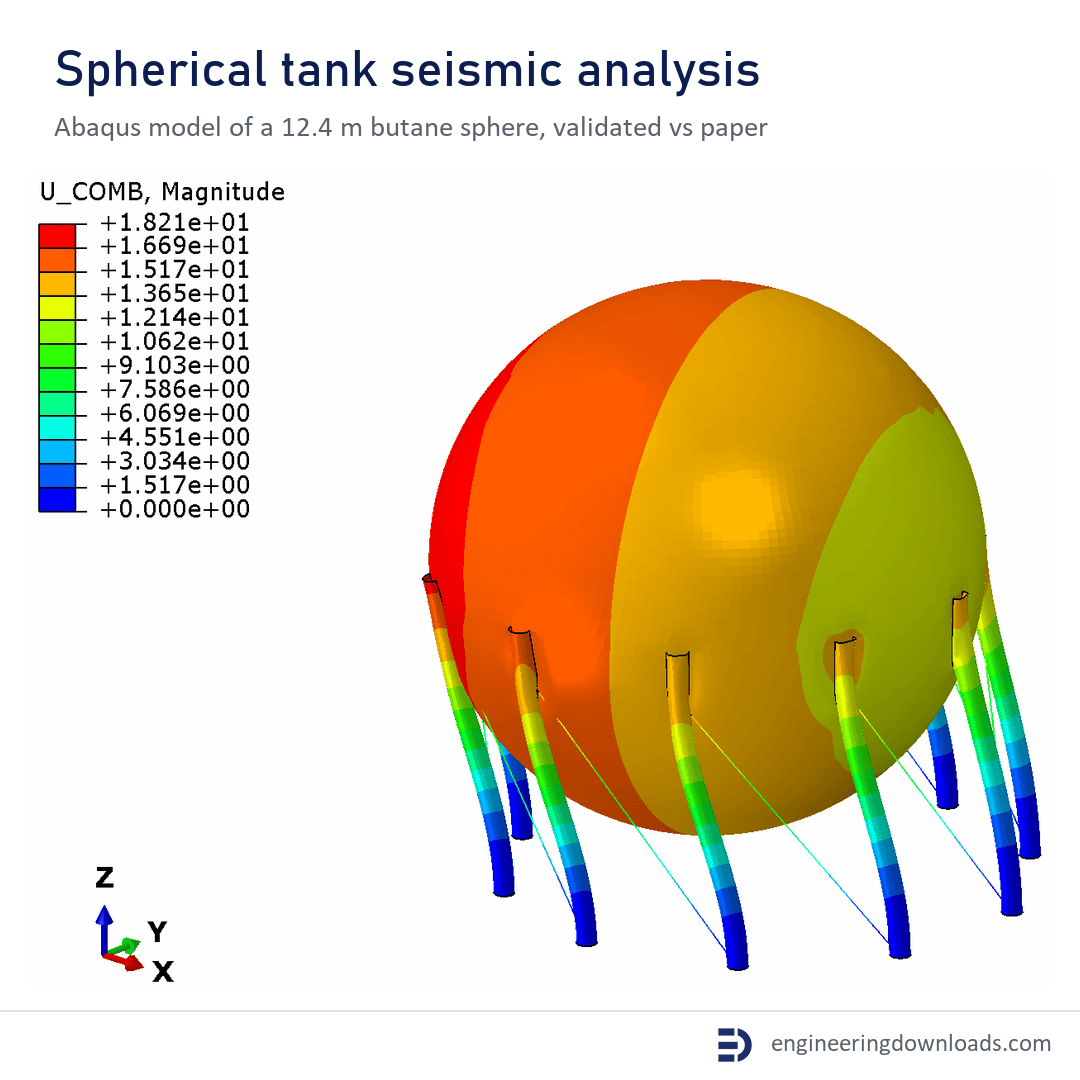 Seismic Analysis of a Spherical Liquid Storage Tank in Abaqus: Response Spectrum, Legs and X-Braces
 Abaqus Rotor Kit Unbalance Response: Two-Disc Shaft Model, Natural Frequencies and Campbell Diagram€129,00
 CFD Analysis and Analytical Validation of Two-Phase Flow in a Pressure Swirl Injector (ANSYS Fluent)
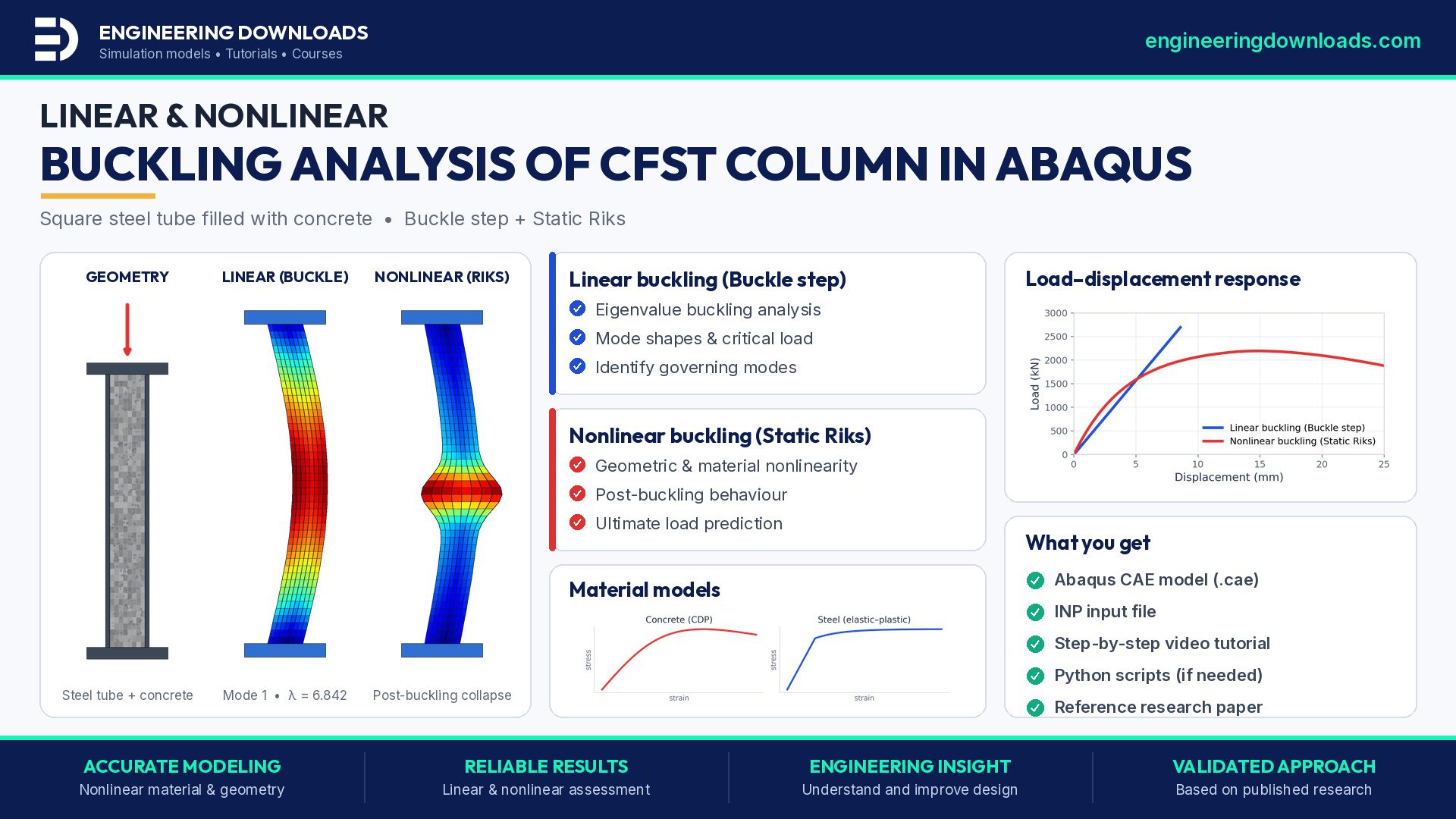 Buckling Analysis of a Concrete-Filled Steel Tube (CFST) Column Using Abaqus
 Seismic Response of a Steel Building in Abaqus: Nonlinear Dynamic Analysis with Beam Elements
 Analysis of the CEL sequential underwater explosion near a steel pipeline
 MATLAB Code for Finite Element analysis of Pipes: Free Vibration Analysis and Validation
 MATLAB Code for Finite Element analysis of Pipes: Static Analysis and Validation

Need a full custom project? See the options below.

€129,00

€179,00

€149,00

€119,00

€129,00

€149,00
See more
Want to receive push notifications for all major on-site activities?