Need a full custom project? See the options below.
Need a full custom project? See the options below.
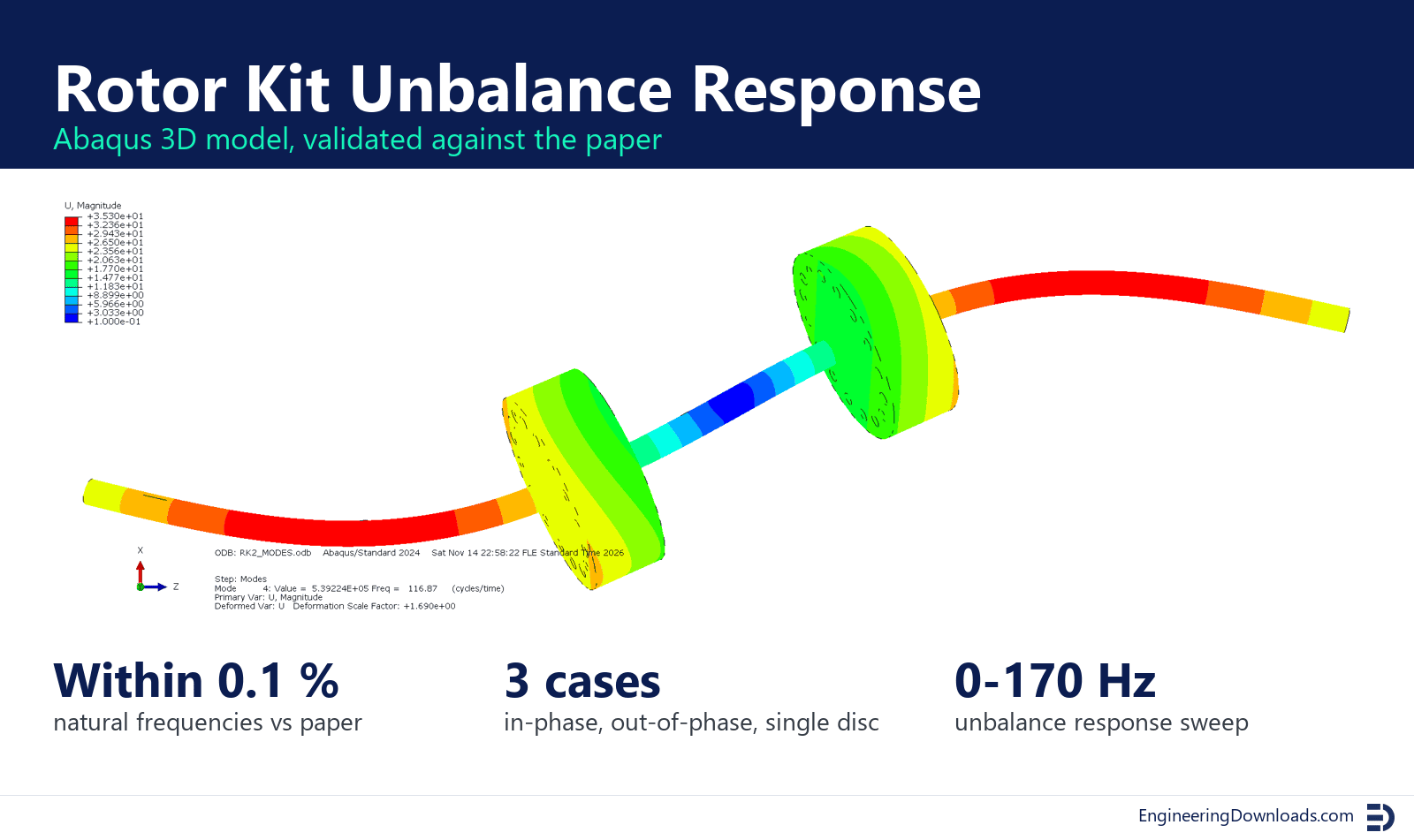
An Abaqus 3D solid model of the RK4 rotor kit with two identical discs between the bearings, built after Katinic, Kolar, Konjatic and Bosnjakovic (Tehnicki glasnik 17(3), 2023). The natural frequencies match the paper within 0.1 %, and the model sweeps the unbalance response from 1 to 170 Hz for in-phase, out-of-phase and single-disc unbalance. You get three Abaqus CAE models with ready input files, key images and an 11-page PDF tutorial.
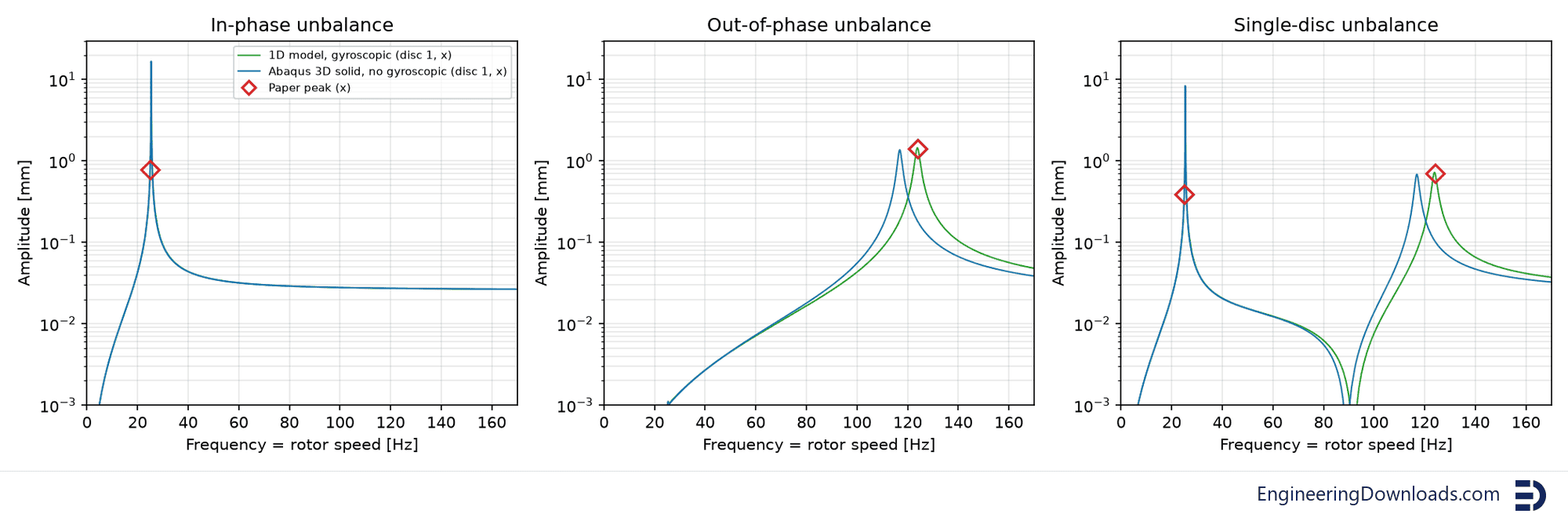
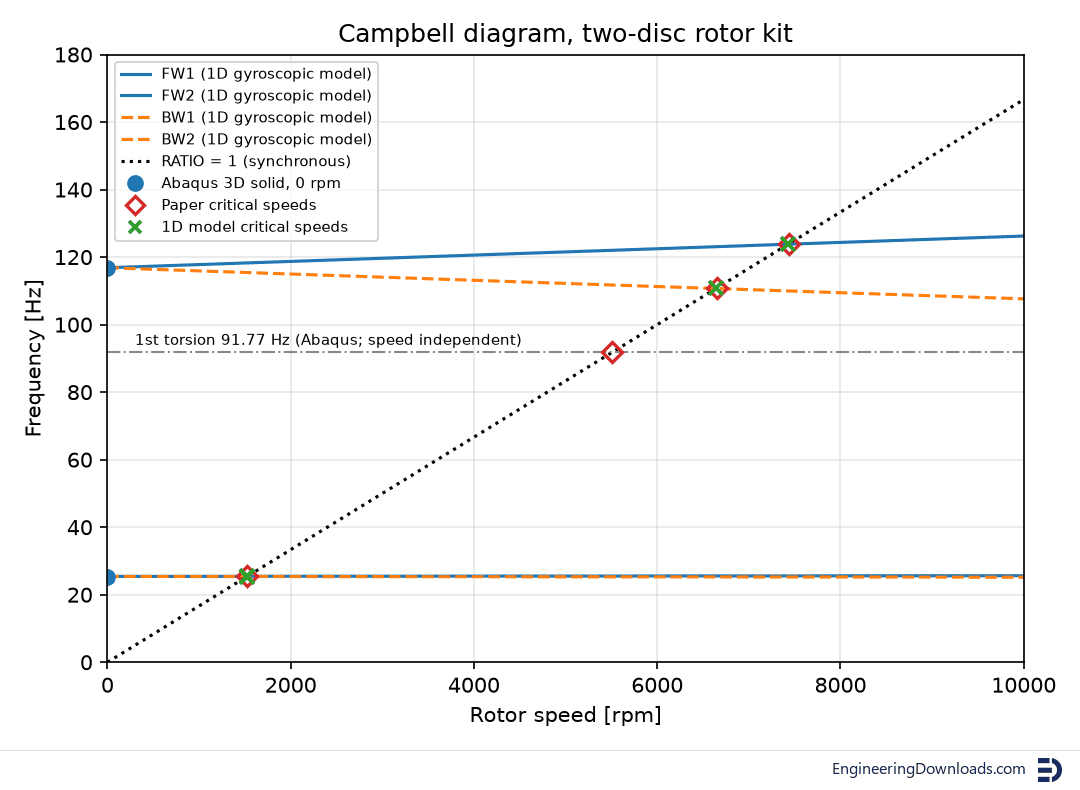
What this is, and is not. It reproduces the finite element results of the paper in Abaqus/Standard. The unbalance response is a zero-speed modal steady-state analysis: it shows the right mode selectivity and the peak places (25.37 Hz and 116.88 Hz), but it has no gyroscopic term. The shifted second-mode peak near 124 Hz of the paper, the Campbell diagram and the critical speeds come from an independent 1D rotor model that is shown in the tutorial for comparison and is not part of the download. One mesh only, no convergence study, and no test-rig measurement.
| Feature | Abaqus implementation |
|---|---|
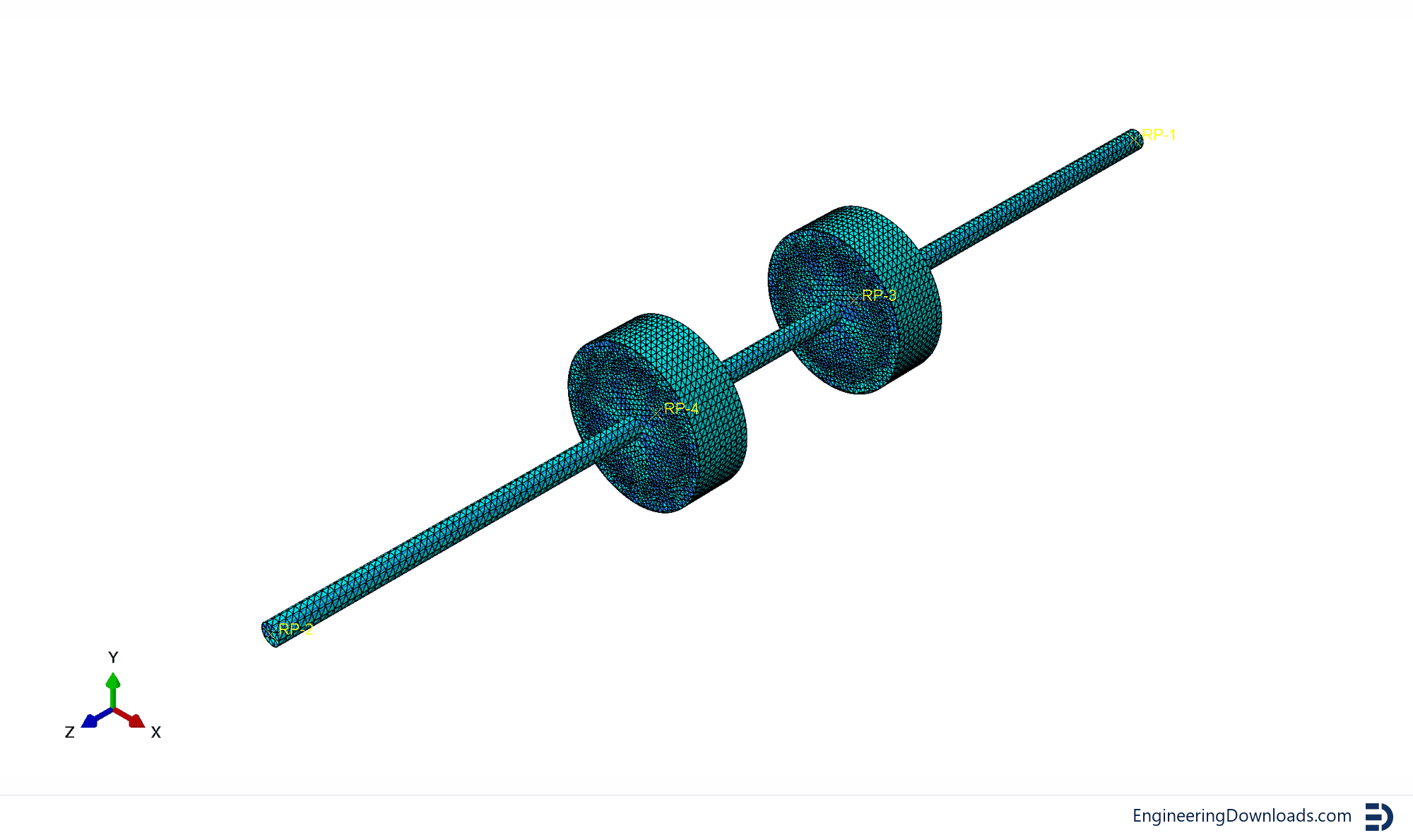
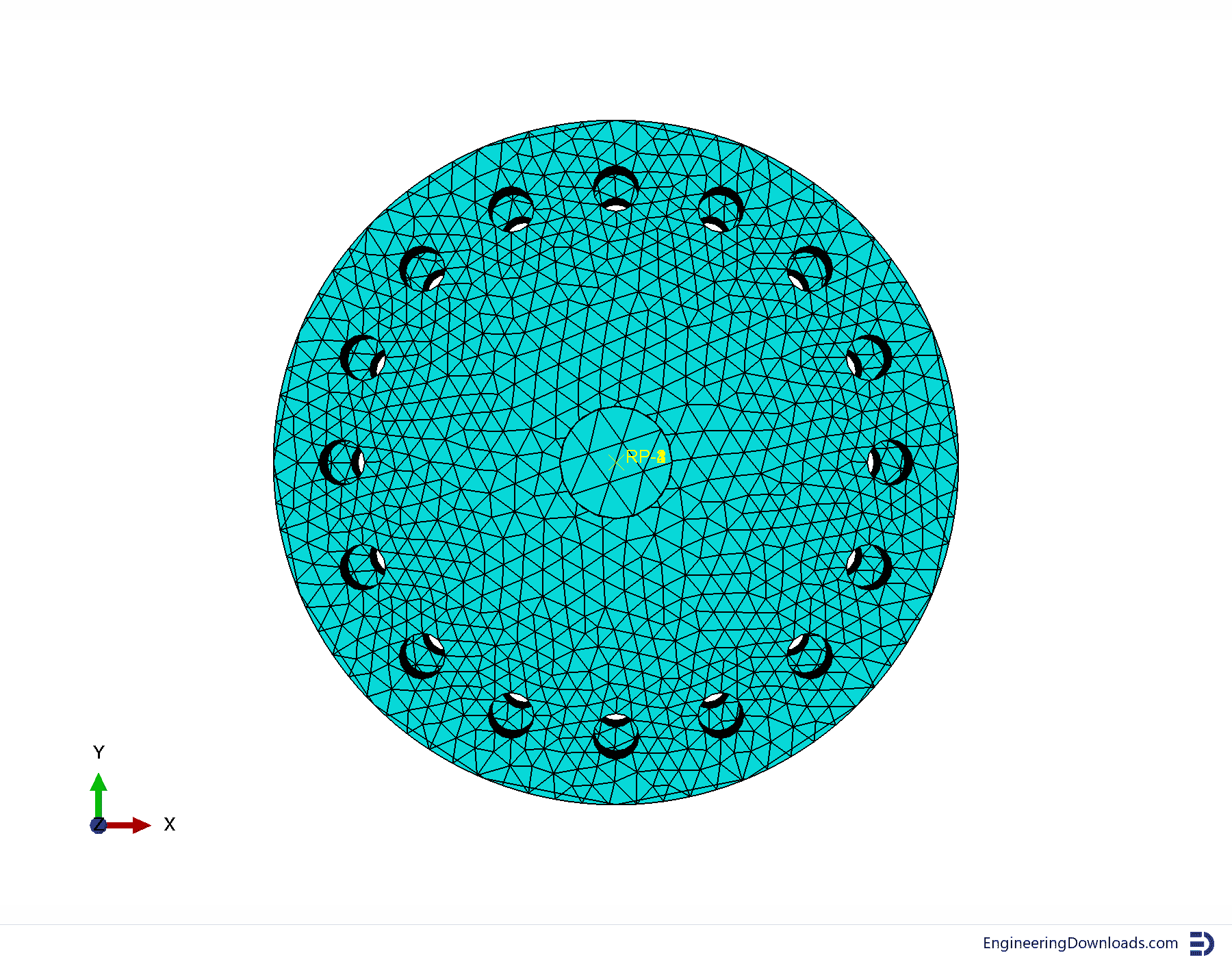
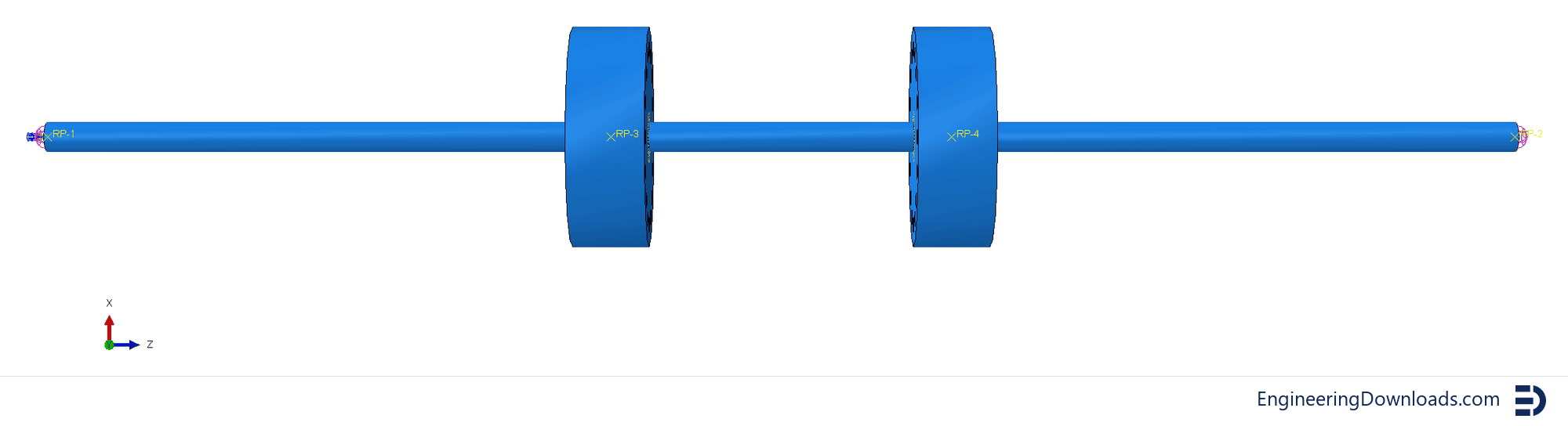
| Geometry | Steel shaft D10 x 500 mm; two discs D75 x 26 mm with 16 holes D5 on R30, at z = 179 and 295 mm |
| Mesh | C3D10 tetrahedra, 3 mm (as in the paper): 129,716 elements and 192,293 nodes (two discs); 69,540 elements and 104,129 nodes (single disc) |
| Material | Steel, E = 210 GPa, Poisson ratio 0.3, density 7850 kg/m3 |
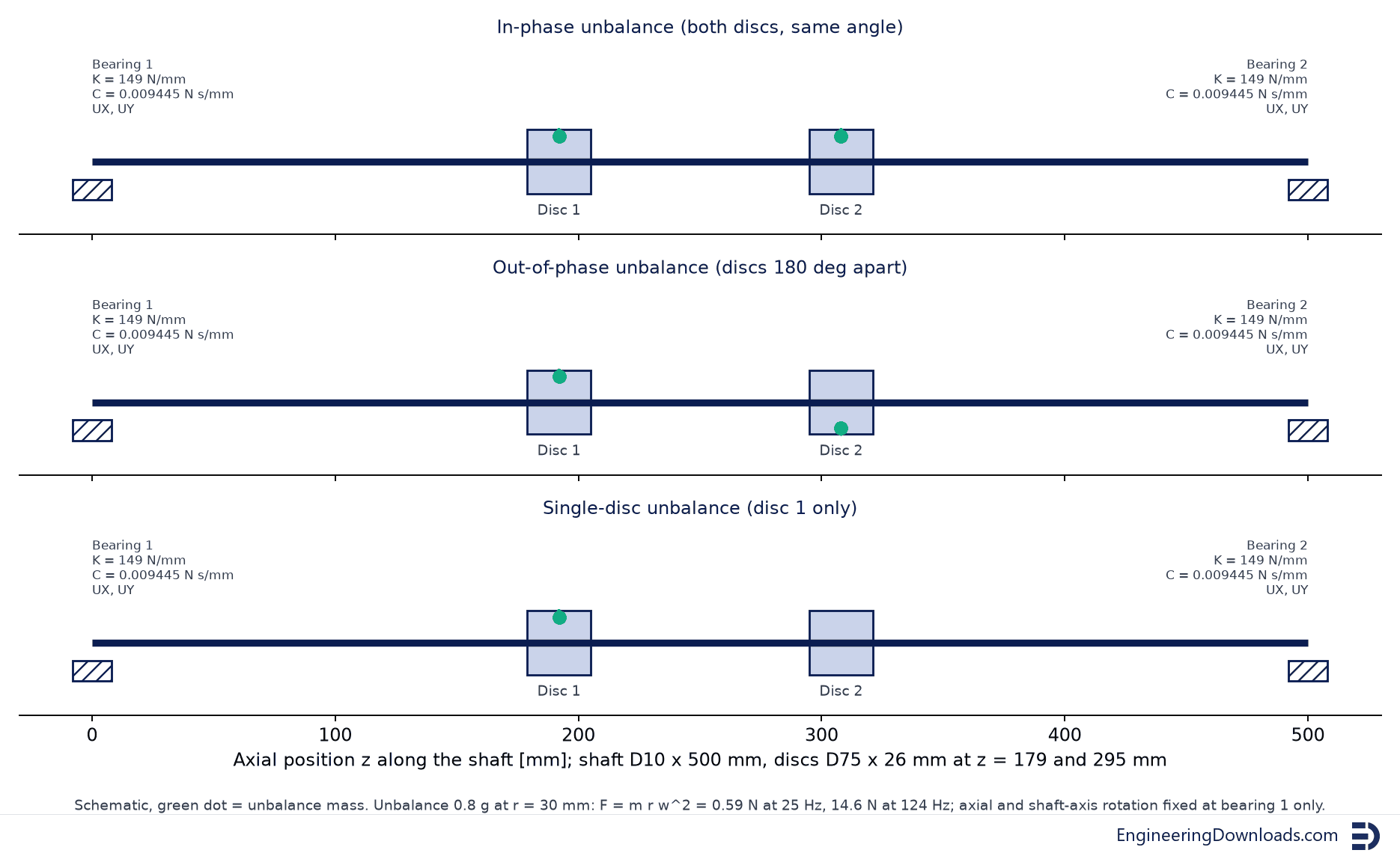
| Bearings | Spring 149 N/mm and dashpot 0.009445 N s/mm in X and Y at both shaft ends (paper values) |
| Constraints | Kinematic couplings at the shaft ends, distributing couplings at the disc hubs; axial and shaft-axis rotation fixed at one bearing node only |
| Procedures | Frequency (Lanczos) and modal steady-state dynamics 1 to 170 Hz with finer points at the two bending resonances |
| Unbalance | 0.8 g at r = 30 mm, force F = m r w^2 rotating with the shaft; in-phase, out-of-phase and single disc |
| Run time | About 4, 6.5 and 16.5 minutes on 6 CPU cores (Abaqus 2024) |
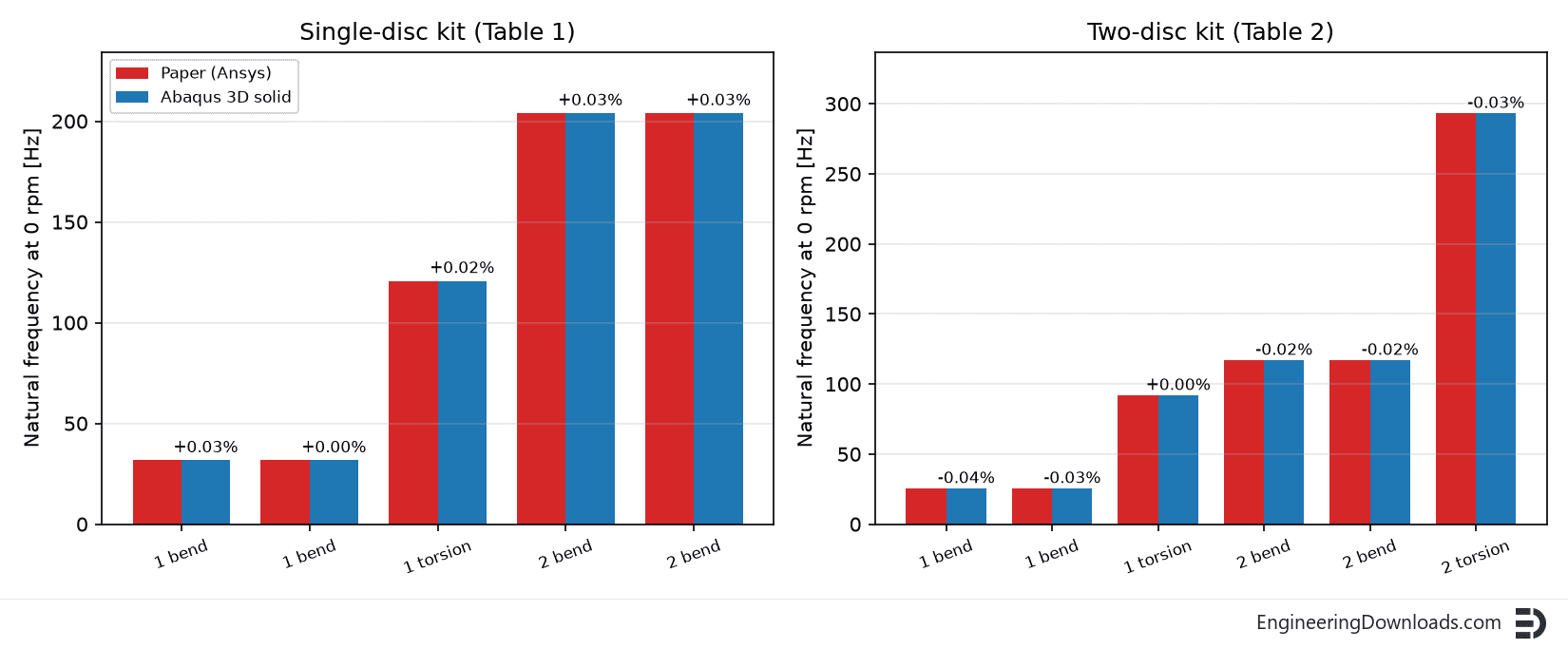
All eleven values of Tables 1 and 2 of the paper are reproduced within 0.1 %. The torsion modes only match when the shaft-axis rotation is fixed at one bearing node, which the tutorial explains.
| Mode | Paper (Hz) | Abaqus (Hz) |
|---|---|---|
| Single disc, 1st bending | 31.66 / 31.67 | 31.669 / 31.670 |
| Single disc, 1st torsion | 120.67 | 120.69 |
| Single disc, 2nd bending | 203.85 / 203.85 | 203.91 / 203.92 |
| Two discs, 1st bending | 25.38 / 25.38 | 25.370 / 25.372 |
| Two discs, 1st torsion | 91.77 | 91.773 |
| Two discs, 2nd bending | 116.89 / 116.90 | 116.87 / 116.88 |
| Two discs, 2nd torsion | 293.12 | 293.04 |
The in-phase unbalance excites only the first bending mode, the out-of-phase unbalance only the second, and the single-disc unbalance both, as in the paper. Abaqus peak amplitudes agree with the 1D model without gyroscopic terms within 6 % (first mode) and 0.3 % (second mode). Because the damping is light, the amplitude at the exact paper sample frequency is sensitive to a shift of 0.1 Hz in the natural frequency.
| Disc 1, X (mm) | Paper | Abaqus 3D | 1D model with gyroscopics |
|---|---|---|---|
| In-phase, 25 Hz | 0.790 | 0.865 | 0.716 |
| Single disc, 25 Hz | about 0.40 | 0.433 | 0.358 |
| Out-of-phase, 124 Hz | 1.415 | 0.179 | 1.434 |
| Single disc, 124 Hz | 0.705 | 0.103 | 0.719 |
The two 124 Hz rows show the limit of the Abaqus model: without the gyroscopic term its second-mode peak stays at 116.88 Hz. The 1D model column is a calibrated cross-check, not an Abaqus result.
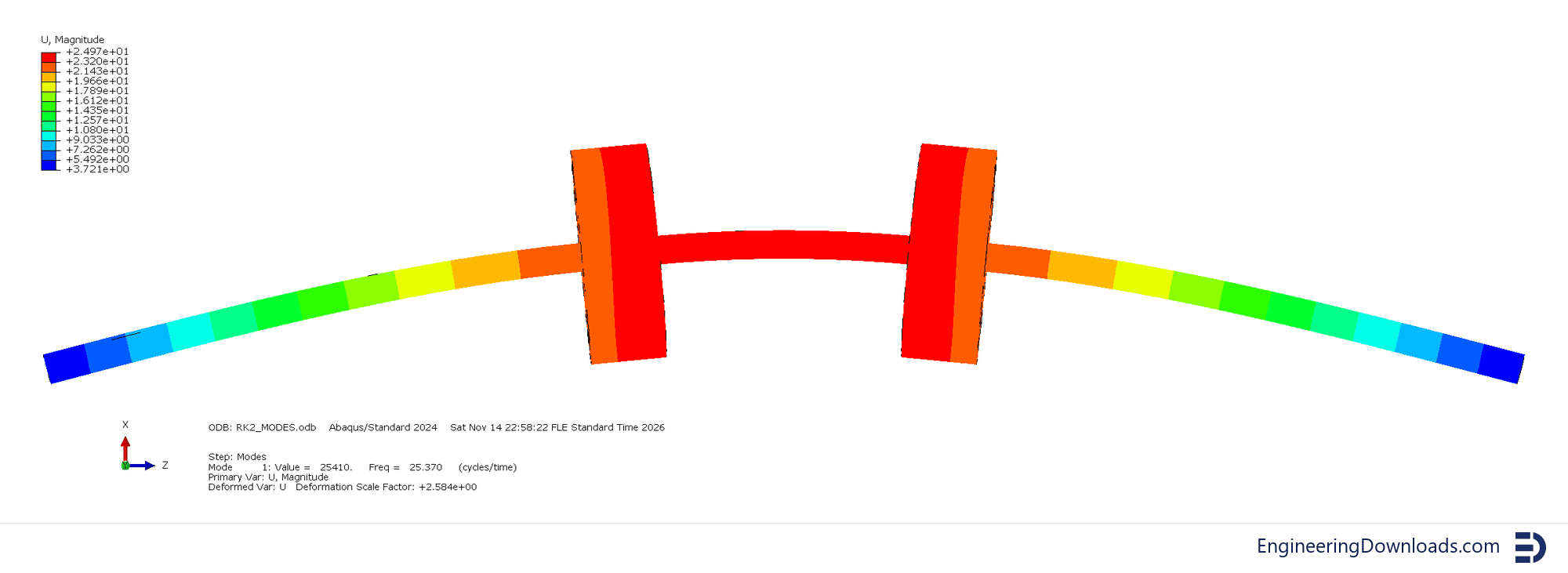
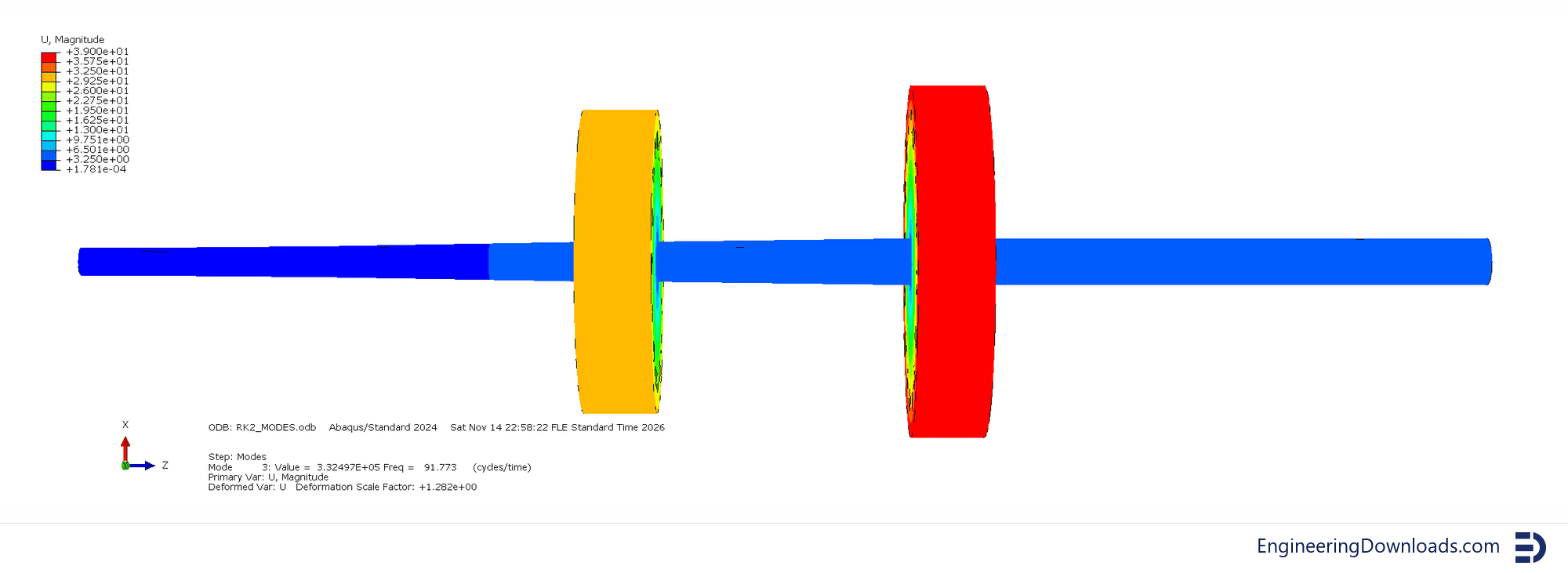
The tutorial walks through the geometry, material, 3 mm mesh, couplings, bearing springs and the boundary condition, with the Abaqus/CAE views below.
Katinic M., Kolar D., Konjatic P., Bosnjakovic M., Unbalance Response Analysis of a Rotor Kit with Two Identical Discs Located Between Bearings, Tehnicki glasnik 17(3), 2023, 324-331. Paper values are quoted for comparison only.
Need more than the files?
There are two ways we can help. Book a one hour online consultation if you want to talk a problem through with a CAE engineer, using the checkbox in the order box. Order a project if you need a full simulation built for you, delivered to an agreed scope, price and deadline under a written contract.
We work on FEA and CFD for engineers, researchers and companies. Order your project, or message us on WhatsApp for a quick reply.
Other packages engineers working on this topic also download.
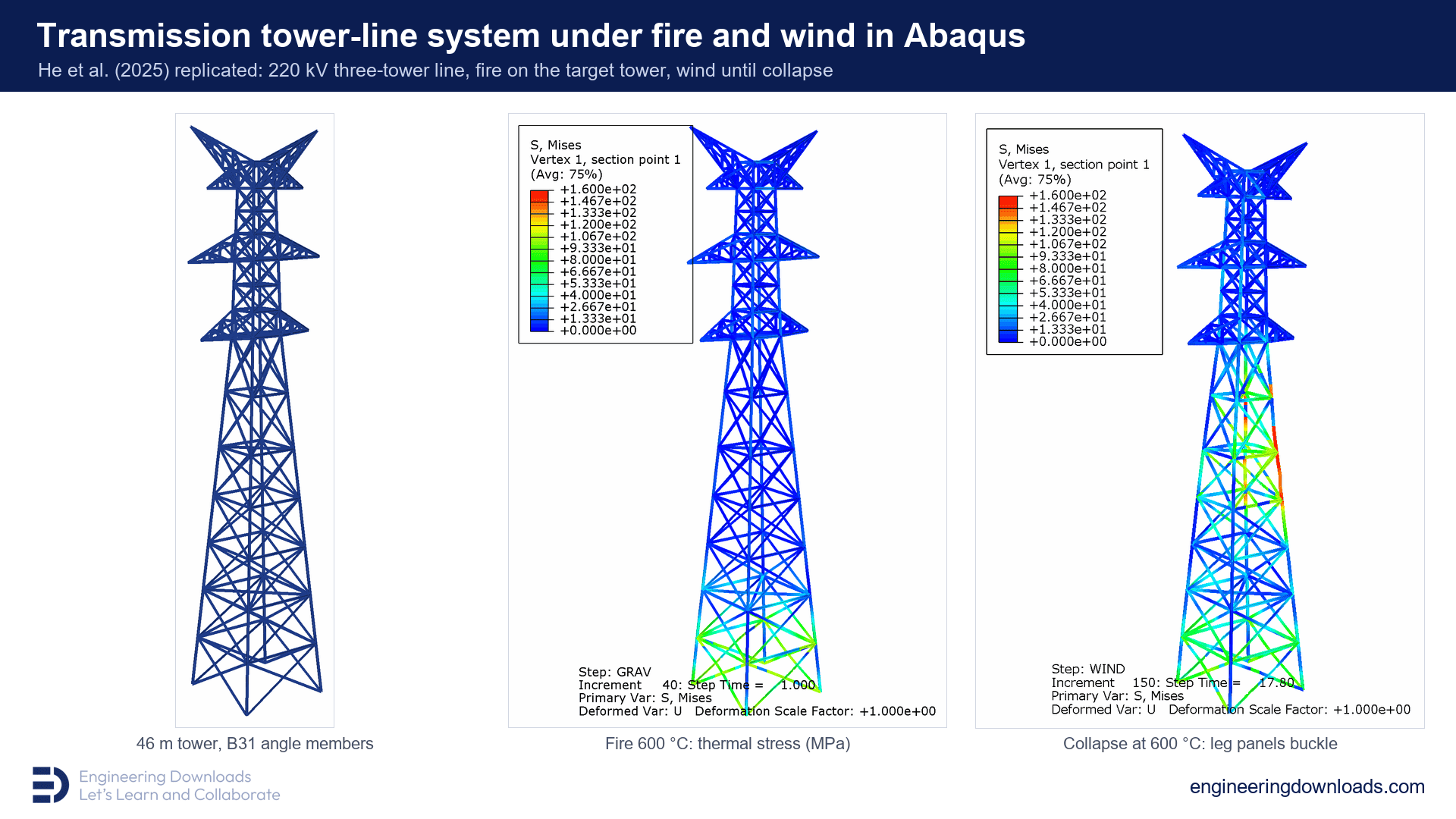 Transmission Tower-Line System under Fire and Wind in Abaqus: Modal and Collapse Analysis, after He et al. (2025)€169,00
 Monopile Offshore Wind Turbine in Abaqus: Soil-Structure Interaction and Bolted Flange, after Jacomet et al. (2021)€169,00
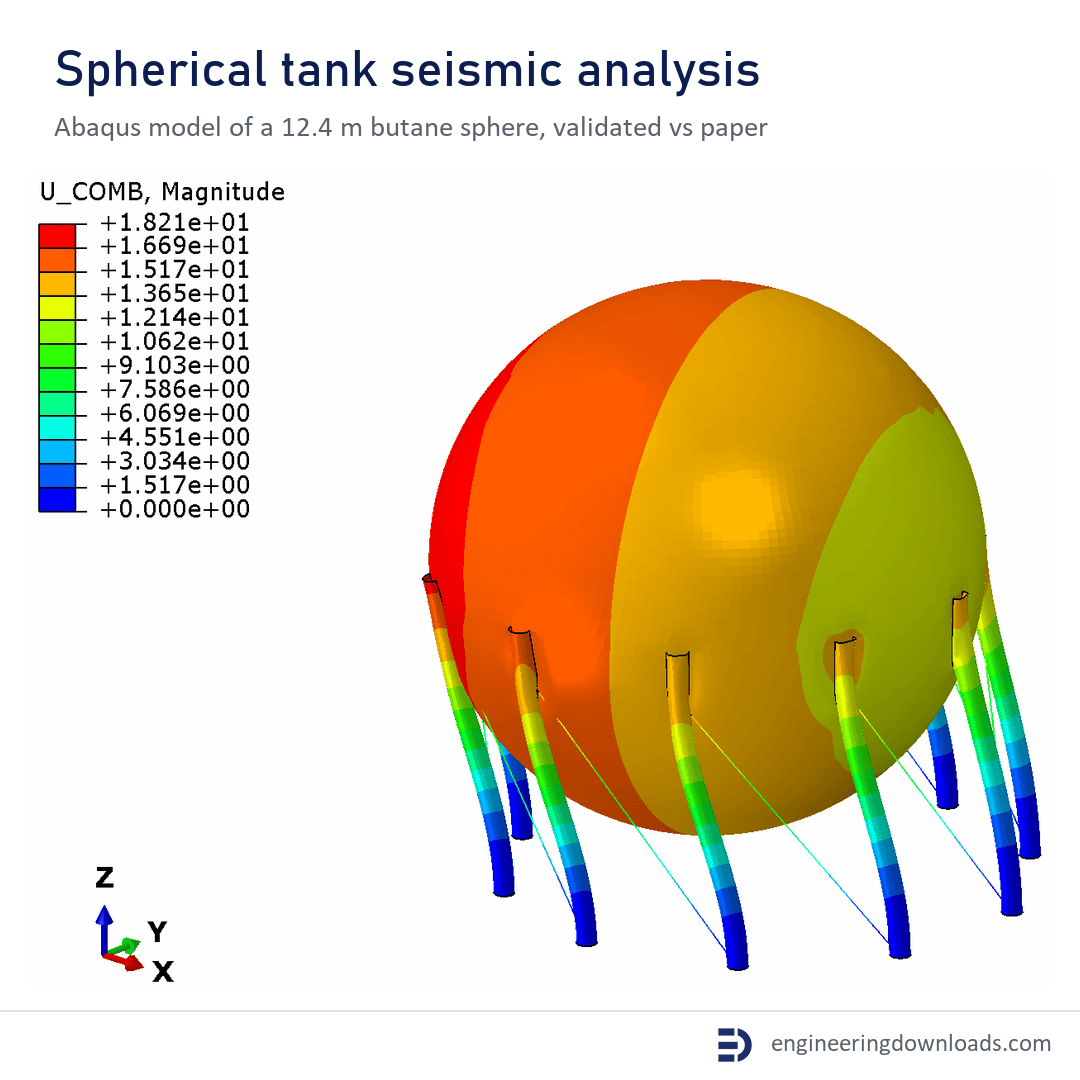 Seismic Analysis of a Spherical Liquid Storage Tank in Abaqus: Response Spectrum, Legs and X-Braces
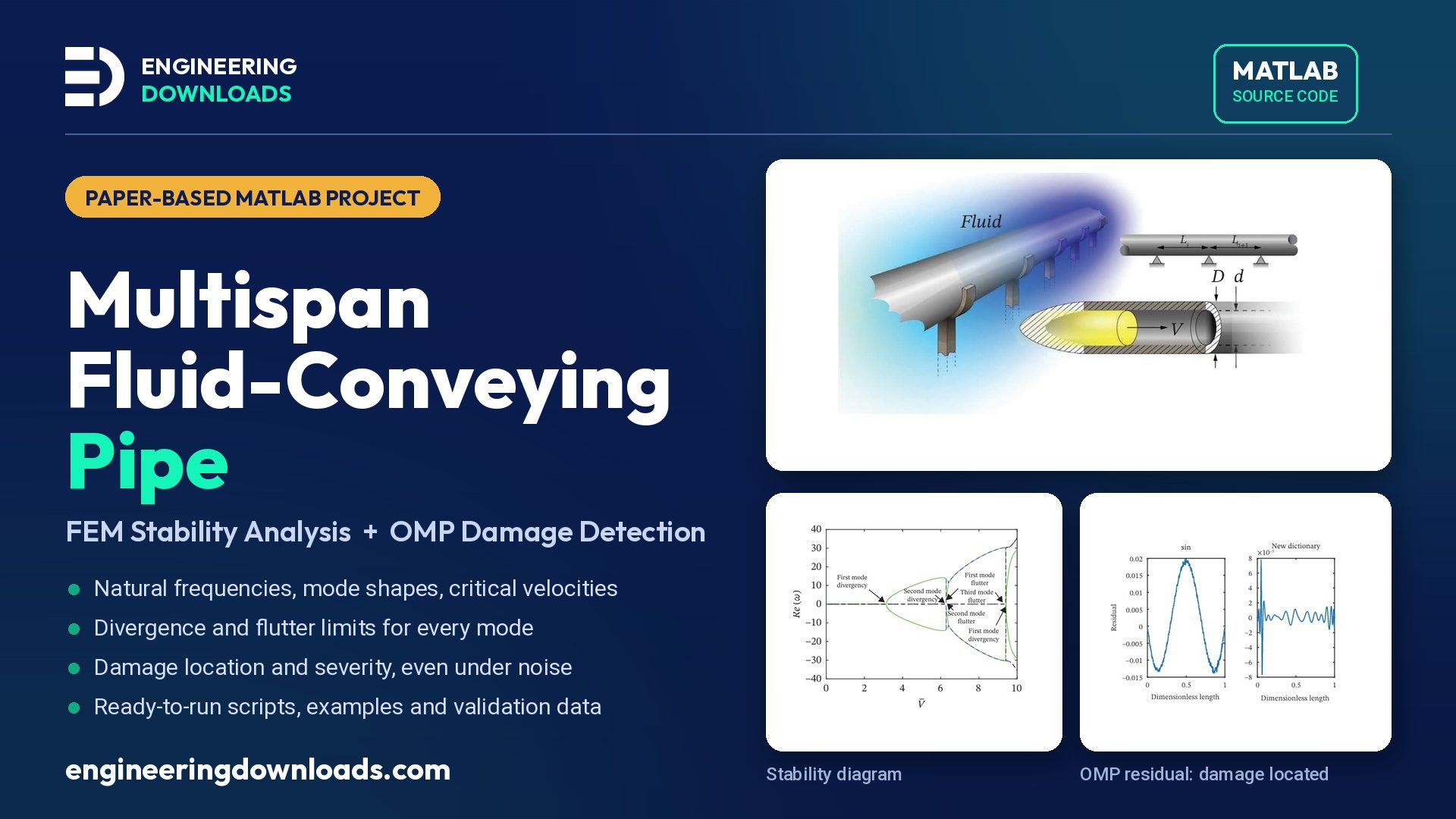 MATLAB FEM Code: Stability Analysis and Damage Identification of Multispan Fluid-Conveying Pipes (OMP Method)
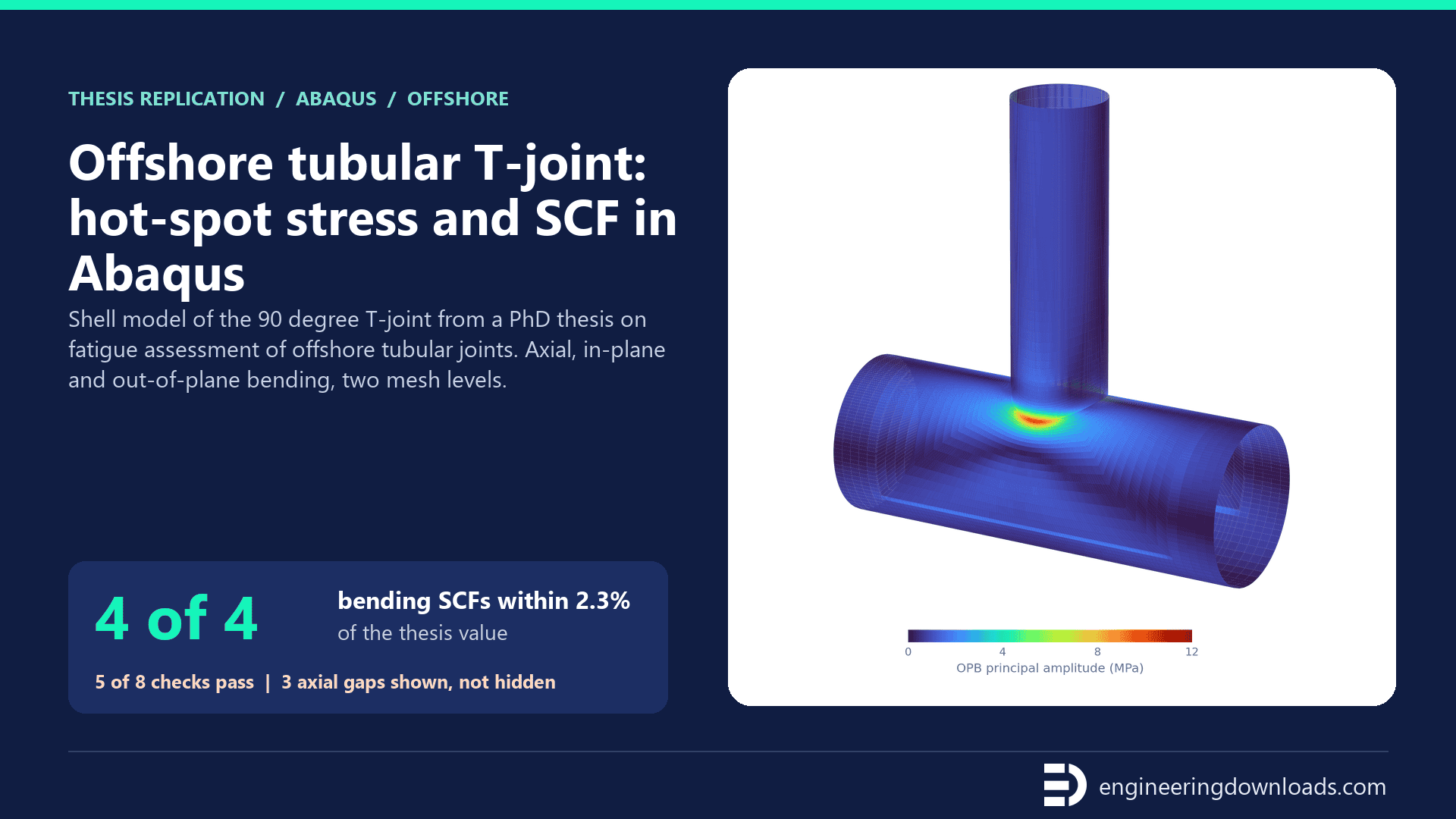 Offshore Tubular T-Joint in Abaqus: Hot-Spot Stress and SCF Replication of a PhD Thesis€89,00
 Fixed Tubesheet Heat Exchanger in Abaqus: Plastic Load and Limit Load Replication of a Journal Paper€99,00
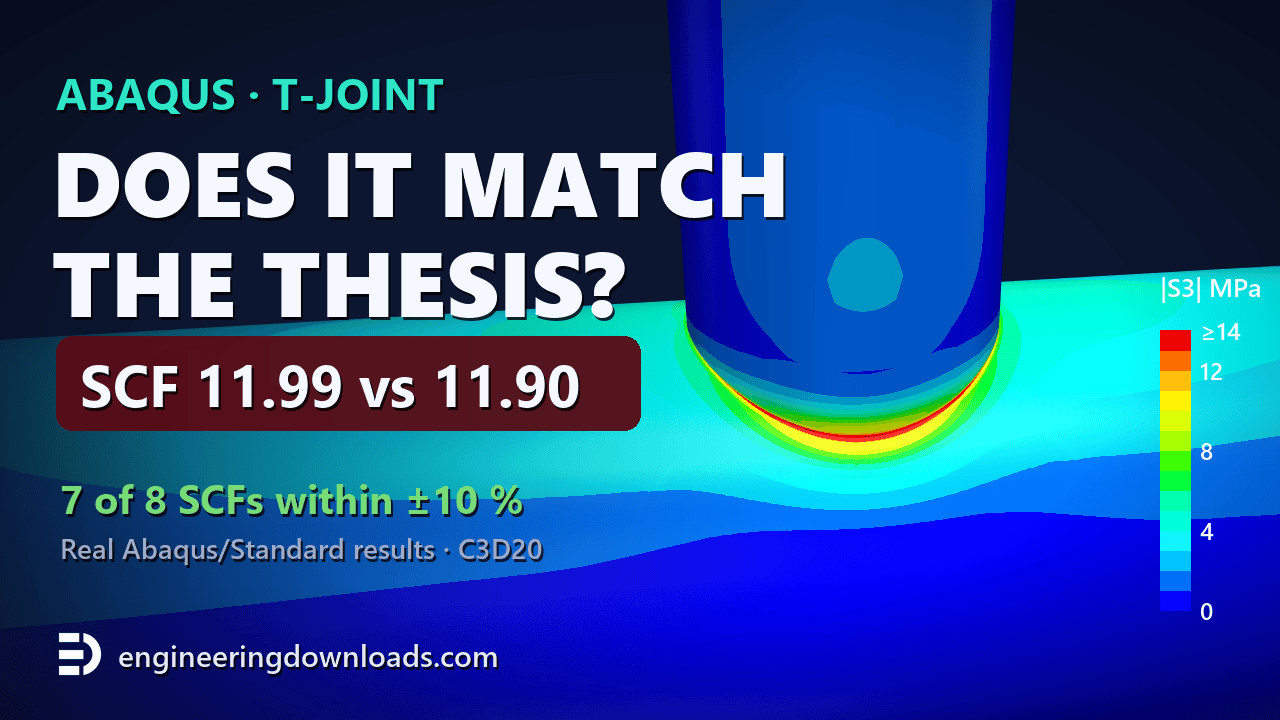 Solid Tubular T-Joint in Abaqus: Hot-Spot Stress and SCF Benchmark of a PhD Thesis€99,00
 Joint 413 in Abaqus: Multiplanar Tubular Joint Solid Model and Hot-Spot Stress€139,00

Need a full custom project? See the options below.

€129,00

€179,00

€149,00

€119,00

€129,00
See more
Want to receive push notifications for all major on-site activities?