

Need a full custom project? See the options below.
Need a full custom project? See the options below.
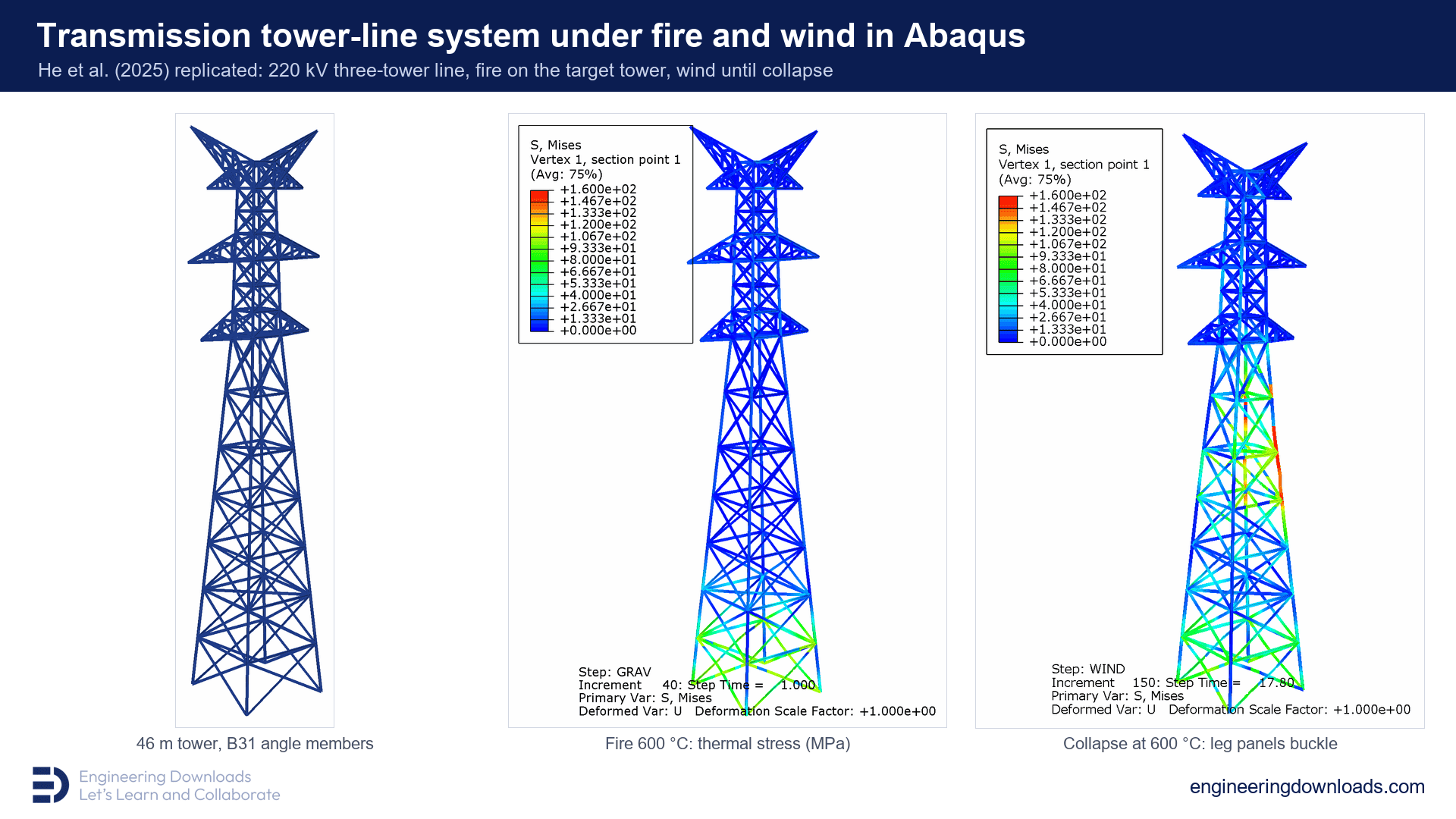
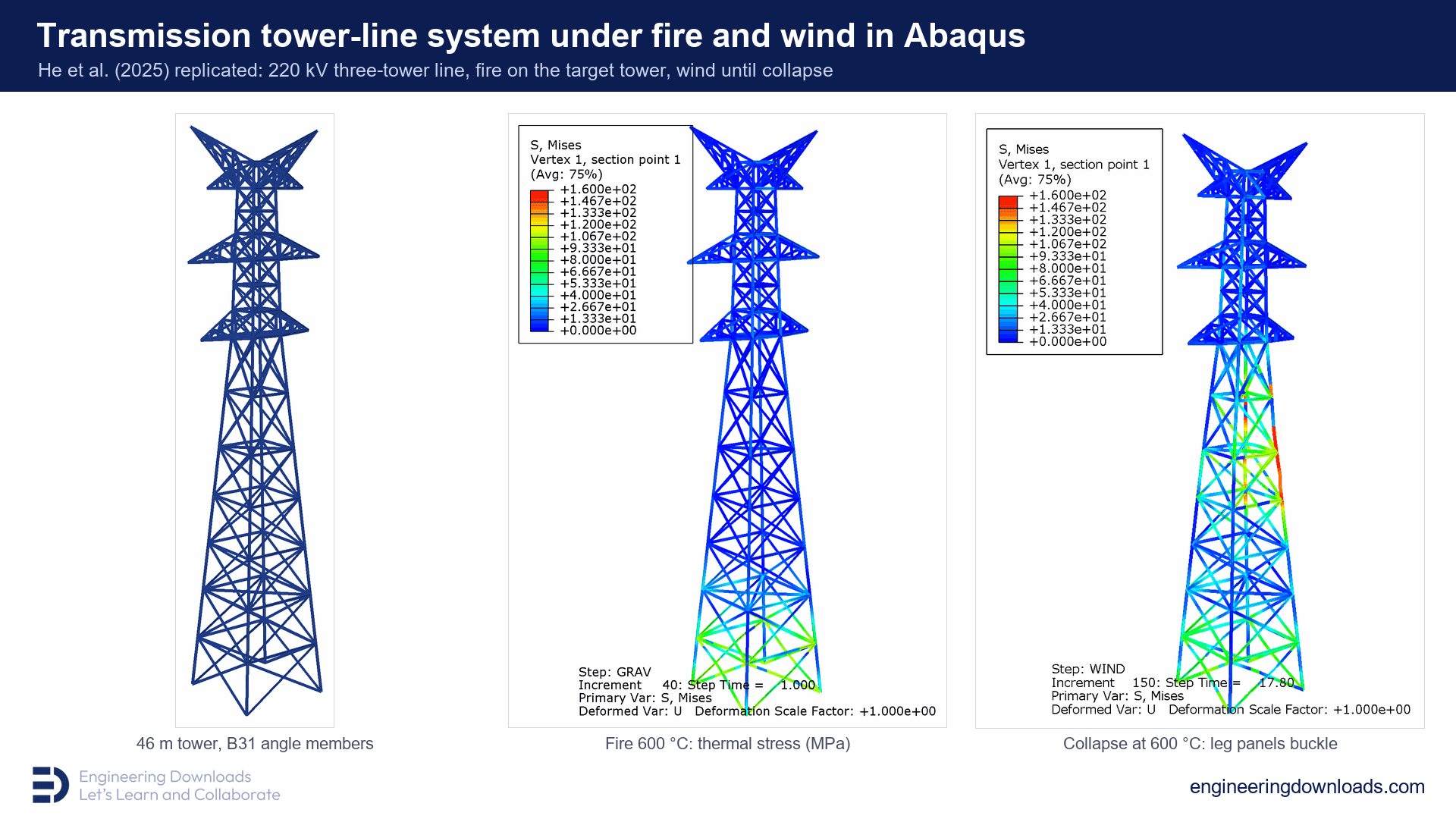
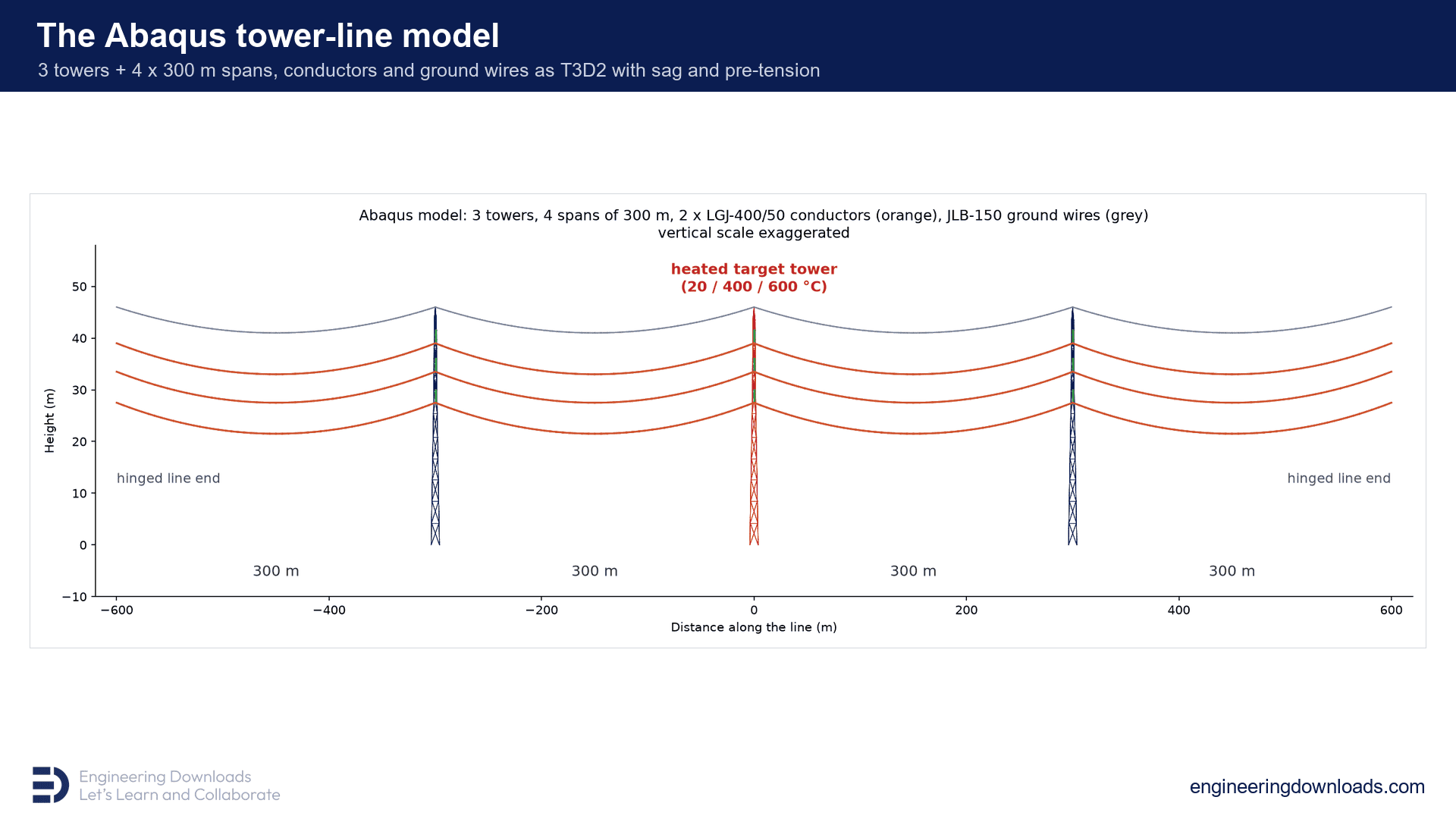
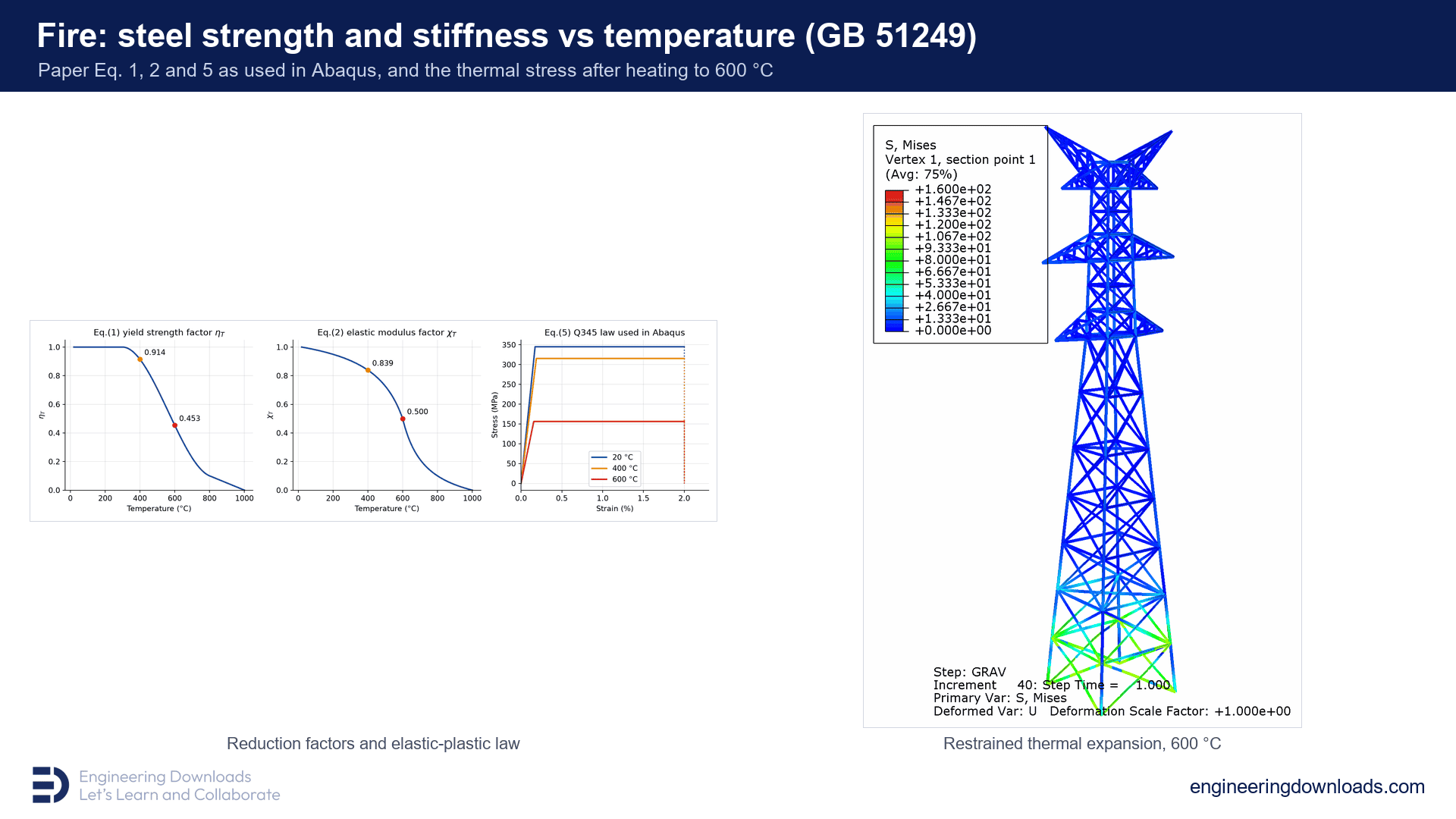
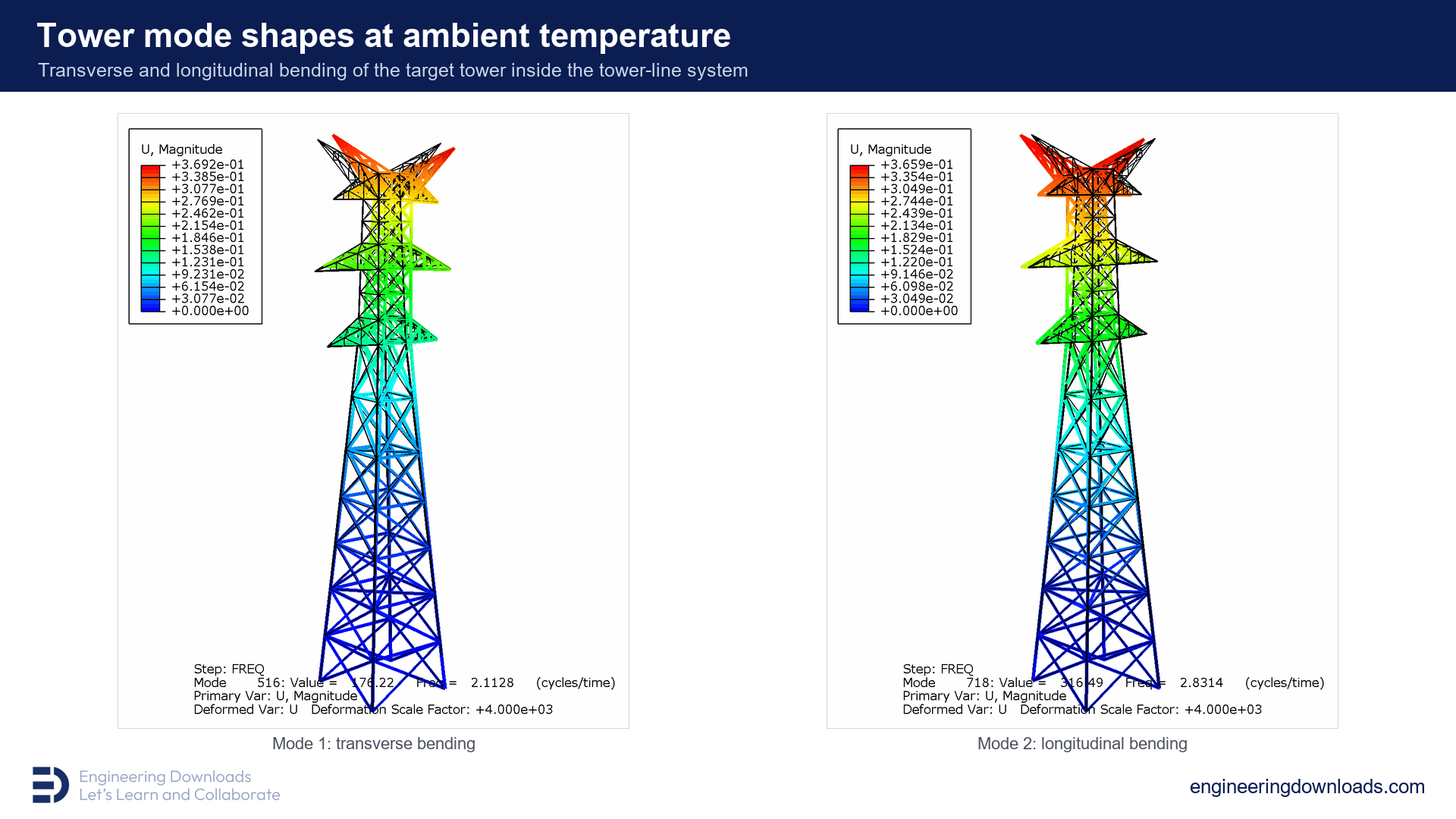
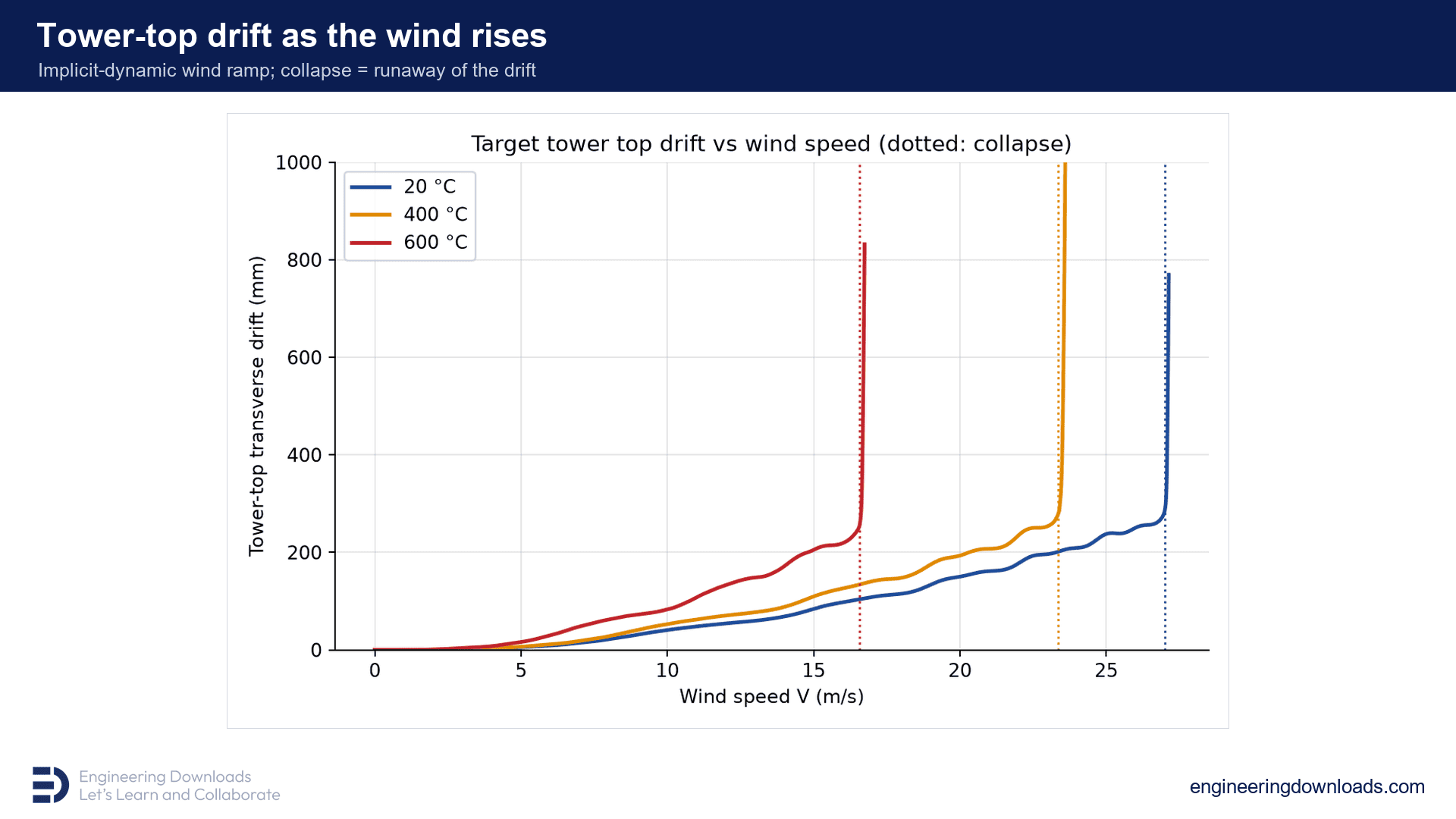
What happens to a high-voltage line when a forest fire reaches a tower while the wind keeps blowing? This Abaqus package replicates the journal paper He, Ma, Zhang, Wang and Zhang, “Study on the Multi-Hazard Responses of Transmission Tower-Line Systems Under Fire and Wind Loads Using ABAQUS”, Applied Sciences 2025, 15, 255. It contains a 220 kV three-tower, four-span tower-line model with the target tower heated to 20, 400 and 600 °C: fire step with temperature-dependent steel, natural frequencies of the heated system, and a wind ramp until the tower collapses. The fall of the tower-mode frequencies with temperature follows Table 2 of the paper, and the collapse wind speed falls steeply above 400 °C, as in the paper.
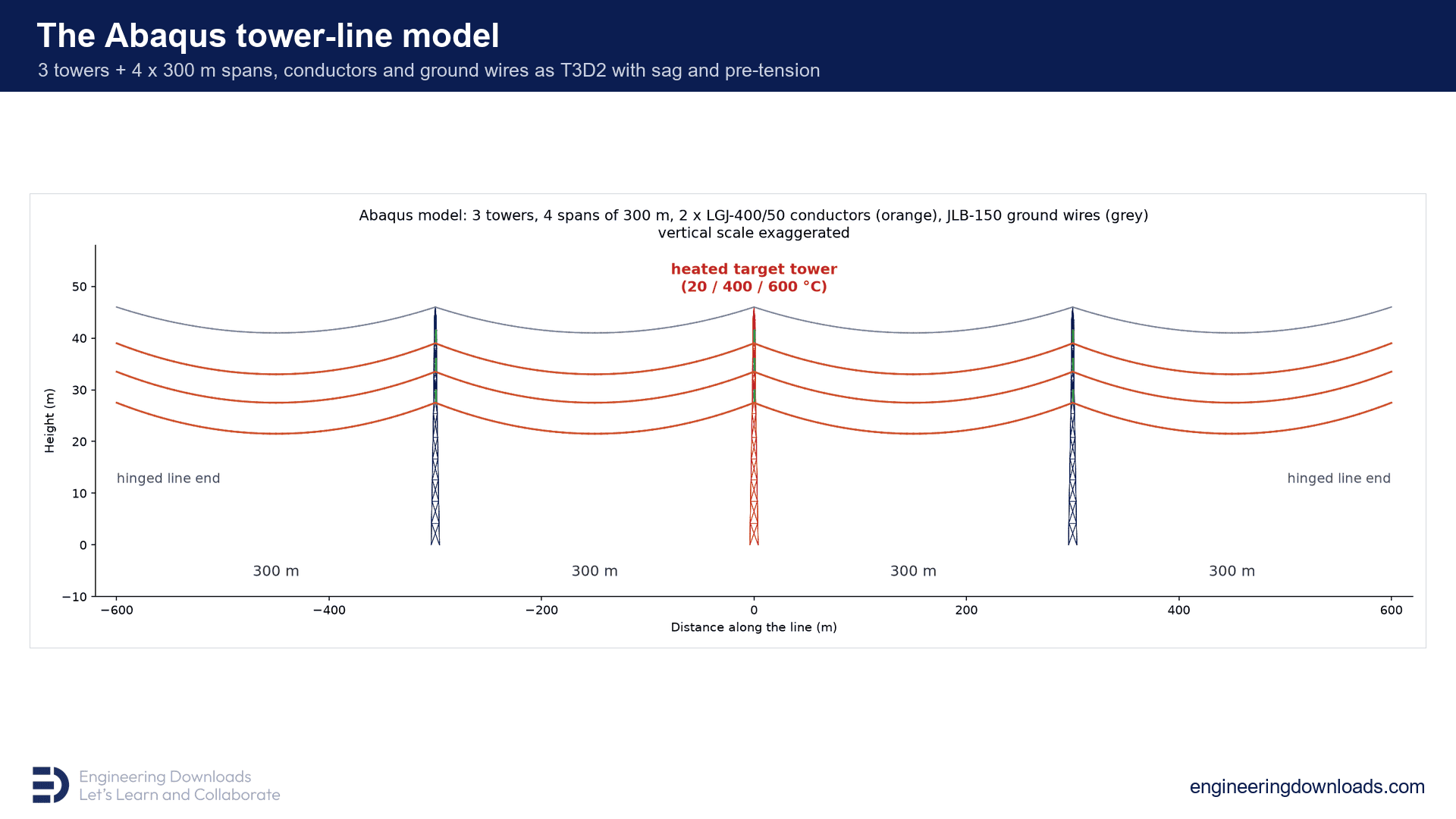
The paper studies a 46 m straight-line tower of a 220 kV line with 2 x LGJ-400/50 conductors and a JLB-150 ground wire. A fire around the middle tower reduces the yield strength and the elastic modulus of its Q345 and Q235 angles according to GB 51249-2017; the line is then loaded by wind until it collapses. The paper reports the natural frequencies at ambient, 400 and 600 °C (Table 2), the collapse-resisting wind speeds (Fig. 9) and the collapse sequence of the observed members. This package rebuilds the uniform 300 m spacing case.
| Item | This package |
|---|---|
| Structure | 3 towers, 4 spans of 300 m, line ends hinged, tower bases fixed |
| Tower | 46 m tower, 7.8 m base (paper Fig. 3), 3 crossarm levels + ground-wire peak, B31 beams with angle sections |
| Lines | 2 x LGJ-400/50 and JLB-150 as T3D2, 50 elements per span, sag and pre-tension, 2.5 m insulator strings |
| Fire | GB 51249 reduction of E and fy (paper Eq. 1-2, 5-8), thermal expansion, target tower only |
| Steps | Gravity + fire (static, NLGEOM), Lanczos frequencies 0.4-4 Hz, implicit-dynamic wind ramp to collapse |
| Wind | GB 50009 / GB 50545 loads on tower panels and conductors, transverse to the line |
| Size | 7,008 B31 + 1,618 T3D2 elements per model |
| Files | Abaqus CAE + INP model files, so it runs in your own Abaqus installation |
| Result | Paper | This work |
|---|---|---|
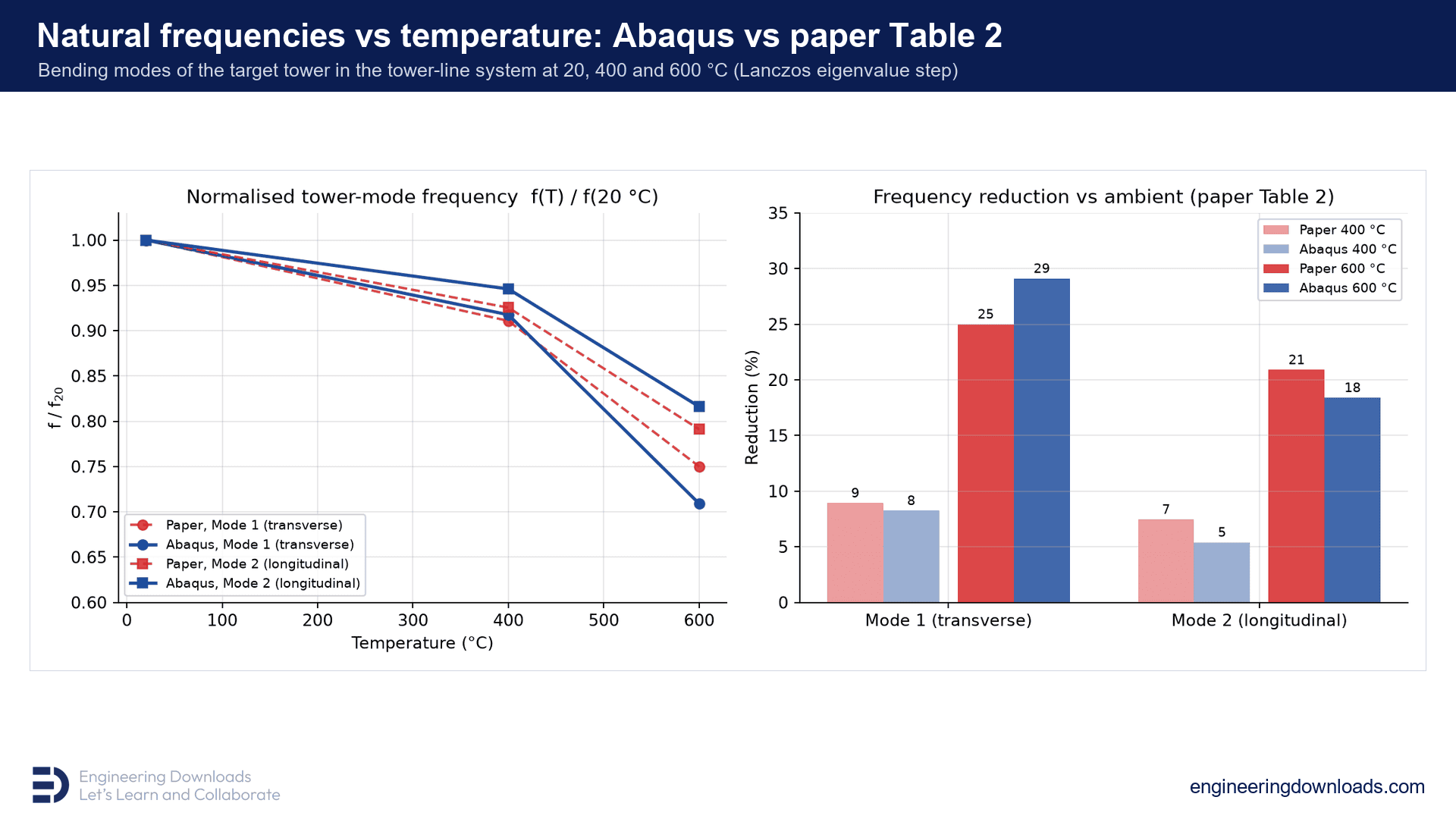
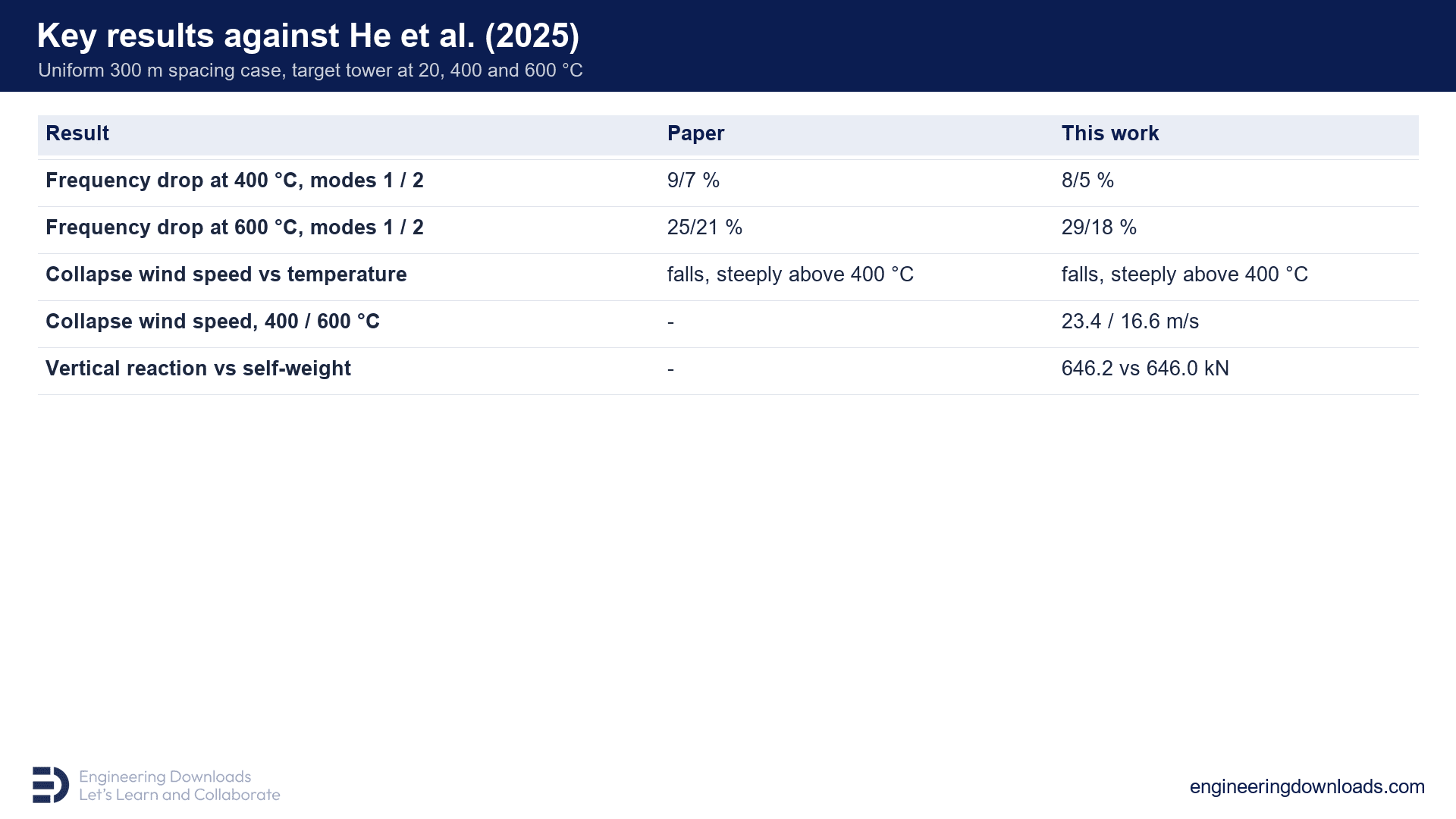
| Frequency drop at 400 °C, mode 1 (transverse bending) | 8.9 % | 8.2 % |
| Frequency drop at 400 °C, mode 2 (longitudinal bending) | 7.5 % | 5.4 % |
| Frequency drop at 600 °C, mode 1 (transverse bending) | 25.0 % | 29.1 % |
| Frequency drop at 600 °C, mode 2 (longitudinal bending) | 20.9 % | 18.4 % |
| Collapse wind speed vs temperature | falls, steeply above 400 °C | falls, steeply above 400 °C |
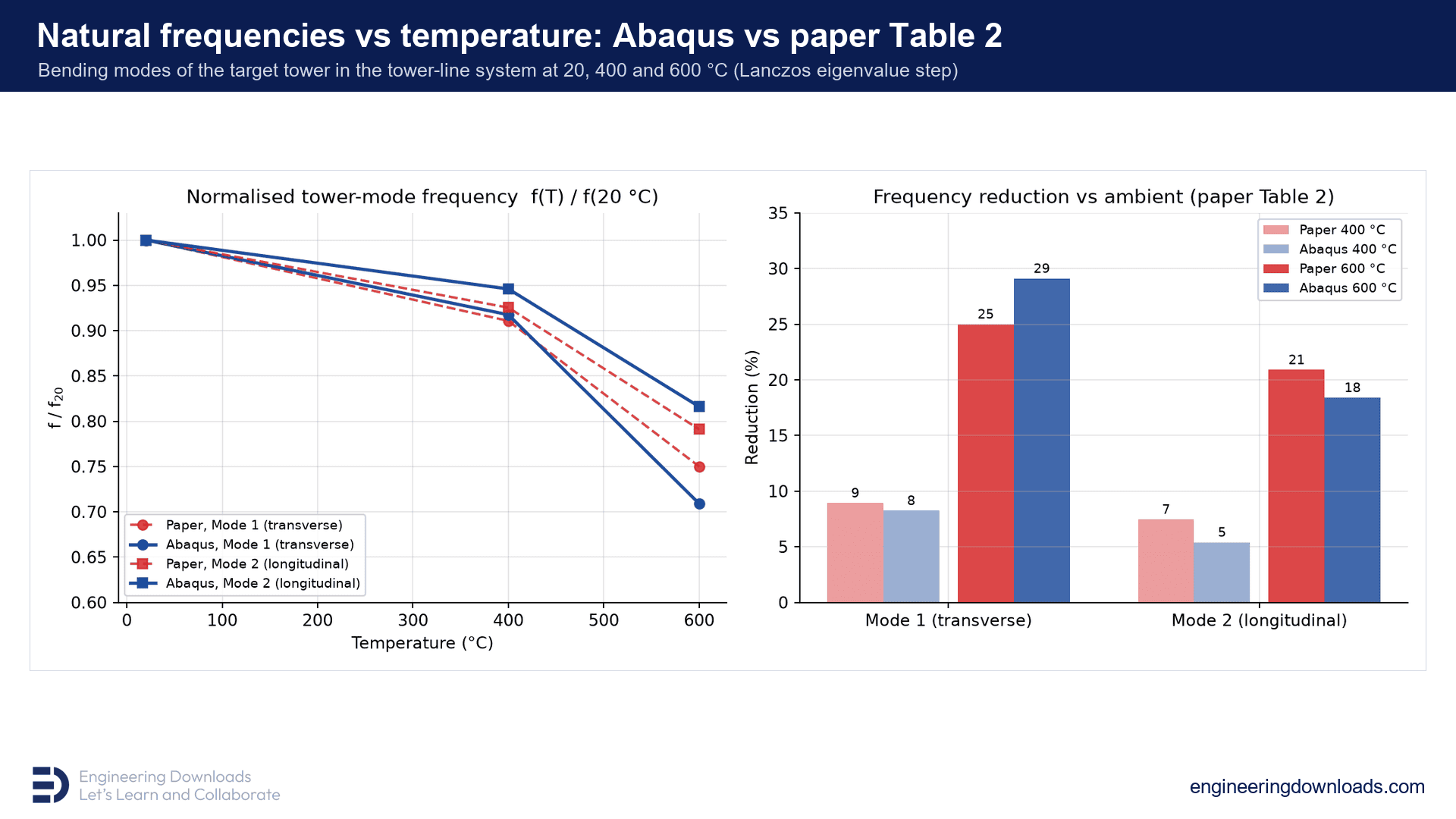
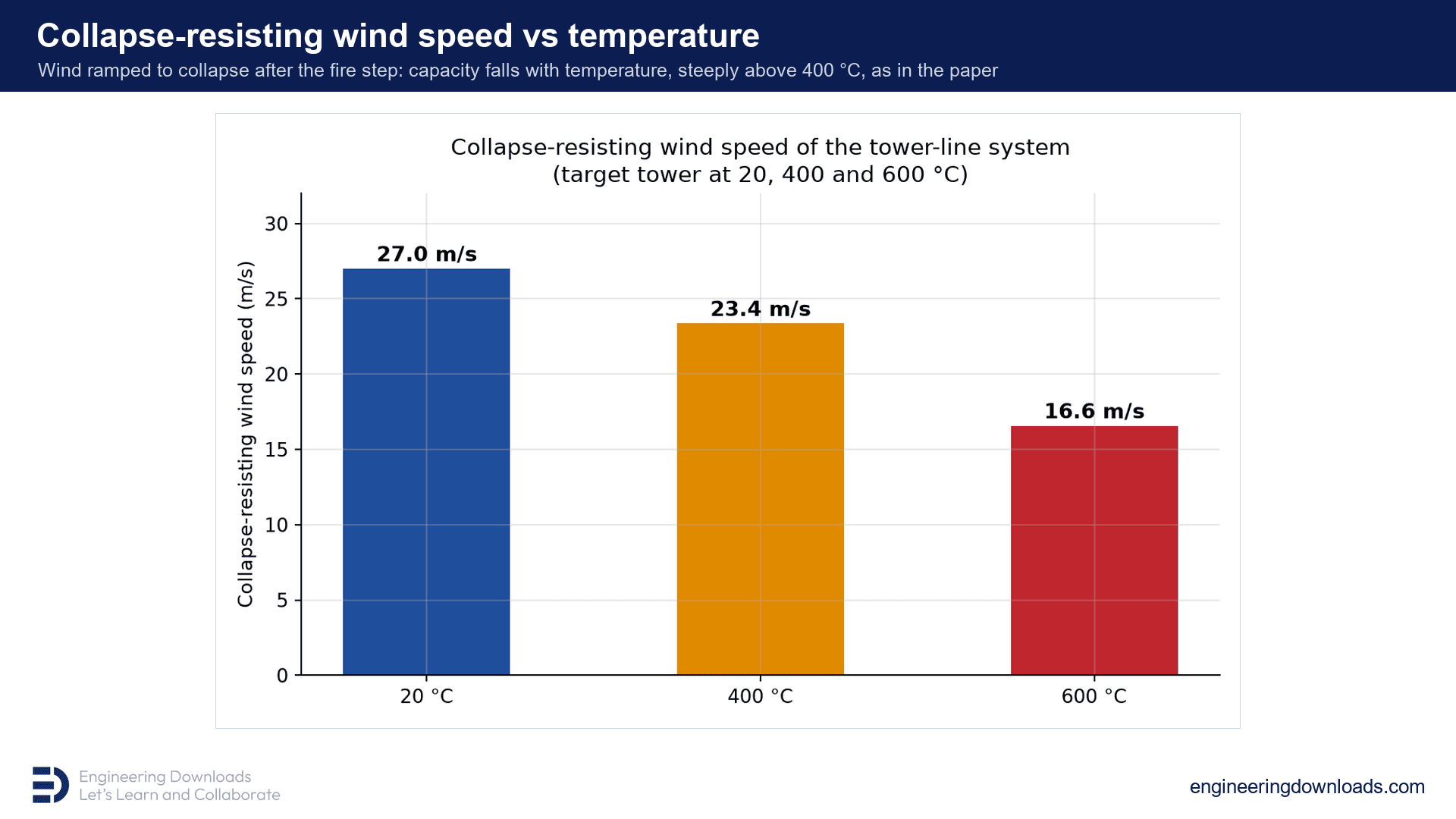
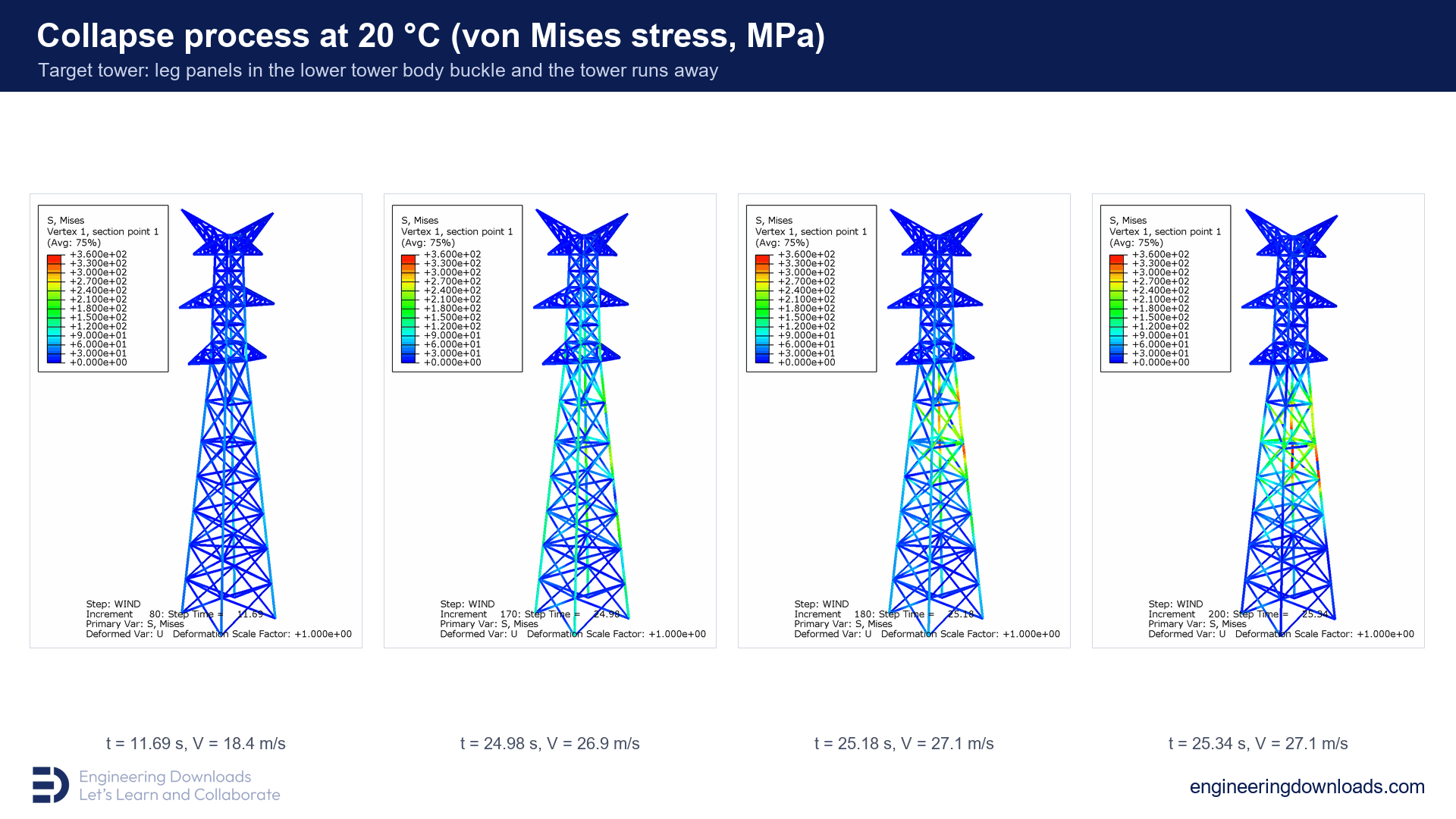
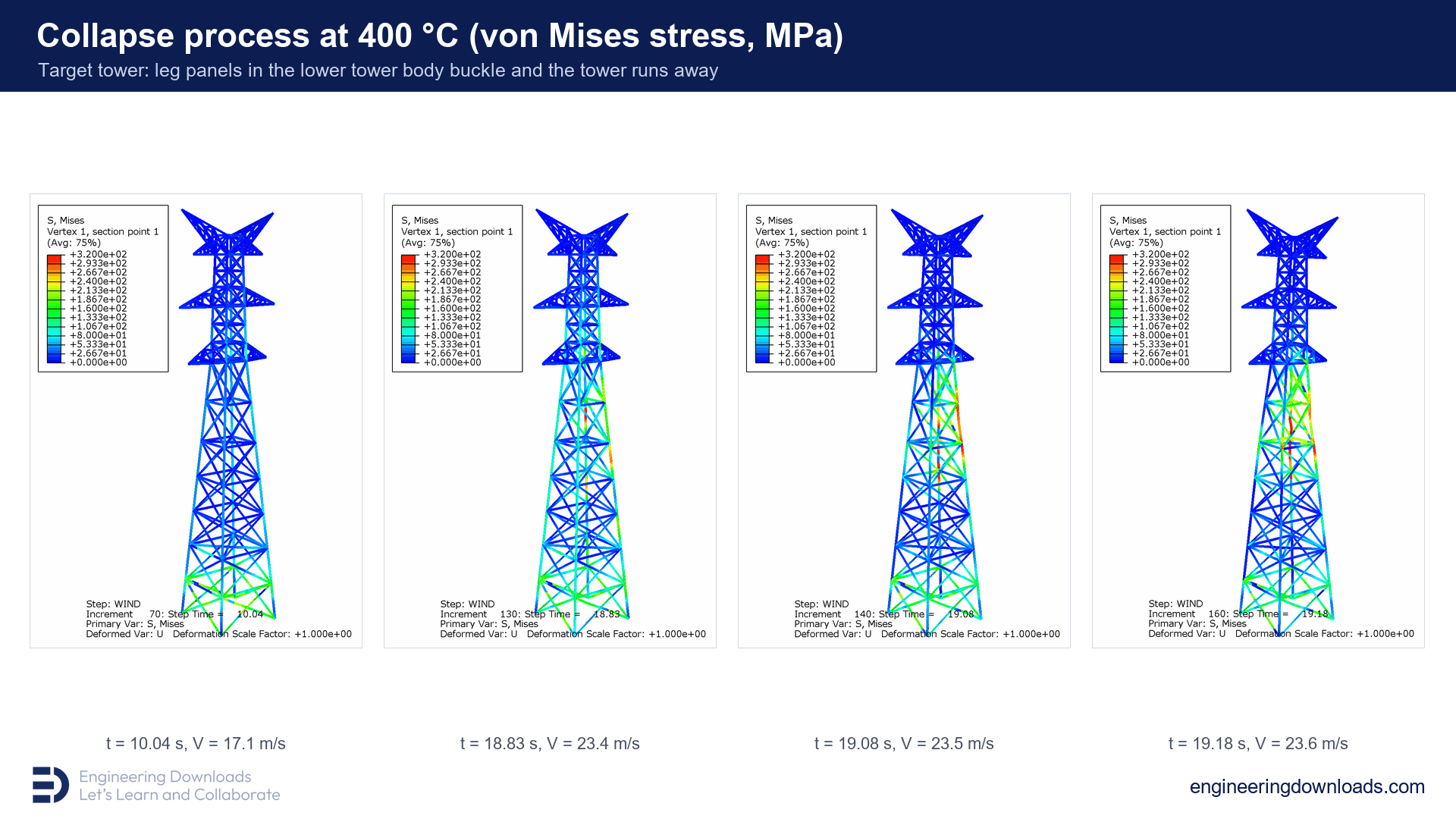
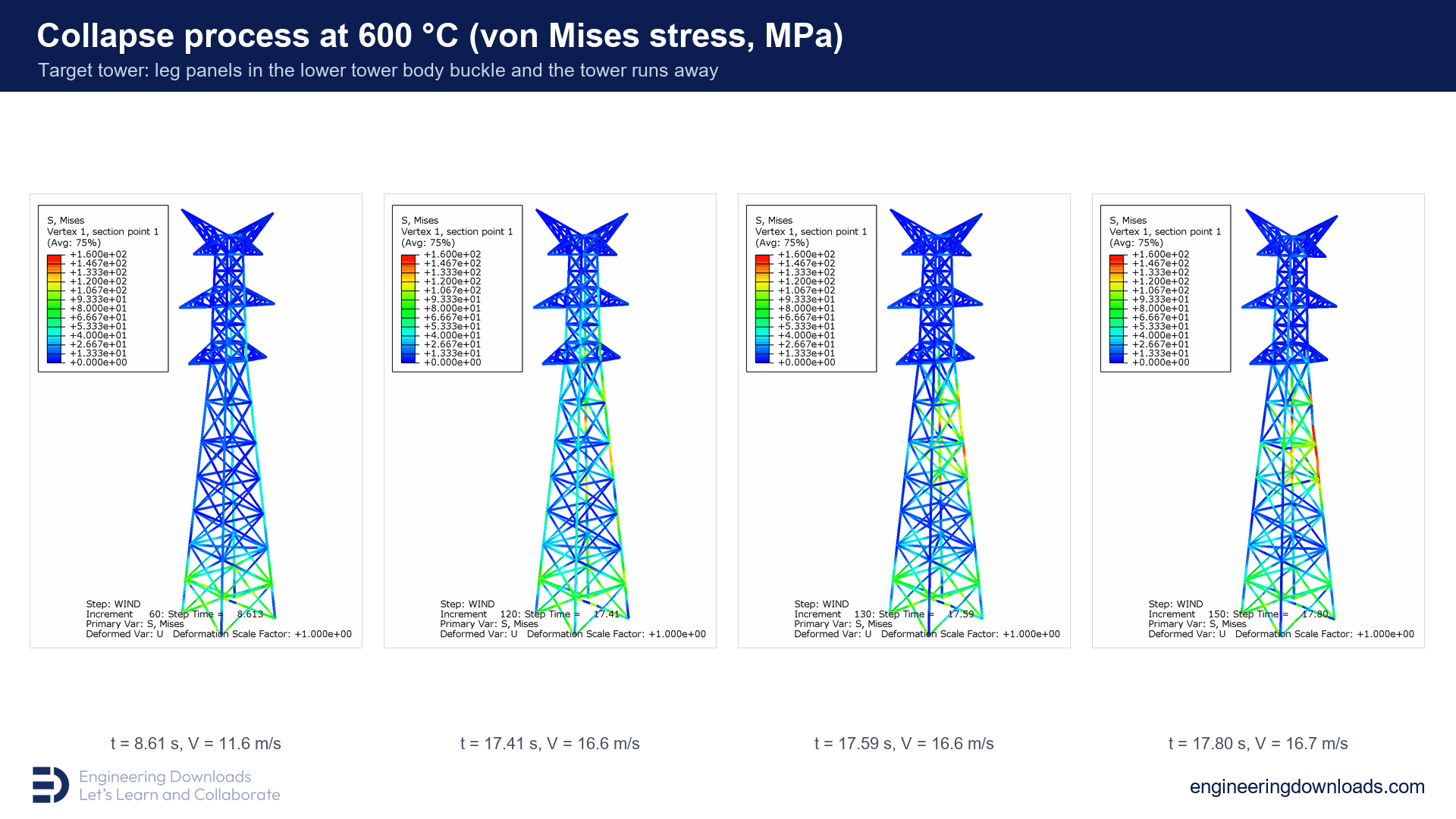
Heating the target tower lowers its bending frequencies as the paper reports: by 5 to 8 % at 400 °C and 18 to 29 % at 600 °C (paper 7 to 9 % and 21 to 25 %). Under the wind ramp the tower collapses at 23.4 m/s at 400 °C and 16.6 m/s at 600 °C against 27 m/s at ambient temperature: the capacity falls with temperature and drops steeply above 400 °C, the trend reported in the paper. At collapse the leg panels in the lower tower body buckle and the tower-top drift runs away.
Transmission-line and tower engineers who assess wildfire risk to overhead lines, FEA engineers who want a working tower-line model with cable pre-tension, temperature-dependent steel and a collapse analysis in Abaqus, and students who want to see a published multi-hazard study rebuilt and checked number by number.
Which paper does this package replicate? He, Ma, Zhang, Wang and Zhang, Study on the Multi-Hazard Responses of Transmission Tower-Line Systems Under Fire and Wind Loads Using ABAQUS, Applied Sciences 2025, 15, 255 (open access). The uniform 300 m spacing case is rebuilt at 20, 400 and 600 C. The paper is cited, not bundled.
How close are the results to the paper? The frequency drop of the two bending modes of the heated tower is 8 and 5 % at 400 C (paper 9 and 7 %) and 29 and 18 % at 600 C (paper 25 and 21 %). The collapse wind speed falls from 27 m/s at ambient to 23.4 m/s at 400 C and 16.6 m/s at 600 C, a steep drop above 400 C as in the paper.
How is the collapse wind speed found? After the fire step the wind load is ramped slowly in an implicit-dynamic step, so the run can pass through member buckling. Collapse is the moment the tower-top drift runs away. Speeds are given relative to the 27 m/s ambient reference: V = 27 m/s times the square root of the load-factor ratio. The README shows the formula.
How are the tower modes picked out? In a tower-line system the conductor modes lie below the tower modes, so the eigenvalue step extracts all modes up to 4 Hz and the transverse and longitudinal bending modes of the heated tower are picked by their kinetic-energy share in that tower.
Are the images real Abaqus results? Yes. Every model and contour image is exported by Abaqus/CAE from the included models; only a title bar, the logo and the web address are added. Charts are drawn from the same solver output, with the paper's values as reference.
Will it run in my Abaqus? The package contains the Abaqus CAE file and the three INP input files, so you run the models in your own Abaqus installation. ODB result files are not included; you create them by running the jobs.
What if the package is not what I expected? Write to us. Engineering Downloads refunds clients who are not satisfied with a delivered product.
Need more than the files?
There are two ways we can help. Book a one hour online consultation if you want to talk a problem through with a CAE engineer, using the checkbox in the order box. Order a project if you need a full simulation built for you, delivered to an agreed scope, price and deadline under a written contract.
We work on FEA and CFD for engineers, researchers and companies. Order your project, or message us on WhatsApp for a quick reply.
Other packages engineers working on this topic also download.
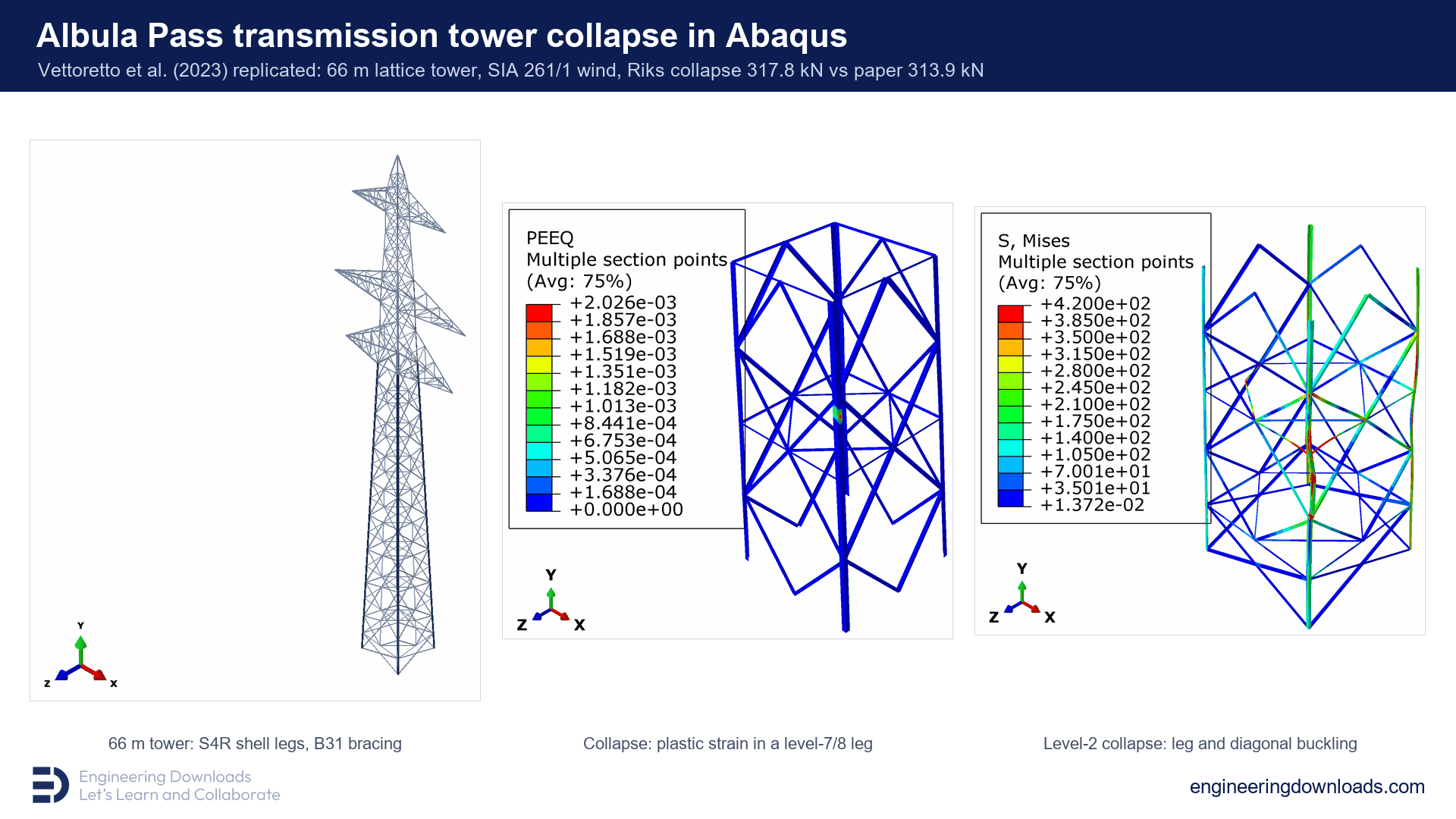 Transmission Tower Collapse under Extreme Wind in Abaqus: Buckling, Riks and Post-Buckling, after Vettoretto et al. (2023)€169,00
 Abaqus Rotor Kit Unbalance Response: Two-Disc Shaft Model, Natural Frequencies and Campbell Diagram€129,00
 Analysis of the bolted steel splice connections under fire-Sequential Method
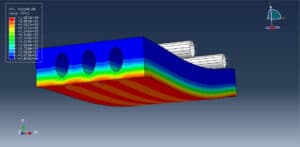 Fire and bending analysis of hollow-core concrete slab-DCT method
 RC Slab Impact Analysis in Abaqus Using the Brittle Cracking Model (Hammer Impact)
 Seismic Response of a Steel Building in Abaqus: Nonlinear Dynamic Analysis with Beam Elements
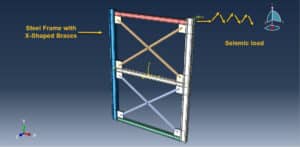 Analysis of the Seismic Behavior of Semirigid Steel Frame with X-Shaped Brace
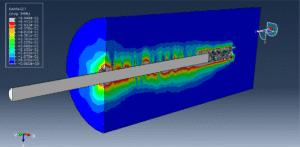 Pull-Out test analysis of a ribbed steel bar from the UHPC

Need a full custom project? See the options below.

€129,00

€179,00

€149,00

€119,00

€129,00

€149,00
See more
Want to receive push notifications for all major on-site activities?



