

Need a full custom project? See the options below.
Need a full custom project? See the options below.
How does a corrosion-damaged pipeline respond to indentation—and what happens after the indenter is removed?
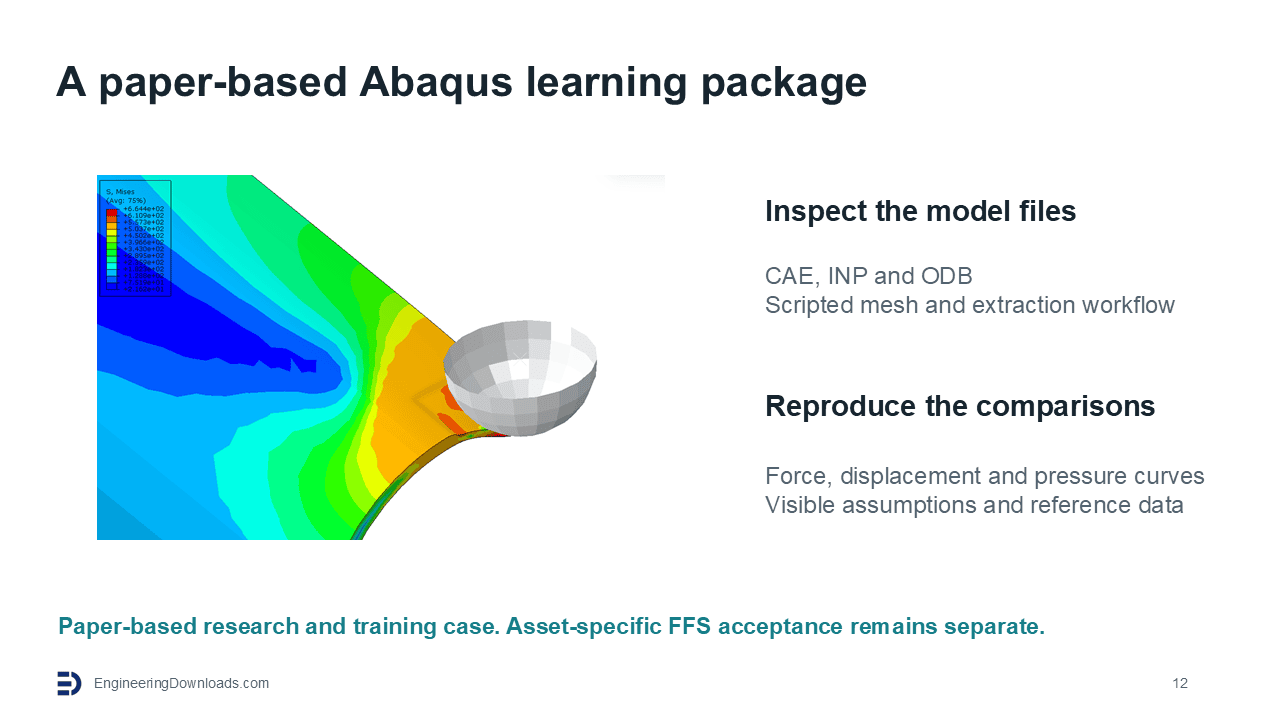
This Abaqus training package follows the deformation history of a steel pipeline containing a dent and a corrosion pocket. The analysis covers dent formation, indenter withdrawal, elastic springback and subsequent internal pressurization. You will see how the residual geometry and accumulated plastic strain influence the pipe’s response during later loading.
The base case uses a 406 mm outside diameter, 10.2 mm wall thickness and an imposed indentation of 8% of the pipe diameter. A quarter-symmetry solid model reduces computational cost while retaining local mesh refinement around the damaged region.
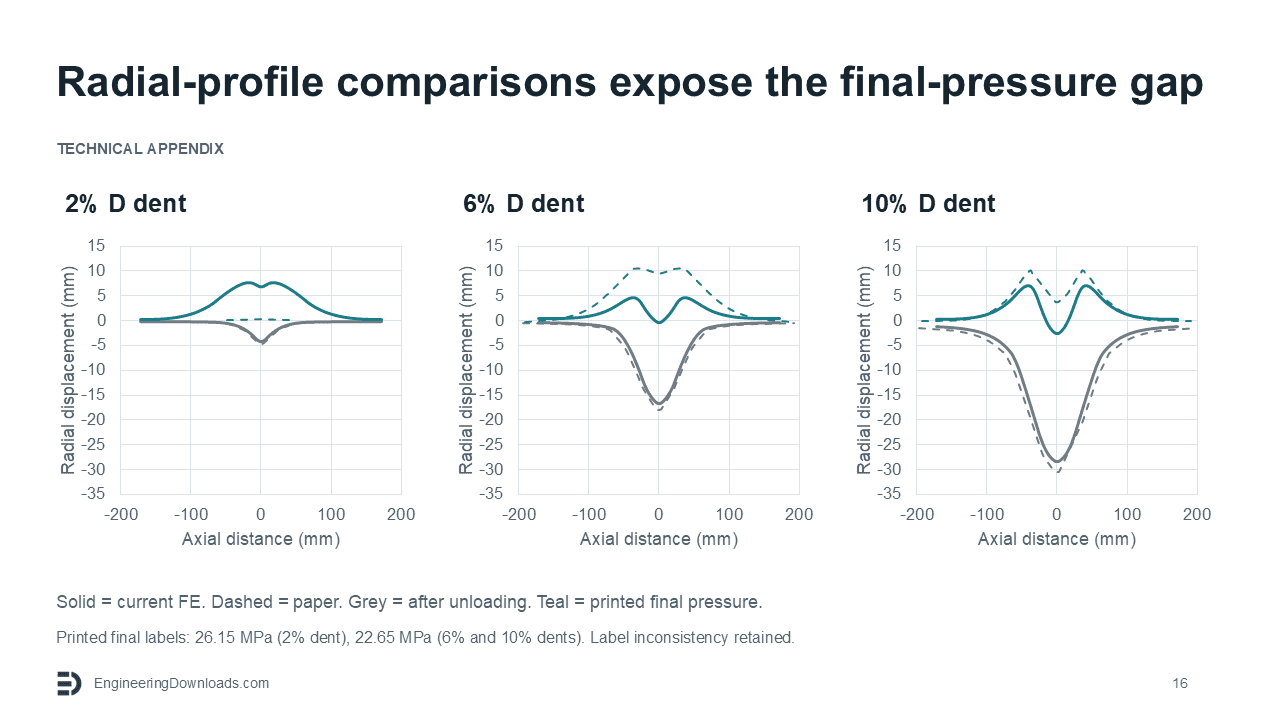
The course explains the scripted mesh workflow, nonlinear material behaviour, indenter contact and staged loading. It also examines the resulting force–displacement curves, inner cross-section shapes, longitudinal radial-displacement profiles and pressure comparisons.
This is paper-based research and training work. Results are compared with the reference publication, with modelling assumptions, differences and unresolved questions identified. The discussion connects the simulation to Level 3 FFS modelling while distinguishing the paper’s strain-based comparison criterion from an API acceptance assessment.
This training package presents a paper-based finite element investigation of a steel pipeline containing interacting dent and corrosion damage. A nonlinear Abaqus model follows indentation, unloading and internal pressurization, retaining the deformation history between analysis stages. The course examines local solid-mesh refinement, contact, plasticity, springback and pressure-driven re-rounding. Extracted curves support comparisons of geometry, indentation force and strain-threshold pressure with published results. The case introduces modelling concepts relevant to Level 3 FFS assessment and explains the limits of the current numerical evidence.
Failure pressure prediction by defect assessment and finite element modelling on pipelines containing a dent-corrosion defect
Y. Huang, G. Qin and G. Hu. Ocean Engineering, Volume 266, Article 112875, 2022. Publisher page and paper details.
The paper investigates how combined dent and corrosion damage affects pipeline pressure capacity. It develops a finite element model to study the interaction between the defects and examines how their characteristics influence the predicted failure pressure. The study provides the reference framework for the course’s numerical comparisons. Source.
The supplied case models a dent with a smooth corrosion pocket. Explicit gouge and crack assessment, fatigue life, verified maximum allowable working pressure and completed API 579 Level 3 acceptance are outside the demonstrated scope. The paper’s PEEQ = 0.27 threshold serves as a comparison criterion.
Engineers and students who already know the basics of Abaqus and want to model a damaged pipeline step by step. It suits anyone working on Level 3 fitness-for-service problems. The course is rated intermediate.
No. The course builds the numerical model and compares it with a published study. A full API 579 Level 3 acceptance assessment needs asset-specific data, which is outside the scope of this package.
No. The supplied case models a dent with a smooth corrosion pocket. Gouges, cracks, fatigue life and verified maximum allowable working pressure are not covered.
A PDF tutorial document, a PowerPoint presentation, Abaqus/CAE files and Abaqus input (INP) files.
Background reading: dent assessment for structural integrity, the FFS Level 3 workflow and corrosion assessment for engineers.
Need more than the files?
There are two ways we can help. Book a one hour online consultation if you want to talk a problem through with a CAE engineer, using the checkbox in the order box. Order a project if you need a full simulation built for you, delivered to an agreed scope, price and deadline under a written contract.
We work on FEA and CFD for engineers, researchers and companies. Order your project, or message us on WhatsApp for a quick reply.
Other packages engineers working on this topic also download.
 API 579 Example 12.5 in Abaqus: Dent-Gouge Assessment, Level 2 Calculation and Nonlinear Pressure Model with a One-Click Python Script€99,00
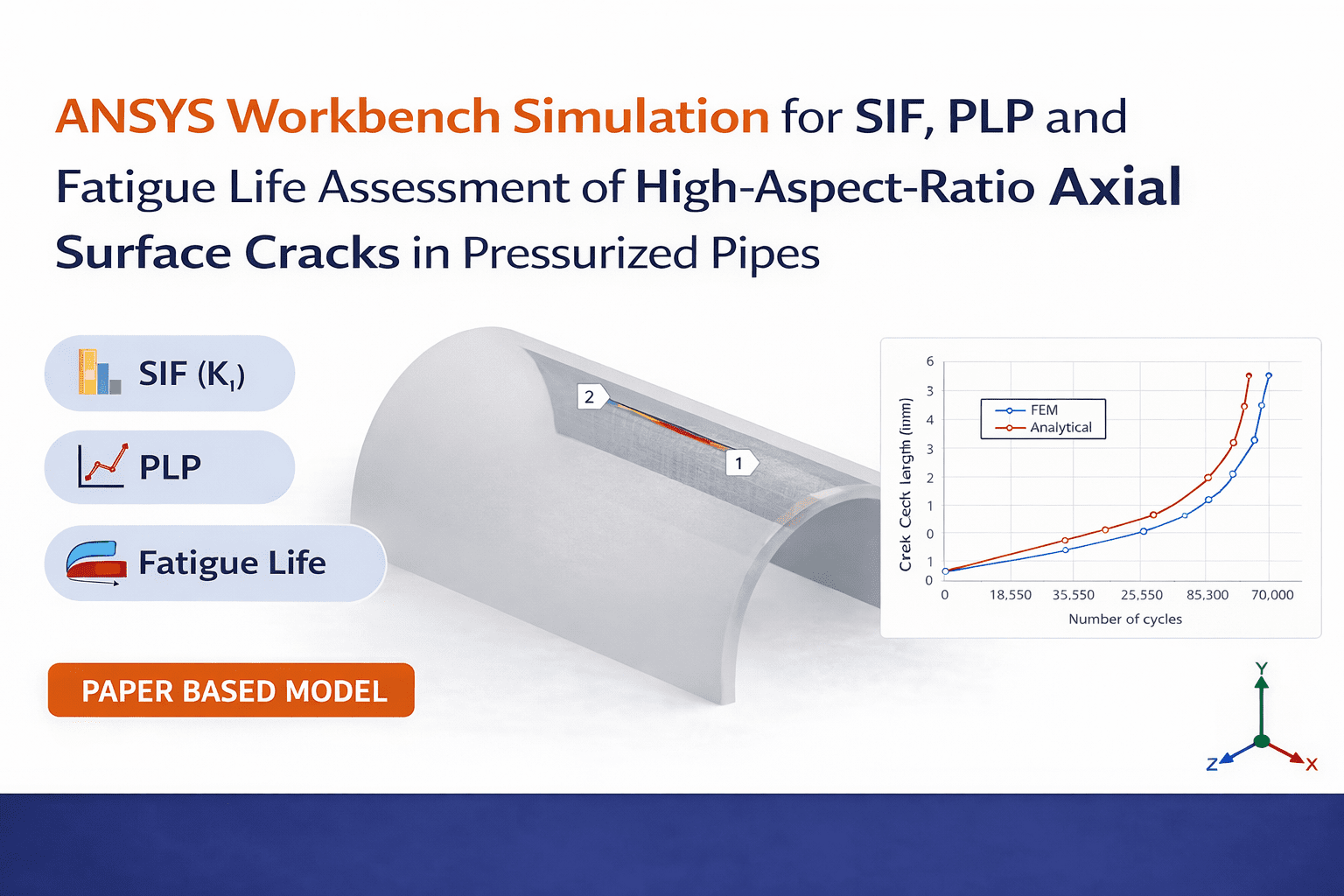 ANSYS Workbench Simulation for SIF, PLP and Fatigue Life Assessment of High-Aspect-Ratio Axial Surface Cracks in Pressurized Pipes€129,00
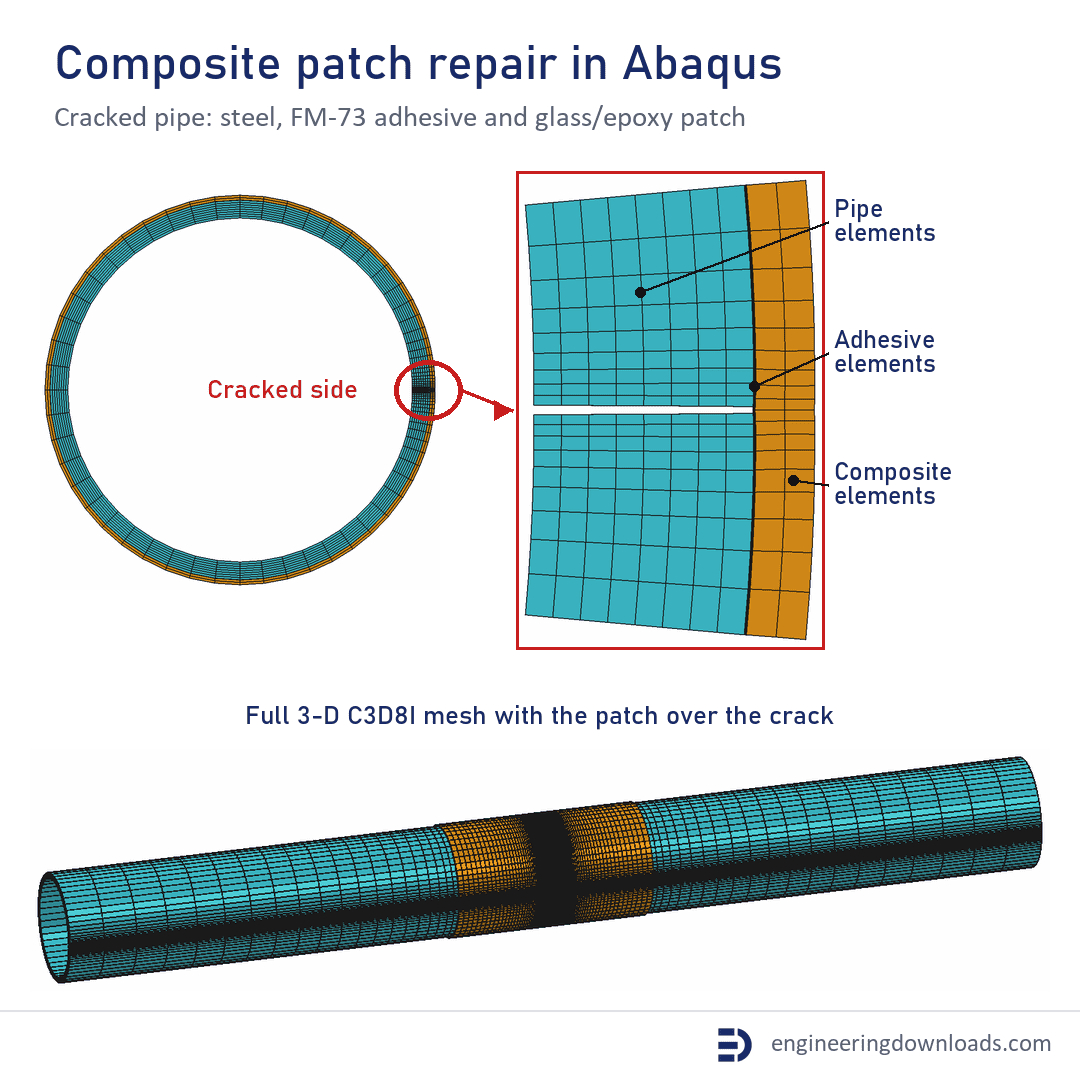 Composite Patch Repair of a Cracked Pipe in Abaqus: Fatigue Crack Growth under Cyclic Pressure
 A parametric study on the mechanical performance of buried X65 steel pipelines under subsurface detonation
 The application of CFRP to strengthen buried steel pipelines against subsurface explosion
 Pipe and Pipeline Simulation Package in Abaqus (21 Models)
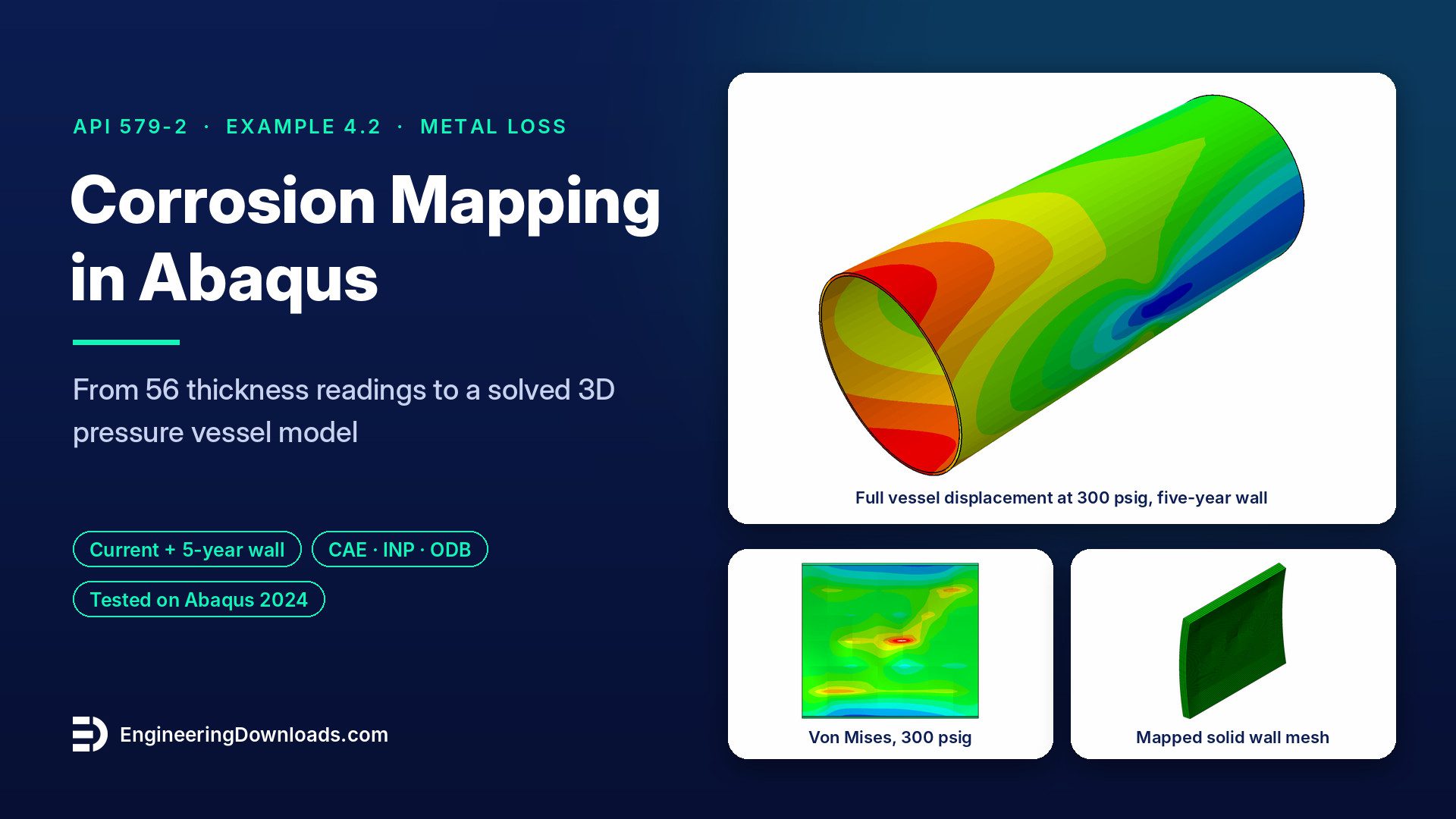 API 579 Example 4.2 in Abaqus: Corrosion Mapping of a Metal Loss Pressure Vessel
 API 579 Example 4.7 in Abaqus: Corroded Conical Transition, Level 3 FFS

Need a full custom project? See the options below.

€129,00

€179,00

€149,00

€119,00

€129,00
See more
Want to receive push notifications for all major on-site activities?