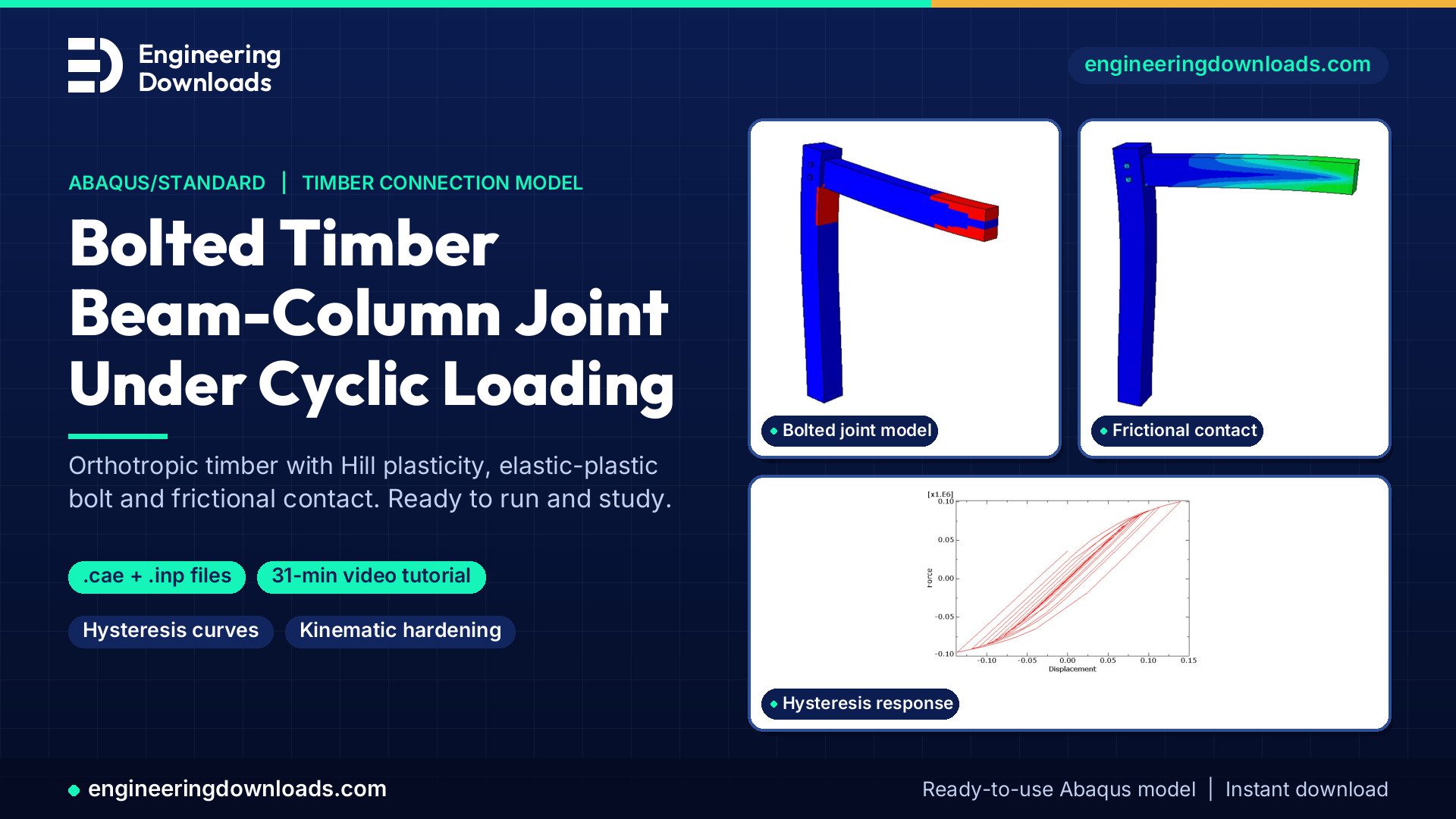
Screw Push-Out Test of Timber in Abaqus/Explicit: Bond-Slip Curve Simulation

€57,00 €112,00
Optional extras

Need a full custom project? See the options below.

€57,00 €112,00
Optional extras

Need a full custom project? See the options below.

24 people watching this product now!

Material Includes

  • 💻 Abaqus Model Files
  • 🔹 .CAE file — Complete Abaqus/CAE model ready to open and inspect
  • 🔹 .INP file — Abaqus input file for running and reviewing the analysis setup
  • 🔹 .STEP file — 3D geometry files for the screw and timber components
  • 🎥 Step-by-Step Video Tutorial
  • 📄 Research Paper / Technical Documentation

Audience

  • 🎓 Students & Researchers
  • 🔹 Civil and structural engineering students
  • 🔹 MSc and PhD researchers working with timber structures
  • 🔹 Researchers studying screw–timber connections and fasteners
  • 🔹 Anyone using FEA for experimental or numerical research
  • 🏗️ Structural & Civil Engineers
  • 🔹 Engineers working with timber and wood structures
  • 🔹 Engineers interested in connection design and failure behavior
  • 🔹 Professionals using numerical simulation to support experimental testing
  • 💻 Abaqus Users
  • 🔹 Beginners learning Abaqus/Explicit
  • 🔹 Users working with nonlinear material models
  • 🔹 Users interested in orthotropic and anisotropic materials
  • 🔹 Engineers modeling contact, slip, and material failure
  • 🔬 FEA & Computational Mechanics
  • 🔹 Anyone interested in 3D finite element analysis
  • 🔹 Researchers working with elastic–plastic and anisotropic materials
  • 🔹 Users investigating contact mechanics and interface behavior
  • 🔹 Those who want to connect FEA results with experimental test data

What You Will Learn?

  • 🧩 Model Setup
  • 🔹 Build a 3D finite element model of a threaded screw and timber specimen
  • 🔹 Define the geometry, assembly, mesh, and material orientations
  • 🔹 Apply realistic boundary conditions and displacement loading
  • 🔩 Screw Material
  • 🔹 Define an elastic–plastic material model for the screw
  • 🔹 Specify Young’s modulus, Poisson’s ratio, density, and yield behavior
  • 🔹 Investigate screw stress, strain, and plastic deformation
  • 🌲 Timber Material
  • 🔹 Model timber as an orthotropic material using engineering constants
  • 🔹 Define longitudinal (L), radial (R), and tangential (T) directions
  • 🔹 Implement anisotropic plasticity using the Hill yield criterion
  • 🔹 Understand the influence of timber’s directional properties on the response
  • 🔗 Screw–Timber Interaction
  • ⚙️ Abaqus/Explicit Analysis
  • 📊 Results & Interpretation

About Course

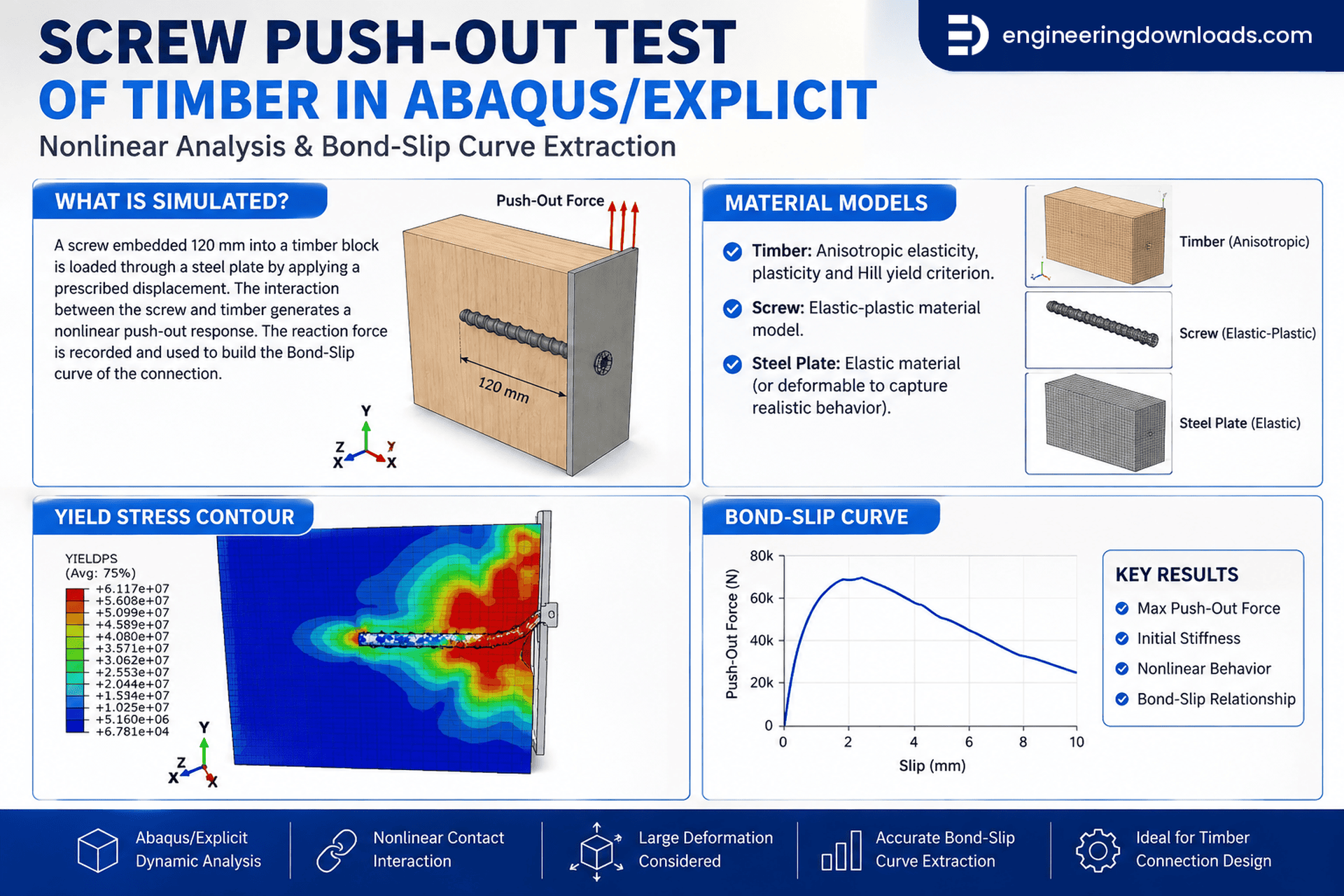
This package is a complete Abaqus/Explicit finite element model of a screw push-out test in timber. A threaded screw is embedded 120 mm into a timber block and pushed out through a steel plate under prescribed displacement. From the reaction force, the model produces the full bond-slip curve of the connection.

You get the ready-to-run model files, the geometry, and a step-by-step video tutorial, so you can open the model, run it, and adapt it to your own screw diameter, embedment length, or timber grade.

What this simulation covers

Threaded screws are one of the main fasteners in timber connections. The strength and stiffness of the whole connection depend on how load transfers between the screw thread and the surrounding wood. Push-out tests measure this in the lab, but they only give the global force-displacement response.

A 3D finite element model shows what happens inside: local stress and strain fields, plastic deformation, contact pressure, and the slip along the embedded length. That is what this model gives you.

Material models used

Screw. Isotropic elastic-plastic model. Elastic behaviour is defined by Young’s modulus and Poisson’s ratio. Beyond yield, plastic deformation follows a defined hardening curve, so you can see where the steel starts to deform permanently.

Timber. Wood is orthotropic, with very different stiffness along the longitudinal, radial, and tangential directions. Elastic behaviour is defined with engineering constants. Plastic behaviour uses the Hill anisotropic yield criterion, so yielding depends on material direction instead of being treated as isotropic von Mises. This matters under the complex multiaxial stress state that builds up around a threaded screw.

Steel plate. Elastic, and can be switched to deformable if you want a more realistic load path.

Why Abaqus/Explicit for a quasi-static test

A push-out test is quasi-static, but the contact and material behaviour are strongly nonlinear. Explicit handles this far more robustly than implicit, with no convergence failures at the screw-timber interface.

The displacement is applied gradually over a controlled step time so inertia stays small. The model is checked by comparing kinetic energy against internal energy during the main loading stage. The tutorial shows how this check is done, which is the part most people get wrong when they move a static problem into Explicit.

Results you can extract

  • Force-displacement and bond-slip curve of the connection
  • Maximum push-out force and initial stiffness
  • Yield stress and von Mises stress contours in screw and timber
  • Plastic strain and damage zones around the thread
  • Contact pressure, interface shear stress, and relative slip along the embedded length
  • Energy balance output to confirm quasi-static conditions

What is included

  • .CAE file — full Abaqus/CAE model, ready to open and inspect
  • .INP file — input file for running and reviewing the analysis setup
  • .STEP files — 3D geometry of the screw and timber block
  • Step-by-step video tutorial covering the full workflow
  • Reference paper and technical documentation

Who this is for

  • Civil and structural engineering students working on timber structures
  • MSc and PhD researchers modelling screw-timber connections and fasteners
  • Engineers designing or checking timber connections
  • Abaqus users who want a working example of orthotropic material, Hill plasticity, and nonlinear contact in one model
  • Anyone who needs to back up a physical push-out test with numerical results

How you can extend it

Once the model runs, it is straightforward to change screw diameter, thread geometry, embedment length, timber grade, and loading rate. That makes it a good starting point for a parametric study or a thesis chapter, not just a one-off result.

Related simulation packages

Support and guarantee

If you need help running the model or adapting it to your own case, our engineers can support you. We also offer custom simulation and consultation if you want the analysis done for your specific geometry, and HPC rental if your parametric study is too heavy for a laptop.

If the package does not match what is described here, we refund you.

Need more than the files?

There are two ways we can help. Book a one hour online consultation if you want to talk a problem through with a CAE engineer, using the checkbox in the order box. Order a project if you need a full simulation built for you, delivered to an agreed scope, price and deadline under a written contract.

We work on FEA and CFD for engineers, researchers and companies. Order your project, or message us on WhatsApp for a quick reply.

Course Content

Modeling of Threaded Screw–Timber Push-Out Behavior
A three-dimensional finite element model was developed in Abaqus to investigate the push-out behavior of a threaded screw embedded in timber. The model explicitly represented the screw and timber geometries and incorporated nonlinear material behavior and screw–timber contact. The numerical model provides detailed information beyond the global force–displacement response, including stress and strain distributions, plastic deformation, contact behavior, bond stress, and relative slip at the screw–timber interface.The results demonstrate the potential of three-dimensional finite element modeling as a tool for investigating the load-transfer mechanism and failure behavior of threaded screw–timber connections. With appropriate calibration and experimental validation, the model can also be used to investigate the influence of screw geometry, timber properties, embedment length, loading conditions, and other design parameters.

  • Abaqus Files
  • Document
  • Video Tutorial
    33:26

Reviews

No Review Yet
No Review Yet
€57,00 €112,00
Optional extras

Need a full custom project? See the options below.

24 people watching this product now!

Material Includes

  • 💻 Abaqus Model Files
  • 🔹 .CAE file — Complete Abaqus/CAE model ready to open and inspect
  • 🔹 .INP file — Abaqus input file for running and reviewing the analysis setup
  • 🔹 .STEP file — 3D geometry files for the screw and timber components
  • 🎥 Step-by-Step Video Tutorial
  • 📄 Research Paper / Technical Documentation

Audience

  • 🎓 Students & Researchers
  • 🔹 Civil and structural engineering students
  • 🔹 MSc and PhD researchers working with timber structures
  • 🔹 Researchers studying screw–timber connections and fasteners
  • 🔹 Anyone using FEA for experimental or numerical research
  • 🏗️ Structural & Civil Engineers
  • 🔹 Engineers working with timber and wood structures
  • 🔹 Engineers interested in connection design and failure behavior
  • 🔹 Professionals using numerical simulation to support experimental testing
  • 💻 Abaqus Users
  • 🔹 Beginners learning Abaqus/Explicit
  • 🔹 Users working with nonlinear material models
  • 🔹 Users interested in orthotropic and anisotropic materials
  • 🔹 Engineers modeling contact, slip, and material failure
  • 🔬 FEA & Computational Mechanics
  • 🔹 Anyone interested in 3D finite element analysis
  • 🔹 Researchers working with elastic–plastic and anisotropic materials
  • 🔹 Users investigating contact mechanics and interface behavior
  • 🔹 Those who want to connect FEA results with experimental test data

Related  Products

See more

Want to receive push notifications for all major on-site activities?

✕