


Need a full custom project? See the options below.
Need a full custom project? See the options below.
This is a ready-to-use Abaqus model of a screw–timber connection, tested under a static push-out load. The package gives you the full three-dimensional finite element model of a timber specimen, a steel loading beam and a non-threaded screw, plus the video tutorial that walks you through every step of building it yourself.
The model uses an orthotropic elastic definition for the timber based on engineering constants, Hill yield plasticity for directional yielding of the wood, elastic–plastic behaviour for the metal parts, and surface-to-surface frictional contact between all components. The push-out response is solved with the Static, Riks procedure so the equilibrium path can be followed well past the point where a standard static step would normally stop converging.
Screwed connections control the strength and stiffness of most modern timber structures, from CLT floors to timber–concrete composite decks. The problem is that timber does not behave like steel. It is stiff along the grain and much weaker across it, it yields differently in each direction, and the load is transferred through a small contact zone around the screw where the wood crushes locally.
Most people trying to model this in Abaqus get stuck on the same three points: setting up an anisotropic wood material that actually runs, keeping the screw–timber contact stable, and getting the analysis to converge past the peak load. This model solves all three, and you get the working files so you do not have to rebuild it from scratch.
A timber block, a steel loading beam and a non-threaded screw are assembled into a standard push-out configuration. The load is applied through a reference point coupled to the steel beam, which is the same way the test is driven in the laboratory.
The wood is defined with engineering constants, so the longitudinal, radial and tangential stiffness values and the shear moduli are entered directly. Isotropic plasticity is then combined with the Hill yield criterion and its stress ratios, so the timber yields at different levels depending on the direction of loading. This is the part most tutorials skip, and it is the part that changes the answer.
Both metal parts use elastic–plastic material behaviour, so any local yielding of the screw during the push-out is captured instead of being hidden behind a rigid assumption.
Surface-to-surface contact with friction is defined at the screw–timber interface and between the components. Separation, sliding and frictional resistance all develop naturally during the analysis, which is what produces a realistic load–slip curve.
The response involves large geometric and material nonlinearity. The Static, Riks arc-length method is used to trace the full equilibrium path, including the softening region after the peak load, where a load-controlled or displacement-controlled static step often fails.
You can open the files, run the job, change the screw diameter, timber grade, friction coefficient or embedment depth, and use the model directly in your own research or project work.
Abaqus/CAE and Abaqus/Standard. The model is solved with the Static, Riks procedure. If you prefer an explicit solution of the same physics, with bond-slip curve extraction, see our Screw Push-Out Test of Timber in Abaqus/Explicit model.
Every model on Engineering Downloads is built and reviewed by practising simulation engineers, not generated automatically. You get the working files, not screenshots. And if a product does not meet what is described here, we refund you.
You can browse our full library of ready-to-use simulation models, tutorials and courses, look through our paper-based validated models, or ask us to build a custom model through our simulation services. Large jobs can be run on our HPC rental service, starting from EUR 5 per week.
The CAE file opens in recent Abaqus versions. The INP file is included as well, so you can run or re-import the model even if your version differs.
No. The screw is modelled as a non-threaded shank, which is the standard simplification for push-out models. Load transfer is handled through frictional contact with the timber.
The push-out response softens after the peak load. The Riks arc-length method follows the equilibrium path through that region, where a conventional static step usually stops converging.
Yes. The engineering constants and Hill stress ratios are entered as material data, so you can substitute values for a different species or grade and rerun the job.
Yes. If you have a question about running or modifying the model, contact us and we will help. You can also book an online consultation if you need help adapting the model to your own project.
Need more than the files?
There are two ways we can help. Book a one hour online consultation if you want to talk a problem through with a CAE engineer, using the checkbox in the order box. Order a project if you need a full simulation built for you, delivered to an agreed scope, price and deadline under a written contract.
We work on FEA and CFD for engineers, researchers and companies. Order your project, or message us on WhatsApp for a quick reply.
Other packages engineers working on this topic also download.
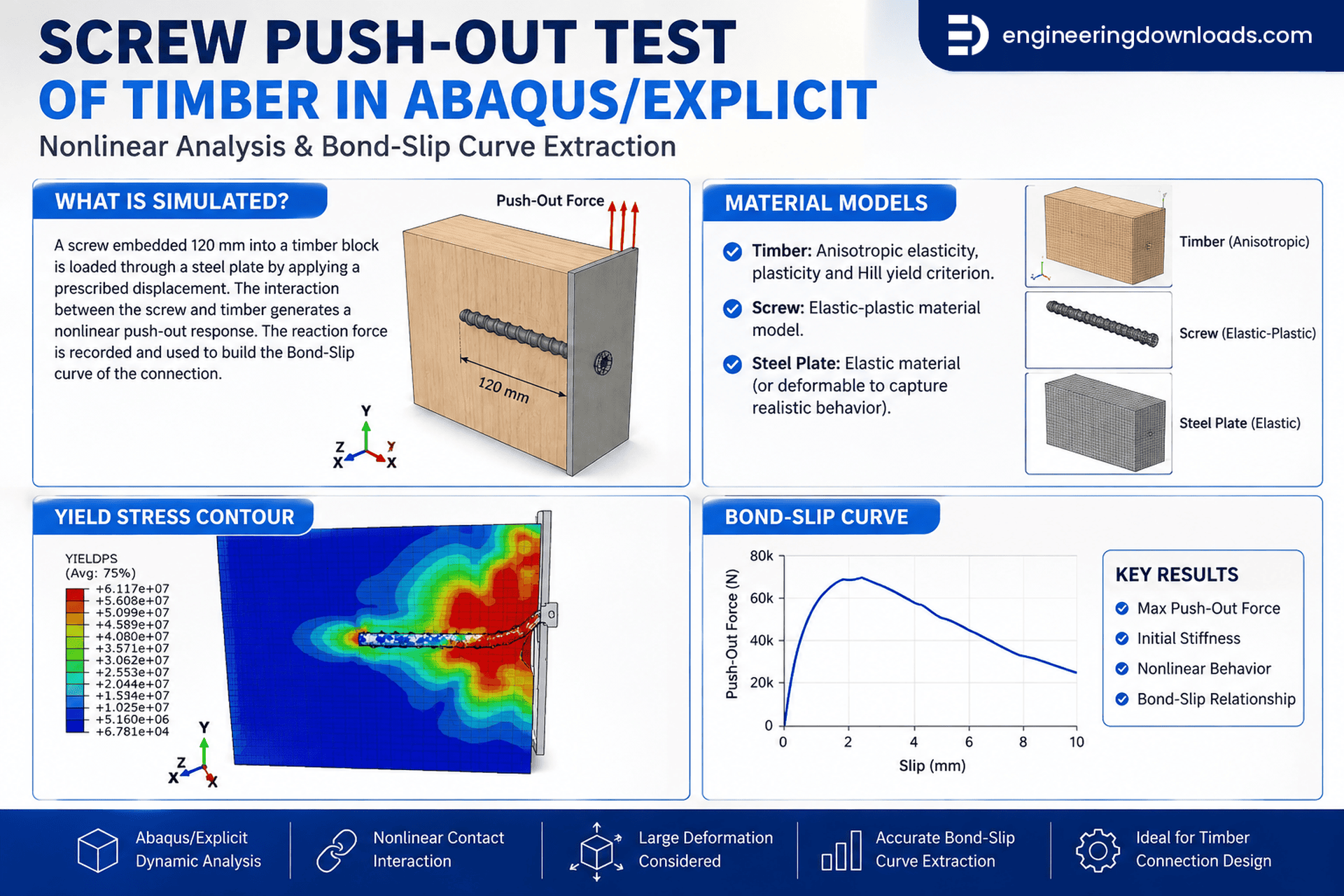 Screw Push-Out Test of Timber in Abaqus/Explicit: Bond-Slip Curve Simulation
 Abaqus Simulation of a Steel Stud Push-Out Test in a Voided Reinforced Concrete Slab
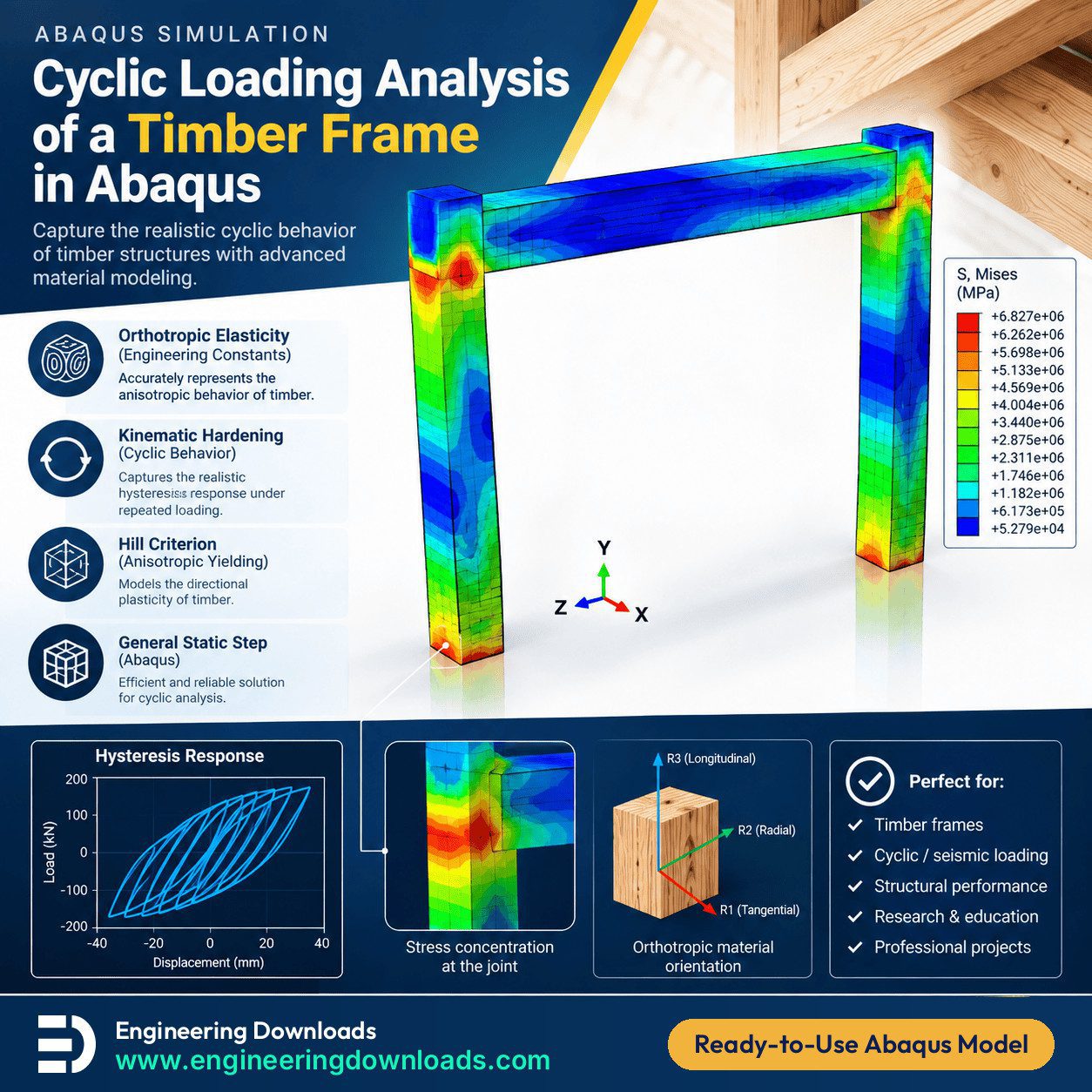 Seismic Cyclic Analysis of a Timber Frame in Abaqus: Hill Plasticity & Hysteresis
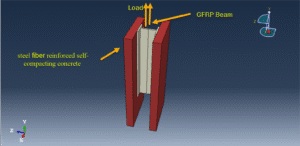 Push-Out analysis of GFRP-concrete adhesively bonded to steel fibre reinforced self-compacting concrete (SFRSCC)
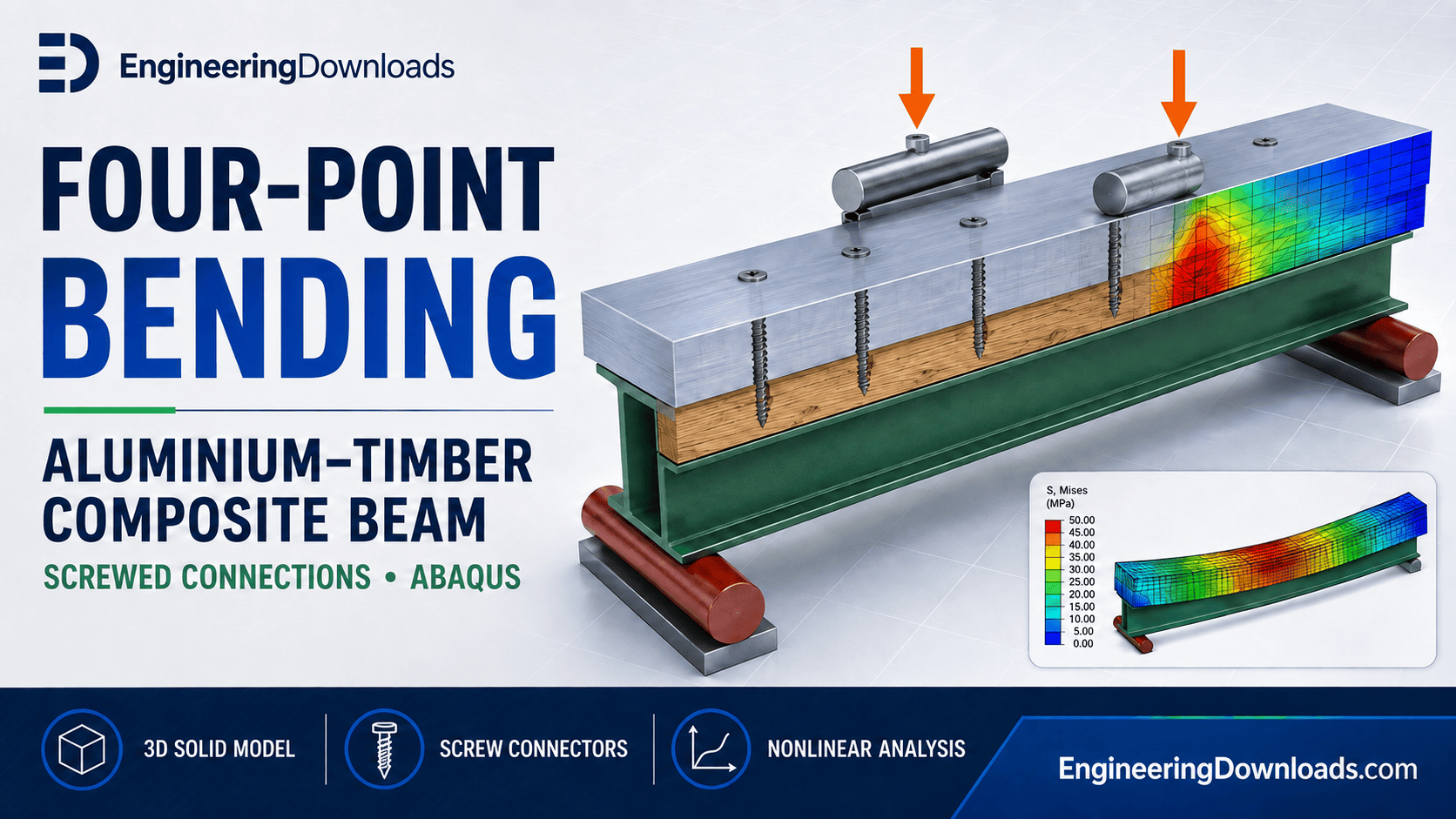 Analysis of aluminium-timber under four-point bending test
 Fire Analysis of Timber–Steel Bolted Connections in Abaqus | Sequential Thermal–Structural Simulation
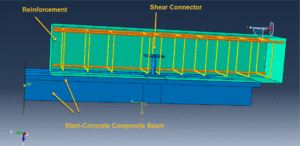 Analysis of the Push Out Test on a New I-Shape Shear Connector
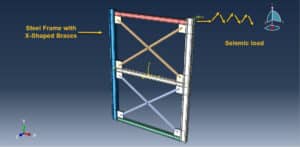 Analysis of the Seismic Behavior of Semirigid Steel Frame with X-Shaped Brace

Need a full custom project? See the options below.

€129,00

€179,00

€149,00

€119,00

€129,00

€149,00
See more
Want to receive push notifications for all major on-site activities?




