

Need a full custom project? See the options below.
Need a full custom project? See the options below.
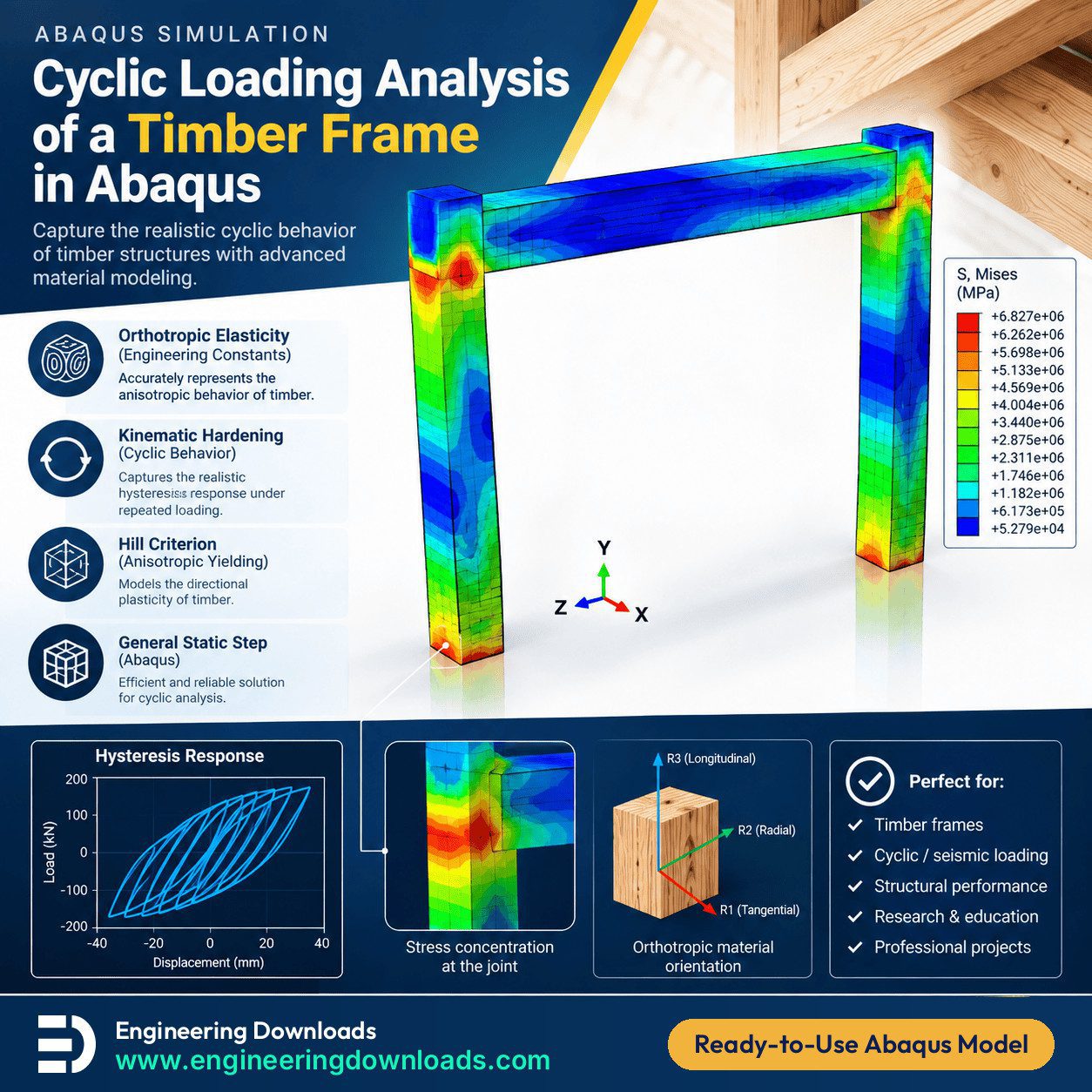
This is a ready-to-use Abaqus/Standard model of a timber frame under cyclic (seismic-type) loading. The frame has two square timber columns and one square timber beam. Timber is modelled as an orthotropic material with Hill anisotropic yielding and kinematic hardening, so the model can produce realistic force–displacement hysteresis loops.
You get the full .cae model, the .inp file, all material data and a step-by-step video tutorial. Open it, run it, and use it as the starting point for your own timber frame study.
Timber is not steel. Its stiffness and strength change a lot with the grain direction. Along the grain it is strong and stiff. Across the grain it is much weaker. When a timber frame is loaded back and forth, as in an earthquake, this directional behaviour and the plastic deformation that builds up in each cycle control how the frame responds.
Many models treat timber as a simple isotropic material. That is quick, but it hides the real behaviour: the wrong stiffness, the wrong yield pattern and hysteresis loops that do not make sense. Setting up an anisotropic plastic timber model in Abaqus is not easy either. You need engineering constants, correct material orientations, Hill stress ratios and a hardening law that works under reversed loading.
This model gives you all of that already set up and running, so you can focus on the results and on your own research question.
A simple portal-type timber frame is analysed in Abaqus/Standard under a cyclic loading history. The goal is to study the nonlinear response of the frame while taking the grain direction of timber into account.
Abaqus/CAE and Abaqus/Standard. Orthotropic elasticity, Hill plasticity and kinematic hardening are standard Abaqus features, so no user subroutine is needed.
The timber material model is intentionally simplified. It captures anisotropic yielding and cyclic hardening, but it does not include timber cracking, damage, stiffness degradation or slip in real connections. This keeps the model clean and easy to learn from. If you need those effects, the model is a good base to extend.
Getting orientations, Hill ratios and cyclic hardening right usually takes many failed runs. With this package you start from a working model, see how every setting is defined and get your first hysteresis curve fast. Use it to learn the method, to save time in a thesis or research project, or as a base for your own parametric study on timber frames.
Engineering Downloads offers a quality guarantee: if the model does not match its description, contact us and we will make it right.
You need Abaqus/CAE with Abaqus/Standard. The .inp file is included, which makes it easier to run the model in a different Abaqus version.
No. The frame is loaded with a quasi-static cyclic loading history in a General Static step. This is the standard way to study seismic behaviour, energy dissipation and hysteresis of structural members, similar to a laboratory cyclic test.
Timber yields at different stress levels along and across the grain. The Hill criterion lets you set different yield ratios in each direction, which isotropic von Mises plasticity cannot do.
Under reversed loading, kinematic hardening shifts the yield surface and captures the Bauschinger effect. This gives more realistic hysteresis loops for cyclic analysis.
Yes. Frame dimensions, the cyclic amplitude, orthotropic constants and Hill ratios can all be edited in the .cae file.
No. All features used in this model are available in standard Abaqus.
Yes. Our team can extend this model or build a custom timber or seismic simulation for you through our FEA and CFD consultation services. For larger parametric runs, you can also use our low-cost HPC server rental.
Browse more ready-to-use models in the Engineering Downloads shop. Have your own Abaqus or ANSYS models? You can sell your simulation content on Engineering Downloads.
Need more than the files?
There are two ways we can help. Book a one hour online consultation if you want to talk a problem through with a CAE engineer, using the checkbox in the order box. Order a project if you need a full simulation built for you, delivered to an agreed scope, price and deadline under a written contract.
We work on FEA and CFD for engineers, researchers and companies. Order your project, or message us on WhatsApp for a quick reply.
Other packages engineers working on this topic also download.
 Bolted Timber Beam-Column Joint Under Cyclic Loading in Abaqus: Hill Plasticity & Hysteresis
 Fire Analysis of Timber–Steel Bolted Connections in Abaqus | Sequential Thermal–Structural Simulation
 Screw–Timber Connection Analysis in Abaqus: Static Push-Out Test
 Analysis of aluminium-timber under four-point bending test
 Seismic Response of a Steel Building in Abaqus: Nonlinear Dynamic Analysis with Beam Elements
 Modeling the Fatigue Response of Reinforced Concrete Columns Using the Direct Cyclic Procedure
 Four-Point Bending of a Bolted Timber–Steel Composite Beam in Abaqus: Hill Plasticity & Force–Displacement
 RC Column under Axial Compression in Abaqus: Smeared Cracking Model

Need a full custom project? See the options below.

€129,00

€179,00

€149,00

€119,00

€129,00

€149,00
See more
Want to receive push notifications for all major on-site activities?




