Need a full custom project? See the options below.
Need a full custom project? See the options below.
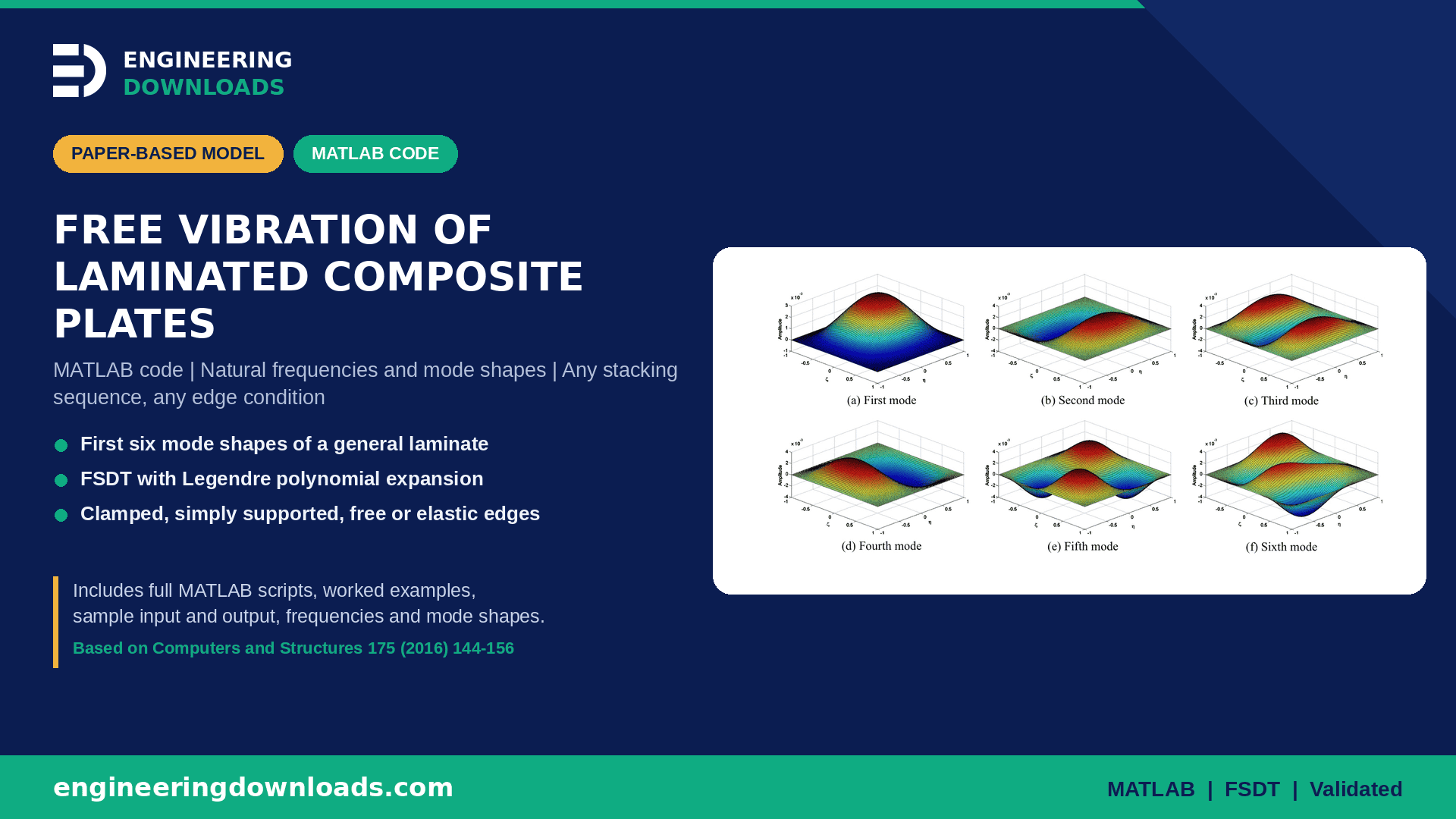
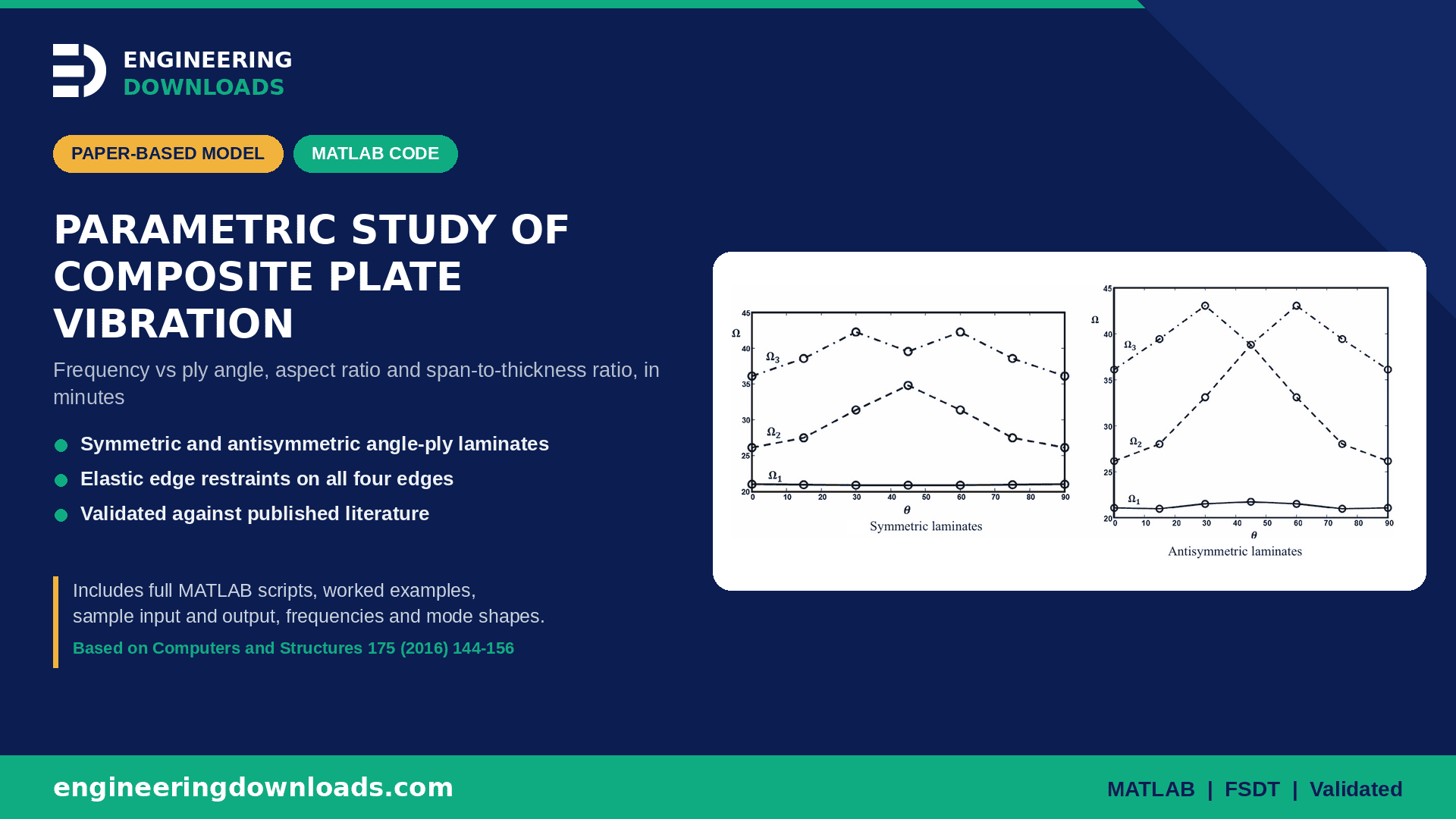
A method is presented to study the free vibrations of rectangular laminated composite plates with general layups and arbitrary boundary conditions. Based on the first-order shear deformation theory, the governing differential equations and boundary conditions are deduced via Hamilton’s principle. Generalised displacements are expanded as series with Legendre polynomials as the base functions. A generalised eigenvalue problem is obtained by following a variational approach, where energy functional is extremised and boundary conditions are introduced by means of Lagrange multipliers. In order to overcome some difficulties in obtaining the natural frequencies and corresponding mode shapes, a new numerical strategy is proposed.
Most composite plate vibration codes only work for the easy cases. Cross-ply or angle-ply. Symmetric layups. Simply supported edges on all four sides.
Real laminates are not always like that. When the stacking sequence is unsymmetric, bending-extension and bending-twisting coupling appear. The governing equations become fully coupled and the standard Navier or Levy solutions stop working. Add a clamped edge, a free edge, or an elastic support, and most academic scripts fail completely.
So researchers spend months writing their own solver, or fall back on a general FE package where they cannot control the theory or run fast parametric studies.
This package is a working MATLAB implementation of a published, peer-reviewed solution method for exactly this problem.
The formulation is based on First-Order Shear Deformation Theory, so transverse shear is included and the results stay accurate for moderately thick plates. The governing equations and boundary conditions are derived from Hamilton’s principle. The generalised displacements are expanded as series of Legendre polynomials, whose orthogonality makes the strain and kinetic energy expressions much simpler.
The boundary conditions are applied through Lagrange multipliers. This is the key point: the assumed displacement functions do not need to satisfy the boundary conditions in advance. Every edge is modelled with fictitious elastic springs for all five degrees of freedom, so clamped, simply supported, free, and elastically restrained edges all come from the same code by changing spring stiffness values.
The result is a generalised eigenvalue problem. Natural frequencies and mode shapes come directly out of it.
MATLAB. No toolbox-heavy dependencies, no commercial FE licence needed.
Writing this solver from scratch is a multi-month job. Debugging the Lagrange multiplier block and the eigenvalue scaling is where most people get stuck. You get a working, validated starting point today, and you keep full control of the code.
Every purchase on Engineering Downloads is covered by our satisfaction guarantee. If the product does not meet what is described, we refund you.
Abedi, M., Jafari-Talookolaei, R.-A., Valvo, P. S. “A new solution method for free vibration analysis of rectangular laminated composite plates with general stacking sequences and edge restraints.” Computers and Structures, 175 (2016), 144–156.
We can adapt the code to your laminate, material system, boundary conditions, or geometry. We also offer simulation outsourcing, publication support, and HPC rental from EUR 5 per week.
Contact us on WhatsApp for a free consultation.
Related links: Shop · Custom projects · Publication support · HPC rental
Need more than the files?
There are two ways we can help. Book a one hour online consultation if you want to talk a problem through with a CAE engineer, using the checkbox in the order box. Order a project if you need a full simulation built for you, delivered to an agreed scope, price and deadline under a written contract.
We work on FEA and CFD for engineers, researchers and companies. Order your project, or message us on WhatsApp for a quick reply.
Other packages engineers working on this topic also download.
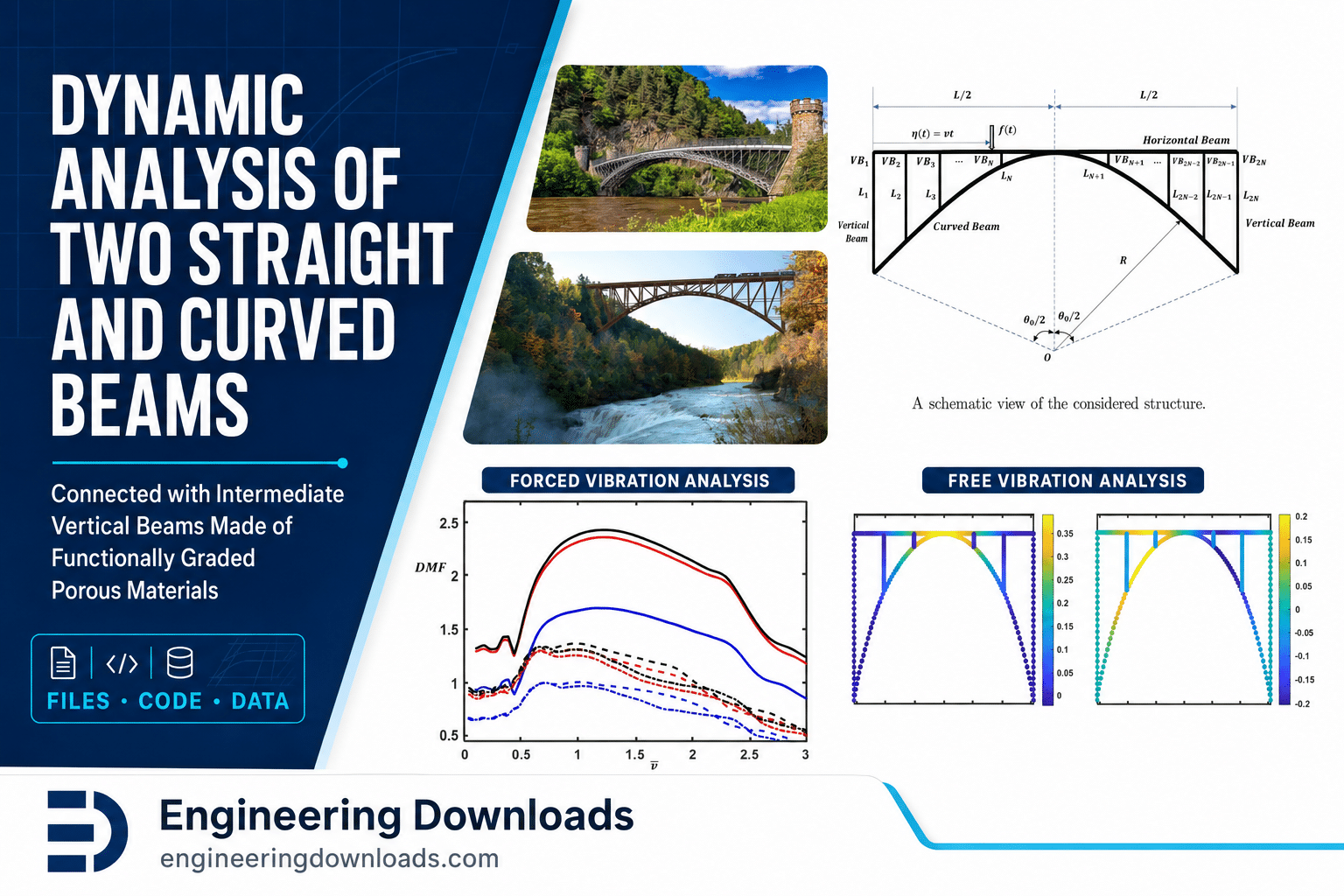 Dynamic Analysis of Functionally Graded Porous Straight and Curved Beams – Files, Code and Data
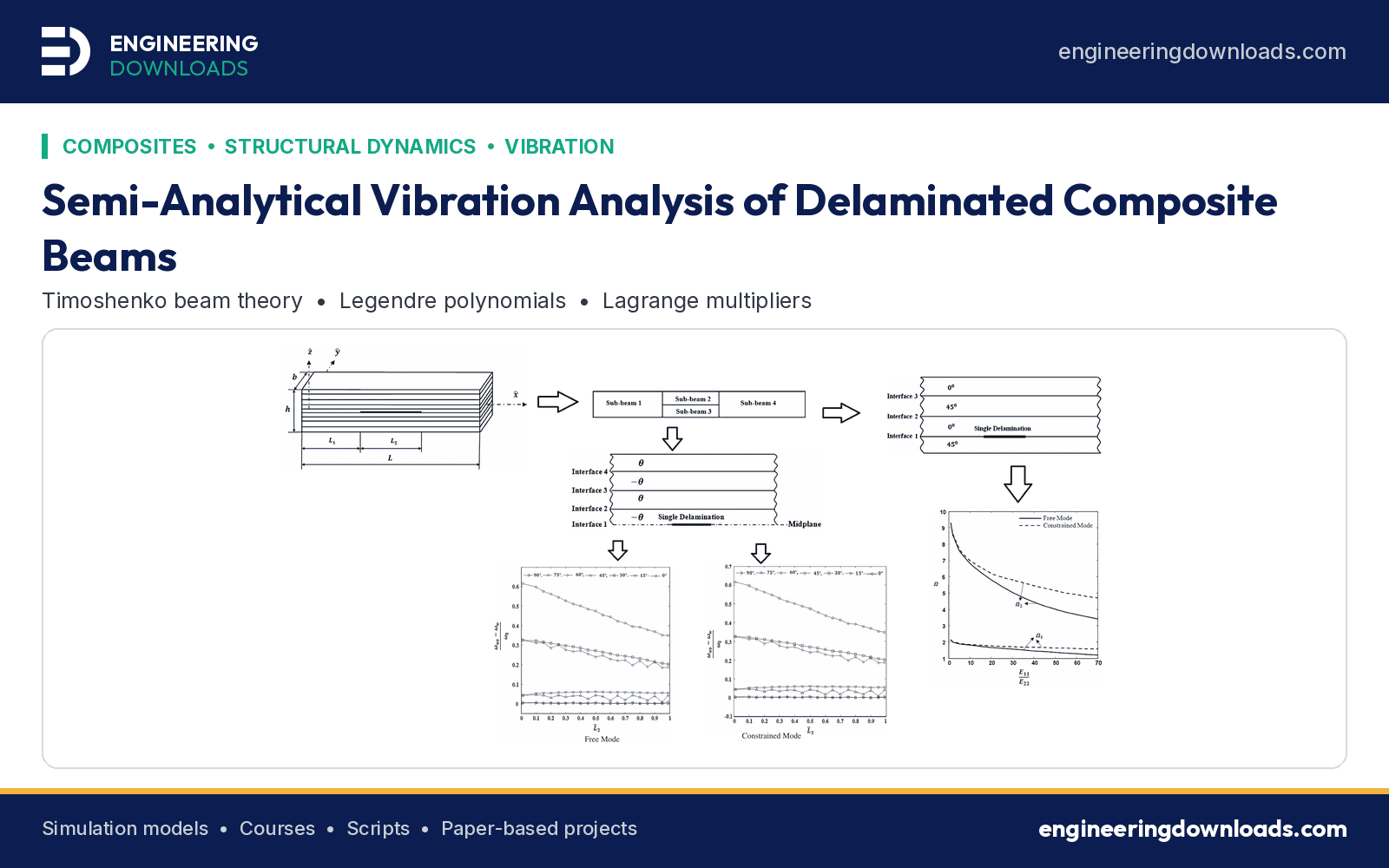 Free Vibration Analysis of Delaminated Composite Beams — Semi-Analytical Timoshenko Model
 Screw–Timber Connection Analysis in Abaqus: Static Push-Out Test
 Fire Analysis of Timber–Steel Bolted Connections in Abaqus | Sequential Thermal–Structural Simulation
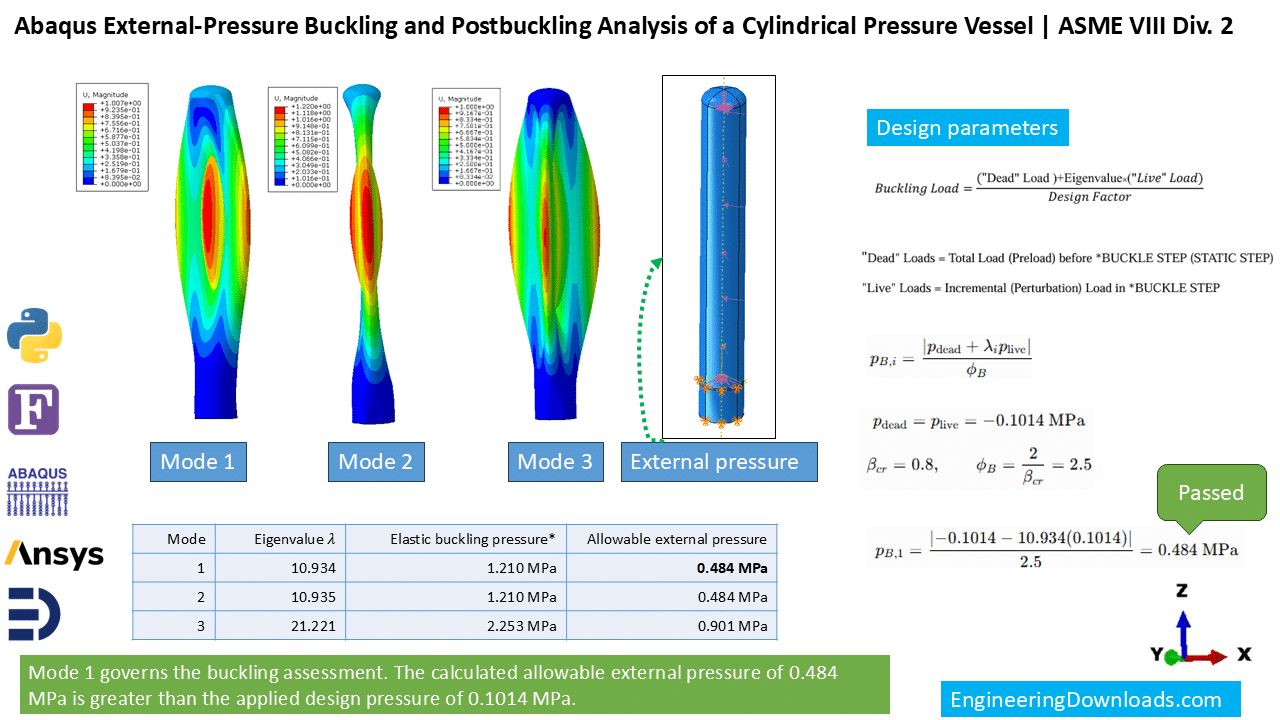 Abaqus External-Pressure Buckling of a Cylindrical Pressure Vessel: Eigenvalue and Static Riks Analysis
 Seismic Response of a Steel Building in Abaqus: Nonlinear Dynamic Analysis with Beam Elements
 MATLAB Code for Finite Element analysis of Pipes: Free Vibration Analysis and Validation
 MATLAB Code for Finite Element analysis of Pipes: Static Analysis and Validation

Need a full custom project? See the options below.

€129,00

€179,00

€149,00

€119,00

€129,00

€149,00
See more
Want to receive push notifications for all major on-site activities?