
Need a full custom project? See the options below.
Need a full custom project? See the options below.
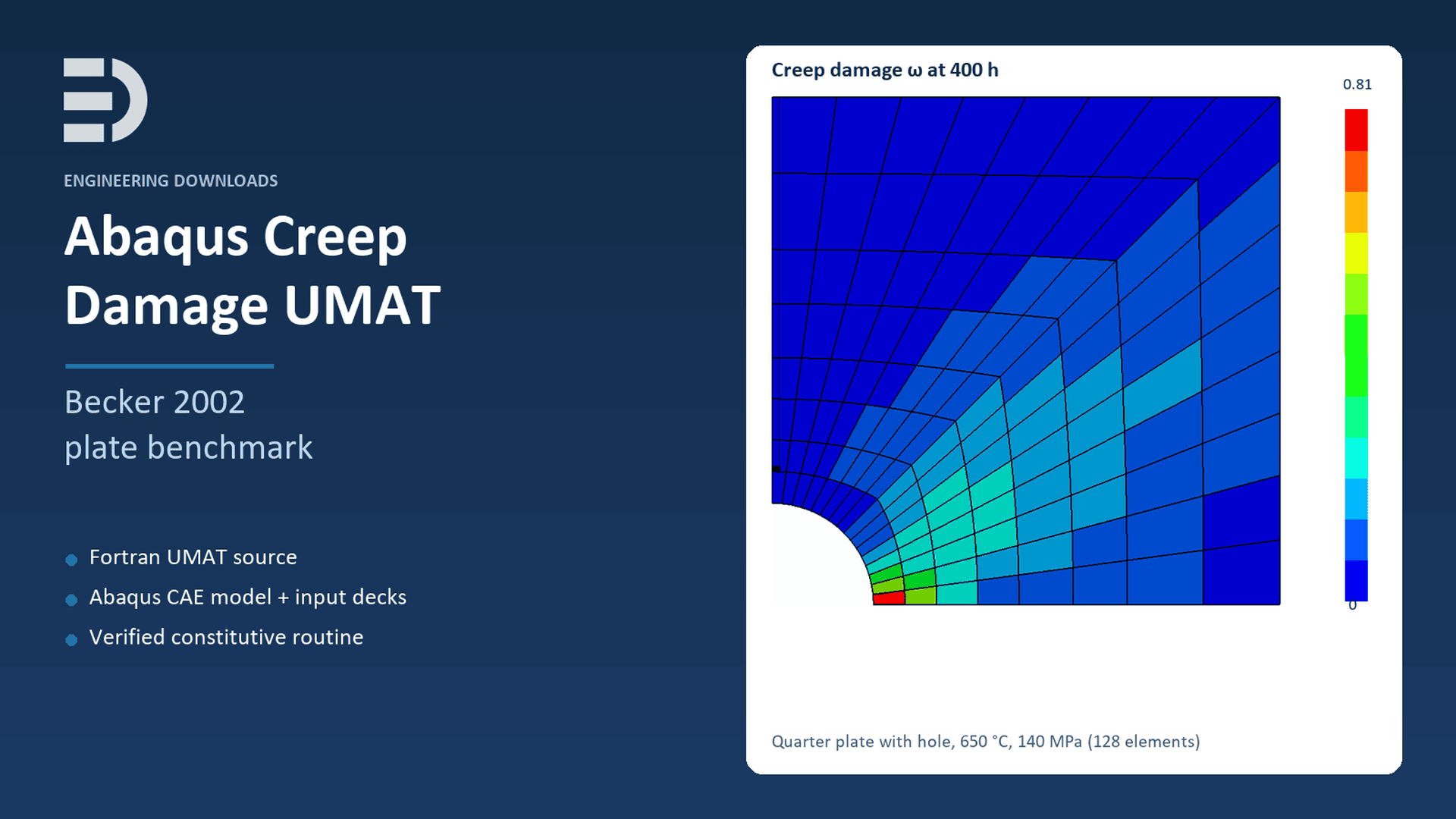
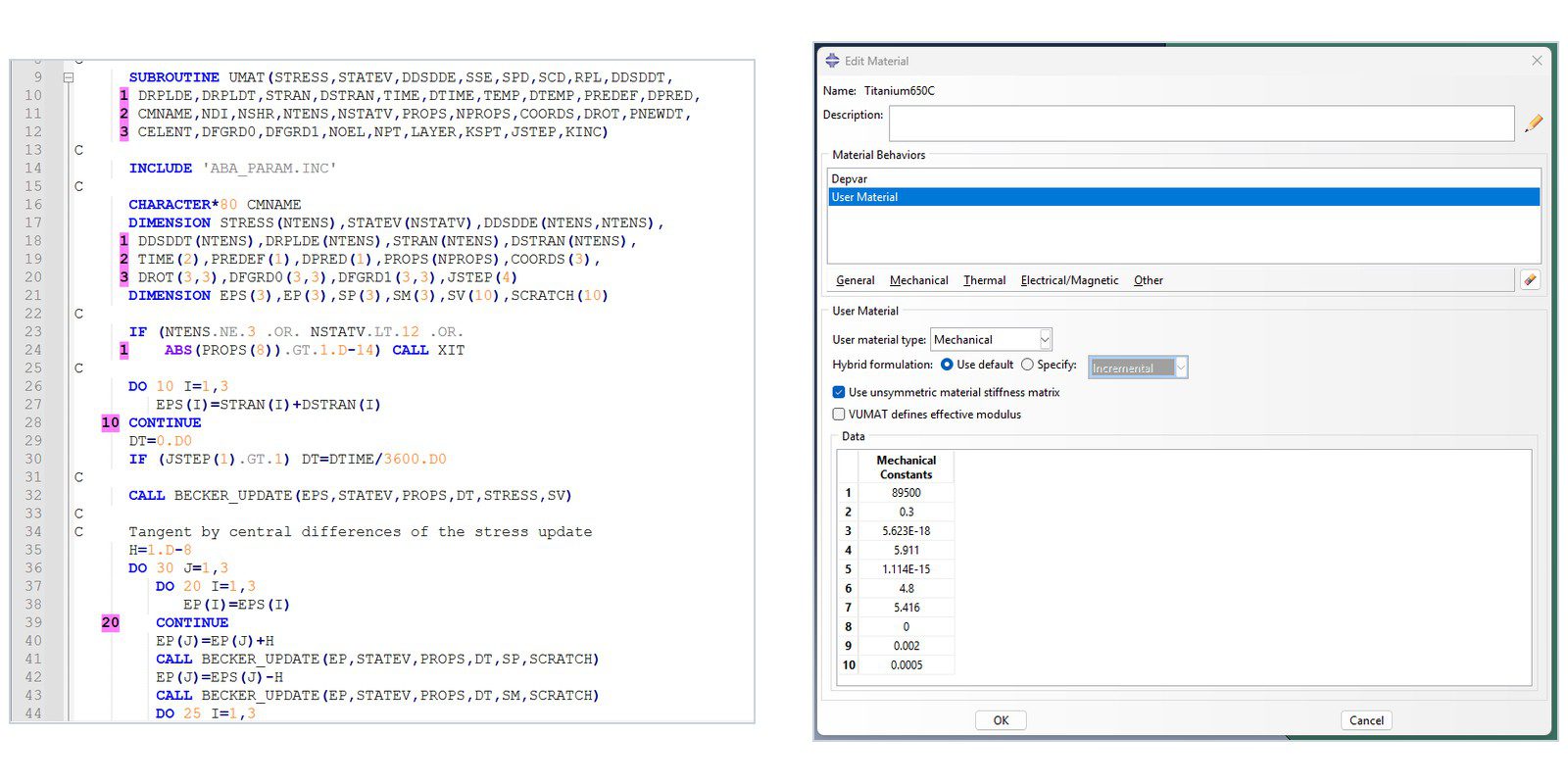
Creep turns a steady load into slow, permanent deformation, and in the last stage internal damage makes the material fail quickly. This ready-to-use Abaqus package gives you a working creep continuum damage model: a plane-stress UMAT in fixed-form Fortran, a quarter-plate model of the perforated plate benchmark of Becker et al. (2002), and a step-by-step tutorial that explains the theory, the code, the model and the results.
Paper: A.A. Becker, T.H. Hyde, W. Sun and P. Andersson (2002), Benchmarks for finite element analysis of creep continuum damage mechanics, Computational Materials Science, 25, 34–41. DOI: 10.1016/S0927-0256(02)00247-1
Creep rupture life can be predicted using a continuum damage mechanics approach incorporated within a finite element (FE) formulation. The rate of change of a damage parameter, ω, ranging from ω = 0 (no damage) to ω = 1 (100% damage), is computed within each element, until failure occurs in the material cross-section. The main difficulty in the numerical formulation arises due to the very small time steps needed as the damage parameter increases to 1. This paper presents the results of a number of benchmark tests involving the FE analysis of creep continuum damage mechanics that can be used to verify the FE solutions. Two independent FE codes are used; an in-house code (FE-DAMAGE) and a commercial code (ABAQUS) in which a user-subroutine (UMAT) is incorporated. The results of a series of tests used to represent uniaxial, biaxial, triaxial and multi-material creep and damage behaviour are presented.
Abstract quoted from the paper for reference (© 2002 Elsevier Science B.V.). The paper itself is not included in this package.
This is a verified benchmark reconstruction. It does not claim a validated rupture life or an API 579 acceptance calculation.
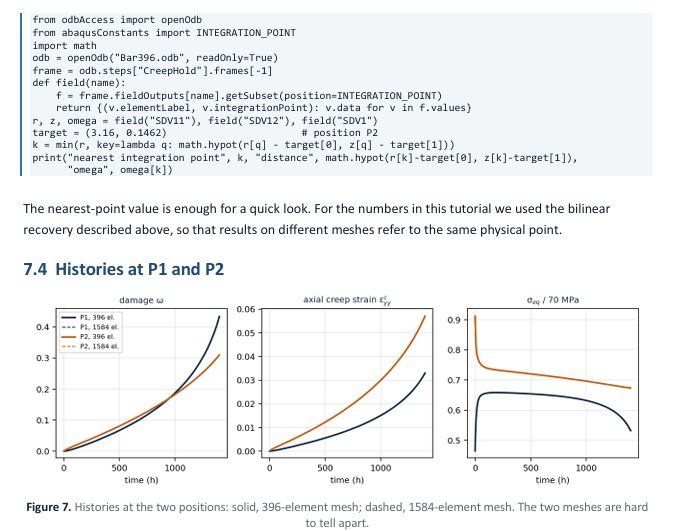
We compared our histories at the paper’s two reporting points with values read from the paper’s figure. Damage at the first point agrees to about 3% up to 300 hours and is about 8% higher near 400 hours. Equivalent creep strain is higher than the paper, by up to about 21% at the end. The material routine itself matches the closed-form uniaxial creep-damage solution, with damage error near 10-11. The hole radius is not readable in our copy of the paper, so R = 10 mm is assumed, mesh convergence is not established, and the model is isothermal at 650 °C. The tutorial reports all of this in detail.
Researchers, graduate students and engineers who want a working example of a creep damage UMAT in Abaqus, a clear explanation of how the code works, and a starting point for high-temperature creep, structural integrity and fitness-for-service work.
Abaqus/CAE and Abaqus/Standard 2024 (the version used to build and run the package) and a Fortran compiler linked to Abaqus to compile the UMAT. The run takes about five and a half minutes on eight cores.
You skip the work of writing and testing a creep damage UMAT and start from a verified file, with the theory and the code explained line by line. See also the blade creep study with built-in and custom creep models, the thermal and creep subroutines package, the API 579 Level 3 FFS crack assessment example in Abaqus, our guide Introduction to UMAT Subroutine in Abaqus and the article Life Assessment and Creep Damage Analysis of Welded Components.
Does it predict rupture life? No. It reproduces damage and creep strain histories for 400 hours. The paper’s plotted failure point lies beyond that window.
Does the temperature change the result? No. The material constants belong to 650 °C, so the model is isothermal. Temperature-dependent constants would be needed for other temperatures.
Can I use my own material? Yes, by changing the ten material constants. The UMAT supports plane stress with the von Mises case only (α = 0).
Do I need a Fortran compiler? Yes, to compile the UMAT. The tutorial shows the one command and how to check it.
Can I edit the model? Yes, you get the CAE and INP files and the Python scripts.
Quality guarantee: if you are not satisfied with the delivered product, we will refund you.
Need more than the files?
There are two ways we can help. Book a one hour online consultation if you want to talk a problem through with a CAE engineer, using the checkbox in the order box. Order a project if you need a full simulation built for you, delivered to an agreed scope, price and deadline under a written contract.
We work on FEA and CFD for engineers, researchers and companies. Order your project, or message us on WhatsApp for a quick reply.
Other packages engineers working on this topic also download.
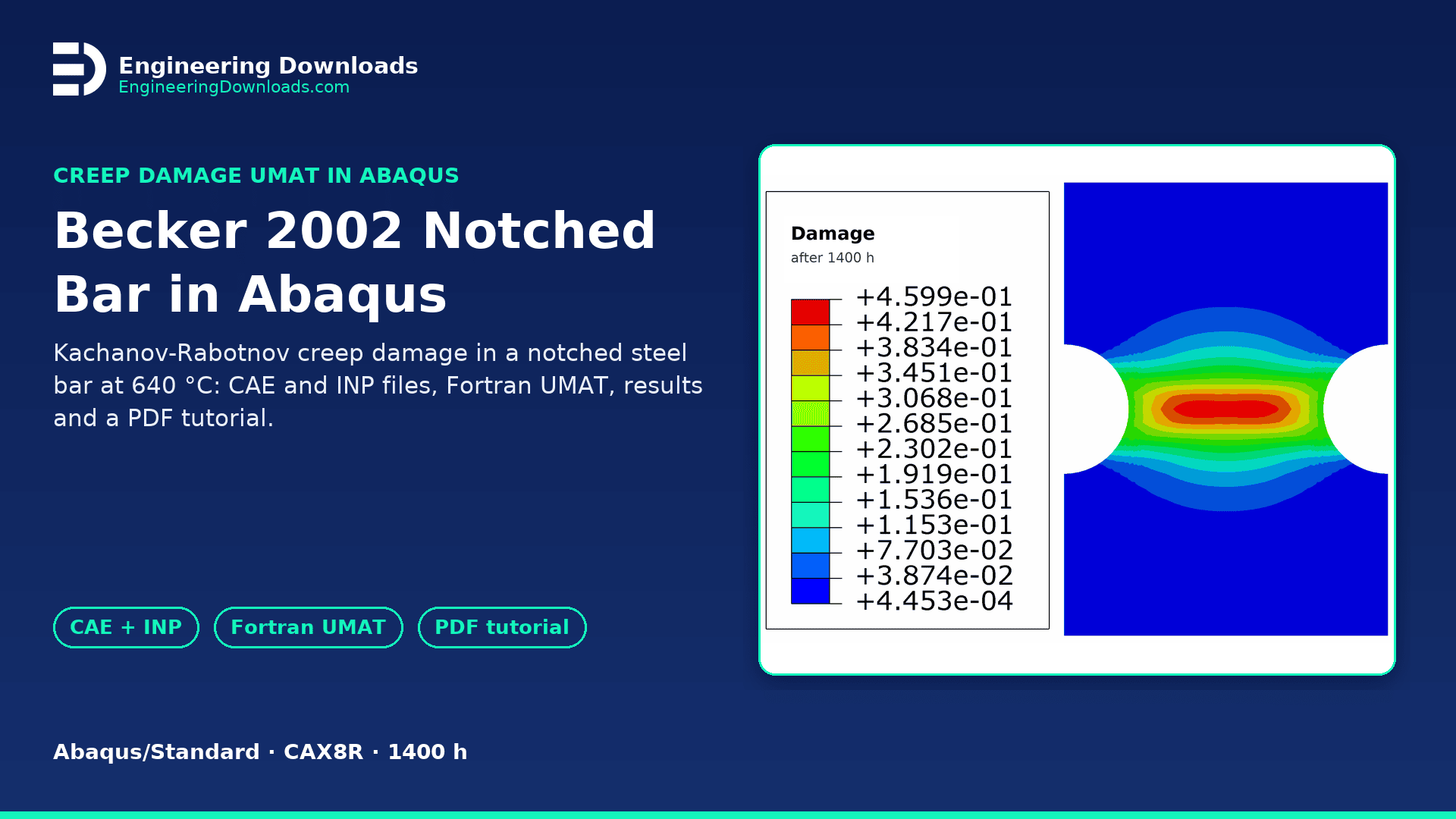 Creep Damage Notched Bar in Abaqus: Becker 2002 Benchmark with UMAT, CAE and INP Files and Paper Comparison€49,00
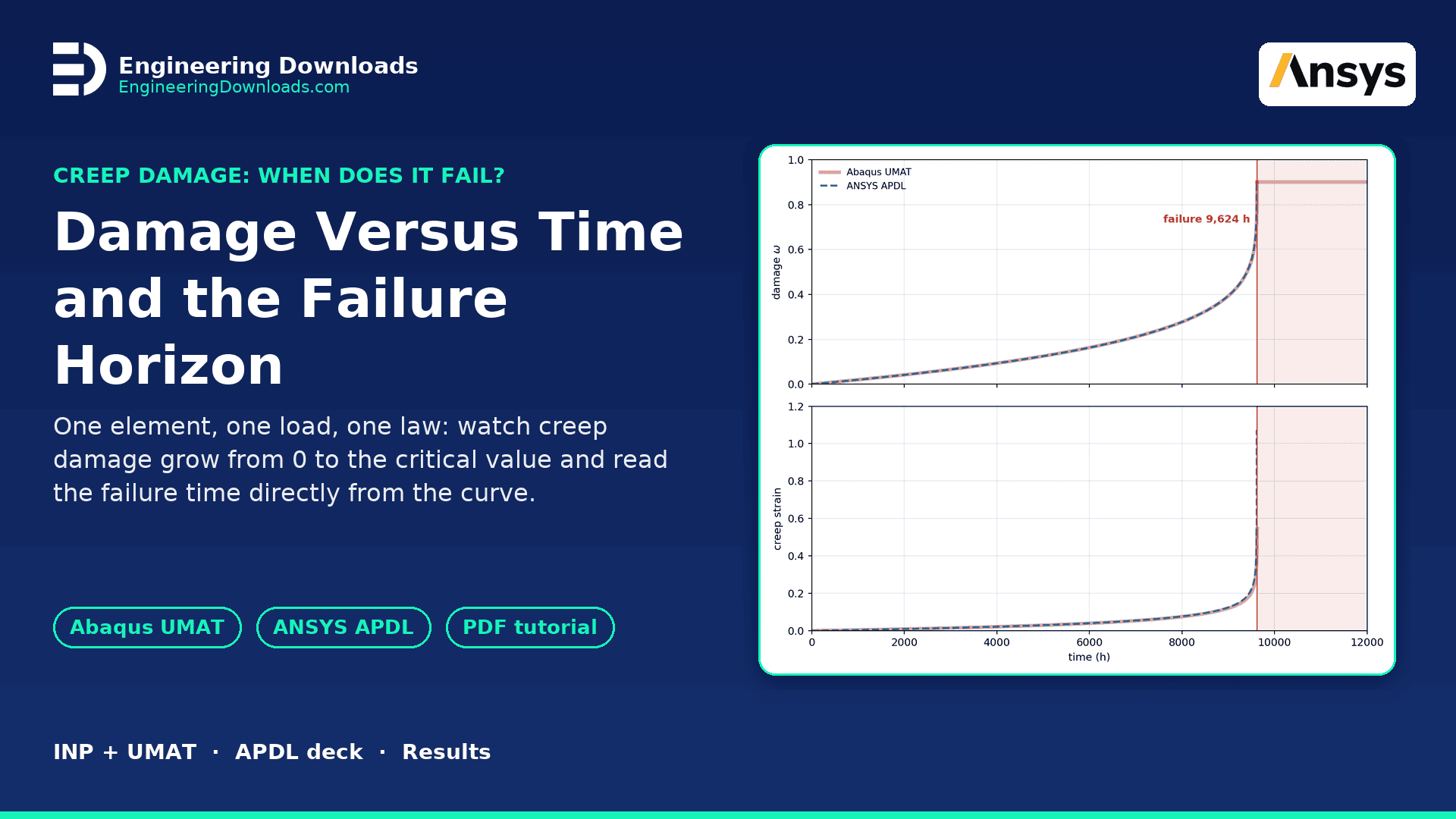 Creep Damage Versus Time in Abaqus: Failure Horizon of a Single Element with a Kachanov-Rabotnov UMAT€49,00
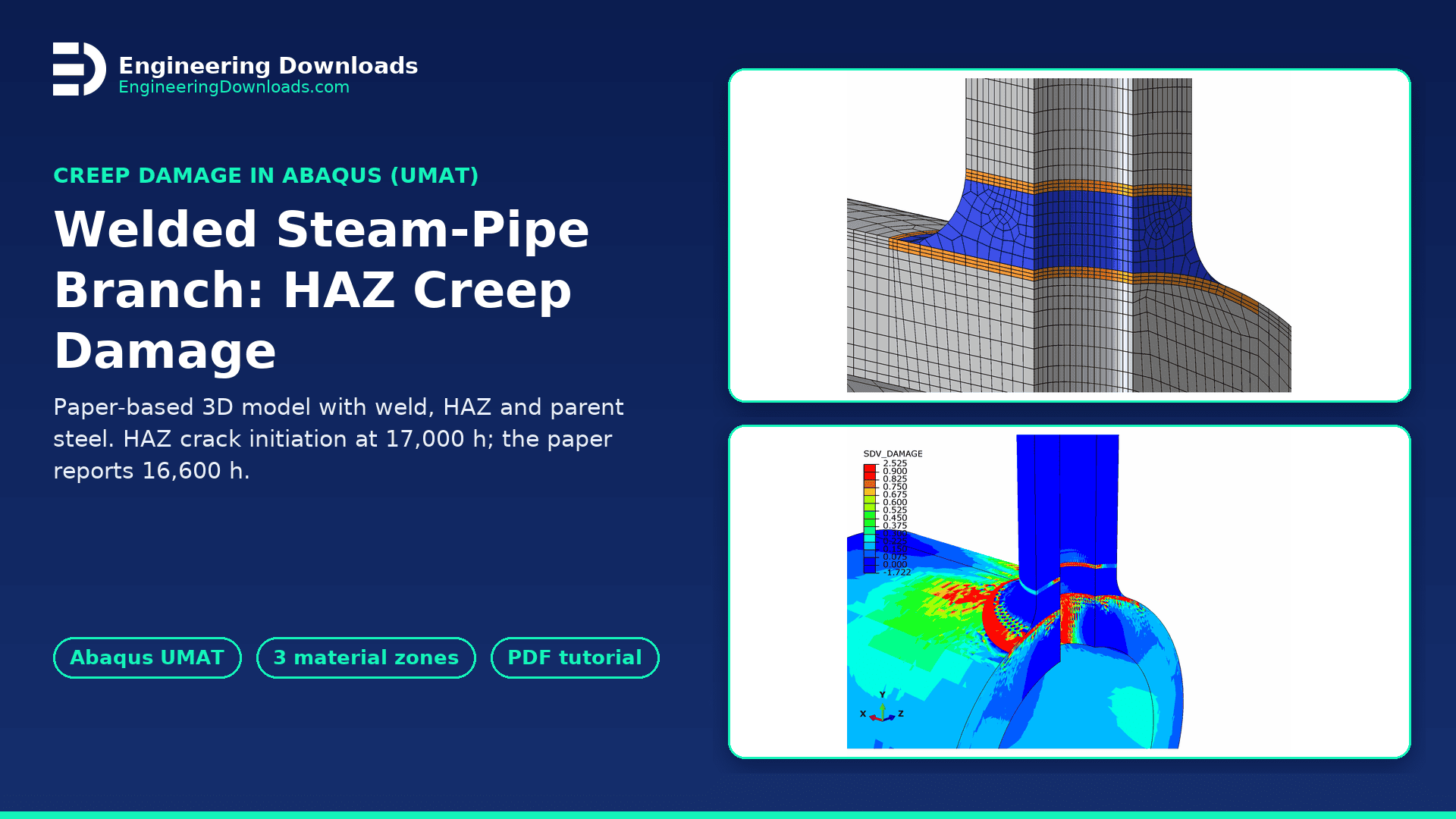 Creep Damage Analysis of a Welded Steam Pipe Branch in Abaqus: UMAT, HAZ Hex Mesh and Paper Comparison€149,00
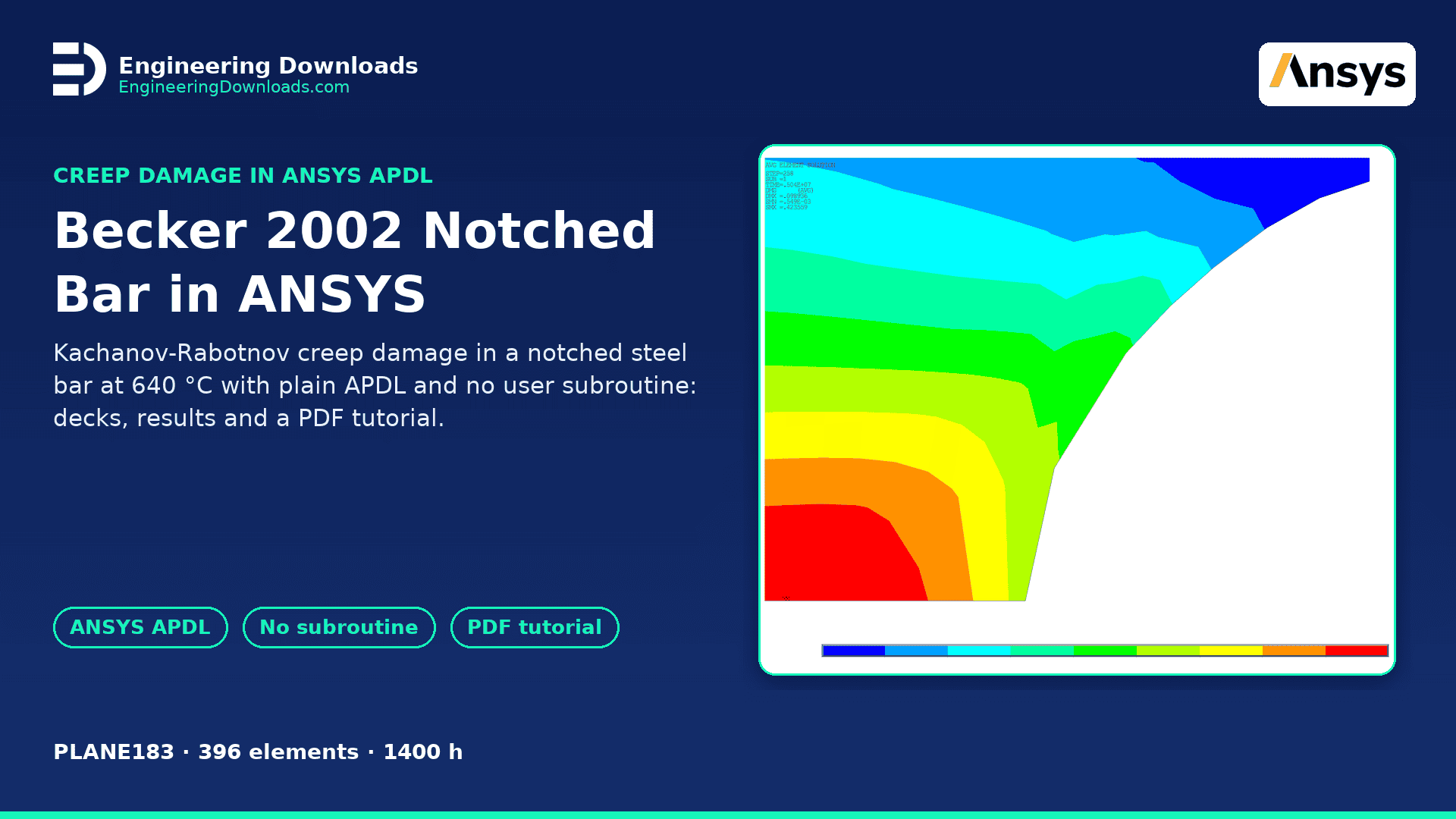 Creep Damage Notched Bar in ANSYS APDL: Becker 2002 Benchmark with No User Subroutine, Decks and Paper Comparison€49,00Creep Damage Versus Time in ANSYS APDL: Failure Horizon of a Single Element, No User Subroutine€49,00
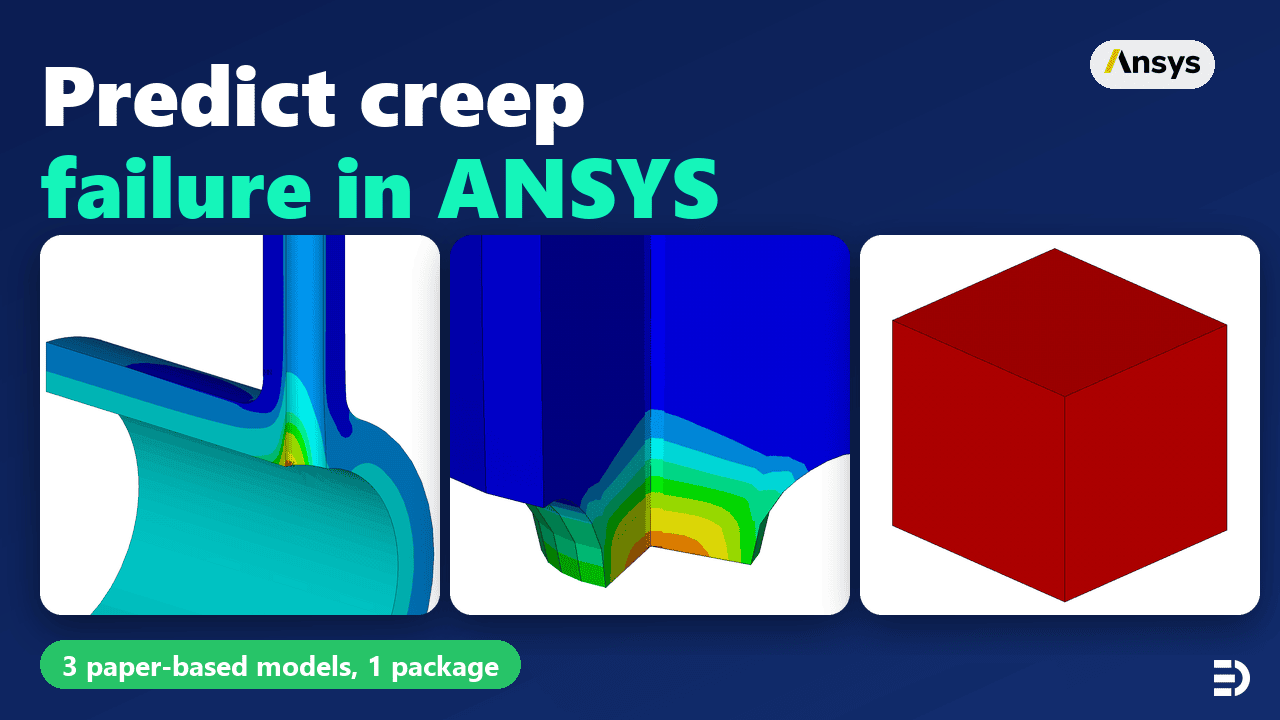 ANSYS Creep Damage Package: 3 Paper-Based APDL Models (Welded Pipe Branch, Notched Bar, Failure Horizon)€299,00
 Composite Fatigue UMAT for Abaqus: Hashin, Tsai-Hill and Maximum-Stress Criteria€159,00
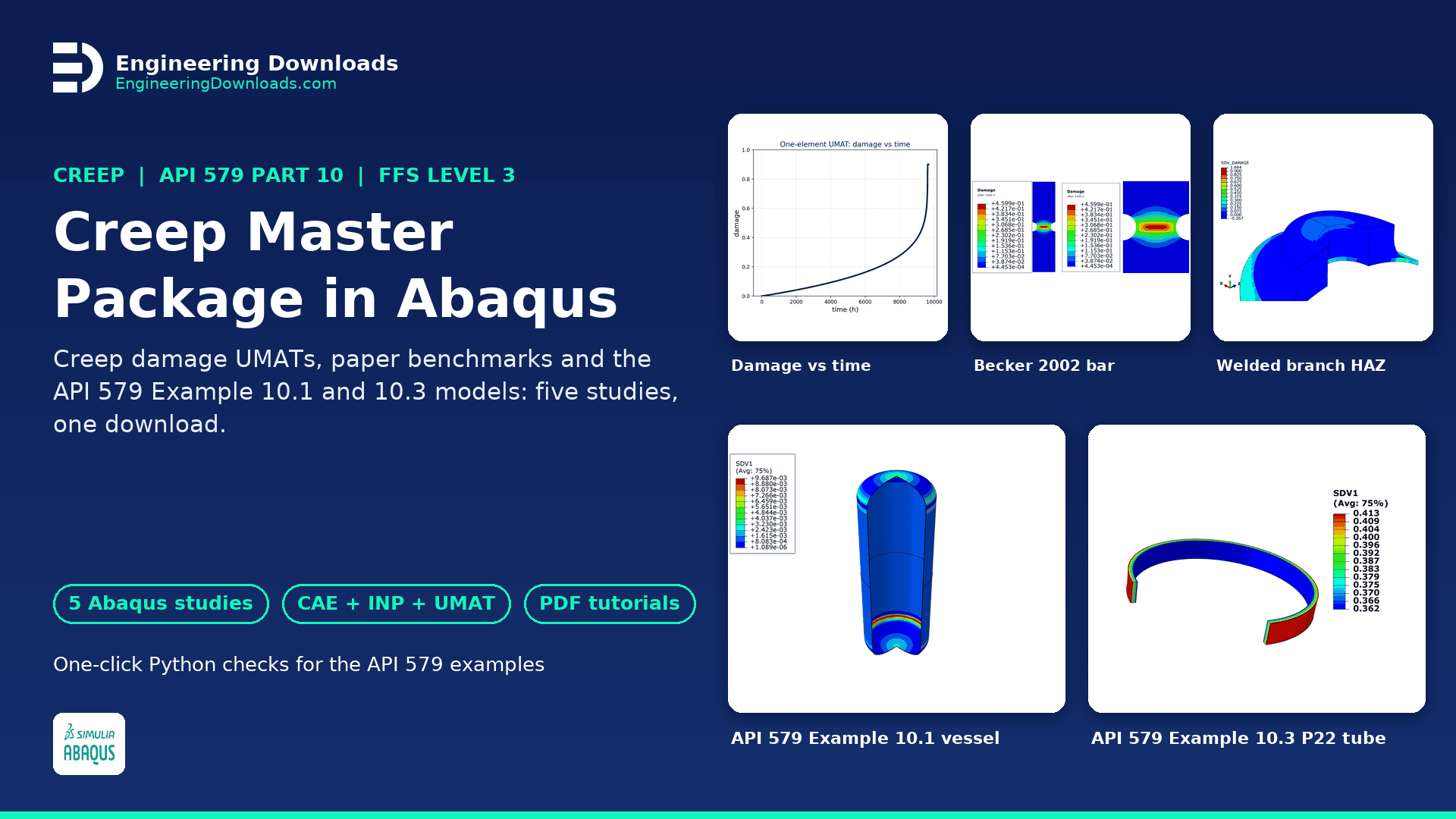 Creep Master Package in Abaqus: API 579 Part 10 Examples 10.1 and 10.3, Creep Damage UMAT and Paper Benchmarks€299,00

Need a full custom project? See the options below.

€129,00

€179,00

€149,00

€119,00

€129,00
See more
Want to receive push notifications for all major on-site activities?