

Need a full custom project? See the options below.
Need a full custom project? See the options below.
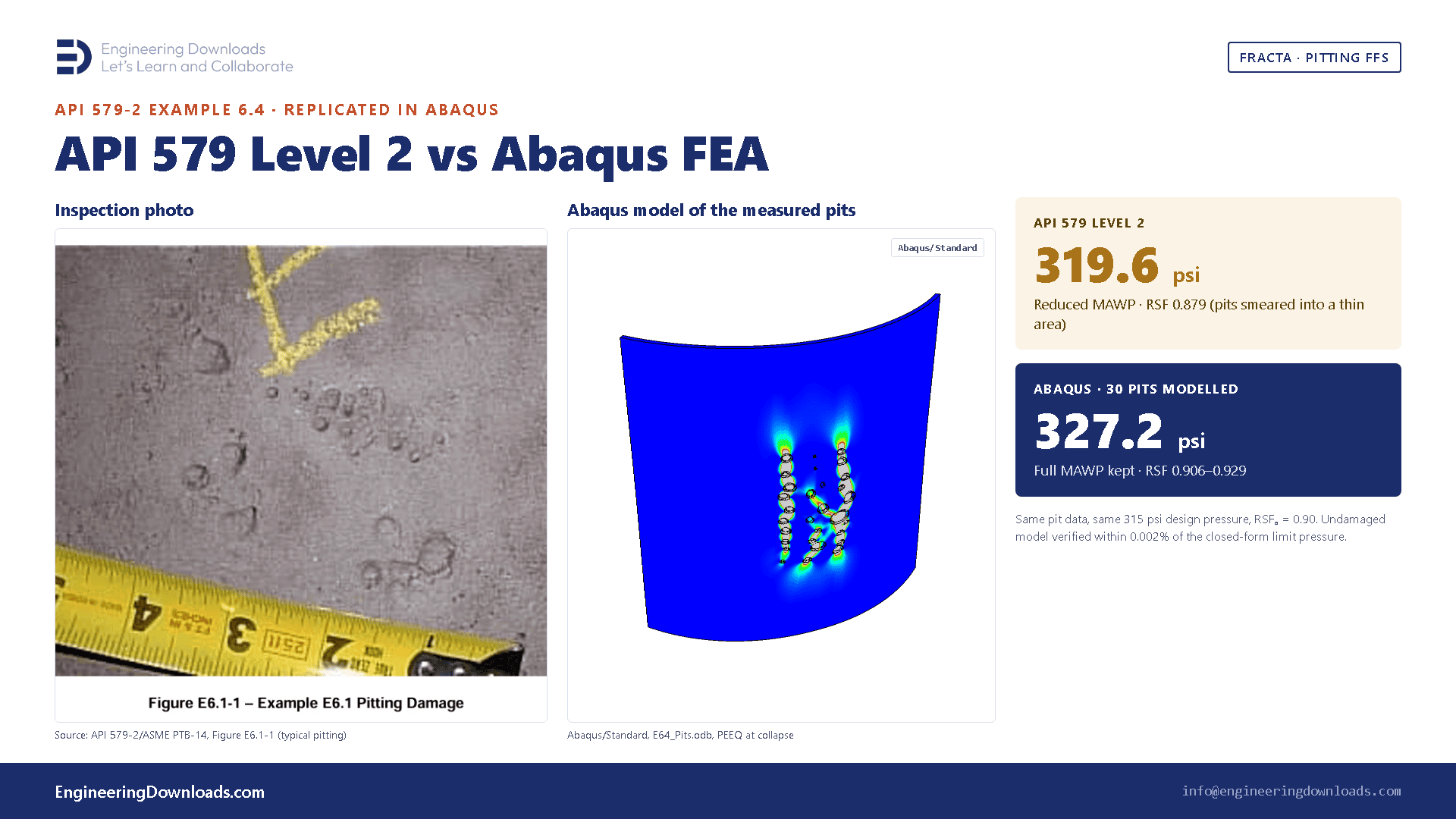
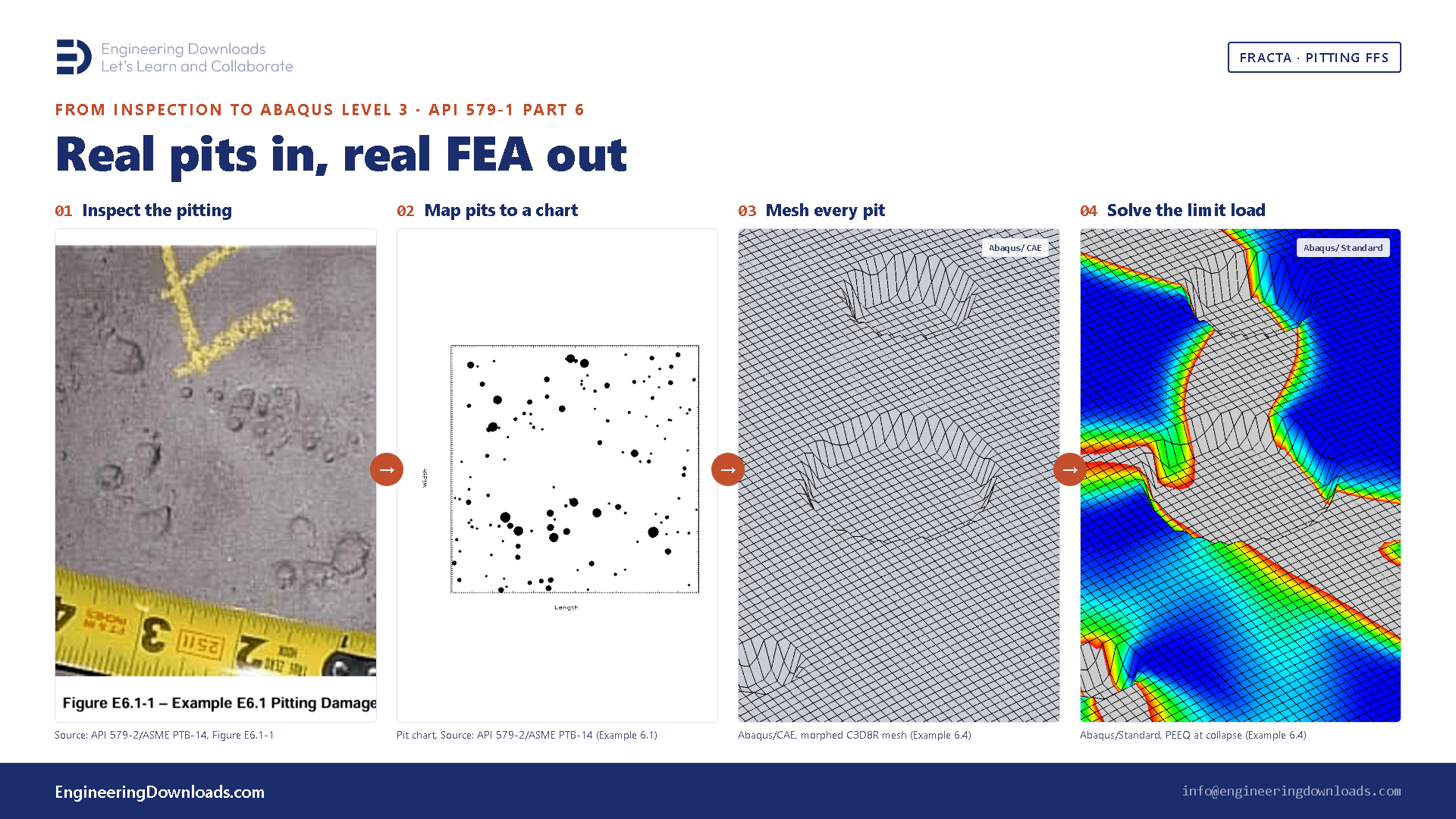
Pitting corrosion found under insulation is one of the most common fitness-for-service (FFS) questions on pressure vessels. API 579-1/ASME FFS-1 Part 6 answers it with pit-couples and, for localized pitting, an equivalent locally thin area. This Abaqus package takes the published API 579-2 Example 6.4 – 30 measured pits on an 84 in ASME VIII-1 shell at 315 psi – and does both: an independent Level 2 recalculation that matches the book, and a Level 3 limit-load model in Abaqus with every pit in the mesh. You get the CAE and INP files, the Python scripts that build the model from pit data, and a PDF tutorial that compares the Abaqus result with the API 579 example step by step.
Source: API 579-2/ASME PTB-14 Fitness-For-Service Example Problem Manual, Example 6.4 (assessment to API 579-1/ASME FFS-1 2021, Part 6, Level 2). A CUI inspection of a pressure vessel shell found localized pitting over a 25 × 15 in region. The diameter, depth, pitch and orientation of 15 pit-couples were measured, and the question is whether the vessel can keep operating at its 315 psi design pressure.
| Item | API 579-2 Example 6.4 | This package |
|---|---|---|
| Component | ASME VIII-1 cylinder, 84 in ID, 1.0 in wall | 90° sector, 65 in long, pitted patch at mid-length |
| Design condition | 315 psi at 450 °F, S = 17,500 psi, E = 0.85 | Internal pressure with closed-end axial load |
| Damage | 15 pit-couples (30 pits), external, FCA 0.0625 in | All 30 pits in the mesh at their measured diameter and depth |
| Method | Part 6 Level 2, then equivalent LTA to Part 5 | Level 3 elastic–perfectly plastic limit load (Annex 2D style), Static Riks |
| Mesh | – | 119,520 C3D8R elements, 3 through the wall, node columns morphed to the pit depths |
| Software | Hand calculation | Abaqus/CAE and Abaqus/Standard 2024, Python |
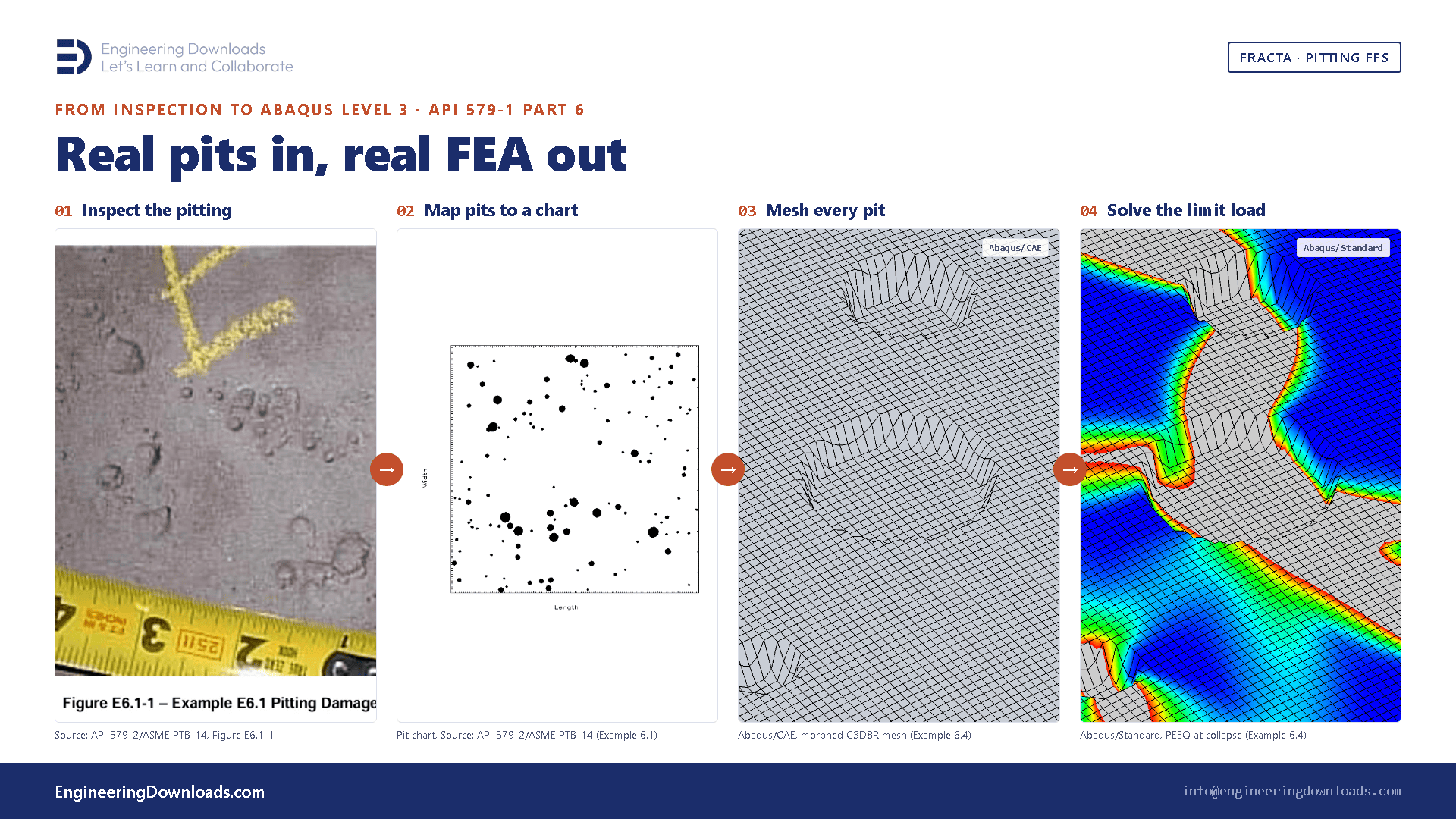
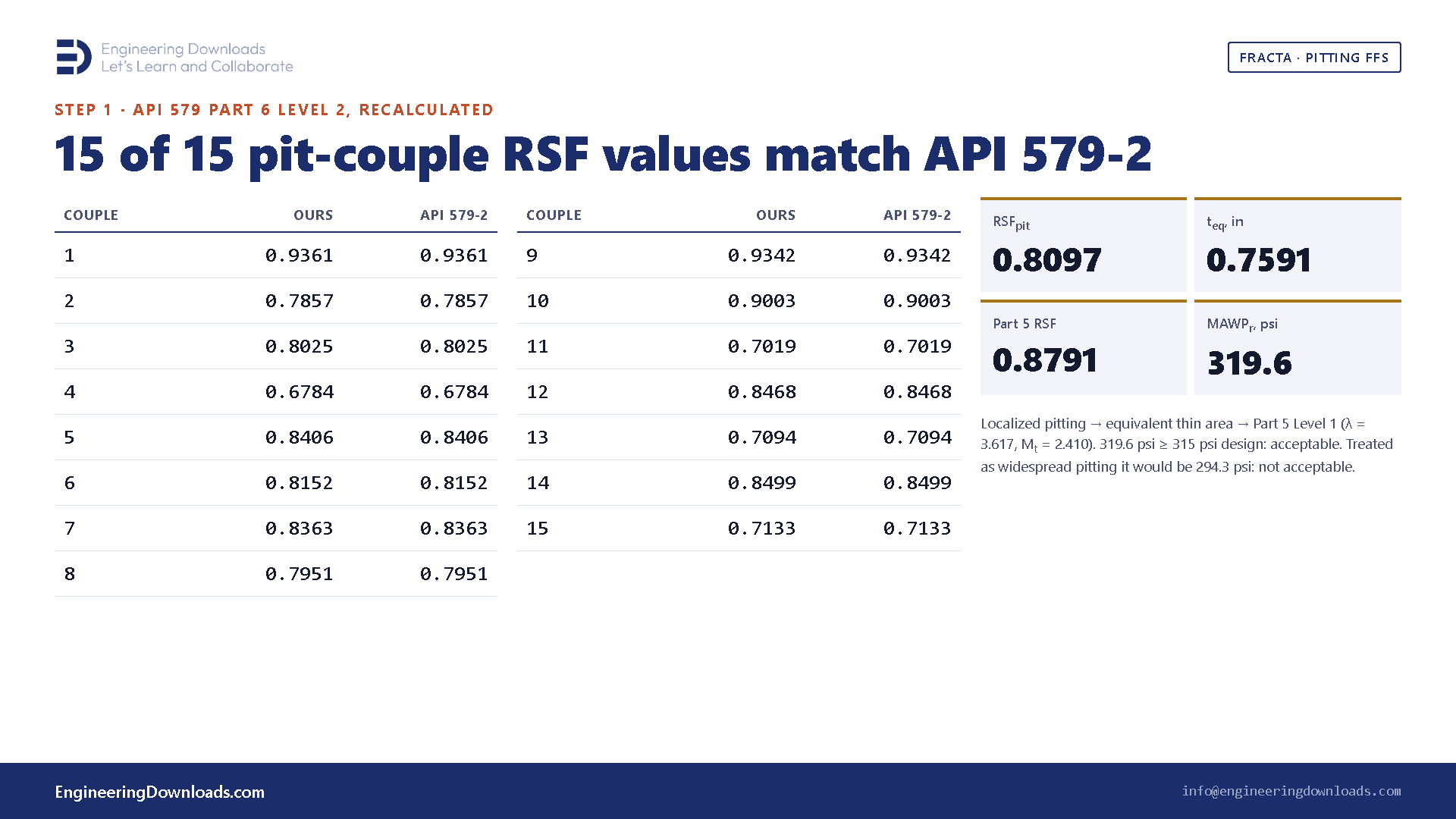
An independent Python calculation reproduces the Part 6 Level 2 assessment: the remaining strength factor of each pit-couple, the average RSFpit, the equivalent thickness and the Part 5 check of the equivalent locally thin area.
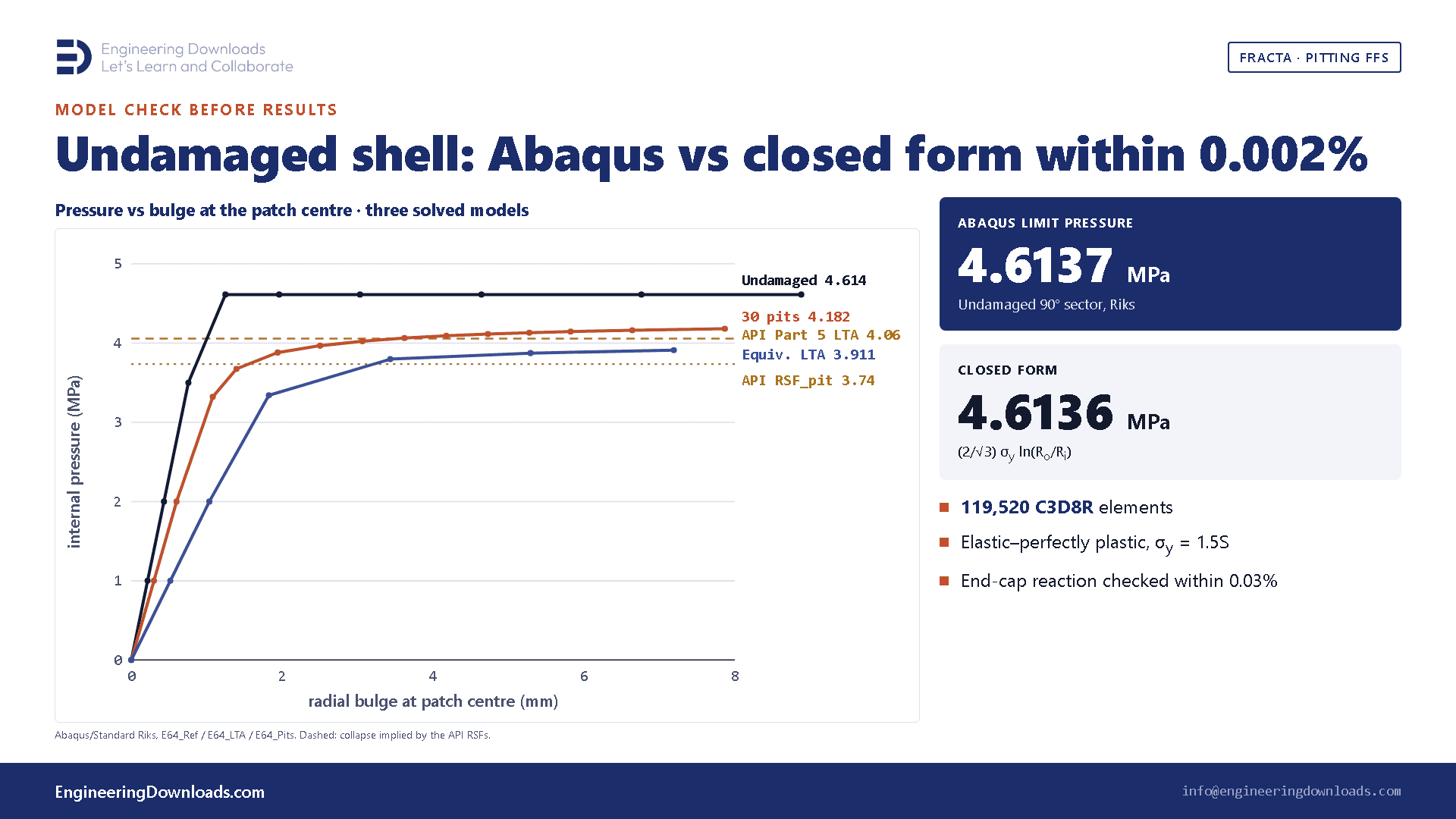
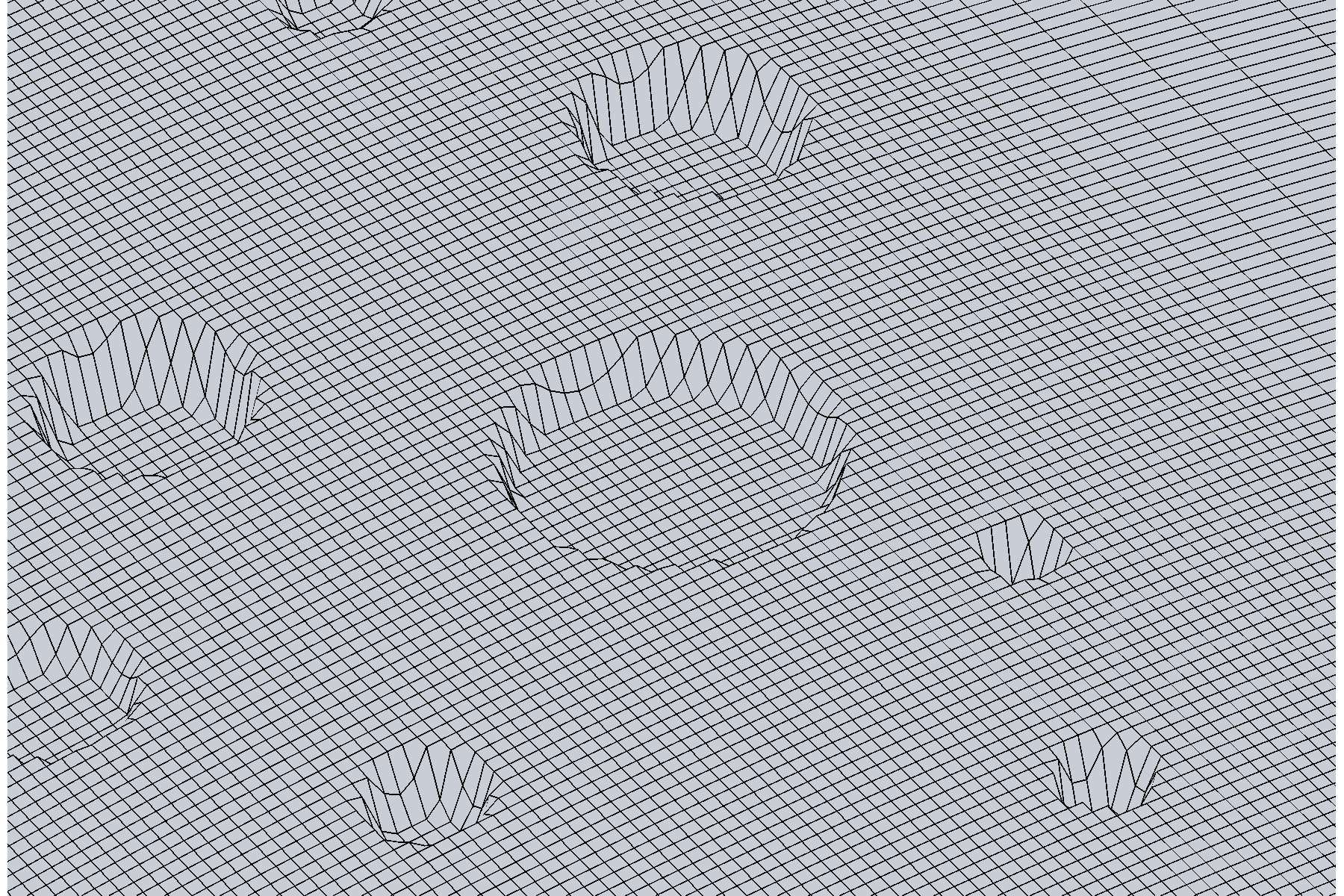
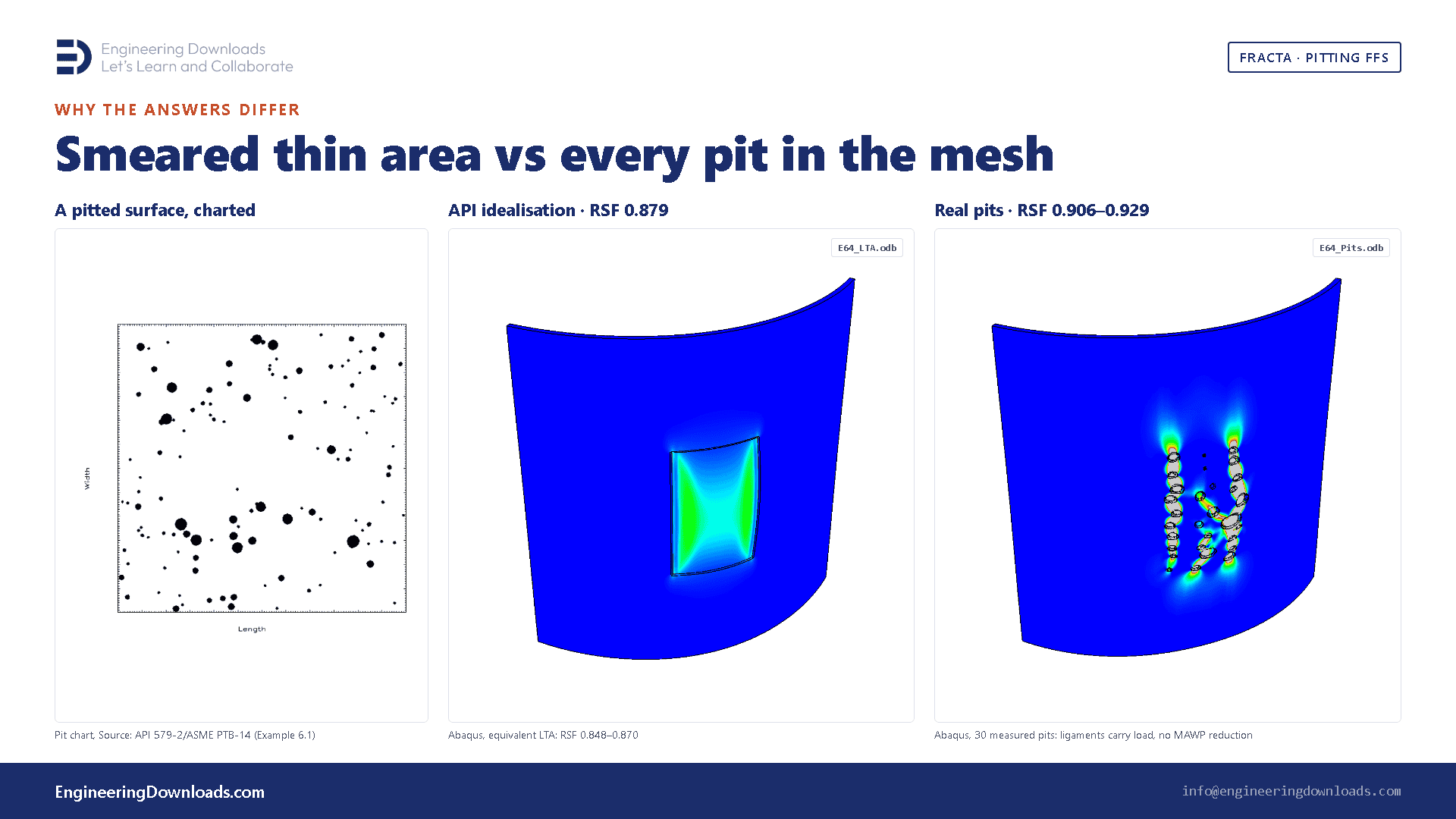
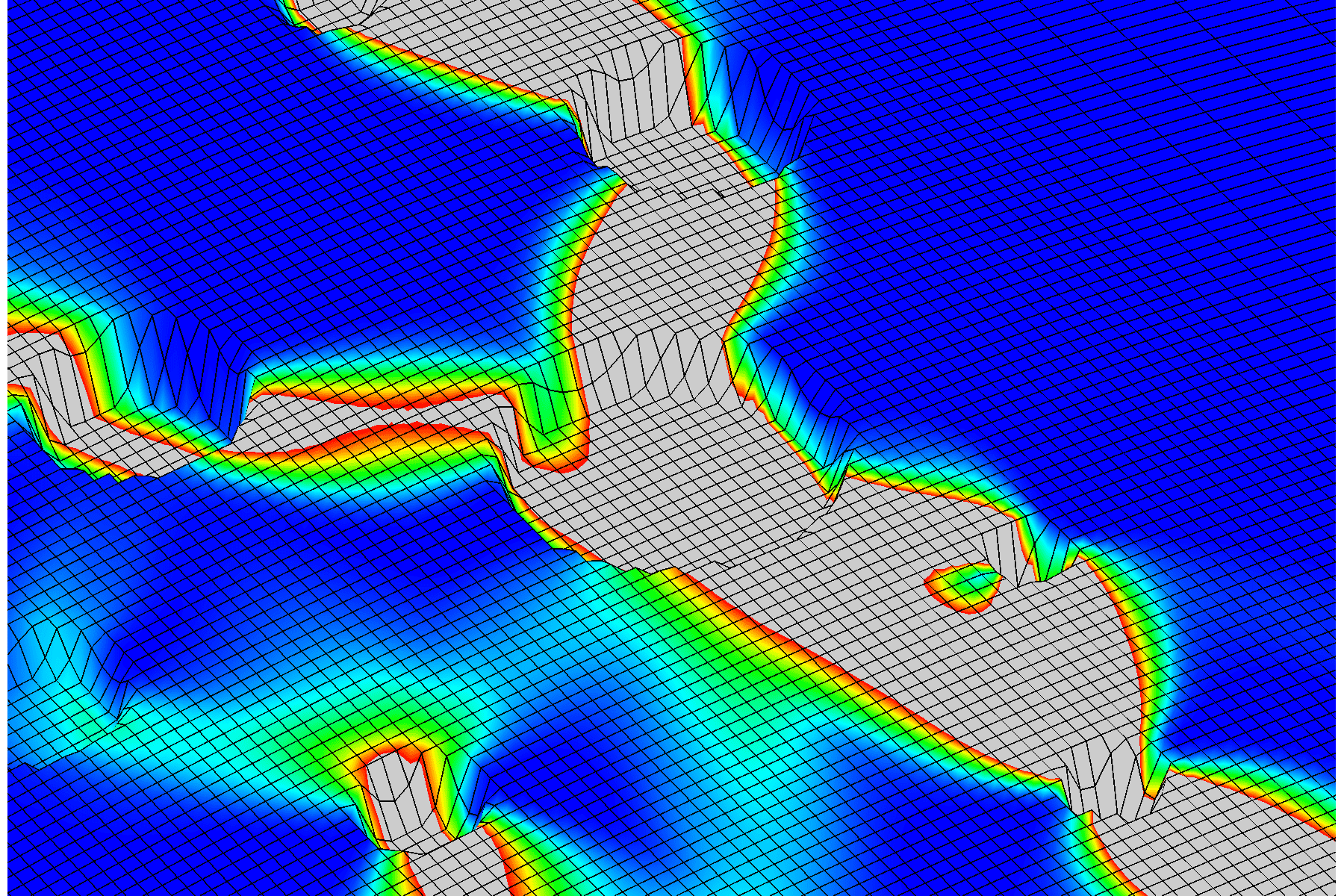
A structured hexahedral mesh is built over the shell and every node column is moved inward by the local pit depth, ramped over one element at the pit edge. No CAD or Boolean cuts are needed, so the same script rebuilds the model for any pit data. Three models are included: the undamaged shell, the API idealisation (a uniform equivalent thin area) and the 30 real pits.
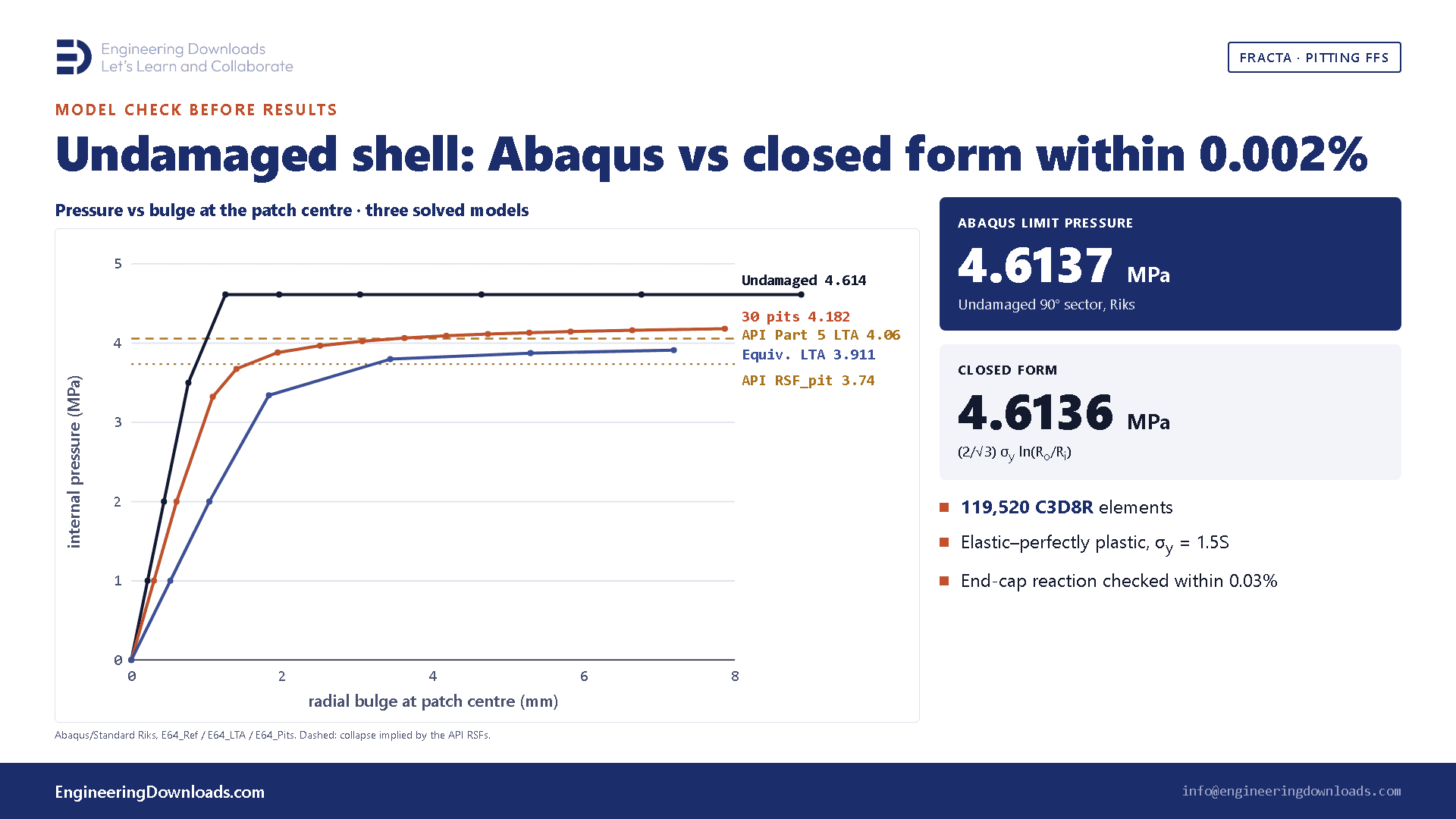
The undamaged shell gives a limit pressure of 4.6137 MPa in Abaqus against 4.6136 MPa from the closed-form solution for a closed-end cylinder, a difference of 0.002%. The end-cap reaction also matches within 0.03%. Every RSF below is a ratio to this verified number.
| Method | RSF | Reduced MAWP | At 315 psi |
|---|---|---|---|
| API Level 2, treated as widespread | 0.810 | 294.3 psi | Not acceptable |
| API Level 2, localized → Part 5 LTA | 0.879 | 319.6 psi | Acceptable |
| Abaqus, same equivalent LTA | 0.848–0.870 | 308.2–316.4 psi | Marginal |
| Abaqus, 30 measured pits | 0.906–0.929 | 327.2 psi | Acceptable, no reduction |
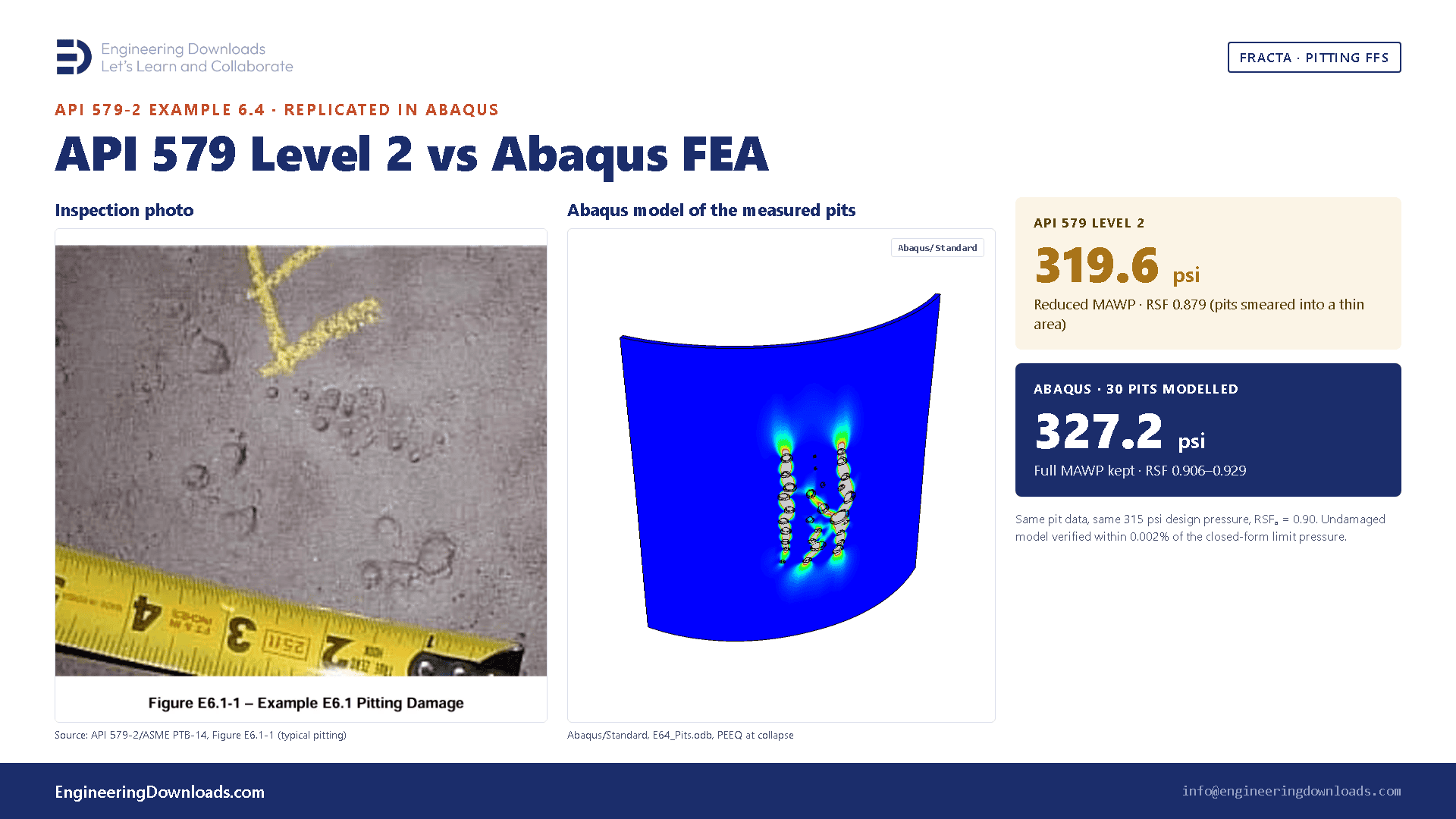
What this means. Level 2 is conservative for this pit field. Modelling the actual pits lifts the RSF above the 0.90 allowable, so the vessel keeps its full rating, about 2.4% above the Level 2 result. The conservatism comes from smearing the pits into a uniform thin patch: in the real pit field, plastic strain concentrates in the ligaments between pits while the full-thickness wall around them keeps carrying load. The FE ranges run from the last converged Riks increment (governing) to a 1/u extrapolation of the load–bulge curve.
Integrity and inspection engineers, FFS assessors and graduate students who want a worked API 579 Part 6 pitting example taken to Level 3 in Abaqus, a scriptable way to put measured pits into a finite element mesh, and a clear view of how much margin Level 2 leaves on the table.
Abaqus/CAE and Abaqus/Standard 2024 or newer for the CAE files (the INP files run in older releases too) and Python (the Abaqus Python is enough). Each analysis takes roughly 5–20 minutes on 6 cores. Result files (ODB) are not included: you run the jobs yourself. You need your own copy of API 579-1/ASME FFS-1 and API 579-2 for the standard itself.
You get a verified, ready-to-run Level 3 pitting model and the full Level 2 calculation behind it, and you see exactly where API 579 is conservative and why. See also API 579 Example 4.7 in Abaqus: corroded conical transition, API 579 Example 4.2 in Abaqus: corrosion mapping of a metal-loss vessel and pipeline dent and corrosion analysis in Abaqus.
Does it reproduce the API 579 example? Yes for Level 2: all 15 pit-couple RSF values, RSFpit = 0.8097 and MAWPr = 319.6 psi. The Abaqus model then goes beyond the example to a Level 3 limit-load assessment.
Where are the pits placed? Example 6.4 gives each couple’s size, depth, pitch and angle but not its location, so one couple is placed in each 5 × 5 in cell of the 25 × 15 in region. The script lets you place them anywhere.
Can I use my own pit measurements? Yes. Edit the pit table in pitmesh.py and run build_model.py; it writes new CAE and INP files.
Has a mesh convergence study been done? No, the package uses one mesh; about 1.3% of the elements, on the steep pit walls, are flagged as distorted. The tutorial says how to refine it.
Is this a design or acceptance result? No. It is a worked benchmark and training package and does not replace an assessment by a qualified engineer.
Quality guarantee: if you are not satisfied with the delivered product, we will refund you.
Need more than the files?
There are two ways we can help. Book a one hour online consultation if you want to talk a problem through with a CAE engineer, using the checkbox in the order box. Order a project if you need a full simulation built for you, delivered to an agreed scope, price and deadline under a written contract.
We work on FEA and CFD for engineers, researchers and companies. Order your project, or message us on WhatsApp for a quick reply.
Other packages engineers working on this topic also download.
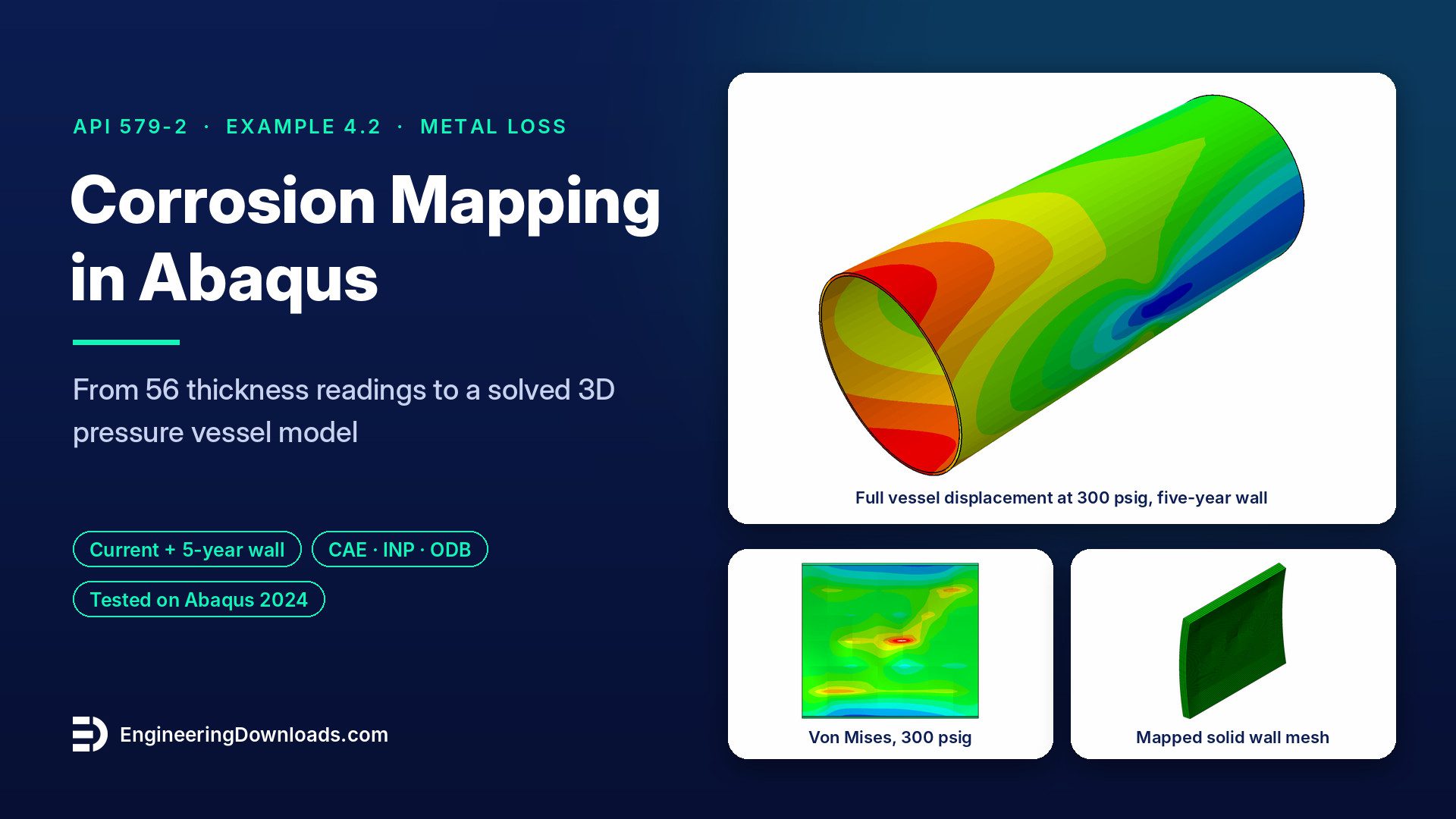 API 579 Example 4.2 in Abaqus: Corrosion Mapping of a Metal Loss Pressure Vessel
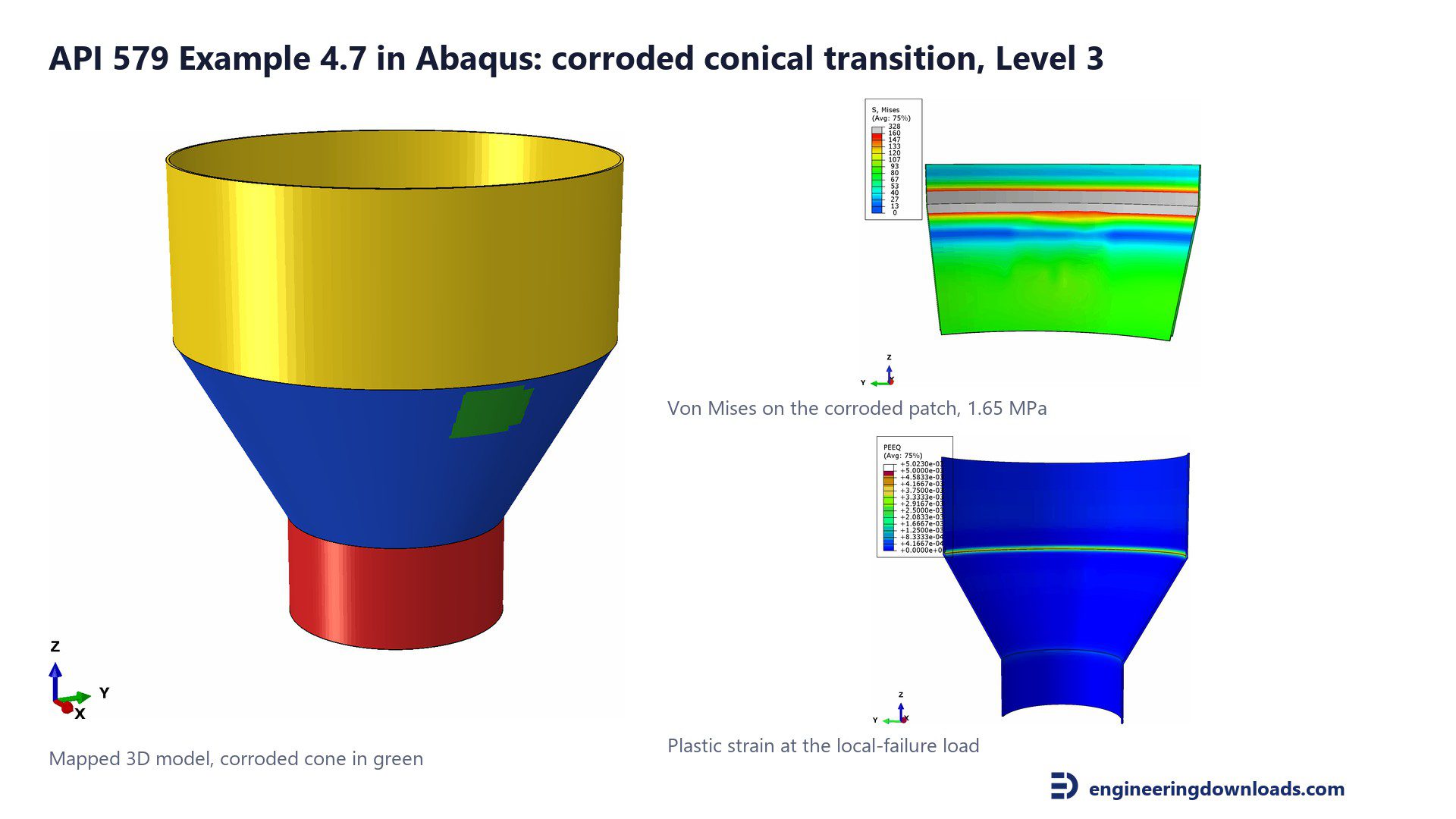 API 579 Example 4.7 in Abaqus: Corroded Conical Transition, Level 3 FFS
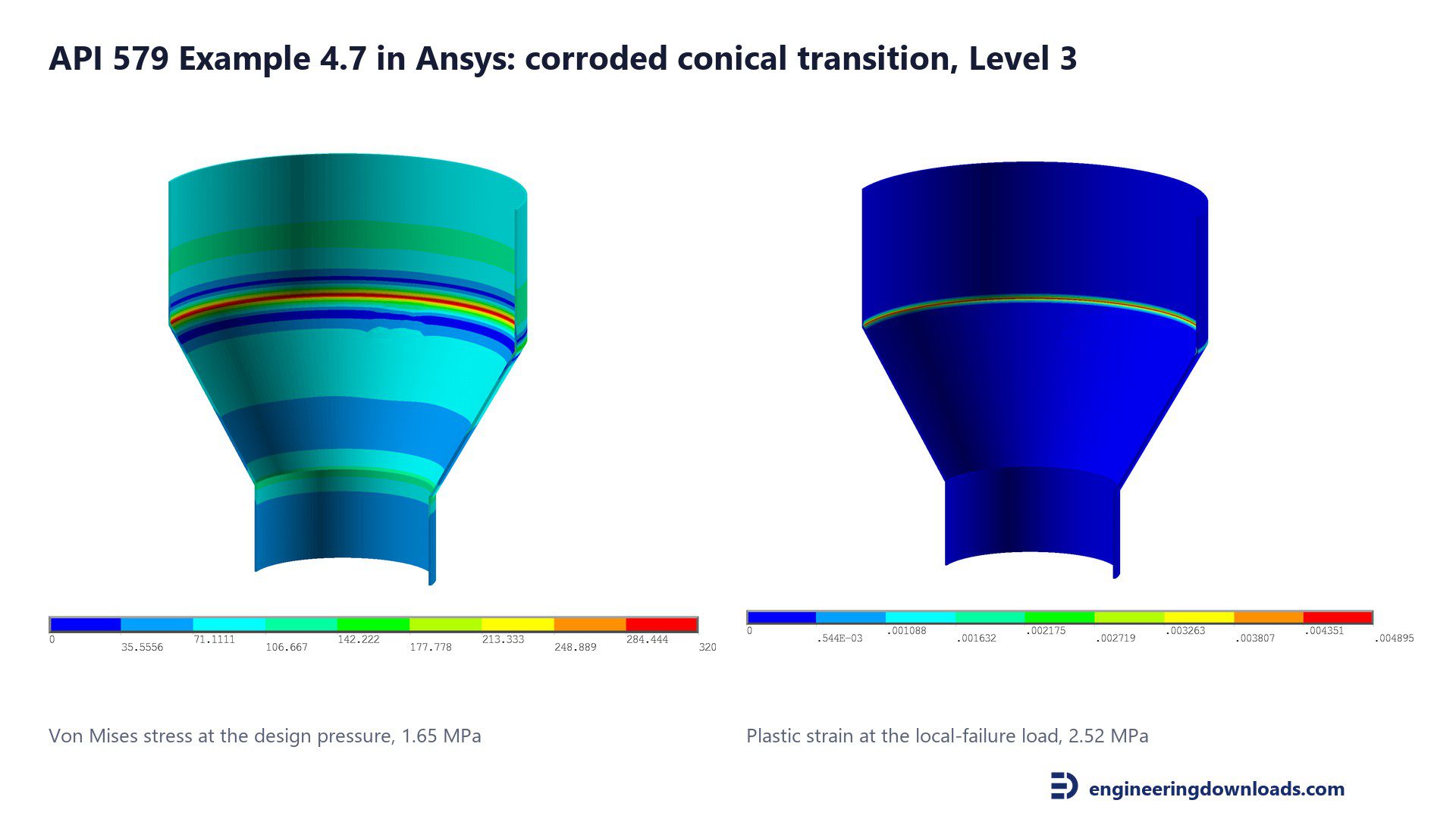 API 579 Example 4.7 in Ansys: Corroded Conical Transition, Level 3 FFS
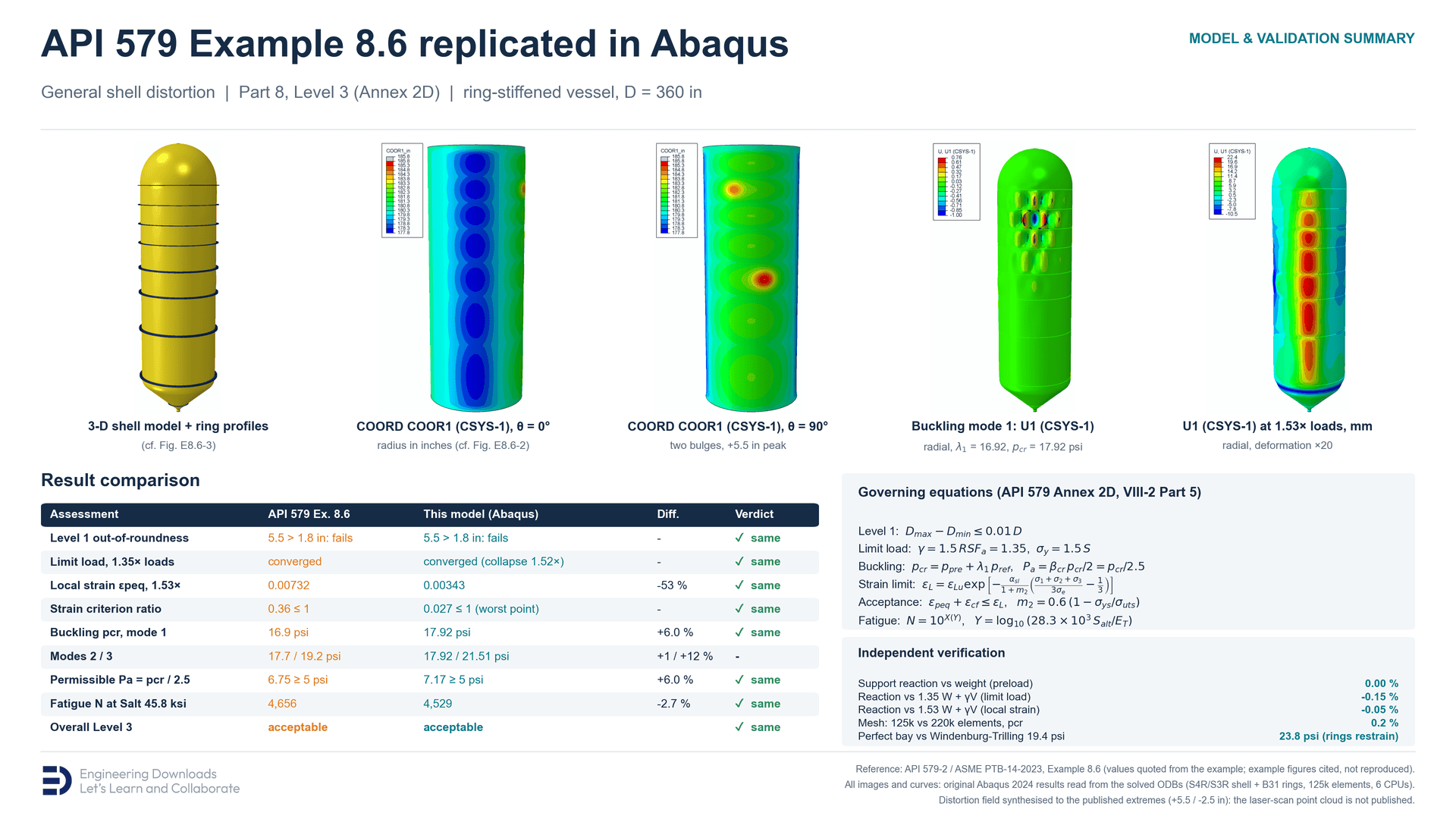 API 579 Example 8.6 in Abaqus: General Shell Distortion and Buckling, Level 3 FFS€129,00
 API 579 Example 5.6 in Abaqus: Local Thin Area Limit Load, Level 3 FFS€89,00
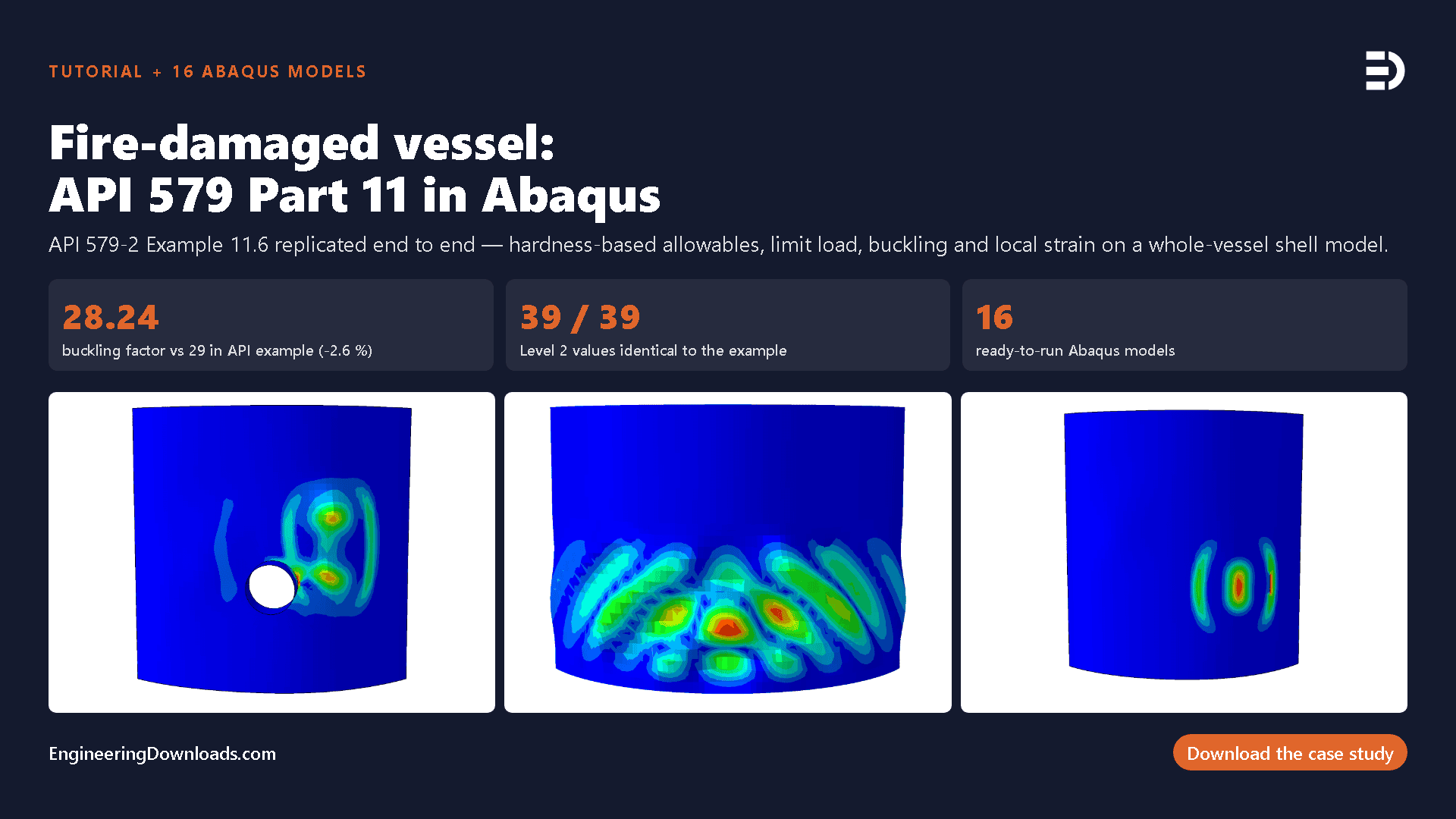 API 579 Example 11.6 in Abaqus: Fire-Damaged Fractionator, Level 3 FFS (Limit Load, Buckling, Local Strain)€139,00
 API 579 Example 7.4 in Abaqus: HIC Damage Level 3 Assessment with FAD and Plastic Collapse€139,00
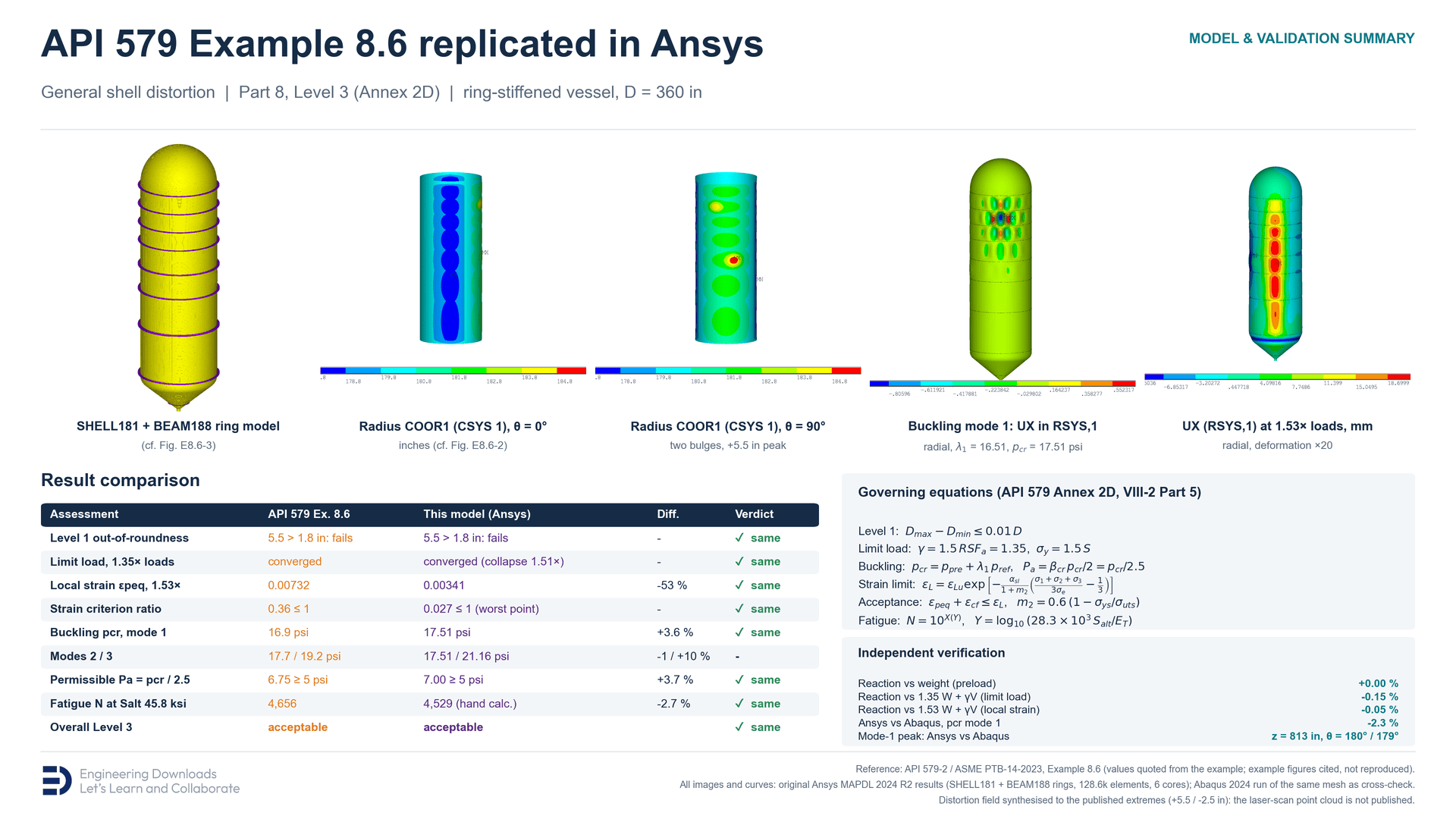 API 579 Example 8.6 in Ansys: General Shell Distortion and Buckling, Level 3 FFS€129,00

Need a full custom project? See the options below.

€129,00

€179,00

€149,00

€119,00

€129,00

€149,00
See more
Want to receive push notifications for all major on-site activities?



