
Need a full custom project? See the options below.
Need a full custom project? See the options below.
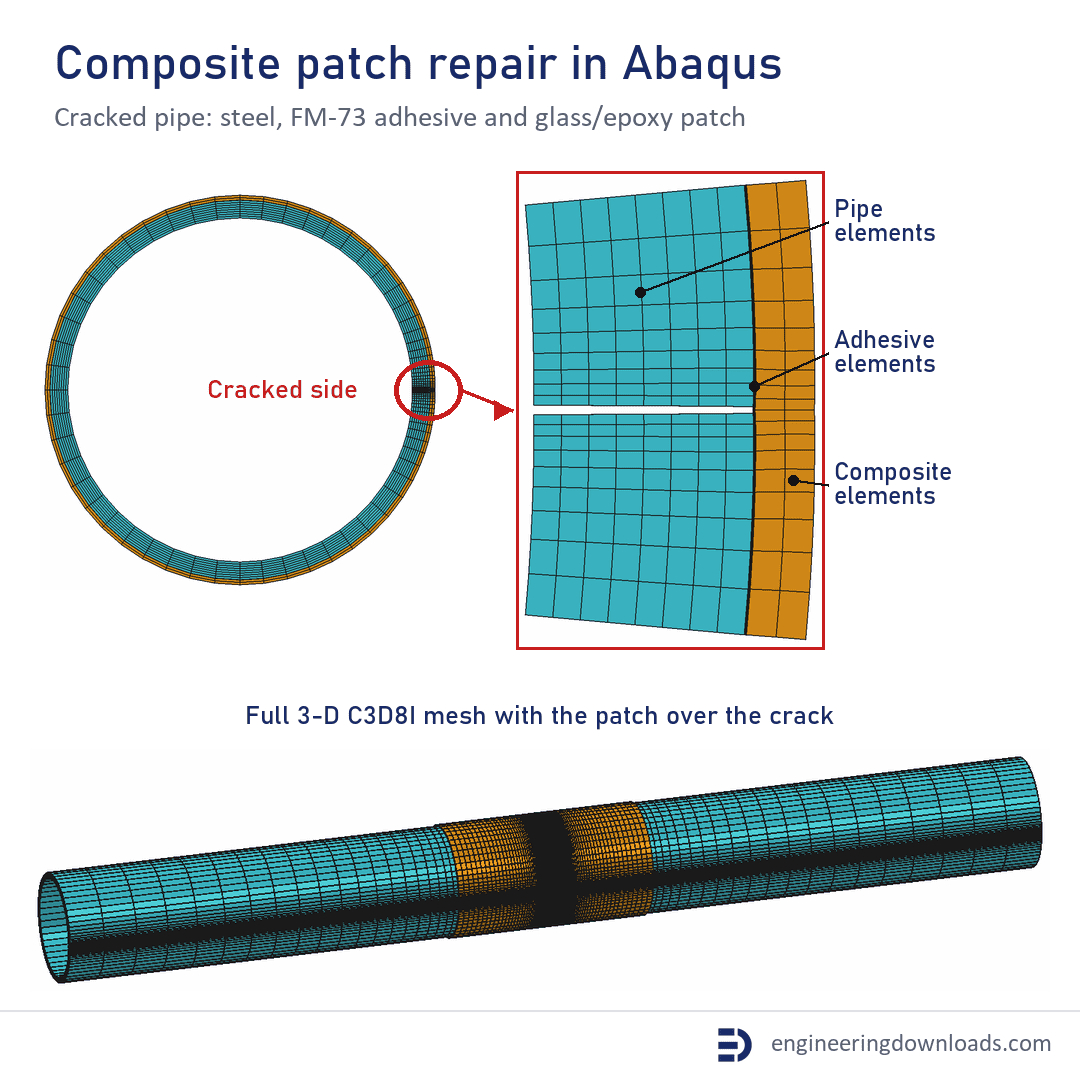
How much fatigue life does a bonded composite patch add to a cracked steel pipe, and how does it change the way the crack grows through the wall? This Abaqus package answers both with a complete 3-D fatigue crack growth model of a pipe repaired with a glass/epoxy patch under cyclic internal pressure. It is based on a peer-reviewed ASME reference paper, which it reproduces step by step: pre-processing, contour-integral J along the crack front, Paris-law crack growth over about 92 increments, and post-processing of the stress intensity factor, crack-front shapes and fatigue life, all compared with the paper. You get six Abaqus/CAE models, ready-to-run INP files, the Python crack-growth scripts, all results and a 17-page PDF tutorial.
Paper title: Fatigue Crack Propagation Analysis of Repaired Pipes With Composite Patch Under Cyclic Pressure
Authors: Mir Ali Ghaffari and Hossein Hosseini-Toudeshky
Journal: ASME Journal of Pressure Vessel Technology, Vol. 135, No. 3, 031402 (2013)
DOI: 10.1115/1.4023568
Abstract (our summary): offshore and marine pipes made of low-strength steel such as A537 face corrosion and cyclic loading at the same time, and corrosion fatigue cracks start and grow in them. The authors repair a pipe with an axial through-wall crack using a bonded glass/epoxy composite patch and simulate fatigue crack propagation in 3-D under cyclic internal pressure. Stress intensity factors are computed along the crack front, the crack front is advanced with the Paris law and the mesh is updated automatically at every step. A parametric study then shows how the patch thickness changes the fatigue life extension of the repaired pipe and the shape of the crack front through the wall. The full original abstract is available from the publisher through the DOI link above; the paper itself is not included in this package.
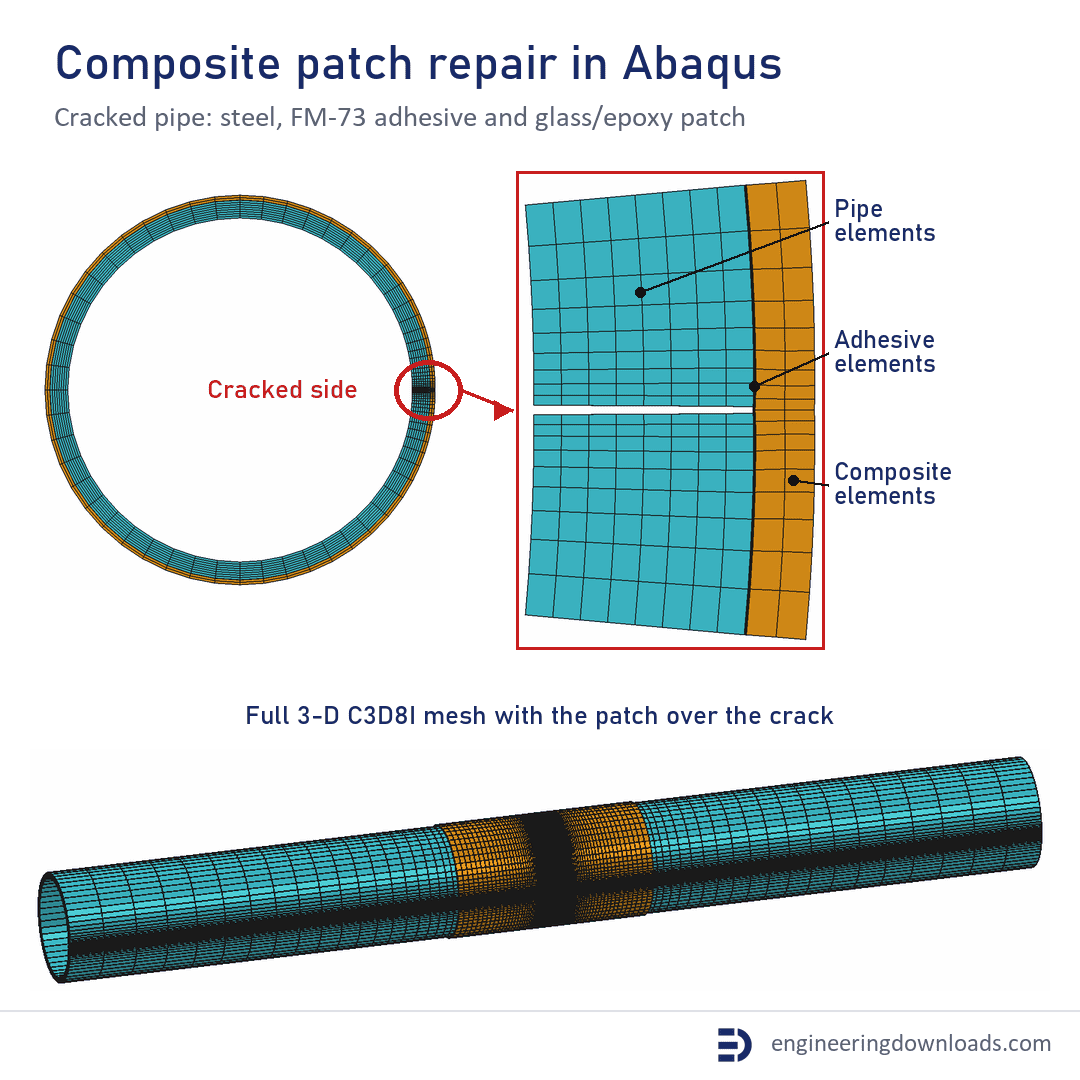
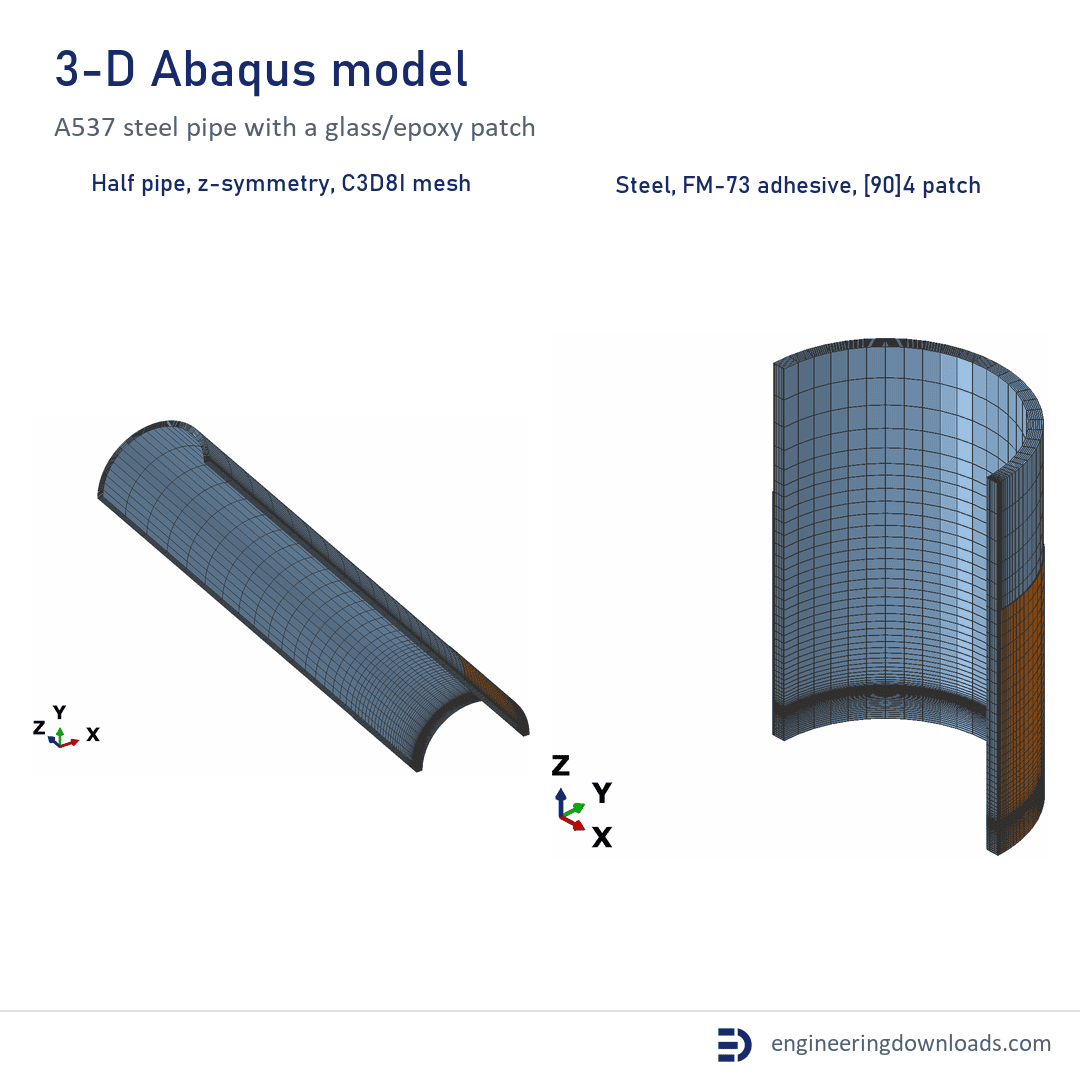
| Item | Reference paper | This Abaqus package |
|---|---|---|
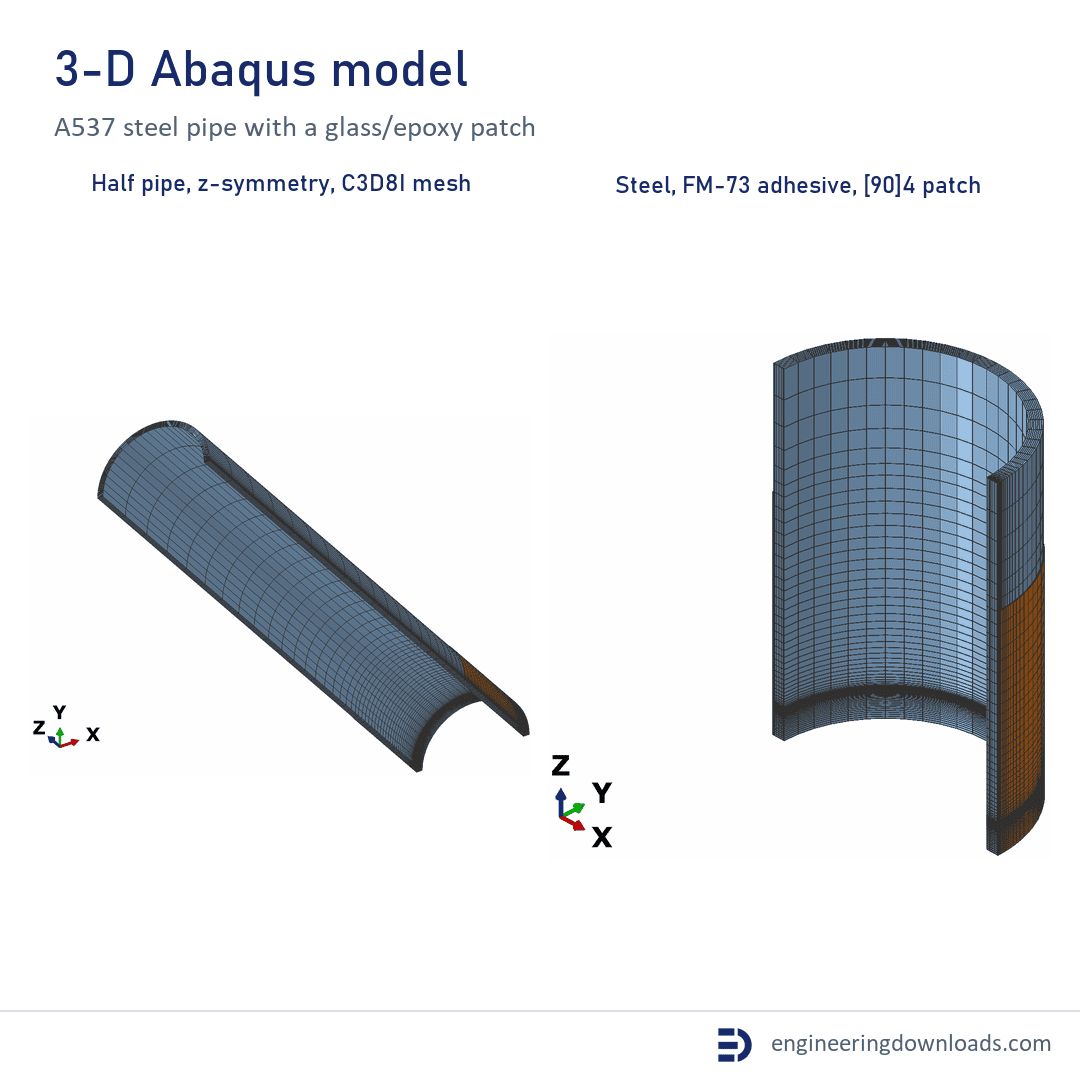
| Pipe | A537 steel, Di 198.38 mm, t 10.31 mm, L 2000 mm | Same, quarter model with two symmetry planes |
| Crack | Axial through-wall crack, 2a0 = 50 mm | Same, grown to 2a = 196 mm in about 92 increments |
| Repair | [90]n glass/epoxy patch on FM-73 adhesive, 400 mm long | Orthotropic engineering constants in a cylindrical orientation; unrepaired, [90]2, [90]4, [90]8, [90]12, [90]16 |
| Load | Cyclic internal pressure 0 to 20 bar | Same (R = 0, ΔK = Kmax) |
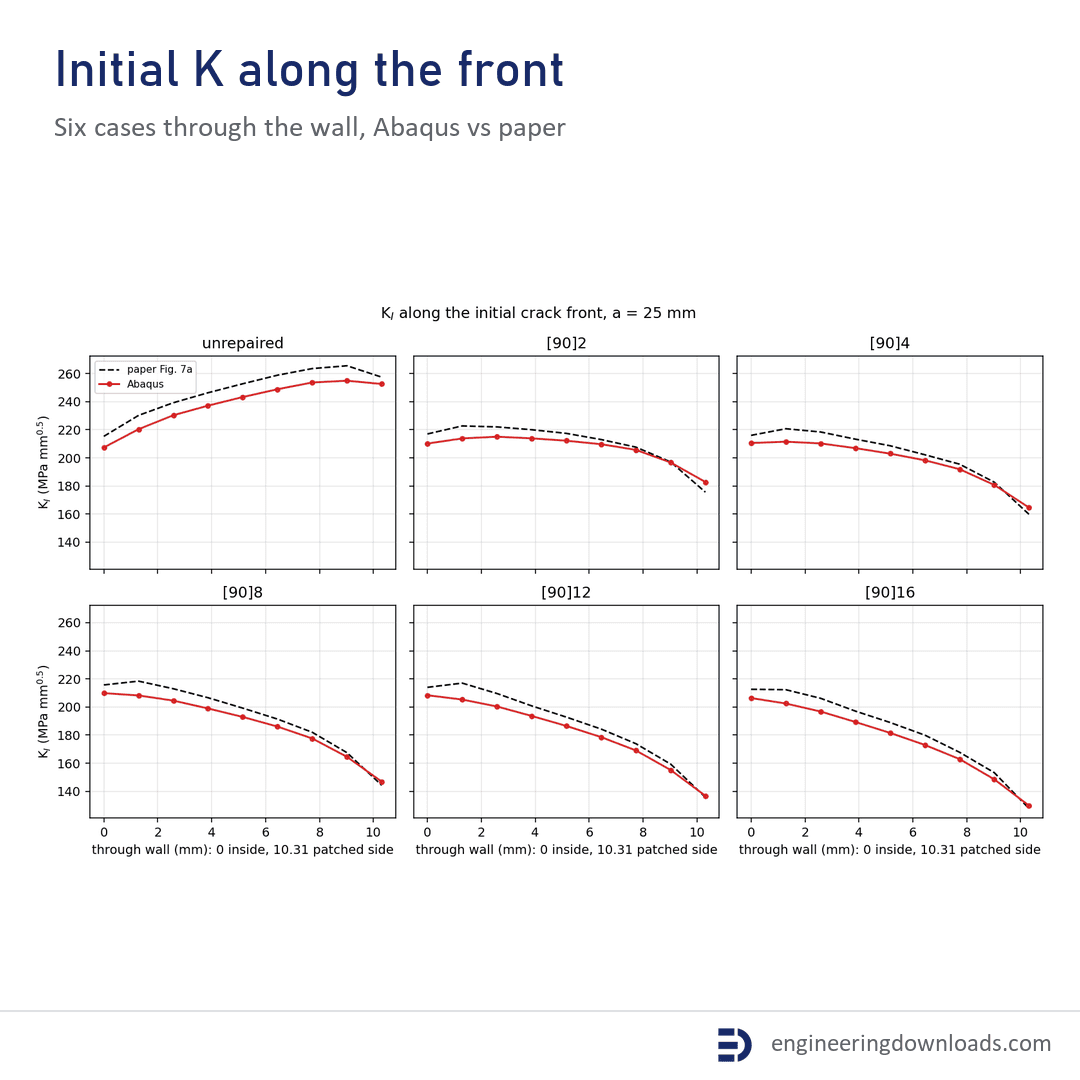
| Fracture | Stress intensity factors at 9 front nodes | Abaqus contour integral (J, 6 contours, symmetric), KI = √(E′J) |
| Crack growth | Paris law, automatic mesh update | da/dN = 6×10⁻¹²ΔK2.8578, 0.8 mm per step, Python loop moving the front nodes |
| Elements | 8-node bricks (SOLID45/46) | C3D8I (8-node, incompatible modes), 32,528 elements per patched model |
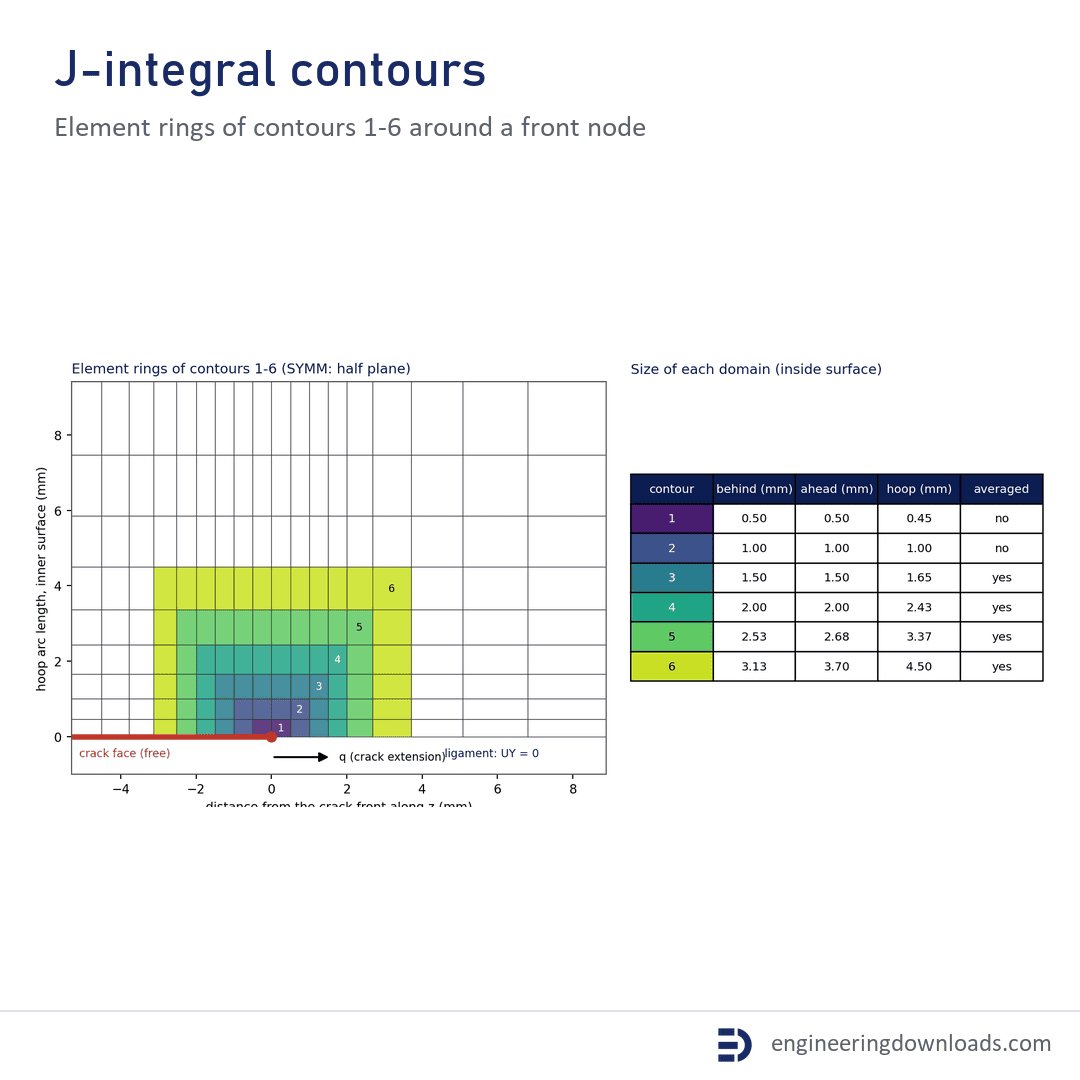
Mesh zones, wall and hoop divisions, the crack-region mesh, loads and boundary conditions, and the crack-front q vectors:
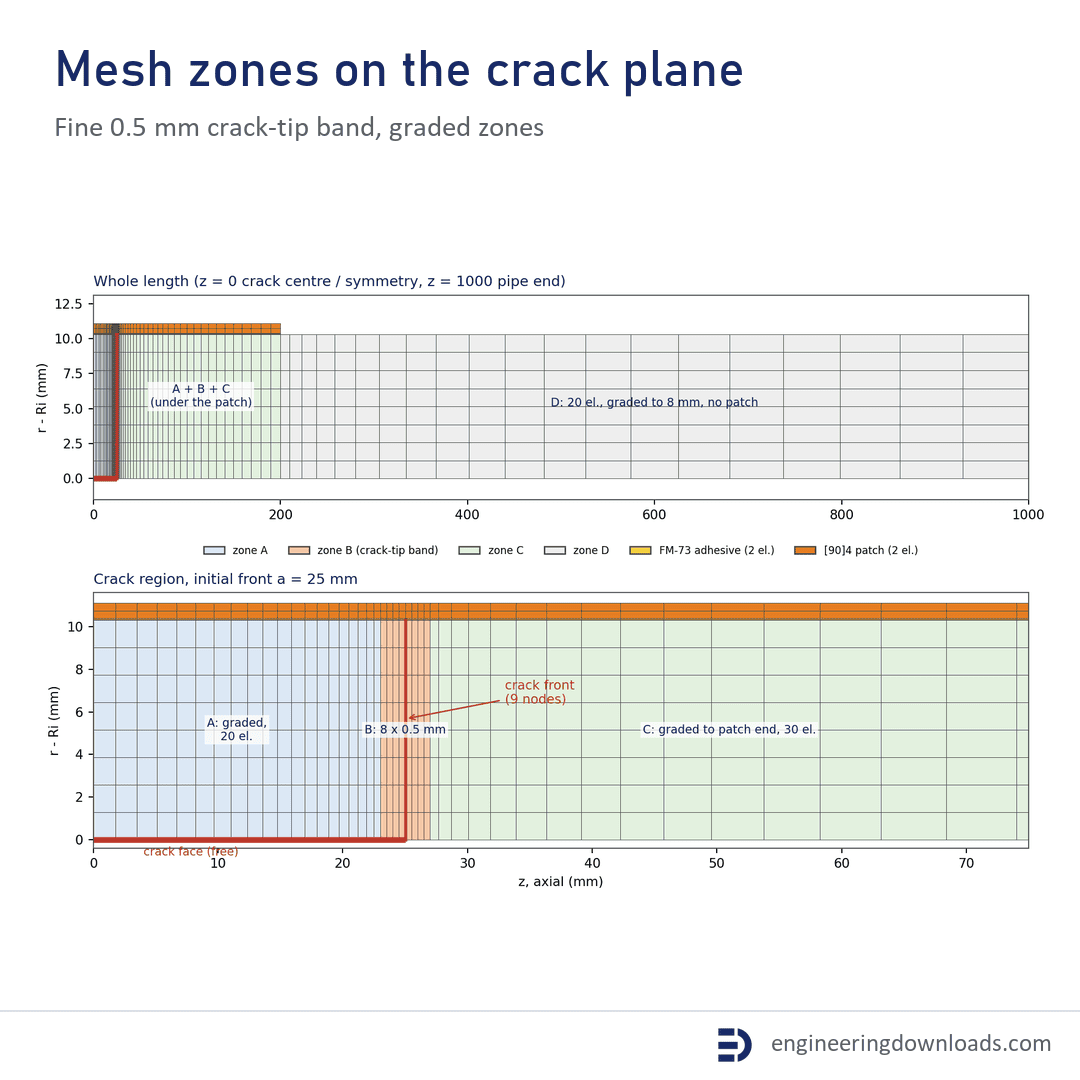
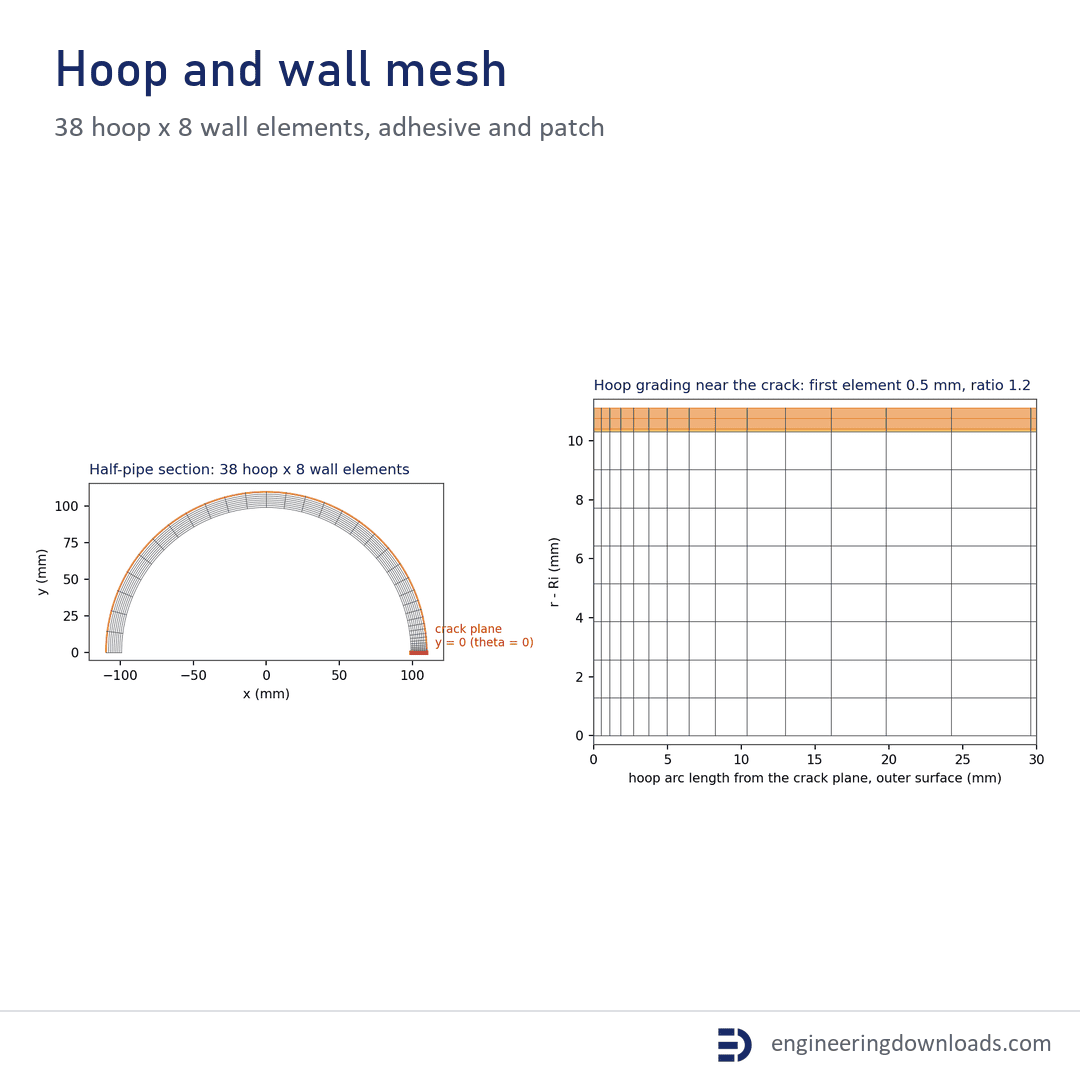
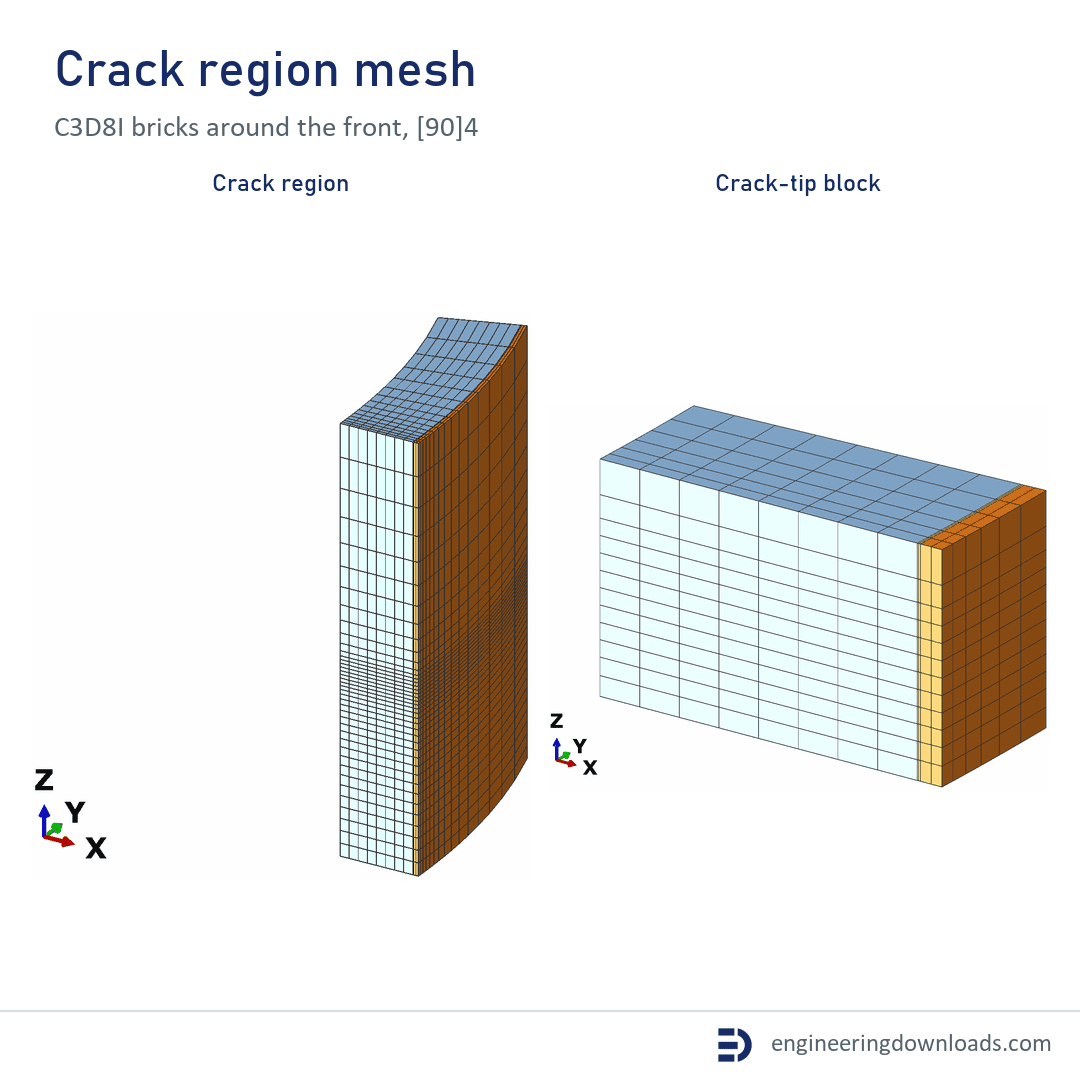
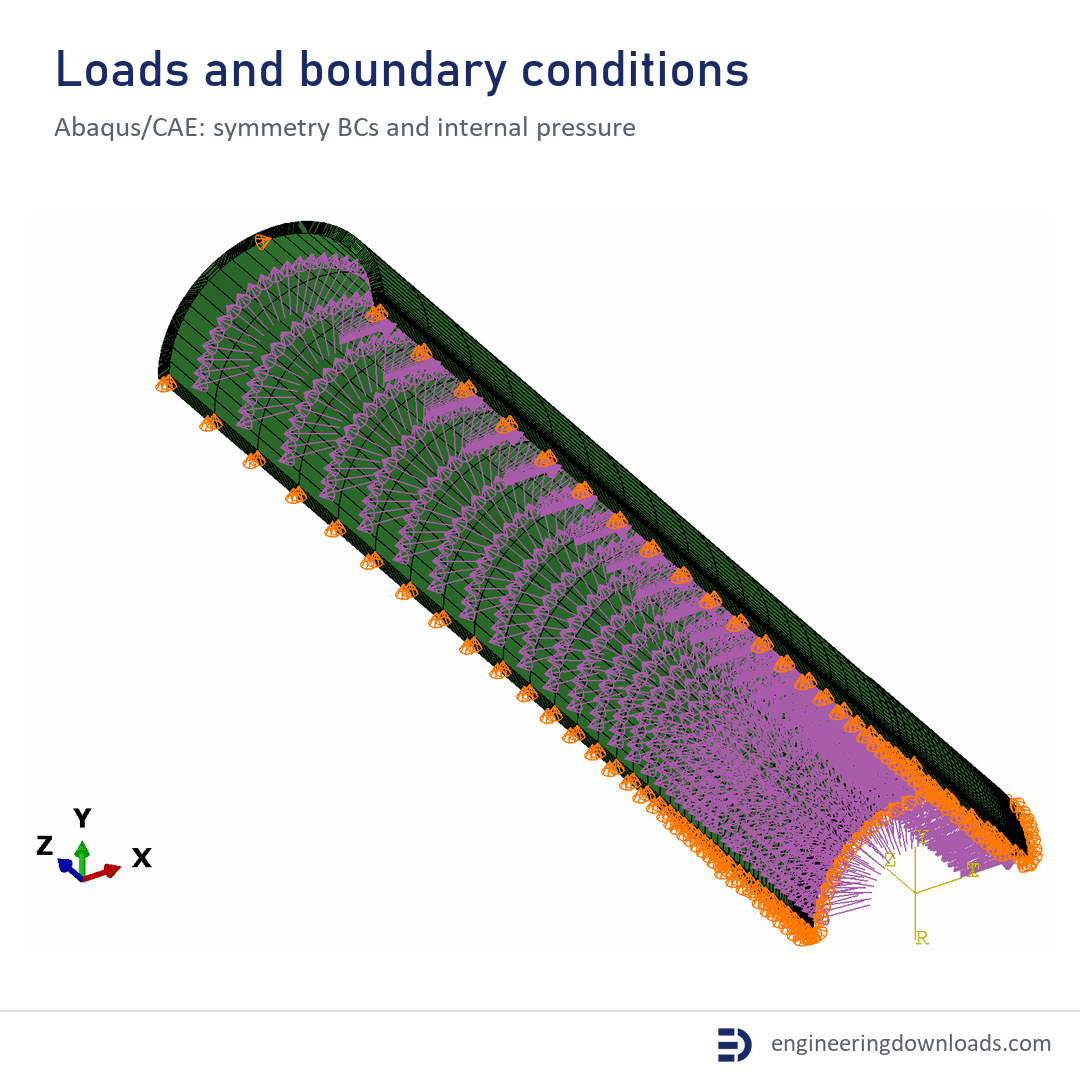
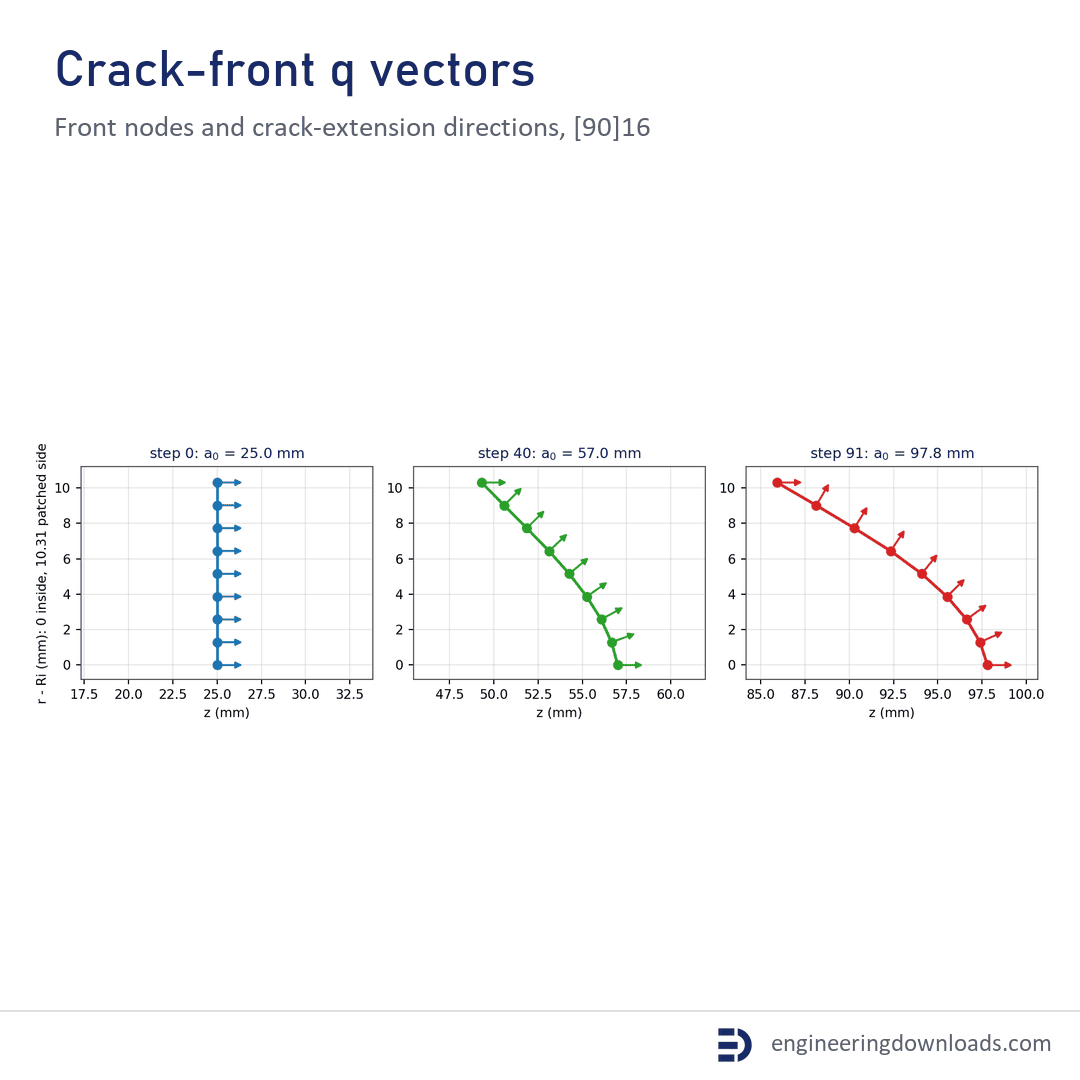
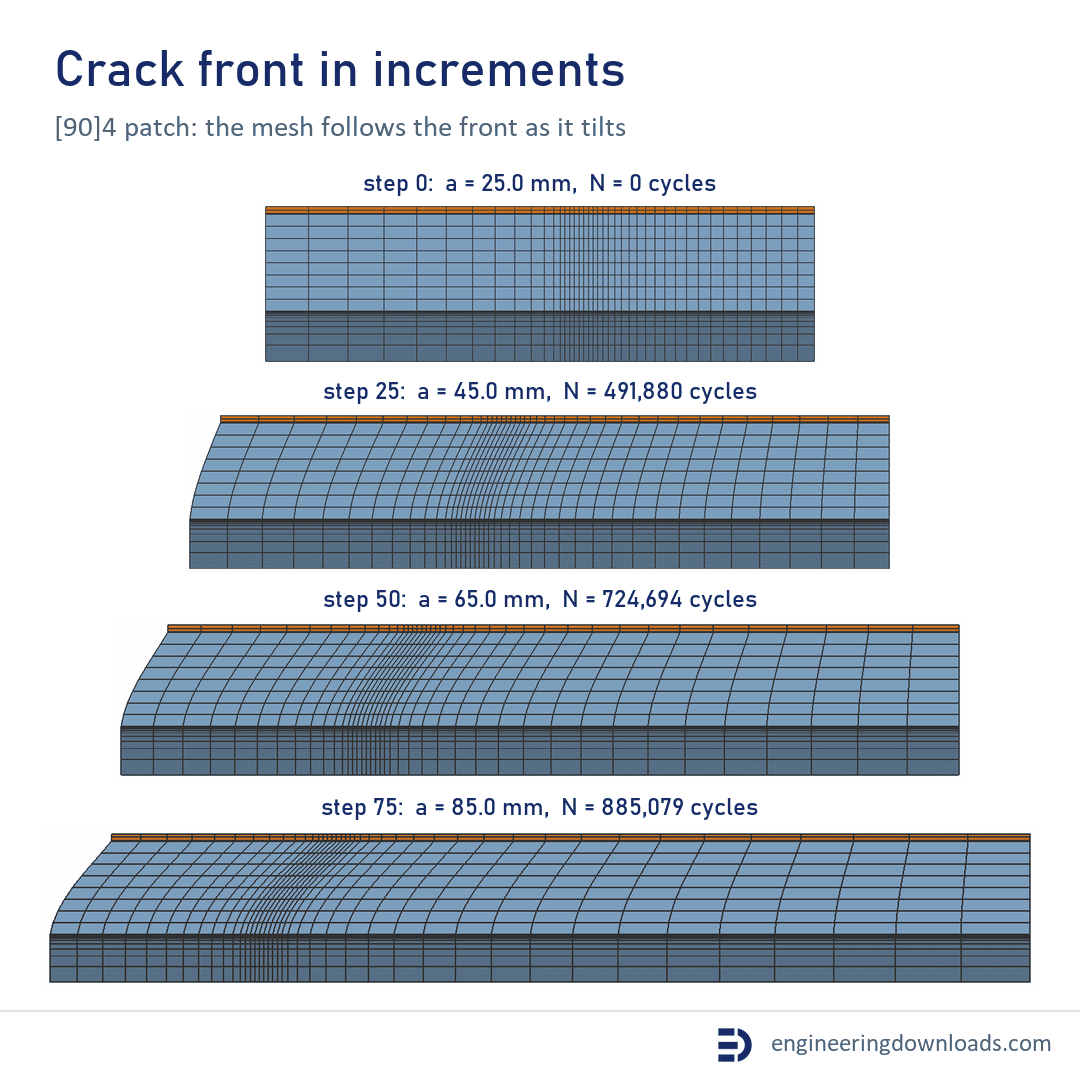
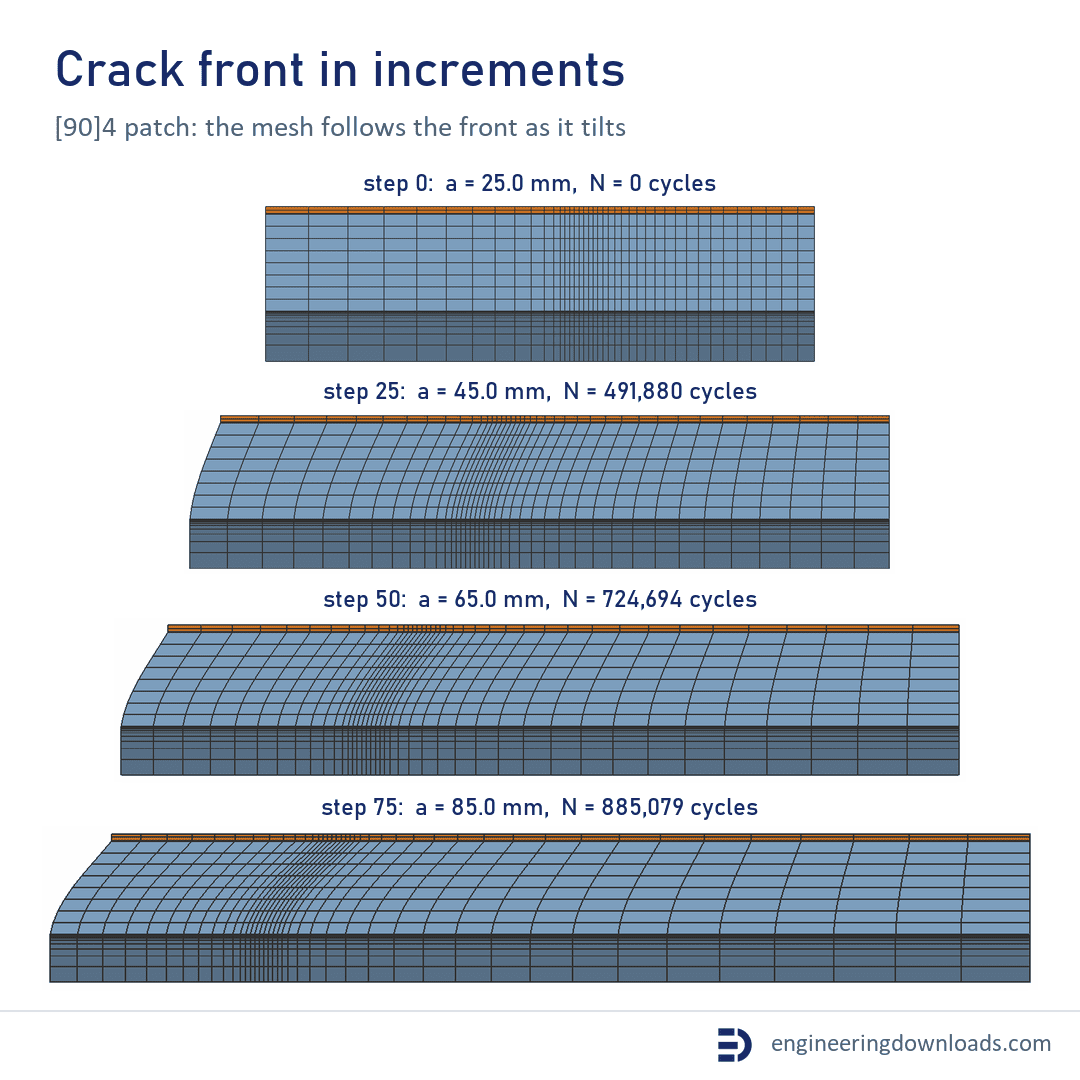
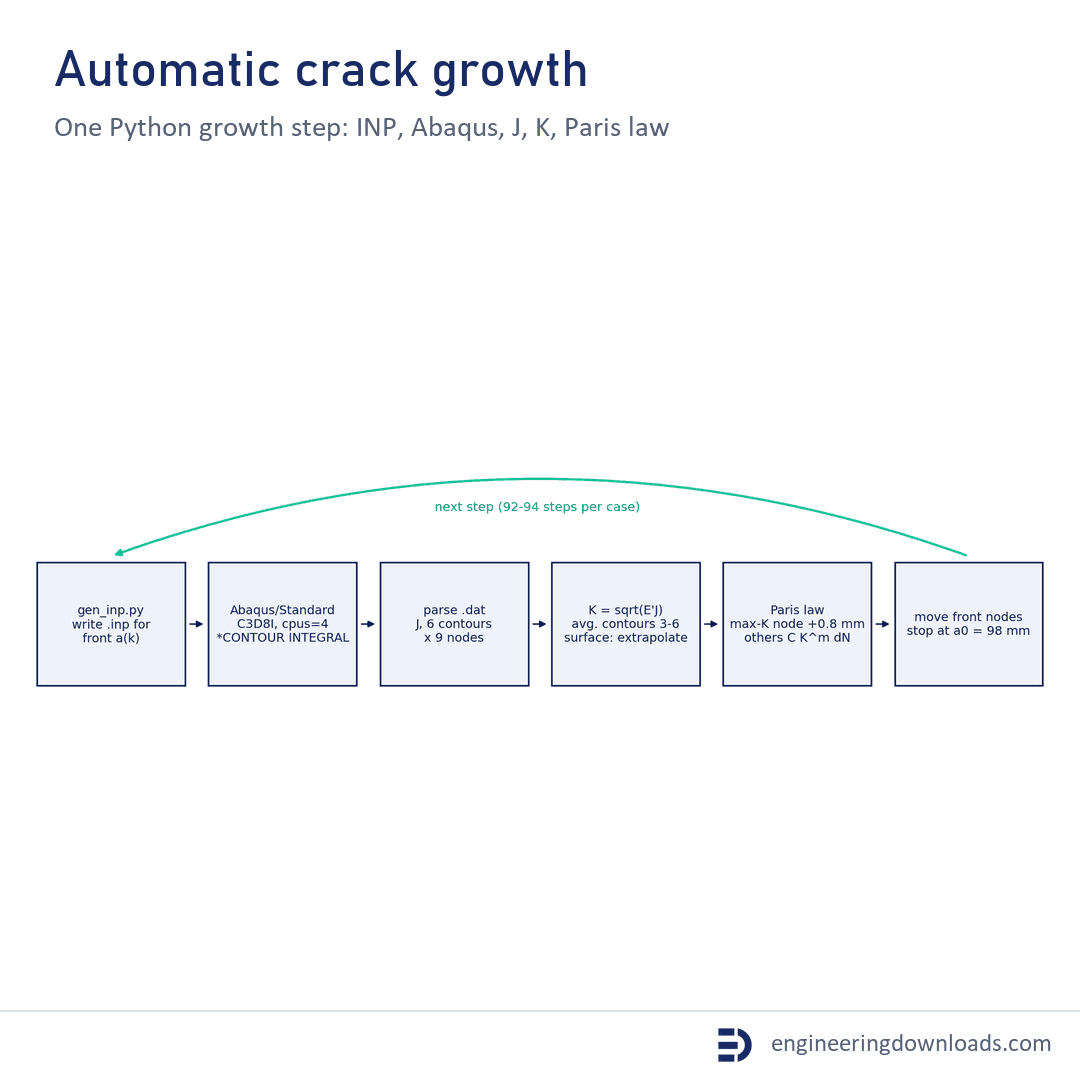
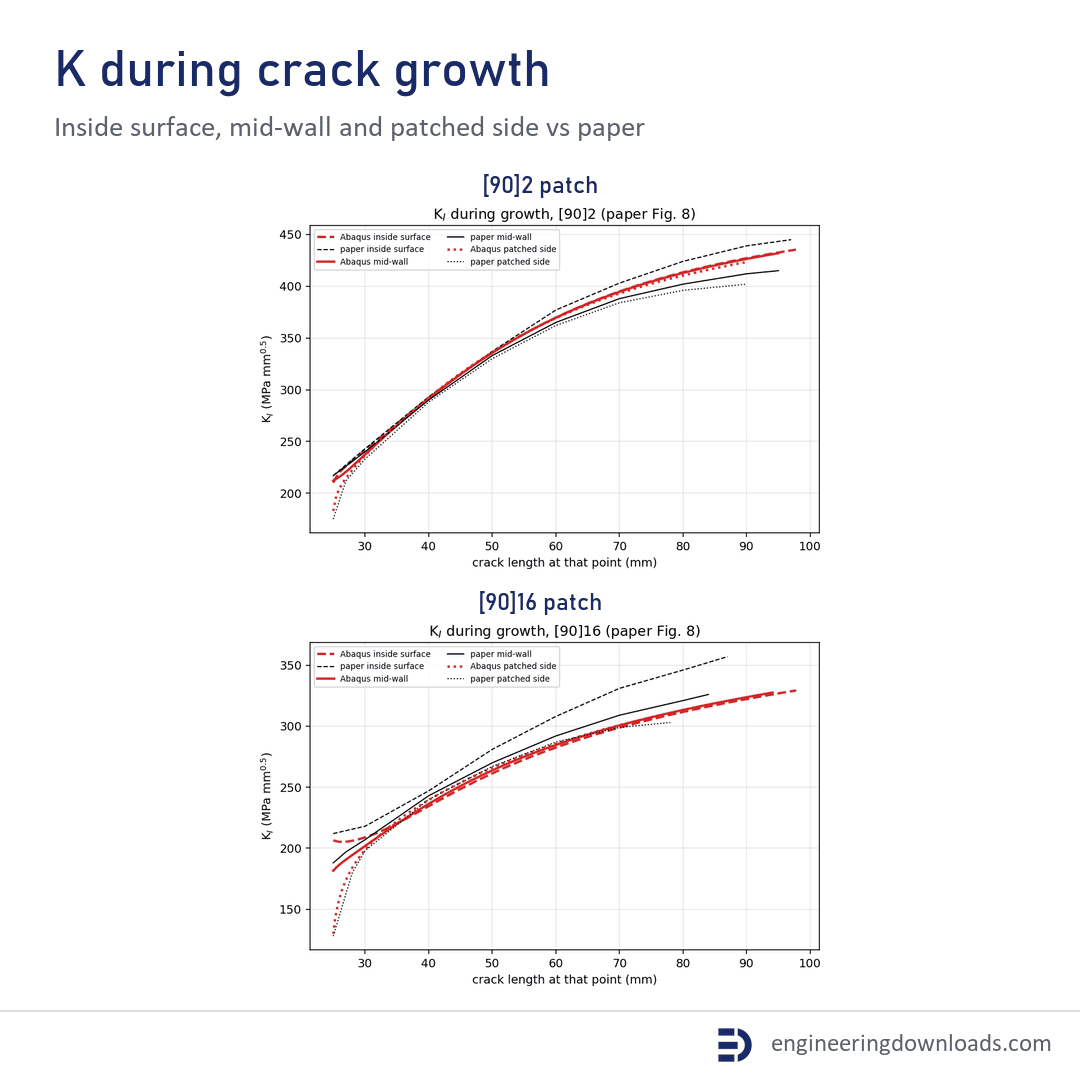
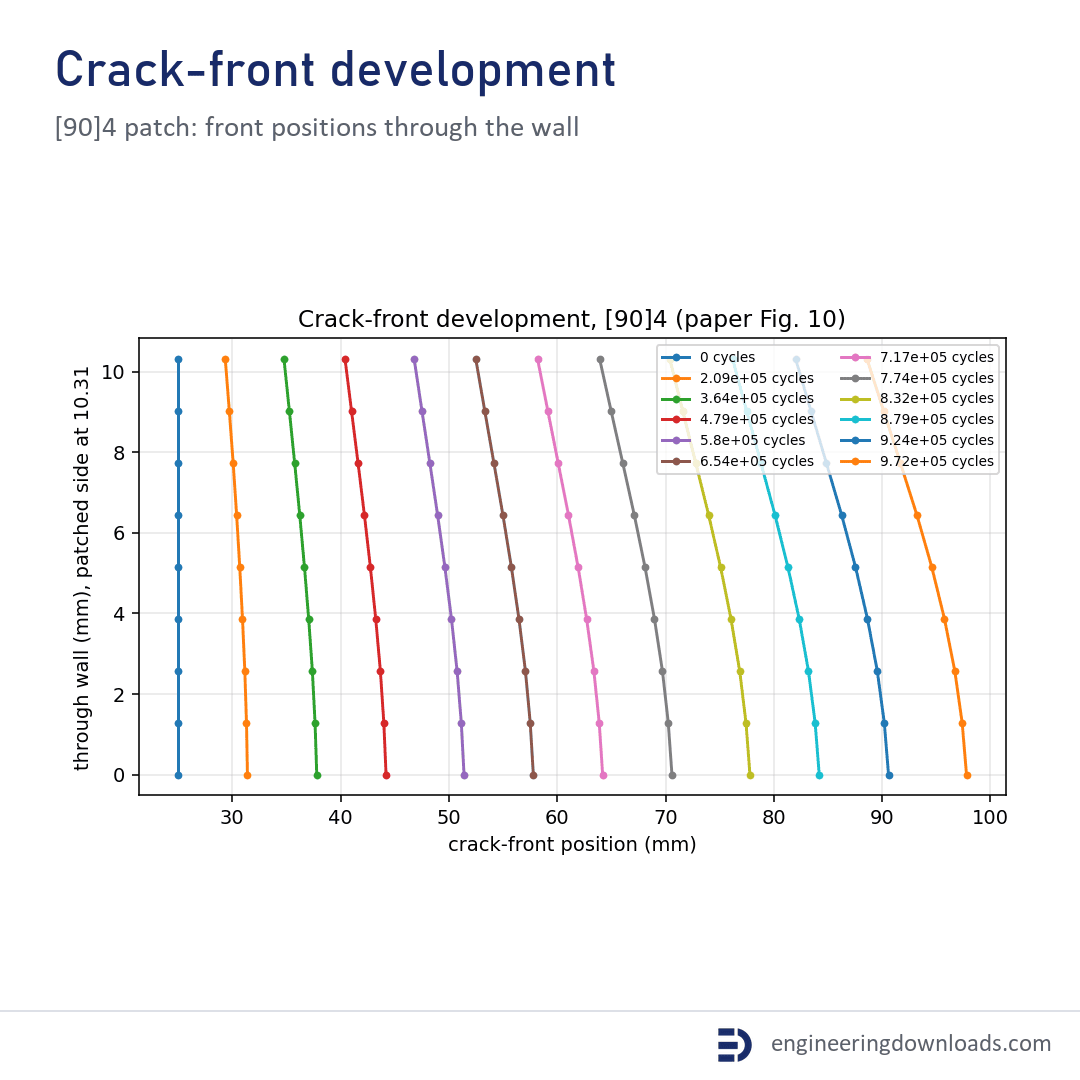
Abaqus evaluates the J-integral as a domain integral over rings of elements around each crack-front node. For linear elastic mode I loading it gives the stress intensity factor KI = √(E′J) with E′ = E/(1−ν2). Fatigue growth follows the Paris law da/dN = C·ΔKm with C = 6×10⁻¹² and m = 2.8578 (mm/cycle, MPa√mm). At every step the front node with the highest K advances 0.8 mm, the others advance in proportion to (K/Kmax)m, and the cycles are added up until the crack reaches 98 mm. The tutorial derives every step.
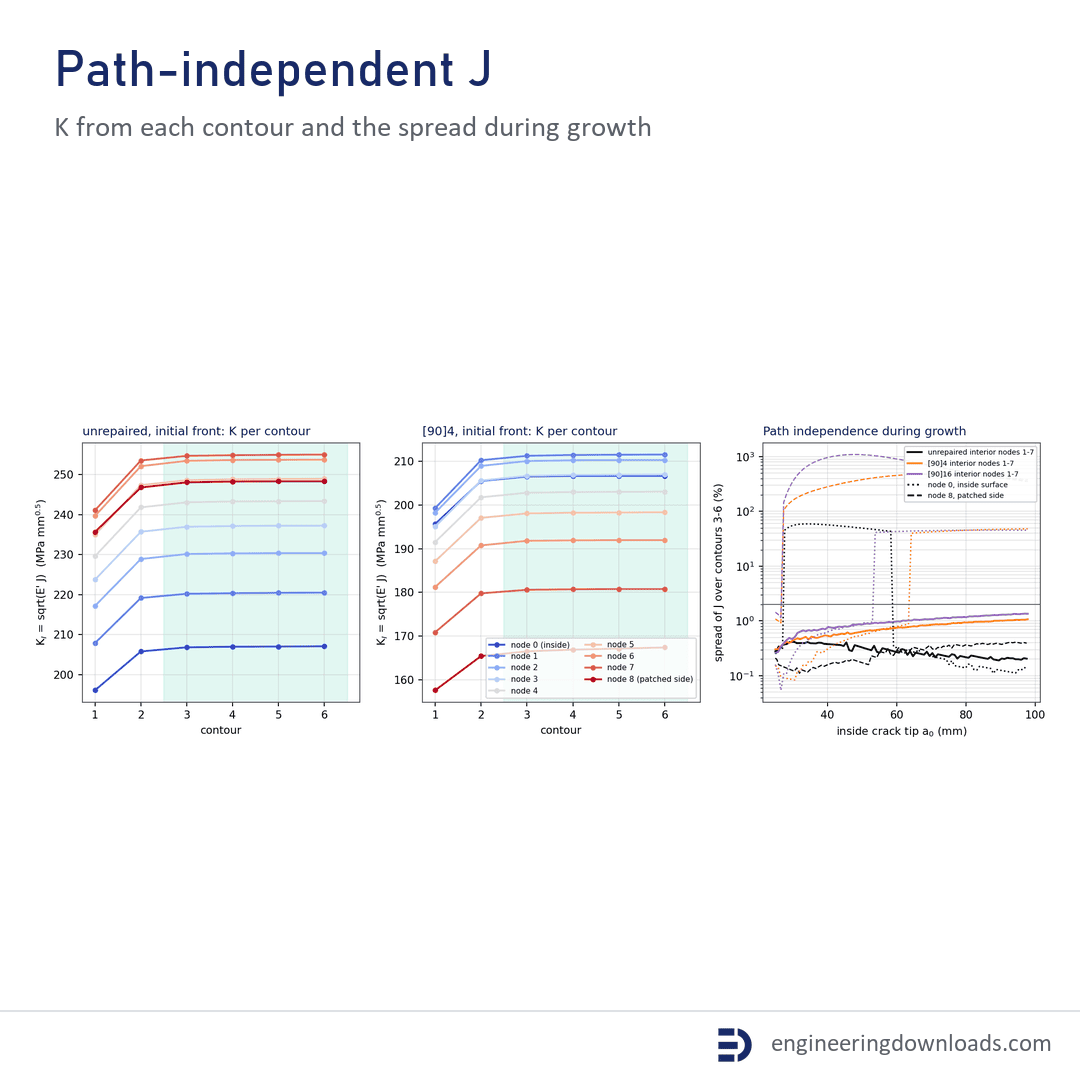
The automatic crack-growth loop and the path-independence check of the J contours:
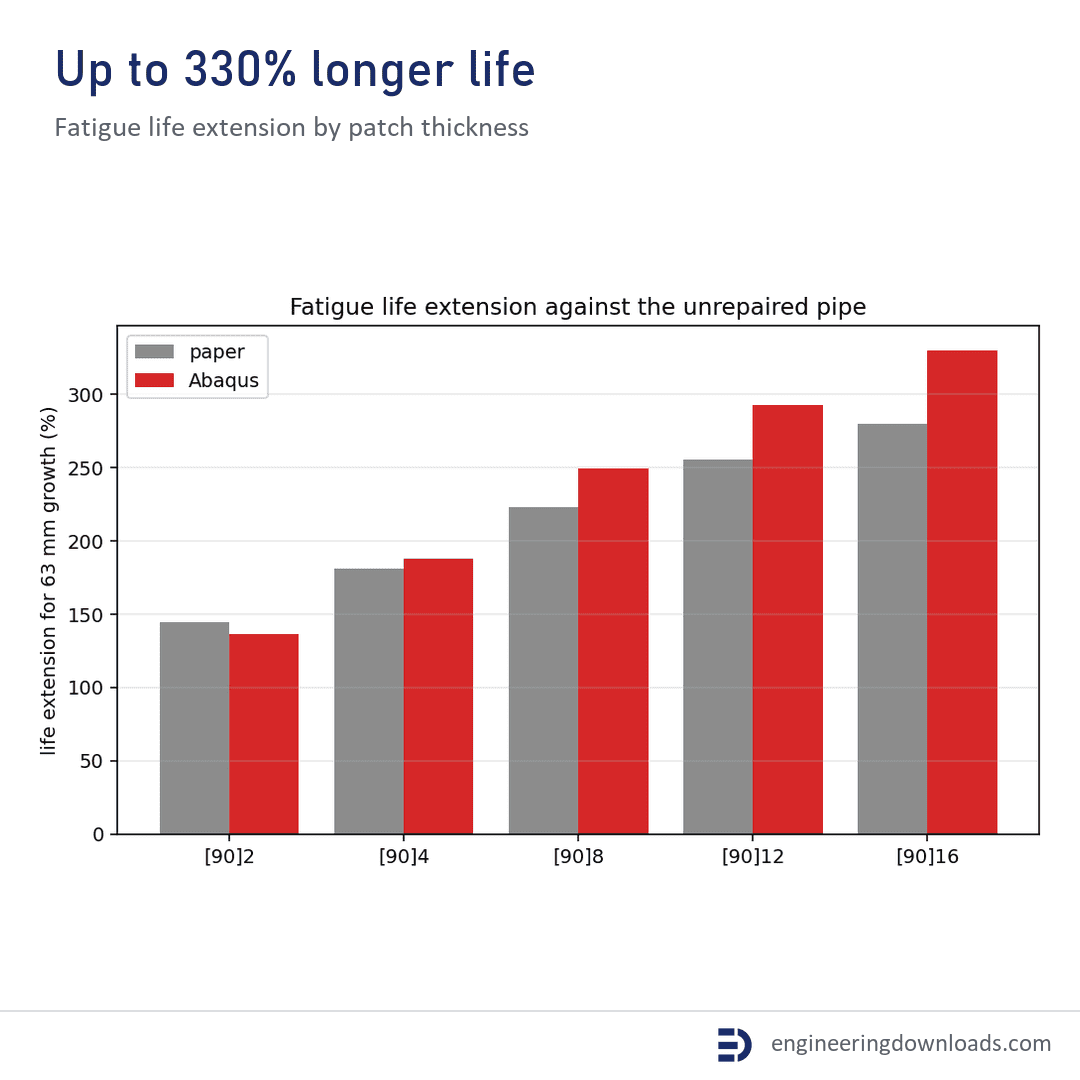
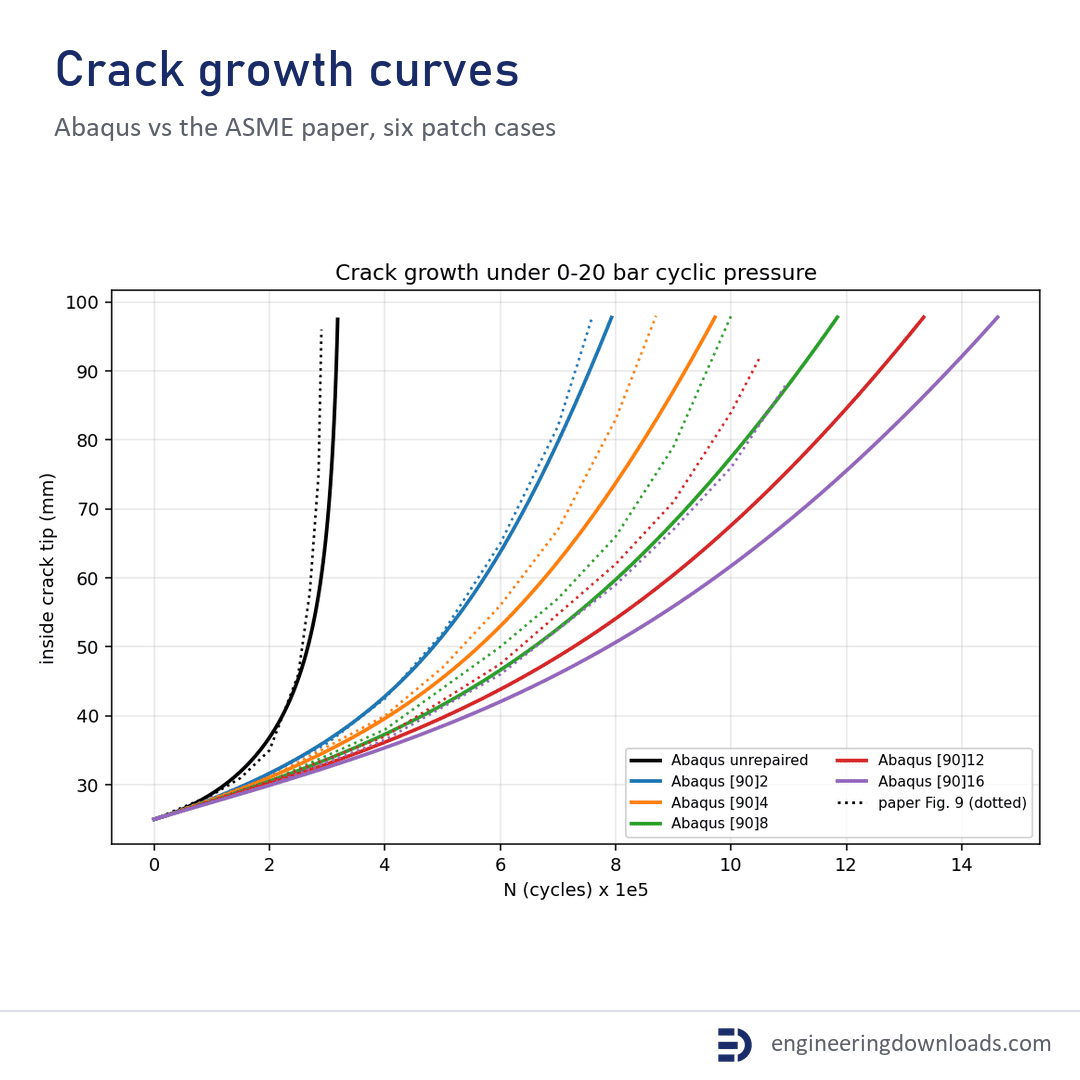
| Case | Cycles for 63 mm growth (Abaqus / paper) | Life extension (Abaqus / paper) |
|---|---|---|
| Unrepaired | 314,590 / 288,000 | – |
| [90]2 | 744,330 / 705,000 | 137% / 145% |
| [90]4 | 906,336 / 809,000 | 188% / 181% |
| [90]8 | 1,099,389 / 930,000 | 250% / 223% |
| [90]12 | 1,236,023 / 1,025,000 | 293% / 256% |
| [90]16 | 1,353,131 / 1,094,000 | 330% / 280% |
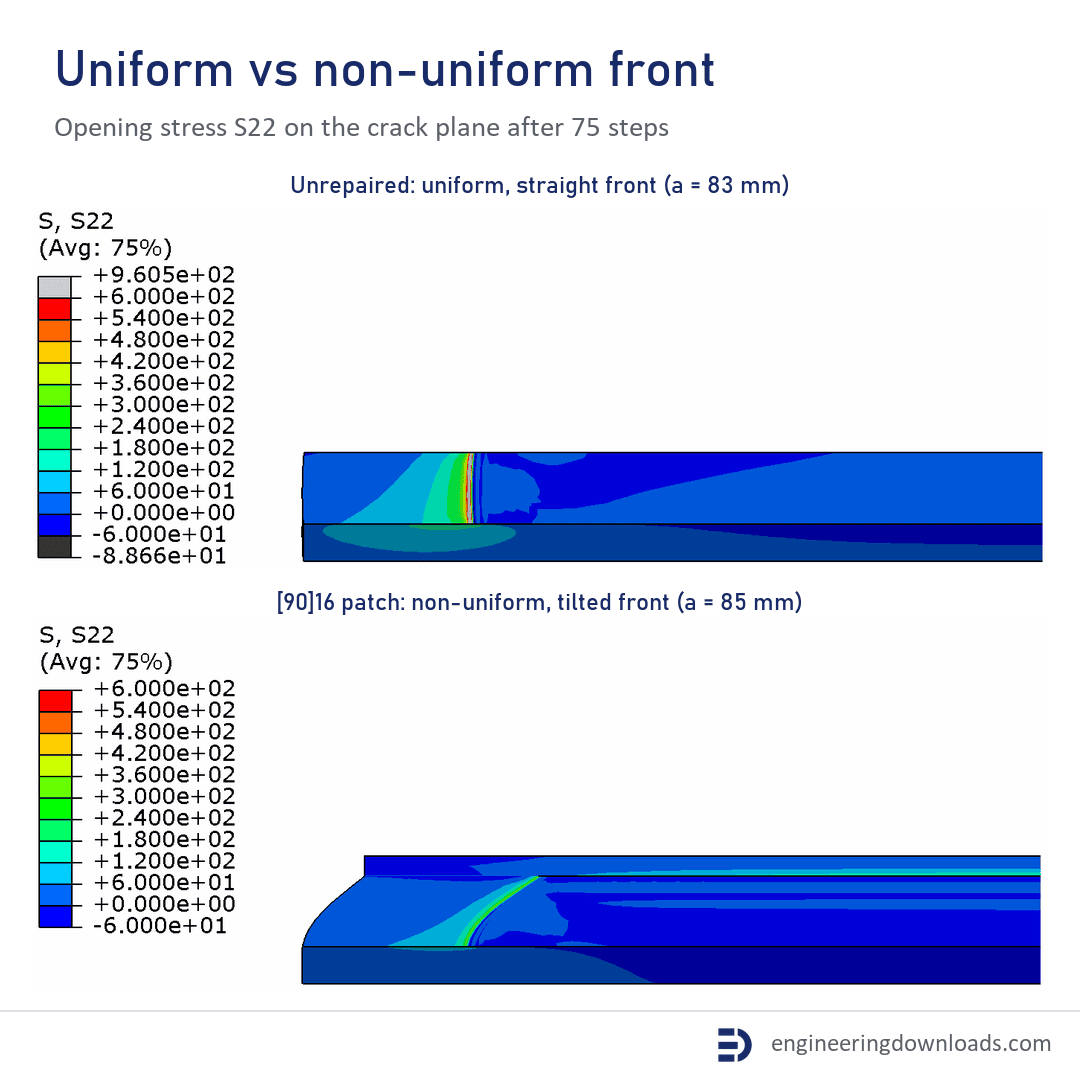
More results: initial K through the wall, K during growth, crack-front development and shapes, surface-node K and life extension:
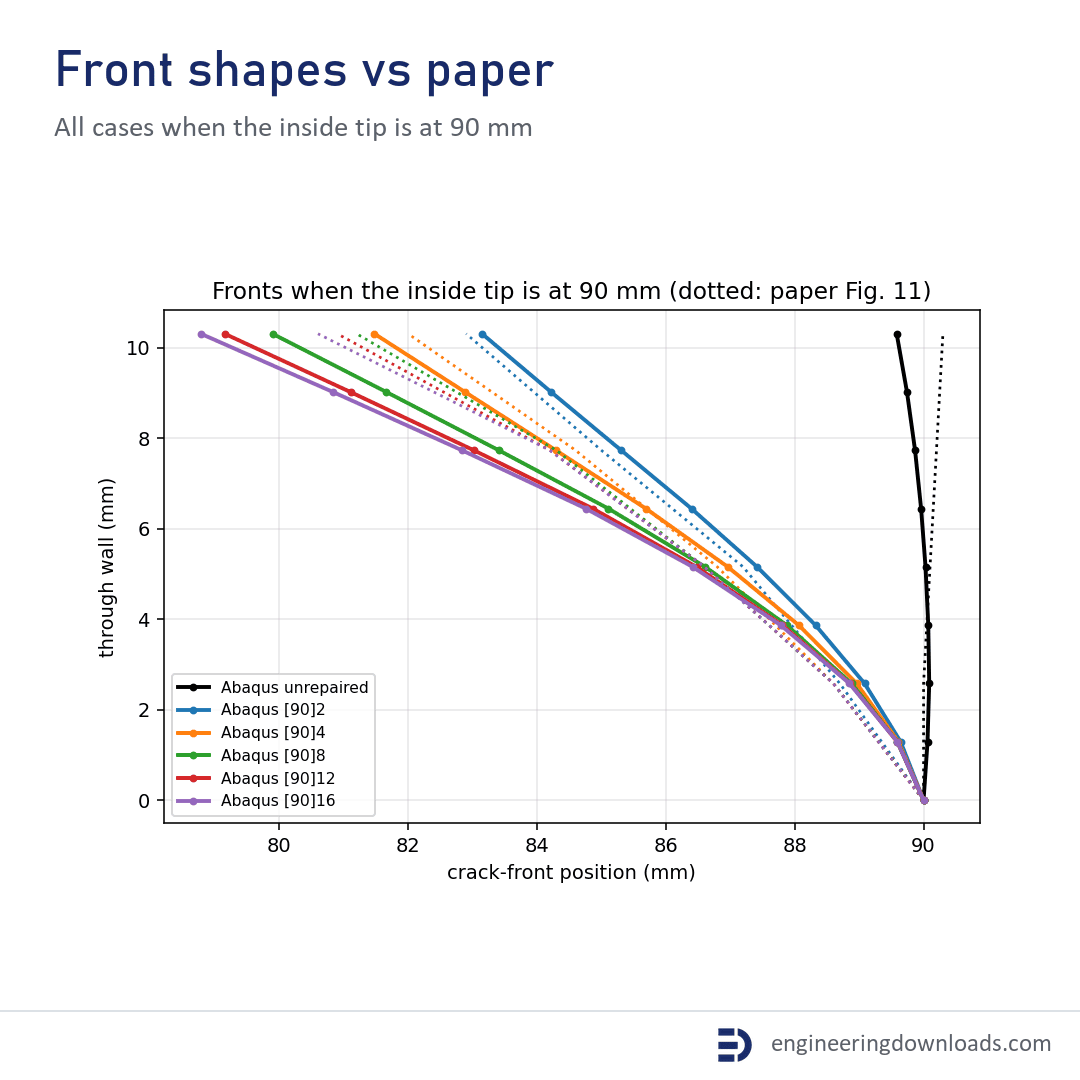
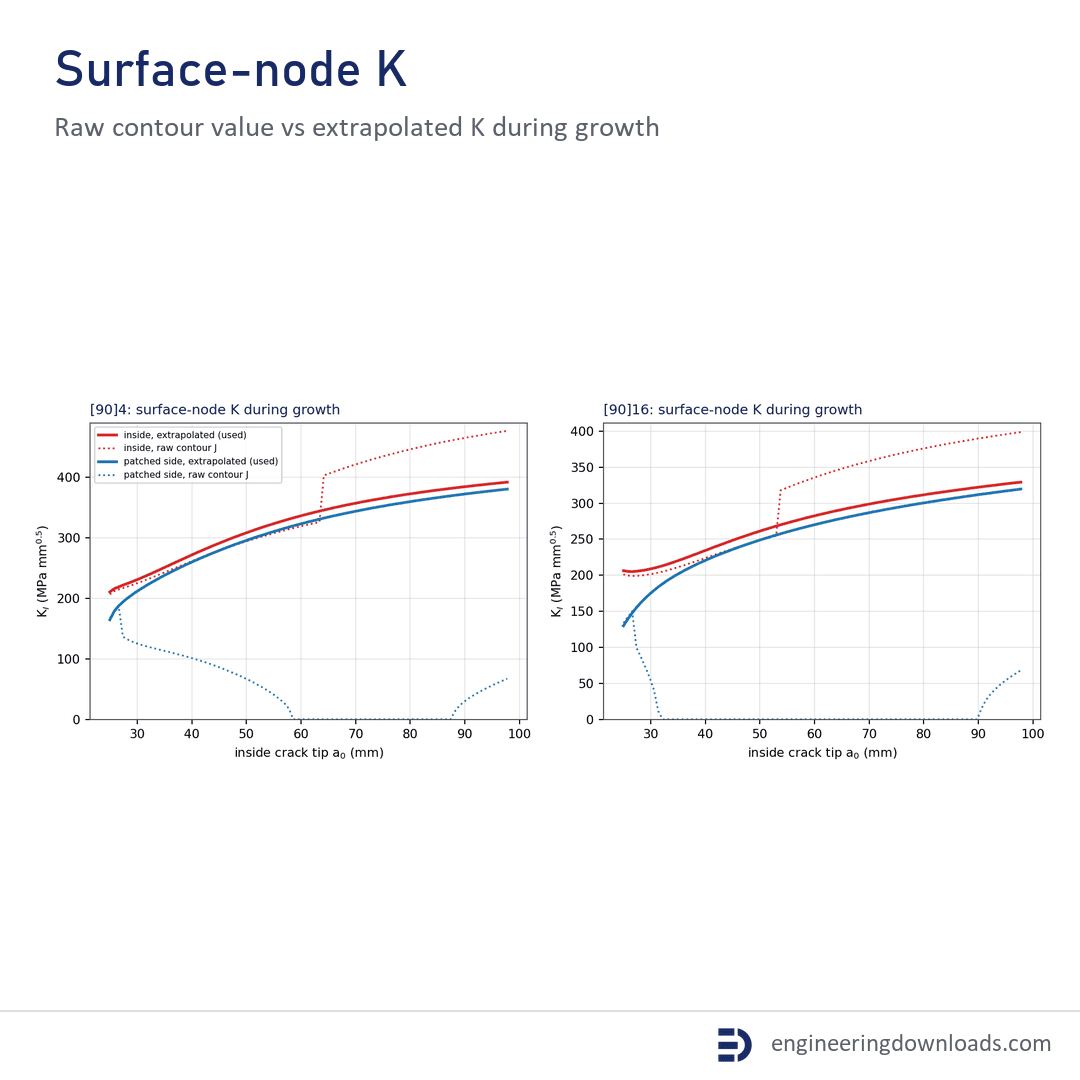
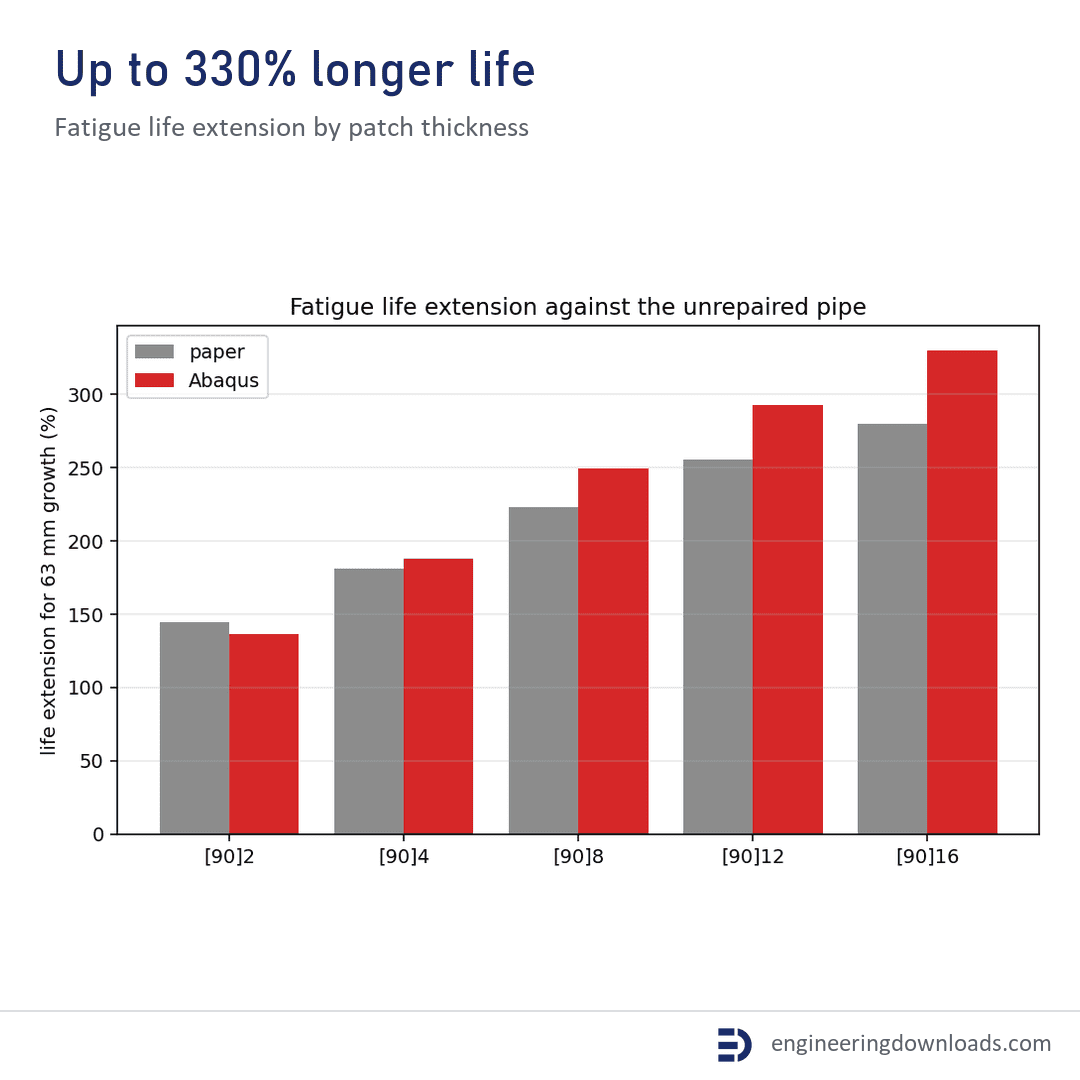
abaqus job=pipe_p90x4 input=pipe_p90x4.inp cpus=4 interactivepython run_growth.py p90x4 runs about 92 increments automatically (about 75 to 90 minutes on 4 cores); python plot_results.py compares your results with the paper.Abaqus/Standard; the files were prepared and tested with Abaqus 2024 (the CAE files open in 2024 or newer, the INP files use standard keywords). Python 3 with numpy and matplotlib for the scripts. Units are mm, N and MPa. You need your own copy of the paper for its original text and figures.
You get a checked, scripted 3-D crack growth model instead of weeks of development: Abaqus/CAE models you can open and inspect, INP files you can run at once, a Python loop that grows the crack front by itself, and every key result compared with a published ASME paper. Change the pipe size, crack length, patch lay-up or growth step in one Python file and run your own case. See also the same study in ANSYS APDL, composite patch repair of a cracked CT specimen in Abaqus and API 579 Level 3 assessment of a cracked pipe.
Is this model based on a published paper? Yes. It reproduces Ghaffari and Hosseini-Toudeshky, ASME Journal of Pressure Vessel Technology 135(3), 031402 (2013), and compares stress intensity factors, crack growth curves, crack-front shapes and fatigue lives with it.
Is the paper included? No. The package contains our own model, results and tutorial. The paper is available from ASME through the DOI link.
Can I open the model in Abaqus/CAE? Yes. Each case comes as a .cae file with the mesh, materials, patch orientation, boundary conditions, pressure and contour-integral crack already defined.
How is K computed at the free surfaces? Domain J is not path independent at the two surface nodes once the front curves (pressure on the inner surface, steel/adhesive/patch interface on the outer surface), so K there is extrapolated from the interior nodes. The tutorial shows this check.
Can I model my own pipe or patch? Yes. Pipe size, crack length, number of plies, materials, mesh and growth step are parameters in gen_inp.py and run_growth.py.
Is this a design or acceptance result? No. It is a benchmark and training package and does not replace an assessment by a qualified engineer.
Quality guarantee: if you are not satisfied with the delivered product, we will refund you.
Need more than the files?
There are two ways we can help. Book a one hour online consultation if you want to talk a problem through with a CAE engineer, using the checkbox in the order box. Order a project if you need a full simulation built for you, delivered to an agreed scope, price and deadline under a written contract.
We work on FEA and CFD for engineers, researchers and companies. Order your project, or message us on WhatsApp for a quick reply.
Other packages engineers working on this topic also download.
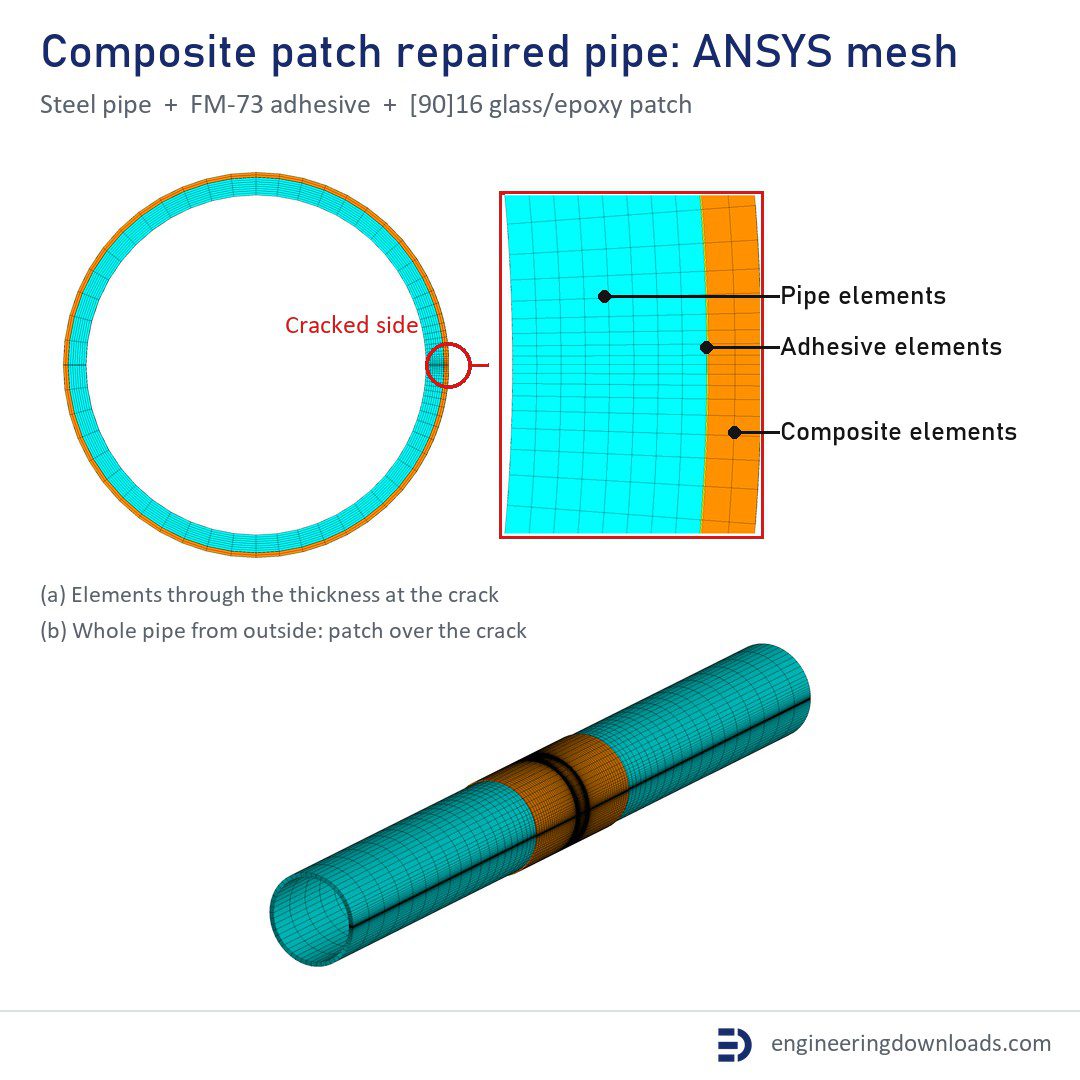 Composite Patch Repair of a Cracked Pipe in ANSYS: Fatigue Crack Growth under Cyclic Pressure
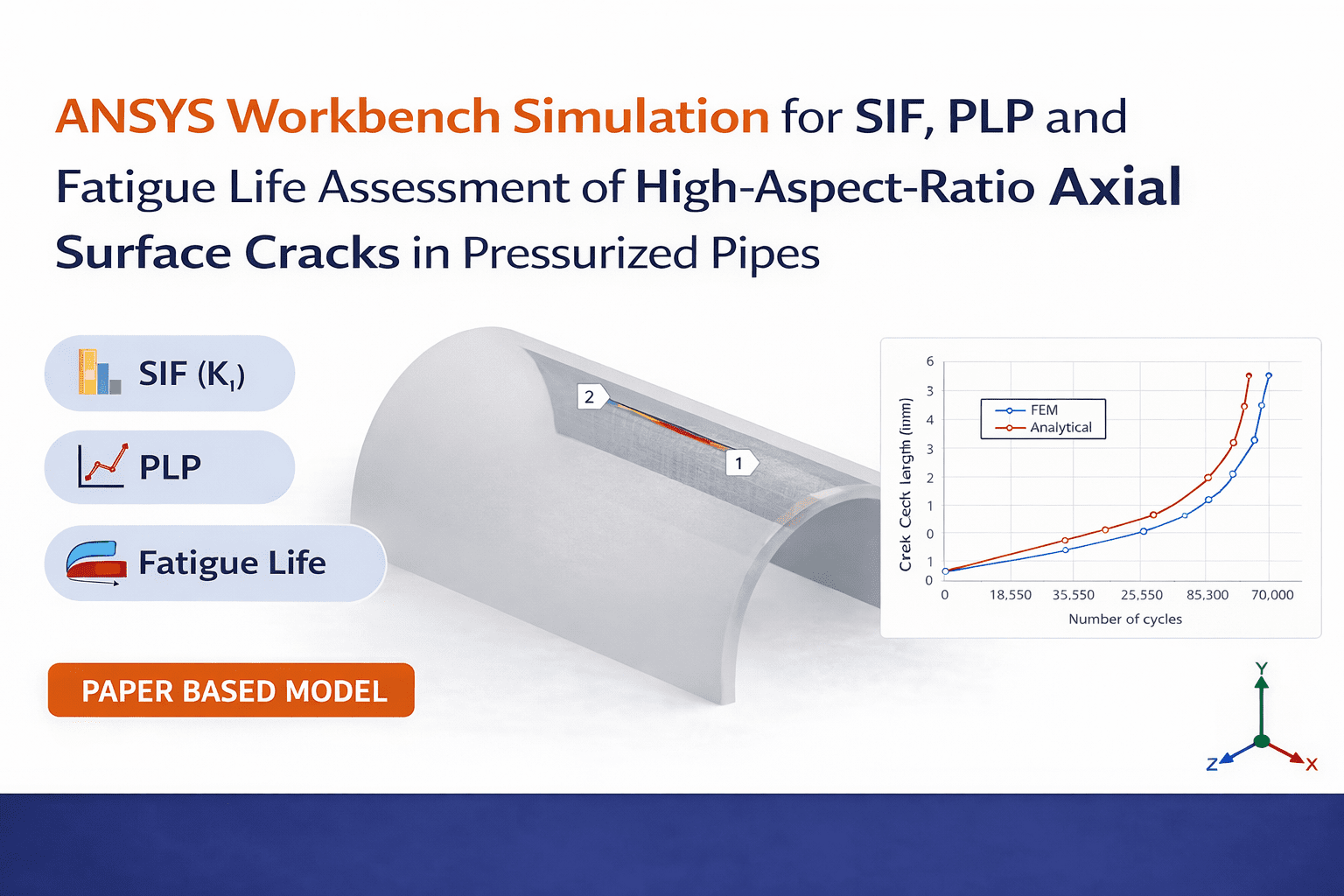 ANSYS Workbench Simulation for SIF, PLP and Fatigue Life Assessment of High-Aspect-Ratio Axial Surface Cracks in Pressurized Pipes€129,00
 Compact Tension (CT) Specimen: Validated Abaqus Stress Intensity Factor Model vs ASTM E647 (2D + 3D)€99,00
 Surface Crack in a Pressure Vessel: Validated Abaqus Stress Intensity Factor Model (Spider-Web Mesh)€129,00
 Pipe and Pipeline Simulation Package in Abaqus (21 Models)
 Fatigue and Cyclic Loading Package
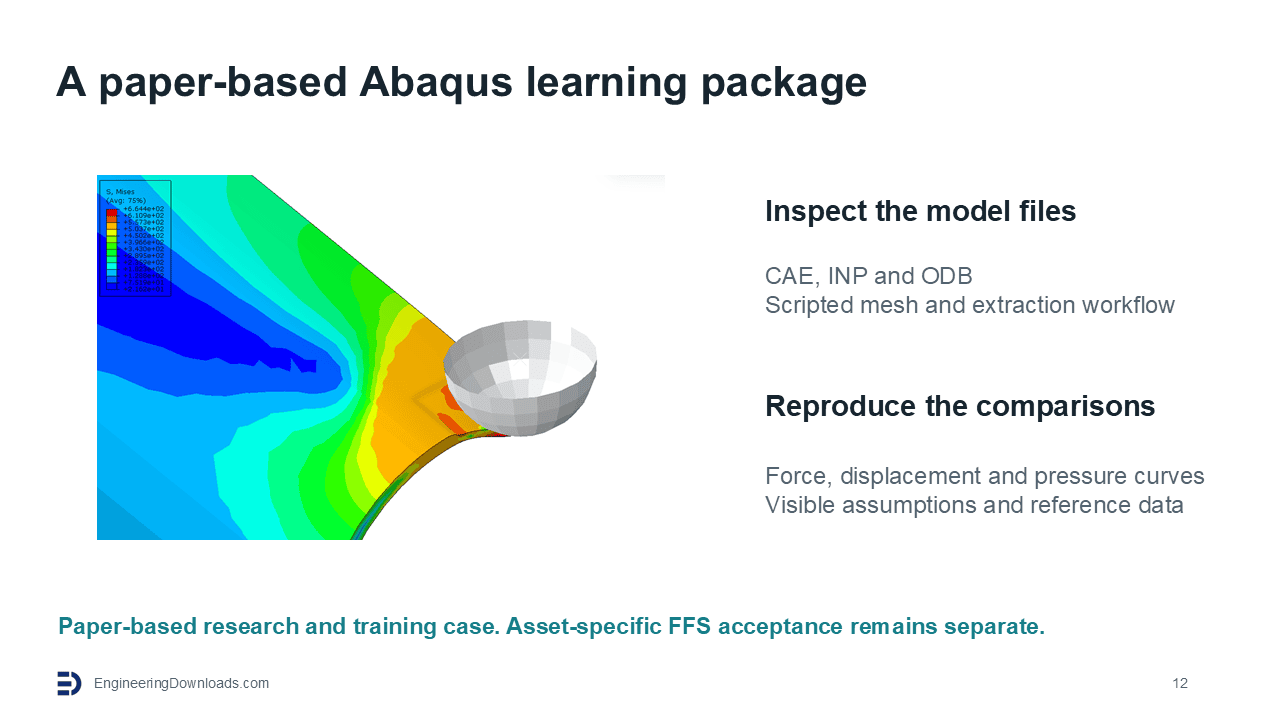 Pipeline Dent and Corrosion Analysis in Abaqus: Level 3 FFS Modelling
 Repair Welding Residual Stress and 3D Fatigue Crack Growth in Abaqus: Ductile Cast Iron Wind-Turbine Hub (FFS Level 3)€299,00

Need a full custom project? See the options below.

€129,00

€179,00

€149,00

€119,00

€129,00

€149,00
See more
Want to receive push notifications for all major on-site activities?



