

Need a full custom project? See the options below.
Need a full custom project? See the options below.
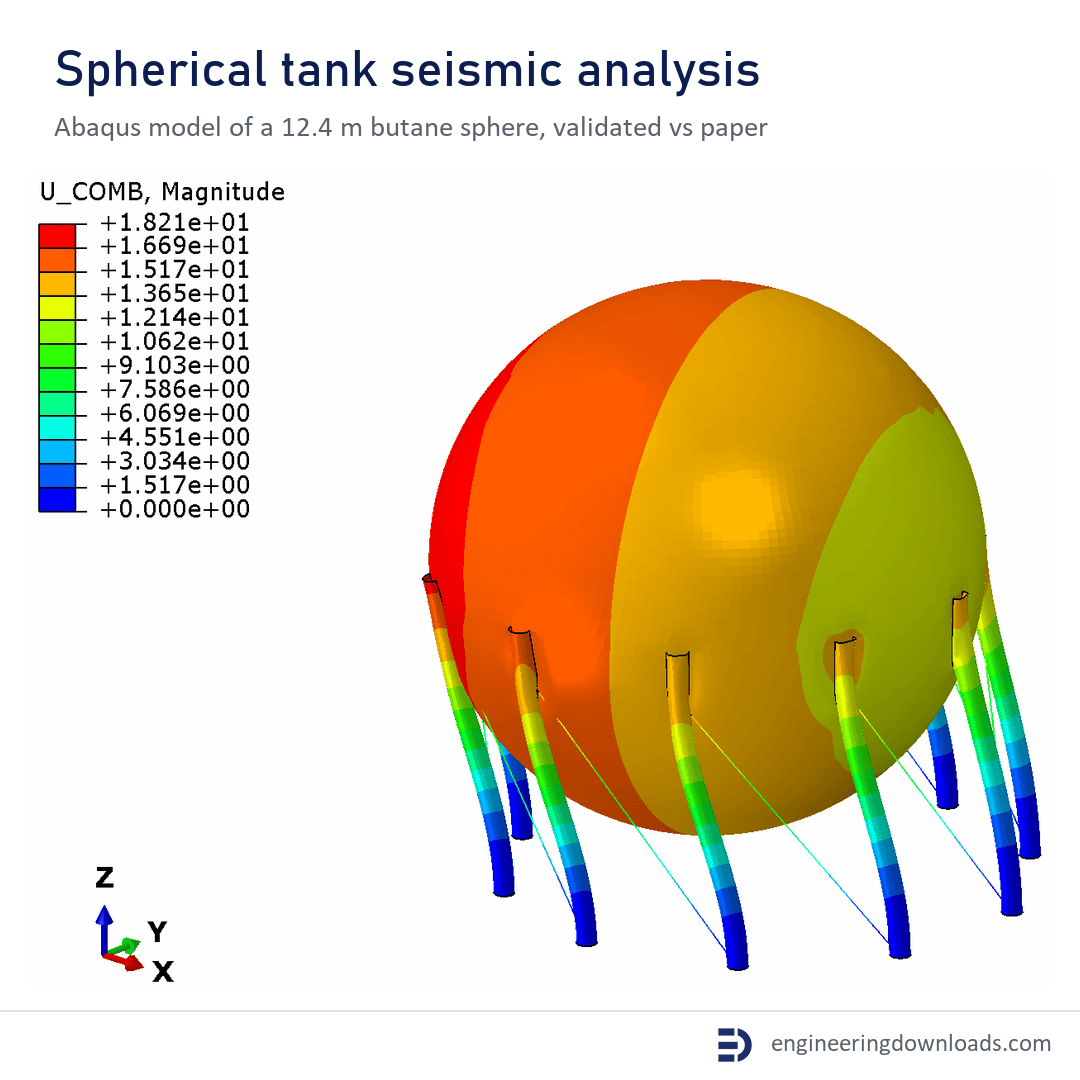
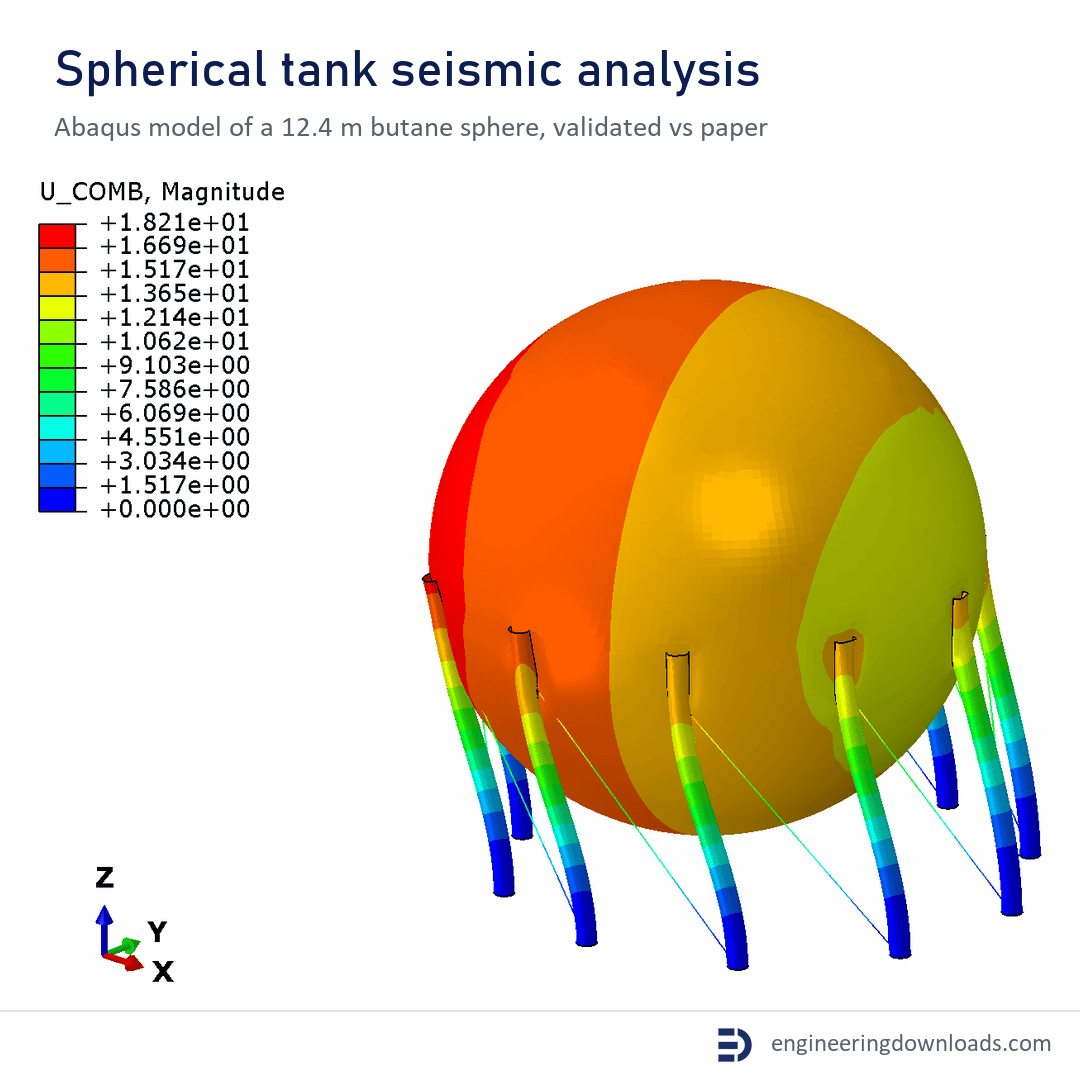
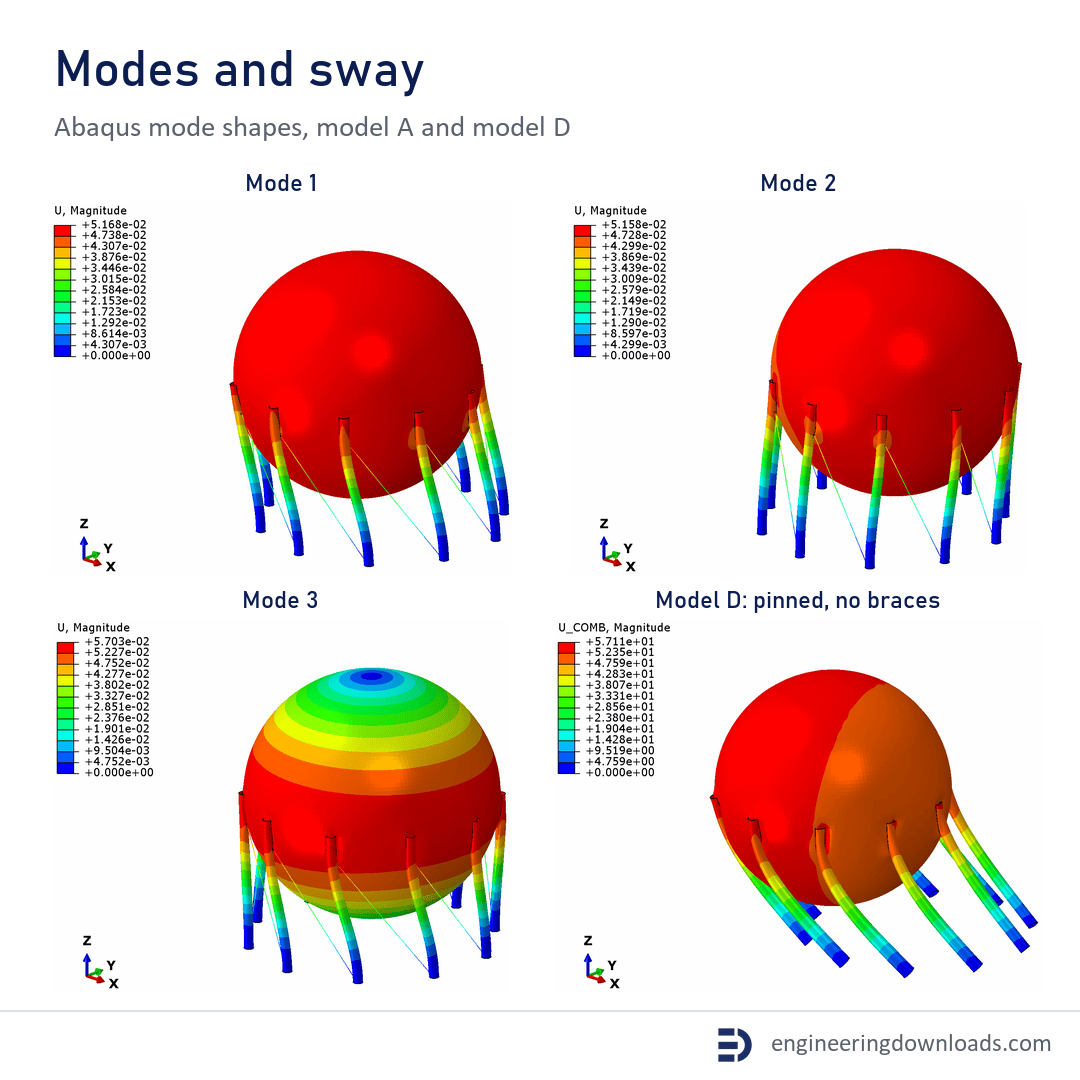
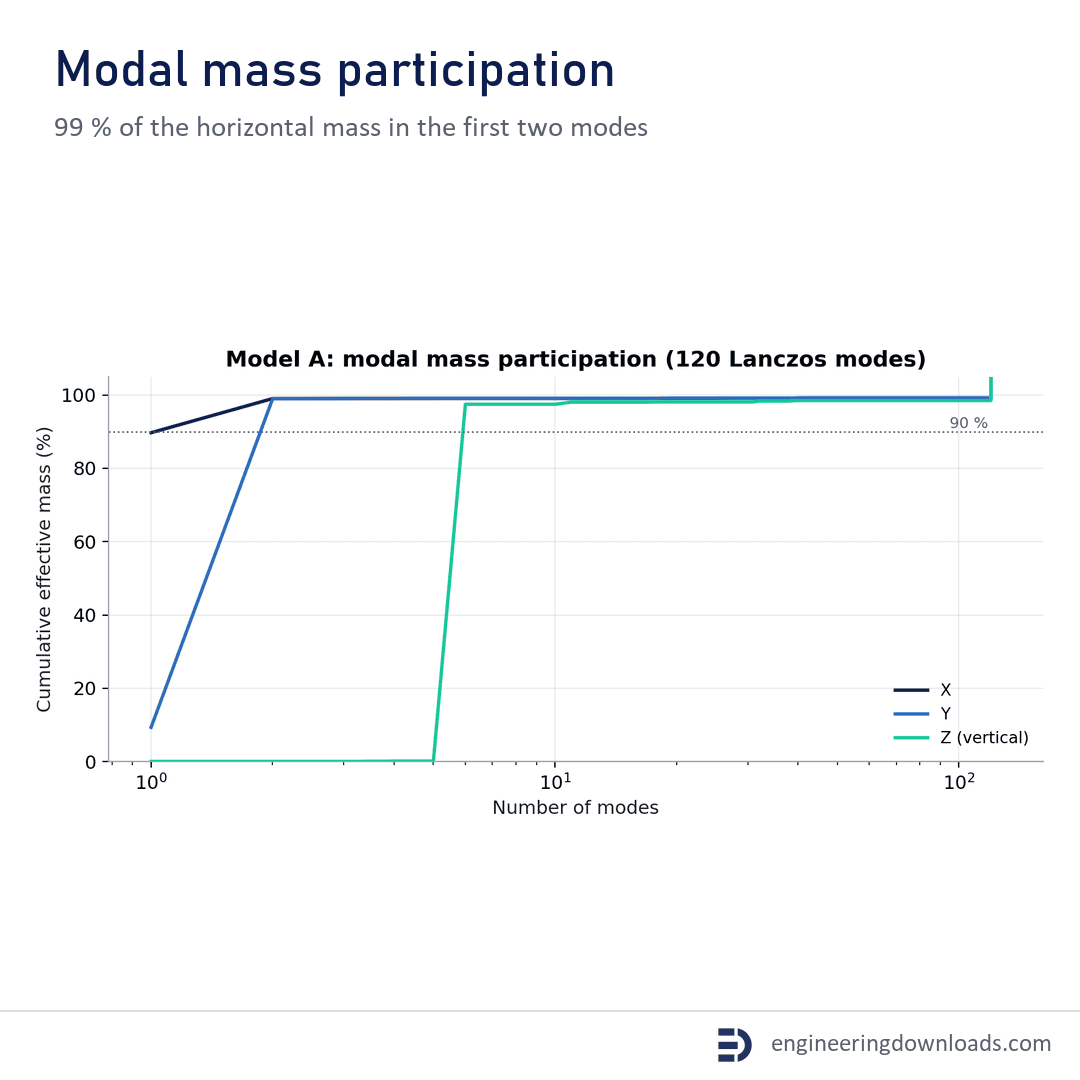
How does a pressurised butane sphere on ten steel legs respond to an earthquake, and how do you model it properly in Abaqus? This package answers both with a complete seismic model of a 12.4 m spherical liquid storage tank (Horton sphere): sphere and legs as one merged shell model, tension-only X-braces, the impulsive liquid mass, internal and hydrostatic pressure, a 120-mode frequency analysis and a response spectrum analysis to NTC 2008. It is based on a peer-reviewed case study and reproduces its fundamental period, base shear, displacements, brace stress and mode shapes, compared figure by figure with the paper. You get four Abaqus/CAE models, ready-to-run INP files, the Python build and post-processing scripts, all results and an 18-page PDF tutorial.
Paper title: Seismic performance of spherical liquid storage tanks: a case study
Authors: Alessandra Fiore, Cristoforo Demartino, Rita Greco, Carlo Rago, Concetta Sulpizio and Ivo Vanzi
Journal: International Journal of Advanced Structural Engineering, Vol. 10, pp. 121-130 (2018)
DOI: 10.1007/s40091-018-0185-1 (open access, CC BY 4.0)
Abstract:
Spherical storage tanks are widely used for various types of liquids, including hazardous contents, thus requiring suitable and careful design for seismic actions. On this topic, a significant case study is described in this paper, dealing with the dynamic analysis of a spherical storage tank containing butane. The analyses are based on a detailed finite element (FE) model; moreover, a simplified single-degree-of-freedom idealization is also set up and used for verification of the FE results. Particular attention is paid to the influence of sloshing effects and of the soil–structure interaction for which no special provisions are contained in technical codes for this reference case. Sloshing effects are investigated according to the current literature state of the art. An efficient methodology based on an “impulsive–convective” decomposition of the container-fluid motion is adopted for the calculation of the seismic force. With regard to the second point, considering that the tank is founded on piles, soil–structure interaction is taken into account by computing the dynamic impedances. Comparison between seismic action effects, obtained with and without consideration of sloshing and soil–structure interaction, shows a rather important influence of these parameters on the final results. Sloshing effects and soil–structure interaction can produce, for the case at hand, beneficial effects. For soil–structure interaction, this depends on the increase of the fundamental period and of the effective damping of the overall system, which leads to reduced design spectral values.
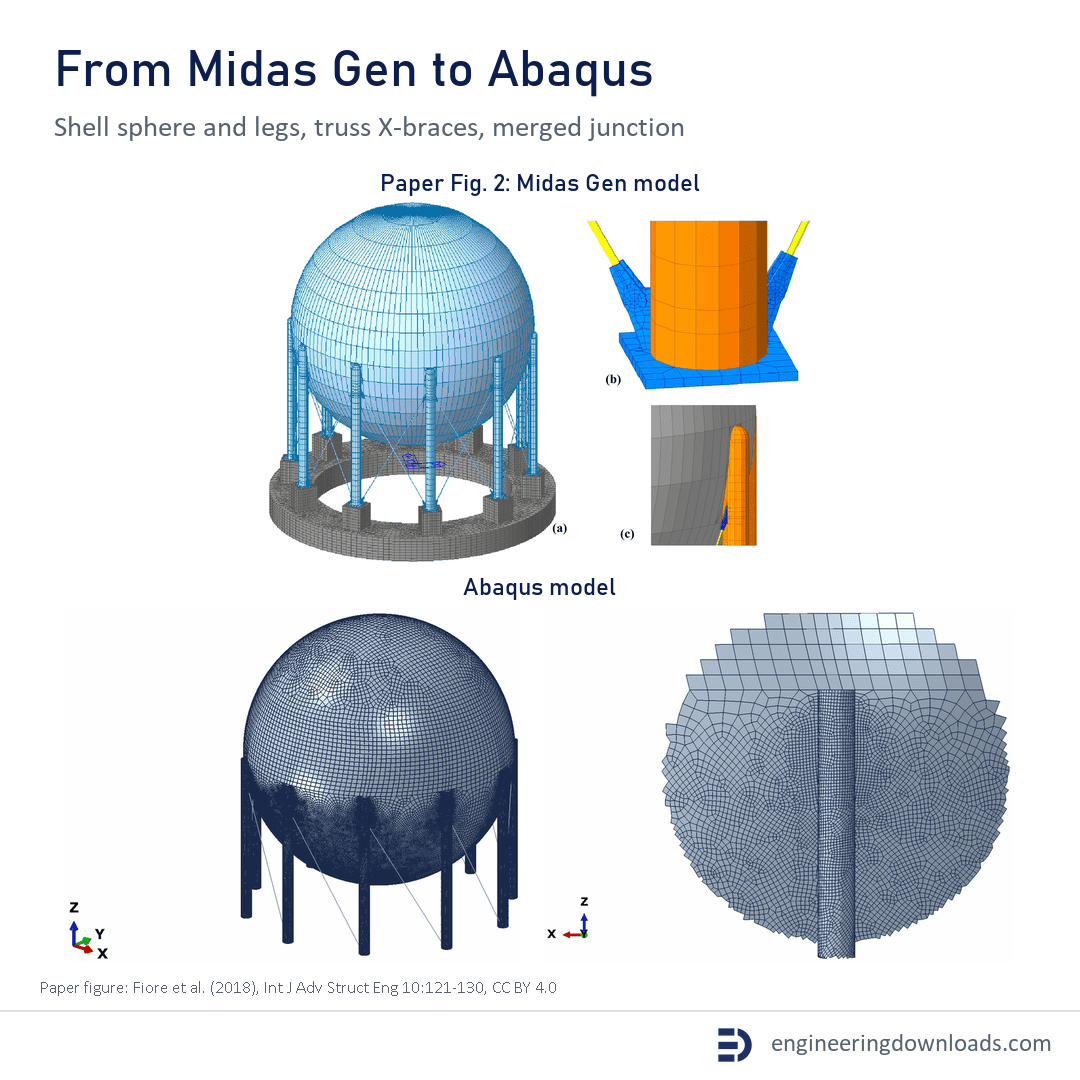
This package reproduces the paper’s detailed finite element model (Midas Gen in the paper) in Abaqus/Standard, including the four support schemes of its sensitivity study. Sloshing and soil-structure interaction are treated as in the paper: the impulsive liquid mass is in the model and the fixed-base results are compared.
| Item | Reference paper | This Abaqus package |
|---|---|---|
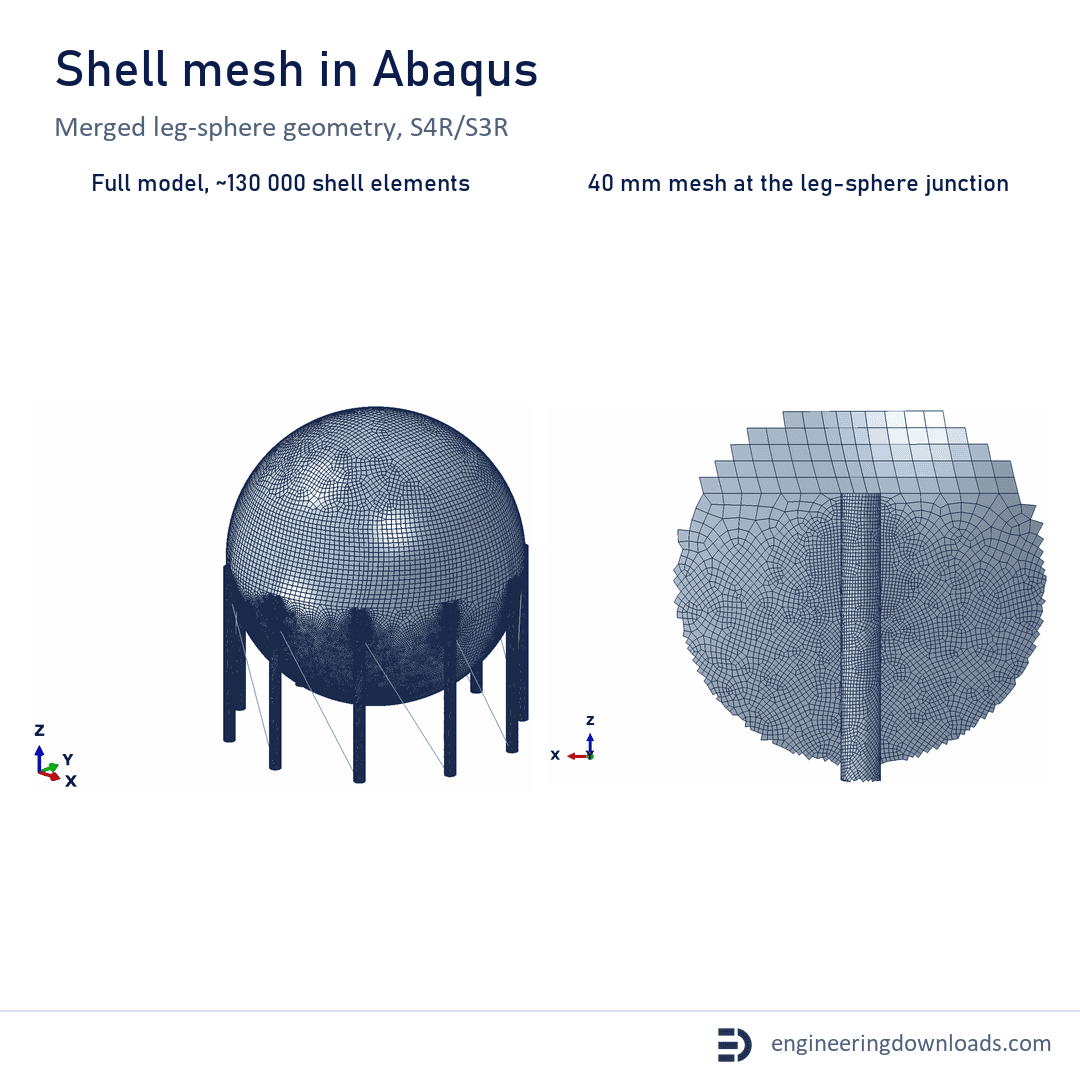
| Sphere | D 12.4 m, t 18 mm, butane 625 kg/m3 | Same; S4R/S3R shell on the mid-surface |
| Legs | 10 tubes 495 x 12 mm, 7.66 m | Same; shells trimmed by the sphere and merged with it (shared weld line) |
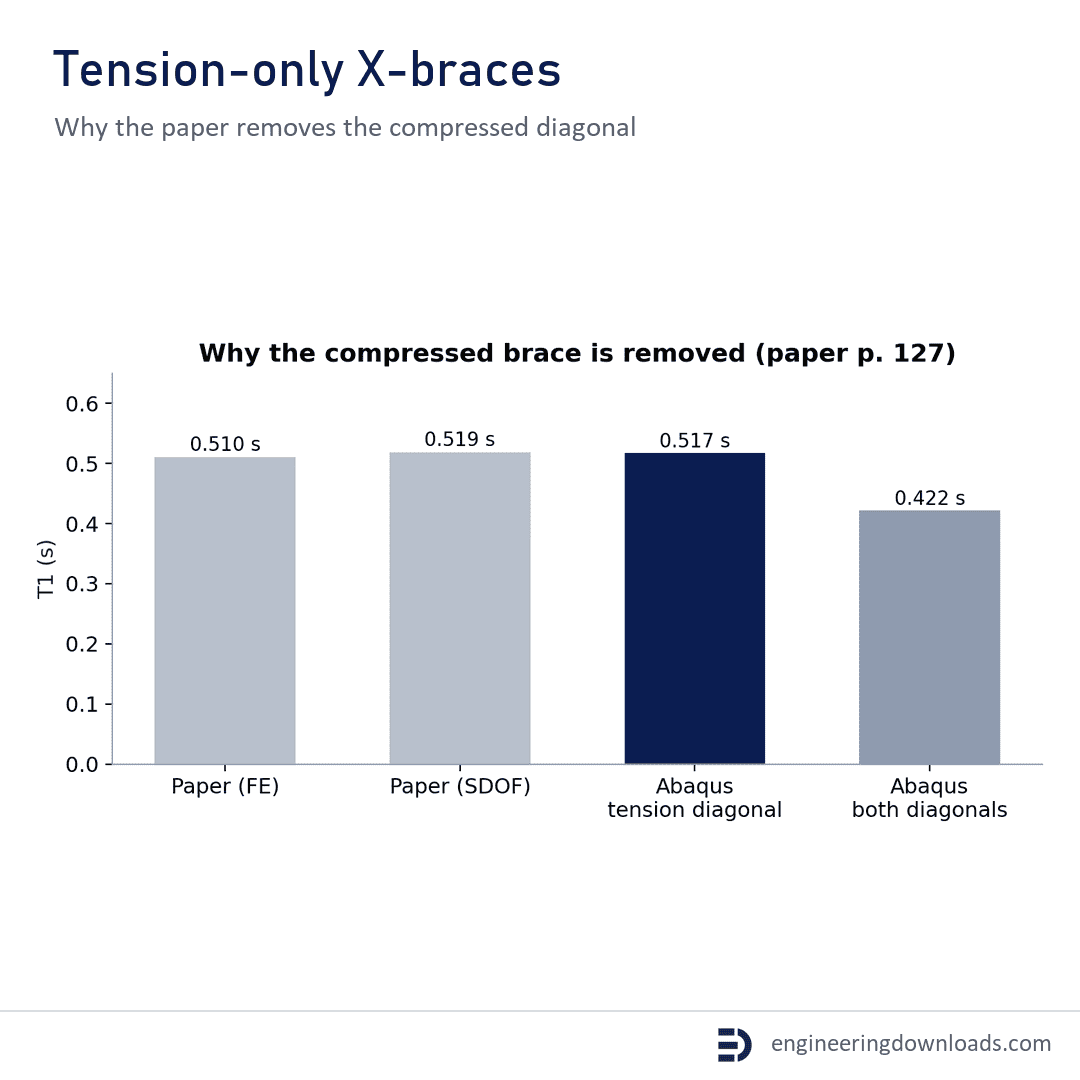
| Bracing | X-braces D 33 mm, compressed brace removed | T3D2 tension diagonals, distributing coupling to the legs |
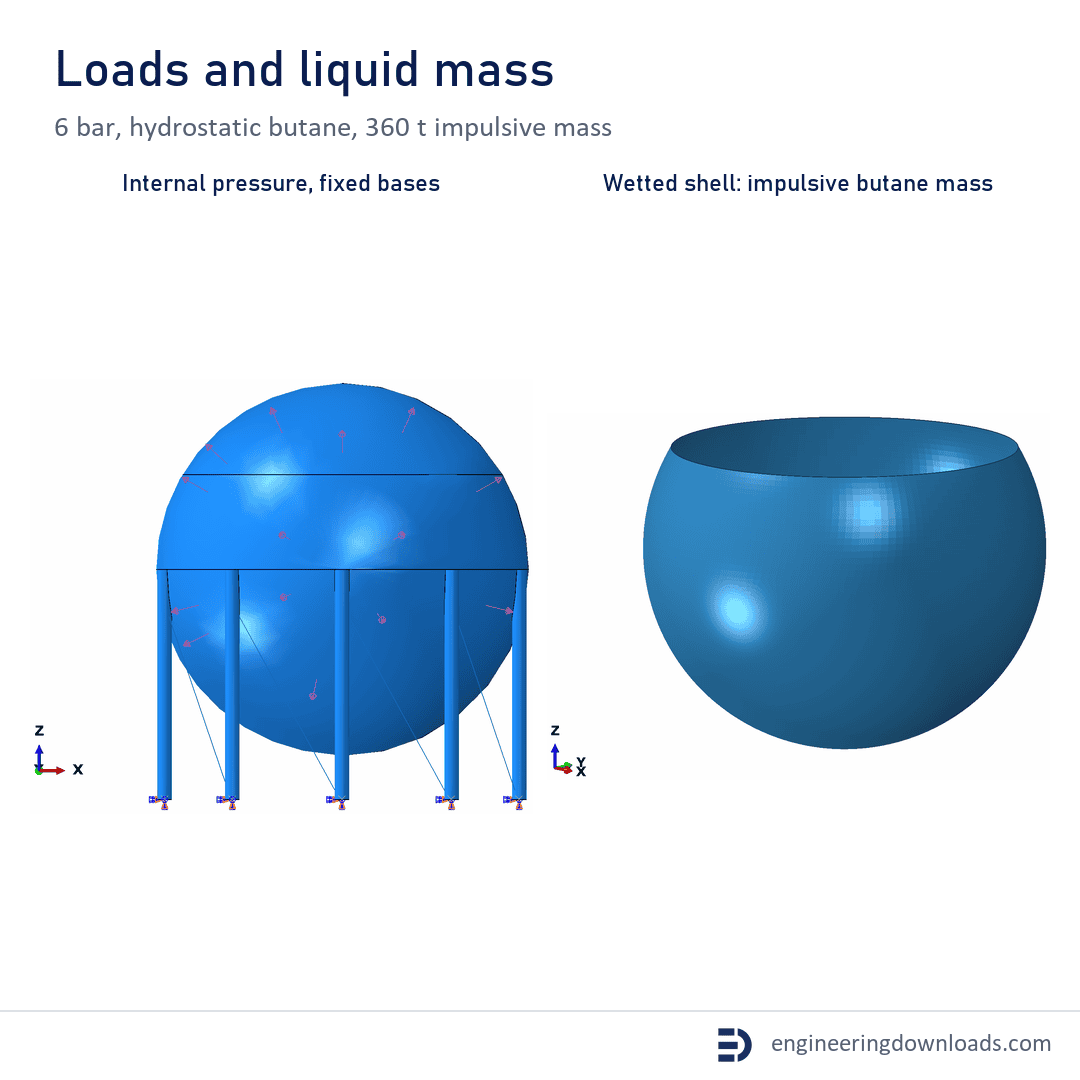
| Liquid | 75.5 % fill, impulsive + convective masses | Hydrostatic pressure + 359.95 t impulsive surface mass |
| Loads | G1, 6 bar, hydrostatic, seismic X/Y/Z | Same; combination G1 + Pi + PH – EX – 0.3 EY + 0.3 EZ |
| Seismic input | NTC 2008 spectrum, q = 1 | Response spectrum (CQC, 120 modes) and equivalent static fields |
| Supports | Models A-D: fixed/pinned, with/without braces | All four models as separate CAE and INP files |
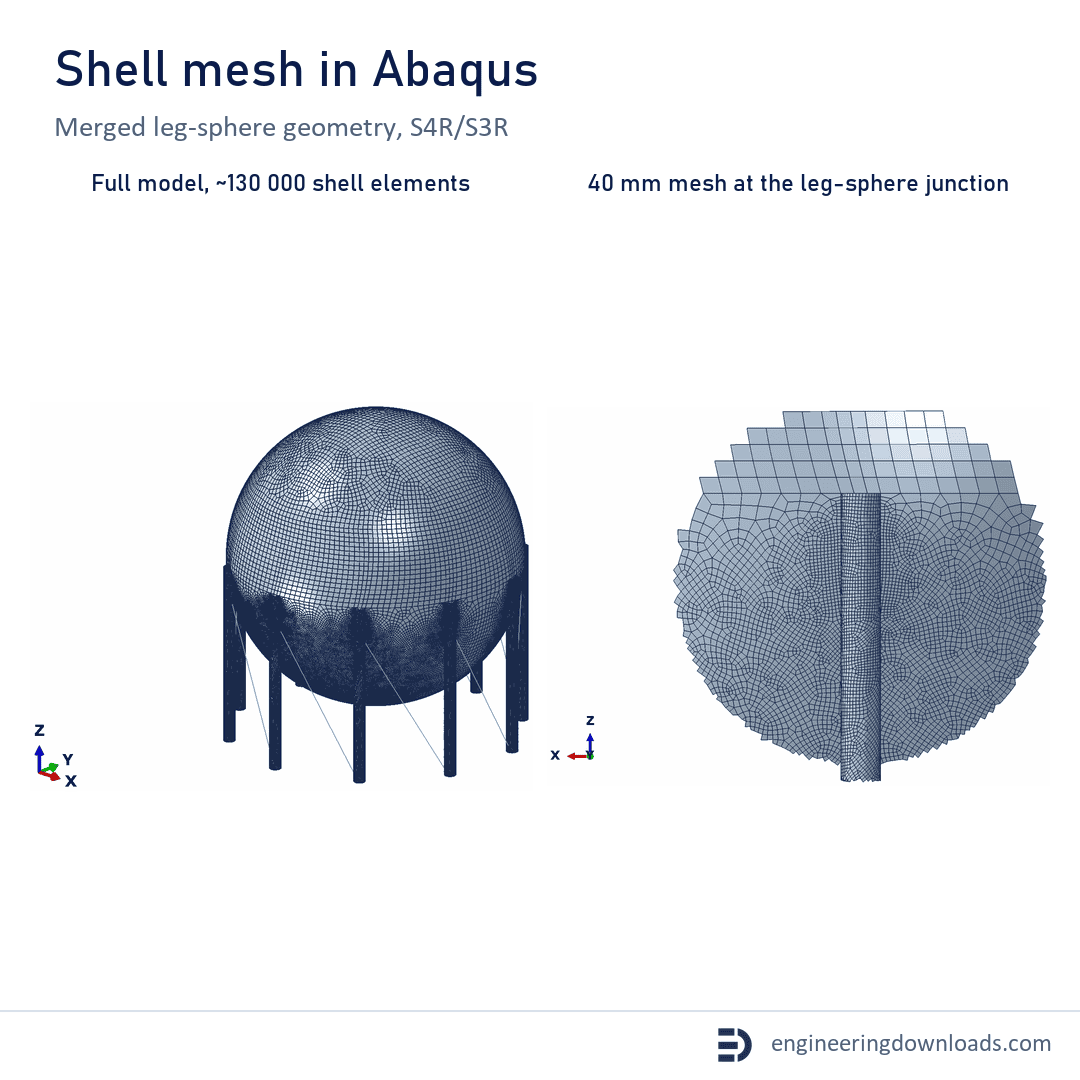
| Mesh | 0.3 m plates, refined at the connections | 200 mm sphere, 40 mm at the junction, about 130 000 shells |
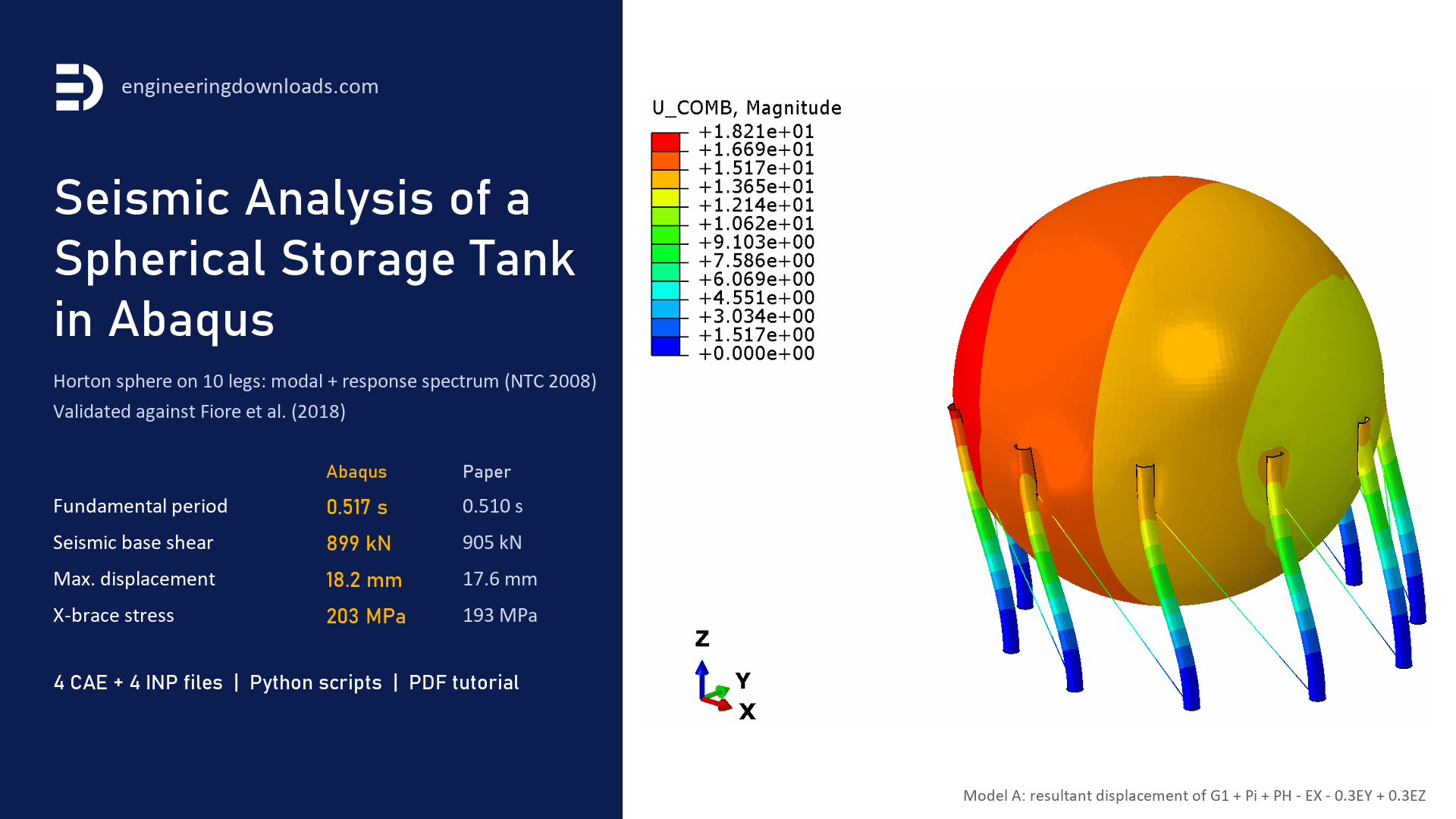
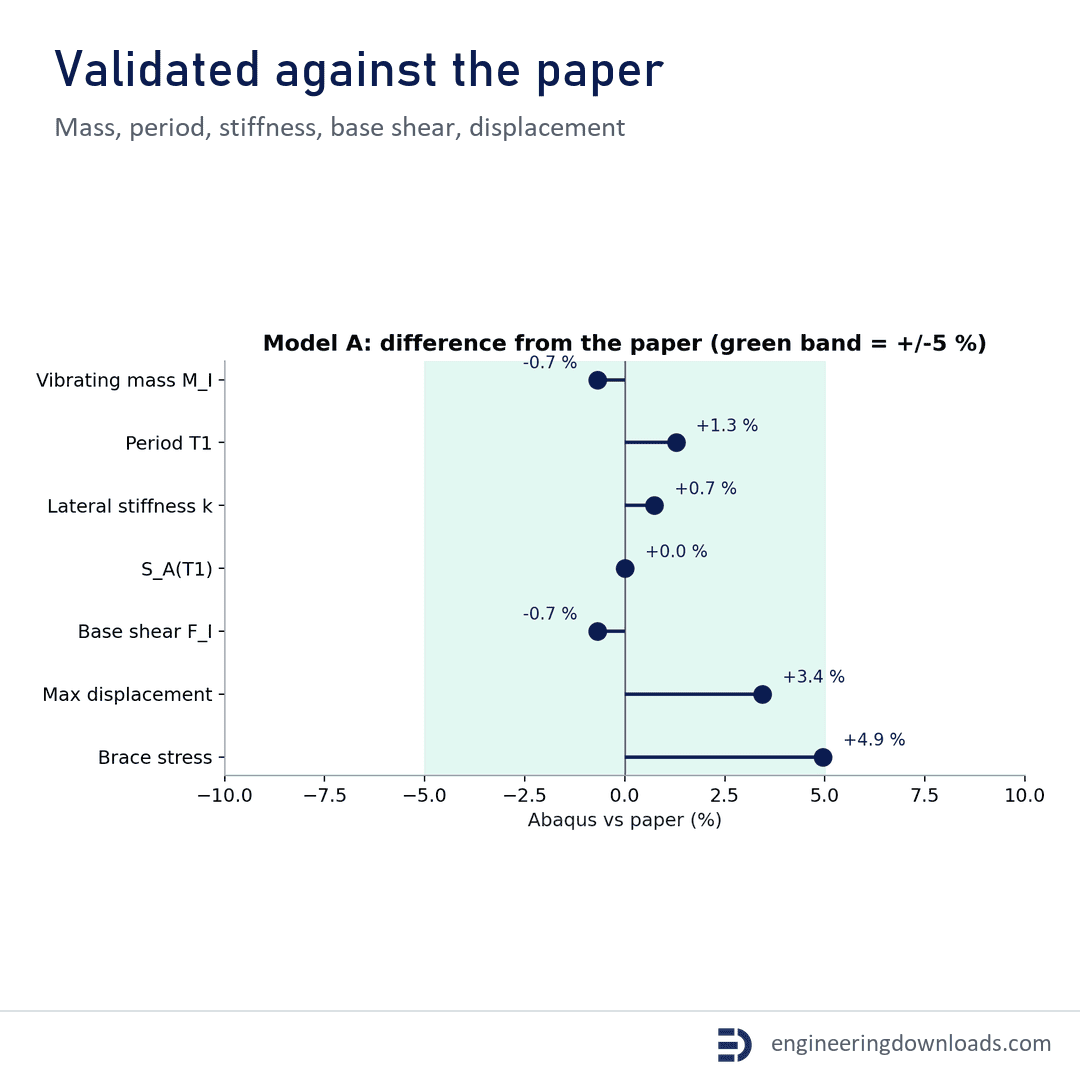
| Model A (reference) | Paper | Abaqus | Difference |
|---|---|---|---|
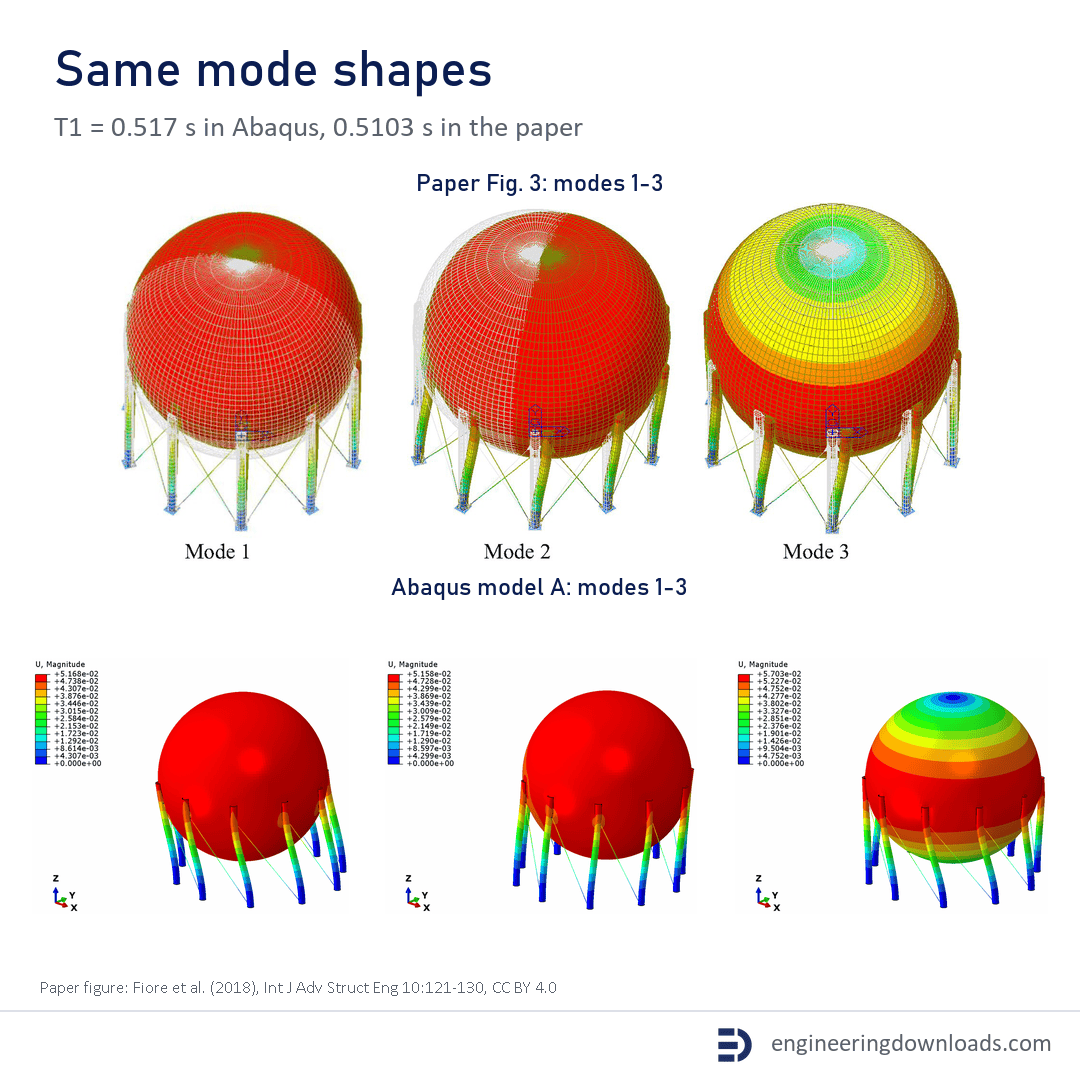
| Fundamental period T1 | 0.5103 s | 0.517 s | +1.3 % |
| Vibrating mass | 441.5 t | 438.5 t | -0.7 % |
| Lateral stiffness | 6.43e7 N/m | 6.48e7 N/m | +0.7 % |
| Seismic base shear | 905 kN | 899 kN | -0.7 % |
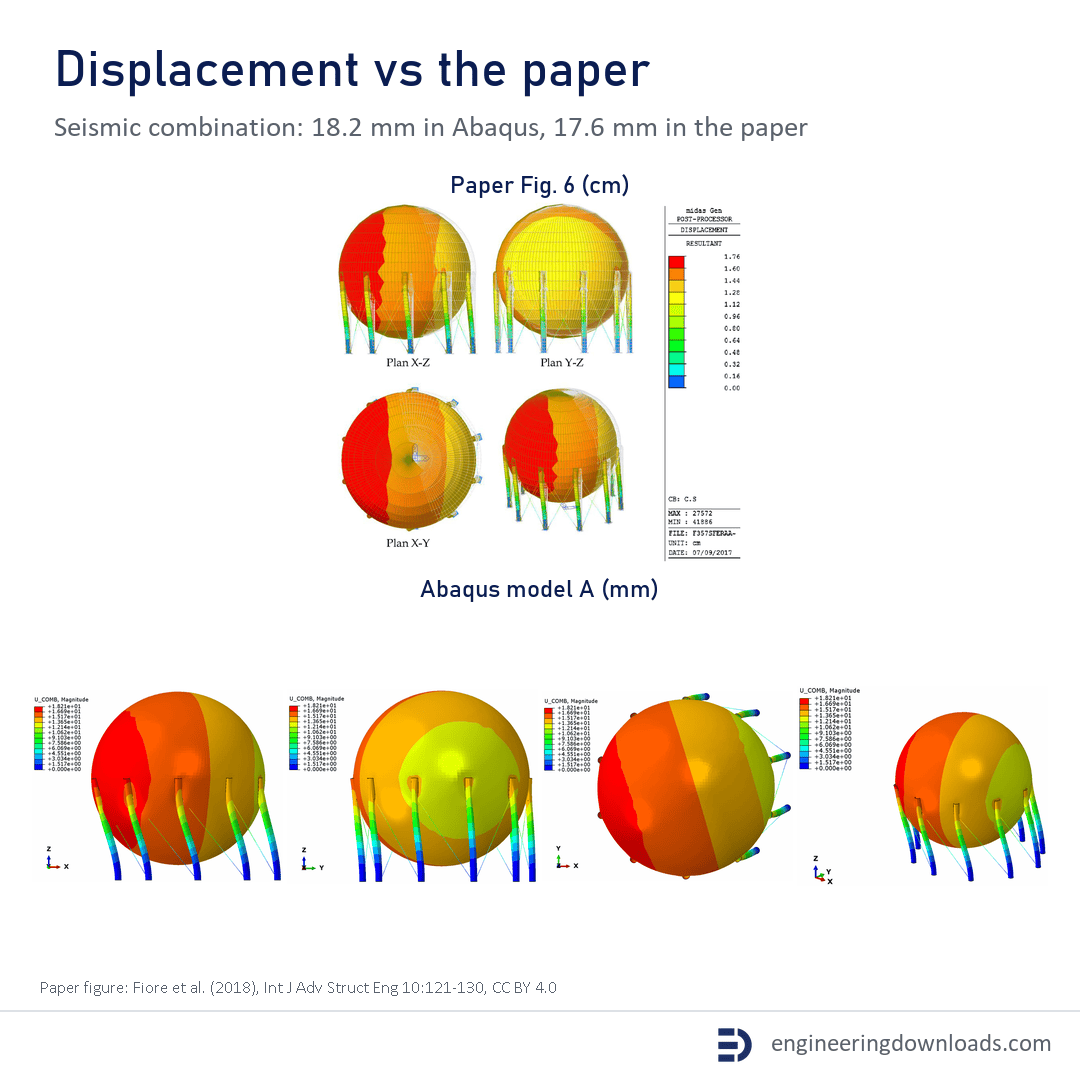
| Maximum displacement | 17.6 mm | 18.2 mm | +3.4 % |
| X-brace stress | 193 MPa | 203 MPa | +4.9 % |
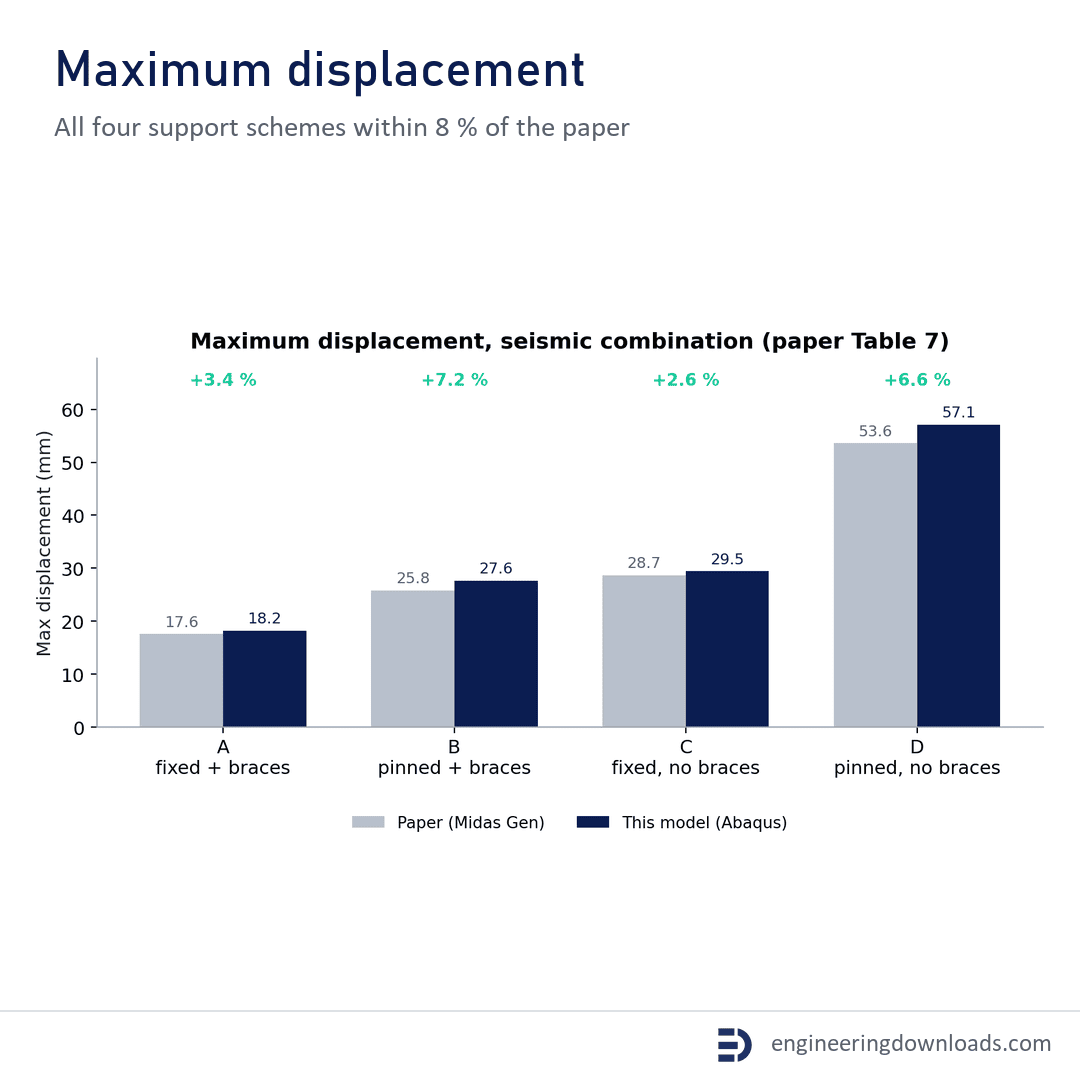
| Support scheme | T1 paper | T1 Abaqus | Umax paper | Umax Abaqus |
|---|---|---|---|---|
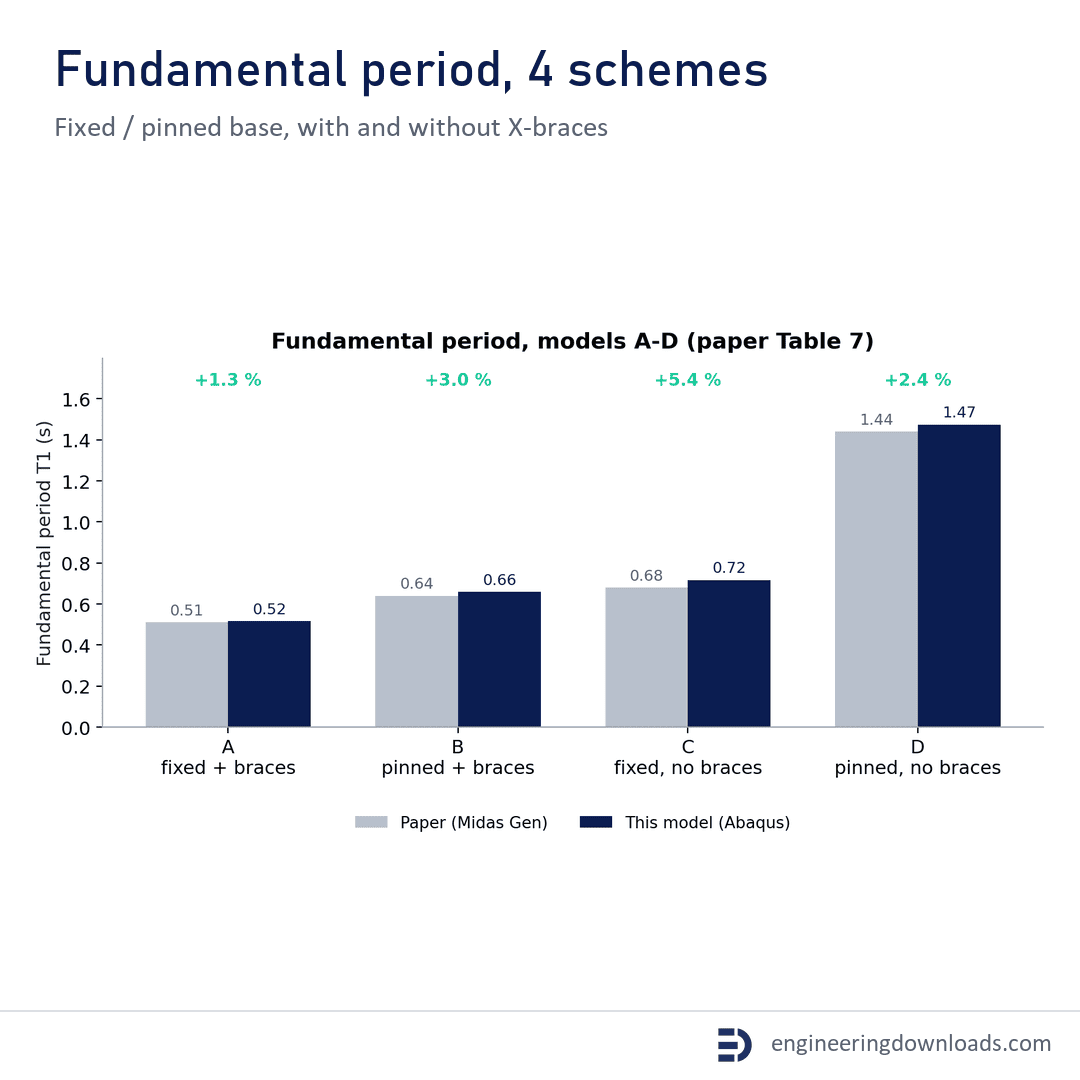
| A: fixed base, X-braces | 0.51 s | 0.517 s (+1.3 %) | 17.6 mm | 18.2 mm (+3.4 %) |
| B: pinned base, X-braces | 0.64 s | 0.659 s (+3.0 %) | 25.8 mm | 27.6 mm (+7.2 %) |
| C: fixed base, no braces | 0.68 s | 0.717 s (+5.4 %) | 28.7 mm | 29.5 mm (+2.6 %) |
| D: pinned base, no braces | 1.44 s | 1.474 s (+2.4 %) | 53.6 mm | 57.1 mm (+6.6 %) |
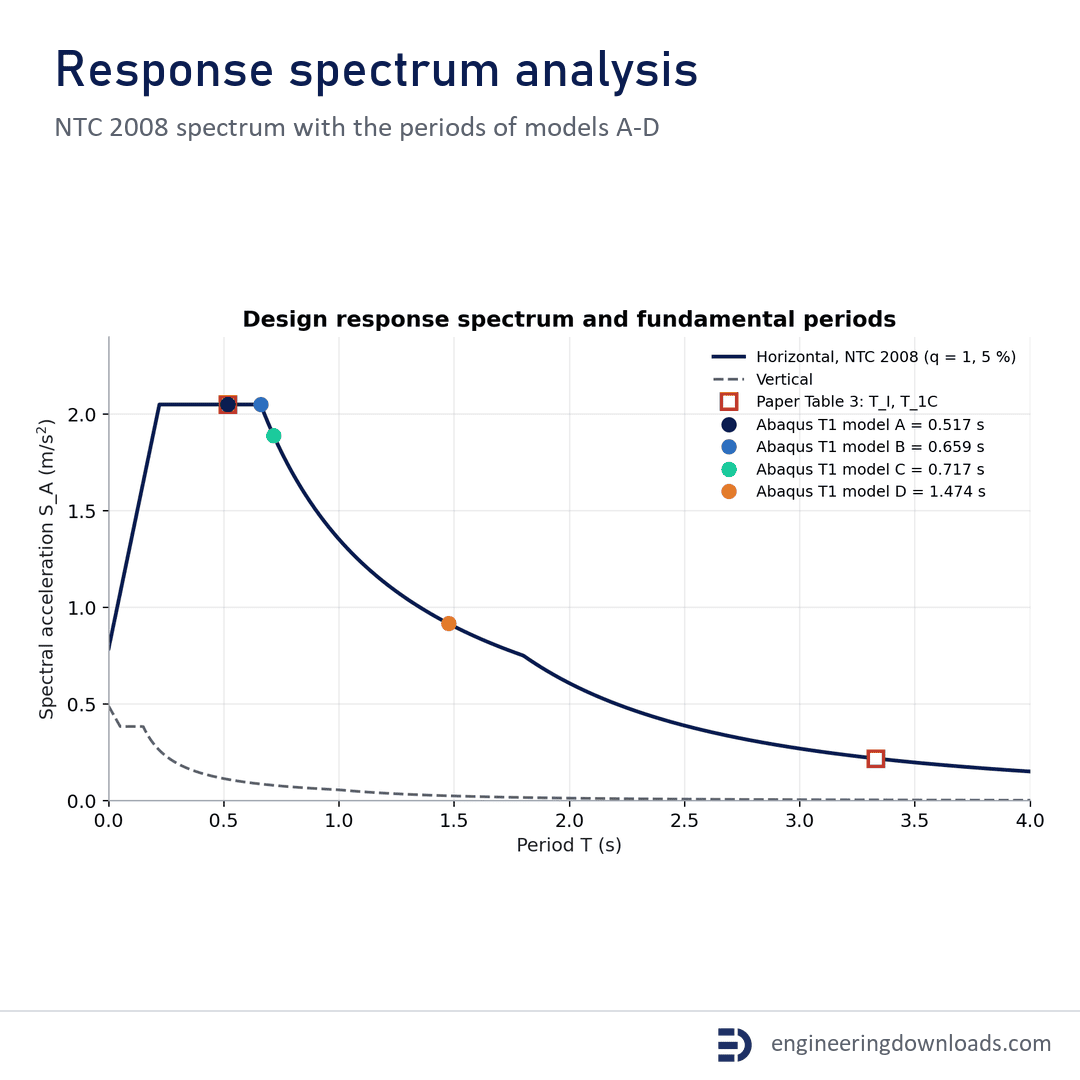
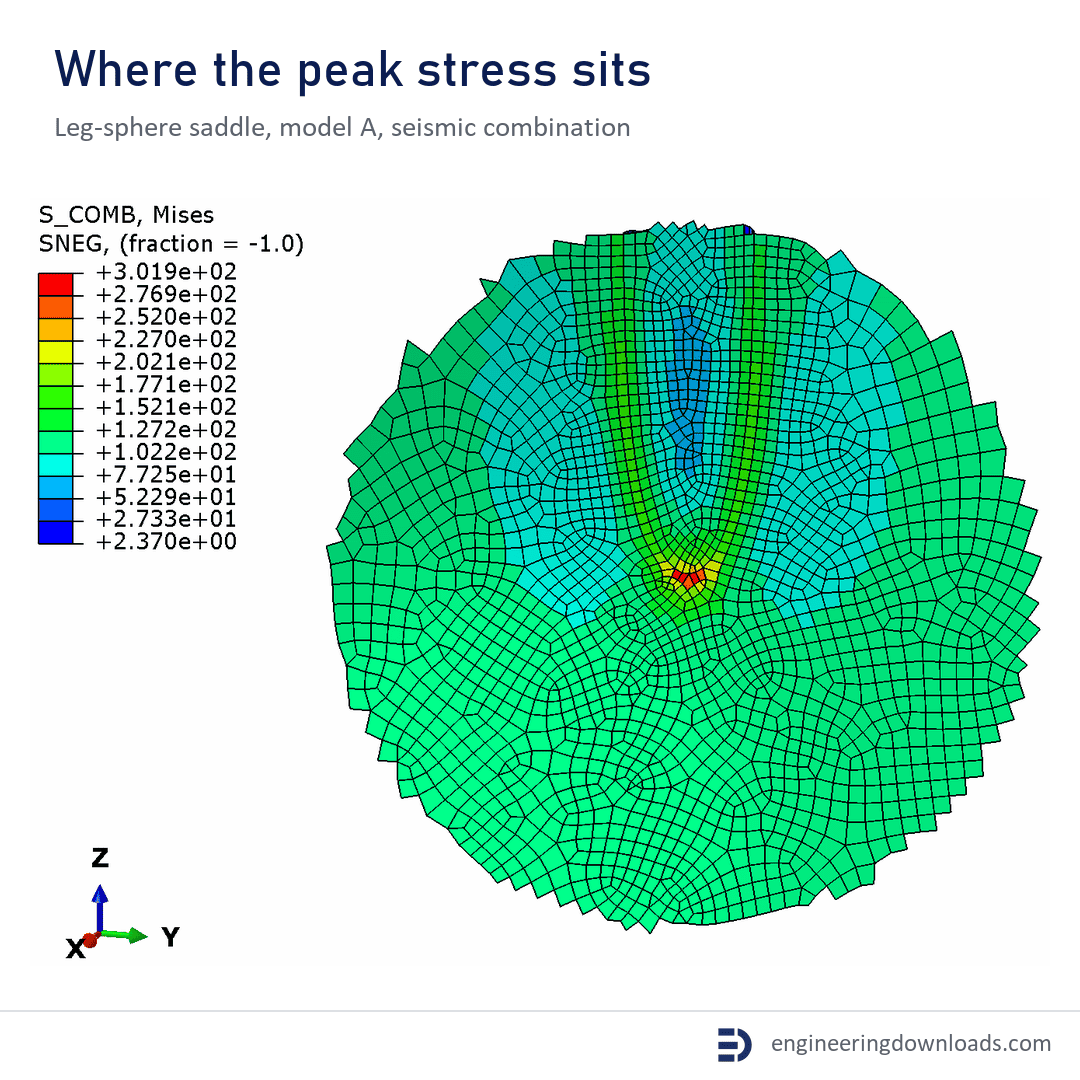
The paper removes the compressed brace of each X; with both diagonals active the period drops to 0.422 s, so the tension-only bracing is what reproduces its 0.51 s. Stresses of all four schemes, with a discussion of the peak at the tip of the leg-sphere weld line, are reported in the tutorial.
abaqus job=SPH_A input=SPH_A.inp cpus=4 interactiveabaqus cae noGUI=sphere_tank.py -- D 300 80 rebuilds model D with a 300 mm sphere and 80 mm junction mesh; abaqus python post_sphere.py SPH_A.odb SPH_A_post.json post-processes any run.Abaqus/Standard; the files were prepared and tested with Abaqus 2024 (the CAE files open in 2024 or newer, the INP files use standard keywords). Python 3 for the post-processing charts. Units are mm, N, MPa, s and tonne. The paper is open access and can be downloaded free through the DOI link.
You get a checked seismic model instead of weeks of development: Abaqus/CAE models you can open and inspect, INP files you can run at once, a Python script that rebuilds the tank with your own mesh, supports and bracing, and every key result compared with a published case study. See also the earthquake and seismic analysis package, water sloshing in a cylindrical tank under seismic loading and the NAFEMS LE7 pressure vessel benchmark in Abaqus.
Is this model based on a published paper? Yes. It reproduces Fiore et al., Seismic performance of spherical liquid storage tanks: a case study, International Journal of Advanced Structural Engineering 10:121-130 (2018), and compares periods, mode shapes, base shear, displacements and stresses with it.
Is the paper included? No. The paper is open access and free to download through DOI 10.1007/s40091-018-0185-1. Paper figures shown for comparison are reproduced under its CC BY 4.0 licence.
Can I open the models in Abaqus/CAE? Yes. Each of the four support schemes comes as a .cae file with geometry, mesh, liquid mass, loads, response spectra and steps already defined, plus a ready-to-run INP file.
How is the liquid modelled? The hydrostatic pressure of the butane acts on the wetted shell, and the impulsive liquid mass of 359.95 t is carried by a surface-element layer with density on the same shell, so it adds inertia without stiffness and without counting the liquid weight twice. The convective (sloshing) mass is small for a full tank and is discussed in the tutorial.
Can I change the tank, the legs or the bracing? Yes. The Python build script rebuilds the model with your own mesh size, base condition (fixed or pinned) and bracing (tension-only, both diagonals or none), and writes a new .cae and .inp file.
Is this a design or acceptance result? No. It is a benchmark and training package and does not replace an assessment by a qualified engineer.
Quality guarantee: if you are not satisfied with the delivered product, we will refund you.
Need more than the files?
There are two ways we can help. Book a one hour online consultation if you want to talk a problem through with a CAE engineer, using the checkbox in the order box. Order a project if you need a full simulation built for you, delivered to an agreed scope, price and deadline under a written contract.
We work on FEA and CFD for engineers, researchers and companies. Order your project, or message us on WhatsApp for a quick reply.
Other packages engineers working on this topic also download.
 Seismic Response of a Steel Building in Abaqus: Nonlinear Dynamic Analysis with Beam Elements
 Analysis of water sloshing in a cylindrical tank under seismic loading-Acoustic method
 Water and Air Analysis Package
 FSI and CFD Analysis Package
 Abaqus Rotor Kit Unbalance Response: Two-Disc Shaft Model, Natural Frequencies and Campbell Diagram€129,00
 Tank Wind Buckling in ANSYS: EN 1993-1-6 MNA-LBA Model of a Cylindrical Oil Tank€129,00
 Oil Storage Tank under Non-Uniform Foundation Settlement in Abaqus, after Jiao et al. (2024)€169,00
 Stiffening Rings at Saddle Supports of a Horizontal Pressure Vessel in Abaqus: 20 Models vs Paper

Need a full custom project? See the options below.

€129,00

€179,00

€149,00

€119,00

€129,00
See more
Want to receive push notifications for all major on-site activities?