

Need a full custom project? See the options below.
Need a full custom project? See the options below.
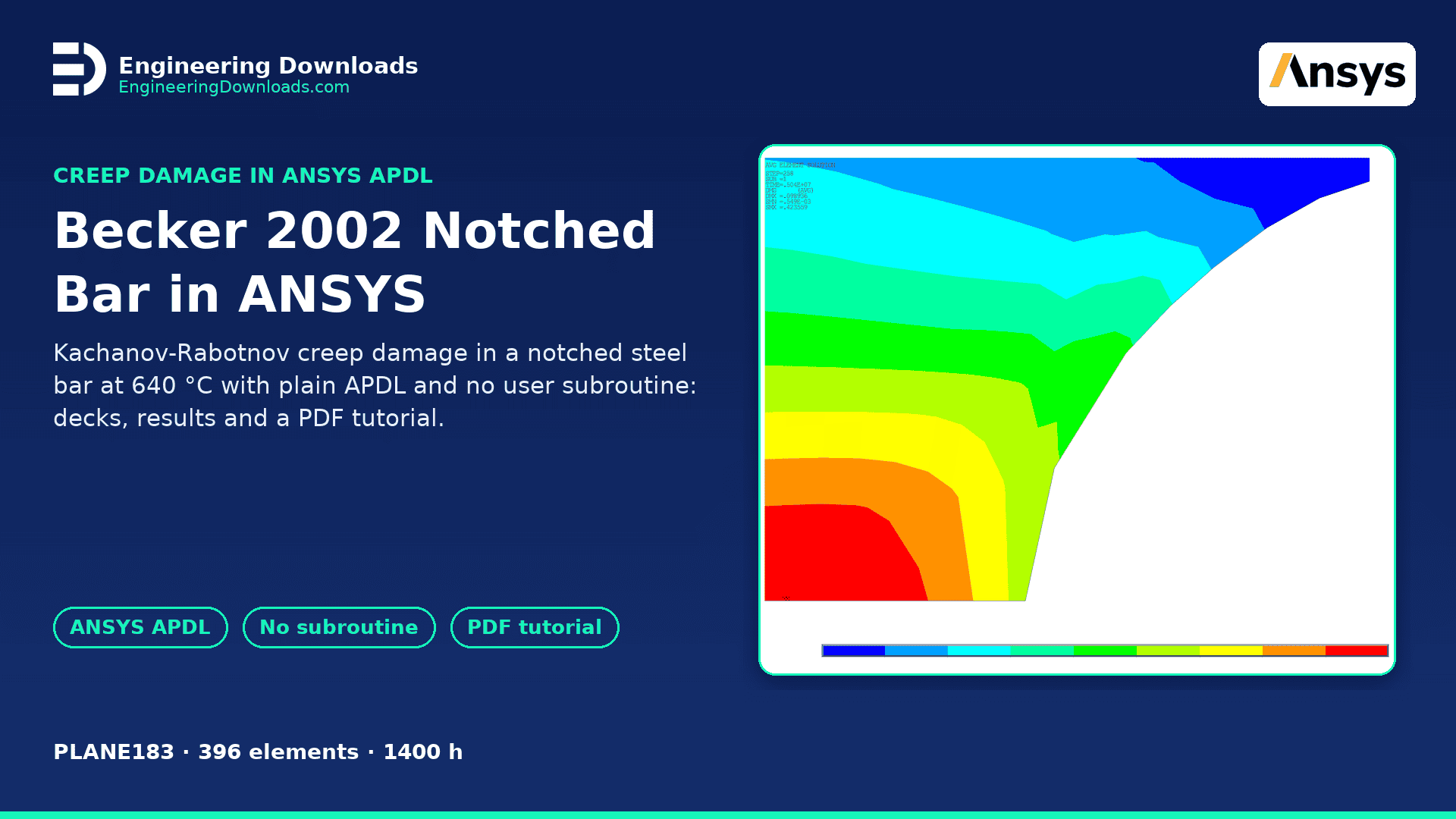
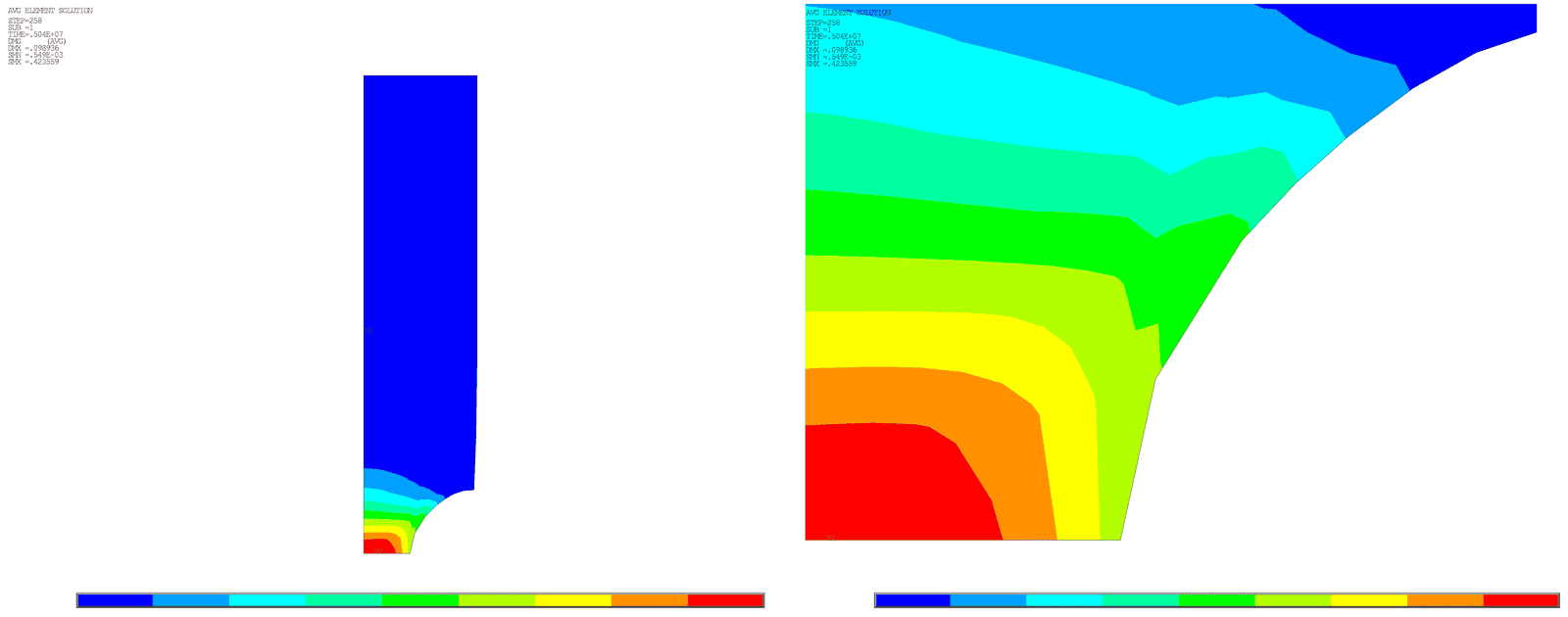
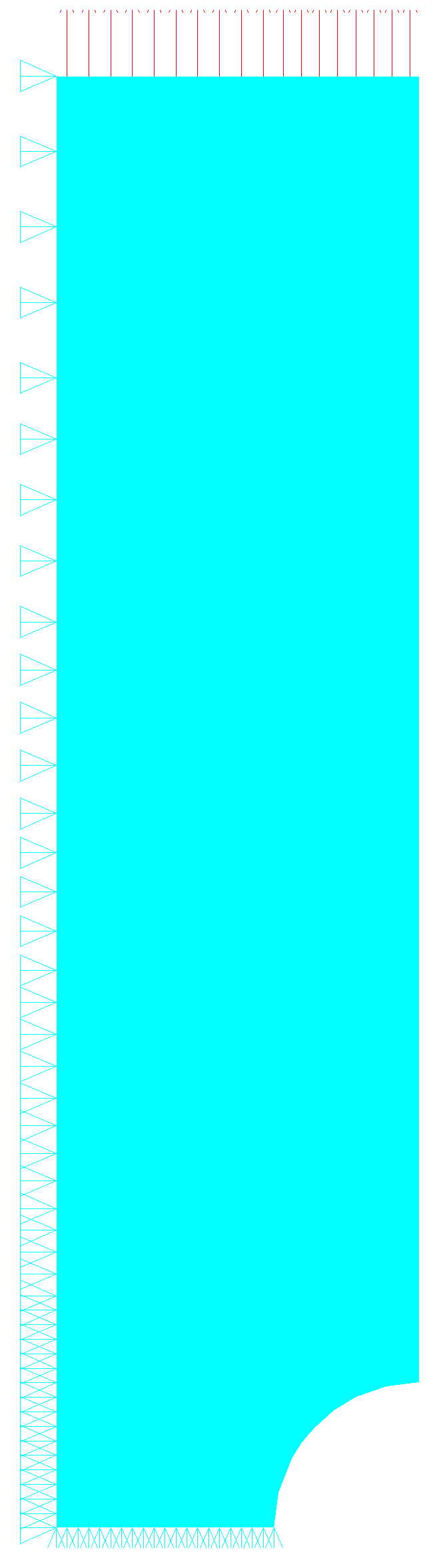
What happens at a deep notch in a steel bar that creeps at 640 °C for 1400 hours? The stress first jumps at the notch root, then relaxes while internal damage grows and speeds the creep up. This package rebuilds the Becker et al. (2002) notched bar benchmark in ANSYS Mechanical APDL with no user subroutine: damage is carried at every Gauss point and the creep law runs on a standard Norton creep table, so there is nothing to compile. You get the APDL decks, a closed-form self-test, reference results and a PDF tutorial that explains the method, the law and how to run it.
Paper: A.A. Becker, T.H. Hyde, W. Sun and P. Andersson (2002), Benchmarks for finite element analysis of creep continuum damage mechanics, Computational Materials Science, 25, 34–41. DOI: 10.1016/S0927-0256(02)00247-1
Creep rupture life can be predicted using a continuum damage mechanics approach incorporated within a finite element (FE) formulation. The rate of change of a damage parameter, ω, ranging from ω = 0 (no damage) to ω = 1 (100% damage), is computed within each element, until failure occurs in the material cross-section. The main difficulty in the numerical formulation arises due to the very small time steps needed as the damage parameter increases to 1. This paper presents the results of a number of benchmark tests involving the FE analysis of creep continuum damage mechanics that can be used to verify the FE solutions. Two independent FE codes are used; an in-house code (FE-DAMAGE) and a commercial code (ABAQUS) in which a user-subroutine (UMAT) is incorporated. The results of a series of tests used to represent uniaxial, biaxial, triaxial and multi-material creep and damage behaviour are presented.
Abstract quoted from the paper for reference (© 2002 Elsevier Science B.V.). The paper itself, and its figures, are not included in this package.
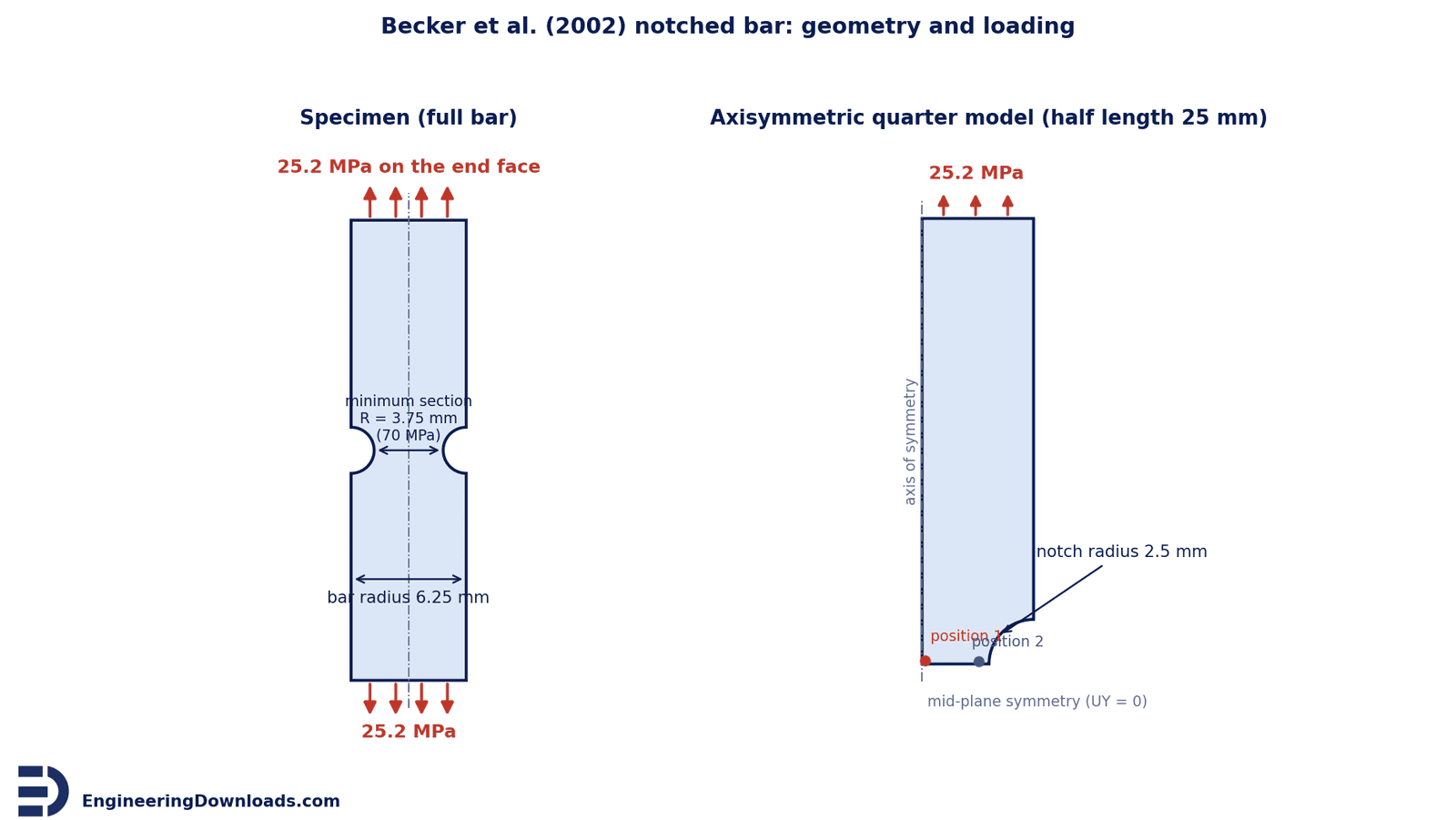
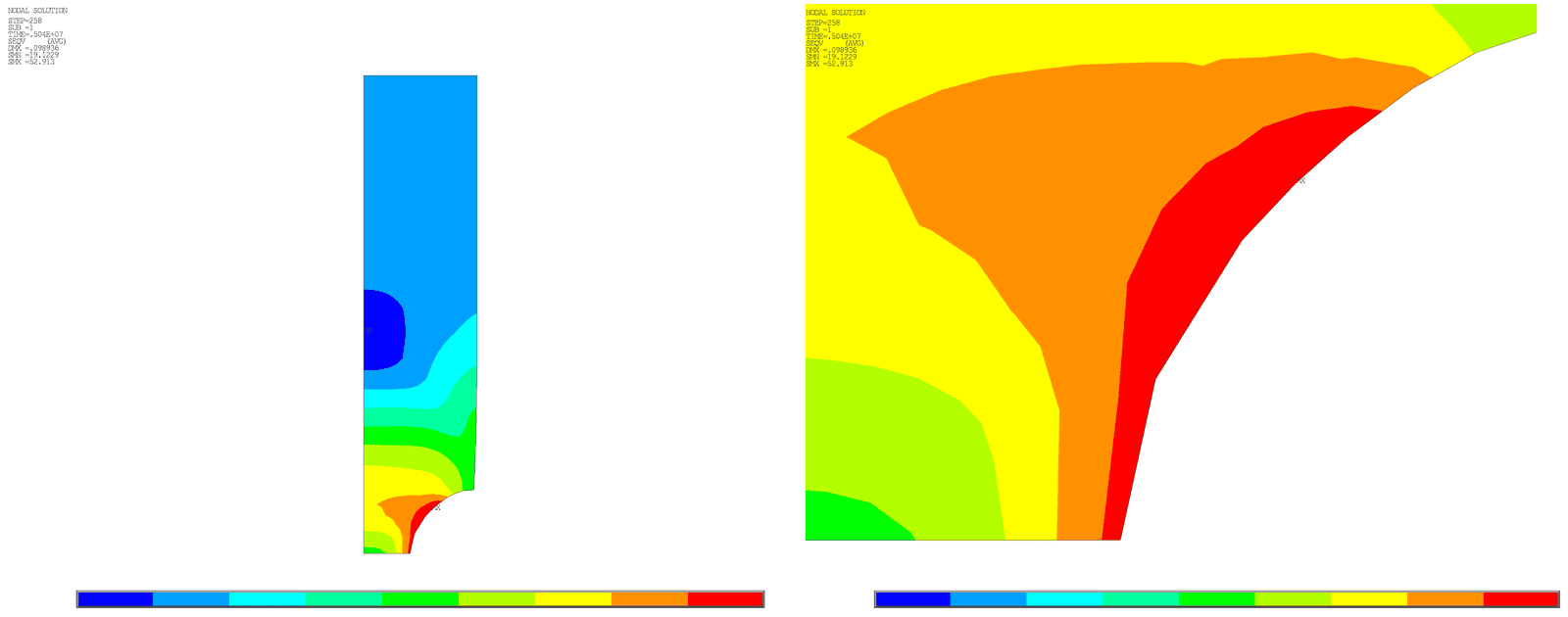
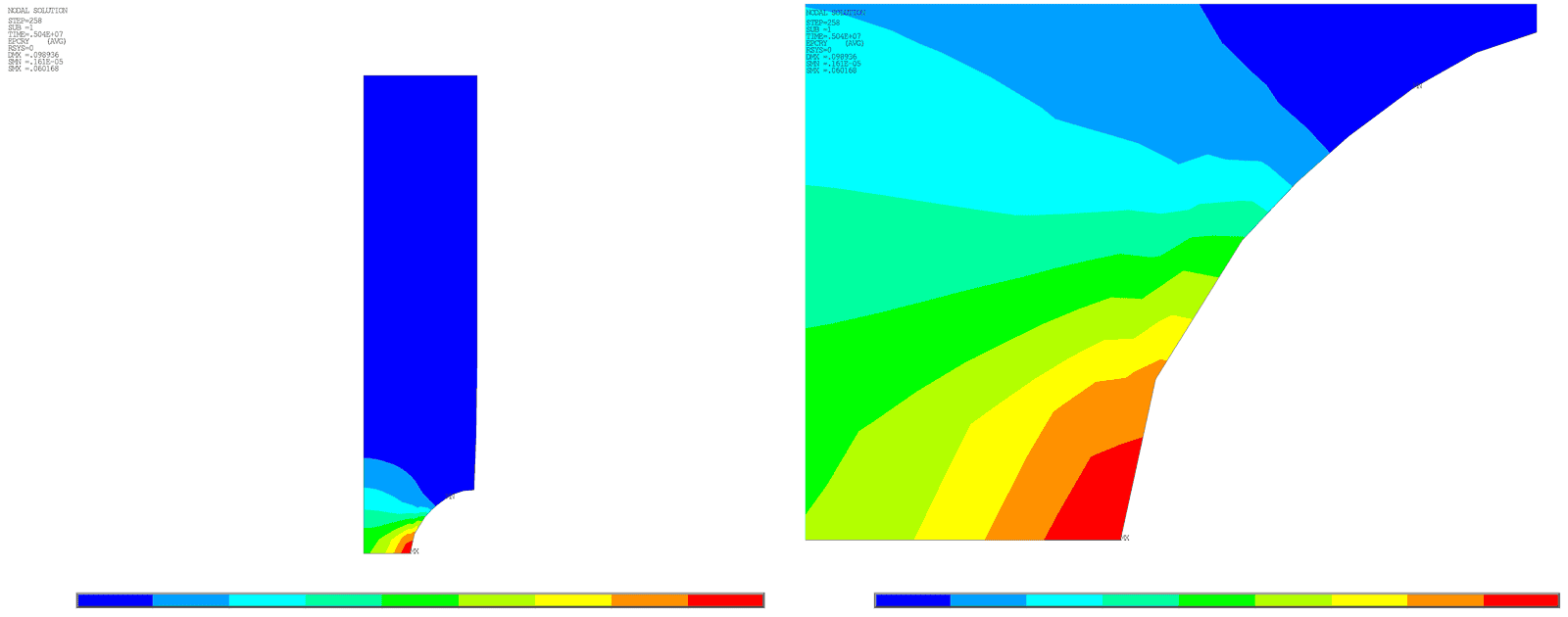
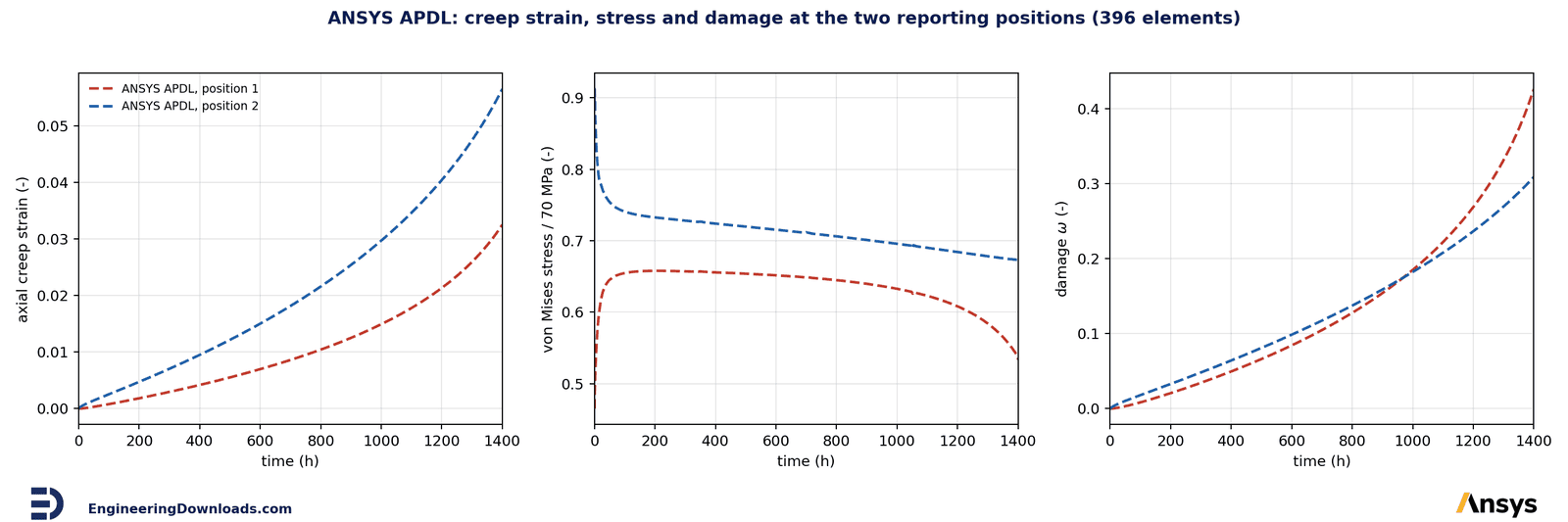
The paper plots the y creep strain, the equivalent stress divided by 70 MPa and the damage against time at two positions (its Fig. 6), from its own FE-DAMAGE code and from Abaqus with a UMAT. We overlaid our curves on a high-resolution scan of that figure, with the axes calibrated from the printed labels (about ±3 pixels). Our Abaqus curves run through the paper’s markers in all three panels at both positions over the 1400 h window, including the initial stress jump and the slow stress relaxation. The ANSYS curves lie on the Abaqus curves, so they follow the paper’s markers in the same way. The paper’s curves continue to about 1550 h, where damage rises steeply; our window ends at 1400 h.
This is a visual comparison with a published plot, not a numerical acceptance test: we did not extract the paper’s data points and no tolerance was agreed. The mesh is not the authors’ mesh (theirs has 77 elements) and the half length of the bar (25 mm) is an estimate, but changing it between 20 and 30 mm moves the results by less than 0.002 %. The model is an independent reconstruction, not the authors’ code.
| Mesh | Damage, position 1 (ANSYS / Abaqus) | Damage, position 2 | y creep strain, position 1 | σeq/70, position 2 |
|---|---|---|---|---|
| 99 elements | 0.4528 / 0.4600 | 0.3054 / 0.3065 | 0.03336 / 0.03381 | 0.679 / 0.682 |
| 396 elements | 0.4258 / 0.4336 | 0.3086 / 0.3100 | 0.03251 / 0.03301 | 0.668 / 0.674 |
| 1584 elements | 0.4303 / 0.4370 | 0.3104 / 0.3113 | 0.03267 / 0.03310 | 0.668 / 0.673 |
At 350, 700 and 1050 h every quantity agrees within 1.5 %. Over all Gauss points at 1400 h the damage differs by an rms of 0.0009 and the von Mises stress by less than 0.9 %. The reaction force is −3092.5 N in every run, equal to 25.2 MPa × π × 6.25². Between 396 and 1584 elements the results change by about 1 %.
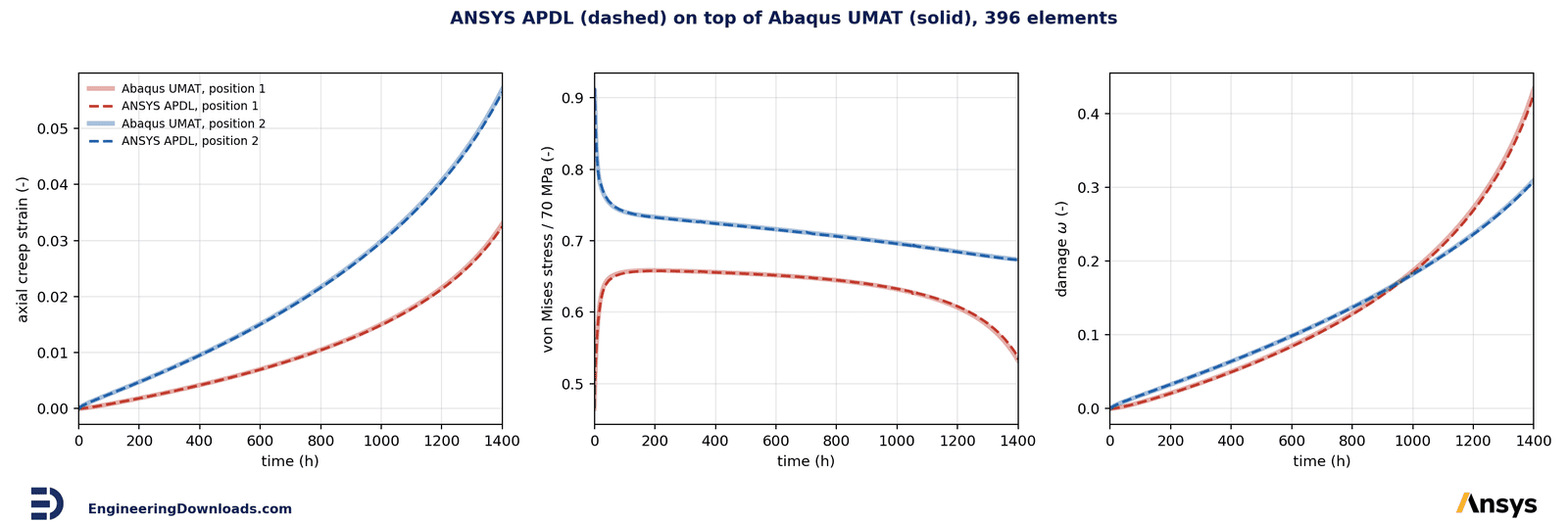
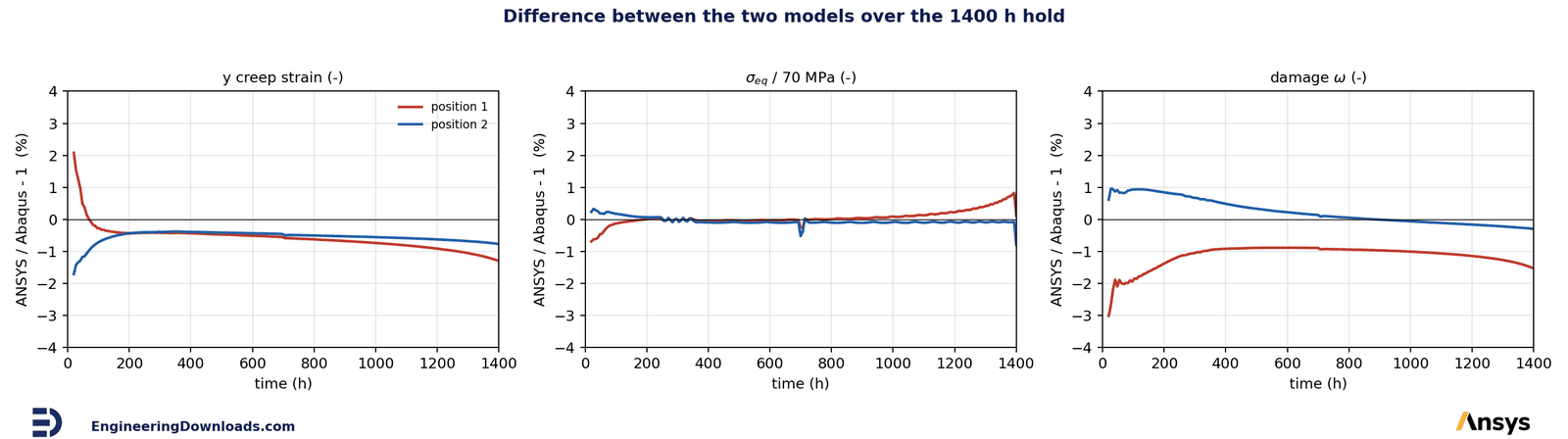
No. The ANSYS version uses no USERMAT, no USERCREEP and no compiled code. Damage is stored per Gauss point and handed to a standard Norton creep table through the element temperature; a restart loop reads the stress element by element and advances the damage with the exact integral of the law after every load step. The price is a difference of about 1.5 % from the UMAT and an APDL loop of a few hundred steps instead of one continuous solve.
Researchers, graduate students and engineers who want a working creep-damage model in ANSYS without writing a user subroutine, a published benchmark to verify their own implementation against, and a starting point for high-temperature creep, structural integrity and fitness-for-service work.
ANSYS Mechanical APDL 2024 R2 or later on Windows (the decks were run in 2024 R2). ANSYS is not included.
You skip the work of building and testing a creep-damage method in APDL and start from decks that already run, with reference results to check against. Prefer Abaqus? There is a separate Becker 2002 notched bar in Abaqus (UMAT) package. See also the creep damage versus time in ANSYS (one-element failure curve), the Becker 2002 perforated plate benchmark in Abaqus, the creep damage analysis of a welded steam pipe branch in Abaqus, our guide Introduction to UMAT Subroutine in Abaqus and the article Life Assessment and Creep Damage Analysis of Welded Components.
Does it predict rupture life? It reproduces creep strain, stress and damage histories for the 1400 hour hold. For a rupture curve to failure see the one-element package.
Is the comparison with the paper numerical? It is a visual overlay on the paper’s Fig. 6, not a digitised acceptance test. The ANSYS and Abaqus models are compared numerically with each other.
Do I need a Fortran compiler? No. The decks are plain APDL.
Can I use my own material? Yes, change the constants at the top of the deck.
Can I edit the models? Yes, the decks are plain text.
Quality guarantee: if you are not satisfied with the delivered product, we will refund you.
Need more than the files?
There are two ways we can help. Book a one hour online consultation if you want to talk a problem through with a CAE engineer, using the checkbox in the order box. Order a project if you need a full simulation built for you, delivered to an agreed scope, price and deadline under a written contract.
We work on FEA and CFD for engineers, researchers and companies. Order your project, or message us on WhatsApp for a quick reply.
Other packages engineers working on this topic also download.
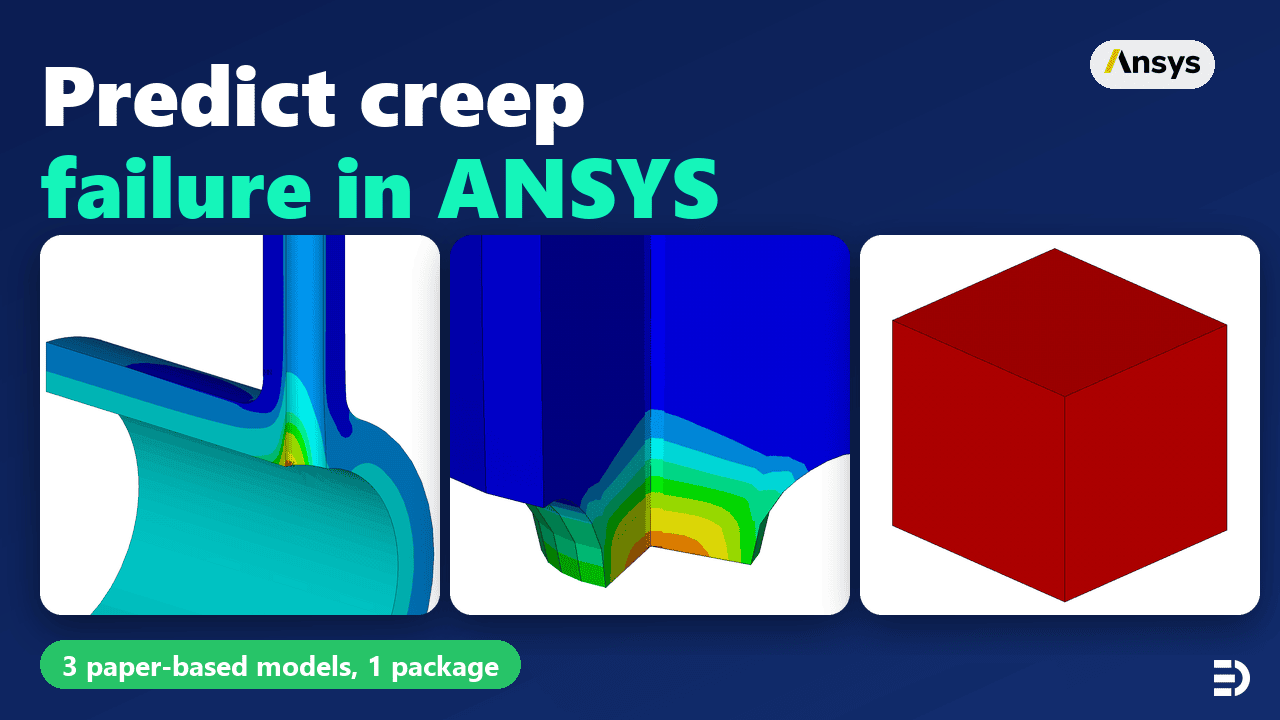 ANSYS Creep Damage Package: 3 Paper-Based APDL Models (Welded Pipe Branch, Notched Bar, Failure Horizon)€299,00
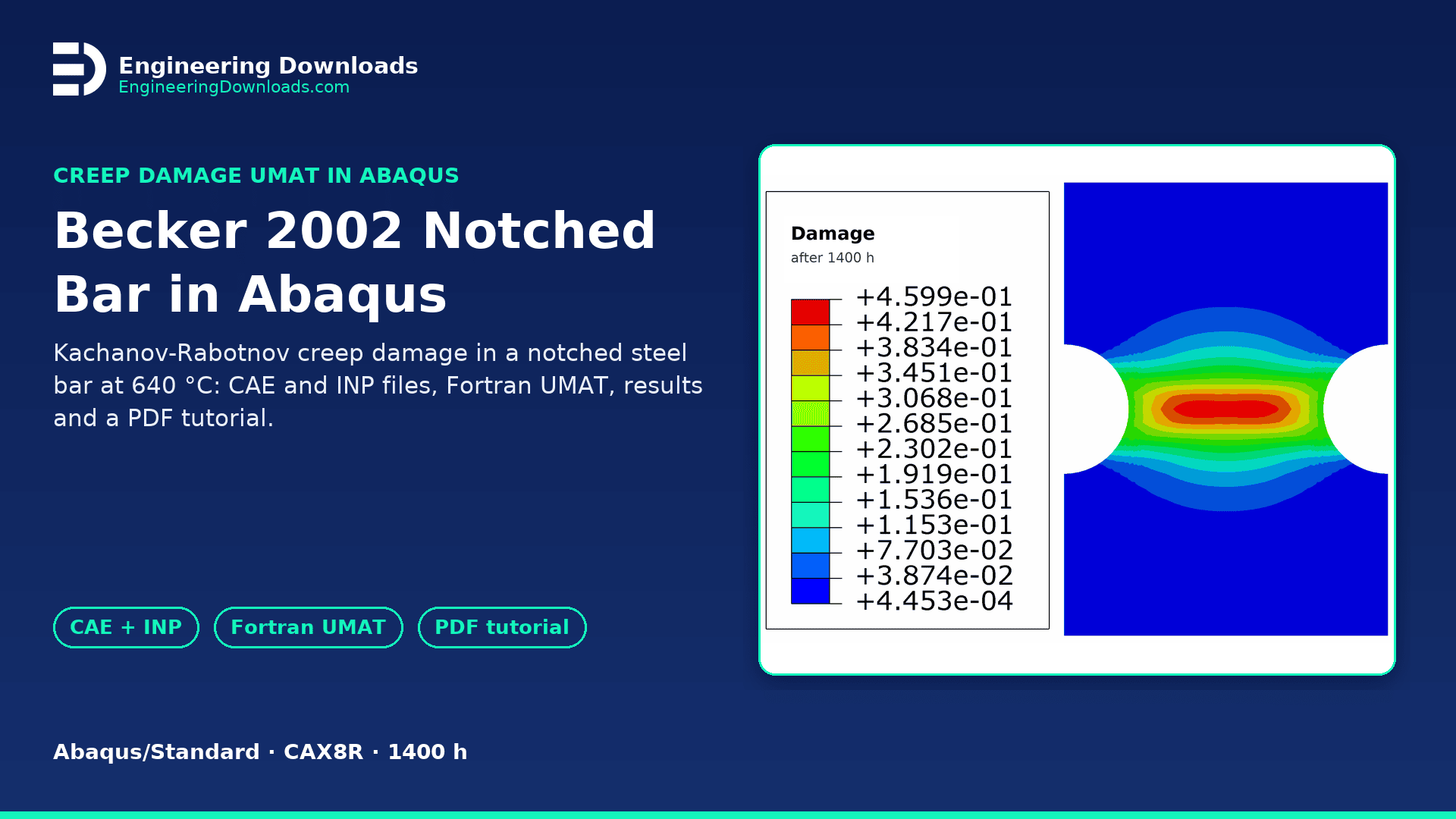 Creep Damage Notched Bar in Abaqus: Becker 2002 Benchmark with UMAT, CAE and INP Files and Paper Comparison€49,00
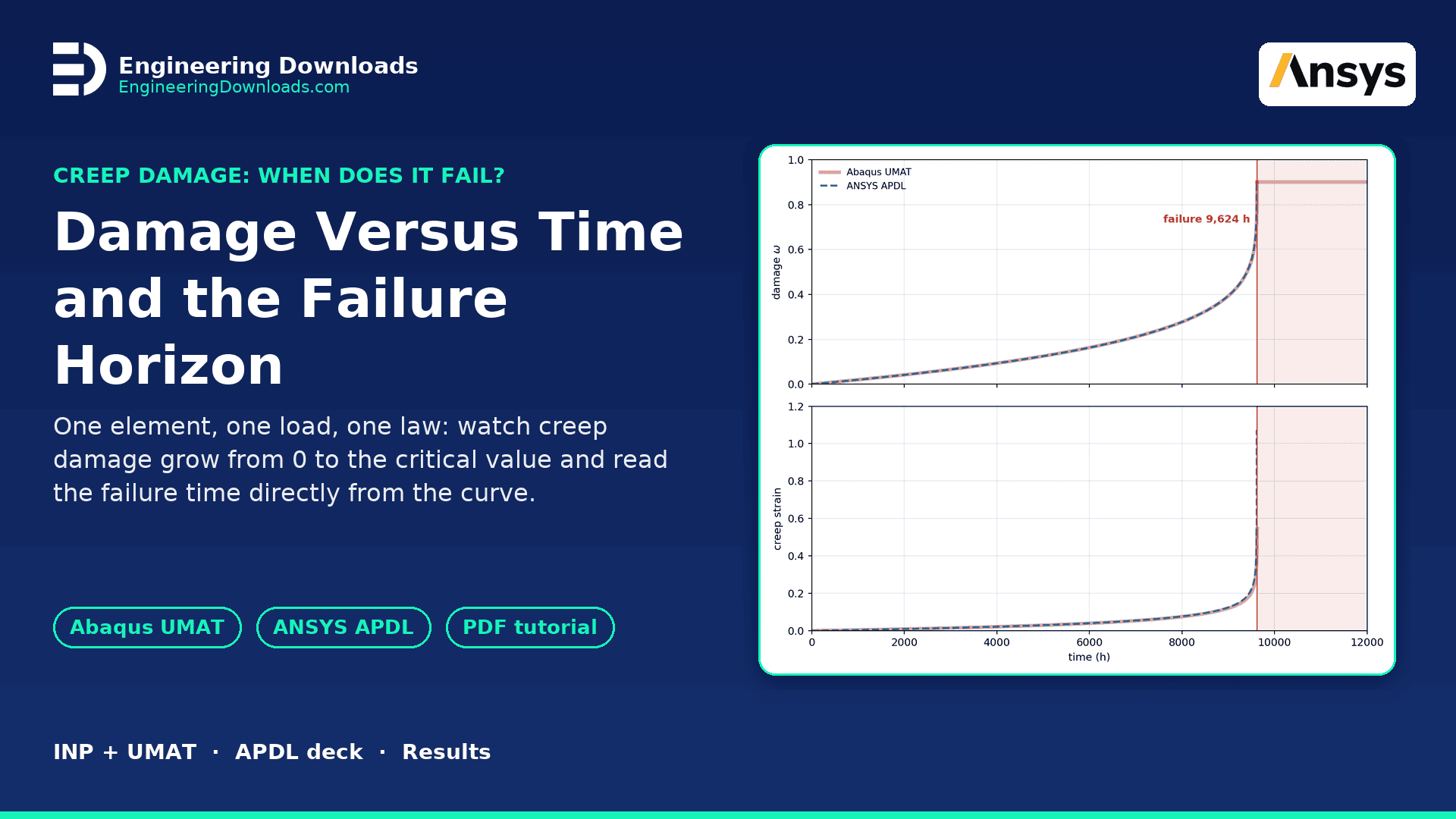 Creep Damage Versus Time in ANSYS APDL: Failure Horizon of a Single Element, No User Subroutine€49,00
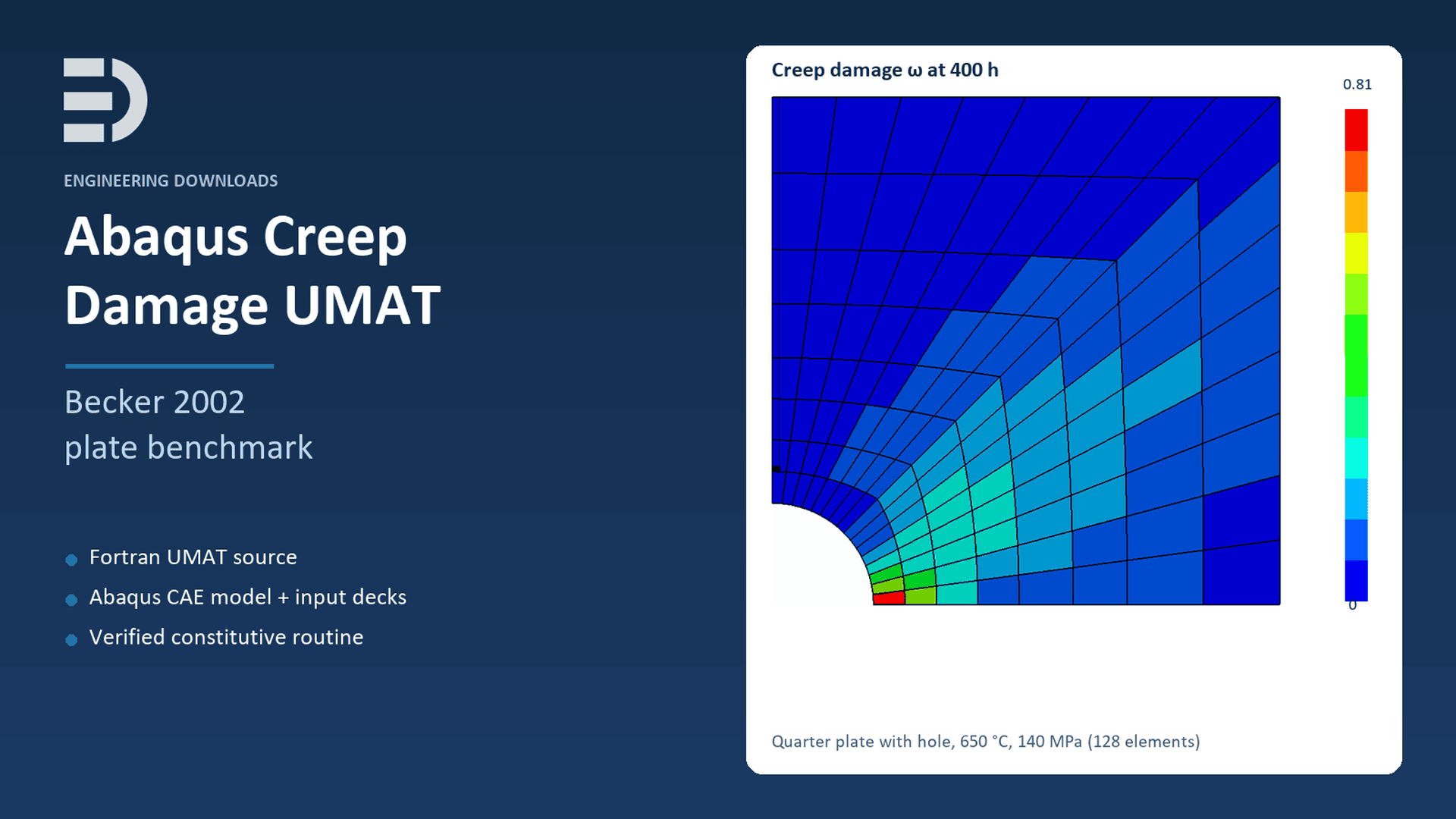 Creep Continuum Damage UMAT in Abaqus: Becker 2002 Perforated Plate Benchmark€49,00Creep Damage Versus Time in Abaqus: Failure Horizon of a Single Element with a Kachanov-Rabotnov UMAT€49,00
 Creep Damage of a Welded Steam Pipe Branch in ANSYS APDL: HAZ Failure, All-Hex Mesh and Paper Comparison€149,00
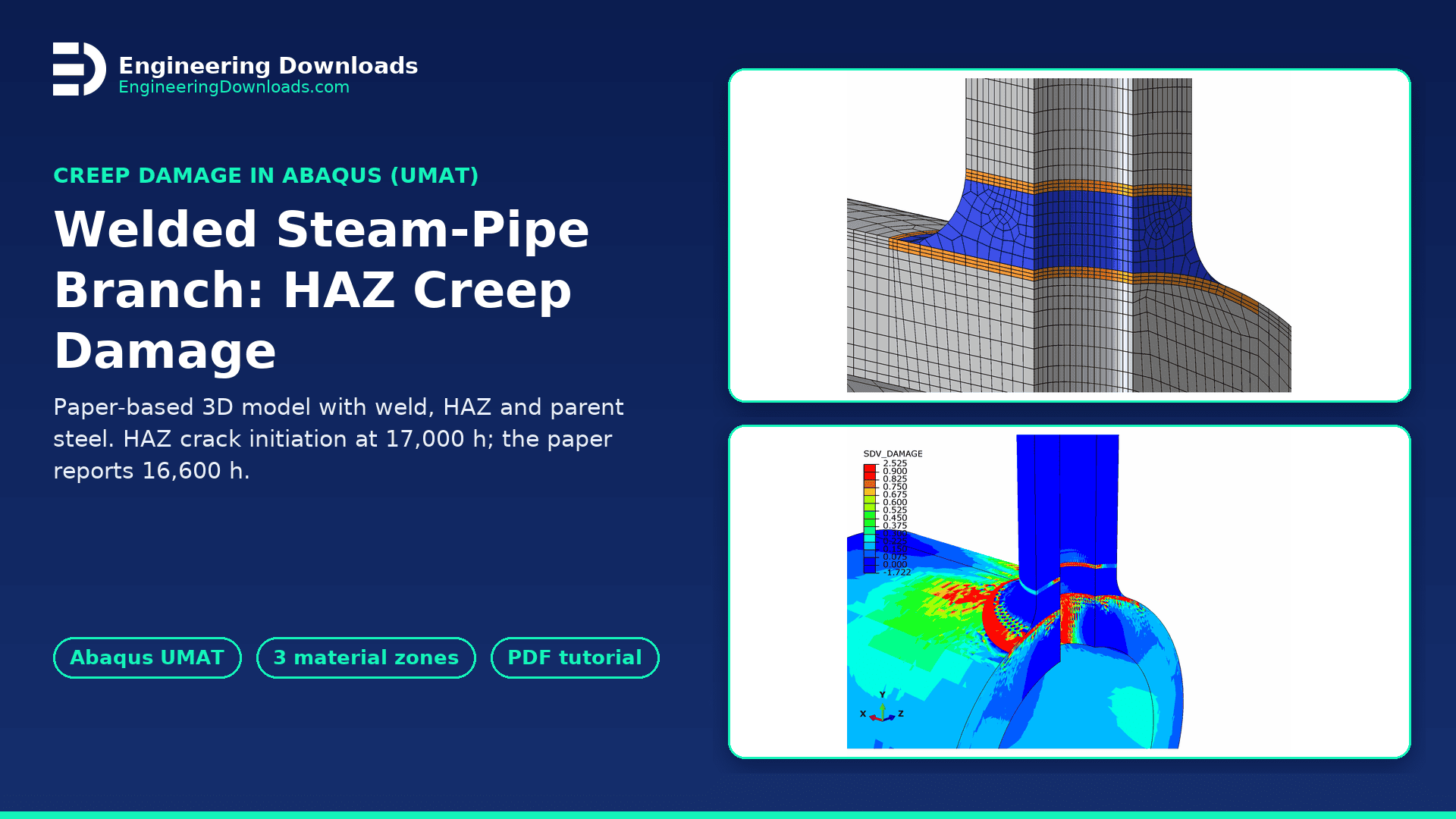 Creep Damage Analysis of a Welded Steam Pipe Branch in Abaqus: UMAT, HAZ Hex Mesh and Paper Comparison€149,00
 API 579 Example 10.1 in Abaqus: Vessel Creep After a Temperature Excursion, Omega Damage Model and One-Click Python Check€129,00

Need a full custom project? See the options below.

€129,00

€179,00

€149,00

€119,00

€129,00
See more
Want to receive push notifications for all major on-site activities?